Experiential learning approaches for developing
professional skills in postgraduate engineering students
D S Thorpe
School of Civil Engineering and Surveying. University of Southern Queensland, Australia Presenting author: E-mail: [email protected]
Abstract: The postgraduate coursework curriculum at the University of Southern Queensland includes a number of engineering management courses focused on developing professional engineering knowledge and skills, such as advanced project management, asset management, risk management and innovation management. Such skills are normally developed through traditional coursework approaches like on-line and written study materials, lectures and tutorials. While such teaching approaches have been successful, it is considered desirable to more strongly embed the professional skills taught into the learner’s future professional practice. Teaching techniques based on experiential learning have the potential to achieve this objective, through processes based on activities like having a concrete experience, reflective observation, abstract conceptualisation and active experimentation. In teaching professional skills, this approach can be delivered through activities like reflective exercises designed to aid understanding, and assignments that as well as being authentic include reflection, development and implementation of the principles taught. It is also possible to further enhance student development though using marker feedback from an experiential learning activity, such as an assignment in a particular course, to inform a subsequent learning cycle of that course. Experiential learning can be enhanced through other approaches like embodied learning, which helps learners to better understand a principle through experiencing the application of theory, and through other techniques like gaming. Advantages and disadvantages of how experiential learning approaches can be applied to improve the development of professional knowledge and skills in postgraduate students undertaking engineering management courses, along with examples of its use, are discussed.
Keywords: Experiential learning, engineering education, postgraduate, professional skills
1. Introduction
In order to undertake practice, engineering graduates are required to demonstrate a set of professional skills that require them to be both knowledgeable in their discipline and have the personal and inter-personal skills that enable them to work successfully as part of the engineering team.
To provide engineering students with these skills, the University of Southern Queensland offers undergraduate programs to enable them to qualify as graduates, and postgraduate programs to further develop their knowledge and skills. The postgraduate coursework programs include the Master of Engineering Science and Master of Engineering Practice, which are designed to enable engineering technologists to meet professional engineering requirements, as well as programs for qualified professional engineers like the Master of Advanced Engineering. The University also offers research programs at Master and Doctorate level, including the Doctor of Professional Engineering, which has a one-third coursework component, and the Doctor of Philosophy.
skills. There are a number of courses, particularly in engineering management, that are common to several of these programs. All of these programs contain a research component.
Course topics offered include asset management, advanced engineering project management, management of technological risk, technological innovation and development and assessment of future specialist technology. All of these courses are delivered on-line through distance education, and several are also delivered to classes at the Toowoomba campus of the University. The skills taught in these courses have been traditionally taught through standard educational approaches, such as the use of written study materials supplemented by lectures and tutorials, which are also made available to distance education learners. As a result of an ongoing continual improvement approach to the delivery of these courses, and the desirability of embedding the concepts taught in them to learners, there is an increasing emphasis on improved approaches to teaching and assessment, such as student centred learning, authentic assessment and experiential learning.
Experiential learning, which can be considered in its simplest form as learning by doing or experiencing, can be described through the experiential learning cycle developed by Kolb (1984) of a concrete experience, reflective observation, abstract conceptualisation and active experimentation. This paper further discusses the use of experiential learning approaches to developing professional skills in postgraduate engineering students through outlining professional skills required of engineers, the role of experiential learning in effectively teaching these skills, examples of the use of this approach, reflections on the resulting teaching and learning process, and a discussion and conclusion.
2. Professional skills requirements of engineers
Professional skills may be defined as the skills required for graduates to succeed in professional practice. Such skills require graduates to be knowledgeable and skilled in their discipline, and include both comprehensive knowledge and skills relating to their discipline and the ability to apply their knowledge and skills in the workplace. As well as including skills specific to a discipline, such skills include both generic (or transferable) skills; and also other attributes like motivation, self-confidence, self-management and self-promotion; and the ability to understand ethical conduct, meet deadlines, be punctual, relate well to others and show initiative (Crebert et al 2011).
Professional engineers are required to achieve professional skills at two Engineers Australia levels. The first level is at the Stage 1 competencies that qualify students as graduate engineers (Engineers Australia, 2013), and the second is the Chartered Professional Engineer level, which may be achieved after the graduate has completed sufficient professional engineering experience (a minimum of three years), and can demonstrate competencies in personal commitment, obligation to community, value in the workplace and technical proficiency (Engineers Australia, 2012). In addition, all practising engineers are required to comply with a Code of Ethics that defines the values and principles that shape the decisions that engineers make in professional practice (Engineers Australia, 2010).
The professional skills of engineers at graduate level are achieved through a combination of activities like theoretical study, and experiential tasks like work experience, laboratory practice and undertaking research projects. On the other hand, many of the competencies expected of more experienced engineers will be obtained through application of professional knowledge and skills. Postgraduate study can aid this process, particularly if builds in a systematic way on the learner’s professional experience. Both sets of requirements underscore the importance of at having least some courses with an experiential learning approach in formal engineering education at both the undergraduate and postgraduate level.
3. The role of experiential learning in teaching professional skills in engineers
Experiential learning, or learning by experience has been developed by Kolb (1984) and other authors. The Kolb model consists of the stages of concrete experience (feeling), reflective observation (watching), abstract conceptualisation (thinking) and active experimentation (doing) phases. Successive Kolb loops can be viewed as a spiral of continual development and improvement.
The experiential learning model has been extended into other applications. For example, Zwetsloot (2003) has applied experiential learning to the development of corporate social responsibility at the organisational level through a continuous improvement and innovation model, applied to a process of doing things right the first time and doing the right things. This model is used in the context of learning from experience, or experiential learning, which can be specific training, education, or the supply of information.
Experiential learning, with its development of competencies through successive cycles of feeling, watching, thinking and doing, is traditionally well suited to the development of traditional engineering skills through activities like using guest speakers, work placements, simulated projects and role plays (Experiential Learning in Planning Education, 2015). An experiential learning approach can also be used, in conjunction with good learning and teaching processes, in teaching courses like engineering asset management, which combine sound theory with good engineering and business practice.
An example of good learning and teaching practice is student centred learning, which according to Biggs (2001) focuses on teaching that leads to learning and leads to high quality learning. It is underpinned by the principles of good assessment, which certifies and prompts learning (Boud, 1998). To fit with an experiential learning model, such assessment should meet the principles of constructive alignment and be criterion focused (Gulikers et al 2004). It should therefore challenge learners and be relevant to their course of study.
One option for good assessment with respect to the development of professional skills is authentic assessment, which accordingly to Gulikers et al (2004) is a form of performance assessment and accordingly links closely with criterion-referenced assessment. It is noted by these authors that to positively influence student learning, authentic assessment should be aligned to academic instruction. It should also require learners to demonstrate their competencies in a setting that resembles professional practice. Authentic assessment is divided by the authors into five dimensions (task, physical context, social context, assessment form and criteria). A sixth dimension, professional issues, was added by Thorpe (2013), who applied this approach to assessment in postgraduate engineering management courses, and in doing so was able to increase its scope.
Another approach that is related to experiential learning is embodied learning, or the development of relationship between the learner and the topic being studied. A description of it is “learning that joins body and mind in a physical and mental act of knowledge construction” (Nguyen and Larson, 2015), a position that is supported by the educational pioneer Dewey (1916), as cited in Nguyen and Larson (2015), who stated that senses are avenues of knowledge not because external facts are somehow ‘conveyed’ to the brain, but because they are used in doing something with a purpose,
(2009), observe the importance of team learning, problem solving and learning space design in discussing the application of experiential learning to management learning, education and development. Extensions to embodied learning include computer simulation and games.
4. Examples of the use of experiential learning in developing professional skills
It has been shown that experiential learning has a range of applications in developing professional skills in engineers, particularly when combined with approaches like student centred learning, authentic assessment and embodied learning and its extensions, such as gaming.
While the traditional applications of experiential learning include problem based learning, professional practice, work experience and similar activities, it has been shown above that it can have much wider application. For example, it can be used in areas like developing corporate social responsibility through a continuous improvement and innovation approach (Zwetsloot, 2003). Similarly, an experiential learning approach can be used for developing professional skills in postgraduate students, particularly in engineering management and research. The extent to which such development occurs varies with the course delivered and its objectives. To illustrate the application of experiential learning approaches in developing professional skills, the following three course groups are briefly reviewed:
Postgraduate engineering management courses with one or more assignments and an examination
Postgraduate engineering management courses with multiple assignments Research projects.
4.1 Postgraduate engineering management courses with one or more assignments and an examination
This group of courses is written from the point of view of developing professional skills in selected engineering management areas, such as asset management and risk management. Courses in this group have one or more assignments, followed by a written examination at the end of the semester. Asset Management in an Engineering Environment (University of Southern Queensland, 2016), which has one assignment and an examination, is typical of such courses. This course is divided into two main sections – asset management concepts and applications of the concepts.
As this course was written with the professional engineer in mind as a learner, it draws heavily on asset management practice. As part of this process, it illustrates its teaching by reflective examples that draw on the learner’s experience and research. The assignment is divided into two components – developing a strategic management solution to restore to good practice an asset management network with a number of engineering management issues that require addressing by the student acting as an asset manager; and an engineering economics exercise, which is based on a likely engineering asset decision making scenario. While this second question is reasonably well defined, the first question on strategic asset management specifies the parameters of the problem to be solved, but leaves it open to the learner to construct the particular asset network being reviewed, using personal engineering experience or research. While the examination draws on the course study material, it achieves a measure of experiential approaches and authenticity through requiring candidates, in a number of questions, to illustrate their answer with an engineering example.
4.2 Postgraduate engineering management courses with multiple assignments
management through exploring the project life cycle, project management knowledge areas, professional issues in project management including the management of project sustainability, program management and current and future issues in engineering project management. It is supported by the Guide to the Project Management Body of Knowledge (PMBOK Guide), fifth edition (Project Management Institute, 2013).
This course also was written with the practising professional engineer in mind as a learner, and to further develop this learner adopts a strategic view of project management. It uses reflective, practical examples to illustrate its teaching. While each assignment has a minor question on specific aspects of the course, the main question in the first assignment challenges the learner, as a project manager who has just taken over a project with a number of issues to develop a process for it to be completed on time and to the required quality, and to report on the result to the project sponsor. In the second assignment, the learner is similarly required to address issues with three projects being managed at the higher level position of program manager, and similarly provide a report to senior management. This task allows the learner to utilise learnings from developing and receiving marking feedback from the first assignment in a similar, but more complex and higher level task in the second assignment.
4.3 Research projects
All postgraduate engineering programs at the University have a research component. The extent of this research component varies with the program in which it is undertaken, and can be a relatively small proportion of the course in programs like the Master of Engineering Science to the whole study program in the case of the Doctor of Philosophy.
The postgraduate research journey will usually commence with the submission of a research proposal. On its acceptance, the research process will move into the literature review, research methodology development, confirmation of candidature, conducting the research, analysing results of the research, developing conclusions and writing a research dissertation. This journey can be challenging, and can be subject to tight time pressures and regular progress reporting. Success in this journey usually comes after a period of considerable thought, experimentation, obtaining results, reflection, learning, further trials, and resultant modification of the research until final outcomes are achieved. This process is similar to the experiential learning process of Kolb (1984) and the continuous improvement approach discussed by Zwetsloot (2003). In undertaking this process, many researchers become closely linked to their research topic, resulting in a synergy between research and research topic that impacts on their thinking processes and brings their personal approach to the research, resulting an embodied learning experience.
5. Reflections on the teaching and learning processes
While a course like Asset Management in an Engineering Environment (University of Southern Queensland, 2016a) could be considered to have a typical course and assessment structure, it aims to focus on student centred learning where possible, uses assessment procedures that draw on real practice as much as possible, and allows learners to impart their professional engineering experience to assessment responses. While it does not strongly use the cycle developed by Kolb (1984), it has a number of components of experiential learning, including utilising as much as possible the learner’s existing expertise to further develop the learner’s knowledge, skills and interest.
assignment using them. This process, which has been extended to a third cycle in a course assessing future technology, strongly utilises the experiential learning cycle developed by Kolb (1984).
Postgraduate research has the potential to link all the elements of experiential learning. The research journey is very much based on what the learner wants, is normally quite challenging, will be assessed from the point of view of its authenticity, and very much uses repeated cycles of the experiential learning process of Kolb (1984). It can also be argued that the postgraduate research journey contains the elements of embodied learning, as its consistent and challenging nature links the researcher with the research in a way that develops a synergy between them.
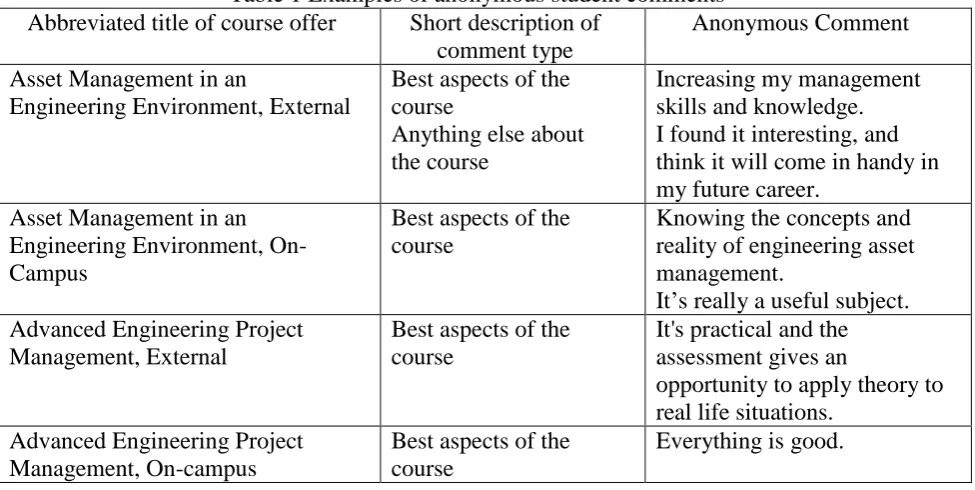
[image:6.595.55.543.289.534.2]Anonymous student comments submitted to the University’s survey of students at the end of each teaching semester for the 2015 offers of the two engineering management courses discussed above, which are shown in Table 1, support the experiential, practical nature of the two coursework oriented courses discussed. The research programs were not subject to student comments.
Table 1 Examples of anonymous student comments Abbreviated title of course offer Short description of
comment type
Anonymous Comment
Asset Management in an
Engineering Environment, External
Best aspects of the course
Anything else about the course
Increasing my management skills and knowledge. I found it interesting, and think it will come in handy in my future career.
Asset Management in an Engineering Environment, On-Campus
Best aspects of the course
Knowing the concepts and reality of engineering asset management.
It’s really a useful subject. Advanced Engineering Project
Management, External
Best aspects of the course
It's practical and the assessment gives an
opportunity to apply theory to real life situations.
Advanced Engineering Project Management, On-campus
Best aspects of the course
Everything is good.
In this table, the external course offer is typically undertaken by experienced practising personnel. Their views that the courses are practical and useful can therefore be considered positive from the point of view of development of their professional skills through studying them.
6. Discussion and conclusion
The use of experiential learning approaches in postgraduate study offered by the University of Southern Queensland, has been discussed, using the examples of two different engineering management courses and postgraduate research. One of the courses reviewed is offered with one assignment and an examination, and the second is offered with two assignments, of which the second assignment builds on the development of and feedback from the first assignment. The discussions of these courses are supported by student feedback on delivery of the courses. Postgraduate research has been discussed as an example of how a range of good teaching practices, including experiential learning, can aid the research process and facilitate embodied learning in the form of the researcher and the research study developing a synergy following a series of experiential cycles.
Overall, the application of experiential learning approaches, particularly in conjunction with other good learning practices, has been considered to be positive. Such learning also has the potential to be further developed by approaches like gaming. While gaming approaches and other extensions to experiential learning have not been discussed in detail, they have the potential to add to the realism of learning experiences, and to the potential for research activities to better link with the researcher.
While experiential learning can be positive for many courses, and has wide application in reinforcing theoretical engineering courses by activities like laboratory experiments and site visits, and in aiding the development and assimilation of work experience, it is unlikely to be suitable for all professional engineering development. For example, it may not be suited to courses with a high theoretical content. At the same time, it is considered a quite useful approach in professional development courses and in areas like research work, which have a clear cycle of experiencing, observation, thinking and experimentation.
One outcome of the discussion of the applications of experiential learning and related learning and teaching practices to the development of professional skills in postgraduate engineering students was the necessity to design the experiential component of the course to meet the purpose and objectives of the course. Thus, for some courses site visits, laboratory experiments, or gaming might be the best approach to utilising the experiential aspects of the course. A course aimed at developing professional skills in experienced engineers may be better suited to the approaches discussed in this paper. Research projects may require individual approaches to achieving the best outcomes. For these reasons, success in courses using experiential learning is only likely to be achieved through carefully considering and tailoring their experiential learning component to the requirements of learners.
It is concluded that experiential learning has considerable potential to be used in the development of professional skills in postgraduate engineering students, provided that its application is carefully considered and focused on the requirements of the course and its learners. The examples discussed indicate that there are a wide range of approaches to achieve this goal, both in the traditional experiential sense of practical activities, and in structuring professional development and other courses to achieve good outcomes through combining experiential learning approaches with other good teaching practices. Therefore, caution and careful course design practice are required to achieve positive learning outcomes through this approach.
Acknowledgements
The author acknowledges the contributions made by the reviewers of the paper.
References
Boud D (1998). Assessment and learning – unlearning bad habits of assessment, Presentation to the Conference, Effective Assessment at University, University of Queensland, 4–5 November 1998. Crebert G, Patrick C-J, Cragnolini V, Smith C, Worsfold, K, Webb, F (2011). Professional Skills
Toolkit, Accessed via http://www.griffith.edu.au/gihe/resources-support/graduate-attributes on 20 May 2016.
Engineers Australia (2010). Our code of ethics, Canberra, ACT, Australia: Author.
Engineers Australia (2012). Australian Engineering Competency Standards Stage 2 – Experienced Professional Engineer, Canberra, ACT, Australia: Author.
Engineers Australia (2013). Guide to Assessment of Eligibility for Membership (Stage 1 Competency), Canberra, ACT, Australia: Author.
Gulikers JTM, Bastiaens TJ, Kirschner PA (2004). Perceptions of authentic assessment: Five dimensions of authenticity, In Proc. Second biannual Northumbria/EARLI SIG assessment conference, Bergen.
Kolb DA (1984). Experiential Learning: Experience as the Source of Learning and Development, Englewood Cliffs, N.J.: Prentice-Hall.
Kolb A, Kolb D (2009). Experiential learning theory: A dynamic, holistic approach to management learning, education and development, In S Armstrong, and C Fukami (Eds.), The SAGE
handbook of management learning, education and development, London: SAGE Publications Ltd. Experiential Learning in Planning Education (2015). The Experiential Learning Toolkit, Accessed
via http://experientiallearninginplanning.com.au on 3 August 2015.
Nguyen DJ, Larson, JB (2015). Don’t Forget About the Body: Exploring the Curricular Possibilities of Embodied Pedagogy, Innovation in Higher Education, 40, 331-344.
Project Management Institute (2013). A Guide to the Project Management Body of knowledge (5th ed.), Pennsylvania, USA. Project Management Institute.
Thorpe D (2013). Reflections on Assessment: Comparison of Assessment Processes for Postgraduate Engineering Management Courses, In Proc. 24th Annual Conference of the Australasian
Association for Engineering Education (AAEE2013), December 8-11, 2013, Gold Coast, Queensland, Australia.
University of Southern Queensland 2016a. Course Specification, Asset Management in an Engineering Environment, on-campus offer, Accessed via
http://www.usq.edu.au/course/specification/2016/ENG8104-S1-2016-ONC-TWMBA.html on 20 on May 2016.
University of Southern Queensland 2016b. Course Specification, ENG8208 Advanced Engineering Project Management, on-campus offer, Accessed via
http://www.usq.edu.au/course/specification/2016/ENG8208-S1-2016-ONC-TWMBA.html on 20 May 2016.