GROUPS
Thesis by
Robin Daniel Tucker-Drob
In Partial Fulfillment of the Requirements for the Degree of
Doctor of Philosophy
California Institute of Technology Pasadena, California
2013
c 2013
Acknowledgements
I would like to thank my advisor Alexander Kechris for his invaluable guidance and support, for his generous feedback, and for many (many!) discussions.
Abstract
Contents
Acknowledgements iii
Abstract iv
Contents v
Chapter 1. Introduction 2
1. Borel reducibility and classification 3
2. Approximation and classification in the ergodic theory of countable groups 4 3. Invariants of weak equivalence and measurable combinatorics 6
4. Co-induction and weak containment 8
5. Automatic freeness 8
6. Expressions of non-amenability in ergodic theory and representation theory 9
Chapter 2. Ultraproducts of measure preserving actions and graph combinatorics 14
1. Introduction 14
2. Preliminaries 20
3. Ultraproducts of standard measure spaces 21
4. Ultraproducts of measure preserving actions 25
5. Characterizing factors of ultraproducts 29
6. Graph combinatorics of group actions 37
8. Matchings 51
9. Independence numbers 56
10. Sofic actions 58
11. Concluding remarks 65
Chapter 3. On a co-induction question of Kechris 69
1. Introduction 69
2. The space of actions and proof of Theorem 1.4 73
3. The Rohlin Lemma 74
4. Proof of Theorem 1.1 76
5. Consequences of Theorem 1.1 77
6. Gaussian actions 80
7. Induced representations and the proof of Theorem 1.3 83
Chapter 4. Weak equivalence and non-classifiability of measure preserving actions 87
1. Introduction 88
2. Preliminaries and notation 95
2.1. Measure algebras and standard probability spaces 95
2.2. Measure preserving actions 96
2.3. The space of measure preserving actions 96
3. Proofs of Theorems 1.1 and 1.2 97
3.1. Weak containment and shift-invariant factors 97
3.2. Convexity in the space of actions 101
3.3. Ergodic decomposition and weak containment 103
4. Consequences of Theorem 1.2 and applications to MD and EMD 108
4.1. Free, non-ergodic weak equivalence classes 108
4.2. The properties MD and EMD 110
5. Weak equivalence and invariant random subgroups 112
5.2. The compact space of weak equivalence classes 113
5.3. Random Bernoulli shifts 120
5.4. A sufficient condition for weak containment 126
5.5. Independent joinings over an IRS and the proof of Theorem 1.5 128
6. Non-classifiability 134
6.1. Non-classifiability by countable structures of∼=, ∼=w, and∼=U on free weak
equivalence classes 134
6.2. Extending Theorem 1.7 136
7. Types and amenability 138
7.1. The space COS(Γ) 139
7.2. Proof of Theorem 1.8 140
8. Ultraproducts of measure preserving actions 142
9. Stable weak containment 146
Chapter 5. Mixing actions of countable groups are almost free 148
1. Introduction 148
2. Definitions and notation 151
3. Proof of Theorem 1.4 152
4. An example 154
5. A question 154
Chapter 6. Shift-minimal groups, fixed Price 1, and the unique trace property 155
1. Introduction 155
2. Preliminaries 162
2.1. Group theory 162
2.2. Ergodic theory 163
2.3. Invariant random subgroups 164
3. Shift-minimality 165
3.2. NA-ergodicity 167
3.3. Amenable invariant random subgroups 171
4. Permanence properties 172
4.1. Invariant random subgroups with trivial intersection 172
4.2. Finite index subgroups 174
4.3. Direct sums 177
4.4. Other permanence properties 178
5. Examples of shift-minimal groups 181
5.1. Free groups 181
5.2. Property (BP) 182
5.3. Linear groups 187
5.4. Unique tracial state onCr∗(Γ) 188
6. Cost 191
6.1. Notation and background 191
6.2. Cost and weak containment in infinitely generated groups 192
6.3. The cost of a generic action 203
6.4. Cost and invariant random subgroups 205
6.5. Fixed price 1 and shift-minimality 211
7. Questions 212
7.1. General implications 212
7.2. Cost and pseudocost 215
7.3. Other questions 216
8. Appendix: Invariant random subgroups as subequivalence relations 217
8.1. Invariant random partitions 218
8.2. Normalized subequivalence relations 221
9. Appendix: The amenable radical of a countable group 226
9.1. Basic properties of ARΓ 226
Chapter 7. Appendix: Mixing via filters and Gaussian actions 232
1. Milding mixing = IP∗-mixing for groups 232
2. F-mixing 239
3. Permanence properties ofF-mixing 247
Chapter 1
Introduction
The questions addressed in this thesis lie at the interface of several fields including de-scriptive set theory, ergodic theory, representation theory, probability theory, and measur-able group theory. A unified approach to studying these questions is facilitated by a global perspective which was initiated and greatly developed in [Kec10]. From this perspective, problems in ergodic theory may be seen as topological-dynamical and descriptive problems concerning continuous actions of the Polish group A = A(X, µ)of automorphisms of a standard (usually non-atomic) probability space (X, µ). Likewise, representation theory may be studied via continuous actions of the Polish groupU=U(H)of unitary operators on a separable (usually infinite-dimensional) Hilbert spaceH.
in ergodic theory and of unitary equivalence in representation theory. We begin with a brief introduction to the basic notions of this framework.
1. Borel reducibility and classification
IfE andF are equivalence relations on standard Borel spacesX andY, respectively, then E is called Borel reducible to F, denoted E ≤B F, if there is a Borel map ψ : X → Y satisfyingxEy ⇔ ψ(x)F ψ(y)for allx, y ∈ X. Such a mapψ is called aBorel reductionfromEtoF. The substance of this notion lies in the requirement that this map be definable in some sense, and there are theoretical reasons for choosing Borel definability. The resulting richness of the ordering≤Band its continuing success in comparing naturally occurring equivalence relations in mathematics may be taken as further justifications for this choice. A Borel reduction fromEtoF may be seen as providing anexplicitly definable
2. Approximation and classification in the ergodic theory of countable groups
A(probability-)measure preserving actionof a (discrete) countably infinite groupΓon (X, µ) is a homomorphisma : Γ → A(X, µ). The set of all measure preserving actions ofΓon(X, µ)naturally forms a Polish spaceA(Γ, X, µ)on whichAacts continuously by coordinate-wise conjugation. The orbitA·aofa∈A(Γ, X, µ)is called itsconjugacy class
and two actionsaandbfromA(Γ, X, µ)with the same conjugacy class are said to be conju-gate. We say thatbisweakly containedinaif it is in the closure of the conjugacy class ofa, and we callaandbweakly equivalentif each weakly contains the other. Ifa∈A(Γ, X, µ) andb ∈ A(Γ, Y, ν)are actions with different underlying probabilities spaces then we say thatb is weakly contained ina if it is a factor (i.e., quotient) of somec ∈ A(Γ, X, µ)that is weakly equivalent toa. The weak containment relation is reflexive and transitive, and weak equivalence is therefore an equivalence relation. Weak containment of measure pre-serving actions was introduced by Kechris in [Kec10] as an ergodic theoretic analogue of weak containment of unitary representations, and it has proven to be a remarkably robust notion that accurately captures an intuition that one measure preserving action asymptoti-cally approximates or simulates another. Ab´ert and Elek have recently defined a compact Polish topology on the set of weak equivalence classes in which many important invariants of weak equivalence become continuous functions [AE11], [TD12c]. A fundamental the-orem regarding weak containment is due to Ab´ert and Weiss and concerns the Bernoulli shift action ofΓwhich we now define.
LetΓact on the set[0,1]Γof functionsf : Γ→ [0,1]by shifting indices:(γ·f)(δ) = f(γ−1δ). This action preserves the product measureνΓ whereνis Lebesgue measure, and we call this measure preserving action the Bernoulli shiftof Γand denoted it bysΓ. The Bernoulli shift provides an ergodic theoretic counterpart to the left regular representation ofΓ.
THEOREM 2.1 (Ab´ert-Weiss [AW11]). sΓ is weakly contained in every free measure
Conversely, any measure preserving action weakly containing sΓ must itself be free. Adrian Ioana conjectured that there is in fact an absorption principle at work which strength-ens this.
CONJECTURE 2.2 (A. Ioana). Letabe any free measure preserving action of a count-ably infinite groupΓ. ThensΓ×ais equivalent toa.
Conjecture 2.2 strengthens Theorem 2.1 since the product actionsΓ×ais easily seen to weakly contain each of its factors. By combining ideas from [AGV12] with a close analysis of weak containment it is shown in Chapter 4 ([TD12c]) that an even more general absorption principle holds, of which Ioana’s conjecture is a special case.
THEOREM2.3 (T-D [TD12c]). Conjecture 2.2 is true.
Theorem 2.3 has interesting global consequences for the spaceA(Γ, X, µ), which are used in Chapter 4 to provide a strong negative answer to a question of Ab´ert and Elek con-cerning the relationship between conjugacy and weak equivalence. Ab´ert and Elek exhib-ited weak containment rigidity amongE0-ergodic profinite actions [AE10] and, prompted by the orbit equivalence superrigidity results of Popa, asked whether it is was possible to obtain full weak equivalence rigidity:
QUESTION 2.4 (Ab´ert-Elek [AE11]). Does there exist a countably infinite group Γ with a free measure preserving action whose conjugacy class and weak equivalence class coincide?
Combining Theorem 2.3 with the work of Kerr, Li, and Pichot [KLP10] on turbulence in spaces ofC∗-algebra representations, the following is shown:
This implies that the weak equivalence class of a contains a continuum of conjugacy classes, and thus provides a negative answer to Question 2.4. But the conclusion is actu-ally much stronger than this: there is no Borel way of assigning countable trees, groups, orderings, etc., as invariants to actions in the weak equivalence class ofathat completely classifies these actions up to conjugacy.
3. Invariants of weak equivalence and measurable combinatorics
Theorem 2.5 shows that the degree to which countable invariants can provide mean-ingful distinctions, even within each weak equivalence class, is limited. Fortunately, the notion of weak equivalence turns out to be valuable in itself: many important properties of measure preserving actions have been shown to be invariants of weak equivalence. Further-more, these invariants of weak equivalence usually turn out to exhibit interesting behavior under weak containment.
Many examples of this phenomenon arise in the study of measurable combinatorial invariants of measure preserving actions (another example is cost, discussed in§6 in this introduction). If Γ is a finitely generated group, then for any finite generating set S of Γ\ {e}and actiona ∈ A(Γ, X, µ)we consider the graphG(S, a), with underlying vertex setX, and wherexandyare connected by an edge ifsa·x=yorsa·y=xfor somes ∈S. We letE(S, a) ⊆ X ×X denote the set of edges of G(S, a). Measurable combinatorial parameters are then associated toG(S, a). For example:
(1) A subsetA ⊆ X of vertices is said to beindependentin G(S, a)if no two ver-tices inAare adjacent. Theindependence number of the graphG(S, a), denoted iµ(S, a), is then defined to be the supremum of the measures µ(A) as A ranges over measurable subsets ofXwhich are independent inG(S, a).
{0,1, . . . , k−1}(called ak-coloring) assigning no two adjacent vertices the same value.1
(3) Theapproximate chromatic numberofG(S, a), denotedχap
µ (S, a)is the smallest natural numberk ∈ Nsuch that for every > 0there exists a Borel set A ⊆ X withµ(A)>1−along with a measurable coloringc:A → {0,1, . . . , k−1}of the induced subgraphG(S, a)A.
(4) A matching of a graph G is a M ⊆ E(G) of edges such that no two edges in M share a vertex. IfM is a matching ofG(S, a) then we letXM denote the set of matched vertices. Thematching number ofG(S, a)is defined asmµ(S, a) =
1
2supMµ(XM), whereM ranges over all matchings ofG(S, a)which are measur-able.
The parametersiµ,χapµ andmµeach respect weak containment: ifais weakly contained inb, theniµ(S, a)≤iµ(S, b),χapµ (S, a)≥χapµ (S, b)andmµ(S, a)≤mµ(S, b). In particular these parameters are invariants of weak equivalence.
Chapter 2 ([CKTD11]) is joint work with Clinton Conley and Alexander Kechris. We connect combinatorial properties of measure preserving actions to random graph-theoretic objects studied in probability theory. Aninvariant randomk-coloringof an infinite count-able graph G is a Borel probability measure on the compact space of k-colorings of G which is invariant under automorphisms ofG. Using ultraproduct techniques we address a question raised by Aldous and Lyons [AL07] about the existence of invariant random colorings of Cayley graphs of groups.
THEOREM 3.1 (Conley-Kechris-T-D [CKTD11]). LetΓbe a countably infinite group with finite generating setS. Let Cay(Γ, S)denote the Cayley graph ofΓwith respect toS
and letddenote the degree of Cay(Γ, S)(i.e.,d=|S∪S−1|). Then Cay(Γ, S)admits and
invariant randomd-coloring.
Aldous and Lyons had previously shown this to hold under the additional assumption thatΓis sofic.
4. Co-induction and weak containment
Chapter 3 is joint work with Lewis Bowen [BTD11]. A residually finite group Γhas property MD [Kec12] if the finite actions (i.e., actions coming from finite quotients ofΓ) are dense inA(Γ, X, µ), andΓhas FD [LS04] if the finite representations are dense in the space Rep(Γ,H)of representations ofΓonH. It is not difficult to show that MD implies FD, but the converse is unknown. It is known that free groups and residually finite amenable groups have MD [Kec12] and that MD is closed under taking subgroups [Kec12] and free products [TD12c]. The groupsSLn(Z) forn ≥ 3are known to not have FD [LS04] and hence do not have MD.
In Chapter 3, Lewis Bowen and I answer affirmatively a question raised Kechris con-cerning the relationship between co-induced actions and weak containment. This leads to another closure property of MD which implies that surface groups have MD and - in light of the recent proof of the Virtual Fibration Conjecture by Agol [AGM12] - that fundamental groups of closed hyperbolic 3-manifolds have property MD.
5. Automatic freeness
imposed on the action. A measure preserving action of Γis calledtotally ergodic if each infinite subgroup ofΓacts ergodically and it is calledtrivialif the underlying measure is a point mass. The following is shown in Chapter 5:
THEOREM5.1 (T-D [TD12a]). All non-trivial totally ergodic actions of countably infi-nite groups are almost free. In particular, all non-trivial mixing actions and all non-trivial
mildly mixing actions of countably infinite groups are almost free.
This is new even for the case of mixing actions; Weiss had previously observed that ac-tions of amenable groups with a much stronger mixing property called completely positive entropy are almost free. The total ergodicity assumption is close to optimal since there are examples due to Vershik [Ver12] of actions with mixing properties only slightly weaker than mild mixing, but which aretotally non-free, which means that these examples are in some sense as far from free as possible. The most surprising aspect of Theorem 5.1 is that its proof ultimately relies on the Feit-Thompson odd order theorem from finite group theory! Indeed, the proof of Theorem 5.1 directly uses the group theoretic fact that every infinite locally finite group contains an infinite abelian subgroup, and all known proofs of this fact in turn rely on the Feit-Thompson theorem [Kar63, HK64, Rob96].
6. Expressions of non-amenability in ergodic theory and representation theory
Chapter 6 may be seen as an investigation into natural analogues of Theorem 5.1. These analogues turn out to have connections to well-known open questions about group C∗ -algebras as well as to the theory of cost.
the stabilizer distribution of some measure preserving action ofΓ[AGV12]. Each normal subgroup of Γ is an invariant random subgroup when viewed as a Dirac distribution and many theorems originally concerning normal subgroups have been shown to generalize to invariant random subgroups, the Stuck-Zimmer Theorem being one prominent example. In what follows, an invariant random subgroup ofΓwill be said to have a particular property if it has that property with probability1.
OPEN QUESTION 6.1. Is every amenable invariant random subgroup of a countable groupΓcontained in some amenable normal subgroup ofΓ?
While this is open in general, Y. Glasner [Gla12] has obtained a positive answer for linear groups (see also the remark after (Diagram 0)). There is a useful way of restating Question 6.1 in terms of the amenable radical of a group. Day showed that every discrete groupΓcontains a characteristic subgroup, called the amenable radicalofΓ, denoted by ARΓ, which is amenable and which contains all other amenable normal subgroups of Γ. Question 6.1 is then equivalent to the question of whether a countable group with trivial amenable radical has no non-trivial amenable invariant random subgroups.
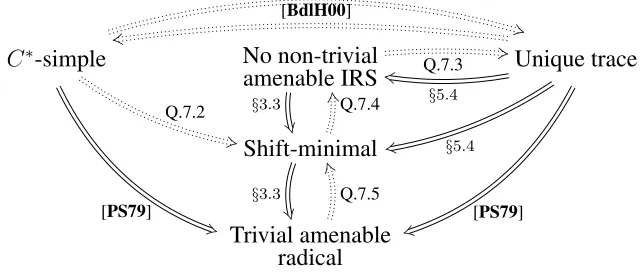
Shift-minimality andC∗-simplicityIfCis a class of groups then a measure preserving action of a groupΓis calledC-ergodicif each subgroup ofΓinCacts ergodically. An idea from the proof of Theorem 5.1 shows that if a non-trivial action ofΓisNA-ergodic, where NAis the class of non-amenable groups, then the invariant random subgroup associated to this action is amenable. One may show that every measure preserving action weakly con-tained in the Bernoulli shiftsΓisNA-ergodic, and therefore any non-trivial action weakly contained in sΓ gives rise to an amenable invariant random subgroup ofΓ which will be non-trivial provided the original action was not free. Call a countable groupΓshift-minimal
if every non-trivial action weakly contained insΓis free.
The Ab´ert-Weiss characterization of free actions as those weakly containingsΓ yields thatΓis shift-minimal if and only if every non-trivial action weakly contained in sΓ is in fact weakly equivalent to sΓ. It is well known thatΓ is C∗-simple, i.e., the reduced C∗ -algebra, Cr∗(Γ), of Γ is simple, if and only if every non-zero unitary representation ofΓ weakly contained in the left regular representationλΓis actually weakly equivalent to λΓ [dlH07]. This is a tantalizing parallel, although there is no obvious implication between the two properties.
OPENQUESTION6.3 (T-D). Are allC∗-simple groups shift-minimal?
C∗-simplicity may be restated as a dynamical property of an action of the unitary group U(H), whereH = `2(Γ). The set Irrλ(Γ,H)of all irreducible representations ofΓonH weakly contained in λΓ naturally forms a Polish space on whichU(H)acts continuously by coordinate-wise conjugation. Then Γ is C∗-simple if and only ifΓ is ICC and every unitary conjugacy class in Irrλ(Γ,H)is dense.
Evidence suggests thatC∗-simple groups should be shift-minimal. In Chapter 6 I show that shift-minimality ofΓfollows from another property called theunique trace property, which means thatCr∗(Γ)has a unique tracial state. In all known examples, the unique trace property andC∗-simplicity coincide, although it is open whether this is the case in general.
THEOREM6.4 (T-D [TD12b]). Groups with the unique trace property are shift-minimal. In fact, groups with the unique trace property have no non-trivial amenable invariant
ran-dom subgroups.
an open problem in general.
(Diagram 0) C∗-simple
[PS79] &.
No non-trivial amenable IRS
T-D
Unique trace
T-D
k
s
T-D
n
v
[PS79]
p
x
Shift-minimal
T-D
Trivial amenable radical
Theorem 6.4 and results of Poznansky [Poz09] imply these properties are all equivalent for linear groups.
Cost and the first `2-Betti number The second half of Chapter 6 connects shift-minimality and cost. The cost of a measure preserving countable Borel equivalence re-lation is a[0,∞]-valued orbit equivalence invariant introduced by Levitt [Lev95] and then developed considerably by Gaboriau [Gab00]. The cost of a measure preserving action of Γis defined to be the cost of the equivalence relation generated by this action. The cost of a groupΓ, denoted C(Γ), is then defined as the infimum of the costs of its free measure preserving actions. When Γ is infinite, thenC(Γ) ≥ 1. Γ is said to have fixed price r, wherer ≥ 0, if every free action ofΓ has costr. For example, infinite amenable groups have fixed price1, and Gaboriau has shown the free group of rankn has fixed pricen. A major open question in the area is whether every countable group has fixed price. This is known to be the case for many groups, but is open in general. The following is shown in Chapter 6.
THEOREM 6.5 (T-D [TD12b]). If a countable group Γ does not have fixed price 1
then Γ/ARΓ is shift-minimal. In addition, if C(Γ) > 1 then every non-trivial invariant random subgroup ofΓ/ARΓof infinite index has cost∞, and in particularΓ/ARΓhas no
non-trivial amenable invariant random subgroups.
respects weak containment in finitely generated groups, to the setting of general countable groups; one consequence is a characterization of countable groups with fixed price1, pre-viously shown to hold in the finitely generated case by Ab´ert and Weiss: a countable group has fixed price1 if and only if its Bernoulli shift has cost1. The second statement is an analogue of a theorem of Bergeron and Gaboriau [BG04] about the first`2-Betti number.
Theorems 6.4 and 6.5 along with Bergeron and Gaboriau’s result provide evidence for the following conjecture:
Conjecture 1: If Γ is a countably infinite group with positive `2-Betti number, then Γ/ARΓhas the unique trace property.
It is known thatC(Γ)≥β1(2)(Γ) + 1for any countably infinite groupΓ, whereβ1(2)(Γ) is the first`2-Betti number ofΓ. It is an open problem whether this is actually an equality. Regardless, the hypothesis β1(2)(Γ) > 0 is at least as strong as the hypothesisC(Γ) > 1 from Theorem 6.5. Peterson and Thom [PT11] have shown that if Γ is torsion-free and satisfies an additional technical hypothesis, then Conjecture 1 holds. What they actually show is that groups satisfying their hypotheses have many free subgroups, and then C∗ -simplicity and the unique trace property are easily deduced using a Powers-like argument from [BCdLH94]. If the additional technical hypothesis is dropped then their methods still show thatΓhas rather strong paradoxicality properties.
Chapter 2
Ultraproducts of measure preserving
actions and graph combinatorics
Clinton T. Conley, Alexander S. Kechris, and Robin D. Tucker-Drob
1. Introduction
In this paper we apply the method of ultraproducts to the study of graph combinatorics associated with measure preserving actions of infinite, countable groups, continuing the work in Conley-Kechris [CK13].
We employ the ultraproduct construction as a flexible method to produce measure pre-serving actionsaof a countable groupΓon a standard measure space(X, µ)(i.e., a standard Borel space with itsσ-algebra of Borel sets and a Borel probability measure) starting from a sequence of such actions an on(Xn, µn), n ∈ N. One uses a non-principal ultrafilterU on Nto generate the ultraproduct actionQ
nan/U of(an)on a measure space (XU, µU),
obtained as the ultraproduct of((Xn, µn))via the Loeb measure construction. The measure algebra of the space(XU, µU)is non-separable but by taking appropriate countably
gener-ated subalgebras of this measure algebra one generates factors a of the action Q
In§2, we discuss the construction of the ultrapower(XU, µU)of a sequence of standard
measure spaces (Xn, µn), n ∈ N, with respect to a non-principal ultrafilter U on N, via the Loeb measure construction. We follow largely the exposition in Elek-Szegedy [ES07], which dealt with the case of finite spacesXnwithµnthe counting measure.
In §3, we define the ultraproduct action Q
nan/U on (XU, µU) associated with a se-quencean, n ∈ N, of measure preserving actions of a countable groupΓon(Xn, µn)and discuss its freeness properties. Whenan =afor alln, we putaU =Qnan/U.
In §4, we characterize the factors of the action Q
nan/U associated with countably generatedσ-subalgebras of the measure algebra of(XU, µU).
For a measure space(X, µ)and a countable groupΓ, we denote byA(Γ, X, µ)the space of measure preserving actions ofΓon(X, µ)(where, as usual, actions are identified if they agree a.e.). This space carries theweak topologygenerated by the mapsa∈A(Γ, X, µ)7→ γa·A(γ ∈Γ, A∈MALG
µ), fromA(Γ, X, µ)into the measure algebra MALGµ(with the usual metricdµ(A, B) = µ(A∆B)), and where we putγa·x = a(γ, x). When (X, µ)is standard,A(Γ, X, µ)is a Polish space.
Ifa ∈A(Γ, X, µ), an∈A(Γ, Xn, µn), n∈N, andU is a non-principal ultrafilter onN, we say thataisweaklyU-containedin(an),in symbols
a≺U (an)
if for every finiteF ⊆Γ, A1, . . . , AN ∈MALGµ, >0, forU-almost alln:
∃B1,n. . .∃BN,n∈MALGµn∀γ ∈F∀i, j ≤N
|µ(γa·Ai∩Aj)−µn(γan·Bi,n∩Bj,n)|< ,
Ifa, bn∈A(Γ, X, µ), n ∈N, we write
lim
n→Ubn =a
if for each open nbhd V of a in A(Γ, X, µ), bn ∈ V, forU-almost alln. Finally a ∼= b denotes isomorphism (conjugacy) of actions.
We show the following (in 4.3):
THEOREM 1. Let U be a non-principal ultrafilter on N. Let(X, µ), (Xn, µn), n ∈ N be non-atomic, standard measure spaces and leta∈A(Γ, X, µ),an∈A(Γ, Xn, µn). Then the following are equivalent:
(1) a≺U (an), (2) ais a factor ofQ
nan/U,
(3) a= limn→Ubn, for some sequence(bn), with
bn ∈A(Γ, X, µ), bn ∼=an,∀n ∈N,
In particular, for a ∈ A(Γ, X, µ), b ∈ A(Γ, Y, ν), a ≺ b is equivalent to “a is a factor ofbU”. Moreover one has the following curious compactness property of A(Γ, X, µ)as a
consequence of Theorem 1: Ifan ∈ A(Γ, X, µ), n ∈N, then there isn0 < n1 < n2 < . . . andbni ∈A(Γ, X, µ), bni ∼=ani, such that(bni)converges inA(Γ, X, µ).
In§5, we apply the ultraproduct construction to the study of combinatorial parameters associated to group actions. Given an infinite group Γ with a finite set of generators S, not containing 1, and given a free action a ofΓ on a standard space(X, µ), the (simple, undirected) graphG(S, a)has vertex setXand edge setE(S, a), where
(x, y)∈E(S, a)⇔x6=y&∃s∈S(sa·x=yorsa·y=x).
As in Conley-Kechris [CK13], we define the associated parametersχµ(S, a)(the
measur-able chromatic number), χap
µ (S, a)(theapproximate chromatic number) and iµ(S, a)(the
•χµ(S, a)is the smallest cardinality of a standard Borel spaceY for which there is a (µ−)measurable coloringc: X →Y (i.e.,xE(S, a)y⇒c(x)6=c(y)).
• χap
µ(S, a) is the smallest cardinality of a standard Borel space Y such that for each >0, there is a Borel setA⊆Xwithµ(X\A)< and a measurable coloringc: A→Y of the induced subgraphG(S, a)|A= (A, E(S, A)∩A2).
•iµ(S, a)is the supremum of the measures of Borel independent sets, whereA⊆Xis
independentif no two elements ofAare adjacent.
Given a (simple, undirected) graphG = (X, E), where X is the set of vertices andE the set of edges, amatching in Gis a subset M ⊆ E such that no two edges inM have a common vertex. We denote by XM the set of matched vertices, i.e., the set of vertices belonging to an edge inM. IfXM =Xwe say thatM is aperfect matching.
For a free actionaofΓas before, we also define the parameter
m(S, a) = thematching number,
where m(S, a) is 1/2 of the supremum of µ(XM), with M a Borel (as a subset of X2) matching inG(S, a). Ifm(S, a) = 1/2and the supremum is attained, we say thatG(S, a) admits ana.e. perfect matching.
The parametersiµ(S, a), m(S, a) are monotone increasing with respect to weak con-tainment, whileχapµ (S, a)is decreasing. Below we leta ∼w bdenoteweak equivalenceof actions, wherea ∼w b ⇔ a ≺ b &b ≺ a, and we leta v b denote thatais a factor ofb. We now have (see 5.2)
THEOREM 2. Let Γ be an infinite, countable group and S a finite set of generators. Then for any free actionaofΓon a non-atomic, standard measure space(X, µ), there is a free actionbofΓon(X, µ)such that
(i) a∼w bandavb,
(ii) χapµ (S, a) =χµap(S, b) = χµ(S, b),
In §6, we study analogues of the classical Brooks’ Theorem for finite graphs, which asserts that the chromatic number of a finite graph G with degree bounded by d is ≤ d unlessd = 2andGcontains an odd cycle ord≥3andGcontains the complete subgraph withd+ 1vertices.
LetΓ, Sbe as in the preceding discussion, so that the graphG(S, a)associated with a free actionaofΓon a standard space(X, µ)has degreed =|S±1|, whereS±1 =S∪S−1. It was shown in Conley-Kechris [CK13] thatχapµ (S, a) ≤ d, so one has an “approximate” version of Brooks’ Theorem. Using this and the results of§5, we now have (see 6.11):
THEOREM 3. LetΓbe an infinite group andS a finite set of generators. Then for any free actionaofΓon a non-atomic, standard space(X, µ), there is a free actionbon(X, µ) such thata∼w bandχµ(S, b)≤d(= |S±1|).
It is not the case that foreveryfree actiona ofΓ we haveχµ(S, a) ≤ d, but the only counterexamples known areΓ =Zor(Z/2Z)∗(Z/2Z)(with the usual sets of generators) and Conley-Kechris [CK13] show that these are the only counterexamples ifΓhas finitely many ends.
The previous result can be used to answer a question in probability theory (see Aldons-Lyons [AL07]), namely whether for any Γ, S, there is an invariant, random d-coloring of the Cayley graph Cay(Γ, S)(an earlier result of Schramm (unpublished, 1997) shows that this is indeed the case with d replaced byd + 1). A randomd-coloringis a probability measure on the Borel sets of the space ofd-colorings of the Cayley graph Cay(Γ, S)and invariance refers to the canonical shift action ofΓon this space.
We now have (see 6.4):
THEOREM4. LetΓbe an infinite group andSa finite set of generators withd=|S±1|. Then there is an invariant, random d-coloring. Moreover for any free action a of Γon a non-atomic, standard space(X, µ), there is such a coloring weakly contained ina.
subgroup. One can consider invariant, random colorings under the canonical action ofGΓ,S on the space of colorings, which we callGΓ,S-invariant, random colorings. This appears as a stronger notion but we show in 6.6 that the existence of aGΓ,S-invariant, random d-coloring is equivalent to the existence of an invariant, random d-coloring, so Theorem 4 works as well forGΓ,S-invariant, random colorings.
One can also ask whether the last statement in Theorem 4 can be improved to “is a factor of” instead of “weakly contained in”. This again fails forΓ =Zor(Z/2Z)∗(Z/2Z)anda the shift action ofΓon[0,1]Γ, a case of primary interest, but holds for all otherΓthat have finitely many ends. Moreover in the case of the shift action one has alsoGΓ,S-invariance (see 6.7).
THEOREM5. LetΓbe an infinite group andSa finite set of generators withd=|S±1|. IfΓhas finitely many ends but is not isomorphic toZor(Z/2Z)∗(Z/2Z), then there is a GΓ,S-invariant, randomd-coloring which is a factor the shift action ofGΓ,S on[0,1]Γ.
In §7, we discuss various results about a.e. perfect matchings and invariant, random matchings. Lyons-Nazarov [LN11] showed that ifΓis a non-amenable group with a finite set of generatorsSand Cay(Γ, S)is bipartite (i.e., has no odd cycles), then there is aGΓ,S -invariant, random perfect mateching of its Cayley graph, which is a factor of the shift action ofGΓ,S on[0,1]Γ. This also implies thatm(S, sΓ) = 12, wheresΓis the shift action ofΓon [0,1]Γ, and in fact the graph associated with this action has an a.e. perfect matching. We do not know ifm(S, a) = 12 actually holds foreveryΓ, Sandeveryfree actiona. We note in 7.4 that the only possible counterexamples are thoseΓ, Sfor whichΓis not amenable and Sconsists of elements of odd order. However we show in 7.7 the following:
THEOREM 6. LetΓ = (Z/3Z)∗(Z/3Z)with the usual set of generatorsS = {s, t}, wheres3 = t3 = 1. Then for any free action a of Γon a non-atomic, standard measure space(X, µ), the associated graphG(S, a)has an a.e. perfect matching.
over all free actions ofΓ, is a closed interval. The question was raised about the structure of the set of alliµ(S, a), where avaries over all free, ergodicactions of Γ. We show the following (in 8.1).
THEOREM 7. Let Γ be an infinite group with S a finite set of generators. If Γ has property (T), the set ofiµ(S, a)asavaries over all the free, ergodic actions ofΓis closed.
We do not know what happens ifΓdoes not have property (T).
In §9, we discuss the notion of sofic equivalence relations and sofic actions, recently introduced in Elek-Lippner [EL10]. We use ultraproducts and a result of Ab´ert-Weiss [AW11] to give (in 9.6) an alternative proof of the theorem of Elek-Lippner [EL10] that the shift action of an infinite countable sofic group in sofic and discuss some classes of groupsΓfor whicheveryfree action is sofic.
Elek-Lippner [EL10] raised the question of whethereveryfree action of a sofic group is sofic.
Acknowledgements. Research of ASK and RDT-D was partially supported by NSF Grant DMS-0968710. We would like to thank Russell Lyons for many useful conversations.
2. Preliminaries
We review here some standard terminology and notation that will be used throughout the paper.
(A)A standard measure spaceis a measure space(X, µ), whereX is standard Borel space (i.e., a Polish space with its σ-algebra of Borel sets) and µ a probability measure on theσ-algebraB(X)of Borel sets. We do not assume in this paper that (X, µ)is non-atomic, since we do want to include in this definition also finite measure spaces. If(X, µ) is supposed to be non-atomic in a given context, this will be stated explicitly.
As a general convention in dealing with measure spaces, we will often neglect null sets, if there is no danger of confusion.
(B)If(X, µ)is a standard measure space andE ⊆ X2 a countable Borel equivalence relation onX(i.e., one whose equivalence classes are countable), we say thatEismeasure preservingif for all Borel bijectionsϕ: A →B, whereA, B are Borel subsets ofX, such thatϕ(x)Ex,µ-a.e.(x∈A), we have thatϕpreserves the measureµ.
Such an equivalence relation is called treeableif there is a Borel acyclic graph on X whose connected components are the equivalence classes.
(C)IfΓis an infinite, countable group and S a finite set of generators, not containing 1, theCayley graphCay(Γ, S), is the (simple, undirected) graph with set of verticesΓand in whichγ, δ∈Γare connected by an edge iff∃s∈S(γs=δorδs=γ).
Finally for suchΓ, Sthe number ofendsof Cay(Γ, S)is the supremum of the number of infinite components, when any finite set of vertices is removed. This number is independent ofS and it is equal to1,2or∞.
3. Ultraproducts of standard measure spaces
(A) Let (Xn, µn), n ∈ N, be a sequence of standard measure spaces and denote by B(Xn) theσ-algebra of Borel sets of Xn. LetU be a non-principal ultrafilter on N. For P ⊆N×X (Xsome set) we write
UnP(n, x)⇔ {n:P(n, x)} ∈ U.
If UnP(n, x) we also say that for U-almost all n, P(n, x) holds. On Q
nXn define the equivalence relation
(xn)∼U (yn)⇔ Un(xn=yn), let[(xn)]U be the(∼U)-equivalence class of(xn)and put
XU = (
Y
n
Xn)/U ={[(xn)]U: (xn)∈
Y
Given now(An)∈
Q
nB(Xn), we define[(An)]U ⊆XU by
[(xn)]U ∈[(An)]U ⇔ Un(xn∈An).
Note that
[(∼An)]U =∼[(An)]U
[(An∪Bn)]U = [(An)]U ∪[(Bn)]U
[(An∩Bn)]U = [(An)]U ∩[(Bn)]U,
where∼denotes complementation. Put
BU0 ={[(An)]U: (An)∈
Y
n
B(Xn)},
so thatB0
U is a Boolean algebra of subsets ofXU.
For[(An)]U ∈BU0, put
µU([(An)]U) = lim
n→Uµn(An),
wherelimn→Urndenotes the ultrafilter limit of the sequence(rn). It is easy to see thatµU
is a finitely additive probability Borel measure on BU0. We will extend it to a (countably additive) probability measure on aσ-algebra containingB0
U.
DEFINITION3.1. A setN ⊆XU isnullif∀ > 0∃A ∈B0U (N ⊆AandµU(A)< ).
Denote byN the collection of null sets.
PROPOSITION3.2. The collectionN is aσ-ideal of subsets ofXU.
Proof. It is clear that N is closed under subsets. We will now show that it is closed under countable unions.
LEMMA 3.3. LetAi ∈ B0
U, i ∈ N, and assume thatlimm→∞µU(Smi=0Ai) = t. Then
there isA∈B0
Granting this letNi ∈ N, i ∈ N, >0be given. LetNi ⊆Ai ∈ B0
U withµU(Ai) ≤
/2i. ThenµU(Smi=0Ai)≤andµU(Smi=0Ai)increases withm. So
lim m→UµU(
m
[
i=0
Ai) =t≤
and by the lemma there isA∈ B0
U withµU(A)≤andSiNi ⊆ SiAi ⊆A. SoSiNi is
null.
Proof of 2.3. PutBm =Sm
i=0A
i, so thatµ
U(Bm) = tm →t. LetAi = [(Ain)]U, so that
Bm = [(Bm
n)]U, withBnm =
Sm i=0A
i n. Let Tm =
n≥m: |µn(Bnm)−tm| ≤ 1 2m
,
so thatT
mTm =∅andTm ∈ U, astm =µU(B
m) = limn
→Uµn(Bnm). Letm(n) =largestmsuch thatn ∈ T
`≤mTm. Thenm(n)→ ∞asn → U, since for eachM,{n:m(n)≥M} ⊇TM
m=0Tm ∈ U. Alson ∈Tm(n). So |µm(n)(Bnm(n))−tm(n)| ≤
1 2m(n), thus
lim n→Uµn(B
m(n) n ) = t. LetA = [(Bnm(n))]U. ThenµU(A) = t. Also for eachi,
{n: Ain⊆Bnm(n)} ⊇ {n: m(n)≥i} ∈ U,
soAi = [(Ain)]U ⊆[(Bnm(n))]U =A, thusSiAi ⊆A. a
Put
BU ={A⊆XU: ∃A0 ∈BU0(A∆A 0 ∈
N)}, and forA∈BU put
µU(A) = µU(A0)
whereA0 ∈B0
PROPOSITION3.4. The class BU is aσ-algrebra of subsets of XU containingBU0 and
µU is a probability measure onBU.
Proof. It is easy to see thatBU is a Boolean algebra containingBU0 andµU is a finitely
additive probability measure onBU. It only remains to show that ifAn ∈ BU, n ∈ N, are
pairwise disjoint, thenS
nAn∈BU andµU(SnAn) =
P
nµU(An). ForA, A0 ∈BU, let
A≡A0 ⇔A∆A0 ∈N. Let nowA0n ∈ B0
U be such that An ≡ A0n. By disjointifying, we can assume that theA
0
n are disjoint. Note also that S
nAn ≡
S
nA
0
n. It is thus enough to find A0 ∈ BU0 with
A0 ≡S
nA
0
nandµU(A
0) =P
nµU(A
0
n) (=
P
nµU(An)). By Lemma 2.3, there isA0 ∈ B0
U with
S
nA
0
n ⊆ A0 andµU(A0) = PnµU(A0n). Then for eachN,
A0\[ n
A0n⊆A0 \ N
[
n=0
A0n∈B0U
and
µU(A0\
N
[
n=0
A0n) =µU(A0)−
N
X
n=0
µU(A0n)→0 asN → ∞. So
A0∆[ n
A0n=A0\[ n
A0n∈N
i.e.,A0 ≡S
nA
0
n. a
Finally, note that forA∈BU, µU(A) = 0 ⇔A∈N. (B)The following is straightforward.
PROPOSITION 3.5. The measure µU is non-atomic if and only if ∀ > 0 ∀(An) ∈
Q
nB(Xn) (Un(µn(An) ≥ ) ⇒ ∃δ > 0 ∃(Bn) ∈
Q
nB(Xn) [Un(Bn ⊆ An & δ ≤ µn(Bn), µn(An\Bn))]
.
Let MALGµU be the measure algebra of(X,BU, µU). IfµU is non-atomic, fix also a
functionSU: MALGµU →MALGµU such thatSU(A)⊆Aand
µU(SU(A)) =
1
2µU(A).
Let now B0 ⊆ MALGµU be a countable subalgebra closed under SU. Let B =
σ(B0) ⊆ MALGµU be the σ-subalgebra of MALGµU generated by B0. Since every el-ement of B can be approximated (in the sense of the metric d(A, B) = µU(A∆B)) by
elements ofB0, it follows that Bis countably generated and non-atomic. It follows (see, e.g., Kechris [Kec95, 17.44]) that the measure algebra(B, µU|B)is isomorphic to the
mea-sure algebra of (any) non-atomic, standard meamea-sure space, in particular MALGρ, whereρ is the usual product measure on the Borel sets of2N. Then we can find a Cantor scheme (Bs)s∈2<N, withBs ∈ BU,B∅ = X,Bsˆ0∩Bsˆ1 =∅, Bs = Bsˆ0∩Bsˆ1,µU(Bs) = 2−n, and(Bs)viewed now as members of MALGµU, belong toBand generateB. Then define
ϕ: XU →2N
by
ϕ(x) =α⇔x∈\ n
Bα|n.
Then ϕ−1(Ns) = Bs, where Ns = {α ∈ 2N: s ⊆ α} for s ∈ 2<N. Thus ϕ is BU
-measurable (i.e., the inverse image of a Borel set in2N is inB
U) and ϕ∗µU = ρ, so that
(2N, ρ)is a factor of(XU, µU)andA7→ϕ−1(A)is an isomorphism of the measure algebra
MALGρwith(B, µU|B).
4. Ultraproducts of measure preserving actions
(A)Let(Xn, µn),U be as in§2. LetΓbe a countable group and let{αn}be a sequence of Borel actionsαn: Γ×Xn → Xn, such that αn preserves µn,∀n ∈ N. We can define then the actionαU: Γ×XU →XU by
where we letγαU ·x=α
U(γ, x)and similarly for eachαn.
PROPOSITION4.1. The actionαU preservesBU0,BU and the measureµU.
Proof. First letA= [(An)]U ∈BU0. We verify thatγαU·A= [(γαn·An)]U, from which
it follows that the action preservesB0
U. Indeed
[(xn)]U ∈γαU ·[(An)]U ⇔(γ−1)αU ·[(xn)]U ∈[(An)] ⇔ Un((γ−1)αn·x
n ∈An) ⇔ Un(xn∈γαn ·An) ⇔[(xn)]U ∈[(γαn ·An)]U.
Also
µU(γαU ·A) = lim
n→Uµn(γ
αn·A
n) = lim
n→Uµn(An) = µU(A),
so the action preservesµU|BU0.
Next let A ∈ N and for each > 0 let A ⊆ A ∈ BU0 with µU(A) < . Then γαU ·A ⊆ γαU ·A
andµU(γαU ·A)< , soγαU ·A ∈ N, i.e.,N is invariant under the action.
Finally, letA∈BUand letA0 ∈BU0 be such thatA∆A0 ∈N, so thatγαU(A)∆γαU(A0)∈
N, thusγαU(A)∈B
U andµU(γαU ·A) =µU(γαU ·A0) =µU(A0) =µU(A). a
unambiguously the ultraproduct action
Y
n an/U
with representativeαU. This is a measure preserving action ofΓon(XU, µU), i.e.,Qnan/U ∈ A(Γ, XU, µU). Whenan=afor alln, we put
aU =
Y
n a/U.
(B) Recall that if a ∈ A(Γ, X, µ), b ∈ A(Γ, Y, ν), we say that b is a factor of a, in symbols
b va,
if there is a measurable mapϕ: X → Y such thatϕ∗µ= νandϕ(γa·x) = γb·ϕ(x),
µ-a.e.(x). We denote by MALGµthe measure algebra of(X, µ). ClearlyΓacts on MALGµ by automorphisms of the measure algebra. If (Y, ν) is a non-atomic, standard measure space, the mapA ∈ MALGν 7→ ϕ−1(A) ∈ MALGµ is an isomorphism of MALGν with a countably generated, non-atomic,σ-subalgebraBof MALGµ, which isΓ-invariant, and this isomorphism preserves the Γ-actions. Conversely, we can see as in§1,(B) that every countably generated, non-atomic,σ-subalgebraBof MALGµ, which isΓ-invariant, gives rise to a factor of a as follows: First fix an isomorphismπ between the measure algebra (B, µ|B)and the measure algebra of(Y, ν), whereY = 2Nandν=ρis the usual product
measure. Use this to define the Cantor scheme (Bs)s∈2<N forB as in §1, (B) and define
ϕ: X → Y as before. Now the isomorphism π gives an action of Γ on the measure algebra of (Y, ν), which by definition preserves the Γ-actions on (B, µ|B)and MALGν. TheΓ-action on MALGν is induced by a (unique) actionb ∈A(Γ, Y, ν)(see, e.g., Kechris [Kec95, 17.46]) and then it is easy to check that ϕ witnesses that b v a (notice that for eachs ∈2<N, γ ∈Γ, ϕ(γa·x)∈N
In particular, the factorsb ∈A(Γ, Y, ν)ofa=Q
nan/U where(Y, ν)is a non-atomic, standard measure space, correspond exactly to the countably generated, non-atomic, Γ -invariant (for a) σ-subalgebras of MALGµU. For non-atomic µU, we can construct such
subalgebras as follows: Start with a countable Boolean subalgebraB0 ∈MALGµU, which is closed under the Γ-action and the functionSU of§2, (B). Then let B = σ(B0) be the σ-subalgebra of MALGµU generated byB0. This has all the required properties.
(C) We will next see how to insure, in the notation of the preceding paragraph, that the corresponding toB factor is a free action. Recall that a ∈ A(Γ, X, µ)isfreeif ∀γ ∈ Γ\ {1}(γa·x6=x,µ-a.e. (x)).
PROPOSITION4.2. The actiona=Q
nan/U is free iff for eachγ ∈Γ\ {1}, lim
n→Uµn({x: γ
an ·x6=x}) = 1.
Proof. Note that, modulo null sets,
{x∈XU: γa·x6=x}= [(An)]U,
whereAn ={x∈Xn: γan·x6=x}. a
In particular, if allanare free, so is
Q
nan/U. PROPOSITION4.3. Suppose the actiona=Q
nanis free. Then for eachA∈MALGµU, A6=
∅ and γ ∈ Γ \ {1}, there is B ∈ MALGµU with B ⊆ A, µU(B) ≥ 161 µU(A) and
γa·B∩B =∅.
Proof. It is clearly enough to show that ifγ 6= 1, A ∈ BU0, µU(A) > 0, then there is
B ∈B0
U, B ⊆A, withµU(B)≥ 161 µU(A)andγa·B∩B =∅.
LetA = [(An)]U and µU(A) = > 0. Then there isU ⊆ N, U ∈ U withn ∈ U ⇒
(µn(An) > 2 andµ({x ∈ Xn: γan ·x 6= x}) > 1− 4). We can assume that each Xn is Polish andγanis represented (a.e.) by a homeomorphismγαnofX
n. Let
so thatµn(Cn)> 4. Fix also a countable basis(Vin)i∈NforXn.
If x ∈ Cn, let Vnx be a basic open set such that γαn ·Vnx ∩Vnx = ∅ (this exists by the continuity ofγαn and the fact thatγαn ·x 6= x). It follows that there isx
0 ∈ Cnwith µn(Cn∩Vnx0) >0andγαn ·(Cn∩Vnx0)∩(Cn∩Vnx0) = ∅. Thus there is C ⊆ Cnwith µn(C) > 0andγan ·C ∩C = ∅. By Zorn’s Lemma or transfinite induction there is an element Bn of MALGµU which is maximal, under inclusion, among all D ∈ MALGµU satifying: D ⊆ Cn (viewing Cn as an element of the measure algebra), µn(D) > 0, γan·D∩D=
∅. We claim thatµn(Bn)≥ 16 . Indeed let
En =Cn\(Bn∪γan·Bn∪(γ−1)an·Bn).
Ifµn(Bn) < 16 , then En 6= ∅, so as before we can findFn ⊆ En withµn(Fn) > 0and γan·F
n∩Fn =∅. Thenγan·(Bn∪Fn)∩(Bn∪Fn) = ∅, contradicting to maximality
ofBn. Soµn(Bn)≥ 16. Let nowB = [(Bn)]U. a
So if the actiona =Q
nan/U is free, let
TU: Γ×MALGµU →MALGµU
be a function such that for eachγ 6= 1, A∈MALGµU\{∅}, TU(γ, A)⊆A, µ(TU(γ, A))≥
1
16µ(A)andγ a·T
U(γ, A)∩TU(γ, A) =∅. Now, if in the earlier construction of countably generated, non-atomic, Γ-invariantσ-subalgebras of MALGµU, we start with a countable Boolean subalgebraB0 closed under theΓ-action, the functionSU of§2,(B)andTU (i.e.,
∀γ(A ∈ B0 ⇒ TU(γ, A) ∈ B0)), then the factorb corresponding toB =σ(B0)is a free action.
5. Characterizing factors of ultraproducts
In sections §4–8 all measure spaces will be non-atomic and standard. Also Γ is an arbitrary countable infinite group.
T 7→ T(A), A ∈ MALGµ, from Aut(X, µ)into MALGµ(equipped with the usual metric dµ(A, B) = µ(A∆B)). We can identify A(Γ, X, µ) with the space of homomorphisms ofΓinto Aut(X, µ), so that it becomes a closed subspace of Aut(X, µ)Γwith the product topology, thus also a Polish space.
DEFINITION 5.1. Let a ∈ A(Γ, X, µ), an ∈ A(Γ, Xn, µn), n ∈ N. Let U be a non-principal ultrafilter onN. We say thataisweaklyU-containedin(an), in symbols
a≺U (an)
if for every finiteF ⊆Γ, A1, . . . , AN ∈MALGµ, >0, forU-almost alln:
∃B1,n. . . BN,n ∈MALGµn∀γ ∈Γ∀i, j ≤N
|µ(γa·Ai∩Aj)−µn(γan·Bi,n∩Bj,n)|< .
Note that ifan=bfor alln, thena≺U (an)⇔a ≺bin the sense of weak containment of actions, see Kechris [Kec10].
One can also trivially see thata≺U (an)is equivalent to the statement:
For every finite F ⊆ Γ, A1, . . . An ∈ MALGµ, > 0, there are [(B1,n]U, . . . ,
[(BN,n)]U ∈BU0(XU)such that forU-almost alln:
∀γ ∈F∀i, j ≤N|µ(γa·Ai∩Aj)−µn(γan ·Bi,n)∩Bj,n|< ).
DEFINITION5.2. Fora, bn ∈A(Γ, X, µ), we write
lim
n→Ubn =a
if for each open nbhdV ofainA(Γ, X, µ), Un(bn ∈V).
Since the sets of the form
forA1, . . . , An a Borel partition ofX, >0, F ⊆Γfinite containing 1, form a nbhd basis ofa,limn→Ubn=aiffUn(bn ∈V), for anyV of the above form.
Below∼=denotes isomorphism of actions.
THEOREM 5.3. LetU be a non-principal ultrafilter on N. Leta ∈ A(Γ, X, µ), and let an ∈A(Γ, Xn, µn), n∈N. Then the following are equivalent
(1) a≺U (an), (2) avQ
nan/U,
(3) a= limn→Ubn, for some sequence(bn),bn∈A(Γ, X, µ)withbn ∼=an, n ∈N.
Proof. (1) ⇒(2): Let 1 ∈ F0 ⊆ F1 ⊆ . . . be a sequence of finite subsets of Γwith Γ = S
mFm. We can assume thatX = 2
N, µ = ρ(the usual product measure on2N). Let
Ns ={α ∈2N: s⊆α}, fors∈2<N.
By (1), we can find for eachm, s∈2≤m, [(Bns,m)]∈BU0 such thatUm ∈ U, where
Um ={n≥m:∀γ ∈Fm∀s, t∈2≤m
|µ(γa·Ns∩Nt| −µn(γan ·Bns,m∩B t,m
n )|< m}, wherem → 0. Since
T
mUm = ∅, letm(n) =largest m such thatn ∈
T
i≤mUi. Then n∈Un(m)andlimn→Um(n) = ∞. Put
Bs = [(Bns,m(n))]U ∈B 0
U.
Since for alln, n ∈Um(n), it follows (takingγ = 1, s =t in the definition ofUm) that for allnwithm(n)>length(s),
|µ(Ns)−µn(Bns,m(n))|< m(n). (*)
So for any >0, ifM >length(s)andM < , thenUn(m(n)> M), so(∗)holds with replacingm(n)forU-almost alln, thus
µU(Bs) = lim n→Uµn(B
s,m(n)
In general, we have that
∀γ ∈Fm(n)∀s, t ∈2≤m(n)
|µ(γa·Ns∩Nt)−µn(γan ·Bns,m(n)∩B t,m(n)
n )|< m(n).
So ifγ ∈F, s, t∈2<N, >0, and ifMis large enough so thatM >max{length(s),length(t)}, γ ∈
FM, M < , then on{n: m(n)≥M} ∈ U we have
|µ(γa·Ns∩Nt)−µn(γan ·Bns,m(n)∩B t,m(n) n )|< , so
µU(γ
Q
nan/U ·B
s∩Bt) =µ(γa·Ns∩Nt). (**)
Viewing each Bs as an element of MALGµU, we haveB∅ = XU, Bsˆ0∩Bsˆ1 = ∅, Bs = Bsˆ0 ∪Bsˆ1 (for the last take γ = 1, t = sˆi in (∗∗)) and µU(Bs) = 2−n, if s ∈ 2n. Then the map π(Ns) = Bs gives a measure preserving isomorphism of the Boolean subalgebra A0 of MALGµ generated by (Ns) and the Boolean algebra B0 in MALGµU generated by(Bs). LetBbe theσ-subalgebra of MALGµU generated by(Bs). Sinceπis an isometry of A0 withB0 (with the metrics they inherit from the measure algebra), and A0is dense in MALGµ,B0is dense inB, it follows thatπextends uniquely to an isometry, also denoted byπ, from MALGµ ontoB. Sinceπ(∅) = ∅, πis actually an isomorphism of the measure algebra MALGµ with the measure algebraB(see Kechris [Kec10, pp. 1-2]), it is thus enough to show thatBisΓ-invariant (forQ
nan/U) and thatπpreserves the Γ-action.
Letb =Q
nan/U. It is enough to show thatπ(γ a·N
Fix γ ∈ Γ, > 0, s ∈ 2<N. There is A ∈ A
0 with µ(γa ·Ns∆A) < /2. Now A=Fm1
i=1Nti,∼A= Fm2
j=1Nt0j and∼Ns=Fmk=13 Nsk (disjoint unions), so
γa·Ns∆A= (γa·Ns∩(∼A))t(γa·(∼Ns)∩A)
= ( m2
G
j=1
γa·Ns∩Nt0j)t( m3 G k=1 m1 G i=1
(γa·Nsk ∩Nti)).
IfB =π(A)∈B0, then we also have
γb·Bs∆B =( m2
G
j=1
γb·Bs∩Bt0
j)t ( m3 G k=1 m1 G i=1
(γb·Bsk ∩Bti)),
so by(∗∗)
µU(γb·Bs∆B) = µ(γa·Ns∆A)< /2.
Sinceπpreserves measure, we also haveµU(π(γa·Ns)∆B)< /2, thus
µU(γb·Bs∆π(γa·Ns))< .
Thereforeγb·B
s=π(γa·Ns).
(2) ⇒ (1): Suppose that a v b = Q
nan/U. Let π: MALGµ → MALGµU be a measure preserving embedding preserving theΓ-actions (so that the imageπ(MALGµ)is a Γ-invariantσ-subalgebra of MALGµU). FixF ⊆ Γ finite, A1, . . . , An ∈ MALGµ and > 0. Let B1, . . . , BN ∈ B0
U representπ(A1), . . . , π(AN). Let Bi = [(Bni)]U. Then for
γ ∈F, j, k ≤N,
µ(γa·Aj∩Ak) =µU(γb·Bj ∩Bk)
= lim n→Uµn(γ
an·Bj
so forU-almost alln,
|µ(γa·Aj ∩Ak)−µn(γan ·Bnj ∩B k n)|< ,
and thus forU-almost alln, this holds for allγ ∈F, j, k≤N. Thusa≺U (an).
(3)⇒(1): Fix suchbn, and letA1, . . . , AN ∈MALGµ, F ⊆Γfinite, >0. Then there isU ∈ U such that forn∈U we have
∀γ ∈F∀i, j ≤N(|µ(γa·Ai∩Aj)−µ(γbn·Ai∩Aj)|< ).
Letϕn: (X, µ)→ (Xn, µn)be an isomorphism that sendsbntoan and putϕn(Ai) = Bni. Thenϕn(γbn·A
i∩Aj) =γan ·Bni ∩Bjn, so forn∈U:
∀γ ∈F∀i, j ≤N(|µ(γa·Ai∩Aj)−µn(γan·Bin∩B j
n)|< ), thusa ≺U (an).
(1)⇒(3): Supposea ≺U (an). Let
V ={c∈A(Γ, X, µ) : ∀γ ∈F∀i, j ≤N(|µ(γa·Ai∩Aj)−µ(γc·Ai∩Aj)|< ),
where A1, . . . , An ∈ MALGµ is a Borel partition of X, > 0and F ⊆ Γ is finite with 1∈F, be a basic nbhd ofa.
Claim. It suffices to show that for any suchV we can findU ∈ U such that forn ∈U there isbn ∈V withbn ∼=an.
Assume this for the moment and complete the proof of (1) ⇒ (3) by verifying that indeed for any suchV we can find a correspondingU as in the claim.
Sincea ≺U (an), for anyδ >0, we can find[(B1,n)]U, . . . ,[(BN,n)]U ∈BU0 andUδ ∈ U such that forn ∈Uδ we have
Takingδ < /20N3 andU =U
δ, the proof of Proposition 10.1 in Kechris [Kec10] shows that forn∈U there isbn=∼anwithbn∈V.
Proof of the claim. LetV0 ⊇ V1 ⊇ V2 ⊆ . . . be a nbhd basis foraconsisting of sets of the above form, and assume that for each m there is Um ∈ U such that for n ∈ Um, there is bn,m ∈ Vm withbn,m ∼= an. We can also assume thatTmUm = ∅. Letm(n) = largest m such thatn ∈ T
i≤mUi. We have an ∼= bn,m(n) ∈ Vm(n), and for any nbhd V of a as above, if M is so large that VM ⊆ V, then bn,m(n) ∈ Vm(n) ⊆ VM ⊆ V, for n∈ {n: m(n)≥M} ∈ U. Soa = limn→Ubn,m(n). a
COROLLARY 5.4. Let U be a non-principal ultrafilter on Nand consider the actions a∈A(Γ, X, µ), b ∈A(Γ, Y, ν). Then the following are equivalent:
(1) a≺b, (2) avbU.
Theorem 4.3 also has the following curious consequence, a compactness property of the spaceA(Γ, X, µ).
COROLLARY 5.5. Letan ∈ A(Γ, X, µ), n ∈ N, be a sequence of actions. Then there is a subsequence n0 < n1 < n2 < . . . andbni ∈ A(Γ, X, µ), bni ∼= ani, such that (bni)
converges inA(Γ, X, µ).
Proof. Let a ∈ A(Γ, X, µ) be such thata v Q
nan/U (such exists by §3,(B)). Then by 4.3, we can find bn ∼= an, with limn→Ubn = a. This of course implies that there is
n0 < n1 < . . . withlimi→∞bni =a. a
Benjy Weiss pointed out that forfreeactions a stronger version of 4.5 follows from his work with Ab´ert, see Ab´ert-Weiss [AW11]. In this paper it is shown that ifsΓ is the shift action of an infinite groupΓon[0,1]Γ, thens
Γ ≺aforanyfree actionaofΓ. From this it follows that given freean ∈A(Γ, X, µ), n∈N, there isbn∼=anwithlimn→∞bn=sΓ.
Any cover ofA(Γ, X, µ)by open,invariant under∼=sets, has a finite subcover.
(B)Consider now a ∈ A(Γ, X, µ)and the action aU on(XU, µU). ClearlyµU is
non-atomic asµis non-atomic. Fix also a countable Boolean subalgebraA0 of MALGµwhich generates MALGµand is closed under the actiona. The map
π(A) = [(A)]U
(where(A) is the constant sequence(An), An = A,∀n ∈ N) embeds A0 into a Boolean subalgebraC0 of MALGµU, invariant underaU, preserving the measure and theΓ-actions
(aonA0andaU onC0).
LetB0 ⊇C0be any countable Boolean subalgebra of MALGµU closed under the action aU and the function SU of §2, (B)and letB = σ(B0)be theσ-algebra generated byB0. Letb be the factor ofaU corresponding toB, so that b v aU and thus b ≺ a by 4.4. We
also claim thatavband thusa∼w b, where
a ∼w b⇔a≺b&b ≺a.
Indeed, let D0 = σ(C0) be the σ-subalgebra of B generated by C0. Then D0 is also closed under the actionaU. The mapπ is an isometry ofA0 withC0, which are dense in MALGµ,D0, resp., so extends uniquely to an isometry, also denoted byπ, of MALGµwith D0. Sinceπ(∅) =∅, it follows thatπis an isomorphism of the measure algebra MALGµ with the measure algebra D0 (see Kechris [Kec10, pp. 1-2]). Fix row γ ∈ Γ. Then γa on MALGµis mapped byπ to an automorphismπ(γa)of the measure algebra D0. Since π(γa·A) = γaU ·π(A), for A ∈ A0, it follows that π(γa)|C0 = γaU|C0, so since C0 generatesD0, we haveπ(γa) = γaU|D0, i.e.,πpreserves theΓ-actions (aon MALGµand aU onD0), thusavb.
An∆An) = 0). We call an actionastrongly ergodic(or E0-ergodic) if it does not admit non-trivial almost invariant sets. We now have:
PROPOSITION 5.6. Leta ∈ A(Γ, X, µ). Thenais strongly ergodic iff ∀b ∼w a(b is ergodic) iff∀b≺a(bis ergodic).
Proof. Assume first thatais not strongly ergodic and let(An)be a sequence of Borel sets such that for someδ >0,δ ≤µ(An) ≤1−δand∀γ(limn→∞µ(γa·An∆An) = 0). Let U be a non-principal ultrafilter on N and let A = [(An)]U ∈ BU0. Then viewing A
as an element of MALGµU we have γaU ·A = A,∀γ ∈ Γ, and 0 < µU(A) < 1. Let
B0 be a countable Boolean subalgebra of MALGµU closed underaU, the functionSU and
containing C0 as before. Let b be the factor of aU associated with B = σ(B0), so that a∼w b. SinceA∈B, clearlybis not ergodic.
Conversely assumeb≺aandbis not ergodic. It follows easily then from the definition
of weak containment thatais not strongly ergodic. a
Finally we note the following fact that connects weak containment to factors.
PROPOSITION5.7. Leta, b∈A(Γ, X, µ). Then the following are equivalent: (i) a≺b,
(ii) ∃c∈A(Γ, X, µ)(c∼w b&a vc).
Proof. (ii) clearly implies (i), sinceavc⇒a≺cand≺is transitive.
(i) ⇒ (ii) Let U be a non-principal ultrafilter on N. By 4.4, if a ≺ b then a v bU.
Then as in the first two paragraphs of§4, (B), we can find an appropriateσ-subalgebra of MALGµU invariant underbU, so that ifcis the corresponding factor, then c ∼w b (and in
fact moreoverbvc) andavc. a
6. Graph combinatorics of group actions
a∈FR(Γ, X, µ)we associate withathe (simple, undirected) graphG(S, a) = (X, E(S, a)), whereX is the set of vertices andE(S, a), the set of edges, is given by
(x, y)E(S, a)⇔x6=y&∃s ∈S±1(sa·x=y),
whereS±1 ={s, s−1: s∈S}. We also writexE(s, a)yif(x, y)∈E(S, a). As in Conley-Kechris [CK13], we associate with this graph the following parameters:
χµ(S, a) = themeasurable chromatic number, χapµ (S, a) = theapproximate chromatic number,
iµ(S, a) = theindependence number,
defined as follows:
•χµ(S, a)is the smallest cardinality of a standard Borel spaceY for which there is a (µ−)measurable coloringc: X →Y (i.e.,xE(S, a)y⇒c(x)6=c(y)).
• χap
µ(S, a) is the smallest cardinality of a standard Borel space Y such that for each >0, there is a Borel setA⊆Xwithµ(X\A)< and a measurable coloringc: A→Y of the induced subgraphG(S, a)|A= (A, E(S, A)∩A2).
•iµ(S, a)is the supremum of the measures of Borel independent sets, whereA⊆Xis
independentif no two elements ofAare adjacent.
Given a (simple, undirected) graph G = (X, E), where X is the set of vertices and E the set of edges, a matching in G is a subset M ⊆ E such that no two edges in M have a common point. We denote byXM the set of matched vertices, i.e., the set of points belonging to an edge inM. IfXM =Xwe say thatM is aperfect matching.
Fora∈FR(Γ, X, µ)as before, we also define the parameter
where m(S, a) is 1/2 of the supremum of µ(XM), with M a Borel (as a subset of X2) matching inG(S, a). Ifm(S, a) = 1/2and the supremum is attained, we say thatG(S, a) admits ana.e. perfect matching.
Note that we can view a matchingM inG(S, a)as a Borel bijectionϕ: A →B, with A, B ⊆Xdisjoint Borel sets andxE(S, a)ϕ(x),∀x∈A. ThenXM =A∪Band soµ(A) is1/2µ(XM). Thusm(S, a)is equal to the supremum ofµ(A)over all suchϕ.
It was shown in Conley-Kechris [CK13, 4.2, 4.3] that
a≺b⇒iµ(S, a)≤iµ(S, b), χapµ (S, a)≥χ ap µ (S, b). We note a similar fact aboutm(S, a).
PROPOSITION 6.1. Let Γ be an infinite countable group and S ⊆ Γ a finite set of generators. Then
a≺b ⇒m(S, a)≤m(S, b).
Proof. Letϕ: A→Bbe a matching forG(S, a). Then there are Borel decompositions A = Fn
i=1An, B =
Fn
i=1Bn, ands1, . . . , sn ∈ S
±1 withϕ|A
i =sai|Ai, ϕ(Ai) = Bi. Fix δ >0. Sincea ≺b, for any >0, we can find a sequenceC1, . . . , Cnof pairwise disjoint Borel sets such that for anyγ ∈ {1} ∪(S±1)2, |µ(γa·Ai∩Aj)−µ(γb ·Ci ∩Cj)| < , fori≤ i, j ≤n. Sincesa
i ·Ai ∩Aj = ∅, for all1 ≤ i, j ≤ n, and sai ·Ai∩saj ·Aj = ∅, for all1 ≤ i 6= j ≤ n, it follows that|µ(Ai)−µ(Ci)| < ,1 ≤ i ≤ n, µ(sib ·Ci ∩Cj) < ,1≤i, j ≤n, andµ(sb
i·Ci∩sbj·Cj)< ,1≤i6=j ≤n. By disjointifying and choosing very small compared toδ, it is clear that we can find such pairwise disjoint C1, . . . , Cn with sbi · Ci ∩Cj = ∅,1 ≤ i, j ≤ n, sbi ·Ci ∩ sbj ·Cj = ∅,1 ≤ i 6= j ≤ n, and if C = Fn
i=1Ci, D =
Fn
i=1s b
i ·Ci, then |µ(C)−µ(A)| < δ. Clearlyψ: C → D given by ψ|Ci =sbi|Ci is a matching forG(S, b)andµ(C) > µ(A)−δ. Sinceδ was arbitrary this
shows thatm(S, a)≤m(S, b). a
THEOREM 6.2. LetΓbe an infinite countable group andS ⊆ Γa finite set of genera-tors. Then for anya∈FR(Γ, X, µ), there isb∈FR(Γ, X, µ)such that
(i) a∼w bandavb,
(ii) χapµ (S, a) =χµap(S, b) = χµ(S, b),
(iii) iµ(S, a) = iµ(S, b)andiµ(S, b)is attained, (iv) m(S, a) = m(S, b)andm(S, b)is attained.
Proof. Let U be a non-principal ultrafilter onN. The action b will be an appropriate factor of the ultrapoweraU.
Let k = χapµ (S, a). This is finite by Kechris-Solecki-Todorcevic [KST99, 4.6]. Let iµ(S, a) = ι≤ 12 and letm(S, a) = m≤ 12. Then for eachn≥1, find the following:
(a) A sequenceCn1, . . . , Cnkof pairwise disjoint Borel sets such thatsa·Cni ∩Cni =∅, for1≤i≤k, s∈S±1, andµ(Fk
i=1C i
n)≥1− 1 n.
(b) A Borel setInsuch thatsa·In∩In =∅, s ∈S±1, andµ(In)≥ι− n1.
(c) A pairwise disjoint family of Borel sets (Asn)s∈S±1, such that sa · Asn ∩Atn =
∅, s, t ∈S±1, sa·Asn∩ta·Atn =∅, s, t ∈S
±1, s 6=t, and
µ( G s∈S±1
Asn)≥m− 1 n.
Consider now the ultrapower action aU on (XU, µU) and the sets Ci = [(Cni)]n ∈ B0
U,1 ≤i ≤k, I = [(In)]U ∈BU0 andAs = [(Asn)]U ∈BU0, s∈ S±1. Viewed as elements
of MALGµU they satisfy: (a0) Ci∩Cj =
∅,1≤i6=j ≤k, saU·Ci∩Ci =∅,1≤i≤k, s∈S±1;µU(Fki=1Ci) =
1,
(b0) saU ·I∩I =∅, s∈S±1;µU(I)≥ι,
(c0) As∩At=
∅, s6=t, s, t∈S±1;saU·As∩At=∅, s, t∈S±1;saU·As∩taU·At= ∅, s6=t, s, t∈S±1;µ(Fs∈S±1As)≥m.
(B) and alsoCi (1 ≤ i ≤ k), I, As (s ∈ S±1). Let B = σ(B
0) and let b be the factor of aU corresponding to B. (We can of course assume that b ∈ FR(Γ, X, µ).) Then by
§4, (B)again,a ∼w b anda v b. So, in particular,χµap(S, a) = χapµ (S, b) = k, iµ(S, a) = iµ(S, b) = ιandm(S, a) = m(S, b) = m, sincea∼w b. The sets(Ci)i≤kgive a measurable coloring ofG(S, b)|A, for someAwithµ(A) = 1and we can clearly color in a measurable way G(S, b)| ∼ A by ` colors, where ` is the chromatic number of the Cayley graph Cay(Γ, S) of Γ, S. Since ` ≤ k, it follows that χµ(S, b) ≤ k, so χµ(S, b) = χapµ (S, b). Finally, (b0), (c0) show thatiµ(S, b) =ιandm(S, b) =mare attained. a
7. Brooks’ Theorem for group actions
(A)Brooks’ Theorem for finite graphs asserts that for any finite graph Gwith degree bounded by d, the chromatic number χ(G) is≤ d, unless d = 2 andG contains an odd cycle or d ≥ 3 and G contains a complete subgraph (clique) with d + 1 vertices (and the chromatic number is always ≤ d+ 1). In Conley-Kechris [CK13] the question of finding analogues of the Brooks bound for graphs of the form G(S, a) is studied. Let d = |S±1| be the degree of Cay(Γ, S). First note that by Kechris-Solecki-Todorcevic [KST99, 4.8], χµ(S, a) ≤ d+ 1 (in fact this holds even for Borel instead of measurable colorings). A compactness argument using Brooks’ Theorem also shows thatχ(S, a)≤d, whereχ(S, a)is the chromatic number ofG(S, a). It was shown in Conley-Kechris [CK13, 2.19, 2.20] that for any infiniteΓ, χap
THEOREM7.1. For any infinite groupΓand finite set of generatorsS withd =|S±1|, for anya∈FR(Γ, X, µ), there isb∈FR(Γ, X, µ), withb∼w aandχµ(S, b)≤d.
This also leads to the solution of an open problem arising in probability concerning random colorings of Cayley graphs.
LetΓ be an infinite group with a finite set of generatorsS. Let k ≥ 1. Consider the compact space kΓ on whichΓ acts by shift: γ ·p(δ) = p(γ−1δ). The set Col(k,Γ, S)of colorings of Cay(Γ, S)withk colors is a closed (thus compact) invariant subspace ofkΓ. Aninvariant, randomk-coloringof the Cayley graph Cay(Γ, S)is an invariant probability Borel measure on the space Col(k,Γ, S). Let d by the degree of Cay(Γ, S). In Aldous-Lyons [AL07, 10.5] the question of existence of invariant, randomk-colorings is discussed and mentioned that Schramm (unpublished, 1997) had shown that for any Γ, S there is an invariant, random (d+ 1)-coloring (this also follows from the more general Kechris-Solecki-Todorcevic [KST99, 4.8]). They also point out that Brooks’ Theorem implies that there is an invariant, randomd-coloring whenΓis a sofic group (for the definition of sofic group, see, e.g., Pestov [Pes08]). The question of whether this holds for arbitraryΓ remained open. We show that 6.1 above provides a positive answer. First it will be useful to note the following fact:
PROPOSITION7.2. LetΓbe an infinite group,Sa finite set of generators forΓand let k ≥1. Then the following are equivalent:
(i) There is an invariant, randomk-coloring, (ii) There isa∈FR(Γ, X, µ)withχµ(S, a)≤k.
Proof. (ii)⇒(i). Letc: X → {1, . . . , k}be a measurable coloring ofG(S, a). Define C: X →kΓ byC(x)(γ) = c((γ−1)a·x). ThenC is a Borel map fromX to Col(k,Γ, S) that preserves the actions, soC∗µis an invariant, randomk-coloring.