ResearchOnline@JCU
This file is part of the following work:
Welch, Paul Gordon John (2018)
Exploring the development of clinical reasoning
skills among doctors-in-training.
PhD Thesis, James Cook University.
Access to this file is available from:
https://doi.org/10.25903/5d801a540f786
Copyright © 2018 Paul Gordon John Welch.
The author has certified to JCU that they have made a reasonable effort to gain
permission and acknowledge the owners of any third party copyright material
included in this document. If you believe that this is not the case, please email
Exploring the development of clinical reasoning skills
among doctors-in-training
Paul Gordon John Welch
BSc (Hons) (University of Manchester, UK) PGCE (University of Manchester, UK)
MA (Keele University, UK)
October 2018
A thesis submitted for the degree of Doctor of Philosophy In the Division of Tropical Health and Medicine
i
Statement of access
I, the undersigned, author of this work, understand that James Cook University will make this thesis available for use within the University Library and via the Australian Digital Thesis network, for use elsewhere.
I understand that, as an unpublished work, a thesis has significant protection under the Copyright Act and I wish the following restrictions to be placed on this work:
Work to be embargoed until September 2019.
_____________________________ Signature
October 24th, 2018
____________________________________________
Date
Paul Welch
____________________________________________
ii
Statement on sources
Declaration
I declare that this thesis is my own work and has not been submitted in any form for another degree or diploma at any university or institution of tertiary education. Information derived from the published or unpublished work of others has been acknowledged in the text and a list of references given.
_____________________________ Signature
October 24th, 2018
____________________________________________
Date
Paul Welch
____________________________________________
iii
Electronic copy
I, the undersigned, the author of this work, declare that the electronic copy of this thesis provided to James Cook University Library is an accurate copy of the print thesis submitted, within the limits of the technology available.
_____________________________ Signature
October 24th, 2018
____________________________________________
Date
Paul Welch
____________________________________________
iv
Declaration of ethics
The research presented and reported in this thesis was conducted within the guidelines for research ethics outlined in the National Statement on Ethics Conduct in Research Involving
Humans (1999), the Joint NHMRC AVCC Statement and Guidelines on Research Practice (1997), the James Cook University Policy on Experimentation Ethics, Standard Practice
Guidelines (2001), and the James Cook University Statement and Guidelines on Research
Practice (2001).
Below are listed the ethics approvals sought and gained for this research thesis.
Self-regulated Learning – Metacognitive awareness - H6008 (JCU) Feb 2015
Learning climate - HREC/12/QTHS/37 (Queensland Health) and H4628 (JCU) May 2012 Consultants role models - HREC/13/QTH (Queensland Health) and H5766 (JCU) July 2014 Interns as learners - HREC/14/QTHS/178 (Queensland Health) and H6087 (JCU) Feb 2015
_____________________________ Signature
October 24th, 2018
____________________________________________
Date
Paul Welch
____________________________________________
v
Acknowledgements
I wish to thank the following people who encouraged and supported me in undertaking and completing this thesis. I owe a huge debt of gratitude to:
… my academic supervisors who freely gave their thoughtful support and detailed advice throughout my candidature, as well as critically reviewing drafts of this thesis and the resulting publications and conference presentations.
Professor Frances Quirk Professor Tarun Sen Gupta Professor Sarah Larkins
Associate Professor Louise Young Dr Rebecca Evans
… Drs Melissa Crowe, Diane Mendez and Jenni Judd from the Division of Tropical Health and Medicine’s Cohort Doctoral Studies Program at James Cook University, for their practical support and passionate encouragement throughout my candidature.
… Associate Professor Andrew Johnson and Dr Gillian Mahy who initially prompted my thinking about the topic of clinical reasoning, and to Dr Carl O’Kane for his formative encouragement and support prior to commencing my candidature.
… the Medical Education Unit at The Townsville Hospital and staff from the James Cook University College of Medicine and Dentistry who actively supported this project from its inception. I am additionally grateful for the encouragement and support given by Diane Salvador and the Medical Education Unit at the Mater Hospital, Townsville.
vi
Statement on the contribution of others
I am grateful for the financial and infrastructure contribution of James Cook University in providing access to resources and funding to attend and present at conferences. I am also indebted to the Intern doctors-in-training and Consultants at the Townsville Hospital as well as the medical undergraduate students at James Cook University for their voluntary participation in this program of research. Below is an account of other’s contribution to the completion of this thesis.
Nature of
Assistance Contribution Details
Intellectual support
Conceptual and data analysis
Professor Frances Quirk Professor Tarun Sen Gupta Professor Sarah Larkins
Associate Professor Louise Young Dr Rebecca Evans
Statistical support Associate Profession Kerrianne Watt (Learning climate study) and Dr Daniel Lindsay
(Metacognitive awareness study).
Editorial assistance
Publications
Professor Frances Quirk Professor Tarun Sen Gupta Professor Sarah Larkins
Associate Professor Louise Young Dr Rebecca Evans
Kathy Fowler for editorial assistance limited to standards D and E of the Australian Standards for Editing Practice (Council of Australian Societies of Editors, 2001).
vii Financial
support
College of Medicine and Dentistry
Provision of funding to assist in helping me to attend and present in Montreal, Canada in 2014 ($1500) and Barcelona, Spain in 2016 ($2000)
Data collection
College of Medicine and Dentistry Assessment Unit
Collection and de-identification of
undergraduate examination results for the Metacognitive Awareness study.
Smart Sparrow technical support
Andrew Moore provided technical support for the Smart Sparrow software as part of the Metacognitive Awareness study
viii
Abstract
Clinical reasoning is complex, difficult to conceptualise and learn, and important as it is closely linked with medical expertise. Learning clinical reasoning skills is primarily an unguided and subconscious process for doctors-in-training, and there is a need for an evidence based, explicit approach to support the learning of these core skills. The focus of this research is the process by which doctors-in-training learn clinical reasoning skills within the context of General Medicine in north Queensland. The literature to date has been extensive but has struggled to identify a practical framework for doctors-in-training which clearly supports their learning of clinical reasoning skills.
This program of research investigated four factors identified in the literature as influencing the development of clinical reasoning skills: the metacognitive awareness levels of doctors-in-training; the learning climate of Intern doctors in their first year of clinical work; the influence of Consultants; and the role of Interns as learners.
The first factor was investigated by exploring whether metacognitive awareness correlated with performance in medical undergraduate examinations, and whether there was an increase in metacognitive awareness from the first to the fifth-year of the undergraduate medical course. Volunteer medical students completed the Metacognitive Awareness Inventory (MAI), as well as consenting to give access to their examination scores for this study. For the first-year undergraduate doctors-in-training there were correlations between the Knowledge of Cognition domain of the MAI and their end of year examination results, but not with the Regulation of Cognition domain. For fifth-year students there were correlations between both the Knowledge and Regulation of Cognition domains and their end of year examination results. This study found that the overall MAI scores were not significantly different between first and fifth-year undergraduates in this sample. The Regulation of Cognition domain and its sub-domains, regarded as key factors in clinical reasoning skill development, did not significantly differ between first and fifth-year undergraduate doctors-in-training.
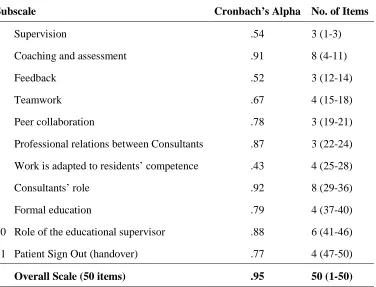
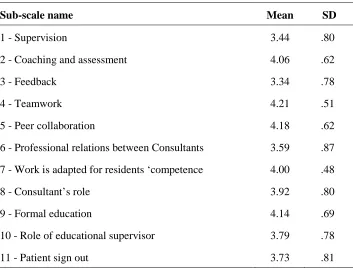
The second factor investigated was whether the learning climate of Intern doctors-in-training was conducive to learning. The validated Dutch Resident Educational Climate Test (D-RECT) was used, and written responses invited to the question ‘What three aspects of the junior doctor
ix
between Consultants domains were identified as significantly lower in General Medicine than for other units, triangulating the written comments provided by the Interns.
The third factor investigated Consultant Physicians as role models for doctors-in-training learning clinical reasoning skills. The focus of the semi-structured interviews explored how the Physicians understood clinical reasoning, their understanding of how they had acquired these skills, and the ways they sought to foster these skills among their doctors-in-training. The seven Consultants described their journey to gaining clinical reasoning expertise as being unguided, generally subconscious and seldom discussed. Most Consultants spoke of being unaware of their own journey to gaining clinical reasoning expertise, and did not regard themselves as role models for doctors-in-training. Most Consultants indicated that acquiring clinical knowledge and learning to think about their decision-making processes (metacognition), were crucial for acquiring expertise, but very few Consultants explained how they could intentionally foster these skills.
The final factor was explored by investigating how Intern doctors-in-training understood their own development of clinical reasoning skills. At the start of their General Medicine term, Interns were presented with basic information about clinical reasoning. At the end of that term, participating Interns were interviewed. A paper copy of the presentation given at the start of the term was used to stimulate Intern reflections on their learning during the General Medicine term. The 27 Interns interviewed identified that learning clinical reasoning was a tacit, personal journey influenced by enabling and inhibitory factors. The Interns attributed the differences between their clinical reasoning skills and those of their Consultants as being primarily due to the experience and superior clinical knowledge of the Consultants.
A multi-methods research design was used to answer the research questions across the four studies. The first two factors were investigated using quantitative methods, while qualitative methods were employed for the last two. The multi-methods approach enabled findings from the separate studies to be triangulated, supporting confidence in the trustworthiness of the synthesised outcomes and reducing an over-dependence on any individual study.
xi
Abbreviations
Abbreviation Name
AAA Acute adult admissions
AHPRA Australian Health Practitioner Regulation Agency AMC Australian Medical Council
CALM Cognitive Apprenticeship Learning Model DCT Director of Clinical Training
DMS Director of Medical Services
D-RECT Dutch Residency Educational Climate Test ED Emergency Department
FRACP Fellow of the Royal Australasian College of Physicians GM General Medicine
GS General Surgery JCU James Cook University KFP Key Features Problems
MAI Metacognitive Awareness Inventory MBA Medical Board of Australia
mCALM modified Cognitive Apprenticeship Learning Model MEU Medical Education Unit
MSAT Multi-Station Assessment Task MSOD Medical School Outcome Database MTRP Medical Training Review Panel
OSCE Objective Structured Clinical Examination QPMA Queensland Prevocational Medical Accreditation RACP Royal Australasian College of Physicians
RACS Royal Australasian College of Surgeons THHS Townsville Hospital and Health Service TTH The Townsville Hospital
xii
Definitions
Term Description
Consultant Fellow of a specialist medical college e.g. Fellow of the Royal Australasian College of Physicians
Doctor-in-training Refers to medical students and doctors in the first two years of clinical practice
Intern Medical doctor in their first postgraduate year of clinical work who holds provisional registration with the Medical Board of Australia Internship The year of supervised training, accredited by the Australian Medical
Council and approved by the Medical Board of Australia, an Intern must complete prior to being eligible for general registration
Learning climate External contextual factors that may influence learning
Metacognition Thinking about one’s thinking that enables understanding, analysis and regulation of cognitive and decision-making processes
Self-regulated learner
xiii
Publications and presented works
Publications
‘Metacognitive awareness and the link with undergraduate examination performance and clinical reasoning’
Paul Welch, Louise Young, Peter Johnson & Daniel Lindsay
MedEdPublish 2018 7(2) DOI 10.15694/mep.2018.0000100.1 * Based on findings of Chapter 3
‘Grounded theory – a lens to understand clinical reasoning’
Paul Welch, David Plummer, Louise Young, Frances Quirk, Sarah Larkins, Rebecca Evans & Tarun Sen Gupta
MedEdPublish 2017 6(1) DOI 10.15694/mep.2017.000002 * Supports Chapter 7
‘Learning and teaching clinical reasoning in daily practice’ Ralph Pinnock & Paul Welch
Journal of Paediatric and Child Health 2014 50(4). pp. 253-7 DOI 10.1111/jpc.12455 * Based on Chapter 1
‘Using the D-RECT to assess the Intern learning environment in Australia’ Ralph Pinnock, Paul Welch, Hilary Taylor-Evans, and Frances Quirk
xiv
Conference Presentations
‘How Consultants understand clinical reasoning expertise – and why it matters’ Paul Welch [Oral presentation]
Australian and New Zealand Prevocational Medical Education Forum November 2017, Brisbane, QLD
‘Teaching and learning clinical reasoning’
Paul Welch, Ralph Pinnock, Louise Young [Pre-conference workshop]
Association for Medical Education in Europe Conference August 2016, Barcelona, Spain
‘Metacognition as a predicator of clinical reasoning skills in medical students’
Paul Welch, Louise Young, Peter Johnson and Daniel Lindsay [Oral presentation]
Ottawa Conference and International Conference on Medical Education March 2016, Perth WA
‘Grounded theory and the clinical reasoning process’ Paul Welch & David Plummer [Oral presentation]
Australian and New Zealand Association for Health Professional Educators July 2015, Newcastle, NSW
‘The similarities between grounded theory and the clinical reasoning process: an opportunity to develop a coaching framework’
Paul Welch [Oral presentation]
2nd Montreal Conference on Clinical Reasoning October 2014, Montreal, Canada
‘Coaching and learning clinical reasoning’
Paul Welch, Louise Young & David Symmons [Workshop]
xv
Table of Contents
Statement of access i
Statement on sources ii
Electronic copy iii
Declaration of ethics iv
Acknowledgements v
Statement on the contribution of others vi
Abstract viii
Abbreviations xi
Definitions xii
Publications and presented works xiii
Publications xiii
Conference Presentations xiv
Table of Contents xv
List of Tables xxi
List of Figures xxii
Chapter 1: Learning clinical reasoning: a scoping literature review 1
1.1 Background 1
xvi 1.9 Empiricism – learning as a social and behavioural process 11
1.9.1 Constructivism 11
1.9.2 Social learning theories 12 1.9.3 Experiential learning 14 1.10 Rationalism – learning as a cognitive process 15 1.10.1 ‘Think-aloud’ - as a methodology 15 1.10.2 Chess Grandmasters and medical expertise 16 1.10.3 Elaborated and encapsulated knowledge 16 1.10.4 Script theory and illness scripts 18
1.10.5 Dual process theory 19
1.10.6 Cognitive load and the construction of meaning 20 1.11 Helpful heuristics, errors and bias 21 1.12 Teaching and learning clinical reasoning 25 1.13 Assessing clinical reasoning 26
1.14 Situational Factors 27
1.14.1 Metacognitive awareness 28
1.14.2 Learning climate 29
1.14.3 Consultants as role models 31
1.14.4 Interns as learners 31
1.15 Summary 32
Chapter 2: Context and approach 34
2.1 Introduction 34
xvii 2.5 Overarching approach to research design 40
2.6 Researcher perspective 41
2.7 Research questions 42
2.7.1 Four situational factor research studies 45
2.8 Structure of the thesis 46
Chapter 3: Metacognitive awareness 49
3.1 Introduction 49
3.2 Self-regulated learning and metacognition 49
3.3 Metacognition 50
3.4 Metacognition and clinical reasoning 51 3.5 Metacognitive failures linked to clinical reasoning errors 53 3.6 Medical accreditation and metacognition 54 3.7 Measuring metacognitive awareness 54 3.8 Medical undergraduate examinations 56
3.9 Research hypotheses 57
3.10 Ethical considerations 57
3.11 Method 57
3.12 Results 60
3.13 Discussion 65
3.14 Conclusion 68
Chapter 4: Learning climate 69
4.1 Introduction 69
4.2 Doctors-in-training: Internship 69
4.3 The learning climate 70
4.3.1 Measuring the learning climate 71 4.3.2 The Dutch Residency Educational Climate Test (D-RECT) 72
xviii
4.5 Ethical considerations 75
4.6 Method 75
4.7 Quantitative results 76
4.7.1 Cronbach alpha 76
4.7.2 Differences between the three core terms 77 4.7.3 Differences between ward and non-ward based terms 80 4.7.4 Responses to the D-RECT by gender 81 4.8 Quantitative result analysis 81 4.9 Qualitative themes and analysis 83 4.9.1 Emergency Department qualitative comments 84 4.9.2 General Surgery qualitative comments 86 4.9.2 General Medicine qualitative comments 87
4.10 Discussion 89
4.11 Summary 93
Chapter 5: Consultants as role models 94
5.1 Introduction 94
5.2 The research questions 95
5.3 Ethical considerations 95
5.4 Methods 95
xix 5.5.2 Theme 2. ‘Observations of the clinical reasoning process’ 114 5.5.3 Theme 3. ‘Nurturing clinical reasoning skill development’ 116
5.6 Discussion 123
5.7 Summary 128
Chapter 6: Interns as learners 130
6.1 Introduction 130
6.2 The research question 131
6.3 Ethical considerations 131
6.4 Methods 131
6.4.1 Rationale and development of the Intern presentation 131 6.4.2 Protocol for the Intern presentation 134 6.4.3 Intern interviews – using stimulated recall 134 6.4.4 Transcription and thematic analysis 135 6.4.5 Participant inclusion criteria 136
6.5 Results and analysis 136
6.5.1 Theme 1. ‘Characteristics of clinical reasoning experts’ 137 6.5.2 Theme 2. ‘Influence of colleagues on learning’ 142 6.5.3 Theme 3. ‘Influence of external factors’ 148
6.6 Discussion 153
6.7 Summary 159
Chapter 7: Synthesis and Proposed Framework 161
7.1 Introduction 161
7.2 Methodological approach to the research 162
7.3 Main findings 163
xx 7.3.4 Situational factor Study 4. ‘Interns as learners’ 165 7.4 Significance of the research findings 166 7.5 Identifying a learning framework 167
7.5.1 Grounded theory 168
7.5.2 The adaptive learner 170
7.6 Cognitive Apprenticeship Learning Model (CALM) 172
7.6.1 Content 176
7.6.2 Method 179
7.6.3 Sequencing 182
7.6.4 Sociology 184
7.7 Modifying CALM 185
7.8 mCALM 185
7.9 Implementing the mCALM - governance considerations 187 7.10 Limitations of this research 190
7.11 Future research 191
7.12 Conclusion 192
References 194
Appendix 1 Metacognitive Awareness Inventory (MAI) 219 Appendix 2 D-RECT questionnaire 224 Appendix 3 Intern PowerPoint Presentation 227
Appendix 4 Publications 232
Metacognitive awareness and the link with undergraduate examination performance and
clinical reasoning 232
xxi
List of Tables
xxii
List of Figures
1
Chapter 1: Learning clinical reasoning: a scoping
literature review
1.1 Background
Clinical medicine is complex and continually evolving. This literature review focuses on a key component of clinical medicine: the development of clinical reasoning skills. For medical knowledge to be clinically useful, it must be synthesised with information gathered from the patient to generate a diagnosis or management plan. Applying medical knowledge effectively is core to clinical practice. Accreditation and training institutions in Australia are increasingly explicit in expecting doctors-in-training to learn clinical reasoning skills (Royal Australasian College of Physicians 2017; Royal Australasian College of Surgeons 2018).
Clinical reasoning is a large and multifaceted construct which is explained and understood variously, depending on the individual’s perspective or discipline. Gruppen (2017) likened it to the fable of the blind men feeling the various parts of an elephant, and therefore describing it in very different ways. It is important that doctors-in-training develop clinical reasoning skills. Trowbridge et al. (2015) stated that ‘The broad and fundamental nature of clinical
reasoning in medical training means that it is housed nowhere but should be taught everywhere’ (Trowbridge, Rencic & Durning 2015 chapter 3 para. 18).
The cognitive psychologist may view clinical reasoning through the lens of information storage and retrieval. This perspective contrasts with the medical administrator’s focus on reducing errors and increasing patient safety. The clinical supervisor, however, may be focused on how to best teach clinical reasoning skills. Because of its complexity and the diversity of ways it can be viewed, clinical reasoning firstly needs to be defined. Once defined, its importance demands that methodologies are applied which enable these skills to be effectively fostered within the clinical setting. This literature review defines and explains the importance of clinical reasoning skill development before exploring early modalities of medical training.
2 applied originates in the field of cognitive psychology. In addition to the cognitive perspective applied to understanding clinical reasoning, a second main branch of research literature explores learning as a social behavioural process. The summary section of this literature review proposes that effectively cultivating clinical reasoning skills in a specified location requires a learning framework that has been tailored for this purpose.
1.2 Defining clinical reasoning
Health professionals make use of clinical reasoning skills as they seek and gather patient data, synthesise it with their knowledge and then create a clinical impression, diagnosis or care plan (Young et al. 2018). Although clinicians seek to teach, assess and research clinical reasoning, an agreed definition across the different health professions remains problematic (Young et al. 2018). There are also widely differing understandings of what clinical reasoning means within the medical profession. In medicine, some clinicians may emphasise the cognitive and subconscious processes involved in clinical reasoning, while others may place greater importance on its social and dynamic components (Young et al. 2018). The literature on clinical reasoning is diverse and fragmented, in part due to the many different ways clinical reasoning is understood (Frank et al. 2010).
A recent concept analysis of the term ‘clinical reasoning’ (as applied to clinical medicine) by Yazdani et al. (2018), determined that the concept had several major attributes, including:
• Cognitive process involving gathering, analysing and interpreting patient information (Montgomery 2005);
• Knowledge acquisition which is then codified and applied (Bordage & Zacks 1984);
• Thinking as part of the process – involving both cognition and metacognition (Colbert et al. 2015);
• Patient data (Higgs et al. 2008);
• Context-dependent and domain-specific (Norman 2005);
• Iterative and complex processes (Marcum 2012; Welch et al. 2017).
• Multi-modal cognitive processes, including both tacit and explicit components (Eva 2005).
3 The research of Yazdani et al. (2018) shed some light on the complexity of establishing a definition for clinical reasoning. In this thesis, the following definition by Eva (2005), will be used as a working definition of clinical reasoning:
Clinical reasoning is the ability to ‘sort through a cluster of features presented by a patient and
accurately assign a diagnostic label, with the development of an appropriate treatment strategy being the end goal (Eva 2005 p.98).
Many researchers, including Croskerry, have regarded clinical reasoning as the physician’s most critical competence (Croskerry 2009c; Nendaz & Bordage 2002; Norman 2005; Pelaccia, Tardif, Triby & Charlin 2011). Clinical reasoning, and its application to teaching, learning and assessment, have been studied for several decades and from several different perspectives.
1.3 Perspectives on clinical reasoning
4 Table 1.1 Approaches to understanding clinical reasoning
Discipline/approach Areas explored Strengths/ limitations Primarily cognitive
Cognitive psychology
How information is encoded (Bordage & Zacks 1984; Charlin et al. 2007), stored, retrieved and applied (Pelaccia, Tardif, Triby & Charlin 2011) metacognition (Eichbaum 2014).
Characteristics of decision making – including Type 1 and 2 (intuitive and analytical) (Norman 2009; Pelaccia, Tardif, Triby & Charlin 2011) types of error/ bias (Scott 2009).
The roles of affect and motivation (Artino Jr, Holmboe & Durning 2012a).
Useful for developing methods for teaching and reflection (Chamberland et al. 2015; Croskerry 2003a); awareness of bias, errors (Graber, Franklin & Gordon 2005) and heuristics. Limitations: learning is also a social process situated in a pressured, complex learning climate (Durning & Artino Jr 2011).
Educational/ learning
Use of virtual patients and simulation technology (Bond et al. 2008; Hege et al. 2018; Posel, Mcgee & Fleiszer 2015).
Useful in developing cognitive dimensions of clinical reasoning. Limitation: Context may not accurately mimic clinical setting.
Assessment Assessment methodologies have been developed including key features tests, script concordance test (Charlin et al. 2000; Hrynchak, Glover Takahashi & Nayer 2014)
Being able to assess clinical reasoning skills is highly desirable, but problematic. These skills cannot be measured directly (Rencic et al. 2016).
Primarily Social Learning as a social
process
Learning is a social process (Bandura & McClelland 1971; Lave & Wenger 1991; Vygotsky 1978) influenced by the learning climate, including role modelling (Irby 1986; Passi & Johnson 2016a; Roff & McAleer 2001).
Useful for understanding the context of learning, the motivators and barriers influencing them (Artino Jr, Holmboe & Durning 2012a)
Limitations: Learning clinical reasoning is also a cognitive process.
Education/ learning Case-based teaching, Problem based learning (Kassirer 2009; Savery & Duffy 1995).
5 Much of the original research described in Table 1.1 first occurred in a range of non-medical disciplines, and was later adapted for use in explaining aspects of the clinical reasoning process. In some instances, despite continuing advances in an area of research, these developments may not have been widely integrated into medical education theory. For example, dual process theory posits that there are two distinct types of decision making: Type 1 – fast and intuitive, and Type 2 – slower and analytical (Kahneman 2012). Early research in this area in the disciplines of management and philosophy can be dated back to at least 1938. Barnard (1938) noted that under pressure, some individuals process knowledge without conscious effort that is intuitively. In the early 2000s, Stanovich et al. (2000) suggested that information processing occurs in a parallel manner with conscious deliberation (Type 2) and subconscious intuition (Type 1). Researchers proposed that Type 1 thinking was the default modality until such time as analytical thinking (Type 2) was required (Epstein 2003). Since the early 2000s, dual process theory research has become very popular as a way explaining decision making as part of the clinical reasoning process (Pelaccia, Tardif, Triby & Charlin 2011). The simplicity of the dual-process theory is appealing, but Custers (2013) argued that it is too basic and does not fully account for the breadth and complexity involved in the clinical reasoning process. The cognitive continuum theory (CCT) which Custer (2013) proposed, posits that Type 1 and Type 2 thinking are at either pole of a continuum, and that a clinical reasoning event is a quasi-rational process, involving a blend of Type 1 and Type 2 reasoning.
6 theory may be regarded as an advancement of the dual-process theory, it has few advocates (Custers 2013; van Merriënboer 2014). Reasons for this may include the appeal and simplicity of the dual-process theory, and the ease with which it aligns with methodologies aimed at reducing cognitive errors (Croskerry 2003a). So, although the model developed by Custers may have greater explanatory power, it has gained little traction. Perhaps it is seen as having little practical benefit, either for teaching or reducing error rates. In writing this review, it was necessary to limit the scope of the literature discussed, and to focus primarily on those frameworks and theories that have been widely accepted and applied, even if they may have been further developed in other disciplines.
1.4 Scoping review – the rationale and methodology
Clinical reasoning literature encompasses a wide range of research approaches. While a scoping review accommodates a variety of study designs and methodologies, a systematic review often uses statistical methods to determine the effectiveness of a specific intervention. A systematic review tends to favour randomised control trial research design (Arksey & O'Malley 2005). A scoping review, however, seeks to provide a descriptive summary of the reviewed literature, and is particularly useful if the topic is complex or heterogenous (Mays, & Popay 2001). Scoping reviews differ from narrative reviews in that they require an analytical re-interpretation of the literature in order to give cohesive meaning to the variety of different studies included (Davis, Drey & Gould 2009; Levac, Colquhoun & O'Brien 2010). Analytical re-interpretation was important in this review due to the diversity of approaches taken within the clinical reasoning literature. Another benefit of the scoping review methodology was that it provided a robust approach to mapping the research area. The methodology adopted for this review was first described by Arksey and O’Malley in 2005.
Colquhoun et al. regarded a scoping review as:
7 Table 1.2 Stages of the Arskey and O’Malley Scoping review
Stages of the
scoping review Description
1 Identifying the broad research question
2 Identifying relevant databases; use of key terms
3 Use of inclusion/ exclusion criteria to identify relevant studies
4 Descriptively analysing information presented in the literature
5 Collating, charting, summarising and reporting of the literature
6 Consulting with external stakeholders then refining focus of
review
Source: Arksey and O’Malley (2005)
Arksey and O’Malley (2005) regarded the sixth and final stage of consulting with external stakeholders as optional. Other researchers have disagreed, regarding it as an essential part of the scoping review process (Levac, Colquhoun & O'Brien 2010). In this research, consulting with clinical staff was regarded as essential in helping to finely tune the review, and to make it relevant to the research location. The review focussed on factors that influence the development of clinical reasoning skills among doctors-in-training as discussed below.
1.5 Literature search strategy
‘Doctors-in-training’ is a term used throughout this thesis and refers to medical students and doctors in the first two years of clinical practice. The overarching research question was: ‘How
do doctors-in-training develop clinical reasoning skills?’ The key terms used in searching for the relevant literature included: clinical reasoning, medicine, decision making, diagnosis,
education, teaching/method, cognition,metacognition, learning environment/climate and role
8 references of interest from the period January 1970 – September 2018. These references encompassed both the English and non-English language literature. Only a few of the papers date from before 1960.
The fourth and fifth stages of the Arksey and O’Malley (2005) scoping framework process required organisation and synthesis of the literature in order to enable gaps in the literature to be identified. The literature review that follows is organised to initially provide a broad theoretical base, which then narrows to the research area explored in this thesis. Before concentrating on the details of clinical reasoning research, it is useful to review the fundamental changes to medical education that have taken place over the last century.
1.6 Early models of medical training
Medical training has evolved a great deal since Flexner delivered his landmark report to the Carnegie Institute in 1910 (Flexner, Pritchet & Henry 1910). Before this date, medical schools varied considerably in the content and duration of their teaching. For example, Abraham Flexner’s brother Simon qualified as a medical doctor in less than a year, without ever having seen a patient or dissected a body (Dornan 2005). There was no agreed best way to teach or to learn, and the accreditation of medical training was still a long way off. Today, many jurisdictions, including Australia, the USA and the UK, require medical training to meet stringent accreditation requirements and take many years (World Federation for Medical Education 2018).
Flexner’s detailed report to the Carnegie Institute highlighted the need for biomedical science to be at the core of medical training, followed by clinical training within teaching hospitals (Dornan 2005). Flexner’s report is regarded as a watershed in the development of medical training. William Osler, a Canadian physician who also taught and practised medicine in the early twentieth century, is primarily remembered for his insistence that clinical medicine needed to be learned within the clinical context and with patients. Osler’s famous quote succinctly sums this up:
9 In the years since Flexner’s report, medical training at both undergraduate and postgraduate levels has seen many changes. These changes have involved both the structure and content of the courses. For example, curricula having a biomedical science focus have been dominant since the early decades of the 20th century (Frenk et al. 2010). More recent innovations included the development of Problem Based Learning (PBL). PBL aimed to integrate the medical sciences and clinical case presentations, with the aim of improving the way students applied their knowledge (Savery & Duffy 1995). In addition to changing the way students were taught, a huge quantity of medical knowledge has been added to the curriculum. Today, many components vie for inclusion in a crowded undergraduate medical curriculum, such as professionalism, communication skills and cultural training (Birden et al. 2013). However, helping doctors-in-training to mobilise their knowledge and then to apply it in a reasoned, relevant and ethical manner is of paramount importance (Frenk et al. 2010). The next sections detail how clinicians mobilise and apply their clinical knowledge.
1.7 Developing expertise in clinical reasoning
It is helpful to define expertise before relating it to clinical reasoning ability. Expertise may be thought of as ‘consistently superior, replicable performance producing definable results within
10
1.8 How doctors-in-training learn
To understand how doctors-in-training learn within the clinical work environment, one must look initially at educational learning theories. The two main epistemological positions from which many of these theories are derived are empiricism and rationalism. Aristotle advanced the view that knowledge is the product of experience alone (empiricism). Meanwhile Plato developed the opposite approach - that knowledge is a product of the mind alone
(rationalism). Educational theories that look at learning through a social and behavioural perspective have their roots in empiricism, while those looking through the cognitive lens are typically rationalist (Durning & Artino Jr 2011).
The following table shows how the literature review has been broadly organised into the empiricist and rationalist approaches. After these approaches have been discussed, three areas of research: the learning climate, role modelling and self-regulated learning (specifically metacognition), are then discussed under the title of ‘situational factors’. These situational factors are used as an organising framework for the research described in the rest of the
thesis.
Table 1.3 Approaches to understanding clinical reasoning skills
Empiricism
(Learning through experience)
Rationalism
(Learning as a cognitive process)
‘think-aloud’
Constructivism Chess Grandmasters as a proxy for expertise
Social learning theories Elaborated and encapsulated knowledge
Experiential learning Script theory and illness scripts
Dual process theory
11
1.9 Empiricism – learning as a social and behavioural process
1.9.1
Constructivism
Constructivist epistemology states that extending one’s learning is a process of adding new knowledge to pre-existing knowledge. It is a building process, in which ‘...[t]he most important
factor influencing learning is what the learner already knows’ (Ausubel, Novak & Hanesian 1968 p.iv). Constructivism had its origins within Kantian philosophy and was employed in the educational and learning context by Piaget (1955). Piaget expanded upon this idea by stating that experience is constantly being ‘filtered’ through pre-existing concepts and existing knowledge networks (Flavell 1963). As new knowledge is understood in the light of existing knowledge, it is added to a schema (or mental model) that is being created and developed in the mind of the learner. In the context of clinical reasoning, these schemas are called ‘illness
scripts’. Illness scripts are networks of organised clinical knowledge constructed by the learner, which may be mobilised to help solve clinical problems (Charlin et al. 2007; Fournier, Demeester & Charlin 2008). As well as aiding in the diagnostic process or the management of the patient, illness scripts may motivate the doctor-in-training to seek additional clinical information in order to confirm their provisional diagnosis (Charlin, Tardif & Boshuizen 2000).
12 Constructivist theory helps explain how knowledge and skills are assimilated in the mind of the learner into schema, which may later be mobilised for clinical use. Schema-based instruction for medical students has been hypothesised to improve diagnostic accuracy and knowledge organisation (Blissett, Goldszmidt & Sibbald 2015). The rationale offered is that teaching using schemas links the clinical information in a way that is intentionally made memorable and ready for application (Blissett, Goldszmidt & Sibbald 2015).
Piaget’s theory of learning through constructivism does not fully account for the social factors that influence learning. Clinical reasoning skills are learned in a workplace. That workplace is often made up of a variety of staff who may have widely varying roles, skills and levels of experience. Within the clinic or hospital, there are often Consultants, Registrars, Interns, medical students and nurses as well as other skilled personnel who work in teams. The clinical focus of these multi-disciplinary teams is the welfare of the patient. However, the learning that takes place within these teams is greatly influenced by social and behavioural factors such as teamwork and the willingness of senior staff to teach, and the motivation of doctors-in-training to learn.
Therefore, the medical staff working within these complex multi-disciplinary environments observe and learn skills, attitudes and beliefs from a range of sources. The effectiveness and speed with which learners recall, synthesise and then apply their knowledge, is affected by this clinical environment.
1.9.2
Social learning theories
Lev Vygotsky was born in 1896, the same year as Piaget, but lived in Russia during the time of the Russian revolution. His work was not translated into English until 1962, and was therefore inaccessible to a non-Russian audience. Vygotsky’s Sociocultural Theory of
Cognitive Development stated that human psychological development is the product of social interaction with the environment (Vygotsky 1978). His description of the zone of proximal
13 Knowledgeable Other (MKO). Within the context of medical education, the MKO could be a Consultant or clinical teacher, perhaps another health professional, or even a learner’s peer who has more knowledge or expertise in a certain area. The notion of learning through an apprenticeship fits closely with the work of Vygotsky (Dornan 2005).
Like Vygotsky’s earlier work, Bandura’s Social Learning Theory emphasised the importance of environmental factors in explaining how a person learns. Bandura stated that how a person learned was a product of the personal, behavioural and environmental factors involved with their learning (Bandura 1986). Bandura called this ‘triadic reciprocal determinism’ in which the person (which includes their cognition, self-efficacy, motives and personality), environment (situation, roles and relationships) and behaviour (complexity, duration and skill level) interact to influence learning. Social Cognitive Theory proposed that learning is effective when there is a close alignment between the learner and the person from whom they are learning, especially if the learner has a high degree of self-efficacy, which is a blend of determination and a belief that they can gain mastery of a skill (Bandura 1989). There is an established understanding in medical education that effective learning is closely linked with imitation, observation and role-modelling (Passi et al. 2013; Sternszus & Cruess 2016). The importance of role modelling in learning has recently attracted increased interest in the literature and is discussed later in this thesis (Passi & Johnson 2016a; Passi et al. 2013; Sternszus & Cruess 2016). Bandura’s important pioneering studies may be regarded as one of the major starting points for a range of research studies that have linked environmental factors to the effectiveness of learning. These views may also be traced back to Aristotle’s empiricist position that associates gaining experience with acquiring knowledge. Bandura’s Social Cognitive Theory appears to have great relevance and application in medical education by assisting in the understanding of the influence of environmental factors on learning. The development of learning climate measuring instruments, such as the Dutch Residency Educational Climate Test (D-RECT) owe part of their theoretical foundations to Bandura's Social Cognitive Theory (Bandura 1989; Boor et al. 2011).
14 experience (Bleakley 2010). A key aspect of learning is its experiential aspect, which was further developed by Dewey, Kolb and Mezirow as detailed below.
1.9.3
Experiential learning
In the early 1930s, John Dewey stated that one does not learn through gaining experience, but by reflecting on that experience (Dewey 1933). In other words, experience alone may not result in learning. Kolb’s Experiential Learning Theory, published in the early 1980s, built on Dewey’s observation and established a constructivist foundation by providing evidence that we learn through experience and by moving through the experiential learning cycle (Kolb 1984). According to Kolb’s now well-established theory, we learn by moving through four stages: concrete learning, reflective observation, abstract conceptualisation and active experimentation. Kolb’s theory is a broad starting point to better understand how experience helps to shape learning within the clinical context. However, the breadth and generality of Kolb’s theory give only an overview of the transformative process going on in the mind of the learner, as additional information is synthesised, stored and then retrieved for use within the clinical setting.
15 Problem-based learning (PBL), developed in the early 1970s, makes use of constructivist principles and is underpinned by the work of Kolb and his Experiential Learning Theory (Savery & Duffy 1995; Schmidt 2012). A core premise of PBL is that a person’s extraneous learning is a function of their grappling to synthesise and generate a personalised understanding of how medical information fits together in order to make meaning. One of the main instructional principles of PBL is that all learning activities be anchored in solving a larger problem or task (Savery & Duffy 1995). These principles have strong parallels with Osler’s belief that effective learning takes place within the clinical work context of caring for the patient (Osler 1914). The Oslerian view is that effective medical education requires a clinical context in order to make sense of, as well as to ground, a student’s understanding of medicine. The close connection between clinical context and the learning of clinical reasoning skills is a frequently repeated theme in the literature.
To understand how the learning of clinical reasoning skills develops both empiricist and rational perspectives need to be understood (Braude 2012). Research aligning with the rationalist, cognitive perspective is detailed below.
1.10 Rationalism – learning as a cognitive process
1.10.1
‘Think-aloud’ - as a methodology
16 experts think differently from novices. More recently ‘think-aloud’ has been promoted as an excellent method of making expert thinking explicit, or ‘visible’ to the learner (Beyer 1997; Houchens et al. 2017; Pinnock, Fisher & Astley 2016). By thinking aloud in the presence of a more senior clinician, gaps and connections in the novice thinking process can be identified, discussed and, if necessary, remediated (Houchens et al. 2017).
1.10.2
Chess Grandmasters and medical expertise
After these early ‘think-aloud’ studies, a different approach was taken in seeking to understand expertise. It was hypothesised that chess Grandmasters become experts by remembering up to 50,000 representative moves from previous games (Simon & Chase 1973). These representative cases were then able to be recalled for use in subsequent games. The study by Simon showed that the single best measure of chess players was their recall of a mid-game position after a five-second look at the game (Simon & Chase 1973). Researchers hypothesised that chess Grandmasters and physicians stored, retrieved and then applied knowledge by the same processes. However, remembering substantial amounts of detailed patient information did not seem to help physicians make better clinical decisions in the future (Schmidt & Boshuizen 1993b). Subsequent studies showed that expertise in chess is dissimilar to expertise in clinical medicine (Ericsson 2004).
This early exploration into understanding medical expertise demonstrates a crucial point. Although clinical knowledge is a key ingredient in gaining clinical reasoning expertise, it is not the only element (Cutrer, Sullivan & Fleming 2013). Clinical reasoning expertise is complex and multi-factorial (Custers 2018). Currently, much of the research, for example into areas such as cognitive psychology, expert performance and decision making, is not incorporated into mainstream medical education (Looi & Yong 2017; Trimble & Hamilton 2016). This is problematic and its omission may lead clinicians who are unfamiliar with the literature to assume a simplistic connection between accumulating knowledge and developing clinical reasoning expertise.
1.10.3
Elaborated and encapsulated knowledge
17 (Schmidt & Boshuizen 1993b). They named this the intermediate effect as it refers to the difference between the way a novice and an expert recall a clinical case after both have briefly read through written case notes. Both novice and expert are given the same case to read and are then asked to recall the patient history, clinical data, diagnosis and management. The novice recalls the case in elaborate detail, whereas the expert is far more concise and focussed in their recall. Experts have their knowledge better organised or encapsulated (Schmidt & Boshuizen 1993b). Based on this research, Bordage et al. developed the concept of ‘forceful features’, later renamed ‘key features’ (Bordage, Grant & Marsden 1990). Key features are defined as important steps in unravelling a clinical problem (Hrynchak, Glover Takahashi & Nayer 2014). Testing trainees for their ability to identify key features in a clinical case is currently regarded as one method available for assessing clinical reasoning ability, along with the script concordance test described in Section 1.12 (Charlin et al. 2000; Hrynchak, Glover Takahashi & Nayer 2014). The key feature assessment approach was developed to overcome domain specificity and focussed only on decision-making. The script concordance test, however, was developed to try and capture the reasoning process using script theory, as it was felt that merely focusing on the decision alone was not sufficient.The focus of research in the early 1990s then shifted to investigating how knowledge is organised in the clinician’s memory (Bordage & Lemieux 1991).
18 Goldszmidt & Sibbald 2015). However, this evidence should be treated with care, as using schemas may be a substitution for a more detailed understanding of the clinical problem (Coderre et al. 2003). Schema-based instruction is thought to be effective because it reduces the cognitive load placed on the learner, a process discussed further in Section 1.10.6. These findings are supported by the more fundamental premise: that learners must construct their schema based on what they already know. Therefore, schema-based instruction appears to encourage the learner to assemble new knowledge, to more easily formulate their understanding.
1.10.4
Script theory and illness scripts
By the end of the 1990s, exploring the way medical knowledge was stored and retrieved had gained a reputation as a productive area of research. Explanations for the reason that the knowledge of medical experts was stored differently from that of novices echoed the conclusions of cognitive psychology research at that time (Elstein, Shulman & Spaka 1978; Gilhooly 1990; Schmidt & Boshuizen 1993b). Researchers noted that medical experts drew on
compiled script-like knowledge when making a diagnosis (Gilhooly 1990). The concept of the script is similar to that of the term schema, which is used in psychological research (Johnson & Hasher 1987). Feltovich et al. (1984) were pioneers among medical education researchers, describing the knowledge of medical experts as being compiled into illness scripts. Illness scripts were defined as networks of encapsulated knowledge, shaped by experiences that direct the selection, interpretation and memorisation of new information (Schmidt, Norman and Boshuizen 1990, Charlin, Tardif & Boshuizen 2000; Custers, Regehr & Norman 1996).
19 effectively refine their repertoire of illness scripts. The links between old and new information may not have been continually refined, and so the progression towards clinical reasoning expertise may have been slowed or inhibited. By failing to reflect upon and therefore learn from experience, the clinical performance levels of the experienced non-expert may plateau or even decline (Dewey 1933; Dhaliwal 2015).
As clinicians gain experience and their illness script repertoire is refined and expanded, they add exemplars and semantic qualifiers to these scripts. Exemplars are memorable case examples of a specific illness script. For example, a clinician may be able to recall many different presentations of a specific condition or syndrome. Some of these presentations may be unusual or have caused the clinician to miss the correct diagnosis when the patient presented. Instances of misdiagnosis are memorable. These exemplars, when added to the detail of a refined illness script, help the clinician to develop a heightened awareness for certain parts of the clinical history; its key features. The key features of a case enable the rapid activation of an illness script, often resulting in fast, intuitive diagnostic hypothesis generation (Charlin et al. 2000). Semantic qualifiers are adjectives that help to fully describe a presentation, for example, acute versus chronic (Bordage & Lemieux 1991). This intuitive, or type 1 thinking, makes use of the illness script repertoire belonging to the expert. Slow, analytical, hypothetico-deductive thinking is often reserved for complex or unusual presentations, for example, where an expert is aware that aspects of the patient’s history are at odds with an intuitive diagnosis.
1.10.5
Dual process theory
20 normally fast and subconscious process by making the clinician articulate their otherwise subconscious thinking.
Type 2, or analytical thinking is slower than Type 1 thinking and often uses cognitively demanding hypothetico-deductive processes. Importantly, Type 2 thinking happens consciously, and is therefore much easier to explain to the learner. Initially, it was thought that intuitive thinking was less reliable than analytical thinking, as it was regarded as more prone to cognitive bias and diagnostic error. It has been accepted for several years that Type 2 thinking is not necessarily superior to Type 1 thinking (Norman 2009). Recent research has indicated that intuitive decision making is a hallmark of expert clinical reasoning (Brush, Sherbino & Norman 2017). Thinking of decision making as a dual process is practically helpful, but may represent an over-simplification of a more complex process (Custers 2013).
1.10.6
Cognitive load and the construction of meaning
21 By the early 1990s, a broad basic understanding of the process of clinical reasoning had begun to develop. Earlier studies had established that expertise in one domain did not confer expertise in another, and that there was no discrete expertise process (Elstein, Shulman & Spaka 1978; Schmidt, Norman & Boshuizen 1990). Medical experts organised their clinical knowledge in an encapsulated form, which enabled them to recall and apply it efficiently within the clinical work environment (Schmidt & Boshuizen 1993a). Understanding that experts had their knowledge organised differently from novices led to an increased interest in how clinical reasoning could be best taught and assessed. Reducing the cognitive load on the learner through schema-based instruction appeared to be beneficial to learning.
The practical benefits of better understanding the clinical reasoning process are twofold. Firstly, to identify and reduce errors caused by clinical reasoning failures, and secondly, to develop better, more effective ways, to teach clinical reasoning skills to doctors-in-training. The section that follows explores how clinical reasoning errors have been researched and explained.
1.11 Helpful heuristics, errors and bias
In recent years the widespread assumption that clinicians are rational decision makers has been challenged (Avorn 2018). Early work in the 1970s by Tversky and Kahneman, and more recently by Thaler in the diverse fields of cognitive psychology and behavioural economics, has provided a compelling narrative which explored these influencing factors further (Kahneman 2012; Leonard 2008). This research provided evidence that professional decision makers, such as clinicians, make predictable, irrational decisions. In his New England Journal of Medicine (NEJM) paper, Avorn (2018) goes further to describe how human emotions and motivation can be manipulated to influence clinical decisions. For example, pharmaceutical companies are adept at providing prescribers with persuasively salient information, in order to deliberately manipulate their prescribing habits.
22 frugal, ignoring irrelevant parts of the available information. Due to these characteristics, heuristics help the expert clinical mind to manage uncertainty more efficiently than the unbiased mind (Gigerenzer & Brighton 2009). Early heuristic research was underpinned by three tightly held beliefs based on the ‘accuracy-effort trade-off’ theory of cognition. This theory, when applied to heuristics, assumed that heuristics are always second best and tend to be used due to cognitive limitations, and that analytical thinking is always better (Gigerenzer & Brighton 2009; Tversky & Kahneman 1974). In the context of clinical reasoning, there was an underlying assumption that more information was always better (Gigerenzer 2008). In the clinical reasoning literature, several of these heuristic elements such as anchoring, availability and repetitiveness heuristics are linked to negative biases that may lead to clinical reasoning errors (Croskerry 2003b).
Medical errors have been the focus of a great deal of attention since the publication of the Institute of Medicine (IOM) report ‘To err is human: building a safer health system’ (Donaldson, Corrigan & Kohn 2000). The updated IOM report defines diagnostic error as
failure to make an accurate patient diagnosis in a timely way (Balogh, Miller & Ball 2016). This report proposed that medical errors be categorised into three groups: systems errors, no-fault errors and cognitive failures (Graber, Gordon & Franklin 2002). Systems errors may include equipment, policy or training failures. Once identified, these system errors are relatively easy for organisations to address and improve. No-fault errors arise due to an atypical patient presentation, or the condition mimicking a more common disease, thereby confounding the treating clinician (Graber, Gordon & Franklin 2002) (Graber, Gordon & Franklin 2002). Classifying these as ‘no-fault’ clinical reasoning errors may appear to be a reasonable administrative categorisation. However, these diagnoses may also be regarded as complex cases of premature closure. The diagnosis may have been finalised prematurely, perhaps due to the way the clinical features of the patient’s illness mimicked a different condition. It may however, have been possible for the clinician to navigate these case confounders, as the correct diagnosis was eventually made at post-mortem.
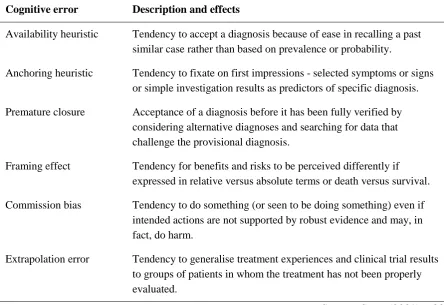
23 errors. To reduce the risk of clinical reasoning errors, there needs to be an understanding of how such errors occur in the first place (Croskerry 2003a). Table 1.4 provides a list of common cognitive errors along with a description.
24 Table 1.4 Examples of cognitive error affecting patient diagnosis or management
Cognitive error Description and effects
Availability heuristic Tendency to accept a diagnosis because of ease in recalling a past similar case rather than based on prevalence or probability.
Anchoring heuristic Tendency to fixate on first impressions - selected symptoms or signs or simple investigation results as predictors of specific diagnosis.
Premature closure Acceptance of a diagnosis before it has been fully verified by considering alternative diagnoses and searching for data that challenge the provisional diagnosis.
Framing effect Tendency for benefits and risks to be perceived differently if expressed in relative versus absolute terms or death versus survival.
Commission bias Tendency to do something (or seen to be doing something) even if intended actions are not supported by robust evidence and may, in fact, do harm.
Extrapolation error Tendency to generalise treatment experiences and clinical trial results to groups of patients in whom the treatment has not been properly evaluated.
Source: Scott (2009) p.339
Recent research has provided evidence that there may be no difference in the frequency of clinical reasoning errors, regardless of whether heuristics or analytical thinking have been used (Bodemer, Hanoch & Katsikopoulos 2015). Indeed, some recent research indicates that it would be wise to acknowledge the important role that heuristics play in everyday clinical practice and seek ways to understand and make better use of them (Bodemer, Hanoch & Katsikopoulos 2015).
25
1.12 Teaching and learning clinical reasoning
The notion that doctors-in-training learn from more senior clinicians is not new. At the time Flexner wrote his report for the Carnegie Foundation in 1910, the notion of learning through apprenticeship was widespread (Flexner, Pritchet & Henry 1910). An apprentice is defined in the Concise Oxford English Dictionary (2001) as ‘A learner of a craft, bound to serve, and
entitled to instruction from, his or her employer for a specified period. Also, a beginner or novice’. Learning through apprenticeship has its theoretical foundations in empiricism, and more recently in the work of Vygotsky and Bandura, as well as with Lave and Wenger (Section 1.9.2). In recent years, the concept of medicine as an apprenticeship has come under pressure due to the increased numbers of learners in the system, the shortening of clinical attachments and the increasing specialisation of medicine (Dornan 2005). There is also the suggestion that recent educational developments have over-simplified or ‘atomised’ professional expertise, reducing it to knowledge, skills and attitudes (Dornan 2005). This realisation has led to a renewed interest in exploring the benefits of apprenticeship for the modern learner (Lyons et al. 2017). Cognitive apprenticeships may be useful in developing clinical reasoning skills by helping to make expert ‘thinking visible’ for the learner (Collins, Brown & Holum 1991).
Within the context of apprenticeship being under pressure, there have been renewed efforts to teach clinical reasoning skills (Nendaz & Bordage 2002; Schuwirth 2002). Many of the early approaches were founded on the premise that making learners aware of how experts’ reason, would, in turn, help them to reason like experts (Rencic 2011). Some of these interventions were based on research which had investigated how clinical knowledge was stored, retrieved and used. For example, teaching using illness scripts (Section 1.10.4) had some success. Using illness scripts was thought to be helpful, as the way knowledge is presented makes it easier for the learner to store, retrieve and clinically utilise information (Blissett, Cavalcanti & Sibbald 2012). Other efforts to reduce clinical reasoning errors have focussed on using cognitive forcing strategies, (described in Section 1.3) or encouraging self-explanation as a means of encouraging students to develop their metacognitive skills (Chamberland et al. 2015; Croskerry 2003a).
26 tailored for learners in a specific location appears to have merit. Often, however, there is little teaching provided to learners to improve their clinical reasoning skills (Trimble & Hamilton 2016). However there has been considerable effort made to develop ways of assessing clinical reasoning. Although assessing clinical reasoning ability is not a central focus of this research, it is often stated that assessment drives learning and the development of expertise (Larsen, Butler & Roediger III 2008; Wood 2009). An overview of approaches to assessing clinical reasoning is discussed below.
1.13 Assessing clinical reasoning
Assessing clinical reasoning skills for doctors-in-training has been the focus of much effort in the last few decades, but it cannot be measured directly (Rencic et al. 2016; Schuwirth 2009). It is regarded as relatively easy to generate assessments to determine student knowledge (Cooke & Lemay 2017). Assessing clinical reasoning performance, however, is problematic. Firstly, clinical reasoning takes place within the context of uncertainty (Fargason et al. 1997). To become a clinical reasoning expert the clinician must learn to tolerate a degree of uncertainty, both with the quality and quantity of patient data (Hillen et al. 2017). Secondly, there may be several interacting variables which may appear contradictory or incomplete, in addition to the clinical information. Additionally, there may be more than one correct answer. This situation poses a considerable challenge to medical students and their patients, who may subconsciously believe there can only be a single, correct diagnosis or management plan (Cooke & Lemay 2017).
As the importance of clinical reasoning has become more apparent, several qualitative methodologies have been developed that seek to assess it. Assessment using chart-stimulated recall requires the learner to use a patient chart in order to stimulate recall of their reasoning process about key aspects of the case. The assessor then evaluates the verbal recall of the examinee. Direct observation is another method of assessing clinical reasoning skills, in which the clinical reasoning and judgement of the examinee are compared to specific criteria (Addy, Hafler & Galerneau 2016).
27 SCT seeks to assess some key characteristics of the clinical reasoning process including the complex, ill-defined and uncertain nature of generating a diagnosis or management plan (Fox 2000). The similarity between the test tasks and the decision points encountered by the clinician during their daily practice is an important characteristic of the SCT (Fournier, Demeester & Charlin 2008). There are three parts to each question: Firstly, the question asks: ‘If you were
thinking of…’ - then a realistic diagnostic option is suggested. The second part of the question follows: ‘…and then you find…’ – a clinical finding is offered, for example, a named pre-existing condition. The third part of the question requires the examinees to make a judgement on a few suggested options and asks: ‘…then this option [a suggested diagnosis] would become
…’ - and the examinee is offered a five-point Likert scale from ‘very likely’ to ‘very unlikely’. The Likert scale enables the examinee to indicate how closely associated he/she estimates the link between the hypothesis, the clinical finding and the suggested diagnosis to be (Fournier, Demeester & Charlin 2008). Constructing and validating a SCT is a demanding and time-consuming task, but it enables aspects of clinical reasoning ability to be quantified within a specific domain (Boulouffe et al. 2014). There is currently a great deal of interest and effort being applied to finding ways to assess clinical reasoning skills.
The next section of the literature review is titled Situational Factors. Having reviewed the general literature relevant to the overarching research question, the researcher now turns to specific situational factors that may influence how doctors-in-training learn clinical reasoning skills. These situational factors need to be understood to enable the development of a nuanced framework to support doctors-in-training to better learn clinical reasoning skills in the research location.
1.14 Situational Factors
So far, this literature review has explored the empiricist and rationalist approaches to understanding clinical reasoning -- in other words, viewing the acquisition of clinical reasoning expertise through either a social learning or a cognitive processing lens. However, neither of these approaches on their own or in combination, are enough to provide a nuanced understanding of how clinical reasoning skills are acquired by individuals in a specific location.
28 situational factors specific to the learning and research context of north Queensland. These situational factors include the metacognitive awareness of the learners in that location, the learning climate, Consultant role modelling, and perceptions of the doctors-in-training. These situational factors align with either an empiricist or a rationalist approach. Once these situational factors have been understood, and the findings synthesised with the literature, it may be possible to create a tailored, location-specific framework to help cultivate clinical reasoning skills.
1.14.1
Metacognitive awareness
In the early years of formal education, a student’s learning is largely regulated by others, such as teachers and parents.