A framework for first year curriculum design and pedagogy: intersecting
the Threshold Learning Outcomes, disciplinary knowledge and the first
year pedagogy principles
Jill Lawrence
School of Arts and Communication, University of Southern Queensland Pamela Allen
Faculty of Arts, University of Tasmania Theda Thomas
School of Arts, Australian Catholic University Joy Wallace
Faculty of Arts, Charles Sturt University Jennifer Clark
School of Humanities, University of Adelaide Adrian Jones
Department of History and Archaeology, Latrobe University Bronwyn Cole
Office of Pro Vice-Chancellor (Education), Western Sydney University Lynette Sheridan Burns
School of Humanities and Communication Arts, Western Sydney University
Abstract
The intersections between disciplinary knowledge, Threshold Learning Outcomes (TLOs) and first year pedagogy principles remain largely unexplored in the Australian context. This paper reviews how these perspectives developed, their implications for quality assurance and the ways they can be integrated to facilitate students’ learning. The paper introduces a project funded by the Australian Government Office of Learning and Teaching (OLT): Renewing first year curriculum for social sciences and humanities. The project investigated what students need to learn in their disciplines in first year so that, upon graduation, they are able to demonstrate their discipline TLOs. The framework developed by the project positions and visualises the connections between the three perspectives and how they can be linked to assist academics to design curricula that not only enable first year students to engage with the changed ways of thinking and studying at university but also with their discipline knowledge and requirements.
Introduction
demonstrated by the successful completion of a unit, course, or program” (Vlăsceanu, Grünberg & Pârlea, 2007, p.64).
In Australia, the concept of Threshold Learning Outcomes (TLOs) stemmed from the Australian Qualifications Framework (AQF) (AQF, 2011), which specifies learning outcomes for different levels of courses. The TLOs are discipline specific and constructed in terms of minimum discipline knowledge, discipline specific skills and professional capabilities including attitudes and professional values expected of a graduate from a specified level of program in a discipline area. The Tertiary Education Quality Agency (TEQSA) was charged with ensuring these standards across the Australian higher education sector (TEQSA, 2013).
A second way of assessing student outcomes is measurement of student engagement (Zepke & Leach, 2010) which, some suggest, can act as a proxy for quality (Kuh, 2001). Concepts of engagement have also by been integrated into first year curriculum design (Kift, 2009).
This paper will explore intersections between disciplinary knowledge, the TLOs and First Year in Higher Education (FYHE) pedagogy principles. It begins by outlining the international perspectives that informed the development of those perspectives, as well as their perceived shortcomings. The paper then reports on preliminary intersections galvanized by the OLT funded project Renewing first year curriculum for social sciences and humanities in the context of discipline threshold standards. The goal of this project was to investigate what students need to learn in their disciplines in first year in order to help them meet the TLOs in their final year. Finally, the paper introduces a Framework for the design of first year curricula and pedagogy developed by the project that integrates these key perspectives and can assist academics to design curricula that enable first year students to develop their discipline TLOs. The strategies and benefits of the approach are also outlined.
Context and theoretical perspectives
The quality assurance aspects of TLOs
The AQF and the development of TLOs in Australia have been influenced by research and practice overseas and particularly in Europe. In Europe, the Bologna and European Qualifications Framework (EQF) aimed to create a European Higher Education Area (EHEA) with more comparable and compatible qualifications and standards across Europe to promote mobility among workers and learners. The EQF was adopted by the European Parliament and Council in 2008 (Kuh & Ikenberry, 2009) with different countries' national qualifications systems linked to a common European reference framework which nominated the ‘outer limits’ within which national frameworks should be situated. While this allows for diversity it also ensures compatibility between national frameworks for higher education (HE) in Europe.
framework established by an academic subject community. These were intended to assist program design, delivery and review. Europe started a similar initiative called the Tuning project to define learning outcomes and competencies for various disciplines (Tuning, n.d.). In the US, the National Institute for Learning Outcomes Assessment (NILOA) was established in 2008 to assist institutions in discovering and adopting promising practices in the assessment of college student learning outcomes (Kuh & Ikenberry, 2009), as a response to the 2006 Spellings Commission, which had raised concerns about HE standards. NILOA was interested in the use of assessment data to improve student learning and approaches to public reporting of assessment data. NILOA supports documenting what students learn, know and can do, for use by institutions, policy-makers, employers and community.
In 2010, through the ALTC (Australian Learning and Teaching Council, the Australian Government funded a one-year demonstration project to define minimum discipline-based learning outcomes as part of the development of Learning and Teaching Academic Standards. The project’s starting point was the award level descriptors defined in the AQF but it also took account of and involved the participation of professional bodies, accreditation bodies, employers and graduates as well as tertiary institutions and academics. Representatives of the discipline communities were encouraged to take responsibility for the project and the outcomes within broad common parameters. Some disciplines then extended the brief to begin consideration of the implications of implementing standards at institutional level (Hay, 2012). Early work was undertaken in the Arts, Social Science and Humanities (ASSH) disciplines of creative arts, history and geography as well as in other discipline groups such as law and accounting. Allied with discipline TLOs are the more general standards, or graduate attributes, that universities want graduates to achieve. These standards could be defined by accreditation bodies, government bodies, employers or by the universities themselves (TEQSA, 2013).
The notion of learning outcomes is not without its critics. Hussey and Smith (2002, 220) observe that “while learning outcomes can be valuable if properly used, they have been misappropriated and adopted widely at all levels within the education system to facilitate the managerial process”. Furedi (2012) is even more scathing in his critique of what he terms a manifestation of “a utilitarian ethos to academic life”. In Furedi’s view, the prescriptive nature of learning outcomes diminishes the open-ended nature of the learning experience and fosters a climate that “inhibits the capacity of students and teachers to deal with uncertainty”.
While there have been detractors to standards and learning outcomes, they are still the reality in quality assurance across many countries. Brawley et al. (2010) in fact argue that to achieve the standards required by graduates, HE needs to embed students’ development of standards from the first year as part of a more holistic view of the curriculum. While this is difficult in the ASSH disciplines where subjects are often part of a liberal arts degree with high degrees of flexibility and choice, the introduction of standards remains sparse across the first year.
Signature/discipline pedagogies and threshold concepts
like Meyer, Land and Davies (2006) and Cousin (2006) argued that certain concepts are held by the disciplines to be central to the mastery of their subjects. These they described as ‘threshold’ concepts. Zepke (2013) adds that such threshold concepts are also integrative, allowing students and academics to communicate effectively and create a subject community.
From these understandings a Decoding the Disciplines methodology emerged. This methodology embodies the idea of signature pedagogies to generate a productive, structured strategy that enables academics to focus on the values, knowledge and way of thinking in their particular discipline (Calder, 2006). Academics are often so ‘deeply ingrained’ in their own discipline that they find it difficult to explain, or make explicit, the key elements and concepts of that discipline without using the discourse of the discipline itself (Pace & Middendorf, 2004). Such knowledge and ways of thinking are often also tacit. Thus, the disciplinary discourse may be difficult for a novice to comprehend, creating a barrier or bottle neck to further learning (Land et al., 2005). Pace and Middendorf (2004) suggest that as a first step designers could identify the concepts and skills that students must learn in the discipline and any barriers they might have to their learning those concepts and skills. They can achieve this by breaking down the difficult concepts and then by assisting students by being explicit about how to master these and explaining why they understanding them is important to the discipline.
The first year experience in higher education
The FYHE literature emanated from two threads: small practitioner studies and large-scale surveys. Early FYHE literature emerged in the 1970s in the US, largely focusing on the impact of the university experience on the cognitive, social and moral development of students. These were driven through analytical ethnographic approaches but lacked a conceptual focus (McInnis, 2001). Specialist journals and research centres on the FYHE began to appear in the 1990s, including national research monitoring trends in the values, behaviours and outlooks of first year students. The National Survey of Student Engagement (NSSE) was devised, for example, to measure student engagement and the degree to which institutions provided students with an effective learning environment (Kuh et al. 2001). In the UK, FYHE research centred on access, participation, attrition and retention. A large quantitative study, for example, conducted by Yorke et al. (1997), targeting attrition, showed that poor choice of programme, financial stress and aspects of the student experience were the most frequently cited reasons given for non-completion. In 2004, the establishment of the Higher Education Academy (HEA), with its emphasis on the student experience, gave a stronger focus on how the student experience may impact on discontinuation. The National Student Survey (NSS), launched in 2005, asked students about a variety of issues that had an effect on their first year experience. Aggregate and cross-institution results, and analyses of the NSS are published on the Higher Education Funding Council for England (HEFCE) website (http://www.hefce.ac.uk/) and results contributed a student-centered dimension of Teaching Quality Information. As such, they are often incorporated into League Tables of British universities (http://www.thecompleteuniversityguide.co.uk/league-tables/rankings) alongside other measures such as entry standards, student/staff ratio and attrition rates.
to fit comfortably into the lifestyle and expectations of the university. It was also misguided to assume that students were considered, or considered themselves, to be joining a community of discipline scholars (Calder, 2006). Australia thus followed the lead of the large-scale student engagement surveys in the UK and the US with the Australasian Survey of Student Engagement (AUSSE). Criticisms of large scale surveys, especially in the UK where they are used as benchmarks, have emerged. Hill (2012: 114, 115) in Australia, attacks the “tyranny’ of learning objectives and student outcomes leading to the ‘rigidification of university teaching”.
A consolidation of FYHE research and building on work from the UK (Yorke & Longden, 2007), the US (Astin, 1984) and Australia (McInnis, 2001) is the development of a first year or transition pedagogy (Kift, 2009). Kift’s pedagogy provides a framework for applying pedagogical principles to institutional contexts in a way to which many academics can relate. The pedagogy is based on six organising principles, one of which is engagement, of intentional curriculum design. Additional principles include transition, diversity, design, assessment and evaluation and monitoring. Kift’s pedagogy delivers useful strategies that enable academics to design purposeful and relevant curricula to promote students’ learning outcomes. Gale and Parker (2014) expand ‘transition’ to argue that such a pedagogy needs to foreground students’ lived realities and broaden its theoretical and empirical base if students’ capabilities to navigate change are to be fully understood/resourced. Thus HE can become more accommodating of diverse knowledges and ways of knowing. Clark et al.’s (2015) research supports Gale and Parker’s ‘third generation’ approach to transition as it calls for an institution-wide approach that is flexible enough to accommodate the huge diversity in both student needs and discipline requirements as there has to be institutional recognition and support behind collective action.
Theoretical perspectives: implications for pedagogy
Interrelationships between the discipline-based TLOs, the discipline pedagogies and the first year/transition pedagogies have remained largely unexplored in the Australian context with their applications for curriculum design and development overlooked. This is for a number of reasons. They have developed relatively recently and in divergent streams, focussing on different aspects of the student experience. The TLOs measure students’ learning outcomes at the end of the degree. The discipline/signature pedagogies and threshold concepts focus on the requirements of the discipline in a whole-of-program approach while the first year pedagogies focus on transition. The discipline threshold concepts analyse the skills, concepts and ways of thinking that students need to unpack in order to understand the discipline, whereas the first year principles offer guidelines about how academics might design curricula and assessment to maximize student engagement and learning outcomes. Further, emerging understandings of the complexities of transition highlight the role of identity and ways of knowing students bring with them as they enter the HE context. Although each perspective influences and informs quality curriculum design, none have been selected for quality assurance processes in Australia.
require to be effective learners in my discipline? What do my students now know and what can they do at the completion of their first year in my discipline? These key questions can be read against a range of questions about first year learners generally, about first year students in any discipline area, and about the TLOs after students complete their studies in a discipline.
This integrated approach was used in a project – Renewing first year curriculum for social sciences and humanities in the context of discipline threshold standards – developed with funding obtained by the Australian Government Office of Learning and Teaching (OLT) in 2013-14. The project’s primary question was ‘What do students need to learn in their disciplines in first year in order to help them meet the TLOs in their final year?’
The project
In response to the dissemination and endorsement of the TLOs, Associate Deans Learning and Teaching (ADLTs) in the Arts, Social Sciences and Humanities (ASSH) disciplines developed a range of projects to understand how the different disciplines might be taught so that students are able to meet their TLOs. The wide variety of discipline areas in ASSH required the development of a sustainable methodology that could then be applied to other areas.
The Renewing first year curriculum for social sciences and humanities in the context of discipline threshold standards comprised one of the projects. This project provided an opportunity for the discipline TLOs and FYHE pedagogy principles to inform each other and, perhaps to be contested. As Kift (2012) argues, we need to embed good practices that develop the agreed TLOs of the discipline in an integrated and incremental way throughout the curriculum. The project involved first year lecturers considering the implications of TLOs using a discipline-based workshop approach. The planned outcomes of the project were:
identification of the skills and standards needed for the first year for each of five disciplines (history, political science, geography, sociology and English);
production of an online toolkit highlighting the skills and examples of good practice in assessment and learning activities that develop those skills;
professional development of first year lecturers across a variety of disciplines in the Social Sciences and Humanities; and
an evaluated approach to benchmarking workshops that could be sustainable across the universities in the Deans of Arts, Humanities and Social Sciences network in the future.
The integrated theoretical perspectives and methodology embodied in the project have been captured in a framework of questions that could be used in a range of disciplines when considering the development of first year curriculum and pedagogy. Table 1 provides the number of students participating in the surveys and focus groups.
History Sociology Politics Geography English
Student (first year) surveys
N 149 116 51 87 119
Universities 7 4 4 4 5
Student (third year) focus groups
N 12 8 3 3 8
Universities 3 2 1 1 2
Methodology
The project (see http://www.firstyearlearningthresholds.edu.au/) followed an action research methodology that was built around three action research cycles, each with four stages:
a. Planning and study of current literature of the discipline/s including the signature pedagogies and any work that had been undertaken on the TLOs for the discipline. b. Implementation in two phases:
i. Surveys and focus groups with students;
ii. Workshop/s with academics teaching in the first year to establish the skills required for their disciplines and to share their assessment practices and activities;
c. Analysis and write-up of activities, assessments and data collected for the website; d. Evaluation and reflection.
In the implementation stage (Stage B) prior to the staff workshops qualitative data was collected through focus groups with third year students in each discipline. The focus group interviews sought insights into why students had chosen to major in the discipline; what problems they encountered in the discipline when they entered first year; what skills they have now that they wished they had known about at first year; and what practices academics used which they found useful to their learning in the discipline. In the discipline workshops a structured approach was used to help academics explore who their students were and what they needed to learn in their discipline in the first year.
Project findings
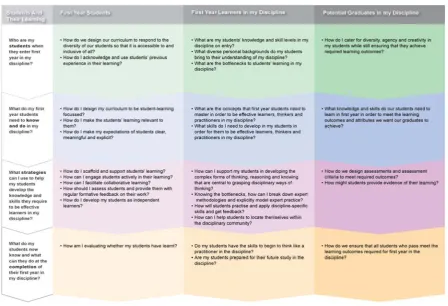
The analysis and evaluation and reflection stages revealed that the Project’s discipline-specific approach was more effective in engaging academics with the concepts of first year pedagogy and the TLOs required in their discipline than if they were participating in a general workshop on first-year pedagogy. The approach also enabled academics to integrate the threshold concepts/skills that they want the students to achieve by the time they graduate. A consequence was the Project’s development of the Framework for the design of first year curriculum and pedagogy (see Figure 1) to assist academics with their curriculum design, challenging them to consider a series of key questions, focussed on students and their learning:
Who are my students when they enter first year in my discipline? What do my first year students need to know and do in my discipline?
What strategies can I use to help my students develop the knowledge and skills they require to be effective learners in my discipline?
What will my students know and what will they be able to do at the completion of their first year in my discipline?
These questions are then expanded using three lenses of thinking of the student: as a first year student, as a learner and practitioner and as a potential graduate of the discipline. A further outcome of the Framework was the production of a series of Good Practice Guides, one for each of the disciplines in the Project. These Good Practice Guides give academics help and direction to think about breaking down disciplinary thinking into a manageable teaching focus.
The Framework’s benefits and strategies
design. Its use of simple questions that challenge academic designers to consider their students’ background, knowledges and ways of knowing and being models a valuable new tool for academics. The questions challenge academics to not only consider the needs of their diverse students but also to be explicit in their teaching of the key concepts of their discipline and to think of their subject in the context of the outcomes for the entire discipline. The Framework also assists academics in planning the activities and assessments they use in their subjects.
Figure 1: Framework for the design of first year curriculum and pedagogy
The Framework provides a starting point for the implementation of the third generation of transition approaches in FYHE research and practice. Gale and Parker (2014) argue that first generation transition (T1) approaches of ‘induction’ centre on orientation programs that help students assimilate to institutional expectations, while second generation transition (T2) approaches of ‘development’ emphasise the importance of the formation of an HE student identity. Third generation transition (T3) approaches (‘becoming’)—the least prevalent and understood according to Gale and Parker (2014)—focus on foregrounding students’ lived realities to help them navigate change, or in the Framework’s case to master both the
university’s and their discipline’s literacies, recognising that for students this is not a linear progression. Gale and Parker (2014) characterise T3 as having curriculum that affirms marginalised student histories and connectionist transition pedagogy (Hockings et al. 2010 cited in Gale & Parker, 2014). Appreciating who students are and how they identify themselves is at the heart of understanding student transition as ‘becoming’.
how student transition is conceived, and the policies, research and practices that flow from these conceptions. Drawing on the broader literature, as the Framework does, reflects students’
lived realities and signals a new approach to transition into the disciplines.
Conclusions
The integration of the three theoretical approaches shows how they can be used to assist academics design curriculum so that first year students develop the skills that they need in order to be effective learners and practitioners in their discipline and profession. The Framework and Good Practice Guides developed by the project position and visualise the connections between the approaches by challenging academics to consider the needs of their students in the context of the discipline and the outcomes they want graduates to achieve by the time they graduate. The Framework can also be used by first year lecturers in planning the activities and assessments they use in their subjects. Further research is needed, however, to validate the Framework and to investigate how it could be applied in structured degrees and in disciplines other than those in the humanities and social sciences.
References
AQF (2011). Australian Qualifications Framework: First Edition. Retrieved from URL: http://www.aqf.edu.au/Portals/0/Documents/Handbook/ustQuals%20FrmwrkFirstEdition July2011_FINAL.pdf
Astin, A. (1984). Student involvement: A developmental theory for higher education. Journal of College Student Personnel, 25, 297–307.
Brawley, S., Clark, J., Dixon, C., Ford, L. Neilson, E., Ross, S. & Upton, S. (2013). After Standards: Engaging and embedding history standards using international best practice to inform curriculum renewal. Retrieved from URL:
http://www.olt.gov.au/system/files/resources/PP10_1812%20_Brawley_Report_2013.pdf Calder, L. (2006). Uncoverage: Toward a signature pedagogy for the history survey. The
Journal of American History, 92(4), 1358-1370.
Chick, N., Haynie, A & Gurung, R. (2012). Exploring more signature pedagogies:
Approaches to teaching disciplinary habits of mind. Stylus Publishing: Sterling, Virginia. Clark, J., Gurney, L., Lawrence, S., Leece, R., Malouff, J., Masters, Y., & Wilkes, J. (2015).
Embedding an institution-wide capacity building opportunity around transition
pedagogy: First Year Teaching and Learning Network Coordinators. The International Journal of the First Year in Higher Education, 6(1), 107-119. doi:
10.5204/intjfyhe.v6i1.268
Cousin, G. (2006). An introduction to threshold concepts. Planet, 17, 4-5.
Furedi. F. (2012). The unhappiness principle. Times Higher Education, 29 November. Retrieved from URL:
http://www.timeshighereducation.co.uk/the-unhappinessprinciple/421958.article
Gale, T. & Parker, S. (2014) Navigating change: a typology of student transition in higher education, Studies in Higher Education, 39(5), 734-753. doi: 10.1080/03075079.2012. Hay, I. (2012). Discipline standards in Arts, Social Sciences and Humanities. Retrieved from
URL: http://disciplinestandards.pbworks. com/w/page/52831201/Arts% 2C%20Social%20Sciences%20and%20Humanities
Hill, R. (2012). Whackademia: An insider’s account of the troubled university. Sydney: University of New South Wales Press.
Hussey, T. & Smith, P. (2003). The uses of learning outcomes. Teaching in Higher
Final Report for ALTC Senior Fellowship Program. Retrieved from URL:
http://fyhe.com.au/wp-content/uploads/2012/10/Kift-Sally-ALTC-Senior-Fellowship-Report-Sep-092.pdf
Kift, S. (2012). Guiding good practice for virtuous compliance, Campus Review, 30 April, 2012, Retrieved from URL: http://www.campusreview.com.au/ blog/2012/04/guiding-good-practice-for-virtuous-compliance/
Kuh, G. (2001). The national survey of student engagement: Conceptual framework and overview of psychometric properties. Bloomington, IN: Indiana University Centre for Postsecondary Research.
Kuh, G., Hayek, J., Carini, R., Ouimet, J., Gonyea, R., & Kennedy, J. (2001).
NSSE technical and norms report. Bloomington, IN: Indiana University Center for Postsecondary Research and Planning.
Kuh, G., & Ikenberry, S. (2009). More than you think, less than we need: learning outcomes assessment in American Higher Education. Urbana, IL: University of Illinois and Indiana University, National Institute for Learning Outcomes Assessment (NILOA).
McInnis, C. (2001). Researching the first year experience: Where to from here? Higher Education Research and Development, 20(2), 105-114.
Meyer, J., Land, R. & Davis, P. (2006). Implications for threshold concepts for course design and evaluation in Meyer, J.H.F. and Land, R. (eds.), Overcoming Barriers to Student Understanding: threshold concepts and troublesome knowledge, London: Routledge Nelson, K. (2014). Keynote: The First Year in Higher Education – Where to from here? The
International Journal of the First Year in Higher Education, 5(2), 1‐20. doi: 10.5204/intjfyhe.v5i2.243
OLT (2012). Discipline standards in Australia. Retrieved from URL: http://disciplinestandards.pbworks.com/w/page/52657697/FrontPage
Pace, D. & Middendorf, J. (2004). Decoding the disciplines: Helping students learn disciplinary ways of thinking. New Directions for Teaching and Learning, 98, 1-12. QAA (n.d.). The UK Quality Code for Higher Education: Subject Benchmark Statements.
Retrieved from URL: http://www.qaa.ac.uk/assuring-standards-and-quality/the-quality-code/subject-benchmark-statements
TEQSA (2013). Higher Education Standards Framework (Threshold Standards). Retrieved from URL: http://www.comlaw.gov.au/Details/F2013C00169/Download
Tuning (n.d.). Tuning Educational Structures in Europe. Retrieved from URL: http://www.unideusto.org/tuningeu/subject-areas.html
Vlăsceanu, L., Grünberg, L. & Pârlea, D. (2007). Quality Assurance and Accreditation: A Glossary of Basic Terms and Definitions. Bucharest: UNESCO
Yorke, M. with Bell, R., Dove, A., Haslam, L., Hughes Jones, H., Longden, B., O’Connell, C., Typuszak, R. and Ward, J. (1997) Undergraduate non-completion in England, Report No. 1, in: Undergraduate Non-completion in Higher Education in England. Bristol: Higher Education Funding Council for England.
Yorke, M. & Longden, B. (2007). The first-year experience in higher education in the UK. Report on Phase 1 of a project funded by the Higher Education Academy. York, The Higher Education Academy. Retrieved from
http://www.heacademy.ac.uk/ourwork/research/ surveys
Zepke, N. & Leach, L. (2010). Improving student engagement: Ten proposals for action. Active
Learning in Higher Education 11(3), 167–77. Retrieved from http://alh.sagepub
.com/content/11/3/167.refs.html
Zepke, N. (2013). Threshold concepts and student engagement: Revisiting pedagogical content knowledge. Active Learning in Higher Education, 14(2), 1-11. doi: