Computer Simulation and Investigation of Underwater Two-Part
and Multi Tow Systems
S '-'--
s. o..NL-1-h_ '°'- "b .e v o...p
r \...(i
c,i...Susantha D Ranmuthugala
(:0..J l_l a. -..d.. 1--u d o · .Lr "'' Q
.:c: ('
< , (\ • .._ . _ ,Submitted in fulfilment of the requirements for the degree of
Doctor of Philosophy in Engineering
University of Tasmania
This thesis contains no material which has been accepted for a degree or diploma by
the University or any other institution, except by way of background information and
This thesis may be made available for loan and limjted copying in accordance with the
Copyright Act 1968.
Note:
ABSTRACT
To maximise effectiveness, towed underwater sonar bodies generally require
perturbations from the steady state motion to be minimised. The instantaneous position of the towed body is influenced by the unsteady, wave-induced motion of the
surface vessel, transmitted via the tow cable. This can render the trajectory of the underwater body beyond acceptable limits for sonar operations.
In an effort to decouple this motion, a two-part tow configuration has been employed.
This thesis describes a three-dimensional dynamic computer model developed to
investigate two-part tows by modelling the individual cabl~s separately and coupling
them dynamically. This approach also enables the modelling of series and parallel
multiple tow configurations. The cable system, modelled using a three
degree-of-freedom finite difference approach, is then coupled to the ·six degree-of-degree-of-freedom
underwater towed bodies at the appropriate locations of the cable system. The
modelling of the cable as a continuous medium and the derivation of the stress wave
speeds are also presented, followed by the validity and.effects of representing it as a
discretised model.
The solution to the dynamic equations describing the motion of the discretised tow
configuration is carried out using an implicit multi-step numerical technique, subject
to specific boundary conditions. This allows the values to be improved through an
iterative procedure, until sufficient convergence is achieved.
An introduction into the use of such numerical techniques in engineering and an
analysis of the numerical procedure used in the solution are also presented. The
requirements for accuracy and numerical stability of the integration technique are
investigated and a guide to the time interval for the time ·stepping algorithm is
deduced.
The computer model is successfully validated using experimental results from scaled
model tests in a circulating water channel. These results together with those obtained
from full scale sonar trials utilising small coastal craft are used to further investigate the behaviour of the two-part tow configuration to varying parameters. The
The thesis also presents a detailed review of the various methods available to
investigate underwater cables and vehicles, together with prediction methods for their
hydrodynamic coefficients. The latter coefficients for the scaled models used in the project are obtained via experimental procedures.
Although a number of investigations have been carried out dealing with aspects of
underwater towing operations, the strength of this investigation lies in that it combines
these aspects, i.e._ mathematical modelling, computer simulation, prediction of the
hydrodynamic coefficients, scaled model experiments, full scale trials, and the
ACKNOWLEDGEMENTS
I wish to thank the following for their assistance and valuable contribution during the
project.
My supervisors Professor Michael Davis from the University of Tasmania and Dr Stan
Gottschalk from AMC for their guidance, support, and encouragement. Dr
Gottschalk's ability to make sense of my somewhat disorganised draft material at such
short notice, and return them with in-depth comments and recommendations has been
a major factor in the completion of this project.
Mr Brendon Anderson and Mr Garry Campanella from DSTO for their assistance in organising the experimental work and providing the ever important industry input.
Special mention must be made of Mr Anderson for his patience, encouragement, and for reminding me on numerous occasions that timeframes are not infinitely
expandable.
Robert Evans from AMC, Peter Graham, Greg Wright, Darryl Gaston, and Darius
Juchnevicius from DSTO, Tim Mak from AMECRC and a number of staff members
from AMC and DSTO for their assistance in the experimental stages of the project.
Ross Warden from DSTO for assistance in video recording the scaled model tests and
their subsequent analysis. Dr Ian MacGillivray from DSTO for assisting with
analysing experimental data.
Special thanks to Dr Paul McShane, Dr Colin Buxton, and Mr Ian Cartwright, my line managers during the project, for their support and understanding that enabled me to
complete the work. My colleagues at AMC for their encouragement, even if only to
ask "when will you ever finish?".
AMC, DSTO, and AMECRC for their assistance, including financial and in-kind
contributions, throughout the project.
Finally my wife Preeni for putting up with a short tempered husband who spent all his
spare time staring at a computer screen, not to mention the mountain of paper that
defied all her efforts at cleaning, my paren13for all their support during the project, and
my two children who made a supreme effort to stay out of Dad's path and expressed
everyone's relief at the end of the project by stating "Dad can now stop playing with
TABLE OF CONTENTS
Abstract
Acknowledgements
List of Illustrations
List of Tables
Nomenclature
Abbreviations
Equation Numbering Scheme
Chapter 1 Introduction
1.1 Definition of Problem
1.2 Outline of Thesis 1.3 Tow Configuration
1.4 Static and Quasi-Static Cable Models
1.5 Dynamic Cable Models
1.6 Tow Cable I Fish Models · 1.7 Solution Techniques
1.8 Underwater Vehicle Models
1.9 Experimental Investigation and Validation
Chapter 2
Modelling Techniques
2.1 Introduction
2.2 Dynamic Cable Models
2.2.1 The Method of Characteristics
2.2.2 Finite Difference Method
2.2.3 Hinged Rod Method 2.2.4 Finite Element Method
2.2.5 Lumped-Mass Method
2.3 Cable Drag and Inertia Forces
2.3.1 Flow Past a Smooth Long Rigid Cylinder
2.3.2 Effects on Drag Coefficient due to Surface
62
63
Roughness and Turbulence 70
2.3.3 Drag on a Rigid Cylinder Inclined to the Flow 71
2.3.4 Morison's Equation 74
2.3.5 Hydrodynamic Cylinder Coefficients in Harmonic
Flow 76
2.3.6 Vortex Induced Hydrodynamic Forces 83
2.3.7 Hydrodynamic Coefficients Selected 91
2.4 Towed Fish Models 91
2.5 Towed Fish Hydrodynamic and Acceleration Coefficients 93
Chapter 3
2.5.1 Towed Fish Acceleration Coefficients
2.5.2 Towed Fish Static and Dynamic Hydrodynamic
Coefficients
Cable and Fish Model
3.1 Modelling of the System
3.2 Axes System
3.2.1 Cable System Transformation Matrix
3.2.2 Tow Fish Transformation Matrix
3.3 Cable Model
3.3.1 Drag Force
3.4 Equations of Motion for Cable Nodes
3.4.1 Junction
3.4.2 Boundary Nodes
3.5 Tow Fish Model
Chapter 4
3.5.1 Force Equations for Tow Fish
3.5.2 Moment Equations for Tow Fish
3 .5 .3 Linearisation of Equations
3.5.4 Equations of Motion for Tow Fish
Solution Algorithm and Program Outputs
4.1 Overview
4.2 Quasi-Static Model
4.3 Dynamic Model Solution Algorithm 150
4.3.1 Boundary Nodes 154
4.3.2 Junction 155
4.3.3 Matrix Solution 157
4.3.4 Angular Displacement of Tow Fish 161
4.3.5 Solution Procedure 162
4.4 Program Outputs 164
4.5 Multiple Tows in Series 167
4.6 Multiple Tows in Parallel 173
ChauterS
Analysis of the Numerical Method 177
5.1 Introduction 177
5.1.1 Derivation of the Houbolt Scheme 181
5.2 Comparison between the Lumped Mass Model and the
Continuous Cable Model 185
5.2.1 Continuous Cable Model 185
5.2.2 Wave Speeds 192
5.2.3 Relationship between Continuous and Discrete
Systems 192
5.2.4 Effects due to Discretisation 197
5.3 Stability and Accuracy 200
5.4 von Neumann (Fourier) and Routh-Hurwitz Methods 202
5.4.1 von Neumann (Fourier) Method 203
5.4.2 Routh-Hurwitz Method 204
5.5 Matrix Stability Method 205
5.5.1 Modal Superposition 205
5.5.2 Stability Analysis 209
5.5.3 Stability of the Houbolt Integration Scheme 212
5.5.4 Non-linear Systems 215
5.6 Accuracy 217
5.6.1 Accuracy Analysis of the Houbolt Scheme 220
5.7 Natural Frequencies of the Model 226
Chapter 6
Experimental Methods and Validation
6.1 Introduction
6.2 Scaled Model Trials
6.2.1 Scaled Model Trial Configurations 6.3 Scaled Model Test Results
6.3.1 Response of the Two-Part Tow due to Vertical
236
236 236
238 240
Excitation 241
6.3.2 Response of the Two-Part Tow due to Horizontal
Excitation 253
6.3.3 Conclusion from the Scaled Model Trial Results 260
6.4 Full Scale Trials 261
6.4.1 Full Scale Trial Results 263
6.5 Scaled Model Hydrodynamic Coefficients 267
6.6 Valid~tion of the Computer Program 269
Chapter7 Conclusion
7.1 Summary
7 .2 Conclusions and Recommendations
7 .3 Future Work
Bibliography
Appendix A
Experimental Results
AppendixB
Computer Program Flowcharts
List of Program Flowcharts
275
275
279
281
283
299
331
LIST OF ILLUSTRATIONS
Figure
1.1 Tow Configurations (a) to (i) 1.2 Two-Part Tow
L3 Conventional Tow
1.4 Typical Transfer Function for Shallow and Deep Water Mooring
Cases
2.1 Cartesian Coordinates of Cable
2.2 Continuous C~ble Element
2.3 t-s Solution Mesh
2.4 Hinged Rod Segment
2.5 Finite Element Model
2.6 Equivalent Nodal Forces on Finite Element
2.7 Tension Forces in Finite Element
2.8 Lumped Mass Model
2.9 Flow Past a Cylinder (a) to (e)
Page No.
2 and3 4 7 12 34 34 39 46 53 54 55 61 67
2.10 _Drag Coefficient for Cylinders and Spheres 68
. .
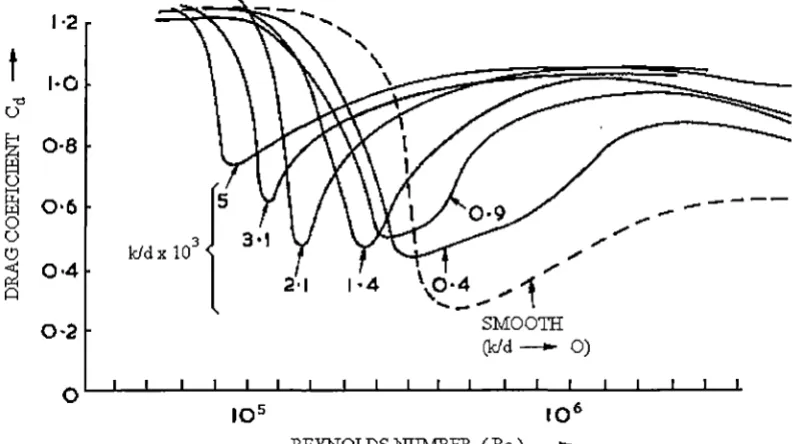
2.11 Typical Variation of Dra9 Coefficient with Reynolds Number for a
Smooth Cylinder 68
2.12 The Drag of Sand Roughened Cylinders 71
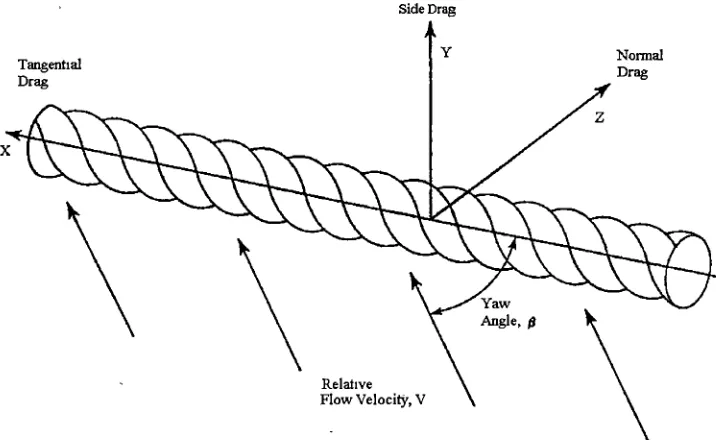
2.13 Direction of Drag Forces on a Cable in a 3D Flow Field 72
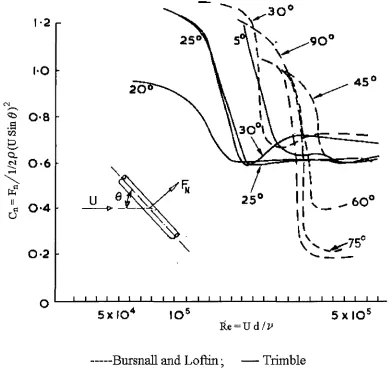
2.14 Variation. of Drag Coefficient for Inclined, Smooth Cylinder~ 73
2.15 Drag Coefficient versus Reynolds Number for KC
=
20 and forVarious Values of Relative Roughness 79
2.16 Drag Coefficient versus Reynolds Numbe~ for KC
-=
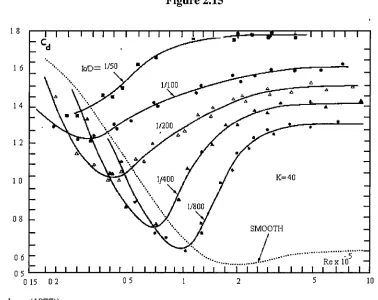
40 and forVarious Values of Relative Roughness · 79
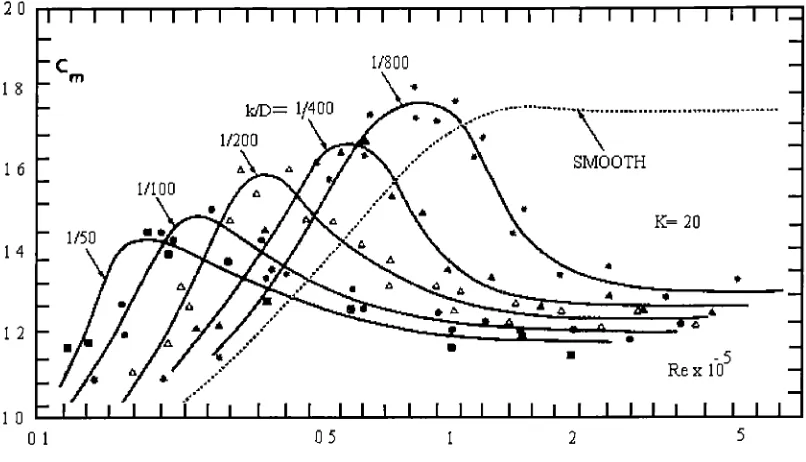
2.17 Inertia Coefficient . versus Reynolds Number for KC = 20 and for ·
Various Values of Relative Roughness
·so
2.18 ln~rtia Coefficient versus Reynolds Nm?b~r for KC-= 40 and for
Various Values of Relative Roughness 80
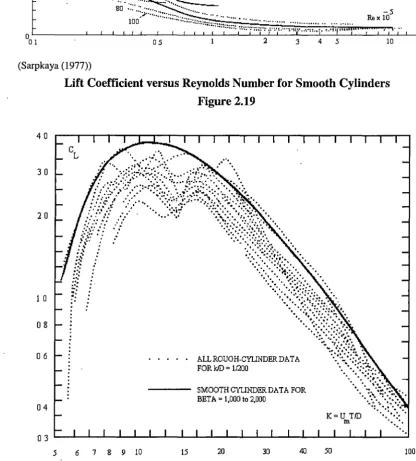
2.19 Lift Coefficient versus Reynolds Number for Smooth Cylinders 81
2.20 Lift Coefficient versus KC for a Relative Roughness of 1/200 81
2.21 Effective Lift Coefficient during Vortex Shedding against Effective
2.22 Drag Coefficient Amplification during Vortex Shedding against Wake
Response Parameter 87
2.23 Drag Coefficient during Vortex Shedding against Reduced Velocity 88
2.24 Orientation of an Underwater Vehicle 94
3.1 Coordinate Transformation for Cable 106
3.2 Right Hand Coordinate System for Towed Fish 106
3.3 Coordinate Transformation for Towed Fish 108
3.4 Lumped Mass Model of the Two-Part Tow 109
3.5 Cable Node "i" 110
3.6 Cable Junction Node "j" 119
3.7 Boundary Nodes 121
(a) Towed Fish, (b) Depressor, (c) Surface Vessel
3.8 Three-Dimensional Towed Fish 124
3.9 Geometry of the Towed Fish 124
3.10 Rotation of Unit Vectors of Towed Fish 127
(a) Rotation about X Axis, (b) Rotation about Y Axis
(c) Rotation about Z Axis
3.11 Forces and Moments at Tow Point (1) and Centre of Gravity (G) of
Towed Fish 131
4.1 Two-Part Tow Modelled with a Single Cable 144
4.2 Two-Part Tow Modelled with Two Cables 144
4.3 Multiple Tow in Series Modelled with a Single Cable 145
4.4 Multiple Tow in Series Modelled with Separate Cable Systems 145
4.5 Quasi-Static Fish Model 147
4.6 Conventional Tow - Surge 165
4.7 Two-Part Tow 1 - Surge 165
4.8 Conventional Tow - Heave 165
4.9 Two-Part Tow 1 - Heave 165
4.10 Conventional Tow - Pitch Angle 165
4.11 Two-Part Tow 1-Pitch Angle 165
4.12 Change in Pitch Angle with Location of Junction 166
4.13 Two-Part Tow 1 - Path of Vehicles 167
4.14 Two-Part Tow 1 - Depth 167
4.15 Two-Part Tow 1 - Pitch Angle 167
4.16 Multiple Tow Fish in Series 168
4.18 Series Multi-Tow - Path-Fast
4.19 Series Multi-Tow - Path - Fast- Slow
4.20 Series Multi-Tow - Depth-Fast
4.21 Series Multi-Tow -Depth- Slow 4.22 Series Multi-Tow - Pitch Angle -Fast
4.23 Series Multi-Tow - Pitch Angle - Slow
4.24 Difference Curve - X Direction 4.25 Difference Curve - Y Direction
4.26 Difference Curve - Depth
4.27 Difference Curve - Pitch Angle
4.28 Multiple Tow Fish in Parallel
4.29 Parallel Multi-Tow -Path
4.30 Parallel Multi-Tow -Depth
4.31 Parallel Multi-Tow - Pitch Angle
5.1 Spectral Radius of Numerical Integration Schemes with Zero
171 171 171 171 171 171 172 172 172 172 173 176 176 176
Damping 215
5.2 Amplitude Decay and Period Elongation 219
5.3 Amplitude Decay and Period Elongation of Numerical Integration
Schemes 219
6.1 Circulating Water Channel 237
6.2 Top View of Channel 237
6.3 Experimental Procedure 237
6.4 Scaled Models 237
6.5 Recording of Vertical Motion 240
6.6 Recording of Horizontal Motion 240
6.7 Surface Excitation Mechanism 240
6.8 Depressor and Towed Fish Response for Configurations Cl
i
to C13 2436.9 Depressor and Towed Fish Response for Configurations C21 to C23 243
6.10 Depressor and Towed Fish Response for Configurations C31 to C33 243
6.11 Depressor and Towed Fish Response for Configurations B3 l to B33 243
6.12 Depressor and Towed Fish Response for Configurations A31 to A33 243
6.13 Depressor and Towed Fish Response for Configurations 121to123 245
6.14 Depressor and Towed Fish Response for Configurations 131 to 133 245 6.15 Depressor and Towed Fish Response for Configurations H31 to H33 245
6.18 Depressor and Towed Fish Response for Configurations E31 to E33 247
6.19 Depressor and Towed Fish Response for Configurations H31 to H33 247
6.20 Depressor and Towed Fish Response for Configurations K31 to K33 247
6.21 Depressor and Towed Fish Response for Configurations C21 to C23 249
6.22 Depressor and Towed Fish Response for Configurations X21 to X23 249
6.23 Depressor and Towed Fish Response for Configurations F21 to F23 249
6.24 Depressor and Towed Fish Response for Configurations T21 to T23 249
6.25 Depressor and Towed Fish Response for Configurations 121 to I23 249
6.26 Depressor and Towed Fish Response for Configurations AH21 to
AH23 249
6.27 Depressor and Towed Fish Response for Configurations C31 to C33 251
6.28 Depressor and Towed Fish Response for Configurations AA62 to
AA64 251
6.29 Depressor and Towed Fish Response for Configurations AA42 to
AA44 252
6.30 Depressor and Towed Fish Response for Configurations AB42 to
AB44 252
6.31 Depressor and Towed Fish Response for Configurations J31 to J33 252
6.32 Depressor and Towed Fish Response for Configurations AC22 to
AC24 252
6.33 Depressor and Towed Fish Response for Configurations AD22 to
AD24 252
6.34 Towed Fish Response for Configurations YY21 to YY23 253
6.35 Towed Fish Response for Configurations YAl l to YA14 253
6.36 Towed Fish Response for Configurations YA21 to YA24 253
6.37 Towed Fish Response for Configurations WA21 to W A23 253
6.38 Towed Fish Response for Configurations YD21 to YD23 255
6.39 Towed Fish Response for Configurations YG21 to YG23 255
6.40 Towed Fish Response_ for Configurations YC21 to YC23 255
6.41 Towed Fish Response for Configurations WC21 to WC24 255
6.42 Towed Fish Response for Configurations W A21 to W A23 255
6.43 Towed Fish Response for Configurations WB21 to WB24 255
6.44 Towed Fish Response for Configurations YA21 to Y A24 257.
6.45 Towed Fish Response for Configurations YB21 to YB23 257
6.46 Towed Fish Response for Configurations W A21 to W A23 257
6.47 Towed Fish Response for Configurations WD21 to WD24 257
6.48 Towed Fish Response for Configurations YD21 to YD23 258
6.50 Towed Fish Response for Configurations YG21 to YG23 259
6.51 Towed Fish Response for Configurations YE21 to YE23 259
6.52 Towed Fish Response for Configurations YF21 to YF23 259
6.53 Towed Fish Response for Configurations WA21 to W A23 259
6.54 Towed Fish Response for Configurations WE21 to WE24 259
6.55 Towed Fish Response for Configurations WF21 to WF24 259
6.56 Full Scale Trial Single Part Tow 261
6.57 Full Scale Trial Two-Part Tow 261
6.58 Aft Deck of Deploying Vessel 261
6.59 Deploying of Two-Part Tow 261
6.60 Use of HPMM to obtain the Hydrodynamic Coefficients 267
6.61 Coefficients for Tow Fish 268
6.62 Vertical Coefficients for Depressor 268
6.63 Horizontal Coefficients for Depressor 268
6.64 Pitch Angle of Tow Fish for 131 - Computer - Degrees 270
6.65 Pitch Angle of Tow Fish for 131 - Experiment - Degrees 270
6.66 Heave of Tow Fish for 131 - Computer - Centimetres 271
6.67 Heave of Tow Fish for 131 - Experiment - Centimetres 271
6.68 Surge of Tow Fish for 131 - Computer - Centimetres 271
6.69 Surge of Tow Fish for 131-Experiment- Centimetres 271
6.70 Tension at Surface for 131- Computer- Kilograms 271
6.71 Tension at Surface for 131 - Experimental - Kilograms 271
6.72 Pitch Angle of Tow Fish and Depressor for C31 Computer
-Degrees 272
6.73 Pitch Angle of Tow Fish and Depressor for C31 Experiment
-Degrees 272
6.74 Heave of Tow Fish and Depressor for C31 - Computer - Centimetres 272
6.75 Heave of Tow Fish and Depressor for C31 Experiment
-Centimetres 272
6.76 Surge of Tow Fish for C31 - Computer - Centimetres 272
6.77 Surge of Tow Fish for C31 - Computer - Centimetres 272
6.78 Tension at Surface for C31 - Computer - Kilograms 273
6.79 Tension at Surface for C31 - Experimental - Kilograms 273
6.80 Yaw Angle of Tow Fish for Y A22 - Computer - Degrees 273
6.81 Yaw Angle of Tow Fish for Y A22 - Experiment - Degrees 273
6.82 Sway of Tow Fish for Y A22 - Computer - Centimetres 273
LIST OF TABLES
Table
4.1 Conventional and Two-Part Tow Configuration Information
4.2 Series Multi-Tow Configuration Information
4.3 Parallel Multi-Tow Configuration Information
6.1 Full Scale Trail - Limiting Parameters
6.2 Trial 1 - Summary of Results
6.3 Trial 2 - Summary of Results
6.4 Tow Configuration Information for Validation Runs
6.5 Statistical Analysis of the Computer and Experimental Results
Al Scaled Model Tests AMC - Information
A2 Scaled Model Tests AMC - Results
A3 Trial 1 - Tow Information
A4 Trial 2 - Tow Information
A5 Trial 1 - Tow Results
A6 Trial 2 - Tow Results
A7 Trial 2 - Results - Direction to Swell
A8 Trial 2 - Results - Cable Length
A9 Trial 2 - Results - Tow Velocity
AlO Trial 2 - Results - Depressor Wing
All Trial 2 - Results - Types of Tows
A list of Flowcharts in Appendix B is given at the beginning of the
Appendix
Page No.
164
170
175
262
264
264
270
274
299
304
309
311
313
317
320
322
324
327
329
NOMENCLATURE
The following defines the major symbols used in this thesis. Since the work m this
thesis encompasses the fluid mechanics and solid mechanics disciplines, some
symbols traditionally have more than one meaning. In order to maintain consistency
throughout the thesis, the symbols selected reflect those used by other authors in this
field. Some variables and constants are defined at the relevant locations in the text.
General Convention
SI units are implicit.
For a dummy variable "A":
A A [A] A A ,... A vector A matrix A matrix A
derivative of A with respect to time
second derivative of A with respect to time
unit vector A
Variables and Constants
A
A,A,A
Ai
Amm
Amu
Amrx· ,y' ,z' Am
Alx',y',z'
Aab
Afab
cross sectional area
vectors representing the body rotational angles and their derivatives
cross sectional area of cable segment "i"
normal added mass coefficient of cable segment "i"
tangential added mass coefficient of cable segment "i"
added mass of the towed fish in the X', Y', and Z' directions hydrodynamic inertia (added mass) matrix of cable element
added inertia of the towed fish about the X', Y', and Z' axes
where a
=
1, 2, 3 and b=
1, 2, 3mass matrix terms of the manipulated equation of motion of the fish
as defined in equations (3.97)
where a
=
1 to 6 and b=
1 to 6mass matrix terms of the equation of motion of the fish as defined in
Ap
Au,Bu
[A]T
[Ar'
B21, B23
Ca
cd
CdE Ce CH CLCm
en
CtCw
CTx,y,zi Cb andDb c D D1 DEN Ecross sectional area of the fish perpendicular to the X axis
geometrical area of the body, (usually the cross-sectional area to the
flow or the surface area)
projected area of cylinder in the plane perpendicular to the direction of flow
amplification matrix
matrices defined in equations (2.9), (2.17), and (5.46)
transpose of matrix [A]
inverse of matrix [A]
variables defined in equations (3.96)
added mass coefficient
drag coefficient
equivalent drag coefficient
linearised equivalent damping coefficient in equation (2.77)
hydrodynamic coefficient
lift coefficient
inertia coefficient
cable drag coefficient in the normal direction
cable drag coefficient in the tangential direction
wave speed
trigonometric terms defined in equations (3.29)
where b
=
1, 2, 3, 4, ...extra terms of the constraint equation for the junction in comparison
to the standard constraint equ~tion (4.18), defined in equations (4.31)
and (4.47)
where t = 0, 1, 2, 3, 4, ...
constants defined in equations (5.11) and (5.20) damping matrix
diameter
diameter of cable segment "i"
variable defined in equation (3.23)
modulus of elasticity
partial differential terms as defined in equations (4.19) to (4.21) error in the cable segment length "i", between the span of the nodal
F, f
F1x,y,z
Fct1x,y,z
Fct1x',y',z'
Fe1x,y,z
p. IOX,y,z
Fr
Ff,x' ,y' ,z'
p' fx' ,y' ,z'
Fftx',y'z'
f
f n
G
Gu, Hu
G(U)
g
I, J, K1,K2
lax',y',z'
lx',y',z'
A A A
i, j, k
J k k =E k =G
[E1F1G1CD] converted to a true tri-diagonal matrix, as defined in
equation (4.35)
force vectors
forces on node "i" in the X,Y, and Z directions
drag forces (global) on segment "i" in the X, Y, and Z directions
drag forces (local) on segment "i" in the X', Y', and Z' directions
mean drag force in equation (2. 77)
any additional forces on node "i" in the X, Y, and Z directions
represents all forces except tension forces, acting on node "i" force vector acting on the fish
components of
Fr
along the X', Y', and Z' (local) axessummed forces in the equation of motion of the fish, defined in
equations (3.84) and (3.85)
summed forces in the manipulated equations of motion of the fish,
defined in equations (3.98)
hydrodynamic force, i.e. drag, lift, or side force
measured force
tension vector along element "i" as defined in equation (2.49) and
(2.52)
frequency
natural frequency
centre of gravity of towed fish
variables defined in equations (2.21) vectors defined in equations (2.23)
acceleration due to gravity (9.81 m/s2)
variables defined in equations (3.18)
moments of inertia of the towed fish at the centre of gravity about the
X', Y', and Z' axes, respectively
moments of inertia of the towed fish at the tow point about the X', Y',
and Z' axes, respectively
unit vectors along u, v, and w (local) axes system
Jordan form of Ap, with eigenvalues O"pi) of Ap along its leading
diagonal. stiffness matrix
cable element elastic stiffness matrix
cable element geometric stiffness matrix
kt
kw
KCL,M,N1,N2
Lllt(R N ~t) Lp
mab
m· e1x,y,z
MrGx' ,y' ,z'
Mfx',y',z'
M' fx' ,y' ,z'
Pnx,y,z
p, q, r
p,q,
t
p
p = I
Pab
tangential stiffness of a single lumped mass
wave number
Keulegan-Carpenter number
variables defined in equations (3.25)
local truncation error of the integration scheme
load operator
length of cable segment "i"
length of fish
length of the smallest element in the lumped mass model
wavelength
mass terms mass matrix
mass of node "i", ie. the addition of half the mass of each adjacent
segments
where a
=
1, 2, 3 and b=
1, 2, 3mass matrix terms
mass and added mass of any additional weight attached to node "i"
mass of towed fish
cable mass per unit length
moment vector
moment vector acting on the fish, about its centre of gravity
components of Mta about the X', Y', and Z' (local) axes moment vector acting on the fish, about its tow point
components of Mn about the X', Y', and Z' (local) axes
summed moments in the equation of motion of the fish, defined in
equations (3.84) and (3.85)
where a= x, y, z
variables defined in equations (3.29a)
variables defined in equations (3.32)
angular velocity components (roll, pitch, and yaw) of the fish about
the X', Y', and Z' axes
angular acceleration components of the fish about the X', Y', and Z'
axes
matrix of eigenvectors of Ap
tensor defined in equations (2.39) and (2.40)
where a
=
1, 2, 3 ... ,n and b=
1, 2, 3 ... ,np(Ap) spectral radius of the amplification matrix ( Ap)
distance from the tow point (1) to the centre of gravity (G)
R, R, R displacement, velocity, and acceleration vectors
Re Reynolds number
Rm, Rm, Rm modal displacement, velocity, and acceleration vectors
ri cable element mass ratio defined in equations (2.~9) and (2.40)
s arc length of any point along the cable
Str Strauhal number
T tension of cable
Ti tension of cable segme~t "i"
T1 tentative tension of cable segment "i"
Tr tension of cable segment attached to towed fish
Trx,y,z component of the cable tension in the X, Y, and Z (global) directions
Trx',y',z' component of the cable tension in the X', Y', and Z' (local) directions
A
t unit vector in cable element direction from bottom to top
t time
tn,mm minimum natural period of the cable mesh
tn,a natural period of "a" mode
tp period of the cycle
U vector defined in equations (2.9), (2.17), and (5.46)
U0 velocity vector of the towc;d fish at its centre of gravity (G)
u, v, w
u, v, w
v
v
Ycx,y,zYnx,y,z
acceleration vector of the towed fish at its centre of gravity (G)
velocity vector of the towed fish at its tow point
acceleration vector of the towed fish at its tow point
local velocity components along the local (X', Y', and Z') axes
system
local acceleration components along the local axes .system
velocity
velocity vector
water current velocities along the X,Y, and Z directions
maximum velocity
reduced velocity
relative velocity between the body and the surrounding fluid relative velocity vector
time dependent relative velocity
velocities (global) of node "i" relative to the water in the X, Y, and Z
VSrix,y,z
VSnx' ,y' ,z'
WR X,Y,Z x,y,z
x,y,z
x,y,z
X',Y',Z'x', y', z'
Xa, Ya,Za
Ym
YRMS
velocities (global) of cable segment "i" relative to the water in the X,
Y, and Z directions
velocities (local) of cable segment "i" relative to the water in the X',
Y', and Z' directions
net weight of node "i" in water, i.e. the addition of half the net weight
of each adjacent segments
wake response parameter
global axis system as defined in sub-section 3.2
displacement along the X, Y and Z directions velocities in the X, Y, and Z directions
acceleration in the X, Y, and Z directions
local axes system as defined in sub-section 3.2
displacement of node along the X', Y' and Z' directions
components of the distance (RG) from the tow point (1) to the centre
of gravity (G), measured from the tow point and positive in the
directions of the local axes system
cross flow displacement amplitude
root mean square anti-nodal displacement
Greek Symbols
a, ~.y
~f <I> \jf p Pc O' E /.., /.., Awi AwL AwT !
right hand rotation of the fish about the Y (pitch), X (roll), and Z
(yaw) axes
where i
=
0,1,2,3,. ..parameters of multi-step integration algorithm, (see equation (5.4))
frequency parameter defined by equation (2.86)
horizontal angle of the cable with the X axis
vertical angle of the cable with the X-Y plane
density of the water in which the towing occurs
density of cable
stress in cable or cable element when stretched
local strain in cable or cable element when stretched eigenvalues
matrix that_ stores the eigenvalues along its main diagonal
where i = 1,2,3,4,5,6
wave propagation speed along a continuous cable system longitudinal wave speed along a continuous cable system
K
u
(l)
Q
<pa
where i = 1,2,3, ... ,n
eigenvalues of Ap
visco-elastic damping coefficient
coefficient to allow for hysteresis
angular velocity vector of cable element
natural frequency
angular velocity vector of the towed fish having components a,
J3,
andy
mass per unit length of the cable
mass of the displaced water per unit length of the element
variable to solve the tri-diagonal matrix [EiF,Gi] recursively, as
defined in equations (4.38) and (4.39)
where a= 1, 2
characteristic lines associated with Aa, defined in' equations (2.13),
shape function of cable element
variable length along the element divided by the element length, (s/li)
damping ratio
Cos-1 ~
C00 (-Cosv ±iSinv)
r+o
cable system transformation matrix
tow fish transformation matrix
modal transformation matrix defined in equation (5.88)
time step (increment)
represents the change in a parameter
error
or
amplitude error, which increases the damping by a small quantity 8a
phase error, which increases the frequency of oscillation by a small
quantity 8a/2n. Kronecker delta,
tension correction term of cable segment "i"
variables defined in equation (2.80)
eigenvectors
matrix that stores the eigenvectors along its columns
Subscripts
D
e
f
G
i+l/2
i-112
j
n
u, v, w
x,y,z
t
0
1
Supercripts
k
m
t
0
(1)
(2)
depressor
additional forces or weights
towed fish
centre of gravity of tow fish
ith cable node, (or i1h cable segment located between nodes "i" and
"i+ 1 ")
cable element just after node "i"
cable element just prior to node "i"
cable node representing the junction
cable node representing the surface towing vessel
direction along axes of local coordinate system
direction along X, Y and Z axes
time
centroid of tow fish
tow point on tow fish
iteration index
convergence correction superscript in equation (4.7)
time
equilibrium position (configuration)
top of cable rod element
ABBREVIATIONS
2D
3D
AMC
AMECRC
DOF
DSTO
FDM
FEM
HPMM
LMM
RAN
ROV
two dimensional
three dimensional
Australian Maritime College
Australian Maritime Engineering Cooperative Research Centre
degree of freedom
Defence, Science and Technology Organisation
finite difference method
finite element method
horizontal planar-motion-mechanism
lumped mass method
Royal Australian Navy
Remotely Operated Vehicle
EQUATION NUMBERING SCHEME
All equations are numbered aligned to the relevant chapter and in ascending order
through that chapter. For example equations in Chapter 3 will commence from (3.1)
and continue as (3.2), (3.3) and onwards.
When an equation number represents a set of equations, the number is usually
sub-divided, e.g. equations (3.8a), (3.8b), and (3.8c). When referring to such a set of
equations, if all of the equations in that set are being addressed, then they will be
referred to as equations (3.8). However, if only some of the equations from the set
CHAPTERl
INTRODUCTION
1.1 Definition of Problem
A sonar platform is an example of a submerged body that is towed behind a surface
vessel. Such platforms are used extensively in offshore, military, hydrography, and
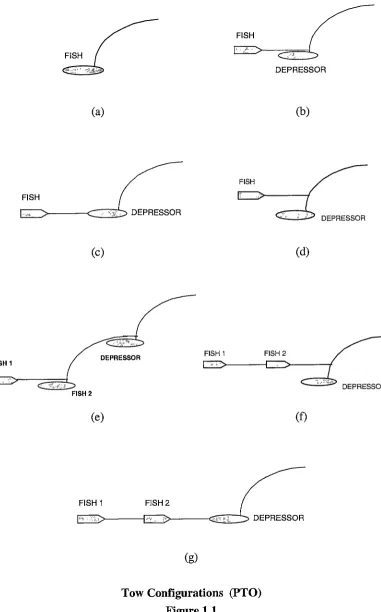
oceanography activities, (see Figure 1.1). They generally require that perturbations
from the steady state motion are minimised in order to ensure clear sonar imaging.
The instantaneous position of the submerged towed object (referred to as the "fish" in
this text), is influenced by the relative motion between the cable and the water, the
hydrodynamic characteristics of the fish, and the unsteady wave induced motion of the
surface vessel.. Depending on the sea state and the towing vessel's response to it, the
wave induced motion can be sufficiently large to render the trajectory of the tow fish
beyond acceptable limits for sonar operations. This motion is transmitted to the fish
along the tow cable.
The Royal Australian Navy (RAN) uses towed sonar vehicles for a variety of
operations. One task is the deployment of side scan sonar from small vessels to detect
mines in coastal waters. As the operation is in coastal (shallow) waters, the length of
the tow cable can be relatively short, e.g. 25 metres. In addition, the relatively small
size of the surface vessel can lead to large wave induced motions. These conditions
can adversely affect the motion of the sonar vehicle, resulting in imperfect sonar
operations.
The wave induced motion of a towed body attached to a conventional tow system used
by the RAN, exceeds the acceptable motion rates in the six-degrees of freedom by
more than 60%, (see Tables 6.2 and 6.3 in Chapter 6). In order to reduce this motion,
and thus improve the efficiency of sonar operations, the Defence, Science and
Technology Organisation (DSTO) of Australia was tasked with optimising the tow configuration. The investigation was carried out by the Australian Maritime College
(AMC), DSTO, and the University of Tasmania with assistance form the Australian
FISH
FISH
DEPRESSOR
(a) (b)
FISH
(c) (d)
DEPRESSOR FISH 1 FISH 2
(e) (f)
FISH 1 FISH 2
j;>-~~-<ZeI[:'.:::: DEPRESSOR
(g)
[image:27.568.102.484.89.702.2]Tow Configurations (PTO) Figure 1.1
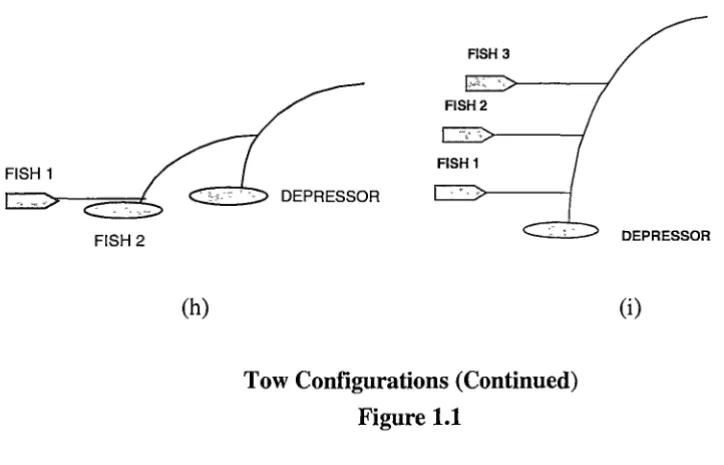
FISH 1
FISH2
(h)
FISH 3
DEPRESSOR
[image:28.568.89.451.78.310.2]Tow Configurations (Continued) Figure 1.1
DEPRESSOR
(i)
Since the surface vessel's motion is usually beyond the control of the operator, the
transmission of the wave induced motion of the surface vessel to the towed fish can be
reduced by:
• designing the fish to be more hydrodynamically stable;
• incorporating adaptive control surfaces on the fish; and/or
• decoupling the surface vessel motion from the fish.
This investigation centres around the third option, since it is an effective, cost efficient
method of achieving the required objective.
Various methods have been employed in tow configurations to increase decoupling of ·
the motions. One such method is the two-part tow shown in Figure 1.2. It consists of
a primary cable attached at its top end to the surface vessel (i.e. the vessel towing the
sonar), while the bottom end is attached to a depressor. The latter ensures that the tow
configuration maintains the required depth. The fish is attached to the lower end of
the primary cable by a secondary cable. The point of attachment (referred to as the
"junction") can be varied along the cable length, thus influencing the behaviour of the
towed fish. The two-part tow configuration and its behaviour are explained in Asplin
In order to investigate and optimise the tow configuration, the project was carried out
in three stages:
1. the development of a three-dimensional (3D) dynamic computer model incorporating the decoupling effect, to predict the motion of the fish due to the excitation at the surface;
2. scaled model tests of the tow configuration; and
3. full scale trials.
TRAIL
PRIMARY GABL'
SECONDARY CABLE
I
TOWED FISH
JUNCTION
DEPRESSOR
Two-Part Tow Figure 1.2
DEPTH
The computer model of the two-part tow incorporates tow line and fish dynamics as
well as the decoupling effect of the two separate lines. The response envelop of the
configuration can be determined by varying the parameters of the model. This allows
the configuration to be optimised to give an acceptable trajectory for the tow fish.
Since the attachment point between the two cables can be varied along the length of
the primary cable, it is inadequate to model the tow configuration as a single cable system, with an "extra" lumped mass representing the depressor. One must model the
two cables separately and then dynamically couple them at the junction. Following a
comprehensive review of the literature, the author was unable to find any
This concept allows the investigation of not only varying points of attachment, but
also multiple towed bodies, i.e. more than one secondary cable attached at various
points along the primary cable, (see Figure 1.l(i))
The results from the computer model were validated and supplemented using:
• experimental data from scaled model tests of the two-part tow configuration
conducted in the circulating water channel at the Australian Maritime College in
Launceston; and
• full scale trials at Jervis Bay and Port Phillip Bay.
1.2 Outline of Thesis
The remainder of this chapter outlines the tow configurations investigated and reviews
the literature relevant to the modelling of such systems. This review includes static,
quasi-static and dynamic cable modelling techniques, current underwater tow models,
numencal procedures employed to solve cable I tow models, and the modelling of underwater vehicle. Finally the experimental investigation is introduced. The rest of
the chapters are structured as follows.
Chapter 2 looks at the methods available to investigate cable and underwater bodies.
It first looks at the more popular mathematical representations of dynamic cable
modelling and the time domain solution techniques utilised. The selected method for
this study is justified based on the ability and suitability of the various methods. The
prediction of drag and inertia coefficients of cables is yet a highly researched area.
Chapter 2 details some of the investigations, analyses the behaviour of the fluid flow
around the cable, and presents current methods used to predict the relevant
coefficients. Finally the modelling techniques available for underwater vehicles and
the prediction of the relevant coefficients are discussed.
In Chapter 3, the mathematical modelling of the quasi-static and dynamic two-part
and multi tow configurations is detailed. This includes the modelling approach used
for the cable junction, series and parallel multiple tows, and the integration of the tow
I depressor fish into the cable model. This is followed by the numerical solution procedure in Chapter 4, where the numerical integration scheme and the required
required to deal with the two types of multiple tow configurations. Typical results for
the various configurations are also presented.
Chapter 5 analyses the numerical procedure used in the solution, and includes an
introduction into such numerical techniques in engineering. The modelling of the cable as a continuous medium and the derivation of the stress wave speeds are
presented, followed by the validity and effects of representing it as a discretised
model. The stability and accuracy of the numerical procedure utilised is analysed and
the prediction of a suitable time step to meet these criteria is discussed.
Chapter 6 details the scaled model experiments and the full scale trials, and analyses
the results in order to investigate the behaviour of the two-part tow. The scaled model
test results are also used to validate the computer model, which includes the
experimental calculation of the hydrodynamic coefficients of the scaled models.
Finally Chapter 7 presents the conclusions and recommendations.
Appendix A gives the results from the scaled model tests and the full scale trials,
while Appendix B presents detailed flowcharts of the computer model.
1.3 Tow Configuration
Conventional towing arrangements consist of a tow cable attached at its upper end to
the surface towing vessel and its lower end to the fish, (Figure 1.3). This
configuration leads to large coupling effects, thus giving unacceptable fish motion due
to the transmission of the excitation at the cable's upper end down to the fish. The
two-part tow, shown in Figure 1.2, consists of a primary cable towed from the surface
vessel in a similar manner to the conventional tow, except that the fish is replaced by a
depressor to maintain the required depth of the cable's configuration. The fish is then
attached to the depressor (Figure l.l(c)) or to the lower end of the primary cable
(Figure 1.l(d)) by a secondary cable.
Usually the primary cable is negatively buoyant, while the towed fish and the
secondary cable are neutrally buoyant. However, these conditions could differ
depending on the operator's requirements. The fish can be modified to be neutrally buoyant by simply adding ballast or buoyancy at the appropriate locations within the
TOWED FISH
TRAIL
CABLE
Conventional Tow Figure 1.3
DEPTH
The computer model was developed to simulate both conventional and two-part tow
configurations. In the latter case, it can consist of a two-part tow without a junction
(Figure l.l(b)) or a two-part tow with ajunction (Figure l.l(d)). This enables the use
of one computer model to simulate and compare various tow configurations.
In order to expand the scope of the investigation, it was decided to incorporate
multi-tow configurations in the computer model. These included:
• Series Multiple Tow (Figures l.l(e) to l.l(h)), where a number of towed fish
are attached in series. Each towed fish is attached via its tow (secondary) cable
to the fish preceding it.
• Parallel Multiple Tow (Figure l.l(i)), where a number of towed fish are
attached in ·parallel. Each towed fish is attached via its tow (secondary) cable to
the primary cable, thus creatmg a number of junctions along the length of the
primary cable.
Following an extensive literature survey into various underwater tow investigations, it
was noted that most tow models dealt with conventional tow configurations, while some were able to deal with multiple tow configurations similar to that shown in
Figure l.l(g), (these will be discussed later in this chapter). However, none were found that could deal with the discontinuity created by having a "junction" at a point
The tow configtJration consists of two major components, i.e. the cable(s) and the tow
I depressor fish. Therefore the investigation looked into the modelling of underwater cables, underwater bodies, and the coupling of the two. In Chapter 2 the various
methods available for the modelling of underwater cables, including the governing
equations and the recommended solution techniques, are described. This is followed by a description of the modelling techniques (again including the equations)
commonly utilised for underwater vehicles.
In this Chapter, an overview of the various methods used in modelling underwater
towed systems will be discussed, which includes a review of the cable models and
solution techniques as well as the modelling of underwater vehicles.
1.4 Static and Quasi-Static Cable Models
Early work with 'cable systems dates back to the Greek civilisation, when eminent
figures such as .Pythagoras and Aristotle investigated cable tensions and frequencies.
In the more recent past well known mathematicians and researchers ,such as Leonardo
da Vinci, Mersenne, and Galileo continued the investigation. Early analytical work in
the eighteenth century is attributed to Taylor who published the first dynamic solution
of transverse cable dynamics, and Bernoulli, who published theories of oscillation for
hanging chains and the superposition principle of several harmonics for taut string.
The latter was illustrated by Fourier in the nineteenth century.
D' Alembert was the first to derive the partial di~ferential equations for · smal,l transverse dynamics of taut wire, which were then solved by Lagrange. Euler derived
the equation for a hanging chain and then obtained a series solution for the first three
natural frequencies. Poisson derived and solved equations of a cable. element
subjected to a general force.
The above description can easily be taken to represent a who is who in the mechanical
I structural engineering arena. This highlights the importance placed upon cable structures from the beginning of known civilisation.
Up till the early part of the 201h century, the analytical work was based on the
prediction of the shape of a hanging uniform static cable using the so called classical
cable is assumed to achieve its stiffness through a change in its shape as the tension
forces change at the ends. The equations describing the configuration are readily available from most structural mechanics text books dealing with compliant
structures, e.g. Berteaux (1976), Wilson (1984) and Patel (1989).
The solution to these equations are obtained by approximate solutions or an iterative process. These models can be classified as "static" and have in the past been used to
investigate underwater cable structures. Around World War I, analytical models were
developed to predict the height of barrage balloons in varying wind conditions and to
analyse aircraft towed cable configurations I systems. Between the wars, investigations primarily dealt with steady state towing of gliders, targets, and
rninesweeping equipment as well as steady state mooring of buoys and ships.
When considering the ocean environment, the effects of the surrounding water and the
nature of the excitations encountered requires a more thorough investigation,
especially if the flexible structure is long. Thus, the inclusion of the non-linear drag,
forces into the mathematical model results in a quasi-static model.
Quasi-static models ignore the affects of inertia and added mass in the calculations,
taking into consideration only the forces such as mass, buoyancy, cable tensions, lift,
and drag due to the cable I fluid interface. Equations for static equilibrium are then developed for the system and solved subject to given boundary conditions. (The
inclusion of drag forces is important when considering an underwater catenary due to
the magnitude of such forces that are experienced). The quasi-static models are able
to incorporate non-linearities that are present in the cable model, which include:
• changes in geometry due to tl}e change in the cable shape; and
• fluid loading, which is usually proportional to the square of the relative velocity
between the cable and the surrounding fluid.
Modelling techniques for quasi-static cables can be broadly divided into the
continuous, lumped mass, finite element, and hinged rod methods. The above
classification is dependent on the method utilised to represent the cable system.
A number of researchers have developed quasi-static models and only a selected number are given in this review. The reference list at the end of the thesis gives a
Parsons (1970) is an excellent review of the work carried out in this area. Berteaux
(1976) gives a concise hierarchical chart outlining the various quasi-static and static model approaches.
Possibly the first quasi-static model was developed by McLoed in 1918 (Casarella and Parsons (1970)), based on the experimental work by Relf and Powell. This was then
extended by Glauert in 1934. Landweber and Protter in 1944 included a constant
tangential hydrodynamic force, and the former modelled an anchor chain in 1947.
O'Hara in 1945 was the first to include the effect of cable stretching on cable density,
cable length, and drag forces. Eames in 1956 and Whicker in 1957 developed
two-dimensional (2D) steady state models including the use of faired section cables.
Pode (1951) investigated quasi-static inelastic continuous cables under constant
tangential drag, and published a set of tables to be used in conjunction with a set of
pre-determined equations to give the tension, length, scope, and/or depth of the
configuration. The tables produced covered, among others, mooring, underwater
towing, and surface towing configurations. To overcome the constant tangential drag
limitation in Pode's data, Wilson (1960) produced a set of tables and graphs that
included variable tangential cable drag forces.
Patton (1972) and Berteaux (1976) give detailed descriptions on the modelling and
solution techniques of the quasi-static inelastic continuous cable configuration used
for mooring of buoy systems. Similar models are also presented by a number of other
researchers including Eames (1967), Ferriss (1980), and Huang and Vassalos (1993),
with the former dealing with faired sectioned cables.
The quasi static lumped mass and hinged rod models have also been used by a number
of researchers, especially as a starting configuration for the respective dynamic
models. Dryer and Murray (1984) describe the two quasi static models in both two
and three-dimensional configurations, and identify their merits and demerits through a
series of numerical examples. Finite element models can also be used to model quasi
static configurations by neglecting the inertia terms.
The above three discrete models offer simple straightforward modelling, although the iteration process to achieve the required equilibrium configuration may be tedious,
with possible convergence problems, (Thomas and Hearn (1994)). One method of determining the equilibrium configuration of redundant cable arrays was introduced
Peyrot and Goulois (1979) use the procedure suggested by O'Brien (1967) to develop a three-dimensional quasi-static cable model from basic catenary equations to analyse
the equilibrium configuration of cable structures. The use of the catenary equation is
claimed by Connaire and McNamara (1997) to give very little difficulty in convergence, as opposed to the problems encountered by finite element and finite
difference quasi static models. This is attributed to the model being based on the catenary equations, thus providing an exact solution for the quasi static configuration
of a curved cable. By contrast, the straight cable segments used in finite element and
finite difference methods, introduce errors due to the approximated' configuration.
Some researchers use the quasi-static model to carry out time stepping algorithms in
an attempt to represent the "dynamic" motion of systems. This is usually carried out
by the use of cable derivatives obtained by differentiating the steady state solµtion.
An example is the method proposed by Ivers and Mudie (1973), in which the inertial
forces are ignored and the cable configuration for a towed system is obtained using a
force balance that is influenced by the surface vessel motion. Another, proposed by
Peyrot and Goulois (1979), uses a three-dimensional quasi-static cable model to
analyse the equilibrium configuration of structures with a number of cables, such as
multi-leg mooring systems. Polderdijk (1985) uses modified quasi-static models to
predict the anchor line response in preliminary studies.
Although quasi-static models are still used for certain applications, it is clear from a
number of experimental validations (e.g. Bergdahl and Rask (1987)), that the dynamic
effects, such as inertia and added mass, cannot be neglected as they have a significant
influence on the cable tension and motion. From Kuwan and Bruen (1991) it is seen
that quasi-static models tend to under-predict the cable tension. The ratio between the
dynamic tension and the quasi-static tension, approaches 20, although when
considering the total tension the under-prediction reduces to around 40%. Thus, the
under-prediction in quasi-static models is significant, especially at the higher:
frequencies of excitation, e.g. wave induced surface vessel motion.
The discrepancy between the dynamic and quasi-static tensions can be explained by
considering Figure 1.4, which shows the transfer function between the cable tension and the tangential motion of the upper end of a mooring line. At very low frequencies
c:: 0 :;:, ~
-
:m c:: c:: Q)g
O:ic::
g~
it
.9 ..._... c::
l:i:
~ 0 tl) ·-::::;::
c:: tl) 0.:
1:11
c::-~~~
20
10
0
0
Elastic Stretch only (Deep Water)
Elastic Stretch only (Shallow Water)
________________
§f!l.JiE_fl~~y~~--( Shallow Water)
---~-s_~~£~E~!x...5!.~---
( Deep Water)0.5 1.0
(Kuwan and Bruen (1991))
Typical Transfer Function for Shallow and_Deep Water Mooring Cases
Figure 1.4
However, as the frequency of the motion increases, the dynamic tension increases
until it reaches the upper bound value defined by pure elastic stretching of the cable.
This increase in tension is due to the higher hydro-dynamic damping on the cable
from the surrounding fluid, thus restraining the change in shape of the cable. This
results in the cable stretching to accommodate -the motion. Although this effect
reduces in shallow water (due to the lower static stiffness), it has a significant effect
on the amplitude at higher frequencies of motion.
This under-prediction will lead to errors in the prediction of the cable behaviour, and
thus the behaviour of the towed body. This is especially significant at the higher
frequencies of excitation, e.g. excitation due to wave induced surface vessel motion.
In addition, if cable specifications are based on computer model predictions, then the strength of the cable selected may be insufficient, leading to possible failure during
operation. Further, by neglecting the dynamic influence, the effect (and possible damage) on the cable due to fatigue may be seriously under-predicted.
For these reasons, the simulation of underwater of towed bodies is now almost
exclusively carried out using dynamic models. However, as shown in Chapter 3, the.
cable influence is marginal, for example as tether models of Remotely Operated
Vehicles (ROV). Some examples of the use of quasi static models are given by de
Wit (1982), Cordelle (1983), Ishii et al. (1986), Hopkin et al. (1990), and Brook
(1992).
1.5 Dynamic Cable Models
The dynamic models are based on Newton's equation of motion. Therefore, the effect
of mass and added mass is incorporated into the equations, which are "driven" by an
exciting displacement or force, and solved to defined boundary conditions.
Although the solution is usually carried out in time domain, some investigations (e.g.
Koterayama (1977), Triantafyllou and Bilek (1983), Leonard and Tuah (1986), Suhara
et al. (1987), and Larsen et al. (1992)), use a frequency domain, approach. In the time
domain solution, the non-linearities can be modelled, and solved at each time step.
However, as the terms such as mass, added mass, damping, stiffness, etc. have to be
calculated at each time step, the computation can become complex and time
consuming.
On the other hand, the ,frequency domain method is always linear, as linear principles
of superposition are used. Therefore, all non-linearities are eliminated either by direct
linearisation or by iterative linearisation procedures. Triantafyllou et al. (1986), Chen
and Lin (1989), Chakrabarti (1990), Teng and Li (1991), Kwan and Bruen (1991), and
Clauss· et al. (1992) give such procedures relevant to cable models and drag terms. An
example of the linearising procedure is given in sub-section 2.3.4 in Chapter 2,
dealing with the cable I fluid drag force.
In carrying out linearisation, the motion of the system is assumed to be a set of small
deviations from an equilibrium position. The modelling for a frequency domain
solution is usually carried out by a linear spring-mass-damper system. This model can
have a number of degrees of freedom, depending on the modelling technique used,
thus yielding a set of equations of motion. Early linear modelling of cable systems
was carried out by a number of researchers including Kerney, Reid, Schram, Phillips,
Whicker, Nath, etc., (see Choo and Casarella (1973)).
Triantafyllou and Bilek (1983) give an example of the use of the linear frequency
coupled linear equations of motion derived for the cable system, most researchers use
modal analysis, from which the modal frequency response is obtained. Examples of
this method are given in Jeffery and Patel (1982) and Leonard and Tuah (1986). Nakamura (1990) utilises the frequency domain solution in a time domam simulation
of a moored semi-submersible. However, Yilmaz and Incecik (1996) claim that the time domain solution must be used to deal with the strong non-linearities.
Leira and Olufsen (1987) use the frequency domain approach to estimate the fatigue
damage to an underwater riser, and conclude that it is ideally suited for this task.
However, they also identify that there are discrepancies between the results obtained
for this solution technique and that from an equivalent time domain solution.
Jeffery and Patel (1982) compare the modal solution of a linearised model against a
non-linear finite element model for a taut mooring system, concluding that the former
offers a relatively poor performance for the computational effort required.
It is therefore concluded that although the frequency domain approach has its uses for
specific situations, the time domain solution is preferred for most cable systems with
strong non-linearities.
Possibly the first time domain dynamic model was by Phillip in 1949 (Casarella and
Parsons (1970)), for airborne towing configurations. In 1957 Whicker indicated a
solution for a two-dimensional dynamic towing model, and in 1958 solved the one
dimensional (axial) motion of a deep mooring cable for the dynamic tension, (without
including the effects of drag and weight).
Modelling the dynamic cable as a continuous elastic medium and solving it using
either the method of characteristics (e.g. Reid (1968) and Patton (1972)) or finite
difference approximation (e.g. Brooks (1990)) is a method utilised by a number of
researchers to investigate various configurations of cable systems. This method
develops a set of coupled partial differential equations to represent the continuous
cable system.
The solution by the method of characteristics put forward by Reid (1968) is a direct integration solution of the equations of motion. It uses the stress wave fronts to
replace the partial differential equations by ordinary differential equations, and then
gives an exact solution to the cable system, although some approximation is usually
required within the numerical solution.
Syck (1981) highlights the difficulties with this method, including the slow execution
due to use very small time steps required by the high longitudinal stress wave speeds along the cable. In order to speed up the calculation, Patton (1972) developed a
lumped mass method (LMM) to solve the cable system using a low order integration
scheme. Patton shows that the simulation using the lumped mass model is faster,
although the high frequency response is truncated.
Brooks (1990) solves the partial differential equations by representing them using a
finite difference scheme. However, the solution technique uses a large amount of
computer space and time.
Many consider the paper by Walton and Polachek (1959) to be the foundation for the
lumped mass solution to underwater cable models. The paper presents a
two-dimensional dynamic model to represent a mooring cable. The cable system is
represented by inelastic segments, (although they did include elasticity in a subsequent
paper in J963), with all external forces on the segments distributed to the adjacent
nodes. The added rnass and drag forces in the tangential directions are considered
small in comparison with those acting in the normal direction, and thus neglected.
The equations of motion obtained for the nodes are solved using an explicit finite
difference integration technique, i.e. the central difference technique. Since the
equations of motion are non-linear, an explicit solution is impractical and an iterative
process based on the Newton-Raphson method of successive approximations is
employed. The tentative tension values for a time step are corrected through the
iteration process to conform to the segment length constraint equation.
Walton and Polachek also carry out a stability analysis of the equations and solution
technique by employing the von Neumann (Fourier) stability method, thus providing a
limiting time step to be used in the solution process.
Nakajima et al. (1982) refined the mooring cable model developed by Walton and
Polachek. Their model (in two-dimensions), includes tangential added mass, drag forces, and cable elasticity. The explicit central difference integration technique is replaced by an implicit algorithm, which should give unconditional numerical