Effects of past and current crop management on leaching losses, soil
microbial community composition and activity
Stark, Christine H.(1), Condron, Leo M.(1), Stewart, Alison(2), Di, Hong J.(1), O’Callaghan, Maureen(3)
(1) Agriculture & Life Sciences Division, PO Box 84, Lincoln University, Canterbury 8150, New Zealand, ++64 3 325 2811, [email protected], [email protected], [email protected].
(2) National Centre for Advanced Bio-Protection Technologies, PO Box 84, Lincoln University, Canterbury 8150, New Zealand. ++64 3 3253697, [email protected]
(3) AgResearch, PO Box 60, Lincoln, Canterbury 8150, New Zealand. ++64 3 3259986, [email protected]
Key Words: soil; mineral N losses; microbial community composition; microbial activity; past and current management
Abstract
A lysimeter experiment was conducted to investigate differences in soil biological properties and leaching losses caused by past and present management practices. Intact monolith lysimeters were taken from sites of the same soil type that had either been under long-term organic or conventional crop management and were then managed according to organic and conventional practices and subjected to the same crop rotation for a period of 30 months. Soil samples were taken at the start and the end of the experiment and analysed for biological soil properties, including microbial diversity. Leachate was analysed for mineral N losses. Results indicated that over the trial period, leaching losses were similar for all treatments and that current management practices, e.g. crop rotation and green manuring, were the main influences on microbial biomass composition and size resulting in microbial communities of similar size and structure for all treatments. Enzyme activities showed significant differences that were equally caused by past and present management practices.
Introduction
Soil biota play a vital role in the maintenance of soil fertility and productivity; however, we know little about the role of microbial community structure and function in sustaining soil ecosystems (Ritz et al.
1994; Insam & Rangger 1997). Microbial diversity in soils is influenced by many factors, including soil properties, environmental conditions, and anthropogenic activities, including land management techniques like organic production systems. Therefore, changing management practices could have significant effects on the soil microbial community and associated soil processes (Shepherd et al.
2000; Waldrop et al. 2000; O'Donnell et al. 2001; Girvan et al. 2003). Intact monolith lysimeters (0.2 m2 surface area) are a suitable way to investigate microbial diversity (community composition, activity and function) and its relationship to nutrient cycling and the associated environmental impacts (e.g. Di et al. 1998). They provide the benefits of a pot trial with the ability to subject soils to various management practices and measure leaching losses. The objectives of this study were to evaluate the influence of organic and conventional farm management practices on the soil microbial community and mineral N leaching losses, and to compare impacts of soil history and current management on selected soil properties, including microbial diversity and activity.
Methodology
Eight intact monolith lysimeters (50 cm diameter; 70 cm deep) were taken from each of two sites within the Lincoln University cropping farm (Canterbury, New Zealand) (43°38’S; 172°27’E). Both areas had the same soil type (Udic Ustochrept, USDA; free draining to 70 cm) and comparable chemical and physical soil properties. At the time of collection, the sites had been under either organic or conventional management for at least 25 years. For the following 30 months, four lysimeters from each site were managed under the original production system, while the other four were managed under the alternative management system, resulting in four treatments distinguished by farming history and current management practice (Table 1).
Table 1: Details of treatments included in the lysimeter study.
Treatment ID Soil origin (past management) Current management
B ORG BHU (organic) organic
B CON BHU (organic) conventional
L ORG LCF (conventional) organic
L CON LCF (conventional) conventional
Hand weeding was used for all treatments and pesticide application was unnecessary during the trial period; the fertilisation regime was, therefore, the main distinguishing factor between the organic and conventional managed lysimeters. The lysimeters were cultivated under identical cropping regimes (three main crops plus a lupin green manure) and managed according to best organic and conventional practices, receiving the same amounts but different forms of fertiliser (mineral vs. BioGro approved; no additional N in ORG treatments) (BioGro New Zealand 2001).
Leachate was collected from the lysimeters after irrigation or significant rainfall events and analysed for total mineral nitrogen. Soil samples (0-15 cm) were taken at the beginning and the end of the experiment and analysed for total carbon (Ctot) and nitrogen (Ntot) (Leco® CNS-2000 elemental analyser), microbial biomass carbon (Cmic) and nitrogen (Nmic) by fumigation extraction (Sparling & West 1988), arginine deaminase activity (ADA) (Alef & Nannipieri 1995), and fluorescein diacetate hydrolysis (FDA) (Adam & Duncan 2001). Genetic diversity of the bacterial communities was determined by DNA extraction, followed by PCR amplification of 16S rRNA genes and denaturing gradient gel electrophoresis (DGGE) (e.g. Heuer et al. 2001).
Data was analysed by general linear model analysis of variance and least significant differences (LSD0.05) were calculated using GenStat (Release 7.1). DGGE patterns were analysed by cluster analysis according to Ward (1963) using Quantity One 1-D Analysis Software (Bio-Rad, USA).
Results
and brief discussion
All treatments showed comparable leaching patterns over the course of the experiment with cumulative mineral N losses ranging from 20.8 to 29.1 kg ha-1 (LSD
0 5 10 15 20 25 30
0 100 200 300 400 500 600 700 800 900
days after start of experiment
kg
N
h
a
-1
B ORG B CON
[image:3.595.75.362.62.232.2]L ORG L CON
[image:3.595.66.530.319.437.2]Figure 1: Mean cumulative mineral N leaching losses (kg ha-1) over the course of the lysimeter study. Diamonds, time of sowing; Squares, time of harvest; arrows, fertilisation (days 127 and 600) and lupin incorporation (day 526), respectively. N=4.
Table 2: Effect of past organic (BHU) and conventional (LCF) management on mean concentrations of soil properties at the beginning and the end of the lysimeter study.
soil property Beginning of experiment End of experiment
BHU LCF BHU LCF
Cmic (µg C g-1) 494 (25.0) 596 (26.4) *** 551.8 (10.4) 553.7 (11.0) NS Nmic (µg N g-1) 50.1 (3.42) 47.6 (2.49) NS 45.9 (1.85) 42.8 (1.88) NS ADA (µg NH4-N g-1 h-1) 2.86 (0.10) 1.91 (0.08) *** 2.95 (0.28) 1.81 (0.10) *** FDA (µg fluorescein g-1 h-1) 115 (9.3) 123 (12.1) NS 228.3 (8.96) 283.2 (6.95) *** Cmic:Ctot (%) 1.93 (0.05) 2.25 (0.04) ** 2.03 (0.04) 1.87 (0.03) **
Ctot (%) 2.77 (0.01) 2.93 (0.04) ** 2.72 (0.02) 2.96 (0.04) ***
Ntot (%) 0.24 (0.001) 0.24 (0.003) NS 0.22 (0.002) 0.23 (0.002) * ***, p<0.001; **, p<0.01; *, p<0.05; NS, not significant. Standard error of means in parentheses. N=3 at initial sampling. N=8 at the end of the experiment.
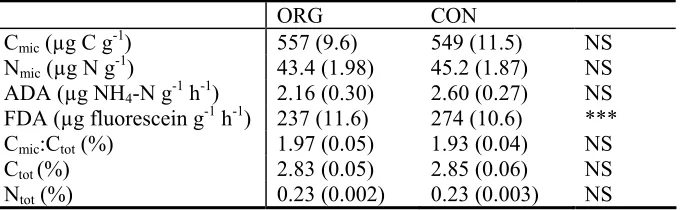
Table 3: Effect of current organic (ORG) and conventional (CON) management on mean concentrations of soil properties at the end of the lysimeter study.
ORG CON
Cmic (µg C g-1) 557 (9.6) 549 (11.5) NS
Nmic (µg N g-1) 43.4 (1.98) 45.2 (1.87) NS
ADA (µg NH4-N g-1 h-1) 2.16 (0.30) 2.60 (0.27) NS FDA (µg fluorescein g-1 h-1) 237 (11.6) 274 (10.6) ***
Cmic:Ctot (%) 1.97 (0.05) 1.93 (0.04) NS
Ctot (%) 2.83 (0.05) 2.85 (0.06) NS
Ntot (%) 0.23 (0.002) 0.23 (0.003) NS
***, p<0.001; NS, not significant. Standard error of means in parentheses. N=8.
[image:3.595.69.409.499.604.2]Conclusion
After 30 months under the same crop rotation and cultivation regime, no major differences between treatments were detected in mineral N losses and soil microbial biomass size and community composition. However, past management was reflected in measurable differences in chemical soil properties, which are expected to change slowly, and microbial activity. This indicates that in the short term, microbial community size and composition are mainly influenced by management practices such as crop rotation and green manuring that were the same for all treatments. Management history, on the other hand, has a lasting effect on enzyme activities with initial differences remaining visible after conversion to organic and re-conversion to conventional, respectively.
References
Adam, G. & Duncan, H. (2001) Development of a sensitive and rapid method for the measurement of total microbial activity using fluorescein diacetate (FDA) in a range of soils. Soil Biology & Biochemistry 33, 943-51.
Alef, K. & Nannipieri, P. (eds.) (1995) Methods in applied soil microbiology and biochemistry. Academic Press Limited, London, UK. 576 pp.
BioGro New Zealand (2001) BioGro NZ Organic Standards. New Zealand Biological Producers & Consumers Council, Wellington, NZ. http://www.biogro.co.nz/main.php?page=170
Di, H.J., Cameron, K.C., Moore, S. & Smith, N.P. (1998) Nitrate leaching and pasture yields following the application of dairy shed effluent or ammonium fertilizer under spray or flood irrigation: results of a lysimeter study. Soil Use & Management 14, 209-214.
Girvan, M.S., Bullimore, J., Pretty, J.N., Osborn, A.M. & Ball, A.S. (2003) Soil type is the primary determinant of the composition of the total and active bacterial communities in arable soils. Applied &
Environmental Microbiology 69, 1800-1809.
Heuer, H., Wieland, G., Schönfeld, J., Schönwälder, A., Gomes, N.C.M. & Smalla, K. (2001) Bacterial community profiling using DGGE or TGGE analysis. In: Environmental molecular microbiology: Protocols and applications (P. Rochelle, ed.). Horizon Scientific Press; Wymondham, UK. pp. 177-90. Insam, H. & Rangger, A. (eds.) (1997) Microbial Communities: Functional vs. structural approaches. Springer
Verlag, Berlin, Germany. 263 pp.
Johnson, M.J., Lee, K.Y. & Scow, K.M. (2003) DNA fingerprinting reveals links among agricultural crops, soil properties, and the composition of soil microbial communities. Geoderma 114, 279-303.
Mäder, P., Pfiffner, L., Fliessbach, A., von Lützow, M. & Munch, J.C. (1996). Soil ecology - the impact of organic and conventional agriculture on soil biota and its significance for soil fertility. In: 11th Scientific
Conference, IFOAM, Copenhagen, Denmark, pp. 24-46.
Marschner, P., Kandeler, E. & Marschner, B. (2003) Structure and function of the soil microbial community in a long-term fertilizer experiment. Soil Biology & Biochemistry 35, 453-461.
O'Donnell, A.G., Seasman, M., Macrae, A., Waite, I. & Davies, J.T. (2001) Plants and fertilisers as drivers of change in microbial community structure and function in soils. Plant & Soil 232, 135-145.
Ritz, K., Dighton, J. & Giller, K.E. (eds.) (1994) Beyond the biomass: Compositional and functional analysis of soil microbial communities. John Wiley & Sons, Inc., Chichester, UK. 275 pp.
Robertson, F.A. & Morgan, W.C. (1996) Effects of management history and legume green manure on soil microorganisms under 'organic' vegetable production. Australian Journal of Soil Research 34, 427-440. Shepherd, M., Harrison, R., Cuttle, S., Johnson, B., Shannon, D., Gosling, P. & Rayns, F. (2000) Understanding
of soil fertility in organically farmed soils (April 2000). produced for UK Ministry of Agriculture, Fisheries and Food. http://www.adas.co.uk/soilfertility/download.html?topid=7
Sparling, G.P. & West, A.W. (1988) Modifications to the fumigation extraction technique to permit
simultaneous extraction and estimation of soil microbial C and N. Communications in Soil Science & Plant Analysis 19, 327-344.
Stolze, M., Piorr, A., Häring, A. & Dabbert, S. (2000) Environmental impacts of organic farming in Europe
(Organic farming in Europe: Economics and policy, Vol. 6). University of Hohenheim, Stuttgart, Germany. 127 pp.
Waldrop, M.P., Balser, T.C. & Firestone, M.K. (2000) Linking microbial community composition to function in a tropical soil. Soil Biology & Biochemistry 32, 1837-1846.
Ward, J.H. (1963) Hierarchical grouping to optimize an objective function. Journal of the American Statistical Association 58, 236-244.