STUDIES IN NATURE CONSERVATION
J.B. Kirkpatrick BA (Hons), PhD
University of Melbourne
AM
Submitted in fulfilment of the requirements for the degree of
Doctor of Science
University of Tasmania
Hobart
July 2005
,::-STATEMENT OF ORIGINALITY
/A./J.o�
/(, I !Z /(.
p
ft Tll I CJ::.
D. (c.
?...,00.J
vo/. I
This volume contains a substantial part of my research contribution to the conservation of nature. It consists 110 refereed papers or book chapters, one invited editorial and one chapter from a sole-authored book. None of this work has been submitted by me as part of a thesis for any other degree, although many papers have been adapted from theses written by the many honours and postgraduate students I have supervised since 1973 (Table 1).
I am sole author of 22 of the writings included in this volume. As can be gauged from Table 1, which outlines the contributions of the various authors of papers contained herein, and from the acknowledgements in the papers, I have benefited from working with many outstanding research students and colleagues, among them: Kerry Bridle, David Bowman, Mick Brown, Kath Dickinson, Rod Fensham, Neil Gibson, Louise Gilfedder, Stephen Harris, Chris Harwood, Tony Moscal and Jenny Scott. I could not have undertaken this work without the help of the general staff of the School of Geography and Environmental Studies and its predecessor academic unit�.
I declare the above information to be true
kpatrick 25 July 2005
Of 1P:3'. _,. i)\ IL� 2-;: .·>:.r�:�. \7
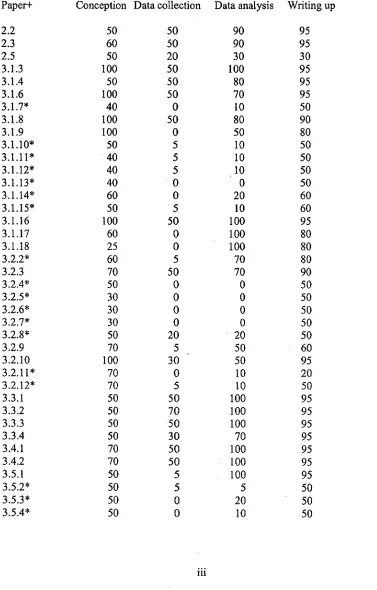
Table 1. Contribution to papers with multiple authors. Estimated percentages are shown. n.a. = not applicable, * paper developed from the thesis of a student co-author who I supervised. + see table of contents for paper codes.
Paper+ Conception Data collection Data analysis Writing up
2.2 50 50 90 95
2.3 60 50 90 95
2.5 50 20 30 30
3.1.3 100 50 100 95
3.1.4 50 50 80 95
3.1.6 100 50 70 95
3.1.7* 40 0 10 50
3.1.8 100 50 80 90
3.1.9 100 0 50 80
3.1.10* 50 5 10 50
3.1.11* 40 5 10 50
3.1.12* 40 5 10 50
3.1.13* 40 0 0 50
3.1.14* 60 0 20 60
3.1.15* 50 5 10 60
3.1.16 100 50 100 95
3.1.17 60 0 100 80
3.1.18 25 0 100 80
3.2.2* 60 5 70 80
3.2.3 70 50 70 90
3.2.4* 50 0 0 50
3.2.5* 30 0 0 50
3.2.6* 30 0 0 50
3.2.7* 30 0 0 50
3.2.8* 50 20 20 50
3.2.9 70 5 50 60
3.2.10 100 30 50 95
3.2.11* 70 0 10 20
3.2.12* 70 5 10 50
3.3.1 50 50 100 95
3.3.2 50 70 100 95
3.3.3 50 50 100 95
3.3.4 50 30 70 95
3.4.1 70 50 100 95
3.4.2 70 50 100 95
3.5.1 50 5 100 95
3.5.2* 50 5 5 50
3.5.3* 50 0 20 50
Paper Conception Data collection Data analysis Writing up
3.5.5 100 20 80 95
3.5.6* 50 10 30 50
4.2 50 0 100 95
4.3* 50 0 20 50
4.4* 40 0 10 50
4.5* 40 0 10 50
4.6* 40 0 10 50
4.7* 40 0 10 50
4.8 50 0 80 95
4.9 50 0 80 95
4.10 40 0 50 60
4.11* 40 5 20 50
4.12* 40 5 10 50
4.13* 50 0 50 50
5.5* 70 20 80 60
5.6* 30 20 30 10
5.7* 60 0 50 70
6.1.1 100 50 100 95
6.1.3 50 0 80 95
6.1.5 50 0 100 95
6.1.6* 60 0 40 50
6.1.7* 40 0 40 40
6.1.8 60 0 50 30
6.2.1 50 na na 90
6.2.2* 40 0 40 50
6.2.3* 50 0 30 50
6.2.4* 50 0 30 50
6.3.1 80 0 100 95
6.3.2 80 30 100 95
6.3.3* 25 0 0 20
6.3.4* 50 na na 50
6.4.1 50 50 40 50
6.4.2* 40 0 30 50
6.4.3* 40 30 30 50
6.4.4* 20 0 30 30
6.4.5 60 0 100 95
6.4.6* 30 0 30 20
6.4.7 80 20 100 95
6.5.2* 50 5 50 50
6.5.3* 50 5 30 40
6.5.4 50 50 50 50
6.5.5 80 0 90 80
6.5.6 70 0 80 80
7.1* 70 na 20 30
Paper Conception Data collection Data analysis Writing up
7.2 100 60 100 95
7.5 80 40 80 70
7.7 100 50 90 95
7.9 50 50 50 80
7.10 90 50 80 95
TABLE OF CONTENTS
Section Page
Introduction 1
Papers
1. Research approach
1.1 Kirkpatrick, J.B., 2000. The political ecology of biogeography. Journal of
Biogeography 27, 45-48. 12
1.2. Kirkpatrick, J.B., 1997. The future of Australian plant ecology - incisively
idiographic or nebulously nomothetic? In Klomp, N. and Lunt, I. (eds.). Frontiers in
Ecology. Elsevier Science, Oxford, 289-298. 16
1.3. Kirkpatrick, J.B., 1999. The politics of the media and ecological ethics. In Wills, R.
and Hobbs, R. (eds.) Ecology for Everyone. Surrey-Beatty, Sydney, 36-41. 26
2. Floristic biogeography of Tasmania
2.1. Kirkpatrick, J.B., 1982. Phytogeographical analysis of Tasmanian alpine floras.
Journal of Biogeography 9,255-271. 33
2.2. Kirkpatrick, J.B. and Brown, M.J., 1984. Numerical analysis of Tasmanian higher
plant endemism. Botanical Journal of the Linnaean Society of London 88,
165-183. 50
2.3. Kirkpatrick, J.B. and Brown, M.J., 1984. The palaeogeographic significance of local
endemism in Tasmanian higher plants. Search 15, 112-113. 69
2.4. Kirkpatrick, J.B., 1986. Tasmanian alpine biogeography and ecology and
interpretation of the past. In Barlow, B.A. (ed.). Flora and Fauna of Alpine Australasia:
Ages and Origins. CSIRO, Melbourne, pp. 229-242. 71
2.5. Nunez, M., Kirkpatrick, J.B. and Nilsson, C., 1996. Rainfall estimation in south
west Tasmania using satellite images and phytosociological calibration. International
Journal of Remote Sensing 17, 1583-1600. 85
2.6. Kirkpatrick, J.B., 2002. Factors influencing the spatial restriction of vascular plant
species in the alpine archipelagoes of Australia. In C. Korner & E.M. Spehn (eds.):
Mountain Biodiversity: a Global Assessment. Parthenon Publishing, London, pp. 155-
164. 103
3. Ecology of natural vegetation
3.1. Cold climate vegetation
3.1.1. Kirkpatrick, J.B., 1983. Treeless plant communities of the Tasmanian high country.
Proceedings of the Ecological Society of Australia 12, 61-77. 113
3.1.2. Kirkpatrick, J.B. 1989. The comparative ecology of mainland Australian and
Tasmanian alpine vegetation . In R. Good (ed.) The Scientific Significance of the
Australian Alps. Australian Academy of Science, Canberra, 127-142. 130
3.1.3. Kirkpatrick, J.B. and Bridle, K.L., 1998. Environmental relationships of floristic
variation in the alpine vegetation of south-east Australia. Journal of Vegetation Science
9, 251-260. 146
3.1.4. Kirkpatrick, LB. and Harwood, C.E., 1980. The vegetation of an infrequently
burned Tasmanian mountain region. Proceedings of the Royal Society of Victoria 91,
79-107. 156
3.1.5. Kirkpatrick, J.B., 1984. Altitudinal and successional variation in the vegetation of
the West Coast Range, Tasmania. Australian Journal of Ecology 9, 81-91. 185
3.1.6. Kirkpatrick, J.B. and Gibson, N.L., 1984. Dynamics of a Tasmanian bolster heath
string fen. Vegetatio 58, 71-78. 196
3.1.7. Gibson, N. and Kirkpatrick, J.B., 1992. Dynamics of a Tasmanian cushion heath
community. Journal of Vegetation Science 3, 647-654. 204
3.1.8. Kirkpatrick, J.B. and Brown, Mi., 1987. The nature of the transition from
sedgeland to alpine vegetation in South West Tasmania: I. Altitudinal vegetation change
on four mountains. Journal of Biogeography 14, 539-549. 212
3.1.9. Kirkpatrick, J.B., Nunez, M., Bridle, K. and Chladil, M., 1996. Explaining a sharp
transition from sedgeland to alpine vegetation on Mount Sprent, south-west Tasmania.
Journal of Vegetation Science 7, 763-768. 223
3.1.10. Bridle, K. and Kirkpatrick, J.B., 1997. Local environmental correlates of
variability in the organic soils of moorland and alpine vegetation, Mt Sprent, Tasmania.
Australian Journal of Ecology 22, 196-205. 229
3.1.11. Cullen, P.C. and Kirkpatrick, J.B., 1988. The ecology of Athrotaxis D. Don
(Taxodiaceae ) I. Stand structure and regeneration of A. cupressoides. Australian
Journal of Botany 36, 547-560. 239
3.1.12. Cullen, P.C. and Kirkpatrick, J.B., 1988. The ecology of Athrotaxis D. Don
(Taxodiaceae) II. The distributions and ecological differentiation of A. cupressoides and
A. selaginoides. Australian Journal of Botany 36, 561-573. 253
3.1.13. Whinam, J. and Kirkpatrick, J.B., 1995. Successional sequences in two
Tasmanian valley Sphagnum peatlands. Journal of Vegetation Science 6,
675-682. 266
3.1.14. Pharo, E. and Kirkpatrick, LB., 1994. Vegetation of the alpine sand dunes at Lake
Augusta, Tasmania. Australian Journal of Ecology 19, 319-327. 274
3.1.15. Lynch, A.J.J. and Kirkpatrick, J.B., 1995. Pattern and process in alpine
vegetation and landforms at Hill One, Southern Range, Tasmania. Australian Journal of
Botany 43, 537-554. 283
3.1.16. Kirkpatrick, J.B., Bridle, K. and Lynch, A.J.J., 2002. Changes in alpine vegetation
related to geomoiphological processes and climate change on Hill One, Southern Range,
Tasmania, 1989-2000. Australian Journal of Botany 50, 753-759. 299
3.1.17. Kirkpatrick, J.B. and Scott, J.J., 2002. Change in undisturbed vegetation on the
coastal slopes of Subantarctic Macquarie Island 1980-1995. Arctic, Antarctic and Alpine
Research, 34, 300-307. 306
3.1.18. Scott, J.J. and Kirkpatrick, LB., in press. Changes in Subantarctic Heard Island
vegetation at sites occupied by Poa annua, 1987-2000. Arctic, Antarctic and Alpine
Research. 314
3.2 Eucalypt-dominated vegetation
3.2.1. Kirkpatrick, J.B., 1997. Vascular plant-eucalypt interactions. In. Williams, J. E.
and Woinarski, J.C.Z. (eds.). Eucalypt Ecology: Individuals to Ecosystems. Cambridge
University Press, Cambridge, pp. 227-245. 329
3.2.2. Hogg, A. and Kirkpatrick, J.B., 1974. The phytosociology and synecology of some
southern Tasmanian eucalypt forests and woodlands. Journal of Biogeography 1, 227-
245. 348
3.2.3. Kirkpatrick, J.B. and Nunez, M., 1980. Vegetation-radiation relationships in
mountainous terrain: eucalypt-dominated vegetation in the Risdon Hills, Tasmania.
Journal of Biogeography 7, 197-208. 367
3.2.4. Bowman, D.M.J.S. and Kirkpatrick, J.B., 1984. Geographic variation in the
demographic structure of stands of Eucalyptus delegatensis R.T. Baker on dolerite in
Tasmania. Journal of Biogeography 11, 427-437. 379
3.2.5. Bowman, D.M.J.S. and Kirkpatrick, J.B., 1986. The establishment, suppression
and growth of Eucalyptus delegatensis R.T. Baker in multi-aged forests. I. The effects of
fire on mortality and seedling establishment. Australian Journal of Botany 34,
63-72. 390
3.2.6. Bowman, D.M.J.S. and Kirkpatrick, J.B., 1986. The establishment, suppression
and growth of Eucalyptus delegatensis R.T. Baker in multi-aged forests. II. Sapling
growth and its environmental correlates. Australian Journal of Botany 34,
73-80. 400
3.2.7. Bowman, D.M.J.S. and Kirkpatrick, J.B., 1986. The establishment, suppression
allelopathy, competition between adult and juvenile for moisture and nutrients, and frost
damage to seedlings. Australian Journal of Botany 34, 81-94. 408
3.2.8. Dickinson, K.J.M. and Kirkpatrick, J.B., 1985. The flammability and energy
content of some important plant species and fuel components in the forests of
southeastern Tasmania. Journal of Biogeography 12, 121-134. 422
3.2.9. Fensham, R.J. and Kirkpatrick, J.B., 1992. The eucalypt forest-grassland/grassy
woodland boundary in central Tasmania. Australian Journal of Botany 40,
123-138. 436
3.2.10. Kirkpatrick, J.B. and Gibson, N., 1999. Towards an explanation of the altitudinal
distributions of three species of Eucalyptus in central Tasmania. Australian Journal of
Ecology 24, 123-131. 452
3.2.11. Pyrke, A. and Kirkpatrick, J.B., 1994. Growth rate and basal area response
curves of four Eucalyptus species on Mt Wellington, Tasmania. Journal of Vegetation
Science 5, 13-24. 461
3.2.12. McKenny, H. and Kirkpatrick, J.B., 1999. The role of fallen logs in the
regeneration of tree species in Tasmanian mixed forest. Australian Journal of Botany 47,
745-753. 473
3.3 Tropical vegetation
3.3.1. Kirkpatrick, J.B. and Hassall, D.C., 1981. Vegetation of the Sigatoka sand dunes,
Fiji. New Zealand Journal of Botany 19, 285-297. 480
3.3.2. Kirkpatrick, J.B. and Hassall, D.C., 1985. The vegetation and flora along an
altitudinal transect through tropical forest at Mount Korobaba, Fiji. New Zealand Journal
of Botany 23, 33-46. 493
3.3.3. Hassall, D.C. and Kirkpatrick, J.B., 1985. The diagnostic value and host relationships of the dependent synusia in the forests of Mount Korobaba, Fiji. New
Zealand Journal of Botany 23, 47-54, 507
3.3.4. Kirkpatrick, J.B., Fensham, R., Nunez, M. and Bowman, D.M.J.S., 1988.
Vegetation-radiation relationships in the wet-dry tropics: granite hills in northern
Australia. Vegetatio 76, 103-112. 515
3.4. Californian coastal sage scrub
3.4.1. Kirkpatrick, J.B. and Hutchinson, C.F., 1977. The community composition of
Californian coastal sage scrub. Vegetatio 35, 21-33. 525
3.4.2. Kirkpatrick, J.B. and Hutchinson, C.F., 1980. The environmental relationships of
Californian coastal sage scrub and some of its component communities and species.
Journal of Biogeography 7, 23-38. 538
3.5. Miscellaneous Tasmanian vegetation types
3.5.1. Kirkpatrick, J.B. and Harwood, C.E., 1983. Plant communities of Tasmanian
wetlands. Australian Journal of Botany 31, 437-451. 554
3.5.2. Daley, E.A. and Kirkpatrick, J.B., 2004. Native riparian vegetation in Tasmania.
Cunninghamiana 8, 409-430. 567
3.5.3. Coates, F. and Kirkpatrick, J.B., 1992. Environmental relationships and ecological
responses of some higher plant species on rock cliffs in northern Tasmania. Australian
Journal of Ecology 17, 441-449. 589
3.5.4. Walsh, D.A., Kirkpatrick, J.B. and Skira, I.J., 1997. Vegetation patterns,
environmental correlates and vegetation change in a Puffinus tenuirostris breeding
colony at Cape Queen Elizabeth, Tasmania. Australian Journal of Botany 45,
71-79. 598
3.5.5. Kirkpatrick, J.B., Leaman, T., Pennington, A. and Pollard, T., 2004. Characteristics
and dynamics of the sand dune vegetation at North Bay, Tasmania. Papers and
Proceedings of the Royal Society of Tasmania 138, 37-45. 607
3.5.6. Harris, S. and Kirkpatrick, J.B., 1991. The distributions, dynamics and ecological
differentiation of Callitris species in Tasmania. Australian Journal of Botany 39, 187-
202. 616
4. The conservation ecology of rare or threatened species
4.1. Kirkpatrick, J.B. 1999. A Continent Transformed- Human Impact on the Natural
Vegetation of Australia. 2nd edition, Oxford University Press, Sydney,
chapter 9. 632
4.2. Kirkpatrick, J.B. and Gilfedder, L., 1995. Maintaining integrity compared with
maintaining rare and threatened taxa in remnant bushland in subhumid Tasmania.
Biological Conservation 74, 1-8. 644
4.3. Woolley, A. and Kirkpatrick, J.B., 1999. Factors related to condition and rare and
threatened species occurrence in lowland, humid basalt remnants in northern Tasmania.
Biological Conservation 87, 131-42. 652
4.4. Gilfedder, L. and Kirkpatrick, J.B., 1993. Germinable soil seed and competitive
relationships between a rare native species and exotics in a semi-natural pasture in the
4.5. Gilfedder, L. and Kirkpatrick, J.B., 1994. Culturally induced rarity? - the past and
present distributions of Leucochrysum albicans in Tasmania. Australian Journal of
Botany 42, 404-416. 671
4.6. Gilfedder, L. and Kirkpatrick, J.B., 1994. Climate, grazing and disturbance and the
population dynamics of Leucochrysum albicans at Ross, Tasmania. Australian Journal
of Botany 42, 417-430. 683
4.7. Gilfedder, L. and Kirkpatrick, J.B., 1994. Genecological variation in the
germination, growth and morphology of four populations of a Tasmanian endangered
perennial daisy, Leucochrysum albi cans. Australian Journal of Botany 42,
431-440. 697
4.8. Gilfedder, L. and Kirkpatrick, LB., 1998. Distribution, disturbance tolerance and
conservation of Stackhousia gunnii Hook. f. in Tasmania. Australian Journal of Botany
46, 1-13. 707
4.9. Kirkpatrick, J.B. and Gilfedder, L., 1998. Conserving weedy natives: two Tasmanian
endangered herbs in the Brassicaceae. Australian Journal of Ecology 23,
466-473. 718
4.10. Lynch, A.J.J., Gilfedder, L.G. and Kirkpatrick, J.B., 1999. The Tasmanian endemic
shrub, Acacia axillaris: conservation ecology applied to the question of rarity or
vulnerability. Australian Journal of Botany 47, 97-109. 726
4.11. Coates, F., Kirkpatrick, J.B. and Minchin, P.R., 1999. Towards an explanation of
the causes of the rarity of two Tasmanian Spyridium species. Australian Journal of
Ecology 24, 11-17. 739
4.12. Coates, F. and Kirkpatrick, J.B., 1999. Is geographic range correlated with climatic
range in Australian Spyridium taxa? Australian Journal of Botany 47, 755-767. 746
4.13. Leeson, K. and Kirkpatrick, J.B., 2004. Ecological and physiological explanations
for the restriction of a Tasmanian species of Ozothamnus to a single population.
Australian Journal of Botany 52, 39-45. 759
5. Urban ecology
5.1. Kirkpatrick, J.B., 1974. Plant invasion and extinction in a suburban coastal reserve.
Australian Geographical Studies 12, 107-118. 766
5.2. Kirkpatrick, J.B., 1975. Vegetation change in a suburban coastal reserve.
Australian Geographical Studies 13, 137-153. 778
5.3. Kirkpatrick, J.B., 1986. The viability of bush in cities - ten years of change in an
urban grassy woodland. Australian Journal of Botany 34, 691-708. 795
5.4. Kirkpatrick, J.B., 2004. Vegetation change in an urban grassy woodland 1974-2000.
Australian Journal of Botany 52, 597-608. 813
5.5. O'Shea, E.M. and Kirkpatrick, J.B., 2000. The impact of suburbanization on
remnant coastal vegetation in Hobart, Tasmania. Applied Vegetation Science
3, 243-252. 825
5.6. Jellinek, S., Driscoll, D.A., Kirkpatrick, J.B., 2004. Environmental and vegetation
variables have a greater influence than habitat fragmentation in structuring lizard
communities in remnant urban bushland. Austral Ecology 29, 294-304. 835
5.7. Zagorslci, T., Kirkpatrick, J.B. and Stratford, E. 2004. Gardens and the bush:
gardeners attitudes, garden types and invasives. Australian Geographical Studies 42,
207-220. 846
6. Human impacts on natural ecosystems
6.1. Clearing
6.1.1 Kirkpatrick, J.B. and Dickinson, K.J.M., 1982. Recent destruction of natural
vegetation in Tasmania. Search 13, 186-187. 860
6.1.2. Kirkpatrick, J.B., 1991. The magnitude and significance of land clearance in
Tasmania in the 1980s. Tas:forests 3, 11-14. 862
6.1.3. Gilfedder, L. and Kirkpatrick, J.B., 1997. The influence of owners intentions on
remnant bush conservation in Tasmania. In P. Hale and D. Lamb (eds.) Conservation
Outside Nature Reserves. Centre for Conservation Biology, The University of
Queensland, Brisbane, pp. 217-225. 866
6.1.4. Kirkpatrick, J.B., 1988. Heritage and development in Tasmania. Australian
Geographer 19, 46-63. 875
6.1.5. Gilfedder, L. and Kirkpatrick, J.B., 1998. Factors influencing the integrity of
remnant bushland in subhumid Tasmania. Biological Conservation 84, 89-96. 893
6.1.6. Bowkett, L.A. and Kirkpatrick, J.B., 2003. Ecology and conservation of remnant
Melaleuca ericifolia stands in the Tamar Valley, Tasmania. Australian Journal of Botany
51, 405-413. 901
6.1.7. MacDonald, M. and Kirkpatrick, J.B., 2003. Explaining bird species composition
and richness in eucalypt-dominated remnants in subhurnid Tasmania. Journal of
Biogeography 30, 1415-1426. 910
6.1.8. Pharo, E.J., Kirkpatrick, J.B., Gilfedder, L., Mendel, L. and Turner, P.A.M., in
press. Predicting bryophyte diversity in grassland and eucalypt-dominated remnants in
subhumid Tasmania. Journal of Biogeography 922
6.2. Logging
6.2.1. Kirkpatrick, J.B. and Bowman, D.M.J.S., 1982. Clemielling versus selective
logging in uneven-aged eucalypt forests. Search 13, 136-141. 959
6.2.2. Dickinson, K.J.M. and Kirkpatrick, J.B., 1986. The impact of grazing pressure in
clearfelled, burned and undisturbed eucalypt forest. Vegetatio, 66, 133-6. 965
6.2.3. Dickinson, K.J.M. and Kirkpatrick, J.B., 1987. The short-term effects of
clearfelling and slash-burning on the richness, diversity and relative abundance of higher
plant species in two types of eucalypt forest on dolerite in Tasmania. Australian Journal
of Botany 36, 601-16. 969
6.2.4. Calais, S.S. and Kirkpatrick, J.B., 1983. Tree species regeneration after logging in
temperate rainforest, Tasmania. Papers and Proceedings of the Royal Society of
Tasmania 117, 77-83. 983
6.3. Burning
6.3.1. Kirkpatrick, J.B. and Dickinson, K.J.M., 1984. The impact of fire on Tasmanian
alpine vegetation and soils. Australian Journal of Botany 32, 613-629. 990
6.3.2. Kirkpatrick, J.B., Bridle, K. and Wild, A., 2002. Succession after fire in alpine
vegetation on Mount Wellington, Tasmania. Australian Journal of Botany
50, 145-154. 1007
6.3.3 Thomas, I. and Kirkpatrick, J.B., 1996. The role of coastlines, people and fire in
the development of heathlands in northeast Tasmania. Journal of Biogeography 23, 717-
728. 1017
6.3.4. Marsden-Smedley, J. and Kirkpatrick, J.B., 2000. Fire management in Tasmania's
Wilderness World Heritage Area: ecosystem restoration using Indigenous-style fire
regimes? Ecological Management and Restoration 1, 195-203. 1029
6.4 Grazing
6.4.1. Gibson, N. and Kirkpatrick, J.B. 1989. Effects of the cessation of grazing on the
grasslands and grassy woodlands of the Central Plateau, Tasmania. Australian Journal
of Botany 37, 55-63. 1038
6.4.2. Bridle, K.L. and Kirkpatrick, J.B., 1999. The comparative effects of stock and
wild vertebrate grazing on treeless subalpine vegetation, eastern Central Plateau,
Tasmania. Australian Journal of Botany 47, 817-834. 1047
6.4.3. Bridle, K.L., Kirkpatrick, J.B., Cullen, P. and Shepherd, R.R., 2001. Recovery in
alpine heath and grassland following burning and grazing, eastern Central Plateau,
Tasmania, Australia. Arctic, Antarctic and Alpine Research 33, 348-356. 1065
6.4.4. Bridle, K.L. and Kirkpatrick, J.B., 2001. Impacts of grazing by vertebrate
herbivores on the flower stem production of tall alpine herbs, Eastern Central Plateau,
Tasmania. Australian Journal of Botany 49, 459-470. 1074
6.4.5. Kirkpatrick, J.B., Zacharek, A. and Chappell, K., 2000. Testing methods for
mitigation of tree dieback in Tasmanian dry eucalypt forests and woodlands. Pacific
Conservation Biology 6, 94-101. 1086
6.4.6. Leonard, S. W. J. and Kirkpatrick, J.B., 2004. Effects of grazing management and
environmental factors on native grassland and grassy woodland, Northern Midlands,
Tasmania. Australian Journal of Botany 52, 529-542. 1095
6.4.7. Kirkpatrick, J.B., Gilfedder, L., Bridle, K.L. and Zacharek,,A., 2005. The positive
and negative conservation impacts of sheep grazing and other disturbances on the
vascular plant species and vegetation of lowland subhumid Tasmania. Ecological
Management and Restoration 6, 51-60. 1109
6.5. Recreational impacts
6.5.1. Kirkpatrick, J.B., 2001. Ecotourism, local and indigenous people, and the
conservation of the Tasmanian Wilderness World Heritage Area. Journal of the Royal
Society of New Zealand 31, 819-829. 1119
6.5.2. Calais, S.S. and Kirkpatrick, J.B., 1986. The impact of trampling on the natural
ecosystems of the Cradle Mt. - Lake St. Clair National Park. Australian Geographer 17,
6-15. 1130
6.5.3. Whinam, J., Cannell, E.J., Kirkpatrick, J.B. and Comfort, M., 1994. Studies on the
potential impact of recreational horseriding on some alpine environments of the Central
Plateau, Tasmania. Journal of Environmental Management 40, 103-117. 1140
6.5.4. Scott, J.J. and Kirkpatrick, J.B., 1994. Effects of human trampling on the
sub-Antarctic vegetation of Macquarie Island. Polar Record 30, 207-220. 1155
6.5.5. Bridle, K.L. and Kirkpatrick, J.B., 2003. The impacts of nutrient additions and
digging for human waste disposal in natural environments, Tasmania, Australia. Journal
of Environmental Management 69, 299-306. 1169
6.5.6. Bridle, K.L. and Kirkpatrick, J.B., 2005. An analysis of the breakdown of paper
products (toilet paper, tissues and tampons) in natural environments, Tasmania, Australia.
Journal of Environmental Management 74, 21-30. 1177
7. Nature conservation planning
7.1. Mendel, L.C. and Kirkpatrick, J.B., 2002. Historical progress of biodiversity
conservation in the protected-area system of Tasmania, Australia. Conservation Biology
16, 1520-1529. 1187
7.2. Kirkpatrick, J.B. and Haney, R.A., 1980. The quantification of developmental
wilderness loss - The case of forestry in Tasmania. Search 11, 331-335. 1197
7.3. Kirkpatrick, J.B., 1983. An iterative method for establishing priorities for the
selection of Nature Reserves: an example from Tasmania. Biological Conservation
25, 127-134. 1203
7.4. Kirkpatrick, J.B., 1986. Conservation of plant species, alliances and associations of
the treeless high country of Tasmania. Biological Conservation 37, 43-57. 1211
7.5. Kirkpatrick, J.B. and Duncan, F., 1987. Tasmanian high altitude grassy vegetation:
its distribution, community composition and conservation status. Australian Journal of
Ecology 12, 73-86. 1227
7.6. Kirkpatrick, J.B., 1990. A synusia-based mapping system for the conservation and
management of natural vegetation, with an example from Tasmania, Australia. Biological
Conservation 53, 93-104. 1242
7.7. Kirkpatrick, J.B., Gilfedder, L., Duncan, F.D. and Harris, S., 1991. Reservation
status and priorities for Tasmanian plants 1. Angiospermae (Dicotyledonae). In Banks,
M.R., Smith, S.J., Orchard, A.E. and Kantvilas, G. (eds). Aspects of Tasmanian Botany,
Royal Society of Tasmania, Hobart, 163-172. 1253
7.8. Kirkpatrick, J.B. and Brown, M.J., 1991. Planning for species conservation. In
Margules, C.R. and Austin, M.P. (eds) Nature Conservation: Cost Effective Biological
Surveys and Data Analysis. CSIRO, Melbourne, 83-89. 1263
7.9. Kirkpatrick, J.B. and Brown, M.J., 1994. A comparison of direct and environmental
domain approaches to planning reservation of forest higher plant communities and
species in Tasmania. Conservation Biology, 8, 217-224. 1271
7.10. Kirkpatrick, J.B. and Fowler, M., 1998. Locating likely glacial refugia in Tasmania
using palynological and ecological information to test alternative climatic models.
Biological Conservation 85, 171-182. 1279
7.11. Kirkpatrick, J.B., 1998. Nature conservation and the regional forest agreement
process. Australian Journal of Environmental Management 5, 31-37. 1291
7.12. Mendel, L.C. and Kirkpatrick, J.B., 1999. Assessing temporal changes in the
reservation of the natural aesthetic resouce using pictorial content analysis and a
grid-based scoring system - the example of Tasmania. Landscape and Urban Planning.43,
181-190. 1299
INTRODUCTION
The papers enclosed in this volume were all created with one major motivation, to
contribute to the conservation of nature, defining nature in its dualistic sense. In paper
1.1, I described several ways in which biogeographers/ecologists can help create positive
outcomes for nature through the research work that they choose to undertake, ranging
from revealing interesting stories that might arouse public interest in nature conservation
to the provision of a technical and knowledge foundation for conservation measures in
matters of public dispute. Paper 1.2 argues the proposition that the particular may be
more important than the general in gaining the types of ecological understandings that
might enable practical nature conservation. Some of the ethical underpinnings of my
research work are discussed in paper 1.3, the main, and unexceptional, point being that
ecologists should base their public utterances on an honest reading of their always
inadequate data. Attachment to ideas/generalizations/hypotheses can be bad for both
science and the living world. The few people who will read this volume will probably
pick up some instances of hypothesis drift, where the initial guiding proposition proves
less interesting than a byproduct of the research process, and many instances of
hypothesis reversal, where an idea that seemed excellent in relation to the data available
at the time proves to be incorrect in a context of more data or a wider understanding.
The work in the present thesis was focused largely on Tasmania, a State of islands in the
Commonwealth of Australia, constituting approximately 6.9 million ha of land, of which
approximately 70% had not been cleared or inundated by 2005. The late Professor Bill
Jackson believed that plant ecologists could only be proficient in their trade by knowing
an area for decades. Whatever the truth of this proposition, longevity in a place does
allow decades scale observations that can often be more powerful than natural or induced
experiments in contributing towards an understanding of natural processes (e.g. 6.3.2,
3.1.16; 3.1.17; 5.4). The size and environmental heterogeneity of Tasmania have made it
an excellent laboratory for the development and testing of ecological and conservation
planning ideas and techniques, many of which have much wider relevance than to one
small set of islands.
Before 1970, Barber (1955) and Barber and Jackson (1957) had used observations of
genecological variation in Eucalyptus urnigera on Mt. Wellington to first postulate the
phenomenon of divergence through selection in continuous populations, and Jackson
(1968) had created a probabilistic ecosystem model that predicted successional change in
lowland western Tasmania in an obscurely published paper way ahead of its time. In
1970, there was relatively little other published knowledge of the plant ecology of
Tasmania, and, thus, little basis for determining conservation priorities for species and
vegetation types, in a decade of expansion of conservation reserve systems in all parts of
Australia, and elsewhere in the world. The literature that existed consisted of broad
overviews of the vegetation (Jackson 1965, 1968), a body of work on the dynamics of tall
eucalypt forests (Gilbert 1959; Cremer and Mount 1965) and a small number of
descriptions, of varying depth, of the vegetation of small parts of the State (e.g. Gibbs
1920; Martin 1940; Davis 1941; Curtis and Sommerville 1947; Gillham 1965). I
opportunistically added to this small body of descriptions, selecting some out of the many
places that no-one had studied (e.g. Kirkpatrick 1973, 1975; 3.1.4; 3.1.5). Many of the
areas I described were almost immediately made into conservation reserves, on the basis
of a scientific description being available. It was obvious to me that scientific description
was a poor selection criterion for reserves for nature conservation, given the almost total
lack of knowledge of the vegetation and flora of most of the State. I thought that the
collection of vegetation and species distribution data on a State-wide basis would be
necessary to make possible an ecologically appropriate selection of reserves. The
provision and analysis of these data became a major focus of my research.
Since 1977, when the first such study was published (Kirkpatrick 1977), State-wide
surveys, based on quadrats or releves, have covered all the major vegetation types of
Tasmania. The surveys in which I was principal investigator, or supervisor, were of
coastal heath (Kirkpatrick 1977; Kirkpatrick and Harris 1999), lentic wetlands (3.5.1;
Kirkpatrick and Harwood 1983; Kirkpatrick and Tyler 1988), alpine vegetation (3.1.1;
7.4; Kirkpatrick 1997), grasslands and grassy woodlands (7.5; Kirkpatrick et al. 1988;
McDougall and Kirkpatrick 1994; Kirkpatrick etal. 1995), wet eucalypt forest
(Kirkpatrick
et al.1988),
Sphagnumbogs (Whinam
et al.1989), coastal vegetation
(Kirkpatrick and Harris 1995), rock plate vegetation (Gilfedder
etal.1997) and riparian
vegetation (3.5.2). A synopsis of this work, and that conducted by others, to the mid
1990s, was published in Kirkpatrick
et al.(1995) and its influence is discussed in paper
7.1. I was also involved in the first State-wide survey of coastal sage scrub in California
(3.4.1 and 3.4.2).
The only vegetation map of Tasmania was small scale and differentiated only the major
formations (Davies 1964). A map better suited to conservation planning was needed. I
was involved in the creation of a 1:500,000 vegetation map for the State (Kirkpatrick and
Dickinson 1984), and later developed a 1:25,000 vegetation mapping technique (7.6)
which has been used to map the whole of the Tasmanian Wilderness World Heritage
Area. The field work for the State-wide mapping was somewhat depressing, in that large
areas of native vegetation were in the process of clearance, or had just been cleared. I
took advantage of the availability of LANDSAT images from 1972 onwards
todocument
the scale and patterning of this clearing (6.1.1 and 6.1.2).
After the pioneering work of Brown
et al.(1977), I began organizing a data base of the
occurrence of vascular plant species in the Tasmanian reserve system, in order to develop
priorities for further reservation (Brown
etal.1983; Kirkpatrick
et al.1991; 7.7). I was
later involved in work to document the distribution and reservation status of bryophytes
in Tasmania (Moscal and Kirkpatrick 1997; Moscal
et al.1997). In the process of
undertaking this work it became apparent that there was a need for work on the
conservation ecology of threatened plants. This became a major focus of work in my
research group from the late 1980s onwards (for a selection of papers, see 4). Many of the
threatened species were largely confmed to vegetation remnants in the most cleared and
developed parts of the State. I therefore decided that it was important to understand how
the attributes of remnants affected their biological and conservation attributes. Work to
date has been done on vascular plants, bryophytes, lizards and birds (see 5 and 6.1.5 to
6.1.8). Different biotic groups have proven to respond very differently to the
characteristics of remnants, and there proved to be no consistent relationship between the
condition of the stands and their importance for threatened elements of biodiversity. For
most species, the geometric characters of stands were irrelevant to their survival, and
management was critical.
Management was also obviously important for the conservation of non-remnant
vegetation. Work on the impacts of trampling by people revealed globally low thresholds
for damage in Tasmanian alpine and subantarctic ecosystems (6.5.2 and 6.5.4). The
impacts of trampling by horses were shown to vary between different alpine vegetation
types (6.5.3). In the first major study of its kind, the impacts of disposal, by burial, of
human wastes in the wild country were investigated (6.5.5 and 6.5.6), indicating minimal
damage to the vegetation, but waste persistence for at least two years in high rainfall, acid
environments.
The alpine vegetation of Tasmania was also very much influenced by fire. Recovery from
a single incidence of fire was shown to be exceedingly slow (6.3.1 and 6.3.2), as was
recovery from the combined effects of past sheep gazing and fire (6.4.1 to 6.4.3). Fire
management was obviously critical in conserving the World Heritage qualities
(Kirkpatrick et al. 1993) of Tasmanian alpine ecosystems. Most fires started in lowland
sedgelands and heaths, making an understanding of their fire management critical in the
conservation of alpine vegetation (6.3.4).
Our work on rare or threatened species, and on remnants, and earlier work comparing
roadsides and adjacent bush (Fensham and Kirkpatrick 1989), had suggested that
vertebrate grazing was playing a major role in determining the species composition and
native species richness of lowland grassy vegetation, as well as high country vegetation.
The big gaps in understanding were the relationship between grazing regime and
vegetation, and the interactions of fire, grazing and vegetation. These were investigated
using experimental manipulation and observation (6.4.6 and 6.4.7).
The woodchip export industry, established in the early1970s in Tasmania, resulted in a
to clearfelling in the dry eucalypt forests of the State. This was controversial (6.2.1).
Research projects on the dynamics of montane eucalypt forests (3.2.4 to 3.2.7) and the
comparative impacts on natural vegetation of clearfelling and selective logging (6.2.2 and
6.2.3) were initiated to determine some of the conservation consequences of this
silvicultural change.
While most of my research has been in native vegetation outside cities, I was the first
researcher in Australia to become interested in the ways in which native ecosystems
responded to envelopment by city and suburbs (see 5), and among the first in Australia to
take an interest in the plant ecology of the suburban garden (5.7).
Research directed towards improving the conservation of nature in Tasmania required
some methodological innovation. I developed the first technique to optimize the selection
of reserves (Kirkpatrick et al. 1980; 7.3), an achievement recognized by those who have
further developed these selection processes (Pressey 2002; Williams et al. 2004). I also
developed the first technique to quantify wilderness value and calculate its potential loss
to development (Kirkpatrick 1979; 7.2), and, with Louise Mendel, devised a method for
quantifying natural aesthetic value (7.12). In other methodological research, M.J. Brown
and I made the first comparison of the effectiveness of environmental domain techniques
and incomplete biological data as inputs to reservation planning (7.9) and M. Fowler and
I developed a technique to locate Last Glacial refugia (7.10).
Nature conservation outcomes result from political and social processes as much as
scientific understanding. Several of the papers I have included in this volume describe
and analyse these processes (1.3, 5.7, 6.1.3, 6.1.4, 6.5.1, 7.1, 7.11).
Pure biogeographical and ecological research can be important for nature conservation
either by providing interesting stories that bolster a conservation case, or by increasing
understanding of patterns and processes that later turn out to be important in conservation
planning or management. Section 2 of the thesis contains floristic biogeographic papers,
the earliest of which (2.1) was on alpine floras in Australia. In doing the analysis for this
paper I discovered that the commonly used similarity measures, Sorenson and Jaccard,
did not produce reasonable classification and ordination outcomes when some mountain
floras were subsets of the flora of larger mountains. I therefore used the number of
species in common/the number of species that could be in common. This, and paper 2.4,
established that there was a floristic continuum from the oligotrophic superhumid
mountains of far southwestern Tasmania to the more fertile, drier and less glaciated
mountains of northeast Tasmania and mainland Australia, with most of the variation
being in Tasmania. An analysis of the biogeography of vascular plant endemism in
Tasmania (2.2) showed the same continuum of variation and also emphasized the role of
dolerite, a rock uncommon on mainland Australia. Another paper (2.3) revealed strong
centres of local endemism, centres that seemed consistent with a refugium hypothesis,
and which were therefore highly important for conservation planning. A graph in paper
2.1 showed a strong relationship between the percentage of endemic species and rainfall,
but with the southernmost floras in a line parallel to, and below, the northernmost floras.
This led to the investigation reported in paper 2.5, in which strategic rainfall data
collection and remote sensing were used to establish that the precipitation maps on which
the figure was based were incorrect, with the mountains in the far south receiving the
highest precipitation in the State. The technique described in this paper can be adapted to
any other areas lacking a reasonable spread of meteorological stations.
Much of my ecological research has been in high mountain and high latitude
environments (see the selection of papers in 3.1 and Kirkpatrick 1997). The work in
Tasmania contributed substantially to the case for the listing of Tasmanian Wilderness
World Heritage Area, demonstrating the globally unusual nature of Tasmanian alpine
ecosystems, a distinctiveness relating to a highly maritime climate, oligotrophic soils and
isolation (Balmer et al. 2004). Several phenomena were researched in detail, for example:
the dynamics at different temporal scales of ecosystems dominated by cushion plants; the
nature and cause of a sharp floristic boundary between alpine and sedgeland vegetation in
southwestern Tasmania; the characteristics and dynamics of unusual fj aeldmark
vegetation; the ecology of the two species in the genus Athrotaxis; the dynamics of
vegetation with Sphagnum; changes in the vegetation of the Australian Subantarctic
islands.
Other ecological work has been on eucalypt-dominated vegetation (see the selection of
papers in 3.2), tropical vegetation in Fiji and the Northern Territory (see the selection of
papers in 3.3), Californian vegetation (see the selection of papers in 3.4), wetland
vegetation (e.g. 3.5.1 and 3.5.2) and coastal vegetation (e.g. 3.5.4 and 3.5.5). With my
students and other colleagues, I have undertaken at least some work on all major
terrestrial Tasmanian vegetation types. My work on eucalypts contributed to my major
role in the development of the eucalypt-dominated vegetation theme for World Heritage
assessment. This theme contributed to the expansion of the listing of the Tasmanian
Wilderness in 1989 and the later listing of the Blue Mountains, and played a major role in
an influential natural heritage assessment of the Australian Alps (Kirkpatrick 1994).
REFERENCES
Balmer, J., Whinam, J., Kelman, J., Kirkpatrick, J.B. and Lazarus, E., 2004. A review of
the floristic values of the Tasmanian Wilderness World Heritage Area. Nature
Conservation Report 2004/3, Department of Primary Industries, Water and Environment,
Hobart.
Barber, H.N., 1955. Selection in natural populations. Heredity 20, 551-572.
Barber, H.N. and Jackson, W.D., 1957. Natural selection in action in Eucalyptus. Nature
179, 1267-1269.
Brown, M.J., Kirkpatrick, J.B. and Moscal, A., 1983. An Atlas of Tasmania's Endemic
Flora. Tasmanian Conservation Trust, Hobart.
Cremer, A.W. and Mount, A.B., 1965. Early stages of plant succession following the
complete felling and burning of Eucalyptus regnans forest in the Florentine Valley,
Tasmania. Australian Journal of Botany 13, 303-322.
Curtis, W.M. and Sommerville, J., 1947. Boomer Marsh — a preliminary botanical and
historical survey. Papers and Proceedings of the Royal Society of Tasmania (1947), 151-
157.
Davies, G.L., 1964. A vegetation map of Tasmania. Geographical Review 54, 249-253.
Davis, C., 1941. Preliminary survey of vegetation near New Harbour, southwest
Tasmania. Papers and Proceedings of the Royal Society of Tasmania 40, 1-10.
Fensham, R.J. and Kirkpatrick, J.B., 1989. The conservation of original vegetation
remnants in the Midlands, Tasmania. Papers and Proceedings of the Royal Society of
Tasmania 123, 229-46.
Gibbs, L.S., 1920. Notes on the phytogeography and flora of the mountain summit
plateaux of Tasmania. Journal of Ecology 8, 1-17.
Gilbert, J.M., 1959. Forest succession in the Florentine Valley, Tasmania. Papers and
Proceedings of the Royal Society of Tasmania 93, 129-151.
Gilfedder, L., Kirkpatrick, J.B. and Ziegeler, D., 1997. Characteristics and conservation
status of rock pavement vegetation in lowland perhumid and subhumid Tasmania. A
report to the Australian Heritage Commission from the University of Tasmania.
Gillham, M.E., 1965. The Fisher Island field station IV. Vegetation additions and
changes. Papers and Proceedings of the Royal Society of Tasmania 99, 71-80.
Jackson, WD., 1965. Vegetation. In J.R. Davies (ed.) Atlas of Tasmania. Lands and
Survey Department, Tasmania, pp. 30-35.
Jackson, W.D., 1968. Fire, air, water and earth — an elemental ecology'of Tasmania.
Proceedings of the Ecological Society of Australia 3, 9-16.
Kirkpatrick, J.B., 1973. The vegetation of Sloping Island, Tasmania. Victorian
Naturalist 90, 312-321.
Kirkpatrick, J.B., 1975. Phytosociological analysis of the vegetation of Lagoon Beach,
Tasmania. Papers and Proceedings of the Royal Society of Tasmania 109, 53-63.
Kirkpatrick, J.B., 1977. The Disappearing Heath. Tasmanian Conservation Trust,
Hobart.
Kirkpatrick, J.B., 1979. Hydro-Electric Development and Wilderness in Tasmania.
Department of Environment, Hobart.
Kirkpatrick, J.B., 1994. The international significance of the natural values of the
Australian Alps. A report to the Australian Alps Liaison Committee from Tasque.
Kirkpatrick, J.B., 1997. Alpine Tasmania: An Illustrated Guide to the Flora and
Vegetation. Oxford University Press, Melbourne.
Kirkpatrick, J.B., Barker, P., Brown, M.J., Harris, S. and Mackie, R., 1995. The
reservation status of Tasmanian vascular plant communities. Parks and Wildlife Service,
Tasmania, Wildlife Scientific Report 95/4.
Kirkpatrick, J.B., Brown, M.J. and Moscal, A., 1980. Threatened Plants of the
Tasmanian Central East Coast. Tasmanian Conservation Trust, Hobart.
Kirkpatrick, J.B. and Dickinson, K.J.M., 1984. Vegetation Map of Tasmania, 1:500,000.
Forestry Commission, Tasmania.
Kirkpatrick, J.B., Gilfedder, L. and Fensham, R., 1988. City Parks and Cemeteries:
Tasmania's' Grassy Heritage. Tasmanian Conservation Trust, Hobart.
Kirkpatrick, J.B., Gilfedder, L., Hickie, J. and Harris, S., 1991. Reservation and
conservation status of Tasmanian native higher plants. Department of Parks, Wildlife
and Heritage, Wildlife Division Scientific Report 91/2.
Kirkpatrick, J.B. and Harris, S. 1995. The conservation of Tasmanian dry coastal
vascular plant communities. Parks and Wildlife Service, Tasmania, Wildlife Scientific
Report 95/1.
Kirkpatrick, J.B. and Harris, S., 1999. The Disappearing Heath Revisited. Tasmanian
Environment Centre, Hobart.
Kirkpatrick, J.B. and Harwood, C.E., 1983. The conservation of Tasmanian wetland
macrophytic species and communities. Papers and Proceedings of the Royal Society of
Tasmania 117, 5-20.
Kirkpatrick, J.B., McDougall, K. and Hyde, M., 1995. Australia's most threatened
ecosystem - the southeastern lowland native grasslands. Surrey-Beatty/WWFA, Sydney.
Kirkpatrick, J.B., Peacock, R.J., Cullen, P.J. and Neyland, M.G., 1988. The wet eucalypt
forests of Tasmania. Tasmanian Conservation Trust, Hobart.
Kirkpatrick, J.B., Hutchinson, M.N. and MacQuillan, P.B., 1993. Alpine ecosystems. In
S. Smith and M.R. Banks (ed). Tasmanian Wilderness -World Heritage Values. Royal
Society of Tasmania, Hobart, 73-79.
Kirkpatrick, J.B. and Tyler, P. 1988. Tasmanian wetlands and their conservation.
In A. MacComb and P.S. Lake (eds.). The Conservation of Australian Wetlands. Surrey
Beatty and Sons, Sydney, pp. 1-16.
McDougall, K. and Kirkpatrick, J.B. (eds.), 1994. Conservation of lowland native
grasslands in south-eastern Australia. World Wide Fund for Nature, Australia, Sydney.
Martin 1940
Moscal, A. and Kirkpatrick, J.B. 1997. Atlas of mosses and liverworts in Tasmania. A
report to the Australian Heritage Commission from the Tasmanian Conservation Trust.
Moscal, A., Askey-Doran, M.J., Kirkpatrick, J.B., Lambourne, M.J., Dalton, P.J. and
Seppelt, R., 1997. A preliminary assessment of the conservation and reservation status of
Tasmanian bryophytes. A report from the Parks and Wildlife Service for the Regional
Forest Agreement Process.
Pressey, R.L., 2002. The first reserve selection algorithm — a retrospective on Jamie
Kirkpatrick's 1983 paper. Progress in Physical Geography 26, 434-431.
Whinam, J., Eberhard, S., Kirkpatrick, J.B. and Moscal, A., 1989. Ecology and
Conservation of Tasmanian Sphagnum Peatlands. Tasmanian Conservation Trust,
Hobart.
Williams, J.C., ReVelle, C.S. and Levin, S.A., 2004. Using mathematical optimization
models to design nature reserves. Frontiers in Ecology and Environment 2,98-105.