Other High-Level Languages
by RV'rl 0 A
f\ltkiav
-
R. A. Freak
B. Sc., Dip. Ed. (New England), Dip. Comp. Sc. (Newcastle)
submitted in fulfilment
of the requirements for the degree of Master of Science
UNIVERSITY OF TASMANIA HOBART
p8, lines 1 & 2
replace "adaption" by "adaptation" p22, 4 th line from bottom
after "variable" insert "sized" p39, line 2
replace "an integer to a negative" by "a negative number to a non-integer"
p60, 2nd line from bottom
before "." insert "(the RETURN is implied when the last end is reached)"
00, line 3
after "." insert "For clarity, the form involving booleans is used when there are two variant parts"
p109, 2nd line from bottom
add "If the first item after the $ is not SET, RESET or POP then all options listed are SET and all others are RESET. This conforms to Burroughs Algol."
p152, line 5
add "Correctness was established by executing a Pascal program produced and checking the. results, or visually comparing the FORTRAN and Pascal listings when procedures were translated" p153, 9th line from bottom
replace "FORTRAN subroutines" by "Pascal procedures" p154, line 9
replace "do" by "would" p154, line 10
replace "saves" by "would save" p154, line 16
replace "submitting" by "to submit" p163, line 4
delete "workable" p168, line 3
replace ". The" by "for special kinds of programs and subroutine libraries in which"
p168, line 4
replace "and these limitations are far" by limitations may be"
p168, line 8
replace "low-level" by "lower level high-level"
which has been accepted for the award of any other degree or diploma in any university. To the best of my knowledge and belief the thesis contains no copy or paraphrase of material previously published or written by another person, except where due reference has been made in the text of the thesis.
0. ABSTRACT vii
1. INTRODUCTION 1
2. HISTORY AND BACKGROUND INFORMATION 3
2.1 History of FORTRAN 3
2.2 History of Pascal 4
2.3 Structured Programming History and Background Information 6
2.3.1 History 6
2.3.2 The Translator's Interpretation of Structured
Programming 9
2.3.3 Theory and Techniques of Structured Programming 10
2.4 FORTRAN Conversions 12
3. FORTRAN TO PASCAL CONVERSION 14
3.1 Reasons for Translating FORTRAN to Pascal 14 3.2 Limitations on the Conversion of FORTRAN to Pascal 17
3.2.1 Input/Output 17
3.2.2 Complex and Double Precision Types 21
3.2.3 Variable Arrays 22
4. CONVERSION DETAILS 23
4.0 General COmmenLs 23
4.1 Program Form 24
4.1.1 Character Set 24
4.1.2 Lines 24
4.1.3 Comment Lines 24
4.1.4 Continuation Lines 26
4.1.5 Statement Label 26
4.2.1 Integer, Real and Boolean Types 30
4.2.2 Double Precision Type 30
4.2.3 Complex Type 31
4.2.4 Hollerith Type 32
4.3 Data and Procedure Identification 33
4.3.1 Constants 33
4.3.1.1 Integer Constant 33
4.3.1.2 Real Constant 33
4.3.1.3 Double Precision Constant 34
4.3.1.4 Complex Constant 35
4.3.1.5 Logical Constant 35
4.3.1.6 Hollerith Constant 35
4.3.2 Variables 36
4.3.3 Arrays 36
4.3.4 Procedures 37
4.3.5 Type Rules 37
4.4 Expressions 38
4.4.1 Arithmetic Expressions 38
4.4.2 Relational Expressions 41
4.4.3 Logical Expressions 42
4.4.4 Evaluation of Expressions 42
4.5 Statements 45
4.5.1 Executable Statements 45
4.5.1.1 Assignment Statement 45
4.5.1.2 GO TO Assignment Statement 48 4.5.1.3 Unconditional GO TO Statement 50
4.5.1.5 Computed GO TO Statement 54
4.5.1.6 Arithmetic IF Statement 55
4.5.1.7 Logical IF Statement 58
4.5.1.8 CALL Statement 59
4.5.1.9 RETURN Statement 60
4.5.1.10 CONTINUE Statement 60
4.5.1.11 STOP Statement 61
4.5.1.12 PAUSE Statement 62
4.5.1.13 DO Statement 63
4.5.1.14 Input and Output 67
4.5.1.14.1 READ and WRITE Statements 68 4.5.1.14.1.1 Input/Output Lists 69 4.5.1.14.1.2 Formatted READ Statement 71 4.5.1.14.1.3 Formatted WRITE Statement 71 4.5.1.14.1.4 Unformatted READ Statement 72 4.5.1.14.1.5 Unformatted WRITE Statement 72 4.5.1.14.2 Auxiliary Input/Output Statements 73
4.5.1.14.2.1 REWIND Statement 73
4.5.1.14.2.2 BACKSPACE Statement 74 4.5.1.14.2.3 ENDFILE Statement 74 4.5.1.14.3 Printing of Formatted Records 75
4.5.2 Non-Executable Statements 75
4.5.2.1 Array Declarator 75
4.5.2.2 DIMENSION Statement 77
4.5.2.3 COMMON Statement 77
4.5.2.4 EQUIVALENCE Statement 84
4.5.2.7 DATA Statement 89
4.5.2.8 FORMAT Statement 90
4.6 Procedures and Subprograms 94
4.6.1 Statement Functions 94
4.6.2 Intrinsic Functions 96
4.6.3 External Functions 101
4.6.4 SUBROUTINE subprograms 106
4.6.5 BLOCK DATA subprograms 107
4.7 Non-Standard Features 108
4.7.1 IMPLICIT Statement 108
4.8 Translator Options 108
4.8.1 B6700/CDC/ICL/STANDARD 112
4.8.2 COMPLEX 112
4.8.3 DISK 113
4.8.4 DOUBLE 113
4.8.5 FLIST/PLIST 113
4.8.6 FORSTMT 114
4.8.7 IDLENGTH 114
5. SPECIFIC IMPROVEMENTS 115
5.1 Structure 115
5.1.1 Techniques of Structuring Programs 116 5.1.2 Structuring used by the Translator 126
5.2 Subprogram Ordering 130
5.3 Pascal Program Layout 132
6. FIELD TRIALS 136
6.1 Specific Test Cases 136
6.1.2 Loop with a Single Entry and Multiple Exits 138 6.1.3 Simple Subroutine Linkage with COMMON Blocks 143
6.1.4 Recursive Subroutine Linkage 147.
6.2 Real Test Cases 152
7. EVALUATION OF RESULTS 163
8. CONCLUSION 168
APPENDIX
A. THE EFFECT OF THE NEW FORTRAN STANDARD ON THE TRANSLATOR 170 B. LISTINGS and EXAMPLES (Microfiche) back cover
B.1 Translator Listing
B.2 Translator Cross-Reference Listing
B.3 A Selection of FORTRAN to Pascal Translations
0. ABSTRACT
This thesis is an investigation into the extent to which the language, FORTRAN, can be converted automatically to Pascal. Much has been written and said about the advantages of a "structured" language but there seems to be some reluctance for the computing community, as a whole, to adopt a structured language. A large amount of investigative work has been carried out by other workers into the possibility of extending FORTRAN to include some of the concepts of structured programming and other people have begun projects to convert FORTRAN to other structured languages but this is the first known attempt to convert FORTRAN to Pascal.
The work reported in this thesis was carried out during the years 1977-1979 while the author was a member of the staff of the Department of Information Science, University of Tasmania.
The project was first mooted in 1976 when the author, in conjunction with Professor A.H.J. Sale, was developing a Pascal compiler for the Burroughs B6700/7700 range of computers. We felt, at that time, that if Pascal were to become a popular language and replace FORTRAN, then some aids would have to be provided to assist in the conversion of FORTRAN programs, particularly large FORTRAN libraries, to equivalent Pascal programs.
The aim of the project was, therefore, to investigate the extent to which correct, standard FORTRAN programs could be converted to correct "standard" Pascal programs. It was felt that, rather than performing a simple transliteration, some of the properties of the
fanguage Pascal, particularly structure and procedure order, should be reflected in the programs produced. Where it is not possible to produce a correct standard Pascal program, either an informative message is produced or an assumption concerning the version of Pascal
to be produced is made and the translation allowed to proceed under that assumption.
The tests and field trials carried out show that the project has been successful and indicate that this sort of language translaton is viable and an aid to language conversion.
system and printed on a DIABLO 1620 terminal.
2. HISTORY AND BACKGROUND INFORMATION
2.1 History of FORTRAN
The FORTRAN project was initiated by IBM in 1954 for the IBM 704 computer. The original objective in the first FORTRAN programming language was defined as:-
"The FORTRAN language is intended to be capable of expressing any problem of numerical computation. In particular,
it deals easily with problems containing large sets of formulae and many variables, and it permits a variable to have up to three independent subscripts. However, for problems in which machine words have a logical rather than a numerical meaning, it is less satisfactory, and it may fail entirely to express some such problems. Nevertheless, many logical operations not directly expressable in the FORTRAN language can be obtained by making use of provisions for incorporating library routines."
The first FORTRAN processor was modified in 1958 to accept programs written in an augmented FORTRAN lanugage, commonly known as "FORTRAN II". The usage of FORTRAN II grew rapidly and processors became available for a wide variety of computers of quite varied structure and power. The major vendors recognized the requirement to provide FORTRAN compilers in order to compete with IBM. Their general strategy was to provide a compiler with the functionability of the 704 FORTRAN but with additional capabilities.
in quite substantial use. Efforts to standardise FORTRAN date back to early 1960 when the language had just been selected by the computing industry over Algol as the de facto standard for scientific and engineering work. Standardisation committees were established to investigate FORTRAN II and FORTRAN IV and eventually a final standard was approved in March 1966, based on FORTRAN IV.
Based on standard FORTRAN, vast libraries of subroutines began to be developed and to come into widespread use. These libraries typically performed scientific, mathematical or statistical functions. The relative ease with which standard FORTRAN is portable led to these libraries being transferred to other manufacturers' machines and helped to spread the use and acceptance of standard FORTRAN.
By 1968, sufficient extensions had appeared in actual implementations for an attempt to be made to standardise them. The standardisation bodies decided, however, to conduct a complete revision rather than a review. The revision took a number of years before a proposed standard was published in 1976 [Fortran 1976]. The work involved several hundred technical proposals from all over the world and is estimated to have cost in excess of two million dollars. The standard was available for comment for some time and during that time a nunber of alterations were made to it. The standard was approved in April 1978.
2.2 History of Pascal
Algol-60 line of languages. After an extensive development phase, the first compiler became operational in 1970, and Wirth published his results in 1971 [Wirth 1971 a and b].
At that time, interest was growing in the development of compilers for other computers, and this called for a consolidation of Pascal. Also, two years of experience in the use of the language dictated a few revisions. This led in 1973 to the publication of a Revised Report and a definition of a language representation in terms of the ISO character set.
Wirth designed Pascal to satisfy two principal aims:
1. TO make available a language suitable for teaching programming as a systematic discipline.
2. To define a language whose implementations would be both reliable and efficient on currently available computers.
Largely through the availability of a portable Pascal compiler, Pascal has been implemented on a large number of machines, particularly at teaching institutions.
standardising Pascal.
It seems likely that a standard for Pascal will become available in the near future.
2.3 Structured Programming History and Background Information
2.3.1. History
Professor Edsger W. Dijkstra, of the University of Eindhoven, Netherlands, has been one of the driving forces in the movement
towards structured programming. In a letter to the editor of the Communications of the ACM in March 1968, [Dijkstra 1968a], he suggested that the GOTO statement could be eliminated from programming languages, and claimed that the quality of a programmer was inversely proportional to the number of GOTO statements in his program. He also enunciated some of his ideas about top-down systems design (which seem to go hand in hand with the idea of structured programming) in a paper published later in that year (Dijkstra 1968b). Dijkstra's objectives were to increase a programmer's programming ability by an order of magnitude and to discover the techniques (mental, organizational or mechanical) which could be applied in the process of program composition to achieve the
increase.
first developed, and then a program written satisfying the structure of the proof, the correctness concerns turn out to be a very effective heuristic guidance.
IBM was experimenting with project organization at this time and, after a few initial tests, the company decided to try an experiment on a large scale: an information retrieval system for the New York Times (Baker 1972]. The major effort in this project was to develop an efficient new form of project organization and project management. However, structured programming and top-down programming
also played a prominent part. The project was very successful and the productivity of the programmers involved was approximately five times higher than that of an average programmer. Since the successful completion of the New York Times project, the ideas used by IBM have spread throughout the industry.
A large number of universities and research organizations began experimenting with "goto-less" programming. In particular, workers at the Carnegie-Mellon University developed a "systems
implementation language" called BLISS which does not have a goto
statement. According to Professor W.A.Milf [Wulf 1971], the experience of three years of BLISS and its use in the development of compilers and operating systems have shown it to be a practical and useful programming language.
In particular, Wulf reported (Wulf 1972] that
present go through a rather brief and painless adaption period. Once past this adaption period they find that the lack of a goto
is not a handicap; on the contrary, the invariant reaction is that the enforced discipline of programming without a goto,
structures and simplifies the task".
A great deal of controversy has raged over the last few years concerning structured programming and "goto-less" programming. Mr Martin Hopkins summed up the situation by stating [Hopkins 19721
"... our wisdom has not yet reached the point where future languages should eliminate the goto. If future work indicates that by avoiding gcto we can gain some important advantage such as routine proofs that the programs are correct, then the decision to retain the goto construct should be reconsidered. But until then, it is wise to retain it".
The notion of structured programming is a philosophy of writing programs according to a set of rigid rules in order to decrease testing problems, increase programmer productivity and increase the readability of the resulting program. There are a number of programming aspects associated with the idea of structured programming and these include top-down program design, restricting the use of the GOTO statement by replacing it with other well-structured branching and control statements, the organization of a program's data into a logical structure and a number of other less important programming restrictions and conventions.
The translator attempts to eliminate as many FORTRAN GOTO statements as possible by introducing the structured control statements of Pascal (while .. do, repeat .. until, case .. of, if .. then .. else etc). By doing this, a number of unstructured sequences of statements are replaced by structured statements in Pascal and the readability of the resulting program is enhanced. The layout methods employed by the translator (see 5.3) add considerably to the clarity of the resulting program.
The structured programming philosophy also involves the structuring of a program's data so that it may be dealt with in a more orderly manner. No attempt is made by the translator to impose a different interpretation on the FORTRAN program's data.
2.3.3 Theory and Techniques of Structured Programming
Top-down programming involves the design of a program as a nested set of modules with each module having a single entry point and a single exit. A paper by Bohm and Jacopini (Bohm & Jacopini 19661 has shown that such a structure can be composed from a language with only two basic control structures, the actual implementation of which is a function of the programming language. The concept presented in the Bohm and Jacopini paper, sometimes referred to as the "structure theorem", is of fundamental importance and is the basis for much of the implementation of structured programming. Their proof that any proper program can be constructed with the two basic control structures is therefore of great significance.
According to Bohm and Jacopini, we need three basic building blocks to construct a program:
1. A process block
2. A generalized loop mechanism 3. A binary-decision mechanism.
Figure 2.1 The Process Box
The loop mechanism, shown in Figure 2.2, is often referred to as a DO-WHILE mechanism and the binary-decision mechanism, shown in Figure 2.3, is often referred to as an IF-THEN-ELSE mechanism.
Figure 2.3 The IF-THEN-ELSE Mechanism
These three constructs can themselves be thought of as a process box since they each have only one entry and one exit. Thus, we can transform these constructs into process boxes and, by repeatedly applying this transformation, transform any program into a single process box. As Wulf [Wulf 19721 points out, this sequence of transformations may be used as a guide to understanding a program and proving its correctness. Conversely, the reverse sequence of transformations can be used to design the program in a top-down fashion, i.e., starting with a single process box, and gradually expanding it to a complex structure of the basic components.
2.4 FORTRAN Conversions
structured programming have been proposed for the new standard.
Melton's work involved translating FORTRAN programs into structured extensions of FORTRAN, particularly IFTRAN, which has the two control constructs IF .. ELSE .. END IF and WHILE .. END WHILE. His translator automatically duplicated common code, or, when the code was too large to duplicate, converted the common code into a subroutine. Extra variables were only introduced to control multiple exits from loops. The techniques of the translator are sound and based on the ideas of Bohm and Jacopini [Bohm & Jacopini 1966]. The translator has the facility to produce richer languages than IFTRAN.
Prudom and Hennell began a project to automatically convert FORTRAN to Algol 68. The first part of this project involved a simple transliteration from FORTRAN to Algol 68. This method preserves the original logic of the FORTRAN program and minimizes the possibility of the introduction of errors. Restrictions were placed, initially, on the conversion of some statements and the principal restrictions are:
1. No input or output statements are converted. 2. All COMMON statements must be identical.
3. Only simple EQUIVALENCE statements are converted.
3. FORTRAN TO PASCAL CONVERSION
3.1 Reasons for Translating FORTRAN to Pascal
In recent years, there has been an increasing interest in the Pascal language, particularly as more compilers and texts become available. One of the major deficiencies of the language definition is that it fails to recognise the vast quantity of important and useful software available in other languages. This blindness is also manifest amongst most compiler writers who fail to make provision for the linking of modules written in some other language. It is true, though, that a generalized interface would preserve some unattractive features, for instance, the user interface for FORTRAN routines with array parameters.
Users wishing to write in Pascal and also use an existing software library are faced with a dilemma. They must either change languages or recode these already existing algorithms into Pascal. It could be argued that these algorithms should be recoded in Pascal to benefit from the advanced data and logical structures available in the new language. Whilst this argument contains a large measure of truth, there are a vast number of algorithms which would not benefit from recoding (such as those which use only very simple data or logic structures). (Prudom & Hennell 1977] suggest that about half the contents of the NAG Numerical Algorithms Library falls into this category and the same result would probably apply to other numerical libraries.
does not permit it, and the proposed new Pascal standard will not permit it, the only alternative to laboriously recoding these algorithms is to implement an automatic translation. Automatic translation could be implemented as transliteration which implies that each FORTRAN statement converts into an equivalent Pascal statement. This process is attractive since it preserves the logic structure of the original program and it suggests that the introduction of bugs into an otherwise thoroughly tested program is minimised. Documentation problems are also minimised since the original FORTRAN documents, with only fairly minor modifications would suffice. The advantages of translating a "COTO" program to a "WHILE" program result from the fact that it is easier to understand what the structured version is meant to do. Translating "COTO" programs is useful in maintaining, modifying, testing and documenting existing software. The structured version can replace the original or be used to refer back to statements in the original program. The advantage of performing the translation automatically is the efficiency of the operation and the reliability of the resulting "WHILE" program. The translated program performs the same algorithm as the original, and requires no additional debugging if the original program were correct.
FORTRAN and Cobol have become universally accepted languages and Rosen [Rosen 1972] claims that they will remain so in the future. He sees little reason to change to another language. Wirth Wirth 1974] claims
moving from a "FCRTRAN" style to a structured style".
The existence of an automatic translator is an aid to overcoming the initial prejudice of a new language.
Yourdon (bourdon 1975) regards FORTRAN as the one major high-level programming language (other than BASIC, perhaps) that is not suited to the concept of structured programming. He sees three major reasons for this:
1. There is no concept of block structures in FORTRAN, as it is presently constituted. That is, it is not possible to group several statements together and treat them as if they were one statement. This immediately forces the programmer to "jump" around groups of statements. While these GOTO statements are not evil in themselves, they begin to give the programmer the ability and the temptation to build complex structures.
2. There is no nested IF .. THEN .. ELSE in the FORTRAN language. 3. While there is a DO statement in FORTRAN, it is not as powerful as
the analogous forms in Pascal. In FORTRAN, it is difficult to use the DO statement for anything other than iterative purposes, which is a common requirement in scientific applications. The concept of a DO .. WHILE is lacking.
for any other purpose. Alternatively, it would be possible to develop an extended version of FORTRAN which would accept some block structures and use a preprocessor to convert those constructs to standard FORTRAN. Such action has been proposed by [Meissner 1974] and used by [Melton 1973].
For the time being, though, FORTRAN is a rather poor vehicle for structured programming concepts. The discipline that has to be imposed upon programmers to ensure a structured use of GOTO statements is difficult, if not impossible, to administrate.
3.2 Limitations on the Conversion of FORTRAN to Pascal
Despite the advantages which Pascal offers when it is compared to FORTRAN, there are some serious limitations in the Pascal language which hinder an automatic upward movement from FORTRAN to Pascal. This section looks at some of those limitations.
3.2.1 Input/Output
In FORTRAN I/O is record oriented. That is, each FORTRAN I/O statement accesses a new record on the external medium. In standard Pascal, I/O is stream oriented - files are considered to be one continuous stream of information and each I/O statement accesses the next availableposition in that stream.
record to be accessed. Accessing of variables in the I/O list commences at the beginning of the new record, proceeds through that record and, maybe, to subsequent records.
In simple cases, where the number of variables in the I/O list is constant, it would be possible to translate FORTRAN formatted I/O to Pascal stream oriented I/O. This procedure would involve interpreting the type of each variable, matching it with the corresponding format specification and adjusting the format specification for any preceding blanks. The Pascal procedures readln and writeln would have to be used to force the Pascal program to skip to the end of the record after processing the last variable in the list.
There are a number of problems with this approach and the major ones are:
1. The number of variables in the I/O list must be fixed.
2. A (large) number of FORTRAN format specifications do not convert directly to Pascal stream oriented notation. Some of the problem cases are:
(a)The FORTRAN E specification has no counterpart in Pascal. (b)Pascal prints the words TRUE or FALSE for boolean variables
but in FORTRAN T or F are used.
(c)The FORTRAN G specification depends on the run-time value of the corresponding variable for its format specification. Standard Pascal specifications must be natural numbers and specified at compile-time.
variable number of variables in the I/O list and the format specification may be repeated a number of times. Pascal insists that the number of variables in an I/O list is constant. It is not possible, without knowing the number of variables involved, to use the above approach for conversion.
Rather than issue an error message for each formatted I/O statement, the translator uses a non-standard feature of B6700 Pascal [B6700 Pascal 1978] to handle FORTRAN formatted I/O. B6700 Pascal permits the use of formatted I/O (see 4.5.2.8) and where a statement label is used in FORTRAN to indicate a FORMAT statement, the translator converts that statement to a Pascal formatted I/O statement.
If an array identifier is used to identify a format specification in FORTRAN, it implies that the format specification may vary during the execution of the program. Array identifiers are not permitted for format specifications in B6700 Pascal and the translator bars the translation of such specifications but prints a warning message at the offending statement in the FORTRAN listing.
be used on non textfiles. The action of forcing each new I/O statement to start a new record is not available for non textfiles in Pascal, and together with the problem of a variable sized I/O list, prohibit the conversion of unformatted I/O from FORTRAN to Pascal.
In FORTRAN, a file may consist of a combination of different types. The combination may be the same within each record or the type of the records may vary from record to record.
A Pascal file must be of a fixed type. This type may be one of the simple types - real, integer, etc, or it may be a record consisting of a combination of types. If a simple type is used, the data must be accessed sequentially but if a record type is used, the whole record must be accessed - individual components may not be accessed separately. Since the type must be fixed, it would be possible to implement variable types by using Pascal variant records-but this could be a long, and messy process.
As the type of components of an unformatted file in FORTRAN is not fixed, in general, and the number of components may vary from record to record and the number of components written in a record may differ from the number read from that record, it is not possible to
translate FORTRAN unformatted I/O statements into Pascal. The translator issues an error message when a FORTRAN unformatted I/O statement is encountered.
Pascal, but it makes no attempt to convert unformatted I/O.
3.2.2 Complex and Double Precision Types
In FORTRAN, a variable may be defined to be of COMPLEX or DOUBLE PRECISION type. Neither of these types is available in Pascal. A COMPLEX variable in FORTRAN is defined to be an ordered pair of real datum. It is possible to translate-the complex type
into a Pascal record of the form: type
COMPLEX = record
RE : real; IM : real end;
Then each assignment to a complex variable would have to be translated to two Pascal assignments - one for the real part of the complex variable and the other for the imaginary part.
type
DOUBLEPR = record D : real; DUMMY : real end;
The FORTRAN variable would be converted to use the 'D' field of the record and the other field ('DUMMY') would be unused.
Both of these types in FORTRAN may be used to specify the type of a FUNCTION. However, in Pascal a function type must be a simple type or a pointer type. A structured type is illegal. Hence, FORTRAN COMPLEX or DOUBLE PRECISION type function cannot be converted to a Pascal function.
3.2.3 Variable Arrays
In FORTRAN, it is possible to specify arrays whose sizes can only be determined at execution time. It is a common practice to use this facility in subprograms and the size of the variable arrays may vary each time the subprogram is called. In Pascal, each array must be declared with constant bounds - there is no facility for specifying bounds at execution time as there is in FORTRAN. There is no way, in general, of translating a FORTRAN variable size array into Pascal.
4. CONVERSICW DETAILS
4.0 General Comments
The following sections give the definitions which the translator follows for converting standard FORTRAN as defined by the Australian Standard 1486-1973 to Pascal as defined by the Pascal User Manual and Report [Jensen & Wirth 1975].
Where possible, one Pascal statement per FORTRAN statement is produced and the ordering of statements within each subprogram is preserved. However, the syntax differences between the tun languages and the structural changes made by the translator necessitate that many FORTRAN statements move from their original order.
In general, it is not possible to preserve the arrangement of characters of a FORTRAN statement in Pascal. FORTRAN ignores spaces within identifiers but each Pascal identifier must be compact. Some
FORTRAN functions are translated to Pascal functions whose names differ in length from the FORTRAN name. Some Pascal statements use a different syntax from their FORTRAN counterparts and the character arrangement within the statement varies accordingly. The layout of
FORTRAN COMMENT statements is preserved in the translation to
T.
Pascal.
Some features, used in many versions of FORTRAN, but not standard, are , accepted by the translator. These features are translated because of their usefulness and their widespread use.
because they are essential to the correct conversion of a FORTRAN program or because they are a useful, sometimes even a necessary, extension to standard Pascal.
4.1 Program Form
4.1.1 Character Set
FORTRAN defines a 47 character set consisting of A to Z, 0 to 9, 'blank',=,+,-,*,/,(,),',',. and $ (currency symbol). Pascal's character set includes all of these characters (and many more) but it does not define a currency symbol ($). FORTRAN defines the currency symbol but it is not mentioned again in the standard and so the translator makes no alteration to the character set.
4.1.2 Lines
A FORTRAN line consists of a string of 72 characters. The Pascal standard does not define the concept of a "line" of a program and so the translator performs the necessary translation on a line but preserves, where possible, the correspondence of one FORTRAN line to one Pascal "line". During the translation process, it may be necessary to reorder the program so that lines of Pascal do not appear in the same order as the FORTRAN source.
4.1.3 Comment Lines
and '*) to act as comment delimiters. The translator uses '(*' and '*)' as they are available on most systems and translates comments as follows :
(a)First Comment Line of a Group
If column 2 is a blank, minus, period or an asterisk then columns 1 and 2 are replaced by '(*'. If column 2 is not one of these characters then a new line is generated consisting solely of '(*' in columns 1 and 2. The FORTRAN comment line follows this line.
(b)Last Comment Line of a Group
If columns 71 and 72 both consist of blank, asterisk, minus or period characters then they are replaced by '*)'. If they do not consist of these characters then the comment line is printed
followed by a line consisting of '*)' in columns 71 and 72.
In all cases the C in column 1 is replaced by a blank. The above process does not alter the layout of the text in any comment. Thus, any specific layout that the original writer may have wanted, is preserved.
If the first or last line of a comment group is a blank line (except for the C in column 1) then this line is omitted from the Pascal comment, but a blank line is printed in the Pascal listing. Blank lines in Pascal are allowable but are not used for any purpose apart from layout.
translated into a series of blank lines in Pascal and the original layout of the FORTRAN program is preserved.
If the FORTRAN comment contained the character combination '*)' then errors could arise in a subsequent Pascal compilation as this sequence of characters delimits a Pascal comment and a compiler would treat further comments as valid non-comment data. If this combination does appear in a FORTRAN comment then the translator converts the '*' to a space character and prints a warning message to the user. This process preserves the parenthetical expression in the comment allows a valid comment to be produced, and draws the user's attention to the problem encountered.
When a FORTRAN comment appears between two blocks of executable code, that comment is 'attached' to the block after the comment for
reordering.
4.1.4 Continuation Lines
Pascal makes no allowance for continuation lines as FORTRAN does. Pascal assumes its input to be one continuous stream. The translator treats each statement as one single statement rather than an initial line plus continuation lines. Thus, any original layout in the FORTRAN statement is not preserved.
4.1.5 Statement Label
Where it is necessary to use a label in the Pascal program the correspondence between labels is preserved for those labels not greater than 9999. However, for all 5 digit labels, a new label consisting of, at most 4 digits, is generated. To produce a new label, the translator uses the following method:
(1)Truncate the five digit label to four digits. If this new number is unique then it is used as the new label.
(2)If it is not unique, then 1 is added to the four digit label until a unique label is found. If a five digit number is reached before a unique label is discovered then 1 is subtracted from the original four digit number until a unique label is found. If zero is reached before a unique label is found, then an error message is printed. This is an extraordinary circumstance as it means that the subprogram contained 9999 labels and not one was used in conjunction with a FORMAT statement (see 4.5.2.8).
This process produces a label closely resembling the original label and some measure of correspondence with the original label is preserved.
eg. 45617 becomes 4561 or, if that is not unique then 4562, 4563, 4554, etc.
If the original label was a large number then the addition and then subtraction of 1 is used to preserve as much correspondence with the original label as possible.
eg. 99988 becomes 9998 but if that is not unique then 9999
9997, 9996, .... etc.
producing a random number, because it produces a number bearing some resemblance to the original 5 digit number.
The label on any FORMAT statement is not altered (see 4.5.2.8) and any label used on a FORMAT statement is available for reallocation as a statement label.
4.1.6 Identifiers
FORTRAN limits the size of its symbolic names to six alphanumeric characters, the first of which must be a letter. In Pascal, identifiers may be of any length but only the first 8 characters are significant. No FORTRAN identifier is altered by the translator. However, new identifiers are generated for boolean variables, format identifiers, etc. and the translator makes these identifiers greater than 6 characters in length to circumvent any problems of duplicate identifiers.
Most of the current Pascal compilers accept identifiers greater than 8 characters in length and the translator accepts a translator option, IDLENGTH (see 4.8.7), to allow the user to specify the maximum length of any identifiers to be generated. This option assumes a default value of 8, the standard length, and all identifiers generated by the translator are longer than 6 characters, contain not more than IDLENGTH characters and are unique over all IDLENGTH characters.
All identifiers generated by the translator have two parts: (1) a series of letters, followed by
29
A problem arises if the total number of characters in both parts exceeds the IDLENGTH parameter.
eg. FORMAT statements are translated into Pascal and an identifier of the form
FORMAT<nn>
is produced where <nn> is the statement label of the FORMAN statement (see 4.5.2.8). If nn were greater than 99 and IDLENGTH=8 then the identifier produced would be illegal as it would be larger than IDLENGTH characters. In cases such as this, the translator reduces the size of the string of letters, truncating from the right, until the number and letters form an identifier of IDLENGTH characters. An error is produced if an attempt is made to eliminate the first letter of an identifier.
eg• 99 FORMAT... produces an identifier FORMAT99
999 FORMAT... FORMA999
9999 FORMAT... F0RM9999
4.2 Data Types
4.2.1 Integer, Real and Boolean Types
Both FORTRAN and Pascal define these three data types and the definitions are almost identical. No problems are encountered in doing a direct conversion from FORTRAN to Pascal for these types.
4.2.2 Double Precision Type
FORTRAN defines a data type of double precision but Pascal does not define this data type (at least at this stage). The translator handles double precision types in one of two ways depending on the setting of the translator option switch, DOUBLE (see 4.8.4). If DOUBLE is set false, then the implication is that Pascal does not handle double precision types and the following statements are generated to appear in the Pascal outer block under the type heading:
DOUBLEPRECISION = record D : real; DUMMY : real end;
By using this method, all FORTRAN double precision variables become Pascal real variables. Some loss of accuracy may occur and a warning message is issued when the above declaration is made.
The names D and DUMMY for the two parts of the double precision record were chosen for brevity. Each name need not satisfy the requirements of section 4.1.6 as the scope of each definition is the record itself.
The name of the record type will be DOUBLEPRECISION or as many letters from this name as the translator option, IDLENGTH, (see 4.8.7) permits. As rDLENGTH will not be less than 8, no problem of uniqueness will arise with the name.
If DOUBLE is set true, then an assumption that the version of Pascal to be produced handles double precision types is made and the
syntax for handling double precision types is assumed to be similar to that of reals.
4.2.3 Complex Type
FORTRAN defines a complex type to be an ordered pair of real data - the first of the pair representing the real part and the second, the imaginary part. Pascal does not define this data type.
Pascal program under the type heading: COMPLEX = record
RE : real; IM : real end;
A11 COMPLEX declarations in the program then become Pascal records with two parts - one corresponding to the real part and the other to the imaginary part. For brevity, the identifiers RE and IM have been chosen to correspond to the two parts, real and imaginary respectively. These names need not correspond to the requirements of section 4.1.6 as their scope is limited to that of the record definition.
If the translator option is set true, then it is assumed that the Pascal compiler handles the complex data type. The syntax is assumed to be that of FORTRAN, ie. an ordered pair of real datum.
4.2.4 Hollerith Type
4.3 Data and Procedure Identification
4.3.1 Constants
4.3.1.1 Integer Constant
Both FORTRAN and Pascal define integer constants to be non-empty strings of digits and a direct conversion between the languages is possible.
4.3.1.2 Real Constant
FORTRAN defines a real constant to be written as an integer part, a decimal point, a decimal fraction and, optionally, a decimal exponent. Either the decimal fraction or the integer part may be empty but not both. If the decimal exponent is used the decimal point may be omitted if no decimal fraction is used.
The Pascal definition is similar except that each decimal string and the decimal point must appear in the real constant. However, in the case where an integer is raised to a power, the decimal point and the decimal fraction may be omitted.
The translator replaces an empty decimal string by a single zero.
34
eg. FORTRAN Pascal Equivalent
10.32 10.32
99. 99.0
.357 0.357
1.47E10 1.47E10
2E10 2E10
4.3.1.3 Double Precision Constant
In FORTRAN, a double precision constant is written as a real constant, using the exponent form, except that the letter D is used
instead of the letter E in the exponent part. eg• 1.567D3
4D10
The translator translates double precision constants in one of two ways according to the setting of the translator option, DOUBLE
(see 4.8.4).
If DOUBLE is set false, then all double precision variables and constants are converted to type real with, maybe, a subsequent loss of accuracy (see 4.2.2). The translator changes the double precision exponent indicator, D, to an E in Pascal.
4.3.1.4 Complex Constant
In FORTRAN a complex constant is written as an ordered pair of real numbers. The translator handles complex constants in one of two ways according to the setting of the translator option, COMPLEX (see 4.8.2).
If COMPLEX is set false, it is assumed that the version of Pascal to be produced does not recognise the type complex. A FORTRAN complex constant is translated to Pascal in accordance with the complex record definition of 4.2.3 and according to the statement in which it appears.
If COMPLEX is set true, an assumption is made that the version of Pascal to be produced recognises the data type, complex, and uses a format similar to that of FORTRAN for writing complex constants. In this case, only the rules for converting real constants (see 4.3.1.2) have to be satisfied during the translation.
4.3.1.5 Logical Constant
The logical constants in FORTRAN are written as .TRUE. and .FALSE.. The translator removes the periods surrounding these . constants to convert them to their Pascal equivalents true and false. The Pascal syntax does not require the periods.
4.3.1.6 Hollerith Constant
necessitates surrounding the n characters by quotes (') and checking to see whether a quote character occurs in the string itself. If it does, it is duplicated because Pascal requires that if a quote occurs within a string, it appears twice.
4.3.2 Variables
In Pascal, all variables must be explicitly declared before being used. In FORTRAN, a variable may be explicitly declared at the beginning of a subprogram or it may be implicitly declared by being used in a FORTRAN statement.
The translator processes each declaration in FORTRAN and converts that statement to Pascal. The order in which DIMENSION and type declaration statements appear is preserved, as are any comments which are interspersed with these declarations. All other FORTRAN declaration statements cause some reordering in Pascal.
After all FORTRAN explicit declarations have been made in Pascal, the translator generates Pascal declarations for all those variables which are implicitly declared in the FORTRAN subprogram. The type declaration is in accordance with the type rule operating in
the subprogram (see 4.3.5).
4.3.3 Arrays
4.3.4 Procedures
Each procedure or function in Pascal must be specifically declared. The first pass of the translator picks out all procedure or function names and parameters and the second pass specifically declares all procedures and functions.
4.3.5 Type Rules
In FORTRAN, the type of a variable, array or function may be explicitly declared in a type statement. If an explicit declaration does not occur then the type depends on the first character of the name: I,J,K,L,M and N imply type integer; any other letter implies type real. In Pascal, each identifier must be explicitly declared. The translator generates explicit declarations for all implicit declarations of a FORTRAN subprogram.
4.4 Expressions
4.4.1 Arithmetic Expressions
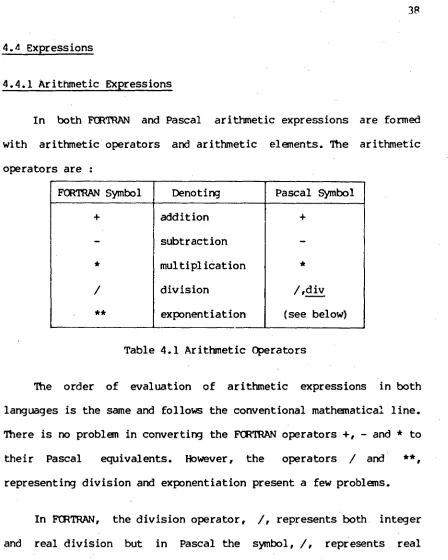
In both FORTRAN and Pascal arithmetic expressions are formed with arithmetic operators and arithmetic elements. The arithmetic operators are :
FORTRAN Symbol Denoting Pascal Symbol
+ addition +
- subtraction -
* multiplication *
/ division /,div
[image:48.555.61.509.42.602.2]** exponentiation (see below)
Table 4.1 Arithmetic Operators
The order of evaluation of arithmetic expressions in both languages is the same and follows the conventional mathematical line. There is no problem in converting the FORTRAN operators +, - and * to
their Pascal equivalents. However, the operators / and ** representing division and exponentiation present a few problems.
In Pascal, the exponentiation operator is not defined because of the problem of type involving the raising of an integer to a negative power
ie. I ** (-N)
FORTRAN treats this case as an error. However, the functions exp and ln are defined in Pascal and may be used to convert the FORTRAN exponentiation symbol to a Pascal expression. The arithmetic result
b ln a a =e
is used to convert the FORTRAN expression
A ** B
to the Pascal equivalent
exp ( B * ln (A) )
In Pascal, the type of this expression is always real but in FORTRAN the resultant type depends on the type of the elements involved.
A primary of any type may be exponentiated by an integer primary and the resultant factor is of the same type as that of the element being exponentiated. Thus, if both A and B are of type integer, the resultant factor is of type integer. As the above Pascal expression produces a real type, the Pascal expression has to be modified to produce an integer type. This is possible by using the round function:
round ( exp ( B * ln (A)))
function INTPONER (11,12 : integer) : integer; var
K : integer; begin
if ((I2<0) or ((I1=0) and (I2=0))) then HALT; K := 1;
while (I2>0) do begin
while not odd(I2) do begin 12 := 12 div 2;
Ii := sqr(I1); end;
12 := 12 - 1; K :=fl * K; end;
INTRO/1ER := K;
end;
This function satisfies all the FORTRAN requirements for raising an integer to an integer power. However, the function may be inefficient because it involves repeated multiplication and division until the power is reached, and, when it is used a warning message is produced by the translator highlighting the possible inefficiency.
A similar function, REALPOWER, is used to raise a real number to an integer power. If the translator option, DOUBLE, is set to true then the function DBLIPPOWER is used to raise a double precision number to an integer power.
block of the Pascal program, before any other function or procedure declaration (see 4.6).
If the power involved in the FORTRAN factor is 2, then the Pascal function sqr will be used instead of one of the above functions.
eg. I ** 2 becomes sqr (I) in Pascal'.
In FORTRAN, when the primary is of type real or double precision and the exponent is of type real or double precision, the resultant factor is real if both primaries are real, otherwise it is of double precision type.
If the translator option, DOUBLE, is true then the above convention is assumed to be true in Pascal. If DOUBLE is false, then all double precision variables are converted to type real and treated as described earlier in this section.
All other combinations of variable types in FORTRAN are illegal.
4.4.2 Relational Expressions
FORTRAN Symbol Representing Pascal Symbol
.LT. less than <
.LE. less than or equal to
<=
.EQ. equal to =
.NE. not equal to <>
.OT. greater than >
.GE. greater than or equal to
[image:52.557.46.469.75.639.2]>=
Table 4.2 Relational Operators
4.4.3 Logical Expressions
Logical expressions in FORTRAN and Pascal are formed from the three basic logical operators, and, or, and not. However, the symbols representing these operators are different in each language as shown in Table 4.3.
Logical Operator FORTRAN Symbol Pascal Symbol negation
conjunction disjunction
.NOT. .AND. .0H.
not and or _ Table 4.3 Logical Operators
4.4.4 Evaluation of Expressions
[image:52.557.63.435.75.307.2]Pascal User manual states that expressions in Pascal are evaluated from left to right according to the rules of parenthesis and operator hierarchy.
The rules for order of evaluation in FORTRAN are therefore freer than those of Pascal. An expression may be evaluated in one of many ways in FORTRAN. One of those ways is from left to right according to the rules of parenthesis and operator hierarchy ie. the rule for Pascal expression evaluation.
The FORTRAN standard states that a part of an expression need only be evaluated if such action is necessary to determine the value of the expression. Such action may be efficient in terms of execution time but could have side-effects through the non-evaluation of parts of an expression. The Pascal report makes no requirements on expression evaluation, but the User Manual states that it is optional whether all expressions are evaluated, or whether enough are evaluated to determine the result of the expression. The Pascal interpretation depends upon the compiler writers of each individual compiler. The choice made by the compiler writers will not affect the result of any expressions and the Pascal interpretation will yield the same results as the FORTRAN interpretation.
FORTRAN treats relational expressions as factors and processes an expression such as:
A .EQ. B .AND. C .EQ. D as (A .EQ. B) .AND. (C .EQ. D)
Pascal, on the other hand, treats relational expressions as expressions, not factors, and would attempt to evaluate the above expression as:
A= (B and C) = D creating an obvious error.
The translator overcomes this discrepancy between the two languages by placing parentheses around all relational expressions if no parentheses are present in the FORTRAN expression. Thus the above expression becomes in Pascal, after translation:
(A = B) and (C = D)
This method forces a Pascal compiler to treat the second relational expression as a factor and evaluate it before applying the logical operator (and). The value of the expression is not altered by this action.
4.5 Statements
In FORTRAN, statements are divided into two types - executable and non-executable. Executable statements specify actions but non-executable statements describe the characteristics and arrangements of data, editing information, statement functions and classification of program units. In Pascal, statements denote executable statements but the term declarations is used to correspond to non-executable statements in FORTRAN.
4.5.1 Executable Statements
4.5.1.1 Assignment Statement
In both FORTRAN and Pascal the assignment statement takes the general form
<variable><replacement operator><expression>.
The value of the <variable> is replaced by a new value specified by the <expression>.
<variable> type <expression> type FORTRAN rule Pascal rule
FORTRAN to Pascal translator
integer integer assign assign direct conversion
integer real fix and assign
error <variable> :=
trunc(<expression>)
integer double fix and (see note (a)) precision assign (<variable> :=
trunc(<expression>))
integer complex error - -
real
, integer float and assign
assign direct conversion
real real assign assign direct conversion
real double precision
double precision
- -
evaluate (assign) (direct conversion) & real
assign
real complex error - -
double precision
integer double precision
- -
float & assign
(assign) (direct conversion)
double precision
real double precision
- -
evaluate (assign) (direct conversion) & assign
double double assign - -
precision precision (assign) (direct conversion)
double complex error - -
<variable> type <expression> type FORTRAN rule Pascal rule
FORTRAN to Pascal translator complex complex complex complex logical integer real double precision complex logical error error error assign assign - - - - (assign) assign - - - -
(see note (b))
[image:57.555.46.470.79.581.2]direct conversion
Table 4.4 Assignment Rules Notes
(a) The assignment statement involving double precision expressions or variables depends
On
the setting of the translator option, DOUBLE(see 4.8.4).
If DOUBLE is false, then all double precision variables and expressions are converted to a type record (see 4.2.2) and the expression is evaluated according to the rule involving real instead of double precision. Each double precision variable is subscripted by ".D" to fit the record description.
Pascal assignment operator converts an integer or real expression to a double precision type.
(b) The assignment statement involving complex expressions or variables depends on the setting of the translator option, COMPLEX
(see 4.8.2).
If COMPLEX is set true, then it is assumed that the version of Pascal to be produced handles complex data types in a manner similar to that of FORTRAN. No special conversion procedures need take place for this data type.
If COMPLEX is set false, all FORTRAN assignment statements with either a complex variable or expression part are converted to two Pascal assignment statements - one for the real part and the other for the imaginary part. The assignment variable is converted to a record description with a field identifier used after the variable name to identify the part of the FORTRAN variable in each statement.
If a user defined complex function is encountered in the expression then a warning message is printed by the translator as complex functions are not converted to Pascal (see 4.6.3).
All combinations involving type LOGICAL not mentioned in the table are illegal in both FORTRAN and Pascal.
4.5.1.2 GO TO Assignment Statement
FORTRAN the GO TO assignment statement is of the form ASSIGN k TO i
execution of such a statement, subsequent execution of any assigned GO TO statement using that integer variable causes the statement identified by the assigned statement label to be executed next, provided there has been no intervening redefinition of the variable.
There is no direct equivalent of this statement in Pascal. However, the translator replaces this statement by an assignment statement of the form
I := n
where n is a unique integer associated with each label in an ASSIGN statement to the variable, I. When an assigned GO TO statement is later encountered a case statement is used in Pascal (see 4.5.1.4).
Internally, in each subprogram, for each variable used, a list is constructed and each list element contains the statement label in FORTRAN and the corresponding integer to assign in Pascal. For example, consider the subprogram
ASSIGN 10 TO I
ASSIGN 20 TO I
The translator produces the Pascal equivalent I := 1;
I := 2;
I := 3;
and, internally, keeps a list which associates 1 with label 10, with label 20, 3 with label 100, ....
In FORTRAN, it is possible to pass a variable, used in an ASSIGN statement, to a subprogram and to use that variable in an assigned GOTO statement in the subprogram, or subsidiary subprograms - maybe as an error exit. No equivalent action is possible in Pascal and where such an action occurs, the translator issues a warning message.
4.5.1.3 Unconditional GO TO Statement
Both FORTRAN and Pascal use a go to statement of the form GO TO <label>
4.5.1.4 Assigned GO TO Statement
In FORTRAN, an assigned GO TO statement takes the form
,G0 TO ,kn )
where i is an integer variable and each k a statement label. At the time of execution of an assigned GO TO statement, the current value of i must have been assigned by the previous execution of an ASSIGN statement to be one of the statements in the parenthesized list, and such an execution causes the statement identified by that statement label to be executed next.
There is no equivalent statement in Pascal. However, by using the list generated for the ASSIGN statements (see 4.5.1.2) a case statement may be used Each label used in the ASSIGN statements is associated with a unique integer and this integer may then be used to select a path in a case statement.
eg. The FORTRAN program ASSIGN 10 TO I
ASSIGN 20 TO I
GO TO I, (10,20)
10
20
I := 1;
I := 2;
case I of
1: . [group of statements starting with label 101
2: . [group of statements starting with label 201
end;
If, in FORTRAN, an ASSIGN statement appears more than once assigning the same label to the variable, then, in Pascal, there are two ways to handle the situation.
If the FORTRAN program was ASSIGN 20 TO I
ASSIGN 20 TO I
GO TO I, (10,20)
I := 2;
I := 3;
case I of
1: . (group of statements starting with label 101
2,3: . (group of statements starting with label 20)
end; or
I := 2;
I := 2;
case I of
1: . (group of statements starting with label 10)
2: . (group of statements starting with label 20)
end;
4.5.1.5 Computed GO TO Statement
In FORTRAN, a computed GO TO statement is of the form GO TO (k1,k2, kn ),i
where each k is a statement label and i is an integer variable. The Pascal equivalent of this statement is the case statement:
case i of
1: {statements whose initial label was k 1 ) 1
2: •
{statements whose initial label was k n
end
In both languages, the effect is undefined if the value of i lies outside the range 1 to n, so no checks to that effect are inserted by the translator.
If a label appears more than once in a computed GO TO statement then more than one label will appear on the corresponding block of code in the Pascal program. A Pascal case label will be generated for each appearance of the FORTRAN label. This approach saves the repetition of code when a FORTRAN label is used more than once.
eg. The FORTRAN statement