Multi-level assessment of soil quality
– linking reductionistic and holistic methodologies
Per Schjønning, Lars J. Munkholm, Kasia Debosz and Susanne Elmholt
Danish Institute of Agricultural Sciences, Department of Crop Physiology and Soil Science, Research Centre Foulum, P.O. Box 50, DK-8830 Tjele, DENMARK.
E-mail: [email protected]
Summary
Soil quality is often used as a qualitative, general term. However, quantification is an
important feature of the scientific approach to nature. On the other hand, addressing specific soil parameters as indicators of soil quality includes a reduction of the whole soil system. Therefore, results obtained by specialized methodologies ought to be evaluated by methods integrating the soil characteristics in situ. In this presentation, results are given from an investigation of the tilth of two differently managed loamy soils. One of the soils had been managed for decades with a forage crop system (labeled FCS), which included fertilization with farmyard manure, while the other had been grown with a continuous cereal system (labeled CCS), receiving no input of organic matter. In the field, the structure of the top 30-cm soil layer was described visually (spade analysis) and by studying the fragmentation behavior (soil drop test). Further, the field measurements included determination of soil strength by a torsional shear box method. In the laboratory, shear strength was determined on bulk soil sampled in metal cylinders, and tensile strength was estimated from crushing tests of individual, differently sized aggregates. The FCS soil appeared porous, with crumbs as
structural units, while the CCS soil was compact with blocks as structural units. The soil drop test yielded the highest degree of fragmentation for the FCS soil. The torsional shear box method showed the CCS soil to have the highest bulk soil strength. This was confirmed by the laboratory shear annulus method. Finally, the tensile strength measurements revealed a much higher strength of 8-16, 4-8 and 2-4 mm dry aggregates from the CCS soil as compared to the FCS soil, while 1-2 mm aggregates were strongest in the FCS soil. This indicates a higher friability for the FCS soil, which is in accordance with the soil behavior in the field tests. In conclusion, the quality of the FCS soil – as evaluated by its mechanical behavior – was found to be higher than that of the CCS soil. An important result is the good correlation between the integrating field methods and the differentiating laboratory methods. This means that the quantifying, reductionistic scientific approach is not conflicting with the ‘holistic’ descriptions in the field.
Introduction
In a review of the development of research in organic agriculture, Niggli & Lockeretz (1996) mention the contrasting opinions concerning the most relevant scientific approach when addressing alternative farming systems. They highlight the need for ’short-term,
user-oriented, highly applied research’ as well as ’the long, slow search for a better understanding of the fundamental natural processes on which any agricultural system rests’. In this context, it is of great importance to secure a good communication between scientists and the non-scientific approach of the NGO’s. The scientists normally use methodologies which demand a ‘reduction’ of the soil system before the specific analysis can take place (reductionism) while the NGO’s involved in the promotion of the alternative systems are focussing on evaluation of the whole system (holism). Research in organic farming systems should therefore preferably include the linking of quantitative, scientific measures of system characteristics and the farmers qualitative impression and judgement of the same characteristics (Harris & Bezdicek, 1994; Romig et al., 1995).
This paper reports some of the results obtained in a case study investigation of soil strength and fragmentation characteristics at two long-term differently managed soils in Denmark. An organically managed field was referenced by a conventionally managed counterpart of similar pedological origin. The two soils are identical to those labeled as Soil Pair II by Elmholt et al. (2000) [this issue]. Quantitative scientific laboratory methods were supplemented with
descriptive methods in the field in order to evaluate the conclusions drawn from the classical methods. A full description of the investigation is given by Schjønning et al. (submitted) and Munkholm & Schjønning (submitted).
Materials and Methods
Soils studied
with no animal manure application and grown continuously with small grain cereals or rape (Brassica napus L.) (labeled CCS [continuous cereal system]). Both soils had been managed according to conventional tillage practices including mouldboard ploughing.
Hierarchical strategy for analyses
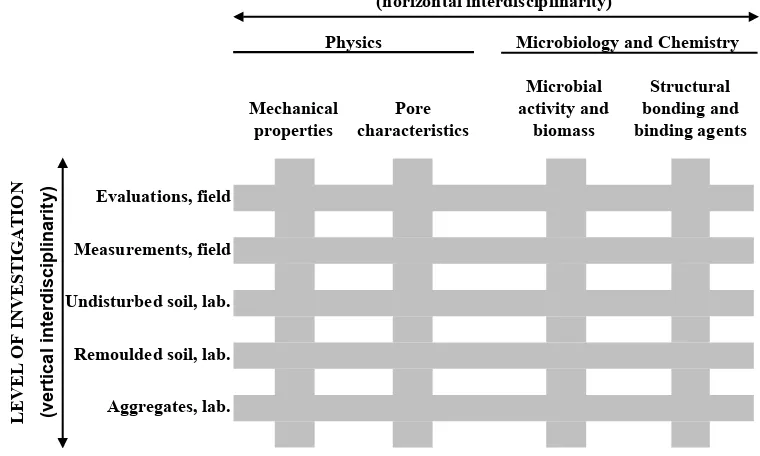
As mentioned by Elmholt et al. (2000) [this issue], the full investigation was a multidiscip-linary approach, including physical as well as microbiological characterization of the soils. This may be designated as horizontal interdisciplinarity, Figure 1. At the same time, especially the soil physical characteristics were assessed by several methodologies, ranging from visual evaluations in the field to measurements on single, dry aggregates in the
[image:3.595.93.473.278.506.2]laboratory. We suggest to label this approach vertical interdisciplinarity, Figure 1.
Figure 1. The analytical strategy included combinations of research disciplines (horisontal interdisciplinarity) as well as analyses of soil characteristics at different levels of ‘reduction’ of the research object (vertical interdisciplinarity).
Measurements
Sampling and field measurements took place in the spring in an autumn-sown winter wheat or spelt (Triticum aestivum L.) as detailed by Elmholt et al. (2000) [this issue]. Only short descriptions of specific methodologies will be given in this paper and these will be found within the ‘Results and Discussion’ section. Consult Schjønning et al. (submitted) and Munkholm & Schjønning (submitted) for a detailed description of methodology.
Evaluations, field
Measurements, field
Undisturbed soil, lab.
Remoulded soil, lab.
Aggregates, lab. DISCIPLINES (horizontal interdisciplinarity) Mechanical properties Pore characteristics Microbial activity and biomass Structural bonding and binding agents (vertical interdisciplinarity)
LEVEL OF I
NVESTI
G
ATI
O
N
Results and Discussion
Visual soil evaluation
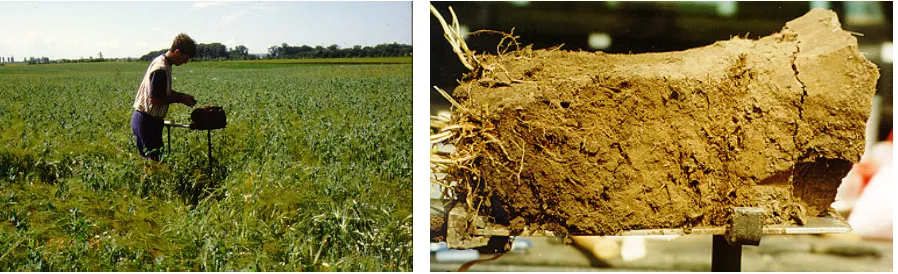
[image:4.595.76.525.234.371.2]The visual evaluation of soil in the field was performed as described by Munkholm (2000) (Figure 2, left). It revealed, that the soil in the CCS field was compact with a blocky structure and of a firm consistency even when moist (Figure 2, right). The FCS soil was on the other hand porous with a crumbly structure, when both wet and dry. The ease/difficulty of digging and sampling in the two differently managed fields further confirmed these observations.
Figure 2. The visual soil evaluation involves studies of the top 30 cm soil (left). The CCS soil appeared dense, with a blocky soil structure (right). Notice the compact plough pan below 20 cm depth.
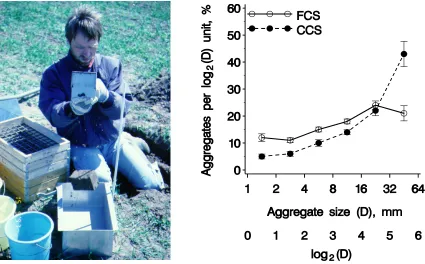
The soil drop test
Science is all about the quantification of the observations, as opposed to general empiricism. The question is therefore whether the visual soil evaluation could be quantified in some way by scientific tests. The soil drop test in a reproducible way can quantify how the soil
Figure 3.Performing the soil drop test (right) provides information of the soil fragmentation behaviour in the field (right).
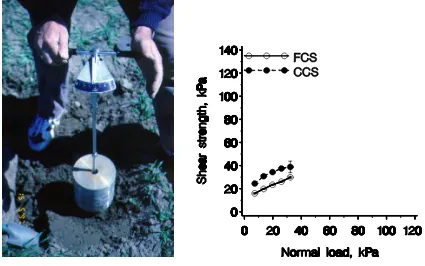
Shear strength – field measurements
Figure 4.The torsional shear box method (left) gives information about soil strength in absolute terms (right).
Shear strength – laboratory measurements
Laboratory measurements provide control of the test conditions better than in the field. Undisturbed soil core samples of 100 cm3 were therefore taken in the field and drained to – 300 hPa matric potential. Using methodology in principle equivalent to that of the field tests, the forces counteracting shearing were measured at loads ranging to above 100 kPa
(Schjønning, 1986) (Figure 5, left). Figure 5, right, shows that it was possible to reproduce the soil properties measured in the field. The laboratory tests also showed the CCS soil to have the highest shear strength. There is, however, a difference in the level of shear strength between the two methods. This may be due to the fact that the laboratory measurements were applied to samples taken after harvest; despite the fact that the soil cores had approximately the same water content as in the spring, they were sampled 4-5 months after the field
Figure 5. The determination of bulk soil strength in the laboratory (left) allows a good control of measuring conditions and provides information (right) analogous to that obtained by the torsioinal
shear box method.
Tensile strength and soil friability
The shear strength measurements indicated that the bulk soil strength was in agreement with the fractionation pattern obtained with the drop test, i.e. the FCS soil fragmented into smaller aggregates, corresponding to a lower cohesive force in the soil. However, the drop test also showed that only the large clods fragmented. In this well-structured FCS soil, the smallest aggregates had such a large cohesive strength that the result of the test was a broad
distribution of aggregate sizes and not only a collection of smaller particles. In order to understand the results of the drop test (and similar results from the visual evaluation
concerning the friable consistency of crumbs) further differentiation (further reduction of the research objective) is required. In the project this was achieved by measuring tensile strength on individual air-dried aggregates. The hypothesis is that the measurement of the strength of several sizes of aggregates enables a quantification of the friability perceived with the visual evaluation and the drop test in the field. A friable soil is defined as a soil where large
aggregates have a low tensile strength and small aggregates a relatively large strength (Utomo & Dexter, 1981). The analysis consists of measuring the tensile strength of air-dried
FCS soil had a larger strength than in the CCS soil. The friability of the soil is subsequently quantified as the coefficient of the slope in the double logarithmic depiction of aggregate size and tensile strength (Figure 6, right). A numerically large slope (high strength of small and low strength of large aggregates) is therefore an expression of a highly friable soil, which was the case for the FCS soil.
Figure 6. Determination of tensile strength of individual air-dried aggregates (right) means a rather extreme reduction of the soil system. However, a high friability (a steep slope) was found for the FCS soil, which also appeared friable in the field (right).
Conclusions and perspectives
In combination, the results presented here revealed a high ease of tillage in the FCS soil; when mechanically disturbed, the bulk soil fragmented into smaller sizes ideal for a good seedbed. In contrast, the CCS soil required a larger energy input to fractionate and there was a tendency for the soil to be pulverized into inconveniently small particles.
More research is needed in the further uncovering of the mechanisms responsible for a ‘good’ soil structure considering the crucial effects for optimal soil functioning. We need a better understanding of how the soil ecosystem in a diversified farm management system develops to give the most optimal conditions for the soil processes of importance for sustainable farming. Such work may well follow the above design and include the application of
integrating, holistic methods as well as differentiating, reductionistic investigations of causal relations in the ecosystem.
References
Dexter, A.R. & Kroesbergen, B., 1985. Methodology for determination of tensile strength of soil aggregates. J. Agric. Eng. Res. 31, 139-147.
Elmholt, S., Debosz, K., Munkholm, L.J. & Schjønning, P., 2000. Biotic and abiotic binding and bonding mechanisms in soils with long-term differences in management. Proceedings from a workshop in Aas, Norway, 10-12 April 2000. DIAS Report No. XX, 2000. The Danish Institute of Agricultural Sciences. Tjele, Denmark, xx-xx.
Harris, R.F. & Bezdicek, D.F., 1994. Descriptive aspects of soil quality/health. In: Doran, J.W., Coleman, D.C., Bezdicek, D.F. & Stewart, B.A. (eds.), Defining Soil Quality for a Sustainable Environment. Soil Sci. Soc. Amer. Special Publication 35, ASA, Madison, WI, pp. 23-35.
Krogh, L. & Greve, M.H., 1999. Evaluation of World Reference Base for Soil Resources and FAO Soil Map of the World using nationwide grid soil data from Denmark. Soil Use Manage. 15, 157-166.
Munkholm, L.J., 2000. The spade analysis - a modification of the qualitative spade diagnosis for scientific use. DIAS report no. 28, Plant Production. Danish Institute of Agricultural Sciences, Foulum, 40 pp.
Munkholm, L.J. & Schjønning, P., (submitted). Long-term effects of fertilization and crop rotation on a humid sandy loam. II. Soil mechanical characteristics. European J. Soil Sci. Niggli, U. & Lockeretz, W., 1996. Development of research in organic agriculture. In:
Østergaard, T. (ed.), Fundamentals of Organic Agriculture. Proceedings, Vol. 1, 11th IFOAM International Scientific Conference August 11-15, 1996, Copenhagen.
Payne, P.C.J. & Fountaine, E.R., 1952. A field method of measuring the shear strength of soils. J. Soil Sci. 3, 136-144.
Romig, D.E., Garlynd, M.J., Harris, R.F. & McSweeney, K., 1995. How farmers assess soil health and quality. J. Soil Water Conserv. 50, 229-236.
Schjønning, P., 1986. Shear strength determination in undisturbed soil at controlled water potential. Soil Till. Res. 8, 171-179.
Schjønning, P., Elmholt, S., Munkholm, L.J. & Debosz, K., (submitted). Soil quality aspects of humid sandy loams as influenced by different long-term management. Agric. Ecosyst. Environ.
Acknowledgements
The technical assistance of Palle Jørgensen, Michael Koppelgaard and Jørgen M. Nielsen is gratefully acknowledged. We also thank the farmers for providing their fields for our studies. This work was financed by the Danish Environmental Research Programme and was