This is a repository copy of
A CCA secure cryptosystem using matrices over group rings
.
White Rose Research Online URL for this paper:
http://eprints.whiterose.ac.uk/144167/
Version: Published Version
Article:
Kahrobaei, Delaram orcid.org/0000-0001-5467-7832, Shpilrain, Vladimir and Koupparis,
Charalambos (2015) A CCA secure cryptosystem using matrices over group rings.
Contemporary Mathematics. pp. 73-81.
[email protected] https://eprints.whiterose.ac.uk/
Reuse
Items deposited in White Rose Research Online are protected by copyright, with all rights reserved unless indicated otherwise. They may be downloaded and/or printed for private study, or other acts as permitted by national copyright laws. The publisher or other rights holders may allow further reproduction and re-use of the full text version. This is indicated by the licence information on the White Rose Research Online record for the item.
Takedown
If you consider content in White Rose Research Online to be in breach of UK law, please notify us by
http://dx.doi.org/10.1090/conm/633/12652
A CCA secure cryptosystem using matrices over group rings
Delaram Kahrobaei, Charalambos Koupparis, and Vladimir Shpilrain
Abstract. We propose a cryptosystem based on matrices over group rings and claim that it is secure against adaptive chosen ciphertext attack.
1. Cramer-Shoup cryptosystem
The Cramer-Shoup cryptosystem is a generalization of ElGamal’s protocol. It is provably secure against adaptive chosen ciphertext attack (CCA). Moreover, the proof of security relies only on a standard intractability assumption, namely, the hardness of the Diffie-Hellman decision problem in the underlying group (see [2], [3]), and a hash function H whose output can be interpreted as a number in Zq (where q is a large prime number). An additional requirement is that it should be hard to find collisions in H. In fact, with a fairly minor increase in cost and complexity, one can eliminate H altogether.
1.1. Definition of provable security against adaptive chosen cipher-text attack. A formal definition of security against active attacks evolved in a se-quence of papers by Naor and Yung, Rackoff and Simon, Dolev, Dwork and Naor. The notion is called chosen ciphertext security or, equivalently, non-malleability. The intuitive thrust of this definition is that even if an adversary can get arbitrary ciphertexts of his choice decrypted, he still gets no partial information about other encrypted messages. For more information see [2], [3].
We define the following game, which is played by the adversary. First, we run the enryption scheme’s key generation algorithm, with the necessary input parameters. (In particular, one can input a binary string in{0,1}n, which describes
the group G on which the algorithm is based.) The adversary is then allowed to make arbitrary queries to the decryption oracle, decrypting ciphertexts which he has chosen.
The adversary then chooses two messages, m0 andm1, and submits these to the encryption oracle. The encryption oracle chooses a random bitb ∈ {0,1} and encrypts mb. The adversary is then given the ciphertext, without knowledge ofb.
2010Mathematics Subject Classification. Primary 68.
Research of the first author was partially supported by a PSC-CUNY grant from the CUNY research foundation, as well as the City Tech foundation.
Research of the third author was partially supported by the NSF grants DMS 0914778 and CNS 1117675.
c
74 D. KAHROBAEI, C. KOUPPARIS, AND V. SHPILRAIN
Upon receipt of the ciphertext from the encryption oracle, the adversary is allowed to continue querying the decryption oracle. Of course the adversary is not allowed to submit the output ciphertext of the encryption oracle.
Finally, at the end of the game, the adversary must output b′
∈ {0,1}, which is the adversary’s best guess as to the value ofb. Define the probability thatb′
=b
to be 1/2 +ǫ(n),ǫ(n) is called the adversary’s advantage, andn∼ |G|.
We say the cryptosystem is CCA-2 secure if the advantage of any polynomial-time adversary is negligible. Note that a negligible function is a function that grows slower than any inverse polynomial, n−c, for any particular constant c and large
enough n.
1.2. The Cramer-Shoup Scheme. Secret Key: randomx1, x2, y1, y2, z∈Zq
Public Key:
groupG;g1, g2= 1 inG c=g1x1g2x2, d=g1y1g2y2
h=g1z.
Encryptionofm∈G:E(m) = (u1, u2, e, v), where
u1=g1r, u2=g2r, e=hrm, v=crdrα, where r∈Z
q is random, and
α=H(u1, u2, e).
Decryptionof (u1, u2, e, v):
Ifv=u1x1+αy1u2x2+αy2, whereα=H(u1, u2, e), then m=e/u1z
else “reject”
1. Theorem: [2]The Cramer-Shoup cryptosystem is secure against adaptive chosen ciphertext attack assuming that (1) the hash function H is chosen from a universal one-way family, and (2) the Diffie-Hellman decision problem is hard in the group G.
2. A CCA-2 secure cryptosystem using matrices over group rings
In [4], the authors proposed a public key exchange using matrices over group rings. They offer a public key exchange protocol in the spirit of Diffie-Hellman, but they use matrices over a group ring of a (rather small) symmetric group as the plat-form and discuss security of this scheme by addressing the Decision Diffie-Hellman (DDH) and Computational Diffie-Hellman (CDH) problems for that platform.
Here we propose to use a similar platform and show that a scheme similar to the Cramer-Shoup scheme is CCA-2 secure. Our protocol is as follows:
Secret Key: randomx1, x2, y1, y2, z∈Zn
Public Key:
3×3 non-identity matricesM1, M2∈M3×3(Z7[S5]) such thatM1 is invertible and
M1M2=M2M1
c=M1x1M2x2, d=M1y1M2y2
h=M1z.
Encryptionof a messageN ∈M3×3(Z7[S5]): E(N) = (u1, u2, e, v), where u1=M1r, u2=M2r, e=hrN, v=crdrα,r∈Z
n is random, and
Decryptionof (u1, u2, e, v):
Ifv=u1x1+αy1u2x2+αy2, whereα=H(u1, u2, e),
thenN = (u1z)−1e(Note thatu1is invertible sinceM1is chosen to be invertible.)
else “reject”
Remarks: M1must always be chosen to be an invertible matrix, whereasM2is just any matrix such that M1M2 = M2M1. One must also decide what group Zn to use, i.e.,nmust be specified.
3. Adaptive CCA security for matrices over group rings
We aim to show, by using Theorem 1, that if for invertible matrices over
M3×3Z7[S5] the DDH problem is hard, then the previously mentioned cyrptosystem
is secure against adaptive chosen ciphertext attack. More formally,
2. Theorem: The Cramer-Shoup cryptosystem using the semigroup G =
M3×3Z7[S5] is secure against adaptive chosen ciphertext attack assuming that (1)
the hash functionH is chosen from a universal one-way family, and (2) the decision Diffie-Hellman problem is hard in the group G.
Before beginning the proof of the theorem we need the following two experi-mental facts.
(1) Given an invertible matrix M ∈ G =M3×3Z7[S5] and random integers a, b andc∈N, it is not possible to distinguish between the distributions generated by (Ma, Mb, Mab) and (Ma, Mb, Mc).
(2) Given an invertible matrixM ∈G=M3×3Z7[S5] and a random integer a, it is not possible to extract information about afrom Ma andM. In
other words, the distributions generated by a random matrix N andMa
are indistinguishable.
We offer the following two experiments as evidence for the plausibility of the above facts. For these tests we used invertible matrices over the group ring
M3×3Z7[S5]. For the first we chose a random invertible matrix M (see section
3.1.1) and random integers a, b and c ∈ N. We choose a and b in the interval [1022,1027) and c in the interval [1044,1054) so thatab and c were roughly of the
same size. For each pair of resulting matricesMabandMcwe counted the frequency
of elements ofS5appearing in each entry.
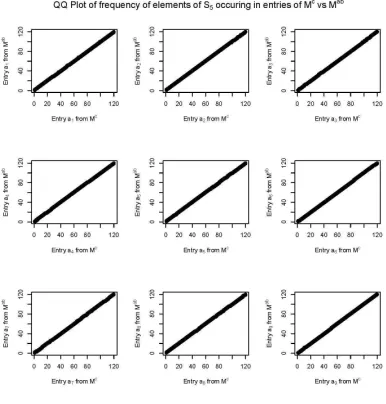
Repeating this 500 times for randomly chosen a, b and c, we obtained a fre-quency distribution of elements of the group ring in each entry of the two matrices. From this we created the QQ-plots for each of the 9 matrix entries. QQ-plots are a quick and easy way to test for identical distributions, in which case the plots should be straight lines. As we can see from Figure 1, it appears that from the generated distributions it is not possible to distinguish DH pairs from non-DH pairs.
For verification of the second fact, we conducted a similar experiment, except in this case, for each of the 500 draws we varied all parameters N,M anda. We again generated QQ-plots as shown in Figure 2, and these show that no information aboutais leaked from publishingM andMa.
76 D. KAHROBAEI, C. KOUPPARIS, AND V. SHPILRAIN
[image:5.504.153.348.308.510.2]Figure 1. DDH results for Mc vs. Mab
Figure 2. Results forMa vs. N
(M1, M2, Mr
1, M2r), and byRthe set of all random tuples (M1, M2, M3, M4). Then
the algorithm is constructed as follows:
• D receives input (M1, M2, M3, M4) fromDH orR.
• Pick x1, x2, y1, y2, z∈Zn and a universal one-way hash functionH. • The adversary Areceives the public key, PK, which is
(M1, M2, c=Mx1
1 M2x2, d=M1y1M2y2, h=M1z, H).
• D picksb∈ {0,1} and passes toA
(M3, M4, M3z·mb, M3x1+αx2M
y1+αy2
4 ),
whereα=H(M3, M4, Mz
3·mb).
• With this informationAtries to determine band returns its guessb′ . • Ifb=b′
return “DH”, else “R”.
The proof is then verifying that this algorithm cannot attack theDDH prob-lem. It is built from the following three claims.
Claim 1: |P(D=DH|DH)−P(D=DH|R)|< ǫ. This claim is trivially true sinceD is a PPT algorithm and the DDH assumption holds as verified previously.
Claim 2: P(D=DH|DH) =PA(Success). If we are given a DDH tuple, then all decryption queries succeed forA. Hence the output ofAwill match the choice ofb withPA(Success).
Claim 3: |P(D = DH|R)− 1
2| < ǫ. Since P(D = DH) = P(A = b), the
proof of this claim relies on the proof of two pieces. We need to show that for all decryption queries where u1 = Mr1
1 and u2 =M2r2 with r1 =r2, the decryption
verification fails with non-negligible probability. In addition to this, we must also show that assuming all invalid decryptions fail, the adversary A does not learn any additional information about z.
We first start with the latter piece. If all invalid decryptions fail, then the only additional information A receives is when valid decryptions are performed. Thus, at the onset of the attack A only has information available that is given to him from PK, namely h= Mz
1. If A submits a valid ciphertext (u
′
1, u
′
2, e
′
, v′
), where
u′
1=Mr ′
1 , thenA obtains that hr ′
=Mzr′
1 . However, based on the results above,
if we denoteM =Mz
1, thenhr ′
=Mr′
and the distributions of any random matrix
N andMr′
generated by r′
are indistinguishable, hence nothing is revealed about
z.
Furthermore, from the encryption information passed toA, the only additional information A has is Mz
3 ·mb, which leaves him with obtaining information from
Mz
3 andM1z, i.e. solving a Diffie-Helmann problem, which we assumed was difficult
in our scheme setup.
We are now left with showing that decryption almost always fails for invalid ci-phertexts. Suppose that the adversary submits an invalid ciphertext, (u′
1, u
′
2, e
′
, v′ )
= (u1, u2, e, v). Then we have the following cases:
Case 1: If (u1, u2, e) = (u′
1, u
′
2, e
′
) andv =v′
, then the hash valuesαand α′ will be the same, however decryption will certainly be rejected.
Case 2: If (u1, u2, e) = (u′
1, u
′
2, e
′
) but a = a′
, then this means that A has found a collision inH. But we assumedH was collision resistant, and sinceAruns in polynomial time, this can only happen with negligible probability.
Case 3: If H(u1, u2, e) = H(u′
1, u
′
2, e
′
), then we have the following system of equations where we denote by log = logM1 and w = log(M2), and u1 = M
r1
1 , u′
1=M
r′
1
1 ,u2=M2r2 andu
′
2=M
r′
2
2 :
logc=x1+wx2,
(1)
logd=y1+wy2,
(2)
logv=r1x1+wr2x2+αr1y1+αwr2y2,
(3)
logv′ =r′
1x1+wr
′
2x2+α
′
r′
1y1+α
′
wr′
2y2.
78 D. KAHROBAEI, C. KOUPPARIS, AND V. SHPILRAIN
These equations are linearly independent as can be verified by looking at
det
⎛
⎜ ⎜ ⎝
1 w 0 0
0 0 1 w
r1 wr2 αr1 αwr2
r′ 1 wr ′ 2 α ′ r′ 1 α ′ wr′ 2 ⎞ ⎟ ⎟ ⎠
=w2(r2−r1)(r′
2−r
′
1)(α−α
′ ).
The above determinant is nonzero since we are considering bad decryptions and hence
r1=r′
1, r2=r
′
2, α=α
′
.
Therefore, almost surely any bad decryption queries of this form will be rejected. Thus we have shown from Claim 3 that the adversaryAis unable to correctly determinebgiven a random tuple, which we saw is equivalent to our algorithm not being able to distinguish a random tuple from a DH tuple when given a random tuple. This together with Claim 1 shows that our algorithm cannot distinguish between tuples no matter what the input was. And finally, from Claim 2, we get that the adversary is unable to attack our scheme with an adaptive chosen
ciphertext attack.
3.1. Parameters for the Cramer-Shoup-like scheme using matrices over group rings. Here we address two problems relevant to key generation in our scheme, namely, (1) how to sample invertible matrices and (2) how to sample commuting matrices.
3.1.1. Invertible matrices. Sampling invertible matrices can be done using var-ious techniques. The first method is to construct a matrix which is a product of elementary matrices,
M =
n
i=1 Ei,
where Ei is any elementary matrix from M3×3(Z7[S5]). Elementary matrices can
be of one of the three types below. In the matrix Ti(u), the element ushould be
invertible in Z7[S5].
Ti,j=
1 . .. 0 1 . .. 1 0 . .. 1
, Ti(u) =
1 . .. 1 u 1 . .. 1 ,
Ti,j(v) =
We can then easily computeM−1as
M−1=
n
i=1 E−1
n−i+1.
The drawback of generating an invertible matrix this way is that we do not have a good grasp of the randomness embedded in this process. In particular, how large mustnbe to generate a truly random matrix? Given that there are 3 different types of elementary matrices, does it matter in what order they are multiplied in and does the number of elementary matrices of each form matter? These are questions that have not been addressed and may influence the final invertible matrix generated in unknown ways.
Here, instead of the previously mentioned method of sampling random matrices, we propose an alternative solution. We start with an already “somewhat random” matrix, for which it is easy to compute the inverse. An example of such a matrix is a lower/upper triangular matrix, with invertible elements on the diagonal:
M =
⎛
⎝
u1 g1 g2
0 u2 g3
0 0 u3
⎞
⎠.
Constructing the inverse of this matrix involves solving a matrix equation,
M·M−1=I
⇒
⎛
⎝
u1 g1 g2
0 u2 g3
0 0 u3
⎞
⎠· ⎛
⎝
u−1
1 g4 g5
0 u−1
2 g6
0 0 u−1 3
⎞
⎠= ⎛
⎝
1 0 0 0 1 0 0 0 1
⎞
⎠
⇒g4=−u−1
1 g1u
−1 2
g5=u−1
1 g1u
−1
2 g3u
−1
3 −u
−1
1 g2u
−1 3
g6=−u−1
2 g3u
−1 3 .
We then propose to take a random product of such invertible upper and lower triangular matrices. Since these matrices are more complex than elementary ma-trices, it seems reasonable to assume that we arrive at a more uniform distribution sooner than by simply using elementary matrices. In our experiments we used a product of 20 random matrices, where each term of the product was chosen ran-domly as either a random invertible upper or lower triangular matrix.
As mentioned previously, the benefits of this method are that inverses are easy to compute and that the chosen matrix already has a large degree of randomness built in. In particular, any element ofZ7[S5] can be used off the diagonal, and any invertible elements of the group ring can be used on the diagonal. These of course include elements such asnu∈Z7[S5], whereu∈S5 andn∈Z7.
Finally, we note that the order of the group GL3Z7[S5] of invertible 3×3 matrices over Z7[S5] is at least 10313. Indeed, if we only count invertible upper and lower triangular matrices that we described above, then we already have (7· 120)3(7120)3∼10313matrices.
80 D. KAHROBAEI, C. KOUPPARIS, AND V. SHPILRAIN
Given a matrix M1 ∈G, defineM2 = ki=1aiM1i, whereai ∈Z7 are selected
randomly. Then clearlyM1M2=M2M1. A reasonable choice forkis about 100 as this would yield 7100∼1085 choices forM2, which is a sufficiently large key space. 3.1.3. Other parameters. As mentioned in the introduction of the Cramer-Shoup algorithm adapted to our group rings, we need to specify the value of n
forZn. Based on experiments in our previous paper [4] we suggestn∼10100. This
seemed a reasonable choice of exponent since it both allowed quick computations and ensured that the power a matrix was raised to could not be figured out by brute force methods alone.
We also use a hash functionH in our algorithm as did Cramer and Shoup. The only requirement on H is that it is drawn from a family of universal one-way hash functions. This is a less stringent requirement than to be collision resistant. The latter implies that it is infeasible for an adversary to find two different inputsxand
y such thatH(x) =H(y). A weaker notion ofsecond preimage resistance implies that upon choosing an input x, it is infeasible to find a different inputy such that
H(x) =H(y).
It should be noted that in their paper Cramer and Shoup also give details of their same algorithm without requiring the use of any hash functions. The modified algorithm is only slightly more complicated but relies on the same principles.
References
[1] D. Boneh,The decision Diffie-Hellman problem, Algorithmic number theory (Portland, OR, 1998), Lecture Notes in Comput. Sci., vol. 1423, Springer, Berlin, 1998, pp. 48–63, DOI 10.1007/BFb0054851. MR1726060 (2000k:94024)
[2] R. Cramer and Victor Shoup, A practical public key cryptosystem provably secure against adaptive chosen ciphertext attack, Advances in cryptology—CRYPTO ’98 (Santa Barbara, CA, 1998), Lecture Notes in Comput. Sci., vol. 1462, Springer, Berlin, 1998, pp. 13–25, DOI 10.1007/BFb0055717. MR1670952 (99j:94041)
[3] V. Shoup,Why chosen ciphertext security matters, IBM Research Report RZ 3076, 1998. [4] D. Kahrobaei, C. Koupparis, and V. Shpilrain,Public key exchange using matrices over group
rings, Groups Complex. Cryptol.5(2013), no. 1, 97–115. MR3065451
CUNY Graduate Center and City Tech, City University of New York
E-mail address:[email protected]
CUNY Graduate Center, City University of New York
E-mail address:[email protected]
The City College of New York and CUNY Graduate Center