Biomolecular Chemistry
PAPER
Cite this:Org. Biomol. Chem., 2015, 13, 2756
Received 11th December 2014, Accepted 8th January 2015
DOI: 10.1039/c4ob02587c
www.rsc.org/obc
Templating carbohydrate-functionalised
polymer-sca
ff
olded dynamic combinatorial
libraries with lectins
†
Clare S. Mahon,
a,bMartin A. Fascione,
b,cChadamas Sakonsinsiri,
bTom E. McAllister,
bW. Bruce Turnbull
band David A. Fulton*
aA conceptually new approach to the design of macromolecular receptors for lectins is outlined. Carbo-hydrate-functionalised Polymer-Scaffolded Dynamic Combinatorial Libraries (PS-DCLs) have been pre-pared in aqueous solution by the reversible conjugation of carbohydrates possessing acylhydrazide functionalities in their aglycone on to an aldehyde-functionalised polymer scaffold. PS-DCLs have been shown to undergo compositional change in response to the addition of lectin templates, with polymer scaffolds preferentially incorporating carbohydrate units which recognise the lectin added. This compo-sitional change has been shown to generate polymers of significantly enhanced affinity for the lectin added, with enhancements in free energy of binding in the range of 5.2–8.8 kJ mol−1observed. Experi-ments indicate that these enhanceExperi-ments are not only as a consequence of increased display of the pre-ferred carbohydrate upon the polymer scaffold, but that templation also reorganises key residues into strategic positions in order to interact more strongly with the target.
Polymer-Scaffolded Dynamic Combinatorial Libraries (PS-DCLs)1–4 (Fig. 1) have been demonstrated to present a viable route towards the generation of macromolecular recep-tors for synthetic polymers and proteins. PS-DCLs are mixtures of interconverting polymers generated through the reversible functionalization of synthetic polymer scaffolds with various side-chain residues, which undergo compositional exchange upon exposure to macromolecular templates to produce poly-mers of enhanced affinities towards the template. The macro-molecular nature of PS-DCLs makes them ideally suited to the development of receptors for biologically-relevant macromole-cules such as proteins, which typically interact with one another over large surface areas,5and present the opportunity to harness multivalency6 in order to increase the influence of many relatively ‘weak’ supramolecular interactions. Indeed, PS-DCLs have been used to deliver polymers of measurably enhanced affinities4towards synthetic polymers and proteins,
by exploiting multivalent electrostatic interactions between charged polymeric receptors and templates.
Synthetic multivalent receptors such as those produced by the PS-DCL approach would be particularly useful in the recog-nition of carbohydrate-binding proteins (lectins) which are crucial to cellular recognition7 and often implicated in bac-terial and viral infection.8 Some pathogenic bacteria, notably
Vibrio cholerae, the causative agent of cholera, andEscherichia coli (E. coli), cause disease through the production of toxic lectins which bind to carbohydrates on cellular surfaces, facili-tating entry to cells and initiating a biochemical cascade resulting in diarrhoea which may be life-threatening.9 Com-pounds which may inhibit these initial recognition processes are understandably of interest to chemists and clinicians.10
Lectins often display multiple identical recognition sites which may interact with multiple carbohydrates through low-affinity supramolecular interactions which reinforce one another to facilitate high-affinity binding, with greatly enhanced activities compared to monovalent inhibitors. The attachment of multiple carbohydrates to a molecular scaffold to facilitate their simultaneous binding at multiple sites is therefore a popular approach to inhibitor design, and is perhaps most successfully demonstrated by the success of glyco-dendrimers11 in inhibiting carbohydrate–protein inter-actions. Often, such inhibitors constitute elegant yet syntheti-cally-challenging molecular architectures, with their production often time- and labour-intensive. An alternative
†Electronic supplementary information (ESI) available: Synthetic and experi-mental procedures and spectroscopic data. See DOI: 10.1039/c4ob02587c aChemical Nanoscience Laboratory, School of Chemistry, Newcastle University,
Newcastle-upon-Tyne, UK. E-mail: [email protected]; Fax: +44 (0)191 222 6929; Tel: +44 (0)191 208 7065
bSchool of Chemistry and Astbury Centre for Structural Molecular Biology, University
of Leeds, Leeds, UK
cDepartment of Chemistry, University of York, Heslington, York YO10 5DD, UK
Open Access Article. Published on 09 January 2015. Downloaded on 19/02/2018 15:43:50.
This article is licensed under a
Creative Commons Attribution 3.0 Unported Licence.
strategy has seen polymers comprised of carbohydrate mono-mers connected through dynamic covalent linkages (‘ dyna-mers’12) produced. These dynamers have been shown to recognise lectins, however, templation has not been used to enhance binding affinities of the polymers towards a target lectin.
The use of a system where pre-formed polymer scaffolds could be decorated with the required carbohydrates would enable convenient access to the large molecular architectures offered by dendrimers, with well-established living radical polymerisation methods such as RAFT13allowing the necess-ary control over the molecular weight distribution of polymers. Most importantly, the dynamic nature of PS-DCLs would allow carbohydrates the opportunity to exchange and reshuffle their positions along polymer scaffolds in order to occupy optimum positions for interaction with a lectin template. This adaptive behaviour presents a conceptually new approach to the gen-eration of polymeric receptors for carbohydrate-binding pro-teins, in addition to expanding the scope of the PS-DCL concept as a platform to new macromolecular receptors. Prom-ising initial results investigating the potential of this concept are reported here.
Results and discussion
PS-DCL preparation and characterisation
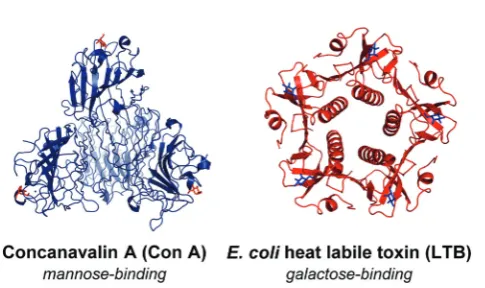
The PS-DCLs in this work have been designed to explore specific molecular recognition between two very different lectins and their complementary carbohydrates. Concanavalin A (Con A) (Fig. 2) is a lectin isolated fromCanavalia ensiformis
(Jack bean), which exists at neutral pH as a tetramer of four identical 26 kDa subunits,14 each bearing a single mannose recognition site incorporating a penta-coordinated Ca2+ ion and a hexa-coordinated Mn2+ ion. These mannose-binding sites are located at the points of a tetrahedron, approximately 72 Å apart.14 In solutions of pH < 5.6, Con A tetramers dis-sociate to yield dimers which may also recognise mannose through complexation at two sites. Con A serves as a useful
‘model lectin’ as its recognition behaviour has been well-studied.15E. coli heat labile toxin (LTB)16(Fig. 2) belongs to
the AB5family of toxins,17and exhibits recognition behaviour
identical to that of cholera toxin.18 The single A subunit is responsible for the toxicity of the protein, with the B-pentamer facilitating entry of the toxin into cells by binding to a galac-tose-terminated ganglioside displayed on cellular surfaces. For the purposes of this investigation, a modified B5variant of the
toxin has been used.
PS-DCLs incorporating GAL and MAN have been con-structed on the aldehyde-functionalised poly(acrylamide) scaffoldP1(Scheme 1). Acylhydrazide residuesGALandMAN display galactose and mannose units and may be expected to interact favourably with LTB and Con A, respectively. Conju-gation ofGALontoP1generates a polymer displaying multiple galactose units, with complete reaction of all aldehyde units of the polymer confirmed by1H NMR spectroscopy. Addition of a second acylhydrazide MAN initiates component exchange through a transimination-type process yielding a PS-DCL of polymers decorated with carbohydrate residuesGALandMAN. The composition of the carbohydrates appended to the polymer scaffold cannot be monitored directly using1H NMR spectroscopy as a consequence of overlap of diagnostic signals corresponding to the residues attached to the polymer scaffold. Instead, the residual composition of carbohydrate-functionalised PS-DCLs may be determined indirectly using
Fig. 1 Conjugation of acylhydrazide functionalised carbohydrate residues onto an aldehyde-functionalised polymer scaffold generates a dynamic combinatorial library of polymers which may interconvert by exchange of carbohydrate residues. Addition of a lectin template induces compositional change, generating polymers of improved affinity for the lectin added.
Fig. 2 Lectin templates used within PS-DCLs. (a) Con A shown as a tetramer with four associated mannose residues shown in blue (5CNA. pdb). (b) LTB with five associated galactose residues shown in blue (1LTA.pdb).
Open Access Article. Published on 09 January 2015. Downloaded on 19/02/2018 15:43:50.
This article is licensed under a
[image:2.595.63.543.53.165.2] [image:2.595.308.551.222.366.2]1H NMR spectroscopy. Integral analysis of resonances
corres-ponding to the anomeric protons ofGALandMANwas used to determine the relative concentration of these unconjugated residues in solution, allowing the relative proportion of each carbohydrate on the polymer scaffold to be determined. Equili-brium was attained overnight, with1H NMR spectroscopic
ana-lysis revealing GAL and MAN to be present in solution in a 1.0 : 1.0 ratio, implying that the residual composition of the polymer scaffolds was also 1.0 : 1.0. No aldehyde signal was observed, indicating that polymers are fully functionalised with carbohydrate residues. The composition of the PS-DCL
was monitored over a period of 48 h, without further deviation from this composition. This observation suggests that, in the absence of any template, the polymer scaffold displays no pre-ference for the incorporation of either acylhydrazide GAL or MAN.
PS-DCLs undergo compositional change in response to addition of lectin templates
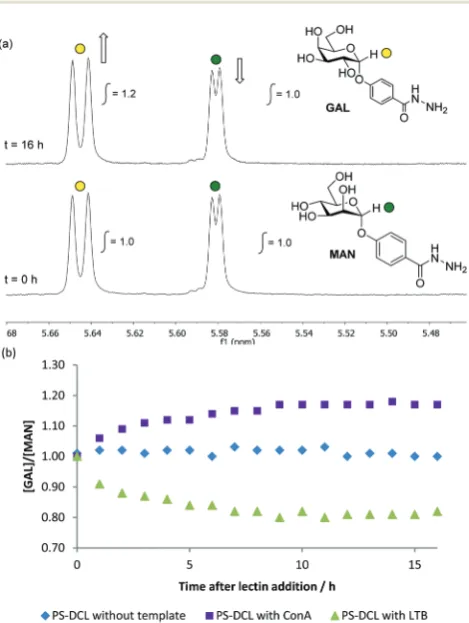
Initial templating experiments were performed using Con A as a template. Upon addition of Con A, changes in the compo-sition of the PS-DCL as a function of time were monitored using1H NMR spectroscopy, which revealed an increase in the relative concentration of GAL compared to MAN of 1.2 : 1.0 (Fig. 3(a) and (b)). This observation suggests that polymer scaffolds have responded to the addition of Con A by preferen-tially incorporating the mannose-functionalised MAN at the expense of the galactose-functionalised GAL. It is proposed that this templating effect proceeds as a consequence of additional stability gained by library members through their favourable interactions with Con A dimers, which
preferen-Scheme 1 Preparation of carbohydrate-functionalised PS-DCLs in 100 mM NH4OAc–AcOH, pH 4.5, D2O. PS-DCLs generated for templa-tion with Con A were prepared in solutempla-tions which also contained 2 mM CaCl2, while PS-DCLs generated for templation with LTB were prepared in solutions containing 100 mM NaCl.
Fig. 3 (a)1H NMR spectroscopic analysis (500 MHz, D
2O, pH 4.5) of PS-DCL before (t= 0 h) and after (t= 16 h) addition of Con A, highlight-ing the changes in intensity of the diagnostic anomeric resonances of
GALandMAN16 h after addition of template. (b) Effect of addition of lectin templates to PS-DCLs upon relative concentrations ofGALand
MANas a function of time, suggesting preferential incorporation of the carbohydrate residue preferred by the lectin added. There is no observed change in the relative concentrations ofGALandMANin the absence of a lectin template.
Open Access Article. Published on 09 January 2015. Downloaded on 19/02/2018 15:43:50.
This article is licensed under a
[image:3.595.310.545.309.621.2]tially bind to mannose in preference to galactose residues. The templating effect of LTB upon the PS-DCL was also investi-gated. Upon addition of LTB,1H NMR spectroscopy revealed a decrease in the relative concentration of GAL compared to MANof 0.8 : 1.0 from an initial ratio of 1.0 : 1.0 (Fig. 3(b)). This observation suggests that polymer scaffolds have preferentially incorporated the galactose-functionalised GAL, rejecting the mannose-functionalisedMAN. This templating effect is likely to be a consequence of favourable interactions between LTB and polymers functionalised primarily with the preferred residue GAL. These observations demonstrate that carbo-hydrate-functionalised PS-DCLs possess that same capacity for template-induced re-equilibration exhibited by other PS-DCLs,2–4 and suggest that favourable multivalent inter-actions between template and library members provide enough of a thermodynamic driving force to cause compo-sitional exchange upon template addition.
The best-binding polymers within PS-DCLs may be isolated A key validation of the hypothesis that templating PS-DCLs presents a viable route to polymeric receptors for lectins is the isolation from a PS-DCL of the best-binding fraction of the library, and demonstration that these polymers exhibit signifi-cantly enhanced affinity for the lectin template. We have pre-viously4 isolated best-binding polymers from PS-DCLs using solid-supported templates and envisioned a similar strategy could be employed in this case.
‘Templation vessels’ were developed by functionalising commercially-available streptavidin-functionalised 96-well plates with biotinylated Con A or LTB, allowing for convenient exposure of PS-DCLs to surface-immobilised lectin templates. It was proposed that those library members which interacted most favourably with the template would become attached to the surfaces of the wells, presenting a straightforward route to their isolation from the rest of the system, which may simply be pipetted away.
Templating experiments were performed using PS-DCLs constructed with acylhydrazidesGALandMANupon polymer scaffold P1. PS-DCLs were shown to contain equal concen-trations of unconjugatedGALandMAN using1H NMR spec-troscopy prior to templation, indicating that both carbohydrates were incorporated onto polymer scaffolds in equal proportions. After 18 h incubation at 5 °C in lectin-func-tionalised wells,1H NMR spectroscopic analysis revealed com-positional change within both systems – a decrease in the concentration of MAN compared to GAL of 0.8 : 1.0 from an initial ratio of 1.0 : 1.0 in Con A-functionalised wells, and a decrease in the relative concentration of GAL compared to MANof 0.9 : 1.0 from an initial ratio of 1.0 : 1.0 in LTB-functio-nalised wells. In both cases, polymer scaffolds have preferen-tially incorporated the carbohydrate known to interact favourably with the displayed lectin. There was no significant change in the composition of PS-DCLs incubated in 96-well plates which had not been treated with biotinyl-LTB or bio-tinyl-Con A, eliminating the possibility that streptavidin could induce unwanted compositional change within these PS-DCLs.
Polymer members of the library which do not bind well to the lectin-functionalized surface were then removed from the wells, and the surfaces of the wells were washed with a dena-turant solution (50 mM EDTA in D2O in the case of
ConA-func-tionalised wells, or 5.0 M guanidinium chloride, 0.5 M NaCl in D2O in the case of LTB-functionalised wells) to disrupt
inter-actions between templates and those polymers bound to the surfaces of wells. These washings were shown using1H NMR spectroscopy to contain polymeric species which were reduced using NaCNBH3 to prevent unwanted compositional change
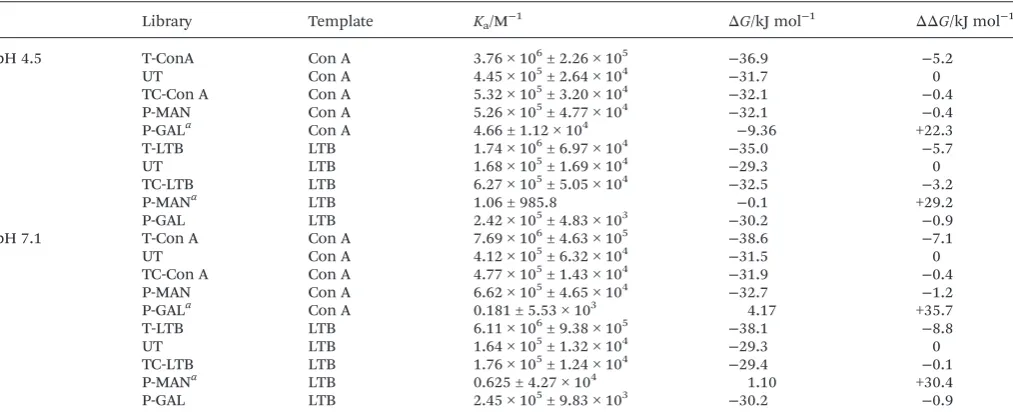
during binding studies and then purified by dialysis. The con-centration of carbohydrate-functionalised polymers in the material isolated may be determined by absorbance measure-ments (ε= 0.264 µM cm−1) (ESI†). In each case around 10% by mass of polymers within the PS-DCL was isolated. These poly-mers (T-Con A,T-LTB) were then titrated against Con A or LTB to determine association constants. For comparison, polymer scaffolds with identical residual composition to an un-templated PS-DCL (UT), a PS-DCL un-templated with the relevant lectin (TC-Con A and TC-LTB) or functionalised solely with GAL or MAN (P-GAL and P-MAN) were prepared and their affinities towards the lectins determined in the same way (Table 1). Binding affinities were established at pH 4.5, under conditions identical to those used during templating, and under neutral conditions, to establish if interactions between polymers and lectins differed at increased pH. It should be noted that whileTC-Con AandTC-LTBdisplayGALandMAN in the same relative concentrations as polymers within a tem-plated PS-DCL, they have not been exposed to either lectin and therefore lack possible sequence-specific information which may be gained during the templating process.
Polymers isolated from the surfaces of wells display signifi-cantly enhanced affinities for the relevant lectin, with an order of magnitude enhancement in association constants observed compared to the untemplated library UT (Table 1). Enhance-ments in free energy of binding of 5.2–8.8 kJ mol−1compared toUTwere observed forT-Con AandT-LTB, which also display significantly improved recognition characteristics compared to polymers functionalised only with the preferred carbohydrate (P-GALandP-MAN) and polymer scaffolds with residual com-positions matching those of templated PS-DCLs (TC-Con A and TC-LTB). Polymers functionalised only with one carbo-hydrate (P-GALand P-MAN) do not display affinities towards the lectin which does not recognise the carbohydrate, as may be expected. These observations suggest that templating leads to the positioning of key residues along polymer scaffolds in specific positions in order to more strongly interact with the lectin they have been exposed to. It is perhaps unimportant which residues are present on those sections of polymer scaffold which bridge the binding sites of the lectin template, but it is conceivable that clusters of preferred residues may compete for interaction with binding sites, introducing steric crowding which may prove detrimental to recognition. Similar behaviour has been observed by Whitesides et al.19 in their investigation of polyvalent sialic acid inhibitors of haemagglu-tinin, with some polymeric receptors demonstrated to display
Open Access Article. Published on 09 January 2015. Downloaded on 19/02/2018 15:43:50.
This article is licensed under a
poorer inhibitory activity than monomer units on a per monomer basis, observations which were attributed to hetero-glycocluster effects.20 Heteroglycoconjugates displaying
mannose and galactose units have been demonstrated21 to
display higher relative potencies in their interactions with Con A than the corresponding mannose-homoglycoconjugates. Additionally, Haddleton et al.22have reported that increasing
mannose content beyond 75% in a library of mannose and galactose containing copolymers yields no improvement in agglutination activity of polymers towards Con A, implying a higher efficiency for heteroglycopolymers on a per mannose basis.
These observations demonstrate that templating PS-DCLs may deliver polymers of markedly improved affinity to lectins, with affinities surpassing those of expected ‘ideal’ binders, and validates the concept as a route to the generation of macromolecular receptors for these species.
Conclusions
Carbohydrate-functionalised PS-DCLs have been shown to adapt their composition in response to the addition of lectin templates, with polymer scaffolds preferentially incorporating the carbohydrate known to interact favourably with the lectin added. Experiments suggest that recognition processes between lectins and carbohydrate-functionalised polymers are highly specific, with polymers adapting their compositions so as to display the required carbohydrate residues at strategic positions along the polymer chain to facilitate stronger recog-nition at binding sites on the lectin.
Thermodynamically-driven templating has been shown to afford compositional change within PS-DCLs which delivers polymers of enhanced affinities for lectin templates. The immobilisation of lectins on 96-well plates to produce‘ templa-tion vessels’ has enabled the isolation of the best-binding fraction of the PS-DCL, separating those polymers of highest affinities towards the template from the rest of the system. These polymers have been shown to display significantly enhanced affinities for the lectin added, with enhancements in free energy of binding of 5.2–8.8 kJ mol−1 observed. The
development of a method to immobilise protein templates onto solid supports using commercially-available materials allows for the rapid expansion of the PS-DCL concept to provide polymeric receptors for a wide range of bacterial toxins and other proteins of interest. The use of 96-well plates for the immobilisation of templates may also facilitate the application of high-throughput techniques for the discovery of macromolecular receptors using PS-DCLs. The best-binding fractions of PS-DCLs could also be conveniently separated from the bulk of the library to undergo a second exposure to template in the presence of additional acylhydrazides, with the possibility of further enhancing the affinities of these poly-mers to the template. Recognition properties could also be improved by harnessing favourable secondary interactions between polymers and lectins.23 Basic information about a
lectin, such as its isoelectric point ( pI) and amino acid compo-sition, could be used to aid in selection from a palette of
[image:5.595.45.552.93.300.2]‘amino-acid like’ residues which may interact favourably with the surfaces of lectins, potentially facilitating a synergistic effect in combination with carbohydrate recognition processes.
Table 1 Association constantsKafor interactions between polymers from libraries and lectins, as determined byfluorescence titration.ΔΔGvalues are calculated againstΔGforUTbinding to the appropriate lectin. Con A titrations were performed at 1.0 µM subunit concentration, in 100 mM NH4OAc, pH 4.5, 2 mM CaCl2; or in 100 mM HEPES, pH 7.1, 1 mM CaCl2, 1 mM MnCl2. LTB titrations were performed at 0.5 µM pentamer concen-tration, in 100 mM NH4OAc, 100 mM NaCl; or in 100 mM HEPES, pH 7.1, 100 mM NaCl
Library Template Ka/M−1 ΔG/kJ mol−1 ΔΔG/kJ mol−1
pH 4.5 T-ConA Con A 3.76 × 10⁶± 2.26 × 10⁵ −36.9 −5.2
UT Con A 4.45 × 10⁵± 2.64 × 10⁴ −31.7 0
TC-Con A Con A 5.32 × 10⁵± 3.20 × 10⁴ −32.1 −0.4
P-MAN Con A 5.26 × 10⁵± 4.77 × 10⁴ −32.1 −0.4
P-GALa Con A 4.66 ± 1.12 × 10⁴ −9.36 +22.3
T-LTB LTB 1.74 × 10⁶± 6.97 × 10⁴ −35.0 −5.7
UT LTB 1.68 × 10⁵± 1.69 × 10⁴ −29.3 0
TC-LTB LTB 6.27 × 10⁵± 5.05 × 10⁴ −32.5 −3.2
P-MANa LTB 1.06 ± 985.8 −0.1 +29.2
P-GAL LTB 2.42 × 10⁵± 4.83 × 10³ −30.2 −0.9
pH 7.1 T-Con A Con A 7.69 × 10⁶± 4.63 × 10⁵ −38.6 −7.1
UT Con A 4.12 × 10⁵± 6.32 × 10⁴ −31.5 0
TC-Con A Con A 4.77 × 10⁵± 1.43 × 10⁴ −31.9 −0.4
P-MAN Con A 6.62 × 10⁵± 4.65 × 10⁴ −32.7 −1.2
P-GALa Con A 0.181 ± 5.53 × 10³ 4.17 +35.7
T-LTB LTB 6.11 × 10⁶± 9.38 × 10⁵ −38.1 −8.8
UT LTB 1.64 × 10⁵± 1.32 × 10⁴ −29.3 0
TC-LTB LTB 1.76 × 10⁵± 1.24 × 10⁴ −29.4 −0.1
P-MANa LTB 0.625 ± 4.27 × 10⁴ 1.10 +30.4
P-GAL LTB 2.45 × 10⁵± 9.83 × 10³ −30.2 −0.9
aErrors associated with these measurements are very large, as a consequence of very limited association between these polymers and lectins.
Open Access Article. Published on 09 January 2015. Downloaded on 19/02/2018 15:43:50.
This article is licensed under a
The PS-DCL approach could also be used to develop poly-meric receptors for lectins whose favoured carbohydrates are not known, by allowing polymer scaffolds to ‘self-select’ favoured residues from a pool of different carbohydrates. Additionally, we anticipate that the incorporation of more complex carbohydrate-recognition motifs, e.g. ganglioside-derivatives may lead to polymeric receptors of even greater affinities towards AB5toxins and other lectins.
Acknowledgements
The authors wish to thank COST action CM1102 for funding. The authors also thank the Engineering and Physical Sciences Research Council for generous support (EP/G066507/1–C.S.M. and D.A.F); (EP/G043302/1–W.B.T., M.A.F. and T.E.M.).
Notes and references
1 D. A. Fulton,Org. Lett., 2008,10, 3291–3294.
2 C. S. Mahon, A. W. Jackson, B. S. Murray and D. A. Fulton,
Chem. Commun., 2011,47, 7209–7211.
3 C. S. Mahon, A. W. Jackson, B. S. Murray and D. A. Fulton,
Polym. Chem., 2013,4, 368–377.
4 C. S. Mahon and D. A. Fulton, Chem. Sci., 2013,4, 3661– 3666.
5 W. E. Stites,Chem. Rev., 1997,97, 1233–1250.
6 M. Mammen, S.-K. Choi and G. M. Whitesides, Angew. Chem., Int. Ed., 1998,37, 2754–2794.
7 A. Imberty and A. Varrot,Curr. Opin. Struct. Biol., 2008,18, 567–576.
8 A. Imberty, Y. M. Chabre and R. Roy,Chem.–Eur. J., 2008, 14, 7490–7499.
9 C. J. O’Neal, M. G. Jobling, R. K. Holmes and W. G. J. Hol,
Science, 2005,309, 1093–1096.
10 A. Bernardi, J. Jimenez-Barbero, A. Casnati, C. De Castro, T. Darbre, F. Fieschi, J. Finne, H. Funken, K.-E. Jaeger,
M. Lahmann, T. K. Lindhorst, M. Marradi, P. Messner, A. Molinaro, P. V. Murphy, C. Nativi, S. Oscarson, S. Penades, F. Peri, R. J. Pieters, O. Renaudet, J.-L. Reymond, B. Richichi, J. Rojo, F. Sansone, C. Schaffer, W. B. Turnbull, T. Velasco-Torrijos, S. Vidal, S. Vincent, T. Wennekes, H. Zuilhof and A. Imberty,Chem. Soc. Rev., 2013,42, 4709–4727.
11 U. Boas and P. M. H. Heegaard,Chem. Soc. Rev., 2004,33, 43–63.
12 Y. Ruff, E. Buhler, S.-J. Candau, E. Kesselman, Y. Talmon and J.-M. Lehn, J. Am. Chem. Soc., 2010, 132, 2573– 2584.
13 G. Moad, E. Rizzardo and S. H. Thang,Aust. J. Chem., 2005, 58, 379–410.
14 K. D. Hardman and C. F. Ainsworth,Biochemistry, 1972,11, 4910–4919.
15 V. Wittmann and R. J. Pieters, Chem. Soc. Rev., 2013, 42, 4492–4503.
16 E. A. Merritt, T. K. Sixma, K. H. Kalk, B. A. M. van Zanten and W. G. J. Hol,Mol. Microbiol., 1994,13, 745–753. 17 E. A. Merritt and W. G. J. Hol, Curr. Opin. Struct. Biol.,
1995,5, 165–171.
18 T. R. Branson and W. B. Turnbull,Chem. Soc. Rev., 2013, 42, 4613–4622.
19 W. J. Lees, A. Spaltenstein, J. E. Kingery-Wood and G. M. Whitesides,J. Med. Chem., 1994,37, 3419–3433. 20 J. L. Jimenez Blanco, C. Ortiz Mellet and J. M. Garcia
Fer-nandez,Chem. Soc. Rev., 2013,42, 4518–4531.
21 M. Gomez-Garcia, J. M. Benito, R. Gutierrez-Gallego, A. Maestre, C. O. Mellet, J. M. G. Fernandez and J. L. J. Blanco,Org. Biomol. Chem., 2010,8, 1849–1860. 22 V. Ladmiral, G. Mantovani, G. J. Clarkson, S. Cauet,
J. L. Irwin and D. M. Haddleton,J. Am. Chem. Soc., 2006, 128, 4823–4830.
23 M. W. Jones, L. Otten, S. J. Richards, R. Lowery, D. J. Phillips, D. M. Haddleton and M. I. Gibson, Chem. Sci., 2014,5, 1611–1616.
Open Access Article. Published on 09 January 2015. Downloaded on 19/02/2018 15:43:50.
This article is licensed under a