ÖP0P©Q]GQ UGQW©
'Π
©Sin) (§(!il(?®p3fi§Cä§ OiîM§gQ©(7fl(îi)g]§(o)a[Â)(iS
[l(â(5»3uù(ô)fc(^ 7(0X0)111®^ ° \ Ë M m ^ ^ @ m m
IDa(ji)(ô)QÎ)© lQO[?®^Xl©lïî)(nl© (οΙ'ΟΟΜδδβοδδΟίήίυΘΙίΰβN o 3 1 - J u l y 1 9 8 2 ISSN 0250-3891
Annual meeting of the Board of Governors
The Board of Governors of the European Investment Bank, consisting of one Minister from each of the ten Member States of the European Community, held Its annual meeting in Luxembourg on 14 June 1982 with Beniamino Andreatta, Minister of the Treasury and Governor for Italy, In the chair.
The Governors expressed their approval of the Board of Directors' and the Management Committee's con duct of the Bank's affairs In 1981. They approved the 1981 Annual Report and the ElB's balance sheet and'
profit and loss account presented by the Bank's Presi dent, Yves Le Portz, on behalf of the Board of Direc tors.
The Annual Report shows that EIB financing opera tions for industrial, energy and infrastructure develop ment In the Community — and In 35 other countries linked to the EEC through cooperation agreements — totalled almost 3 850 million ECUs last year, com pared with 3 500 million in 1980 and 3 070 million In 1979.
At 31 December 1981, the Bank's balance sheet total stood at 19 570 •million ECUs asagainst 15 120 mil lion at end-1980. The subscribed capital was doubled to 14 400 mil lion ECUs on 31 December. The ElB's own funds ^ c o m p r i s i n g paid-in capital, reserves and the balance of the profit and loss' account to be appropriated to reserves and provi sions — totalled 1 920 million ECUs at year-end compared with 1 565 million at end-1980. The funded debt totalled 13 480 million ECUs (10 605 million at end-1980); the amount of loans · and. guarantees outstanding was16 950.millionECUs(13 175 mil lion at end-1980).
The Governors also decided on the appointment of thé Bank's new Man-agement Committee — the ElB's President and five Vice-Presidents
In this issue
Annual meeting of the Board of Governors
— President's address — New Management
Committee ρ 1-3
Over 1 000 million ECUs now lent from New Community instrument (NCI) funds
— background
— list of loans ρ 4-8
— for the next statutory six-year term of office (see inside).
Below follows thè major part of the address to the Board of Governors by Mr Le Portz.
Mr Chairman, Gentlemen,
Today's presentation of the report on the activity of the European In-vestment Bank in 1981, which the Board of Directors is submitting for your approval, marks the end of the term of office of. the Management Committee which you appointed in
1976.
On this occasion, therefore, I should Hike to trace the salient features of the Bank's activities, not only in 1981, but also during the six years which have just.ended.
The European Investment Bank's ac-tivity in 1981 took place against a particularly difficult background of stagnating economies, falling in-vestment, rising unemployment — now affecting more than 10
mil-lion workers — and, at the financial level, very high interest rates and great monetary instability.
Bank financing in support of priority investment projects within the Com-munity achieved moderate expan-sion to reach 3 361 million ECUs,
14% higher than in the previous year. Of the total recorded, 540 mil-lion, or 16%, took the form of loans from New Community Instrument (NCI) resources.
There was a striking change in the distribution of Bank financing operations among the Community Member Countries: a sharp fall in the demand for loans in the United Kingdom was more than offset by a vigorous upturn in activity in Italy, Belgium and Denmark, and a re-sumption of EIB financing in Ger-many in the form of guarantee operations.
In addition, 328 million ECUs, a third of the authorised amount, was com-mitted for restoration of the regions of Campania and Basilicata stricken by the earthquake in 1980.
In the Community as a whole, the priority area for Bank financing con-tinued to be the energy sector. Loans and guarantees provided here amounted to 1.5 billion ECUs, ac-counting for almost half total Bank financing within the Community. The main aims were:
— development of the Community's internal energy resources;
— diversification of its external sources of energy supplies;
— more rational use of energy. Taken all together, investment pro-jects which the Bank helped to fi-nance in this sector in 1981 should enable the Community to reduce its dependence on oil by more than 10 milliori tonnes.
Bank financing provided in support of investment in countries outside the Community last year amounted to 487 million ECUs, that is to say about one eighth of total Bank financing. The salient features of the relevant operations, which con-cerned some 35 countries, were: — rapid commitment of financing totalling 209 million ECUs in respect of the first operations in the African, Caribbean and Pacific (ACP) States under the second Lomé Convention, mainly for projects in the mining, energy and industrial sectors; — acceleration of the rate of
finan-cing operations (109 million
com-ECU
Below are the ECU'S values in nation-al currencies, as at 30 June 1982; these rates are applied the present quarter in preparing financial state-ments and operational statistics of the Bank:
DM 2.36212 Lfrs 45.0061 £ 0.552098 Dkr 8.17529 Ffrs 6.55319 Dr 66.5276 Lit 1 327.20 IR£ 0.685588 Fl 2.61168 US$ 0.959823 Bfrs. 45.0061
Statistics summarising Bank ac-tivities have been based on several different conversion rates applied since 1958 first to the unit of account, then the ECU. This, coupled with the effects of price trends, would suggest prudence in interpreting the signifi-cance of figures which relate to oper-ations extending over many years. The composition and hence value of the ECU is the same as that of the unit of account used previously.
pared with 32 million in 1980) in those countries along the southern shores of the Mediterranean whose financial protocols were nearing ex-ρίΎ;
— in Europe, the completion of aid provided for under the third finan cial protocol with Turkey, satisfac tory progress with operations in Por tugal with the entry into force of pre-accession aid, and the Bank's first operations in Spain.
In order to finance its operations, the Bank in 1981 borrowed the equi valent of 2 310 million ECUs, chiefly in dollars, Deutsche Mark, guilders, Swiss francs and yen; in addition, for the first time, it issued loans in ECUs for 85 million.
The present annual meeting marks the end of the term of office of the Management Committee which you appointed in 1976.
At such a juncture, it is appropriate for this Management Committee to provide a few figures to enable you to evaluate the results of Bank activi ty over this 6-year period, during which the worldwide economic and social situation continued to de teriorate so that our institution's role was not so much to promote the balanced development of the Com munity as to limit the effects of the crisis on priority investment projects and employment.
Since the beginning of 1977, when it was clear that the effects of the oil crisis would amount to more than a passing recession, the European Council and the Board of Governors asked the Bank to increase the vo lume of its financing operations and to direct these towards creating jobs, raising the level of investment, particularly in the energy sector, and reducing divergences between the economies of the Member States, particularly by providing financing in support of regional development.
In accordance with these general Community guidelines and with due regard to the Bank's Statute, the Management Committee has, during the past six years, shaped its prop osals to the Board of Directors with a view to two main priorities:
— providing increased support for the financing of investment projects contributing to the development of the less prosperous regions;
— intensifiying its financing opera tions in the energy sector, especially in favour of projects likely to reduce the Community's dependence on oil. ' Another priority for our institution has been its participation in Com munity aid for investment in coun tries linked to the Community through financial cooperation ag reements. The implications of this policy, the implementation of the two l-omé Conventions with the Afri-can, Caribbean and Pacific coun-tries, the signature and implementa-tion of agreements with the coun-tries of the southern and eastern Mediterranean, the start of Bank operations in Yugoslavia, Spain's and Portugal's, applications for
membership of the Community and extension of financial cooperation with these two countries have all combined to give the Bank's ac-tivities outside the Community a new dimension of fundamental im-portance.
In line with these developments, to enable the Bank to discharge these new or more demanding tasks, you have made fresh resources available to our institution.
On two occasions, in 1978 and again in 1981, you decided to double the Bank's subscribed capital, which since 1 .January of this year now stands at 14.4 billion ECUs, while you also decided to increase paid-in capital to 1.47 billion. As a further measure you also approved propos-als to increase the Bank's recourse to the national financial markets of our Member States Ln accordance with Article 22 of the Bank's Statute.
In addition, the Community created the New Community Instrument for borrowing and lending, whose lend-ing operations are managed by the Bank. The Bank was also given the possibility of deploying in the ACP and Mediterranean countries sub-stantial funds provided . from Member States' or Community budgetary resources. Similarly, Community decisions introducing a system of subsidised loans for Italy and Ireland in conjunction with the European Monetary System, the guarantees provided for Bank financing operations and facilities established in certain countries to promote the Bank's, activities have all played an important part in in-creasing the effectiveness ,of its operations.
The ElB's Management Committee
At Its annual meeting on 14 June 1982, the Board of Governors appointed the new Management Committee — the ElB's President and five Vice-Presidents — for the next statutory six-year term of office. The Management Committee Is the full time "motor" of the Bank, controlling all current operations, recommending decisions to the Directors and then carrying responsibility for their Implementation. The President presides at meetings of the Board of Directors. The composition of the Committee is as '"Mows (from 15 June 1982):
Yves LE PORTZ - President (appointment renewed):
French, born 1920, Inspecteur Général des Finances, Vice-President of the EIB from 1962 to 1970, President thereafter. Previous career: Inspection Générale des Finances 43; Directeur Adjoint du Cabinet, Président du Conseil 48-49; Sous-DIrecteur, then Chef de Service, Ministry of Finance and Economie Affairs 49-51 ; Directeur du Cabinet, Secretary of State for Finance and Economic Affairs 51-52; Directeur du Cabinet, Minister for Posts, Telegraphs and Telephones (PTT) 52-55; Directeur du Cabinet, Minister for Reconstruction and Housing 55-57; French Delegate to United Nations Economic and Social Council 57-58; Directeur-Général, Finance, Algeria 58-62; Administrateur-Général, Develop-ment Bank of Algeria 59-62.
Horst-Otto STEFFE - Vice-President (appointment renewed):
German, born 1919; has been with the EIB for 15 years, first as Manager of the Economic and Research Directorate (1967-1972), as Vice-President thereafter. Previous career: economist, Austrian Institute for Economic Research 48; Assistant, then Deputy Section Head, Federal Ministry of Economic Affairs 52; Managing Director, Gemeinschaft zum Schutz der deutschen Sparer 57; Director, National Economies and Economic Trends, EEC Commission, Brussels 60, also Chairman, EEC Committee of experts for Business Cycle Analysis and of Working Parties on Economic Budgets, Cyclical Statistics and Economic Tendency Surveys; Member, Short Term Economic Policy and Budgetary Policy Commit-tees, Alternate Member, Monetary Committee.
C. Richard ROSS - Vice-President (appointment renewed):
British, born 1924, first appointed Vice-President in 1978. Previous career: Fellow, Hertford College, Oxford and University Lecturer in Economics 51 ; Economic Adviser to H.M. Treasury 52-55; taught at Oxford 55-63 (Bursar of Hertford College from 1959); Dean, School of Social Studies and Professor of Economics, University of East Anglia 63-68; Member, East Anglia Regional Economic Planning Council 66-69 (Deputy Chairman 67-69); Special Consultant to OECD 68-71; Deputy Secretary, Central Policy Review Staff ("Think Tank"), UK Government Cabinet Office 71-78.
Arie PAIS - Vice-President (new appointment):
Dutch, born 1930; Administration of the Rijkspostspaarbank, culminating as Personal Adviser to the Director-General of the PTT 59-67; Reader, later Professor of Economics at the University of Amsterdam 67-77; Member of the Economic and Social Council (appointed by the Crown) 75-77; Minister of Education and Science in the government of Mr. A.M. van Agt 77-81 ; Member of the First Chamber of the Parliament 77, 81-82; Member of Advisory Board, Banque de Paris et des Pays-Bas 75-77. Also Member, Amsterdam City Council 67-77, and Member, North Holland Provincial States, 70-74.
Lucio IZZO - Vice-President (new appointment):
Italian, born 1932; Economic Research Department, Bank of Italy 58-60, 62-63; Rockefeller Fellow, Department of Economics, Massachussetts Institute of Technology 60-62; Assistant Professor of Economics, University of Rome 63-66; Associate Professor then Professor of Economics, University of Siena 66-74, subsequently Professor of Economics at the University of Rome; also Visiting Professor'of Economics, London School of Economics 71-72. Participated in International Economic Association Round Tables 69, 75. Economic Adviser to the Minister of the Budget, Rome, 74-78; Economic Adviser to the Minister of the Treasury, 80-82. Italian Representative, OECD Working Party 3, Economic Policy Committee 76-81.
Noel WHELAN - Vice-President (new appointment):
Irish, born 1940; Assistant General Manager, Coras lompair Eireann (National Transport Authority) 69-74; Deputy Secretary, Department of the Public Service 74-77; Secretary, Department of Economic Planning and Development 77-80; Second Secretary then Secretary, Department of the Taoiseach (Prime Minister) 80-82 and Chairman of National Economic and Social Council (77-82). Amongst other positions In Ireland, served as President and Chairman, Institute of Public Administration, Council Member and Member of the Executive Committee of the Economic and Social Research Institute (78-82) and Council Member of the Statistical and Social Enquiry Society. Special consultant to OECD (78-82).
Two Vice-Presidents who did not seek re-appointment have retired:
— Giorgio BOMBASSEI FRASCANI de VETTOR, Italian diplomat who joined the EIB In 1976, having previously served as Italy's Permanent Representative to the European Communities.
— Maurits ESSELENS, Belgian financial executive, also joined the ElB's Management Committee in 1976, formerly Director General of the Belgian Treasury and Member of the ElB's Board of Directors.
In appreciation of their valued service, the Board of Governors conferred upon them the title of Honorary Vice-President.
Pierre WERNER, Prime Minister, Minister of State and Governor for Luxembourg, took over chairmanship of the Bank's Board of Governors until the 1983 Annual Meeting.
The European Investment Bank in 1981
The European Investment Bank (EIB) is the European Community's bank for long-term finance.
It was created In 1958 under the Treaty of Rome which established the European Economic Community — the Bank's Statute forms part of the Treaty. The ElB's principal task is to channel finance on a non-profit-making basis into investment promoting the Community's smooth and balanced development; most of its work benefits less prosperous regions.
The EIB has also provided development finance in some 60 other countries to date ^ ^ mainly in the "Third World" — which have negotiated cooperation agreements with
the Community.
Key data for 1981 miiiionEcus
Total financing provided in 1981 . 3 848-1 of which — loaris from own resources and guarantees . . 3 217-9
loans from other resources (accounted for in the
Special Section) . . . 630.-2
Operations within the Community
Total . . . . . 3 361-3
of which ^ loans from own resources and guarantees . . . .. 2 821-5 ; including .
EMS subsidised loans in Italy and Ireland 911-4 subsidised loans for reconstruction work in Gam- ..
pania and Basilicata . 3 1 - 8 — loans from the resources of the New Community
Instrument for borrowing and lending (NCI) . • 539-8
including ; • EMS subsidised loans in Italy and Ireland . . . . . ·,. 113-7
subsidised loans for reconstruction work in Cam
pania and Basilicata. . . . 296-4
Operations outside the Community
Total . . . . Αββ-β of which — financing from own resources . . 396-4
— financing.from Community budgetary funds ' 90-4 Breakdown:
Financing provided in the Mediterranean region . . . 277-0
of which — Spain, Portugal, Turkey 168-0 — Maghreb and Mashreq countries, Cyprus and
, ', Israel.. : . . . . . . . . . 109-0 . . Financing provided in the African, Caribbean and Pacific (ACP)
States and-in the Overseas Countries and Territories (OCT) . . .. ' 209-8'
Amount outstanding at 31 December 1981 in respect of loans
from own resources and guarantees 16 949-3 Amount outstanding at 31 December 1981 in respect of
operations accounted for In the Special Section . . . . . 2 850-5
Subscribed capital at 31 December 1981 . . . . . 1 4 400-0 of which paid in and to be paid in . . , . 1465-715
Funds raised in 1961 2 309-7 Borrowings outstanding at 31 December 1981 13 481-8
6 years and the results achieved can be illustrated by means of a few figures;
— the total amount of financing provided was about 15.5 billion ECUs;
— of the total amount of loans and guarantees provided within the Community, 13.3 billion ECUs, al-most 70% went to the less pros-perous regions with loans in support of regional development projects being largely concentrated in the Mezzogiorno, Ireland, the north and north-west of the United Kingdom, west and south-west France and, since 1981, in Greece;
— despite the low level of industrial investment, loans for small and medium-sized ventures amounted to 710 million, i.e. 3.4 times as much as during the previous 6-year period; — financing provided in the energy sector amounted to 5.3 billion, 4 times as much, that is, as during the previous 6 years. All other things being equal, the investment projects to which this financing contributed should make for a reduction of ab-out 80 million tonnes per annum in the Community's imports of oil, that is to say, 17% of the ceiling adopted by the Council of the European Communities for oil imports in 1990. — it is estimated that the total in-vestment to which the Bank contri-buted, amounting in all to 45 billion ECUs, will have helped directly to create or safeguard around 175 000 permanent jobs, most of them in industry. In addition,-work and sup-plies entailed by the completion, over relatively long implementation periods, of all the projects con-cerned have contributed, annually, through their direct and indirect ef-fects on employment, to keeping some 400 000 workers in jobs.
— European Investment Bank financing outside the Community during the period 1976-81 increased fivefold compared with the previous six years, rising from 10% to almost 14% of total Bank financing. Of all Bank financing outside the Com-munity, amounting to 2 126 million ECUs, nearly half went to the Euro-pean Mediterranean countries (Greece, Turkey, Portugal and Spain), more than one third to the ACP States and about one sixth to the countries along the southern and eastern shores of the
Mediterra-nean. Priority was accorded to in-dustrial and energy investment, but financing was also provided for i n - . frastructure essential for production facilities. Investment projects fi-nanced, together totalling more than 11 billion ECUs, contributed to creating or safeguarding around 80 000 permanent jobs, a significant proportion of them in small and medium-scale industrial ventures. The effect of financing provided in-side and outin-side the Community was to raise the total of outstanding loans and guarantees entered on the Bank's balance sheet from about 4.5 billion at the end of 1975 to around 17 billion at the end of 1981. In order to finance these commitments, the Bank raised 11.1 billion by borrow-ing on the capital markets durborrow-ing the period 1976-81.
I believe that this very cursory review of the European Investment Bank's activities and results both during the last financial year and during the last six years as a whole shows that the funds mobilised by the Bank, al-though insufficient by themselves to reverse the overall economic trend, nevertheless, in conjunction with other Community financing in sup-port of investment, played an impor-tant part in maintaining.investment in productive enterprises as well as employment in the less favoured re-gions, increasing Europe's inde-pendence as regards energy and stepping up Community aid to non-member countries.
It would be inappropriate for me today to prejudge how the European Investment Bank's activities will evolve in the future. It will be for the Board of Directors and the Manage-ment Committee which you appoint today to lay the groundwork for this and to adapt the Bank's priorities within the terms of its Statute to meet the needs and guidelines of Community policy.
Nevertheless, a certain number of points should be underscored: — priorities fixed in recent years still remain entirely valid for the im-mediate future; this was confirmed several weeks ago in the European Council's deliberations as well as by its conclusions in which it under-lined the need to increase Commu-nity credits for investment, particu-larly in favour of energy and
indust-rial development and more especial-ly in sectors pioneering advanced technologies;
— the New Community Instrument has proved its worth as. a means of providing additional support for priority investment projects. The.di-vision of responsibilities between the Commission of the European Communities and the Bank for the management of funds raised has proved effective. Nevertheless, a certain rigidity in the NCI's finan-cing mechanisms has hampered the use of this instrument; the establish-ment of a special treasury facility, which you recently approved, should enable NCI funds tp be used in the same flexible manner as the Bank's own funds and should thus encourage their wider deployment, particularly in those areas desig-nated as eligible for financing from the new tranche of 1 billion recently decided on by the Council: a special effort is envisaged in favour of modernising small and mèdiuni-scale businesses;
— despite the remarkable results which some of them have achieved, a large number of developing coun-tries, especially in Africa, still face more or less serious economic and financial difficulties. The Communi-ty will need to take full account of this in its financial cooperation with these countries.
In the very short term, that is to say for the current year, the rhythm of the European Investment Bank's ac-tivities is such that the amounts already lent are well above the fi-gures for the corresponding period last year. The volume of financing administered by the European Investment Bank will probably be at least equal in real terms to that recorded in previous years.
Mr Chairman, Gentlemen.
In concluding these remarks, I should like, on behalf of my collea-gues on the Management Comm-ittee and myself to thank the Board of Governors and the Board of Di-rectors, which have constantly guided and supported our actions, as well as the Managers and staff of the Bank, whose competence, dili-.gence and sound judgement have
Over 1 000 million ECUs now lent from
New Community Instrument (NCI)
Conversion of a Danish power station from oil to coal-firing, water supply/sewerage schemes In Ireland, construction of a stretch of the Paris-Bordeaux motor-way, a hydro-electric power station In Wales, equip-ment to cut energy consumption In Italian car fac-tories... the connection Is that all have been financed with the help of loans from the resources of the New
Community Instrument for borrowing and lending (NCI) which the European Investment Bank manages on the Community's behalf.
Over 1 000 million ECUs have now been lent from the NCI for energy, infrastructure and industrial projects of various kinds in the European Community.
Recent decisions foresee that sub-stantial funds will continue to be available from this source, the fields of investment eligible for support are being widened, in particular to step up finance for investment aimed at more rational use of energy and to help small and medium-scale ventures, while technical changes are being adopted to improve the flexibility of financing operations. Because of these developments, and a high degree of interest which has followed the NCI since its inception, questions frequently arise as to who can obtain loans, for what purposes, the terms and conditions of finance, the ElB's and Commission's respon-sibilities in the implementation etc. This article briefly re-states the characteristics of New Community Instrument finance, details lending to date and outlines the various steps in the NCI's development.
*
.'*
-*
First proposed on an "experimental basis", the New Community Instru-ment (sometimes referred to as the "Ortoli Facility", after Commission Vice-President François-Xavier Or-toli, who presented the scheme ini-tially) has become an effective com-plement to the longer-established sources of Community loan finance for investment.
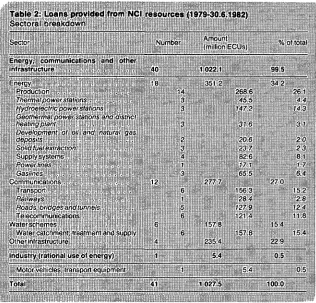
Since the NCI came into operation just over 3 years ago, 41 loans have been granted for a total of 1 027.5 million ECUs (as at 30 June 1982); they went towards investment in Ita-ly - 676.3 million ECUs (65.8%); Ire-land - 153.4 million ECUs (14.9%); United Kingdom - 139.2 million ECUs (13.6 % ) ; France - 40.3 million ECUs (3.9%); Denmark-18.1 million ECUs (1.8%).
In the first two years of operations (1979-1980) NCI loans accounted for approximately .6.3% of all Communi-ty loan financing for investment in Member Countries (474.6 million ECUs out of a combined total of 7 538.2 million ECUs made available from ElB's own resources —
basical-ly the proceeds of Bank borrowings on capital markets — and from NCI, European Coal and Steel Communi-ty and Euratom funds).
In 1981 this rose to 14.1% (539.8 million ECUs out of a total of 3 824.4 million), not a négligeable contribu-tion (see table 1).
Background
The basic idea to the New Communi-ty Instrument for borrowing and lending is simpler than the long and rather complicated name suggests. The NCI is a means through which the European Economic Community raises long-term funds on the finan-cial markets, in its own name and on its own credit; the European Invest-ment Bank then uses these funds, under Community mandate, to make loans for investment projects. In this way the NCI harnesses finan-cial resources mustered by the EEC to the operational capacity — in terms of personnel experienced in banking and evaluation of projects, and close contacts with the au-thorities, financial and industrial cir-cles in the Member Countries — that the EIB has built up in nearly 25 years of its own lending in all sectors of the economy.
These NCI funds can be directed to projects furthering economic objec-tives to which the Community at-taches special priority. The objec-tives are determined by the Council of thè European Communities,
which asks the European Parliament for its opinion.
European Council: IVIarch 1977
The initiative to set up the new mechanism stemmed from the Euro-pean Council's call in Rome, in March 1977, for stronger Communi-ty action to combat unemployment and sluggish investment and en-courage more convergence in na-tional economic performances. There were two responses to this. For its part the EIB substantially expanded its financing operations in the EEC, principally to help invest-ment in regions with the worst de-velopment problems and also to bolster action aimed at reducing the Community's dependence upon oil imports. The Bank's annual lending from its own resources which had been under 1 000 million ECUs in 1976, plus about 120 million in guarantees on loans, rose to almost 2 550 million in 1981, plus guaran-tees for a further 280 million. This growth was backed by .capital in-creases: the Member States doubled the Bank's subscribed capital to
7 087.5 million ECUs in the summer of 1978 and at the end of last year raised it to 14 400 million.
The Commission of the European Communities, already responsible for ECSC and Euratom"' borrowing
(1) Tile EIB does tiie project appraisal work tor Euratom loans, and manages the loans on betialt ot Euratom, but it is ttte Commission wiiicii decides o n ' the granting of loans.
T a b l e 1 : N C I a s p a r t o f o v e r a l l C o m m u n i t y l e n d i n g f o r I n v e s t m e n t (1979-1981 ) (in m i l l i o n ECUs)
ElB's own resources
1979 2 2812
1980 2 739.0·
1981 2 539.4· 67 4 66.0 66 4
NCI
277 0 197.6 S39.8
ECSC
Eur-atom bined
com-8.2 4.8 14 1
675.7 1 031 0 387.6
199 24.8 10.1
152 3 184 4 357 6
Total 7 559.6 66.6 1014 4 8 9 2 094.3 18.4 694.3
4.5 3 386 2 4 4 4 152.0 9 4 3 824 4
6.1 11362.6
and lending operations, proposed that the European Economic Com munity — which some time before had borrowed at relatively short term to provide balance of payments support to Ireland and Italy — should also start to borrow long-, term on a regular basis and so pro vide another source for financing capital investment; in practice, the funds have been used so far for investment in fields which are the same as or complementary to those in which the Bank works using its own resources.
Below is a brief run-down of the key decisions which set up and subse quently expanded the fields for NCI lending (references are given to publication of the decisions in the Official Journal of the European Communities):
D October 1978: the Council of Ministers agreed to introduce the new mechanism "on an experimen tal basis"; it gave outline approval for the Commission to borrow up to 1 000 million ECUs in the name of the EEC and for a mandate to the EIB to carry out the lending opera tions "on behalf of, for and at the risk of the Community" (O.J. L 298, 25.10.1978).
Π May 1979: the Council activated the first tranche of borrowing (500 million ECUs) and specified the funds were to be used for invest ment "consistent with priority Com munity objectives in the infrastruc ture and energy sectors". Loans for infrastructure were to cover, in par ticular, transport, teleconimunica-tions, agricultural improvements, water supplies and environmental protection; energy projects should help the Community to attain greater independence, security or diversification of its energy supplies — specific reference was made to energy-saving and development of alternative energy sources (O.J. L 125, 22.5.1979).
[image:7.584.217.533.65.368.2]D August 1979: the Council de cided that 3% interest subsidies, paid from the Community budget, could be applied to loans from both the ElB's own resources and NCI funds made in less prosperous Member Countries fully participat ing in the European Monetary Sys tem (Ireland and Italy were desig nated as such). Subsidised loans
Table 2: Loans provided from NCI Sectoral breakdown
Sector
Energy,- communications and other infrastructure
Energy .'.','. . , '. ' , . . . . , Production . ' . . . - . Jhermal power stations . ... . "., .
Hydroelectric power stations
Geothermal power stations and district' heatingplant
Development of oil and natural gas deposits . . '.
Solid fuel extraction Supply systems Powerlines . . . • Gaslines : .'
Communications ' . . . ' . Transport • . , . . ' . : • Railways '.
' Roads, bridges and tunnels ,. Telecommunications . . . '
Waterschemes
Water catctiment. treatment and.supply Other infrastructure
Industry (rational use of energy)
Motor vetiicles, transport equipnrient.
Total , ; ,
resources
Numtir^r
40
IH
12
6
4
1
41 14
3 3
3
2 3
• \
1
Ì
6
/
5 6Ò
1
1979-30.6.1982)
Amount (million EUU·:)
1 022.1 .151 2
277 7
1'57 8
23Ì-.4 5.4
1 027.5 268 6
4b b 1 4 / ?
3-16
20 6 2.17 82 6 171 65 5
156 3 28 4 r j 7 9 121 -J
157 8
5 4
°.„
99.5 34 2
27 0
154
22« 0.5
100.0
Df total .
.. ί
>
26.1 ' 4.4 '' 14.3 '.
3.1
2.0 2.3 : 8.1 ( 1.7 •) 6.4 .1
' ,
'15.2 ! 2.8 ' 12.4- • 11.8
15.4
0.5 ;
• Î
— in total worth up to 5 000 million ECUs granted in the five year period 1979/1983 — are concentrated on infrastructure projects which help to solve major structural problems, re-duce regional disparities and im-prove the employment situation (O.J. L 200, 8.8.1979).
Π July 1980: the Council activated the second tranche of borrowings (up to '500 million ECUs) and specified that 80% (400 million) of this should go to infrastructure and energy investment as before (O.J. L 205, 7.8.1980).
D November 1980: the Council de cided that deployment of the re maining 100 million ECUs could be extended to advanced factory con struction and housing development "provided they form part of a total project of economic and industrial development presenting a regional interest" (O.J. L 326, 2.12.1980). D January 1981: following the earthquakes in Southern Italy, the Council authorised a total of 1 000 million ECUs in loans, with 3% inter est subsidies paid from the Com munity budget, as exceptional aid to help reconstruction; the resources for the loans are to be raised under the NCI name, less any amounts which the EIB lends for the same purpose from its own resources (O.J. L37, 10.2.1981).
D December 1981 : similar arrange ments — up to a ceiling of 80 million ECUs — were agreed by the Council to help reconstruction in parts of Greece which were damaged by earthquakes (O.J. L 367,23.12.1981 )
D April 1982: after discussions on the level of further operations, the Council authorised the Commission to go ahead with borrowing 1 000 million ECUs (O.J. L 116, 30.4.1982) with new fields of investment elig ible for support, explained further on. In the meantime discussion con tinues between all interested parties on next stages of NCI lending. The Commission has announced that it will propose to the Council another increase in NCI resources, with the intention that measures to moder nise industrial structures should have priority claim on the funds.
Lending to date
The NCI loans handled by the Euro pean Investment Bank in 1979 and 1980 amounted to 474.6 million ECUs out of total lending operations carried out by the Bank worth 5 494.8 million (plus 14.2 million in guarantees on loans).
million in loans plus 282.1 million in guarantees. The increase was due to lending (296.2 million ECUs) for re-construction in the earthquake areas of Southern Italy.
The majority of New Community In-strument loans granted up to 30 June this year — 65% or 669.5 mil-lion ECUs — have been at subsid-ised interest rates:
— 565.5 million in Italy (296.2 mil-lion subsidised under the earth-quake reconstruction arrangements, 269.3 million under the EMS-system);
— 104 million in Ireland (EMS sub-sidies).
The complementary nature of NCI_ finance is again illustrated by the fact that 35 out of the 41 loans signed up to 30 June were for pro-jects which have also been sup-ported with loans from the ElB's own resources, granted in many cases prior to the NCI operations. This is a key point. The EIB has a statutory obligation that as far as possible it should grant loans only on condition that other sources of finance also be used. Accordingly it. limits its lending to 50% (max.) of ihe fixed asset costs. The sheer
scale of many projects, however, particularly in infrastructure and energy, often means that the Bank's participation must be smaller (in fact, the average over the years has worked out at about a quarter). By using the NCI in addition to the ElB's own loans, the Community has been able to give a high level of support to projects, some of them very large and specially important. The 35 dual financing operations mentioned above covered some 45% of the total fixed asset costs involved, as follows:
cost of projects EIB loans NCI loans combined loans
M ECUs 5 335 1 691.8
691.3 2 383.1
% 100 32 13 45 The six operations in which only NCI finance was provided were, with one exception, for reconstruction pro-jects in the earthquake areas; be-cause of the special circumstances the loans were granted to meet a much higher proportion than usual of the project costs — they covered over 80% of the forecast outlay. The sectoral breakdown of NCI loans to 30 June 1982 (see table 2,
New Community Instrument loans list
The following list gives a breakdown by country and broad sector of New Community Instrument loans signed up to and including 30 June 1982. It also lists loans granted within the NCI framework for reconstruction in areas of Basilicata and Campania in Southern Italy which were hit by the earthquakes in November 1980
The symbol· against many loans in Ireland and Italy indicates that they were granted with a 3% interest subsidy, paid from the Community budget, under arrangements agreed upon when the two countries joined the European IVIonetary System (EMS). All the loans for earthquake reconstruction carry 3% subsidies, also paid from the Community budget, under the Council s decision on exceptional Community aid for the affected areas.
The figures In italics show the amounts which the European Investment Bank has lent from Its own resources for the same projects. Of course, the EIB has helped to finance many more projects in tha Member Countries, completely independently of NCI operations, dunng the same pe-iod; the amounts involved are not included in the figures printed in Italics Most of the operations in Ireland and Italy listed below benefit from EMS subsidies (N.B. In a few cases only part of the amount indicated was lent at subsidised rates).
M ECUS M Dkr DENMARK: total NCI 18.1 142.0 Energy
Construction of coal-fired generating plant at Randers (Aarhus) as 9.2 72.0 combined electriciiy and district heating unit 23 0 180 0 - Municipality of Randers (1980)
Conversion from oil to coal-firing of power station at Asnaes (West 8 9 70 0 Zealand) 42.6 300 0 - Elektricitetsselskabet Isefjordvaerket Interessentskab — IFV (1980)
M Ffrs FRANCE: total NCI 40.3 240.0 Communications
Construction of Poitiers-Bordeaux section of A10 Pans-Bordeaux 40 3 240 0 motonway 10.0 60.0 - Société des Ajtoroutes du Sud de la France, through intermediary
of Caisse Nationale des Autoroutes (1981 : two loans)
IRE m IRELAND: total NCI 153.4 103.3 Energy
Construction of Aghada (Co. Cork) power station 24 7 16 5 - Electricity Supply Board (1979) 45.2 30.0' Development of bogland, mainly in the Midlands, for supplying fuel to 14.7 10 0· peai-fired power stations 19.4 13 0 ' - Bord Na Mona (1980, 1981: two loans)
Development of bogland and construction of a peat briquette factory 8.9 6.0* at Littleton (Co. Tipperary) 8.8 6 0 ' - Bord Na Mona (1980)
Communications
Extension and modernisation of national telecommunications system 53 3 36 0* - The state (1979. 1980, 1981. three loans) 107.8 73.0' Improvements to over 20 roads in national road network and on major 19 4 13.0' roads in Dublin, Cork, Limerick and Dundalk areas 16.5 11.0' - The State (1979)
Water suppilesisewerage
Water supply and sewerage schemes for Greater Dublin area 24 7 16 5 - The State (1979) 44.9 30 0 ' Water supply and sewerage schemes in the Midlands and North-East 7.7 5 3 ' regions 24.8 16.8' - The state (1982)
Lit billion ITALY: total NCI 676.3 835.0 Energy
Construction of Mazzara del Vallo (Sicily) — Sant Eufemia (Calabria) 41.7 50.0* section of Algeria-Italy gasline 168.7 1 9 0 0 ' - SNAM SpA. through intermediary of Ente Nazionale Idrocarburi
- ENI (1980)
Construction of Sant Eufemia-Castrovillari (Calabria) section of 7 9 10 0' Algeria-Italy gasline 33.2 40 0 ' - SNAM SpA. through intermediary of ENI (1981)
Construction of pumped storage power station at Alto Gesso (Pied- 34 9 40.0' mont) 139.1 160 0 ' - Ente Nazionale per I Energia Elettrica — ENEL (1979)
Construction of pumped storage power station at Edolo (Lombardy) 32 9 40.0' - ENEL (1981) J03 J 120.0'
page 5) and the list of loans pub-lished with this article reflect the priorities laid down by the Council for the first 1 000 million ECUs of funds. There is a clear emphasis on roads, telecommunications, sewer-age and water supplies in areas of the Italian Mezzogiorno and Ireland, principally, but also in N.E. England, Scotland and S.W. France, and on a range of investment aimed at cut-ting dependence upon oil imports (e.g. hydro, coal-fired, geothermal power stations, oil and gasfield de-velopment, exploiting peat re-sources); these energy projects should have a total effect in saving energy, exploiting new Community resources; or in shifting part of im-port dependence from oil to other fuels, equivalent to 7.4-million ton-nes of oil per year.
The list also shows how substantial NCI resources have been allocated to the most urgent reconstruction work in the earthquake areas (e.g. repairs to 900 km of road and some 1 100 krii of railway lines, restoring telephone services to 14 000 sub-scribers, repairs to 1 200 schools, basic infrastructure'for resettlement areas to house some 120 000 people).
Widened fields for lending
Apart from the special character of financing earthquake zone recon-struction, there has been a gradual widening of the investment fields eligible for support through NCI loans.
Housing is one which has generated particular interest. In line with the Council's decision in November 1980 to allow up to 100 million ECUs to be used for tiousing as part of the infrastructure necessary for indust-rial development, the EIB and the Commission have signed a framework agreement foreseeing a series of loans worth some 170 million ECUs (110 million from the Bank's own resources, 60 million from NCI funds) to help finance con-struction of 5 400 low-cost homes in the vicinity of 14 industrial areas in the Italian Mezzogiorno. These are to be built under a social housing programme, of which one of the promoters is the Italian Cooperative Movement; the homes will be re-served for Cooperative members with, priority, going to workers in local industry.
Development of "Settala" "Amelia ', ' Davide" and ' Barbara ' gasfields and Cavione" oillield
— AGIP SpA (1980J
Construction of gaslines between Minerbio (Emilia Romagna) and Zimella (Venezia) and Ripaita (Lombardy) and Cortemaggiore (Emilia Romagna)
— SNAM SpA (19811
Conversion of two depleted natural gasfields into storage reservoirs at Minerbio and Ripaita
— AGIP SpA (1981)
Installation of combmed-heat and electricity plant for district heating system at Brescia (Loirbardy)
— Azicnoa Servizi Municipalizzati dei Comune di Brescia, through intermediary of IMI — Istituto Mobiliare Italiano (1981)
Conversion of Brindisi (Apulia) and Sulcis (Sardinia) power stations from Oll to coal-firing
— ENEL (1981)
Construction of geothermal power stations in Tuscany — ENEL (1979)
Industry
Energy-saving investment in factories m Central and Northern Italy — FIAT group, through intermediary of Centrobanca (1982) Communications
Construction of Carma-Pontebba section of Friuli motorway — Concessioni e costruzioni autostrade SpA (1980) Extension to telephone network in Sardinia
— Società Italiana per I Esercizio Telefonico — SIP through inter-mediary of Credito Industriale Sardo (1981)
Extension to telephone network in Campania
— SIP through intermediary of Istituto per lo Sviluppo Economico dell'Italia Meridionale— ISVEIMER (1981)
Extension to telephone network in Apulia — SIP through interniediary of IMI (1980)
Water supplies
Extension of PertusiMo acqueduct for supplying drinking water to central Apulia
— Cassa per il Mezzogiorno (1979) Industrial zone development
Road, water supply and flood protection infrastructure for industrial zone at Syracuse (Sniy)
— Cassa per il Mezzogiorno (1980)
Provision of road rail, water and gas supply and diamagc infrastruc-ture for industrial estates at Chieti |Abru77ij, Frosmone (Latium). Naples and Salerno (Campania; ana Catania (Siciiyl
— Cassa per il Mezzogiorno (1981)
Reconstruction in earthquake areas of Campania and Basilicata - all loans subsidised
Provision of basic infrastructure for prefabricated villages rehousing victims
— The State (1981)
Restoration of almost 1 200 damaged schools — The State (1981)
Restoration of 900 km of damaged roads and motorv./ays — Azienda Nazionale Autonoma delle Strade — ANAS (1981)
Reinstatement of almost 1 150 km of railway network
— Azienda Autonoma delle Ferrovie dello Stato-F S.. through inter-mediary of Italian Treasury (1981 j
Provision of drinking water supply and sewage disposal ml restructure for resettlement centres housing some 120 000 people
— Cassa per il Mezzogiorno (19811
UNITED KINGDOiU: total NCI Energy
Construction of Dinorwic pumped storage power station (Wales) — Central Electricity Generating Board through intermediary of tne
Electricity Council (1979) Water supplles'sewerage
Improvements to water supply system by construction of dam at Kielder on North Tyne River and installations to transfer water to rivers Wear and Tees
— Northumbrian Water Authority through intermediary of National Vi/ater Council (1981)
Water supply and sewerage scnemes m Lothian Region (Scotland) — Lothian Regional Council (1979)
167 44 7
159 33 6
4 0
2Γ.3
11 9 »5 7
11 8 25 6
105 29 1
5 4 17.9
37 3 30 7
39 8
15.8 82 9
125 86 4
39 6 111.9
125 175
11 9 419
20.0 48 5·
20 0 4 1 0 '
5 0' 25.0·
15 Ο ίο Ο
Ι 5.0·
31.4-12.0· 37 5
7 0 22.0
45.0 40 0 50 0
20 0 WOO
150 fOOO
45.0-130 0'
15 0' 20 α
ιδο ίο
2-155 2 195 0
55 7 70 0
30 8 40 0
28 4 36 0
26 1 35 0
139.2
79 4 181 4
33 9 69 4
25 9 50 8
em 86.3
50 0 118 9
20 0 43 9
Another extension was in April this year with the first NCI loan granted for. direct industrial investment; 5.4 million ECUs went to help finance energy-saving schemes in 11 FIAT group factories in Central and Northern Italy.
The Council's authorisation of NCI 2, with a fresh 1 000 million ECUs funding, opens further possibilities. While reaffirming the importance of continuing to direct part of NCI financing to regional development infrastructure, the Council's deci-sion
i) puts a somewhat different slant on energy projects eligible for sup-port, underlining the "efficient use of energy, the replacemerit of oil by other sources of energy in all· sec-tors and infrastructure projects facilitating such replacement"; in practice this means that finance can be provided for investment in sec-tors other than industry, services and economic infrastructure (fields in which the Bank already regularly provides financing) to embrace, for example, energy-saving in public building and housing construction;
ii) specifies that "productive invest-ment projects of small and medium-sized undertakings" should be able to benefit from NCI financing; this may extend also to investment by small and medium-scale ventures outside the areas normally covered under the Bank's usual criteria for lending in support of development in assisted areas.
Although there are no rigid rules, the characteristic of additionality in co-financing, by which NCI loans joined to EIB loans have permitted substan-tial Community backing for projects, should hold good as the broad prin-ciple for most NCI 2 lending.
NCI loan procedures
In accordance with the initial Coun-cil decision, the Commission and the Bank drew up detailed arrange-ments for the practical implementa-tion of the lending mandate which the Cpuncil gave to the EIB. Jhis agreement covers a range of details, extending from the various points at which exchanges of information or consultations . are essential to smooth working, to technical and legal points that could arise in the course of loan administration.
The intention was to avoid unneces-sary complications and duplications and the result is that procedures for New Community Instrument loans, seen from the borrower's eyes, are quite similar in most respects to those applying to loans from the ElB's own resources.
The EIB receives loan applications, normally directly, which is the usual practice for the Bank's operations, through the Commission or through the Government concerned.
For each application, the Bank must first ask the Commission for an opin-ion that the proposed investment comes within the guidelines oh the use of the funds laid down by the Council.
Once the eligibility is established, the Bank then carries out its own customary appraisal of the economic, financial, technical, legal and management characteristics of the project, in accordance with the procedures laid down in its Statute. The aim of the appraisal is to ensure, inter alia, that the project
— will make a worthwhile contribu-tion, either direct or indirect, to-wards improving economic produc-tivity;
— complies with relevant national and Community legislation;
— is on a sound financial and tech-nical footing.
The appraisal is carried out in con-tact with the borrower by the Bank's Directorate for Operations in the Community assisted by technical ad-visers specialising in the various sectors and by economists and lawy-ers, all of whom are members of the Bank's staff.
If satisfied with the result of this "appraisal, the Bantu's Management Committee recommends the loan for approval by the Board of Directors, which.fixes the conditions of the finance.
Here again, there is no a great differ-ence for the borrower between an NCI loan or a loan from the Bank's own resources. Interest rates are calculated on a similar non-profit-making basis. They reflect the cur-rencies disbursed and the cost of borrowing them on the markets, to which is added a small margin to cover the Bank's administrative ex-penses in loan appraisal and man-agement.
Evidently, the choice of currencies and the term (so far NCI loans have
been for between 12 and 20 years) depends basically upon the condi-tions prevailing on the capital mar-kets, as is also the case for the ElB's own loans.
This said, added flexibility has now been. introduced to the system through the constitution of a NCI "Treasury" managed by the EIB on behalf of the Commission. This should alleviate a technical problem which hindered NCI lending opera-tions, namely that funds were raised in matched maturity operations, i.e. destined for'one or several specific loans. This proved somewhat, rig id because the borrower normally wants to have some foreknowledge of the rate of interest he will have to pay and the currencies he will re-ceive and also wants the grace period on capital repayments tai-lored to the nature of the project. The new facility should enable a smoother use of NCI funds and encourage their wider deployment. The Bank's lending procedures ^^ both for loans from its own re-sources and from NCI funds — are more fully described in the booklet "Loans and Guarantees In the IVIember Countries of the European Community", available on simple re-quest in any of the Community offi-cial languages.
EIB-INFORMATION Is published pe-riodically by the European Invest-ment Bank In seven different languages (Danish, Dutch, English, French, German, Greek and Italian). Material which appears in EIB-INFORMATION may be freely repro-duced; an acknowledgement would be appreciated and also a clipping of any article published.
100, bd Konrad Adenauer ' L-2950 Luxembourg tel. 4379-1 - telex 3530 bnkeu lu .
telecopier 43 77 04 : Department for Italy: Via Sardegna, 38 - 1-00187 Rome tei 49 79 41 - telex 611130 bankeu i
telecopier 474 58 77 Representative Office in Brussels:
Rue de la Loi 227 B-1040 Brussels
tei 230 98 90 - telex 21721 bankeu b telecopier: 230 58 27
Liaison Qff'ice .. • for the United Kingdom: 23, Queen Anne's Gate, Westminster
London SW1H9BU tei 222 2933 telex 919159 bankeu g . Telecopier 222 2936