by
Dipesh Chakrabarty
This thesis was submitted in partial fulfilment of the requirements for the
degree of Doctor of Philosophy in the Australian National University.
This thesis examines the problems of protest, solidarity, organization and class consciousness in the history of the jute mill workers of Calcutta in the period 189Q to 1940. The jute workers were a very large labour
force, numbering well over 250,000 in the years mentioned, who were involved in several strikes and other militant acts of protest against their employers. Yet they never formed strong and enduring trade unions and their sense of class-solidarity remained remarkably fragile, often giving way to internecine conflicts of religion or ethnicity. It is argued here that none of these problems can be reduced to purely political,
This thesis is my o\i/n composition.
I V
CONTENTS
WORDS OF THANKS
ABBREVIATIONS Vlll
1. PROBLEMS, PERSPECTIVES
2. JUTE: THE NATURE OF THE INDUSTRY 15
3. OF CONDITIONS AND CULTURE 95
4. THE PARADOX OF ORGANIZATION 172
5. THE CULTURE OF PROTEST 232
6. OF SOLIDARITY AND CONSCIOUSNESS 275
7. CONCLUSION 315
BIBLIOGRAPHY 321
The hare of labour history was started for me ten. years ago by Barun De, my teacher at the Indian Institute of Management in Calcutta. The race has eventually taken a somevi/hat different course from the one he initially envisaged, but he has always been a source of encouragement even when our views and opinions on the subject have differed. It was his lectures at the Management Institute that first awakened in me an interest in history, a subject that had always seemed dull and boring at school. I have found the experience of thinking and writing about history an immensely rewarding one, and for this I remain grateful to Barun De who willingly took upon himself, ten years ago, the rather unrewarding task of making a historian of me.
In Australia, it was my good fortune to work under the supervision of Anthony Low who has been extremely patient and understanding with the rather slow emergence of this study. His gentle but sharp criticisms and his insistence on clarity of expression have helped me to keep my thoughts in line by forcing me to clarify my own ideas to myself.
V I
Several friends in Australia, India and elsewhere have helped me with their encouragement and criticisms. Special mention must be made of Roger Stuart and Stephen Henningham who gladly provided a captive but responsive audience for several of my draft chapters. I have also benefited from the cominents of Robin Jeffrey, John McGuire, Meredith Borthwick, Brij Lai, Pauline Rule, Katherine Gibson and Merrilyn Wasson. In Calcutta, I have had very good friends and stern critics in Gautam Bhadra, Amiya Bagchi and Rajat Ray. My one-time colleagues at the
Centre for Studies in Social Sciences were always forthcoming with ideas and criticisms. Of them, Ranajit Das Gupta deserves to be specially
mentioned. I have had several intellectual differences with him but he has always handled them in a most friendly spirit. In Delhi, I had brief but stimulating discussions with Sumit Sarkar, Tanika Sarkar,
Sabyasachi Bhattacharya, Chitra Joshi and Neeladri Bhattacharya. Several discussions with Stephen Gourlay in London were also of help. In the later stages of my work, I received many useful comments from my friends in the SubalteAn Studies group. To all these people, my heartfelt thanks.
My search for source materials was made easier by the kindness of several people. Nabaneeta Deb Sen helped me locate the private papers of K.C. Roy Chowdhury, a trade-union organizer of the 192Gs. These papers were eventually made over to me by their custodian Basudha Chakrabarty to whom I remain much indebted. The authorities of Thomas Duff and Company, Dundee especially their Secretary, J.G. Smith
-kindly allowed me to consult their old records without which this study would have been a lot poorer. Sarit Roy and S.K. Chatterjee of the
West Bengal State Archives, Calcutta, the National Archives of India, New Delhi, the India Office Library, London, Centre for South Asian Studies, Cambridge, Dundee Central Library, Dundee, Dundee University Library Archives, Menzies Library, A.N.U., for all their assistance in making this study possible. Lakshmisree Sinha, Raghab Banerjee, Narayani Bhadra and Rudrangshu Mukherjee helped me in my search for material at different stages of my work. I thank them sincerely for their help. I must also record with gratitude the general support I have received from the members of the South Asian History Section, A.N.U. from Margaret Hall and Margaret Carron in particular -throughout the course of this study.
I also thank Sayandev Hukherjee and Catherine Daniels for their hospitality in London; Henry and Barbara Daniels for being my hosts in Cambridge; and Udaytapan and Krishna Das Gupta for making my stay in Delhi so comfortable.
Rosemary Smith typed my drafts with interest and care. My friend Leona Jorgensen did a cheerful and enthusiastic job of typing the final version. I would have taken even longer to complete this study if I had not been under pressure to keep up with her pace.
Vlll
ABBREVIATIONS USED
B.P. Benthall Papers
C.S.A.S. Centre for South Asian Studies, Cambridge
C.S.S.S.C. Centre for Studies in Social Sciences, Calcutta
Com. Commerce
Edn Education
Genl General
I.E.S.H.R. The. Indian Economic and Social H-Utofiy R^v-im
I.J.M.A. Indian Jute Mills Association.
I.J.M.A. MponJ: Ro^po^t tko, Indian Jute. Mllti A6-i,oelation
I.O.L. India Office Library
K.C.R.P. Papers of K.C. Roy Chowdhury
N.A.I. National Archives of India
Misc. Miscellaneous
Poll Political
R. C.L.I. Re.po^t the. Royal Comml^6lon on LabouA In India
(London, 1931)
T.D.A. Archives of Thomas Duff and Company
PROBLEMS, PERSPECTIVES
If Marx gave the working class a special place and mission in history, it is also clear that he situated this class within a framework of bourgeois relationships. The figure of the worker invoked in his
exposition of the category of 'capital' was that of a person who belonged to a society where the bourgeois notion of eguality was ingrained in culture. Thus Marx considered labour to be a 'moment' ''i.e. a constituent element) of capital, and capital, according to him, 'is a bou^g^o-U,
p^odiict^on fi^lcutlon, a production relation of bourgeois society'.^ The labourer of Marx's assumption had internalized and enjoyed 'formal freedom', the freedom of the contract (which brought legal and market relations together), and he enjoyed this not just in abstraction but as
of his argument. Indeed, as we now know from historians in our times, the 'notion of equality before the law' was an essential ingredient of the culture with which the English working class handled its experience of the Industrial Revolution.^ This of course does not mean that everything about the culture of the English working class was bourgeois. Bourgeois society, Tlarx said, was 'itself a contradictory development' where
'relations derived from earlier [social] forms' were still to be found in 'stunted' or 'travestied' conditions.^ What however made the society distinctively bourgeois was the predominance of bourgeois relationships over pre-bourgeois ones.
Marx's discussion of the labour-capital relationship as it operated within the capitalist organization of work thus cannot be placed outside his assumption of a hegemonic bourgeois culture. This assumption, it will be shown in later chapters of this work, is a crucial one in Marx's understanding of the working class. On it rests his notions of 'industrial discipline', 'capitalist authority' and such like ideas which he used in analyzing the labour process in a capitalist factory. In other words, it is a key assumption in Marx's discussion of the power-relationship between labour and capital, and since 'power' or 'authority' cannot be thought
of without linking it to 'consciousness',^ it can also be argued that a hegemonic bourgeois culture is an indispensable aspect of the social
framework within which Marx locates his idea of working-class consciousness,
seriously crippled these workers in respect of their capacity to constitute themselves into a class by developing the necessary kinds of solidarity, organization and consciousness.
This is not - and I must stress the point - an effort to see culture in a causal relationship to history. If anything, what we present here is
CK/
more^negative argument than a positive one. It is an argument aQOuiyUit the primacy that is religiously accorded to the 'economic' in many Marxist his-torical writings and analyses of society. In the particular case of Indian history, it also means opposing the Indian nationalist view of history since the 'primacy of the economic' has for long been an inherent characteristic of the nationalist thought that developed in India under conditions of colonial
domination.^ In fairness to all however it should be emphasized that while we refuse to see the culture and the consciousness of workers as being ultimately determined by their economic and material conditions, the guestion of the determination of history by economic forces - even if only 'in the last instance' - remains an unresolved one within Marxism, the writings of Marx and Engels on the subject being open to opposed interpretations.^° The present work is thus also intended as a contribution to an on-going debate within the Marxist movement.
II
betvi/een 1890 and 1940. The terminal dates selected refer mainly to the period for which I have examined the available historical documents but the argument presented here may well apply to years not covered by them.
There was a stage in the history of Calcutta when the city owed its economic importance and fame to the jute mills that - thanks to British enterprise in India - lined the two sides of the river Hocghly both north arid south of the city. 'To write about Calcutta without saying a word about jute', said a tourist-guide to the city in 1906, 'would be as bad as to deprive the lamb of its mint s a u c e S t a r t e d in 1855, this
industry by the 1910s was the most important jute industry in the world, consuming more raw jute than the 'rest of the world' put together.^^ The chief advantage that the industry had over its rivals in other countries was its proximity to the source of its raw material. India, and Bengal in particular, had a virtual monopoly in the production of raw jute. In 1945-46 India produced 97 per cent of the total world-supply of raw jute and by far the greater part of it was produced in Bengal, eastern Bengal alone account-ing for 'nearly 60 per cent of the total production of jute in the whole of I n d i a A c c o r d i n g to one estimate, Bengal produced more than 88 per cent of the jute grown in India between 1922 and 1931.^'* Bengal was thus the main producer of jute, and jute manufactures - mainly cheap packing and wrapping material - being largely meant for overseas markets, m.cst of the Indian jute mills came to be set up within a very narrow geographical region around the port-city of Calcutta. 'In 1940', writes T.R. Sharma,
banks of the Hooghly, above and below C a l c u t t a T h e main centres of the Calcutta industry are shown in the map provided here.
The Indian jute industry was thus much more localized, geographically speaking, than the other important industry of India, the cotton textile industry. Moreover, individual jute mills employed a larger number of workers than did individual cotton mills. 'While the average number of workers employed in the cotton industry [was] about 1,150 per establishment in 1929, the average number employed in the jute industry per establishment [was] nearly 3,635 in the same year'.^^ The jute industry therefore brought together a very large number of people and put them all within a narrow geographical area under broadly similar conditions of life and labour. At the peak of the prosperity of the industry, in the 1920s, this was a labour force well over 300,000 in number. Even in the 1930s, when the industry suffered a depression, the number of people employed by it remained substantially greater than 250,000 (Table 1).
As Table 1 shows, most of the jute labourers were adult males, women on an average forming about 16 per cent of the labour force
Year factories No. of No. of adult males No. of adult females No. of children
1912 61 145,389 31,329 23,007
1913 64 158,261 34,010 24,106
1914 69 167,858 36,800 25,909
1915 70 181,445 40,674 26,646
1916 70 191,036 42,145 27,603
1917 71 192,667 41,395 27,320
1918 72 199,977 43,278 27,^09
1919 72 20],009 43,112 28,628
1920 73 207,255 44,545 28,521
1921 77 207,908 44,^705 29,235
1922 80 239,660 49,25^ 28,267
1923 83 242,652 51,495 28,400
1924 85 252,107 54,801 27,823
1925 83 256,312 55,511 26,474
1926 86 253,935 52,827 20,785
1927 85 253,681 52,935 19,249
1928 86 260,342 53,678 17,879
1929 90 267,717 54,6"^0 17,278
1930 91 264,417 52,114 11,646
1931 93 222,573 42,254 3,462
]932 94 212,505 40,294 1 ,515
1933 92 208,246 3^,337 1,134
1934 93 213,894 36,932 915
1935 95 225,372 37,749 278
1936 94 233,481 38,261 4
1937 96 249,737 37,997 9
1938 97 242,342 36,683 9
1939 101 243,496 37,699 34
1940 101 248,046 36,640 34
1941 101 251,388 35,255 38
1942 101 252,799 35,083 32
1943 101 245,125 34,759 35
1944 101 231,121 36,005 67
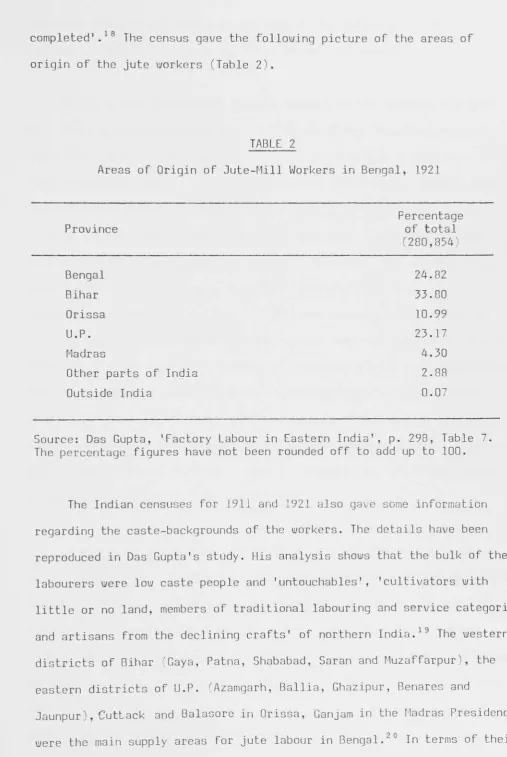
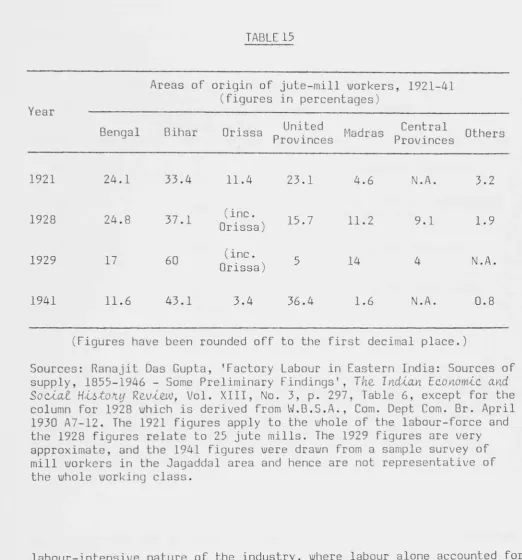
completed'.^® The census gave the following picture of the areas of origin of the jute workers (Table
TABLE 2
Areas of Origin of Jute-Mill Workers in Bengal, 1921
Percentage Province of total
(280,854)
Bengal 24.82 Bihar 33.80 Orissa 10.99 U.P. 23.17 Madras 4.30 Other parts of India 2.88
Outside India 0.07
Source: Das Gupta, 'Factory Labour in Eastern India', p. 298, Table 7, The percentage figures have not been rounded off to add up to 100.
The Indian censuses for 1911 and 1921 also gave some information regarding the caste-backgrounds of the workers. The details have been reproduced in Das Gupta's study. His analysis shows that the bulk of the labourers were low caste people and 'untouchables', 'cultivators with
little or no land, members of traditional labouring and service categories and artisans from the declining crafts' of northern India.^^ The western districts of Bihar (Gaya, Patna, Shababad, Saran and Muzaffarpur), the eastern districts of U.P. ';Azamgarh, Ballia, Ghazipur, Benares and
Though one of the largest working classes in the country, the jute-mill workers were also among the lowest paid of the industrial workers in
India (see Table 3). This was reflected in their dismal poverty and in their problems of housing, health and chronic indebtedness. Their wages were often not enough to support their families and most jute workers
- it is difficult to say just how many - left their families at 'home' in the countryside and took long leaves to visit them as and when their means permitted.^^ The 'majority of the [jute] workers' then, as a
government report put it in 1946, '[had] some connection with lands in their villages'. This however did not 'always mean that they own[ed] the land'. More often than not, 'instead of receiving income from agriculture, they have to meet certain incidental expenses regarding farming being done in the villages by their relatives', apart from having to provide money 'for certain conventional, although nonetheless obligatory expenses, such as marriages and funerals', when the workers had 'no option except to borrow money to meet these obligations'.^^
TABLE 3
Average monthly money wages of workers in different centres, 1900 to 1939 (figures in Rs.)
Average monthly Average monthly Average monthly money wages of money wages of money wages of
Year workers in workers in workers in
Bombay Ahmedabad Calcutta
cotton mills cotton mills jute mills
1900 12.29 11.35 12.0
1901 12.58 11.35 12.0
1902 12.59 11.35 12.0
1903 12.59 11.35 12.0
1904 12.59 11.35 12.7
1905 12.59 11.82 12.8
1906 12.59 12.44 12.8
1907 14.36 12.59 12.8
1908 15.36 12.76 13.5
1909 15.46 13.33 13.5
1910 15.46 13.45 13.5
1911 13.40 13.45 13.7
1912 14.11 13.45 13.2
1913 14.21 13.45 14.4
1914 16.37 13.45 14.5
1915 16.75 13.45 14.6
1916 16.78 13.45 14.6
1917 17.01 13.70 14.8
1918 21.08 17.70 14.8
1919 24.75 20.06 16.4
1920 30.75 22.77 18.4
1921 30.63 31.89 19.9
1922 31.69 32.58 19.9
1923 32.75 33.27 19.6
1924 32.75 33.44 19.4
1925 32.75 33.62 19.8
1926 34.56 33.80 19.2
1927 34.56 33.80 19.3
1928 34.56 33.80 17.7
1929 34.56 33.80 16.5
1930 34.56 33.80 14.3
1931 34.56 33.80 16.2
1932 34.56 35.69 15.4
1933 34.56 35.69 14.6
1934 27.25 35.69 14.6
1935 27.25 33.46 14.6
1936 27.25 33.46 16.9
1937 28.44 30.96 18.3
1938 32.13 32.98 19.6
1939 35.37 35.00 19.6
have studied this particular group of labourers. These concerns are understandable, for political and economic factors are of undoubted importance in the history of any working class. But a problem arises when they are seen as the most important determinants of a working-class history. One is left with no clues as to what role the workers themselves, as the willing subjects of their own history, played in it; or what role the bosses played, as human beings endowed with particular kinds of
mentalities, in determining the nature of that history. It is not a question of reducing the Marxian concept of 'relations of production' to inter-personal relations, but of emphasizing that production-relations are relations after all, and as Marx once said, relations can only exist in ideas, in consciousness. And the logic of consciousness, we argue, cannot be derived from a techno-economic argument or from considerations about the nature of political institutions in colonial India.
Economic, technical or political factors, on the other hand, do net operate in a cultural vacuum. Behind the jute industry's demand for cheap unskilled labour (or its problems of industrial discipline) lay the culture of the 'bosses' - a deeply entrenched mercantilist outlook and the cultural milieu of the British Raj in India. This culture did not even always act in the best 'economic' interests of the industry. So was the case with the jute-mill labourers. Their notions of authority, their modes of protest, the problems of their organizations, the weakness of their solidarity - all reveal, on inspection, the existence of a
pre-bourgeois culture and consciousness which, in combination with the so-called 'economic' and 'political' factors, impaired their capacity to act as a class. This is what eventually leads us to emphasize the
11
Chapter 1
NOTES
1. Marx quoted in Roman Rosdolsky, The. hiaklng MaAx'6 'Cap-ctal' (London, 1 9 8 0 \ p . 184, n . 3 . Emphasis original. For Marx's conception of labour as a 'moment of capital', see his
foundcutlon^ o^ the CnAXlque Potlt^caZ Economy (Harmondsvi/orth, 1974), p p . 293-301. CapUal, I , (Moscow, n.d.?^ p . 3 3 3 , sees labour as 'a mode of existence of capital'. HegeX'4 Loggia (tr.
W . Wallace; London, 1975), p p . 7 9 , 113, uses 'moment' to mean both 'stage' as w e l l as a (constituent) 'factor'. Jinrich Zeleny, The. Log-ic 0^ MOAX ''Oxford, 1980^, p . x i , defines 'moment' as 'one of the elements of a complex conceptual entity'.
2 . M a r x , GmndfvUie,, p . 4 6 4 .
3 . ibid., p p . 2 9 6 - 7 . Emphasis original.
4 . M a r x , CapitciZ, I, p . 6 0 . Admittedly, Marx made this statement with reference to the problem of deciphering the 'secret of the expression of v a l u e ' . But then one has to remember that for Marx capital is
self-expanding value and labour a moment of capital. For these and related points also see I.I. Rubin, E66aij6 on Ma^x'6 The.on.y o{) Value.
13
5. The classic statement is E.P. Thompson's The. Making o^ -the. Engti^h Woftking Clcui THarmondsvi/orth, 1968).
6. Marx, G^undbvU^O., pp. 106-6.
7. The point is developed in Chapters 3 and 5 below.
8. Here and elsewhere in this work, the expression 'working class' is used in a designative manner i.e. without any connetations of class-consciousness .
9. See the discussion on Nehru in Partha Chatterjee's forthcoming book hiati.oncitU,t Thought.
10. The crisis of Marxist theory on the question of 'determination' would be obvious to anyone familiar with the current debate and
literature on the subject. A particularly interesting contribution is Alvin W. Gouldner, Tho. Two Contn.a(iLcXA,on^ and AnomatisJi In thz ddvelopmmt oi Th^o^ij (London, 1980'>.
11. W.K. Firminger, ThackeA'^ Guide, to Calcutta (Calcutta, 19061, p. 237.
12. See D.R. Wallace, Tht Romance oi Jute (London, 1928), p. 106.
13. Tulsi Ram Sharma, Location lndu^tn.ie^ In India (Bombay, 1954), p. 89.
14. H.K. Chaturvedi, 'On Jute Industry in Bengal', IhoAx-Ut l-i-UcelZany, Vol. 7, April 1946, pp. 94-143. I owe this reference to Stephen Gourlay.
16. P.S. Lokanathan, IndiutAlal On.ganlzcuUon In India (London, 1935), p. 112.
17. Ranajit Das Gupta, 'Factory Labour in Eastern India: Sources of Supply, 1855-1946 - Some Preliminary Findings', I.E.S.H.R. vol. 8, no. 3, 1976, pp. 277-329.
18. ibid., p. 281.
19. ibid., p. 315.
20. ibid., p. 292.
21. W.B.S.A., Com. Dept Com. Br., April 1930, A 19-20.
22. See Radhakamal Mukherjee, The. Indian Working Cla66 'Bombay, 1948), p. 10.
15
Chapter 2
JUTE: THE NATURE OE THE INDUSTRY
A trader's mentality was what characterized entrepreneurship in the jute industry of Calcutta. 'In the working of a jute mill there [were] three distinct operations', said the Indian Jnvejstou' Ve^aA Book in 1911:
'the buying of raw jute, its manufacture into fabrics, and the sale of those fabrics'. Of these three operations, buying and selling were
considered 'the most important', requiring 'the exercise of much judgement and foresight', much more than the process of manufacturing did.^ The main products of the industry - jute bags called hessian and sacking - had
Association (I.J.M.A.) which frequently arranged for restriction of output by the members of the industry in order to match demand. I.J.M.A. thus represented the unity of the industry on which its restrictive trade practices were based.
The very founding of I.J.M.A. in 1884 marked the end of a period in the history of the industry. Between 1855, when the first jute mill in Bengal was started, and the 18903, the industry had foundered from one crisis to another which were caused by a small and uncertain market. After the 1890s and up to the end of the First World War, the quasi-monopolistic policies of I.J.M.A. and the opening up of distant markets brought
unprecedented prosperity to the Calcutta jute mills. After 1920 however the policies of the industry ran into trouble as advances in the chemical sciences and textile technologies made it possible to produce economic and better-quality substitutes for jute. Unfortunately for the Calcutta industry, its mercantilist economic philosophy had by then turned into a dogma. The leaders of the industry refused to see the problem in terms of technology or quality of output and clung more ferociously than ever to their age-old policies of price-manipulation through restriction of output. This created further problems as new companies, owned and managed mainly by Indians, entered the industry in the late 1920s and refused to join hands with I.J.M.A. This in turn severely affected the internal unity of the latter making any cartel-like arrangements harder to implement.
17
strictly economic analysis of the industry; readers interested in such analyses may turn with profit to some of the works used and cited here. Our aim
is to highlight the strong element of mercantilist spirit inherent in the economic calculations of the industry. Many of the problems of jute-mill labourers followed from policies dictated by this spirit.
II
The early history of the Calcutta jute industry cannot be separated from that of the industry at Dundee in Scotland. The Calcutta industry started as an off-shoot of the latter and some of its early problems stemmed from the fact of being a late-starter. The Dundee industry was at least twenty years older.
A few words about the Scottish industry may be in order. After a chequered industrial career in the eighteenth century, when she produced coarse woollens, shoe buckles and tanned leather, the town of Dundee on the river Tay came to develop the linen industry as her most important manufacture in the second half of the eighteenth century.^ There were
three other 'linen centres' in Great Britain - Belfast, Leeds and Inverness - but they differed from Dundee in that Dundee produced fabrics of the coarsest kind, both of flax and hemp.^ This meant that, unlike the other three centres, Dundee operated in a market for cheap products, where survival depended on keeping prices low. Faced with a rise in flax and hemp prices early in the nineteenth century - especially in consequence of the French Revolutionary Wars (1793-1801) and the Napoleonic Wars
'substitute for hemp in the manufacture of cotton bagging [i.e. bagging for raw cotton]' and for an 'adulterant of flax tow'.'' They tried tow and sunn before.settling upon jute in the 1830s. It was this use of jute for
adulterating flax that gave both Dundee and jute a bad name in the early nineteenth century when some of the Dundee flax and hemp spinners felt constrained to guarantee their products '"free from Indian jute"'.^
19
Linen however \i/as still the more important product of Dundee and
'in 1851 Dundee imported 40,000 tons of flax'. But a Dundee factory
inspector reported the same year that 'Dundee seemed prosperous and that
an increase in the cost of flax, which was reducing the profitability of
flax-spinning, was being ccmficnsated for by an increased production of a
new fabric - jute'.^^
The fate of the linen trade was sealed by the Crimean War of
1854-1856 which shut off the supply of flax to Dundee, and jute took its place.
What placed the industry on a firm footing was the American Civil W a r .
Lancashire's loss was Dundee's gain. Jute assumed the place of cotton, and
'while the war lasted, jute packing and baggings were used very extensively
in America for normal needs and to meet the insatiable demand of the
war'.^^ A Dundee merchant wrote later of this period that 'during the
American War little mills grew into big ones; big ones doubled their power,
and new ones rose up everywhere. There never were such times'. And a
Forfarshire man remarked: 'The money didna only come in shoals, but in
barrowfuls' . ^
Such popularity of jute, however, soon attracted competitors into
the trade. The French set up their first jute mill at Ailly-s-Somme in
1843, though their industry was not a serious threat to Dundee till 1892
when the French government imposed tariff duties on imported jute products.
The German jute industry was started in 1861 and was 'firmly established'
by 1879. It had a rapid growth through the nineteenth century and imported
more than 21?o of India's raw jute exports by 1914. Belgium and Austria started their industries in the 1860s, while It&.'iian hemp mills began to
process jute in 1885. Dundee however retained her lead till the first decade
These developments had an important bearing on the growth of the
Calcutta industry. By the time this industry came into being (in the
1850s and '60s) there already existed a world-market for jute manufacturers
in which the Dundee industry predominated. The growth, behind tariff walls,
of other European jute industries in the late nineteenth century would
have only made the world-market even harder to enter. The first few mills
in Calcutta therefore turned to the market that India traditionally served
with her handloom products of jute - the network of country ports in India
and some coastal markets in South-East Asia, mainly Burma. The first jute
mill in Bengal set up in 1855 at Rishra even had 'a number of hand frame
looms'^® and chose its location precisely because the neighbouring town
of Serampore was 'a noted centre for hand spun jute and hemp', where
'labourers possessing knowledge of hand-spinning and weaving were available
in good numbers'.^^ Another factory, the Gourepore [Gouripur] Jute Mill,
was started in 1862 with the express purpose of competing 'with the native
weavers in the Indian markets', for 'at that time', as a 'Dundonian' was
to put itlater, 'there was no rivalry between Dundee and India'.
One feature of the early history of the Calcutta jute industry was
thus the displacement of the older artisanal production. From a position
of near-total predominance in the 1850s,^^ the traditional industry was
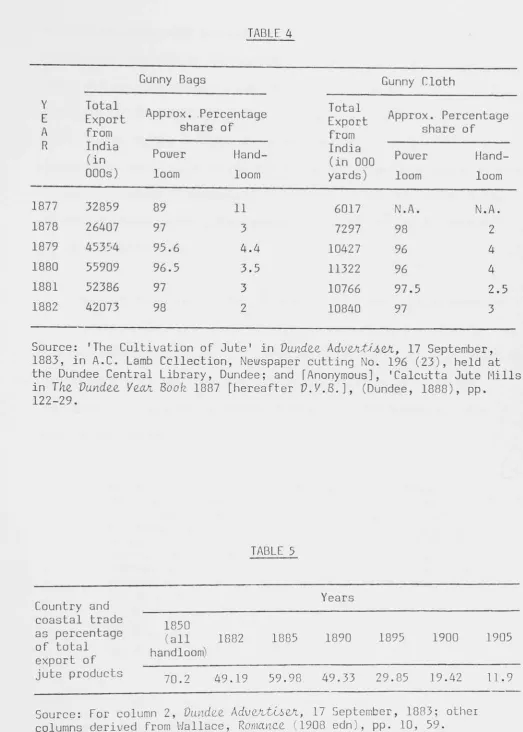
relegated to absolute unimportance by the 1870s (see Table below) and
disappeared altogether from the customs house statistics after the 1880s.
For the first thirty years in the industry's career, i.e. 1855 to
1885, most of its products were sold in the country and coastal market that
the handloom industry traditionally served. These markets were small and
21
TABLE 4
Gunny Bags Gunny Cloth
Y E A Total Export from Approx. Percentage share of Total Export from Approx. Percentage share of
R India (in 000s) Power loom Hand-loom India (in 000 yards) Power loom Hand-loom
1877 32859 89 11 6017 N.A. N.A.
1878 26407 97 3 7297 98 2
1879 45354 95.6 4.4 10427 96 4
1880 55909 96.5 3.5 11322 96 4
1881 52386 97 3 10766 97.5 2.5
1882 42073 98 2 10840 97 3
Source: 'The Cultivation of Jute' in Vundze. kdyjOJiXiMOJi, 17 September,
1883, in A.C. Lamb Ccllection, Newspaper cutting No. 196 (23), held at the Dundee Central Library, Dundee; and [Anonymous], 'Calcutta Jute Mills' in The Vundee. V^oA Book 1887 [hereafter V.V.B.], (Dundee, 1888), pp.
122-29.
TABLE 5
Country and Years
coastal trade 1850 (all handloom) as percentage of total export of 1850 (all handloom)
1882 1885 1890 1895 1900 1905
jute products 70.2 49.19 59.98 49.33 29.85 19.42 11.9
business and high price g u n n i e s T h e precarious position of the
industry is indicated by the history oT some of the oldest mills. The
first of them, for instance, came to depend so heavily on the 'fairly good profits' it made off the fortuitous boom produced in the Bombay
cotton market by the American Civil War that the termination of the war caused it to collapse as no alternative marl<eting outlets could be found
to match its scale of production.^^ 'Several pioneer shipments having
turned out disastrously', this company was 'wound up' and its property put up for auction.^^
The dependence on the 'traditional' market for handloom products had another implication: there was little pressure cn the mills to
standardize their products. Consequently, entry into the world market for manufactured jute was even more difficult than it would have been
otherwise. D.R. Wallace, a pioneer historian of the industry, v/rote thus of the problem:
We have now [c.l870] got to five mills with about 950 looms at work. Up to this time there was very little export trade in gunnies beyord Burma. It was not found necessary to be particular about regularity in weights or counts of the two or three qualities of bags in use ... But now it became necessary to seek foreign outlets. The Borneo Co. made the first serious attempt about 1868 bv shipping 400 bales of their 2^8 lbs. twills as 2V2 lb 3 bushel twill bags to the United Kingdom. The result was disastrous. The bags averaged on arrival anything from 2 lbs to 3 lbs. the shotting varied from 7 to 10 per inch and the result was a claim of a pound per bale.^"*
There are two points that this quotation makes. One is about the lack of
standardization of the product, which came as a result of dealing in coastal
23
a little too small for the industry. 1870 is cited by Wallace as the year
'when production, by the advent of new mills, outran the local and
neighbouring country demand, and compelled the industry to invade foreign
market with their g o o d s ' A t the present moment', wrote Elija Helm in
1875,
there is reason to conclude that ... the jute
manufacturers of Bengal have been overdone. The
production is large and increasing, and the
difficulty of finding profitable outlets for the
manufactured product is constantly becoming
greater.^^
The smallness and uncertainty of the market encouraged a spirit of
specul-ation both in the promotion of the first few mills and in their management.
Floating and selling off a jute mill was often seen as a more profitable
proposition than running it in the interest of the shareholders.
Naturally, quite a few of the early entrepreneurs were essentially
fortune-hunters who had no long term interest in the industry. George
Ackland, for instance, the founder of the first mill in 1855, a one time
'middy' in the East India Marine Service, turned his attention to jute
only to make good a loss he had suffered in Ceylon.^^ That accomplished,
he was out of the scene by 1867.^® The Baranagar Jute Mill, which was
set up by the Borneo Company in 1859, was sold to the Baranagar
Jute Factory Ltd in 1872, after the former owners had got back their
capital 'twice over'.^^ An observer from Dundee commented that 'the
price which was paid by the Baranagar Company was £384 000, a figure
far beyond what the mill could have been built for, and fully £125 000
more than the concern was worth'. The high price was not justified by
the value of the mill. It was meant 'to enable the firm [Borneo Co.]
The 'quick money' mentality is also evident in the history of another of these early mills, the Asiatic Jute Mill, or the Soorah Jute Mill as it was called later. This mill was built in 1874 by Charles Smith, a small mill-owner in Dundee. Smith's attention shifted to Calcutta when he faced business difficulties in Scotland; but investing in Calcutta was only a way of repairing his financial losses. He 'did not even wait to see the mill start, but took his profits from the firm of Jews who had financed him in the venture and r e t i r e d T h i s 'firm of Jews' -Cohen & Co. - in their turn stopped all payments due to their creditors in 1878 and simply absconded from the trading scene of Calcutta; it was revealed that 'they had largely helped themselves to the manufactured goods and were indebted to the Company in over Rs 20,000'.^^ Yet another attempt by an Armenian trader to set up a jute mill in the late 1860s came to naught because 'he lost all his capital in speculation'.^^
The person who most embodied the spirit of the times was Richard Macallister. At one time a 'bus conductor in Philadelphia', he came out
'to the Tudor Ice Company about 1869' and, as VJallace put it, 'with Yankee instinct decided to have a hand in the golden pie'.^"* In the early 1870s, when the gunny bag trade was seemingly, if briefly,
25
They sold the Fort Gloster Jute Mill for Rs 13,00,000, the Oriental Jute
Manufacturing Co. for Rs 18,00,000 and the cotton mill for about the
same price, (the figure for the twine factory being unknown).^'' If the
proceeds made on the cotton mill were any guide - and bearing in mind
the popularity of jute mill shares in those years - the company would
have profited by at least 40 per cent on each of these ventures.
Besides, R . Macallister & Co. also got themselves appointed as the
Managing Agents of these mills 'for five years certain at a remuneration
of 3?o of the gross sales ... and an allowance of Rs 500 a month for
office establishment in Calcutta'.^®
Unsurprisingly, none of the Macallister mills were well managed. The
twine and canvas factory - the idea 'not proving sufficiently remunerative'
- was soon converted 'into a jute mill' - with very little thought, it
would appear, as the 'spinning and preparing machinery' were reported to
be 'all more or less intended for flax, and [were] too light for jute'.
A Dundee correspondent worte in 1880: 'The concern was never worked at
anything but a loss, and is now in liquidation, and when the last advices
left Calcutta it was to have been exposed to public roup on the 1st
March last'.^^
The directors of the Oriental Jute Manufacturing Company admitted
in 1879 that the mill 'cannot work to a profit, burdened as it is with
debts'. In 1880, the mill was stopped 'with a view to liquidation and
reconstruction of the Company', when it was eventually taken over by
Bird & Co., and renamed the Union Jute Mill.'*° Fort Gloster Jute Mill
also had a very 'spasmodic' career. After a prosperous first year the
1875. On top of this, the shareholders and creditors had to bear the additional burden of their traumatic discovery, in 1878, that Richard Macallister had suddenly 'disappeared' from Calcutta 'on urgent private affairs' and that his firm had declared itself bankrupt. The later
revelation that Flacallister had also 'misappropriated' Rs 33,370 from the funds of the mill, and that 'the reserve fund, Rs 40,000, [had] also disappeared and [that] in fact, it never had any existence except on paper', twisted the knife.
A spirit of speculation thus reigned supreme in the flotation and management of these early mills, often to the detriment of the interests of the shareholders. The mills in the seventies were typically set up in years of temporary boom, and shareholders were drawn in by the
immediate prospects of enormous dividends. It is this that explains the lumpy nature of the growth of the industry in this decade (Table 6 ).
TABLE 6
Year No. of mills set up
Up to 1872 5 mills
1873 4 new mills
1874 7 new mills
1875 1 new mill
1877 2 new mills
27
given away in a spirit of total neglect of the financial health of
the mills.
That in the ordinary course of working the mills would require serious repairs and replacements did not occur to any one, and no allowance of any kind was ever made from time to time for depreciation, and the consequence is that many of the mills are now [1880] burdened with debenture debts, they having no funds wherewith to pay for the renewal of and replacements in the mill, when such became absolutely necessary.'*^
A typical example was Rishra Mill which was made into the Calcutta Jute
Mill in 1872. For a couple of years both profits and dividends were very
good (20 per cent), but with the trade depression of the mid 1870s the
mill found itself in a deepening crisis.
Large repairs and replacements were urgently required, and as all the gross profits had been paid away in dividends (the words "depreciation", "wear and tear" not then finding places in the Indian millowners' vocabulary), it became necessary to raise money on debenture mortgages, and first £30 000 and then £10 000 were borrowed on the security of mortgage debentures bearing interest at 10 per cent. This, of course, had the effect of virtually raising the capital from Rs 12,00,000 to Rs 16,00,000 without any corresponding increase in the size of the mills. Since 1874 the company had declared no dividend, and
the Rs 200 shares, which at one time were selling at Rs 290, can now be picked up easily at Rs 40.''^
The problem was of such a general magnitude that even in 1880, when
the practice of having 'reserve' and/or 'depreciation' accounts was more
common than before, six of the eleven Calcutta-owned mills had little or
no such funds. 'The result of this mismanagement has been a very serious
decline in the value of all Jute stock, and, with exception of two
Name of Mill
Paid-up
Capital
(Rs)
Reserve,
Wear and
Tear (Rs)
Debentures
& Pref.
(Shares (Rs)
Other
Liabilities
(Rs)
'Present' (1880)
Market Value
(Stock Exchange
Quotations) ('Rs)
Calcutta
12,00,000
6,554
4,00,000
1,59,803
1,80,000
Gourepore
12,00,000
1,90,954
nil
1,16,965
7,44,000
Seebpore
15,00,000
32,155
nil
1,51,228
4,50,000
Mowrah
14,00,000
2,52,072
3,00,000
2,49,164
8,82,000
Asiatic
3,99,900
3,858
nil
61,397
59,985
Balliaghata
1,66,500
nil
3,30,500
18,865
33,300
Kamarhatty
4,00,000
nil
4,00,000
4,62,115
3,20,000
Oriental
19,00,000
nil
96,500
3,84,242
1,90,000
Fort Gloster
14,00,000
nil
2,00,000
2,00,615
13,86,000
Budge Budge
14,40,000
3,40,000
nil
2,18,339
4,06,000
Baranagar
40,00,000
3,40,000
nil
3,90,373
22,00,000
Total
150,06,400
68,51,285
Loss to shareholders = Rs 81,54,755
Source: JMB, p. 86.
29
to an enormous extent', wrote the correspondent from Dundee whom we
have quoted before.'*'* (Table 7.)
TABLE 8
Name of Mill No. of Cost of Cost per (1880) looms block (Rs) Loom (Rs)
Calcutta 260 14,64, 909 5632
Gourepore 224 11,12, 472 4970
Seebpore 250 13,93, 072 5572
Howrah 275 15,27, 150 5918
Asiatic 75 3,99, 812 5330
Balliaghata 100 4,69, 302 4693
Kamarhatty 202 10,20, 885 5053
Oriental 350 18,97, 595 5421
Fort Gloster 250 13,62, 176 5448
Budge Budge 320 14,24, 299 4450
Baranagar 516 39,61, 970 7619
Source: JMB, p. 88,
Behind this state of affairs lay the speculative spirit in which the
mills were floated. Much of the initial paid-up capital raised was spent
in buying the mills from their vendors, so that the mills often started
with not enough working capital. The Oriental Jute Manufacturing Company,
for instance, was bought from R. Macallister & Co., at Rs 18,00,000 out
of a total paid-up capital of Rs 19,00,000.'*^ And promoter-speculators
like Macallister hiked up the cost-price of a jute mill much above what
could be considered an economic price for the period. The mills as a
result often started with too much of their money invested in their
that 'a mill of 300 looms, with all needful accommodation, could be put
up for Rs AOOO per loom, and, if this assumption is correct, no mill
whatever its size, should be worth more than Rs 4000 per loom'. But the
eleven Calcutta-owned mills for which he could collect the information
had their cost figures as above (Table 8). The correspondent rem.arked
that 'this would work out on the above an average cost of Rs 5,673 per
loom; and as two mills only are above this average, it seems to follow
that the average is too high'.'^^
Ill
New and bigger markets had to be found and secured for the Calcutta
industry before it could overcome the competition from Dundee and realize
the benefits of its two 'natural' advantages, cheap labour and
proximity to the source of raw jute. But this called for determined
enterprise and, above all, contacts in the already established
world-market for finished products of jute. There is an element of irony in the
fact that the eventual supremacy of the Calcutta mills (over their Dundee
counterparts) owed a great deal, initially at least, to their Dundee
connections. The Samnugger Jute Factory Company Limited (1874), which is
credited with having done for the Calcutta industry 'more than all the
other companies put together' in their search for new markets, was
floated by four businessmen in Dundee - Thomas Duff, J.J. Barrie, and
'the brothers Nicol[l] of A . and J. Nicol[ 1]' . ^ In the early 1880s, the
four men held between them sixty per cent of the shares of the Samnugger
31
Duff, Barrie and the Nicolls appear to have all come from middle ranking trading or manufacturing families of the town, and they all had, either individually or through their families, connections in the
textile trading world. While these connections were important, it was their involvement in the Calcutta industry that made them prominent in Dundee. The Nicolls were one of 'the oldest members of Dundee's textile trade', yet when Alexander Nicoll died in 1909, he was remembered not for his doings in Dundee but as 'one of the pioneers of the great jute
industry on the banks of the Hughli'. Joseph J. Barrie, who rose so high as to be made President of the Dundee Chamber of Commerce in 1887,
started his career in a modest way as an apprentice to a firm of flax merchants. He gradually worked his way up and became a clerk with Messrs George Armistead & Co., a Dundee trading firm; in the 1860s he was their
'market man'. At this time he resigned and 'began business on his own account, in which he proved very successful'. In 1874 he became a partner of Thomas Duff to promote the Samnugger Company. Thomas Duff, the key man in the Samnugger story, was born into an old
artisan-manufacturing family with long and established connections with flax and jute. His father Daniel Duff, 'machine maker and flax spinner. South Tay street works, Dundee', was known as 'the inventor of the jute teaser or devil, the softening elephant'. Daniel Duff himself had some ideas about starting jute spinning in Calcutta. Thomas Duff's elder brother Robert Duff was a gunny broker who made over his business to Thomas Duff in 1855.
India u/as so marked', commented the Pandee V^oA Book after his d e a t h ,
'that after 8 years' residence in the East he returned home with ample
competency, and built a large jute mill at Barking, in E s s e x ' . B u t ,
as IJallace said of h i m , 'like the old h o r s e , he smelt the battle from
afar'.^° He sold his mill and joined hands with the Nicolls and Barrie
to start the Samnugger Company.
Thomas Duff's company did not go for the local and the coastal
markets that other Indian mills normally served. Instead it managed to
break into the Australasian market very early in its career. And once
they got an opening into the Australian and New
Zealand markets for cornsacks, woolpacks and hessian bran bags, the mill agents, without any organised combine, nursed this outlet by turning out and stocking bigger and bigger quantities of the goods in anticipation of the seasonal orders ... The
'Frisco central hessian wheat pocket demand was fostered in a like manner.^^
D . R . Viallace, from whose account of the history of the industry this
quotation comes, was at pains to emphasize the importance of the inherited
Dundee 'connections' of the company to the success of their first few raids
on foreign markets:
They were particularly fortunate in their selection of an expert to conduct their business in the agents'
... office. This gentleman, M r . VJ. Smith, had forged his way from office boy in Messrs Cox Brothers, Lochee, to a confidential position with the firm. He was endowed with indomitable assurance and when he came to Calcutta had nothing to learn in the devious ways of jute. Backed by the practical
experience and biUimM conmction o^ the. hoim boa/id {lOfi^ign moAkeX^, this company did more than all the companies put together to invade foreign
33
The phenomenal success of the Samnugger Company in these new markets
in years when many of the other mills were struggling to survive must
have set an example to the latter. 'In 1880', reported Sir John Leng, a
Dundee M . P . who visited Calcutta in the winter of 1895, 'there was a
great collapse in the industry consequent upon overproduction and the
Calcutta mills not having made a market for their produce, for up to this
time the demand was principally local'.^^ In this crisis that had been
building up since 1875 - when 'the other mills languished or went to the
wall' - the Samnugger Jute Mill with its overseas markets
paid a steady dividend of 10 per cent, per annum, besides building up a huge reserve fund, enabling them to present their shareholders with 40 per cent, bonus shares in a baby m i l l , the Titaghur, floated
in 1883, which has grown to rive its father's bonnet.^"*
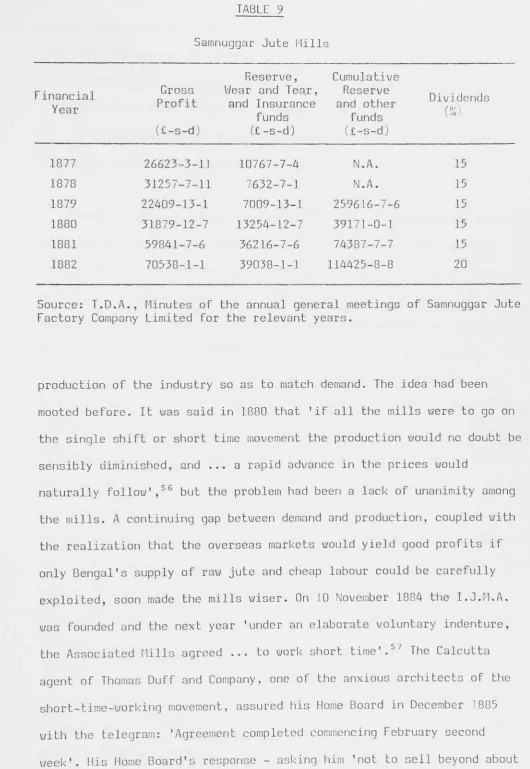
If anything, as the following table suggests, Wallace probably
underestimated Samnugger's prosperity in those years. The annual report
of the company for 1881 described its reserve and depreciation funds as
exceeding, 'very considerably', 'the excess expenditure on B d g s . , Plant,
Boats & c . ' , and 'over and above, the subscribed and fully paid up capital
of the company' (Table 9).
Such an object lesson in profit-making did not fail to have its
effect on an industry desperate for profits and markets. Before long, other
mills were also in the race for overseas outlets, and by the late '80s
'had made a fair progress' in this direction.^^ One very important
development of this period was the formation in 1884 of the Indian Jute
Manufactures' Association, later called the Indian Jute Mills Association
Samnuggar Jute Mills Financial Year Gross Profit (£-s-d) Reserve, Wear and Tear,
and Insurance funds (£ -s-d) Cumulative Reserve and other funds (£-s-d) Dividends ' 0' ^ , '0
1877 26623-3-11 10767-7-4 N.A. 15
1878 31257-7-11 7632-7-1 N.A. 15
1879 22409-13-1 7009-13-1 259616-7-6 15
1880 31879-12-7 13254-12-7 39171-0-1 15
1881 59841-7-6 36216-7-6 74387-7-7 15
1882 70538-1-1 39038-1-1 114425-8-8 20
Source: T.D.A., Minutes of the annual general meetings of Samnuggar Jute Factory Company Limited for the relevant years.
production of the industry so as to match demand. The idea had been
mooted before. It was said in 1880 that 'if all the mills were to go on
the single shift or short time movement the production would no doubt be
sensibly diminished, and ... a rapid advance in the prices would
naturally follow',^^ but the problem had been a lack of unanimity among
the mills. A continuing gap between demand and production, coupled with
the realization that the overseas markets would yield good profits if
only Bengal's supply of raw jute and cheap labour could be carefully
exploited, soon made the mills wiser. On 10 November 1884 the I.J.M.A.
was founded and the next year 'under an elaborate voluntary indenture,
the Associated Mills agreed ... to work short t i m e ' . " The Calcutta
agent of Thomas Duff and Company, one of the anxious architects of the
short-time-working movement, assured his Home Board in December 1885
with the telegram: 'Agreement completed commencing February second
[image:45.609.53.584.46.816.2]35
a month forward in the anticipation that the reduced production will
strengthen the market'^®- was as much an instruction as a statement of a
point of view that was soon to become an article of faith with the
industry and I.J.M.A. Throughout the period under discussion, I.J.M.A.
sponsored and led several short-time movements in the industry, all in
the belief that 'reduced production [would] strengthen the market'.
These efforts soon bore fruit. By the late 1880s the Calcutta mills
received 'regular orders' from the United Kingdom for flour and salt
bags, and had also 'annexed' the 'Egyptian Diara contract' and 'Levant
orders for grain sacks and other twill g o o d s B y the early twentieth
century, they had found new, steady and extensive markets in Australasia,
the United States, South Africa, and the countries of South America. In
1913, for instance, of the total export of bags by the Calcutta mills,
Australia took about 30 per cent, while of the cloth export, 60 per cent
went to the United S t a t e s . T h e United States' import of jute manufactures
from India in that year constituted 82 per cent of the country's total
consumption, the rest coming from the United Kingdom. The progress that
the Indian industry had made in the 1900s may be gauged from the fact that
as late as 1897 India had supplied only 32 per cent of the total American
import of manufactured jute goods, while the United Kingdom provided the
balance.^^ The extent of change in the Australian market, which was
once a preserve of Dundee's, is also reflected in the following figures
for 1911 (Table 10).
Once the Calcutta mills established themselves as a major source of
cheap and coarse jute bags these markets were to stay for a long time
TABLE 10
Jute bags and sacks imported
into Australia in 1911 Percentage imported
Type Quantity (in doz.)
from India
Corn and flour packs 813123 99.9
Bran, chaff and
259193 100
28798 99.8
compressed fodder packs
Potatoes, onions
and coal packs
Ore packs 40368 100
Wool packs 957047 99.7
Source: [Anon.], 'Jute',
AgMlcultuAal
Gazette
him SoLith OJale^,
vol. 24, Pt 8 2 August 1913, p. 668.
every year of the total export of gunny bags from India between
1920-21 and 1929-30, and America, 66 per cent of the cloth exports
between 1896 and 1 9 3 0 . "
The Dundee industry fell into increasing difficulties after the 1880s
when rising tariff barriers in Europe and the competition from Calcutta
effectively narrowed the market for Dundee products. In 1900, 'no exports
of jute manufactures were recorded as being sent from Britain' to Italy
and France, and the amount sent to Germany was a mere 1.3 per cent of that
exported in 1878.^^ As one observer put it:
in the 1880s and 1890s, the Dundee manufacturers,
increasingly shut out from their established
37
The intensity of Calcutta's competition forced Dundee to specialize after the First World War in finer products like carpet backing, leaving the market for coarser goods like hessian and sacking to the Calcutta industrialists.®^ A dramatic demonstration of Calcutta's supremacy came in May 1919 'when ... the Angus Jute Works in Dundee were sold and the whole machinery transferred to Calcutta', causing, understandably,
'considerable surprise and resentment among the unemployed in Dundee'.®® That the rivalry between Dundee and Calcutta, and the consequent decline of Dundee, never quite assumed the shape or importance of the Lancashire-Bombay conflict has been put down by A.K. Sen to 'three factors':
First of all, it [the Dundee industry] was still [in the 1890s] a relatively unimportant part of the British economy, and the influence of Dundee was less than that of Manchester. Secondly, by this time the group of Scots who had been investing large amounts in Indian jute mills had become an influential force in itself ... [Thirdly] Indian jute goods exports were by the '90s playing a crucial part in the settlement of Britain's dollar purchase ... [i.e.] in the
settlement of British balance of payments. Since this fact was considerably discussed [in Dundee and
elsewhere], this too must have played its part in not allowing to develop in the case of the Indian jute mills the type of social ethos that developed against the Indian cotton industry.®^
home manufacturers' mouths water. In the home textile trades for the same period of years such returns have been unheard of and u n k n o w n ® ® On his return to Dundee, Sir John warned the Dundee Chamber of Commerce that the 'time will probably never return when the jute industry in
Dundee will advance again with leaps and bounds, and when large fortunes will be realized in a few years in a very rough and easy way'.®^ Indeed, by 1908, Dundee's intermittent outcries against some practices of the Calcutta millowners and managers appeared to the latter as 'nothing more serious than harmless wails from their small competitor on the Tay'.^° The tone of that statement speaks for itself; Wallace's book, from which it is quoted, is in itself a testimony to the growing sense of complacency that the Calcutta industry developed in the twentieth century.
lU
Wallace's book Romance. Jute, was published twice - once in 1909 and then again, in a revised and updated form, in 1928. The
differences between the two editions are indicative of the change of mood in Calcutta jute circles. The first edition ended on an optimistic
note - it envisaged a future that 'would appear to be good ... for the Calcutta mills'. But its optimism was still cautious. The 'scandals' of the nineteenth century were still there like unhealed scars; so the
39
seen the Calcutta industry pass through a phenomenal boom during the First World War when, according to one observer, in spite of large
increases 'in the reserves and depreciation funds, the level of profits reached was incredible'. 'The ratio of net profits to paid up capital of the jute mill[s] ... was 58 per cent in 1915, 75 per cent in 1916, 49 per cent for 1917 and 73 per cent for the first half of 1918'.^^ The
importance of trench warfare in the VJar created a huge demand for sandbags and the fall in India's export trade gave the industry an almost captive supply of raw jute.'^ As the following figures for five individual jute mills suggest, the profits-rates of the years 1918-19 remained unsurpassed for most periods in the history of the industry (Table 11).
Wallace wrote the second edition of his book when the industry was still gathering the fruits of the harvest it had reaped during the War. By 1925 the Calcutta mills consumed 'more than five times as much jute as the Dundee industry' and 'the reserve funds of the mills in almost every case' exceeded their c a p i t a l . T h e Qapi;taJi of 3 April 1924 - the mouthpiece of the Bengal Chamber of Commerce - looked at the profit
figures for the industry for 1913 to 1923 'given below, Table 12) and remarked with unconcealed glee, 'What a wonderful decade it has been!'.
The industry now developed a new sense of its own history. The
murky past of the 1870s and 80s was forgotten, and the story of Calcutta's jute industry since 1855 was now seen as 'one of uninterrupted progress'.^^ The mood of the Scottish entrepreneur in Calcutta became highly
TABLE 11
Profit Rs) per ton of manufactured jute for five jute mills 1916-1935
Year Samnugger
North Samnugger Titaghur No. 1 Titaghur No. 2 Victoria
1916 170.04 144.30 137.42 146.09 136.49 1917 132.39 122.68 114.01 119.49 123.05 1918 394.40 327.49 305.73 305.35 303.16 1919 242.00 208.73 202.15 203.63 197.41 1920 195.53 184.72 183.10 184.68 181.90
1921 59.81 44.45 48.45 50.80 50.05
1922 94.90 67.57 68.60 71.09 74.62
1923 114.75 86.71 86.46 90.70 97.39
1924 90.74 76.81 69.69 69.25 82.89
1925 66.06 34.85 49.50 46.22 63.28
1926 50.43 40.65 39.14 40.37 49.16
1927 78.73 69.04 66.54 68.77 76.72
1928 104.73 90.82 86.01 91.15 97.41
1929 90.77 71.99 71.63 72.76 83.86
1930 69.28 52.82 46.80 51.20 56.92
1931 46.19 36.39 33.65 38.06 39.09
1932 45.62 32.49 30.17 35.42 36.70
1933 57.27 36.77 39.45 43.18 48.26
1934 55.41 31.43 37.67 40.44 48.11
1935 41.38 31.93 31.76 31.03 38.93
41
TABLE12
Year Profits before paying
debenture interests (Rs)
1913 24597553
1914 9618614
1915 42148960
1916 64871041
1917 42392573
1918 122925767
1919 116453696
1920 125382066
1921 49586033
1922 35835863
1923 49533808
Source: Capital, 3 April 1924.
To increase the jute manufacturing industry from 10,000 looms to 40,000 in the comparatively short period of 20 years, to provide the necessary capital, to secure the required machinery, to recruit and
train.175,000 new mill workers, and all the time to have the satisfaction of knowing that we are enriching Bengal, improving the standard of Indian labour and earning a fair return on our capital, what better results can be looked for by the most ardent protectionist or free trader?
'Don't these figures speak for themselves?'. Sir Alexander continued. 'Don't they show the sound basis of which the jute manufacturing is established, so far at least as this country's trade is concerned?'.^®
The reworked text of the second edition of VJallace's book was
coloured by this prevailing mood of robust confidence. 'For all time' to come, it seemed to Wallace in 1927-28, the mills should be 'in a position to weather ... the fluctuating dangers of market'^^ so long as they
followed the I.J.M.A.'s price - manipulative policies of restricting production to meet the demand. These policies, Wallace reckoned, were
'a factor for good to the trade'.''® The revised 'dedication' of the book in this late edition no longer carried any references to the uncertainties of the last century. Instead, so strong was Wallace's optimism now that he broke into poetry:
43
V