Commission of the European Communities
he Community's research and development
programme on radioactive waste management
and storage
Shared cost action
Annual progress report 1986
am
n<>
¿ f & O f k
Commission of the European Communities
nuclear science
and technology
The Community's research and development
programme on radioactive waste management
and storage
Shared cost action
Annual progress report 1986
Edited by:
S. Orlowski, J.M. Gandolfo
Commission of the European Communities200 rue de la Loi B-1049 Brussels
1988
Directorate-General
Science, Research and Development
fe
H>1
H
PARL W O . Cibüoth.
N . C . ' E J , :
Published by the
COMMISSION OF THE EUROPEAN COMMUNITIES Directorate-General
Telecommunications, Information Industries and Innovation Bâtiment Jean Monnet
LUXEMBOURG
LEGAL NOTICE
Neither the Commission of the European Communities nor any person acting on behalf of the Commission is responsible for the use which might be made of the
following information
Cataloguing data can be found at the end of this publication
Luxembourg: Office for Official Publications of the European Communities, 1988
ISBN 92-825-8019-9 Catalogue number: CD-NA-11089-EN-C © ECSC-EEC-EAEC, Brussels · Luxembourg, 1988
FORKWORD
This is the first Annual Progress Report of the European Community's 1985-1989 programme of research on radioactive waste management and disposal, carried out by public organisations and private firms in the community under cost-sharing contracts with the Commission of the European Communities.
The Council of the Ministers of the European Communities adopted the programme in March 1985 (1), considering : "The use of nuclear energy inevitably involves the production of radioactive waste; it is therefore essential to implement effective solutions to guarantee the safety and protection of man and the environment against the potential risks associated with the management of such waste".
The Council also recognised that the 1980-1984 programme of research on radioactive waste management and disposal, which was the second of its kind, "has enabled a large amount of information to be obtained which it is advisable to complete and validate by the implementation of research, development and demonstration actions representing the real waste management and disposal conditions which can be expected in the future". The main publications relating to the results of this second programme are listed in reference (2), and the main results in reference (3).
The 1985-1989 programme is therefore aiming at perfecting and demonstrating a system for managing the radioactive waste produced by the nuclear industry, ensuring, at the various stages, the best possible protection of man and the environment; its contents are as follows :
A. WASTE MANAGEMENT STUDIES AND ASSOCIATED R S D ACTIONS
TASK 1 : SYSTEMS STUDIES
TASK 2 : IMPROVEMENT OF RADIOACTIVE WASTE TREATMENT AND CONDITION-ING TECHNOLOGIES
TASK 3 : EVALUATION OF CONDITIONED WASTE AND QUALIFICATION OF ENGINEERED BARRIERS
TASK 4 : RESEARCH IN SUPPORT OF THE DEVELOPMENT OF DISPOSAL FACI-LITIES; SHALLOW BURIAL AND GEOLOGICAL DISPOSAL STUDIES TASK 5 : SAFETY OF GEOLOGICAL DISPOSAL
TASK 6 : JOINT ELABORATION OF RADIOACTIVE WASTE MANAGEMENT POLICIES
B. CONSTRUCTION AND/OR OPERATION OF UNDERGROUND FACILITIES OPEN TO COMMUNITY JOINT ACTIVITIES (INITIALLY FOR THE THREE PROJECTS LISTED BELOW, BUT TAKING INTO ACCOUNT THAT ADDITIONAL PROPOSALS ARE LIKELY)
PROJECT 1 : PILOT UNDERGROUND FACILITY IN THE ASSE SALT MINE (FEDERAL REPUBLIC OF GERMANY)
PROJECT 2 : PILOT UNDERGROUND FACILITY IN THE ARGILLACEOUS LAYER LOCATED UNDER THE MOL NUCLEAR SITE (BELGIUM)
PROJECT 3 : EXPERIMENTAL UNDERGROUND FACILITY IN FRANCE
The Commission's participation to the cost of the programme amounts to 62 Million ECU for its five years duration.
The Commission is reponsible for managing the programme.
In this task, the Commission is being assisted by the Management and Co-ordination Advisory Committee "Nuclear Fission Energy - Fuel
Cycle/Waste Processing and Disposal" (see annex I ) .
At the beginning of the 1985-1989 programme, the Commission issued a first call for research proposals dealing with tasks 2, 3, 4 and 5. Over 250 research proposals have been received at the closing date (15th June, 1985), trespassing in total several times the available budget, and only a fraction thereof could be accepted for negotiation. A second call for research proposals has been issued in 1986 with
31st October, 1986 as a closing date.
This first report, covering the period of putting the programme into action, describes the work to be carried out under the research contracts already concluded before end of 1986, as well as the initial work performed and the first results obtained.
For each contract, the Paragraph C "Progress of work and obtained results" has been prepared by the contractor, under the responsibility of the project leader. The Commission wished to express its gratitude to all scientists who have contributed to this report.
S. ORLOWSKI
Head, Nuclear Fuel Cycle Division
References
(1) Council decision of 12th March, 1985 adopting a research and development programme on the management and storage of radioactive waste (1985 to 1989)
O.J. No. L 83, 25.03.1985, p. 16
(2) Community R & D programme on radioactive waste management and storage - scientific reports - 2nd edition - report EUR 10745 EN
(3) Radioactive waste management and disposal, proceedings of the 2nd European Community Conference, Luxembourg, April 22-26, 1985
R. SIMON od. Cambridge University Press, 1986 - EUR 10163
-CONTENTS Page
PART A : WASTE MANAGEMENT STUDIES AND ASSOCIATED R & D ACTIONS .... 1
1) TASK NO. 1 : SYSTEMS STUDIES 3 2) TASK NO. 2 : IMPROVEMENT OF RADIOACTIVE WASTE TREATMENT AND
CONDITIONING TECHNOLOGIES 7 a) Waste from light water reactor : 11
- Immobilisation in cement of ion exchange resins arising from the purification of reagents used for
decontamina-tion of reactor 12 - Modified sulfur cement : a low porosity encapsulating
material for LLW, MLW and alpha wastes 15 The treatment of radioactive effluents of PWR
-nuclear power plants by centrifugation 18 - Study of the industrial operation of plants for the
solidi-fication of radioactive waste with regard to quality
assu-rance 22 - Conditioning of ashes from combustion plants in special
melting furnaces 27 b) Waste from reprocessing plants, plutonium fuel fabrication
plants and research centres 31 - Treatment of radioactive wastes by a combination of
pre-cipitation and crossflow membrane filtration 32 - Conditioning of alpha and bèta-gamma ashes from
incinera-tion into different matrices 37 - Solidification of tru-waste by embedding in a ceramic
matrix 40 - Conditioning of nuclear cladding waste by high
tempera-ture melting in cold crucible 42 - Conditioning of fuel hulls and structural materials by high
pressure compaction 45 - Decontamination of solid alpha wastes and recovery of the
plutonium (PROLIXE facility) 50 - Active pilot plant for the decontamination of ILW solutions
by chromatographic processes 53
-- Separation of actinides and long--lived fission products
from HLW at the EUREX plant MTR fuel reprocessing 57
- Treatment (separation and recovery transuranic elements) from liquid wastes produced by plutonium plant of
CRE-Casaccia 64
- Electrochemical ion-exchange/sorption for medium active
liquid waste treatment 71
- Immobilisation of cladding waste by press compaction and conditioning for final disposal by encapsulation in a
lead containment 75
c) Optimization of waste management at source 79
- Minimization of volume and Pu content of wastes from a
plutonium fuel fabrication plant 80
- Optimization of waste management at source 85
3) TASK NO. 3 : EVALUATION OF CONDITIONED WASTE AND QUALIFICATION
OF ENGINEERD BARRIERS 87
a) Medium active waste form characterization 91
- Embedded wastes and leachates analysis 92
- Full-scale leaching tests, scale effects, lysimeter
tests 94 - Speciation of the transuranium elements stemming from
low intermediate and high activity level wastes 99
- Colloids related to LLW and ILW 103
- Physico-chemical characterization of bituminized Eurochemic
medium level waste 108
- Mechanisms and interaction phenomena influencing release
in low- and medium-level waste disposal systems 110
- The effects of radiation on intermediate level waste
forms 112
- The influence of organic complexing agents upon the mobilization and migration of radionuclides from ILW contained in cement and bitumen under near-field
conditions for a repository in a salt dome 115
- Investigation of LLW and MLW cement products resulting
from reprocessing 120
-- Study of leaching mechanisms of ions incorporated in
cement of simple polymer 124
- Evaluation and characterization of conditioned LLW and
MLW 130
- Medium active waste form characterization : the
perfor-mance of cement-based systems 133
b) High active and alpha vaste forms characterization 139
- Long-time behaviour of tru-waste bearing ceramics 140
- Radiolytic oxidation 142
- Characterization of HLW glass samples 147
- Laboratory and in situ interaction between simulated
waste forms and clay 149
- Radionuclide release from solidified high-level
waste 152
- Basic mechanisms of aqueous corrosion of waste glasses .... 156
- Testing of the alteration of waste glasses under
geological storage conditions 160
- Investigation of the long term behaviour of HLW glass
under conditions relevant to final storage 164
c) Other engineered barriers 169
- Study of the physico-chemical properties of the transu-rani an elements necessary to the understanding of the migration/retardation processes in the near- and
far-field 170
- Corrosion of container and infrastructure
materials under clay repository conditions 177
- Near-field modelling in cement environments 182
- Near-field behaviour of clay barriers and their interaction
with concrete 185
- Corrosion testing of selected container materials for
disposal of HLW glass 191
- Corrosion of carbon steel overpacks for the geological
disposal of radioactive waste 196
-d) Development of tests for quality control and quality
inspection purposes 199
- Quality assurance : procedures - standardization 200
- Evaluation of non-destructive methods for quality-checking
of vitrified HLW 201 - Study of a n o n destructive testing method for packed
radioactive waste containers 205
- Quality assurance for radioactive waste packages b y
computerized tomography 209
4) TASK N O . 4 : RESEARCH IN SUPPORT O F THE DEVELOPMENT O F DISPOSAL FACILITIES; SHALLOW LAND BURIAL A N D GEOLOGICAL
DISPOSAL STUDIES 223
a) Work related to sites and their characterization 227
- Development of the methodology of geoprospective study
of a repository site 223
- Long-term rheological and transport properties of dry
and wet salt rock 230
- Comparison of computer codes for salt for geological
disposal of high-level waste project COSA phase II 234
- The 600 m bore hole project : development of a surveillance method during dry-drilling of a 600 m deep bore hole in
salt and performance of geotechnical measurements in the
600 m hole 237
- Faults in clays : their detection and properties 241
- Methodology for application of electric and electromagnetic borehole techniques for detailed exploration of
fractured rocks 245
- Development of self-contained drill-hole chromatographic
probe 250
- The detection and measurement of faults in clay 256
- Studies of disposal possibilities in geological formations :
investigation in granite media 258
- U s e on an underground cavity as a test facility for
radioactive waste disposal in clays 263
-b) Geological repositories and barriers 267
- Study on backfilling and sealing materials for radioactive vaste repositories : tests and controls on reduced scale
disposal holes and galleries 268
- Research on backfilling and sealing of rooms and galleries
in a repository in salt 270
- Study of the thermal behaviour of clay-based buffer materials on reduced scale mok-ups and in underground
laboratory 273
c) Radionuclide migration in the geosphere 279
- In situ determination of the effects of organice on the mobili'ty of radionuclides in controlled conditions
of groundwater flow 280
- Development and application of a retention properties measurement system in a geological environment using
radioactive tracers in the drill-hole 283
- The role of organica in the migration of radionuclides
in the geosphere 285
- Actinoide migration phenomena in groundwater : colloid
generation and complexation with natural organice 288
- Interactions between organic substances and transuranic
elements 294
- Natural analogues of radionuclide migration in granitic rocks through the study of palaeo-hydrothermal
alteration 300
- Natural analogue studies of radionuclide migration 303
- Long-term diffusion in rock : natural analogue 307
- Geochemical modelling 309
- Geochemical databases 311
- Migration of radionuclides by high concentration brine :
finilization of the METROPOL code 313
5) TASK NO. 5 : SAFETY OF GEOLOGICAL DISPOSAL 315
a) Pagis project : 317
- Performance evaluation of HLW waste disposal in
geolo-gical formations - PAGIS 2 project : clay options 320
- Performance evaluation of HLW waste disposal In geolo-gical formations - PAGIS 2 project :
salt rock option 325
- Performance evaluation of HLW waste disposal in
geolo-gical formations - PAGIS 2 project : granite option 329
- Performance evaluation of HLW waste disposal in
geolo-gical formations - PAGIS 2 project : sub-seabed option .... 338
- Summary and review of PAGIS - Phase 2 344
b) PACOMA project : 347
- Performance assessment of confinements for MLW and alpa
waste (PACOMA proj ect) 348
- Validation of the Vault computer model "VERMIN" for post-closure behaviour of repositories in geological
formations 350
- Acquisition of subjective data for use in models for
waste site assessments (PACOMA project) 356
c) Support studies 361
Safety studies of HLW disposal in the Mors salt dome
-support to the salt option of the PAGIS project 362 - Definition of standards of quality assurance performance
assessment codes for waste disposal 365
6) TASK NO. 6 : JOINT ELABORATION OF RADIOACTIVE WASTE MANAGEMENT
PART Β : CONSTRUCTION AMP/OR OPERATION OF UNDERGROUND EXPERIMENTAL FACILITIES OPEN TO COMMUNITY JOINT
ACTIVITIES 371
- The Hades project :a pilot underground facility in the argillaceous layers located under the Mol nuclear site with a view to demonstrating the feasibility of
radioactive waste disposal 375
- The Haw project :demonstration facility for high-level
waste disposal in the Asse salt mine 379
ANNEX I :MEMBERS OF THE MANAGEMENT AND COORDINATION ADVISORY COMMITTEE NUCLEAR FISSION ENERGY - FUEL CYCLE/
PROCESSING AND STORAGE OF WASTE 385
+ + + + + + + + + + + + + + + + + + + + + + +
PART A
CHAPTER 1
CHAPTER 1
TASK No. 1 : SYSTEMS STUDIES
A. Objective
To characterize the various overall management schemes for some waste categories with a view to evaluating their feasibility and availability and optimizing their radiological and economic features.
B. Research topics dealt with under the 1980-1984 programme
Studies on the evaluation and comparison of various management modes for two well defined categories of waste have been performed during the last programme :
- Solid Plutonium contaminated waste
- Alkaline liquid wash waste, arising during spent fuel reprocessing operations.
C. 1985-1989 programme
The systems studies to be carried out are related to three subjects :
- Assessment of management alternatives for reactor waste
- Assessment of management alternatives for hulls
- Comparison of waste management implications of spent fuel disposal and reprocessing.
Additionally, in order to allow comparison of management options with large differences in cost and radiation exposure, procedures are to be developed to provide a rational base for comparative evaluations. In particular, two subjects are to treated :
- Comparative weightings for cost and radiological parameters in the assessment of radioactive waste management options
- Accounting method of radiation doses due to long-lived natural radionuclides and daughters.
D. Programme implementation
The three subjects mentioned above under C were selected during the first half of 1986 with the support of an ad hoc group of national experts nominated by the competent Management and Co-ordination Advisory Committee.
At the end of 1986, several contractors have been selected on the basis of the proposal received following to the second call for
research proposals issued by the Commission in August 1986.
-CHAPTER 2
CHAPTER 2
TASK No. 2 ; IMPROVEMENT OF RADIOACTIVE WASTE TREATMENT AND CONDITIONING TECHNOLOGIES
A. Objective
To optimize waste management by minimization of the volume, reduction of discharges and promotion of new conditioning processes for some types of wastes.
B. Research topics dealt with under the 1980-1984 programme
Research on the treatment and conditioning of low- and medium-activity wastes mainly concerned :
- Denitoation of highly acid waste, chemical precipitation, whether or not combined with ultrafiltration, and electrochemical reactions with a view to reducing the volume of low- and medium-activity wastes
- Mineral ion exchangers, solvent extraction and the selective preci-pitation of actinide and rare-earth oxalates for the separation of long-lived radionuclides from low- and medium-activity wastes.
Research on the treatment of solid waste contaminated with plutonium concerned the study and development of an incineration process making use of pyrolysis and the construction and acceptance of the following installations for experimental operation with radioactive materials : - The ALONA pilot plant, which makes use of an acid-digestion
treatment process
- A prototype high-temperature incinerator and incombustible waste can be decontaminated by special washing operations.
As regards ţ}Î2l};activit£ _wa^ţe (fuel claddings and dissolver
residues), research was conducted on :
The characterization of the properties of irradiated fuel claddings
and dissolver residues in the case of both light water reactors and
fast breeder reactors
The conditioning of fuel claddings by a method involving embedding
in matrices made of lead alloys, highdensity graphite or
aluminium, ceramics and improved cement
The immobilization of the claddings by melting, chemical conversion
processes or embedding in glass
The immobilization of dissolver residues in ceramic matrices with
an aluminosilicate base.
C. 1985-1989 programme
The research and other work to be carried out will cover :
a) Waste from light water reactors
- Reduction at source of radioactive waste and of discharges of radioactivity into the environment by better management of effluents and the possible use of alternative treatment processes
- Development of new waste/matrix formulae in order to keep in step with safety regulations
- Analysis of the industrial operating conditions of waste conditioning installations with a view to setting up or improving quality assurance
- Development of new methods of conditioning incineration ashes.
b) Waste from reprocessing plants, plutonium fuel fabrication plants and research centres
- Decontamination of low- and medium-activity liquid waste by means of chemical precipitation with new, highly selective précipitants (for example, organic compounds). This activity will have to include active tests on real waste
- Development of processes alternative to those already developed under the 1980-1984 programme for the decontamination of reprocessing concentrates
- Conditioning of residues or concentrates rich in actinides (and possibly in fission products) in matrices of long-term stability
- Operation of pilot installations, functioning under active conditions, for the treatment of low- and medium-activity liquid waste by means of advanced processes (membrane and electrochemical processes, etc ...)
- Operation of pilot installations, functioning under active conditions, for the decontamination of solid waste and the recovery of plutonium
- Pilot-scale application of processes, under active conditions, for the conditioning of claddings.
c) Optimization of waste management at source
Improvement of management methods based on "de minimis" criteria (segregation at source, separation, monitoring).
D. Programme implementation
20 contracts have been signed and the available information is listed thereafter.
Immobilisation in Cement of Ion Exchange Resins arising from the Purification of Reagents Used for Decontamination of Reactor Circuits
Contractor: AEE Winfrith Contract~Ñ°: Fl.lW.OOüò.UK(H)
Work Period: July 1986 December 1986 Project Leader: D J Lee/C G Howard
A. Objectives and Scope
The overall objective of the programme is to identify a suitable cement matrix to dispose of Organic Ion Exchange resins contaminated with decontaminating agents.
For the last five years, Low Oxidation state Metal Ion reagents (LOMI) have been used to decontaminate the 100 MW(e) Steam Generating Heavy Water Reactor at Winfrith. The use of these reagents has
resulted in a dilute ionic solution containing activation products which are produced by corrosion of metallic components in the reactor. It has already been demonstrated that the amount of activity in solution can be reduced using organic ion exchangers, for example Duolite C225, a
crosslinked polystyrene with sulphonic acid functional groups.
The aim of the programme at present is to show that ion excnange resins used to remove activity from decontaminating agents can be
successfully immobilised in cement. To achieve this, blends of Ordinary Portland Cement (OPC) and ground granulated Blast Furnace Slag (BFS) will initially be used.
B. Work Programme
Β.1· Identify suitable simulant ion exchange resin waste.
B.2. Development of formulation using a range of waste simulant to cement ratios at Laboratory scale.
B.3. Demonstrate formulation is still acceptable after scaling up to 200 litres. If necessary the formulation will be adjusted.
B.A. Establish waste volume reduction factors.
B.5. Compare and contrast methods used by other LWR Operators in Europe for decontamination of their reactor circuits and disposal of the solutions generated.
B.6. Establish a satisfactory process flow sheet for encapsulating ion exchange resins in cement.
C. Summary
Duolite C225 ion exchange resin (a crosslinked polystyrene with sulphonic acid functional groups) in the sodium form can be successfully
immobilised in blended cement systems. The formulation which appears acceptable is manufactured from a 9 to 1 blend of Blast Furnace Slag and Ordinary Portland Cement containing H0% ion exchange resin by weight in the form of a slurry. The product has adequate strength for handling and shows little dimensional change with time.
Experiments show that above 50Ï waste loading the product becomes unstable and its strength is unacceptably low.
Changes in the metal cation have shown little effect on the
properties of the product. Increasing the waste loading appears to have little effect on the hydration rate of the product.
Preliminary calculations show that a volume reduction factor of H is obtained by taking the active LOMI effluent, removing the activity onto the Duolite C225 and then immobilising in cement.
Introduction
In 1980 a pilot plant was constructed at Winfrith to demonstrate that organic ion exchange resins could be used to remove radioactive nuclides from the Decontaminating agent LOMI. Using a strong Cation exchange resin like Duolite C225, most of the activation products eg F e ^
Cr5 1, Mn5 4, Zn6 5 and C o6 0 plus the Vanadium from the LOMI and some of
the fission products Cs -" and Sr5 can be removed from solution.
Results also showed that some of the picolinate and formate from LOMI were also trapped in the resin.
Formulation Development
When developing a formulation for immobilising materials in cement a number of factors have to be considered including
1 The product in the mixing stage must be fluid enough to give a homogenised product.
2 The product must not have free water on the surface of the product (bleed) at 2H hours.
3 The product must have undergone initial hydration within 2^ hours.
H The product must have adequate strength for handling.
5 The product must be sufficiently dimensionally stable to ensure durability with time.
For any formulation a compromise of the ideal values for each parameter must be achieved. To investigate the properties of the
cemented ion exchange resin a number of well established tests were used including
(i) Dimensional stability (ii) Compressive strength
(iii) Pulse Velocity (Non-destructive determination of Compressive Strength)
(iv) Conduction Calorimetry (heat output at constant temperature) (v) Viscometry
Small Scale Trials
A number of experiments were undertaken to determine the effects of Duolite C225 resin on the properties of cemented matrices. Most of the experiments were undertaken using the' sodium form of the resin in a damp state. The slurry of the resin contained 30? water. To ensure the
results produced for various BFS/OPC systems were comparable a water cement ratio of 0.33 was chosen. This was based on experience with BFS/OPC grouts that above 0.35 free water will segregate from the cement
("bleed") and below 0.30 the product becomes so viscous that it becomes unmixable in a simple mixer. For the resin based system the water cement ratios are total water including the amount included in the damp resin.
Small scale experiments using pure 0PC as the matrix to immobilise the resin caused swelling at a very early stage. The effect of this
swelling was that the waste form distintegrated after about a week. This occurred using a 20? loading of damp Duolite resin.
To improve on the product's properties and the waste loading, BFS was blended with 0PC. BFS hydrates very slowly, however, when blended with 0PC it acts as a latent hydraulic binder. Using a blend ratio of 3:1 (BFS/OPC) an improvement in waste load from 20? to 30? loading was obtained; however, at 30? the product was very fragile. If a blend ratio of 9:1 (BFS:0PC) is used a further improvement is achieved. At this blend'ratio at least 50? resin can be incorporated in cement without incurring expansion which causes the product to crumble.
Scale up experiment
A 20 litre mix was undertaken to confirm that the product properties were acceptable based on the small scale formulation studies. Using a lJ0? waste loading and a blend ratio of 9:1 (BFS:0PC) a number of samples were manufactured for testing. At 90 days the compressive strength of
1 litre cubes was around 10 Nmm and the prisms (286 mm χ 25 mm χ 25 mm) showed no dimensional change after 90 days.
A small sample of the mix was used to determine that the viscosity of the product was within an acceptable limit. The product underwent hydration within 10 hours.
Further Small Scale Work
Small scale experiments also showed that increasing the resin loading increased the viscosity of the product measured after mixing. Resin loading had little effect on the hydration rate of the product.
Experiments were undertaken to determine the effect of changing the cation in the resin. Very little effect was observed on the hydration properties or the dimensional stability of the product, if the sodium was replaced with C s+ or Ca prior to mixing with cement blends. If however
the Η form of the resin was used, rapid hydration occurred due to an exothermic reaction betweeen the resin and the cement blend. Hydrogen sulphide was also generated from the reaction between the acidic proton from the resin and the Sulphides in BFS.
Volume Reduction Factor
At present each decontamination operation at the Winfrith reactor requires iJNF of L0MI. Most of the activity can be removed if the liquor
is passed through a total of approximately 600 litres of resin. If this material was immobilised in cement it would take up a volume of 1,000 litres and weigh approximately 1 ,500 Kg. This gives a volume reduction factor of H assuming the effluent from the ion exchange resin column is considered non-radioactive.
Modified Sulfur Cement: a low porosity encapsulating material for LLW, MLW and alpha Wastes
Contractor: ECN, Petten, The Netherlands Contract N': FIlW/0008
Duration of Contract: June 1986-July I988 Project Leader: A. van Dalen
A. Objectives and Scope
Modified sulfur cement is a material comparable in strength and hardness to concrete products with a low porosity and resistant to at-tack by salts and acids. The handling of modified sulfur cement is com-parable with bitumen: melting, and solidifying by cooling. This mate-rial has promising features regarding better retention of mobile radio-nuclides compared with ordinary concrete products by low porosity. High strength" should prevent swelling of encapsulated salt wastes as in the case of bitumen. The restrictions on the use are about the same as for bitumen: heat producing waste is to be avoided; it is burnable but does not sustain fire.
Modified sulfur cement is in use in plants as floors and ponds to replace or protect concrete against attack by salts and acids. It has been proposed as a backfill material in shallow land burial but it has never been realized.
B. WORK PROGRAMME
For a critical judgement of modified sulfur cement as encapsula-ting material data are lacking for:
B.1. Radiation resistance.
B.2. Maximum loading capacity of modified sulfur cement with ashes, sludges, spent ion-exchangers regarding strength and leachabi-lity.
B.3- Porosity regarding tritiated water.
B.^. Reactions with metal components of discarded equipment to be encasulated.
C. Progress of Work and obtained results
This year report covers the investigations carried out from the start of the contract on June 1st, I986 till December 3I. 1986 and was devoted to the items given in the time schedule of the contract for I986: sample preparation and gamma irradiations for compressive strength.
Modified Sulfur Cement is a product developed by the US Bureau of Mines. The existence of the two allotropie forms of elemental sulfur is a drawback for the use of sulfur as a construction material. Below the temperature of 96 'C the rhombic form is stable, and between 96 *C and the melting point the monoclinic form. The higher density of the rhombic form results in disintegration of a sulfur ingot by recrystal-lization of the monoclinic form. The product Modified Sulfur (MS) ce-ment is manufactured by reacting sulfur with cyclopentadien.
According to the description a cyclopentadien molecule is added to So molecule in the liquid phase in the temperature range of 120-150 *C. On cooling the MS cement forms an amorphous product at 120 *C. The so-lid material is stable and no allotropie forms are known. This material in the form of chips obtained from Chemical Enterprises, Inc. Houston, Texas U.S.A. is used in our experiments.
Modified sulfur in liquid form resembles elemental sulfur: the viscosity is lowest just above the melting temperature of 120 *C. Be-yond I5O 'C the viscosity increases rapidly. At temperatures above 220
'C the molten mass ignites in air. The rate of burning is slow with small blue flames and the fire can be extinguished very easily by ad-ding cold material, even MS, or by closing the vessel to cut off the air.
This behaviour has consequences for the preparation of simulated waste materials on laboratory scale: the workability of mixtures of salts, ashes with MS is best at temperatures between 120 and l40 *C. The solidifying temperature of the mixtures is 120 'C so the tempera-ture difference between the molten preparation and the solid material is very small. For the small ingot to be used on laboratory scale the rate of solidification is too fast when the liquid is poured in a cold form even in the case of a wooden form with low heat transfer. The coo-ling starts very quick at the walls resulting in a depression in the middle of the ingot, and small air bubbles are trapped in the material. A better way of preparation is to pour the molten material in a prewar-med mould of glass tubes and to cool slowly in an oven preheated to I30
'C. The smooth cylinders can be pushed out off the glass cylinders. The cylinders have a diameter of 2 cm and a height of 5 cm. This procedure of slow cooling of the samples has been chosen to simulate the much slo-wer cooling rates of large ingots.
Good preparations were obtained of MS with chalk (Calciumcarbonate), silicates (dune sand, diatomite), pulverized fly ash, borate salts and lead iodide. The incorporation of ion-exchange resins is less easy: du-ring the preparation the ion-exchange beads are heated and lose the main part of their adsorbed water. During a few days in humid air or a few hours in water the cylinders disintegrate completely. Ion-exchange beads on the outside of the cylinder take up again water, swell,and crack the outer layer and so on. This is in accordance with the findings at Brook-haven National Laboratory /l/. By covering the cylinder with a layer of 2-3 mm of MS this destructive action is avoided, but breaking or cracks
in the cylinder will reactivate the disintegration. Another way of in-corporating ion-exchangers has been discovered: prolonged heating of the mixture results in the development of hydrogensulfide; the ion-exchange beads darken and loose their property of water uptake and swelling. Both cation and anion exchangers react in the same way. A cation exchanger loaded with Co was treated and a qualitative leaching experiment indica-ted the formation of CoS an insoluble compound. A sample of simulaindica-ted borate waste in MS cement was placed in water and the pH was recorded. The qualitative interpretation was that only a few microns of the cylin-der surface gave off the soluble compound and the cylindric form does not show traces of attack.
Samples of MS cement with fly ash and sand in a ratio of 3:2:4 have been prepared for the measurement of radiation stability of the MS cement with inert components. The compressive strength was measured to have an indication of the radiation effect. The results were 0 MGy - 43 MPa; 2.6 MGy - 4l MPa; 6.1 MGy - 50 MPa; 16 MGy - 55 MPa. The doserate was 30 kGy/h.· It was noted that the unirradiated samples reacted in a slightly more plastic way during the compression test. The irradiated samples were harder and scattered into pieces at the breaking point. These results indicate that MS cement is sufficient radiation resistant to be used as encapsulating material for non-heat producing radioactive waste.
The water uptake of the same type of samples has been measured now for 100 days and amounts to 0.3 % of the sample weight.
Reference
/l/ ARNOLD, George, et al. Brookhaven National Laboratory Report
BNL-51923(1985), Modified Sulfur Cement Solidification of low-level Wastes.
-The treatment of radioactive effluents of PWR nuclear power plants by centrifiliation
Contractor : Laborelec (Belgium)
Contract N° : FI 1 W 0007 Β (GDF)
Duration of contract : 18 months
Project leader : R. Koofthooft
A. Objectives and scope
The objective of this study is to develop a treatment system for the radioactive waste solutions which are not recovered of the Tihange nuclear power plant. The activity should be absorbed on a solid phase which will be separated from the liquid by centrifugation. The procedure should be applied to all types of liquid wastes except the primary effluents from which boric acid is recovered and which is treated by evaporation.
This program can be seen as the continuation of a previous study on a continuous floculation and settling system in the nuclear station of Chooz.
The centrifugation should lead to a more compact system. Before the centrifugation a batch type floculator will be used. This system seems to be more flexible and adaptable to different waste types. It could also de crease the amount of reagents and hence the amount of sludge.
B. Work program
B.l Systematic analysis of the effluents in unit 2 of Tihange. B.2 Study of a procedure to precipitate Co58 and Co60.
B.3 Caracterisation of the floes.
B.4 Influence of chemical composition on the floculation. Β.5 Centrifugation tests.
B.6 Determination of the optimal conditions for a continuous centrifugation system.
B.7 Control of the grain size of particles to be eliminated. B.8 Pilot plant tests on several effluents.
C. Progress of work and obtained results
Summary
The composition of the effluents of Tihange 2 has been examined from a chemical and radiochemical point of view. Two types of effluents are taken into account : drains and service waters. This examination shows a wide variety in chemical pollution and radioactive contamination although gene rally fission products are absent.
The initial procedure for the precipitation of Coisotopes has been simplified and recirculation of the precipitate can be realized several ti mes.
The pilot plant centrifugation tests will be delayed due to installa tion problems.
Progress and results
Composition of the effluents
The chemical composition and the γactivity of drains and service wa ters are given in Table I.
The γspectromntry shows that generally fission products are absent. The main isotopes are always corrosion products, particulary ^ C o , 6 0 QO > 5 4 ^n and *2 4S b . This is due to the good behaviour of the nuclear fuel elements and the efficiency of the primary cleanup.
Treatment, of the effluents
This study is a continuation of the study performed on a floculation settling plant in Chooz. In the present case however the use of double ferrocyanides is not necessary as there are no fission products such as Cs to eliminate.
It is also an aim to reduce the surface requirements for the treatment and for this reason a compact vertical centrifugal machine with plates has been chosen. The proposed flow sheet is shown in figure 1.
In order feoreduce the volume of waste the sludge will be recycled. The tests were started in the laboratory with the following procedure : acidification of the effluent to solubilise Coisotopes which can be
present as colloids (pH = 2) addition of Cocarrier
addition of Fe+++ increase pH to 9,3
addition of a floculant.
This procedure has given excellent results on several effluents in the beginning of September '86.
However during the decennial revision of Tihange 1 more than 1000 per sons have been working in the controlled area. This has given rise to a huge production of laundry waste water, which was sent to the tanks of Tihange 2 for treatment. On some occasions this laundry waste has been mixed with residual drains and service waters and this has given some pro blems in our tests. With a concentration of 4,2 ppm PO4 and a "milky" co lour the decontamination factor for Co decreases to a value of about 4.
Afterwards came a period of high activity due to effluents from the primary circuit (activity up to 17.200 MBq/m3). The procedure described before gave only a DF of 5,4. Good results (a significant DF) have been achieved by using KMnC>4 at pH 4 as can be seen from Table II.
It should be noted however that the discharge limit to the river is 18,5 MBq/m3 (total γactivity).
The same type of treatment on an effluent containing important activi ties of *2 4Sb gave insufficient results due to a poor DF for l2 4Sb
(DF <2 ) .
This pollution however is exceptional.
Tests have continued on service waters with lower activity (about 100 MHq/m3) and replacing F e+ + + by F e+ + added before the Cocarrier. In this case a DF of 250 has been obtained for 5 8C o and 5,6 for 1 2 4S b (DF ~ 20 for total γactivity). In order to examine the influence of laundry waste on the treatment of drains a series of tests has been realized. In these tests the influence of different parameters has been measured :
use of F e+ + or F e+ + + doses of F e+ + and F e+ + +
necessity of using C o+ + as a carrier dose of detergents
reuse of floes.
The results of these tests are Cocarrier is not necessary
FeH gives better results than F e+ + a dose of 50 ppm of F c+ + + is sufficient
floe can be reused several times if the solution is acidified first the DF decreases when the ratio service water/drains increases.
As a result of these tests a new simplified procedure is adopted : acidification to pH 2,2
addition of F e+ + + 50 ppm increase of pH to 8,5
floe reused with acidification (with or without addition of another 10 ppm of F e+ + +) .
The addition of another 10 ppm of F e+ + + at each reuse of floe has al ready allowed 9 recyclings. The activity of the effluent remains below the limit of discharge.
Without the addition of 10 ppm of F e+ + + at each recycling of the floc. 6 treatments have been realized with an effluent activity below the dis charge limit if the overflow is treated by centrifugation.
Program
The program for the next future is to decrease the amount of F e+ + + and to identify the agents thare are responsible for the poor decontamination in some cases (complexing agents? ) .
The adsorption capacity of activated coal for detergents will be measu red.
Table I
Chemical composition and γactivity of drains and service waters in Tihange 2 (year 1986)
pH
Β ppm
PO4 ppm Cl" ppm
total γact. MBq/n>3
Drains
6,25 9,35 20 1760
< 0.1 3.2 0,08 80
50 18500
Service waters 2,5 5 0,2 1 Bg
10,5 (mostly 6,5 9) 2000 (mostly 5 100)
45
100
30.000 (mostly BG 20)
Table II
Decontamination achieved by using KMnO¿ on highly active effluents (all activities in MBq/m3)
M02 HNOj
ΝαΟΗ
LN2Í.1
BQc==)
TIHANGE
2
CentrifugeuseEffluents
divers.
Figure
1.
Reactifs
Pi
9
TEUP15___
V9Í.1
PD
VEch.
SVEO,
VEO3
W W W , ·
, [Ţ]Polyélectrolyte I ^ I
V B 8 , yp,
- r — o < > —c&— \ Centrifugeuse
M.S.
EON V639
VEDs
7 Eau démin
1
Ps,Ps,
Dét, VED,
PED
TØ
D é t ,
air comprime c> VAC, Dét, soup. Cxi J VAC,
tp
Ü
Pist.hyd. AutomatismeR, R, RjRt Rţ
EV, ι
" T T I I
-o ,-i ι
J4 EV,
hu
VP,χ
vp,o
c,o
Pc,
l — l p ^
Study of the industrial operation of plants for the solidification of radioactive waste with regard to quality assurance
Contractor
Contract No
Working period
Project leader
NUKEM GmbH, D-6450 Hanau 11, Fed. Rep. of. Germany
FI-1-W-0009-D (B)
01.01.-31.12.1986
Dr. H. Brunner
A. Objectives and Scope
According to German proposals, which have been developed by the Physikalisch Technische Bundesanstalt, quality control of radioactive waste - to be deposited in the KONRAD-mine - shall be provided by qualifi-cation of waste treatment systems and process control.
Purpose of the R+D-programme is the investigation of the industrial operation of four different waste treatment plants with regard to quality control: compactor, evaporator/dryer, mobile cementation unit (MOWA) and stationary cementation system (continuous process). Within the programme the application of proposed controls at start up and active operation shall be systematically investigated. Expected results are the realisation of the proposed quality assurance procedures, which cover the commonly used waste treatment systems, and technical improvements of process control.
B. Work programme
B.l. Process qualification and product control
- Establishment of the actual status
- Development of qualification concepts
B.2. Conditioning of radioactive wastes
- Participation at cold/hot function tests and operation - Data collection and comparison with process parameters B.3. Additional investigations
- Cold test operations with laboratory/pilot plants with not stan-dardized wastes
- Waste characterization - Adjustment of process
B.4. Comparison of data and establishment
-C. Prorgress of work and obtained results State of advancement
According to german proposals, developed by the Physikalisch-Techni-sche Bundesanstalt (PTB), the quality control of wastes to be disposed in the KONRAD mine shall be provided by qualification of waste treatment systems and quality control. Content of the reported R+D-program is the investigation of four different waste treatment plants with regard to the quality control. In the reported period, we performed the work for a high force compactor (HFC). The HFC was constructed by NUKEM. We developed and performed a program for the inactive testing.
Progress and results (B.l.)
The waste produced by the HFC (fig. 1) belongs to the KONRAD waste product group 06 "Compacted waste". This wastes have to fulfill the accep-tance criteria listed in tab. 1. Essential for the HFC is a miniumum pres-sure of 30 MPa.
The HFC was constructed for the compaction of 180-1-drums. The resul-ting pellets can be stored in 200-1-drums. The automatic routine operation is drum charging, compaction and drum discharging. The instrumentation consists of manometer, stamp distance measurement, balance and pellet height measurement. Integrated in the standard software are programs for misoperations like unexact drum positioning or sticking of pellets in the
lower die.
The experiments for the inactive testing have been performed with the most common compactable waste simulates.
- metals (cuttings, trash) - glass (glass wool, bottles) - wood (bars, facings)
- plastics (glove box waste)
- paper (paper box waste, packagings) - ash, slag
- Kieselgur
All simulates have been controlled on their humidity, the weight and the bulk densities. During each compaction the pressure, pressure time,
re-leased material (dust, water, gas) have been controlled. For each drum a pressure/stamp-distance diagram was plotted. The weight and height of each produced pellet was measured within 1 h and after 7 days after the compaction.
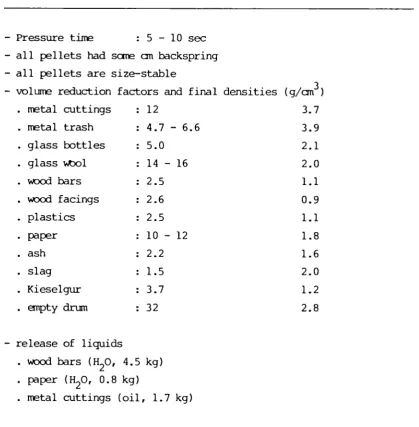
The results are summarized in tab. 2. The maximum pressure of the HFC was 1500 t resp. 73 Mpa. For each drum a pressure time of 5 - 10 s was sufficient to reach the maximum volume reduction. All pellets were size stable. The volume reduction factors are depending on the waste material and were between 1.5 (slag) - 16 (glass wool). The final densities of the pellets were only depending on the material, not on the type of the
raw waste, and reached about 60 % of the theoretical material density: - metals
- glass, slag - ash, Kieselgur - wood
3.7 2.0 1.2 0.9
-- 3.9 g/cm, -2.1 g/cm.. -1.6 g/cm, -1.1 g/cm
In some cases, a release of liquids was detected (wood bars: 4.5 kg H_0; paper: 0,8 kg UJD; metal cuttings: 1.7 kg oil).
The results show a sufficient quality of the final product. According to the high pressure of 73 Mpa, a release of liquids under final storage conditions (30 Mpa) can be excluded.
Table 1
Results from the inactive testing of the high force compactor
- Pressure time : 5 - 10 sec -all pellets had some cm backspring -all pellets are size-stable
- volume reduction factors and final densities (g/cm ) 3.7 3.9 2.1 2.0 1.1 0.9 1.1 1.8 1.6 2.0 1.2 2.8 metal cuttings
metal trash glass bottles glass wool wood bars wood facings plastics paper
ash
slag Kieselgur empty drum
: 12 : 4.7 : 5.0 : 14 -: 2.5 • 2.6 : 2.5 10
-2.2
1.5 3.7
32
- 6.6
16
12
release of liquids
. wood bars (H20, 4.5 kg)
. paper (H-O, 0.8 kg)
. metal cuttings (oil, 1.7 kg)
1 compactor case 2 lid
3 control stamp 4 compactor stamp 5 cover
6 cover lift cylinder 7 door
8 door ¿·
9 lower die 10 stamp plate 11 compaction plate 12 drum charge 13 drum discharge 14 positioning
Fig. 1: High Force Compactor (HIFOC)
-Conditioning of ashes from combustion plants in special melting furnaces Contractor : NUKEM GmbH, D-6450 Hanau 11, Fed. Rep. of Germany
FI-1-W-0010-D (B) 01.01.-31.12.1986 Dr. G. Klein Contract No:
Working Period Project leader
A. Objectives and Scope
Ashes from nuclear combustion plants are actually treated by cementa-tion or they are shipped directly to intermediate storage without condi-tioning. For melting or slaging of these ashes R+D-progranmes were per-formed, but nevertheless up to now doesn't exist an unexpensive simple process.
Scope of our work is the qualification of a simple and unexpensive melting furnace in order to get products of high quality for final dispo-sal. Special item will be the quality assurance.
B. Work programme
B.l. Aquisition of basis data
- Composition of expected ashes - Suitability and need of additives - Conventional process experience - Suitability of conventional furnaces - Extent of changes in construction - Cost analysis
B.2. Construction of a pilot plant B.3. Laboratory experiments
- Testing of process parameters - Characterisation of final products
C. Progress of work and obtained results State of advancement
During the reported period the work started with a literature survey and contacts to furnace manufacturers in order to get basis data. We used the literature data systems DATA-STAR, STN and INKA to get information about the raw wastes and the composition of the resulting ashes, also about the types of furnaces used in conventional and radioactive waste combustion. Our own experiments started with melting tests of selected simulated ashes in a laboratory oven.
Progress and results
C. 1. Aquisition of basis data (B. 1.) C.l.l. Type of raw waste
In nuclear facilities solid and liquid wastes are given to combustion. The solid wastes are wood, paper and polymer materials (PVC, rubber, resins etc.) the liquids in general organic solvents (TBP) and contaminated oils. The not burnable content with < 5 % is comparable low because of waste selection.
C.1.2. Composition of ashes
In the literature we detected totally the analytical data of 6 diffe-rent ashes (see tab. 1 and 2). Depending on the diffediffe-rent raw wastes, es-pecially the content of Ti02 and MgO (filler materials of paper or filters)
is higher compared with domestic ashes, the Fe~C· content is lower. The composition of TBP-ash is naturally different, and consists mainly of Phos-phate salts. The chemical character of the ashes is acid, therefore the careful selection of oven materials is important.
C.1.3. Types of processes and furnaces
In the conventional industrie similar processes are used in the glass and ceramic production and in the domestic waste combustion. The furnaces used are e.g. tank furnaces or tunnel kilns, the processes are continuous. The heating at glass/ceramic production is done in general by direct cur-rent resistance, sometimes like at domestic waste combustion by support flames. The throughputs are some tons per day, which is not comparable to nuclear waste generation. For the nuclear use two parameters are important:
- offgas treatment - volume reduction
Therefore the selection of furnaces resp. melting processes has to be performed in order to avoid large off gas volumes (connection with com-bustion off gas line) and secondary wastes like melting containers or fur-nace wall materials. Two types are common in nuclear use:
- In-can-melting - Melting/Filling.
The In-can-melting takes place directly in a possible storage container, To avoid off gas problems, the electrical heating is effective (inductive or direct resistance). Because of the metal containers the maximum temp, is limited to 1050 °C. The Melting/Filling is independent from the storage container and can work at higher temperatures, but with the same type of heating the melting containment has to consist of graphite ceramic. This creates a significant corrosion.
C.2. Construction of a pilot plant (B. 2.)
The decision for a prototype process resp. furnace is depending on the actual german situation and on cortpeting ash treatment processes like the high force compaction. It will be part of the next report.
C. 3. Lab experiments (B. 3.)
According to table 1 we simulated this 6 types of ashes by grinded oxydes or salts. Actually we detected the melting temperatures and we star ted with.addition of compounds like glass formers resp. network transfor mers (Si , Β , Ρ , Al ) , to reduce the melting temperature.
All simulated ashes had melting points < 1300 °C. After addition of maximum 20 weight % of Sodium borates the melting points dropped below 1100 °C. The work is actually going on. The first results can be reported in the next period.
TABLE 1
Selected ash simulates (literature)
1. Battelle PNL
2. CEA Marcoule
3. Rocky Flats
4. Rocky Flats
5. Rocky Flats
6. KFA Jülich
Glove box wastes
PVC, rubber; low SiO, content
average waste; high TiCu content
combustion of average waste simulate, low SiO_ content
HEPA-filter ash, high MgO content
average waste
TABLE 2
Composition of ashes of silici burnable radioactive waste
COMPONENT
SiO-,
A 12 ° 3 CaO
F e203
TiCL·
MgO
N a20
κ
2ο
P2°5 CI so3 others CONTENT 12 -12 -0 -0 -0 -0 -1 -0 -0 -0 -0 -0 -40 35 30 8 25 34 16 1 12 5 12 1.5 REMARK also as CaCl2, CaSO. also as
NaCl, N a2C 03, N a2S 04
also as N a3P 04
ZnO.ι,BaO, B-O,, C r203 u.a.
-2 b) Waste from reprocessing plants,, Plutonium fuel fabrication plants/
TREATMENT OF RADIOACTIVE WASTES BY A COMBINATION OF PRECIPITATION AND CROSSFLOW MEMBRANE FILTRATION
Contactor: UKAEA, AERE Harwell; UK. Contract No: FI. 1W.0017 UK(H)
Duration of contract: July 1986 - December 1989.
P r o j e c t L e a d e r s : R G Gutman/I W Cummlng/A D T u r n e r .
A. OBJECTIVES AND SCOPE
The overall objective of this programme is to improve the design and operation of membrane plant for radioactive waste treatment by the incorporation of new process developments into an existing active ultrafiltration pilot plant facility, and by evaluation of perform-ance during processing of a real radwaste.
B. WORK PROGRAMME
Bl. Tests with new precipitation agents. B2. Tests with alternative membranes.
B3. Tests with electrically assisted process. B4. Tests with ancillary equipment items. B5. Design of advanced prototype unit. B6. Operation of advanced prototype unit.
C. PROGRESS OF WORK AND OBTAINED RESULTS
Summary
During the first six months of this new R&D programme, two new types of inorganic microfiltration membrane have been examined in a pilot plant facility processing Harwell site radioactive waste. The new membranes were shown to give enhanced flux compared to ultra filtration membranes and similar α removal efficiency to the ultra filters. The effect on β/γ removal efficiency from Harwell site waste of the addition of different compounds prior to ultrafiltration has also been assessed in small scale experiments. Activated carbon was able to remove C o6 0, but only at high dosages; copper ferrocyanide enhanced both C o6 0 and C s1 3 7 removal at low dosages. Laboratory experiments have also been carried out in which electrical fields were applied in order to enhance membrane performance. In these experiments tabular and planar membranes were used in combination with either continuous or pulsed electrical fields.
Progress and Results
1. Introduction
During the first 5 months of the programme, new process develop ments have been assessed both through extensive Initial laboratory scale tests and also by shortterm tests in the pilot plant facility.
2. Small Scale Ultrafiltration Experiments (Bl)
Small scale experiments using a single Carbosep tubular membrane have been performed with Harwell site low level radioactive waste, in order to examine the effect of effluent chemical pretreatment, by pH adjustment and addition of various precipitates, on β/γ removal efficiency. The removal of C s1 3 / and C o6 0 was found to be enhanced at high pH, and could be further increased by the addition of a copper ferrocyanide precipitate, at dosages equivalent to 24g/m3 of ferro cyanide ions. Activated carbon appeared much less attractive as a selective activity absorbing material, since a dosage of 40kg/m3 was required to achieve 99% removal of C o6 0.
Although C s1 3 / removal efficiencies of up to 90% were achieved by the addition of copper ferrocyanide to the waste, these values were much less than those achieved previously during pilot scale tests with the site low level waste, and further experiments are under way to determine whether this difference is related to the different volume reduction factor during the two processes.
Overall β removal efficiency during ultrafiltration of the low level waste has generally been found to be lower than the overall γ removal efficiency. The difference may be due to the presence of S r9 0 in the waste, and its relatively poor removal during the existing ultra filtration decontamination process.
3. Pilot Plant Experiments (B2)
The original ultrafiltration pilot p l a n t ^1' , which started operation on Harwell low level waste in 1984 during the previous CEC radwaste R&D programme, has now been modified so that it can be used as a test bed to examine the performance of a variety of alternatives to the Carbosep 20,000 molecular weight cutoff M4 ultrafiltration membrane studied previously. The changes to the plant have meant that higher processing rates, higher crossflow rates and a wider range of operating pressures can now be studied in the plant.
So far two alternative types of membrane have been examined. A more "open" Carbosep microfiltration membrane, which has a pore size rating of about 0.08μπι and about twice the water permeability of the M4 membranes, fouled rapidly on Harwell low level waste. As a result enhanced processing rates could only be sustained for a few hours. In contrast, for a Ceraflo alumina 0.2μτη membrane, fluxes of over 7m/d could be maintained for at least 90 hours as shown in Figure 1. There was some indication that fouling of the Ceraflo membrane was reduced by the formation of a ferric hydroxide precipitate in the waste, and also by operation of the Ceraflo membrane at low trans membrane pressure.
4. Electrically Enhanced Membrane Processes (B3)
The electrical enhancement of crossflow micro and ultra filtration systems has already been demonstrated at a bench top scale to increase permeation rate and solid/liquid separation factors.
In electrokinetic dewatering, an electric field is applied across a nonconducting membrane. Not only does this Induce an increased permeation rate by electroosmosis, but at the same time an electrophoretic effect helps to reduce membrane fouling and increases permeate clarity. This has been demonstrated during the dewatering to 2040% of Harwell low level gravity settled slurries at planar 100cm2 cotton, fibre glass and zirconia microfiltration membranes.
A tenfold scaledup rig (planar membrane area 0.1m2) has been constructed and is currently being commissioned. Process rates of slurry feed up to 1.3m3 per day should be achieved for thickening at a permeate rate of O.lmh 1. A recycle flow up to 100L/min1 (corres ponding to a slurry velocity of approximately 5ms~* through the cell) is provided by a Monopump SAE12. Automatic control by a micro processor is achieved by valve and auxiliary pump operation triggered by sensors in the system.
Some parameters affecting the electrokinetic dewatering of ferric hydroxide slurries at Ceraver tubular alumina membranes with porosities of 0.2, 1.2 and 5μπι have also been investigated. The electric field was applied across the tube wall between an axial rod and an outer cylindrical electrode. Using a transmembrane pressure
of 1 bar, the 0.2μπι porosity gave the highest permeation rate, with a further enhancement from 0.5mh-1 bar- 1 to 0.7mh-1 bar- 1 in the
presence of an electric field. At lower pressures, the electric field improved the permeation rate for all porosities. Experiments on the 0.2μπι porosity membrane indicated that this increase in performance is dependent on the current and voltage applied.
Pulsed field electro-osmosis has also shown promise - further improving permeation rates at thin membranes (e.g. c o t t o n ) . Experiments conducted using 1% Fe(OH)3 showed that the improvement
increased with minute period square wave), an additional improvement of 30% was obtained compared with the equivalent constant current process. Other membranes may have an even better response.
At electrically conducting membranes, the electrolytic
generation of microscopic gas bubbles at the filter surface can be used to remove fouling layers. As only short current pulses (< 15 seconds) are required periodically (> 5 minutes) to maintain ' an increased permeate flux, minimal gas volumes are produced. The process has been demonstrated successfully at microporous stainless steel during the dewatering of Ti02 suspensions and Fe(0H)3 slurries
using planar and annular configurations. It has also been shown on a bench top scale to be effective in cleaning the microporous graphite based 'Carbosep' tubular ultrafiltration membranes of the type presently undergoing pilot plant tests. A design for the modifie-modification of a full scale ultrafiltration unit for pulsed electrical membrane cleaning is currently being drawn up.
14.
13..
12..
DOSING 100 g Fe / 13 INTO LLH
AVERAGE TRANSMEMBRANE PRESSURE 3.6 BAR
OJ (35
4 ..
3..
2..
1 ..
10 15 20 25 30 35 40 45 50 55 60 65 70 75 BO Θ5 90
Time ( h r s . )
FIG. i VAfílATION IN FLUX HITH TIME IN PILOT PLANT USING A CEPAFLO MEMBPANE
C o n d i t i o n i n g of alpha and beta-gamma ashes f r o m i n c i n e r a t i o n i n t o d i f f e r e n t matrices.
C o n t r a c t o r : Commissariat à l'Energie A t o m i q u e , CEN -Cadarache, France C o n t r a c t n° : FI1W-0005-F
D u r a t i o n of c o n t r a c t : June 1986 - December 1 9 8 9
Project leader : F. Josso
A. Objectives and scope
Ashes embedding takes a greater i n t e r e s t for storage of these
r a d i o a c t i v e products due to the volume r e d u c t i o n f a c t o r which can be
obtained and due to the safety aspect of this k i n d of storage.
The d i f f e r e n t matrices usable are more or less adapted for a k i n d of ashes and l a b o r a t o r y studies are necessary to check t h e i r capacities.
The f i r s t tests are based on the research of the physico-chemical and
mechanical properties of the m a t r i x , then leaching test and radiolysis
measurement are c a r r i e d on. The next stage of the research is the study of f u l l scale ashes embedding (100 or 200 l i t e r s c y l i n d e r ) .
These tests are useful to prove the f e a s i b i l i t y of embedding ( i n c l u d i n g the t h e r m a l ' s problems of p o l y m e r i s a t i o n ) . A f u l l scale p i l o t u n i t adapted for d i f f e r e n t types of products (cement, polymer, m i x e d c e m e n t - p o l y m e r ) has been studied. This p i l o t unit w i l l be realised in 1988.
B. Work programme
B . l . Formulations studies. Tests are p e r f o r m e d w i t h various embedding systems : c e m e n t , polymer and m i x e d c e m e n t - p o l y m e r to o p t i m i s e t h e i r c o m p o s i t i o n .
B.2. Selective p r e - c h a r a c t e r i z a t i o n . Tests are p e r f o r m e d w i t h a given r a d i o a c t i v e ash to select the best m a t r i x (using samples of 0.1 l i t e r ) B.3. F i n a l p r e - c h a r a c t e r i z a t i o n . The leaching and radiolysis measurements
are p e r f o r m e d w i t h the m a t r i x f i n a l l y chosen on bigger samples
(0Λ l i t e r )
Β.Ί. Pilot scale tests. F u l l scale tests w i l l be made (100 or 200 l i t e r s c y l i n d e r ) , using a p i l o t u n i t adapted for the d i f f e r e n t types of matrices.
C. Progress of work and obtained results Summary
Laboratory studies for determining the best f o r m u l a t i o n of ashes embedding have been done during the first period devoted to this program. The main physico-chemical and mechanical properties have been checked for ashes embedding made with cement, polymer and mixed cement-polymer formulations.
The selective pre-characterization phase is now to be done. During the last year the f u l l scale pilot unit project has been studied, the p i l o t w i l l be realised during the year 1987 and i t w i l l be operational in 1988.
Progress and results
Ashes used during phase 1 are non radioactive ones. They were obtained from incineration of wastes composed of cotton (5 %), kleneex (5 %), latex gloves (35 %) PVC (55 %).
The results of f o r m u l a t i o n studies for the three matrixes are summarized in the Table 1 (0.1 l i t e r samples).
The results show that the formulations proposed comply with the "Basic Safety Regulations" currently recommended by the Ministry of French Industry. Polymer and mixed embedded products have the advantage of incorporating 40 % of ashes in weight with better mechanical properties than the cement embedded products which only incorporate 20 % in weight of ashes.
I n i t i a l m i x i n g tests carried out on a semi-industrial scale on 10 liters, 50 liters and 100 liters drums have shown that certain precautions must be taken when embedding ashes :
- in the case of the polymer m a t r i x embedded products, the core temperature of the capsule may reach 150°C during p o l y m e r i z a t i o n . The CIBA resin has been chosen in preference to the CDF resin as i t is easier to work and improves the properties of the resulting embedded products.
- the core temperature of the mixed matrix embedded products remains below 100°C.
- the ashes in cement and mixed matrix embedded products should not contain too much non-oxidized metal fines ( A l , Mg, Zn etc) as there is a risk of a reaction between the cement and the metals during setting causing the embedded product to swell as a result of the release of hydrogen. This effect is less marked in the case of the mixed matrix capsule which contains only 30 % in weight of cement and water.
These tests also showed that there is no increase in volume during embedding operations. Volumes remain equal in the case of cementing with 20 % of ash. Polymer and mixed embedded products enable an additional volume reduction gain of an order of 2.
These results are particularly important. They show that the embedding techniques chosen w i l l enable the volume reduction factor of the incinerator to be maintained and even improved.
A full-scale pilot unit capable of producing the three types of embedded products, cement, resin and mixed, is under construction in the CEA. It is shown in F i g . l and includes essentially :
- an ashes or dry residue feed systems,
- tanks for mixes (cement, ash, water, resin, hardener, etc),
- a blade mixer with cooled walls operating under p a r t i a l vacuum, - a 200 liters drum f i l l i n g system.
TABLE 1 : Κ SULTS OF T C ASH EMBEOOING FORMULATION STUDIES
Matrix Formulation
(I 1n weight)
D e n s i t y kg.m-J
Compressive S e t t i n g , Hardness s t r e n g t h time χ I O3 ( s h o r e ) (NPa) ( h )
(Cement + w a t e r ) 8 0 1 CLC Ashes 2 0 1
cement · · water/cement r a t i o
0.63
1.73 23 5 to7
(CIBA resin+ Epoxyb" hardener)60t
thermosetting Ashes 401 1.65
resin » Mixed cement/ resin·>· hardener/resin ratio0.6
(CDF resin+ hardener) 301 (CLC cement+ water) 30% Ashes401 water/cerneηt ratio 0.36 hardener/resin ratio0.6
82 125
1.9 85 65