This is a repository copy of Influence of process conditions on syngas production from the thermal processing of waste high density polyethylene.
White Rose Research Online URL for this paper: http://eprints.whiterose.ac.uk/87464/
Version: Accepted Version
Article:
Saad, JM, Nahil, MA and Williams, PT (2015) Influence of process conditions on syngas production from the thermal processing of waste high density polyethylene. Journal of Analytical and Applied Pyrolysis, 113. 35 - 40. ISSN 0165-2370
https://doi.org/10.1016/j.jaap.2014.09.027
© 2014. This manuscript version is made available under the CC-BY-NC-ND 4.0 license http://creativecommons.org/licenses/by-nc-nd/4.0/
Reuse
Unless indicated otherwise, fulltext items are protected by copyright with all rights reserved. The copyright exception in section 29 of the Copyright, Designs and Patents Act 1988 allows the making of a single copy solely for the purpose of non-commercial research or private study within the limits of fair dealing. The publisher or other rights-holder may allow further reproduction and re-use of this version - refer to the White Rose Research Online record for this item. Where records identify the publisher as the copyright holder, users can verify any specific terms of use on the publisher’s website.
Takedown
If you consider content in White Rose Research Online to be in breach of UK law, please notify us by
Influence of Process Conditions on Syngas Production from the Thermal
Processing of Waste High Density Polyethylene
Juniza Md Saad, Mohamad Anas Nahil and Paul T. Williams*
Energy Research Institute
University of Leeds, Leeds, LS2 9JT, UK
(Tel: #44 1133432504; Email: [email protected])
Abstract: A range of process conditions, including the type of reactor, the reacting
atmosphere and the presence of catalyst, and their influence on the production of
syngas i.e. hydrogen and carbon monoxide, from the thermal processing of waste high
density polyethylene (HDPE) has been investigated. Pyrolysis in the presence of
nitrogen and in the presence of carbon dioxide, two-stage pyrolysis-steam reforming
and carbon dioxide/catalysis process conditions were investigated in relation to gas
composition and particularly hydrogen and carbon monoxide yield. The influence of
addition of a Ni-Mg-Al catalyst in the second reactor was also investigated. It was
found that a two-stage pyrolysis at 500 °C, followed by second stage reaction at
800 °C resulted in a significant increase in hydrogen production. With the addition of
carbon dioxide, the two stage process also increased carbon monoxide yield in
addition to hydrogen. Addition of steam into the second stage reactor with the carbon
dioxide produced a further increase in hydrogen production. Also, the presence of a
Ni-Mg-Al catalyst in the second reactor increased the amount of hydrogen and carbon
monoxide produced.
Keywords: High-density polyethylene; Waste; Carbon dioxide reforming;
1. Introduction
There is current interest in the production of syngas from waste materials and
in particular from waste plastics [1-5]. Pyrolysis and gasification of waste plastics is a
promising route to produce high yields of a hydrogen-rich syngas. Pyrolysis of
plastics produces low yields of hydrogen [6,7]. However, two-stage processing of
waste plastics which combines thermal degradation of the plastic in a first stage
pyrolysis step followed by gasification/reforming in a second stage, usually in the
presence of catalysts generates high yields of hydrogen [8-10]. The gasification
process produces reactions of the volatile products that are released from the pyrolysis
process and recombines them to produce synthesis gas. The addition of steam via
steam reforming of the waste plastic is recognized to be effective for hydrogen
production through promotion of the water gas shift reaction [11]. Compared with
steam reforming, studies on carbon dioxide reforming, also known as dry reforming,
are limited especially on waste plastic.
The use of carbon dioxide for hydrocarbon reformation is of current interest
because carbon dioxide is known to be a cost effective, recyclable and a toxic-free
carbon source. In addition, the concerns around the increasing levels of carbon
dioxide in the atmosphere particularly arising from anthropogenic activities has
resulted in research into carbon capture schemes which are likely to generate large
quantities of carbon dioxide which has the potential for use, rather than sequestration
[12].
Widespread studies have been made specifically on methane dry reforming
because methane reforming with carbon dioxide produces synthesis gas with a ratio
close to unity i.e., H2/CO = 1 which has been suggested to be beneficial for the
production of Fischer – Tropsch liquid hydrocarbon and oxygenate [17-19]. Tsang et
al. [16] reported that the dry reforming of methane is more endothermic than steam
reforming because it is thermodynamically favoured above 913K. Bulushev [20] also
suggested that the dry reforming process has to be performed at high temperature and
low pressure to achieve maximum conversion because of the highly endothermic
nature of the reaction.
In this paper, the influence of process parameters on the yield of syngas, i.e.
hydrogen and carbon monoxide from waste high density polyethylene has been
investigated. The yield of syngas from pyrolysis in nitrogen and carbon dioxide are
compared, followed by comparison with two-stage pyrolysis-gasification/reforming.
Further investigations on syngas production from carbon dioxide reforming of
high-density polyethylene using the two-stage reactor with the addition of steam and
Ni-Mg-Al catalysts were also carried out. A Ni-Ni-Mg-Al catalyst was used in this research
since this catalyst has been shown to be effective, with good catalytic and stability
results during our previous work on the steam reforming of waste plastics to produce
a hydrogen-rich syngas [8,21,22].
2. Materials and Methods
2.1 Materials.
High-density polyethylene (HDPE) was obtained as 2 mm waste polymer
The Ni-Mg-Al catalyst with molar ratio of 1:1:1 was prepared by the rising-pH
technique according to the method reported by Garcia et al. [1]. Ni(NO3)26H2O,
Mg(NO3)2H2O and Al(NO3)39H2O were dissolved in 200 ml deionised water with
moderate stirring at 40 °C. Ammonium solution was then added to the aqueous
solution until the pH value of 8.3 was reached. The solution was filtered, dried
overnight at 105 °C and calcined at 750 °C with a heating rate of 10 °C min-1 for 3
hours. The catalyst was ground using a mortar and pestle and finally sieved to
produce a particle size of 50-200 m.
2.2 Experimental reactors.
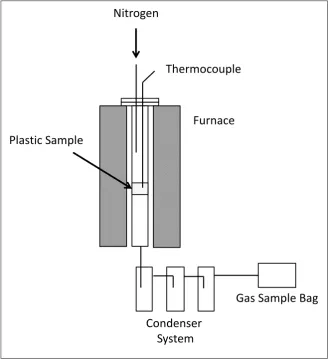
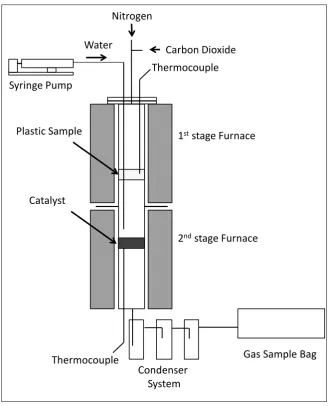
Two types of reactor were used as shown in Figure 1 and Figure 2. Figure 1
shows a one-stage fixed bed reactor used for the pyrolysis of the waste HDPE under
two different types of reaction atmosphere, nitrogen (N2) or carbon dioxide (CO2).
The reactor was 250 mm in length by 30 mm internal diameter and was externally
heated by an electrical tube furnace (1.2 kW). 2 g of waste HDPE was placed in the
sample crucible boat. The pyrolysis temperature was increased from ambient to
500 °C at a heating rate of 10 °C min-1 and maintained at 500 °C for 30 minutes.
Nitrogen or carbon dioxide was used as the carrier gas with a flow rate of 200 ml min
-1
. The oils were condensed in a three stage dry ice condenser system and the gases
were collected in a Tedlar™ gas sample bag.
For two-stage pyrolysis-gasification/reforming experiments a two-stage fixed
bed reactor was used as shown in Figure 2. The reactor was constructed of stainless
steel and electrically heated by two separate furnaces. The experimental procedure
of the Ni-Mg-Al catalyst to the desired temperature of 800 °C. 2 g of waste HDPE
was placed in the 1st stage reactor and heated from ambient temperature to 500 °C at a
heating rate of 10 °C min-1. The volatile pyrolysis products passed directly to the 2nd
stage reactor maintained at 800 °C, where further gasification/reforming reactions
took place. Sand was used as the substitute when the experiment was carried out
without the Ni-Mg-Al catalyst. N2 or a mixture of N2 and CO2 were injected as the
feed gases into the top of the 1st stage reactor. The flow rate of the nitrogen was fixed
to 200 ml min-1. Where steam was used, this was added to the second stage and used a
syringe pump to deliver the water.
2.3. Gas analysis
The gases collected in the sample bag were analysed by gas chromatography
(GC). Hydrocarbons (C1-C4) were analysed using a Varian 3380 GC with a flame
ionisation detector, with a 80-100 mesh Hysep column in a nitrogen carrier gas flow.
Hydrogen, oxygen, carbon monoxide and nitrogen (H2, O2, CO and N2) were analysed
using a different Varian 3380 GC with a 60-80 mesh molecular sieve column while
carbon dioxide (CO2) was analysed with a 80-100 mesh Hysep column, both in argon
carrier gas.
In this work, the carbon dioxide conversion was calculated according to the
formula reported by several researchers; Albarazi et al., Asencios et al. and Oyama et
al.[23-25].
CO2 conversion = (molsCO2 input– molsCO2output) / molsCO2input
The properties of the carbonaceous coke deposited on the reacted catalysts
were determined by temperature-programmed oxidation (TPO) experiments. TPO
experiments were carried out using a thermogravimetric analyser (TGA-50 Shimadzu).
About 8 mg of reacted catalyst was heated in an atmosphere of air with a heating rate
of 15 °C min-1 from ambient temperature to a final temperature of 800 °C.
The reacted or coked Ni-Mg-Al catalysts from the pyrolysis-gasification of
waste HDPE with and without carbon dioxide were also analysed using high
resolution scanning electron microscopy (SEM, LEO 1530). The characteristics of
carbon deposited on the reacted catalysts was examined and characterized.
3. Results and discussion
3.1 Influence of N2 and CO2 atmosphere.
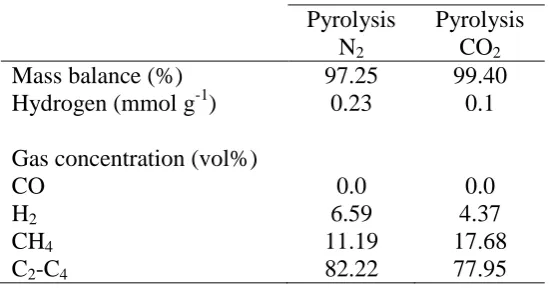
The pyrolysis of waste (HDPE) was undertaken in the one-stage fixed bed
reactor (Figure 1) in the presence of nitrogen or carbon dioxide atmosphere. Pyrolysis
of 2g of waste HDPE was undertaken from ambient temperature to 500 °C final
temperature. Table 1 shows the experimental results. The data show that only a small
amount of hydrogen was produced during pyrolysis of the waste HDPE and the
highest yield was for the nitrogen atmosphere compared to carbon dioxide. In
addition, the methane concentration was correspondingly decreased in nitrogen
compared to the carbon dioxide pyrolysis atmosphere. No carbon monoxide was
both atmospheres showed similar gas concentrations. Therefore, it can be suggested
that the carbon dioxide does not significantly affect the pyrolysis products.
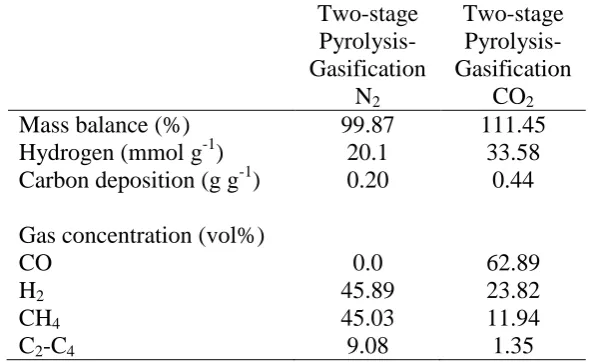
However, when the two-stage reactor system was used with pyrolysis of the
waste HDPE in the 1st stage followed by reaction of the derived product volatiles in
the presence of quartz sand in the 2nd stage at 800 °C there was a marked increase in
hydrogen yield (Table 2). Regardless of the type of atmosphere, the hydrogen yield
was significantly increased with the two-stage fixed bed reaction process compared to
one-stage reactor. It is apparent from the results that the large improvement in
hydrogen production was due to secondary reactions of hydrocarbons in the second
furnace, as shown by the reduction of CmHn gas concentrations in the two-stage
reactor system. The reaction at 800 °C in the 2nd stage enhanced the carbon dioxide
reaction with hydrocarbons, hence raising the volume concentration of hydrogen.
In the presence of the nitrogen atmosphere, the hydrogen production in the
two-stage fixed bed reactor increased from 0.23 to 20.10 mmol H2 g-1plastic. While in
the carbon dioxide atmosphere, the hydrogen yield increased from 0.1 to 33.58 mmol
H2 g-1plastic. There was also a marked increase in the production of carbon monoxide in
the presence of the carbon dioxide atmosphere. This suggests that in the carbon
dioxide atmosphere dry reforming reactions (Reaction 1) occurred between the
methane and other hydrocarbons with carbon dioxide in the second stage as compared
to the result obtained for the experiment with a nitrogen atmosphere. This was also
suggested from the marked decrease in the concentration of methane and other
hydrocarbon gases in the experiment using carbon dioxide atmosphere. Treacy et al.
[12] reported that the highly endothermic characteristic of CO2/dry reforming requires
high temperature for the reaction to occur since both carbon dioxide and methane are
hydrogen and carbon monoxide concentrations from the experiment with the carbon
dioxide atmosphere can be seen when the 800 °C second stage was introduced.
CxHy + xCO2 = 2xCO + y/2 H2 (1)
3.2 Influence of steam and CO2 on the non-catalytic pyrolysis-gasification of HDPE.
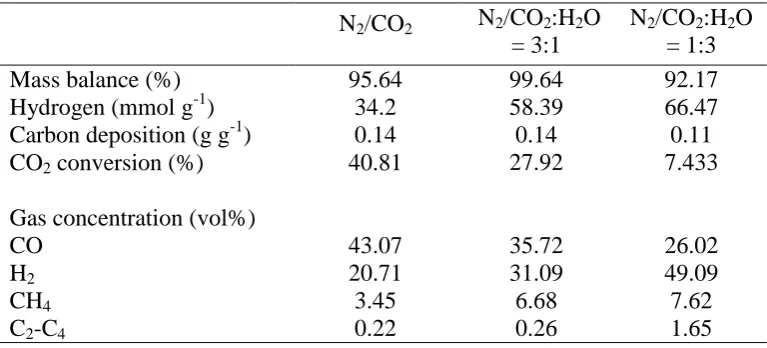
Table 3 shows the influence of varying the process conditions for the
two-stage reactor with 1st stage pyrolysis at 500 °C, followed by reaction in the 2nd stage at
800 °C in the presence of quartz sand. In this series of experiments, the carbon
dioxide was mixed with nitrogen at the inlet to the 1st stage. In additional experiments,
steam was introduced into the 2nd stage reactor. The carbon dioxide and steam were
introduced at different ratios, CO2:H2O = 1:0, CO2:H2O = 3:1 and CO2:H2O = 1:3 to
the system. The total amount of carbon dioxide and steam addition was 8 g and the
nitrogen flow rate was 200 ml min-1 for the all experiments.
The first experiment was with the addition of only carbon dioxide to nitrogen
(8g of CO2) introduced into the 1st stage of the reactor system. The products from the
process were mainly gases, however a small amount of water was found in the
condenser system. Oyama et al. [25] suggested that the production of water was due
to the reverse water gas shift reaction (RWGS). From Table 3, the addition of carbon
dioxide into the system resulted in an increase in hydrogen production from 20.1
mmol H2 g-1plastic to 34.2 mmol H2 g-1plastic representing a 70 % increase in the
hydrogen production in mmol per gram. The carbon dioxide conversion was the
highest among others with 41 % conversion. The presence of carbon monoxide shows
that the CO2 reforming or dry reforming process occurred. During the CO2/dry
reacted with the carbon dioxideproducing more hydrogen as well as carbon monoxide.
It is suggested that thermal cracking of heavy hydrocarbons during the gasification
reactor was influenced by the addition of carbon dioxide. This was further supported
by the large reduction in methane concentration, from 45.03 vol.% to 3.45 vol.% and
reduction of other hydrocarbons, from 9.08 vol.% to 0.22 vol.% in the experiment
with the addition of carbon dioxide.
The carbon deposition data in the table represents the formation of carbon on
the sand in the 2nd stage reactor. The data indicates that with the addition of carbon
dioxide, the carbon deposition was reduced from 0.2 gram per gram of sample (Table
2) to 0.14 gram per gram of sample (Table 4). Huang et al. [26] found that carbon
dioxide has the ability to reduce carbon by the gasification reaction as shown in
reaction 2a and 2b. This also contributed towards the amount of carbon monoxide
produced from the process. In addition, the water gas shift reaction (Reaction 3) might
also occur, thereby consuming carbon monoxide and producing carbon dioxide.
C + CO2 = 2CO (2a)
C + H2O = CO + H2 (2b)
CO + H2O CO2 + H2 (3)
Table 3 also shows the results from the pyrolysis-gasification of waste HDPE
with the addition of steam at a N2/CO2: H2O ratio of 3:1 and 1:3. The results show
that the addition of steam into the system markedly increases the amount of hydrogen
production. The highest amount of hydrogen produced was 66.47 mmol H2 g-1plastic
which was achieved at a N2/CO2:H2O ratio of 1:3. From the table, it appears that more
of steam introduced the steam reforming reaction (Reaction 4), which contributes
towards hydrogen production.
CxHy + xH2O = xCO + (y/2 + x) H2 (4)
The addition of steam also produced high amounts of methane and other
hydrocarbons and increased with a higher level of steam addition. Despite the
consumption of methane in the reforming reaction, the increase in methane
concentration might be caused by the lower hydrocarbon-cracking efficiency. The
addition of steam might affect the reaction conditions inside the reactor and steam
may consume some energy in the reactor, hence limiting the cracking of methane and
other hydrocarbons. These results are consistent with those obtained in previous work
[8], in which the hydrocarbon concentration of non-catalytic steam reforming of
HDPE was higher compared to without steam addition. However, with the addition of
catalyst in that study, the hydrocarbon-cracking efficiency was greatly improved
resulting in higher hydrogen concentration but lower concentrations of methane and
other hydrocarbons.
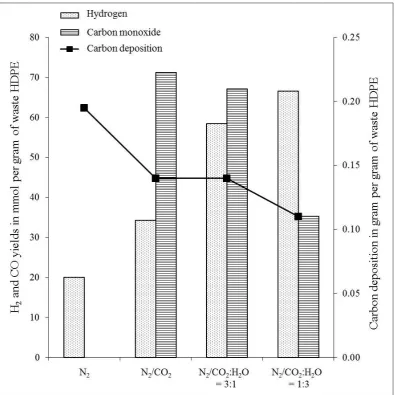
Figure 3 shows the relationship between hydrogen and carbon monoxide
production in mmol g-1plastic with the carbon deposition in g g-1plastic. . It appears
that more carbon monoxide was produced when less steam was injected to the system.
The carbon monoxide yields from the experiment with the addition of steam and
carbon dioxide were produced from two different reactions; the steam reforming
reaction and dry reforming reaction. Compared to the steam reforming reaction, the
dry reforming reaction produces twice the number of moles of carbon monoxide in
each reaction. Therefore when the concentration of steam was low in the system, the
the reverse water gas shift reaction might also occur, consuming more carbon dioxide
and resulting in high carbon monoxide concentration. This is also suggested from the
CO2 conversion results, which showed 27.92 % CO2 conversion when less steam was
injected into the system as compared to 7.4 % CO2 conversion at higher steam
injection rate.
In terms of the carbon deposition, the lowest carbon deposition was achieved at
a CO2/N2:H2O ratio of 1:3. Edwards and Maitra [27] reported that methane dry
reforming produced more carbon compared to steam reforming due to the lower H/C
ratio in both the feed and product gases. However, with the addition of suitable
catalyst, the carbon formation in methane dry reforming (without steam) can be
reduced and might achieve a carbon-free process.
3.2 Influence of catalyst.
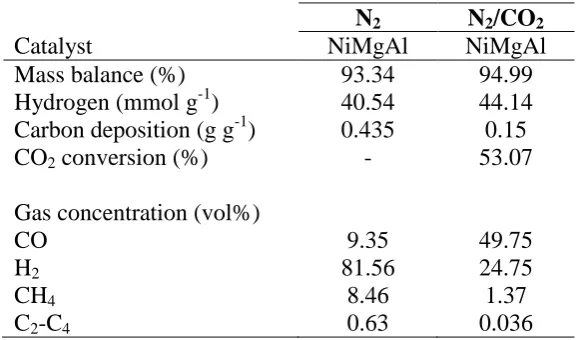
The Ni-Mg-Al catalyst was introduced into the 2nd stage reactor to investigate
the effect on hydrogen production and carbon dioxide conversion from the
pyrolysis-gasification of waste HDPE. The reactor was kept under 200 ml min-1 N2 flow with or
without 8 g of carbon dioxide addition. 2 g of waste HDPE was placed in the 1st stage
pyrolysis reactor and 1 g of Ni-Mg-Al catalyst maintained at 800 °C was introduced
in the 2nd stage reactor. The results are shown in Table 4.
In the absence of carbon dioxide, the hydrogen yield significantly increased
from 20.01 (Table 2) to 40.54 mmol H2 g-1plastic with the addition of the Ni-Mg-Al
catalyst (Table 4). The introduction of carbon dioxideto the system further increased
the hydrogen yield from 34.2 mmol H2 g-1plastic (Table 3) to 44.14 mmol H2 g-1plastic
achieved in the pyrolysis – gasification process in the presence of carbon dioxideand
Ni-Mg-Al catalyst. The addition of Ni-Mg-Al catalyst also improved the carbon
dioxide conversion from 40.81% (Table 3) to 53.07% (Table 4) as well as the amount
of carbon monoxide produced from 43.07 vol% (Table 3) to 49.75 vol% (Table 4).
From the amount of methane and other hydrocarbons production which were
reduced by more than 80%, it can be deduced that the addition of catalyst enhanced
the CO2/dry reforming reaction (Reaction 1), hence increasing the hydrogen
production. The increase in hydrogen yield in the presence of catalyst in the CO2
reforming of polyethylene was similarly reported by Yamada et al. [28], where
hydrogen yield was increased from 1.7% in the absence of catalyst to 35.4% using a
Pd/Al2O3 catalyst. The catalyst used was pre-treated with H2 for 3 hours. They also
reported that the decomposition of polyethylene into hydrogen and carbon monoxide
was completely reformed at the catalyst temperature of 850 °C.
The reacted Ni-Mg-Al catalysts were analysed using temperature-programmed
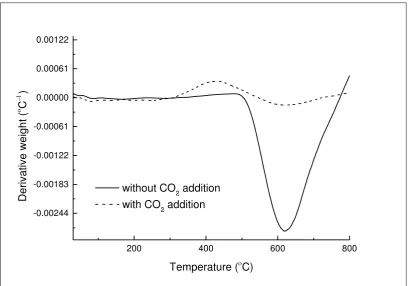
oxidation (TPO) and scanning electron microscopy (SEM). The DTG thermograms
were plotted from the TPO results of the reacted catalyst derived from
pyrolysis-gasification of waste HDPE without and with the carbon dioxide addition and are
shown in Figure 4. The maximum mass loss for both samples was at around 600 °C
in the DTG-TPO thermograms. The mass losses for TGA-TPO of the reacted
Ni-Mg-Al catalyst derived from pyrolysis-gasification without carbon dioxide addition and
with carbon dioxide addition were calculated as, 38.56 % and 4.49 % respectively. It
is suggested that the mass loss was due to the combustion of carbon, demonstrating
the amount of carbon deposition on the Ni-Mg-Al catalyst. The results suggest that,
the reacted Ni-Mg-Al catalyst from catalytic dry pyrolysis-gasification had less
addition. From Figure 4, there is a mass increase in the DTG-TPO thermograms at
around 400 °C which was attributed to the oxidation of the Ni particles during the
TPO experiment.
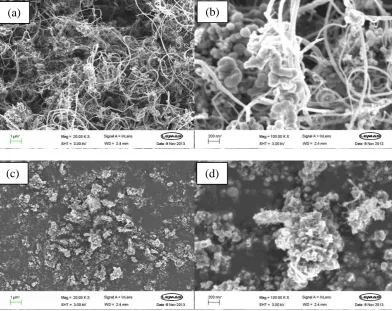
From the SEM analysis shown in Figure 5, filamentous carbons were observed
for the reacted Ni-Mg-Al catalyst derived from pyrolysis-gasification without carbon
dioxide addition compared to the pyrolysis-gasification with carbon dioxide addition.
The finding was in agreement with the amount of deposited carbon data shown in
Table 4, which showed high deposited carbon (0.435 g g-1 of sample) was found in
the experiment without carbon dioxide addition. The lower deposited carbon in
pyrolysis-gasification of waste HDPE with carbon dioxide addition was likely to be
due to the reaction between filamentous carbons and carbon dioxide that significantly
increased the amount of carbon monoxide production to 49.75 vol% in
pyrolysis-gasification with carbon dioxide addition (Reaction 2a).
4. Conclusions
In this paper, the influences of thermal treatment type, carbon dioxide
reforming, effects of steam injection and catalyst on the production of syngas, i.e.
hydrogen and carbon monoxide from waste plastic (high density polyethylene) have
been investigated. Based on the obtained results, it may be concluded:
(1) Thermal treatment of waste HDPE using a two-stage fixed bed reactor
significantly improved the hydrogen production compared to the one-stage
fixed bed reactor due to the gasification process in the second stage of the
(2) The addition of carbon dioxide as carrier gasnot only increases the hydrogen
and carbon monoxide production but also reduces carbon deposition.
(3) The addition of steam results in a marked increase of hydrogen produced from
the water gas shift reaction.
(4) The addition of a nickel based catalyst, Ni-Mg-Al, also enhances the hydrogen
production in pyrolysis–gasification of waste HDPE with carbon dioxide
addition.
(5) Carbon deposits on the catalysts were of the filamentous type and were
minimised in the presence of carbon dioxide addition due to reaction of the
carbon to produce carbon monoxide.
Acknowledgements.
The authors are grateful for the financial support of the Majlis Amanah Rakyat
(MARA) Malaysia (PhD scholarship for Juniza Md Saad) and the University of Leeds.
The authors also thank Mr. Ed Woodhouse for his technical support and the analytical
References
[1] L. Garcia, A. Benedicto, E. Romeo, M.L. Salvador, J. Arauzo and R. Bilbao, Energy & Fuels, 16, (2002) 1222.
[2] T. Namioka, A. Saito, Y. Inoue, Y. Park, T.J. Min, S.A. Roh and K. Yoshikawa, Applied Energy, 88, (2011) 2019.
[3] C.E. Efika, C. Wu and P.T. Williams, Journal of Analytical and Applied Pyrolysis, 95, (2012) 87.
[4] S. Luo, Y. Zhou and C. Yi, Energy, 44, (2012) 391.
[5] S. Martínez-Lera, J. Torrico, J. Pallarés and A. Gil, Journal of Material Cycles and Waste Management, 15, (2013) 370.
[6] A. Adrados, I. de Marco, B.M. Caballero, A. Lopez, M.F. Laresgoiti and A. Torres, Waste Management, 32, (2012) 826.
[7] P.T. Williams and E.A. Williams, Energy & Fuels, 13, (1998) 188. [8] C. Wu and P.T. Williams, Fuel, 89, (2010) 3022.
[9] Toshiro Tsuji, Yoshiki Tanaka, Toshiharu Shibata, Osamu Uemaki and H. Itoh, Two-stage Thermal Gasification of Plastics, at: International Symposium on Feedstock Recycling of Plastic, Japan, 211.
[10] M. He, B. Xiao, Z. Hu, S. Liu, X. Guo and S. Luo, International Journal of Hydrogen Energy, 34, (2009) 1342.
[11] C. Wu and P.T. Williams, International Journal of Hydrogen Energy, 35, (2010) 949.
[12] D. Treacy and J.R.H. Ross, in American Chemical Society Energy and Fuels Symposia Spring (Anaheim), American Chemical Society, Anaheim, 2004, p. 126.
[13] S.R. de Miguel, I.M.J. Vilella, S.P. Maina, D. San José-Alonso, M.C. Román-Martínez and M.J. Illán-Gómez, Applied Catalysis A: General, 435–436, (2012) 10.
[14] A.Shamsi, in American Chemical Society Energy and Fuels Symposia Fall (WASHINGTON DC), American Chemical Society, Washington DC, 2000, p. 690.
[15] H. Er-rbib, C. Bouallou and F. Werkoff, Chemical Engineering Transactions, 29, (2012) 163.
[16] S.C. Tsang, J.B. Claridge and M.L.H. Green, Catalysis Today, 23, (1995) 3. [17] T.X. Z. Jiang, V. L. Kuznetsov and P. P. Edwards, Philosophical Transactions
of The Royal Society A, 368, (2010) 3343.
[18] I. Luisetto, S. Tuti and E. Di Bartolomeo, International Journal of Hydrogen Energy, 37, (2012) 15992.
[19] K. Tomishige and K. Fujimoto, Catalysis Surveys from Asia, 2, (1998) 3. [20] D.D. Bulushev, in, Carbolea (Advanced Biomass Research for Beyond the
Petroleum Age), 2009.
[21] C. Wu and P.T. Williams, Applied Catalysis B: Environmental, 96, (2010) 198. [22] C. Wu and P.T. Williams, Applied Catalysis B: Environmental, 90, (2009) 147. [23] A. Albarazi, P. Beaunier and P. Da Costa, International Journal of Hydrogen
Energy, 38, (2013) 127.
[25] S.T. Oyama, P. Hacarlioglu, Y. Gu and D. Lee, International Journal of Hydrogen Energy, 37, (2012) 10444.
[26] C.J. Huang, X.M. Zheng, L.Y. Mo and J.H. Fei, Chinese Chemical Letters 12, (2001) 249.
[27] J.H. Edwards and A.M. Maitra, Fuel Processing Technology, 42, (1995) 269. [28] H. Yamada, H. Mori and T. Tagawa, Journal of Industrial and Engineering
Table 1
Gas yields from the pyrolysis of waste HDPE
Pyrolysis N2
Pyrolysis CO2
Mass balance (%) 97.25 99.40 Hydrogen (mmol g-1) 0.23 0.1
Gas concentration (vol%)
CO 0.0 0.0
H2 6.59 4.37
CH4 11.19 17.68
Table 2
Gas yields from the two-stage pyrolysis-gasification of waste HDPE
Two-stage Pyrolysis-Gasification
N2
Two-stage Pyrolysis-Gasification
CO2
Mass balance (%) 99.87 111.45 Hydrogen (mmol g-1) 20.1 33.58 Carbon deposition (g g-1) 0.20 0.44
Gas concentration (vol%)
CO 0.0 62.89
H2 45.89 23.82
CH4 45.03 11.94
Table 3
Influence of the reaction atmosphere on the pyrolysis-gasification of waste HDPE using the two-stage fixed bed reactor with sand in the second stage at 800 °C
N2/CO2 N2/CO2:H2O
= 3:1
N2/CO2:H2O
= 1:3
Mass balance (%) 95.64 99.64 92.17
Hydrogen (mmol g-1) 34.2 58.39 66.47
Carbon deposition (g g-1) 0.14 0.14 0.11
CO2 conversion (%) 40.81 27.92 7.433
Gas concentration (vol%)
CO 43.07 35.72 26.02
H2 20.71 31.09 49.09
CH4 3.45 6.68 7.62
Table 4
Influence of the reaction atmosphere on the pyrolysis – gasification of waste HDPE using the two-stage fixed bed reactor with Ni-Mg-Al catalyst in the second stage at 800 °C
N2 N2/CO2
Catalyst NiMgAl NiMgAl
Mass balance (%) 93.34 94.99
Hydrogen (mmol g-1) 40.54 44.14 Carbon deposition (g g-1) 0.435 0.15
CO2 conversion (%) - 53.07
Gas concentration (vol%)
CO 9.35 49.75
H2 81.56 24.75
CH4 8.46 1.37
Figure Captions
Fig. 1. Schematic diagram of one-stage fixed bed reactor.
Fig. 2. Schematic diagram of two-stage fixed bed reactor.
Fig. 3. Hydrogen, carbon monoxide and carbon deposition production relationship
from pyrolysis – gasification of waste plastic with the addition of carbon dioxide and
steam.
Fig. 4. DTG-TPO results for the reacted Ni-Mg-Al catalyst after
pyrolysis-gasification of waste HDPE with and without the addition of carbon dioxide.
Fig. 5. SEM results for reacted Ni-Mg-Al catalyst after pyrolysis-gasification of waste
Nitrogen
Thermocouple
Condenser System
Gas Sample Bag Furnace
[image:23.595.151.483.99.459.2]Plastic Sample
Nitrogen
Thermocouple
Condenser System
Gas Sample Bag 1ststage Furnace
Plastic Sample
Carbon Dioxide
Syringe Pump
Water
Thermocouple Catalyst
[image:24.595.151.480.95.502.2]2ndstage Furnace
200 400 600 800 -0.00244
-0.00183 -0.00122 -0.00061 0.00000 0.00061 0.00122
without CO2 addition with CO2 addition
D
e
riv
a
tiv
e
w
e
igh
t
(
C )
[image:26.595.126.535.97.383.2]Temperature (C)
Figure 5
(a) (b)