PE R IO D IC A L L Y D R IV E N
T W O -M O D E
O P T IC A L SY STEM S
by
Ping Koy Lam
B.Sc., University of A uckland, 1990.
A thesis s u b m itte d for the degree of
Master of Science of th e A ustralian National University.
D e c la ra tio n
The contents of this thesis, except where indicated by references, are entirely my own work.
A c k n o w le d g e m e n ts
I sincerely t h a n k my supervisor Dr. Craig Savage for his guidance, patience and support, wit ho ut which it would have been impossible for me to begin or complete my Masters study. I would also like to t ha nk Dr. John Love and Dr. Andrew Stevenson for giving me the valuable oppor tu ni t y to work with t h e m on their ar ea of expertise.
1 am privileged to have the acqua inta nce of the me m b e r s of the Q u a n t u m Optics Gr oup, particularly with Dr. Hans Bachor, Dr. David McClelland, Dr. T i m Ralph, Charles Harb and Joseph Hope. T h e many discussions with t h e m and their frank opinions on my work have no d ou bt been very helpful. I also t hank Dr. Alan Baxter for his efforts in helping me to overcome th e ma ny a d m in is tr at i ve obstacles t hroughout the course of my study.
I a m grateful to my mot her, my two brothers, my sister a nd Koon Chye Kua for their e n co u ra g em en t and moral s upport. Knowing t h a t all of you are always there has helped me in g et ting through the hard times.
I V
A b s t r a c t
We consider a two-level atom driven by m odulated light and find th a t com plete p o p u la tion inversion can be induced by light without any resonant frequency com ponent. This is in co n trast to the familiar case of m onochrom atic driving in which com plete p o p u la tion inversion is only possible with resonant light. This result concerns experim entally realizable systems and hence the effect of spontaneous emission is also considered. We also relate our work to other recent works on q u a n tu m double-well. Analogies with the suppression of q u a n tu m tunneling and with the low-frequency radiation generation are discussed.
Alice’s two-level system:
‘I know what you're thinking about, ' said Tweedledum; ‘but it isn't so, nohow.
‘Contrariwise, ' continued Tweedledee, ‘if it was so, it might be; and if it were so
it would be; but as it isn't, it ain't. That's logic. '
C o n te n ts
1 I n t r o d u c t i o n
1.1 Overview and m o t i v a t i o n s ... 1.2 Thesis s t r u c t u r e ...
2 C o r r e l a t e d S i d e b a n d I n v e rs i on
2.1 O v e r v ie w ... 2.2 T h e generalized optical Bloch e q u a t i o n s ... 2.3 M onochromatic l i g h t ... 2.4 A m plitude m odulated l i g h t ... 2.5 Symmetrically d etu n ed l i g h t ... 2.6 Phase m odulated l i g h t ... 2.7 Phase modulation: Phase m o d u lated ro ta tin g fram e . . 2.8 Phase modulation: Sideband a n a l y s i s ... 2.9 Effect of spontaneous e m i s s i o n ... 2.10 O utline of ex perim ent ...
3 S u p p r e s s i o n o f Q u a n t u m T u n n e l i n g
3.1 O v e rv ie w ... 3.2 2-level approxim ation of q u a n tu m d o u b l e - w e l l ... 3.3 Analogy with the two-level a t o m ... 3.4 Low-frequency radiation g e n e r a t i o n ...
4 B l o c h r e p r e s e n t a t i o n o f o p t i c a l c o u p l e r s
4.1 O v e rv ie w ... 4.2 T h e Schrödinger equation and the scalar wave equation 4.3 Bloch representation for optical c o u p l e r s ...
CONTENTS
vii4.4 Uniform c o u p l e r ... 41
5 M o d u l a t e d I n d e x C o u p l e r 44 5.1 O v e r v ie w ... 44
5.2 T h e zero coupling c o n d i t i o n ... 45
5.3 Numerical r e s u l t s ... 47
5.4 Bloch representation of the m o dulated index coupler ... 49
5.5 Square-wave longitudinal index c o u p l e r ... 51
5.6 G ratin g assisted c o u p l e r ... 53
5.7 C o n c l u s i o n ... 55
6 B a n d - P a s s O p t i c a l C o u p l e r 57 6.1 O v e r v ie w ... 57
6.2 Wavelength dependence of the m o d u lated index c o u p l e r ... 58
6.3 M odulated index band-pass f i l t e r ... 60
6.4 P a ra m e te r v a r i a t i o n s ... 64
6.5 C o n c l u s i o n ... 64
L ist o f F ig u re s
2.1 Th e atomic population inversion for mo n oc h ro ma ti c d r i v i n g s ... 2.2 Ma xi mu m atomic population inversion versus laser d e t u n i n g ... 2.3 Bloch sphere of d e t un ed mo noc hr omat i c d r i v i n g ... 2.4 Fourier s pect rum of a m p l i t u d e m o d u l a t i o n ... 2.5 Atomic population inversion of a m p li t u d e m o d ul a te d d r i v i n g ... 2.6 Symmetrically d e t un ed driving a r r a n g e m e n t ... 2.7 Atomic population inversion for single sideband d r i v i n g ... 2.8 Atomic population inversion for symmetrically det uned sidebands . . . 2.9 Fourier s pect rum of phase mod ul at i on ... 2.10 Atomic population inversion for phase mo d u l a t ed l i g h t ... 2.11 Th e effective torque field for phase mo d u l a t ed d r i v i n g ... 2.12 Effects of individual sidebands on the two-level a t o m I ... 2.13 Effects of individual sidebands on t he two-level a t o m I I ... 2.14 Monochromatic driving with s pontaneous e m i s s i o n ... 2.15 Phase modu lat ed dr iving with spontaneous e m i s s i o n ... 2.16 Monochromatic driving with spontaneous e m i s s i o n ... 2.17 Symmetrical sideband driving with s pontaneous e m i s s i o n ... 2.18 Experi ment al setup for correlated sideband inversion demonst ration . .
4.1 The double wells of q u a n t u m mechanics and wave o p t i c s ... 4.2 The Bloch r epresentation of an optical c o u p l e r ... 4.3 The Bloch r epresentation of a uniform non-identical c o u p l e r ...
5.1 Schematic of a four-port mo dul at ed index c o u p l e r ... 5.2 Power transfer of a four-port mo dul at ed index c o u p l e r ... 5.3 Bloch r epresentation of a four-port mo d u l a t ed index c o u p l e r ...
v i i i
LIST OF FIGURES
ix5.4 Bloch representation of the grating assisted c o u p l e r ... 52
5.5 Optical field vector evolution of the grating assisted coupler ... 54
5.6 Power transfer of the grating assisted c o u p l e r ... 55
6.1 Twin fibre band-pass filter geom etry ... 58
6.2 Effective coupling constant versus wavelength ... 60
6.3 Spectral response of the four-port m o d u lated index c o u p l e r ... 61
6.4 Spectral response of an identical core (u n m o d u la te d ) c o u p l e r ... 61
6.5 Schematic of the m o d u lated index band-pass f i l t e r ... 63
6.6 Effect of varying decay constant on band-pass filter r e s p o n s e ... 65
C h a p t e r 1
I n tr o d u c tio n
1.1
O v e r v ie w a n d m o t i v a t i o n s
T h e studies of tim e-dependent two-level system s have been d e m o n strated to be re warding in producing interesting breakthroughs in many areas of physics. A few of the n otable greats are [10]:
E i n s t e i n
on the formulation of the rate equation using th e A and B coefficients. R a b i
on nuclear magnetic resonance and molecular beam techniques. B l o c h a n d P u r c e l l
on magnetic fields in atom ic nuclei and nuclear magnetic mom ents. T o w n e s , B a s o v a n d P r o c h o r o v
on the maser-laser principle.
T h ere are m any reasons for the successes in using th e two-level models. They are simple system s to analyse, hence the complexity of a real physical problem can be reduced to a m anageable simplicity. On the o th er hand, they contain rich enough characteristics to accurately describe many real physical systems. Unlike th e simple harm onic oscillator, their non-linear properties also w arrant their usefulness in modeling many non-linear
CHAPTER 1. INTRODUCTION
2physical problems. Th e two-level models are therefore a good building block for the dev el opmen t of more complicated theories.
Yet a n o t h e r successful use of the two-level system is t h a t it provides a simple e x pl a nation of the phenomenon of particle q u a n t u m tunneling in a potential double-well [10]. In 1991, Grossmann et. al. [24, 25] found t h a t periodic p e r tu r ba t io ns of a po tential double-well can control and, in particular, suppress q u a n t u m tunneling. Thei r discovery was based on results obtained by numerically solving the evolution of the wavefunction of a particle in a quar ti c potential well, taking into account the presence of all energy levels. It is therefore not surprising t h a t shortly after th e discovery, a simple tw'o-level model is again used to d e m o n s t r a t e th at such a phenomen on is also present without taking into consideration the ot he r higher energy levels of a quar ti c potential well [27, 28]. This implies t h a t the newly discovered phenomenon of q u a n t u m tu nne ling suppression, is actually an inherent property of the two-level system. Unfortunately, a physical expl anati on of the suppression of q u a n t u m t unneling wras not manifested by both the quartic well and the two-level system analyses.
Because of the wide applicability of the two-level syst em, it is interesting to investigate similar periodic per tu rba ti on s of other two-level syst ems modeling entirely different physical problems. T h e aim of the investigations is two-fold: they ma y provide new and mor e complete insights into the phenomenon of q u a n t u m tunneling suppression itself and may also reveal new applications of t he phenomenon to different areas of physics.
In this thesis, we are primarily interested in periodic per tur ba ti ons of two optical two-level systems: the interaction of light with a two-level at om and t he optical field evolution in a single-mode optical coupler.
1.2
T h e s i s s t r u c t u r e
Most of th e results in this thesis are from th e following papers:
1. P. K. Lam, A. J. Stevenson and J. D. Love, “Control and suppression of power transfer in couplers by periodic index m o d u l a t i o n ” , Electronics Letts. 3 1, 1233
CHAPTER 1. INTRODUCTION
32. P. K. Lam, A. J. Stevenson and J. D. Love, “Coupling suppression by periodic in dex m odulation in single-mode couplers” , 19th A ustralian Conference on Optical
Fibre Technology conference proceedings, 158 (1994).
3. P. K. Lam and C. M. Savage, “C om plete atom ic population inversion using corre lated sidebands” , Phys. Rev. A 50, 3500 (1994).
T he first part of this thesis, consisting of chapters 2 and 3, studies the properties of a two-level q u a n tu m system under the influence of periodic p e rtu rb a tio n . We are mainly interested in the interaction of light with a two-level ato m . We find t h a t a two-level ato m can achieve com plete population inversion when driven by a m p litu d e or phase m o d u lated light with no resonant com ponent. This is in con trast to th e well know Rabi oscillation for m onochrom atic driving since only resonant Rabi oscillation can achieve com plete population inversion. By making the two-level ap p ro x im atio n of the double-well, we also show th a t the suppression of q u a n tu m tunneling is possible via sinusoidal p ertu rb atio n . Equivalence between a two-level ato m in teractin g with laser radiation and a particle in a double-well is established. This allows us to understand the suppression of q u a n tu m tunneling in term s of sideband excitations.
T h e second p art of this thesis consist of chapters 4 through 6. In this p a rt we apply the results obtained in th e first part of the thesis to optical waveguide couplers. We show th a t many interesting applications of th e concept of tunneling suppression are possible, physical devices like band-pass filters and switches can be built based on a m echanism analogous to the suppression of q u a n tu m tunneling. This is possible due to th e close analogy between q u a n tu m mechanics and wave optics.
T h e contents of the individual chapters are as follow:
CHAPTER 1. INTRODUCTION
4p otentially be observed.
In c h ap ter 3, we review the work on the suppression of q u a n tu m tunneling. T he m a th em atic al equivalence between th e model in ch ap ter 2 and th e suppression of q u an tu m tu n n elin g is shown. We show th a t using a suitable tran sfo rm atio n between rotating frames, the suppression of q u a n tu m tunneling can also be explained by sideband in teraction. We also relate the work in ch ap ter 2 to work on low frequency generation [31].
In ch ap ter 4, we begin by drawing the analogy between q u a n tu m mechanics and the wave optics. Because of the similarity between th e Schödinger equation and the scalar wave equation, we are able to establish a one-to-one correspondence between the pa ram e ters of the two models. It is found th a t the Bloch sphere used in analysing the interaction of light with a two-level atom can also be used to describe the evolution of optical fields in an optical coupler. An exam ple of th e use of the Bloch representation of an optical coupler is given.
In ch ap ter 5, we make use of th e formalism developed in ch ap ter 4 to study the effect of periodically m odulating the refractive indices of th e cores of a coupler. It is found th a t an out-of-phase m odulation can suppress power transfer between cores. We refer to this ty p e of coupler as the m o dulated index coupler. T h e Bloch representation of the optical coupler is used to analyse this coupler as well as th e g ratin g assisted coupler. From the analysis, a zero coupling condition is o btained for th e m o d u lated index coupler. We also show th a t the criteria of com plete power transfer in a grating assisted coupler can be obtained by simple geometric arg u m en ts using th e Bloch representation.
In ch ap ter 6, we make use of th e results in ch ap ter 5 to investigate the spectral response of a m o d u lated index coupler. We show th a t with th e addition of an absorptive medium along one of the cores of the m o d u lated index coupler, an optical band-pass filter can be constructed. T h e design criteria of such a band-pass filter is discussed. It is found- that th e b andw idth and the suppression level of th e band-pass filter is determ ined by the length of the coupler and the decay constant of th e absorptive medium, respectively. Moreover, dynam ic tunability of these p aram eters is achievable by using the electro o ptic effect to induce the index m odulation.
C h a p te r 2
C o r r e la te d S id e b a n d In v e rs io n
2.1
O v e r v i e w
Rabi oscillation of a two-level ato m driven by m o n ochrom atic light is a central phe nom enon in nonlinear optics [13]. And since it describes the dynam ics of a driven two-level q u an tu m system its significance extends beyond optics to a wide range of o th e r physical systems [5, 6, 8]. In this chapter, we use th e optical Bloch equations to analyse a two-level ato m driven by m o d u lated light. We are particularly interested in driving light which has no Fourier com ponents at th e ato m ic resonance frequency. A naive analysis might then suggest th a t com plete atom ic population inversion cannot oc cur. However we show th a t it does occur. This com plete inversion is in contrast to the familiar case of monochrom atic driving in which com plete population inversion is only possible with resonant light. T h e requisite light has pair(s) of correlated sidebands w ith o u t any resonant carrier. We refer to this kind of com plete ato m ic population inversion as “correlated sideband inversion” .
Two experim entally accessible cases of correlated sideband inversion are: a single pair of phase locked (correlated) sym m etrically d etu n ed sidebands, and resonant light phase m o d u lated so th a t all the power is in the m o d u latio n sidebands. Such light may be produced from a laser using acousto-optic and electro-optic m odulators respectively [12] .
We begin this chapter by reviewing the optical Bloch equations with m onochrom atic light before considering m odulation. We then focus on the two previously described
C H A P T E R 2. C O R R E L A T E D S I D E B A N D I N V E R S I O N 6
cases of driving by a sideband pair and driving by phase m odulated light. A Bloch sphere based physical in terp reta tio n of both cases is given. We conclude with a dis cussion of spontaneous emission and an outline of a possible non-linear optical experi m ental d em onstration of correlated sideband inversion.
2.2
T h e g e n e r a l i z e d o p t i c a l B l o c h e q u a t i o n s
In this section, we give a brief derivation of the optical Bloch equations from the interaction Hamiltonian and the Heisenberg equation. T h e electric dipole interaction of a single two-level atom with light has the following semi-classical Hamiltonian [13],
H = \hujaGz - d E ( t ) d x, (2.1)
where d (taken to be real) is th e atom ic dipole m o m en t in the direction of the electric field E(£), gx and d z are the Pauli spin operators and uja is the atomic transition frequency. T he zero of energy for th e atom is taken to be midway between the ground and excited states. We assumed th a t the q u a n tu m correlations between the field E(t) and th e atomic operators d, are insignificant, so th a t
( E( t ) i i ( t ) ) = (2.2)
This is known as the semi-classical appro x im atio n . T h e Heisenberg equations for the operators after the semi-classical approxim ation are,
° X — U ^ Q C 7 y ,
d y = u>ad x + 2Ll0£ ( t ) d z, (2.3) d z — —2Elo£(t)dy,
where the electric held has been factored into a co n stan t am p litu d e E0 and a tim e varying part, E(t ) = E0£(t). T h e q u an tity Q0 = d E0/ h, is called the resonant Rabi frequency. These Heisenberg equations are not very convenient to work with because they contain fast rotating term s a t optical frequencies. We dehne rotating frame ex pectation values u, u, and w by,
a = cosaJit(dx ) + sin cu/^(dy),
C H A P T E R 2. C O R R E L A T E D S I D E B A N D I N V E R S I O N
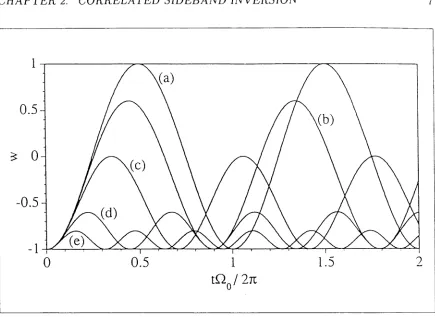
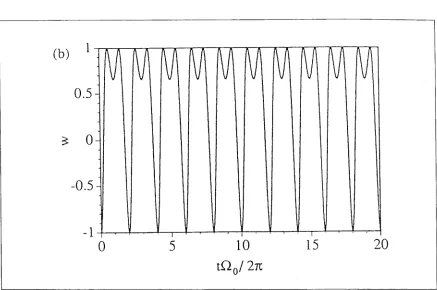
Figure 2.1: The at omic population inversion for monochromati c drivings
Atomic population inversion as a function of dimensionless time for detuning frequencies of S/Q0 = (a) 0.0 (resonant), (b) 0.5, (c) 1.0, (d) 2.0 and (e) 3.0.
where u>i is normally the laser field frequency. Since the quant i ty of interest is the at omic inversion given by u \ switching to this r otat ing frame will not alter the final results. Th e Heisenberg equat ions now become
— 8v +2Eto£(t) sin L J i t w , (2.5)
6u -\-2D0£(t) c o su>itw, (2-6)
— 2 Q .q£ ( t ) [ u sin l jR + v c o s l oR ] , (2.7)
where 6 = uja — lji is the atom-field det uni ng frequency. Note t h a t thus far the rotating wave approximati on has not been ma d e and no as sumpti on has been ma de on the ti me dependence of the electric field. We call these equat ions the generalized optical Bloch equations.
2.3
M o n o c h r o m a t i c l i g h t
[image:17.561.84.519.64.381.2]C H A P T E R 2. C O R R E L A T E D S I D E B A N D I N V E R S I O N 8
In th is case, u and — v re p re s e n t th e in -p h a se and in - q u a d ra tu re c o m p o n e n ts o f th e a to m ic d ip o le m o m e n t, re s p e c tiv e ly . W e m a ke th e r o ta tin g wave a p p r o x im a tio n to th e
d y n a m ic e q u a tio n s o f u,t>, a nd w by n e g le c tin g an y fa st (o p tic a l fre q u e n c y ) r o ta tin g te rm s a nd th u s o b ta in
ii — — Sv, (2 .8 )
V = 6u + DqIV, (2 .9 )
£• II 1 JO o G (2 .1 0 )
T hese are th e s ta n d a rd o p tic a l B lo c h e q u a tio n s . T h e ir s o lu tio n is g iv e n by [13]
u ( t ) 0 ^ +<$2 cos Clt — 8 s i n f t ift — <5 f t o (1 ft2—cos f t f ) U o
v ( t ) = 8 s i n ftC lt COS Pit f t n s in f t (
f t Vo
w { t ) — 6 f t o (1 —co s f t f ) - f t n s i n f t * <52 + f t n c o s f t f
w °
L ft2 ft f t 2 J
(2.11)
w h e re u 0, v0 arid w 0 are th e in it ia l values, a nd Pi is th e g e n e ra liz e d R a b i fre q u e n c y ,
(2.12)
n =
+
W h e n an in it ia l g ro u n d s ta te o f w ( 0 ) = —1 is a ssum ed, th e a to m ic in v e rs io n is g iv e n by
w ( t, 6) = —
S2 + f l l cos(\J62 t)
(2 .1 3 )
Ä2 + og
T h is s o lu tio n d escribes R a b i o s c illa tio n and F ig . 2.1 show s th e e ffe c t o f v a ry in g th e
d e tu n in g fre q u e n c y on th e a to m ic p o p u la tio n in v e rs io n .
W e ob se rve d t h a t d e tu n in g increases th e o s c illa tio n fre q u e n c y and decreases th e m a x
im u m in v e rs io n ,
Pl20 - 6 2
W m ‘ I ~ a 20 + ,9 ' ( 2 I 4 )
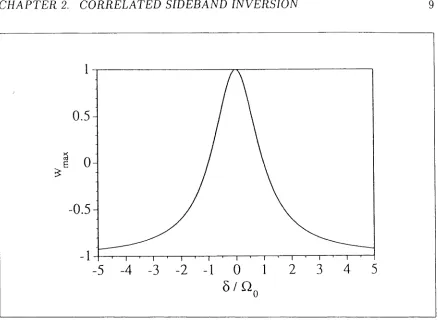
So n o n - r e s o n a n t (6 ^ 0) m o n o c h r o m a t i c li ght c a n n o t yi el d compl ete a t o m i c i nv e r s i o n
o f Wmai = 1. F ig (2 .2 ) show s th e L o re n tz ia n p ro file o f th e m a x im u m a to m ic in v e rs io n p lo tte d as a fu n c tio n o f laser d e tu n in g .
In tr o d u c in g th e B lo c h v e c to r p = ( u , v , w ) a llo w s th e o p tic a l B lo ch e q u a tio n s (2 .8 , 2.9, 2.10) to be w r itte n in th e fo rm o f [13]
P = t x p, (2 .1 5 )
w h e re r is d e p e n d e n t on th e d r iv in g fie ld . T h e d y n a m ic s o f th e B lo c h v e c to r is a n a lo
CHAPT ER 2. CORRELATED SI DEBAND I NVERSI ON
9Ö / Q ,
Figure 2.2: M axim um atom ic population inversion versus laser detuning
The maximum achievable atomic population inversion versus detuning frequency gives a Forenlzian profile with a peak of u>max = 1 at the resonant frequency.
refer to r as the effective torque field. T h e m odulus of
p
is conserved and has the value one. Hence thep
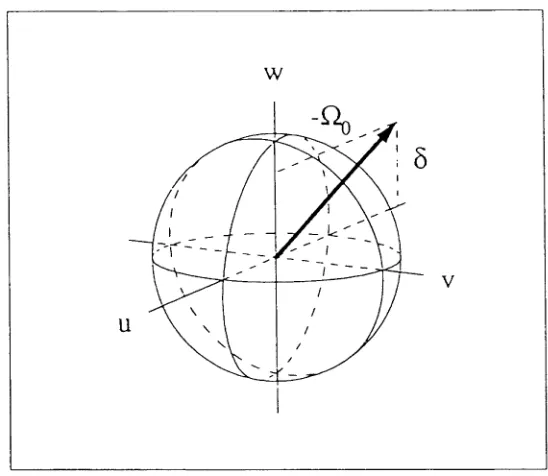
dynam ics occurs on a unit sphere, referred to as th e “Bloch sphere11. This provides a useful pictu re for u n d erstan d in g driven two-level systems.Driving with m o n ochrom atic d etu n ed light corresponds to having an effective torque field of
t = ( —f i0,0,6). (2.16)
As shown by Fig 2.3, since th e Bloch vector
p
makes a co n stan t angle0
with r , it rotates around the effective to rq u e field, tracing out a small circle on the lower hem isphere of the Bloch sphere. Hence th e optical vector does not intersect the “pole1'p
= (0,0, 1) corresponding to com plete inversion.2.4
A m p l i t u d e m o d u l a t e d lig h t
[image:19.561.78.516.70.397.2]monochro-C H A P T E R 2. monochro-C O R R E L A T E D S I D E B A N D I N V E R S I O N 10
w
Figure 2.3: Bloch sphere of det uned mo noc hr om at i c driving
T h e Bloch vector makes a constant angle 0 = t a n ~ l ( — Do/6) with the effective torque field, assuming initial ground s tat e w = — 1.
m a t ic light beam through an acousto-optic modul at or . T h e general formula for a m pl i tu de mo dul ati on is given by [12]
S(t) = [1 + Af ( t ) ] c o su>it. (2-17) We restrict ourselves to consider only the case when f ( t ) = cosu)mt. Hence u>m is the a m p l i t u d e modul ati on frequency and A the mo dul at i on index. T h e Fourier de co m position of the amp li t ud e modul ati on gives a pair of sidebands d e t u ne d by the same a m o u n t of u>m on either side of the carrier frequency as shown in Fig. 2.4.
T h e a m p l i t u d e of the sidebands is given by T \ and hence their intensities depend on the mo dul at i on index, by subst i tu ti ng Eq. (2.17) into Eq. (2.5, 2.6, 2.7) we obtain,
ii = —8v, (2.18)
v = 8u +Qo[l T A cosujmt]w, (2.19)
w = — f20[l + A cos ujmt ]v . (2.20)
[image:20.561.159.433.98.336.2]CHAPTER 2. CORRELATED SIDEBAND I NVERSI ON
1 1frequency
-cos
Figure 2.4: Fourier s pe ct ru m of a m p l i t u d e modulation
The Lorentzian profile of maximum inversion is shown superimposed on the amplitude mod ulation fourier spectrum. The length of the vectors show the relative strength of the carrier and sideband components.
2.5
S y m m e tric a lly d e tu n e d lig h t
We now consider the case of driving by a pair of sidebands s ymmetrically d et une d a bo ut resonance. We require t h a t the two s ymme tr ica lly det uned sidebands to be phase-locked to each other without which correlated sideband inversion will not occur. This requirement is experi ment ally achievable by a m p l i t u d e mod ul at i ng the laser light and t hen filtering off the lower sideband, say, leaving the carrier and th e upper sideband phase locked. Th e carrier and the remaining sideband can then be chosen to have frequencies equally det uned from the atomic resonance by choosing u;/ =
uja —a>m/2
as shown in Fig. 2.6 . £(t) is t hen given bysin((cua + + sin((u;a
y
1)0
1 (2.21)T h e amp li t ud e modul ati on index of
A =
2 is chosen to ensure t h a t t he carrier and the sideband have equal intensities. The optical Bloch equat ions are given by,u
v
w
Q0 cos( 0,
- Q 0 c o s (-UJmt)u,
(2.22)
[image:21.561.79.519.80.359.2]CHAPT ER 2. CORRELATED SI DEBAND I NVERSI ON
12F ig u re 2.5: A to m ic p o p u la tio n inversion of a m p l i t u d e m o d u la te d driv ing Here the modulation index
A
= 1 and the laser light is resonant with the two-level atomS =
0. Note t h a t the atomic inversion is dominated by the presence of the resonant component. Hence it oscillates at a frequency close to the resonant Rabi frequency. The effect of the sideband pair only slightly alters the shape of the oscillation.symmetrical
sideband pair
a i A
C O S GO
, a
k . i
sin *
r - -0)
1 m
1
1
1
sin
!
i
frequency —
-cos
Figu re 2.6: S y m m e tric a lly d e t u n e d d r iv in g a r r a n g e m e n t
[image:22.561.77.514.100.387.2] [image:22.561.79.520.498.718.2]C H A P T E R 2. C O R R E L A T E D S I D E B A N D I N V E R S I O N 13
Since in this case the i n- quadr atur e dipole m om e nt is not coupled to the other atomic par ameter s, we can write the ti me evolution of the a tomic inversion as a second order non-linear differential equation,
1 . „ 2 2/ 1
iv + iom tan( -iomt)w + \l0 cos ( -uOmt)w — 0. (2.25) This differential equation has the solution, assuming an initial ground stat e rc(O) = — 1, given by [7]
— cos
^2fl0
s i n ( - ^ ’m/) (2.26)LV m 2
Eq. (2.26) shows that complete at omic inversion can be achieved provided the a rg ume nt of the cosine can exceed 7 r , t h a t is provided t h a t th e inequality,
7r < 2Q0
'~u m
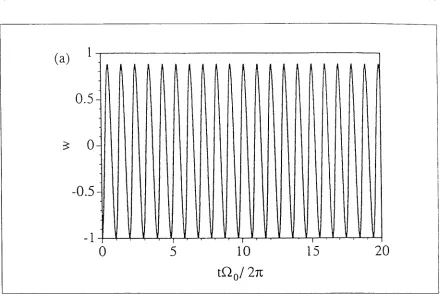
(2.27) is satisfied. This requires t h a t the det uni ng be sufficiently small. This is our first ex ample of correlated sideband inversion, for which co mplete at omic inversion is possible in the absence of resonant light. Note t h a t linear c ombinati ons of the sideband and the carrier cannot reconstruct the resonant co mp o ne nt because the Fourier components are orthogonal to each other. Hence this complete a t omi c population inversion is en tirely due to the non-linear characteristic of the two-level a t om driven by correlated sideband inversion. Fig. 2.8 and Fig. 2.5 c omp ar e such a case when w m = 0.50f2o to normal monochromati c detuning.
This example of correlated sideband inversion can be under stood using the Bloch sphere picture. For the pair of sidebands the effective tor que field is,
T = (0, - Q 0 cos(umt), 0), (2.28)
C H A P T E R 2. C O R R E L A T E D S I D E B A N D I N V E R S I O N 14
Figure 2.7: Atomic population inversion for single sideband driving
Atomic population inversion w as a function of dimensionless time for a two-level atom driven by a single sideband £(t) = sin((a;a 4- u>m)t) with u>m =
0.25S2o-2.6
P h a s e m o d u la te d lig h t
We next consider the phase m o d u lated field,
S(t) = cos(u>at + A costjomt), (2.29) where A is the phase m odulation index and u>m <C u a is th e m odulation frequency. This is an interesting case since it can be realized by electro-optic m odulation of a resonant laser. After m aking th e ro tatin g wave ap p ro x im atio n on Eqs. (2.5, 2.6, 2.7) we find the optical Bloch equations,
u = — s\n( A cos ujmt) w,
v = Q0 cos( Ac o su>mt) w, (2.30)
w = D0[s\n( A cos Ljmt) u — cos( A cos i j mt) v}.
T he phase m odulated light can be decomposed into its Fourier com ponents [7] E(t) = cos(uiat + Acosujmt)
- Jq(A) cosujat
[image:24.561.74.515.76.370.2]C H A P T E R 2. C O R R E L A T E D S I D E B A N D I N V E R S I O N 15
F igure 2.8: A to m ic p o p u la tio n inversion for s y m m e tr ic a lly d e tu n e d s id e b a n d s Atomic population inversion w as a function of dimensionless time for a two-level atom driven by a pair of symmetrically detuned sidebands Eq. (2.21) with u>m = 0.50fio- The effective detuning of the carrier and upper sideband is
±0.25Oo--COS
frequency
F igure 2.9: Fourier s p e c t r u m of p h a s e m o d u la tio n
[image:25.561.79.516.82.372.2] [image:25.561.84.519.445.694.2]C H A P T E R 2. C O R R E L A T E D S I D E B A N D I N V E R S I O N 16
+ ^ ( — 1 )n + 1 J2n+1 (A)[sin((ioa — (2n T 1 )com ) 0 + sin((u;a + ('2n -f 1 )u m )t)]
n —O
oo
+ - 1)nJ2n{ A)[cos((ioa - 2nu>m)t) + cos((u;a + 2n(jjm)t)\, (2.32)
n — 1
where J n(A) is the n -th order Bessel function. Eq. (2.32) shows th a t the phase m o d u lated light is equivalent to resonant light with an a m p litu d e of J0(A)Eo plus non resonant light at the sideband frequencies with am p litu d es ± J n( A) E0 as shown in Fig. 2.9. Similarly the Bloch equations (2.30) can be w ritten as,
OO
Ü = — n 0[2 ^ ( - l ) n J W i M ) cos((2n + l)ium0]
n = 0
v = D0J0(A) w OO
+fio[2 ]T]( —l ) n Jiri(A) cos(2mum£)] w, (2.33)
n — 1
w = - % J o { A ) V
OO
- Q 0[2 ^ ( - l ) nJ 2n(A) cos(2nu;mf)] v
n — 1
oo
+ n 0[2 ^ ( — l ) nJ2n+i(^4) cos((2n + 1 )umt)] u.
Tl —0
Note th a t in this ro tatin g frame, th e even order sidebands couple the atomic inver sion with the in -q u ad ratu re dipole m om ent whereas the odd order sidebands couple th e atom ic inversion with th e in-phase dipole m o m en t. An analytic solution of these equations is not known, so we need to solve th e m numerically.
C H A P T E R 2. C O R R E L A T E D S I D E B A N D I N V E R S I O N 17
tQQ/
2n
Figure 2.10: Atomic population inversion for phase modulated light
CHAPTER 2. CORRELATED SIDEBAND INVERSI ON
18f a ^ W f
w
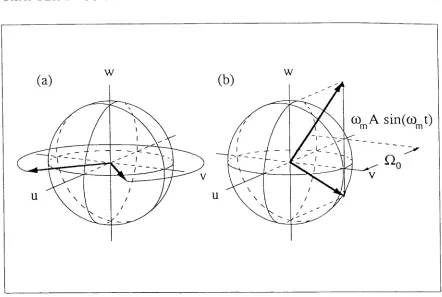
Figure 2.11: T he effective torque field for phase m o d u lated driving
(а) The effective torque field of the phase modulated driving oscillates in the uu-plane, r = ( - Q o c°s(AoCosu;m£), - Q 0 cos(A0 cosu>mf), 0). When transformed to the phase modulated rotating frame, (b) shows that the effective torque field becomes r = ( - f t 0, 0,
Um A
sin2.7
P h a s e m o d u la tio n : P h a s e m o d u la te d r o ta ti n g
fra m e
T h e correlated sideband inversion induced by phase m o d u lated light can be understood using th e Bloch sphere picture if we switch to a frequency m o d u lated ro tatin g frame [б] . This is done by replacing the
up
term s in Eq. (2.4) withup
4-A cos umt.
In this frame th e effective field is given by,This is similar to the single d etuned sideband case Eq. (2.16), except th a t the re- com ponent is oscillating ab o u t zero at the m odulation frequency Fig. 2.11. This is the crucial difference th a t makes com plete inversion possible. T he co n stan t u-com ponent alone would cause com plete inversion, b ut th e effect of the oscillating te-component does not simply average to zero. It moves the Bloch vector out of the
v-w
plane, reduc ing th e effective strength of the u-com ponent of r and hence increasing the inversion period. T h e inversion period increases with th e m odulation frequency because the[image:28.561.75.517.77.374.2]
C H AP T ER 2. C OR REL AT ED SID E BA N D I NVER SI ON 19
v 0
-tO / 2k
F ig u re 2.12: E ffe c ts o f in d iv id u a l s id e b a n d s on th e tw o -le v e l a to m I
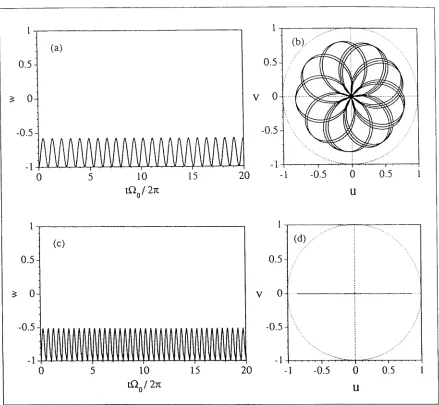
A tw o-level atom driven by (a) & (b ): S\ and (c) & (d ): S\ + S2- The m o d u la tio n frequency
Uyn = f i 0. C om plete a to m ic inversion is not achieved in both (a) &: (c).
T h e ra p id o s c illa tio n o f th e in v e rs io n is th u s caused b y th e o s c illa to r y m -c o m p o n e n t.
2.8
P h a se m o d u la tio n : S id e b a n d an alysis
M o s t o f th e b e h a v io u r o f th e c o rre la te d sid e b a n d in v e rs io n in d u c e d b y phase m o d u la te d
lig h t can be a c c o u n te d fo r by th e fir s t tw o p a irs o f side b a n d s. F ig . 2 .1 3g shows th e
a to m ic p o p u la tio n in v e rs io n w h e n ,
[image:29.561.81.520.85.490.2]C H A P T E R 2. C O R R E L A T E D S I D E B A N D I N V E R S I O N 20
Fi gure 2.13: Effects of in div idu al s i d e b a n d s on t h e two-level a t o m II
[image:30.561.84.518.191.596.2]C H A P T E R 2. C O R R E L A T E D S I DE B A N D I N V E R S I O N 21
where,
Si = - J {( A 0 )[s\n((uja + u ; m)0], (2.36)
s 2 =
J\( Aq) [si n ((u^a u^m ) / ) | , (2.37)S3 = S 2 { Aq^[c o s(((-Ua -f 2 i o m ) t ) ] , (2.38)
- J 2{ A0)[cos((u;a - 2 u m )t)\. (2.39) Com parison with Fig. 2.10 shows th a t the behaviour of the inversion in the phase m o d ulated case is approxim ately reproduced. O ur numerical work shows th a t as long as two pairs of sidebands exist, one of which is odd order and the other even order, corre lated sideband inversion is possible for any m odulation frequency. W ith the two pairs of sidebands, Eq. (2.35), the effective field, in the uniformly rotating frame Eq. (2.4),
is
t = 2Q.0( J2(A) cos(2ujmt)i —J i ( A) c o s ( i j mt). 0). (2.40)
This effective field vector describes a curve in the u-v plane, not a line through the origin as in the case of the single sideband pair Eq. (2.28). This change breaks the s y m m e try th a t was previously responsible for periodically undoing the small increments in the atom ic inversion, and hence a “secular” increase becomes possible. Since the inversion is coupled to v only by even order sidebands and to u only by odd order sidebands, such secular increase is only possible when th e driving field contains both even and odd order sidebands.
2 .9
E ffe c t o f s p o n t a n e o u s e m is s i o n
CHAPT E R 2. CORRELATED SI DEBAND I NVERSI ON
22Fi gure 2.14: M o n o c h r o m a t i c dr ivi ng w it h s p o n t a n e o u s emission
[image:32.561.86.516.133.646.2]CHAPT E R 2. CORRELATED SI DEBAND I NVERSI ON
23-
0
.5
-1
— - ' - 'F igu re 2.15: P h a s e m o d u la te d d riv in g w ith s p o n ta n e o u s em ission
[image:33.561.86.522.128.642.2]CHAPT ER 2. CORRELATED SIDEBAND I NVERSI ON
24v
0-Figure 2.16: Monochromatic driving with spontaneous emission
-CHAPT E R 2. CORRELATED SIDEBAND I NVERSI ON
25V 0
-Fi gu re 2.17: S y m m e t r i c a l s i de b an d d r iv i ng wi t h s p o n t a n e o u s emi ssion
[image:35.561.80.511.138.655.2]-CHAPTER 2. CORRELATED SI DEBAND I NVERSI ON
26Filter
EOM/AOM
Laser No. 1
Laser No. 2 Atomic
Beam Source
Figure 2.18: E xperim ental setup for correlated sideband inversion d em o n stratio n
2 .1 0
O u t l i n e o f e x p e r i m e n t
We conclude this ch apter with an outline of an optical ex p erim en t in which correlated sideband inversion could potentially be observed. Fig. 2.18 shows such an experim ental setup.
A laser tuned to the atom ic resonance can be phase m o d u lated (or am p litu d e m od ulated) as required with an electro-optic m o d u la to r (acousto-optic m o d u lato r). The required modulation am p litu d e
A
q % 2.4 is easily achieved with a resonant m odulator. An atom ic filter could be used to ensure th a t no resonant com ponent is left. In order to observe correlated sideband inversion the light-atom interaction tim e m ust be con trolled. This is possible using either a cw laser and a velocity selected (cooled) atomic beam or a pulsed laser and a th e rm al atom ic beam . T h e inversion could be detected by sta n d a rd hot wire or laser induced fluorescence techniques, for exam ple. [image:36.561.76.515.84.403.2]chap-CHAPTER 2. CORRELATED SIDEBAND INVERSION
27C h a p t e r 3
S u p p re s s io n o f Q u a n tu m T u n n e lin g
3.1
O v e r v i e w
T h e phenom enon of q u a n tu m tunneling has been known since the early heyday of q u a n tu m mechanics. Hund [3] in 1927 explained th a t the observed splitting of the vibration sp ectra of a m m o n ia NH3 was due to q u a n tu m tunneling and th a t q u a n tu m tunneling is im p o rta n t for the intram olecular rearran g em en t of atom s in pyram idal molecules in general.
However, it was only until very recently th a t th e phenom enon of q u a n tu m tunneling was found to be controllable by periodic p e rtu rb a tio n . More im portantly, if the pe riodic p e rtu rb a tio n satisfies certain conditions, q u a n tu m tunneling can be completely suppressed. This result was first rep o rted by G rossm ann et. al. [24, 25]. Their investi gation was on the effect of a m onochrom atic driving force on the tunneling of a particle in a sym m etric double-well potential. T h e H am iltonian of their system was given by
~ 1 1 X ^
' H(x. p) = - p 2 - - X 2 + — — + x S s mu j t , (3.1)
2 4 54 U
where S is the am p litu d e of the p e rtu rb a tio n and D is a barrier height param eter. This H am iltonian is of fu n d am e n tal interest because it can be used to model proton transfer in atom s and molecules, inversion m otion of ato m s in pyram idal molecules, as well as other mesoscopic system s (ac-driven SQUIDs).
In both their papers [24, 25], th e Floquet formalism and the concept of quasienergy were used. By first defining a propagator for small enough tim e steps, they were able to
CH APT E R 3. SUPPRESSION OE QUANTUM TUNNELI NG
29o b tain a stroboscopic description of the p article’s m otion in the double-well. T he initial s ta te of the system chosen was to position a particle with a G aussian centre in one of the wells. It was found th a t in certain cases even after twenty normal tunneling periods, the particle remained localized in th e same well. However, their work was mainly numerical and no physical explanation was offered to explained the newly discovered phenom enon. T he condition for the suppression of tu n n elin g was found to be the exact crossing of the two Floquet ground states, <I>e and <f>0, and no analytic expressions were given.
A mong other results, they also observed th a t gradual tunneling still occurs even at the exact crossing of the two Floquet ground states. T h ey a ttr ib u te d this gradual tu n n elin g to the fact th a t their chosen initial state, the G aussian state, is not exactly th e superposition sta te of the two Floquet eigenstates, ^<J>e T $0
-In this chapter, we will make use of th e two-level a p p ro x im atio n of the q u a n tu m double well [28, 27] to relate th e phenom enon of the suppression of tunneling to the work of the correlated sideband inversion of a two-level atom . This simplification of the q u a n tu m double-well enables us to find an analytic expression for the conditions needed for th e suppression of q u a n tu m tunneling. F u rth erm o re , we will show th a t the gradual tu n n elin g of particles even at the tunneling suppression conditions is not solely due to th e initial Gaussian s tate of the wavefunction, b u t ra th e r it is also due to a phenom enon analogous to the correlated sideband inversion in th e two-level ato m model. Finally, we also relate the two-level atom model to the work of th e low-frequency radiation generation scheme proposed by Dakhnovskii and Metiu [31]. Again because of an analogy to the correlated sideband inversion of the two-level ato m , we are able to ex ten d th e proposed p a ra m e te r regime of the low-frequency radiation generation.
3.2
2 - l e v e l a p p r o x i m a t i o n o f q u a n t u m d o u b l e - w e l l
A two-level approxim ation of the double-well potential is given by the Hamiltonian [28, 27]
H
=~ Y
(UXM - |2)(2|)
+
v(t
) (
11>{2
1+
12
)<
11)
, (3.2)C H A P T E R 3. S UPP RES S I ON OE Q U A N T U M T U N N E L I N G 30
the localization of a particle in the “right” and “left” well are represented by the states
i n = d = ( | l > + |2>), (3.3)
11) = ^ ( | 1 > - | 2 > ) , (3.4)
respectively. This two-level appr oximati on of the double-well is valid provided t h a t the driving frequency u and the energy splitting A 0 of th e two levels is small compar e to the energy of the other higher excited levels.
Using t he per tu rba ti on me th od, the first order appr oxi mat i on to the period propagator ma tr ix U of the system in the basis set of { |r), |/)} can be shown to take the form of [28]
u
11 = 1, (3.5)U 2 2 = 1, (3.6)
to r
U12 - exp )
h (3.7)
u \ to / \ u> /
u2i = - u ;2.
(3.8)This is a good approximati on provided t h a t the period is small enough to not have caused significant changes in the st at e amplitudes. Hence, q u a n t u m tunneling is sup-pressed when
2 V o
J O , m
UJ (3.9)
and
A 0 « 2a; (3.10)
where j 0,m is the m- t h root of the zeroth order Bessel function.
3.3
A n a lo g y w ith t h e tw o -le v e l a to m
We now relate our work on t he two-level at om to the suppression of q u a n t u m tunneling. Our two-level a t om Hami ltoni an Eq. (2.1) gives th e following equations of motion for the ampl it ud es cg to be in t he ground st at e and ce to be in the excited state,
C H A P T E R 3. S U PP R E S S I O N OF Q U A N T U M T U N N E L I N G 31
Using dashes to denote rotating variables defined by,
ce = exp[ \i(ujat + A cosujmt)]ce, (3.13) cg - exp[—^ ( u ;a/ + A cos ijomt)}cg, (3.14) we o b ta in for the phase m odulated field E(t ) = E0 cos(u;a/ + A cosu:mt),
i ce = l-Aujm s\n(ujrnt)ce - {-Q0cgi (3.15) i cg = - \ E l 0ce - \Aujm s\n(Ljmt)cg, (3.16) where we have used the rotating wave ap proxim ation to neglect rapidly rotating term s proportional to exp(2i(wat -f A cosujmt)).
The equations of motion for q u a n tu m tunneling in a m o d u lated double-well, in the two-level approxim ation, are
i cr — Vqs\n(u)t)cr - -2A 0c/, (3.17) i ci — - l A 0cr - VÖsin(u;Oc/, (3.18) where cr and c/ are the am plitudes of the right and left well states |r) and |/), respec tively. A comparison of Eqs. (3.15, 3.16) and Eqs. (3.17, 3.18) shows th e m ath em atical equivalence of the two models by making the following s ta te correspondence,
ce cr , (3.19)
c'g Cl. (3.20)
T h e correspondence between param eters is,
iOm ^ U), (3.21)
Flo Ao, (3.22)
A <r+ 2V0/uj. (3.23)
C H A P T E R 3. S UPP RES S I ON OE Q U A N T U M T U N N E L I N G 32
3 .4
L o w - f r e q u e n c y r a d i a t i o n g e n e r a t i o n
Dakhnovskii and Metiu [31] has proposed th a t by driving a charged particle in a double well with laser, intense low-frequency radiation can be produced . Again the two-level ap p ro x im ated Hamiltonian is used,
where /r12 is the induced dipole m om ent, E(t) is electric field and 2c the energy splitting.
Similarly there is a correspondence between th e two-level ato m model and this,
where lo is the driving laser frequency, and e0 = 2/j.12Eo/f u o is proportional to the laser
am plitude. Accordingly their conditions for low frequency generation, e/kco 1 and eJo(e0)/h small, correspond in our model to having highly d etuned sidebands and a small com ponent of resonant carrier, which induces a low frequency Rabi oscillation. T h e analogous effect to our correlated sideband inversion occurs in their model for cJo{co)/h = 0. F urtherm ore it occurs for a rb itra ry values of e/hco. This extends the p a ra m e te r regime for low frequency generation to th e point of accidental degeneracy [31] and to a rb itrary driving laser frequencies.
K = £ ( | l ) ( M - | 2 ) ( 2 | ) - / i n ß ( 0 ( | l > ( 2 | + |2>(l|),
(3.24)iOm ^ ^ i
flo c-> 2c j h,
A eo,
C h a p t e r 4
B lo c h r e p r e s e n ta tio n o f o p tic a l
c o u p le rs
4 .1
O v e r v ie w
“ Men's labour therefore should be turned to the investigation and observation o f the resemblances and analogies o f things. .. f o r these it is which detect the unity of nature, and lay the foundation f o r the constitution o f the sciences. ” Francis Bacon.
T h e analogy between mechanics and wave theory is long established and has been used to tran sp o rt knowledge between the two fields. More th an a century ago, Jam es Clark Maxwell draws upon a mechanical analogy when developing his electromagnetic theory [1]. In the early days of q u a n tu m mechanics, m any m ade use of concepts from wave optics to explain the newly form ulated q u a n tu m theory. More recently, the analogy between q u an tu m mechanics and optics has yet again been studied in a new framework of optical waveguide theory. Black and Ankiewicz [11] show th a t in th e respective length and tim e independent case, th e scalar wave equation and the Schrödinger equation are m ath em atically equivalent. One-to-one correspondence is found between the quantities of the two models.
In this chapter, we re-establish the one-to-one correspondence between the quantities in q u a n tu m mechanics and wave optics. O ur sta rtin g point is also a comparison of the two most im p o rta n t equations of the respective fields, namely, the Schrödinger equation and the scalar wave equation. However, we do not wish to limit ourselves to the le n g th /tim e independent case. W ith th e help of the slow varying envelope
CHAPTER 4. BLOCH REPRESENTATI ON
O FOPTI CAL COUPLERS
34a pp roximati on, we proceed to establish a correspondence of the quantities between the two models when they are l e n g t h / t i m e dependent. This chapt er hence plays the i m p o r t a n t role of a bridge linking the two parts of this thesis.
We continue with the comparison of a four-port optical coupler and a potential double well. It is found t h a t the four-port optical coupler has ma ny similar characteristics to the potential double-well in q u a n t u m mechanics. Q u a n t u m tunneling, for example, is tran sl at ed to the well understood phenomenon of power transfer between the two cores of an optical coupler. Finally, we tr ans lat e th e Bloch representation used for analysing the two-level a t om to a new representation for th e optical s ta t e in a coupler. This Bloch representation of the optical coupler is a convenient tool for visualizing the evolution of the optical state. As an exampl e of the application of this new representation, we consider the case of a uniform coupler. In the next chapter, we also use this representation to consider a coupler with two out-of-phase sinusoidally modul ated core indices.
4 .2
T h e S c h r ö d i n g e r e q u a t i o n a n d t h e s c a l a r w a v e
e q u a t i o n
In this section, we establish the m a t he ma t i c al correspondence between the Schrödinger equation,
h2 9 Ö
V 2T +
VV
=ih — ty,
2
m
dt
(4.1)and the scalar wave equation,
V 2T +
k2n 24? =
0. (4.2)C H A P T E R 4. BLOCH R E P R E S E N T A T I O N O F O P T I C A L COUPLERS 35
the refractive index of the wave equation to be constant along the entire propagation length 2. The two equations in the t i m e / l e n g t h i nde pendent case are
arid
V 2'!' + N ( e - V)»P = 0.
h (4.3)
V 2* + (k2n2- ß 2)ty = 0. (4.4)
Here E is the total energy of the particle and ß is the propagation constant of the elec tric field. Note t h a t in simplifying the scalar wave equat ion to the length independent case, we have removed the z-dependence of the scalar wave equation and hence are left with
2
d2
d
2v? = ---- 1
----* d x2 d y 2 (T5)
on the left hand side of Eq. (4.4). If we assume t h a t the Schrödinger equation is two dimensional, the correspondence is easily found to be,
2 m,
2 m ~ l ß
k2n2 (4.6)
ß2 (4.7)
X (4.8)
y (4.9)
We observe t h a t t he square of the refractive index in wave optics is analogous to an inverted potential energy and the total energy in q u a n t u m mechanics is analogous to the inverted squared propagation constant. If t he above correspondence were made, problems and solutions in q u a n t u m mechanics will have a corresponding c ount er par t in wave optics.
However, we observe t h a t when t he Schrödinger equation and the scalar wave equation become t i me / le ng t h - d e p e n d e n t , t he correspondence is no longer obvious due to the difference in the first order and t he second order derivative terms on the right hand side of Eqs (4.1, 4.2). This a pp ar e nt discrepancy can be resolved if we assume t h a t the complex electric field a m p li t u d e in th e scalar wave equation has the following form,
<P(2 ) = il>(z)e'f Pd*,(4.10)
so t h a t
dz # ( * ) = d_
dz4'(z) T iß4>{z.
,i f 0 d z
and
dß_ d z 2
q 2 Q C\
^(*) = ^</>(2) + 2z/? —ö’(-) + z^(2) ^ ß - d2U{ =
(4.11)
CHAPT E R 4. BLOCH REPRESENTATI ON
O FOPTI CAL COUPLERS
36The scalar wave equation is now' of the form ‘ d2
V 20(z) +
( k 2n 2( z)- /^(z) )?/>(*) = -
^ 2*/’U) +
2 i ß ( z ) — il'(z)‘ö+
i i p ( z ) — ß ( z )d(4.13) If we assume t h a t the envelope function
E( z )
is varying sufficiently slowly for the slowly-varying envelope approximati on ( SVEA) to be valid, we can then neglect the second order partial derivative d 2U / d z 2. F ur the rm or e th e t e r m i i j ; ( z ) d ß( z )/
d z , which is responsible for the coupling of the f orward-propagating modes to the backward- propagat ing modes, can also be ignore by assuming t h a t the change in the refractive index profile along the direction of propagation is slow compar e to th e evolution of the envelope function. Th e scalar wave equation is therefore reduced toV 20 ( z ) + (k 2n 2( z
) -
ß 2( z) ) i p( z )-2
i ß ( z ) — ip(z).o z (4.14)
By also assuming t h a t the wavefunction of a particle in q u a n t u m mechanics can be wr itt en as,
^ t ) =
(4.15)T h e Schrödinger equation can then be rewritten as,
o , 2m 2m 2m
Ö
V 20 ( O + ( - - ^ - V ' ( z ) +
-^-E(t))ik(t) =
(4 -16)Once again, we can obtain a correspondence of all the quant iti es between the two equations,
—
2 m V ( t )n2,
(4.17)—2
mE( t )
<-*
A20
2, (4.18)d
~ d t
<-»
d
d z1 (4.19)
m
C-» *(*),
(4.20)0 ( 0
<->
H z ) , (4.21)7711
<->
A ß z , (4.22)X
X,
(4.23)y
*->
y,
(4.24)h
<->
A, (4.25)C H A P T E R
4. BLOCH REPRESENTATI ON
O FOPTICAL COUPLERS
37L well
R well
Core 1
Core 2
Figure 4.1: T h e double wells of q u a n tu m mechanics and wave optics
optics which is entirely classical. We see th a t when the wavelength of the electric field is short (corresponding to
h
—>
0), the “q u a n tu m features” of wave optics disappear and th e wave optics is then replaced by the more classical ray optics in this regime. T he Planck constant on the other hand is a universal co n stan t and cannot be varied. Hence th e q u a n tu m properties of a microscopic object are always present. Because of this correspondence between all the q uantities of th e Schrödinger equation and the scalar wave equation, we can now an ticip ate interesting results in wave optics analogous to th e coherent destruction of q u a n tu m tunneling and correlated sideband inversion.Since the potential energy in q u a n tu m mechanics is found to be analogous to the refractive index in wave optics, we an ticip ate th a t a q u a n tu m double well will in many ways be similar to an optical coupler with the inverted profile, as shown in Fig. 4.1. In p articu lar, if the two-level and tw o-mode ap p ro x im atio n were m ade on the respective models, we can a t tr ib u t e the power transfer between cores of an optical coupler to a phenom enon similar to q u a n tu m tunneling between potential wells. The tunneling period is then found to be analogous to the coupling length of an optical coupler. We give a further listing of the correspondence of oth er q u an tities in this case.
Q U A N T U M M E C H A N IC S <-> WAVE O P T IC S (4.26) unbound states <-» radiation modes, (4.27)
bound states bound modes, (4.28)
l*> = ~ ( l r ) + | / » <-> « , = - 4 ( ^ 1 + ^ ) , (4-29)
k> = 7 2 ( | r > ~ |,}) °
=
- 4' 2)’
(4'30)
C H A P T E R 4. BLOCH R E P R E S E N T A T I O N O P T I C A L COUP LE RS 38
10
=4 = ( l 9 >
- |e>) « *2 = -'J'«)-
(4. 32)(4.33)
4.3
B lo c h r e p r e s e n ta tio n fo r o p tic a l c o u p le rs
T h e evolution of a coherent optical s ta te along a general weakly-guiding, weakly coupled four-port coupler is well modeled by the first order coupled mode theory. Here for generality we consider a coupler with the following coupled m ode equations for the field am plitudes in each core
d ,
Tzb'
— iß\{z)b\ -\-iC\2(z)b2, (4.34)d h
Tzhl
— lß7{z )b2 -\-iC2\(z)b\, (4.35)where bj (z) are the complex modal am p litu d es and ßj (z) are the propagation constants of the fu ndam ental mode of each waveguide taken in isolation from th e other, so th a t the field in each core is described by (j = 1,2)
E j { x , y , z ) = bj (z)'l}j ( x , y ) . (4.36) Tj are th e fundam en tal-m o d e of core j , solutions o b tain ed from the scalar wave e q u a tion (4.2). T h e coupling constants C\ 2 and C2\ in Eq. (4.34, 4.35) are approxim ately equal in a weakly coupled system , so we may ap p ro x im a te these by C(z). Because ßj (z) are com parable to the optical wavenumber, these equations allow us to solve for the rapid absolute phase variation in each core of the coupler. Since we are mainly in ter ested in th e much slower power variation induced by th e weak power transfer between the cores, and also in the correspondingly slow variation in the relative phase between th e fields in each core, we restrict our a tten tio n to these “envelopes” by factoring out the rapid optical frequency dependence and tran sfo rm to th e following coupled m ode equations
— a l = i 6ßl ( z ) a l + i C ( z ) a 2, (4.37) dz
d
— a2 = iSß2( z ) a2 + i C ( z ) a i, (4.38) dz
where a.j(z) are the complex am p litu d es of the phasors obtained after factoring out the rapid phase variations from bj ( z),
a , ( 2 ) = bl ( z ) e ~ ^ 0)C
a 2(z) =
CHAPT E R 4. BLOCH REPRESENTATI ON
O FOPTICAL COUPLERS
39Also
6ßj(z) = ßj{z) - ß3(
0), whereßj (
0) denoting th e u n p e rtu rb e d or average p ropa gation constant of the fundam ental m ode for th e waveguidej
in isolation.W ith these equations, we can describe the entire envelope field in the two core system at each position
z
along the axis, provided we specify the m agnitudes of the complex phasors, |a i(z )| and |a 2(z)|, and the relative phase between them<
f>
1 2(2). T h e field am p litu d es alone are sufficient to completely specify the power in each core, and for coherent systems, the relative phase </>12(z) is the only o th e r q u an tity needed to predict the subsequent evolution of the fields along this coupler. Because these three quantities are needed, this system lends itself to a three-dim ensional geom etric representation for describing field evolution.We now introduce a new formalism of using geom etric phase to represent the optical field along any optical coupler. We will first show th e m e th o d of transform ing from the coupled mode equations (4.37, 4.38) to the geom etric phase representation. Provided th a t energy is conserved along the length of th e coupler, th e optical fields trace out a three dimensional sphere similar to th a t of the Bloch sphere in q u a n tu m mechanics and Poincare sphere in polarization coupling. Hence, we also refer to this representation as the Bloch representation for optical couplers.
We let the local modes of th e two cores of th e optical coupler be denoted by and T 2, respectively. We denote the sym m etric and an ti-sy m m etric normal m ode of the coupler by T s and T a. W hen light is launched into one core of a coupler with uniform and identical cores so th a t th e initial optical field m ode is given by T i, we find th a t at propagation distances of a q u a rte r and three q u a rte rs of a coupling period later power is equally shared between th e two cores. T h e optical field modes at these points are given by
4T — —^ ( ^ i + ?4>2),
* 0 =
- i * 2),
(4.41) (4.42) for propagation distances of one q u arte r and th ree q u a rte r periods later, respectively. We call these two modes the q u a d ra tu re modes.
W ith these three pairs of optical modes, we define an axis for each pair and thus obtained a three-dimensional space with the following axes
=
Ps-Pa,
CHAPTER 4. BLOCH REPRESENTATION OE OPTICAL COUPLERS
40Q = P o - P ß
,
P = P2 - P u
where P3 is simply the power in the j mode given by
Pj =
s V(4.44) (4.45)
(4.46) We use the symbols N , P and Q to help identify th e fact th a t the power difference of th e two cores is given by the P-axis; the difference between the norm al modes gives th e N value and Q represents the quadrature modes difference. Hence for exam ple, N
is therefore a measure of the mode sym m etry, with N = P t o ta i denoting th a t all the op tical power is in the sym m etric mode and N = — Ptot a i , the anti-sym m etric mode. We can proceed by normalizing the three q uantities to unity by dividing each p aram eter by the total power Ptotai. Hence N , Q and P can only take the values between 1 and -1. A table is given below to show the relationships between these th ree pairs of modes.
4p and 4p 4/a and 4 ^ 4p and 4p
N = 1 4P i [ ( i - O'J'a - (i + O'J’a!
N = - 1 ^[(1 + O ^ - ( 1 - O'J'a] ^ ( * 1 - ' M
0 = 1 i[ ( l + (1 - O 'J 'a ] ^ ( ' I ' l + i'J'j)
<3 = - i — j [ ( l - t ) * , + (1 + O^a] «a ^ ( ' J ’l
-P = 1 - * « ) - T j J f ' J ’a + i'i'fl) 4p
P = - 1 & 0 i e* 4/ 1
In term s of only the local held am p litu d e, we can express these param eters as
N a i^ 2 g j Ö2
P t o t a i