
ÌQD[?0[p©(3GQ Qmw©8öDu]©mö
BQDQDS
©©Crû ©QUI]r®p3fl@fó© 0(JöW§SQ©(7fl(n)g©(o)aCa)fö
(SaOïXôJQO© gQÛPsJêSiÂKn)© (â'0(nKÎÎ^Qfl§©©(nn)©oî)Û (1]©ÖD@® ί ΐ 0 Φ ® ( ο ) ^ (ό)©(? gOÖ 0(iiR5©gßö(M)©(iöß8 (ÌQJ](?®(ó)©g© O(fiKi©§QS(70[f()gSÎo)S(ïDte
No 33· February 1983
ISSN 0250-3891EIB firiarìoing In 1982 totals 4.7 bIflionECUs
Financing provided by the European Investment Banl(, the European Community's banic for long-term finance, showed a healthy upturn of 22% in 1982, in response to the European Council's request that the activities of Community financing institutions should be directed towards stimulating investment and creating jobs. Lending totalled 4.7 billion ECUs com-pared with 3.8 billion ECUs, in 1981, despite the
continuing unfavourable economic climate and high interest rates. The objectives pursued are, in order of priority, regional development; reducing dependence on imported oil; industrial modernisation. The EIB has pursued its efforts in the framework of Communi-ty development aid, particularly in Africa and the Mediterranean countries.
Lending in EEC Member Countries amounted to more than 4.24 billion ECUs, with a very significant expan-sion in operations in Greece where, in the second year following this country's accession to the Commun-ity, the EIB advanced a total of 459 million ECUs as against 159 million ECUs in 1981. An appreciable recov-ery was recorded in activity in the United Kingdom, along with a sharp upswing in Denmark and France and a further rise in Ireland and Italy; in contrast, a downturn in opera-tions was observed in Belgium and Germany. ,
Of the total, 791 million ECUs were drawn fronri the resources of the New Community Instrument for bor-rowing and lending NCI"' (see Ta-ble 1).
In line with the foremost task en-trusted to the Bank under the Treaty of Róme, priority was accorded to lending for regional development, which increased substantially com-pared with 1981: the bulk of funds was channelled to less advanced regions and areas where unemploy-ment is most rife, as well as to parts of Southern Italy and Greece devas-tated by earthquakes in 1980 and 1981. 80% of loans within the Com-munity went to projects in Italy, the United Kingdom, Greece and Ire-land, i.e. countries where structural problems are most acute.
The EIB also, accorded priority to financing investment aimed at cut-ting back the EEC's dependence on
imported oil, improving communica-tions within the Community, promot-ing development pf high technology and protecting the environment.
Projects financed in the energy sec-tor in 1982 should, once fully opera-tional, provide means of replacing the equivalent of 17.3 million tonnes of o i l p e r annum, including savings of 4.8 million t.o.e. accruing mainly from schemes promoting more effi-cient use of energy in industry.
A salient feature of EIB activity in 1982 was the upswing in loans for productive enterprise, with a par-ticularly pronounced increase in funds earmarked for smaller scale ventures via global loans channelled to banks or financing institutions. New global loans made available in 1982 totalled 842 million ECUs, as against 318 million ECUs in 1981, while 454 million ECUs in all was approved from ongoing loans of this type in support of 1 200 smaller ven-tures. The majority of such loans granted in 1982 were designed to establish or expand SMEs in region-al development areas, whereas others were intended specifically to promote energy savings. November saw the first batch of global loans from NCI resources for productive investment by smaller businesses lo-cated outside regional development
areas: these will complement similar loans provided by the EIB and the ECSC to aid regional development or conversion, modernisation of en-terprises and energy saving.
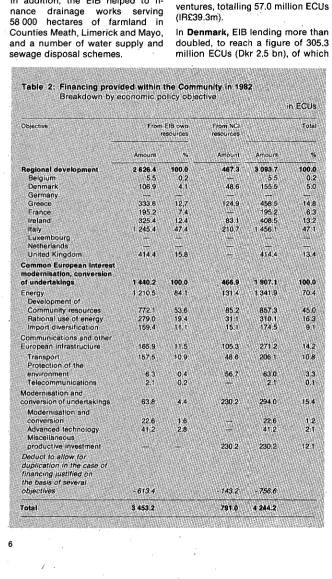
The EIB also helped to financé-im-provements to transport infrastruc-ture between Member Countries (motorways in Friuli and Jutland, road links across the Alps), as well as installations to protect the envi-ronment (sewerage scheme in the Gulf of Naples, equipment to reduce pollution in the Baltic) and projects making use of advanced technology (cancer treatment drugs) — see Table 2.
Financing provided by the Bank last year is estimated to have contri-buted towards new fixed investment totalling more than 12 billion ECUs. On the employment front, ventures backed by the EIB should lead to the creation or safeguarding of more than 58 000 permanent jobs.
Moreover, ventures financed by the EIB since 1977, Implementation of which generally spans several years particularly in the case of infrastruc-tural schemes are thought, to have secured emploYment, directly or in-directly, for more than 410 000 workers in 1982.
A substantial proportion of lending in Italy and the bulk of loans in Ireland attracted 3% interest sub-sidies financed from the Community budget under arrangements de-signed to assist less prosperous countries fully participating in the European Monetary System. Furth-ermore, 3% interest subsidies, also funded from the EEC budget, were provided for loans in Italy and Greece granted in conjunction with Community aid to areas stricken by earthquakes in 1980 and 1981.
Outside the Community: loans made in 38 countries, mainly in Spain and Portugal in conjunction with preaccession aid, and in the states signatory to the Second Lomé Convention
The EIB advanced 292 million ECUs under the heading of financial coop-eration with the Mediterranean Countries, while 159.5 million ECUs were made available under the Lomé Convention in the context of de-velopment aid"'.
To help in preparing for accession, 105 million ECUs were provided in Spain for infrastructural works (rail-ways, water supplies, roads), natural gas supplies, energy savings, coal mining, hydroelectric schemes and smaller industries. In Portugal,
ECU
Below are the ECU'S values in nation-al currencies, as at 31 December 1982; these rates are applied the pre-sent quarter in preparing financial statements and operational statistics of the Bank:
DM 2.30014 Bfrs 45.3207 £ 0.600289 Lfrs 45.3207 Ffrs 6.52207 Dkr 8.11485 Lit 1 325.70 Dr 68.5398 Fl 2.54206 IR£ 0.692923
US$ 0.967667 N.B.: ECU/national currency conver-sions given in this review of opera-tions in 1982 are based on different exchange rates, applicable at the time of each contract signature.
80 million ECUs were earmarked for constructing a coal-fired power sta-tion, improving communications with Spain and the EEC by upgrad-ing the road from the Port of Aveiro to the border crossing point at Vilar Formoso and promoting the de-velopment of SMEs.
Under the Financial Protocols con-cluded between the EEC and other Mediterranean Countries, 67 million ECUs were made available in Yugos-lavia for modernising facilities for controlling and monitoring electrici-ty generation, transmission and ex-changes with European countries. In Egypt, 28 million were lent for step-, ping up development of an offshore natural gas field at Abu Gir, while in Cyprus, 12 million ECUs helped to finance development of water re-sources, along with water supply and sevyerage schemes.
In the African, Caribbean and Pacific (ACP) States, following a swift start to operations when the Second Lomé Convention entered into force in 1981, the EIB advanced 160 million ECUs, of which 37 mil-lion ECUs were drawn from risk capital resources. The funds bene-fited ventures in 31 ACP States, in-cluding seven in which the Bank mounted operations for the first time, and two of the Overseas Coun-tries and Territories. More than 55% of.lending in 1982 centred on indus-try and agricultural processing, with the emphasis on projects designed to exploit local production. More than 50% of funds channelled to this sector supported SMEs.
Borrowings
The EIB borrowed 3.2 billion ECUs on the capital markets in 1982 to finance its lending operations, as against 2.3 billion ECUs in 1981. Borrowings were concluded mainly in US dollars (760 million ECUs, or^ 23.7% of the total), Deutsche Mark (631 million ECUs; 19.7%), Guilders (413 million ECUs;.12.9%), Yen (387 million ECUs; 12.1%), Swiss francs (346 million ECUs; 10.8%), Sterling (263 million ECUs; 8.2%) and French francs (177 million ECUs; 5.5%). The Bank launched three new ECU~ denominated public issues (112 mil-lion), thereby promoting use of the Community's currency unit, and floated its first "bulldog loan" on the United Kingdom domestic capital. market.
1 826 million ECUs were raised through pubMc issues, 1 319 million ECUs via private placings and 60 million ECUs by the sale to third parties of participations in EIB loans, guaranteed by the Bank.
Geographical breakdown of financing in 1982 within the Community
In Italy, loans came to 2 038.1 million ECUs (Lit 2 689 bn), including 449.4 million ECUs (Lit 595 bn) from New Community Instrument resources, which was a substantial improve-ment on the previous year (1 699.6m ECUs, or Lit 2 139.6 bn).
Of this amount, almost two thirds — 1 355.8 million ECUs (Lit 1 770 bn) — went into investment in the Mez-zogiorno, including 194.8 million ECUs (Lit 257.4 bn) as Community aid for reconstruction work in Cam-pania and Basilicata.
Over 50% of the loans attracted a 3% interest subsidy charged to the Community budget in accordance with the provisions adopted when Italy joined the European Monetary System, or as part of the aid to the disaster areas.
Loans for investment in productive enterprise — in particular the indust-rial sector and within it the segment of small and medium-sized enter-prises, totalled 876.3 million ECUs (Lit 1 155.4 bn).
Over two thirds of the total loaned for investment in productive ven-tures—616.7 million ECUs (Lit 813.4 bn) — went in the form of global loans, of which 334.3 million ECUs (Lit 440 bn) was for financing small and medium-scale projects in the Mezzogiorno and the least-developed regions of Central and Northern Italy (loans to EFIBAIMCA, the Industrial Credit Section of the Banco di Napoli, BNL-Banca Nazionale del Lavoro, Mediocredito Centrale, IMI — istituto Mobiliare Italiano, ISVEIMER — Istituto per lo Sviluppo Economico dell' Italia Meridionale, and CIS — Credito In-dustriale Sardo). Of this total, 192.6 million ECUs (Lit 255.0 bn) was channelled into small and medium-scale ventures in industry and
The EIB, with 3.2 billion ECUs mobilised on the markets in 1982, compared with 2.3 billion in 1981, is one of the major world borrowers, and it is thanks to its excellent credit standing with lenders that the markets were able to assimilate the increase, of almost 40%, with ease. The Bank's Statute"', which is an integral part of the Treaty of Rome, is another clear pointer to the fact that the founders of the Community wanted to create a sound bank and knew that a prime credit rating was essential, if the Bank was to. fulfill its ap-pointed task. What the Bank offers is in fact just such a first-rate security, and this article describes briefly why this is so.
A first consideration is the very nature of the projects that the EIB finances: it is stipulated in Article 20 of the Statute that these projects must contribute to an increase in economic productivity in general, for which reason it finances tangible investment projects designed to achieve a particu-lar objective of the sort that can be implemented in a given period of time.
The EIB enjoys financial and administrative free-dom enabling it to make.an independent profes-sional assessment of the projects it is to finance. It always operates on a case-by-case basis after thorough vetting of loan applications, not to work to an overall quota for given countries or given sectors, and there is no political decision involved.
The Bank makes sure that the funds it advances are properly deployed and that projects are im-plemented correctly. It also keeps its financing within a limit of 50% of the fixed asset cost of any given project: the average in 1982 was 31.7%. Most of its financing (87.1 % between 1958 and the end of 1982) goes into projects located in EEC Member Countries.
Under the terms of its Statute, the Bank makes its loans conditional upon the granting of a guaran-tee by the Government of the country in which the project is to be implemented or by some other equally acceptable security. In practice this means that about 90% of its loans carry the guarantee of the State concerned, either directly or through a public institution. Outside the Community, in addition to the individual guarantee on each loan, the EIB is further covered by a blanket Community guarantee (in Mediterranean countries) or a blank-et guarantee furnished by the Member States themselves (Lomé Convention), amounting to 75% of the credit advanced'^'.
In these countries, the Bank also deploys EEC budgetary resources which, as they are not raised through market borrowing, can have more flexible terms and conditions applied. The operations in question are written up off balance sheet under a Special Section and thus do not affect the Bank's credit rating.
The Statute provides for the EIB to hedge against exchange risks by writing whatever provisions it thinks appropriate into its finance contracts. Its approach in practice is to disburse loans in the same currencies as it has raised on the capital markets and the borrower then repays the princi-pal and settles interest in the currencies he has actually received. Like the World Bank in particu-lar, the EIB does not allow rescheduling of its loans and its original repayment schedules must be followed.
A working principle at the EIB is to adjust the average life of the loans it grants to the average maturity ot its borrowings.
The Bank has a 14.4 billion ECUs capital, sub-scribed by the" Member States of the EEC, of which 1 466 million ECUs is paid in or due for paying in, the 12.9 billion balance being the guarantee capi-tal. It is the subscribed capital that determines the total for loans and guarantees outstanding, which may not exceed 250% of its total, i.e. about 36 billion ECUs at present. At 31 December 1982, the total outstanding was 20.7 billion. The Board of Governors has always increased the capital well before the ceiling would be broached, and in fact on the last two occasions doubled it, in June 1978 and at the end of 1981. •
The Statute also enacts that there should be progressively built up a reserve fund amounting to 10% of the subscribed capital, into which the annual operating income is paid. The Board of Directors is also able to make decisions on the creation of supplementary reserves. At 31 De-cember 1982, these statutory and supplementary reserves, with the 1982 profit already written in, came to more than 1.6 billion ECUs.
The Statute also says that payment of the balance of the subscribed capital may be required by a majority Board decision, to such extent as may be necessary for the Bank to meet its obligations to those who have made loans to it. This clause, althrough addressed to an entirely hypothetical situation, does provide ultimate security for len-ders.
The financial statements and the year-end ac-counts are published, with explanatory notes, in the Annual Report, which is offered each year for approval by the Board of Governors"'. There is an Audit Committee, on which sit public accounts monitoring officials from Member Countries, which exists to ensure that operations are proper-ly conducted, carrying out its task on the basis of reports drawn up by the international auditors. Price Waterhouse & Co.
l'I available free of charge on request from the Bank (for addresses, see last page)
«' particulars of guarantees given in Annex Β to the Balance Sheet published in the Annual Report, which appears each June
ism from NCI resources via Medioc redito Centrale and its regional divi sions, as well as IMI, Centrobanca and BNL. Those loans will in fact be
deployed in areas not eligible for regional development aid. Other global loans were granted for the more specific purpose of helping to
to the restoration of the means of production in the disaster areas of Campania and Basilicata.
From global loans already under dis-bursement, the EIB in 1982 helped to finance investment by smaller undertakings in a total of 545 ven-tures, representing an overall total of 309.1 million ECUs (Lit 407.2 bn)..
For larger projects, the EIB adv-anced 259.6 million ECUs (Lit 342.0 bn), chiefly in the following indus-tries: motor vehicles, cement (con-version from oil to coal firing), food-stuffs, paper and pulp, flat glass, electrical engineering, chemicals and the development of advanced technology (cancer treatment drugs, and phytopharmaceutical products).
Lending for transport and telecom^ munications infrastructure, at 478.4 million ECUs (Lit 631.5 bn), was 45% up on the previous year, with funds going to the Friuli Autostrada (Carnia — Pontebba section) linking the German and Italian motorway systems via that of Austria, the road networks in Abruzzi and Basilicata, access roads to French and Swiss border crossings, improved ap-. proaches and layout at the Fréjus Tunnel, rehabilitation of the earthquake-damaged rail system in Campania and Basilicata, and, in particular, telecommunications in
Sicily, Calabria, Apulia and the dis-aster areas of Campania and Basilicata, plus a satellite earth sta-tion in Abruzzi.
A total of 319.2 million ECUs (Lit 421.5 bn) was loaned in support of water schemes: catchment and sup-ply in Campania, Apulia and Sar-' dinia, where sewage treatment facilities were also financed; irriga-tion and drainage schemes in Mol-ise, Apulia, Calabria, Basilicata and Sardinia; drinking water supplies and sewerage facilities for the disas-ter areas in the South, and recon-struction of the Pugliese Aqueduct, on which supplies to about 1.7 mil-lion people depend.
In the energy sector. Bank lending totalled 264.7 million ECUs (Lit 349.5 bn). Mention has already been made of energy-saving schemes in indus-try, but in addition funds were adv-anced for the tapping of indigenous resources (offshore oil and gas in the Adriatic), the laying of gaslines as a way of diversifying imports (the Algeria-Italy line, a spur in Friuli to the .Trans-Austria Gasline — TAG and improvements to the gas dis-tribution system in Bologna, Flor-ence, Liguria and Piedmont). Credit was also advanced for the reinstate-ment of generating plant and power transmission installations in the dis-aster zone in Campania and Basilicata.
Table 1 : .Financing provided within the Community in 1982 and 1981 •'Breakdown by project location - ' ,. ' • " ^
Belgium Denmark Germany Greece (') France Ireland (•) Italy (-J United Kingdom Non-member countries (')
Total
Troni FIB own
Amount
60 5 209 3 20 8 333.6 424.3 325.4 1588.7 490.6
—
3453.2 resources
' c
1 7 6 1 0 6 9 7 12.3 9 4 46.0 142
—
100.0
From NCl resources
Amount
—
96.0—
124 937 6 83 1 449.4
—
—
791.0
Amount
60S 305.3 20 8 458 5 4619 408.5 2038 1 490.6
—
4244.2
Total
=0
1 4 7.2 0 5 108 10.9 9 6 48 0 11.6
—
100.0
i')
Subsidised loans of which "Greece Reconstruction": from NCl resources: 80.0 millions d'Ecus of which EMS subsidised loans:',
from own resources: 248.0 m ECUs: from NIC resources: 83.1 millions d'Ecus of which EMS subsidised loans:
from own resources: 639.1 m ECUs; from NCI resources: 147.3 m ECUs of which ':Campania-Basilicata Reconstruction" subsidised loans; •
from,pwn resources: 116.4 m ECUs; from NCI resources;,78.4 m ECUs ' •
-Financing.in accordance with the second paragraph of Article 18 (1) of the Bank's Statute 'ernpowering'the Board Governors'to authorise the Bank to contribute towards financing projects •outside, but of direct interest'to.-the Community.
A total of 84.3 million ECUs (Lit 111.1 bn) went towards road and rail im-provements, water and drainage works to further economic develop-ment in Sicily, Sardinia, Apulia and Abruzzi and the installation of effluent treatment plants to serve the textile industry at Prato, near Flor-ence. There was also a global loan to IMI to finance the tapping of local energy resources and the use of oil substitutes in district heating sys-tems, waste-burning heating plant and natural gas distribution facilities.
In addition to the above lending, an agreement was signed in November setting out the general terms of re-ference for the release of 62.8 mil-lion ECUs (Lit 82.5 bn) of credit for financing construction of 1600 housing units forming part of the basic infrastructure needed for further economic development at in-dustrial development centres in Latiurn, The Marches, Abruzzi, Apulia, Calabria, Sardinia and Sicily. The funds are in fact due for dis-bursement in a number of tranches
Ιη 1983, and thus do not affect the 1982 figures. The decision to grant an EIB loan was based on the fact that the housing in question directly complements investment. in the means of production.
In the United Kingdom, lending al most doubled, to 490.6 million ECUs (£273.8m) from EIB own resources, compared with 252.7 million ECUs (£142.6m) in 1981. This upturn can be ascribed largely to the quite lively demand for credit to finance energy and water schemes and regional in frastructure, chiefly in Scotland, the North, Yorkshire and Humberside, the North West and, to a lesser extent, Wales, the South West and the East Midlands.
Loans for energy equipment (188.4m ECUs — £104.7m) were directed mainly towards developing domestic resources, such as nuclear fuel stor age and handling facilities in the North, Torness Point nuclear power station in Scotland, tapping a North Sea oilfield, laying a submarine cable to connect the Orkneys to the Scottish power grid and construct ing a thermal power station in the Shetlands.
the North West and the South West. Also included were road schemes, the development of industrial sites and vocational training centres.
Lending to industry, at 79.9 million ECUs (£45.4m), more than trebled in comparison with 1981. Funds total-ling 33.8 million ECUs (£18.9m) went towards a micro-processor plant, a hydraulic motor factory, a plant producing gas circulators for nuc-lear reactors and the restructuring and improvement of various cable manufacturing plants. There were four global loans, totalling 46.1
mil-lion ECUs (£26m) to help finance small and medium-scale ventures in industry and tourism in the Assisted Areas. These were placed with seven intermediaries: the Scottish De-velopment Agency, the Clydesdale Bank Finance Corporation and the Welsh Development Agency, as well as the Department of Industry, under a contract of mandate and guaran-tee, for on-lending via its regional offices in England, and with its equi-valent departments in Scotland, Wales and Northern Ireland.
In the realm of transport infrastruc-ture, 52.1 million ECUs (£29m) went towards the assembly and commis-sioning of 210 sleeper cars on the main lines serving . the Assisted Areas, works on various sections of
road and motorway in the North West, Scotland and Wales, in par-ticular outer Edinburgh and Cardiff, and the extension of Birmingham Airport to improve air links within the Community.
In France, loans totalled 461.9 mil-lion ECUs (Ffrs 2 981m), of which 37.6 million ECUs (Ffrs 250m) came from NCI resources (1981: 267m ECUs — Ffrs 1 595.9m).
Of this amount, two thirds — 323.1 million ECUs (Ffrs 2 bn) — went into energy projects: the first two units of Belleville power station in Cher and the European Super-Phénix fast-breeder reactor power station at Creys-Malville in Isère, which to-gether represent 3 740 MW of instal-led generating capacity. Funds also helped to finance a lignite mine and the addition of 600 MW of capacity at the Gardanne lignite-fuelled pow-er station near Aix-en-Provence, as well as the construction of coal ter-minals at the ports of Rouen and Marseilles.
Infrastructure and industrial invest-hnent offering regional benefits ac-counted for loans totalling 138.9 mil-lion ECUs (Ffrs 906m). The
Gardan-ne complex, where some 2 000 jobs were., made secure, accounted for part of this, other funds being chan-nelled into harbour works (Séte and La Rochelle) and upgrading of the Le Mans -Nantes railway line, as well as small and medium-scale pub-lic infrastructure projects in de-velopment and conversion areas, through the intermediary of CAECL — Caisse d'Aide à l'Equipement des Collectivités Locales. In addition, the EIB helped to finance a metallur-gy plant in the Midi-Pyrénées and various projects by small and medium-sized enterprises in indus-try and tourism. There were two global loans to CEPME — Crédit d'Equipement des Petites et Moyen-nes Entreprises, one from EIB sources and one from NCI re-sources, the former for investment in areas scheduled for regional velopment aid and the latter for de-ployment in the rest of the country. The Caisse Centrale de Crédit Coopératif (CCCC) received a global loan for support to the fishing
in-dustry.
In "Greece, Bank lending in that country's second year of Community membership almost trebled, to 458.5 million ECUs (Dr 29.8 bn), compared with 159.2 million ECUs (Dr 9.8 bh) in 1981. The amount granted from NCI resources came to 124.9 million ECUs (Dr 8.3 bn). The funds went towards various regional develop-ment projects, including two hyd-roelectric power stations which will play their part in reducing the Com-munity's dependence on outside sources of energy.
An 80 million ECU (Dr 5.3 bn) loan from NCI resources with a 3% inter-est subsidy from the Community budget was granted as Community aid for reconstruction work in the areas devastated by the earthquakes in February and March 1981, with funds used to finance the reinstate-ment of roads and railway infrastruc-ture, reconstruction and repair work on some 800 educational establish-ments and 10 400 homes and the assembly of 550 prefabricated build-ings. These operations accounted for the whole of the aid package in question.
The sum of 159 million ECUs (Dr 10.2 bn) was advanced for the exten-sion and improvement of local and trunk teleptione systems and the connection of some 370 000 new subscribers. The
Thessaloniki-Serres road in Macedonia and the Patras — Olympia highway in the Péloponnèse accounted for further financing worth 25.5 million ECUs (Dr1.7bn).
In addition, 4.5 million ECUs (Dr 300m) of credit will go towards the preparation of industrial estates in Thrace, Eastern Macedonia, Thessa-ly, the Péloponnèse and Crete.
Lending for investment in energy installations, which came to 50.8 million ECUs (Dr 3.3 bn), was for hydroelectric power stations at Pigai (210 MW) and Stratos (150 MW), which will boost economic develop-ment in Epirus, the Péloponnèse and Central and Western Greece, and in the process save the country some 180 000 tonnes of oil imports per annum.
Lending to industry almost trebled in comparison with 1981 to reach a total of 138.9 million ECUs (Dr 9 bn). Of this, 55.3 million ECUs (Dr 3.6bn) went towards: industrial modernisation (transfer of a cement works from Piraeus to Milaki in Euboea), alumina and aluminium production, the reduction of elec-tricity consumption and the switch-ing from oil to coal firswitch-ing. A total of 83.6 million ECUs (Dr 5.4 bn) was advanced in the form of global loans for financing small and medium-scale industrial and agro-industrial ventures and projects in the tourist sector, on-farm investment and smaller, communal irrigation schemes. The intermediaries for these lines of credit were the Nation-al Investment Bank for IndustriNation-al Development, the National Bank of Greece, the Investment Bank and the Agricultural Bank of Greece.
From global loans already under dis-bursement, a total of 78 small and medium-scale investment projects were financed by the EIB in 1982, for a total of 51.4 million ECUs (Dr3.4bn).
In Ireland, the EIB in 1982 advanced a total of 408.5 million ECUs (IR£281.7m), compared with 342.6 million ECUs (IRÊ237.1 m) in 1981, of which 83.1 million ECUs (IR£57.3m) came from NCI resources. Within this total, loans carrying an EMS interest subsidy amounted, to 331.1 million ECUs (IR£228.2m).
(IR£118m), for financing the exten sion and modernisation of parts of the telephone and telex network, and road improvement works, espe cially on the Dublin and Cork ring roads.
Energy installations accounted for a further 104.4 million ECUs (IR£72m): construction of two new, 300 MW units at the Moneypoint coal-fired power station, uprating two peat-fired generating plants, and laying a gasline between Cork, where supplies are piped ashore from the field off Kinsale Head, and Dublin. ·
In addition^ the EIB helped to fi nance drainage works serving 58 000 hectares of farmland in Counties Meath, Limerick and Mayo, and a number of water supply and sewage disposal schemes.
Lending for the development of in dustrial, agricultural and service ac tivities totalled 113.7 million ECUs (IR£78.4m). The funds went towards the expansion and improvement of a cement works, construction of a soft wheat processing mill and the provision of 45 advance factories, 28 training centres and the enlarge ment and modernisation of 18 others. There were also three global loans to the Industrial Credit Com pany and the Agricultural Credit Corporation.
From current global loans, the EIB was able in 1982 to provide support ing finance for productive invest ment in 469 small and medium-scale ventures, totalling 57.0 million ECUs (IR£39.3m).
[image:6.588.44.376.250.829.2]In Denmark, EIB lending more than doubled, to reach a figure of 305.3 million ECUs (Dkr 2.5 bn), of which
Table 2: Financing provided within the Community in 1982 Breakdown by econonnic policy objective
in ECUs
Onjti live
R e g i o n a l d e v e l o p m e n t B e l g i u m
f l e n m a r k G e r m a n y Greece F i a n c e Ireland Italy Luxemt)Ourg N e t h e r l a n d s U n i t e d K i n g d o m
C o m m o n E u r o p e a n i n t e r e s t m o d e r n i s a t i o n , c o n v e r s i o n of u n d e r t a k i n g s
Energy
D e v e l o p m e n t of C o m m u n i t y l e s o u r c e s Rat i on a l use of energy I m p o r t d i v e r s i f i r a t i o n C o m m u n i c a t i o n s a n d o t h e r E u r o p e a n i n f r a s t r u c t u r e
T r a n s p o r t P r o t e c t i o n of t h p e n v i r o n m e n t T e l e c o m m u n i c a t i o n s M o d e r n i s a t i o n a n d c o n v e r s i o n of u n d e r t a k i n g s
M o d e r n i s a t i o n a n d c o n v e r s i o n
A d v a n c e d t e c h n o l o g y M i s c e l l a n e o u s p r o d u c t i v e investment D e d u c i to a l l o w f o r ύ υ ρ ί ι ο β ί ι ο η in t h e case o f f i n a n c i n g j u s t i f i e d o n the basis o f several o b j e c t i v e s
T o t a l
From EIB iv^n
An-uunt 2 626.4 5 5 106.9
-333 6 195 2 325.4 1 245.4.-—
414.4 1 440.2 1 2 1 0 5772.1 279.0 159.4 165.9 157 5 6 3 2 1 63 8 22 6 41.2
—
- 5 7 3 4
3 453.2 rt^sourcei 100.0 0 2 4 1
—
12,7 7 4 12.4 47 4—
—
15.8 100.0 84 1 53.6 19.4 11 1 11 5 10.9 0.4 0 2 4 4 1 6 2.8—
Fro-n NCI resouri-es Amount 467.3—
48 6—
124 9—
83 1 210 7—
—
—
466.9 131.4 85.2 31.1 15.1 105 3 48.6 56 7—
230 2—
—
230 2- 1 4 3 2
791.0 Amount 3 093.7 5 5 155.5
—
458 5 195 2 408 5 1 4 5 6 1—
_
414.4 1 907.1 1 341.9 857.3 310.1 174.5 271 2 206 1 63.0 2.1 294 0 22.6 41.2 230 2 - 756.6 4 244.2 ΤοΙ,ιΙe , j
100.0 0 2 5.0
—
1 4 86.3 1 3 2 47 1
—
—
13.4 100.0 70.4 45.0 1 6 3 9.11 4 2 1 0 8
3 3 0.1
1 5 4
1 2 2 1
1 2 1
96 million ECUs (Dkr 790m) was from NCI resources, as compared with 142.9 million ECUs (Dkr 1.12 bn) in 1981.
The above total included 147.8 mil lion ECUs (Dkr 1.2 bn) for energy investment: district heating systems in Aarhus (North Jutland) and Varde (Ribe), a treatment plant for gas from the Tyra field in the North Sea, and some 330 km of gaslines in South Jutland.
A total of 131.6 million ECUs (Dkr 1.08 bn) was advanced in support of the southern motorway from Copenhagen to Rodby, a submarine telecommunications cable link bet ween the Island of Romo and the Netherlands, and the expansion of a sewage treatment plant at Nakskov to reduce polliition in the Baltic. Loans were also granted for: a reg ional airport on the west coast of Greenland, a fairway enlargement scheme and the construction of a fisheries research and develop ment centre in North Jutland, and a range of small and medium-scale ventures in industry and tourism in regional development areas. In Belgium, lending totalled 60.5 mil lion ECUs (Bfrs 2.75 bn) the main items financed being further phases of the Doel and Tihange nuclear power stations — total capacity ad ded, 3 805 MW — and, via the
Société Nationale de Crédit à l'Industrie, various small and medium-scale industrial ventures in regional development areas.
In Germany, 20.8 million ECUs (DM 50m) were advanced for the second unit — 1 281 MW — of the nuclear power station at Phillipsburg.
No loans were made in 1982 in the Netherlands or Luxembourg, partly as a result of relatively low interest rates on their respective national markets which depressed the de-mand for EIB finance. However, a loan was advanced to the Danish post and telecommunications ad-ministration, to finance installation of a submarine cable to improve telecommunications between Den-mark and the Netherlands.
Cooperation with'Euratom
Creys-Malville, Rhône-Alpes); Bel-gium — 73.9 million ECUs/Bfrs 3.3 billion (Doel, Antwerp province, and Tihange, Liège province); Italy — 28.6 million ECUs/Lit 37.3 billion (Montalto di Castro, Latium).
These operations were financed from funds raised by Euratom on the capital markets; the EIB, under man-date from Euratom, appraises the financing applications and the mission of the European Com-munities then decides on the loans on the basis of the Bank's recom-mendations. The EIB manages the loans on behalf of Euratom but these operations are not included in the Bank's statistics.
Outside the Community: 38 countries benefit
In 1982, the EIB lent 451.5 million ECUs towards financing investment in the Mediterranean countries, Spain and Portugal, in particular, who are negotiating accession to the Community; 33 African, Carib-bean and Pacific States, signatories to the Lomé Convention, and the OCT. The projects financed were, mainly in the industrial and agricul-tural procesing sectors, with the em-phasis on small and medium-scale investment, schemes, energy and mining and quarrying. 410.2 million ECUs,.representing more than 90% of this aid, were advanced from the ElB's own resources and the rest of the loans granted carried an interest subsidy. 41.3 million ECUs were made available from European Development Fund risk capital re-sources or in the form of loans on special conditions (long term, low interest rate) financed from the Community's budgetary resources. As the funds provided for in the first Financial Protocols with the Mediterranean countries were most-ly drawn down in full by the end of 1981 and ratification procedures for the new generation of protocols were not completed in 1982, the ElB's activities in Mediterranean countries outside the Community showed a downturn on previous years.
iUlediterranean countries
In Spain, 105 million ECUs went towards: improving the main railway line along the Mediterranean coast which caters for a substantial prop-ortion of traffic with the Community; small and medium-scale infrastruc-ture schemes (water supply,
sewer-age, regional and local road net-works); constructing a gasline to tap a natural gas deposit in the Pyrenees; smaller scale investment schemes making for more efficient use of energy in industry or harnes-sing hydro power for electricity gen-eration and tapping coal deposits in order to reduce dependence on im-ported oil; promoting small and medium-scale industrial ventures in the less developed regions.
Loans made in Portugal totalled 80 million ECUs and helped to finance: construction of a coal-fired power station in the south of the country; improvements to the road linking the port of Aveiro and the border post at Vilar Formoso, the main crossing point for traffic with the Community, and; smaller scale in-dustrial and tourism ventures.
In Yugoslavia a loan for 67 million ECUs went towards modernising facilities to control and monitor electricity generation and transmis-sion and to improve exchanges with other national grids, particularly in Italy and Greece.
In Egypt, 28 million ECUs went to-wards development of the Abu Qir offshore natural gas field near Alex-andria, where production should be virtually doubled, allowing a saving of some 930 000 tonnes of oil per annum which will then be available for export.
In Cyprus, a loan of 12 million ECUs was advanced in support of a sever-age system in Nicosia and improve-ments to water supplies in Nicosia, Famagusta and Larnaca, drawing on resources in the Troodos moun-tains.
Operations mounted through de-velopment finance companies (dfcs) continue to represent a valuable means of aiding small and medium-scale industrial schemes. In 1982, no less than 174 allocations totalling 98.6 million ECUs were drawn down from lines of credit (global loans)
made available by the EIB.
Lomé Convention countries and Overseas Countries and Territories (OCT)
After thé.viigorous start to activity in 1981, when the Second Lomé Con-vention came into effect, EIB financ-ing under this headfinanc-ing in 1982 ran to 159.5 million ECUs, including 37.3 million from European Development Fund risk capital resources, com-pared with 209.8 million the year before, of which 51.4 million from
risk capital. Loans were provided in 31 countries (20 African, 5 Carib-bean, 6 Pacific), 7 of which were the recipients of Bank assistance for the first time. Credit was also extended to the Cayman Islands and the Netherlands Antilles as part of spe-cial aid for Overseas Countries and Territories.
Since the First Lomé Convention came into effect, the Bank has undertaken operations in 51 of the 63 signatory States.
More than 55% of the loans adv-anced in 1982 helped to finance industrial and agricultural proces-sing projects, aimed in particular at making the most of local products. Global loans to dfcs to support small and medium-scale enterprises, ac-counted for more than half of loans made to productive enterprise and approximately 30% of total loans granted. About one-third of the amount lent went to fund investment in the energy field, in an effort to lessen the burden of oil imports on these countries' balance of pay-ments. Loans were also made avail-able for telecommunications, ship-ping, tourism and feasibility studies.
The EIB pursued its policy of coop-eration with dfcs. 46 ventures were financed from ongoing global loans via the proceeds of allocations total-ling 22.8 million ECUs.
AFRICA
Ivory Coast: 21.6 million ECUs: im-provements to international tele-communications network; extension of three latex production/processing plants; global loan to COFINCI (Compagnie Financière de la Côte d'Ivoire)
Zimbabwe: 20.4 million ECUs: up-rating a coal-fired power station; coal mining feasibility study*
Kenya: 17 million ECUs: uprating a geothermal power station; global loan to Development Finance Company of Kenya Limited
Botswana: 15 million ECUs: con-struction of a coal-fired power sta-tion
Senegal: 12.85 million ECUs: con-struction of a factory to produce chemicals and fertilisers; construc-tion of a tourist hotel
Cameroon: 10.7 million ECUs: con-struction, expansion or renovation of four palm oil mills
loan to State for a contribution to UDB's capital*
Mauritius: 4.5 million ECUs: global loan to Development Bank of Mauritius; loan to DBM for feasibility studies and acquisition of equity participations*
Malawi: 3.0 million ECUs: hotel ex-tension*; loan to Malawi Develop-ment Corporation to increase its stake in the capital of the company owning the hotel*
Somalia: 2.6 million ECUs: rehabili-tation and expansion of Mogadishu dairy*
Cape Verde: 1.8 million ECUs: up-rating a power station
Burundi: 1.3 million ECUs: global loan to Banque Nationale de Déve-loppement Economique*
Seychelles: 1 million ECUs: global loan to Development Bank of Seychelles for feasibility studies, equity participations and small and medium-scale investment schemes*
Ethiopia: 500 000 ECUs: global loan to . Agricultural and industrial Development Bank for feasibility studies*
Djibouti: 400 000 ECUs: acquisition of a founding equity participation in Caisse de Développement de Dji-bouti*;
Zaire: 400 000 ECUs: feasibility study on use of products from tin mining*
Benin: 350 000 ECUs: feasibility study assessing secondary recovery of oil from the Sene deposits*
Congo: 180 000 ECUs: pulp mill feasibility study*
Guinea: 150 000 ECUs: feasibility study on the construction of a dam and an aluminium smelter*
Madagascar: 150 000 ECUs: chro-mium mine rehabilitation study*
CARIBBEAN
Trinidad and Tobago: 8 million ECUs: global loan to Trinidad and Tobago Development Finance Company Limited
Jamaica: 5 million ECUs: loan to State for subscribing part of the founding capital of National Development Bank of Jamaica*
Barbados: 4 million ECUs: global loan to Barbados Development Bank
Grenada: 2.4 million ECUs: expan-sion and modernisation of electricity generation and distribution facilities
Dominica: 1 million ECUs: loan to State towards Agricultural, Indust-rial and Development (AID) Bank capital increase; construction of a mineral water bottling plant*
PACIFIC
Papua New Guinea: 7.9 million ECUs: expansion of a palm oil mill
Vanuatu: 1 million ECUs: global loan to Development Bank of Va-nuatu*
Regional project: 2.575 million ECUs for purchase and commissioning of containers by a regional shipping company* (Fiji: 1.8 million ECUs; Western Samoa: 325 000 ECUs; Tonga: 325 000 ECUs; Tuvalu: 125 000 ECUs).
OCT
Cayman Islands: 3 million ECUs: uprating a thermal power station and extending associated installa-tions
Netherlands Antilles: 840 000 ECUs: loan to central Government towards its contribution to Ontwik-kelingsbank van de Nederlandse Antillen (OBNA) capital increase*
* operations mounted from European Development Fund risk capital resources man-aged by the Bank.
Personalia
Two new Managers took office on 1 January 1983.
Mr. Paul DIRIX was appointed Manager of the General Administration Directorate and Secretary General. A Doctor of Law and a qualified solicitor, he served previously as Secretary General and Personnel Manager of Société Nationale de Crédit à l'Industrie, Brussels.
Mr. Hans HITZLBERGER, Head of Personnel, who was Acting Manager of the General Administration Directorate from July 1981 to the end of 1982, has now been appointed Co-Manager of this Directorate.
Mr. Philippe MARCHAT succeeds Mr. André GEORGE as Manager of the Finance and Treasury Directorate. A graduate of the Institut d'Etudes Politiques, Paris, and of the Universities of Cambridge and London, Mr. Marchat also studied at the Ecole Nationale d'Administration (ENA) and is an Inspecteur Général des Finances. He had since 1974 been Manager of the Caisse des Dépôts et Consignations in Paris, before which one of the posts he occupied was that of Administrative and Financial Manager of Société Centrale pour l'Equipement du Territoire. Mr. George, who has now left the Bank, receives the title of Honorary Manager in recognition of his outstand-ing services to the Bank since 1974.
Mr. Gérard d'ERM, Principal Adviser, has been appointed Head of the Monitoring Department in the Directorate for Operations in the Community, taking over from Mr. Marc de BUYER upon the retirement of the latter. Mr. de Buyer also receives the title of Honorary Manager in appreciation of his 13 years of dedicated service.
In M e m o r i a m :
Mr. Anthon PETERSEN, Manager of the General Accountancy Department, died suddenly on 30 January 1983. Mr. Petersen entered Bank service as the head of the general accountancy section in 1958, and was one of the longest-serving members of staff. He will be long remembered as both a highly able and particularly warm-natured colleague.
EIB-INFORMATION Is published pe-riodically by the European Invest-ment Bank in seven different languages (Danish, Dutch, English, French, German, Greek and Italian). Material whicti appears In EIB-INFORMATION may be freely repro-duced; an acknowledgement would be appreciated and also a clipping of any article published.
100, bd Konrad Adenauer L-2950 Luxembourg tel. 4379-1 - telex 3530 bnkeu lu
telecopier 43 77 04 Department for Italy: Via Sardegna, 38 - 1-00187 Rome tei 49 79 41 - telex 611130 bankeu i
telecopier 474 58 77
Representative Office in Brussels: Rue de la Loi 227
B-1040 Brussels
tel. 230 98 90 - telex 21721 bankeu b telecopier: 230 58 27
Liaison Office for the United Kingdom: 23, Oueen Anne's Gate, Westminster
London SWIH 9BU tei 222 2933 telex 919159 bankeu g
Telecopier 222 2936
![Amended proposal for a European Parliament and Council Regulation (EC) establishing a system for the identification an [sic] registration of bovine animals and regarding the labelling of beef and beef products (presented by the Commission pursuant to Arti](data:image/gif;base64,R0lGODlhAQABAIAAAP///wAAACH5BAEAAAAALAAAAAABAAEAAAICRAEAOw==)