This is a repository copy of Water Exchange Systems.
White Rose Research Online URL for this paper:
http://eprints.whiterose.ac.uk/123733/
Version: Accepted Version
Book Section:
Sridharan, S, Barrington, DJ orcid.org/0000-0002-1486-9247 and Saunders, SG (2015)
Water Exchange Systems. In: Bartram, J, (ed.) Routledge Handbook of Water and Health.
Routledge , London, UK , pp. 498-506. ISBN 9781317436997
© 2015 The authors. This is an Accepted Manuscript of a book chapter published by
Routledge in Routledge Handbook of Water and Health on 05 Oct 2015, available online:
http://www.routledge.com/9781138910072. Uploaded in accordance with the publisher's
self-archiving policy.
[email protected] https://eprints.whiterose.ac.uk/ Reuse
Unless indicated otherwise, fulltext items are protected by copyright with all rights reserved. The copyright exception in section 29 of the Copyright, Designs and Patents Act 1988 allows the making of a single copy solely for the purpose of non-commercial research or private study within the limits of fair dealing. The publisher or other rights-holder may allow further reproduction and re-use of this version - refer to the White Rose Research Online record for this item. Where records identify the publisher as the copyright holder, users can verify any specific terms of use on the publisher’s website.
Takedown
If you consider content in White Rose Research Online to be in breach of UK law, please notify us by
Water exchange systems
Srinivas Sridharan, Dani J. Barrington, Stephen G. Saunders
1. Introduction
There is a widely held view that the world faces a water management crisis, and many people within the water sector believe that supply mismanagement is a major contributing factor (Vorosmarty et al., 2010). To address this issue they advocate for market-based solutions that are responsive to water demand. That is, market-based solutions that attempt to satisfy water needs and wants through a market pricing mechanism (Gulyani, Talukdar and Mukami Kariuki, 2005). However, the fundamental aim of the proposed post-2015 Sustainable Development Goal Six is to balance market demand with sustainable and equitable access to water and sanitation for all (United Nations Department of Economic and Social Affairs, 2014), and there is increasing uncertainty as to whether market-based solutions will be able to provide such universal access (Bakker, 2007, Ahlers et al., 2013a).
In this chapter we present an exchange systems approach to evaluate the potential of water markets to provide sustainable and equitable access for all. The approach is sourced from marketing theory, which in turn is constructed on a social exchange and general systems theory platform (Bagozzi, 1978; Layton, 2007). The exchange systems concept offers a systemic view of exchange that allows for the integration of broader economic and social considerations into the design of water markets. We illustrate different types of exchange systems to offer the reader a broader perspective on water markets and provide some guidance on how it can contribute to human health and well-being. We begin with a general introduction to the marketing exchange concept and subsequently trace its evolution to exchange systems.
2. Marketing exchange concept
Marketing theorists have described marketing as the creation and resolution of exchange
relationships (Bagozzi, 1978). What i al or
economic in nature (e.g., time, energy, feelings versus goods, services, money) (Kotler, 1972). Whether marketing or the exchange process is seen as a predominantly economic or societal activity depends upon the prevalent mediating mechanism. In a market economy, for example, the market becomes a focal point of exchange relationships; the values exchanged tend to become more economic; and the exchange partners resemble economic institutions and consumers (i.e., Willing buyers and sellers). By the same token, public-interest platforms can also be focal points of exchange relationships where the values exchanged are predominantly societal (e.g., voters and politicians, citizens and governments, communities and social organisations).
Hunt (1983, p13) emphasizes that there are three inter-related areas of investigation that are of particular importance to marketing scholars when studying marketing exchange relationships:
1. The behaviours of exchange partners
2. The institutional frameworks that facilitate the exchange
3. The consequences of the exchange relationship on societal wellbeing
The first area of investigation may be categorised as a micro-level topic, which involves developing a detailed understanding of human exchange behaviours (e.g., a study of perceptions and preferences that explain why and when an individual will seek to satisfy their needs and wants through
develop to facilitate exchange? Under what conditions will they develop? Once developed, what kinds of functions will they perform?). The third area may be categorised as a macro-level topic (Alderson, 1965), which allows for broader questions to be asked about the consequences of the exchange relationship on societal wellbeing (e.g., Is the exchange relationship producing optimal effects on a human or natural ecosystem? Is the relationship harmonious? Equitable? Inclusive?). Elevating the study of marketing exchange to meso- and macro-levels allows a transition to marketing exchange systems, the core subject matter of a specific school of thought, macromarketing (Layton, 2007).
3. Marketing exchange systems concept
Layton (2014) defines marketing exchange systems as , adaptive social networks of individuals and groups linked through shared participation in the creation and delivery of economic value through exchange . One can view the (marketing) exchange system concept as the
culmination of a logical ordering of analytical ideas from isolated exchange acts, to stable exchange relationships, to complex, adaptive social networks of exchange. Whilst the outcome of a single exchange act may be a sale or donation or installation of one product, a key outcome of an exchange system is the of products that are generated (Layton, 2007). These could include tangible products or intangible services and experiences that are differentiated in terms of their form, price, location, promotion, availability, or a range of other exchange factors.
For example, provision of piped water to household taps and its supply of water tankers could represent two distinct assortment made available to a particular community. Installing community standpipes would then further deepen and widen the water assortment that the community has access to. One can ask important micro-, meso-, and macro-level questions when adopting such an exchange system frame of analysis. For example, why does a poor slum dweller prefer to procure water from a private seller, rather than from a community tap, even though the privately acquired water may cost five times as much as that from a community tap (micro-level question)? Under what conditions do informal water sellers proliferate (meso-level question)? Why does a community get access to one assortment of products rather than another, and why is this different (is there a disparity or inequity?) for another community (macro-level question)?
Therefore, the overall goal is to interrogate the marketing exchange system for the breadth and depth of assortments it can generate, which contributes positively to the quality of life of a community. This can be contrasted with success of an individual exchange act or relationship, which tends to be defined in terms of isolated benefit or profit.
Macromarketing theorists find it useful to classify four types of exchange systems: market-based, command-based, culturally determined and non-market-based exchange systems. These exchange systems are not mutually exclusive, and often co-exist in complementary ways on the ground. They may exist as several systems interlinked at their boundaries and working together, or as an
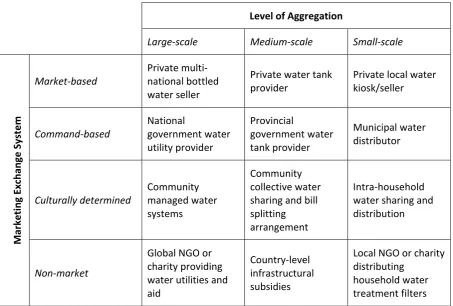
amalgamated hybrid system. Regardless of its structure the analytical benefit of specifying and evaluating each type of system is that it highlights key features as to the behaviours of willing exchange partners (micro-level), the institutional frameworks that facilitate the exchange (meso-level), and consequences of the exchange on societal wellbeing (macro-level); all of which would not be evident through a traditional demand analysis. Examples of different types of water exchange systems which reside within individual archetypes are shown in Figure 1.
Market-based exchange systems
market-based exchange is a way to access goods or services, while from a seller perspective it usually provides an opportunity to pursue economic profit. The market-based exchange system has been criticized in the water and sanitation sector for not being universally inclusive and sustainable, for its relentless drive for profit at any cost, and for failing to adequately address human rights (Davis, 2005). For example, the multi-national bottled water industry, which sells brand-name water in both developed and developing countries, has come under close scrutiny for its exploitative practices (Clarke, 2007), even though it may have achieved some broader social good (e.g., improving health outcomes by selling bottled water in developing countries in areas where the local water source is polluted). Despite much criticism, market-based exchange systems operate widely across the water sector - from small-scale water kiosks to large-scale multi-national bottled water sellers.
Command-based exchange systems
A command-based exchange system occurs when an authority (often governments or regulatory authorities) provides goods and services through a regulatory institution that pursues a provision motive rather than a profit motive. The goal is often to ensure the health and well-being of a population by ensuring their right to water is upheld. However, in pursuing a non-profit motive, this system has been criticised for not providing people with an optimal range of choices (i.e.,
assortments), not fully engaging recipients in the decision making process, and for being rigid and bureaucratic with low responsiveness to local economic and social dynamics (Mitlin, 2004). In the water sector, command based exchange systems range from local government provision of water (e.g., community boreholes or wells) to large-scale water supply infrastructural projects. In addition, command-based exchange systems can involve water authorities that regulate environmental water flow so as to provide ecosystem services (Commonwealth of Australia, 2007).
Culturally determined exchange systems
A culturally determined exchange system occurs when the provider and recipient enter into an exchange relationship primarily sanctioned by social traditions and norms rather than by economic institutions (Thapar, 1987). Given its culturally rooted motivations of reciprocity and locally
equitable redistribution of resources (Layton, 2007), a culturally determined exchange system tends to produce some collectively beneficial outcome, rather than purely an individual gain (Levy and Zaltman, 1975). For example, in rural areas a community-scale water system may be maintained by an elected committee of representatives with the aim of providing all villagers with access to sufficient water resources. Alternatively, in informal settlements of some of the rapidly growing cities of the world, it is common to see households splitting their water bills with other households. This is potentially a win-win outcome in that the water on-seller shares fixed costs, while the recipient overcomes their difficulties to access or pay for individual water supply connections.
Non-market exchange systems
Level of Aggregation
Large-scale Medium-scale Small-scale
Ma rke ti n g E x ch a n g e S y st e m Market-based Private multi-national bottled water seller
Private water tank provider
Private local water kiosk/seller Command-based National government water utility provider Provincial government water tank provider Municipal water distributor Culturally determined Community managed water systems Community collective water sharing and bill splitting arrangement
Intra-household water sharing and distribution
Non-market
Global NGO or charity providing water utilities and aid
Country-level infrastructural subsidies
Local NGO or charity distributing
[image:5.595.67.521.89.395.2]household water treatment filters
Figure 1: Examples of water exchange systems
4. Integration of multiple exchange systems
In reality, even in the simplest of cases, water exchange systems are likely to be complex hybrid systems. This section provides practical examples of water exchange systems and highlights how multiple forms of exchange can be involved in the provision of water from source to use.
Example 1: Water Marketing Exchange System in Greater London, U.K.
Public water supply in the Greater London area is provided to households at a retail level by private companies (i.e., a market based exchange between retailers and consumers); however, the price is regulated by the Office of Water Services, a government authority, (i.e., a command based exchange between regulator and retailers), resulting in a hybrid command-market exchange system (OFWAT,
2014). See Figure 2. T
Figure 2: The relationships between water exchange partners in Greater London, U.K.
Example 2: Complex Source-to Use Water Exchange Systems
In peri-urban Honiara, Solomon Islands, the authors have observed a complex system where all four marketing exchange systems are involved in providing households with water. The following explains how such systems can arise, particularly in low income settings.
Often water utilities serve high-density urban centres through command-based exchange systems mandated by government regulations. However, while one part of an urban centre may receive water through pipes plumbed into houses, another part (e.g., an informal settlement) may only be provided community-scale taps susceptible to uncertain water flow and breakdowns. In the latter context, the under-met need for water has stimulated local entrepreneurs in some cities to become informal water traders through running private trucker or tanker services or water kiosks (i.e., market-based exchange systems). For example, the size of the informal water market in Luanda, Angola in sub-Saharan Africa is estimated at $250mn a year (Cain, 2014). The command and market systems produce their own assortments. The latter sometimes contain more numerous member products, as multiple providers can be involved (Ahlers, Schwartz and Guida, 2013b), which speaks to the breadth of its assortment; on the other hand, its pricing may be exorbitant and exploitative, denting its ability to be inclusive or enhance the quality of life of the community.
Such a situation has also arisen in peri-urban settlements where command-based water systems are unable to reach all consumers (Njiru, 2004). Here water utilities sometimes unofficially rely on
small-scale informal providers (SSIP) (Solo, 1999) an
unofficial hybrid exchange system. If the safety of water provided by the SSIPs becomes problematic, the utilities may choose to formally sub-contract them, thus moving to an official hybrid command-market exchange system where the utility can regulate the water quality. In such a case, the prices of SSIP services are regulated by the command based portion of the system, but the assortment presented to consumer households remains in the market based portion.
be more affordable per se). In such cases, those households with reliable water supply (such as a
emand,
and may either re-sell their water (a community-scale market-based exchange system) or engage in a culturally determined exchange system such as splitting bills with their neighbours. To add complexity, in some instances households have a water connection or tank which they have acquired through a non-market exchange mechanism. For example, it may have been donated by a local politician.
[image:7.595.71.519.283.520.2]Our example from the Solomon Islands highlights how all of these exchange systems can come together to provide a single household with water (Figure 3). In a particular informal, peri-urban community, some households split water bills with a neighbour as part of a culturally determined exchange system, where their neighbour received the tank as part of a non-market exchange system, where their water is provided by a small scale provider working within a market based exchange system but sub-contracted by a utility in a command based exchange system.
Figure 2: The relationships between water exchange partners in some parts of peri-urban Honiara, Solomon Islands
5. Conclusion
The global debate around water supply systems has alternatingly supported private versus public water management, and more recently hybrid public-private partnership methods. However, such analysis, which is focused on governance and control issues, can obscure the nuanced nature of water demand, and not adequately consider the goal of achieving universal sustainable and equitable access to water services.
private. The subjects of analysis become the identities, behaviours, roles and relationships of exchange partners, the exchange flows they generate, the institutional frameworks within which they act, and the consequences such water provision systems bring about to the quality of living of communities.
We have also described and illustrated four water exchange systems types. It is unlikely that a single form will be a panacea to the global water management crisis; it is therefore unhelpful to engage in
debate around which exch I
analyse the functioning of existing systems using this analytical frame, and generate new insights into how the four system types can be constructively combined to provide water in a way that is responsive to needs and wants whilst moving towards universal equitable access.
Our premise is that water demand is a complex, multilayered concept. This demand may not even be about water per se, but rather about what the availability of clean and safe water enables people to achieve such as avoiding disease, enjoying better health and well-being, and achieving economic progress. Hence it is imperative that water exchange systems are designed to generate innovative and adaptive water assortments that are economically, socially, and environmentally enriching within the context of individual countries and communities.
Suggested Key Readings
C J C
Water International, Vol. 29 No. 2, pp. 138-147.
L ‘ A F G A C M “ Journal of Macromarketing, (in press) DOI: 10.1177/0276146714550314.
Mankiw, N. G. (2014). Principles of microeconomics. 7th Edition, Stamford, CT. Cengage Learning.
References
Ahlers, R., Guida V. P., Rusca M. and Schwartz K. (2013a), "Unleashing entrepreneurs or controlling unruly providers? The formalisation of small-scale water providers in Greater Maputo, Mozambique", Journal of Development Studies, Vol. 49 No. 4, pp. 470-482.
Ahlers, R., Schwartz K. and Guida V. P. (2013b), "The myth of 'healthy' competition in the water sector: The case of small scale water providers", Habitat International, Vol. 38, pp. 175-182. Alderson, W. (1965), Dynamic Marketing Behavior: A Functionalist Theory of Marketing, R.D. Irwin,
Homewood, IL, U.S.A.
Bagozzi, R. P. (1978), "Marketing as exchange: a theory of transactions in the marketplace", American Behavioral Scientist, Vol. 21 No. 4, pp. 535-556.
Bakker, K. (2007), "The "commons" versus the "commodity": Alter-globalization, anti-privatization and the human right to water in the global south", Antipode, Vol. 39 No. 3, pp. 430-455.
C A T C C W M Development Workshop, Angola (http://www.dw.angonet.org/content/water-sanitation - accessed Oct 15, 2014) Clarke, T. (2007), Inside the bottle: An exposé of the bottled water industry, Canadian Center for
Policy Alternatives, Ottawa, Canada.
Commonwealth of Australia (2007) Water Act. Basin Plan. Canberra, Australia.
Davis, J. (2005), "Private-sector participation in the water and sanitation sector", Annual Review of Environment and Resources, Vol. 30 No., pp. 145-183.
Hunt, S. D. (1983), "General theories and the fundamental explananda of marketing", The Journal of Marketing, Vol. Fall No. 47, pp. 9-17.
Kotler, P. (1972), "A generic concept of marketing", The Journal of Marketing, Vol. 36 No. 2, pp. 46-54.
Layton, R. A. (2007), "Marketing systems A core macromarketing concept", Journal of Macromarketing, Vol. 27 No. 3, pp. 227-242.
L ‘ A F G A C M “ Journal of Macromarketing, (in press) DOI: 10.1177/0276146714550314.
Levy, S. J. and Zaltman G. (1975), Marketing, society, and conflict, Prentice Hall, Englewood Cliffs, N.J., U.S.A.
Marks, S. J. and Davis J. (2012), "Does user participation lead to sense of ownership for rural water systems? Evidence from Kenya", World Development, Vol. 40 No. 8, pp. 1569-1576. Mitlin, D. (2004) Competition, regulation and the urban poor: a case study of water. In: Cook, P.,
Kirkpatrick, C., Minogue, M. & Parker, D. (eds) Leading Issues in Competition, Regulation and Development. Manchester, U.K.: Centre on Regulation and Competition, Institute for
Development Policy and Management, University of Manchester.
Njiru, C. (2004), "Utility-small water enterprise partnerships: serving informal urban settlements in Africa", Water Policy, Vol. 6 No. 5, pp. 443-452.
OFWAT. 2014. Regulating the Industry [Online]. Available: http://www.ofwat.gov.uk/regulating/. Solo, T. M. (1999), "Small-scale entrepreneurs in the urban water and sanitation market",
Environment and Urbanization, Vol. 11 No. 1, pp. 117-131.
Thapar, R. (1987), "Cultural Transaction and Early India: Tradition and Patronage", Social Scientist, Vol. 15 No. 2, pp. 3-31.
United Nations Department of Economic and Social Affairs. 2014. Outcome Document - Open Working Group on Sustainable Development Goals [Online]. United Nations Department of Economic and Social Affairs. Available:
http://sustainabledevelopment.un.org/focussdgs.html [Accessed 3rd September 2014]. Vorosmarty, C. J., McIntyre P. B., Gessner M. O., Dudgeon D., Prusevich A., Green P., Glidden S.,
Bunn S. E., Sullivan C. A., Liermann C. R. and Davies P. M. (2010), "Global threats to human water security and river biodiversity", Nature, Vol. 467 No. 7315, pp. 555-561.