Theses Thesis/Dissertation Collections
9-21-2015
Expanding Dimensionality in Cinema Color:
Impacting Observer Metamerism through
Multiprimary Display
David L. Long [email protected]
Follow this and additional works at:http://scholarworks.rit.edu/theses
This Dissertation is brought to you for free and open access by the Thesis/Dissertation Collections at RIT Scholar Works. It has been accepted for inclusion in Theses by an authorized administrator of RIT Scholar Works. For more information, please [email protected]. Recommended Citation
Expanding Dimensionality in Cinema Color:
Impacting Observer Metamerism through Multiprimary Display
David L. Long
College of Science Program of Color Science Munsell Color Science Laboratory
Ph.D. Dissertation
A dissertation submitted in partial fulfillment of the Requirements for the degree of Doctor of Philosophy
In the Program of Color Science
Expanding Dimensionality in Cinema Color:
Impacting Observer Metamerism through Multiprimary Display
David L. Long
B.S. University of Texas at Austin, 1997 M.S. University of Rochester, 2001
September 21, 2015
Signature of the Author ____________________________________________
Accepted by _____________________________________________________
Director, Ph. D. Degree Program Date
David L. Long
Expanding Dimensionality in Cinema Color: Impacting Observer Metamerism through Multiprimary Display
Advisor: Mark D. Fairchild Committee Chair: David Ross
Committee Members: Jeff Pelz and Elena Fedorovskaya
Rochester Institute of Technology
College of Science 1 Lomb Memorial Drive Rochester, NY 14623
COLLEGE OF SCIENCE
ROCHESTER INSTITUTE OF TECHNOLOGY ROCHESTER, NEW YORK
CERTIFICATE OF APPROVAL
Ph.D. DEGREE DISSERTATION
________________________________________________________________
The Ph.D. Degree Dissertation of David L. Long Has been examined and approved by the
Committee as satisfactory for the Dissertation required for the Ph.D. degree in Color Science
_________________________________________________ Dr. David Ross, Committee Chair
_________________________________________________ Dr. Mark D. Fairchild, Dissertation Advisor
_________________________________________________ Dr. Jeff Pelz, Committee Member
_________________________________________________ Dr. Elena Fedorovskaya, Committee Member
Abstract
Acknowledgement
Completion of this dissertation has been a long journey, balanced carefully with requirements and expectations of serving as a full-‐time faculty member in the School of Film and Animation at Rochester Institute of Technology. Without the steadfast support of many dear colleagues and family, the task would have been impossible. I would like to acknowledge, first and foremost, the support of my advisor, Mark D. Fairchild, who contributed innumerable hours of consultation and support. His excellent ideas and suggestions for research direction were very much appreciated and unquestionably critical to my success. I am also grateful that he conceded me the opportunity to design a project statement equal parts engineering and science so that I could satisfy each of my academic passions.
Next, I would like to acknowledge the support of my dissertation committee, Drs. David Ross, Jeff Pelz and Elena Fedorovskaya, for their input and contributions to my work. I would also like to acknowledge Dr. Jinwei Gu for service on my committee in its earliest days.
I would also like to thank my fellow faculty and students in the School of Film and Animation who afforded me time and understanding as I balanced these two important endeavors in my professional life. I especially want to recognize the support of Malcolm Spaull, Chair of the School of Film and Animation, for his advocacy in permitting this work to represent my scholarship and academic contributions to the RIT community.
I would like to thank my parents, my wife, Karen, and my children, Morgan and Garrett, for offering me such encouragement and understanding through many long years of effort. In his short eight years, my son has only known me as a sometimes student and a sometimes teacher. This work has been impactful to all of us and they have been my biggest cheerleaders. I am so proud to be a part of my family.
Preface
The current digital transition being experienced by the motion picture industry has afforded effective increased resolution in the domains of time and space, however, comparatively little effort has been put into expanding a rigorous treatment of color. More than 150 years after Maxwell and his contemporaries first proposed the theory of trichromatic color reproduction, all practical motion imaging systems continue to rely on metamerism wherein a particular integrated stimulation of the three cone types found on the human retina is sufficient to reproduce a tenable illusory sensation of color of any real object regardless of higher dimension spectral composition. Such treatments, though effective in a basic sense, fundamentally restrict cinema color reproduction, offering limitations in absolute color accuracy, reproducible color gamut, observer variability and consistency of creative communication.
It is in the vein of controlling a viewer’s experience in cinematic presentations that the topics of observer metamerism, observer variability and spectral video systems warrant extensive research. With the recent emergence of laser cinema projection, ITU-‐R Rec. 2020 broadcast color spaces and advances in high dynamic range displays, the future of color for content producers is potentially bigger than ever, but understanding consequences of such trends for the artist demands careful attention be paid to attributes of both system engineering and human visual behavior.
Within practical cinema applications, relatively little is understood of the magnitude of observer metameric variability in traditional three-‐primary standard and wide-‐gamut imaging systems. As the industry promotes larger colorimetric gamut, however, previous research suggests the consistency of viewing experience amongst a population of observers will suffer. Optimized multiprimary reproduction focused on spectral reproduction accuracy or metamerism reduction may ultimately prove a better answer to enhancing the color experience in future systems. It also promises to open new color management paradigms such as can be used for visual effects compositing of live action and computer-‐generated imagery or for virtual cinematography.
The following dissertation concentrates on the design and construction of an abridged multispectral video display system for evaluating potential improvements in spectral accuracy and observer metamerism versus traditional three-‐channel systems. Work comprises both engineering design and color science investigation to address practical application spaces in cinema color. Fundamental color vision models and observer metamerism metrics are pursued to aid in optimization of the abridged multispectral display workflows. Ultimately, the proposed topic is likely to expand beyond the confines of the dissertation process and yield continued research opportunities within the Program of Color Science and the Motion Picture Science program at RIT. A larger effort to include multispectral video capture and image processing has been envisioned with cursory work also begun. And so intentionally, aspects of this larger effort will also garner attention in the accompanying dissertation, as they are useful in communicating a comprehensive body of work applicable to the topics of observer variability and multispectral video in general.
Contents
Abstract ... i
Acknowledgement ... iii
Preface ... v
Chapter 1 An Introduction ... 1
Chapter 2 Research Objectives ... 7
Acknowledging Context for Displays in the Full Spectral Imaging Chain ... 9
Chapter 3 Literature Review ... 11
Previous Efforts in Multispectral Video ... 13
Capture Spectral Sensitivity Optimization ... 21
Training Set Selection ... 26
Spectral Estimation Algorithms ... 28
RIT Prototype Multispectral Video Camera ... 36
Multispectral Displays ... 38
Driving Multispectral Displays ... 41
Observer Metamerism and Spectral Encoding ... 51
Reducing Observer Metamerism in Multiprimary Display ... 52
Multispectral Image Encoding ... 55
Metrics for Evaluating Spectral Match ... 59
Further Literature Review ... 61
Chapter 4 Literature Influences on Work ... 62
Experiment #1 – Multiprimary Projector Design ... 62
Categorizing Spectral Match / Metamerism Metrics ... 63
Identifying Candidate Projectors ... 64
Determining Optimized Primaries ... 65
Experiment #2 – Observer Metamerism ... 66
Optimizing Observer Metamerism Amongst Various Display Types ... 66
Salience to Current Cinema Trends ... 67
Chapter 5
The Two-‐projector Proof-‐of-‐Concept ... 68
Abstract ... 68
Native Display Models ... 68
Multiprimary Design Objectives ... 70
Building the System ... 73
Results and Discussion ... 74
Baseline Display Characterization ... 75
Verification and Long-‐term Stability ... 77
Primary Characterization ... 78
Filter Selection Models ... 80
Actual Filter Characterizations ... 81
Observer Metamerism ... 84
Conclusion ... 88
Chapter 6 Modeling Observer Variability and Metamerism in Electronic Color Displays ... 89
Abstract ... 89
Color Vision Models ... 89
Observer Metamerism Indices ... 95
Observer Metamerism Simulations ... 99
Conclusions ... 127
Chapter 7 The Seven-‐channel RIT Multiprimary Display ... 128
Abstract ... 128
Trends in the Cinema Space ... 128
Design Methodology ... 129
Optimization Results ... 133
Seven-‐projector MPD Prototype ... 140
The One-‐projector Solution ... 146
Conclusions ... 146
Chapter 8 Validating Observer Metamerism Models and the Multiprimary Display Design ... 150
Abstract ... 150
Review of the Problem Statement ... 150
Other Experiences with Highly Metameric Color Matching ... 151
Experiment Equipment ... 152
Equipment Calibration ... 157
Experimental Procedure ... 159
Results ... 161
Conclusions ... 173
Chapter 9
What We Have Learned ... 174
Contributed Publications ... 177
Epilogue
Potential Future Work ... 179
Chapter 1
An IntroductionElectronic imaging technologies for cinema and television applications have evolved at an impressive pace during the course of the last 20 years. In particular three trends have dominated the story: a move from analog to digital systems, an enhancement of spatial resolution and an increase in framerate. And in each plotline, the fundamental ways in which we interact with motion content have been altered. But while the digital transition has afforded an effective increase in dimensionality in the domains of time and space, color continues to be engineered with deference to the trichromatic theory of human vision. All practical motion imaging systems continue to be founded mostly in device-‐dependent, three-‐channel color spaces with system physics similarly conforming to a three-‐primary or ‘RGB’ model. This simplified treatment, though effective, is necessarily restrictive in light of emerging trends, such as the convergence of live action and computer-‐generated imagery and the expansion of wide gamut display technologies. Full spectral color treatments may render improved realism in digital visual effects and enhanced uniformity of viewing experience across large audiences. Through this work, display of full spectral stimuli will be studied in the context of video applications to identify trends and limitations in spectral reconstruction accuracy and to address issues of observer metamerism. Work in display and visual perception is, further, one fundamental piece of a larger body of study in spectral workflow for cinema, including efforts in capture, color management and creative manipulation.
Advancing digital technologies, though have been purposed to improve the quality of the viewing experience and not just the ubiquity of motion content. Analog standard definition video at 480 or 576 lines of resolution in an interlaced presentation is now consistently replaced by high definition systems at 720 and 1080 lines of progressive scan by broadcasters throughout the world. And consumers are today able to readily invest in systems with even more pixels available for Ultra High Definition Television (UHDTV) video distribution. In the digital movie theater, 2K and 4K systems used for both capture and display allow the cinematic experience to offer something more than general television broadcast. And with standards imposed less rigorously than for broadcasters, higher resolution systems such as FilmLight’s 8K film scanner and Sony’s 8K F65 Digital Cinema camera push the industry towards even higher resolutions. Though there are limits in optics, bandwidth, noise and dynamic range, having more pixels does still sell. So, too, does having more frames. 24 frame per second capture as standardized in 1920s film and accompanying sound equipment remains, for now, the basis for typical creative content generation along with 30 and 60 frame per second video acquisition. However, many are experimenting with deviations from the norm. Peter Jackson produced “The Hobbit” in 2012 at 48 frames per second based partly on the findings of Doug Trumbull and the Showscan system1. James Cameron
promises similar efforts for future installments of the Avatar series. On the display side, higher framerate systems in television sets permit expanded opportunities for advanced image processing at presentation, such as smooth motion estimation in high action content and flicker-‐free stereo modulation for 3D media. The trend has expanded to capture, too, where a number of groups are promoting native 120 Hz recording formats which may take advantage of frame blending algorithms to yield traditional 24, 30 and 60 fps output packages or remain as captured to offer an enhanced temporal texture with minimized motion blur and intermittency artifacts.
not be matches for another observer with slightly different color matching functions or may prove inconsistent even for the single observer as they age. Or increasingly an issue for modulated stereo presentations, a single observer may experience a metameric mismatch between his or her two eyes that inhibits them resolving the binocular fusion illusion in such systems.
The solution to both problems lies, in part, in generating a full spectral-‐based reproduction environment. In the ideal case, narrow bandwidth, high spectral resolution systems would be conceived to accomplish the goals of controllable spectral capture and reproduction of target stimuli. By combining near monochromatic characteristics at a high sample rate across the visible electromagnetic spectrum, many sufficiently complex stimuli could be rigorously rendered. In a practical sense, however, an abridged spectral reproduction model makes more sense in both hardware design and image processing complexity, utilizing capture and display devices whose individual spectral features are purposefully optimized. In order to define terms used consistently throughout this dissertation, such abridged spectral systems with greater than three channels of controllable color are designated multiprimary and are engineered with intent to render explicit multispectral color reproduction objectives.
Successful spectral image reproduction systems require both image capture and reproduction devices capable of characterizing and representing real world scene spectra across a wide range of the spectral gamut. The intent of multispectral capture is to either directly or indirectly collect energetic profiles of scene objects under native illumination and to convey those profiles to an appropriate storage or display system. Motion-‐imaging systems are expected to accommodate dynamic image content often with non-‐uniform mixed-‐source lighting and with challenging high contrast ratios. Further in video applications, this must be accomplished for each pixel in each frame of a motion sequence. For spectral capture, conventional trichromatic integrating cameras can either be engineered to deliver intermediate predictions of statistical spectral behavior necessary for pixel-‐by-‐pixel spectral estimation or in a more rigorous treatment may be replaced by a much higher dimension full spectral sampling with potential temporal or spatial overhead. Other solutions invoke prismatic beam splitters and generate high spatial resolution RGB images concurrently with high spectral resolution signals at a much-‐reduced spatial sampling to be recombined in post-‐processing. Reasonably adequate systems for generating multi-‐spectral image data have been demonstrated by a number of researchers for both still and motion applications2.
carries the dubious task of physically re-‐creating the enormous spectral gamut present in the natural world. As stated, most reproduction devices rely on colorimetric matches with finite primary sets rather than attempting to actually reconstruct full spectra. Emissive electronic display systems have historically provided very little value to the spectral reconstruction problem as optics and image processing requirements make high primary count systems impractical. Further, current industry motivations behind newer display types lie heavily in expanding colorimetric gamut via increasingly monochromatic primaries (such as found in laser-‐based projectors) though some groups such as Sharp3, Texas
Instruments4 and the Natural Vision Project5 , 6 have promoted larger gamuts
through adding more primaries to the standard RGB set. In these multiprimary devices, great care is taken with advanced color management when the display primaries no longer conform to the spectral sensitivities of the image capture device or when there is a mismatch in number of color channels between capture and display (requiring effective management of degrees of freedom). Reflective spectral attenuation systems such as those found in traditional photographic media, print media or colorant mixing (paints, textile dyes/pigments, etc.) have provided promise for static spectral re-‐creations, as high primary count designs are more attainable and cohesive color mixing is generally more trivial in the limit of cooperative material properties. A multispectral video system demands the flexibility of optimized multiprimary designs be expanded to an emissive display architecture with a high framerate refresh.
One complication most visual artists are complacently ignorant of is the exact impact of physical and perceptual phenomena on visual appearance differences between scene and screen. As the artistic vision is refined somewhere on a well-‐ illuminated set, motion imaging systems must be carefully engineered to account for predictable alterations in appearance during the transfer of captured images to the mastering and exhibition environments. After all, it would be unfair to ask the colorist to efficiently execute manipulations for viewing condition differences in addition to aesthetic treatments, especially if he or she were not able to be present on the set to see the original stimuli. And in the case of film-‐based systems, the color controls available in a traditional optical printing workflow wouldn’t provide near the necessary power if fundamental reproduction appearance requirements weren’t built into the media itself. Just as trichromatic motion imaging systems have been designed carefully to account for physiological and psychophysical visual phenomena across different viewing environments, multispectral image content should similarly provide color appearance accommodation in any future workflow.
Spectral content can be compatible with current best practices in image manipulation but also provide added flexibility and benefit. Multispectral capture is one key to more photorealistic compositing of live action and computer-‐generated content. Advanced digitization strategies for recreating virtual models of actor’s facial features are already enabling enhanced visual effects work and reducing complexity otherwise required from live action visual effects shots7. Adding
multispectral data to the simulation environment can permit seamless alteration of virtual lighting and surface reflectivity once the virtual actors are placed in the computer graphics (CG) environment. For example, an actor who sits to be digitized using a traditional three-‐channel imaging system has his skin tones forever simplified to the metameric response defined by the camera’s spectral sensitivities. Trichromatic manipulation in the virtual system may not be faithful to the actual color rendition changes accompanying a lighting change on set. If the virtual actor is to be spatially intercut with other objects captured in live action across multiple lighting setups, the spectral representation permits more realistic and seamless color reproduction.
of the camera itself can be faithfully represented in rendered footage. The astute director of photography who chooses an Arri or Red camera for their engineered color reproduction on a real set could retain that benefit even on the virtual set.
Electronic multispectral displays could better emulate the color gamut and spectral profiles of motion picture print films than do current standard Digital Cinema Initiatives three-‐primary systems, at the same time reducing observer metamerism. A common issue for any digital intermediate suite is the quality of color match achieved between the digital grading projector and the answer print film projector (where answer print refers to the final color-‐corrected film print approved by the production team during post-‐production mastering). Part of this difficulty derives from the lack of similarity in color gamut and colorant spectral behavior between the two devices. A match meticulously forced for one observer may prove completely different for another. Necessity for color control like this will become even more important as film projection systems manufactured by just a few vendors using a mostly consistent optical design are replaced by a myriad of modulation technologies on the digital side such as laser, LED and LCOS, all with different spectral signatures. Some standards bodies, including SMPTE, are currently contemplating spectral definitions for future display systems as opposed to simple colorimetric definitions.
And finally, allowing colorists control over a multispectral palette affords opportunity for leaps forward in creative color manipulation. As meticulously as a director of photography and art team select wardrobe, makeup and props for explicit color appearance when rendered by the camera and display systems, post-‐ production control of spectral pixels in a color correction session could afford equivalent power in the final mastering. Manipulation of spectral curves rather than trichromatic channel values portends ultimate artistic control over the entire visual experience for filmmakers who work to generate intentional visual stimuli for their audiences.
An expansion of color dimensionality is an obvious and compatible addition to rapidly evolving motion imaging capabilities in spatial and temporal resolution. In the attached dissertation, optimization of an abridged multispectral display will serve to explore one fundamental building block of the multispectral imaging chain. Observer experiences with multiprimary systems will generate fundamental understanding of preferred system architectures for maximizing color gamut, enforcing color accuracy and minimizing observer metamerism and variability. Special emphasis will be placed on building and confirming models of observer color vision and on engineering displayed color stimuli that yield measurable
Chapter 2
Research Objectives
The completed dissertation has concentrated on the design and construction of an abridged multiprimary display (MPD) intended to yield improvements in spectral image reproduction accuracy and a minimization of observer metamerism. The predominant motivation for this focus has come from experiences in the cinema industry with variable interobserver color perception in emerging near-‐ monochromatic display technologies, trends previously predicted by Fairchild and Wyble8. Major phases of the project have included:
1) an investigation of color vision models and color matching function (CMF) variability across color normal observer populations
2) an establishment of interobserver color reproduction quality indices based in both spectrometry and colorimetric metamerism 3) a screening of existing display devices for observer metamerism and observer variability
4) modeled optimization of MPD prototypes intended to minimize observer metamerism against results from phases 1) and 2)
5) the engineering and construction of prototype MPD systems and 6) psychophysics experimentation across multiple display types, intended to confirm models of observer metamerism and variability
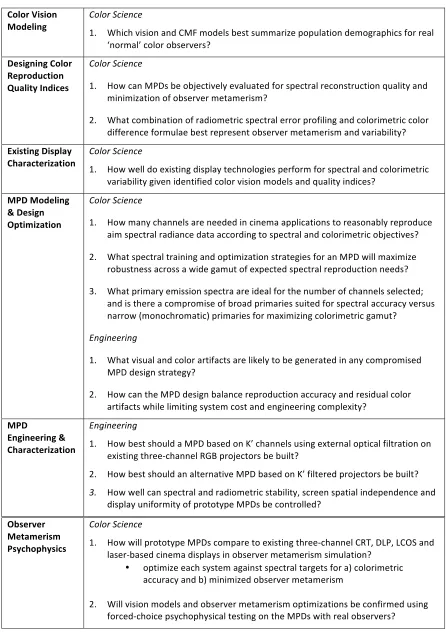
A more detailed summary of the engineering and color science challenges driving the research in these phases is presented in Table 1.
Table 1. Research objectives and associated questions across project phases
Color Vision
Modeling Color Science 1. Which vision and CMF models best summarize population demographics for real
‘normal’ color observers?
Designing Color Reproduction Quality Indices
Color Science
1. How can MPDs be objectively evaluated for spectral reconstruction quality and minimization of observer metamerism?
2. What combination of radiometric spectral error profiling and colorimetric color difference formulae best represent observer metamerism and variability?
Existing Display
Characterization Color Science 1. How well do existing display technologies perform for spectral and colorimetric
variability given identified color vision models and quality indices?
MPD Modeling & Design Optimization
Color Science
1. How many channels are needed in cinema applications to reasonably reproduce aim spectral radiance data according to spectral and colorimetric objectives?
2. What spectral training and optimization strategies for an MPD will maximize robustness across a wide gamut of expected spectral reproduction needs?
3. What primary emission spectra are ideal for the number of channels selected; and is there a compromise of broad primaries suited for spectral accuracy versus narrow (monochromatic) primaries for maximizing colorimetric gamut?
Engineering
1. What visual and color artifacts are likely to be generated in any compromised MPD design strategy?
2. How can the MPD design balance reproduction accuracy and residual color artifacts while limiting system cost and engineering complexity?
MPD
Engineering & Characterization
Engineering
1. How best should a MPD based on K’ channels using external optical filtration on existing three-‐channel RGB projectors be built?
2. How best should an alternative MPD based on K’ filtered projectors be built?
3. How well can spectral and radiometric stability, screen spatial independence and display uniformity of prototype MPDs be controlled?
Observer Metamerism Psychophysics
Color Science
1. How will prototype MPDs compare to existing three-‐channel CRT, DLP, LCOS and laser-‐based cinema displays in observer metamerism simulation?
• optimize each system against spectral targets for a) colorimetric accuracy and b) minimized observer metamerism
have been executed with both simulated and real observers to determine benefits gained by a full multispectral display system versus standard three-‐channel colorimetric systems utilizing both highly saturated primaries such as found in laser displays and more typical ITU-‐R Rec. 709 or SMPTE-‐431 primaries found in DLP and LCOS cinema devices.
Chapter 5 summarizes an initial proof-‐of-‐concept display design based on delivering six unique spectral channels from external filtration applied to two traditional RGB projectors. Chapters 6 and 7 summarize subsequent improvements with a multi-‐projector array and seven individually optimized color channels. Chapter 8 concludes with discussion of psychophysical experiments confirming model predictions and display performance across a population of color normal observers.
Acknowledging Context for Displays in the Full Spectral Imaging Chain Multiprimary display actually sits at the end of the full multispectral imaging chain. Prior to presenting spectral reconstructions using MPDs, stimuli must be first captured and processed. These phases of research are intentionally not part of this dissertation, but it remains of value they be introduced to expand context for the benefits multiprimary display is intended to offer.
The purpose of multispectral capture is to either directly or indirectly collect spectral profiles of scene objects under native illumination and to convey those profiles to an appropriate storage or display system. Example approaches for spectral capture are included in the literature review summarized in Chapter 3, including description of a prototype multispectral video camera designed at RIT during an exploratory pre-‐dissertation phase of this research.
In optimizing a camera design, fundamental color science questions associated with the spectral estimation generated from the capture system must be addressed. These same questions can be extended to interpretation of the rendered display color, too. In the absence of high-‐resolution direct spectral measurement, several compromised reconstruction strategies are possible, optimizing results in either colorimetric, spectral or metamerism indices.
spectral signals only and do all processing on-‐demand for delivery to the display. In other scenarios, conversion and storage of spectral signals to display drive values may be more prudent. These questions are closely aligned with theories of profile connection spaces (PCS) addressed in modern color management research.
This introduction to characteristics of spectral capture and post processing is useful, but as stated, the completed dissertation focuses predominantly on issues of multispectral display only. For the majority of the work outlined, original multispectral content of sufficient quality and accuracy was simulated or assumed available for the display work. Further, offline image processing was employed to render content for visual experiments. Maximum attention is thus given to issues of content preparation and presentation to meet the objectives of multispectral rendering and to address issues of observer variability.
Chapter 3
Literature ReviewMotivations for multispectral imaging systems, complete with strategies for capture, color management and display, have been purported by several researchers for well over a decade now. Hill summarizes the problem statement most succinctly as he outlines the limitations of three-‐channel imaging paradigms that don’t conform to the spectral performance objectives dictated by human color matching functions.9
Trichromatic theory, whether applied to engineered devices or human observers has its foundation in the integrated spectral signature represented in Equation 1. An object with spectral reflectance, R(λ), illuminated by a source with spectral power distribution Il(λ), is spectrally integrated through the sensitivity signature of a detector, SS(λ)k, across k=1…K independent channels of captured
response (where K is most classically 3 but is left generic in this introductory treatment for future multiprimary expansion). After appropriate normalization, hk,
the resulting quantity is generically dubbed tristimulus, Wk. A more specific
replacement of SS(λ)k with the CIE 1931 2° standard observer color matching
functions (or any other appropriate observer color matching function) yields XYZ
tristimulus values. Likewise, individual observer signal responses in the three primary cone types, LMS, are specified when SS(λ)k are replaced by l(λ) m(λ) and
s(λ) cone fundamentals. For film or digital image capture systems, insertion of the device’s spectral sensitivities generates quantities indicative of the captured energy signal at a specific position on the image plane in each channel. And in digital systems in particular, hk may be set variable across the response channels and even
across the spatial domain in a frame, allowing for an equalization of the channels relative to a perfect white reflector with R(λ) = 1.0 at all wavelengths (white balancing) and/or for accommodating hardware response non-‐uniformities.
W! =h! !!"#𝐼𝑙(𝜆)∙𝑅(𝜆)∙𝑆𝑆 𝜆 !𝑑𝜆 !!"#
(1)
unnecessary for delivering an equivalent interpretation of the stimuli. This is especially useful in both soft-‐copy and hard-‐copy image display where the spectral characteristics of colorants used in either additive or subtractive mixing models do not afford a precise spectral match to the target. As Hill points out though, this also leads to several failure modes in the metamerism model.
As an elementary example, presume the goal of a designed image capture system is to mimic the responsivity of the 1931 2° standard observer or a simple linear combination thereof, an approach referred to generically as the ‘Luther’ condition, named for German physicist, Robert Luther. To accomplish this directly, the capture system should possess SS(λ)k which are equivalent to either the
standard observer’s color matching functions or linearly related cone fundamentals. As both of these responsivity sets are physically realizable, appropriate optical filtration could theoretically be designed to accomplish the objective. In fact, this is the typical design strategy for three-‐channel colorimeters used routinely for scientific and technical color measurement. However, the nature of human color vision is such that the integrated tristimulus signals from this model in three channels must be paired with rendering or display primaries that are radiometrically non-‐realizable if a direct full gamut reconstruction is desired. Peculiarities of the linear transforms involved in human color matching dictate that primary spectra directly driven from either XYZ or LMS must have negative energies in some portion of their spectral signatures in order to properly represent a metameric match to target stimuli captured via these sensitivity functions.55
When direct capture of human tristimulus signals becomes imprudent for practical display processing, imaging system designers typically look to compromises employing minimal color processing between capture and display. In particular, device responsivities may be chosen which are color matching functions of a chosen set of display primaries, though in a three-‐channel system there are no such choices where both sensitivity functions and primary spectra are all positive and realizable. This is further indication of a gamut mismatch between capture and display design when only three channels are employed. The result is that real function shapes are designed and related by statistically optimized color processing transforms instead, typically 3x3 matrices or more customized 3-‐dimensional look-‐ up tables. The specification of colorimetric video cameras employing ITU-‐R Rec. 709 encoding characteristics and intended for display on sRGB additive displays are famously described in this approach.10 Further, Hill summarizes that electronic
The primary consequence of spectral responsivity compromises in real image capture equipment is that these systems are prone to failures of metamerism. In particular, multiple spectral stimuli which may integrate via Equation 1 to equivalent tristimulus signals for the standard observer may not yield equivalent response for a capture system with sensitivities that aren’t linear combinations of the CIE color matching functions. Of course, the reverse scenario is also true where a camera system may fail to exhibit discrimination amongst a series of color targets that are different in appearance to the standard observer. Metamerism failure may also manifest as a function of illuminant. A particular pair of color targets may match for a given detector’s response under one illuminant but not another. Finally, presumption that the standard observer represents all human response functions can cause significant issues. Just as a camera system may fail to metamerically coincide with the response of the standard observer, real human observers vary significantly in their spectral response characteristics. These variations have been studied extensively with some success found in systematically characterizing average differences as a function of observer age and field-‐of-‐view11 and other
models based on large sets of collected physiological data76. Of course, even studies
such as these can only claim to summarize the mean trends in human observers, recognizing there are still unique results found throughout real populations.
Previous Efforts in Multispectral Video
Perhaps the most comprehensive collection of efforts in generating a working multispectral capture and display system for video applications to date can be attributed to the Akasaka Natural Vision project in Japan, a joint effort of the Tokyo Institute of Technology and the Japanese Ministry of Internal Affairs and Communication along with other industrial and academic partners.12 Between 1999
and 2006, the Natural Vision laboratory tackled several issues of multispectral system engineering design, signal encoding, signal transmission and color science, publishing numerous significant findings. The group also built several working prototypes to confirm design principles and generate practical data.
through an optical assembly with optimized spectral responsivities. Spectral radiance, reflectance or transmittance information is then preserved via a spectral profile connection space, compatible also with more traditional colorimetric image encoding schemes. Spectral signatures are reconstructed pixel-‐by-‐pixel to a multiprimary projection system capable of delivering higher spectral accuracy versus target stimuli, a larger colorimetric gamut, reduced observer metamerism or a co-‐optimized response of all three. The system may also be engineered to deliver a prediction of object colors under alternate illuminants by combining reflectance estimation with a new user-‐defined observation illuminant, a process referred to as “illumination conversion.”
The primary Natural Vision still camera is a 16-‐band tunable filter-‐based system with a monochrome sensor. Calibration procedures include white balancing the spectral bands against a perfect reflecting diffuser and correcting for non-‐linear optoelectronic transfer functions and black signal bias. Despite tunable spectral accuracy from the filter wheel design, the camera is subject to notable issues with field uniformity and peripheral image accuracy. Further, mechanical lag during the collection of the 16 successive image channels is sufficient that motion blur and registration errors upon interaction with moving scene content would be unacceptable. Thus in a second system used for motion applications, a simultaneous multichannel capture design is implemented13. Two three-‐band HDTV CCD cameras
are connected by way of an optical splitter and custom interference filtration in each camera path modifies the native spectral responses of the sensors to generate 6 specific spectral sensitivities, see Figure 1. Knee and gamma functions are turned off
in each camera to yield 10-‐bit linear exposure signals over 4:4:4 HD-‐SDI connections. The signals are recorded in twin synchronized video streams to solid-‐ state media.
For initial evaluations of the six-‐channel camera, colorimetry predictions were employed to determine improvements over a single native three-‐channel HDTV camera. Using a forward model for the three and six channel camera signals, exposures for the 24 Macbeth Color Checker patches illuminated by daylight, incandescent and fluorescent sources were simulated and conversion matrices of appropriate dimension to CIE tristimulus values were constructed using least squares linear estimation. Nine matrices were built for each camera system employing capture simulation under each of the three taking illuminants further used to independently predict the standard colorimetry under the same three illuminants, with off-‐diagonal permutations intended as illuminant conversion transforms. In all nine scenarios, the six-‐channel system with a typical average ΔEab
<1 well outperformed the native three-‐channel camera with average ΔEab between
2.0 and 4.0. Of some concern, however, is the spatial nonuniformity in the Natural Vision design. Angular dependencies in the interference filters and optical path contribute to color prediction differences in the corners of the frame as high as 4.0 ΔEab units when compared to a baseline frame-‐central reading.
Simple colorimetric prediction from the six-‐channel camera is impressive in the Natural Vision video system but is not sufficient to accommodate more serious spectral reproduction goals. For this, full spectral estimation is required. To capture information on spectral radiance as well as reflectance or transmittance, the ambient illumination spectra may be captured either through the cameras themselves or by way of external spectroradiometric measurement. Once collected, several spectral estimation techniques can be applied to the data in post-‐processing though the Natural Vision project team suggests the best success is found by using careful training target sets and Wiener estimation. Where training is impractical, a first-‐order Markov process provides fair accuracy for natural object spectra containing reasonably smooth spectral profiles. Unfortunately, many of these approaches to full spectral estimation cannot be implemented in real time for HD video signals.
system, but the Natural Vision team argues for more flexibility in color reproduction by expanding the gamut through additional control vertices in color space. In particular, the colorimetric gamuts of real surface colors summarized by Pointer14
and the SOCS database15 are more efficiently encompassed by the multi-‐primary
design. Further, generating tristimulus matches to target colors with >3 primaries affords co-‐optimization in several supplemental areas thanks to excess degrees of freedom, including device energy consumption, observer metamerism and spectral reconstruction.
Independent of capture, driving the multiprimary display requires either K-‐ to-‐K’ or N-‐to-‐K’ transforms (where K’ is the number of multiprimary display channels, independent of captured or encoded channels, K, and N is target encoded spectral resolution), necessary to communicate color signals to the screen. In either case, implementation complexity and processing overhead must be evaluated in practical applications, especially for video. For traditional three-‐channel colorimetric encoding, the over-‐specified problem described for a multiprimary display affords flexibility in designing 3-‐to-‐K’ processing to accomplish specific system goals such as power savings or rudimentary observer metamerism accommodation. Another such computational flow incorporating the six-‐channel HDTV camera and colorimetry prediction matrices described previously is summarized in Figure 2. Here, the camera signal is translated to an efficiently
encoded all-‐positive colorimetric space (XYZ or large-‐gamut RGB) that comprises traditional 10-‐bit video packing. This calculation requires a 1-‐dimensional look-‐up table to account for camera opto-‐electronic transfer function and black bias followed by the 6x3 colorimetry matrix. In the Natural Vision examples, these matrices can be customized to predict object colorimetry under either the capture illumination or some secondary illumination declared for illumination conversion. For display, a 3D LUT is implemented to pre-‐calculate six-‐channel outputs from three-‐channel input according to one of several proposed methodologies. This LUT is preceded by a 10-‐bit to 8-‐bit conversion LUT and followed by display transfer function LUT to generate device drive values. Video processing through the LUT may then progress in real time though colorimetric errors do manifest in the system as a function of digital quantization in the signals and low node counts in the 3D LUT lattice16,17. For alternate deliverables from spectrally defined target colors in N
wavelengths, spectral approximations are engineered while concurrently minimizing standard observer colorimetric error. This approach has proven to further reduce observer metamerism in controlled experiments but, again, not at video framerates in the Natural Vision work18. Expanding a full spectral estimation
Figure 2. Real-time video processing for 6-channel HDTV camera and 6-channel display employing illuminant conversion matrices and colorimetric interchange (reproduced from Yamaguchi, et al.16)
The Natural Vision image encoding and transmission schemes are careful to offer flexibility of communication in either traditional colorimetric terms or high dimension spectral information, depending on application. Multispectral image data at each pixel and within each frame may be represented in terms of original camera signal, post-‐processed spectral estimation, rendered spectral reproduction or converted display drive signals. The onus for image processing may then be distributed amongst different system components as necessary to accommodate a particular imaging goal.
The proposed color management architecture is summarized in Figure 3 and is
analogous to ICC-‐based systems though with emphasis on a physical model versus an appearance model18. The profile connection space may be colorimetry under a
specify algorithmic treatment for conversion from device data to the spectral profile connection space and may be updated as new methods and models are devised. The color-‐space conversion profile permits user-‐defined rendering objectives from the captured data. For example, image rendering options consistent with this system include:
1. traditional three-‐channel colorimetric reproduction of captured object 2. illumination conversion between capture space and observation space for
specified objects
3. spectral reflectance/radiance reproduction of captured object
4. multi-‐observer colorimetric reproduction (reduced observer metamerism) of captured object
5. general source object spectral analysis
Figure 3. Natural Vision color management architecture (reproduced from Yamaguchi, et al.18)
The challenge of video is especially daunting as, even in three-‐channel paradigms, data rates are extremely high and most often compression strategies are necessary to fit hardware capabilities. When multi-‐channel signals are introduced, the issues are even greater. Figure 4 illustrates the real-‐time processing workflow