Rochester Institute of Technology
RIT Scholar Works
Theses
Thesis/Dissertation Collections
12-16-2014
Exploring Feng Shui: A Real-Time Learning
Experience
Yue Fan
Follow this and additional works at:
http://scholarworks.rit.edu/theses
This Thesis is brought to you for free and open access by the Thesis/Dissertation Collections at RIT Scholar Works. It has been accepted for inclusion in Theses by an authorized administrator of RIT Scholar Works. For more information, please [email protected].
Recommended Citation
Exploring Feng Shui
A Real-Time Learning Experience
Rochester Institute of Technology
A Thesis submitted in partial fulfillment of the requirements
For the degree of
Master of Fine Arts in Visual Communication Design School of Design | College of Imaging Arts and Sciences
Title: Exploring Feng Shui: A Real-Time Learning Experience
Submitted by: Yue Fan
Chief Adviser: Professor Marla Schweppe, Visual Communication Design
Associate Adviser: Professor Chris Jackson, Visual Communication Design
Associate Adviser: Assistant Professor Shaun Foster, Visual Communication Design
School of Design Administrative Chair: Peter Byrne
1
Abstract
Exploring feng shui: The 3D Real-time Experience is an interactive 3D design project that
introduces daily feng shui tips to college students, office workers, and anyone who wants to learn how feng shui can enhance their lives. This project uses Web GL technology that runs on any computer with an up-to-date, modern browser. The user flow is a simple four-step process: “listen,” “observe,” “find,” and “solve.” This is how feng shui masters help people figure out their problems. It is an engaging practice because users become actively involved in the whole problem-solving experience. My goal for this project is to present the principles and rules of feng shui philosophy, as well as its applications in modern interior design and to interpret feng shui through creative interactive experience. I wish that by introducing feng shui to a new western audience, they can benefit from learning feng shui theories and improve their living environment.
Thesis URL: http://fengshuirealtime.com
Keywords
2
Words of Thanks
I greatly appreciate my committee members, Professor Marla Schweppe, Chris Jackson, and Shaun Foster for their expert insight into designing this 3D interactive experience. Also, I want to express my appreciation to classmates and colleagues who were involved in usability testing and interviews, and the
3
Contents
1. Introduction
2. Review of Literature 2.1 Journal 2.2 Books 2.3 Papers 2.4 Articles
2.5 Online Resources 3. Process
3.1 Project Overview 3.2 Project Goals 3.3 Target Audience 3.4 Software
3.5 Programming Languages 3.6 Research
3.61 Design Investigation 3.62 User Interview 3.63 Market Survey 3.64 Definition 3.7 Design
3.71 Concept Design 3.72 UX Design 3.73 3D Design 3.74 Interface Design 3.75 Interaction Design 3.76 Character Design 3.8 Development
3.81 Workflow 3.82 Optimization 4. Summary
4.1 Troubleshooting 4.2 Usability Testing 5. Conclusion
4
Introduction
Feng shui, also known as “Geomantic Omen,” can be translated from the Chinese as “wind and water.” It includes disciplines such as aesthetics, psychology, and environmental science.
For many people living in the digital era, feng shui is a concept that they haven’t read or heard about. It is just known as a very regional culture. But in fact, we all have a basic understanding of feng shui, such as if we want to purchase a townhouse, we know we need to think about the outer environment, the inner room structure, and even the best direction in which to face a desk.
The most basic theory of feng shui is that the arrangement of a person's house is believed to have an influence on the fortune of the family and its offspring. It also provides principles and guidance about avoiding bad energy.
5
Review of the Literature
Journal
Karan, P.p. "Chinese Landscapes: The Village as Place." Journal of Rural Studies: 304-05.
The Chinese have a very distinct understanding of feng shui. This book offers a detailed introduction to the concept of harmony and flow of energies between individuals and their surrounding spaces.
The principles used then are evergreen and provide us with an experience of positive energy as explained by the ancient theories. I got from this book an in-depth understanding of the unique regional culture, lifestyle of Chinese village communities, and the impact of these two factors have on the design and set up of the villages. As far as feng shui is concerned, this book offers
discussions on spatial layout, physical setting, settlement designs, geomantic ideologies, and evolutionary models as portrayed in the featured case studies.
Books
Kennedy, David. Feng Shui for Dummies. Foster City, CA: IDG Books Worldwide, 2001.
Offering simple and easy-to-understand guidance on feng shui principles, this book provides troves of information on making a more positive life. It showcases the relationship between man and his natural surroundings, as well as all that needs to be done to enhance that connection. It offers good guidance on commonly sought after topics such as bad luck, stress reduction, chronic illnesses. The book gave me intense insights into the many ways of dealing with the negative energies of a space, especially those resulting from certain placements of the bathroom or the kitchen. It also offers good direction especially for beginners and carries a lot of basic info on feng shui for those just getting started.
Lam, Kam Chuen. Feng Shui Handbook: How to Create a Healthier Living and Working
Environment. New York: Henry Holt, 1996.
6
Roberts, Stephanie. Fast Feng Shui: 9 Simple Principles for Transforming Your Life by
Energizing Your Home. Kahului, HI: Lotus Pond Press, 2001.
This book outlines some simple ways to access and become aware of the energies inherently present in your environment. It offers solutions to make lives more positive and enriching. The book also offers a brief yet engaging introduction to geomantic omen and offers some effective ways of enhancing the usage of space in the home. Fast feng shui offers the reader a clear and straightforward to using feng shui for improving the energy in life and in home. I found this book to be a well-written guide to the basics, including the Ba Guo energy map and the five elements among many other things. The book also provides practical insights into the nine core principles of feng shui as drawn out by the author.
Papers
Li, Wen Wen. Scientific Evaluation Of geomantic theory And The Study On Utilization In Planning
Of Residence. Beijing University of Technology (People's Republic of China), 2009
This paper provides the reader with in-depth task analysis of residential planning in Beijing. The developers have to work within feng shui constraints as well as the innate properties of the areas, such as the geological, climatic, and ecological living environment present. The aim of this study is to provide an all-inclusive evaluation of the building processes. I learned from this paper that every living environment is intrinsically related to traditional geomantic elements. The paper provided me with an understanding of the way that traditional geomantic theory is collated with the typology of an area to survive through the ages.
Ar ticles
Caroline, Marshall. Chinese Urged to Rely on Communists, Not Witches [Bulldog Edition].
United Press International, May 1986
7
Online Resources
http://www.fengshuidesigns.com/
“Fengshuidesigns.com” is the ultimate resource for beginners on all things related to feng shui. The site explores the origins of feng shui practices and offers its readers tips and techniques to improve their energy balance and flow. It also offers insight into the spread of geomantic practices into the western countries and how it became an important part of interior design practices.
The website is a dynamic teaching resource where I learned about both analytical and intuitive approach to including feng shui in both home and in life. The website offers a lot of freebie educational resources that I benefited from, but there are also educational and training programs available.
http://www.fengshui.about.com/
The number 1 website on Google searches for feng shui, About.com is a comprehensive resource on feng shui, geomantic and a many other related subjects. It offers videos, explanations, simple definitions and links to many other easy-to-understand resources on feng shui. This website provided me with short and to-the-point insights into various facets of feng shui.
http://www.fengshui-doctrine.com/
8
Process
Project Over view
The process includes a 4-phase development process: Research, Design, Develop, and Summarize. Research Design Investigation User Interview Market Survey Definition Design Concept Design UX Design 3D Design Interface Design Interaction Design Character Design Develop Workflow Optimization Summarize Troubleshooting Usability Testing Conclusion Project Goals
1. To present feng shui and interpret it through an exploratory experience.
2. To adapt a case study and focus on content that is relevant to modern daily life.
3. To introduce the feng shui concept to Western audiences, who can benefit from this ancient eastern theory.
4. To focus on the initial ways to connect with people, through aesthetics, play, and subtlety.
Target Audience
My target audience is college students and young white collars who have interests in feng shui or interactive experiences.
There are two reasons for this choice: first, college students and young workers are educated and open to new ideas. They also have more familiarities with games of 3D graphics and are more likely to use advanced browsers like the Webkit. It is easier for them to get started and
learn new things online. Besides, a USA Today survey found that young adults are the most
stressed group of people in western society and I suggest them have much joyful living environments by applying some feng shui tips quickly learnt from this website.
Software
After Effects, Blender, Illustrator, Photoshop, Sketch
Programming Languages
9
Research
D e s i g n I n v e s t i g a t i o n
Information Architecture Analysis
The traditional feng shui websites heavily rely either on category navigation or a search function (sometimes both). The category websites usually have a clean IA (information architecture) and try to provide some related-topic links to keep users browsing longer, but most of the time, the extra content they offer doesn’t meet the users’ needs. Also, the experience of walk-through is a one-way interaction, and visitors cannot actively participate in the learning progression.
On the other hand, the search function websites require built-in knowledge from users. If a visitor comes with limited understanding about feng shui, she will fail to obtain any useful knowledge at the very beginning.
Layout Analysis
Because feng shui is an abstract theory, the websites usually don’t have very creative interface or interactive design. There are usually several relevant images (or irrelevant ones) surrounding each paragraph. But some websites start playing around with the font size and style of the headline and body, which makes the whole webpage’s hierarchy more explicit. Another good solution I have seen is adding videos and quotes.
Content Analysis
Most feng shui websites overuse fancy or special verses, which makes this topic tedious and monotonous. Moreover, the language they are using is more than negative: “Don’t” is one of the high-frequency words found on a lot of sites. Reading these feng shui tips made me feel pressure and fear.
Besides, all the websites seem to want to overwhelm their visitors. The most useful narrative flow is step-by-step input and great storytellers know how to turn an ordinary message into a
suspenseful one by withholding information.
10
U s e r I n t e r v i e wStudying user behavior is of great significance in every design aspect. The purpose of this interview is not to look at individual page designs, which we study through user testing; it is about users' general interests in relation to and attitudes toward the topic of feng shui in general.
In order to get the best results quickly, I asked 20 potential users from my target audience group to take a 10-question online survey. This group covered a range of age, gender, race, and educational background. (Figure 1 User survey I )
Here are several representative questions and responses: 88.9% of respondents are looking for basic feng shui principles first; their main interests in feng shui relate to how this concept can be used in their lives and how it relates to Chinese philosophy. (Figure 2 User survey II )
11
Figure 2 User survey II
Conclusion
Most graduate students, design majors and young white collars know little about feng shui, yet many show interest in and support for its concepts. I worked closely with my target users throughout the project—from outlining initial concepts to prototyping to final development—and stayed focused on how to introduce feng shui to young people.
M a r k e t S u r v e y
Basically, feng shui websites usually have four types of marketing strategy: sharing
non-profit websites; introducing on-site paid courses; selling feng shui products; and offering paid advertising.
For press release and social media, those websites use Facebook, Twitter and Google+. But in general, their Twitter accounts don’t have enough information or retweets.
Definition
Information architecture and overall interface design should be a clean path to follow. For good reason, I value elements like user control, clarity, and consistency. But on the other hand, it should be open to explore. There is no level- complete-required unclear, so users can feel free to dig deeper into the tips they need or are most interested in. In other words, the website will not force users to take in information, but their curiosity will lead them to do so.
12
skim text, so the copy should be written for scanning. Instead of using jargon and gobbledygook language, I want to use familiar words and trails that tell a user he is in the right place.Generally known words will also help with the SEO (Search Engine Optimization) and website promotion in the future.
Based on user interviews and the target audience feedback on the project, there is a need for more engaging interactive elements including case studies, as well as take-away design tips.
From a marketing perspective, this will be a non-profit project that will focus on dissemination of culture and knowledge. In order to drive more traffic, the Facebook page and Twitter account will become active after the website is officially launched.
Design
Concept Design
In its media form interactive websites are not developed for this topic yet unclear: “its” is singular but “websites” is plural. Most of the feng shui websites are not well thought out, or even attractive. The related cultural symbols and patterns tend to be too Asian in style, and with paragraphs of incomprehensible theories, feng shui often comes across as pseudoscience. Ultimately, they all contribute to an obscure learning experience. With my project, Feng Shui Real-time, I want to introduce this theory through storytelling and teach its principles through real-time problem solving, as well as give the user down-to-earth tips.
13
UX Design
Before starting design on the website use flow, I observe lots of videos about how a feng shui master has helped people solve their problems in reality. Usually, a feng shui master gets a request from a client and then entered the house and carefully started searching; finally, he points out the problem he found in the house and provided suggestions.
In this process, I notice several things that are unique and interesting. The feng shui master often chats with the client and gathers more related information about the homeowner, such as occupation, age, and life style. He also has alternative advice if the first could not be adapted.
In addition, professional feng shui equipment includes a compass, a blueprint of the house layout, and finally, a handbook that can be used for reading and taking notes.
Furthermore, the conversations with the homeowner are also a part of the
experience. This experience motivates and sustains the users’ interest and they will be more willing to help the homeowner resolve their feng shui problems.
Greatly inspired by those practices, I abstracted many of the above ideas into my UX design. The website can simulate real-life scenarios, but in an appealing way. First of all, the website should have a 3D environment that users can walk through and look around. The objects that have a feng shui problem should somehow stand out and therefore be easy to find.
Secondly, there would be a virtual homeowner present in each scenario, so users can feel like they are really helping to resolve problems.
Thirdly, once they solve the problems in the home, the users will get special thanks from the virtual characters and the tip will be unlocked and social sharing functions
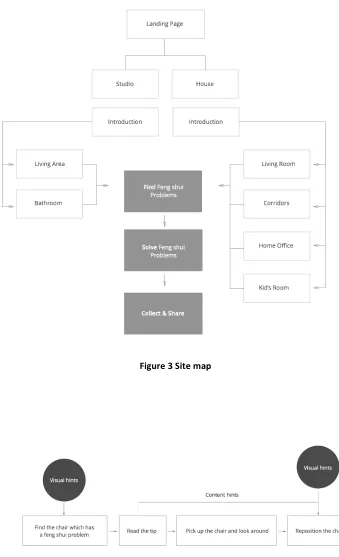
will be activated (Figure 3 Site map).
The most challenging parts in this user experience flow chart are that for some interactions, for example, repositioning an item will take more steps to accomplish than a single click. What can I do to make this process simpler?
For the first question, I decided to break down a large request by letting users take the first small step and them providing enough hints for them to move on. (Figure 4 Feng shui tip-finding process) For instance, a chair blocks the path from a window to a door and windows can be considered as bad feng shui because they chunk the energy flow of the house.
14
Figure 4 Feng shui tip-‐finding process
[image:17.612.157.496.57.614.2]
15
3D Design
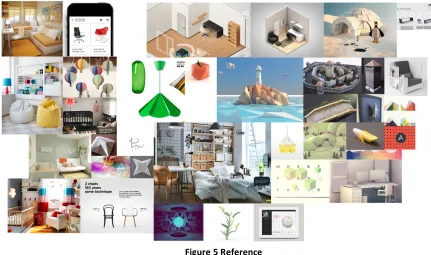
The style of the 3D environment will determine the whole experience for users. Since my target audience and market is Western people, I don’t want to emphasize the Asian style; instead, a more international and modern style environment is what I am going to achieve (Figure 5 Reference).
My expectation is the 3D scene should be aesthetically attractive but not distract users in regard
to the model’s or texture’s details (unless this is a tip that should be noticed).
Modeling
From a design standpoint, high-poly modeling will drive the users’ attentiveness to interior design, furniture design, or in other directions. So mid-low polygon modeling will be more ideal, so that when users see a sofa in my scene, they will be likely to recognize “This is a sofa” rather than compare this model with the one he or she owns.
Furthermore, based on my previous technical research in WebGL, the more faces and texture I have for one loading session, the more time will be needed, and computers with low configuration GPU may cause browsers to crash because they cannot handle that heavy traffic.
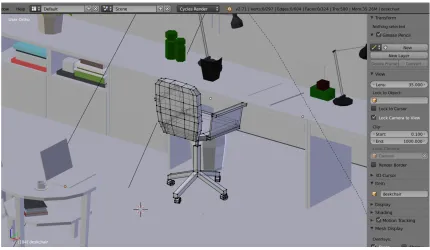
The challenge for low poly modeling is abstraction of objects. I need to represent an item with as few vertices as possible but still ensure that the user knows what it is (Figure 6 Polygon
reduction).
[image:18.612.144.575.176.431.2]
16
[image:19.612.143.573.72.322.2]
17
UV TextureAfter modeling an object, I marked seams and unwrapped UV, then imported it into Photoshop and drew its textures. To keep the low-poly style, usually I used a solid color simple vector drawing texture in place of photo-realistic material.
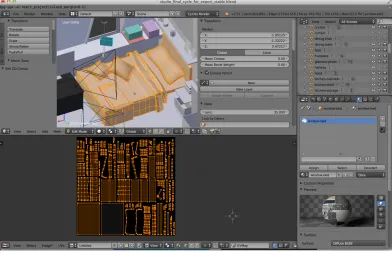
There are several benefits to unwrapping UV manually. I was been able to make full use of space and group the objects in an easy, organized way; faces had more details that can be assigned to a larger area (Figure 7 Smart UV; Figure 8 Unwrapping UV manually).
Figure 7 Smart UV
[image:20.612.159.551.202.455.2] [image:20.612.157.553.481.736.2]
18
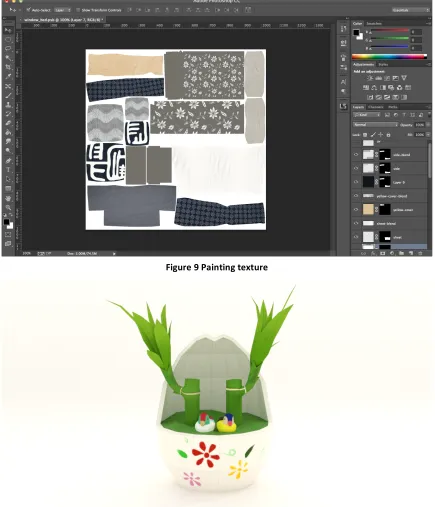
After importing the UV into Photoshop, I started painting the texture based on the UV pattern. Because the object wouldn’t have many details on the mid-poly model, adding more features in the texture process was essential (Figure 9 Painting texture).Another thing that I needed to take note of was the tone a room/house would approach finally: there should always be a main color, a secondary color, and so on. I envisioned the style as universal, so the pattern can be applied to realist Asian style as well as more conceptual generic style (Figure 10 Lucky bamboo render result).
Figure 9 Painting texture
[image:21.612.141.571.213.473.2] [image:21.612.138.573.219.726.2]
19
LightingThe goal is to create an anime-style, non-realistic scene with Blender. Then I needed a lighting arrangement that achieves this goal. The blender internal lighting still looked flat and unrealistic (see left column), lacking the shadows and reflection from other objects even in the simplest of outdoor illumination.
I started trying another lighting solution named “Cycles Render” and it is also notable that the light should be a mixture of ambient occlusion and environment lighting (see right column). The Cycles lighting rending method produces an image by tracing the paths of "rays" through the scene. As a result, the main objects with light source stand out (Figure 11 Cycles lighting).
H e r e
i s
H E
Here is how it works: by connecting the image to the strength input of the background
shaders, it will use those bright pixels of the environment texture (using a sun in the sky) as the strength, meaning the sun is actually brighter than all the other lighting sources (Figure 12 Nodes).
Figure 12 Nodes
[image:22.612.141.564.209.493.2] [image:22.612.141.573.569.701.2]
20
Interface Design
The UI design simplifies the visual elements and user flow. I come up with two basic main page layout designs. The first layout has a two-sided bar (Figure 13 Interface design option 1). The left side bar is a dynamic menu, so when a user hovers over a certain area on the left, the side bar will show up. When a user clicks on a special perspective, the right slide panel with content will appear.
The second layout (Figure 14 Interface design option 2-1, Figure 14 Interface design option 2-2,) gives users more space to explore and have fun—without the left side bar occasionally stretching out and getting so much attention. The simpler reward system encourages users to keep going to resolve all the feng shui problems.
This set of UI designs also combined similar functions in one icon; for example, the navigation cube can help users look around (if the user clicks the sides) as well as observe the whole room in a top view (if the user clicks the top area).
21
Figure 14 Interface design option 2-‐1
22
It was not easy to determine the best direction to go, so I listed all the possible influences and asked 10 potential users to rate them. Here is the result.To sum up, the first version UI design seems more standard and organized, but for this particular 3D experience, it is complicated. If a user wants to check a feng shui object, he needs to click the item in 3D view and then hover to the left side of the screen to activate the design mode (Figure 16 UI Set).
Figure 16 UI Set
23
Interaction Design
Interaction design focuses on how to tell users what to do and keep them on the right track. To begin with, I designed an intro using the loading time, and there will be a short, 5-second tutorial. Users can always review this tutorial during the exploration by clicking on the “info” icon.
The keywords for this interaction design are “hints” and “bonus.” I have three ways to tell people what the feng shui problem is. This first one is using visual indication; for example, in the studio, there is a tip about fruit (Feng shui Tip: fruit represents affluence, so always display the fruit instead of hiding them), and the fruit in now in the refrigerator, so I want users to find the fruit and place it on the plate. So I paint the fruit and the plate, now the plate stands out in the kitchen cabinet, and the user will very likely check this item and then be asked to finish this task.
The second important hint will come from the characters. Using the same example as above, the host of the studio, Jessica, will chat with users about whether they want to share some fruit and mention she has several pieces of fruit in the refrigerator. If users have clicked the plate before, now they have a clear idea about what to do.
Other hints I have are the tooltips visible from the top view (Figure 19 Top view), the process bar (Figure 17 Process bar design), and the feng shui collection book. The top view will reveal the rough location of the tip by showing a lock icon, while the process bar will blink when the user
gets close to a tip. The feng shui book can tell users how many puzzles are still locked (
Figure 18
Feng shui tips collection feng shui is listed as one word in figure
).
How about the bonus? What metric will it add to the whole experience? Obtaining more feng shui in a real case study is the first benefit, and users can also share the unlocked tips with friends through Facebook, Twitter, and Google+. Besides, the homeowner will jump up and express his or her appreciation to the user when the user has finished all the tips in this room.
24
Figure 18 Feng shui tips collection
feng shui is listed as one word in figure
25
Character Design
To make the feng shui 3D experience more engaging, introducing characters into this project was an effective approach. The characters have a welcome page when users enter rooms, a thank you page when users finished all the tasks in the rooms, and during the exploring process, the characters are on the bottom right-hand corner of the screen and will
occasionally “ping” the visitors some hints. Users can click the characters and ask for those clues as well (Figure 20 Characters).
Since I have two main scenes and six areas in total, this is the distribution of the characters.
I considered the way characters speak and behave differently. For instance, the 6-year-old Nick may not know anything about feng shui, so he will only describe his life rather than ask for a suggestion. Because his mother may have more insight about interior design and home decoration, her concern is therefore more sophisticated. These differences can be seen in the language I used in the popups (Figure 21 Characters’ interaction).
The animation of each character has been designed based on their background (age and gender) and the homeowner Scott is a university professor in a department of Mathematics, so he should look thoughtful and conservative.
Figure 20 Characters
26
Development
Workflow
Before any actual programming, I made the decision that Feng Shui Real-time should be made as an open-standard, plug-in, free installation powered by HTML5 and JavaScript, among all the other options like Adobe Flash or Unity 3D, which are plug-in-based and less accessible to web features like social sharing and SEO.
Even though developing a web-based application normally requires HTML, CSS, and
JavaScript, given its complex interactive 3D nature, the making of Feng Shui Real-time involves more tools and technical experiments, as well as some unique workflow compared to the coding on traditional web pages.
27
Unlike Adobe Flash or Unity 3D, the lack of a good IDE (Integrated Development Environment) makes creating high-level 3D content in HTML not as easy or obvious. Fortunately, I’ve found THREE.JS library to be extremely helpful when writing 3D in JavaScript. For example, the easy-to-understand scene graph tells me very clearly about the hierarchy of my 3D scene. Also, there are many helper classes that have made dynamic texturing/shading much easier than dealingwith OpenGL language.
Optimization
Feng Shui Real-time features six interior scenes. In addition to that, there are sounds, background ambient loops, and textural content to load for the whole experience to start. Loading speed had gradually become an issue as the amount of assets reached higher numbers.
An average scene in Feng Shui Real-time is used to load around ten megabytes of content, comprised mostly of high-resolution image textures. And some of them are not compressed as JPEGs, but are .DDS (DirectDraw Surface) files that can be processed as textures by the graphics card faster due to the non-compression format. It is a hard decision to not use DDS just because of the file size, but to balance real-time user experience and network speed, I finally opted to use all JPEGs in order to let the experience start quicker. Additionally, with the compression of nearly lossless quality done by JPEGMini, I am more convinced of the fact that JPEGs are the optimal solution.
28
Summary
Troubleshooting
UX
The question came up whether we should make the clues more explicit by adding more hints or icons. In the end, I decided that the user’s delight in deciphering this visual cue on her own would create a better overall experience.
Visual Design
I also gathered a bunch of problems in visual design either the testing users came up with or by my own findings and redesigned them.
Below is the refined version of the apartment house on the landing page. On the left is a previous version, and the right one is the final one. In the left one, the visual center falls on the city park or the station, but what I should have displayed to the users is the apartment, so I moved around the elements and reorganized the scene (Figure 23 Visual design retouch).
Development
The built-in lighting and shadowing system in THREE.JS are dynamic and can reflect the
changing lighting condition in real-time, which is great on one hand. On the other hand, it can also become very expensive to compute once I throw more objects into the scene, meanwhile
rendering all the shadows of decent qualities. This is a significant trade-off, which does not worth for this real-time experience. The solution I came up immediately is to bake all the shadows onto textures to save precious resources used for computing lightings or shadows.
However, there has been a turnaround on the texture baking process. I have been using Blender Internal, the default renderer of baking for a while. Unfortunately, since Blender Internal is not a physics-based rendering engine, the shaded textures look a little bit dull and do not feel very close to the visual effect I’m after. I had to do a lot of tweaks in Photoshop to make it look better.
29
Starting in July 2014, Blender offered a new baking option called Cycles Baking, which can bake textures of photo-realistic quality using its powerful Cycles rendering engine. The Cycles renderer is based on physics-based lighting calculations. That means the passes we can bake in Cycles are different from what a 3D artist may be used to in the Blender Internal renderer.The output is very satisfying, with the exception of some occasional noises on the baked textures, but this issue can be resolved using Photoshop DeNoise plug-in.
Time Management & Optimization processes
I always tried to optimize the production process throughout the design and development stages. Take the texture baking for example: it is not a one-step task as I previously assumed. There are dozens of 3D models in a scene and it is time-consuming to bake them individually, therefore it is important to group objects and have them baked into shared textures. So here is a problem: many of the UVs unwrapped previously would need to be unwrapped again to fit the different dimensions of new UVs. In order to be more efficient, I developed a better work flow (Figure 24 Materials baking process optimization).
It is equally important to be able to make choices. I abandoned ideas and adopted other ideas as long as this was goal centered and more efficient. For example, in the interactive part my original idea for the observation was that when users rolled over graphics the content could pop out from an individual window. Later I found this lacked interactivity and was hard to realize in coding. Then I switched to another method and made the graphics into buttons in Flash and put the roll-over content in the roll-over state. This decision saved me a lot of time in production.
30
Usability Testing
This contributed to clarifying my thinking and was very helpful in improving the thesis website.
The information architecture and user experience is unique in Feng Shui Real-time. Also, because of its creative ideas and distinctive interface design, I have conducted involved user testing from the very beginning of the project.
The objective of testing is to see if this website has learnability, memorability, and efficiency as well as to ensure that it conveys messages and reduces errors of confusion during the
exploration.
I conducted the usability test with two groups: the select users group and the random users group. Both groups were my target audience. The select group were personal friends who had heard about or been interested in feng shui and were actively searching related content.
Another group was random users who had been found on usertesing.com check URL, who fell into my target audience in the five demographics: gender, age, country, web expertise, and access to high-speed internet and modern browsers.
Seeing real people using Feng Shui Real-time.com let me see where they have problems and how I could make it easier to use. I designed and coded throughout the testing process, and it was very valuable for me to see the difficulties of users navigating the 3D environment in order to figure out which object could be a feng shui tip. I also preferred to observe whether there were inadequate designs or technical bugs rather than ask the users. I especially paid
attention to the moments of pause when users were wondering what to do. Additionally, I took notes and evaluated suggestions that might lead to enhancements to improve the website within the allowable time.
31
Conclusion
Through exploring the feng shui topic and making it alive by this interactive experience, I have learnt a lot in regards to studying and extracting the core concept of this theory, as well as choosing proper design elements, and user experience flow to make the learning process more engaging.
In the future I would like to further sharpen the details and send this project to the interactive design awards. I will have a link to the website on my personal portfolio website
(http://graceux.com).
32
Bibliography
Lam, Kam Chuen. Feng Shui Handbook: How to Create a Healthier Living and Working
Environment. New York: Henry Holt, 1996.
Anderson, Stephen P. Seductive Interaction Design: Creating Playful, Fun, and Effective
User Experiences. Berkeley, CA: New Riders, 2011.
Luppa, Nicholas V.Interactive Design for New Media and the Web. 2nd ed. Boston: Focal
Press, 2001.
Lin, Larry. Designing and Developing Multimedia: A Practical Guide for the Producer,
Director, and Writer. Boston: Allyn and Bacon, 2001.
33
Appendix 1 Thesis Proposal
Thesis Proposal for the Master of Fine Arts Degree
Rochester Institute of Technology College of Imaging Arts and Sciences School of Design
Computer Graphics Design
Title: Exploring Feng Shui: A Real-Time Learning Experience
Submitted by: Yue Fan
Date: Oct 9, 2012
Thesis Committee Approval:
Chief Adviser: Marla Schweppe, 3D Digital Graphics / Design
Signature of Chief Adviser Date
Associate Adviser: Professor Chris Jackson, Computer Graphics Design
Signature of Associate Adviser Date
Associate Adviser: Assistant Professor Shaun Foster, Computer Graphics Design
Signature of Associate Adviser Date
School of Design Chairperson Approval:
Chairperson, School of Design: Patti Lachance
34
Thesis Proposal for the Master of Fine Arts Degree
Exploring Feng Shui: A Real-Time Learning Experience
By Yue Fan
Abstract
The Visual exploration in feng shui is an interactive graphic design project, including personal interpretation and analysis. My goal for this project is to explore the history, principles, and basic rules of feng shui, as well as its applications in modern society. The interpretation will be
presented as creative interactive graphic solutions based on traditional theory and individual illumination. I will create several topics and interactive experiences about principles that allow this ancient Asian theory to be visualized using modern technology.
Problem Statement
Feng shui can be translated as” Wind and Water” in Chinese.
It includes multiple disciplines, such as aesthetics, psychology, and environmental science.
Design competition in feng shui websites is not very strong. There are several reasons for this. To begin with, the layouts are not attractive. Traditional elements are not properly used, full pages of incomprehensible theory make feng shui like a pseudo-science theory. Also, most of these websites are difficult to read and search. On my website, I will tell the story of feng shui in a graphic way and teach the principles in case study mode. Instead of learning feng shui in terms of deep concepts or history, users are going to learn only down-to-earth tips.
Moreover, the target market of my feng shui project is different from the others, as many of these websites are used as advertising for classes or books, and their creators do not really want to share their thoughts on these particular sites. For me, at this stage, the website is a way to spread knowledge. Sources will be supplied for users to gain basic knowledge about feng shui as well as practical tools
Furthermore, I will try to establish some emotional connection with the users. For instance, users will have a prestigious title like “The Feng Shui Master” after they finish the quiz on my website. They cannot only share this special title in relation to social media, but can also invite their friends.
Feng shui, in some modern people’s minds, is a concept that they haven’t heard about, or it is just known as a very Asian and distant idea. In fact, feng shui provides practical instructions related to everyday life. Before getting into the project description, here are some basic definitions of feng shui.
35
Thesis Proposal for the Master of Fine Arts Degree
Exploring Feng Shui: A Real-Time Learning Experience
By Yue Fan
In the past, people believed that the structure and geomantic position of buildings might lead to an unpredictable future. People related feng shui to fame or destiny at that time
because of accumulated experiences (their own and that of others).
Actually, we all have a basic understanding of feng shui, such as if we want to purchase a townhouse, we need to think about the outer environment, like the direction a house is facing, and the inner room structure. For example, if the house is facing south, or south-east, it will receive more sunshine in the daytime, and the UV in the sunbeams is a good source of sterilization.
From the above example, we can see already that feng shui can be applied to our modern life. Many of its principles still provide important guidance and value in day-to-day life. However, there are a few sources that clarify feng shui in a professional way. Many of them are books or online passages. I wanted to use the techniques I have learned and analysis of this topic in a graphic and interactive way. Creating a direct and captivating way to explain the principles and basic knowledge of feng shui will be my goal in this project.
36
Thesis Proposal for the Master of Fine Arts Degree
Exploring Feng Shui: A Real-Time Learning Experience
By Yue Fan
Design Ideation
Concept
The design concept of this visual, interactive website is to introduce feng shui methods in an easy way. It is intended to be like inviting users into a house in which has been applied most of the geomantic rules, and guiding them to see the whole house.
Visual Design Components
In order to address the concept, I will create a whole perspective house model (with garden and car) to tell people about the geomantic rules. Details and realistic textures will be applied. Color will be bright and cheerful. Universe and Helvetica are typefaces that I will consider first, since they are easy to recognize and fit my topic.
Outline
37
Thesis Proposal for the Master of Fine Arts Degree
Exploring Feng Shui: A Real-Time Learning Experience
By Yue Fan
Methodological Design
This will be an interactive website, with pictures and 3D models provided for users to
interact with. Unlike other feng shui websites, this one highly recommends that users
participate as well as read. I will also create a listening study mode, which will make the learning process even easier.
I will use a house layout as a exploration area. Since I will focus on the arrangement of the house, the map will be a cross-sectional view of an apartment or townhouse (including a car and garden). Knowledge about feng shui will be available by clicking on certain areas. This design will not force users to study step by step. Instead, users will decide where to go depending on their own interests or orientation.
Users are supposed to see a rapid transition effect and then get into the room. When they choose certain objects in the room, explanations about the omen rules will be supplied. This feedback showsWC: provides? what users are looking for.
In addition, users can experience different types of interactions. The most attractive part is that they can arrange their own room by applying the geomantic methods that they have just learned. After that, they
will have an opportunity to upload their works to Facebook or Twitter and invite friends to join.
In the modeling part, I may use cinema4D to create three or four environments and give users
chances to arrange and upload the works they have created. QuickTime will be used for output.
Implementation
Strategies
38
Thesis Proposal for the Master of Fine Arts Degree
Exploring Feng Shui: A Real-Time Learning Experience
By Yue Fan
Academic
I have chosen to take related courses this quarter specify which term such as Human Computer Interaction and Graphic User Interface. These will give me more understanding about a user’s experiences and how to design the layout.
Software
After Effect, Final Cut, Illustrator, Photoshop, Cinema4D, Dreamweaver
Technique
Here are the programs I need to develop this website. They are Html+CSS, JavaScript, JQuiry, or PHP (optional). To this point, I was able to use HTML+CSS and JavaScript library. The project required a lot of coding for some functions, such as when a user can arrange their room. I have already found similar open-source third-party JQuiry plug-ins, which I will analyze further as I rewrite the coding for this project.
Implications of the Research
Feng shui Concept Research
- Feng shui background,development, andapplications
- Discuss the environment engineering with professors in the architecture department
Design Research
- Research the GUI design principles
- Study similar websites and analyze their implementation
User Research
- Explore users’ interest in feng shui
- Do user research during this time period: 1.paper version mock up; 2. First version design
3. Finally version. 4. Interaction test
Design
The project consists of three parts: introduction, interaction, feedback, and project
implementation. Users may start with amusing animations about the principles of feng shui. The interactive models will explain feng shui in specific contexts by interacting with the users. I will also interview participants about their life philosophies.
1. Introduction: The homepage will be a peaceful scene of a house, based on the rules and principles of feng shui. This introduction will consist of three paragraphs and several images.
Content:Origins and history of feng shui (drop down menu on the top);
geomantic principles and practice (click the parts in the house or use thumbnail navigation); feng shui in western society (side menu)
39
Thesis Proposal for the Master of Fine Arts Degree
Exploring Feng Shui: A Real-Time Learning Experience
By Yue Fan
2. Interactivity: The navigation provides choices in a simulated environment with soft music. Users can simply choose what they want to see, and there will appear tips or practical content aimed at informing users about the practical principles of feng shui in an autonomous learning mode. In the following parts see above, users have opportunities to take part in real housing arrangement activities.
Transitions:Most of the transitions will be the render effects of the models, and the menu and
other visual elements will be edited in Vanilla Javascript or jQquery.
Communication:
- Multiple choices in a virtual environment
- Allow personalization by uploading and sharing files
40
Thesis Proposal for the Master of Fine Arts Degree
Exploring Feng Shui: A Real-Time Learning Experience
By Yue Fan
Flow Chart
41
Thesis Proposal for the Master of Fine Arts Degree
Exploring Feng Shui: A Real-Time Learning Experience
By Yue Fan
Content and Sub-‐Scenario Script
Here I list the contents I will include in my project, and I will analyze how to put them in the right place in a home. Brief explanations are provided:
Scene 1:Outside Environment
1)
Facing: The house should face a certain direction (depending on
the house’s location) to receive more sunlight.
2)
Path: The road connects the house and the outer environment.
3)
Garden: The influence of flowers and trees.
Scene 2: Floor Plan
1)
Door of the bedroom or bathroom cannot directly face the house
door.
2) Living room should be in the center of the house.
3) Irregularly shaped rooms cannot be used as bedrooms or kitchens.
They should only be used for storage.
Scene 3: Living Room
1)
Sofa: Sofa should be put in the living room, but not face the door
directly.
2) Fish tank: Water represents money in Omen.
3) Televisions: The television should be placed 2 meters from the sofa.
4) Tea table or living room table: Should be backed by a wall, and 2-‐3
meters from sitting areas.
5) Plants: Plants improve the quality of life of the entire house. They
are not only a decoration, but also help people to relax.
Scene 4: Main Bedroom
1)
Bed: Bed should be placed away from the door, and no frames
should be hung above the bed.
2) Dresser: Dresser should be cleaned often.
3) Mirror: A mirror close to the bed will cause fear and nightmares.
4) Lighting: To avoid hard natural light, blinds are good, but a curtain
provides more safety. For indoor light, warm light is always better
than white light.
5) Closet : Closet should be arranged in different layers.
42
Thesis Proposal for the Master of Fine Arts Degree
Exploring Feng Shui: A Real-Time Learning Experience
By Yue Fan
Scene 5: Dining Room
1)
Dining table and chairs: Round or square tables are all fine, but the
number of chairs should be even.
2) Tableware: Warm colors and simple patterns.
3) Order of seats: Elders should sit away from the entrance.
Scene 6: Bathroom
1) Closet: Keep the closet clean and dry.
2) Exhaust fan: This fan should be 1.9 meters from the floor or higher.
3) Flowers: Flowers in the bathroom freshen the mind.
Budget
43
Thesis Proposal for the Master of Fine Arts Degree
Exploring Feng Shui: A Real-Time Learning Experience
By Yue Fan
Timeline (specific calendar on next page)
Oct. 2012 – Nov. 2012
- Survey target users to determine their interests in feng shui
- Discuss feng shui project with a professor in the architecture department of RIT; Read related books and translate of feng shui content from Chinese books
- Wire frame and prototype design - Continue researching
Nov. 2012 – Mar. 2012
- Create model base on geomantic principles
- Interview participants and get feedback, revise design accordingly - Create interactive HTML5 to create direct interaction with users - Continue reading and researching
Mar. 2013 – Apr. 2013 - Finish production
45
Thesis Proposal for the Master of Fine Arts Degree
Exploring Feng Shui: A Real-Time Learning Experience
By Yue Fan
Project Timeline
October 22
-
October 28: Interactive effects analysis, special script designOctober 29
-
November 4: User usability questionnaire gatheringNovember 5
-
November 11: First version sketches, user test first timeNovember 12
-
November 18: Html5 frame works (design and build): index pageNovember 19
-
November 25: Html5 frame works: other pages (all room pages andexplanation page; I will use illustrations instead of the model at this point)
November 26
-
December 2: Motion effect adding (besides the rendering effects, jQuery)December 3
-
December 9: Techniques search and implementation (Javascript, PHP)December 10
-
December 16: User test second timeDecember 17
-
December 23: Think carefully about the whole room and draw and writeDecember 24
-
December 30: Main house outline design and sketches of its insidesDecember 31
-
January 6: Main house section modelJanuary 7
-
January 13: Floor plan drawingJanuary 14
-
January 20: Main bedroom model, shadowing, and renderingJanuary 21
-
January 27: Main bedroom interaction creationJanuary 28
-
February 3: Living room model, shadowing, and renderingFebruary 4
-
February 10: Living room interaction creationFebruary 11
-
February 17: Dining room model, shadowing, and renderingFebruary 18
-
February 24: Dining room interaction creationFebruary 25
-
March 3: Edit the question and answer part of quizMarch 4
-
March 10: Learn the coding of quizMarch 11
-
March 17: Quiz pictures and interaction creationMarch 18
-
March 24: Explore the possibility of including the self-arrange functionMarch 25
-
March 31: Bathroom model, shadowing, and renderingApril 1
-
April 7: Bathroom interaction creationApril 8
-
April 14: Refine the detailsApril 15
-
April 21: User test third time Note: April 22-28 missingApril 29
–
May 5: Document work continuesMay 6
-
May 12: Presentation preparation
46
Thesis Proposal for the Master of Fine Arts Degree
Exploring Feng Shui: A Real-Time Learning Experience
By Yue Fan
Dissemination and Marketing
Design competition in the feng shui websites is not very strong. There are plenty of books and websites talking about feng shui, but they all have some inadequacies. Many websites only have text or a few static pictures. Readers will find it is hard to keep reading all the rules. The book versions have more case studies and are well designed, but readers may be restricted by the techniques offered as they cannot search for or easily find whatever they need in a short time.
My feng shui website highly encourages users to join the learning process. Along with the basic interactive design, I also have dynamic 3D model implementations, which allow users to rotate and explore and experiment more.
Here are the marketing strategies for this project. First, I will put the project on my portfolio website and look for opportunities to cooperate with other websites in related areas. I will consider selling it in the Apple store if I can use PhoneGap to convert the format in the future. Second, putting my website on the top of the Google or Bing search list is another goal. In order to promote this website, I will write more articles and post some of the screenshot images. Third, I am going to use social media websites such as LinkedIn and Twitter to market it. Finally, I will also create “Friendly Links” to similar sites and invite those website managers to do the same.
Evaluation Plan
A successful website should realize the importance of user tests in its whole building process. Participants will be tested before and after playing with the project. Their point of view should be representative. Any negative or positive feedback concerning the project will be documented and analyzed. Also, after uploading online, I will use Google analytics to see the feedback from mass audiences. Also, I am going to create an online
47
Thesis Proposal for the Master of Fine Arts Degree
Exploring Feng Shui: A Real-Time Learning Experience
By Yue Fan
Pragmatic Considerations
The workload in this project is heavy, so I will first finish two or three rooms (including one room that I need to make completely interactive) and start coding the webpage. If there are any problems in the process, I can solve them earlier; if not, I can continue finishing the rest of the models.
Besides, I will think about other interactive components that can be applied to this project and make it more fun. But I will consider carefully whether I have the ability to use this technique. I will also keep in mind that the user experience goes first, since this is not a
48
Appendix 2 Survey
1. Have you heard about feng shui (Geomantic Omen) before?
A. Yes, I know a lot B. Yes, but only a little
C. No, I haven't heard of it before
2. Briefly, feng shui includes multiple disciplines, such as aesthetics, psychology, and environmental science. It reveals how to balance the
energies of any given space to assure health and good fortune for the people inhabiting it. Do you want to learn more about it?
A. Yes, I am interested! B. So so
C. No
3. If there were a way to get the knowledge of principles or rules about feng shui, which method would do you prefer?
A. Television documentary B. Professional books C. Useful small tips handout
D. Teaching and Learning (a feng shui master tells you in person) E. Picture books on paper or electronic version
F. Other (please specify)
49
B. ParticipationC. Getting to know the basic principles first D. Other (please specify)
5. Which part of feng shui are you most interested in?
A. Origins and history of feng shui B. Feng shui and Chinese philosophy C. Feng shui principles
D. Feng shui practical applications E. Feng shui masters and their stories
F. Famous buildings or villages that have applied feng shui concepts G. Discussion and opinions about feng shui
50
Appendix 3 Content
The Crystal (Tip)
Feng shui crystals are used for various purposes and can benefit the user by
enhancing the flow of energy in different areas of an office or a house. Apart from
this, they are also well known for their energizing abilities.
One of the attributes of crystal is that it stores the energy from sunlight and
distributes it as positive energy in the form of rainbows. It is because of this property
that these crystals are placed near windows.
The Light (Interactive)
Part One: Introduction
Cold lights mostly give rise to stress, tension, and a lot of negative energy, which is
why it should not be used in a dining area. Instead, warm color lights should be
selected.
Part Two: Warm Color
Pink is the color of love in accordance with feng shui beliefs. It is linked with positive
factors like longevity, health, and abundance, which is why pink light works so well
to reignite passion in a relationship. It is important to note here that these
characteristics are not associated with any reddish shade of pink; that shade has
proved to be too stimulating.
Another warm color to consider is the yellow shade of sunlight. Sunny colors are
associated with positive and cheerful attributes and emotions. Apart from this,
yellow has a soothing effect, which can lighten the sourest of moods and make a
person feel good.
The feng shui philosophy marks orange as the “social” color, as this color helps to
encourage conversations. During winter, this color serves as a reminder of summer.
The Sharp Object (Interactive)
According to feng shui beliefs, objects that are pointed in nature and appear to be
sharp are transmitters of “sha energy.” Such objects serve to induce negative
energy in a household and stimulate tension and stress, leading to a rise in blood
pressure.
51
The Windows (Interactive)
You can easily understand how energy enters your home by imagining it as a
stream of gushing water flowing in. The water needs to flow freely and should not be
allowed to stagnate, as it might compromise the flow of positive energy otherwise.
+ Please choose a window to open
Fruit Legend (Interactive)
Part One:
Feng shui ideology encourages homeowners to place fruits in their homes. This is
because its scriptures clearly highlight the fact that fruits are viewed as symbols of
fertility, success, wealth, longevity, etc.
Part Two:
Apples symbolize harmony and peace, which makes it ideal for households.
The peach signifies longevity, wealth, and health.
Oranges are well known for their revitalizing scent and the color of the fruit has
positive attributes or “yang.”
Lastly, we have the pineapple. Scrumptious and full of positive goodness, the word
sounds like the Chinese word for “good luck coming your way.”
Chair (Interactive)
The chair on which you sit should be located in the right position so as to retain the
energy of your body. If you sit between two doors, between a door and a window, or
if your chair is aligned with a door, then your body energy can drain quickly due to
“yang activity.”
Relocate the chair to a quiet place.
Glamour Photo (Interactive)
Photographs can bring life to a dull room; however, in the lifelong search for lover
and, large photos and more than three glamour photos can create a problem.
Putting up pictures featuring yourself conveys the message that you are too
self-involved.
52
you put up dull and negative images in your bedroom then you will be affected
negatively. It therefore follows that images that are too graphic or that are violent
should not be introduced.
Plants (Interactive)
Part One: Cactus
The art of feng shui lays great emphasis on plants. In accordance with this, plants
are the source of lively energy and their presence are absolutely crucial for one’s
office space as well as homes. There are, however, plants that are termed as “bad”
feng shui representation. One such plant is the cactus due to its “spiky” energy.
Part Two: Lucky Bamboo
Bamboo is considered to be the transmitter of wise and harmonious energy as it
serves to teach a fundamental lesson, namely the importance of adopting a flexible
and open approach to life.
Part Three: Ivy
The ivy plant teaches patience, continuity. and the power of friendship. This is
because ivy has the ability of stick to different objects and structures. It serves to
control substances like formaldehyde in carpets and paint, as well as the harmful
chemicals found in plastic and ink.
Part Three: Orchid
The orchid blooms throughout the year and is popularly used to attract new partners
as opposed to bamboos, which are used to strengthen existing relationships. These
plants have the capability to take in carbon dioxide and to diffuse oxygen at night.
This property of the plant makes it ideal for bedrooms as it facilitates sleep and
maintains a comfortable environment.
Now choose a plant.
Cabinet
Positive energy is consumed by messy stuffs, leaving nothing for you. Being
disorganized cannot be overlooked nor should you seek to overlook it, because the
world of feng shui is limitless.
It is for this reason that all clutters and untidy messes should be cleared from your
home. An organized mind begets an organized home and thus a positive and
stress-free environment.
53
Lotus (Tip)
The lotus plant remains pristine regardless of the mud it grows in. This plant has
many medical attributes attached to it, which is why the Chinese make use of each
part to create medicine. This quality makes it an ideal energy purifier for bathrooms.
Water Leaking (Tip)
Any leakage or loss of water translates into deteriorating financial conditions.
Everything from water seepage to leaks is an indicator of a home that is falling
apart. That is why it is strongly advised that all these leaks should be repaired as a
priority.
Bookshelves
If you have bookshelves, they need to be organized and well maintained. Stacking
books on shelves, in the form of a miniature library, is a very good way to be
organized.
Keeping a lot of books in the living room is not a very good idea as they might take
up a lot of space. This, however, does not mean that a small amount of books, in the
living room, is a bad idea.
Goldfish
The presence of fish symbolizes the energy associated with the flow of water. In the
scriptures of feng shui, water is associated with wealth and success. The idea of
greater wealth is also associated with the reproductive capabilities of fish, because
they are able to reproduce significantly in a very short time.
Cooking Utensils
There are some cooking utensils, like knives, which transmit “sha” energy or bad
luck. This sort of energy flow needs to be stopped from flowing through the kitchen.
This is, therefore, advised that knives should not be left hanging from walls and
should not be left on countertops, especially if you have children.