Microstructural Abnormalities in
Children with Post-traumatic Stress
Disorder: A Diffusion Tensor Imaging
Study at 3.0T
Du Lei
1, Lingjiang Li
2, Lei Li
1, Xueling Suo
1, Xiaoqi Huang
1, Su Lui
1, Jing Li
3, Feng Bi
3, Graham J. Kemp
4& Qiyong Gong
1,51Huaxi MR Research Center (HMRRC), Department of Radiology, West China Hospital of Sichuan University, Chengdu, PR China, 2Mental Health Institute, The Second Xiangya Hospital of Central South University, Changsha, PR China,3Departments of Psychiatry
and Oncology, State Key Laboratory of Biotherapy, West China Hospital of Sichuan University, Chengdu, China,4Magnetic
Resonance and Image Analysis Research Centre (MARIARC) and Institute of Ageing and Chronic Disease, University of Liverpool, United Kingdom,5Department of Psychology, School of Public Administration, Sichuan University, Chengdu, PR China.
Posttraumatic stress disorder (PTSD) is a severe anxiety disorder characterized by re-experiencing,
avoidance and hyperarousal. Brain microstructure abnormalities in PTSD, especially in children, are not yet
well characterized. The aim of this study was to use MR diffusion tensor imaging (DTI) to identify brain
microstructure alterations in children with PTSD compared to non-PTSD controls who experienced the
same time-limited trauma. We studied 27 children with PTSD and 24 age- and gender-matched traumatized
controls without PTSD, who all experienced the 2008 Sichuan major earthquake. DTI data were acquired
and analyzed in terms of fractional anisotropy (FA), mean diffusivity (MD), radial diffusivity (RD) and axial
diffusivity (AD). Children with PTSD showed an abnormal pattern, not only of FA, but also of the diffusivity
measures MD, AD and RD. Most of the abnormal brain regions belonged to two important networks: the
default-mode network, including precuneus and angular gyrus, and the salience network, including insula,
putamen and thalamus. This DTI study identifies microstructural abnormalities of children with PTSD
after a major earthquake, our results are consistent with the suggestion that pediatric PTSD is accompanied
by a connectivity disequilibrium between the salience and default-mode networks, a finding of potential
pathophysiological significance.
P
osttraumatic stress disorder (PTSD) is a severe anxiety disorder developing after direct experience of a
traumatic stressor, characterized by re-experiencing, avoidance and hyperarousal. It is not uncommon
(lifetime prevalence is reported as 1–14% (American Psychiatric Association, 2000), and can have
long-term consequences, notably in children, in whom psychological effects of trauma can persist into adulthood
1.
Magnetic resonance imaging (MRI) has been used to quantify brain structural and functional abnormalities in
PTSD. Diffusion tensor imaging (DTI) is an MRI technique used to characterize white matter microstructure by
exploiting the diffusion characteristics of tissue water molecules
2. DTI has been proved to be reliable and
repeatable
3,4, and has been widely used to investigate microstructural abnormalities in psychiatric disorders such
as major depressive disorder (MDD)
5–7, schizophrenia
8–10and ADHD
11–13, as well as PTSD
14–16. DTI data can be
analyzed in several ways. Fractional anisotropy (FA), which quantifies the directionality of diffusion, is a fairly
non-specific biomarker of microstructural architecture and neuropathology
17. Mean diffusivity (MD) measures
the average diffusion in all directions and provides information about changes in the interstitial space
18. More
neurobiological specificity is available from two directional diffusivities: although there are some important
technical qualifications and caveats
19, axial diffusivity (AD), which measures diffusion parallel to the axonal
fibers, is correlated with axonal injury
20or axonal pruning
21, while radial diffusivity (RD), which measures
diffusion perpendicular to the fibers, is related to myelin injury or decreased myelination
22,23.
We have recently published a meta-analysis of gray matter abnormalities in PTSD
24. Results of the few studies
of white matter abnormalities are diverse (for a recent review see Ref. 25), with reports of decreased FA in
prefrontal cortex (PFC)
26, anterior cingulum
26–28and posterior cingulum
29, and increased FA in anterior gulum
30SUBJECT AREAS:
ANXIETY
NEUROSCIENCE
Received
17 September 2014
Accepted
2 February 2015
Published
11 March 2015
and superior frontal gyrus
28. The early studies used manual tracing
in predefined regions of interest
31,32, which relies on anatomically
specific prior hypotheses
33. This bias is avoided by whole brain
voxel-based analysis
34, but in the few voxel-based studies of PTSD
sample sizes are often small
26–30,35, and results are potentially
con-founded by use of non-traumatized individuals (rather than
similarly-traumatized non-PTSD individuals) as controls
36, or by psychotropic
medication
26,30.
Children are thought to be more vulnerable to developing PTSD
than adults
37. To our knowledge, only one study has used DTI to
investigate children with PTSD
15. However, this is limited to
mal-treated children, which may have somewhat different psychological
consequences than single-incident trauma
16. Thus, the
microstruc-tural and microstructure networks abnormalities in the brains of
children of PTSD have not been thoroughly investigated.
In this study, therefore, we used statistical parametric mapping
(SPM) to perform a whole-brain analysis of the DTI data and to
investigate patterns of whole-brain microstructural alterations in
children who survived an 8.0-magnitude major earthquake, both
those who had been diagnosed with PTSD, and those who had not
(‘non-PTSD’) as controls. The potential power of the study to
illu-minate the neuropathophysiology of PTSD is enhanced by the
unique characteristic of the trauma event, the relatively
homogen-eous demographic characteristics of the child trauma survivors, and
the use of trauma-exposed non-PTSD controls. As well as
compre-hensive investigation of FA using the whole brain voxel-based
ana-lysis and rigorous statistical thresholds, we also studied the
relationship of abnormalities in MD, RD and AD to clinical measures
of symptom severity.
Results
The detailed demographic and clinical characteristics of the
partici-pants are presented in Table 1. There were no significant
between-group differences in the age, gender distribution or duration of
school education.
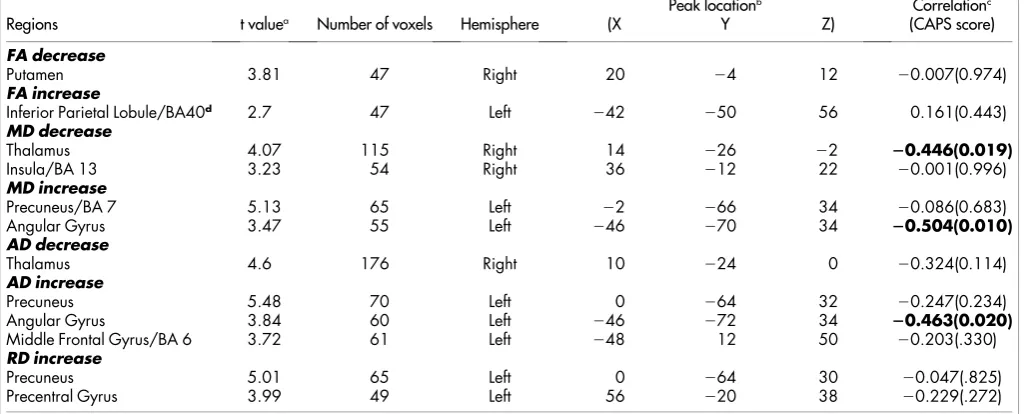
Compared to non-PTSD controls, children with PTSD
demon-strated significant changes in the right putamen (decreased FA), left
inferior parietal lobule (increased FA), right thalamus (decreased
MD and AD), right insula (decreased MD), left precuneus (increased
MD, AD and RD), left angular gyrus (increased MD and AD), left
middle frontal gyrus (increased AD), and left precentral gyrus
(increased RD). The detailed results are shown in Figure 1 and
Table 2.
CAPS scores in PTSD patients were negatively correlated with
mean MD in the thalamus (r
5 2
0.446, p
5
0.019) and angular
gyrus (r
5 2
0.504, p
5
0.01), and with mean AD values in angular
gyrus (r
5 2
0.463, p
5
0.02), after controlling for age and gender
(Figure 2).
Discussion
The present study explores white matter abnormalities in child
sur-vivors of a major earthquake, comparing those diagnosed with and
without PTSD 10–15 months after this single but prolonged trauma,
using not only the conventional DTI parameter FA, but also MD,
AD and RD, which reflect different aspects of the underlying
neurobiology.
In our study child patients with PTSD showed significantly
decreased MD and AD in the right thalamus. The thalamus is a relay
center between several subcortical areas and the cerebral cortex,
subserving both sensory and motor mechanisms
38. It is also
impli-cated in memory, which can be influenced by stress
39. There is
neu-roimaging evidence that thalamic dysfunction plays a part in
dysregulation of emotional memories in PTSD. Functional MRI
(fMRI) studies have shown that, compared with non-PTSD controls,
adult PTSD patients showed less activation of the thalamus during
internal generation of memories of the traumatic experience
40. There
is a case report of thalamic infarct resulting in the onset of adult
PTSD with re-experience and reawakening of old traumatic
mem-ories
41. Consistent with such a causal role, we found a negative
cor-relation between CAPS scores and MD of right thalamus: that is,
mean MD of right thalamus is decreased in child PTSD, and across
individual patients, the higher the score (the worse the symptoms)
the lower the MD (the worse the abnormality).
In the children with PTSD we also found decreased FA in right
putamen, which is part of the basal ganglia. Structures of the basal
ganglia play a role not only in the modification of movement, but also
in cognition and emotion
42. An fMRI study in normal adult subjects
has revealed the role of the basal ganglia in enhancing working
memory through attentional control and filtering of irrelevant
information
43. An fMRI study using a task requiring regulation of
emotional reactions has found decreased activation in putamen in
adult PTSD compared to healthy subjects
44. Our results are
consist-ent with this idea of a role for dysfunction of the putamen in the
abnormal neural mechanisms in PTSD.
We also found decreased MD in right insula in children with
PTSD. The insula is proposed to play a key role in the process by
which increased prediction signal of a prospective aversive body state
triggers an increase in anxious affect, worrisome thoughts and other
avoidance behaviors
45. Consistent with our finding, other
neuroima-ging work, including a recent meta-analysis of morphometry
stud-ies
46and a report of reduced gamma-aminobutyric acid (GABA) in
the right anterior insula
47, has suggested that the insula may be
important in the abnormal neural mechanisms of adult PTSD
48,49.
[image:2.595.43.559.602.694.2]We found increased MD, AD and RD in the left precuneus in
children with PTSD. Dysfunction of the precuneus, demonstrable
using fMRI, is thought to be related to abnormalities of working
memory in adult PTSD
50. Interestingly, compared to controls, adult
Table 1 | Demographics and Clinical Characteristics of Participants
aNC (n524) PTSD (n527) p-value
Ageb 13.2(61.3) 13.0(61.8) 0.76d
Gender (male/female) 11/13 11/16 0.71e
Handedness (R/L) 24/0 27/0 —
Years of educationc 7.8(61.6) 7.7(61.7) 0.78d
Time since trauma (months)b 12.1(61.6) 11.7(61.6) 0.41d
PTSD checklist 24.0(62.9) 53.8(65.1) —
CAPS — 65.1(68.3) —
aData are presented as mean6SD. Analyses performed in SPSS 16.0 (http://www.spss.com). All tests were two-tailed. No significant differences were found between PTSD patients and non-PTSD controls in age, gender, education and time since trauma. Abbreviations: NC: traumatized controls; PTSD: patients with post-traumatic stress disorder; CAPS: clinician-administered PTSD scale.
bAt the time of magnetic resonance scanning. c
Total years of completed education as reported by participant and guardian. dBy two-sample t-test.
Table 2 | Diffusion parameter results from voxel-based analysis of the PTSD group compared with the non-PTSD control group
Regions t valuea Number of voxels Hemisphere Peak location b
(X Y Z) Correlation
c
(CAPS score)
FA decrease
Putamen 3.81 47 Right 20 24 12 20.007(0.974)
FA increase
Inferior Parietal Lobule/BA40d 2.7 47 Left 242 250 56 0.161(0.443)
MD decrease
Thalamus 4.07 115 Right 14 226 22 20.446(0.019)
Insula/BA 13 3.23 54 Right 36 212 22 20.001(0.996)
MD increase
Precuneus/BA 7 5.13 65 Left 22 266 34 20.086(0.683)
Angular Gyrus 3.47 55 Left 246 270 34 20.504(0.010)
AD decrease
Thalamus 4.6 176 Right 10 224 0 20.324(0.114)
AD increase
Precuneus 5.48 70 Left 0 264 32 20.247(0.234)
Angular Gyrus 3.84 60 Left 246 272 34 20.463(0.020)
Middle Frontal Gyrus/BA 6 3.72 61 Left 248 12 50 20.203(.330)
RD increase
Precuneus 5.01 65 Left 0 264 30 20.047(.825)
Precentral Gyrus 3.99 49 Left 56 220 38 20.229(.272)
aAll effects survived after alphasim correction(p,0.05). bFor peak areas of activation; X, Y, Z
5MNI coordinates.
cData are presented as the correlation coefficient r (p-value), p,0.05 are shown in bold font. dBA: Brodmann area.
[image:3.595.43.556.502.709.2]PTSD patients show greater activation of the precuneus in response
to trauma-related stimuli
51.
We also found increased MD in the angular gyrus in children with
PTSD, which was negatively correlated with CAPS scores (r
5
2
0.504, p
5
0.01). MD is the sum of AD (axial diffusion) and RD
(radial diffusion), and further analysis revealed significant changes
only of AD (p
5
0.02), suggesting that it is changes of AD in the
angular gyrus which contribute to this negative correlation with
disease severity. This finding is of interest as it suggests the possibility
that increased AD may mitigate severity of disease in this population,
as reported in schizophrenia
52, Gulf War illness
53and Alzheimer’s
disease
54. The angular gyrus is believed to play a role in organizing
language and thoughts
55and increased neural activity in the left
angular gyrus has been observed in patients with PTSD
56.
Increased AD reflects faster water movement along the axons, which
might be functionally associated with enhanced neural transmission.
We therefore hypothesize that the MD increase may be compensatory.
The precuneus and angular gyrus are commonly considered as the
central node of the default-mode network (DMN)
57. Parts of the
DMN have exhibited functional abnormalities in PTSD in previous
neuroimaging studies
58–60. It might be that the increased MD and AD
we observed in these DMN regions (which is, for precuneus at least,
negatively correlated with symptom score) is related to a
strength-ened role in coordinating whole-brain networks as part of
compens-atory response to the pathological disorder of PTSD.
The other areas in which we found microstructural abnormalities,
namely the insula, putamen and thalamus, are all components of the
salience network (SN), which plays an important role in attention,
cognition, control, working memory and switching
61–63. In contrast
to the DMN regions (precuneus and angular gyrus), in these
salience-network areas we observed a decrease in FA, MD or AD. It has been
proposed that functional alterations of PTSD involve a triple network
model which corresponds broadly with the salience network, central
executive network, and default model network
64,65. Taken together,
our findings are compatible with an earlier study
60which proposed
that disequilibrium between the salience network and the DMN is
important in the pathophysiology of PTSD.
The present sample is homogeneous for surviving a single
trau-matic event, and all of the children are drug-na
ı¨
ve, which provides a
good opportunity to observe disease-related changes in brain and
behavior without confounds. Several issues remain to be addressed.
First, our results show some difference in gray matter, such as
thal-amus. It is generally accepted that FA is more sensitive in white
matter because of the specialized structure of nerve fibers.
However, FA, MD, AD, and RD can also be used to measure
micro-structure connections of dendrites and soma in gray matter, and DTI
has been used to detect microstructure changes of gray matter
66–69.
Thus our results suggest that dysfunction of gray matter, as well as of
white matter, may also play a role in PTSD pathophysiology. Second,
limited by the relatively small number of gradient orientations in our
DTI acquisition, we did not attempt fiber tracking. Further studies
with more gradient directions in MRI acquisition are encouraged to
explore the neurocircuitry in PTSD using direct connectivity
ana-lyses. Third, this study is cross-sectional; whether the microstructural
abnormalities evolve dynamically remains to be established in
lon-gitudinal studies. Fourth, studies of functional connectivity using
fMRI will be needed to confirm the suggestion of a connectivity
disequilibrium between the salience and default-mode networks in
PTSD. Finally, in order to control for the traumatic stress-related
brain alterations
70, we chose the population who were also exposed to
the major earthquake but did not develop PTSD as controls. Future
studies using non-traumatized healthy participants as controls will
provide further insights into PTSD pathophysiology.
Conclusion
This DTI study identifies the microstructural abnormalities of
chil-dren PTSD patients exposed to a major earthquake. Our findings
demonstrate regional microstructural abnormalities with an altered
pattern of diffusion changes, not only FA, but also specific directional
diffusivities (MD, AD and RD), in a group of highly homogeneous
single-incident traumatized individuals with pediatric PTSD. Most
of the brain regions with alerted DTI measures in children with
PTSD were the components of two important networks: the
default-mode network (DMN), including precuneus and angular
gyrus, and the salience network (SN), including insula, putamen,
and thalamus. Our results are consistent with the suggestion that
pediatric PTSD is associated with a disequilibrium between the
sali-ence network and the DMN. This may give new insights into
struc-tural network abnormalities in PTSD, assisting our understanding
the pathogenesis of this disorder.
Methods
Subjects.We recruited 51 child (#16 years) survivors of the 2008 Sichuan earthquake 10–15 months after the event. To be included, survivors must have (i) physically experienced the earthquake, and (ii) personally witnessed death or serious injury or the collapse of buildings, but (iii) suffered no physical injury or serious head trauma
with any known cognitive consequences, or any loss of consciousness.5 min.
Exclusion criteria, assessed using Structured Clinical Interview for DSM-IV (SCID), included: any history of or current psychiatric or neurological disorders other than PTSD, with the exception (to avoid an unrepresentative sample) of current depression, panic disorder, and generalized anxiety deemed secondary to PTSD; drug abuse; current psychotropic medication use (to avoid possible confounding effects on brain structure); previous psychiatric diagnosis; and IQ,80. Each participant was interviewed and screened with the PTSD checklist (PCL)71. Survivors scoring$35
were given the Clinician-Administered PTSD Scale(CAPS)72by psychiatrists to
[image:4.595.51.545.51.194.2]confirm the PTSD diagnosis. Finally 27 children with PTSD and 24 non-PTSD individuals were included for DTI assessment. The detailed demographics and clinical characteristics of the participants are presented in Table 1. The study protocol was designed in accordance with guidelines outlined in the Declaration of Helsinki and approved by the Research Ethics Committee of the Huaxi Hospital of Sichuan University. After a complete description of this study was provided to the parents of each subject, the informed consent was obtained and every child agreed to participate.
Data acquisition.MRI data were acquired on a 3T MR imaging system (EXCITE; General Electric) using a single-shot spin-echo echo planar image (SE-EPI) sequence. The diffusion sensitizing gradients were applied along 15 non-collinear directions (b-value51000 s/mm2) together with an acquisition without diffusion weighting
(b50). Imaging parameters were: TR512000 ms, TE571.6 ms, number of
excitations (NEX)52, slice thickness53 mm, 50 slices, 1283128 matrix and 243 24 cm field of view (FOV).
Data processing and statistical analysis.SPM 8 (http://www.fil.ion.ucl.ac.uk/spm/), MATLAB 2010 (The Math Works, Natick, MA) and FSL4.1 (http://www.fmrib.ox.ac. uk/fsl/) were used to analyze the data. First, the DICOM files of each DWI acquisition were converted into a single multivolume NIFTI file. FSL’s eddy current correction was then applied. The brain was extracted using BET (Brain Extraction Tool, http:// fsl.fmrib.ox.ac.uk/fsl/bet2/). Finally, FA, MD, RD and AD maps were calculated using FSL.
The correction of head motion image artifacts, normalization and statistical ana-lyses were performed using SPM 8. We developed a customized pediatric template using SPM to reduce potential errors caused by matching to an adult template73. This
development had three steps. First, we normalized the FA maps of the control group based on the deformation information generated from the corresponding unweighted
images (first b50 image) and the echo-planar imaging (EPI) template (in MNI152
space). These, termed wFA maps, were averaged to produce a mean map which was smoothed (using a [6,6,6] FWHM Gaussian kernel) to obtain the customized pediatric template74. We normalized all of the original FA maps (from both the
patient and control groups) to the deformation field produced from the original FA maps and our FA-specific pediatric template. The normalized FA maps were smoothed using a [6,6,6] filter for statistical analysis. Finally, a fractional design specification was set up to compare the PTSD group against the controls using a two-sample t-test. The same processes were applied to the MD, AD and RD maps. For all analyses, the statistical map cluster level threshold was set to p,0.05 and voxels$45
(Alphasim corrected), determined through Monte Carlo simulations75using AFNI
AlphaSim (http://afni.nimh.nih.gov/afni/).
Significant clusters’ mean DTI parameter values (FA, MD, AD and RD) were calculated using Marsbar-0.42.Then partial correlations were computed to examine relationships between the mean DTI parameter values in regions and CAPS score, using age and gender as covariates.
1. Lamberg, L. Psychiatrists explore legacy of traumatic stress in early life.JAMA
286, 523–526 (2001).
2. Beaulieu, C. The basis of anisotropic water diffusion in the nervous system - a
technical review.NMR Biomed15, 435–455 (2002).
3. Cercignani, M., Bammer, R., Sormani, M. P., Fazekas, F. & Filippi, M. Inter-sequence and inter-imaging unit variability of diffusion tensor MR imaging histogram-derived metrics of the brain in healthy volunteers.AJNR Am J
Neuroradiol24, 638–643 (2003).
4. Pfefferbaum, A., Adalsteinsson, E. & Sullivan, E. V. Replicability of diffusion tensor imaging measurements of fractional anisotropy and trace in brain.J Magn
Reson Imaging18, 427–433 (2003).
5. Ota, M.et al. White matter abnormalities in major depressive disorder with melancholic and atypical features: A diffusion tensor imaging study.Psychiatry
Clin Neuroscidoi:10.1111/pcn.12255 (2014).
6. Bessette, K. L., Nave, A. M., Caprihan, A. & Stevens, M. C. White matter abnormalities in adolescents with major depressive disorder.Brain Imaging
Behav8, 531–541 (2014).
7. Tha, K. K.et al. Impaired integrity of the brain parenchyma in non-geriatric patients with major depressive disorder revealed by diffusion tensor imaging.
Psychiatry Res212, 208–215 (2013).
8. Sun, Z.et al. Abnormal anterior cingulum in patients with schizophrenia: a diffusion tensor imaging study.Neuroreport14, 1833–1836 (2003). 9. Manoach, D. S.et al. Reduced microstructural integrity of the white matter
underlying anterior cingulate cortex is associated with increased saccadic latency in schizophrenia.Neuroimage37, 599–610 (2007).
10. Miyata, J.et al. Abnormal asymmetry of white matter integrity in schizophrenia
revealed by voxelwise diffusion tensor imaging.Hum Brain Mapp33, 1741–1749
(2012).
11. Ashtari, M.et al. Attention-deficit/hyperactivity disorder: a preliminary diffusion tensor imaging study.Biol Psychiatry57, 448–455 (2005).
12. Cortese, S.et al. White matter alterations at 33-year follow-up in adults with childhood attention-deficit/hyperactivity disorder.Biol Psychiatry74, 591–598 (2013).
13. Pavuluri, M. N.et al. Diffusion tensor imaging study of white matter fiber tracts in pediatric bipolar disorder and attention-deficit/hyperactivity disorder.Biol
Psychiatry65, 586–593 (2009).
14. Sanjuan, P. M., Thoma, R., Claus, E. D., Mays, N. & Caprihan, A. Reduced white matter integrity in the cingulum and anterior corona radiata in posttraumatic stress disorder in male combat veterans: a diffusion tensor imaging study.
Psychiatry Res214, 260–268 (2013).
15. Jackowski, A. P.et al. Corpus callosum in maltreated children with posttraumatic stress disorder: a diffusion tensor imaging study.Psychiatry Res162, 256–261 (2008).
16. van der Kolk, B. A., Roth, S., Pelcovitz, D., Sunday, S. & Spinazzola, J. Disorders of extreme stress: The empirical foundation of a complex adaptation to trauma.
J Trauma Stress18, 389–399 (2005).
17. Alexander, A. L., Lee, J. E., Lazar, M. & Field, A. S. Diffusion tensor imaging of the brain.Neurotherapeutics4, 316–329 (2007).
18. Basser, P. J. Inferring microstructural features and the physiological state of tissues
from diffusion-weighted images.NMR Biomed8, 333–344 (1995).
19. Jones, D. K., Knosche, T. R. & Turner, R. White matter integrity, fiber count, and other fallacies: the do’s and don’ts of diffusion MRI.Neuroimage73, 239–254 (2013).
20. Budde, M. D., Xie, M., Cross, A. H. & Song, S. K. Axial diffusivity is the primary correlate of axonal injury in the experimental autoimmune encephalomyelitis spinal cord: a quantitative pixelwise analysis.J Neurosci29, 2805–2813 (2009). 21. Bockhorst, K. H.et al. Early postnatal development of rat brain: in vivo diffusion
tensor imaging.J Neurosci Res86, 1520–1528 (2008).
22. Song, S. K.et al. Dysmyelination revealed through MRI as increased radial (but unchanged axial) diffusion of water.Neuroimage17, 1429–1436 (2002). 23. Song, S. K.et al. Diffusion tensor imaging detects and differentiates axon and
myelin degeneration in mouse optic nerve after retinal ischemia.Neuroimage20, 1714–1722 (2003).
24. Li, L.et al. Grey matter reduction associated with posttraumatic stress disorder and traumatic stress.Neurosci Biobehav Rev43, 163–172 (2014).
25. Daniels, J. K., Lamke, J. P., Gaebler, M., Walter, H. & Scheel, M. White matter integrity and its relationship to PTSD and childhood trauma--a systematic review and meta-analysis.Depress Anxiety30, 207–216 (2013).
26. Schuff, N.et al. Patterns of altered cortical perfusion and diminished subcortical integrity in posttraumatic stress disorder: an MRI study.Neuroimage54 Suppl 1, S62–68 (2011).
27. Kim, M. J.et al. Disrupted white matter tract integrity of anterior cingulate in trauma survivors.Neuroreport16, 1049–1053 (2005).
28. Zhang, L.et al. Different white matter abnormalities between the first-episode, treatment-naive patients with posttraumatic stress disorder and generalized anxiety disorder without comorbid conditions.J Affect Disord133, 294–299 (2011).
29. Fani, N.et al. White matter integrity in highly traumatized adults with and without post-traumatic stress disorder.Neuropsychopharmacology37, 2740–2746 (2012).
30. Abe, O.et al. Voxel-based diffusion tensor analysis reveals aberrant anterior cingulum integrity in posttraumatic stress disorder due to terrorism.Psychiatry Res146, 231–242 (2006).
31. De Bellis, M. D.et al. Brain structures in pediatric maltreatment-related posttraumatic stress disorder: a sociodemographically matched study.Biol
Psychiatry52, 1066–1078 (2002).
32. De Bellis, M. D. & Keshavan, M. S. Sex differences in brain maturation in maltreatment-related pediatric posttraumatic stress disorder.Neurosci Biobehav Rev27, 103–117 (2003).
33. Lee, J. E.et al. A study of diffusion tensor imaging by tissue-specific,
smoothing-compensated voxel-based analysis.Neuroimage44, 870–883 (2009).
34. Bandettini, P. A. What’s new in neuroimaging methods?Ann N Y Acad Sci1156, 260–293 (2009).
35. Zhang, L.et al. Increased white matter integrity of posterior cingulate gyrus in the evolution of post-traumatic stress disorder.Acta Neuropsychiatr24, 34–42 (2012). 36. Conybeare, D., Behar, E., Solomon, A., Newman, M. G. & Borkovec, T. D. The
PTSD Checklist-Civilian Version: reliability, validity, and factor structure in a nonclinical sample.J Clin Psychol68, 699–713 (2012).
37. Fletcher, K. E. Childhood posttraumatic stress disorder. inChild psychopathology
(2nd ed.)(ed. Barkley, E. J. M. R. A. ) 330–371 (Guilford Press, New York, NY, US,
2003).
38. Herrero, M. T., Barcia, C. & Navarro, J. M. Functional anatomy of thalamus and basal ganglia.Childs Nerv Syst18, 386–404 (2002).
39. Bremner, J. D., Krystal, J. H., Southwick, S. M. & Charney, D. S. Functional neuroanatomical correlates of the effects of stress on memory.J Trauma Stress8, 527–553 (1995).
40. Lanius, R. A.et al. Recall of emotional states in posttraumatic stress disorder: an fMRI investigation.Biol Psychiatry53, 204–210 (2003).
41. Duggal, H. S. New-onset PTSD after thalamic infarct.Am J Psychiatry159, 2113–2114 (2002).
42. Shucard, J. L.et al. Symptoms of posttraumatic stress disorder and exposure to traumatic stressors are related to brain structural volumes and behavioral measures of affective stimulus processing in police officers.Psychiatry Res204, 25–31 (2012).
43. McNab, F. & Klingberg, T. Prefrontal cortex and basal ganglia control access to
working memory.Nat Neurosci11, 103–107 (2008).
44. Xiong, K.et al. Negative emotion regulation in patients with posttraumatic stress disorder.PLoS One8, e81957 (2013).
45. Paulus, M. P. & Stein, M. B. An insular view of anxiety.Biol Psychiatry60, 383–387 (2006).
46. Meng, Y.et al. Anatomical deficits in adult posttraumatic stress disorder: A
meta-analysis of voxel-based morphometry studies.Behav Brain Res270C, 307–315
47. Rosso, I. M.et al. Insula and anterior cingulate GABA levels in posttraumatic stress disorder: preliminary findings using magnetic resonance spectroscopy.
Depress Anxiety31, 115–123 (2014).
48. Chen, S.et al. Gray matter density reduction in the insula in fire survivors with posttraumatic stress disorder: a voxel-based morphometric study.Psychiatry Res
146, 65–72 (2006).
49. Simmons, A., Strigo, I. A., Matthews, S. C., Paulus, M. P. & Stein, M. B. Initial evidence of a failure to activate right anterior insula during affective set shifting in posttraumatic stress disorder.Psychosom Med71, 373–377 (2009).
50. Zhang, J. N.et al. Negative emotional distraction on neural circuits for working memory in patients with posttraumatic stress disorder.Brain Res1531, 94–101 (2013).
51. Sartory, G.et al. In search of the trauma memory: a meta-analysis of functional neuroimaging studies of symptom provocation in posttraumatic stress disorder
(PTSD).PLoS One8, e58150 (2013).
52. Lu, L. H., Zhou, X. J., Keedy, S. K., Reilly, J. L. & Sweeney, J. A. White matter microstructure in untreated first episode bipolar disorder with psychosis: comparison with schizophrenia.Bipolar Disord13, 604–613 (2011).
53. Rayhan, R. U.et al. Increased brain white matter axial diffusivity associated with fatigue, pain and hyperalgesia in Gulf War illness.PLoS One8, e58493 (2013). 54. Acosta-Cabronero, J., Williams, G. B., Pengas, G. & Nestor, P. J. Absolute
diffusivities define the landscape of white matter degeneration in Alzheimer’s disease.Brain133, 529–539 (2010).
55. Mazoyer, B.et al. Cortical networks for working memory and executive functions sustain the conscious resting state in man.Brain Res Bull54, 287–298 (2001). 56. Flatten, G.et al. Neural processing of traumatic events in subjects suffering PTSD
-a c-ase study of two surgic-al p-atients with severe -accident tr-aum-a.Psychosoc Med1, Doc06 (2004).
57. Khalsa, S., Mayhew, S. D., Chechlacz, M., Bagary, M. & Bagshaw, A. P. The structural and functional connectivity of the posterior cingulate cortex: Comparison between deterministic and probabilistic tractography for the investigation of structure-function relationships.Neuroimage102, 118–127 (2014). 58. Bluhm, R. L.et al. Alterations in default network connectivity in posttraumatic
stress disorder related to early-life trauma.J Psychiatry Neurosci34, 187–194 (2009).
59. Lanius, R. A.et al. Default mode network connectivity as a predictor of post-traumatic stress disorder symptom severity in acutely traumatized subjects.Acta
Psychiatr Scand121, 33–40 (2010).
60. Sripada, R. K.et al. Neural dysregulation in posttraumatic stress disorder: evidence for disrupted equilibrium between salience and default mode brain
networks.Psychosom Med74, 904–911 (2012).
61. Seeley, W. W.et al. Dissociable intrinsic connectivity networks for salience processing and executive control.J Neurosci27, 2349–2356 (2007).
62. Sridharan, D., Levitin, D. J. & Menon, V. A critical role for the right fronto-insular cortex in switching between central-executive and default-mode networks.Proc
Natl Acad Sci U S A105, 12569–12574 (2008).
63. Menon, V. & Uddin, L. Q. Saliency, switching, attention and control: a network model of insula function.Brain Struct Funct214, 655–667 (2010).
64. Menon, V. Large-scale brain networks and psychopathology: a unifying triple
network model.Trends Cogn Sci15, 483–506 (2011).
65. Patel, R., Spreng, R. N., Shin, L. M. & Girard, T. A. Neurocircuitry models of posttraumatic stress disorder and beyond: a meta-analysis of functional
neuroimaging studies.Neurosci Biobehav Rev36, 2130–2142 (2012).
66. Behrens, T. E.et al. Non-invasive mapping of connections between human
thalamus and cortex using diffusion imaging.Nat Neurosci6, 750–757 (2003).
67. Alkonyi, B.et al. Thalamocortical connectivity in healthy children: asymmetries
and robust developmental changes between ages 8 and 17 years.AJNR Am J
Neuroradiol32, 962–969 (2011).
68. Eckert, U.et al. Preferential networks of the mediodorsal nucleus and centromedian-parafascicular complex of the thalamus--a DTI tractography
study.Hum Brain Mapp33, 2627–2637 (2012).
69. Snook, L., Plewes, C. & Beaulieu, C. Voxel based versus region of interest analysis
in diffusion tensor imaging of neurodevelopment.Neuroimage34, 243–252
(2007).
70. Chen, L.et al. Impact of acute stress on human brain microstructure: An MR
diffusion study of earthquake survivors.Hum Brain Mapp34, 367–373 (2013).
71. Weathers, F. W., Litz, B. T., Herman, D. S., Huska, J. A. & Keane, T. M. The PTSD checklist: reliability, validity & diagnostic utility. Paper presented at theAnnual
Meeting of the International Society for Traumatic Stress Studies,San Antonio, TX,
October (1993).
72. Blake, D. D.et al. The development of a Clinician-Administered PTSD Scale.
J Trauma Stress8, 75–90 (1995).
73. Lei, D.et al. Changes in the brain microstructure of children with primary
monosymptomatic nocturnal enuresis: a diffusion tensor imaging study.PLoS
One7, e31023 (2012).
74. Ashburner, J. & Friston, K. J. Voxel-based morphometry--the methods.
Neuroimage11, 805–821 (2000).
75. Ledberg, A., Akerman, S. & Roland, P. E. Estimation of the probabilities of 3D clusters in functional brain images.Neuroimage8, 113–128 (1998).
Acknowledgments
This study was supported by the National Natural Science Foundation (Grant Nos. 81030027, 81227002 and 81220108013), National Key Technologies R&D Program of China (Program No. 2012BAI01B03), Program for Changjiang Scholars and Innovative Research Team in University (PCSIRT) of China and China Postdoctoral Science Foundation (Grant Nos. 2012M521696 and 2013T60856). The authors have disclosed that they have no competing or potential conflicts of interest.
Author contributions
D.L., Li. L. and Q.G. designed the study and drafted the manuscript. Le. L., X.S., X.H., S.L., J.L. and F.B. performed the experiments. G.K. modified the manuscript. D.L. and Q.G. carried out statistical analyses. All authors reviewed the manuscript.
Additional information
Competing financial interests:The authors declare no competing financial interests.
How to cite this article:Lei, D.et al. Microstructural Abnormalities in Children with
Post-traumatic Stress Disorder: A Diffusion Tensor Imaging Study at 3.0T.Sci. Rep.5, 8933;
DOI:10.1038/srep08933 (2015).