This is a repository copy of Retirement policies and the life cycle : current trends and
future prospects.
White Rose Research Online URL for this paper:
http://eprints.whiterose.ac.uk/116572/
Version: Accepted Version
Article:
Jackson, W. orcid.org/0000-0001-5194-7307 (2009) Retirement policies and the life cycle :
current trends and future prospects. Review of Political Economy. pp. 515-536. ISSN
0953-8259
https://doi.org/10.1080/09538250903215823
Reuse
Items deposited in White Rose Research Online are protected by copyright, with all rights reserved unless indicated otherwise. They may be downloaded and/or printed for private study, or other acts as permitted by national copyright laws. The publisher or other rights holders may allow further reproduction and re-use of the full text version. This is indicated by the licence information on the White Rose Research Online record for the item.
Takedown
If you consider content in White Rose Research Online to be in breach of UK law, please notify us by
RETIREMENT POLICIES AND THE LIFE CYCLE:
CURRENT TRENDS AND FUTURE PROSPECTS
William A. Jackson
Department of Economics and Related Studies,
University of York, York YO10 5DD, UK
Email:
[email protected]
Abstract
During the 20th century, pensions in developed countries were generally payable from a statutory retirement age which provided a norm for retirement behaviour and a threshold dividing older from younger age groups. Governments, by setting fixed starting dates for work and retirement, created a standardised life cycle with clearly delineated and uniform boundaries between education, work and retirement stages. Over the last thirty years or so, retirement behaviour has diverged from official norms and moved towards earlier retirement, though pressures for later retirement are now increasing as concerns over pension finance provoke calls for older workers to remain economically active. Weaker retirement norms have prompted speculation that working practices may be evolving from a Fordist life cycle with fixed stages to post-Fordist life courses with fluid and variable personal experiences. This paper assesses current trends, asking whether they do indicate major changes in the life cycle, and considers the flexibility of retirement, paying particular attention to the influence of government and employers. Several ways in which retirement could develop are identified, but few of them remove the constraints on retirees: truly flexible retirement will not occur spontaneously and will require explicit policies to safeguard retirement choices.
1. Introduction
Formal retirement from work at a given age became widespread only in the mid-20th century,
when public pension schemes were introduced on a large scale in developed countries. Pensions
were subject to a retirement condition and payable from a statutory retirement age, which became
the norm for retirement behaviour and the threshold marking the start of old age. For the first time,
an official boundary separated younger from older age groups and confirmed the inactive status of
older people. Retirement, defined by a fixed starting date, became a stage in a standardised life
cycle with uniform progression from education to work to retirement. Alongside the
school-leaving age, the retirement age was one of the two main transitions determining the
lifetime experience of the average person. As formal retirement burgeoned, individual life
courses in each country converged on a common pattern. The timing of life-cycle transitions was
not the same everywhere, because of international differences in school-leaving and retirement
ages, but a similar periodic life cycle could be observed in almost all developed countries.
Recent retirement behaviour has shown signs of drifting away from previous norms: early exit
from work has spread widely, working patterns have fragmented, average unemployment rates
have increased, and the chances of staying in the same job for life have declined. Former
assumptions about a regular, stable career path ending at a known retirement date no longer seem
reliable. Many people have withdrawn from the labour force before they were scheduled to do so,
the period of actual or de facto retirement has expanded, and the role of statutory retirement ages
has diminished. Retirement is now less predictable, blurring the boundary between a working
stage of the life cycle and a retirement stage, and fewer people adhere to a fixed programme of
lifetime events. Diverse behaviour makes it harder to trace distinct periods of education, work
and retirement. The standardised life cycle may be dissolving, to be replaced by a multitude of
individual, personalised life courses.
Long-run trends in the 20th century were towards earlier retirement, with average retirement
ages initially above the statutory age, then in line with it, and eventually below it. Temporary
labour shortages led to calls for delayed retirement but these had little impact on the early
retirement trend. To leave work earlier, readjust the work/leisure balance and enjoy more leisure
pension finance have aroused demands for later retirement and longer working lives, to the extent
that previous trends may be halted and reversed. As well as showing greater diversity, retirement
in the 21st century may see the end of the long-term fall in retirement ages and increased economic
activity by older workers.
Orthodox economics makes frequent use of life-cycle modelling but seldom addresses the
social origins of the life cycle: it follows neoclassical economic theory by assuming optimum
intertemporal planning and stressing individual retirement choices above all else. Social norms
appear as external constraints on individual decisions and are not related to other institutions or
placed within a historical setting. To consider how the life cycle emerged in the 20th century and
how it may evolve in the 21st, one must adopt a social and institutional perspective. The present
paper draws from heterodox economics, social gerontology and sociology to assess how the later
stages of the life cycle are changing and what this implies for retirement. The next two sections
discuss the concept of a life cycle and its relevance for retirement behaviour; later sections
examine its apparent breakdown and evaluate future prospects.
2. The Life Cycle as a Concept
Ever since ancient times, many authors have written about ageing and reflected upon the stages of
a typical human life (de Beauvoir, 1977, Chapter 3). Such writings can be construed as implicitly
adopting a life-cycle approach, yet they offer no formal account of the life cycle and make little
attempt at theorising. Formal life-cycle concepts date back only as far as Darwinism and the
evolutionary ideas of the late 19th century (O’Rand & Krecker, 1990). The theory of natural
selection requires population thinking in which members of a population have finite life spans and
are subject to continuous replacement by new members. A life cycle starting with birth or
conception, ending with death, and allowing for growth and reproduction in between, is a vital
ingredient in evolutionary arguments whether applied to human beings or any other organisms.
Dissemination of these arguments encouraged life-cycle models in many natural and social
The classic concept of a life cycle has three elements: phasing, maturation and reproduction.
First, for an entity to possess a life cycle it must pass through a sequence of phases or stages which
take a cyclic form. The phases should be universal and always follow the same sequence, so that
they are common to the whole population. Second, a life cycle entails an irreversible process of
maturation or development. The normal pattern for a living organism is to have growth at the
beginning of the life cycle, cessation of growth once maturity is reached, and then physical
decline culminating in death. Third, a life cycle should incorporate reproduction in at least one of
its stages, in order that new generations are created to replace old ones. Without reproduction, life
cycles would not be sustainable over the long term and evolution by natural selection would not
occur. Although life-cycle models should logically have all three elements, they often overlook
reproduction or leave it implicit: the theory then rests upon a sequence of stages and a growth
process but does not refer to reproduction or make evolutionary arguments. Phasing and
maturation are regarded as sufficient, for most purposes, to identify a life cycle.
The earliest formal life-cycle models relied on biological analogies and were applied within
natural rather than social sciences. Living creatures share common experiences that can be
condensed into a life-cycle framework: birth or conception as a starting point, a phase of growth
and development, attainment of maturity (at which time reproduction takes place), a phase of
gradual decline and senescence, and finally death as an end point. This course of events, clearly
not the product of human design, is portrayed as natural, inevitable and applicable at all times and
places. The human life cycle embodies biological ageing, which is beyond our control, but
individual experiences do not follow a rigid, mechanical schedule and display extensive
variations. While ageing does have a preordained, programmatic component, it also has
unprogrammed features that should be recognised in a full account of ageing and its physical
consequences (Bond, Briggs & Coleman, 1993; Jackson, 2001). For any particular person, the
rate of growth and then decline during the life cycle depends not only on genetics but on the
physical and social environment. More favourable external conditions permit faster growth
during the development phases, greater physical and mental capacities at maturity, slower decline
in the later stages of the life cycle, and higher life expectancy. Even if one adopts a biological
view, the life cycle leaves space for variations due to other factors.
In the early 20th century, familial and social versions of life-cycle modelling began to appear.
Priority is usually accredited to Seebohm Rowntree, who mapped out a life cycle as part of his
the typical life course depended on a mixture of biological, institutional and familial
considerations, but he emphasised the raising of a family – his model, unlike later ones, retained a
link with reproduction. Earnings, in Rowntree’s view, show limited variability over the life
course, whereas expenditures are distorted by the high spending incurred in child care during the
middle years. The upshot is a twin-peaked pattern of net saving caused by the temporary
dissaving required to finance the upbringing of children. Familial circumstances give rise to
financial hardship at the middle of the life course because needs are high relative to earnings.
Another period of hardship is old age, when cessation of work creates a fall in earnings
unmatched by any fall in spending (especially as health care needs may be greater). The driving
forces of the life cycle are biological ageing and reproduction, which are common to all human
societies, and so the life cycle can lay claim to universality, a property it shares with Rowntree’s
concept of absolute poverty. Official retirement ages had not yet come to the fore when he
undertook his initial social research and played little part in his account of the life cycle.
By the late 20th century, social versions of the life cycle had moved from a familial to an
institutional perspective. The spread of pensions and retirement, associated with post-war
welfare states, promoted retirement behaviour at a single age. Institutions now defined a typical
life course by a three-stage sequence of education-work-retirement, with the school- leaving age
and the statutory retirement age as the fixed thresholds. For the first time, life-cycle stages were
built into public policies and fostered uniformity. Academics came to describe this as the ‘social
construction of old age’, such that institutions of retirement, welfare provision and social care set
the boundaries of old age and divided an elderly section of the population from the rest (Phillipson,
1982, 1998; Fry, 1996; Estes, 2001). Old age was characterised by economic inactivity, which
led to structured dependency on public pensions, social security benefits and other welfare
measures (Walker, 1980; Townsend, 1981). Since a life cycle was written into public institutions,
any academic work that acknowledged these institutions would be adopting (implicitly or
otherwise) a life-cycle stance. Arguments about the social construction of old age have come
largely from outside the economics discipline, though they have affinities with institutionalism
and other heterodox approaches – retirement policies provide a clear instance of how institutions
shape economic behaviour (Wolozin, 1990; Jackson, 1994; Dugger, 1999). Social constructionist
theories, despite their non-economic heritage, mesh well with heterodox economics.
Orthodox economics too has made extensive use of life-cycle models, but in a distinctive type
intertemporal optimisation decision made by a rational agent over a lifetime planning horizon,
subject to constraints imposed by financial endowments and earning opportunities. Such models
move away from the original basis of the life-cycle approach in evolutionary biology and say little
about the physical processes of ageing. Institutions enter the analysis as constraints upon
planning decisions but play a secondary role to the individual agents and are not portrayed as
constructing the life cycle or moulding preferences. The chief economic aspect of the life cycle is
seen as being the individual consumption/saving decision, which allows gains in welfare or utility
through smoothing out of consumption patterns to compensate for unevenness of income flows.
Early models appeared in the 1920s and 1930s with the work of Ramsey and Fisher on optimum
saving, and the life-cycle approach became fully realised in the 1950s and 1960s with attempts to
explain aggregate consumption and saving behaviour (Modigliani & Brumberg, 1955). A central
prediction of simple, well-behaved models was that rational individuals would seek to stabilise
consumption, so that it is disengaged from income and much less variable. Empirical studies, by
contrast, suggested that consumption and income track each other closely, and it soon became
apparent that simple optimising behaviour could not reliably depict the typical life cycle (Thurow,
1969). The remedy has been to add various institutional and other constraints to the model which
limit an individual’s ability to make optimum lifetime choices. In the quest for more realistic life-cycle approaches, neoclassical economists have had to invoke a greater number of external
institutional details.
From the 1960s the scope of orthodox life-cycle modelling was expanded greatly through the
human capital research programme and its applications in areas such as labour economics, the
economics of education and health economics (Browning & Crossley, 2001). The intertemporal
optimisation framework remained intact but was augmented by variable labour supply,
investments in education and training, changing familial circumstances, bequests, and so forth.
Of particular relevance to retirement behaviour is the modelling of long-term labour supply. In a
neoclassical life-cycle model that permits a free choice of working time (dynamic labour supply),
a rational individual with well-behaved intertemporal preferences would normally choose a
smooth retirement path of gradually reduced working hours (Ghez & Becker, 1975). As with
consumption/saving patterns, the observed behaviour of many workers does not conform to this
theoretical ideal: working hours often vary little during a person’s full-time working career until
an abrupt cessation of work upon retirement. To fit actual retirement behaviour into the life-cycle
framework requires external institutional constraints such as fixed working hours, statutory
employers. Room for individual choice is greatly reduced, shifting from continuously variable
labour supply to a narrow menu of discrete choices between work and retirement. Neoclassical
approaches can thus be reconciled with an institutionalised life cycle, even though the
institutional content has to be appended as exogenous, ad hoc imperfections.
The biological analogies behind life-cycle approaches became fainter during the 20th century,
and recent applications give greater weight to institutions. While human biology remains crucial,
the everyday experience of ageing depends more directly on the institutional setting and cultural
attitudes towards older people. Life-cycle arguments reflect this by highlighting the formal
thresholds marking out the life course (notably the official retirement age) in preference to the
physical effects of old age. What matters most is phasing, as against maturation or reproduction.
To understand the life cycle, one has to appreciate its socially determined character and pay heed
to the institutions that define and regulate our passage through life. Retirement is central here,
and any future transformations of the life cycle must stem from changes in retirement practices.
3. Origins of Standardised Retirement
In pre-capitalist societies and in early capitalism the typical life course was unstructured. Few
people underwent formal education and many children were working, so the education-work
transition was hazy. Wage labour with fixed working hours was itself an artefact of capitalism
and absent from the pre-capitalist world, where neither working time nor the life course were
monitored and regulated (Kohli, 1986; Vincent, 2003, Chapter 1). The same goes for retirement,
which depends on a prior period of clearly defined full-time work. High death rates in
pre-industrial societies meant that only a small fraction of each birth cohort reached old age and
stopped working. Low incomes ensured that few could save and dissave; institutionalised saving
and retirement pensions did not yet exist. Working careers followed an unregulated path without
People in all societies face biological ageing and, as they pass from childhood to adulthood to
old age, must adapt their work habits and lifestyle. Ageing occurs continuously, without fixed
borderlines: older people must work less intensively when their physical capabilities decline, but
this adjustment need not be sudden and abrupt. In pre-capitalist societies, older workers reduced
their work gradually to suit their capabilities and varied the timing and speed of the adjustment;
no common retirement date applied, nor were the retired labelled as a separate group. The life
course was a personal affair determined by human biology and local circumstances.
Age thresholds – the school-leaving age and retirement age – were introduced in most
developed countries during the late 19th or early 20th century. Formal retirement entered the scene
among certain large employers before it spread to the whole working population (Graebner, 1980;
Hannah, 1986; Midwinter, 1997, Part I; Costa, 1998). Policies to foster withdrawal from work at
fixed ages were motivated by employers' desire to influence the size and age composition of their
labour forces. The advent of formal retirement ages coincided with the emergence of scientific
management (Taylorism) founded upon strict separation of managers from workers, creating the
specialised management familiar in modern business. The task of managers was to plan
production optimally so as to maximise productivity and minimise waste and organisational slack.
Managerial planning and control included working time as well as working procedures and, when
applied on a lifetime basis, required a policy for cessation of work (Graebner, 1980, Chapter 2).
The logic of scientific management suggested the case for a formal, standardised retirement age
that would assist manpower planning by generating an orderly, controlled and predictable end to
the employee’s working life.
Since the retired would have to receive a pension, old-age pensions were bound up with
retirement. At first, retirement programmes were internal to large public and private
organisations; employees elsewhere had different retirement practices, while many were
excluded from retirement. Standardised retirement on a national scale came about only after the
widespread introduction of public retirement pensions. Governments, though they seldom
adopted a retirement policy as such, imposed an age threshold and a retirement condition on the
receipt of public pensions. To claim a public pension one had to be both above the age threshold
and fully retired from work – there were few possibilities for combining part-time work with a
pension. Workers were forced into deciding between full-time work and retirement, with the age
threshold for public pensions as the earliest date at which the choice could be exercised. Many
flourished, the average age of withdrawal from work fell; the trend accelerated in the 1930s
depression, when older workers were entreated to retire earlier and relieve the competition for
jobs (Laczko & Phillipson, 1991, Chapter 2). From the 1950s only a minority of workers in
developed countries exceeded the statutory retirement age, which became the norm for retirement
behaviour.
The introduction of public retirement pensions raised awkward questions about how they
should be financed. Private pensions had been perceived as a reward for long service and were
financed on insurance principles, such that pension contributions were related to wages and paid
into a fund. This was portrayed as natural and desirable, given that it imitated virtuous saving
activities and provided pensions only to those who apparently deserved them. Public pensions
could be organised as an insurance scheme but could alternatively be financed by taxes or other
compulsory contributions, which had immediate practical advantages in being rapid to implement
and open to low-income households with limited saving capacity. Most public pensions were
ultimately to be financed on pay-as-you-go (PAYG) principles, though their nature as a
cross-sectional transfer mechanism was often concealed. Debates among orthodox economists
led to the ‘insurance fiction’, whereby PAYG was construed as an intergenerational insurance scheme that links contributions and benefits in a manner similar to funding (Cesaratto, 2002).
PAYG pensions frequently adopted the terminology of a national insurance system basing
pensions on past wages, even though no fund of financial assets was accumulated and pensions
were financed from public revenues. The insurance fiction fulfilled the pragmatic purpose of
making the new redistributive measures politically acceptable, but at the same time it clouded the
true character of PAYG finance. Opting for PAYG implies a shift of emphasis from
individualistic to collective arrangements and from life-cycle saving to cross-sectional income
distribution. Orthodox economists never quite came to terms with the shift and continued to
interpret pensions and retirement in the language of private insurance.
Firms running their own pension schemes could still set retirement ages that differed from the
statutory one but mostly fell in line with the public pension system. The private, regulatory
function of retirement became merged with the public, welfare function of redistributive PAYG
pensions. Formal retirement had initially been justified as a tool that assisted the efficient
planning of work within large organisations; it provided a decisive but non-punitive way of
removing workers reaching the end of their productive lives. As the 20th century progressed,
because it offered guaranteed leisure in old age supported by generous public and private
pensions. Once retirement became standardised and the bond between retirement and public
pensions was secured, the perception of retirement moved away from its regulatory function
towards its welfare function. The idea of retirement as a welfare measure was, nevertheless, an ex
post rationalisation of something that had been advocated as a planning device and only later
became absorbed into the wider notion of the welfare state.
Retiring at a fixed age was not, by and large, mandatory. Capitalist labour markets are
voluntary in so far that employees are nominally free to withdraw from the labour force. People
with sufficient private means can retire at any age just by resigning and living on their savings; the
privileged few with huge unearned incomes can choose never to work. The majority do not have
this option and, in order to subsist, must work full-time to support themselves and rely on
pensions in their old age. Despite the semblance of voluntariness, economic reality compels the
average employee to work until a pension is available. Retirement practices were standardised
through state pensions paid from a statutory retirement age, as against a mandatory retirement
rule. Some employers did impose mandatory retirement as a feature of their own employment
contracts, but governments never organised this centrally. No rule dictated that everyone had to
retire at the statutory age, yet the economic context channelled most people into doing so.
4. The End of Standardised Retirement?
The heyday of standardised retirement, from the 1950s to the 1970s, spanned the post-war era of
recovery and expansion, when growth rates stood at historically high levels, employment was
readily available, and inflation rates were low. Many countries, keen to start afresh after their
wartime experiences, introduced fundamental reforms of social policy with the expressed intent
to establish new welfare states. Among the reforms was consolidation of public retirement
pensions financed on PAYG principles and organised around a statutory retirement age.
Governments were embracing, at least implicitly, cross-sectional income redistribution through
pensions and other welfare measures. It became politically acceptable to speak not just of poverty
component. Coupled with welfare reforms came commitment to activist Keynesian
macroeconomic policies aimed at boosting aggregate demand and – in principle if not always in
practice – attaining full employment. Other traits of the post-war era were the spread of mass
production and associated work methods (which had first appeared earlier in the 20th century), the
growing importance of mass consumption with standardised goods and services, and various
institutional developments such as large-scale trade unionism, corporatist wage bargaining and
nationalisation of public utilities.
Theorists in the Regulation School tradition have devoted much effort to studying the post-war
period, which they term the Fordist era (Amin, 1994; Jessop, 1994; Boyer & Saillard, 2002).
From the viewpoint of Regulation theory, public welfare measures, including state pensions and
standardised retirement, provided the social and political context (the 'mode of regulation') that
facilitated rapid economic growth and capital accumulation from the 1940s onwards. Technical
and industrial changes may have been pivotal, but long-term growth would have been impossible
without a suitable institutional setting. Keynesian macroeconomic policies likewise assisted
growth by smoothing out economic cycles and sustaining aggregate demand, while also
bolstering standardised retirement by dampening cyclical pressures for earlier or later withdrawal
from work. Highly regulated working practices created what has been termed the Fordist life
cycle divided into education, work and retirement stages (Myles, 1990). Centralised planning of
the life cycle matched the broader tendencies towards centralisation and uniformity observed in
mass production, mass consumption, and generous public welfare provision. Standardised
retirement may therefore belong to the Fordist phase of economic development which peaked in
the third quarter of the 20th century and now seems to be receding.
In referring to a Fordist life cycle, one should be careful to allow for its origins and character.
Retirement became standardised only after the introduction of PAYG public pensions revolving
around a statutory retirement age. The age threshold acted as the borderline for a cross-sectional
redistribution scheme but was arbitrarily defined and had little to do with the physical ageing of
an individual. By contrast with arrangements within private firms, public pensions were seldom
regarded as a response to the low productivity of older workers and the need to replace them.
Improved health and longevity during the 20th century have made it increasingly clear that most
people are capable of working productively well beyond the statutory retirement age, which has
no real significance for productive capacities. The result is a ‘life-cycle fiction’ akin to the
individual life course. For each individual, the retirement age does determine lifetime
experiences, but the Fordist life cycle is socially constructed and has no basis in individual
behaviour or biological ageing.
Experience since the 1970s has seen an economic downturn and a retreat from Fordist
arrangements as new technologies have surfaced (microelectronics; computing; information
technology) and industries have swung away from mass production towards smaller scale, more
flexible production methods. Such post-Fordist trends may ultimately dislodge Fordist
institutions and bring a new institutional context of decentralisation and diversity. Among the
possible social changes are greater variation in career histories, withering of the welfare state,
reduced reliance on tax-financed state pensions, and deregulation of retirement. If official age
thresholds vanish, then the outcome could be 'dechronologisation', in other words the
abandonment of a preset chronology for the life course (Kohli, 1986; Guillemard, 1989; Gaullier,
1992; Phillipson, 1998, Part II). Retirement could start earlier or later, take place gradually and
vary with the characteristics of the retirees. A postmodern or post-Fordist life course, without the
standardisation observed during the Fordist era, would replace the Fordist life cycle (Featherstone
& Hepworth, 1989; Myles, 1993; Hockey & James, 2003, Chapter 6; Mayer, 2004; Gilleard &
Higgs, 2005, Chapter 2). People would change jobs more frequently, with re-training if needed,
and no longer abide by fixed boundaries between education, work and retirement. The orderly
Fordist sequence of education-work-retirement would for many people be disrupted and replaced
by slower entry into full-time work, shorter job tenures, major career switches, a return to
full-time education in later life, and a less predictable pattern of lifetime transitions. Social
consequences of these developments would be increased variability of household composition,
causing a shift away from the traditional married couple with children, and a reduction in fertility
levels (Mayer, 2004). Post-Fordism would raise the rate of female labour force participation and
lessen gender differences in employment histories: fewer women would dedicate themselves
wholly to unpaid domestic work and the raising of children. In an unstructured life course,
retirement would be both flexible, allowing choices over its timing, and gradual, allowing choices
over its speed or smoothness (Parker, 1982, Chapter 8). Post-Fordism would have an
individualistic flavour, for people could ideally pursue their own lifetime projects or, if this
proved unfeasible, at least follow a distinctive, personalised career path subject to material
As general concepts, Fordism and post-Fordism are open to doubt. Critics have queried the
existence of post-Fordism and the 'new economy', together with the causal role of technology in
propelling them, and cast doubt on any neat divisions between Fordist and post-Fordist eras
(Sayer, 1989; Webster, 2002, Chapter 4; Henwood, 2003). Announcements of a post-Fordist era
may be premature and, if it does happen, its peak may be decades into the future: on a long-wave
account of economic history, the post-Fordist long wave would be expected to cover the first half
of the 21st century (Tylecote, 1991). We cannot know for sure whether a post-Fordist phase of
economic development will emerge, though trends in that direction are discernible. Post-Fordism
can also be given varied normative assessments. Seen in a positive light, it may remove
long-standing social constraints, put an end to age discrimination, enhance opportunities for
education in later life, permit frequent career changes, allow for flexible and gradual retirement,
and offer people greater control over their own lifetime experiences. The appearance of
post-Fordist life courses should, from this angle, be welcomed for their contribution to personal
freedom and self-expression. On the negative side, post-Fordism may bring increased uncertainty
for the average worker, greater job insecurity, reduced access to welfare benefits and public
pensions, enforced rather than voluntary job changes, risks of downward social mobility,
fragmentation of familial and other personal relations, and loss of social cohesion and identity.
Instead of being something new, the changes labelled as post-Fordism may just be a throwback to
a deregulated, pre-Fordist brand of capitalism engendered by recent neo-liberal policies. The
waning of the old retirement practices need not evolve into total flexibility allowing employees a
free choice over the speed and timing of their withdrawal from work. Between the extremes of
standardised and flexible retirement come many intermediate cases, some of which proffer little
choice for the retiree.
5. Current Trends
Is there any evidence for post-Fordist life courses and transformed retirement behaviour? Key
indicators here would be movements in the average timing of retirement away from the statutory
age, increased variability and smoothness of retirement paths, and a higher degree of choice
timing of retirement, which has not adhered closely to official norms. Average retirement ages
moved below statutory ones during the 1970s, when many employees in developed countries
made an early exit from the labour force before they were scheduled to retire (OECD, 2006,
Chapter 3). This unofficial early retirement took place by several routes, including occupational
pensions, disability benefits, unemployment and public pre-retirement schemes (Laczko &
Phillipson, 1991, Chapter 4). A major stimulus for change was high unemployment, since earlier
exit from work could release jobs for younger workers and convert unemployment into retirement:
a fixed retirement age lost some of its appeal once the Keynesian promise of full employment had
broken down. Trends towards earlier retirement concealed wide variations in experience among
individual retirees, some of whom could choose to retire early with generous occupational
pensions, whereas others had to endure spells of part-time work or
unemployment-cum-retirement on low benefit levels (Guillemard & Rein, 1993; Contini &
Leombruni, 2006). Pension and social security measures often generated incentives for workers
to retire earlier, so that ‘voluntary’ decisions were susceptible to outside influences. The extent
and manner of early exit from employment showed significant international variations that merit
further discussion.
In drawing international comparisons, it is helpful to distinguish between countries with high
and low levels of early exit. From the 1970s to the 1990s, high early exit countries saw a rapid fall
in male labour force participation rates for the 60-64 age group to reach levels well below 50%:
examples are France, Germany and the Netherlands (Rein & Jacobs, 1993). Many workers in
these countries were switching from full-time work to retirement before reaching the official
retirement age marked out by public pension programmes. Earlier retirement was generally
supported by governments which in some cases went as far as to set up formal pre-retirement
schemes with associated benefit payments (Kohli et al., 1991). Public support also came from
disability or unemployment benefits, and the average worker had a range of early exit options.
Private employers too sanctioned earlier retirement by permitting access to occupational pensions
at ages lower than those previously scheduled. Taken together, the public and private measures
gave workers an extensive menu of pathways to early exit, most of which were accompanied by
generous pensions or benefits. As early exit was relatively attractive, few workers in these
countries elected to seek gradual retirement or part-time work in later life. Although the trends
may seem to corroborate the post-Fordist story, they hailed from a series of formal, centralised
to early exit had a decidedly Fordist complexion, and one should be cautious about viewing it as
evidence of post-Fordism.
Low early exit countries saw similar but less dramatic retirement trends, such that male labour
force participation rates in the 60-64 age group declined steadily from the 1970s to the 1990s but
remained above 50%: examples are the US, UK and Japan (Rein & Jacobs, 1993). Retirement
varied greatly among these countries, but on the whole early exit was less institutionalised than in
high early exit countries and given less concerted support from government. It was rarer for
workers to make a complete switch to early retirement, and they often passed through a period of
part-time work before retiring fully. In the US, for instance, public retirement pensions were
lower and less readily available than their equivalents in European welfare systems. The upshot
was a greater disparity between employees with adequate private pensions, who could take
well-funded early retirement, and those without, who faced financial pressure to stay at work and,
in some cases, switch from a career job to a bridge job with shorter working hours before ceasing
work entirely. Retirement modes were more diverse than in high early exit countries and subject
to stronger incentives to keep working longer. Similar forces have prevailed in the UK and Japan,
both of which have had public retirement pensions financed at lower levels than in Continental
Europe. Low early exit countries may appear to display post-Fordist traits in their small welfare
states, diverse retirement behaviour and higher incidence of gradual retirement and part-time
work. These traits were visible in the Fordist era, however, and reflect local institutional
variations rather than any universal trend towards post-Fordism.
Other, longer-term influences have also been present. To retire earlier was supposedly a
reward of economic prosperity: when a society got richer it could reduce its working hours,
compress its average working life, and have more leisure. This is borne out by 20th century
experience, as average retirement ages converged downwards on the statutory retirement age and
then fell below it through early exit. Economic growth was expected to evoke not only greater
material wealth but ever increasing leisure time. Various commentators have argued that
retirement should be subdivided into a period of able-bodied, active retirement (the 'third age')
followed by a period of genuine physical decline in advanced old age (the 'fourth age') (Laslett,
1989; Young & Schuller, 1991; Gilleard & Higgs, 2000, Chapter 3). Improved health and
prosperity would allegedly yield a continuous expansion of the third age. Forecasts of this kind
and energy of older people. A trend towards early active retirement can no longer be taken for
granted.
Within the last fifteen years or so, the long-run passage to earlier retirement has faltered.
Retirement ages are no longer falling so consistently and seem to have levelled off or started to
rise, bringing the possibility of a turning point in retirement behaviour. Empirical studies based
on longitudinal data have yet to confirm such a turning point: some studies suggest that earlier
retirement continued well into the 1990s (Gendell, 1998, 2001); others provide tentative evidence
of later retirement trends beginning in the mid-1990s (Purcell, 2000; OECD, 2001; Scherer, 2001;
Zaidi, Makovec & Fuchs, 2006). It is too soon to draw firm conclusions about a watershed in
retirement, but there are signs that the long 20th century trend towards earlier retirement may have
ended. As average retirement ages are already below statutory ones, a later retirement trend
would bring them closer together and narrow the gap that opened up in the late 20th century. This
outcome is also uncertain, because the pension/retirement ages in many OECD countries, after
decades of stability, are moving upwards and seem set to establish new retirement norms (Turner,
2007). Higher statutory retirement ages should confirm and strengthen any tendency towards
delayed retirement, as well as allowing people to retire chronologically later but ‘early’ with
respect to the official retirement age. Consequently, we should expect later retirement in the 21st
century, even though the strength and generality of the new trend still remains unclear.
The engine behind these changes has been pension finance. With large generations of workers
due to retire in the early 21st century, PAYG pensions can maintain a balanced budget only if
taxes rise. Governments, reluctant to impose higher taxes, have been seeking other ways of
readjusting pension schemes, and a relatively painless adjustment is to hold pensions constant but
encourage or force people to retire later. Retirement policy has jumped from early-exit strategies
urging older workers to retire earlier and make room for the young to late-exit strategies urging
them to remain in employment and prolong their working lives (Auer & Fortuny, 2000; De
Vroom & Guillemard, 2002; Spiezia, 2002; OECD, 2002, 2006; Maltby et al., 2004). Late-exit
strategies will, if successful, block and reverse the previous retirement trend. Regardless of
individual attitudes to the work/leisure balance, the collective interest is viewed as justifying a
higher average retirement age. New policy imperatives geared to tax and public finance concerns
have replaced former ones geared to offsetting unemployment and securing expanded retirement
Population ageing lies at the heart of the rationale for delayed retirement. All developed
countries have experienced rising average ages and higher proportions of older people during the
20th century, a trend which is linked with the demographic transition and expected to continue
well into the 21st century. Generous public pensions introduced in the Fordist period have posed
difficult policy adjustments to accommodate population ageing, with an unpalatable choice of
higher taxes, reduced benefits or delayed retirement. Fears have been widely expressed about
intergenerational conflicts and a breach of the implicit contracts that underlie pension and welfare
programmes (Walker, 1990; Johnson & Falkingham, 1992, Chapter 2; Jackson, 1998, Chapter 2).
Among the potential policy responses, later retirement seems an attractive option, given that life
expectancies are increasing and most people would still be left with a substantial retirement
period. The long-run character of population ageing gives plenty of time for adjustments, yet the
policy issues have often been dramatised in popular discussion as an ageing crisis, as if the
difficulties had arisen suddenly and unpredictably. Talk of an ageing crisis dates largely from the
1980s onwards and coincides with the drift towards laissez-faire policies, privatisation and
reduced public expenditure – demographic change appears to offer an objective, uncontroversial
case for curtailing the public sector. Such crisis arguments should be treated with due caution and
scepticism. Population ageing had begun in the early 20th century and persisted through the rise
and heyday of Fordism but was perceived as a crisis only when the political climate had swung
towards neo-liberalism (Jackson, 2006). The policy issues raised by population ageing, though
genuine enough, have fed into wider economic debates about the welfare state and should be
viewed within that context.
Beside the changes in its timing, retirement has also apparently become more diverse and
flexible. Some European countries have allowed partial or gradual retirement before or after the
official retirement age: Sweden was first to do this in the 1970s, followed by others such as
Germany, Austria, France and Italy (Delsen & Reday-Mulvey, 1996; Phillipson, 1998, Chapter 5).
Contrary to appearances, the chief goal of these policies has not been to promote flexibility but to
call forth later retirement in a late exit strategy. Flexible retirement will, it is hoped, induce
workers to continue part-time work beyond the normal retirement ages. Policy-makers are eager
for retirees to exercise their choices in an upward direction and slow down or reverse the early-
exit trend. At the same time as implementing gradual retirement schemes, many of these same
countries are raising their statutory retirement ages so as to delay retirement. Enhanced
individual choice has been coupled with attempts to guide that choice towards later retirement and
Another factor behind flexible retirement has been the desire to remove age discrimination in
employment: a society without age barriers should, in principle, be conducive to work and
retirement options for older people. The late 20th century saw increasing recognition of ageism
and efforts to counteract it (Bytheway, 1995, Part I; Duncan, 2001). One approach has been to
encourage employers to take a positive attitude towards older workers and show greater
willingness to retain or recruit them. Some countries, such as the US, have gone further and
adopted anti-discriminatory legislation that bans employers from setting age limits in job
recruitment or imposing mandatory retirement on grounds of age (Macnicol, 2004). By
preventing overt age discrimination, this should weaken age boundaries and sanction flexibility
around retirement and employment norms. Legislation cannot alter discriminatory attitudes,
however, and to dispel all age biases would demand a wholesale cultural transformation. Many
employers, while not overtly discriminating against older workers, have adhered to employment
practices that place them at a disadvantage (Taylor & Walker, 1998). Giving them genuine
work/retirement options is not just a question of lifting age barriers and depends on other things,
such as intergenerational relations within the workplace and the costs of early exit to the employer
(Duncan, 2003; Roberts, 2006). Workplace cultures stressing novelty, dynamism and flexibility
put a low value on the attributes of older workers (notably their experience and loyalty) and harm
their employment prospects. Unofficial age thresholds will linger long after official ones have
been banned, but anti-discriminatory legislation should help to quicken the pace of cultural
change.
Flexibility and diversity of retirement, despite having widespread official approval, are well
short of being the general case in most countries. Empirical evidence suggests that single-date
retirement still predominates in OECD countries and that the incidence of flexibility and
gradualness is limited (OECD, 2000, Chapter 8; Purcell, 2000). Greater diversity would be
expected to increase the spread of retirement ages, but empirical studies show little sign of any
general trend in this direction (Gendell, 1998). Discussion about increased flexibility and a
post-Fordist life course remains speculative, and one should beware drawing firm conclusions
about the demise of work/retirement boundaries. Shifts in the average age of retirement, which
do have empirical support, need not be linked with flexibility and choice over retirement
behaviour. The fact that governments are raising statutory retirement ages in order to induce
delayed retirement suggests that they believe the work/retirement boundary is robust and will
continue for the foreseeable future. Recent policy measures have also brought a convergence of
retirement ages, usually by raising the female age to the male level (Turner, 2007). These
changes, if they bear upon actual retirement behaviour, should reduce the diversity of retirement
rather than increase it. Claims about the dawn of a new era of flexibility are somewhat
exaggerated, and empirical backing for such a hypothesis has not so far emerged.
Retirement behaviour may also be influenced by shifts in pension finance from PAYG to
funding, as recommended by international economic organisations (World Bank, 1994; OECD,
2000). According to orthodox economic criteria, a transition to funding would alleviate the
effects of demographic change and encourage savings and investment, but these arguments are
open to criticism from a heterodox perspective (Cesaratto, 2005, Chapters 3 and 4; 2006; Pivetti,
2006). Many governments are, nonetheless, pushing for private funded pensions at the expense
of public PAYG pensions. A revival of funding is at odds with ideas of post-Fordism and
increased flexibility. Funded pension schemes hark back to the private origins of formal
retirement and pensions, when a funded pension came at the end of a lifetime’s commitment to a
single firm. Amid the standard grounds for funding has always been its encouragement of loyalty
and long service, with associated gains in job-specific skills and experience. In a post-Fordist
world, where there are no jobs for life and people make frequent career changes, it would be
harder to organise funded pensions successfully. Those who change jobs, undertake part-time
work, or return to full-time education in later life risk undermining their entitlements to a funded
pension. The need to accumulate pension contributions restricts options to retire early, thereby
reducing the degree of choice. Ironically, the old Fordist PAYG arrangements are more flexible
in allowing labour mobility and individual choice over the retirement date. Any movements to
funding are liable to induce delayed retirement (in tandem with late exit strategies) and stifle true
flexibility.
Current retirement trends entail ambiguities and tensions. Flexible retirement, much discussed
and widely advocated, remains uncommon and has not replaced standardised, single-date
retirement in any of the major developed countries. Governments have argued for flexible
retirement and taken small steps towards it while trying to steer retirement choices in a particular
direction; a proclaimed desire for flexibility sits uncomfortably with a wish to manipulate
'voluntary' decisions. Policies to curtail state pensions may damage people's ability to support
themselves in old age, and in a privatised environment the influence of employers will loom
larger. The conflicting tendencies create uncertainty about the future of retirement and open up
6. Future Prospects
Retirement behaviour has diversified over the last few decades, but diversity is not equivalent to
choice and retirees still have limited options. Observed variations in retirement, which seem to
reflect personal choice, can in fact be due to government, firms or individuals, as Table 1
illustrates. Individuals in Table 1 have three levels of choice: none, if they face a fixed and
externally imposed retirement date; constrained, if they have a small menu of options or are
subject to lower and upper age boundaries on retirement; and free, if they can choose their own
retirement path. The structural context varies between a centralised case in which the government
oversees uniform arrangements and a decentralised case in which firms have their own retirement
schemes. When retirement is centralised, variations come from government regulation (if, say, a
different retirement age is set for males and females) or from individual choices, constrained or
unconstrained. When retirement is decentralised, firms replace the government as the prime
source of structural variations. With firms at liberty to make separate arrangements, retirement
practices broaden to give an intricate mixture of individual and firm-level variations.
Table 1. Sources of variation in retirement behaviour
__________________________________________________________________
Structural context
Centralised Decentralised
__________________________________________________________________
None Government Firms
Individual Constrained Individuals Individuals choice & Government & Firms
A flexible retirement system would not liberate everyone from external pressures. Flexibility
may be accompanied by attempts from the government or employers to sway what are ostensibly
voluntary decisions. This is evident when government policies combine gradual or flexible
retirement with a late exit strategy designed to raise the average retirement age. Employers too
have an interest in the retirement decisions of their employees. When labour is scarce they
welcome later retirement as a means of offsetting their recruitment problems; when labour is
plentiful they prefer earlier retirement as a means of reducing their labour force. Even an
unconstrained retirement regime (bottom row of Table 1) could be prone to manipulation from
government or employers. The real extent of voluntary retirement can be difficult to decipher.
Employers have leeway for choice under post-Fordism, but this may not filter down to
employees. Decentralisation carries no assurance that employees participate in decision making –
on the contrary, employer power may swell as regulations are slackened. Employers' own
single-date retirement arrangements could displace the centralised version: the outcome would be
diversity at the behest of employers, offering no flexible retirement for the employee. Individuals
would have a privatised Fordist life cycle (top right of Table 1) with the work/retirement
boundary fixed by the firm at a single date for the employee but variable among firms and perhaps
among employees within a firm. Truly flexible retirement for the individual would come about
only if employers granted their employees a free choice of retirement modes (bottom right of
Table 1) and refrained from manipulating employees' decisions.
Left to their own devices, employers cannot be relied upon to provide flexible and gradual
retirement. Some might be happy to do this, but others would want to keep tighter control over
the size and age composition of their labour force. Flexible retirement would take on a random
aspect depending on employer attitudes, and life cycles would still be periodic but in an
uncoordinated fashion: to call this dechronologised is misleading, since people continue to
experience a work/retirement timetable. Rather, it is a decentralised style of Fordist retirement
which augments employer influence but leaves individuals in the same position as before.
Retirement choices would be available at the grace of the employer, not as a right for everyone.
A guarantee of flexible retirement, with enhanced and universal retirement options, cannot
emerge spontaneously and is achievable only through government policy. Among the measures
needed are flexible/gradual retirement schemes, initiatives to give employees discretion over
new values attuned to an active old age (Phillipson, 2002; Walker, 2002). Retirees would have to
agree on retirement arrangements with their employers, but an official policy of flexibility would
goad employers to cooperate, so that variable retirement options would become the norm.
Employers unwilling to cooperate on a voluntary basis would be subject to coercive legislation.
Flexible retirement, in a systematic rather than haphazard form, requires a retirement policy
covering all employees.
Changes in pension finance could have a bearing on retirement behaviour wherever funding
replaces PAYG and individuals become reliant on accumulated financial assets. Flexible
retirement for everyone will be possible only if people are not unduly penalised for early
retirement decisions and if movements between jobs do not jeopardise pension rights
(Esping-Andersen, 2001). Post-Fordist life courses imply that people work for shorter periods in
each job and make more job or career changes in a lifetime. Flexible employment could endanger
flexible retirement unless rules are in place to protect pension entitlements and prevent their
erosion as workers pass from job to job. Any nominal menu of retirement choices is nullified
when retirees are unable to express their preferences through a lack of pension rights. In a flexible
retirement system, pensions must be generous enough to furnish a proper set of options: the
higher the pension level, the greater the options. Problems of pension access affect both funding
and PAYG, but PAYG opens the door to redistributive transfers where necessary and increases
the chances of retirement flexibility for low income groups. At present many governments seem
set to overlook retirement flexibility and, in their zeal to encourage later retirement, use pension
rights as a lever to force people to work longer.
Individual choice of retirement date depends not only on pension rights and formal retirement
arrangements but on the availability of work for older employees. Even if a retiree has a pension
and is nominally free to choose between work and retirement, the work option still rests upon
decisions made by employers: nobody can work without the employer’s compliance. The
absence of age discrimination is important here, but also relevant is the employment level in the
economy as a whole. Past experience suggests that the work prospects of older people are
strongly procyclical and dwindle during a downturn in economic activity – the recession of the
1970s and 1980s, for example, caused many firms to shed their older workers and sparked off the
drive towards early exit and early retirement. Government policies aiming for late exit and
extended working lives are unlikely to succeed unless economic activity is high enough to sustain
retirement, and so measures to increase flexibility and diversity of retirement should not be
viewed in isolation from employment conditions. In Keynesian terms, it is essential for aggregate
demand to be maintained at levels sufficient to yield employment opportunities for all age groups.
Activist macroeconomic policies with full employment as a policy goal are features of Fordism
and fit less neatly into the post-Fordist era of deregulation and laissez faire. In a neo-liberal
climate full employment may be elusive, in which case the policy goals of flexible and later
retirement would be hard to achieve.
When flexible retirement occurs on a piecemeal footing, it is apt to be unequally distributed.
Low income groups frequently have no private or occupational pensions and rely heavily on state
pensions bound to a statutory retirement age. Because their early exit from work derives from
unemployment (actual or disguised) as against retirement, they are vulnerable to the actions of
employers and have little say in their retirement behaviour. Higher income groups, on the other
hand, have private pensions affording them variability around the statutory retirement age
(Pampel, 1998, Chapter 3). Sheltered by internal labour markets, they are secure in their jobs and
well placed to make retirement plans. Those at or near the top of a managerial hierarchy have the
authority to influence their own (and other people's) pensions and retirement. The power and
flexibility enjoyed by senior management is often exercised through greater constraints and
reduced flexibility for workers lower down the corporate hierarchy. A widening diversity
between managers and workers could hinder the chances of attaining flexible retirement for all.
How, then, will retirement develop? Much will turn upon the relative importance of the
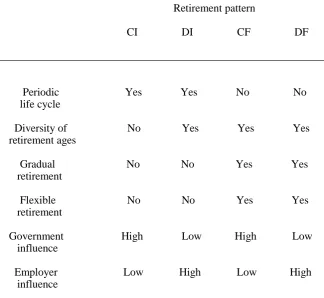
parallel but distinct trends towards flexibility and decentralisation. Table 2 identifies four
alternative scenarios and sets out their implications for retirement behaviour.
Centralised inflexibility (CI), corresponding to the Fordist case, denies individual choice over
retirement but entitles everyone to a given retirement period with a pension. Such arrangements,
which differ from the alleged flexibility of post-Fordism, have retained their importance. Many
governments are preserving the statutory retirement age and raising it in order to encourage later
retirement and reduced pension expenditure. If private pensions supersede state pensions, then
the role of the statutory retirement age should wane and retirement ages should diversify. Any
obstacles to the public/private switch would delay this, as people without private pensions must
depend on state pensions or other benefits during their retirement. In the immediate future,
Table 2. Future retirement possibilities
_____________________________________________________________
Retirement pattern
CI DI CF DF
_____________________________________________________________
Periodic Yes Yes No No life cycle
Diversity of No Yes Yes Yes retirement ages
Gradual No No Yes Yes retirement
Flexible No No Yes Yes retirement
Government High Low High Low influence
Employer Low High Low High influence
Decentralised inflexibility (DI) arises if retirement practices are decentralised but nothing has
been done to secure flexible retirement. Employers determine retirement policy, and retirees have
little or no choice; at best the retirement date is negotiable for employees with sufficient
bargaining power. Life courses resemble the Fordist pattern, except that they are now structured
locally by employers.
Centralised flexibility (CF) ensues when the government introduces flexible retirement as a
reform of the retirement system. A flexible/gradual retirement scheme replaces single-date
[image:25.595.134.459.153.451.2]within a single scheme. Centralised regulation contrasts with post-Fordism, but flexible
retirement for the individual accords with ideas of flexibility and diversity.
Decentralised flexibility (DF) denotes retirement practices decentralised to firm level but
allowing flexible retirement for individuals. This could happen only if all employers without
exception were glad to embrace flexibility; the tide of cultural change would have to be
overwhelming. Although the DF column in Table 2 comes closest to the spirit of post-Fordism, it
seems less credible than the others.
The trends towards laissez faire, privatisation and reduced public expenditure may end up
outweighing the trends towards flexible and gradual retirement. If so, then retirement would
diversify as public influence was relaxed and succeeded by employer influence. The outcome
would be decentralised but offer little choice to retirees (top right of Table 1; DI case of Table 2).
Conceivably, strong individual demands for flexibility backed up by bargaining with employers
might yield a transition to the DF case of Table 2, but a universal switch to flexible retirement
would not be straightforward and many employers would be anxious to preserve fixed,
single-date retirement. At best, decentralised flexibility might emerge fitfully and arbitrarily.
Future retirement, instead of matching one of the four cases in Table 2, will probably be
distributed across several of them. Privatisation and deregulation will not bring flexible
retirement for everybody, and retirement conditions will stay in place for many reliant on state
pensions or working for employers unwilling to tolerate retirement choices. Diversity will extend
beyond the individual level to include the structural context: a source of variation will be the
difference between those in flexible and restricted modes of retirement. Flexible retirement
should, if anything, spread to a bigger proportion of retirees, but progress in this direction has
been slow. The prime mover behind recent retirement policies has been the desire to induce later
retirement and shift from early exit to late exit strategies. As a policy goal, late exit has
overshadowed flexible retirement and often clashed with it, as is clear when governments raise
the statutory retirement age or manipulate retirement decisions. The prolonged 20th century trend
towards earlier retirement has fuelled expectations among today’s working generations that are
inconsistent with the thrust of current retirement policies (Schulz, 2002; Phillipson, 2004).
Individuals, given a proper choice among retirement options, might prefer to retire as soon as