
A structural examination of the Telfer gold-copper deposit and surrounding region, northwest Western Australia: the role of polyphase orogenic deformation in ore-deposit development and implications for exploration
196
0
0
Full text
(2) A Structural Examination of the Telfer Gold-Copper Deposit and Surrounding Region. northwest Western Australia: The Role of Polyphase Orogenic Deformation in Ore-deposit Development and Implications for Exploration.. VOLUME 1. Thesis submitted by Simon Andrew John HEWSON BSc (Hans) (Curtin) in October, 1996. for the degree of Doctor of Philosophy in the Department of Earth Sciences at James Cook University of North Queensland..
(3) I, the undersigned, the author of this thesis, understand that the following restriction placed by me on access to this thesis will not extend beyond three years from the date on which the thesis is submitted to the University. I wish that access to this thesis not to be permitted for a period of three years. After this period has elapsed I understand that James Cook University of North Queensland will make it available for use within the University Library and, by microfilm or other photographic means , allow access to users in other approved libraries. All users consulting this thesis will have to sign the following statement:. " In consulting this thesis I agree not to copy or closely para-phrase it in whole or in part without the written consent of the author; and to make proper written acknowledgement for any assistance which I have obtained from it.. .. (signed). .?..q(:!.:.!Z'!t (date).
(4) DECLARATION. I declare that this thesis is my own work and has not been submitted in any form for. another degree or diploma at any university or other institution of tertiary education. Information derived from the published or unpublished work of others has been. acknowledged in the text and a list of references is given.. Simon A.J. Hewson 3rd October, 1996..
(5) I dedicate this thesis to my parents, John and Monica Hewson, without whose love, support and financial assistance over my life this would never have happened. I will remain forever indebted for their encouragement throughout my academic endeavours..
(6) "The heights by great men reached and kept Were not attained by sudden flight But they, while their companions slept Were toiling upward in the night".. HENRY WORDSWORTII LONGFELLOW.
(7) CONTENTS of VOLUME 1. PREAMBLE THESIS OVERVIEW ACKNOWLEDGEMENTS SECTION A -. Multiple Orthogonal Overprinting Deformation Events. in the Telfer Region, w.A.: Preservation of a Complex Tectonic History in Weakly Deformed Rocks.. SECTION B -. Structural Reconnaissance afthe Lower Yeneena Group, Paterson Province, W.A.; Overprinting of an. Ensialic Intracratonic Basin by Migrating lateProterozoic Collisional Orogenesis and Resolution of. Conflicting Tectonic Indicators.. SECTION C -. Late Structural Timing of Mineralisation in the Telfer. Au-Cu deposit and the Role oj Orogenic Defannation in Regional Fluid Flow and Mineralisation.. SECTION D -. Progressive Structural Development a/the Telfer Dome. and Controls on Gold-Copper Mineralisation.. SECTION E -. Exploration Modelsfor Fold-hosted and Other Epigenetic Mineralisation Styles in the NE Paterson. Province.. REFERENCES - all sections.
(8) CONTENTS of VOLUME 2. SECTION A. .................... Figures. SECTION B. .................... Figures. SECTION C. .................... Figure s. SECTION D. ........ ......... ... Figures. SECTION E. .......... .......... Figures. APPENDICES. APPENDIX 1 - Stereographic data for Section A APPENDIX 2 - Location descriptions, field diagrams and stereographic data for Section B. APPENDIX 3 - Sample catalogue (referred specimens)..
(9) CONTENTS of MAP CASE MAPS MAP 1. - Structural Geology of the Telfer Mine (1:7,500). MAP 2. - Structural Geology of the Telfer region (1: 100,000). MAP 2B - Structural Geology of the O'Cailaghan, Corridor (1:50,000). ENCLOSURES: Laminated full A4 size versions of figures that are regularly referred to in the teltt (e.g . defonnation chronology tables, regional maps etc.) are also enclosed in the Map Case. A number of regularly referred to figures are also enclosed in the Map Case. These have been included for the reader to hold/place in. front of themselves so as to negate the need to search backwards through the Figure volume for reference to these figures .. ENCLOSURE 1 - Summary Table of the Defannation History in the Telfer Region ( For use with Sections A, C, D & E).. EN CLOSURE 2 - Geology of the Rudall Metamorphic Complex and Lower Yeneena Group, Paterson Province, and field locations. (For use with Section B).. ENCLOSURE 3 - Stratigraphic Distribution of Stratabound Mineralised Reefs in the Telfer Dome. (For use with Sections C & D).. ENCLOSURE 4 - Structural Geology of the Telfer DomelMine. (For use with Section D).. EN CLOSURE 5 - Regional Geological Map of the Telfer District (For use with Section E, and Section A).. TWO GENERAL USE ENCLOSURES: 1. Orientation of Unoriented Drill Core Utilising CleavageBedding Relationships. 2. Conceptual Exploration Models for the Telfer Region/Paterson Province - schematic flow chart..
(10) PREAMBLE. The Telfer Au (+Cu) deposit is one of Australia's premier gold-producers, currently accounting for. approximately 4OO,OOOoz. per year. It's discovery in 1972 heralded the recognition of the Proterozoic Paterson Province, in wtllch it is located, as a polymetallic terrane with the potential for significant. gold and base-metal mineralisation. The Paterson Province represents a small exposure ('" 36 OOOkm2) of the large NW -SE rrending Paterson Orogen, a continental-scale orogenic belt that passes across. northern Western Australia and into central Australia. Rocks in the Paterson Province have recorded a protracted Proterozoic history for this orogenic belt, which includes continent-continent collision at '". 1250Ma (Watrara Orogeny) and late-Proterozoic collisional tectonism (the Paterson Orogeny) between 700 and 6OOMa. The latter generated considerable mineralisation in middle- to late-Proterozoic metasedimentary rocks of the Paterson Province.. Late-Proterozoic mineralisation in the Paterson Province is well developed in the NE region where numerous syn- and post-tectonic granitoids, gabbros and dolerites intruded the metasedimentary sequence. However, mineral exploration in this region is commonly hindered by extensive Phanerozoic and Tertiary cover that precludes observation of much of the Proterozoic sequence. Additionally, the province lies within the Great Sandy Desert, and is thus covered by extensive aeolian sand deposits. The large amount of younger cover has resulted in relatively small scattered "windows" that expose the mineralised Proterozoic rock sequence. The NE region of the Paterson Province provides one of the best exposures of this sequence and hosts the Telfer deposit.. Sampling of gossanous and stratabound quartz veining in the Telfer Dome (a regional antiformal fold) in 1972 by geologists from both Day Dawn Minerals and Newmont Pty Ltd identified gold enriched horizons within the pelitic sedimentary sequence (felfer Formation) exposed in the dome. Subsequent drilling of these horizons confirmed an initial resource of I Million ounces of gold and mining activity commenced in 1975. During the early 19805 mining concentrated on one particular reef that outcropped in Main Dome, a sub-dome of the Telfer Dome. This reef, the Middle Vale Reef (MVR) exhibited strong secondary enrichment of gold and has historically comprised a significant resource in the Telfer deposit (Dimo, 1990). During the middle to late 1980s a shift to high-volume low-grade mining was facilitated by the ongoing success of dump leach extraction of gold from rocks previously too low-grade to be milled. TIlls inereased throughput caused production to expand to the second subdome (West Dome) as the E-Reefs were mined, and helped to make Telfer one of the top four gold producers in Australia during the late 1980s.. More recently, deep diamond drilling in Main Dome (commenced in 1992) has led to the discovery of approximately ten to twelve new reefs at depth in the dome. Underground mining, which had commenced in 1990, has been extended through an exploration decline. 10. the upper of these newly.
(11) discovered reefs (MIO and M30). This decline is currently being extended to reach !he deepest reef, the 130, at approximately 1100m below !he present ground surface. This should occur by the end of 1997. Another consequence of the deep drilling has been the further confirmation of an epigenetic genesis for !he Telfer deposit. and panicularly the identification of mineralisation in units other !han the Telfer Formation.. Initial research on !he stratabound reefs in !he Telfer deposit suggested thai !hey had formed through syngenetic eJdJalative processes (Tyrwhitt, 1979; Turner, 1982). A variation on this, whereby the MVR was considered to have formed as an evaporite horizon !hat was subsequently replaced by quartzsulphide assemblages, was proposed by Royle (1985). However, the expansion of mining and deep drilling within the deposit provided increasing evidence for an epigenetic origin. This came both through structural observations and geochemicaUfluid-inclusion studies that indicated the reefs were locally discordant, had associated stockwork veining in both the foot- and hanging-walls, contained magmatic elements in the ore-assemblage and that the ore-fluids were of variable salinity and temperature (Goellnicht, 1987). These observations led to an epigenetic model whereby magmatic fluids from the regional granitoids had mixed with cooler connate/formational waters, and had precipitated in structurally controlled, and compositionally favourable, sites within the Telfer Dome (Goellnicht, 1987; Goellnicht et aI., 1989). Subsequent research downgraded !he role of the granites, suggesting that !hey acted more as heat sources to convectively circulate connate/contact-metamorphic fluids that scavenge elements from !he sedimentary sequence (Hall & Berry, 1989; Rowins. 1994).. The changing ideas on !he genesis of the Telfer mineralisation are reflected in !he changing focus of mineral exploration in !he Telfer region and the Paterson Province. Initial exploration, utilising !he syngenetic exhalative model, concentrated on locating further outcropping Telfer Formation. The inferred variable thickness of exhalative lenses was considered to have assisted the formation of !he regional domal antiforms (Turner, 1982), and consequently those domes that exposed the Telfer Formation were targeted. However, recognition of an epigenetic genesis has focussed exploration activity towards targeting favourable host structures, such as regional folds and other ore-fluid traps. The change in exploration strategy means thaI a greater reliance is now placed on the structural geological setting of mineralisation in the Paterson ProviDce. This study represents the first formal examination whereby the structural geological setting of mineralisation in the Telfer Mine is integrated with the regional- and orogenic-scale tectonic development of the Paterson Province..
(12) TELFER (Aul+Cul DEPOSIT DEPOSIT STYLE: Epigenetic mesothermal lode-gold mineralisation hosted as stratabound quartz-carbonale reefs within a doubly-plunging damal antiform. (Elements: Au-Cu-AsBi-Co±Ni±Pb±Mo). ~. -1 I ~elfer Pen I POle,.- - -. ~. Port He<iland. AGE: Late-Proterozoic (=650-600Ma). PaterSon Province. ono'0 - -. LOCATION: 21 -44'S 122 -12'E RESOURCE: (in situ) - 129M1 @ 1.24g1t (So",,,,. Se~on 1994) - 5.1Moz (1591) Au . , - Cu reserve undefined DISCOVERED BY: Day Dawn Minerals I Newman! Pty. ltd. (now owned and operated by Newerest Mining Ply. Ltd.). WESTERN AUSTRAlIA. I I. .......... Eastern. ,oldfield Province. PERTH. GEOLOGIC LOCATION: Paterson Province, Paterson Orogen northwest Western Australia GEOGRAPHIC LOCATION : SW fringe of the Great Sandy Desert, W.A. CURRENT PRODUCTION : = 400,0000z . per annum DEPOSIT HISTORY: - Outcropping stra1ifonn gossans ";1hin the Telfer Dome were discovered and sampled in 1972 (named the Middle Vale Reef (MVR) and E-Reefs). - During 1972 - 1977 reserve drilling confirmed a shallow ore-body of = 1 Moz. - Mine construction commenced in 1975, - In the lale 19805 Telfer becomes one of Australia's largest gold produceo;. - Deep drilling commenced in Main Dome in 1992 and further stratabound reef mineralisation was discovered in the underlying Malu Quartzite and Isdell Formations GENETIC MODELS: - 1979, 1982 - Syngenetic exhalative genesis; accumulation of dense metalliferous brine in small pools (Tyrwhitt, 1979; Turner, 1982) - 1985 - MVR was an evaporite horizon that was replaced by quartz-sulphide ( Ro~e, 1985) -1987 - Epigenetic origin; structurally controlled mineralisation; geochemicallfluid inclusion studies suggest that the ore-fluid was derived from the mixing of a magmatic and connate/formational fluid; most elemnts derived from magmas (Goellnicht, 1987) - 1989,1994 - Convective model; Regional granites convectively circulate the ore-fluid through the host rocks; major elements derived from the se<iimentary sequence (Hall & Berry, 1989;Ro";ns, 1994).
(13) THESIS OVERVIEW. This thesis presents the results of a study of the structural geology of the Telfer Au (+Cu) deposit and surrounding region. The major aim of the project was to detennine the timing and structural controls on mineralisation in the Telfer deposit in order to produce conceptual models that could be used for further mineral exploration in the Telfer region and Paterson Province. This aim was approached through an integrated. study of four key structural problems in the Telfer regionIPaterson Province and these have been written in this study as individual sections whose content is summarised below;. SECTION A - Details a structural analysis of middle- to late-Proterozoic metasedimentary rocks in both the Telfer Gold Mine and surrounding region, the NE Paterson Province. A defonnation history involving mUltiple successions of subvertical and sub-horizontal foliation development has been observed, and is similar to modem examples of gravity-coUapse orogenesis. This has established a regional tectonic history against which specific structural fearures in the Telfer mine and region can be related.. SECTION B - Presents the results of a further structural analysis of similar-aged rocks (to those studied in Section A) that lie approximately 40-50kms south of Telfer but are separated by extensive Permian fluvioglacial sedimentary cover. An identical deformation sequence has been observed in this southern sequence of rocks. However. they _contain much better evidence for the first two deformation events because of the presence of schistose units. The fIrst of these in particular could only be inferred in the Telfer region. Additionally. changes in the vergence directions for subhorizontal deformations between both areas have been observed. These changes suggest that the orogen core was initially located well to the northeast but migrated during the middle and later stages of orogenesis southwestwards. They suggest that the Paterson Province may have lain in an ensialic back-arc tectonic setting.. SECTION C - Presents the results of paragenetic and structural turung of mineralisation (both micro- and meso-/macroscale) in the Telfer Au-Cu deposit. The discovery and development of new mineralised. bodies in this ore-system has allowed access to unweathered mineralisation that was unavailable for previous studies. Structural timing of mineralisation in the Telfer deposit occurred synchronous with two weak deformation events. D3 and 04, which post-date the major deformation.. Dz. that produced the large-scale host-structure. The hydrothermal veining/alteration.
(14) paragenesis indicates that the ore-fluid homogenised and equilibrated with the regionally metamorphosing rock sequence prior to entering the Telfer deposit, suggesting that regional metamorphic fluids may have played a greater role, than was previously considered, in mineralisation genesis.. SECTION D - This section presents the results of a geometric analysis of the Telfer dome and the control that the two defonnations associated with mineralisation,. D:3. and. D4, identified in Section C have had on the emplacement of mineralisation into this host-structure. These two events produced distinct ore-body geometries within the Telfer Mine. Additionally, pre-~ folding controlled the subsequent geometry of the. D2. Telfer dome making it more conducive during later mineralising defonnations to gaping in discrete locations. Much of the data for this section was gained from mapping of the Telfer Dome (Map 1).. SECTION E - This section applies models derived from Sections C & D to the NE Paterson Province in an attempt to provide a guide for future exploration in this area. The results of regional mapping (Maps 2 & 2B), which incorporates newly acquired geophysical data, assist the identification of late mineralising defonnation effects across the region. The models integrate the key structural parameters identified in the Telfer region and conceptually extend and apply these to the geometrical relationships present within the larger-scale region..
(15) ACKNOWLEDGMENTS Firstly, I would like to gratefully acknowledge Newcrest Mining pty. Ltd. for their financial and logistical support of lhe project. and in particular for allowing me access to data generated from the. Main Dome Deep Drilling Project (which commenced in 1992) and high-resolution aeromagnetic data collected across the region in 1993. I would like to thank Don Hall (Chief Geologist) and Ray. McCleod (Senior Exploration Geologist) who initiated the project in 1992, and to Andrew Richards (Chief Geologist), Peter Russell (Senior Exploration Geologist) and Colin McMillan (Senior Mine Geologist) who continued to support it from 1993 to completion.. Grateful acknowledgment must also go to the numerous staff at Telfer who assisted me whilst on site,. including: Cameron Switzer, Myles Johnson, Jan DeVisser, John Foley, Sean Helm,. Colin Moorhead, Julia Gleeson, Anna Timmins, Ingvar Kirchner,. Neil Simmons, Steve Ruvf!$,. Campbell Mackey, Alex Eaves, Karen Johnson, Suzy Webb,. Mike Sexton, Anne Woodgate, and Rob Cameron. I would like to especially thank Hardy Cieriitza and Boris Tavcar for their boundless help and youthful enthusiasm with all things Telfer. Thanks are also owing to members of the Geological Survey of Western Australia for their advice and guidance on geological localities in the Rudall River National Park; including Ian.. ,. Williams, Leon Bagas and Arthur Hickman.. Secondly I would like to extend grateful thanks to the "other halP'; the staff and fellow students in the Department of Earth Sciences at James Cook University. In particular I gratefully thank my supervisor, Dr. Tim H. Bell (alias Reactivation), for his enthusiasm, guidance and help with the project. Additionally, I express grateful appreciation and thanks to my two "pseudo" supervisors (and close friends), Dr. Brett Davis (alias "Trumpet") and Dr. Ken Hickey (alias. "MacTech",. "Groundhog", "Kenny M-Hoggy", ), and their respective partners Pamela and Frankie, for their extensive support, guidance and party's. Thanks for the memories!! Brett in particular is thanked for all his valuable advice on diagram preparation, stylistics and proof reading. Ken is thanked for his incisive and encyclopaedic assistance with all matters (including, at times, structural geology).. Heartfelt appreciation is extended to Ms. Kaye Lake who supported me in the dying months of the thesis. Thankyou so very much Kaye for all your love and support. Thanks also to my sister,. Alison, who supported me whilst I was in Perth.. Lastly, I extend my sincerest thanks and appreciation 10 my parents, John and Monica, for all their love, support and financial assistance throughout my life, and particularly this PhD. Thankyou for all your encouragement and guidance at times when I needed it; without your support this thesis would never have been completed..
(16) SECTION A. Multiple Orthogonal Overprinting Deformation Events in the Telfer Region, W.A.: Preservation of a Complex Tectonic History in Weakly Deformed Rocks..
(17) SECTION A Multiple Orthogonal Overpr inting Deformation Events in the Telfer Region, W.A.: Preservation of a Complex Tectonic History in Weakly Deformed Rocks. ABS1RACf ............................................................... .. ............... . ........ 1. INTRODUCTION ........................................................ ...... .•..•.•••••• ........ 2 REGIONAL GEOLOGY AND PREVIOUS INVESTIGATIONS ....... ...•..• .... ......... 3 DEFORMATION SEQUENCE ............ ........ .... ......... .............. ......• ••••• ....... .4 I>efonnation Event D1 ...... ...................................... _..... ..... _. _•• _........4 Intrafolial Isoc linal Folding ......................... .............................. 6 I>eforrnation Event D:l ........................ ............ .................... _•........... 6 Deformation Event D:3 .................. ................................ ... ................7 Deformation Event D4 ..................... _............ ................. ... _. _._._ ........ 8 Deformation Event D5 ................................. .......................•............ 8 Late D5 Defonnation (D5b) .................................... . ....... ...... ..... 9 INTERPRETATION ............. ... ................................................... .. •....... 10 Kinematic History of the Telfer Region ...................................•••.•....... 10 Dr Monocline Fonnation; Implications for SW Directed Thrusting and Early Orogenic Shortening ....... ............................ 10. Dz Defonnation - Bulk Inhomogeneous Shortening and Dome Fonnation .......................................... ...... ....................... 12 Late-D2 Bedding Reactivation .... ..................................... 12 OJ Defonnation - Implications for Vertical Crustal Shortening ............................................ ................. ....... .. .. 13 Post - D3 defonnation - Progressive Re-orientation of Vertical Compression ..... .... .......................................................... 13 DiSCUSSION .................... ...... ............................................ ............... 14 The Preservation of Complex Tectonic Histories in Multiply Deformed Rocks ........................................................................ 14 The Heterogeneity of Polyphase Defonnation; Reactivation and Reuse of Regional Structures .................. . .. ......... .. ...... ... ...... ........... 15 Tectonic Implications - Gravity Collapse Orogenesis ................................ 17 SIGNIFICANCE ...... .............. .......................... ..... .............................. 17 CONCLUSIONS ................................................. .•••• ........................... 18.
(18) Section A -. 1. ABSTRACT Structural analysis of mesoscale Jolds and axial plane Joliations indicates that multiple phases oj orthogonally overprinting (ie: vertical and horizontal cleavage Jorming) deJormation are preserved in low-grade meta-sedimentary rocks in the Telfer region. Horizontal compression, recorded as three generations oJverncal deformation structures (DEF. Dz & D4), was successively punctuated by horizontalJoldicleavage Jonning events (D} & D3J. Afinal event, DS, encompasses two differently oriented phases oj crustal compression, from that occurring previously. Horizontal defonnation events (D} & D3J produced recumhentfold structures, the development of which involved a vertical shortening component. The cyclic change from horizontal compression to vertical shortening can be explained by a gravity collapse tectonic model with gravitational instability produced by uplift/thickening oj a central plateau. Periodic collapse oJthis plateau would cause lateral spreading of rock material towards the margins of the orogen. The Telfer region appears to have lain on the margin of such an orogen. Mesoscale fold and Joliation development was extremely heterogeneous for deformation events that post-date the major folding phase, Dz. This partly resulted from folds in thick quartzite units producing vertical competent "struts" in the sequence that tended to prevent refolding. The heterogeneity was also due to partitioning of later tectonic stress into earlier structures causing them to be reactivated and re-used..
(19) Section A •. 2. INTRODUCTION Tectonic sequences involving a succession of vertical and horizontal deformations have been described for a number of orogenic belts around the world (e.g. Cboukrane & Seguret, 1973; Meneilly, 1983; Mitra et al., 1984; Platt et aI.,. 1983; Johnson, 1990a, 1992; Frotzheim, 1992; Jones. 1994). These sequences suggest that horizontal crustal shortening (vertical deformation) during compressional orogenesis is regularly punctuated by periods of vertical shortening or horizontal shearing. This appears to be related to the specific orogenic process of gravitational collapse (Bucher. 1956; Elliot. 1976; Ramberg. 1981; Bell & Johnson. 1989). Multiple phases of orthogonal deformation have previously been recognised in higher metamorphic grade terranes, particularly where porphyroblasts have grown and preserve successive generations of foliations from destruction in the rock matrix during subsequent deformation (Meneilly, 1983; Platt et aI., 1983; Johnson, 1990b; Bell & Hayward, 1991). Similar histories have also been recorded in strongly deformed lower grade rocks where foliations develop with greatest intensity against vein margins, and are subsequently preserved in strain shadows around the same veins during younger orthogonal overprinting events (e.g. Aerden, 1991,1993). In thinskinned thrust belts, upright folds rotated and overprinted by thrusting deformation (Mitra et al., 1984; Mitra & Yonkee, 1985) also preserve evidence for episodes of orthogonal deformation. However, such histories are less commonly described for fold belts where axial plane cleavages are only weakly developed. The Telfer region, in northern Western Australia, contains middle Proterozoic sedimentary rocks that were affected by convergent orogenesis during the late Proterozoic (Myers, 1990a,b). Previous structural analyses of these rocks in the Telfer region, host to the giant Telfer Au-Cu deposit, identified three potential deformation events (Chin et ai., 1982; van Dijk, 1986; Goellnicht et al., 1989). However, these studies were limited to specific areas and did not integrate local, regional and orogenscaIe observations. Superficially the Telfer region appears to have been affected by only one or two deformation events, and structural analysis is complicated by the poor.
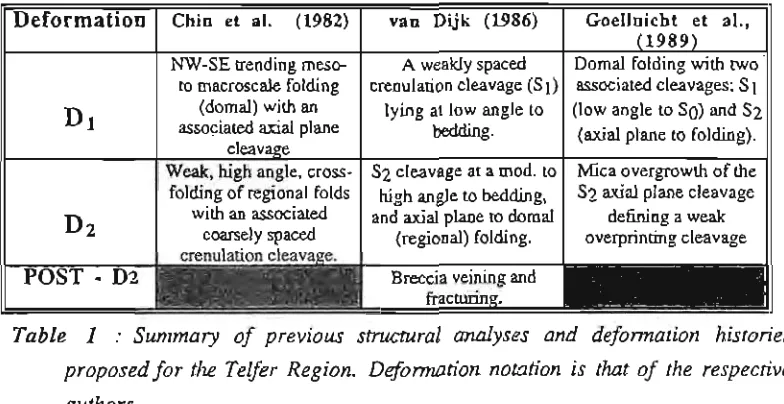
(20) Section A·. 3. exposure and highly weathered character of the Proterozoic sequence. Nonetheless, an analysis of mesoscale fold and foliation overprinting relationships encountered during systematic mapping of the Telfer mine and region has revealed a much more protracted deformation history and this is the subject of this section.. REGIONAL GEOLOGY AND PREVIOUS INVESTIGATIONS The northern exposed section of the Paterson Orogen (Williams & Myers, 1990), the Paterson Province (Blockley & de la Hunty, 1975), comprises an early to middle Proterozoic gneiss complex, the Rudall Metamorphic Complex, unconformably overlain by middle to late Proterozoic sedimentary rocks of the Yeneena Basin (Fig. 1). Upper units of the Yeneena Basin, encompassing the north-eastern zone of the province (Fig. 1) are exposed in the Telfer region. The Yeneena Group was deformed and weakly metamorphosed during the late Proterozoic (Pan African) Paterson Orogeny ("" 640-600Ma - see Section B for discussion of chronology) resulting in strong NW-SE striking folding, which in the Telfer region created a dome and basin strucrural setting north of the Karakutikati Range (Fig. I). Late syn- and post-tectonic granitoid suites, as well as mafic intrusions, intruded the Yeneena Group in the Telfer region (GoeUnicht et al., 1991). Initial mapping of the Telfer region by the Geological Survey of Western Australia (GSWA) identified two folding events (Chin et aI., 1982; Table I), the first (Dl) comprising regional NW-SE trending folds , which were locally cross-folded by a second high angle deformation (Ih). Subsequent microstructural studies of rocks from the Telfer Mine identified two overprinting cleavages (van Dijk, 1986; Goellnicht, 1987; Goellnicht et al., 1989). However, whereas van Dijk (1986) interpreted these as two separate deformation events (Table I), Goellnicht et aL (1989) considered both cleavages to be produced by one deformation (regional folding). Both authors interpreted S2 as axial plane to the domes. Goellnicht et al. (1989) also identified a weak third fabric, comprising coarse muscovite growth, which postdated S2 and that potentially represented the second deformation observed by Chin et aL (1982). Van.
(21) Section A -. 4. Oijk (1986) also inferred post-regional folding defonnation to explain breccia veining and hydrofracturing in the Telfer ore-bodies.. D,. Dz. high angle to bedding, and axial plane to domal (regional) folding.. Table 1 : Summary of previous structural analyses and deformation histories proposed for the Telfer Region. Deformation notation is that of the respective authors.. DEFORMATION SEQUENCE In the following section the tenn "defonnation event" is used to signify a group of structures that are indicative of specific crustal kinematic conditions, and which can be compared with other different groups, into a relative chronological sequence on the basis of overprinting (e.g. Turner & Weiss, 1963; Hobbs et ai., 1976). This is in contrast to an "orogeny" which describes a protracted period of crustal defonnation that may comprise a number of individual defonnation events. StructuraJ terminology used to describe the following structures is after Bell & Duncan (1978), and summary stereographic data for each defonnation event are presented in Appendix 1.. Deformation Event Dl 0\ produced recumbent monoclinal folds ranging from centimetre (Fig. 2) to metre-scale (e.g. fig. 4 in Section 0) with shallow SW dipping axial planes. The monoclines have short NE limbs, which are rarely overturned, open hinges and attenuated long (SW) limbs, the latter demonstrating a movement sense consistent with that observed on the axial plane cleavage (see further). A shallow SW dipping coarsely.
(22) Section A •. 5. spaced cleavage (SI), at low angle to bedding, lies axial plane to the monoclines (Fig. 2). Although SI is rarely sub-parallel to bedding, it is more conunonly oblique, and generally ranges between 3- and 15- to So. SI varies from a weakly differentiated crenulation to a discontinuous/continuous pervasive slaty cleavage defined by recrystallised sericite and muscovite grains (Fig. 3). It is corrunonly coarsely spaced in those units where it overprints/crenulates a pre-existing bedding-parallel fissility. This fissility, marked by coarse muscovite and sericite grains, is a mimetic enhancement (Spry, 1969; Durney & Kisch, 1994) of bedding surfaces formed prior to Dl, rather than a tectonic feature (e.g.Holst, 1985), and is spectacularly developed locally along relict sedimentary cross-beds. Dl folds and $1 cleavage verge (A. Bell. 1981) east in most locations throughout the Telfer region NW of the Karrakutikati Range. However, south-west of this range sporadic Dl folds in the Isdell Formation verge west/south-west suggesting either a regional scale ~. hinge in the vicinity of the Karrakutikati Range, or. alternati~ely. coaxial deformation during 01- Fold axes (F1) and intersection lineations (L~ ) lineations are re-folded during subsequent regional folding. However, Dl folds preserved in sub-areas of horizontal bedding exhibit shallow-plunging or subhorizontal. t:-. axes that trend ~ to NW (310.,315°). A rarely observed weak. mineral stretching lineation (~), defined by mineral streaking on SI, is approximately perpendicular to. fit axes. Differentiated crenulation asymmetry (e.g. Bell & Johnson,. 1992) suggests that S1 had a top-to-the-SW shear sense along the cleavage plane (Figs 4 & 5). which produced an extensional geometry (e.g. Platt & Vissers, 1980) consistent with the attenuation of the long (SW) limbs of 01 monoclines (Fig. 4). Additionally, mesoscale normal faults (see fig. 10 - Section D) and tension veins, parallel to SI and pre-dating D2. also suggest SW directed movement during Dl. Thus 01 in the Telfer region appears to have involved SW directed sub-horizontal thrusting. (shear) coupled with vertical shortening deformation..
(23) Section A -. 6. lnlrajoliallsoclinal Folding. Rare examples of isoclinal folding (Figs 6, 7A & B) developed in finely laminated units. These folds are generally symmetric and show parasitic folds along either limb (Figs 7B & 8) suggesting that they initially formed through coaxial shortening rather than through non-coaxial layer-parallel shearing (e.g. Sanderson, 1982). In some examples, the symmetric isoclinal folds terminate against enveloping laminae (Fig. 8) indicating post-formational disruption and potential rotation of the folds during a subsequent phase of layer-parallel shearing. One mesoscale example of these isoclinal folds (Fig. 7 A), located on the NE limb of Trotmans Dome (Fig. 9A; see fig. 1 & 5 - Section E, or Maps 2 & 2B for location of Trotmans Dome) has a steep axial plane that strikes perpendicular to the Ih axial trend (Fig. 9A). This isoclinal fold was refolded by. ~,. producing steeply. plunging F2 folds (Fig. 9A). It is not clear whether the steep plunge of Ih axes is due to a pre-existing vertical axial plane orientation of the isoclinal fold, or is the result of post-Dz refolding. The presence of high-angle D5 cross-folding in the outcrop suggests the latter. and thus it is inferred that the isocline was recumbent prior to D2. Consequently, it may be a 01 fold, although it has a different style to the more common 01 monoclinal geometry. An alternative explanation for the isocline is that it fonned prior to 01 as an upright fold that was subsequently rotated into a recumbent orientation by D1, prior to refolding by Oz (Fig. 9B).. Deformation Event D2. Dz constituted the major period of defonnation that formed during the Paterson Orogeny and produced upright, open to tight, NW-SE trending micro- to macroscale folds, and macroscale domes, with an associated regionally penelrative axial plane cleavage (S2). S2 varies from a coarsely spaced weakly differentiated crenulation cleavage to a pervasive slaty cleavage in shale-mudstone units. In quartzite and crystalline carbonate units prominent fractures that fonned along weathered lraces of S2 mark the. Dz axial p1ane.. The development of S2 was broadly synchronous with.
(24) Section A -. 7. metamorphic matrix recrystallisation, and locally, a strong quartz grain elongation developed. In the Telfer deposit, S2 is commonly indicated by small elongate quartzalbite (± pyrite) metasomatic aggregates that have grown along the cleavage. Refolding of SI cleavage gives the relationships shown in Fig. 10. with both SI and S2 having the same vergence on the south-western limbs of mineral stretching lineation. Dz folds.. A rare. <Li). defined by a weak streaking of fine micas on the S2. cleavage plane, has a sub-vertical pitch suggesting mainly vertical movement during. Dz. Late reactivation (Bell. 1986; Aerdan,. 1993) of bedding locally rotated S2 towards. parallelism with SO. as well as crenulating it (Fig. 10).. Dz axial planes. exhibit strike. variations across the region (orogenic curvature), in addition to local anastomosing of S2 which has arisen due to inhomogeneous shortening as well as refolding by subsequent deformation events.. Deformation Event D3 The third deformation, D3, was a weak, heterogeneously developed mesoscale folding event that formed asynunetric recumbent folds and crenulations of So and S2 (Figs 11,12 & 13). D3 folds have sub-horizontal axial planes (S3) with a consistent shallow NW to N dip and fold axes (F~ •. F; )that plunge shallowly N to NNE. A. penetrative axial plane cleavage is rarely developed, fonning only in association with tight D3 folds in finely fissile units (Fig. 13) and as discrete crenulations (Fig. 12; see also fig. 22 - Section C). Where present. S3 is a coarsely spaced, differentiated crenulation cleavage or, less commonly, parallel fracture sets with associated enechelon veining (e.g. Big Tree Costeans - see Maps 2 & 2B for location). No macroscale D3 folds were observed. However, refolding of Dz folds in the Telfer Dome, resulting in local tightening and rotation of hinges. is interpreted to be the result of horizontal overthrusting deformation during. D:3. (Section D). All. D:3. folds. verged NE with the exception·of those in the Big Tree Costeans that verge to the SW. Additionally, differentiated crenulation asymmetry indicates a top-to-the-NE shear sense on S3, suggesting that D:3 had a consistent NE transport direction in the Telfer.
(25) Section A •. 8. region. The local vergence change may potentially arise from local coaxiality or local shear reversals due to shifting patterns in deformation partitioning (e.g. Bell & Johnson. 1989.1992) during D3.. Deformation Event D4 04 produced mesoscale cross· folding of ~ folds, particularly in finer-bedded. units of the Isdell Fonnation south of the Karakutikati Range (Fig. 1; see also Map 2B). These folds are upright open structures (Fig. 14), of small (24m) amplitude and limited axial plane extent (in both plan and section), and have a consistent orientation throughout the Karakutikati Range area. 04 axial planes are sub-vertical or inclined towards the NW and strike 345-355°, which is 2()"300 clockwise from the. ~. axial. trend. In one example a broadly spaced differentiated crenulation cleavage (S4) lies axial plane to 04 folds (Fig. 15). No mineral stretching lineation (L: ) was observed, but the axial plane orientation suggests that D4 comprised a weaker period of horiwntal shortening that was oriented approximately viSW.ENE (255,260· • 075,080°). The limited occurrence of D4 folds throughout the Telfer region probably reflects the similarity in the primary orientations of S2 and S4 preventing refolding of. ~. folds. (e.g. Ghosh & Ramberg. 1968; Treagus. 1983; Ghosh et al.. 1992). Overprinting. relationships between f>] and 04 were assisted by the observation of structures. produced by correlateable events further south of Telfer (Section B).. Deformation Event Ds The fifth deformation, Os, is characterised by small scale asymmetric monoclinal kink folds (Fig. 16A) and crenulation planes (Fig. 16B), which are also well developed in finely laminated units of the Isdell Formation. These kinks, which range from centimetre· to metre·scale, are discrete structures that commonly tenninate at either end of the axial plane in small rounded monoclinal flexures (Fig. 16A). Kink axial planes and crenulations dip steeply (80' ,85·) toward the WNW, NW (290") although there is a marked variation in trend in some areas (see further). ~ and. F;.
(26) Section A. ~. 9. axes are generally steeply plunging in the prevalent bedding plane. Ds axial planes are marked by coarse dissolution seams and exhibit an apparent dextral shear sense. No conjugate kink sets were observed. North of the Karakutikati Range, in. coarse r~bedded. units, similar crenulations. of both So and S2 occur, albeit rarely, in addition to sporadic examples of NNE~SSW trencting vertical discontinuous cleavage. High angle cross· folding of D2 folds occurs in theMalu HiIlS/17 Mile Hil110calities (see Map 2 for location; cf Chin et, ai, 1982). with a similar axial plane orientation to other DS structures. The axial plane orientation of all these structures indicates DS involved weak compression oriented 290~110·) .. WNW~ESE. (=. The absence of conjugate kink sets suggests that Ds compression was. slightly oblique to the regional structural grain (Gay & Weiss, 1974; Reches & Johnson, 1976).. Late D5 Dejol7tUJtion (D5b) A group of distinctly oriented structures suggests that a separate NNW-SSE to N-S compressional event occurred. These include extension veins, nonnal faults and dolerite dikes, all of which trend N-S and crosscut D2 folds. Small tensional fractures, which fonned in the country rock along dike margins, lie parallel to the trend of the dikes. These suggest that the dikes fanned through extensional opening perpendicular. to (11, produced by an approximately N-S directed compression. Additionally, Ds-style kinks exhibit two distinct orientational groups (Fig. 17), one of which reflects a period of NNW-SSE to N-S compression. Kinks in both groups each have a similar crenulalionlkink asymmetry and therefore are not members of a conjugate set. Dissolution along the axial planes of both kink sets suggests that each fonned through shortening perpendicular to the axial plane implying two separate compressive episodes (ie. NW-SE compression - DS described in previous section, and NNW-SSE to N-S compression - DSb described in this section). As the overprinting relationships between these two episodes are unclear, the N-S compressional phase is designated. DSb, implying that it is stylistically similar to Ds, but represents ctifferent kinematic.
(27) Section A - I 0. conditions. The development of similar structures (ie. kinkslcrenulations) by these two compressive phases suggests that they may represent a progressive re-orientation of tectonic compression from 290-110- (WNW-ESE; 05) through to NNW-SSE I N-S (D5b) late in the deformation sequence.. INTERPRETATION Structural analysis of mesoscale folds and foliations indicates that multiple fold-forming deformation events occurred across the Telfer Region (Fig. 18). These are preserved as distinct minor folds, with associated axial plane foliations, that record a complex kinematic history comprising horizontal shortening of the belt punctuated by periods of horizontal deformation suggestive of vertical crustal shortening.. Kinematic History of the Telfer Region DJ Monocline Formation; /mplicationsforSW Directed Thrusting and Early Orogenic Shortening. 01 produced a penelrative sub-horizontal foliation (SI) the geometry of which against bedding has ambiguous implications for F 1 monocline formation. Fold and cleavage vergence are consistent with formation during sub-horizontal thrusting (e.g.. Elliot, 1976; Boyer & Elliot, 1982; Coward & Potts, 1983) towards the NE. However. SI cleavage has a SW directed shear sense, locally producing an extensional crenulation (Platt & Vissers, 1980) geometry along the attenuated long limbs of D I folds, whilst the short NE fold limbs represent low-strain zones in which bedding was not thinned. These fold-cleavage geometries are incompatible with fonnation during NE directed thrusting as the forelimbs (short NE limbs) should be overturned and thinned (Jamieson, 1992; Rowan & K.ligfield, 1992; Bons, 1993), and cleavage (SI) should exhibit a synthetic (ie. top-to-the-NE) movement sense in line with tectonic transport. However, the fold geometry is also difficult to reconcile with a SW directed thrusting regime that is suggested by the extensional shear sense on S ,..
(28) Section A -. 11. One explanation for the conflicting genesis of D, folds is that they may comprise. an. earlier. fold. phase. that. was. overprinted. by. sub-horizontal. shearing/thrusting deformation (e.g. Sanderson, 1979; Rowan & Kligfield, 1992), with two possible scenarios capable of explaining the observed geometric relationships (Fig. 19). In the first, upright folds with an axial plane foliation are overprinted by a NE directed thrusting/sbearing deformation (with or without vertical shortening) that rotates the folds and cleavage towards parallelism with bedding (Fig. 19A). Such rotation would also cause reactivation (Bell, 1986) of the axial plane cleavage (Fig. 19) producing a SW directed shear sense. The alternative path comprises the same earlyformed folds being overprinted by SW directed thrusting/shearing with concomitant cleavage formation, the latter exhibiting a synthetic shear sense (ie. top-to-the-SW) consistent with the bulk tectonic movement (Fig. 19B). Both models discussed above (Fig. 19) can explain the geometry of 01 folds. However, they differ in the relative timing of cleavage formation and direction of thrusting/shearing. Additionally, each model implies the presence of a pre-Dl fold phase. A similar development history is inferred for intrafolial isoclinal folds observed in this study. Such folds may represent the early fold phase on which 01 monoclines could have formed during SW directed shearing. Structural analysis of Lower Yeneena Group rocks south of Telfer indicates that similar Dt-style monoclines, which have a. SW shear sense on the axial plane cleavage (Section B), overprint small upright folds. These overprinting relationships were not unequivocal in the Telfer region. However, the presence of a pre-DJ fold phase is interpreted to explain the geometry of both the isoclinal folds (e.g. Fig. 9) and 0, folds. Consequently, it is interpreted that DI was a thrusting/shearing event, potentially driven by vertical shortening, with a SW directed tectonic transport consistent with the shear sense on Sl (Fig. 19B). The main implication of the interpretation discussed above is that upright and approximately symmetrical folds existed prior to 0,. Such folds could have been the product of layer-parallel shear during the initial stages of D, prior to being rotated under progressive deformation (e.g. Ghosh, 1966; Manz & Wickham, 1978;.
(29) Section A·. 12. Sanderson, 1979; Ramsay et aI., 1983). Alternatively, they may have formed during pre-DI layer-parallel shortening, that was precursor to gravity-induced orogenic collapse (Bucher, 1956; Elliot, 1976; Ramberg. 1981) driving sub-horizontal DJ deformation. The overprinting relationships further south of the Telfer region (Section B) support the latter, and hence in this study this inferred deformation is assigned the notation DEF (early folding), signifying it's occurrence prior to Dt .. D2 Deformation· Bulk Inhomogeneous Shortening and Dome Fonnation Previous structural studies have inferred wrench- or transpressive tectonism for the Paterson Province basec;l on the presence of regional domes (Harris, 1985; Bogacz, 1990; Baxter, 1991; see Sections D & E for discussion). However, the results of this study indicate that the domal axial plane cleavage (S2) exhibits a sub-vertical stretching lineation. CLi ) suggesting. vertical movement during ~. This is characteristic of. inhomogeneous tectonic shortening (e.g. Ramsay, 1967; T. Bell, 1981), rather than transpressive or wrench environments where oblique movement would be expected (Woodcock & Schubert, 1994).. Late-D2 Bedding Reactivation. - 52 cleavage is rarely crenu1ated along bedding planes. with an antithetic shear sense (Fig. 10). similar to that for flexura1-slip deformation.. Rather than signifying a separate defannation event, this crenulation is consistent with reactivation (Bell, 1986; Aerdan, 1993) of bedding during. Dt. Reactivation occurs. when bulk fold movement, initially accommodated by synthetic shearing on axial plane foliations, is locally partitioned into antithetic shear on the surface being folded (BeU, 1986). This will occur late in the folding event. However, it may also happen during subsequent and similarly oriented folding episodes that reuse the earlier fold (Davis & Forde, 1994)..
(30) Section A -. 13. D3 De/ormation -Implications for Vertical Crustal Shortening. The crenulationlfold asyrrunetry of D3 suggests that it involved NE directed tectonic transport related to a period of vertical crustal shortening. Evidence for this comes from the near-horizontal attitude of the axial surface. and vergence reversals . suggestive of locally coaxial deformation, a feature characteristic of vertical inhomogeneous shortening (T. Bell. 1981; Bell & Johnson. 1989, 1992). Another indicator for vertical shortening is the development of sporadic crenulation planes, which exhibit a top-to-the-NE shear sense across a markedly inclined axial plane (Fig. 20). Potential development paths, which account for both the inclination and shear sense on the axial plane, are illustrated in Fig. 20. However, the kink-style of these folds. which occur in sub-vertically dipping and finely laminated bedding. suggests that shortening was slightly oblique, but near parallel, to the layers (ie. vertical; e.g. Gay & Weiss. 1974; Reches & Johnson. 1976; Ramsay & Huber. 1987. p. 428).. Structures of a similar style to D3 folds in the Telfer region have been interpreted in other orogenic belts to result from ductile thrusting (Meneilly, 1983; Meneilly & Storey, 1986). However, no regionally penetrative thrust structures are observed in the Telfer region, and DJ structures are only sporadically developed and thus not typical of extreme shearing deformation. In contrast, vertical shortening deformation could produce sub-horizontal cleavage and discrete structures, the latter occurring where pre-existing foliations were suitably oriented for shortening (ie. vertical). Such vertical shortening could also produce a shallowly oriented shearing component (T. Bell, 1981) producing horizontal differential movement that in the Telfer region was mainly NE directed.. Post - D3 de/onnation - Progressive Re-orientation o/Vertical Compression. Both 04 and Os formed vertical structures indicative of horizontal crustal shortening. For 04 this occurred at a low angle ("". 25-30~). to the. lh. shortening. direction whilst 05 and DSb formed structures at higher angles (NW-SE and N-S respectively) indicating a progressive clockwise rotation of compressive forces. This.
(31) Section A -. 14. suggests that the Telfer region would have become increasingly transpressive during the defotmation history, characterised by left-lateral movements.. DISCUSSION The Preservation of Complex Tectonic Histories in Multiply Deformed Rocks Complex deformation histories resulting from multiple orthogonal overprinting of successive deformation events have been documented in many terranes, particularly modem convergent plate tectonic settings such as accretionary wedges/prisms (Platt, 1986; Sample & Moore. 1987) and collisional orogens/mountain belts (Dahlen & Suppe, 1988; Johnson, 1990a, 1992; Bell & Johnson, 1989, 1992; Aerden, 1994). Such sequences are recognisable in these settings because of their preservation within zones that have been protected from subsequent deformation, metamorphism and alteration. In higher-metamorphic grade terranes these include porphyroblasts, whose inclusion trails may preserve evidence for multiple foliation development (Meneilly & Storey, 1986; Johnson, 1990a,b; Ben & Hayward, 1991; Jones, 1994), and in some cases the original foliation orientation (Hayward. 1990; Bell & Johnson, 1992; Johnson. 1992). In lower grade rocks. quartz veining may preserve axial plane foliations (e.g. Forde. 1991), and record the strain history of the rocks through progressive quartz-fibre growth in strain shadows (Durney & Ramsay. 1973; Ramsay & Huber, 1983, p. 265; Kirkwood, 1995).. Similarly, boudinaged veins can preserve earlier formed matrix foliations in pressure shadows lying adjacent to boudin necks (Aerden • 1991; Davis & Forde, 1994). In the absence of rigid elements, deformation partitioning (e.g. T. Bell. 1981) within the rock matrix. can also preserve evidence for the primary orientation of foliations in zones of shortening (coaxial deformation), whilst in adjacent non-coaxial shearing domains these earlier foliations get re·oriented (Bell et aL, 1989). These examples all reflect the general tendency for relatively competent portions of rock. or structural elements. to preserve the foliation evidence for earlier deformations from.
(32) Section A •. 1 5. subsequent destruction or re·orientation in the rock matrix.. Previously, such features may have been rationalised by geologists as locally developed complexities against heterogeneities, rather than earlier developed and preserved structures indicative of a distinct phase of orogenic deformation. Since the post-D2 deformation intensity in the Telfer region was weak. fold and foliation evidence for successive orthogonal events has remained intact in the matrix. In very low-grade thrust belts. evidence for orthogonal deformation events can be preserved as initial upright symmetric folds (horizontal shortening) that have been. subsequently rotated into a recumbent orientation and overprinted by a horizontal solution cleavage associated with thrusting deformation (Mitra et a1., 1984; Mitra & Yonkee, 1985). In these terranes, thrusting appears to be the main deformation style, and has acted at a scale equal to or larger than folding. In contrast, the Telfer region is characterised by the development of regionally penetrative folding (vertical deformation) with minimal thrusting. The absence of well developed thrust sheets, which could have accommodated much of the movement during sub-horizontal deformation, may be one reason why multiple successive orthogonal events have been preserved. In particular, vertical structures (ie. upright folds) would more likely have been preserved. Another reason may be that the limbs of upright D2 folds in thick quartzite units acted as competent "struts" during subsequent deformations. This may have restricted the effects of further deformations that produced sub-horizontal axial planes. Younger deformations will tend to reactivate (Bell, 1986; Aerden, 1993) bedding between these "struts" rather than produce new folds or foliations, and consequently these events may have been very heterogeneously developed.. The Heterogeneity of Polyphase Deformation; Reactivation and Re·use of Regional Structures. Heterogeneous structural development is common in multiply deformed terranes (e.g. Tobisch, 1967; Tobisch & Fiske, 1982; Davis, 1993; Davis & Forde,.
(33) Section A •. 16. 1994). This is particularly so for fold phases that post-date the major period of deformation with one reason for this being the strong structural anisotropy produced by the main folding episode. In addition to preventing further strain (as discussed above), this anisotropy may cause subsequent tectonic strain to be accorrunodated dominantly by re-orientation and/or reactivation and re-use of pre-existing structures (e.g. Davis & Forde, 1994). This would be particularly true for defonnation where. there was a low angular difference between the primary compression direction for successive events. At Telfer, the low angular difference between compression contributed to the lack of refolding of. D:z folds. D:z and D4. by this event (Ghosh &. Ramberg, 1968). These folds would have been simply tightened and slightly reoriented (Ghosh & Ramberg, 1968; Odonne & Vialon, 1987; Price & Cosgrove, 1990, p. 400; see Section D) thereby accommodating the D4 strain. Since weak, and did not grossly re-orient previous fabrics, the. DJ was. D:z axial plane foliation (52). could be re-used during D4 resulting in the development of a composite foliation (e.g. Tobisch & Fiske, 1982; Meneilly, 1983; Tobisch & Paterson, 1988). Refolding, and subsequent development of new structures is most likely to occur where a high angular difference exists between two defonnations. For example, it is interpreted that Dl folds nucleated on a previous generation of upright folds (Da=). These pre-D, folds locally produced a vertical bedding surface that was oriented at a high angle to the subsequent horizontal Dl strain. Similarly, horizontal. OJ. folding is. best developed in steeply/vertically oriented bedding (Fig. 21), such as the NE limbs of D:z folds. These limbs were in a forelimb position with respect to NE directed D3 movement (el Ray, 1991; Alonso & Teixell, 1992). In contrast, no D3 fo lds were observed on the SW limb of. D:z folds, reflecting the more favourable orientation of. bedding in this limb for reactivation, rather than folding (Fig. 21). This preferential reuse of earlier structures according to their orientation relative to the prevailing defonnation is another reason for the inherent heterogeneity of polyphase defonnation..
(34) Section A -. 17. Tectonic Implications • Gravity Collapse Orogenesis Orthogonal overprinting deformation is suggestive of widely variable compressional directions during orogenesis of a rock sequence. Although horizontally directed shortening dominated in the Telfer region. consistent with convergent orogenesis, this was interspersed with repeated components of vertical crustal shortening. Such cyclic switching between horizontal compression and vertical crustal shortening in a convergent orogen is suggestive of gravity collapse tectonism (Bucher, 1956; Ramberg, 1981; Bell & Johnson, 1989, 1992; Aerden, 1994). The driving force. for such tectonism is interpreted to be gravitational instability leading to collapse of the orogen core (Bucher, 1956; Price, 1973; Elliot, 1976; Ramberg, 1981). A similar process has been inferred for accretionary/orogenic wedges lying at the margins of an orogenic belt (Platt, 1986; Dahlen & Suppe, 1988). In both mountain belts and accretionary wedges, colJapse of an uplifted and. thickened orogen core causes lateral spreading of material (horizontal deformation) towards the orogen margins (Bell & Johnson, 1989, 1992; Northrup, 1996). This is manifest as extensional deformation in the upper levels (Dewey, 1987; Aerden, 1994; Inger. 1994) and thrusting at lower levels (Bell & Johnson, 1992) and towards the margins (Price, 1973; Elliot, 1976; Northrup. 1996). The absence of thin-skinned thrusting in the Telfer region, generally indicative of processes in the extreme margins of an orogen (Platt, 1986; Northrup, 1996), coupled with locally penetrative cleavage. development, suggests these rocks were at moderate depths during orogenesis (Elliot, 1976). and thus probably lay within an orogenic wedge adjacent to a thicker orogen core.. SIGNIFICANCE. Late deformations have been demonstrated in other terranes to be associated with, and control, epigenetic mineralisation (Kontak. et aI., 1990; Forde, 1991; Aerden, 1993, 1994; Wilkins, 1993; Forde & Bell, 1994). Their recognition at Telfer has enabled the timing and controls on goJd-copper mineralisation within the Telfer.
(35) Section A -. 18. deposit to be detennined (Section C, Section 0). The results of these models contrast with previous studies (e.g. GoeUnicht 1987; Goellnicht et aI., 1989) where the limited knowledge of the deformation sequence has meant that many aspects of the Telfer oresystem were considered only in terms of the most recognisable deformation, D2. Consequently, it should be possible to develop more specific structural models to assist exploration for ''blind'' mineralisation occurrences. The results of this study suggest that structural analysis of other similar low-grade and highly weathered but mineralised terranes has the potential to identify orthogonal overprinting deformations, which in tum could prove beneficial in developing exploration strategies (e.g. Forde & Bell. 1994).. CONCLUSIONS Structural analysis of mesoscale folds and axial plane foliations in the Telfer region h,as identified a tectonic history that consists of five deformation events that occurred during the late-Proterozoic Paterson Orogeny ("" 640-600Ma). The deformation sequence comprises alternating vertical and horizontal fold/cleavage forming events. Dl produced recumbent monoclinal folds, whose geometry is ambiguous and suggests that an earlier. but as yet unverified, fold phase was refolded by SW directed thrusting deformation. This inferred period of folding is termed 0EF. The strongest event , 02, produced upright regionally penetrative NW-SE striking folds and axial plane cleavage that are the major structural elements of the Telfer region. D3 was a period of horizontal deformation that produced folds with a horizontal axial plane, whilst 04 comprised horizontal crustal shortening that was approximately. 20-25 ~. clockwise to that of D2. The final event, Os, comprised two. periods of compression, each differently oriented and at a high angle to D2 folding. The presence of two sub-horizontal deformations, 01 and D3, in the sequence suggests that horizon(al crustal shortening was interspersed by periods of vertical compression. This is evident from the development of folds and crenulations with subhorizontal axial planes during OJ and D3. Vertical shortening in the tectonic sequence.
(36) Section A -. 19. suggests that the Telfer region was affected by gravity collapse tectonism during the Paterson Orogeny. Such tectonism may have occurred when the orogen core collapsed as a result of gravitationaJ instability causing lateral spreading of rock materiaJ to the margins of the orogen. The absence of thin-skinned thrusting in the Telfer region suggests that it lay at moderate crustal levels, probably marginal to a larger orogen. AdditionaJly, late verticaJ deformations indicate an anti-cloclcwise re-orientation of horizontal compression over time, suggesting that the orogenic convergence changed from orthogonaJ to oblique. and that the Telfer region became transpressive. One feature of the deformation sequence is the extreme heterogeneity m mesoscale fold and foliation development, particularly for. post-~. events. This is. interpreted to arise from the structural anisotropy produced by the major folding (DV phase.. AdditionaJly. the strain produced by subsequent deformations. was. accommodated through reactivation and re-use of earlier structures. Given that multiple phases of , orogenic deformation may playa pivotal role in the development of some styles of epigenetic mineralisation, the recognition of such a teconic sequence in lowgrade gold-bearing metamorphic terranes is an important first step in establishing a genetic model for deposit formation..
(37) SECTION B. Structural Reconnaissance of the Lower Yeneena Group, Paterson Province, W.A.; Overprinting of an Ensialic Intracratonic Basin by Migrating late·Proterozoic Collisional Orogenesis and Resolution of Conflicting Tectonic Indicators..
(38) SECTION B. Structural Reconnaissance of the Lower Yeneena Group, Paterson Province, W.A.; Overprinting of an Ensialic Intracr atonic Basin by Migrating late-Proterozoic Collisional Orogenesis and Resolution of Conflicting Tectonic Indicators. ABSTRACT .. ......................................................... .......................... 1. INTRODUCITON ..................................... ....................... ......• .••........ 2 GEOLOGICAL SETTING AND PREVIOUS INVESTIGATIONS ..........•......... .3 LOWER YENEENA GROUP - PATERSON PROVINCE................... .••......... .5 Macrostructure ........................................................ ... ....... ........ 5 Deforntation Chronology ..............................• _.... .. ...• .................... 5 Pre - Regional Deformation (OJ, ~) ................... .• .. .. •••••• ........ 6. Regional Defonnation (03) ....................... . . .. .......•...•............7 Post-regional Deformation (04, D5, D6)·················· ..... .. . ·· .. · .... ·7 Deformation Event D4 ............................................. ... 7. Deformation EventDj ................................................ 8 Deformation Event D6 ........ ........................................ 8 STRUCI1JRAL ARCJflTECTIJRFjGEOMETRY OF THE PATERSON PROVINCE .................................................................................. 9 GEOCHRONOLOGy ............................... .......••• .•••••......................... .. 10 METALLOGENESIS - YENEENAGROUP ... ... ......... ................................ 11 INTERPRETATION ............................................................................ 11 Multiple Phases of Horizontal and Vertical (orthogonal) Deformation; Implications for Compression and Gravity-driven Orogenesis ..... ............ 12 Implications for a Migrating Orogenic core .......................................... 14 Late-Proterozoic Tectonic Development of the Paterson Province ................ 16 D6 Deformation ............. .......................................... 16 Macroscale Geometric Development of the Paterson Province ..... ...... 17 DISCUSSION ................................................. ................ .................. 18 Tectonic Setting of the Paterson Province ...................... .................... . 18 Periodic Ex.tensional Opening of the Paterson Orogen ........................... ..20 SIGNIFICANCE ............................................. .............. .•• ••.•... .•.........21 CONCLUSIONS ................... ......................... ...••..•.•••••••••••••••••••. ....... 22.
(39) Section 8 -. 1. ABSTRACT Structural reconnaissance of lower Yeneena Group sedimentary rocks, complements studies of the Telfer region (Section A) and confirms that a terrane-wide deformation sequence affected the Paterson Province during convergent orogenesis (Paterson Orogeny) in the late-Proterozoic (=640-600Ma). This sequence comprised alternate horizontal and vertical-structure forming deformation events, indicating that horizontal compression was regularly punctuated by episodes of vertical crustal shortening. Vertical-structure fonning episodes produced upright NW-SE trending folds at various scales, with the exception of later events whose primary compression rotated clockwise to become NW-SE. trending.. Horizontal-structure fonning. deformations produced distinctive recumbent folds and flat-lying cleavage. The regular altemation of shortening directions suggests that gravity collapse orogenesis occurred. Vergencelshean·ng directions for the sub-horizontal deformations provide information on the gross horizontal movement of material during collapse phases, which in tum assists the identification of the position of the orogen core during orogenesis. These suggest that initially orogenesis commenced NE of the Paterson Province but migrated south-westward during the middle and larter stages of orogeny to encompass the province. This history provides an explanation for the conflicting tectonic indicators in the province by suggesting that the Paterson Province, and contained sedimentary rocks (Yeneena Group) initially fonned in an. ensialic backardintracratonic setting that was subsequently overprinted by SW migrating collisional orogenesis. Migration of the orogen core craton-ward during late-Proterozoic orogenesis has implications for both the magmagenesis and metallogenesis of the Paterson Province..
(40) Section B - 2. INTRODUCTION Within Australia, large Proterozoic mobileJlinear belts (Davies & Windley, 1976), bordering stable Archean cratons (Fig. I) exhibit long-lived episodic orogenic histories (e.g. Baer, 1983; Etheridge et a!., 1987; Muhling, 1988; Wellman, 1988; Myers,. 1990a,b; Tyler & Thome, 1990; Clarke, 1991; Goscombe, 1992; Collins & Shaw, 1995) arising from repeated supercontinent aggregation and break-up (Bond et aI., 1984; Gurnis, 1988; Hoffman, 1989). One such example, the Paterson Orogen (Williams & Myers, 1990; -previously the Paterson-Musgrave Structural Trend Austin & Williams, 1978) spans the north-west and central regions of the Australian continent and records a long-lived Proterozoic orogenic history (Myers, I 990a, Clarke, 1991). Renewed orogenesis in the late-Proterozoic (=700-600Ma - Paterson Orogeny) resulted in significant mineralisation in an exposed portion of this orogen, the Paterson Province in northwest Western Australia. As much of the Paterson Orogen is now covered by Phanerozoic sedimentary. basins, the Paterson Province represents only a very small marginal exposure of the large orogenic belt and thus the tectonic setting of this mineralised province is problematic. Although the middle-late Proterozoic sedimentary history is suggestive of an ensialic (intracratonic) setting (Turner, 1982; Goellnicht, 1992; Hickman et ai., 1994), granitoid geochemistry, mineralisation and structural styles are all indicative of continent accretion or the development of an island/magmatic arc setting in the lateProterozoic (Myers, 1990b; Goellnicht, et ai. , 1991). Additionally, structural analysis of the host sedimentary sequence in the NE areas of the province has indicated a sequence of orthogonally overprinting (ie. horizontal and vertical) defonnation events suggestive of gravity collapse tectonism similar to that inferred in many modem collisional orogens (Section A). Recent research suggests that successive foliationlfoliation asymmetries produced by gravity collapse tectonism can be used to more accurately refine the position of a rock sequence within an orogenic belt (Bell & Johnson , 1989; 1992; Aerden, 1994; Northrup, 1996). Tectonic movement directions for horizontal (collapse.
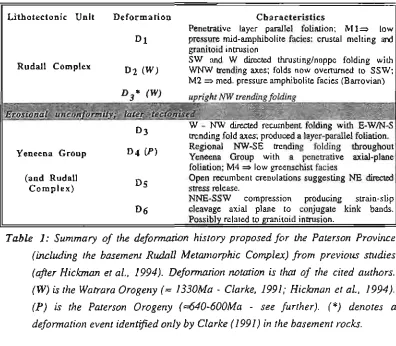
(41) Section B - 3. stages) deformation events within such sequences provide information on the position of the orogen core, the locus of collapse (Bell & lohnson, 1989; Northrup, 1996). This study presents the results of a reconnaissance study of rocks in the SW area of the province which suggest that the Paterson Province Jay marginal to a larger orogen, whose core migrated SW (inboard) during the middle and later stages of the Paterson Orogeny. Such a history may provide a resolution for conflicting tectonic indicators in the Paterson Province, and other deformed sedimentary basins marginal to large Proterozoic orogenic belts, by implying that collisional orogenesis may migrate inboard to deform and produce mineralisation in these basinal settings.. GEOLOGICAL SEITING AND PREVIOUS INVESTIGATIONS The Paterson Province (Daniels & Horwitz, 1969; Blackley & de la Hunty, 1975), of northern Western Australia is an inlier of Proterozoic rocks lying on the SW margin of the NW-SE trending Paterson Orogen (Fig. 1). The province exposes two major lithotectonic units; the Rudall Metamorphic Complex which is unconformably overlain by the Yeneena Group (Fig. 2). The Rudall Metamorphic Complex comprises early-middle Proterozoic gneisses and meta-sediments that exhibit a complex tectonic history of crustal reworking culminating in orogenesis and continent-continent fusion at. =1330Ma (Watrara Orogeny - Table 1; Clarke, 1991; Hickman et aI., 1994). The Yeneena Group comprises a mixed sequence of terrigenous and marine. carbonate units (fable 2) that are divided into three geographic zones; the Western, Central and Northeastern zones (Fig. 2; Williams, 1990a). Deposition of the group occurred in fluvio-deltaic, shallow marine shelf and pelagic environments that progressively deepened north-east, in an interpreted continental margin (Hickman et aI., 1994) or intracratonic (aulacogen/failed rift) setting (Turner, 1982). The Yeneena Group was multiply defonned during late-Proterozoic tectonism at "" 640-6OOMa (Paterson Orogeny - Myers, 1990b; Table 1; see also Section A) that also resulted in some reactivation of basement (Rudall Metamorphic Complex) structures. This was.
(42) Section B -. 4. accompanied by numerous syn- and post-tectonic granjtoid and other igneous intrusions in the NE Paterson Province ([elfer district).. Lithotectonic: Unit. Deformation. D, Rudall Complex. D2(W). Yeneena Group. D4 (P). (and Rudall Complex). DS. Characteristics Penetrative layer parallel foliation; M l~ pressure mid-amphibolite facies: crustal melting granitoid intrusion SW and W directed thrusting/nappe folding WNW trending axes; folds now overturned to M2 ~ med. pressure amphibolite facies (Barrovian). trending fold axes; produced a layer-parallel foliation. Regional NW-SE trending folding throughout Yeneena Group with a penetrative axiaJ-plane fo liation; M4 ~ low greenschist facies Open recumbent crenulations suggesting NE directed stress release. NNE-SSW compression producing axial plane to coniul!.ate kink. D6. Table 1: Summary of the deformation history proposed for the Paterson Province (including the basement Rudall Metamorphic Complex) from previous studies (after Hickman et ai., 1994). Deformation notation is that of the cited authors. (W) is rhe Warrara Orogeny. (~1330Ma. - Clarke. 1991; Hickman. er al... 1994).. (P) is the Paterson Orogeny (t>:Q40-600Ma - see further). (*) denotes a deformation event identified only by Clarke (1991) in the basement rocks.. Unit. Lithology. Max. Thiclcn. ess (m). Kaliranu Beds. Silly dolomite, shale, sandstone Quartzite; minor shale, siltstone Dolomite, calcarenite; minor clastics Sandstone, siltstone, shale Sandstone Dolomite, dolomitic shale: minor clastics Sandstone, shaJe, conglomerate; dolomite Dolomite, siltstone, shale Sandstone Dolomite, sha1e1siltstone. sandstone Sandstone, conglomerate Graphitic shale, siltstone; dolomite Sandstone, con~ l omerate, minor shale. >350. Wilki Quartzite Puntapunta Fm. Telfer Formation Malu Quartzite Isdell Formation Choorun Fonnation Yandanunyah Formation Brownrigg Sandstone Waroongunyah Fonnation Googhenama Formation Broadh~IFonnation. Coolbro Sandstone. 1000 2()()() 6()(). 700. 0 -1000 2000. 0-2000. 80 350 250 0-250 0- 1000 4()()(). Table 2: Summary of the Yeneena Group stratigraphic sequence over the whole Yeneena Basin (from Williams, 1990a). See Fig. 2 for the geographic divisionAocation of the various units..
(43) Section B. ~. 5. LOWER YENEENA GROUP - PATERSON PROVINCE Macrostructure The rocks described herein comprise the basal units of the Central Zone of the Yeneena Group (Coolbro and Broadhurst Formations - Fig. 2; see also Table 2) that immediately overlie the Rudall Metamorphic Complex (Fig. 3). The contact between the Yeneena Group and RudaJl Metamorphic Complex is erosional and marked by a boulder-cobble conglomerate that is locally strongly tectonised (Fig. 4). Regional-scale folding of the Yeneena Group is upright, NW-SE trending and formed during the major period of deformation in the Paterson Orogeny, D3 (see further). Two areas, on either side of the Rudall Metamorphic Complex, were examined for mesoscale fold structures and associated axial plane foliations; the south-western margin and the Broadhurst Range (Fig. 3). Folding along the south-western margin is open to tight, with long horizontal fold. traj-[~s. that are commonly overturned/inclined to the SW (Fig. 3). Numerous high-. angle thrust faults disrupt the sequence and have interleaved basement and Yeneena Group rocks (Fig. 3). The relative intensity of faulting along this margin may reflect the surficial expression of larger, and deeper seated thrust planes, on which the basement and Yeneena .Basin were transported south-westwards during the Paterson Orogeny (Chin et at, 1980; Clarke, 1991). In the Broadhurst Range, regional-scale anticlinal/synclinal folding over domed basement is upright or SW inclined, plunges SE, and is commonly faulted by high-angle thrusts along fold limbs (Fig. 3). Late N-S trending faults cross-cut the regional folds (Fig. 3).. Deformation Chronology Reconnaissance structural analysis, conducted by vehicle traverses across the study areas, indicates six deformation events are preserved in the Lower Yeneena Group. Well developed datum structures are provided by regional (03) folds, enabling correlation between the two study areas. The structural terminology used is after Bell. & Duncan (1978)..
Figure
+7


Related documents