A STUDY TO ASSESS THE EFFECTIVENESS OF
COMPUTER ASSISTED INSTRUCTION ON
KNOWLEDGE AND EXPRESSED PRACTICE
REGARDING FIRST AID MEASURES FOR DISASTER
EVENT AMONG THE STUDENTS AT SELECTED ARTS
COLLEGES, THANJAVUR.
BY
REG. NO: 301312451
A DISSERTATION SUBMITTED TO THE TAMILNADU
DR.M.G.R.MEDICAL UNIVERSITY, CHENNAI
±
32 IN
PARTIAL FULFILLMENT OF THE REQUIREMENT FOR THE
AWARD OF THE DEGREE OF MASTER OF SCIENCE IN
NURSING
A STUDY TO ASSESS THE EFFECTIVENESS OF
COMPUTER ASSISTED INSTRUCTION ON KNOWLEDGE
AND EXPRESSED PRACTICE REGARDING FIRST AID
MEASURES FOR DISASTER EVENT AMONG THE STUDENTS
AT SELECTED ARTS COLLEGES, THANJAVUR.
By
301312451
Research Advisor:
Prof.Mrs. VANITHA INNOCENT RANI, M.Sc (N), Ph.D., Principal,
Our Lady of Health College of Nursing, Thanjavur.
Clinical Speciality Advisor:
Mrs.IRAIMANI, M.Sc. (N), HOD of Medical Surgical Nursing Dept, Our Lady of Health College of Nursing, Thanjavur.
SUBMITTED IN PARTIAL FULFILLMENT OF THE REQUIREMENT
FOR THE AWARD OF THE DEGREE OF MASTER OF SCIENCE IN
NURSING FROM THE TAMILNADU DR.M.G.R.MEDICAL
UNIVERSITY, CHENNAI.
DECLARATION
I
KHUHE\ GHFODUH WKDW WKLV GLVVHUWDWLRQ HQWLWOHG ³
A study to assess the
effectiveness of Computer Assisted Instruction on knowledge and expressed
practice regarding first aid measures for disaster event among the students at
VHOHFWHG $UWV FROOHJHV 7KDQMDYXU´
outcome of the original research work
undertaken and carried out by me, under the guidance of research guide Prof.
Mrs.VANITHA INNOCENT RANI, M.Sc(N)., Ph.D., Professor cum Principal,
and
Mrs. IRAIMANI, M.Sc(N), HOD of Medical Surgical Nursing department,
Our Lady of Health College of Nursing, Thanjavur.
I hereby declare that the material of this has not found in any way, the basis
for the award of any degree / diploma in this university or any other university.
CERTIFICATE
CERTIFIED THAT THIS IS THE BONAFIDE WORK OF
301312451
AT OUR LADY OF HEALTH COLLEGE OF NURSING,
THANJAVUR
SUBMITTED IN PARTIAL FULFILLMENT OF THE
REQUIREMENT FOR THE AWARD OF THE DEGREE OF MASTER OF
SCIENCE IN NURSING FROM
THE TAMILNADU DR.M.G.R.MEDICAL UNIVERSITY, CHENNAI.
Examiners:
1.
____________________
2.
____________________
____________________________
Prof.Mrs. VANITHA INNOCENT RANI M.Sc(N)., Ph.D
Principal,Our Lady of Health College of Nursing,
ACKNOWLEDGEMENT
I praise and thank God Almighty for his grace and abundant blessings he has
showered upon me to bring this dissertation with an immiscible presence and guidance
who has helped me to complete the project successfully.
I extent my sincere gratitude to our Bishop Rev. Fr. Dr. Devadoss Ambrose
D.D.L.S.S, S.T.D for his valuable prayer and support throughout my studies.
I would like to thank our correspondent Rev. Fr. Arockiya Baskar D.C.L., and
Rev.Fr.A.M.A.Prabhakar who boosted me to get along with my studies and who stands
as a source of inspiration.
I express my cordial thanks to Prof. Mrs. Vanitha Innocent Rani, M.Sc (N),
Ph.D(N), Principal of Our Lady of Health School and College of Nursing, who granted
permission to do this project.
I am very gratitude to the Head of the institution of Arts colleges for provided all
the facilities to carry out my project successfully.
I submit my extreme gratefulness to the statistician Dr. Dharamalingam Ph.D.,
for his excellence advice and support in analyzing the data of my study.
I also extend my deepest thanks to the experts Dr.Saravanavel consultant, M.D
(A&E) & Dr. Deepak Narayanan, M.D (Emergency Medicine), FICM, Meenakshi
hospital, Thanjavur and Nursing experts Prof.Dr.Santham Sweet Rose M.Sc(N),
Ph.D(N)., Principal of KMC College of Nursing, Prof.Dr.Rajina Rani, M.Sc(N),
Ph.D(N)., Principal of Rass Academy college of Nursing Mr.Balaguru, M.Sc(N),
Ph.D(N), Asst.professor, Mannai Narayanaswamy College of Nursing to valid the
content and provided the valuable suggestions for my study.
I would like to thank our vice principal Mrs. Sharan Sophia M.Sc (N) for her
From the bottom of my heart, I spell out the words of thanks to Mrs. Iraimani
M.Sc(N)., HOD of Medical Surgical Nursing department. Her interest, valuable
guidance and generous contribution, thoughtful suggestions, insight and judgment which
enlighten my path to complete the work systematically.
I express my special thanks to Mrs. Jayanthi M.Sc(N), Medical Surgical Nursing
Department, who worked behind the screen, imparted the knowledge regarding project
spend her precious time in guidance and her contribution helped me to complete my
project successfully.
I express my gratitude to my co-ordinator Mrs.Ambika, M.Sc(N) for her precious
timely guidance and her contribution helped me to complete my project successfully.
I wish to extent my sincere thanks to Mrs.Natchathiram M.A., B.Ed.,
M.Phil.,P.G Asst in English Govt. Hr. Sec. School, Vadagadu, Pudukkottai. For editing
the thesis patiently for the English grammar correction.
I extend my thanks to Librarian Mrs. Jenifer BBA, M.L.IS, PGDCA, for her
co-operation in procuring books, journals and net facilities whenever needed.
I also accord my respect and gratitude to the Faculties of Our Lady of Health
College of Nursing for their timely support throughout the period of my project.
I immense a special thanks to all the participants for their continuous
co-operation and patience during my study.
I would like to thank my lovable seniors, friends and colleagues for support and
encouragement to complete this project successfully.
I would like to thank all my lovable Father Mr.Nadanam B.Lit.,B.Ed., my
mother, my sisters and my family members for their love, moral support and
encouragement throughout the studies to complete successfully.
TABLE OF CONTENTS
ChapterNo. CONTENTS
Page
No.
I
INTRODUCTION
Background of the study
Need for the study
Statement of the problem
Objectives of the study
Hypothesis
Operational definitions
Assumptions
Delimitations
Projected outcome
2
4
6
6
7
8
9
9
9
II
REVIEW OF LITERATURE
Review of literature
Conceptual framework
11
26
-
III
RESEARCH METHODOLOGY
Research approach
Research design
Variables under study
Settings of the study
Population
Sample
Sample size
Sampling technique
31
31
31
32
32
32
32
Criteria for data collection
Report of the pilot study
Reliability and validity of the tool
Method of data collection
Scoring and interpretation procedure
Plan for data analysis
Protection of human subjects
33
33
34
34
34
36
37
IV
DATA ANALYSIS AND INTERPRETATION
Organization of data
Presentation of data
39
41
V DISCUSSION 66
VI
SUMMARY AND CONCLUSION
Summary
Conclusion
Nursing implications.
Recommendations
72
73
73
75
REFERENCES
LIST OF TABLES
TABLENO
TITLE OF THE TABLE
PAGE
NO
1.1 Represents the Nepal earthquake casualties by country on
2015 5
3.1 Represents the percentage for the levels of knowledge
score 35
3.2 Represents the percentage for the levels of practice score 36
3.3 Represents the plan for data analysis 36
4.1 Frequency and percentage distribution of demographic
variables of students regarding first aid measures for
disaster event in both experimental and control group
41
4.2 Frequency and percentage distribution of pre test levels of
knowledge among the students regarding first aid measures
for disaster event in both experimental and control group
47
4.3 Frequency and percentage distribution of pre test levels of
expressed practice among the students regarding first aid
measures for disaster event in both experimental and
control group
48
4.4 Frequency and percentage distribution of post test levels of
knowledge among the students regarding first aid measures
for disaster event in both experimental and control group.
49
4.5 Frequency and percentage distribution of post test levels of
expressed practice among the students regarding first aid
measures for disaster event in both experimental and
control group.
50
4.6 Comparison of pre test and post test levels of knowledge
students in both experimental and control group
4.7 Comparison of pre test and post test levels of expressed
practice regarding first aid measures for disaster event in
both experimental and control group
54
4.8 Comparison of experimental and control group levels of
knowledge regarding first aid measures for disaster event
among the students
56
4.9 Comparison of experimental and control group levels of
expressed practice regarding first aid measures for disaster
event among the students
58
4.10 Assess the correlation between the post test scores of
knowledge and expressed practice regarding first aid
measures for disaster event in both experimental and
control group.
60
4.11 Association between the pre test levels of knowledge and
expressed practice regarding first aid measures for disaster
event among the students of experimental group with their
selected demographic variables
61
4.12 Association between the pre test levels of knowledge and
expressed practice regarding first aid measures for disaster
event among the students of control group with their
selected demographic variables.
LIST OF FIGURES
FIGURENO TITLE OF THE FIGURE
PAGE
NO
2.1 Conceptual framework 29
4.1 Represents the percentage distribution of age of the
students in experimental and control group 44
4.2 Represents the percentage distribution of gender of the
students in experimental and control group 44
4.3 Represents the percentage distribution in domiciliary area
of the students in experimental and control group 45
4.4 Represents the percentage distribution in medium of
education of the students in experimental and control group 45
4.5 Represents the percentage distribution in residential area of
the students in experimental and control group 46
4.6 Represents the percentage distribution in source of
information of the students in experimental and control
group
46
4.7 Comparison of pre test levels of knowledge regarding first
aid measures for disaster event in both experimental and
control group
53
4.8 Comparison of post test levels of knowledge among the
students regarding first aid measures for disaster event in
both experimental and control group
53
4.9 Comparison of pre test levels of expressed practice among
the students regarding first aid measures for disaster event
in both experimental control group
55
4.10 Comparison of post test levels of expressed practice among
in both experimental and control group
4.11 Comparison of experimental and control group pre test
levels of knowledge regarding first aid measures for
disaster event among the students
57
4.12 Comparison of experimental and control group post test
levels of knowledge regarding first aid measures for
disaster event among the students
57
4.13 Comparison of experimental and control group pre test
levels of expressed practice regarding first aid measures for
disaster event among the students
59
4.14 Comparison of experimental and control group post test
levels of expressed practice regarding first aid measures for
disaster event among the students
LIST OF ANNEXURES
ANNEXURENO TITLE
1. Letter seeking permission to conduct research study
2. Letter seeking experts opinion for content validity of the tool
and independent variables
3. List of experts validated the tool and independent variables
4. Content validity certificate
5. Certificate for English editing
6. Research tool
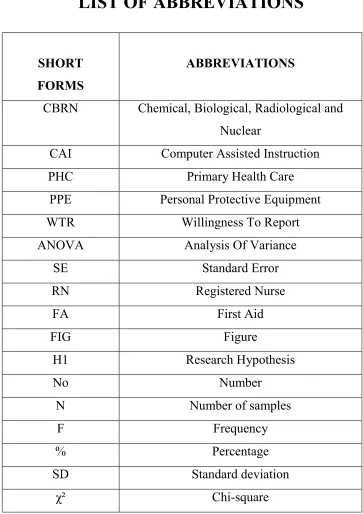
LIST OF ABBREVIATIONS
SHORT
FORMS
ABBREVIATIONS
CBRN Chemical, Biological, Radiological and
Nuclear
CAI Computer Assisted Instruction
PHC Primary Health Care
PPE Personal Protective Equipment
WTR Willingness To Report
ANOVA Analysis Of Variance
SE Standard Error
RN Registered Nurse
[image:14.612.115.478.81.595.2]FA First Aid
FIG Figure
H1 Research Hypothesis
No Number
N Number of samples
F Frequency
% Percentage
SD Standard deviation
ABSTRACT
Disaster event is a catastrophic event needs a first aid measures in emergency
situations. The study focused on effectiveness of computer assisted instruction on
knowledge and expressed practice regarding first aid measures for disaster event among
the students at selected Arts colleges, Thanjavur. Quasi experimental (Non-equivalent
control group design was used among 80 students by using purposive sampling
technique. The knowledge questionnaire and expressed practice questionnaire were given
to assess the knowledge and expressed practice. The statistical analysis revealed that for
WKHSDLUHGµW¶WHVWvalue µW¶ 21.75DQGIRUH[SUHVVHGSUDFWLFHµW¶ 19.5195). Where as in
control group knowledge µW¶ 1.6935) expressed practice (W¶ 1.1679). Hence the given
CAI was effective. The comparison between the group of unpaiUHGµW¶WHVWIRUNQRZOHGJH
value µW¶ 023) and for e[SUHVVHGSUDFWLFHµW¶ This proved that there is a
significant difference between experimental and control group at 0.05 level. Where as in
correlation between the post test scores of knowledge and expressed practice of the
experimental group µU¶YDOXHU and control group µU¶YDOXHU )RUDVVRFLDWLRQ
between the chi-square test there is a significant association in age, medium of education,
residential area of pre test levels of knowledge and expressed practice. Hence the given
1
CHAPTER - I
2
CHAPTER
±
I
INTRODUCTION
Timely first aid saves more lives than heroic surgeries!!!
- Dr. Debangshu Dam
BACKGROUND OF THE STUDY
A disaster is a serious disruption of the functioning of a community
involving widespread human, material, economic or environmental losses and
impacts, which exceeds the ability of the affected community or society to cope
using its own resources.
Developing countries suffer the greatest costs when disaster hits- more than
95 % of all deaths caused by hazards occur in developing countries and losses due
to natural hazards are 20 times greater in developing countries than in
industrialized countries. Disaster can strike any part of the world at any time. We
do not expect disasters, but they happen are an act of God, or an act of man, a
wide spectrum of disaster is on the rise around the world.
India is vulnerable, in varying degrees, to a large number of natural as well
as man-made disasters. 58.6 % of the landmass earthquakes of moderate to high
intensity; over 40 million hectares (12 %) of land floods and river erosion; of the
7,516 kms long coastline, close to 5,700 kms is prone to cyclones and tsunamis.
Vulnerability to disasters/ emergencies of Chemical, Biological, Radiological and
Nuclear (CBRN) origin also exists. Heightened vulnerabilities to disaster risks can
be related to expanding population, urbanization and industrialization,
development within high-risk zones, environmental degradation and climatic
3
NATIONAL FLOOD COMMISSION reports of floods are the most
common and widespread of all natural disasters. Around 40 million hectares of
land in India is prone to floods. Floods cause damage to houses, industries, public
utilities and property resulting in huge economic losses, apart from loss of lives.
Geophysical disasters include earthquakes, volcanoes, dry rock falls,
landslides and avalanches. Climate-related disasters include hydrological events
and meteorological events. There were 3 times as many natural disasters between
the years from 2000 to 2009 compared to the amount between the years from 1980
to 1989. A vast majority (80%) of this growth is due to climate-related events.
NEW ENGLAND JOURNAL OF MEDICINE stated that the scale of
disasters has expanded, owing to increased rates of urbanization, deforestation,
environmental degradation and to intensifying climate variables such as higher
temperatures, extreme precipitation and more violent wind/water storms.
Man-made disasters are the result of human action; act; intent, error; and
negligence. These disasters includes accidents in roadways, waterways and
airways; human design structure collapse; oil spills; industrial hazards outbreak;
CBRN hazards; pollutions, bomb explosions; war; terrorism and its related threats.
In recent years man-made disasters occur frequently and vigorously due to
advancement of science and technology on its devil face leads to epidemic
increase of man-made hazards which demolish both biotic and environment
irrespective to color, creed, religion, caste, community, race and socio-economic
status of the people. The random losses of human lives and their belongings in
terms of casualties and sufferings are irreversible and making a permanent black
scar in anthropo-development. In this context this study has been more momentous
4
NEED FOR THE STUDY
0RVWRIXVGRQ¶WWKLQNDERXWWKHYDOXHRIILUVWDLGXQWLOZHQHHGLW0DQ\RI
its basic skills can be mastered without attending a formal training course. Medical
emergencies are bound to happen, the best thing we can do is to be prepared and
know about how to give first aid. Students are the future of any nation. The
healthy existences of students are essential to build up a challenging nation.
Catastrophic events, including both natural and man-made disasters, usually
create surge capacity needs for health care systems; subsequently, the ability to
meet such capacity needs requires thoughtful preparation. While it is true that
disastrous emergencies may not be prevented or controlled, it is vital for citizens
to be prepared at multiple levels, including individuals, families and community.
INTERNATIONAL FEDERATION OF RED CROSS AND RED
CRESCENT SOCIETY (IFRCS) revealed that the last decade (1999-2008), over
7100 disasters happened in the world that caused 1,243,480 deaths and over 1
billion US dollars damage. In 2005, 246 (42%) out of 650 severe natural hazard
events recorded globally occurred in Asia killing over 97,000 (90%) of the global
total of 110,000 individuals) and affecting more than 150 million people. In 2006,
174 disasters affected 28 million people in Asia and the Pacific were affected.
The statistical report of Nepal earthquake in April 2015 (also known as
the Gorkha earthquake) killed more than 8,800 people and injured more than
23,000 people. The earthquake triggered an avalanche on Mount Everest, making
it the deadliest day on the mountain in history. It triggered another huge avalanche
in the Lang tang valley, where 250 people were reported missing. About 90 % of
soldiers from the Nepalese Army were sent to the stricken areas in the aftermath of
the earthquake under Operation Sankat Mochan, with volunteers mobilized from
5
Table 1.1 represents the Nepal earthquake Casualties by country on April, 2015
Countries No of deaths No of persons injured
Nepal 8773 22,304
India 130 560
China 27 383
Bangladesh 4 200
TOTAL 8947 23,447
Volunteering Queensland Inc. stated that From November 2010 to
February 2011, experienced a series of floods and cyclones that directly affected
more than 2 lakhs people and indirectly affected a great many more. During this
period, many community and government organizations were contacted by
individuals and groups to help their communities. Queensland was contacted by
more than 1 lakh people among them 80,000 potential volunteers were registered.
7KH 86$ 'HSDUWPHQW RI +RPHODQG 6HFXULW\¶VFederal Emergency
Management Agency (FEMA) partners with the Corporation for National and
Community Service (CNCS) to recruit, place and support members of
AmeriCorps NCCC members, called FEMA Corps members, to serve in projects
related to disaster preparedness, mitigation, response, and recovery activities,
providing support in areas ranging from working directly with disaster survivors to
supporting disaster recovering centers to sharing valuable disaster preparedness
and mitigation information with the public.
Disaster related aid is provided to the victims to save lives, alleviate
sufferings and protect human dignity during disaster who are unable to get help
from their own community or local authorities. Natural disasters are tragic
6
recent decades, millions of people have been killed by natural disasters, resulting
in economic damages.
Majority of the research reports indicates that the children and women are
highly vulnerable during disasters. The students are the future teachers, who are
going to uphold millions of future citizen and nourish them with required
knowledge and skills for their sustainability in this modern webbed universe. The
knowledge sharing about manmade hazards in top down model to the students will
reach the society within the need of an hour. Volunteers plays a vital role in the
recovery effort following disasters such as floods, droughts, storms and bushfires.
Volunteers are critical partners and participants in societies throughout the world.
Whether actively participated through a formal organizations where citizens
voluntarily participate in community activities or provide personal care for family,
friends, neighbours, or even strangers as part of accepted cultural norms of giving
and reciprocity.
STATEMENT OF THE PROBLEM
A study to assess the effectiveness of computer assisted instruction on
knowledge and expressed practice regarding first aid measures for disaster event
among the students at selected Arts colleges, Thanjavur.
2%-(&7,9(6
7
x 7R HYDOXDWH WKH HIIHFWLYHQHVV RI FRPSXWHU DVVLVWHG LQVWUXFWLRQ UHJDUGLQJ ILUVW DLG PHDVXUHV IRU GLVDVWHU HYHQW DPRQJ WKH VWXGHQWV LQ H[SHULPHQWDO JURXS
x 7R FRPSDUH WKH OHYHOV RI NQRZOHGJH DQG H[SUHVVHG SUDFWLFH DPRQJ WKH VWXGHQWV UHJDUGLQJ ILUVW DLG PHDVXUHV IRU GLVDVWHU HYHQW EHWZHHQ WKH H[SHULPHQWDODQGFRQWUROJURXS
x 7R FRUUHODWH WKH SRVW WHVW VFRUHV RI NQRZOHGJH DQG H[SUHVVHG SUDFWLFH UHJDUGLQJ ILUVW DLG PHDVXUHV IRU GLVDVWHU HYHQW DPRQJ WKH VWXGHQWV LQ H[SHULPHQWDODQGFRQWUROJURXS
x 7RGHWHUPLQHWKHDVVRFLDWLRQEHWZHHQWKHSUHWHVWOHYHOVRINQRZOHGJHDQG H[SUHVVHGSUDFWLFHUHJDUGLQJILUVWDLGPHDVXUHVIRUGLVDVWHUHYHQWDPRQJWKH VWXGHQWV ZLWK WKHLU VHOHFWHG GHPRJUDSKLF YDULDEOHV LQ H[SHULPHQWDO DQG FRQWUROJURXS
+<327+(6,6
$OOWKHK\SRWKHVLVZHUHWHVWHGDWOHYHORIVLJQLILFDQFH
x +- 7KHUH ZLOO EH D VLJQLILFDQW GLIIHUHQFH EHWZHHQ WKH SUH DQG SRVW WHVW OHYHOVRINQRZOHGJHDQGH[SUHVVHGSUDFWLFHUHJDUGLQJILUVWDLGPHDVXUHVIRU GLVDVWHUHYHQW DPRQJWKHVWXGHQWVLQH[SHULPHQWDODQGFRQWUROJURXS
x +-7KHUH ZLOO EH D VLJQLILFDQW GLIIHUHQFH LQ WKH OHYHOV RI NQRZOHGJH DQG H[SUHVVHG SUDFWLFH DPRQJ WKH VWXGHQWV UHJDUGLQJ ILUVW DLG PHDVXUHV IRU GLVDVWHUHYHQWEHWZHHQWKHH[SHULPHQWDODQGFRQWUROJURXS
8
x +- 7KHUH ZLOO EH D VLJQLILFDQW DVVRFLDWLRQ EHWZHHQ WKH SUH WHVW OHYHOV RI NQRZOHGJHDQGH[SUHVVHGSUDFWLFHUHJDUGLQJILUVWDLGPHDVXUHVIRUGLVDVWHU HYHQW DPRQJ WKH VWXGHQWV ZLWK WKHLU VHOHFWHG GHPRJUDSKLF YDULDEOHV LQ H[SHULPHQWDODQGFRQWUROJURXS
23(5$7,21$/'(),1,7,216
(IIHFWLYHQHVV
,Q WKLV VWXG\ LW UHIHUV WR WKH H[WHQW WR ZKLFK WKH FRPSXWHU DVVLVWHG LQVWUXFWLRQKDVLQIOXHQFHGLQLQFUHDVHWKHNQRZOHGJHDQGH[SUHVVHGSUDFWLFH UHJDUGLQJ ILUVW DLG PHDVXUHV IRU GLVDVWHU HYHQW DPRQJ WKH VWXGHQWV LQ$UWV &ROOHJH
&RPSXWHU$VVLVWHG,QVWUXFWLRQ
,QWKLVVWXG\LWUHIHUVWRWKHSODQQHGLQVWUXFWLRQVJLYHQLQWKHIRUPRI YLGHRFOLSVSLFWXUHV3RZHU3RLQWSUHVHQWDWLRQVZKLFKKHOSVWRHGXFDWHWKH VWXGHQWV UHJDUGLQJ ILUVW DLG PHDVXUHV IRU GLVDVWHU HYHQW ZLWK WKH KHOS RI FRPSXWHU+HUHDIWHULWLVUHIHUUHGWRDV&$,
.QRZOHGJH
,Q WKLV VWXG\ LW UHIHUV WR WKH LQIRUPDWLRQ DFTXLUHG E\ WKH VWXGHQWV UHJDUGLQJ ILUVW DLG PHDVXUHV IRU GLVDVWHU HYHQW ZKLFK ZDV PHDVXUHG E\ XVLQJVHPLVWUXFWXUHGNQRZOHGJHTXHVWLRQQDLUH
([SUHVVHG3UDFWLFH
9
)LUVW$LG0HDVXUHVIRU'LVDVWHU(YHQW
,QWKLVVWXG\LWUHIHUVWRWKHLPPHGLDWHFDUHLQPLQLPL]LQJWKHULVNRI GHVWUXFWLRQV WR YLFWLPV VXEMHFWHG E\ FDODPLWLHV VXFK DV EOHHGLQJ EXUQV IUDFWXUHHOHFWULFDOVKRFNDQGXQFRQVFLRXVQHVV
6WXGHQWV
,Q WKLV VWXG\ LW UHIHUV WR WKH SXSLOV ZKR DUH VWXG\LQJ ILUVW \HDU %&RPDWVHOHFWHG$UWV&ROOHJH
$668037,216
&$,PD\KHOSWKHVWXGHQWVWRGHDOZLWKGLVDVWHUHYHQW
Students may not have adequate knowledge regarding first aid measures
for disaster event.
'(/,0,7$7,21
7KH VWXG\ ZDV OLPLWHG WR WKH VWXGHQWV DW VHOHFWHG $UWV &ROOHJHV 7KDQMDYXU
7KHGDWDSHULRGZDVOLPLWHGWRZHHNV
PROJECTED OUTCOME:
The study helps to improve the knowledge and expressed practice
regarding disaster management among the Arts students.
The CAI on knowledge and expressed practice regarding disaster
management will help the students to handle the disruptions during the
10
CHAPTER - II
11
CHAPTER-II
REVIEW OF LITERATURE
Review of literature is a text of a scholarly paper, which includes the
current knowledge including substantive findings, as well as theoretical and
methodological contributions to a particular topic.
PART - I
Literature related to first aid measures for disaster event
PART
±
II
Conceptual framework
PART
±
I LITERATURE RELATED TO FIRST AID MEASURES
FOR DISASTER EVENT
Alfred.D, Chilton.J et al., Nurse Education in practice (2015) stated that
during the last half of the 20th century, the focus of nursing changed from home
and field to high-tech clinics and hospitals. Numerous disaster events and threats
in the early 21st century caused educators and practitioners to increase the
emphasis on disaster nursing this article tools used by nurse educators to
integrate disaster nursing into the didactic and clinical experiences of
baccalaureate nursing students. They represent two nursing schools about 90 miles
apart that collaborated to provide students with practical application
of disaster nursing concepts. Part 1: A curriculum in action provides an overview
of the curricular tools used to insure adequate coverage of disaster nursing
concepts across the curriculum. Part 2: Collaborative learning in Community
Health Nursing for emergency preparedness relates the steps taken to plan,
12
Aliyu.A, Annals of African medicine (2015) stated that African continent
has not been spared of disaster events. A new phenomenon in the continent is
terrorism that is fuelled by globalization of arms trade and has contributed
significantly to escalation of conflicts in sub-Saharan Africa (SSA) resulting in
complex emergencies and destruction of socioeconomic structures. Systematic
search of published literature was conducted between 1990 and 2013. The impact
of these events has overstretched and overwhelmed the health care system that is
least prepared to handle and cope with the surge capacity and also render normal
services. There is an urgent need for national emergency agencies across Africa to
develop a robust emergency preparedness and response plan. There is a need for
curriculum review in tertiary institutions across Sub-Saharan Africa to introduce
and or expand training in disaster management.
Al Thobaity.A, Plummer.V, et al., Australasian emergency nursing
journal (2015) reported that this study explored nurses' knowledge and sources of
knowledge, and skills as they relate to disaster management in Saudi Arabia,
where more than 4660 people have died, 32,000 people have been affected, and
US $4.65 billion in damage has been caused by disaster since 1980: A
quantitative, non-experimental, descriptive research design. Nurses in Saudi
Arabia have moderate knowledge concerning disaster preparedness. The majority
of nurses gained their knowledge and skills from disaster drills. Nurses need more
education in all areas of disaster management, most importantly in their roles
during response to disasters. Nurses perceive themselves as not well-prepared but
they are willing to improve their skills in disaster preparedness if educational
opportunities are provided.
Azerikatoa.D, Ayoung, SAGE journals (2015) reported that the
importance of disaster management plans for library staff rests on their effective
13
evaluate the preparedness of Ghanaian polytechnic libraries towards disasters,
with respect to measures put in place. Based largely on a qualitative approach, the
study interviewed five head librarians and 25 other staff members of selected
polytechnics, who were chosen using purposive and convenience sampling
techniques. Data was analyzed using interpretative techniques. The results showed
general absence of security policies and disaster plans. Polytechnic libraries were
found to be ill-prepared with respect to disasters. Therefore, it is recommended
that libraries develop policies for disaster management, organize training programs
for staff in order to increase their awareness about disasters and be involved in
cooperative networks.
Biswas.A, Rahman.A et al., Scientific world journal (2015) reported that
tragic disaster occurred on April 24, 2013, in Bangladesh. The study describes the
process of rescue operation and emergency management services provided in the
event. Data were collected using qualitative methods including in-depth
interviews. Immediately after the disaster, rescue teams came to the place from
Bangladesh Armed Forces, Bangladesh Navy, Bangladesh Air Force and local
Police and doctors, medical students, and nurses from nearby medical college
hospitals and private hospitals and students from colleges and universities
including local civil people. Bangladesh faced a tremendous challenge to manage
the man-made disaster and experienced enormous support from different sectors of
society to manage the disaster carefully and saved thousands of lives. This effort
could help to develop a standard emergency management system applicable to
Bangladesh and other counties with similar settings.
Keith Nicholls.J, Steven Picou et al., Journal of applied social science
(2015) stated that Lay Health Workers can play a pivotal role in improving
disaster response and recovery because of their potential effectiveness in
14
disaster responders, and building relationships of trust among all interested parties.
When properly trained, they constitute a proven strategy for timely interventions
aimed at reducing long-term collective trauma and building social capital. Provide
an overview of essential training needed to prepare them to participate in disaster
preparedness, response, and recovery efforts. They concluded with some
suggestions for future research.
Sadeghi-Bazargani.H, Azami-Aghdash.S et al., Health promotion
perspectives (2015) explored that Bam earthquake was the most catastrophic
natural disasters in recent years. The aim of this study was to review different
aspects of crisis management for the period from 2003 to 2011. The data were
summarized and were analyzed using Content Analysis. Out of 422 articles, 25
articles were included in the study. Crisis Management aspects and existing
problem were classified into seven categories including planning and organization,
human resource management, management of logistics, international
humanitarian aids, field performance of the military and security forces, health and
medical service provision, and information management. Thus, concerning the
importance of different aspects of the crisis management and the high prevalence
of disasters in Iran, the observed vulnerability in disaster management process
should be addressed.
Usher. K, Redman-Maclaren ML et al., Nurse Education in practice
(2015) Nurses are often first line responders in a large scale emergency or disaster.
This paper reports an evaluative study of a tailored research capacity building
course for nurse delegates from the Asia Pacific Emergency and Disaster Nursing
Network (APEDNN). 23 participant delegates from 19 countries attended a
three-week course that included learning and teaching about the critique and conduct of
research. An outcome of the course was the collaborative design of a study now
15
nurses' preparedness for disaster response. Overall, participant delegates rated the
planning, implementation and content of the course highly. Recommendations
from this study include funding a mix of face-to-face and distance mentoring and
writing for publication workshops to ensure the sustainability of outcomes from a
research capacity building course such as the one described
Wilkinson. Am, Matzo. M et al., Journal of continuing education in
nursing (2015) stated that catastrophic mass casualty events (MCEs), such as
pandemic influenza outbreaks, earthquakes, or large-scale terrorism-related events,
quickly and suddenly yield thousands of victims whose needs overwhelm local
and regional health care systems, personnel, and resources. Such conditions
require deploying scarce resources in a manner that is different from the more
common multiple casualty event. This article presents issues associated with
providing nursing care under MCE circumstances of scarce resources and the
educational needs of nurses to prepare them to effectively respond in these
emergencies.
Boon, Helen.J et al., Australian Journal of Environmental Education
(2014) Australia regularly suffers floods, droughts, bushfires and cyclones, which
are predicted to increase and intensify in the future due to climate change. School
disaster education is essential to raise awareness among students and their
communities and to encourage preparedness action. This article presents the
results of a critical literature review of peer-reviewed publications on disaster
education programs in Australian schools conducted through Scopus, A Plus,
PsycINFO and the Education Resources Information Center (ERIC) databases.
Results highlight a significant dearth of studies examining disaster education
programs in Australian schools. Recommendations for future research are
proposed to bridge knowledge gaps and establish disaster preparedness resources
16
Gerdan, Serpil., Eurasian Journal of Educational Research (2014)
stated that in disaster prone countries, preparedness is an important factor in
disaster mitigation. The goal of this study is to determine the levels of disaster
awareness and attitude and the individual priorities of the personnel and the
students at Umuttepe Campus of Kocaeli University. In this survey, a relational
scanning model was applied and the data were collected by a measurement tool
via the Internet. The data were analyzed with percentage, frequency, arithmetic
means, t-test, F-test and by using SPSS 14.00 statistical program. Level of
education is an important factor in reducing disaster damages. Students in the
Department of Engineering have the highest awareness level of all. Our results
support the world's science-based developments and emphasize that education and
training in disaster awareness in formal education is very important
Oztekin. SD, Larson. EE et al., Japan journal of nursing science (2014)
reported that compare 4 year undergraduate nursing students' educational needs
concerning disaster preparedness and response in Istanbul and Miyazaki. Second
year of their nursing programs, rarely participate in disaster preparedness and
response courses at their universities (75.2%) or outside (89.8%). Educational
needs of Miyazaki's students who had already participated in these courses (85%)
were higher than in Istanbul's (67.2%). Effective teaching methods were mock
drills. The present study also addresses the need to incorporate mass casualty care
and disaster management skills into undergraduate curricula. Core contents for
nursing curricula in both cities need to be continued. Outcome competencies must
be identified and validated through further research.
Soureche. R., International journal of scientific research (2014)
reported that a survey was conducted to emphasize the level of perception of B.Ed
17
of 450 randomly sampled B.Ed students (includes both gender) procured from 6
different colleges of education in Pondicherry. The data collected from the sample
was statistically analyzed using SPSS package. The result revealed that the sample
have high level of perception towards man-made hazards. Significant difference is
exhibited in the level of perception of B.Ed students with respect to different
demographic variables.
Arbon.P, Ranse J et al., Australasian emergency nursing (2013) stated
that the type of disaster, individual demographic factors, family factors and
workplace factors, have been identified in the international literature as factors that
influence a Australian emergency nurses willing to attend and assist in their
workplace during a disaster. This research was exploratory and descriptive study
design, using online and paper based surveys as a means of data collection. In
total, 451 Australasian emergency nurses participated in this research. Participants
were more willing to attend their workplace during a conventional disaster S
0.001), if they worked full-time (p = 0.01), had received formal education
pertaining to disasters SKDGDIDPLO\ disaster plan (p = 0.008), did not
have children (p = 0.001) and worked in an environment in which they perceived
their colleagues, managers and organization to be prepared. This study
improving disaster knowledge and skills, having a family disaster plan and
improving the perceptions of the nurses' workplace preparedness can enhance the
nurses' willingness to assist in a disaster.
Ardalan.A, Mowafi.H et al., Disaster Medical Public Health
Preparedness (2013) reported that to evaluate the effectiveness of a
capacity-building intervention administered through a primary health care (PHC) system on
community disaster preparedness in Iran. A controlled community intervention
trial with pre- and post assessments was conducted in 2011 in 3 provinces of Iran.
18
control group. Relative changes in awareness in intervention and control areas
were 2.94 and -0.08, respectively (P <.001). Relative changes for readiness scores
were 5.52 in intervention areas and 0.56 in control areas (P <.001). Relative
changes for awareness and readiness were significantly correlated with a
community's baseline risk perception and previous experience with natural
disasters (P <.001). An educational intervention administered through the PHC
system effectively improved disaster awareness and readiness at a community
level.
Min Zhang, LI LI Gou., Journal of scientific research (2013) reported
about current status of school disaster education of primary school students and
analyze potential causes and discuss how to establish a corresponding education
mode. The questionnaires of disaster knowledge for Primary and middle school
students were used in this study and a random sampling method was adopted for
the research. The primary school students maintained the high rate of disaster
attention. 73% primary school students had pay attention to the occurrence of
disasters; more than 75% primary school students were lack of knowledge on
disaster prevention and mitigation and 58.5% students were not satisfied with
school disaster education work. It might improve the quality of the disaster
education and expand the disaster education to promote the development of
disaster education.
Rakesh Kumar Sharma., Journal advanced pharmaceutical technology
(2013) stated that disaster education is aimed at developing a culture of
preparedness and safety besides implementing school Disaster management plans.
Disaster management as a subject in social sciences has been introduced in the
school curricula for Class VIII, IX, and X by the Ministry of Human Resources
Development (HRD), through the Central Board of Secondary Education (CBSE)
19
is being extended to all schools through their Secondary Education Boards. State
Governments will also ensure the inclusion of disaster management curriculum
through State School Boards. The education content is so designed as to inculcate
skill-based training, psychological resilience, and qualities of leadership. The role
of the NCC and Boy Scouts is also being included in schools and colleges for
disaster management related work.
Boon, Helen Joanna et al., Journal of Policy and Practice in Intellectual
Disabilities (2012) stated that recent weather-related disasters impacting Australia
may potentially increase in frequency and severity as a result of predicted climate
variability. In the absence of routine policies and procedures, students with
disabilities may be placed at risk to ill-advised evacuation efforts or neglected
during severe emergencies. The study's results indicate that insufficient
consideration has been given to the emergency preparedness planning and
management with respect to meeting needs of vulnerable students with disabilities.
They recommend that education authorities worldwide review current emergency
management policies in a consultative manner with schools, researchers, first
responders, and carers so as to minimize risk for students with disabilities in
natural disaster emergencies.
Chinwe Ogedegbe, Themba Nyirenda., International Journal of
Emergency Medicine (2012) revealed that there is limited research on preparation
of health care workers for disasters. The objective of this study was to compare
perceptions of clinical and non-clinical staff with regard to personal needs,
willingness to report (WTR) to worN DQG OHYHO RI FRQILGHQFH LQ WKH KRVSLWDOµV
ability to protect safety and provide personal protective equipment (PPE) in the
event of a disaster. $ WRWDO RI HPSOR\HHV ZHUH VXUYH\HG ௗ UHVSRQGHG
20
majority was willing to report for duty in the event of a disaster. Clinical and
non-clinical staff differs in the types of barriers to WTR endorsed, as well as their
FRQILGHQFHLQWKHKRVSLWDO¶VDELOLW\WRSURYLGHWKHPZLWK33(DQGJXDUDQWHHWKHLU
safety.
Deepak M. , Sabitha Nayak., Nitte University Journal of Health
Science (2012) explored that a descriptive study was conducted to assess the
knowledge on first aid measures among self-help group members in selected
community areas of Natekal PHC. The sample for the study comprised of 100
self-help group members selected by purposive sampling technique. The data was
collected by using structured questionnaires. The results showed that majority of
the samples 62% had good knowledge, and 38% had average knowledge about the
first aid practice. Among the seven areas of the knowledge assessment on first aid
measures the mean percentage score of the samples were highest (70%) in the area
of poisoning and lowest score (28.8%) in the area of bleeding.
Jirapongsuwan.a, Englande AJ, Fos.PJ., Journal of medical association
Thailand (2012) stated that disasters, be they natural or manmade, are
catastrophic events that confront nursing managers with the challenge of acting to
reduce the impact of such events upon society as a whole. The combination of the
two-round of modified Delphi method and The Simple Multi-attribute Rating
Technique (SMART) was used to develop a decision tool. The 36 variables were
constructed with seven alternatives: policy, communications, materials, human
resource management, operation effectiveness and health and stakeholder
participation. The authors proposed a practical method to develop a decision
model based on the input of key individuals in disaster management. The model
can be used to guide the decision making for nurse managers resulting in the best
21
1XUXO¶$in Ahayalimudin, Aniza Ismail., BMC public health (2012)
reported that aim of this study was to determine knowledge, attitude and practice
of emergency nurse and community health nurse towards disaster management.
This was a cross-sectional study conducted in emergency departments and health
clinics in Selangor, one of the states in Malaysia. Questionnaire forms eliciting
information towards disaster management were randomly distributed to 468
nurses. Emergency nurses who have been involved in disaster response are more
likely to report adequate practice (P<0.01, AOR=4.008, 95% CI=1.691-9.504)
while those who attended disaster-related education/training are more likely to
have adequate knowledge (P<0.05, AOR=3.807, 95% CI=1.584-9.153) and
practice (P=0.001, AOR=4.145, 95% CI=1.804- 9.525). Attending disaster-related
education/training is seen to be a predictor to adequate knowledge (P<0.001,
AOR=3.511, 95% CI=2.097-5.881) and practice (P<0.001, AOR=4.080, 95%
CI=2.326-7.156), and portraying positive attitude (p<0.05, AOR=2.042, 95%
CI=1.025-4.069) among community health nurse.
Shrestha.SS, Sosin.DM., Disaster medical public health preparation
(2012) stated that build a tool to assist disaster response planning and estimate the
numbers of displaced persons that will require special medical care during a
disaster. We developed a tool Pre Event, which incorporates data from the 2006
National Health Interview Survey, We calculated that 79 428 (95% CI = 76
940-81 770) per million evacuees would need special medical care. The daily
occupation of hospital beds would be 1710 beds (95% CI = 1328-2160) per
million. The occupation of nursing home beds would be 5094 beds (95% CI =
5040-5148) per million. Pre Event tool can assist disaster planners to prepare for
medical care needs of large numbers of evacuees and consider re-evaluating the
22
St John Ambulance Australia., (2012) explored that the Australian Youth
Council and the National Cadet Group held a consultation with young adult
members of St John Ambulance Australia to get their feedback on how to engage
their age-group in community resilience and emergency disaster preparedness. The
Disaster Resilience Toolkit, developed by young people for young people,
provides valuable tips for preparing for any emergency disaster situation. The
toolkit encourages the reader to discuss disaster resilience and preparedness with
neighbors and local communities; provides a quick reference guide for first aid
most commonly required in any disaster area, and gives advice on dealing with the
most often recovery stage. Not just for young people, the Disaster Resilience
Toolkit is an accessible resource for all ages, and all first aid kit bags. The toolkit
also provides a quick reference to the first aid management may need in a disaster
situation.
Bistaraki.A, Waddington.K et al., Cochrane journal (2011) explored
that a recent natural disaster has made disaster training a public priority. Repeated
measures analysis of variance (ANOVA), t-test, one-way ANOVA and chi-square
test were used to analyze the data. The mean score was significantly higher
immediately after the intervention programme [86; standard error (SE): 2] than
before (44.5; SE: 1.7) (P<0.001). The mean score 1 month later was significantly
lower (77.2; SE: 2.3) than that immediately after the intervention programme
(P<0.001), but significantly higher than the mean score before the intervention
programme (P<0.001). Participants in the control group achieved a score of 40
(SE: 2.4), which was significantly lower than the scores of the intervention group
after the course (P<0.001). The disaster training course had a great benefit for the
participants.
Murad.A, AL Khalaileh, Elaine bond., International Emergency
23
knowledge, skills, and preparedness for disaster management. The participants
were 470 completed the survey. Sixty-five per cent of respondents described their
current disaster preparedness as weak: 18% medium: 12% good; and 5% felt their
preparation was very good. 31% received disaster education in undergraduate
programs; 8% in graduate nursing programs; 31% in facility drills, and 22% in
continuing education courses. 11% had participated in a real disaster. Four
hundred and thirty RNs wanted to learn more about RNs role in disasters,
including knowledge and skills. There is a need for a consistent national nursing
curriculum for disaster preparedness and nationwide drills to increase disaster
knowledge, skills, preparedness, and confidence.
Curtis.H, Chason.K et al., Cochrane Database Systemic Reviews (2010)
stated that compare video-based learning (VBL) to traditional lecture about
disaster medicine for emergency medicine (EM) residents. Participants completed
a 123-item knowledge quiz before and after the instruction; a 5-item confidence
survey before and after a three-station (decontamination (DCN), mass triage (MT)
and personal protective equipment (PPE) Significant improvement was also seen
between pre- and post-exercise confidence surveys, which again did not differ (p =
0.78) between video (16.2%, 2.1% - 34.6%) and lecture (14.6%, 13.76% - 43%)
groups. In the video group, 28.6% of critical actions were missed on the practical
exercise stations vs. 45.7% in the lecture group, but this did not reach statistical
significance (p = 0.07). The study suggests that VBL for disaster medicine
increases knowledge and confidence as much as traditional lecture, and may offer
greater improvements in practical skill performance.
Gore .R, Bloem. C, et al. Pre hospital and disaster medicine (2010)
reported that methods of teaching methods have been applied in Haiti before and
after the 2010 earthquake. They include eVWDEOLVKHGD³7UDLQWKHWUDLQHU´PRGHO-
24
participants completed the First Aid Instructors course. 95 program participants
completed an end of course survey. 41 participants had no prior first Aid training
or exposure. The course participants included 2 physicians, 22 students, 8 nursing
students, 7 nurses, 20 teachers, 12 health workers, 5 drivers, and 14 laborers. 92 of
those surveyed stated they would recommend this course to a friend. 88
participants stated that hands on learning helped them better learn the course
material. They will serve as a foundation for self-sustaining higher-level
emergency, pre-hospital, disaster training and management. This will improve the
general quality of health care delivery.
Khan.A, Shaikh.S., Journal of Pakistan medical association (2010)
reported that to assess knowledge, attitude and practices of first aid measures in
undergraduate students of Karachi. A total of 446 medical and non-medical
students were interviewed. 78 students (17.5%) had formal First Aid (FA) training.
The mean number of correct answers of students with FA training was 10.3 (+/-
3.5) as opposed to 8.58 (+/- 4.0) in those without FA training (p < 0.001, 95% CI)
with a mean difference of 7.84%. The mean number of correct answers by medical
students with FA training was 11.2 (+/- 2.9) as opposed to 7.2 (+/- 3.43) by
non-medical students (p < 0.001, 95% CI) with a mean difference of 18.14%. First aid
training programmes should be introduced at school and college level in
developing countries to decrease the early mortality and morbidity of accidents
and emergencies.
Reilly.MJ, Markenson.D., Disaster medical public health preparation
(2010) stated that prevalent assumption in hospital emergency preparedness
planning is that patient arrival from a disaster scene will occur through a
coordinated system. Strength of the emergency medical services system, case
reports in the literature and major incident after-action reports have shown that
25
necessarily arrive via ambulance. They were 25 years of aggregate data suggest
that only 36% of disaster victims are transported to hospitals via ambulance,
whereas 63% use alternate means to seek emergency medical care. Hospitals
should evaluate their emergency plans to consider the implications of alternate
referral patterns of patients during a disaster. Additional consideration should be
given to mass triage, site security, and the potential need for decontamination after
a major incident.
Park.K, Preventive & Social Medicine., (2011) stated that after major
disaster the need for first aid is likely to be so great that organized relief services
will be able to meet only a small fraction of the demand. Most immediate help
comes from the uninjured survivors.
Central Board of Secondary Education., (2006) explained this book will
help all the students who are the future citizens, volunteers and also disaster
managers to be able to cope up with disasters and be better disaster managers and
26
CONCEPTUAL FRAMEWORK
.,1*¶6
GOAL ATTAINMENT THEORY
Conceptual framework is a basic structure that consists of certain abstract
block which represents the observational the experimental and analytical or
synthetically aspects of a process or system being conceived. The interconnection
of these blocks completes the framework for certain expected outcomes. A
conceptual framework is used in research to the outline possible course of action
or to present a preferred approach to an idea. Nursing theory should provide the
principles that under practice and help to generate further nursing knowledge.
7KHVWXG\LVEDVHGRQ,PRJHQHNLQJ¶VJRDODWWDLQPHQWWKHRU\ZKLFK
would be relevant for CAI regarding first aid measures for disaster event. Imogene
NLQJ¶V V\VWHP LV DQ RSHQ V\VWHP ,Q WKis system human are in constant contact interaction with their environment.
Perception:
In this study the researcher perceives that most of the students had
inadequate knowledge and expressed practice regarding first aid measures for
disaster event.
Judgment:
In this study the researcher judge that the CAI is effective in improving the
knowledge and expressed practice regarding first aid measures for disaster event.
27
Action:
In this study the researcher prepare the CAI to improve the knowledge and
expressed practice on first aid measures for disaster event among the students.
Mutual goal setting:
In this study it is an activity that includes the students in prioritizing the
goal and in developing the plan of action to achieve those goals. Here these study
both the researcher and students accept to undergone with the research study.
Reaction:
The researcher plans together and moves towards goal attainment. Here the
researcher plan to teach the first aid measures for disaster event after conducting
the pre test to the experimental group.
Interaction:
The act of two or more persons in mutual presence and sequence of verbal
and non-verbal behaviors that are directed towards the goal.
In this study the interaction includes pre test (for assessing the knowledge
and expressed practice) then administration of CAI and post test to the samples of
the experimental group and no intervention to the samples of the control group.
Post test was conducted for both groups.
Transaction:
In this study the transaction includes the assessment of post test levels of
knowledge and expressed practice on first aid measures for disaster event among
28
In this study the researcher and the subject came together for an interaction,
a different set of perception to exchange. The researcher perceives the subject
need to teach the first aid measures for disaster event to manage the emergency
situation confidently in community settings
The researcher communicates the subjects by implementing the CAI
regarding first aid measures for disaster event between the subjects takes place.
The goal is said to be achieved where there was an increased level of knowledge
R E S E A R C H E R S T U D E N T S P E R C E P T IO N : t h e r e se ar c h er perce ive s that mos t o f the studen ts had lack o f kno w led ge an d ex p r esse d practice . JUDG E
MENT: the CAI is
creatin g aw aren ess regard in g
first aid m
e asures f o r disaste r event a m
ong the students
ACTION: Im ple m ents the CAI in ord
er to create aw
a
ren
ess an
d
im
proving their know
ledge and
expressed practi
ce regarding
first aid m
e asures f o r disaster ACTION: Stud ents ar e readiness to c ooperat e w
ith the researcher.
JUDG
E
MENT: Identifying the
sou
rces to gain
kno
w
ledge and
expressed practi
ce regarding
first aid m
e asures f o r disaste r P E RCE P TION: Students analyze about the early initiation o f f irst aid w il
l helps to
handle the v
ictim
s in disaste
r
Feedback and reassessment no
31
CHAPTER-III
RESEARCH METHODOLOGY
Research methodology is a way to systematically solve the research
problem. In this chapter the investigator discusses the Research approach,
Research design, Variables, Setting, Population, Sample, Sample size, Sampling
technique, Criteria for data collection, Description of the tool, Plan for data
analysis and protection of human rights.
RESEARCH APPROACH
Evaluative research approach was used in this study.
RESEARCH DESIGN
Quasi-experimental (Non-equivalent pre test post test control group) design
was used in this study. (E ± Experimental Group, C ± control Group)
E
C
O1 - Pre test
× - Computer Assisted Instruction
O2 - Post test
VARIABLES
Independent Variable: CAI regarding first aid measures for disaster event.
Dependent Variables: Knowledge and expressed practice regarding first
aid measures for disaster event.
O1 × O2
32
Demographic Variables: It includes Age of the student, Gender,
Domiciliary area, Medium of education, Residential area and Source of
information.
SETTING
The study was conducted among I year B.Com students at selected Arts
colleges in Thanjavur District such as Annai Velankanni Arts college and
Kundhavai Nachiyar Arts college for women. It was nearby 2 kms. Pilot study
was conducted at Bharath college of Arts and Science and Abi and Abi of Arts,
Science and Technology were situated in Thanjavur District.
POPULATION
The population comprised of B.Com students at selected Arts colleges in
Thanjavur District.
SAMPLE
The sample comprised of I year B.Com students.
SAMPLE SIZE
The sample size comprised of 80 I year B.Com students those who are
studying at selected Arts colleges in Thanjavur District.
Experimental group: 40 students
33
SAMPLING TECHNIQUE
Non probability Purposive sampling technique was used to select the
colleges for research study. Then again purposive sampling technique used for
selecting the sample in this study.
CRITERIA FOR SAMPLE SELECTION
INCLUSION CRITERIA
x Students who are studying I year B.Com at selected Arts colleges in
Thanjavur District.
x Students who are willing to participate in the study.
EXCLUSION CRITERIA
x Students who are undergone previous disaster management
programmes, workshops and seminars.
x Students who are studying other than B.Com.
REPORT OF THE PILOT STUDY
Pilot study was conducted to test the reliability, practicability, validity and
feasibility of the tool. Pilot study was conducted for a period of 2 weeks. The
investigator obtained a written permission from the head of the institution
authorities of Bharath College of Arts and Science (Experimental group) and Abi
and Abi College of Arts, Science and Technology, Thanjavur (Control group). The
investigator obtained the oral permission from the participants prior to the study.
Non probability purposive sampling technique was used to select the samples. The
pre test was conducted by using semi-structured knowledge questionnaire to assess
the knowledge and semi-structured expressed practice questionnaire to assess the
34
the post test was conducted after 7 days by using the same tools for both the
experimental and control group. The result of the pilot study was analyzed by the
descriptive and inferential statistics it showed the feasibility to do the study. So the
main study was proceeded.
RELIABILITY AND VALIDITY OF THE TOOL
The reliability and validity of the tool was established by Medical and
Nursing experts. The tool was modified according to their suggestions and
recommendations of experts and the tool was finalized. The reliability of the tool
was established by using test-retest method, r = 0.7(Karl Pearson co-efficient
Formula).
METHOD OF DATA COLLECTION
Written formal permission was obtained from the head of the institution
authorities. The investigator obtained the oral permission from the participants
prior to the study then the investigator conducted the pre test on first day by using
the structured knowledge questionnaire to assess the knowledge and
semi-structured expressed practice questionnaire to assess the expressed practice. After
the pre test, next day CAI was provided to the experimental group students. After
7 days the investigator conducted the post test to both the experimental and control
group to determine the knowledge and expressed practice of subjects with the help
of using the same tools.
SCORING AND INTERPRETATION PROCEDURE
(A) DESCRIPTIONS OF THE TOOLS
Semi structured questionnaire will have III parts,
35
Part-II - It consisted of semi-structured knowledge questionnaire
regarding First aid measures for disaster event.
Part-III - It consisted of semi-structured expressed practice
questionnaire regarding First aid measures for Disaster event.
(B) SCORING OF THE TOOL
PART-II:
It consisted of 24 items related to knowledge regarding First aid
measures for disaster evHQW (DFK LWHP FDUULHV ³´ mark for correct
DQVZHUDQG³´ mark for wrong answer
Obtained score
× 100
Total score
TABLE 3.1 represents the percentage for the levels of knowledge score
LEVEL OF KNOWLEDGE SCORE PERCENTAGE
Inadequate knowledge 0 ± 8 0 ± 33 %
Moderately adequate knowledge 9 ± 16 34 ± 67%
Adequate knowledge 17 ± 24 68 ± 100%
PART-III
It consisted of 15 items related to practice regarding First aid
measures for disaster evHQW (DFK LWHP FDUULHV ³´ mark for correct
36
Obtained score
× 100
Total score
TABLE 3.2 represents the percentage for the levels of expressed practice
score
Level of expressed practice score Percentage
Inadequate expressed practice 0 ± 5 0 ± 33 %
Moderately adequate expressed
practice
6 ± 10 34 ± 67 %
Adequate expressed practice 11 ± 15 68 ± 100%
PLAN FOR DATA ANALYSIS
Collected data was tabulated and analyzed by using descriptive and
inferential statistical methods.
TABLE 3.3 represents the plan for data analysis
S.N
O
DATA
ANALYSIS METHODS REMARKS
1. Descriptive
statistics
Percentage,
Frequency
distribution,
Mean and
standard
Deviation
To describe the demographic variables of I
year B.Com students on knowledge and
expressed practice in both experimental and
control group.
37
post test scores of knowledge and expressed
practice I tear B.Com students knowledge and
expressed practice in both experimental and
control group.
2. Inferential
statistics
PDLUHG³W´
Test
To assess the effectiveness of Computer
Assisted Instruction regarding First aid
measures for disaster