UNIVERSITY OF SOUTHERN QUEENSLAND
CHINA AND PERIPHERAL CONFLICTS
A Dissertation submitted by Tunna P. Burathoki, B.Tech (Hons.)
For the award of Master of Arts
ABSTRACT
China’s enormous size and stature as a new hub of economic growth in tandem with its military modernisation make China a rising power. The strategic consequences of China’s economic growth synergised with its military muscles are multiple and profound, especially, for the neighbours in its conflict-prone periphery. The aim of this dissertation is not only to assess the importance and complexities of conflicts in the periphery of China, but also about the necessity for the neighbours to coexist with a more powerful China. At the same time, in the Chinese geopolitical context, domestic stability and hence, the CCP’s legitimacy has been perpetually paramount, and external threats or conflicts are usually perceived in the context of aggravating domestic and international stability, thereby hampering its strategic aim of achieving global economic command and power-projection military capability.
CERTIFICATION OF DISSERTATION
I certify that the ideas, research work, results, analyses, and conclusions reported in this dissertation are entirely my own effort, except where otherwise acknowledged. I also certify that the work is original and has not been previously submitted for any other award.
__________________________ _______________
Signature of Candidate Date
ENDORSEMENT
__________________________ _______________
Signature of Supervisor/s Date
ACKNOWLEDGEMENT
Many individuals and institutions helped me to bring this study to fruition. Among these, I would like to thank my supervisors Professor Don McMillen and Dr. Bryan Ridge who have contributed and complemented in guiding me throughout this study. This dissertation would not have been possible without Professor McMillen’s intellectual guidance, supervision, and encouragement. At the same time, I owe a special debt of gratitude to USQ for granting a scholarship through the Office of Research and Higher Degree, without this support, my study would not have materialised. My thanks are also extended to Mrs Helen Janes, a staff member in the Faculty of Asian and International Studies, for her continuous assistance.
I am sincerely grateful to the ADF officers and Managers of Helitech-Sikorsky Australia at SSP in Oakey for granting leaves to continue my studies. I have also benefited greatly from the ADF library services of Oakey, Enoggera and Canberra as they have provided valuable study materials for this dissertation.
ABBREVIATIONS
ADF Australian Defence Force
APEC Asia Pacific Economic Cooperation ARF ASEAN Regional Forum
ASEAN Association of Southeast Asian Nations ASEAN +3 ASEAN + China, Japan and S. Korea CBM confidence-building measures CBSM confidence-building and security measures CCP Chinese Communist Party
CIISS China Institute of International Strategic Studies CIS Commonwealth of Independent States CMC Central Military Commission
CTBT Comprehensive Test Ban Treaty CVBG [aircraft] carrier battle group DPRK Democratic People’s Republic of Korea DoD Department of Defence
EMP Electronic Magnetic Impulse
EU European Union
FBIS Foreign Broadcast Information Service
FBIS – CHI Foreign Broadcast Information Service – China (Daily Report) FEER Far Eastern Economic Review
FISS Foundation of International Strategic Studies G-7 Group of Seven (US, UK, France, Germany,
Italy, Canada, and Japan) GNP gross national product
ICBM Intercontinental-range ballistic missile IISS International Institute of Strategic Studies IMF International Monetary Fund
IRBM Intermediate-range ballistic missile
JCS Joint Chiefs of Staff
JSDF Japan Self-Defence Forces
KMT Kuomintang (Nationalist Party) LACM Land-attack cruise missile LAD Jiefanguin Bao (Liberation Army Daily)
LW limited war
LWUHTC limited war under high technological condition MBT main battle tank
MIRV multiple independent re-entry vehicles MoD Ministry of Defence
MR military region
MRAF Military Region Air Force
MRBM medium-range ballistic missile MTCR Missile Technology Control Regime NATO North Atlantic Treaty Organization NEFA Northeast Frontier Agency
NFU No first Use
NMD National Missile Defence
NPC National People’s Congress
PLA People’s Liberation Army
PLAAF PLA Air Force
PLAN PLA Navy
PLANAF PLA naval air force
PPP purchasing power parity
PRC People’s Republic of China
PW people’s war
PWUMC people’s war under modern condition RMA revolution in military affairs
RMB renminbi (Chinese currency)
RNA Royal Nepalese Army
ROC Republic of China
ROK Republic of Korea
SAM surface-to-air missile
SC Security Council
SCO Shanghai Cooperation Organization (China, Russia, Kazakhstan, Kyrgyzstan, Tajikistan and Uzbekistan)
SEATO Southeast Asia Treaty Organization SIGINT Signal Intelligence
SIPRI Stockholm International Peace Research Institute SLBM submarine-launched ballistic missile
SLOC Sea lines of communication
SLORC State Law and Order Restoring Council SPDC State Peace and Development Council
SOE state-owned enterprise
SRBM short-range ballistic missile
SSM surface-to-surface missile
SSN nuclear-powered attack submarine
SSBN nuclear ballistic missile submarine
SSP School Support Platoon
TMD theatre missile defence TRA Taiwan Relations Act
UN United Nations
UNCLOS UN Conference on the Law of the Sea
US United States of America
WMD weapons of mass destruction
TABLE OF CONTENTS
Abstract ... ii
Certification of dissertation... iv
Acknowledgement ...v
Abbreviations... vi
Table of contents... viii
List of tables... ix
List of figures... ix
Chapter I: China and Peripheral Conflicts ...1
Introduction...1
Definition of Key Terms:...5
Review of Relevant Literature ...6
Research Methodology ...9
Analytical Framework ...10
Organization of the Dissertation ...15
Chapter II: China’s Strategic Culture ...17
Introduction:...17
Strategy in Western Perspectives...17
Chinese perspectives on the concepts of doctrine, strategy and strategic frontiers 18 China’s Strategic culture...24
Evolution of China’s Strategic Culture...24
China’s Contemporary Strategic Culture...32
Nuclear Weapons in China’s Strategic Culture ...35
Conclusion: ...38
Chapter III: China and the Peripheral Conflicts - An Overview ...41
Introduction:...41
China and Conflicts in Northeast Asia...42
Sino-Russia-Central Asian Cooperation ...47
China and Conflicts in South Asia...50
China and Conflicts in Southeast Asia...53
Conclusion: ...57
Chapter IV: China and the Indo-Pakistani Conflict...60
Introduction:...60
Historical Overview of India’s Wars ...63
Threat: The Leading Component of Strategic Culture ...74
Sino-Pakistan Entente ...81
Sino-Indian Rapprochement ...85
Defence Capability and Future Alignment ...90
The Sino -US Relationship and China’s Peripheral Conflicts ...94
Conclusion: ...96
Chapter V: Sino-Burmese Nexus in China’s Periphery ...98
Introduction:...98
Burma’s Strategic Culture and China ...100
The Impact of Rangoon-Beijing Ties on China’s Peripheral Zone ...103
Sino-Burmese Nexus and Regional Reactions ...105
Conclusion:...107
Chapter VI: China and Peripheral Conflicts - Conclusion...110
LIST OF TABLES
Table 2.2: Levels of Doctrinal Analysis in the PLA ... 21
Table 2.3: China’s Principal Dynasties... 25
Table 2.4: The PLA’s Doctrine... 33
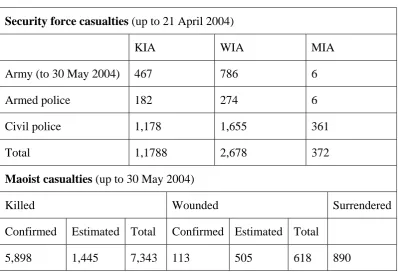
Table 3.1: Casualties - Government Forces Vs. Maoist Rebels ... 51
Table 3.2: Countries and their respective claims in South China Sea ... 55
Table 3.3: Military Conflicts in South China Sea ... 56
Table 4.1: Defence Capabilities of China, India, and Pakistan in 2003-2004 ... 91
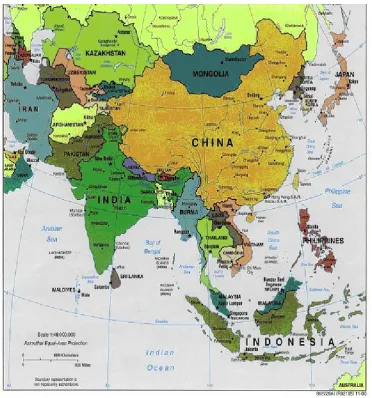
LIST OF FIGURES Figure 1.1: China and Peripheral Conflict Zone... 4
Figure 2.1: The command structure of the PLA ... 20
Figure 2.2: Chinese territories taken by imperialism... 30
Figure 4.1: China and its conflict-prone periphery... 62
Figure 4.2: Divided Kashmir ... 64
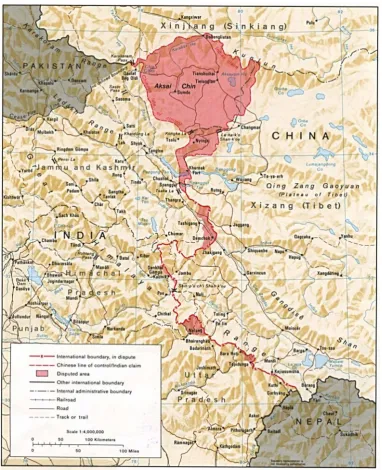
Figure 4.3: Main Sino-Indian Dispute in the Western Sector... 69
Figure 4.4: Sino-Indian eastern border conflict zone ... 70
Figure 4.5: Showing Gwadar and River Indus in Pakistan... 83
Chapter I: China and Peripheral Conflicts
Introduction
This dissertation aims to assess the generic nature and particular dimensions of interstate and intrastate conflicts on the periphery of China. Particular focus has been placed on their significance in China’s strategic culture and its geostrategic interests and roles in them. In this context, the study has analysed the enduring Indo-Pakistan conflict as the central case study, and also has considered a secondary case study focused on strategic competition and potential conflict in Burma. The “central questions” involving China’s opportunities and challenges for the containment or facilitation of the peripheral conflicts have been addressed in Chapters II-VI.
• What are China’s defined strategic cultural views and future geostrategic interests vis-à-vis the conflicts in its peripheral zones?
• What are these “Peripheral Conflicts” that are of such concern to the PRC, particularly those involving itself, India, Pakistan and Burma?
• What role has China played, or will China play, in the conflicts, and to what ends?
• What resources must China marshal to play an active role in addressing these simmering tensions in its neighbourhood?
Another question that could be examined, although it is not done so here in any depth, is - How do domestic handicaps and foreign constraints limit the pace and scope of China’s role in addressing the conflicts?
enduring volatile rivalries stemming from its colonial heritage (e.g., India-Pakistan), the carving of the newly freed territories by the WWII victors (e.g., North-South Korea), and the attrition inflicted by civil wars germinated from ideological heterodoxy (e.g., China-Taiwan). Instead, the emergence of new intra and inter-state actors with conflicting agendas, including Maoist insurgency in Nepal, the transnational Islamic radical forces in Afghanistan and Kashmir, the brutal authoritarian military junta in Burma, the political vacillation in adolescent Bangladesh, some unhealed political wounds in Indo-China, and a continuing regional friction in the South-China Sea, are new addenda to the old Cold War era rivalries and tensions.
At the same time, China has emerged as an economic powerhouse in the midst of this conflict-prone zone, meticulously interweaving the forces of globalisation into its huge population with the size of continental territory and cultural work ethics as the fountain of resources. Armed with a vibrant economy, China’s new ‘stealth weapon’ takes the form of economic diplomacy. As China is entering a new era as a global power, it has moved from strength to strength – China a WTO member, Beijing hosting the 2008 Olympic games, China’s entry after Russia and USA to the intergalactic elite in 2003, China’s surpassing of the US to become the world’s largest recipient of FDI (The Economist 2nd October 2004, pp. 3-24); and the fact that its foreign exchange reserves reached $US 403 billion, the second largest reserves in the world after Japan (The Economist 28 February 2004, p.72) have provided the Chinese with a sense of confidence about the future. The six-nation multilateral talks in Beijing led by China in an effort to diffuse the North Korean nuclear arsenal crisis has lifted China’s prestige as a multilateral player in the international community. This also indicates that Beijing’s strategic interests are not being “isolated” or “contained” in the early 21st century environment.
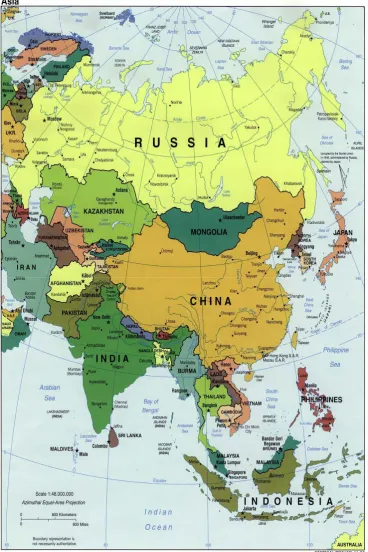
overthrow of the Saddam Hussain regime in Iraq (2003), has led China to perceive itself as facing the US as a rival for global dominance. The strong US military presence in Japan and South Korea and American support for Taiwan as in the Taiwan Strait Crisis (1996) are seen as US threats both global in nature and specific to China’s peripheral security. Moreover, the prospect of continued US and allied military force deployed in Afghanistan, and particularly in the Central Asian republics on China’s northwestern periphery (see Fig. 1.1), are unsettling and perennial sore points for China. This has already been conceived as an American strategy of encircling China. Beijing presumes that the United States’ new propensity to intervene in regional conflicts under the pretext of “humanitarian intervention” is a cover for extending and consolidating American hegemony in a climate of “neo-containment” of China.
In this context, China’s diplomatic patterns of amity and enmity around its geographic periphery will be a key component in the containment or continuation of proximate conflicts, and bear significant influence on China’s own future development as a national, regional and global power. This is especially true in the case of India-Pakistan relations, which are fraught with potential dangers of nuclear conflict and continuing terrorist-like currents.
Figure 1.1: China and Peripheral Conflict Zone (Source:
Definition of Key Terms:
Some key terms used in the dissertation are elaborated here, with a view to achieve greater clarity and comprehension.
Conflict
:
This term is used to indicate a state of disharmony between opposing actors as a result of prolonged skirmishes, battles, wars or open clashes of ideas / interests. The first salient characteristic of the conflict, which is contextual in the dissertation is the conflict between dyads of similar ethnicity or over ethnically specific stakes -whatever the objectives of the states beyond the immediate conflict, unifying the territories of common ethnicity is viewed as the primary foreign policy objective. The second salient feature of conflict is enduring patterns of objectives, and alliances and rivalries, associated with differences in regime types.National Interest: This term is invoked by realists to signify that state-survival is at the top of the list. An individual state’s interests connect policies and actions adopted by the government, with want-satisfaction and possibly need fulfilment. National Interest expresses an instrumental relation between such policies and action, and its preference-attainment (Baylis & Smith 2001, p.77).
Periphery: In the context of this dissertation, the “periphery” is defined as being a zone adjacent to the contemporary political boundaries of China. Any state with or without a common border with China but having conflicts of concern to the PRC is included in this periphery.
Strategic Culture: Strategic Culture is an integrated set of concepts and symbols that act to establish pervasive and long-lasting grand strategic preferences by formulating notions of the role and efficacy of force in interstate political affairs (Johnston 1995, pp.32-64). Strategic Culture represents “the sum total of ideas, conditioned emotional responses and patterns of habitual behaviour that members of a national strategic community have acquired through instruction or imitation and shape with each other”(Snyder 1984, pp. 108-146).
national interests. Strategic frontiers are far greater than geographic boundaries, and include spheres of concern under the sea and in space (Shambaugh 2002, pp.66-69).
Review of Relevant Literature
The issues raised by the dissertation’s central questions have been systematically addressed in the discussion and analysis in Chapters II to VI. The research material for this dissertation has been based on the relevant literatures of primary and secondary sources such as archives, documents, newspapers, TV and radio news, Internet articles, and Internet databases.
Primary Sources:The Defence White Papers and Annual Budgetary Reviews of the PRC, India and Pakistan, Jane’s Intelligence Review, document pertaining to the PLA’S defence doctrines, strategy, and security documents have been perused to cover the issues raised in this dissertation.
Secondary Sources: (i) Published Books: China has always occupied a special niche in the world community – a model to some, a mystery to others. From the early 1990s, there has been a dominant theme in the literature regarding the “China-Threat” in terms of its booming economy in general, and the PLA’s parallel modernisation in particular. The recently published books covering the regional geo-politics and geo-economics provide a firm source base to support the analytical dimensions of this dissertation.
China’s New Rulers: The Secret Files(2002), a book edited by Andrew J. Nathan and Bruce Gilley, is based on confidential Party files leaked to a Chinese writer abroad. It offers an unprecedented glimpse into the most orderly succession in the turbulent history of the People’s Republic. It provides detailed descriptions of the men who will rule China for the next five years – their backgrounds, their characters and their vision for the future. This book contains insights into matters of great importance to the West, such as who will lead China, what changes they may bring in terms of economic reform, China’s integration into a global economy, pressures for political liberalization and human rights, ethnic unrest in Tibet and Xinjiang, the status of Taiwan, peripheral conflicts, and relations with the US.
Field Marshal Lord Carver’s historical chronology War since 1945(1990) largely concentrates on the conflicts in the Asian theatre. This book covers the Korean War (1950-1953), the Indo-Pakistan War (1948,1965,1971), the Sino-Indian War (1962), and the Vietnam War (1954-1975) in a lucid, comprehensive, and critical way, thus assisting in the determination of contextual factors shaping the conflicts that this dissertation raises as the “raison d’guerre”.
The volume entitled South Asia in 2020: Future Strategic Balances and Alliances, (2002), edited by Michael R. Chambers, consists of seventeen papers presented at the cosponsored conference by the Asia/Pacific Research Centre, the Centre for International Security and Cooperation at Stanford University, and the U.S. Army War College’s Strategic Studies Program on January 4-5, 2002. The papers focus on the future of strategic balances and alliances in the South Asian region, with 2020 as the target date. This book not only talks about the pattern of amity and enmity in the triangular equation of the Sino-Indian-Pakistan relationship, but also provides information about the role of extra regional powers and issues such as economic trends, domestic political conditions, strategic culture, and, above all, the role of nuclear weapons.
Andrew Nathan and Robert Ross argues that China remains a vulnerable power, crowded on all sides by powerful rivals and potential foes. In any event, China’s long-term prospects to successfully modernise its small and dated strategic nuclear force depend on its success at modernising the country’s economy, infrastructure, technology and human capital. Therefore, China is not likely to pose a challenge to US strategic primacy in the first two decades of the 21st century. On the other hand, some contributors point out that the PRC has an aspiration to become a hegemonic power because of its authoritarian socialist political system, rapid economic growth and historical role as a great power. The ‘China threat’ has thus become an “open excuse” as well as a “latent factor” affecting many countries’ policies towards the PRC. The arguments presented in this book are thus very pertinent to the analytical questions addressed in the dissertation.
David Shambaugh’s Modernising China’s Military: Progress, Problems, and Prospects (2002), analyses China’s evolving military power. It is comprehensive, meticulously researched, and enriched by many years of personal interviews in Beijing with top military/ security specialists. He includes an insightful summary of the Chinese military and explains many of the problems the PLA has had, and will continue to have, in its course of modernisation. This book is rich in data, and will be extensively used in the dissertation, as the role of the Chinese military will be a critical determining factor not only in the containment or conflagration of conflicts in the periphery of China, but also in how China relates to the outside world, especially to the US.
The Military Balance, published annually by the IISS in London, is an authoritative assessor of China’s military modernisation, and the IISS’s series of Adelphi Papers concentrates on military issues. For example, G.V.Segal’s “China Changes Shape: Regionalism and Foreign Policy” (Adelphi Paper No.287, IISS London), and some publications by the Strategic and Defence Studies Centre at ANU have assisted in outlining the role of the PLA in China’s national interests for this dissertation.
(iii) Internet sources. The Internet allows extensive access to relevant data, particularly up-to-date policy documents and critical press releases of PRC. Used with care, it greatly assists in addressing the questions raised in this dissertation. For instance, ‘The Survey of the World Economy’ by The Economist (2nd October 2004, pp. 3-24) has precisely indicated China’s strong economic health vis-à-vis the wobbling global economy (www.economist.com/surveys).
Dr Hill’s articles ‘China’s armed forces set to undergo face-lift’ (JIR, Feb. 2003), ‘China’s naval development focuses on Taiwan’ (JIR, June 2003), ‘ One year on: China’s leaders set out strategy for 2004’ (JIR, March 2004) highlight the PRC’s current military modernisation process and tactical moves in achieving its immediate strategic goals (jir.janes.com).
Research Methodology
The method adopted for this study has been documentary research and analysis in which multiple primary and secondary sources have been extensively utilised. The content analysis based on an archival methodology/approach has been the primary technique applied to this dissertation topic and its central questions so as to reach a set of interpretative conclusions. Guided by the central questions set for the study, the research investigates four basic source types.
comprehensive military almanacs from Western resources, which helped to eliminate the common belief that there is no military transparency, especially in regard to information about China.
The second set of sources are specialist analyses of the PLA generally and of its many specialised aspects. This research uses not only the annual volumes of conference proceedings from the two annual meetings on the PLA, sponsored by the American Enterprise and its partners (Institute of US Army War College in recent years) and the Council on Advanced Policy Studies in Taiwan and its partners (the RAND Corporation in recent years), but also the rising number of PLA and China security articles appearing in Western scholarly and policy journals.
Primary data and assessments in leading defence and security publications are a third and invaluable source utilised in the study. These include many publications of the Jane’s Information Group, the annual volumes of The Military Balance, published by the IISS in London, and the annual volume of the Military Technology, published by the MPG, Germany.
A fourth source of information is the growing number of Internet websites on global military and security affairs, as well as some PLA-specific websites listed on the China Security Homepage (http:// mehampton/Chinasec.html). This has unparalleled holdings of books, periodicals and journals on defence and security issues.
Finally, the Defence Library Service of Canberra has been extensively used as it has a large holding of books, periodicals and journals on defence and security issues. However, contradictions and misstatements of fact frequently appear in many works, and thus a lot of time has been spent on crosschecking sources and checking with knowledgeable experts to verify questionable data or assertions, and this dissertation is hoped to be as fully accurate as humanly possible.
Analytical Framework
World-System Theory (Baylis & Smith 2001, pp.141-249). A newer model, “Constructivism,” which is a more radical variant of Neo-Liberalism, has been found to be of particular use in analysing some important features of the conflicts covered in this dissertation
Realism/Neo-Realism: In international security, a conservative worldview strongly influences the contours of “realism,” or power politics (Realpolitik), which holds that a nation rationally uses power to pursue its self-interest. In this “power politics” model, relative gain, balance of power, sovereignty, the state-centric anarchic system model, capabilities, trust, and so on are the bedrock characteristics of Realism/Neo-Realism. Regardless of differences in their doctrines and objectives, all states face threats to their integrity and survival. They can never be entirely certain where threats may arise. Therefore, they have to take seriously all potential threats and deter them by arming and attracting allies. Thus, the common environment of the international system tends to confront different types of states with relatively homogeneous challenges, and to elicit relatively homogeneous responses. The situation of particular states in the system is thus characterized by two primary variables: the number of states in the international system, and the distribution of military power amongst them.
In the Neo-Realist framework, uncertainty about military capabilities is usually the most important reason. States may significantly over-assess their own or their allies’ military capabilities and level of trust, or under-assess enemy capabilities, such that a level of preparation sufficient to deter war in the presence of accurate assessments no longer suffices. On the other hand, uncertainty about the preferences of other states is not usually taken to be similarly destabilizing. This is because cautionary countermeasures are more easily taken to hedge against the risk of uncertainty about preferences. Theoretically, if a country hitherto perceived to be an ally or a neutral becomes a threat, arms and alliances can be used to deter such a threat just as readily as they can be used to deter threats from states that are more certainly enemies.
South Korea and available US forces be deterred by the combination of North Korean nuclear preparations and the possibility of Chinese backing? In this analysis, war is most likely to break out if North Korea over assesses its own capabilities, or under-assesses South Korean capabilities or US resolve to back South Korea; or if South Korea over-assesses its own capabilities, or under-assesses North Korean capabilities or China’s resolve to back North Korea. A similar analysis applies to the China-Taiwan and India-Pakistan conflicts.
Liberalism/Neo-Liberalism. The basic tenet of the set of perspectives comprising Neo-Liberalism is that state objectives, and thus strategies, are largely determined by regime type and state identity. State identity includes not only a “civic identity,” like democracy and individual rights, but also an “ethnic identity” based upon the state’s ethnic composition. States typically reconcile both types of identity into a legitimising ideology that is at least the normal basis of representation by political elites. The role of non-state actors also is accounted for, and there is a belief in the concept of relative gain.
In contemporary Asia, these debates typically turn on what strategies are most likely to pacify North Korea, China, and Pakistan. The dovish view is that these regimes are liable to remain peaceful as long as certain of their fundamental interests are not threatened. For North Korea, this means that economic aid; trade and diplomatic recognition are desirable to prevent worsening famine and the possibility of a desperation-driven invasion of the South. For China, it means that declaring and recognizing an independent Taiwan are to be avoided as an affront to the strong national pride of Chinese elites. Such a provocation may lead otherwise cautious leaders to consider more seriously a military solution to the “one China problem” For Pakistan, it means that India can avoid conflict by negotiating with Kashmiri secessionists and increasing regional autonomy. This strategy avoids pushing Pakistan into a corner, where the regime is forced to choose between peace and favourable change in Kashmir.
mechanisms. For North Korea, this means that economic aid and trade make war more likely by strengthening an aggressive military outlook, and that diplomatic recognition may be misinterpreted as a lack of resolve. For China, it means that the US should better arm Taiwan and make clear that its defensive commitment will be unchanged by a Taiwanese declaration of independence. For Pakistan, it means that India must not reward secessionist violence in Kashmir with concessions, but must rather impose retaliatory costs on Pakistani support for such violence.
Neo-Liberalism is inadequate in terms of explaining some important characteristics of the China-Taiwan, Korean, and India-Pakistan conflicts. Neo-Liberalism tends to take state preferences as given, largely determined by their regime types and state identities. For example, according to Neo-Liberalism, regime types can change and produce dramatic changes in foreign policy preferences.
Will concessions push North Korea toward following China’s reform path, or will they merely solidify the existing regime and embolden its more radical elements? Will concessions lead Pakistan to return toward secular nationalism and mutually beneficial political and economic stability, or will they vindicate and thus deepen Islamist identity and the associated jihadi (holy war) methods? To conclude, constructivism has the merit of explicitly addressing the kinds of transformations of state identity and regime type that are now under way in China, Pakistan, and possibly in North Korea, in the years to come.
Constructivism should be seen as a complement to the other theoretical approaches, which continue to yield valuable theoretical insights. Constructivism and Neo-Liberalism emphasize, respectively, the sources of foreign policy preferences and the transforming effects of interaction between states with different foreign policy preferences. Neo-Realism focuses more on whether or not the balance of power mechanism is effective in the context of a system with units of given preferences and resources.
Marxist/Structuralism or World-System Theory: In this theory, the most important feature of world politics is that they take place within a structural, “class-like” environment shaped by the world capitalist economy. In this world economy, the most important actors are not actors but classes, and the behaviour of all other actors is ultimately explicable by class forces. Thus, capitalist dominated states, multinational corporations, and even international organizations represent the dominant class interest in the world economic system. As for the order in world politics, Marxist theorists think of it primarily in economic rather than in military terms and consider the “order” to be exploitative, hegemonic, and “unjust”. This theory is the least applicable and influential of the three theories in discussing the conflicts in the study of this dissertation.
identities as they pertain to strategic culture. This approach implies further changes or possible changes in foreign policy preferences and in the corresponding structure of threats. Alternative strategies and the likely patterns of strategic interaction are then laid out. Finally, the various possible outcomes are mapped back into an assessment of further changes in regime types, state identities, preferences, and threats. With these consequences, or payoffs, of different patterns of strategic interaction in mind, it is possible to select out a number of more plausible scenarios for the future development of the three conflicts.
Organization of the Dissertation
The dissertation’s Chapter II provides an historical as well as contemporary perspective of China’s evolving strategic culture, which is largely driven by a “cult of defence”. There are core strategic issues embedded in the enduring conflicts around China. Its strategic culture, the “cult of defence,” is the result of interplay between Confucian and Realpolitik strands, whereby Chinese elites believe strongly that their country’s strategic tradition is pacifist, non-expansionist, and purely defensive. But, at the same time, it provides them with a justification for demonstration or use of force; including offensive and pre-emptive strikes, as being defensive in nature. The first two central questions raised in the dissertation are addressed in this chapter.
explored. In South Asia, another peripheral state, Nepal, has been experiencing an intrastate Maoist inspired struggle in recent times, and this will be briefly mentioned. The interstate transnational Islamic radical forces in Afghanistan and Kashmir have successfully attracted world attention. Islam remains a powerful cultural force in the western periphery of China, including its own northwest XUAR.
Chapter IV, a case study of China and the Indo-Pakistani conflict, is the ‘nucleus’ of this dissertation. It explores at the roots of the rivalry to understand the difficulty of obtaining peace between India and Pakistan. The regional geopolitical dynamics of the 1960s gravitated Pakistan into the Chinese orbit, and ever since, their strategic partnership has solidified. Over the past fifty years, the Indo-Pakistan rivalry has erupted into three wars and numerous disputes. Due to the geographical proximity of China, India, and Pakistan and enduring Sino-Pakistani entente cordiale as the background to Sino-Indian enmity, the goals of the PRC in approaching the explosive India-Pakistan rivalry has been a key feature in the strategic triangle of three nations.
This chapter also deals with the contemporary geopolitical scenario of shifting global alliances and changing priorities, especially the Sino-American rivalry for predominance in Asia will be central in the final realignment of nations regionally and addresses the last central question of the dissertation “How do domestic handicaps and foreignconstraints limit the pace and scope of China’s
Chapter II: China’s Strategic Culture
Introduction:
This chapter provides an historical and contemporary perspective of China’s evolving strategic culture, which is largely driven by its national interest vis-a`-vis the contemporary global geopolitical environment. China’s political and military leaders generally accept history as a guideline to its future and see the foreign as well as domestic environments as treacherous, filled with threats and conspiracies. China’s ‘cult of defence’ is the nucleus of strategic culture, which evolved as a result of interplay between its ancient Confucian philosophy and Sun Tzu’s Art of War, and contemporary Realpolitik strands. Chinese elites believe strongly that their country’s strategic tradition is pacifist, non-expansionist, and purely defensive. But at the same time, it provides them with a justification for the demonstration, if not the use of force; including pre-emptive strikes, as being defensive in nature. This chapter discusses myths and intrigues in China’s political thought- a nexus to the strategic culture, which helps to address some of the central questions raised in the dissertation, including ‘What are China’s defined strategic cultural views and geostrategic interests vis-a` -vis
the conflicts on its peripheral zone?’
Along the way, the contemporary Chinese perceptions of other states are strongly coloured by China’s interpretations of their assumed cultural proclivities. These cultural images of other countries, particularly those in the strategic domain, influence China’s assessment of real and potential threats in the international environment. As this dissertation focuses on Chinese strategic thought in parallel to Western views, the multidimensional views framed by some distinguished Western strategists at various critical times illustrate their differences from Chinese perspectives on the notion of using force in its strategy.
Strategy in Western Perspectives
organised force for political purposes. Broader still is the concept of ‘Grand Strategy’, which involves the co-ordination, and direction of all the resources of a nation (or a group of nations), towards the attainment of political objectives. Strategy deals with the different problems of national policy, the areas where political, economic, psychological, and military factors overlap. This point is distinctly made by Henry Kissinger, who stated that the ‘separation of strategy and policy can only be achieved to the detriment of both. It causes military power to become absolute application of power and it tempts diplomacy into an over-concern with finesse’ (Baylis & Wirtz 2002, p.3). There has evolved a greater importance of political and economic factors in modern strategic warfare, and the closer linkage between military and political/economic affairs has become the cardinal principle of modern strategy. Various Western strategists have given multidimensional views on strategy. Baylis and others’ collection of the definitions of ‘strategy’ (Baylis & Wirtz 2002, p.4) reveals some common features but also significant differences:
‘Strategy is the use of engagements for the object of war.’-Carl Von
Clausewitz
‘Strategy is the art of distributing and applying military means to fulfil
the ends of policy.’- Liddel Hart
‘Strategy is a process, a constant adaptation to the shifting conditions and
circumstances in a world where chance, uncertainty, and ambiguity
dominate.’-W. Murray and M. Grimslay
‘Strategy must now be understood as nothing less than the overall plan
for utilizing the capacity for armed coercion- in conjunction with
economic, diplomatic, and psychological instruments of power- to
support foreign policy most effectively by overt, covert and tacit means.’-
Robert Osgood
Chinese perspectives on the concepts of doctrine, strategy and
strategic frontiers
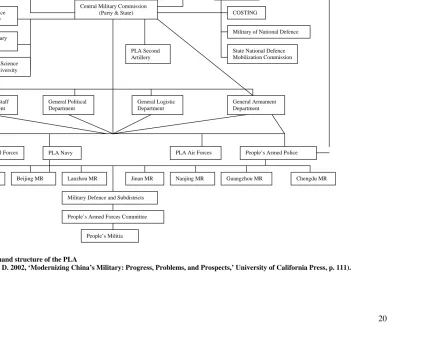
Doctrine: The Chinese doctrine is shaped or contextualized by strategic culture, and vice-versa, and is fundamental in all facets of political thought, including those relating to China’s military modernisation. Doctrine is far more than the abstract study of core warfare—it is central to how the PLA is organised (the Command Structure of the PLA is shown in the Figure 2.1) and how it prepares to apply lethal force. As US Army Field Manual says: “Doctrine captures the lessons of past wars, reflects on the nature of war and conflict in its own time, and anticipates intellectual and technological developments in future times” (US Army, 1993).
Figure 2.1: The command structure of the PLA
(Source: Shambaugh, D. 2002, ‘Modernizing China’s Military: Progress, Problems, and Prospects,’ University of California Press, p. 111). CCP central committee politburo
State council
Central Military Commission (Party & State) National Defence
University
COSTING
Military of National Defence
State National Defence Mobilization Commission Academy of Military
Sciences
National Defence Science & Technology University
PLA Second Artillery
General Staff Department
General Political Department
General Logistic Department
General Armament Department
PLA Ground Forces
Chengdu MR People’s Armed Police
Guangzhou MR PLA Air Forces
Nanjing MR Jinan MR
People’s Armed Forces Committee Military Defence and Subdistricts PLA Navy
Shenyang MR Beijing MR Lanzhou MR
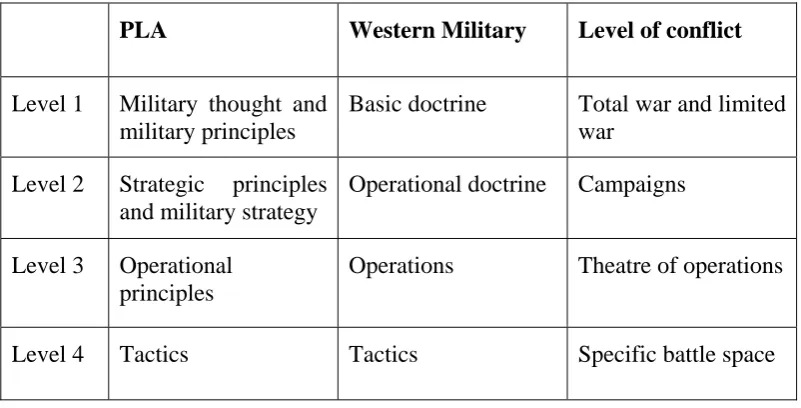
The PRC’s Defence White Paper, published in 2000, has outlined the assessment of China’s national security environment and other subjects, but unlike many militaries the PLA unfortunately does not publish a National Military document explicitly detailing its war fighting doctrine. Yet, through researching of various publications and observation of China’s military campaigns, different elements of PLA doctrine can be pieced together. Four separate levels of the PRC’s doctrinal theory and planning are presented in Table 2. 2.
Table 2.2: Levels of Doctrinal Analysis in the PLA (Source: Shambaugh, D. 2002,
Modernising China’s Military: Progress, Problems, and Prospect, University of California Press, p.59).
PLA Western Military Level of conflict
Level 1 Military thought and military principles
Basic doctrine Total war and limited war
Level 2 Strategic principles and military strategy
Operational doctrine Campaigns
Level 3 Operational principles
Operations Theatre of operations
Level 4 Tactics Tactics Specific battle space
All three elements – doctrine, technology, and threat – have interacted to shape the PLA’s posture over time, the Red Army Marshal Zhu De’s axiom “The kind of war to fight depends on what kind of arms we have.” has now been replaced by “Build weapons necessary to fight whatever kind of war” (Shambaugh 2002, p.60). As the PLA remains technologically inferior to most potential adversaries, thus, must continue to rely on asymmetrical warfare strategies. Despite the exigencies of the Taiwan situation, the Chinese military’s overall posture today thus remains largely driven by the doctrine.
military conflict (Godwin 2000, p. 15). The PLA’s operative military strategy, primarily at the campaign level of warfare, has come to be known as “active defence”. This term has its origins in the Chinese revolutionary war, when Mao proposed a military strategy of “offensive defence, or defence through decisive engagements,” in which PLA units would proactively engage the enemy, exploiting its weak points and attempt to destroy enemy capabilities and will (Mao 1972, p.105). “Active defence” takes place within a broader context of “people’s war” and is often regarded as passive warfare of necessity to “lure the enemy in deep” in order to overcome the enemy’s technological superiority by playing to the strengths of geography and the civilian population. This conceptualisation of active defence as a military strategy is thus a core component of broader Chinese military doctrine. It can best be thought of as “operational doctrine” in the Western sense, while people’s war and its modern equivalents fit the category of “basic doctrine” (Shambaugh 2002, p.58). As the term suggests, operational principles are applicable to large-scale operations within broader campaigns, which include mobility, attrition, annihilation, quick-decision battle, close or deep defence, layered defence, joint operations, combined arms operations, pre-emptive strikes, asymmetrical warfare, transregional operations, offensive operations, and other general concepts.
Strategic Frontiers: This concept delineates the territorial parameters of a nation’s perceived national security interests – that is, territories to which it would be willing to commit military forces in pursuit of goals that it defines to be in its national interests. China’s claimed strategic frontiers now extend beyond its immediate borders into its regional periphery. They have always included Taiwan and countries contiguous to Chinese boundaries.
ocean and seas,and this is codified in the 1992 Maritime Law of the Seas adopted by the National People’s Congress (Shambaugh 2002, p.67).
In as much as China became a net petroleum importer in the 1990s, some strategists even define its strategic frontiers as encompassing the Persian Gulf (Shambaugh 2002, p.67). China has made strong claims under international law to a vast expanse of ocean and islets in the South China Sea. Chinese strategic maritime frontiers are also described as ultimately extending far into the Pacific Ocean (Shambaugh 2002, p.67).
These new strategic maritime frontiers are discussed in detail in Ye Shiping’s surprisingly candid 1998 volume Zhongguo Haiquan (China’s Sea Power), which makes clear China’s aspirations to be a regional and pan-Pacific naval power by the middle of the twenty-first century. More disturbing, however, are Ye’s observations about the need for “living space” for China’s large population, which is forced to live on a limited arable land mass, and the need for excess Chinese labour to find employment destinations (Ye 1998, Zhongguo Haiquan). China’s extension of its sea and space strategic frontiers began in the mid 1980s. In an article in Liberation Army Daily there was an emphasise on “living space,” distinguished between “visible space” (controlled territory) and “invisible space” (undersea and space jurisdiction), and called for an expansion of China’s ground, sea, and air strategic frontiers (Xu 1987, Jiefangjun Bao 3 April). As cited in Xu:
The ‘national gateway’ concept of active defence must be pushed
outward from traditional geographic borders to strategic boundaries – by
three-dimensional menacing force to protect China’s legitimate rights and
interests on a battlefield using strategic defensive and offensive weapon
systems for prompt counterattacks in space, on land, and at sea far from
China (Jiefangjun Bao, 3 April 1987).
periphery. The PRC’s assertive claims over the Paracel and Spratly island groups in the South China Sea are proof of its inclusion of these territories within its strategic frontiers. As one article put it, “The strategically and economically important Spratly Islands and surrounding waters have a bearing on the basic interests of the Chinese nation. We should adopt a modern concept of the ‘strategic ocean’ in forming our perspective on these islands” (Shen 1988, pp. 4-5).
China’s Strategic culture
Strategic culture is a collection of the beliefs, norms, values and historical experiences of the dominant elite in a polity that influences their understanding and interpretation of security issues and environment, and shapes responses to them. Strategic culture establishes “pervasive and long-standing strategic preferences by formulating concepts of the role and efficacy of miliary force in interstate political affairs, and by clothing these conceptions with such an aura of factuality that the strategic preferences seem uniquely realistic and efficacious” (Johnston 1995, pp. 32-64). The advocates of strategic culture argue that security management decisions are shaped by “different cultural influences on the decision makers and not by the rational pursuit of similar national security or functional organisational interests” (Synder 1984, pp.108-146).
Evolution of China’s Strategic Culture
China’s sense of Superiority: The first feature of China’s strategic culture is the sense of innate superiority, which is largely attributed to its long history. China possessed a sense of superiority and arrogance that was spectacular in world history, at least until the twentieth century brought fascist regimes upon the scene. The doctrine behind this confidence was cosmological, hierarchical, and based on a social ethic, yet with a dose of peripheral Realpolitik. Chinese maps, from early times and also in the Ming and Qing Dynasties, included not only earth, with China central, but also heaven, with the sun depicted at the top and the moon at the bottom (Godwin 1986, pp.1-13). Wrote Ho Ping-ti of the Qing Dynasty’s dealings with surrounding powers: “The true status of any of China’s peripheral areas depended on China’s ability to exert effective control” (Ho 1967, p.190).
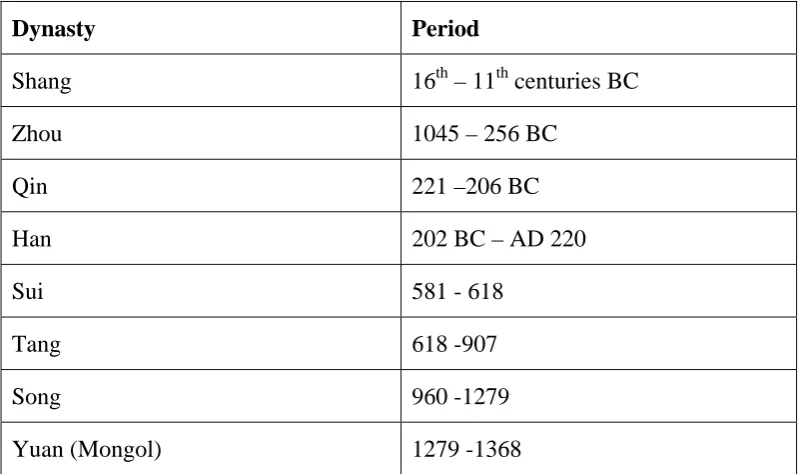
[image:34.595.131.531.525.762.2]There had been no reason to doubt China’s view of itself as a central pool of civilization or “The Middle Kingdom,” as it was surrounded by barbarous and vassal nomadic races in the bleak territory of the north and insurmountable Himalayan range in the south. The history of China is far too long and convoluted to summarize here, it need only be said that the prominent dynasties (see Table 2.3) played an instrumental role in shaping the strategic culture of present day China.
Table 2.3: China’s Principal Dynasties
Dynasty Period
Shang 16th – 11th centuries BC
Zhou 1045 – 256 BC
Qin 221 –206 BC
Han 202 BC – AD 220
Sui 581 - 618
Tang 618 -907
Song 960 -1279
Ming 1368 -1644
Qing (Manchu) 1644 -1912
The Chinese have claimed that their civilization is as old as 5000 years, but a coherent Chinese polity took root only in the sixteenth century BC with the establishment of the Shang Dynasty, known for fine bronze technology, horse-drawn chariots and maturation of the Chinese writing system (Hucker 1975, p.28). By the Zhou Dynasty (1045-256 BC), the polity displayed many coherent features – unity as a creed, a king with a doctrine, a claim to rule by virtue, strict hierarchy, an assumption of being at the centre of the world – the Middle Kingdom - that continued to mark the Chinese polity until our own time (Hucker 1975, p.41). In the last period of the Zhou, Confucius (551-479 BC) and Mencius (d. 289 BC) supplied Chinese civilization with its most influential public philosophy, later to be known as Confucianism, which did have the spectacular virtue of binding government and people together in a comprehensive ethic.
The Qin Dynasty (221-206 BC) set up a totalitarian regime and established a centralized rule that scoffed at virtue and ruled by tough laws and the sword. The Qin dynasty introduced the notion of “state” that was close to that later defined in the modern Western sense and thus created the “Chinese State” (Terrill 2003, p.33).
After less than four decades of Sui rule, the brilliant Tang Dynasty began to reinvent the Chinese polity, building a complex legal structure. The governmental system, inherited from the Han Dynasty and refined, had such appeal that neighbouring Japan borrowed it in the 7th century. An examination system for selecting officials on the basis of their grasp of the Confucian classics came into full flower. Beyond China, the Tang, whose ruling class had often intermarried with non-Chinese nobility, attacked and regained control of peripheral states of Korea, and parts of Persia and Vietnam (Terrill 2003, p.34). Yet the Tang Dynasty came crashing down after being fatally weakened by the massive An Lushan rebellion followed by widespread farmer revolts at the end of ninth century. In both the Han and Tang cases, and in others too, two fundamental flaws of Chinese polity, i.e. legitimacy and succession, caused the great fall.
During the Zhou Dynasty the Chinese Wang (King) began to call himself son of Heaven, establishing a wider, “international” unlimited jurisdiction (Terrill 2003, p.39). For a long time the Chinese did not accept the idea of boundaries. A Delphic sentence from the Han Dynasty makes the point clear: “The virtuous power of the Han Chinese has no borders” (Wang 1984, p.1150). It was culture, way of thinking, not lines on a map, that set the Chinese apart from nearby peripheral peoples.
often marked the start of a dynasty. The aim was to protect the recent achievement of Chinese unification, and flex the muscle of a new polity in a wider space was the signal to the peripheral states in and around China. The common premise was that China would play a ‘world-arranging role’ for its peripheral neighbours.
Despite the predominance of a focus on “continental security”, there was a brief period when China made a series of forays into the “Maritime regions.” In 1421, the largest fleet the world had ever seen, under the command of Ming Emperor Zhu Di’s loyal eunuch admirals set sail ‘to proceed all the way to the end of the earth.’ The voyage lasted for two years and by the time the fleet returned, China was beginning its long, self imposed isolation from the world it had so recently embraced, so the great ships were left to rot, and the records of their journey destroyed. Thus, as Menzies has argued, the knowledge was lost that the Chinese had virtually circumnavigated the globe a century before Magellan, reached America seventy years before Columbus, and Australia three hundred and fifty years before Captain Cook (Menzies 2003, pp. 6-399). Some PRC historians have expressed scepticism about such claims, as they are unsubstantiated by hard evidence.
Tibet, which had been unified for the first time in 607 AD, also came under Chinese suzerainty, and from there a Chinese emissary, leading Tibetan troops, pacified a part of North India, bringing back to Chang-an in 648 AD a captive Indian princeling. This incident was the only military encounter between China and India prior to 1962 when India faced a humiliating military defeat over the Sino-Indian disputed border of Ladakh (Aksai Chin) in the Northwest and NEFA–Arunachal, a northeastern state of India (Fairbank and Reischauer 1989, p.98). The Qing dynasty in late 18th century had four expeditions abroad to chastise the Burmese (1766-1770), the Vietnamese (1788-1789), and the warlike Gurkhas in Nepal on the border between Tibet and India (1790-1792), there after Nepal sent tribute to Beijing every five years until 1908 (Fairbank and Reischauer 1989, p. 238).
altogether natural”–Sun Yat-sen (Terrill 2003, p.55). When British entourage led by Lord Macartney arrived in the Chinese court with the latest invention of the “Industrial Revolution” in 1793’ seeking a trade agreement, access to additional ports, and a permanent mission at Beijing, in contrast, the Chinese Emperor handed an edict of refusal flavoured with Chinese condescension to the British envoy, which eventually passed to King George III of the British throne.
Some of the maps published by PRC, are cartographically and historically egregious. The case in point is shown in Figure 2.4, which was first published in Beijing in 1954. If it portrays the potential goal of the PRC’s irredentism, then there is no “if”, but only “when” and “where” the conflicts could eventuate in the periphery of China.
At the height of tensions following the demise of Sino-Soviet “friendship” in the 1950s, the former Soviet Union alone maintained heavily armed mobile assault divisions on the Sino-Soviet frontier and threatened nuclear attacks against strategic targets in China’s heartland. During the 1960s and 1970s, Beijing added to the tensions by actively supporting insurgency movements and the destabilization of governments in Southeast Asia, the Middle East, Africa, and Latin America. The international anti-communist campaigns in many countries were perceived as threatening by Mao-era Chinese strategists, and suggested that the PLA must be prepared for a range of potential threats, both external and internal. Furthermore, in the more comprehensive context, domestic ‘stability’ is always paramount, and external threats are usually perceived in the context of aggravating domestic instability.
Humiliations: The contact with the West in the nineteenth century was the dawn of the third feature in the Chinese mentality, the role of humiliation in the evolution of China’s strategic culture. The humiliations of the “unequal treaties” beginning in the early nineteenth century with the Opium War (1839-42), when Britain forced China to open five treaty ports and relinquished Hong Kong, led almost all Chinese to feel a grave sense of affront to their nation’s dignity. The outcome of contact with the West was the moribund Middle Kingdom, experiencing colonial dismemberment and internal imperial decay, which ultimately led to the profound national humiliation in the Sino-Japanese War of 1894-95, followed by another Japanese invasion of Manchuria in 1931. A half century ago, on the eve of the Chinese Communists seizure of power in 1949, much of the country lay in ruins from three decades of internecine strife, civil war, and occupation by invading Japanese forces. Although China was on the verge of territorial unification for the first time in more than a century, the soon-to-be-established PRC was left “isolated” on the precipice of bloody conflict in Korea and two decades of hot and cold war around its periphery
China’s Contemporary Strategic Culture
Strategic culture has a significant dimension in the analysis of China’s national security policy for two reasons. First, the subject of national culture has been widely recognised as a key factor in strategy, including its tendency to use force if necessary. Indeed, the impact of culture is vital in understanding China’s military and security affairs. Particularly prevalent is the contention that contemporary Chinese international relations have been heavily influenced by an ancient and enduring civilisation. Second, scholars, analysts, and policymakers in the PRC frequently assert that past and present policy and behaviour is conditioned by a unique traditional Chinese philosophy of international relations and a set of unique experiences in dealings with other actors. Culture is the root and foundation of strategy. As cited in Nan:
“Strategic thinking flows into the main stream of a country or a nation’s
culture. Each nation’s strategic culture cannot but bear the imprint of
cultural traditions, which in a subconscious and complex way, prescribes
and defines strategy making”-an influential Chinese military thinker Lt.
Gen. Li Jijun (1996, pp. 443-63).
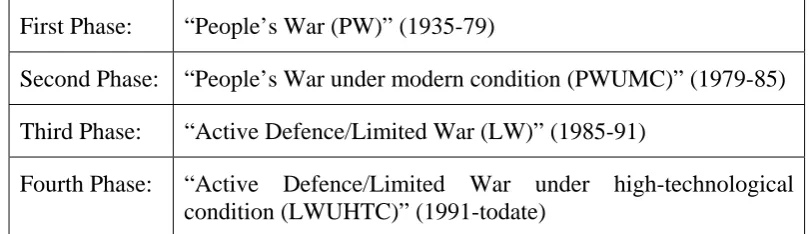
Table 2.4: The PLA’s Doctrine
First Phase: “People’s War (PW)” (1935-79)
Second Phase: “People’s War under modern condition (PWUMC)” (1979-85) Third Phase: “Active Defence/Limited War (LW)” (1985-91)
Fourth Phase: “Active Defence/Limited War under high-technological condition (LWUHTC)” (1991-todate)
Thus, the PLA’s operative doctrine is the product of decades of rethinking the nature of contemporary conflict, the potential treats to China, and the adequacy of the PLA force structure.
Deng’s Doctrine: Deng, like Mao, had never forgotten that the CCP’s success was due to the PLA. Without it, there would have been no successful CCP, and no PRC. In line with Deng’s ‘Grand Compromise’ (Marti 2002, p.143), another major change occurred in Chinese military planning in 1985. China’s CMC concluded that the nation’s military doctrine should be revised to one of “ limited war/active defence.” The “limited war/active defence” strategy envisions China waging small-scale conflicts along its peripheries. It also places a greater emphasis on rapid force projection than did PWUMC along with the application of high technology and intense firepower, and the achievement of military objectives over a relatively short period of time. The CMC concluded that the PLA should prepare to fight and win “limited wars” rather than major nuclear conflicts against the US. China decided to strengthen its capacity to fight along its own border and peripheries, where it could operate within “controlled space and time” with a greater level of lethality and increased mobility subject to efficient command and control.
conducted a series of military exercises emphasising combined operations to test China’s rapid reaction capabilities in the South China Sea (Lennox 1999, pp. 20-3). Preparation for amphibious operations spear headed by missile strikes against Taiwan has also preoccupied Chinese military planners as demonstrated in 1996.
Post-Deng Strategy: Following Deng Xiaoping’s death in 1997, the PLA came to exert even greater influence over China’s national security posture. China’s security planning has been influenced more by perceptions of how technological change will affect war fighting capabilities than it has been by threat assessments or strategic priorities. China wants to project greater military power beyond its borders but it cannot oppose simultaneously every other potential military rival. However, China’s preoccupation with infusing high technology into its defence systems does indicate that the country’s policy elites have little inclination to modify their regional security interests to assuage their neighbours’ threat perceptions.
the conditions would be very different from those, which have unfolded so far in history.
Nuclear Weapons in China’s Strategic Culture
China has been modernising its nuclear capabilities over the last four decades, and its efforts are beginning to produce results. Two new ICBMs - the Dong Feng 31 and the Dong Feng 41 – are in development. Both are solid-fuelled, road-mobile missiles capable of carrying MIRVs. A new class of SSBN, the Type 93, along with a new SLBM, the Ju Lang 2, is under development, with the new missile capable of carrying multiple warheads. The development of new mobile ICBMs capable of carrying accurate MIRVs, and new MIRVed SLBMs on a more capable SSBN reinforces the ability of Chinese nuclear forces to survive a first strike, penetrate missile defences, and strike the US.
Nuclear force modernization raises the question of whether China is moving away from a minimum deterrence posture against the United States based on ‘counter value’ targeting of cities, towards some form of war-fighting posture geared to ‘counterforce’ targeting of US strategic nuclear forces. Alternatively, China may pursue a ‘differentiated’ strategy. China might continue to maintain a ‘minimum deterrent’ directed against the United States, while sub-strategic nuclear forces are employed in a coercive role against regional competitors such as Japan and India.
Any move towards a counterforce posture directed against the United States, Japan, or India would require China to reconsider its ‘no first use’ pledge. The pledge highlights the defensive posture of China’s nuclear forces. According to Lt. Gen. Li Jijun:
China’s nuclear strategy is purely defensive in nature. The decision to
develop nuclear weapons was a choice China has to make in the face of
real nuclear threats. A small arsenal is retained only for the purpose of
self-defence. China has unilaterally committed itself to responsibilities
not yet taken by other nations, including the declaration of a no-first-use
policy, the commitment not to use or threaten to use nuclear weapons
is completely defensive, focused only on deterring the possibility of
nuclear blackmail being used against China by other nuclear powers.
(Manning, Montaperto, and Roberts 2000, p.30).
It is uncertain if China’s pledge not to use nuclear weapons against non-nuclear states applies to Taiwan, because China’s leaders view Taiwan as a rogue province. Thus, in a future conflict with Taiwan, China might employ nuclear weapons against the island to destroy Taiwanese military capability or use ‘electromagnetic pulse’ (EMP) attacks to neutralize command and control capabilities without causing substantial damage or casualties. Some Chinese hardliners were prepared to test the ‘Los Angeles option’ (targeting major US cities in retaliation) if the Americans opted to interdict PLA units firing test missiles off Taiwan’s shores during the 1996 US military intervention in China-Taiwan confrontation (Tow 2001, p.38).
America has some 6,000 nuclear warheads able to hit China, while much of China’s existing arsenals are old and becoming obsolete (Thatcher 2002, p.181). At this stage, on the basis of the Military Technology, (see Table 4.1 in chapter IV), PRC’s superpower status on parity with America is no more than a delicious fantasy for many in Beijing.
Notwithstanding, the deployment of a NMD system by US is a source of concern for Chinese strategic planners. Even a very limited NMD system or a regional TMD system might reduce the effectiveness of the current Chinese nuclear arsenal. NMD deployment would require China to increase the number of nuclear warheads it aims at the United States so as to maintain a minimum deterrent posture.
partly in response to Chinese military threats to disputed territories along the two states’ common borders. The 1998 nuclear tests saw India officially ‘go nuclear’ as a response to growing Chinese capability, as well as for reasons of national prestige and domestic politics. A Chinese nuclear build-up would lead India to maintain the current strategic balance of forces, potentially sparking an arms race between the two Asian giants. Pakistan, another nuclear power in the region, would respond to any Indian strategic build–up, possibly with Chinese or perhaps North Korean assistance, by increasing its nuclear capability. In other words, a nuclear arms race in China’s periphery could quickly become three-sided phenomenon. Unlike the US-Soviet nuclear balance of the Cold War, the geopolitical dynamics of a Pakistan-India-China nuclear balance are more unpredictable. The continuing Indo-Pakistan confrontation in the Chinese peripheral zone of Jammu- Kashmir at the proximity of Sino- Indian disputed area of Ladakh (Aksai Chin) makes the likelihood of tension and conflict more real between these Asian nuclear powered countries.
Strategic Limitations: There are several reservations to consider with this updated security strategy. First, there is the danger that China’s military leaders may apply the new doctrine before the PRC achieves the necessary force levels and diversity of capability needed to make it credible, or they may apply it ambiguously. This concern seems particularly applicable to China’s nuclear strategy of “limited deterrence”. Active defence emphasises the value of pre-emptive strikes as an essential tactic enabling the ‘weak to overpower the strong”. “Limited deterrence” relies instead on China maintaining a sufficient nuclear force structure to avoid nuclear pre-emption (Lin 1996).
Prior to US deployment of two aircraft carrier battle groups at Taiwan Strait in March 1996, it was thought that even the few nuclear weapons China targeted against the United States would be sufficient to deter significant US military intervention in a China-Taiwan confrontation (The Military Balance 2000/2001).
The idea that “inferior forces can defeat superior forces” and that a “people’s war” is still the foundation of active defence undercuts the new strategy’s utility. This is because it concedes that a high-technology war started by a major adversary could still overwhelm Chinese border defences forcing the PLA to apply the old PW /PWUMC defensive tactics within China’s own borders. Active defence strategy, therefore, presents the risk that Chinese force planners could become too preoccupied with what type of wars China may be fighting over the near-term at the risk of under-assessing how China can prevail in limited war situations if the other side initially applies active defence better than the PLA. Therefore, if a future regional conflict involving China emerges as something other than a replay of the Persian Gulf conflict (1991 and 2003-4), the only real recourse for Chinese commanders would appear to be returning to fighting the very type of indecisive wars of attrition that the active defence strategy is supposed to avoid. China is prepared to respond conceptually to “the last war fought” but may not be prepared to adjust to the inevitably unique challenges of future war fighting scenarios.
Conclusion:
acknowledges the advantages of employing highly trained personnel in coordinated military operations with limited strategic objectives. By emphasising border defence, Chinese strategists are also being forced to revise their traditional defensive bias –“luring the enemy in deep” before counter-attacking, a strategic approach that anticipated high casualty rates among China’s rural and urban populations. Mao’s famous quote of tolerating several hundred million deaths is recalled in this context.
economic renovation. The realisation of this goal calls for domestic stability, security along the borders with peripheral states, and a world order that falls in line with the common interests of the world’s people. All of this requires China to further augment building military strength while attaching importance to politics, economics, science and technology and diplomacy.
Chapter III: China and the Peripheral Conflicts - An Overview
Introduction:
and its concomitant military development programs are being watched closely by analysts in the region, and any signs that China is looking to extend its strategic reach are considered causes for concern.
China and Conflicts in Northeast Asia
China adjoins several conflict-prone zones (Korea, India, Southeast Asia and central Asia) and its geographical position in Northeast Asia - a nerve centre of the global economy - makes China an indomitable actor in the region. The Chinese geostrategic trajectory in Northeast Asia reflects both the historical specificity of nation-state formation and the wider problems of the nation-state system in post-Cold War Asia.
China and Korean Peninsular Conflict: Contemporary Chinese leaders are keen in Korean peninsular security, especially because of China’s rivalries with Japan and, in the last century, the US. Today, China’s key national-security objectives on the Korean peninsula are to have a friendly, stable Korea on its doorstep; this means having a Korea that is not the setting for a major war, is receptive to the PRC’s influence, and does not become a springboard for the extension of Japanese military or economic power.