Rochester Institute of Technology
RIT Scholar Works
Theses Thesis/Dissertation Collections
5-2017
Re-Presenting Racist Objects: A Case Study of the
Dentzel Carousel at Ontario Beach Park in
Rochester, NY
Kelli M. Spampinato
Rochester Institute of Technology, [email protected]
Follow this and additional works at:http://scholarworks.rit.edu/theses
This Thesis is brought to you for free and open access by the Thesis/Dissertation Collections at RIT Scholar Works. It has been accepted for inclusion in Theses by an authorized administrator of RIT Scholar Works. For more information, please [email protected].
Recommended Citation
THE ROCHESTER INSTITUTE OF TECHNOLOGY COLLEGE OF LIBERAL ARTS
RE-PRESENTING RACIST OBJECTS:
A CASE STUDY OF THE DENTZEL CAROUSEL AT ONTARIO BEACH PARK IN ROCHESTER, NY
A THESIS SUBMITTED
IN PARTIAL FULFILLMENT OF THE BACHELOR OF SCIENCE DEGREE
IN MUSEUM STUDIES
BY
Contents
Page Abstract . . . 2 Introduction . . . 3 - 8 Literature Review . . . 8 - 17 Case Study
Abstract
Caricatures of African Americans and associated racist imagery, once commonplace in American life, have been used to display dominance and oppression over African Americans. These images were created in order to support the Jim Crow hierarchy, which white Southerners established in the late 1800s and upheld until the 1960s, with white people reigning at the top and black people at the bottom. This Southern social construct was not limited to this
geographical area, but also influenced white opinions and attitudes towards the black population in the north as well. In part, white supremacy was maintained through the creation of everyday consumer objects to reinforce the idea that black people were inferior to white people. This tactic was used on any number of manufactures, such as on salt and pepper shakers, restaurant
buildings and lawn ornaments, and was also seen in the visual culture during that time in TV shows, cartoons and commercials. Their relevance eventually became overlooked and the items fell out of favor in the post-Civil Rights era. Nonetheless, these objects still exist, and
subsequently leave those that come across them wondering what we are supposed to do with such items.
In this thesis, I have conducted a case study of one such situation. The focus of this case study is the racist imagery removed from an amusement park-like attraction in Rochester, New York, the Dentzel Carousel, in 2016 and the charge of a local institution, the Rochester Museum and Science Center, to create a display and interpretive plan surrounding it. This examination and the related analysis is based upon interviews with museum staff and members of the
Rochester community as well as recent press clippings and documents regarding the controversy surrounding the carousel. I combine these with a review of museum ethics and recent approaches to exhibiting like materials to answer the following questions: What is the responsibility of a museum to its community in addressing and facilitating the display and interpretation of difficult content? How can these activities reclaim the past and re-present it within an appropriate
Introduction
“For some people, especially those who came of age after landmark civil rights legislation was passed, it is difficult to understand what it was like to be an African American living under Jim Crow segregation.”1 This sentiment is at the root of any exhibition that chooses to put on view for the public objects that convey an essence of this past. In order to fully
understand and appreciate this part of the American past, we must first learn where it came from in the first place.
“Jim Crow” was a character made famous by white actor Thomas Dartmouth “Daddy” Rice in 1832. He was one of the first actors to perform in blackface as this character, which sang and danced to a song with which he shared a name. The minstrel show became so popular among white audiences, that the term “Jim Crow” eventually became a racial slur to both categorize and to refer to African Americans. By the end of the nineteenth century, the term was abandoned as a reference to black people but adopted as a descriptor for the “racial caste system” that became the norm in the late 1870s and lasted through the 1960s—what we know now as the “Jim Crow Era.”2
Jim Crow, as the societal framework, began as a series of rules of etiquette that were set in place to restrict and regulate African Americans’ behavior, but it quickly became more than that. Jim Crow became the social condition normalizing racism and reinforcing the idea that blacks were inferior to whites intellectually and culturally through segregation and violence. In 1896, the Supreme Court case Plessy vs. Ferguson3 solidified the Jim Crow way of life into state
1 David Pilgrim, Understanding Jim Crow: Using Racist Memorabilia to Teach Tolerance and Promote Social
Justice (PM Press, 2015), 37.
2 Pilgrim, Understanding Jim Crow, 37-41.
3 The court case Brown vs. Board of Education of 1954 overturned the Plessy vs. Ferguson decision, as it pertained
law (See Appendix I), and set a precedence that the mistreatment and discrimination of African Americans4 was not only acceptable, but legal in southern states.5
Throughout the century, the oppression and discrimination of blacks was sustained and strengthened in many different ways. One of the most prominent methods of doing this was through the use of caricatures and imagery that depicted African Americans in a very
stereotypical way that was incredibly offensive to the black population, but at the time was seen as entertaining to its intended white audience because it represented non-whites, and more
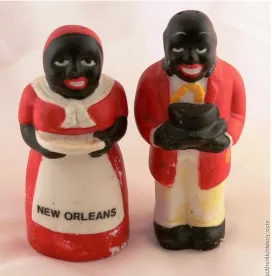
specifically blacks, as less than whites. The three most common depictions were the Mammy, the Tom, and the picaninny. “Mammies” were a pro-slavery depiction of happy, loyal, black women as servants and slaves (See Figure 1). This caricature of an overweight, maternal figure, with a big smile and warm laugh, served as an argument that these women were perfectly content to serve their white families and suggested that the institution of slavery was good. “Tom” was Mammy’s male counterpart, and just like Mammy, the Tom caricature presented male, black slaves as happy, loyal and submissive. The Tom caricature got its name from the title character in Harriet Beecher Stowe’s Uncle Tom’s Cabin. He was often depicted with dark skin, big, red lips and wide eyes. He worked as a fieldworker, butler, or waiter, among other jobs, and, was seen as non-threatening and dependable (See Figure 1). He, like mammy, also served as racist propaganda. Tom and Mammy were presented as being content as slaves and happy to be working for their white owners. There were multiple ways of portraying black men and women during this time, but the Tom and the Mammy were used most frequently. The most common caricature used during this time to depict black children was the picaninny (See Figure 2). Picaninny children had “bulging eyes, unkempt hair, red lips, and wide mouths into which they
stuffed huge slices of watermelon. They were themselves tasty morsels for alligators…
Picaninnies were portrayed as nameless, shiftless natural buffoons running from alligators and toward fried chicken.”6 Picaninny imagery was used as a means of degrading the black
community. The children were often shown either naked or barely dressed. When they were dressed, they wore old, tattered and oversized clothing. This served as way to describe black children, as well as their parents, as lacking modesty. This also suggested the black parents either did not or could not properly care for their children, either by providing them with poor clothes, or no clothes at all. The nude depictions also sexualized black children and justified sexual abuse against them. The interpretations also represented black children as dumb and insignificant. They were constantly being chased and eaten by animals, crushed by boulders and set on fire. The representation of the black family through Mammies, Toms and picaninnies, among others, suggested to white audiences that the African American family was innately subservient to them and entirely a lower class of human being.7
This imagery originated in the southern parts of the United States and was commonplace throughout that part of the nation, but did not only exist there. These caricatures and images were also present in the northern states as well. While Jim Crow laws were not upheld in the north, the perceptions of African Americans, and the stigmas about how they should be treated by white Americans, were still very much present there. So while northerners did not go so far as to legally segregate public places, racism still existed and the attitude that blacks were subservient and of a lower class was, in fact, quite prevalent. Due to this influence, it is of no surprise that this imagery would exist throughout the north as well, and it served to help institutionalize racism into the fabric of society throughout the entirety of the United States. Proof of this can
still be seen in every-day products in use today. The depiction on the logo of “Aunt Jemima’s” syrup (See figures 3, 4 and 5) is a Mammy, and the man on “Uncle Ben’s” rice (See figures 6 and 7) is a representation of a Tom.8 These logos and pictures are no longer interpreted as those once- oppressive figures, but that is how they originated, and they are so engrained in our everyday lives that their history has been completely lost and overlooked.
Recognizing this trend and addressing it publicly and as a community is necessary to attempt to reclaim this imagery and reconcile with our country’s past. Museums and like
institutions can play an integral role in that process. These places function, ultimately, as public servants and hold a moral and ethical duty to not only care for and preserve these materials, but also address the community need regarding education about these materials. The American Alliance of Museums (AAM), the governing body for 35,000 museums in the United States, as well as the national accreditation body, has set forth an explicit Code of Ethics to which
museums and like institutions should adhere. This Code of Ethics contains a section describing a museum’s ethical duties when it comes to collections, stating that a museum’s collection should support its institution’s mission and its responsibilities to the public trust. It also states that the collections should be lawfully held, protected, secure, unencumbered, cared for and preserved.9 Based on these standards, museums must properly care for, protect, and preserve the objects which come to them and which they willfully accept. These standards also indicate the
museum’s responsibility to the public trust, which means that they must use their collections and information to benefit the communities in which they serve. So, if a museum were to find itself
8 Jennie Rothenberg Gritz, “New Racism Museum Reveals the Ugly Truth Behind Aunt Jemima,” The Atlantic,
April 23, 2012, accessed April 5, 2017, https://www.theatlantic.com/national/archive/2012/04/new-racism-museum-reveals-the-ugly-truth-behind-aunt-jemima/256185/.
9 American Alliance of Museums, “Code of Ethics for Museums,” accessed March 9, 2017,
owner or steward of a piece of Jim Crow-era imagery, that museum would not only have a duty to care for this item, but a responsibility to its community to use that object as a tool for
education in order to benefit the public.
The AAM Code of Ethics also has a set of standards regarding programs within a museum and/or exhibition. These standards state that programs must respect pluralistic values, traditions and concerns, and similarly to the ethics regarding collections, programs must also support the institution’s mission and its responsibility to the public trust.10 So, if a museum obtains an artifact that depicts Jim Crow-era imagery and, in turn, designs a program around that object, museum staff must consider the multiplicity of perspectives that this object fosters. The museum staff should, further seek out the input of members of the community to which that object pertains, in this case, the black community. By reaching out and involving those that may be most affected by this object, the museum does just what the AAM Code of Ethics states, and shows respect for other values, traditions and concerns. Furthermore, in doing this, the museum also upholds its responsibility to the public trust by designing a program with the help and input of the community in which this object resides and belongs. This allows the community to be able to connect to that object and the entire program in a collaborative and transparent way.
Yet, a Code of Ethics is a document that does not lay out prescriptive remedies.
Specifically, how should a racist object be treated when held in an AAM-accredited institution? To explore this question and its larger frames of reference, this thesis traces how the complicated past and present of such imagery come into play in the space of the museum by examining the yearlong controversy surrounding a panel on the Dentzel Carousel that depicted two young black children in the picaninny style that became so prominent during the Jim Crow era. Upon the
panel’s removal in 2016, it was transferred to the Rochester Museum and Science Center (RMSC), who became the institution that was charged by the City of Rochester11 to act as stewards of the panel and took on the task of carefully exhibiting and contextualizing the panel and its imagery.12 In undertaking this case study, this thesis examines an institution’s efforts to house and exhibit an offensive work while abiding by only AAM’s Code of Ethics and
committing to serve their local community and offers a model for other institutions that may seek to reclaim racist imagery from their own communities in their museums.
Literature Review
How do museums shape the way in which we remember the past? The way an institution exhibits and interprets an object has a direct effect on the way in which its visitors will remember that object and their experience with it in the future. But when there are multiple stories that can be told about an object, from multiple points of view, which one is “the right one” and how does a museum find that out? More fundamentally, is it even appropriate to exhibit that object at all? These questions are raised quite often in the acquisition, exhibition, display and interpretation of racist objects and memorabilia.
Racist and offensive objects and images have been quite prominent throughout American history. They have taken many forms, such as in public advertisements or TV commercials, as well as in everyday household items, like salt and pepper shakers and lawn ornaments. They have also been interpreted in many different ways. The progression of time has changed the way
11 The charge by the City of Rochester to the Rochester Museum and Science Center (RMSC) is explained in further
detail in the Case Study section of this paper.
12 The author of this thesis served as an intern in the collections department at the Rochester Museum and Science
we now view such items, but they once were commonplace in the everyday lives of the average, white American and helped to reinforce the oppressive and superior attitude the white population had over the black population during the time of Jim Crow legislation that lasted from the 1880s to the 1960s. While these objects have been recognized for their offensive and oppressive qualities, they have not been eliminated from the historic record, our memories, or, in some cases, our homes. So, how can a museum use such objects as a tool for education? “Forgetting” pieces of history, or sweeping the difficult things under the rug, would be a disservice to the communities that museums serve. Not only would trying to forget the atrocities that happened during this time disrespect the plight of African Americans in this country, but it also has no benefit for future generations.
This review will examine scholarship that has studied the collection, care, and exhibition of racist and offensive objects and memorabilia, as well as broader subjects such as inclusivity in museum exhibitions and museum controversy. In doing so, it will consider the question: “what are the best practices for displaying racist objects in museums?”
There is no shortage of racist objects or objects that display racist imagery and represent the struggle of African Americans throughout American history that could be exhibited. There have been millions of everyday objects that were made to support the racial hierarchy in the United States.13 A majority of these items come from the Jim Crow era spanning from 1877 to the mid-1960s. Many of these objects bore oppressive depictions and caricatures of African Americans, as a means to degrade an entire race and instill a community-wide sense of superiority over them. So, when a museum or institution decides to interpret these items, how can they do so without offending the public, but still be true to the object and the story it tells?
13 Logan Jaffe, “Confronting My Racist Object,” The New York Times, October 7, 2016,
Recent scholarship has argued that giving the cold, hard truth about this country’s past is the way to go.
Willard Boyd, president emeritus of the Field Museum, a museum of natural history located in Chicago, argues in his article about controversy within museums that the museum should reach out for diverse perspectives when exhibiting controversial objects. He believes that when creating an exhibit it is necessary to include representatives from the groups whose
cultures are being represented in the exhibit.14 This is a valid point and a good way for an
institution to include its surrounding community to ensure that the most honest and factual telling of the story is what visitors will get. He believes that consulting with and listening to others, particularly those with a different point of view, is a way to secure new knowledge and insights that can then improve and expand exhibits.15 Another point Boyd makes is that museums can then use this opportunity to explain why they must explore the difficult questions like the role of race, class, and gender in history. By teaching about points of view, you can create a greater understanding of the cultures around you that some may not fully understand.
Susan Crane, an associate professor in the department of history at the University of Arizona, makes a similar point when she argues that national histories and personal memories tend to be at odds within the museum space. By this, she means that what we are taught about a topic and the way people personally remember it sometimes differ. That conflict, then, becomes present in the museum when a visitor who personally experienced the subject of a museum exhibition does not see what they remember represented. She calls this “distortion,” and supports her argument with the example of the halted Enola Gay exhibit in 1994-95 at the National Air and Space Museum in Washington D.C., and how the question of which story to tell with this
exhibit could not be settled upon due to conflicting viewpoints.16 She believes that in order to educate truly, we must consider points of view other than our own when interpreting objects. Her main point is that history sometimes disregards personal experiences and that to fully understand the context of something, memory and history must be blended so as to present a full picture.17 This perspective pairs well with Boyd’s because they both speak to personal interpretations of content. These approaches allow the institution to give an accurate portrayal of not just the history of an object, but the ideas and memory that surround it as told by those most affected by it.
Another somewhat similar approach is that of Didier Maleuvre, a professor of French and comparative literature at the University of California at Santa Barbara, although his arguments differ in a few key ways. He makes similar arguments that the truth about an object must be conveyed within the museum, but, unlike Boyd and Crane, does not believe the feelings or comfort of the visitor should be a priority.18 While the first two authors advocate for inclusivity, Maleuvre questions it. He does not believe that education should be second to cultural
sensitivity, but that it should be the other way around. He believes that it is a museum’s ethical and moral responsibility to be a leader and teacher, and that the narrative the institution puts forth should be in service to the object’s truth, not in service to the opinions of the visitor. So, in the case of displaying racist objects, Maleurvre’s approach would mean giving the entire history of the object; the background of the imagery, the purpose of the object and its implications in encouraging racism and white supremacy. It may seem as though this is the same point Boyd and Crane were making as well, but if the perspectives of African Americans were not utilized in this
16 Susan A. Crane, “Memory, Distortion, and History in the Museum,” History and Theory 36, no. 4 (1997): 44–63. 17 Ibid.
18 Didier Maleuvre, “Must Museums Be Inclusive?” Journal of Educational Media, Memory, and Society 4, no. 2
telling of an object’s narrative, then only assumptions can be made about its perpetuation of intolerance. Which is to say, without knowing the feelings and opinions of the group that has been targeted by these items, we as an audience cannot fully understand their context or their implications in propagating racism and oppression.
The perpetuation of intolerance is, in truth, what is so important about these objects in the first place. Today, museums and scholars collect and exhibit these objects for many reasons, with education chief among them. The motto of the Jim Crow Museum of Racist Memorabilia19 at Ferris State University in Big Rapids, Michigan is to “use objects of intolerance to teach tolerance and promote social justice.”20 David Pilgrim, curator of the museum, states that the value of his collection does not lie within the objects themselves, but in what they represent and the discussions they encourage. By talking about their origins, significance and different
interpretations, he believes that a greater understanding of how the objects in his collection contributed to the continued oppression of African Americans throughout history can be achieved.21 The value of racist objects and imagery is determined by their ability to inform. These items help document the life, culture, contributions, trials and tribulations of African Americans during the times in which they were made.22 This idea also applies to the importance of their exhibition. The collection and preservation of racist memorabilia is the first step, making these objects available to the public so they can learn about them and learn from them is the next.
The way in which museums have displayed these types of objects thus far is quite important to consider. Director of the National Afro-American Museum and Cultural Center in
19 The Jim Crow Museum of Racist Memorabilia is a very young institution, established April 26, 2012. 20 “Jim Crow Museum: Home,” accessed November 6, 2016, http://www.ferris.edu/jimcrow/.
21 “Jim Crow Museum: The Garbage Man,” accessed November 8, 2016,
http://www.ferris.edu/HTMLS/news/jimcrow/collect/.
22 Elvin Montgomery, “Recognizing Value in African American Heritage Objects,” The Journal of African
Wilberforce, Ohio,23 John Fleming, argues that the general African-American museum has played an important role in transmitting black cultural values. He makes the point that African-American museums have grown out of the responsibility to preserve what is of value to African American people.24 Fleming keeps this in mind when exhibiting collections at his own
institution. His approach is to tell the story that relates directly to the life experiences of his visitors. He generalizes that “African American museum professionals understand that the value of history is in its relevance to the life experiences of the museum users. History serves as the context for preservation, providing African American museum professionals clarity of purpose on what to preserve and how to interpret the artifacts they collect.”25 This approach is somewhat similar to that of David Pilgrim of the Jim Crow Museum of Racist Memorabilia. He, too, considers the life experience of the visitor and hopes to draw out conversation on the topic of racism and discrimination. His methods of display utilize this concept of conversation by presenting artifacts in an honest way that does not attempt to add justification for the views and opinions of those of the past, but represents these stereotypes in a factual, and possibly
uncomfortable, way that allows visitors to draw on their memory and make their own meanings.26
Another approach to display is that of Fred Wilson, creator of the Mining the Museum
exhibition that took place at the Maryland Historical Society in 1992-93. His aim was to use the historical society’s collections in new and distinctive ways and thereby create a discomfort in
23 The city of Wilberforce, Ohio, contains two respected Historically Black Colleges and Universities (HBCUs):
Wilberforce University and Central State University.
24 John E. Fleming, “African-American Museums, History, and the American Ideal,” The Journal of American
History 81, no. 3 (1994): 1020–26.
25 John E. Fleming, “African-American Museums, History, and the American Ideal,” The Journal of American
History 81, no. 3 (1994): 1021.
26 “Jim Crow Museum: Values and Vision,” accessed November 8, 2016,
museum goers, forcing them to recognize the history of invisibility of African Americans in different portrayals of American life.27 He used a combination of subtlety and blatancy to display white perceptions of history versus the African-American reality. For example, in a section entitled "Metalwork, 1793-1880," slave chains are shown with an ornate silver tea service, representing the correlation between the chained slaves and the wealth and leisure of their owners. There was also a child’s Ku Klux Klan hood in a stroller, representing the irony that African-American nannies were raising the next generation of slave owners and white
supremacists.28 By highlighting these juxtapositions, he reflected the larger struggle of African Americans that was, and still is, being played out by society.29 This mode of display of objects that reveal the racial hierarchy was direct and unabashed. The importance was bringing light to the truths being overlooked and putting those truths in the forefront, even if it made the visitor uncomfortable.
The scholarship examined to this point seems to all agree on methods of display for controversial objects and perspectives. There are, however, some countering views on the subjects discussed thus far. Robert Weyeneth, a professor of history at the University of South Carolina, addresses different stances on how, and if, what he calls the “architecture of racial segregation” should be preserved.30 He first explains architecture of racial segregation as the physical buildings and features produced to instill racial segregation through partitioning and isolation. To represent this, he uses the construction of colored bathrooms, colored water fountains, colored waiting rooms, and segregated schoolhouses as examples. He explains that
27 Noralee Frankel, review of exhibition Mining the Museum, by Fred Wilson, The Public Historian 15, no. 3
(1993): 105–8.
28 Fred Wilson and Howard Halle, Mining the Museum, Grand Street, no. 44 (1993): 151–72. 29 Ibid.
30 Robert R. Weyeneth, “The Architecture of Racial Segregation: The Challenges of Preserving the Problematical
looking at the story of space and race can help us fully comprehend the day-to-day experience of segregation, particularly from the perspective of African Americans.31 He then goes on to
address questions some may have about preserving these places at all. He calls attention to the objections some may have by stating:
“Some will ask: why preserve places that reflect shameful episodes in American history? These critics might propose that we focus on places that speak to values such as tolerance rather than prejudice. Others might object that the simple presence of a building on the landscape ratifies a particular ordering of the world. To this way of thinking, existence in and of itself makes a prescriptive statement of how things should be. Thus, the remnants of Jim Crow architecture are dangerous monuments to institutionalized racism. Still others might argue that preserving places like these can represent a form of ‘double victimization.’
Victimized once by enduring life in a segregated world, African Americans would be victimized a second time by having to remember, recall, and relive the Jim Crow era.”32
While Weyeneth, in his article, ultimately argues that these spaces must be preserved as a form of education and that “it’s a case for historical knowledge: the world of Jim Crow seems increasingly distant and incomprehensibly foreign to blacks and whites born in the wake of the civil rights movement,”33 it is important to consider and address opposing viewpoints, as he has done.
Another counter-argument lies in the opinion of Dennis Byrne, a contributing op-ed columnist for the Chicago Tribune. In 2012 he wrote an article in the wake of the 200th
anniversary of the happenings at Fort Dearborn on August 15th, 1812. What had always been known as a massacre of American soldiers and civilians, men, women and children alike, by Potawatomie Indians, was being questioned as to whether it truly was a massacre, or a
battle.34 There was a call to rename the event the Battle of Fort Dearborn,35 but Byrne strongly opposed this suggestion. He sees this type of “revisionist history” as a derogatory act, and urges the public to see history as it is and label it as such, not revise what we already know in an attempt to reconcile with our past wrongdoings.36 Based on his opinions in this article, it seems as though he might argue that a re-presentation of a historical, racist object in an attempt to reclaim its meaning would not be appropriate. He would view this as an attempt to appease the black community by re-writing the history of the object. There is a human need, he states, “to seek reconciliation when injustices have been committed. But reconciliation based on one-upmanship and politically motivated concoctions is
impossible.”37 In the case of the Ontario Beach Park Carousel, he may label its removal and contextualization in a museum exhibit as a politically motivated concoction to reconcile Rochester’s past in regards to racism. This opinion seems to operate under the assumption that because something has always been known a certain way, that it must remain that way. And while it is correct that times were different when the panel was created, public opinion has not remained the same, and revising our history, and historic landmarks, is a step in the direction of changing those past opinions and inciting acceptance in the community.
The focus of this thesis, the Ontario Beach Park Carousel, has very few references available addressing its history in Rochester, and fewer still addressing the controversy over the rounding panel that was ultimately removed. Historical sources were limited to websites copyrighted by the Dentzel family, and a book of historical images capturing amusement
34 Dennis Byrne, “Historical Truths or Fabrications? The Slaughter near Fort Deerborn,” Chicago Tribune, August
14, 2012.
35 Ann Durkin Keating, “The Potawatomi Attack (Chapter 10),” in Rising Up from Indian Country: Fort Dearborn
and the Birth of Chicago (Chicago: University of Chicago Press, 2012).
parks and resorts of Rochester. Information on the controversy of the panel was gathered through newspaper articles and interviews with some of those involved. This material will be reviewed in the case study section of this paper, not here in the literature review.
While methods may differ, it seems that there is a general consensus about how racist artifacts should be displayed—truthfully. When approaching the subject of Jim Crow racial segregation, context and memory must be prominent in the interpretation that is presented. No one wants to glaze over the troublesome parts of American history and, it seems, there is a general belief that only education and discussion can truly help the ongoing problem of racism. The perspectives we bring in to the museum space will greatly affect the way in which we interpret different exhibition styles, but the lesson institutions wish for us to walk away with seems to be the same; only by truthfully acknowledging these objects and their contributions to the perpetuation of intolerance can we properly respect the history of African Americans in this country.
Case Study
The History of the Dentzel Carousel and Rochester’s Ontario Beach Park
by his father. The Dentzel family is credited with “jump-starting” the carousel industry in
America, and the company flourished even after Gustav’s death in 1908, when his sons, William and Edward, took over. The company ran until 1928 when William passed away and Edward decided to close.38 Of the many carousels produced by the Dentzel family during this time, only twenty-eight remain, and of those, only fourteen are still operating.39 The carousel at Ontario Beach Paper in Rochester is one of these fourteen.
In 1905 “The Duchess” was installed at Ontario Beach Park in Rochester. The park was established in August of 188440 and, in an effort to draw more visitors, an amusement park began to develop in 1885.41 There was no better place for a carousel and “The Duchess” fit right in. “The Duchess” is a menagerie-style carousel containing 52 hand-crafted wooden animals and two chariots. The animals consist of eleven varieties, including multiple horses, cats, rabbits, ostriches, pigs, mules, and one each of a lion, tiger, giraffe, goat, and deer. Eleven of the animals are stationary and 22 are jumping, or animals that move while the carousel is operating.42 At the time of its placement at Ontario Beach Park, the amusement park was booming. It was added to the collection of rides already in place, such as the “Virginia Reel,” the “Waterchute,” a fun house, and many others. The carnival-like feel of the boardwalk, pier and park earned Ontario Beach Park the nickname “The Coney Island of the West.”43 It became the summer destination
38 The The Dentzel Carousel Company, “The Dentzel Family Carousel Story,” accessed March 10, 2017,
http://www.dentzel.com/coloringbook/story/.
39 The Dentzel Carousel Company, “Census of Dentzel Carousels,” accessed March 10, 2017,
http://dentzel.com/census01.htm.
40 Donovan A. Shilling, Images of America: Rochester’s Lakeside Resorts and Amusement Parks (Arcadia
Publishing, 1999) 10.
41 Kyle Somerville, “‘This Is Where I Love to Go’: The (Re)creation of Place at Ontario Beach Park,” Rochester
History 75, no. 1 (Spring 2013): 1–35.
42 National Carousel Association, “Census Entry,” accessed March 10, 2017,
http://carousels.org/USACensus/census.pl?NCANo=123.
for visitors from all over Rochester, and was the prime location for weekend excursions for visitors from Pennsylvania, New Jersey and Ohio.44 These visitors, however, as seen in figures 8 and 9, notably seem to all be white. While it is not specifically stated in the sources examined for this thesis, it does seem as though Ontario Beach Park served as a space of racial segregation. Somerville speaks to this point briefly:
“… parks like Ontario Beach have also been a crucible for contested race as well as class relations. Historically… sites of urban leisure often served as overlooked but highly significant civil rights battlegrounds… Conflict between ordinary black consumers seeking leisure and white defenders of recreational space often lies outside the purview of social movements. That is, a close investigation of parks reveals a painful blind spot in public awareness of racial inequality, an oversight rooted in the historical tendency to focus on institutional segregation instead of more ‘circular’ patterns of discrimination ‘hidden in plain sight.’”45
Again, while it is not stated directly, this statement seems to imply that visitors of
different races and classes were not always welcome at Ontario Beach Park during its hay day. It is quite likely that those of non-white races were permitted to visit the park at specific time or on specific days. These were called “parallel policies” and allowed locations of public, commercial entertainment, like amusement parks, public pools and skating rinks, that were racially segregated on most days to cater to black families on specific days or at specific times. These policies could apply on just one day a year, like at Lakewood Park in Atlanta, or one day a week, like at Bob-Lo Island outside Detroit, or every other day, like at Hot Springs Arkansas.46 While laws of segregation were not upheld in the North during this time, the general white opinion still was deeply opposed to “social equality.”47
44 Shilling, Images of America, 10.
45 Somerville, “‘This Is Where I Love to Go’: The (Re)creation of Place at Ontario Beach Park,” 25-26. 46 Victoria W Wolcott, Race, Riots, and Roller Coasters: The Struggle over Segregated Recreation in America
(Philadelphia: University of Pennsylvania Press, 2012) 18.
However, despite the park’s unclear history of racial segregation, it was
nonetheless a highly revered and fondly remember piece of Rochester history. Due to its presence at the Ontario Beach Park, and it being the only remaining piece of the old amusement park left, the carousel was granted landmark status by the Preservation Board in 1980, and in 1984, the Monroe County Parks Department began an extensive
restoration project on it. The restoration addressed mechanical issues, as well as the building the carousel is housed in and the surrounding walkways, but it focused mainly on the wooden animals. They had been worn and repainted many, many times over the years, and the goal was to bring the carousel back to its original glory (See Figures 10 and 11). This goal was certainly achieved, and brought new life back to the carousel. In the years following, the carousel remains a staple of the Rochester community and is enjoyed by countless patrons every year.48
The Community Need
It was a patron of the carousel that noticed a problem and brought it to the attention of the public. In 2015, Andrea Raethka wrote a blog post49 for the Democrat and Chronicle, a local newspaper, bringing attention to one of the rounding panels that circled the top of the carousel (See figures 12 and 13). The panel contained an oil painting of two young black children with an angry rooster attacking. The children are painted in the picaninny style that became so popular during the Jim Crow era. Their skin is very dark, their eyes wide and incredibly white, and their
48 The carousel panel in question remained in its original place throughout this time and was not removed until 2016. 49 Andrea Raethka, “As Symbols of Racism Are Taken Down in South Carolina, Rochester Must Follow Suit,” July
10, 2015, Accessed May 2, 2017
lips bright red. The young girl is pictured wearing only what seems to be a nightgown or light dress, while the young boy’s ears are exaggerated and stick out form the sides of his head. Raethka points out the picaninny children and publicly asks why such overt, racist imagery was overlooked when the carousel was granted landmark status. She cites 1980 as a time “far past the time of civil rights, but apparently too soon for a time of change for Rochester.”50 She goes on to condemn the depiction and calls for it to be removed, while addressing the extra steps and longer process this would require due to its landmark status.51 Raethka’s initial blog post received so much attention that it helped the cause gain massive support throughout the community, and protests and more calls for its removal from the carousel began.
The carousel’s original existence in the Ontario Beach Amusement Park during the early 1900s puts this artwork in a context of normalcy. The racial climate during the time in which it was made allowed this type of depiction to go, not only uncontested, but rather enjoyed by visitors for its entertainment purposes. The depiction of young, picaninny children among several other rounding panels that only depicted animals implied that the children on this panel were animalistic themselves. Additionally, this caricature was represented on a carnival ride meant for fun and amusement. Its association with the light-heartedness and joy that a carousel ride evokes only advances the notion that people were meant to laugh at this picture, see it as entertaining, and subsequently instill the idea that blacks were meant to be laughed at.
Howard Eagle, a Rochester community activist and a key advocate of the panel’s removal, made the point that the panel’s presence on the carousel further engrained ideas of racial superiority and stated that the panel represents structural, institutionalized racism as it
exists in the very fabric of not only this community, but the nation.52 This sentiment holds particularly true once one considers the fact that the carousel is now the only remnant of the original Ontario Beach Amusement Park that remains. It now stands alone, and it stands during a time of exceptionally different thinking and public opinion. This type of imagery is no longer commonplace, and it is no longer socially acceptable, but somehow it has persevered. It has lasted well over 100 years on a prominent structure in the community that has received landmark status in spite of its offensive feature. It begs the question, how was this never a public problem before 2015?
That answer is twofold, but it all lies in the timing. Firstly, since we have grown up seeing these characters, and having never known the history behind where they come from and how they originated, what they truly represent has been overlooked by generations. It takes some kind of grand gesture, like a blog post for the local newspaper, to bring it to our attention. Once that happens, it is then up to the people, the members of that community, to take action and incite change. These changes have been occurring more and more often now and have set the stage for the same to happen in Rochester. In July of 2015, the Confederate flag that had been flown at the South Carolina Capitol grounds for 54 years was permanently removed after years of
controversy.53 In 2016, a young, black employee of Calhoun College, a residential college of Yale University, broke a stained glass window situated in the dining hall that depicted a black man and black women in a field picking cotton. There was initial backlash consisting of criminal charges and his resignation from his position as the college’s dishwasher. However, after gaining the support of the Yale and New Haven communities, the charges were eventually dropped and
52 Howard Eagle, interview with the author, March 7, 2017.
53 Jason Hanna and Ralph Ellis, “Confederate Flag’s Half-Century at S.C. Capitol Ends,” CNN, July 10, 2015,
the young man was offered a new job at the University.54 In light of actions like these, and many others that have happened across the country, there is a new precedence for how these items are viewed by the public. Communities are taking action and local and state governments are listening. Secondly, now is the time for the panel’s removal because there has been a growing movement throughout the country of recognizing institutionalized and structural racism and calling attention to it. This has come in the form of the #BlackLivesMatter movement that began in 2013 with death of Trayvon Martin. It was then that the hashtag was created, but it wasn’t until the following year that the movement really gained fuel, after the death of Michael Brown in Ferguson, Missouri.55 This online and social movement has created an atmosphere for
confronting racial problems that have been overlooked for far too long. This, combined with the new precedence of removing public works have brought about the perfect time to act for the Rochester community.
Act is exactly what the community of Rochester did and, in the summer of 2015, a Preservation Board hearing was held to determine the fate of the panel. The outcome was that didactic text would be added in the carousel house explaining the racial climate during the time of the panel’s creation and its now racist interpretation, but the panel would remain on the
carousel. Monroe County decided not to affect the integrity of the carousel as a landmark, but rather to provide historical interpretation and hopefully create “teachable moments” for those that came to see it.56 Some seemed to be placated by this decision, but many others of the
54 Mark Branch, “Employee Rehired after Breaking Calhoun Window,” Yale Alumni Magazine, October 2016,
Accessed May 2, 2017, https://yalealumnimagazine.com/articles/4349-employee-rehired-after-breaking-calhoun-window.
55 “Black Lives Matter | Freedom & Justice for All Black Lives,” accessed May 3, 2017,
http://blacklivesmatter.com/.
56 Steve Orr and David Riley, “Signs in the Works to Explain Contested Carousel Image,” Rochester Democrat and
Chronicle, accessed March 10, 2017,
Rochester community did not agree. Eagle believed that it was unacceptable that the panel could remain where it was, in public view, and paid for by taxpayer money.57 Protests continued, and more and more activists stepped into the spotlight to speak out on the issue. For some, like Eagle, this was an opportunity to confront the ongoing impact racism has had on this society.58 The community continued to argue that the panel must be removed and, in March of 2016, a second Preservation Board hearing was held.59
During the second Preservation Board hearing, there no longer seemed to be a question of whether or not to remove the panel. It seemed as though, from the start, the Preservation Board members were all in favor of removing it, but the hearing was simply a technicality that must be seen through before the official decision could be made. The application was for the panel to be removed from the carousel and be placed in the care of the Rochester Museum and Science Center (RMSC), a local institution that has been a part of the Rochester community for over 100 years.60 Eighteen community members stood up to speak at the hearing, seventeen of whom advocated for the panel’s removal, while only one spoke on behalf of the panel remaining on the carousel. At the end of the hearing, the decision was unanimous, the panel would be removed from the carousel and it would go to the Rochester Museum and Science Center. The RMSC, as custodians of the panel, would then design an exhibit around the panel and the entire
controversy.
57 Eagle, interview with the author. 58 Ibid.
The Museum’s Role
The Rochester Museum and Science Center was charged by the local government to take the carousel panel into their possession and act as custodians of the panel on the behalf of the City of Rochester. Due to the fact that the panel is still owned by the city, not the RMSC, the museum needed to adhere to and abide by AAM standards set forth. The institution had a moral and ethical responsibility to care for and preserve this object as stewards of the panel in service to the city, therefore a higher level of accountability is held. Kathryn Murano Santos, the Senior Director of Collections and Exhibits for the RMSC, was left in charge of making decisions for the proposed exhibit.61 It was clear from the Preservation Board hearing that the community wanted to see the panel used as a tool to educate about racism in Rochester, as well as using the panel as an opportunity to create discussion and understanding. Eagle was clear on this point, stating that just removing the panel does not do much in the way of changing anything associated with the institutionalized racism implied by the panel. He recalled that many people he had spoken with truly did not believe there was anything wrong or offensive about the panel and did not understand why it needed to be removed. He cited the problem with that stance as
miseducation, and that many do not know the history behind the panel, further exacerbating the problem. He asserts that the educational component is what is most critical to come out of this entire process.62 Murano Santos agreed and viewed this as an opportunity to facilitate that community need. However, it was clear that this need could not be addressed if the panel remained at the RMSC. The community members in attendance at the Preservation Board
hearing, among them Howard Eagle, made it clear that it was important to them that the panel be visible to the entire Rochester community, and that they wished to see it travel to different
61 Ibid.
locations across the city. These same community members expressed a desire to collaborate with the museum in the exhibition design process. Murano Santos had been clear from the beginning that she did not believe the content which would be delivered about this panel should be solely decided by a group of white people sitting in a room together, so a community advisory group, the “Carousel Panel Education Committee,”63 was formed by the museum and the collaboration process began.64
Murano Santos served as a process facilitator and led the group of volunteers the way she would lead any exhibition development project. The first step of the exhibition process required the committee to produce a “big idea”65 that they wished the exhibit to convey, which was decided to be that picaninny art perpetuates ongoing institutional, structural, and individual racism by dehumanizing black children. From there, the exhibition narrative was developed. Murano Santos then handled the administrative tasks of tying all the ideas together, writing the label copy and procuring the graphic images needed for the display.66
During the collaboration process with the community, the RMSC was also working with their exhibit designer and carpenter to create the main structure of the display. The case needed to be large enough to fit the carousel panel, which is over eight feet in length, as well as have spaces for didactic text and include a TV monitor on which video would be screened. The most important feature the case needed, though, was to be portable. The vision of the community advisory board was that the exhibit would travel to different locations throughout the city, so the
63 The group consisted of four members that attended consistently, one of which was Howard Eagle, and others that
attended sporadically.
64 Murano Santos, interview with the author.
ease of movability was essential. Given the size of the panel, this was not an easy task, but was, in the end, achieved (See figure 14).67
The finished exhibit consists of the carousel panel in a display case behind glass with didactic text on either side. These labels define racism and picaninny art, as well as explain why the depiction was installed in the first place, the controversy that arose surrounding it, and why the panel was ultimately removed. Beneath the panel display there is the TV monitor that played video addressing racism throughout history, and more didactic text addressing why it took 111 years for this issue to come to light, the problem of ongoing racism and what needs to be done to help fight it. The last panel contains a mirror with the heading “Who will do it?” asking who is responsible for trying to end racism, while the mirror suggests to the visitor that the
responsibility is on them.
The exhibit’s debut location has been the Central Church of Christ, located in downtown Rochester. This location was chosen as the first location due to the fact that the Central Church of Christ has served as a pillar of the African-American community in Rochester since long before the controversy surrounding the carousel panel arose.68 First celebrating the triumph of getting the panel removed and the development of the educational platform in a location close to the hearts of those that were involved was very important to the community, as well as the museum.69 Minister Clifford A. Florence has been an activist in the Rochester area for many, many years, and was instrumental in helping to get the panel removed, so its placement at his church to be used as a tool to educate and combat racism now is somewhat of a victory lap.70 The exhibit sites (i.e., the locations where the panel will be on display) have not yet been finalized,
67 Ibid.
68 Eagle, interview with the author.
but there are some locations around Rochester that Murano Santos and the community advisory board have in mind. Another open-ended question is what will happen with the panel after its initial one-year tour and its return to RMSC. There has not yet been too much thought put into its more distant future, but perhaps RMSC will employ a display method similar to that of David Pilgrim of the Jim Crow Museum of Racist Memorabilia and focus not as much on the panel itself, but on the history behind it and what it represents, and use that to create discussion and promote tolerance and social justice.71 Perhaps the method used by Fred Wilson in his Mining the Museum exhibit, a method intended to make the visitors uncomfortable as they are faced with a history not often told, could continue educating the public and not allow this object to fall out of the spotlight.72
There has been a shift over time of the purpose of museums from being preservers and interpreters of artifacts and history to being educational institutions. This shift brings along with it a necessity that the museum present its content in a neutral yet factual way so that the visitors can create their own meaning from it, and therefore create their own experience.73 One could argue that this display contradicts that sentiment because the perspective and interpretation of this panel is, indeed, quite direct and clear: this depiction is racist and offensive and its existence perpetuates more racism. When asked about this, Murano Santos stated that this was quite intentional and that the purpose of this exhibit, right from the start, was to show that picaninny art is racist. An activist approach was taken in this situation in framing the educational content surrounding the panel, rather than an “objective” approach wherein all the sides of the story
71 “Jim Crow Museum: Values and Vision.” 72 Frankel, “Review of Mining the Museum.”
73 Stephen E. Weil, “From Being about Something to Being for Somebody: The Ongoing Transformation of the
would be told. The goal was to educate people about racism and the role that racial caricatures have played in the perpetuation of African American oppression.74
The Rochester Museum and Science Center, as well as any other museum, has a responsibility to the community it serves to address difficult content and attempt to facilitate discussion and understanding. These actions then, in turn, assist in the re-presentation of racist objects. Murano Santos and the RMSC achieved these aims by including the community in the exhibition design process and taking their wants and needs into consideration when making decisions about the panel exhibit and the locations it will travel to. Murano Santos stated that the RMSC, in a recent strategic-planning initiative, developed three purposes that are quite important to the institution and are aims that everything the RMSC does should strive to meet. One of these purposes is to be a convener of thought and be a safe space for ongoing community
conversations about issues that are important. The Rochester community has recognized racism as an ongoing problem, not only locally but nationwide. The RMSC has already made efforts to bridge the gap between black and white in the community in 2013 with their “Race: Are We So Different” exhibit.75 The institution is continuing to attempt to effect change by addressing the issue head on, using the carousel panel as a tool to educate the public about a topic that is not only sensitive, but difficult to grapple with.Understanding the history behind the creation of the carousel panel can help create an awareness of the institutionalized, structural, and individual racism that still exists all around us and what museums can do to re-present racist objects in a new context. 76
74 Murano Santos, interview with the author.
75 Rebecca Rafferty, “Race: Are We So Different?,” City Newspaper, March 20, 2013, Accessed May 2, 2017,
http://www.rochestercitynewspaper.com/rochester/race-are-we-so-different/Content?oid=2202595.
Figures
[image:32.612.74.426.419.641.2]
Figure 1. Mammy and Tom salt and pepper shaker souvenirs, New Orleans,
http://www.historyonthenet.com/authentichistory/diversity/african/1-mammy/
Figure 2. “A Darky’s Prayer,” American postcard, 1940s,
Figure 3. Aunt Jemima Victorian trade card, 1890s,
[image:33.612.72.198.71.257.2]http://www.historyonthenet.com/authentichistory/diversity/african/1-mammy/
Figure 4. Aunt Jemima ad, 1943,
http://www.historyonthenet.com/authentichistory/diversity/african/1-mammy/
Figure 5. Aunt Jemima makeover, after 1989,
[image:33.612.77.213.464.590.2]Figure 6. Uncle Ben’s Rice box, 1940s,
http://www.historyonthenet.com/authentichistory/diversity/african/2-tom/index.html
Figure 7. Uncle Ben’s updated image, after 2007,
[image:34.612.74.286.405.677.2]Figure 8. A postcard depicting the midway, Ontario Beach Park, Rochester Public Library History & Geneology Division, Sommerville, 18.
[image:35.612.73.515.394.687.2]Figure 10. G.A. Dentzel, Outside standing horse, 1905, Pre-restoration, Ontario Beach Park, Rochester, NY, Photo by Marie Poinan, http://carousels.org/psp/Rochester/
[image:36.612.72.287.427.628.2]Figure 12. Carousel panel in situ, 2015, Ontario Beach Park, Rochester, NY, Photo by Steve Orr, Democrat & Chronicle, http://www.democratandchronicle.com/story/news/2015/07/16/ontario-beach-carousel-image/30234441/
[image:37.612.73.490.391.636.2]Appendix I
Examples of Jim Crow Laws, Retrieved from Ferris State University,
http://www.ferris.edu/jimcrow/links/misclink/examples/homepage.htm, accessed April 5, 2017.
Alabama
Nurses: No person or corporation shall require any white female nurse to nurse in wards or rooms in hospitals, either public or private, in which negro men are placed.
Buses: All passenger stations in this state operated by any motor transportation company shall have separate waiting rooms or space and separate ticket windows for the white and colored races.
Railroads: The conductor of each passenger train is authorized and required to assign each passenger to the car or the division of the car, when it is divided by a partition, designated for the race to which such passenger belongs.
Restaurants: It shall be unlawful to conduct a restaurant or other place for the serving of food in the city, at which white and colored people are served in the same room, unless such white and colored persons are effectually separated by a solid partition extending from the floor upward to a distance of seven feet or higher, and unless a separate entrance from the street is provided for each compartment.
Pool and Billiard Rooms: It shall be unlawful for a negro and white person to play together or in company with each other at any game of pool or billiards.
Toilet Facilities, Male: Every employer of white or negro males shall provide for such white or negro males reasonably accessible and separate toilet facilities.
Arizona
Intermarriage: The marriage of a person of Caucasian blood with a Negro, Mongolian, Malay, or Hindu shall be null and void.
Florida
Intermarriage: All marriages between a white person and a negro, or between a white person and a person of negro descent to the fourth generation inclusive, are hereby forever prohibited.
nighttime the same room shall each be punished by imprisonment not exceeding twelve (12) months, or by fine not exceeding five hundred ($500.00) dollars.
Education: The schools for white children and the schools for negro children shall be conducted separately.
Juvenile Delinquents: There shall be separate buildings, not nearer than one fourth mile to each other, one for white boys and one for negro boys. White boys and negro boys shall not, in any manner, be associated together or worked together.
Georgia
Mental Hospitals: The Board of Control shall see that proper and distinct apartments are arranged for said patients, so that in no case shall Negroes and white persons be together.
Intermarriage: It shall be unlawful for a white person to marry anyone except a white person. Any marriage in violation of this section shall be void.
Barbers: No colored barber shall serve as a barber [to] white women or girls.
Burial: The officer in charge shall not bury, or allow to be buried, any colored persons upon ground set apart or used for the burial of white persons.
Restaurants: All persons licensed to conduct a restaurant, shall serve either white people exclusively or colored people exclusively and shall not sell to the two races within the same room or serve the two races anywhere under the same license.
Amateur Baseball: It shall be unlawful for any amateur white baseball team to play baseball on any vacant lot or baseball diamond within two blocks of a playground
devoted to the Negro race, and it shall be unlawful for any amateur colored baseball team to play baseball in any vacant lot or baseball diamond within two blocks of any
playground devoted to the white race.
Parks: It shall be unlawful for colored people to frequent any park owned or maintained by the city for the benefit, use and enjoyment of white persons...and unlawful for any white person to frequent any park owned or maintained by the city for the use and benefit of colored persons.
Wine and Beer: All persons licensed to conduct the business of selling beer or
wine...shall serve either white people exclusively or colored people exclusively and shall not sell to the two races within the same room at any time.
Kentucky