INQUIRY INTO A TRANSFORMATIVE APPROACH TO
PROFESSIONAL DEVELOPMENT FOR ONLINE EDUCATORS
A Dissertation submitted by
Shirley E. Reushle, MEd (USQ), BEd (BCAE), DipT (DDIAE)
In partial fulfilment of the requirements for the award of Doctor of Education
Faculty of Education, University of Southern Queensland
Certification of Dissertation
I certify that the ideas, experimental work, results, analyses, and conclusions reported in this dissertation are entirely my own effort, except where otherwise acknowledged. I also certify that the work is original and has not been previously submitted for any other award, except where otherwise acknowledged.
________________________ __________________ Signature of Candidate Date
ENDORSEMENT
________________________ __________________ Signature of Supervisor/s Date
Acknowledgements
I would like to thank the following people for their advice, support and contributions that enabled this thesis to be written:
• The participants who allowed me to share in the learning journey with them and who were so generous and thoughtful in sharing their work and thinking through the interviews, and to the management personnel at the Singapore polytechnic for their permission to conduct this study.
• My principal supervisor Dr Glen Postle who was able to provide a balance of support, encouragement, and challenge and who was able to steer me towards important references that had a significant influence on my thinking and analysis. • My co-supervisor Associate Professor Don Rice who gave generously of his time
and thinking to assist me with so many things and who also read and discussed each chapter in a way that greatly assisted me to refine early drafts and tease out
important themes and issues.
• The Faculty of Education, University of Southern Queensland, for its support throughout the process.
• My colleague and fellow student, Jacquie McDonald who, over the years, has provided invaluable peer support, shared insights, humour, and fun times as we progressed together through this learning journey.
Table of Contents
List of Tables List of Figures Abstract
Foreword: A Practitioner’s Journey
i iii iv vi CHAPTER 1–INTRODUCTION
1.1 1.2 1.3 1.4 1.5 Background
Significance of the Study Scope of the Study 1.3.1 Context 1.3.2 Propositions
1.3.3 Purpose, Objectives and Scope Strengths and Limitations of the Study The Study in Outline
1 4 8 8 9 11 13 14 CHAPTER 2–LITERATURE REVIEW
2.1 2.2 2.3 2.4 2.5 Introduction
Theories of Constructivism, Adult Learning, and Transformation (Transformative Learning)
2.2.1 Constructivism 2.2.2 Adult Learning
2.2.3 Transformation Theory (Transformative Learning) 2.2.4 Application to Online Contexts
2.2.5 Concepts and Principles of Transformative Learning
Learning and Teaching in Online Settings - Principles of Online Pedagogy 2.3.1 Principle One: The “e-Community” and Sense of “Presence” 2.3.2 Principle Two: Learning - Situated, Authentic, Meaningful and Timely
2.3.3 Principle Three: Critical Reflective Practice
2.3.4 Principle Four: Interactive, Collaborative, Social, Learner-Centred Learning
2.3.5 Principle Five: Dynamic and Lifelong Learning Professional Development for Educators
2.4.1 Peer Learning Relationships
Implications for the Study and Concluding Remarks
16 17 17 19 19 23 25 31 32 34 36 40 41 42 44 45 CHAPTER 3–METHOD
3.1 3.2
3.3
Introduction
3.1.1 Context Approach
3.2.1 Action Research 3.2.2 Role of the Researcher Procedure
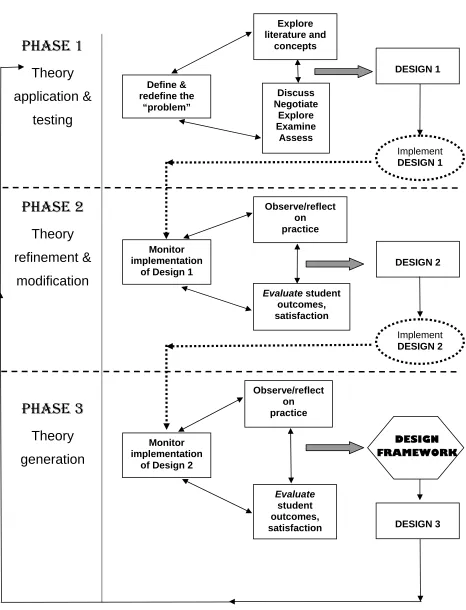
3.3.1 Phases of the Study
3.4 3.5
Phase 1: Theory Application
Phase 2: Theory Refinement and Modification Phase 3: Theory Generation
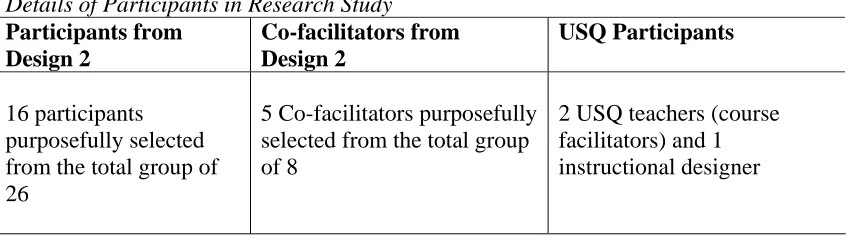
3.3.2 Validity, Reliability, and Generalisability 3.3.3 Data Source – Participants
3.3.4 Data Sources and Data Collection 3.3.5 Ethical Issues
Data Analysis Framework Concluding Remarks 61 63 64 73 74 76 CHAPTER 4–ANALYSIS AND FINDINGS
4.1 4.2 4.3 4.4 4.5 Introduction
4.1.1 Purpose of Data Analysis
4.1.2 Issues Encountered during Data Analysis Phases 1 and 2 – Findings and Recommendations
4.2.1 Data Sources and Participants 4.2.2 Pedagogical Recommendations
4.2.3 Administrative Recommendations 4.2.4 Technical Recommendations
Phase 3 – Procedures Used to Analyse Data from Design 2 4.3.1 Data Screening – Drawing the Data Together
4.3.2 Data Reduction and Creating Key Words for Coding 4.3.3 Displaying Data in a Matrix
4.3.4 Interpreting the Matrix – Looking Back to Look Forward Findings and Interpretations
4.4.1 Learning and Teaching in Online Settings: Findings
4.4.2 Professional Development for Educators in Online Environments: Findings
4.4.3 Transformative Approaches to Professional Development for Educators in Online Settings: Findings
4.4.4 Principles of Transformative Online Pedagogy Concluding Remarks 77 77 78 79 79 81 84 85 86 87 94 101 112 114 116 119 122 124 125 CHAPTER 5–CONCLUSIONS AND RECOMMENDATIONS
5.1
5.2
Introduction
5.1.1 Contribution to the Field
5.1.2 The Influence of Post-Study Facilitative Activity
Reviewing the Journey – Principles that Underpin the Transformative Online Terrain
5.2.1 Principle 1 – The CHE Factor: Connectivity-Humanness-Empathy 5.2.2 Principle 2 – Focus on the Learner and Learning
5.2.3 Principle 3 – Immerse to Converse: Reflection is Critical 5.2.4 Principle 4 – Learning is a Community Activity
5.2.5 Principle 5 – Merge the Roles of Educators and Learners: Blurring the Boundaries in Online Contexts
5.2.6 Principle 6 – VIP Communication: Online Communication is
5.3
5.4 5.5
Visible–Instant–Permanent
5.2.7 Principle 7 – Interpret and Respond to Signs of Change 5.2.8 Principle 8 – Lead by Example: Create a Model Experience 5.2.9 Principle 9 – Build, Manage, and Nurture the Learning Environment
5.2.10 Principle 10 – Motivation and Preparation: A Predisposition for Change and Transformation
Principles + Context = ? – A Practitioner’s Guide to Online Design for Transformative Professional Development
5.3.1 The Contextual Screen: Conditions, Travellers, and Roadblocks 5.3.2 Implications for Educators
5.3.3 Implications for Institutions
The Journey Continues – The Möbius Strip and the Potential for Future Research
Planning the Next Trip – A Navigator’s Epilogue
155 157 159 162 166 168 172 175 178 180
REFERENCES 184 APPENDICES 203
Appendix A: Data Collection (Design 2)
Appendix A1 Letter: Consent of Participants 205
Appendix A2 Letter: Consent of Teachers 207
Appendix A3 Email Follow-up 209
Appendix A4 Interview Questions (Design 2) 210
Appendix B: Reports
Appendix B1 Pre-planning: Design 1 - 2002 215
Appendix B2 Orientation Workshop Survey (Design 1) 217
Appendix B3 Orientation Workshop Review by Researcher (Design 1) 220 Appendix B4 Review Meeting Following Teleconference – Evaluation
Outcomes of PD01 Design and Facilitation of e-Learning & USQ Response (Design 1)
222
Appendix B5 Final Session of PD01 Design and Facilitation of e-Learning (Design 1)
227
Appendix B6 Online Evaluation Feedback (Design 1) 230
Appendix B7 Focus Group Evaluation Outcomes of PD01 Design & Facilitation of e-Learning (Design1)
232 Appendix B8 Recommendations for Future Developments of PD01
Design and Facilitation of e-Learning (Design 1)
234
Appendix B9 Proposal for Design 2 235
Appendix B10 Report of Standard Web-based Questionnaire Responses (Design 2)
238
Appendix C: Other Documentation
Appendix C1 Contact Summary (Design 2) 241
Appendix C2 Contact Summary (Post-Study Activity, 2004) 243
Appendix C3 Document Summary (Design 2) 244
Appendix C4 Discipline Areas – Design 1 245
Appendix C5 Discipline Areas – Design 2 246
Appendix D: Raw Data
Appendix D1 Researcher’s Reflective Journal (Design 2) 248 Appendix D2 Participant and Co-Facilitator Responses to Interview
Questions (Design 2)
253 Appendix D3 Sample of Interview Transcript Conducted as a
Synchronous Chat (Design 2)
274 Appendix D4 Application of Framework to Analyse Data (Design 2) 277
Appendix D5 Transformation in Action (Post-Study) 291
List of Tables
CHAPTER 3–METHOD Table 3.1
Table 3.2 Table 3.3 Table 3.4 Table 3.5
Role Clarification of the Researcher Details of Participants in Research Study
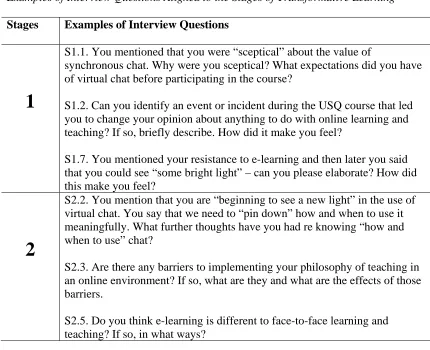
Framework for Interview Questions Based on the Work of Greene (1975), and Mezirow (1991)
Examples of Interview Questions Aligned to the Stages of Transformative Learning
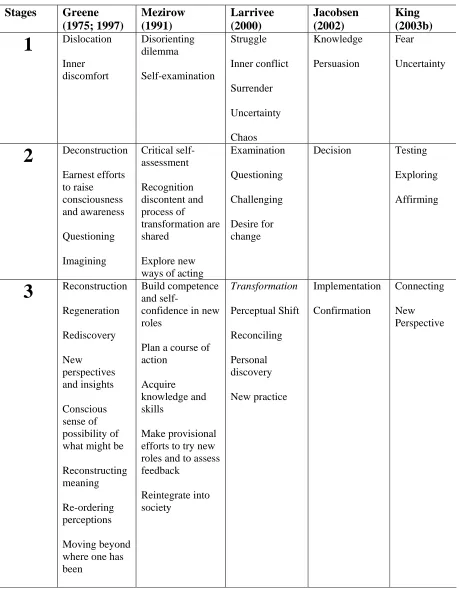
Scholarly Work Which Contributed to the Elaborated Data Analysis Framework 54 64 69 70 75
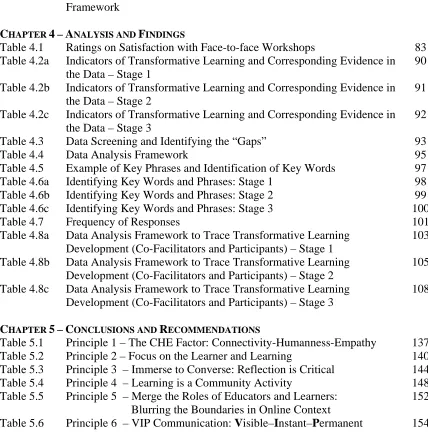
CHAPTER 4–ANALYSIS AND FINDINGS Table 4.1 Table 4.2a Table 4.2b Table 4.2c Table 4.3 Table 4.4 Table 4.5 Table 4.6a Table 4.6b Table 4.6c Table 4.7 Table 4.8a Table 4.8b Table 4.8c
Ratings on Satisfaction with Face-to-face Workshops
Indicators of Transformative Learning and Corresponding Evidence in the Data – Stage 1
Indicators of Transformative Learning and Corresponding Evidence in the Data – Stage 2
Indicators of Transformative Learning and Corresponding Evidence in the Data – Stage 3
Data Screening and Identifying the “Gaps” Data Analysis Framework
Example of Key Phrases and Identification of Key Words Identifying Key Words and Phrases: Stage 1
Identifying Key Words and Phrases: Stage 2 Identifying Key Words and Phrases: Stage 3 Frequency of Responses
Data Analysis Framework to Trace Transformative Learning Development (Co-Facilitators and Participants) – Stage 1 Data Analysis Framework to Trace Transformative Learning Development (Co-Facilitators and Participants) – Stage 2 Data Analysis Framework to Trace Transformative Learning Development (Co-Facilitators and Participants) – Stage 3
83 90 91 92 93 95 97 98 99 100 101 103 105 108
CHAPTER 5–CONCLUSIONS AND RECOMMENDATIONS Table 5.1 Table 5.2 Table 5.3 Table 5.4 Table 5.5 Table 5.6
Principle 1 – The CHE Factor: Connectivity-Humanness-Empathy Principle 2 – Focus on the Learner and Learning
Principle 3 – Immerse to Converse: Reflection is Critical Principle 4 – Learning is a Community Activity
Principle 5 – Merge the Roles of Educators and Learners: Blurring the Boundaries in Online Context Principle 6 – VIP Communication: Visible–Instant–Permanent
[image:8.595.83.511.304.741.2]Table 5.7 Table 5.8 Table 5.9 Table 5.10
Principle 7 – Interpret and Respond to Signs of Change Principle 8 – Lead by Example: Create a Model Experience Principle 9 – Build, Manage, and Nurture the Learning
Environment
Principle 10 – Motivation and Preparation: A Predisposition for Change and Transformation
List of Figures
CHAPTER 1–INTRODUCTION
Figure 1.1 Scope of the Study 12
CHAPTER 2–LITERATURE REVIEW Figure 2.1
Figure 2.2
Scope of the Literature Review
Larrivee’s (2000) Multi-level Process for Self-reflection
16 27 CHAPTER 3–METHOD
Figure 3.1 Figure 3.2
The Iterative Nature of Action Research Research Framework
52 58 CHAPTER 4–ANALYSIS AND FINDINGS
Figure 4.1 Figure 4.2 Figure 4.3
Checking the Validity of Coding Procedures
Sample of Participant Progress in Course According to Data Analysis Framework
Scope of Findings of the Study
89 113 115 CHAPTER 5–CONCLUSIONS AND RECOMMENDATIONS
Figure 5.1 Figure 5.2
Reushle Framework for the Design of Transformative Approaches to Professional Development for Online Educators
The Möbius Strip
Abstract
This study investigates professional development for online educators within a
transformative learning framework. A qualitative, action research method was adopted that captured data from interactions between the researcher and participants, and which allowed the generation of theory that could guide future design efforts. The project was conducted online from Australia during 2002 and 2003 with two groups of participants drawn from a Singapore polytechnic. Data were analysed utilising content analysis of transcripts,
interviews, and observations, with the researcher being an active participant in the project. The findings which differentiated online from traditional educational contexts, and which therefore are significant in terms of future design considerations were that since interactions were all text-based and visible, participants were careful to provide reasoned, reflective contributions. Furthermore, the archived interactions were available for
inspection by all participants, giving rise to more articulate and constructive dialogues while maintaining evidence of the human “presence”. Other findings related to supporting an online community of adult learners by recognising the individuality of each learner and their specific needs in terms of their experience, need for relevance and flexibility in the learning activity, and valuing the sense of human connectivity. Offering of peer support through a peer learning partnership model was found to be an effective way for learners to support each other in a trusting, respectful, empathetic, non-threatening manner. Findings indicated that the provision of exemplars, or models of good practice, supported situated, authentic activity, and contributed to positive, motivated learners. The dynamic (constantly changing, growing, adapting) nature of the Internet required facilitators to be continually evaluating the learning situation in order to promote and nurture an atmosphere that supported the development of new ideas, the challenging of old, the exploration of
alternatives, and support for changes in perspective and action. Evidence suggested that the use of the Internet for learning and teaching could go some way towards addressing the challenges of prejudice, discrimination, and celebrate the notion of difference.
From these findings, the literature, and the personal experience of the researcher, ten design principles were formulated and, if considered in light of local contextual
development for online educators. Further research to address the application of this framework to other discipline areas, and other educational settings, is recommended.
Key indicators
Foreword – A Practitioner’s Journey
I find the great thing in this world is not so much where we stand, as in what direction
we are moving. Oliver Wendell Holmes
This thesis arose from my professional practice, my reading of the literature, and my desire to make a difference in the field of education. I believe the understanding I have gained from this research has informed my practice, and will enable me to build capacity in others.
My interest in information and communications technologies began not long after I joined the University of Southern Queensland (USQ) in its Distance Education Centre (DEC) in 1992. My final paper for a Masters degree (completed part-time, and at a distance from 1992 to 1995) focused on the design considerations for developing hypermedia courseware. This paper provided an opportunity for me to expand my existing skills and knowledge, and to enter the world of academic writing and publishing when I had my first article published in a refereed journal.
As time went on, I observed a change in my conceptualisation of computer use.
Working with the staff of a local school to develop a computer policy was a catalyst for this change. A conference introduced me to the Internet and the possibilities of online learning and teaching, particularly communications technologies. I commenced teaching online in 1997 – part-time, and in my “own time”. I met regularly with a like-minded colleague, to talk and to write about our experiences, and to critique each other’s work. Our expertise, knowledge and confidence in the field grew. During that time I expanded my technical skills through a range of practical classes. Along with other colleagues at our institution, we decided to run professional development sessions through the Human Resource department in order to put forward our beliefs about learning, and ways of using online technology to enhance that learning. I developed a Web site to support this and consequently improved my understanding of, and ability to use, the Internet.
reflection, action, and social engagement. A strong influence on my thinking at that time was the work of Pere (Father) Teilhard de Chardin, particularly his book The Phenomenon of Man, written in 1955. He maintained that evolution had a definite direction, an
“Ariadne’s Thread”, and that thread is the increasing complexity of living beings, the focus of which is their nervous systems and more precisely, their brains. Central to this is thought and reflection. His opinions about the interconnectivity of mankind and his concern with establishing a global unification of human awareness as a necessary prerequisite for any real future progress of mankind struck a chord with me.
In 2003, I attended the Transformative Learning Conference at Teachers’ College, Columbia University, New York, and I was hooked! I heard Maxine Greene and Jack Mezirow speak. I met with Patricia Cranton, Kathy King, John Dirkx, and many other great names in the field. I was surrounded by positive, enthused, “transformed” educators – it was indeed a transformative learning experience for me, and as Cohen (1997, p. 61) has observed, “in order to practice and teach transformative learning, I had to experience transformative learning”.
On my return to Australia, I began working in earnest on my doctoral write-up.
However, the more I wrote, the more I felt I needed to read, and the more I discovered. In 2004, I ran two online courses (twice) with postgraduate learners. I implemented many of the strategies I had been hearing and reading about, I trialled, I critically reflected, I discussed, debated and challenged. And the results were amazing. During the courses, learners engaged in reflective practices and I noted significant changes in terms of their confidence to challenge, explore, and push the boundaries. A series of professional readings was used as journal and discussion prompts. Connections between theory and practice became more explicit.
teacher providing guidance rather than clear instructions on how to get from point to point. The teacher may change into a fellow traveller at any point, or points along the way. The concept of learning as a journey is not a new one. In 1853, Hole (as cited in Candy, 1991, p. 57) observed that “education is not an affair of childhood and youth, it is the business of the whole life”. Indeed, the belief that learning is a lifelong journey is the subject of much interest and research in today’s educational community. Conferences are dedicated to the study of “lifelong learning” (e.g., Lifelong Learning Conference at Central Queensland University), and many “lifelong learning” university centres have sprung up e.g., Centres for Lifelong Learning at several UK universities. Learning can and should be a lifelong process that is promoted and supported from childhood and throughout adulthood, in formal settings as well as informal ones (Fraser, 2001).
Anderson and Kanuka (2003) say that they are convinced that “a networked society is not a fad and that we are at the beginning of a new era in human collective activity” (p. 7). Raschke (2003) emphasises the ability of the internet to encourage and nurture a
partnership between those who teach and those who are taught and sees the internet as an “incubator of knowledge” (p. 38). Perhaps the Internet can support the incubation of life itself . . .
CHAPTER 1
Introduction
I am who I am not yet . . . Maxine Greene
1.1 Background
Do we know what makes professional development for educators effective? Have researchers and practitioners reached consensus about the characteristics of a successful professional development experience? Is there a “one size that fits all” model of
professional development? A review conducted by Guskey (2003) of the characteristics of effective professional development generally indicates the answer to these questions is “No”. In analysing 13 lists of the characteristics of effective professional development published in the last 10 years by a variety of agencies, Guskey (2003) concluded that there appeared to be little agreement between professional development researchers and
practitioners on the criteria for professional development “effectiveness” and that most of the currently identified characteristics of effective professional development could be described as being important in some cases, but possibly not in others.
This study focuses on professional development for educators, specifically addressing the professional development of educators engaged in learning and teaching in online contexts (also referred to as “Internet-supported”, “web-based” or “e-learning” contexts). Within this study, the e prefix means that the activity, or noun modified, is associated with the electronic processes of the Internet and takes place on a “digital network that is
available any time/anywhere” (Anderson & Kanuka, 2003, p. 4) e.g., email, learning, e-research, and e-community. The term “professional development” refers to a process of engaging in continued learning to enhance knowledge of, skills in, and attitudes towards relevant practice and theory, and the educational contexts in this study relate to post-compulsory settings e.g., polytechnics and universities.
constitutes an effective learning experience for adult online learners and their teachers. Although the use of electronic mail (email) communication and computer conferencing began over three decades ago, there remain questions about the value and quality of online education (Harasim, 2000). Some practitioners have expressed concern that “the technology is driving the pedagogy” (Postle, Sturman, Cronk, Mangubhai, Carmichael, McDonald, Reushle, Richardson, & Vickery, 2003, p. 66). Reeves (2002, ¶ 2) refers to this as the “Trojan Horse notion” – the belief that if you let technology into the classroom, pedagogical change emerges, rather than viewing technology as a means of supporting sound pedagogy. Mayes (2002, section 1, ¶ 2) makes the point that “new technologies don’t lead inevitably to major change in education”. Laurillard (2002, p. 1) urges higher
education institutions to “meet the demands of the knowledge society and take full advantage of the possibilities technology presents” rather than perpetuating the
transmission model (the passing on of knowledge or information), which she believes has prevailed in higher education “throughout fundamental innovations including writing, books, computers, and the Internet”. Fowler and Mayes (1999, pp. 6-7) refer to this as the “acquisition metaphor” or a “representational view of learning” and voice concern about a tendency to “design by imitation” where existing learning environments are transposed into web-based learning environments with a “lack of innovation or utilization of the power inherent in technology-based learning”. Dede (2001, p. 29) asserts that “the most
significant influence on the evolution of education will not be the technical development of more powerful devices but the professional development of wise designers, educators and learners”.
Examples of professional development provision for teachers in relation to the use of online technologies illustrate this point. Jacobsen (2002) reports on her Canadian educational context where teachers are expected to educate future workers for the
O’Rourke (2003) notes that within Australia, all states and territories have made the use of information and communication technologies (ICTs) a policy imperative for education and have made large investments in infrastructure, both in terms of networking and hardware provision. This in turn has influenced professional development provision for teachers in relation to ICTs, with authorities offering extensive train-the-trainer models of professional development together with workshop opportunities, professional networks, conferences, best practice schools, and seminars. Despite this commitment, significant concerns are still being raised in relation to how technology is actually being used to enhance learning and teaching, and whether teachers are simply reinforcing old pedagogy better suited to
production line type educational systems (Bigum, 2002; Herrington, Oliver, Herrington, & Sparrow, 2000; Jones, 2001; Lankshear, Snyder, & Green, 2000; Luke, 2000).
investigate the nature of these differences as they relate to professional development for online educators, in order to make a contribution to existing research.
1.2 Significance of the Study
The study builds upon extant research into the professional development of educators using technology in educational contexts. The majority of previous studies have been situated in classroom environments from schools through to tertiary institutions, both in terms of the focus of the professional development, and the means of accomplishing that development (e.g., Bigum, 2002; Jacobsen, 2002; O’Rourke, 2003). This study will add to the body of research on learning and teaching online, in that it is conducted predominantly in an online environment. Using an action research framework, the study investigates how best to prepare educators to teach (and learn) in online higher education environments. Professional development designed for educators to develop their capacity for using computer technologies in their learning and teaching has passed through a number of iterations. The first efforts in the 1970s and 1980s focused on the machines and the learning of technology skills (Salmon, 2002). Educators could access support on how to use and program the computer, often in a site away from their teaching location. The second wave of professional development (1980s to 1990s) responded to the realisation that technology integration had less to do with the technology and much more to do with learning and teaching (Jacobsen, 2002). However, this wave of professional development focused largely on specific computer applications (the software) and strategies for using the technology tools, often occurred in lengthy workshops, but it was still removed from the teacher’s immediate work context. While accomplishing some skill development, this approach did not bring about large scale changes in teaching practice and many teachers continued to teach the way they had been taught, often perpetuating the transmission model of education (Cranton, 1996; Jacobsen, 2001), or the banking system of education where students are seen as passive consumers (Freire, 1976).
the next. Educators are required to prepare learners to be critical, self-directed,
collaborative individuals who are able to contribute meaningfully to their own “learning organisations” (Cranton, 2003; Jacobsen, 2002; King, 2003b; Laurillard, 2002). It is evident from the literature (explored further in Chapter 2) that a third wave of situated, flexible professional development is emerging aimed at supporting and responding to the individual needs of educators and to current and future contextual requirements (Jacobsen, 2002; Stein, Smith, & Silver, 1999; Swan, Holmes, Vargas, Jennings, Meier, & Rubenfeld, 2000).
This third wave of professional development calls for the transition from transmissive to transformative approaches in education. The reasons for such a transition are strongly promoted in contemporary adult education literature (Cranton, 2003; King, 2003b; Laurillard, 2002). The transmissive approach refers to a traditional model of a teacher-student relationship, where the teacher is the expert communicator of knowledge and the student the recipient (Laurillard, 2002; The Tavistock Institute, 2002). The analogies “sage on the stage” or “teacher-centric” are often used to describe the transmission model of education (McDonald & Postle, 1999). The transformative approach relates to learning which occurs when an individual is empowered to reflectively transform their meaning schemes in terms of their beliefs, attitudes, opinions, and emotional reactions.
Transformative learning is the process by which we call into question our taken for granted habits of mind or mindsets to make them more inclusive, discriminating, open and
Mezirow, 1991) – collaborative, interactive learning communities that support and promote transformative learning. Bonk (1999) observes that,
. . . online learning offers a chance for students to enter into dialogues about authentic problems, collaborate with peers, negotiate meaning, become apprenticed into their field of study, enter a community of experts and peers and generally be assisted in the learning process. (p. 410)
This approach to learning and teaching is not new, so why is it attracting such renewed interest in the tertiary education arena? In the early 1900s, for example, the educational theorist John Dewey (1916) supported an approach to education that would transform schools, work organisations, and the society at large into more participative, democratic cultures (Gregson, 1995). Dickinson (1992, ¶ 2) stressed the importance of finding new ways of communicating and working together “to confront the problems that threaten the lives of human beings, countries, even the planet itself”. The attempted transition, however, is a relatively recent phenomenon in the higher education sector and has met with some opposition (Raschke, 2003). What has hindered such ideas in the higher education “classroom” setting? Raschke (2003, p. 110) claims that higher education, unlike other “pillars of culture” or “sectors of the economy” has undergone little change over the last 80 years. He notes that despite significant cultural, social, economic, and political revolutions, the view of learning and teaching in higher education “does not look or function much differently from the way it did in the 1920s”. He believes that this resistance to new systems of knowledge creation and distribution is linked more to the desire to sustain a sense of privilege and aristocracy, than to a fear of the loss of quality standards. He
observes that much of higher education has refused to join the “information grid” and that a good deal of institutional resistance to technological transformation stems from a belief that knowledge is nothing but “the transfer of information from one database or brain to
another” (Talbot, 1999, as cited in Raschke, 2003, p. 110). However, technological advances and changing societal, economic, and political expectations are strongly
influencing and encouraging the exploration of how tertiary educators “can go beyond the acquisition of simple techniques to a deeper reflection on and understanding of their work” (Cranton, 1996, p. vii).
Recent studies have supported this need for change. Cranton (1996) has observed that, A strong theoretical and practical literature is [emerging] in adult education . . . it is not informed by one perspective, but perhaps that is not an ideal state given the kaleidoscope of activities included under the adult education umbrella. We are, though, witnessing a stage of development in the field that is reflective, critical, and fairly comprehensive. That is, we are beginning to understand how adults learn and how educators can foster, support, and challenge that learning. (p. 6)
The online environment may provide a setting for this to occur.
Samuelowicz (1999) argued that professional development activities in a university should be directed at changing the beliefs of people as well as altering teaching approaches. Pelliccione (2001), in her study on implementing innovative technology in an Australian university focused on two areas: the use of online technologies in learning and teaching by teaching staff, and the mechanisms the university has established in order to realign themselves with the information age. She identified the existence of transformational leadership across all levels of the university as a major factor in the promotion and adoption of ICTs, strongly supported by the development of a professional learning community. Pelliccione’s (2001) research revealed that only through the synergy of university (organisational) commitment and individual commitment could change take place.
Jacobsen (2002) reported on the Galileo Educational Network Association (GENA) project conducted at the school and district level within the province of Alberta in Canada.
GENA’s expert teachers successfully worked in schools in a mentoring capacity with teachers and students to “co-create new images of engaged learning, technology integration and professional development”.
1.3 Scope of the Study
1.3.1 Context
The study focused on the work conducted by myself in 2002 and 2003 with a polytechnic located in Singapore. At this location, I acted in a consultative role as project manager and key facilitator for polytechnic teachers in an online course on designing and facilitating online learning and teaching.
The Ministry of Education (MOE) in Singapore introduced its Masterplan for IT in Education in 1997 and concluded the initiative in 2002. The government subsequently released its 2003-2007 MasterplanII or “mp2”. The vision of mp2 is that,
IT [Information Technology] will be pervasively and effectively used to enhance educational processes and structures to help realize the ability-driven paradigm. By leveraging on IT as a tool to customize education to meet the different needs and abilities of our pupils, we will be able to support and develop lifelong learners as we work towards the overall vision of Thinking Schools: Learning Nation. (Educational Technology Division, Singapore Ministry of Education, 2003, Philosophy, ¶ 4)
In response to the MOE initiative in Singapore, the polytechnic chose to facilitate the use of technology throughout all facets of the organisation. Management at the polytechnic decided to include online technology for learning and teaching as part of its strategic plan. Under its Mobile eLearning (MeL) initiative, the polytechnic was the first in Singapore to encourage all students to have their own notebook computers so that they could study, interact, participate in online discussions, access Internet resources, submit assignments and access Internet laboratories from campus or home. In addition to a high-speed network, each student has been issued with a wireless card which allows them contact to the network at any access point on campus. The polytechnic has an enrolment of approximately 20,000 and an academic staff of 850. All students are on-campus but the polytechnic expects to fully integrate e-learning and e-services by 2005.
web-based Learning Management System (LMS) and was offered over one semester in 2002. NextEd Ltd, a company which specialised in providing online education infrastructure and had an office located on the USQ campus, supplied the technological infrastructure and support to deliver the course to the polytechnic. Data for this study were drawn from the first offering to polytechnic teachers of this USQ facilitated, online course, and the successive revision and offering of that course to a second cohort of 26 teachers in 2003. The context is discussed further in Chapter 3.
1.3.2 Propositions
An à priori assumption in this study was that learning and teaching in an online
environment is different to learning and teaching in traditional educational settings. It was argued that effective professional development for educators to teach in online
environments can be based on the principles of constructivist and transformative learning theories and should be, in the main, conducted in an online environment.
This study evolved from a need to marry theory to a practical program of professional learning for educators, and a desire for my work to contribute to productive change in places of higher learning and in the learning experiences of students, particularly in the online environment. The extent to which the outcomes of this study might apply beyond the immediate sample is an important issue. These limitations are addressed later in this
chapter. It is an unrealistic expectation that a proposed framework is relevant to other users in different educational environments. As new information is discovered and new questions are raised, “early theories give way to redefined relationships and new generalizations” (Bell-Gredler, 1986, p. 6). Nevertheless, as an outcome of this study, I propose to conceptualise and articulate ways of sharing the findings, with the aim of building the capacity of others to work in online environments.
I chose this area of study because of the increased use, worldwide, of the Internet for supporting learning and teaching, and the growing evidence that effective use of the Internet can significantly improve the educational experiences of learners. My personal experience and interest as an online educator, as a designer of online learning
for ways that my research, scholarship and teaching practice are connected. I share a belief with Daley (1997) that these areas are intricately woven into the fabric of our role as educators of adults. This belief is supported by a conceptual framework for scholarship proposed by Boyer (1990) who was sponsored by the Carnegie Foundation for the Advancement of Teaching in the USA to examine academic work within a university setting. The Carnegie Foundation report proposed that university work be thought of as having four separate, yet related, functions, these being the scholarship of discovery (what we most often think of as scholarship, or the pursuit of knowledge for its own sake); the scholarship of integration (making connections and drawing insights from discrete facts and findings to interpret, draw together, and bring new insight to bear on original research); the scholarship of application (which relates to the service role of the academic); and the scholarship of teaching (not merely a technical or routine activity, but a highly complex activity of professional practice) (Boyer, 1990). This approach supports Laurillard’s (2002, p. 20) proposal that universities must “realign research and teaching and aspire to teaching methods that help students acquire the skills of scholarship” and must redefine “what counts as higher learning by moving beyond a curriculum that teaches what is known to one that teaches how one comes to know”. This involves moving from an “acquisition” metaphor, to a “participation” metaphor (Sfard, 1998, as cited in Fowler & Mayes, 1999, p. 7).
stored as digital text files. Because of this instant transcription, cost and possibility of error were reduced. Use of the Internet also enabled me to reach a diverse population sample that may otherwise have been inaccessible due to the constraints of time, cost, and location.
1.3.3 Purpose, Objectives and Scope
The overall purpose of this research was to create an approach, in the form of a framework which could effectively support and guide the design of professional
development for educators engaged in learning and teaching in higher education, online contexts. A challenge for this project was how to go beyond the technical and practical. With this in mind, my study had six research objectives:
1. To identify the learning theories appropriate for the professional development of educators (specifically constructivism, adult learning, and transformation). 2. To identify the emerging principles of online learning and teaching (online
pedagogy).
3. To identify the key attributes of current professional development practice for educators.
4. Using an iterative, cyclical process, to develop, implement, evaluate, and modify a professional development course which embodies the principles and practices identified in objectives 1-3.
5. To determine the factors which contribute to successful professional development for educators engaged in learning and teaching online.
The overall objective was:
6. To formulate a framework for the design of transformative professional development for online educators, based on the developmental phases of this study.
The study explored three areas of literature (see Chapter 2):
1. learning theories, including constructivism, adult learning and, in particular, transformation theory (transformative learning),
2. learning and teaching in online settings (online pedagogy), 3. professional development for educators,
and reflected upon:
4. feedback and critical reflections from online learners/participants, and 5. the experience of several online teachers at USQ.
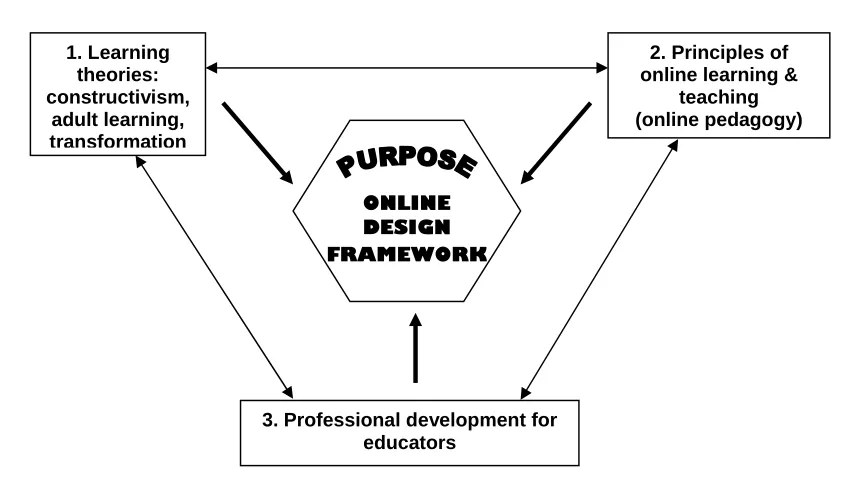
The core purpose of the study lies at the intersection of the three areas of work and aims to propose a framework that guides the design of transformative professional development for online educators. Figure 1.1 illustrates the scope of this study.
[image:27.595.85.516.351.598.2]
Figure 1.1. Scope of the study.
Central to professional development for educators is Cranton’s (1996) tenet that educators are learners. She observes that the literature “applies equally to us as we learn about teaching. What we know about how our learners [learn] will be applied to how we grow and develop as educators. We too, are adult learners” (p. 6). King (2003b, p. 13) supports this perspective by stating that the “emphasis on the faculty as adult learners is
1. Learning theories: constructivism,
adult learning, transformation
2. Principles of online learning &
teaching (online pedagogy)
3. Professional development for educators
central to the new paradigm for professional development” as it helps us to understand their needs and experiences better. Professional development should provide new insights, stimulate critical reflection, and further the development of an educator’s knowledge of theory and practice. It is argued that professional development should therefore be underpinned by Mezirow’s (1991) theory of adult learning - transformation theory.
1.4 Strengths and Limitations of the Study
A number of strengths and possible limitations to the study were identified as: 1. The study focused on the design of an online professional development course
offered by one Faculty at USQ. However, the course selected for this study did provide authentic examples of online learning and teaching and did focus on broadening a collective understanding of best practice to do with professional development for educators and online pedagogy.
2. The study followed an action research method. A common criticism of action research is its lack of generalisability, or external validity. To some extent this is a legitimate criticism. This study was sourced from one institution outside the
Australian educational system - a Singapore polytechnic. This is because the cohort needed to be “intact” and contained. Therefore, the application of the findings was restricted to this group. Beyond that, reader generalisability (Merriam, 1998) means that each reader will relate the findings to their own existing “picture” of online learning and teaching in their own educational institution or other context. The fact that the study was located in both an Australian and an Asian setting may be considered both a strength and a limitation.
1.5 The Study in Outline
In this study, I collaborated with teachers from a polytechnic in Singapore to build the capacity of the group in the area of online learning and teaching. The study investigated the process of professional learning and change associated with the use of online technologies in an institution of higher education. Chapter 2 reviews the literature in this area. Views on learning and teaching in online environments, and contemporary learning theory
(particularly transformation theory) are presented, along with key recommendations and justification for particular approaches to professional development for educators. These have also helped to focus the method and analysis strategies of the research.
Chapter 3 articulates the major issues involved in the choice of research design and related research methods. This chapter provides a rationale for the methods chosen and describes the participants, the methods of data collection, the types of data that were collected and the role of the researcher. For this research study, which is primarily
qualitative in nature, the concepts of validity, reliability, and generalisability are discussed. The exploration of themes initiated in the literature review continues in this chapter with the aim of creating a framework that can support and guide the design of professional development for online educators. The description and application of a context-specific, data analysis framework is introduced.
Chapter 4 describes the data analysis phase of the study. This chapter further elaborates on the impact of the researcher roles, and the effect a contaminating variable has upon the study. Limitations and issues are highlighted. The themes of learning and teaching in online settings, professional development for educators in online settings, and transformative approaches to professional development for educators in online settings provide useful organisers under which to report the findings of the study.
The final chapter (5) articulates a way forward, both in terms of a framework for online design and the principles, practices and contextual considerations which define that
framework. The implications for individuals (educators and learners), and educational institutions are discussed in light of the demands that they might face in facilitating
CHAPTER 2
Literature Review
A word is not a crystal, transparent and unchanged, it is the skin of a living thought and may vary greatly in colour and content according to the circumstances and the time in which it is used. Oliver Wendell Holmes
2.1 Introduction
The purpose of this chapter is to explore the proposition, through relevant literature, that the online environment can support a process of learning promoted by contemporary educational theorists (Jonassen, 1998; Knowles, 1990; Mezirow, 1997) – learning which Bonk (1999) suggests occurs in collaborative, interactive communities where authentic problems are investigated, meaning is negotiated, and learners become apprenticed into their field of expertise. The study is located within a broad structure of existing theory and knowledge relating to three themes which were introduced in Chapter 1 (Figure 1.1). These themes are explored in this chapter by reviewing pertinent literature (see Figure 2.1):
1. theories of learning, including constructivism, adult learning and, in particular, transformation theory (transformative learning),
2. learning and teaching in online settings (online pedagogy), and 3. professional development for educators.
[image:31.595.90.506.535.701.2]
Figure 2.1. Scope of the literature review. 1. Learning
theories: constructivism,
adult learning, transformation
2. Principles of online learning &
teaching (online pedagogy)
The first theme incorporates relevant learning theories and the impact of these theories on the proposed framework for design. Given the relative “newness” of this research area (transformative professional development through online education), and the fact that the theories guiding this area are still in developmental stages, a rationale for the chosen research method also emerges. The second theme addresses learning and teaching in online environments. Focus is on a number of key principles that guide much of the current online education work globally, and how these principles are applied to the design of the initial course under investigation in this study. The third theme examines the literature on professional development for educators which, in this study, acknowledges the need to provide professional support that reflects the elements revealed in themes 1 and 2. Through this review of the literature, gaps in extant theory and knowledge which require further investigation are revealed. Opportunities to extend knowledge and theory are provided through the research processes of the study.
2.2 Theories of Constructivism, Adult Learning, and Transformation
(Transformative Learning)
2.2.1 Constructivism
Jean Piaget (1896-1980) was one of the first theorists in Western civilisation to explore learning and knowledge structures with a model that viewed people as the “builders of their own intellectual structures”. Another who also explored new views on the nature of
learning was Soviet psychologist Lev Vygotsky (1896-1934) who developed “dialectic theory”, a social learning perspective that describes how children learn through interaction and dialogue with socialising agents (such as peers, teachers, parents), that is, viewing human knowledge as socially constructed. While both Piaget and Vygotsky are prominently mentioned in most texts as pioneers in the field of constructivist learning (Duffy &
Various forms of constructivism have emerged in the literature including radical, social, physical, evolutionary, postmodern, and information-processing constructivism (Steffe & Gale, 1995). Jonassen (1998) refers to the concepts of individual or personal constructivism (individuals constructing their own cognitive structures as they interpret their experiences in different learning situations), and social (learning with and from others) constructivism. Whether learning is viewed as socially situated or whether it is considered to be an
individual construction has implications for the ways in which the learning process is conceptualised.
For this study, constructivism is based upon the assumption that meaning exists within, in that learners build from experience and construct their own knowledge and meaning (they are actively involved in making meaning), rather than relying on external
enlightenment - “an active process of constructing rather than acquiring knowledge” (Hung, 2001, p. 282). Constructivism is also viewed as a process that recognises the role that society plays in the development of an individual (social constructivism). It is proposed that learners construct their own meaning from information and that one way of effectively constructing that knowledge is through joint construction with other learners.
Constructivism can be considered a theory of learning (how people learn), and an
epistemological concept (the nature of knowledge – a theory of knowing) that draws from a variety of fields, including philosophy, psychology, and science. The proponents of
constructivism do not claim to have developed earth-shaking innovations in the area of education; constructivism merely claims to provide a sound conceptual basis for some of the things that inspired teachers have been doing without theoretical foundation (von Glasersfeld, 1995).
With the advent of computer-based instruction and the ever-growing capabilities of technology, researchers and educators are linking constructivism, and the use of technology with learning. Within the field of instructional design and technology, constructivist theory has become popular among theorists and practitioners who are creating and studying its practical applications to learning. Many see strong support for the principles of
2.2.2 Adult Learning
The principles of constructivism can be argued to be similar to that of andragogy, which was originally defined as the “art and science of helping adults learn” by the adult learning theorist, Malcolm Knowles (1975). Knowles, having re-examined his original assertions about the unique characteristics of andragogy, now believes that it is not simply a theory of adult learning, but describes it as a situational model for human learning. As with
constructivism, the learner is centrally important to the learning process. Andragogical principles include the need of the learner to be personally involved in the planning and evaluation of instruction, the importance of learner experience and relevance to the learner in providing the basis for learning activities, and a focus on content as process rather than content as product (the process of learning is of greater value than acquiring the
knowledge). When examining these principles, together with the social context and history of adult education, one can find many philosophical connections between adult education theories and constructivism.
Because constructivist learning theory maintains that learning is a process of the learner constructing meaning from experience, it is congruent with the adult learning concepts of self-direction, transformative learning, and situated cognition (Merriam & Caffarella, 1999). It also connects directly to beliefs about the central role of learner “experience” in adult learning where the focus is on contextualising learning by providing instruction directly related to the life experiences or the functional contexts of adult learners (Sandlin, 2000).
2.2.3 Transformation Theory (Transformative Learning)
In 1991, Jack Mezirow, in his study of adult learning formally proposed “transformation theory” and “transformative learning”, the essence of which is grounded in constructivism. Transformation theory is defined as “a theory of adult learning which attempts to describe and analyze how adults learn to make meaning of their experience” (Mezirow, 1991, p. 198). In the preface to one of his books on the topic, Mezirow (1991) briefly explains the history from which his theory emerged:
law, literature, and art. Transformation theory also grows out of the cognitive
revolution in psychology and psychotherapy instigated by scores of studies that have found that it is not so much what happens to people, but how they interpret and explain what happens to them that determines their actions, their hopes, their contentment and emotional well-being, and their performance. (p. xiii)
Ten phases of transformative learning were identified by Mezirow based on a national study of women students returning to higher education (Taylor, 1998). The phases were:
1. A disorienting dilemma.
2. Self-examination with feelings of guilt or shame. 3. A critical assessment of assumptions.
4. Recognition that one’s discontent and process of transformation is shared and that others have negotiated a similar change.
5. Exploration of options for new roles, relationships, and actions. 6. Planning of a course of action.
7. Acquisition of knowledge and skills for implementing one’s plans. 8. Provisionally trying out new roles.
9. Building of competence and self-confidence in new roles and relationships. 10.A reintegration into one’s life on the basis of conditions dictated by one’s new
perspective.
can become a more equitable place for all to live” (Taylor, 1998, p. 16). Mezirow also gives specific credit to the philosopher and critical theorist, Jurgen Habermas (1984), whose theory of communicative action “provides the social theoretical context for the
transformation theory of learning” (Mezirow, 1991, p. 7). Habermas’ view of
communicative rationality (where persons use language to reach democratic, cooperative agreement based on mutual understanding), influenced Mezirow’s interpretation of critical reflection (Taylor, 1998).
According to Mezirow, all meaning is based on the learner interpreting experience, with the critical dimension of an adult’s learning being reflection, or the process of validating ideas and assumptions based on prior learning. He believes the role of the educator is to help the learner focus on, and examine, the assumptions that underlie their beliefs, feelings and actions, assess the consequences of these assumptions, identify and explore alternative sets of assumptions, and test the validity of assumptions through effective participation in reflective dialogue. Mezirow (1991) states that transformative educators should help others, and perhaps themselves, to move towards a fuller and more dependable understanding of the meaning of mutual experiences. Transformation theory may be viewed as a subset of constructivism within adult education. Grabov (1997) further redefined Mezirow’s view of transformative learning by adding that learning is an intuitive, creative, and emotional process. This “inner journey” was also explored by Boyd (1991) whose model of transformation is grounded in the work of Carl Jung. Boyd’s view of transformative learning is of a journey of “individuation” defined as a lifelong process of coming to
understand through reflection the psychic structures of ego, shadow, persona, and collective unconscious that make up one’s identity (Taylor, 1998).
reactions that constitute our meaning schemes. Cranton (1996) observes that no other person can teach someone self-awareness, although another person can challenge, question, support, and otherwise foster the process. Because transformative learning involves
challenging underlying assumptions, beliefs, and values that we have acquired through our life experiences, it must essentially be directed by the self.
The concept of a “dilemma” leading to “disorientation” (Mezirow, 1991) is not a new one. In Dewey's (1933) work, he declared that the capacity to reflect is initiated only after recognition of a problem or dilemma and the acceptance of uncertainty. The “dissonance” created in understanding that a problem exists engages the reflective thinker to become an active inquirer, involved both in the critique of current conclusions and the generation of new hypotheses. Dewey believed that traditional reinforcement of information only led to superficial learning. He believed the educator to be responsible for creating learning events in which the learner is presented with problematic situations that he/she would be
motivated to solve by learning. According to Dewey, learning was driven by the learner's sense of “disequilibrium” (cognitive dissonance) when confronted with new experiences and ideas, rather than by reinforcement of existing ideas. If real growth is to occur, the learner must want to learn and be active in the learning process. The theoretical concept of disequilibrium is at the heart of the work of many developmental theorists such as Bruner (1960), and Piaget (1952).
What Dewey (1933) refers to as “perplexity, hesitation, doubt”, Greene (1975) calls “dislocations”, Brookfield (1987) refers to as “inner discomforts”, and Larrivee (2000) identifies as “inner conflict” or “inner turmoil”, parallel transformation theory’s
Learning becomes,
a mode of orientation - or reorientation - in a place suddenly becoming unfamiliar . . . [and] . . . if he is to learn, he must identify what is questionable, try to break through what is obscure. Action is required of him, not mere gazing; praxis, not mere reverie . . . Only with the ability to be reflective about what he is doing will he be brave enough to incorporate his past into the present, to link the present to a future. (Greene, 1975, p. 308)
Greene (1988) refers to Virginia Woolf’s book, Moments of Being and makes reference to Woolf experiencing certain shocks or “exceptional moments” which ended in a sense of powerlessness. However, when Woolf was able to find a reason, she found she was “not powerless, I was conscious…that I should in time explain it” (Woolf, 1976, p. 72, as cited in Greene, 1988, p. 183). Woolf came to realise that such sudden shocks were welcome and she supposed that the shock-receiving capacity is what made her a writer. Greene (1988, p. 183) observes that “it may well be that the same capacity is what makes people students and, in time, reflective practitioners”. Greene (2001, p. 116) describes the experience as a “sense of surprise . . . an acute sense that things may look otherwise, feel otherwise, be otherwise than we have assumed”, and that suddenly the world may seem new with new possibilities to be explored. However, the significance of these exceptional, inner discomforts and dislocations, is of no consequence if issues of safety and trust in the learning setting have not been considered (King, 2003a). Disorienting dilemmas must be carefully monitored to ensure that their impact does not result in negative outcomes for the learners. It is one thing to be disoriented but to have a “compass” or “map” on hand; it is another situation entirely to be totally lost without any support or guidance.
Brookfield (1990, as cited in Cranton, 1994, pp. 16-18) has observed that,
adults can be particularly tenacious in holding on to their beliefs . . . routine, habit, and familiarity are strongly appealing and for some, the conduct of life is a quest for certainty, for a system of beliefs and a set of values . . . that they can adopt and commit to, for life.
for an often irrational world” (Taylor, 1998, p. 6). In response to a challenge to their assumptions, many learners entrench themselves even more firmly in their belief system and become hostile or withdrawn in the learning environment. Assumptions give meaning and purpose to who we are and what we do. Becoming aware of the implicit assumptions that frame how we think and act is one of the most perplexing (and enlightening)
intellectual challenges we may face (Brookfield, 1995b). It is also something we
instinctively resist, for fear of what we might discover. Who wants to clarify and question assumptions one has lived by for a substantial period of time, only to risk finding out that they don’t make sense?
2.2.4 Application to Online Contexts
When taking into account the literature on transformation theory, and the characteristics of transformative learning, there is an indication that online educational settings offer an environment conducive to this type of learning. Jacobsen’s (2002) study, which focused on the adoption of the use of technology by school-based educators used Rogers’ (1995) model of the innovation-decision process. Rogers’ (1995, p. 163) model, consisting of five stages outlines “a process through which an individual passes from first knowledge of an innovation, to forming an attitude toward the innovation, to deciding to adopt or reject, to implementation of the new idea, and to confirmation of this decision”. These stages were described by Jacobsen (2002) as knowledge, persuasion, decision, implementation, and confirmation stages, are relevant to the adoption of online approaches to teaching and learning, and appear to align with Mezirow’s stages of transformative learning.
1. Fear and uncertainty (hesitant, fearful, uncertain, embarrassed, nurturing needed). 2. Testing and exploration (beginning confidence, testing, exploring, guidance,
challenges).
3. Affirming and connecting (affirming, connecting technology with education, connecting learning experiences).
4. New perspectives (vision, new perspectives of teaching, new connections, new strategies).
The challenge to an individual’s long held beliefs is particularly relevant to this study as it explores the journey of experienced higher education teachers moving into a new realm of learning and teaching – that which occurs in online settings.
2.2.5 Concepts and Principles of Transformative Learning
The concepts evident in transformative learning have been topics of research and theory building in the field of education for some time (Boyd, 1991; Boyd & Myers, 1988; Freire, 1972) and have evolved into “a comprehensive and complex description of how learners construe, validate, and reformulate the meaning of their experience" (Cranton, 1994, p. 22). These concepts can be discussed with a view to applying them in online contexts. The process of transformative learning is not lock step nor rigid and involves a progressive critical examination of beliefs that may previously have been unexamined and
unquestioned, to facilitate the development of “a frame of reference that is more inclusive of diverse understandings, perceptions, and even realities” (King, 2003a, p. 86). It has been noted that the process of transformative learning is likely to occur as learners “engage in discussing the changes in perspective, considering new possibilities, and exchanging insights” (King, 2003a, p. 86). King (2003a, p. 88) also remarks on the impact that “hardship and sacrifice” can have in stimulating transformative learning experiences and recounts how learning dilemmas in the lives of individuals can lead to life-changing experiences and significant changes in perspective and action.
The main concepts in the theory of transformation focus on critical reflection, centrality of experience, learner-centredness, and rational discourse (in contrast to everyday
open to other perspectives and accepting of new ideas. Dialogue with others is crucial. Transformative learning and transformed practice involve critical self-reflection: an articulation of assumptions about practice and a questioning of those assumptions. Critical reflection can lead to changes in one’s perspective on practice, or it can serve to confirm current practices.
When an individual finds that their assumptions are invalid or constraining and revises those assumptions, transformative learning takes place. Real change and growth in our practice is an ongoing process of examining and questioning our assumptions, values and perspectives. Cranton (1996, p. 95) observes, “We need to move beyond tinkering with teaching and consider our fundamental beliefs and philosophies”. Mezirow (1991, p.117) notes, “fostering reflective and transformative learning should be the cardinal goal of adult education”. According to Cranton (1996), if educators are to turn their reflection on their practice into transformative learning about their practice, many conditions need to be in place – seeing that the “old ways” simply do not work, a critical examination of the origin of beliefs must occur, the educator must be ready to change, support must be available from the organization and others, an alternative is possible, and a freedom from constraints can be achieved. By engaging in critical reflection on practice, the educator becomes a model for learners and develops an informed theory of practice. Rational discourse is “the medium for critical reflection to be put into action, where experience is reflected upon and
assumptions and beliefs are questioned, and where meaning schemes and structures [may be] transformed” (Taylor, 1998, p. 11).
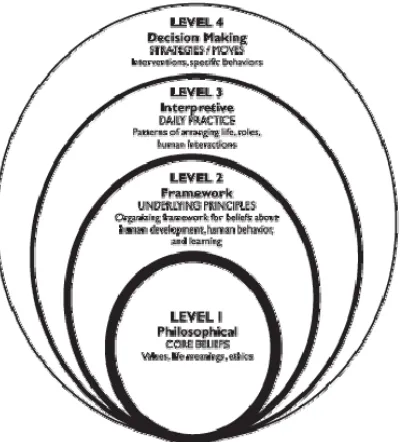
against existing data and against other possible interpretations of the data. Resulting decisions remained open to further scrutiny and reformulation. Engaging in critical reflection brought commonly-held beliefs into question. Beliefs are convictions we hold dearly, having confidence in their truth, while acknowledging they are not susceptible to proof. Our beliefs shape our identity; hence shedding a dearly-held belief shakes our very existence. For example, if a teacher tries to shed the belief that the teacher must be in control to be effective, it means revealing uncertainty and vulnerability (Larrivee, 2000). Larrivee’s (2000) interpretation of the process of critical reflection is represented in Figure 2.2.
Figure 2.2. Larrivee’s (2000) multi-level process for self-reflection.
(Source: Larrivee, B. (2000). Transforming teaching practice: Becoming the critically reflective teacher. Reflective Practice, 1(3), p. 302).
Larrivee (2000) explains that one’s philosophy of life embodies core beliefs which govern all other levels and activities. Examining core beliefs is a critical aspect of self-reflection. Becoming a reflective practitioner requires teachers to face deeply rooted personal attitudes concerning human development in terms of human nature, human potential and human learning. Level 2 of Larrivee’s model (“Framework”) suggests a person’s way of organising basic beliefs including the theories subscribed to by that individual. An
next level represents how the underlying principles of an individual’s framework are put into practice and where beliefs and theories influence how an individual behaves. The last level represents single acts of behaviour based on moment-by-moment decision making. Reflective practitioners challenge assumptions and question existing practices, thereby continuously accessing new lenses to view their practice and alter their perspectives. As de Chardin commented in 1955, “reflection is . . . the power acquired by a consciousness to turn in upon itself...no longer merely to know, but to know oneself; no longer merely to know, but to know that one knows” (p. 164).
Larrivee’s (2000) work has similar concepts to that of Mezirow’s (1991) description of transformative learning. She proposes a structure for understanding the development of a critically reflective teacher which can be applied to reflective practice in online educational settings. The structure consists of 3 stages:
1. Current Practice – examination, questioning, challenging, desire for change. 2. Fear – struggle, inner conflict, surrender, uncertainty, chaos.
3. Transformation – perceptual shift, reconciling, personal discovery, new practice. Larrivee (2000) notes that,
. . . our operating values steer how we behave on a daily basis to pursue educational goals and student outcomes. They also define the lines we will and will not cross. Values are our ideals, hence they are subjective and arouse an emotional response . . . We develop mental habits, biases and presuppositions that tend to close off new ways of perceiving and interpreting our experiences. (p. 296)
Although emphasising the importance of experience, she cautions that we must be aware of its “potential for distortion” because of its cultural and personal biases.
When education is linked to transformative learning, it results in an autonomous and developmental learning process where learners exhibit the following characteristics – co-operation, mutual respect, individual creativity, flexibility, rational criticism, inner-directedness, and independence. These characteristics are appropriate for learning in online environments. The major descriptors of the theory include emancipation,
this process may not be easy. There may be quite a distinction between what we profess to believe in, and our values in action - those which actually guide our behaviour (Senge, Kleiner, Roberts, Ross, & Smith, 1994).
Associated with transformative learning is emancipatory learning, which