How to Incorporate the Needs and Expectations of the Employers into
Quantitative Courses
MEHRYAR NOORIAFSHAR
University of Southern Queensland
Abstract
Model building applications using mathematical programming techniques are discussed widely in the majority of the textbooks on Operations Management and related fields. For instance, Linear Programming and its derivatives are applied to a variety of situations which range from machine shop scheduling to health and education management. To what extent the industries rely on these techniques to manage and allocate their resources to achieve optimal results needs to be investigated. Teaching approaches also have a significant effect on students’ learning and meeting the employers’ needs. Feedback from the students and employers will certainly help with teaching materials and formal assessment improvements.
This paper reports the findings of investigations on the students’ learning preferences and the employers’ requirements with regard to Operations Management tools and techniques. The paper also presents procedures and findings of an experiment on teaching basic mathematics concepts to Business undergraduate students by employing very practical aids.
Key words: Employers’ Needs, Quantitative, Interactive
Introduction
The modern universities have their roots very firmly established in the ancient academic institutions. The foundations of these institutions were laid back in the Middle Ages. Initially, these institutions were either ecclesiastical or had royal links. Some of the oldest universities in Europe include Oxford, Cambridge and Paris; these were established sometime in the 12th Century. Until the late 19th Century, women were not allowed to enter universities, and most of the medieval universities were developed to educate young men in law, religion and medicine.
Employers’ Needs and Expectations
It can be argued that the employers are the ultimate customers of the educational institutes. Hence, their needs and expectations should be taken into consideration.
As an initial study, a sample of 83 organisations representing both goods producing and service providing industries were surveyed. These firms were selected randomly from both the regional and metropolitan areas in Australia. Data collection was carried out by telephone and a specially designed brief questionnaire was completed during each call. The questions aimed to identify the applicability of quantitative Production and Operations Management techniques favoured and utilized by these industries. Most (88%) of these industries employ less than 100 employees. The goods producing industries made up around 70% of the sample.
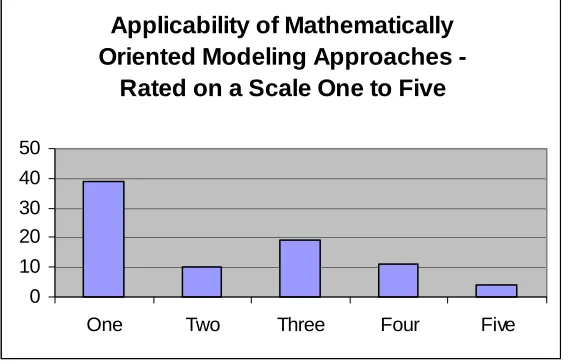
Around 18% of the surveyed employers rate the applicability of mathematically oriented approaches to decision making as reasonably high (4 or 5 on a sale 1 to 5) It should be noted that a very large proportion (47%) of these employers rate the use of mathematical modeling approaches very low (1 on a scale 1 to 5). See Figure 1.
Applicability of Mathematically Oriented Modeling Approaches -
Rated on a Scale One to Five
0 10 20 30 40 50
[image:2.595.164.449.354.536.2]One Two Three Four Five
Figure 1 – Employers’ Rating of the Applicability of Mathematically Oriented Modeling Approaches
Employers’ Perception of the Graduate Suitability
Yes 43% No
[image:3.595.162.450.74.262.2]57%
Figure 2 – Employers Perception of the Suitability of University Graduates
These findings can help course improvements with a view to catering for the needs of the industries. The next section investigates students’ learning needs and preferences with a view to linking them with the employers’ requirements.
Identifying Students Learning Needs and Preferences
A group of twenty first-year undergraduate students were selected for the purposes of an experiment on the effectiveness of teaching basic mathematics concepts via practical teaching aids. These students were from different mathematical backgrounds and the majority did not have a very strong background in quantitative fields.
that the general concept of “constructivism” is quite simple and practical and the underlying theory, perhaps, goes back to the Socratic times. The concept of guiding and leading the learner to find out the solution or the right answer to a problem was discussed by Plato (the ancient scholar) almost 2400 years ago. If we analyse Plato’s famous “dialogue” Meno, we will realise that Socrates demonstrates to Meno how a mathematically ignorant person solves a geometrical problem through a controlled guidance procedure rather than being told directly. For an appropriate definition of learning under constructivism see Bruner (n.d.) who considers learning as an active process in which the new ideas or concepts are constructed based on the existing ones. Teaching mathematics thematically which is also based on constructivist ideas is reported by Handal and Bobis (2003).
The effectiveness of the above-mentioned approach (teaching basic mathematics concepts via practical teaching aids) was tested by identifying and measuring students’ performance and learning preferences. A comparison between students from different mathematical backgrounds was also made.
The findings of this study suggest that students, regardless of their background in mathematics, have a preference for visual methods of learning mathematical concepts. It was also demonstrated that most students who participated in the study, enjoyed learning mathematics and believed that they would benefit from it in their future studies and career.
In order to determine the effectiveness of the visual method of teaching the basic concepts outlined above, a specially designed instrument was used. The main purpose was to collect information on the following:
x Part A:
1. students’ background;
2. students’ perceptions and preferences for learning styles; and
x Part B:
1. students’ performance in the topics presented.
[image:4.595.89.511.630.700.2]A very small number (only one) of students indicated that they did not have a strong background in mathematics and a preference for text in learning materials. A much larger proportion (nine) of students reported that they had a strong background in mathematics with a preference for visual features in learning materials. See Table 1.
Table 1 – Mathematics background and modal preferences of students Modal Preference
Mathematics
Background Text Visual
Not Very Strong 1 5
Strong 5 9
x H0 : There is no relationship between students’ background in mathematics and their learning modal preference.
x H1 : There is a relationship between students’ background in mathematics and their learning modal preference.
x The Test Statistic of 0.724 falls outside the Critical Region (Tabulated Chi-Square value of 3.84 with 1 degree of freedom and 5% level of significance). Hence, the null hypothesis is not rejected. It is concluded that there is no relationship between students’ background in mathematics and their learning modal preference
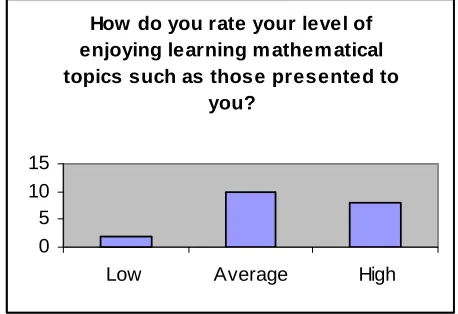
It is interesting to note that a very large proportion of the students have indicated that they enjoyed learning mathematical topics such as those presented to them in the experiment. See Figure 3.
How do you rate your level of enjoying learning m athem atical topics such as those presented to
you?
0 5 10 15
Low Average High
Figure 3 – Students’ Level of Enjoyment of Learning Mathematics
[image:5.595.182.411.314.471.2]How do you rate the usefulness of m athem atical topics such as those
presented to you?
0%
35%
65%
Low
Average
High
Figure 4 – Students’ Perception of Usefulness of Mathematics
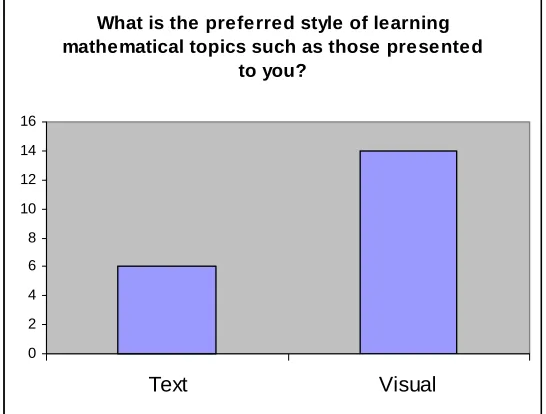
As Figure 5 illustrates, a large proportion of these students have reported that they would have a preference for seeing relationships and patters demonstrated to them visually. This finding is compatible with recent research findings that students prefer and benefit from visually rich methods of teaching. For details see Nooriafshar et al (2004); and Nooriafshar and Todhunter (2004). It is interesting to note that the use of analogies and visuals in teaching materials are identified as ways of encouraging learners to become “whole-brained”, see Funderstanding (n.d.). In other words right brain is invoked through creative activities such as the visual features. Hence, we would not just use the part of the brain which is referred to as “50% of brain’s mighty toolkit” by Buzon (2002).
What is the preferred style of learning mathematical topics such as those presented
to you?
0 2 4 6 8 10 12 14 16
[image:6.595.163.433.76.295.2]Text Visual
Figure 5 – Students’ Preference for Learning Styles
[image:6.595.168.441.484.691.2]achieved by asking students different questions based on the materials presented to them. The above findings illustrate that students needs and preferences are not very much different from the employers. Both parties recognize the importance of the quantitative fields and have a preference for practically oriented approaches.
The latest technologies in educational products also contribute to effective teaching and learning. Classroom Performance System (CPS) is the state-of-the-art in bringing full participation and interactivity to the classrooms. Students are provided with handsets (clickers) which are used to respond to questions provided by the teacher. The correct answers to questions along with the results are shown immediately on the screen without identifying individual students.
CPS encourages all students to participate in discussions. Students who are not sure about the right answers would be able to participate without being recognized and embarrassed. Students who know the correct answer will receive a confirmation about their response. Hence, they will be further motivated.
As reported by Hafner (2004) Paul Caron uses CPS in his law classes at the University of Cincinnati to break through the “cone of silence”.
This technology was adopted for one of the undergraduate courses on Business Forecasting in 2005 and was used to:
x Test the students’ understanding for the topics presented in the session;
x Motivate and generate discussion based on class opinion during the session;
x Guide students towards identifying appropriate factors for solving case studies; and
x Assign tests and quizzes at appropriate stages of the course to assess progress.
The following methodology was developed to utilize the system in a constructivist manner:
1. Present Case Study 2. Provide Guidance
3. Receive Feedback from students
4. Initiate Discussion based on the Feedback 5. Allow Students to Develop Solutions
6. Receive Feedback from Students Based on their Solutions 7. Initiate Discussion based on the Feedback
8. Recommend the Final Solution
1 - I enjoyed my experience with CPS
2 - CPS contributed to the speed of my learning process.
3 - CPS made my learning experience easy.
4 - The interactivity provided by CPS made the sessions more interesting.
5 - CPS allowed me to participate in answering questions without being embarrassed.
[image:8.595.103.525.218.426.2]6 - I would very much like to have CPS incorporated into my learning materials.
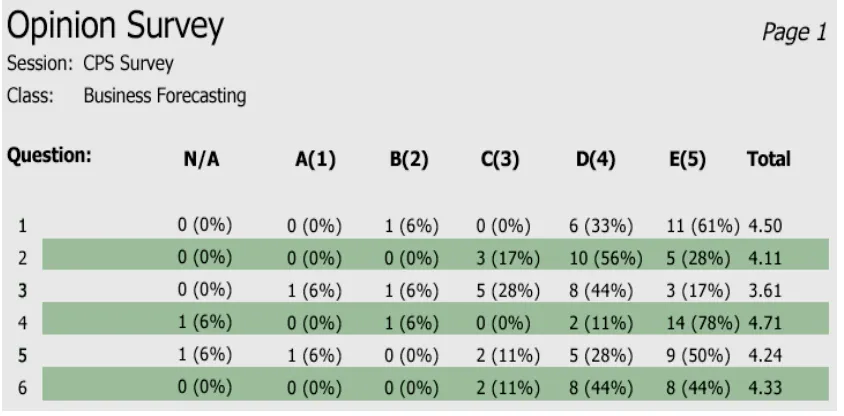
Figure 6 – Students’ Feedback on Classroom Performance System (CS)
As the feedback illustrates students have a preference for this way of face to face sessions. For instance, almost 80% of the students strongly agree with the interactivity provided by this way of learning. Just under 80% also agree (or strongly agree) with the fact that CPS allows them participate in answering questions without being embarrassed. Results also indicate (88%) of the participants would very much like to have CPS incorporated into their learning materials.
Conclusions
The majority of the students who participated in the study reported in this paper have indicated their preference for visual features. Theses features represent mathematical concepts, relationships and patterns which were demonstrated to them visually. Most of the students rate the usefulness of mathematical subjects such as those presented in the experiment as high in their future studies and profession. It should be noted that most of the students who participated in this study regard learning mathematical topics enjoyable.
a flexi-curve. The main purpose is to make it possible for the learner to build new meanings without simply memorizing pieces of information received from the teacher. Hence, the student will be able adopt or customize methods to suit the real problems in the real world. The ability to adapt and adjust in response to needs of the modern world will certainly help with meeting the employers’ needs. Ironically, Plato as an ancient scholar also believed that knowledge should be acquired via a process of criticism and questioning without compulsion. In modern times, we refer to this method as reflective learning. The latest technologies such as Classroom Performance System can be utilized as a vehicle to achieve constructivism in the classroom.
References
Bruner J. (n.d.), Constructivism Theory Retrieved August 15, 2004 from
http://www.artsined.com/teachingarts/Pedag/Constructivist.html
Buzon T. (2002), How to Mind Map, Thorsons, London
Funderstanding: Right Brain vs. Left Brain (n.d.) Retrieved August 11, 2004 from http://www.funderstanding.com/constructivism.cfm
Handal B. and Bobis J. (2003), "Instructional Styles in the Teaching of
Mathematics Thematically ", International Journal for Mathematics Teaching and Learning, October Issue.
Nooriafshar M. and Todhunter B. (2004), "Designing a Web Enhanced
Multimedia Learning Environment (WEMLE) for Project Management ", Journal of Interactive Learning Research (JILR), (2004) 15(1), 33-41.