UNIVERSITI TEKNIKAL MALAYSIA MELAKA
THE STUDY OF EFFECT OF ENGINE PERFORMANCE USING
DIFFERENT FUEL FOR PERODUA VIVA
This report submitted in accordance with requirement of the Universiti Teknikal Malaysia Melaka (UTeM) for the Bachelor Degree of Mechanical Engineering
Technology
(Automotive Technology) with Honours
by
AHMAD JAZLI BIN JUSOH
B071310258
910603-03-5839
UNIVERSITI TEKNIKAL MALAYSIA MELAKA
BORANG PENGESAHAN STATUS LAPORAN PROJEK SARJANA MUDA
TAJUK: The Study Of Effect Of Engine Performance Using Different Fuel For Perodua Viva
SESI PENGAJIAN: 2016/17 Semester 1
Saya AHMAD JAZLI BIN JUSOH
Mengaku membenarkan Laporan PSM ini disimpan di Perpustakaan Universiti Teknikal Malaysia Melaka (UTeM) dengan syarat-syarat kegunaan seperti berikut: 1. Laporan PSM adalah hak milik Universiti Teknikal Malaysia Melaka dan penulis. 2. Perpustakaan Universiti Teknikal Malaysia Melaka dibenarkan membuat salinan
untuk tujuan pengajian sahaja dengan izin penulis.
3. Perpustakaan dibenarkan membuat salinan laporan PSM ini sebagai bahan pertukaran antara institusi pengajian tinggi.
4. **Sila tandakan ( )
SULIT
TERHAD
TIDAK TERHAD
(Mengandungi maklumat yang berdarjah keselamatan atau kepentingan Malaysia sebagaimana yang termaktub dalam AKTA RAHSIA RASMI 1972)
(Mengandungi maklumat TERHAD yang telah ditentukan oleh organisasi/badan di mana penyelidikan dijalankan)
Alamat Tetap:
PT 6417 Kg Gual Mesa, 17000 Pasir Mas,
Kelantan Darul Naim.
Tarikh: ________________________
Disahkan oleh:
Cop Rasmi:
FAKULTI TEKNOLOGI KEJURUTERAAN
Tel : +606 234 6623 | Faks : +606 23406526
Rujukan Kami (Our Ref) : Rujukan Tuan (Your Ref) :
9 DEC 2016 Pustakawan
Perpustakaan UTeM
UniversitiTeknikal Malaysia Melaka Hang Tuah Jaya,
76100 Durian Tunggal, Melaka.
Tuan/Puan,
PENGKELASAN LAPORAN PSM SEBAGAI SULIT/TERHAD LAPORAN PROJEK SARJANA MUDA TEKNOLOGI KEJURUTERAAN AUTOMOTIF (TEKNOLOGI AUTOMOTIF): AHMAD JAZLI BIN JUSOH
Suka cita dimaklumkan bahawa Laporan PSM yang tersebut di atas bertajuk “The Study Of Effect Of Engine Performance Using Different Fuel For Perodua Viva” mohon dikelaskan sebagai *SULIT / TERHAD untuk tempoh LIMA(5) tahun dari tarikh surat ini.
2. Hal ini adalah kerana IANYA MERUPAKAN PROJEK YANG DITAJA OLEH SYARIKAT LUAR DAN HASIL KAJIANNYA ADALAH SULIT.
Sekian dimaklumkan, Terima kasih.
Yang benar,
________________
Tandatangan dan Cop Penyelia
* Potong yang tidak berkenaan
i
DECLARATION
I hereby, declared this report entitled “The Study of Effect of Engine Performance Using Different Fuel for Perodua Viva” is the results of my own research except as
cited in references.
Signature :………....
Author‟s Name : AHMAD JAZLI BIN JUSOH
ii
APPROVAL
This report is submitted to the Faculty of Engineering Technology of UTeM as a partial fulfillment of the requirements for the degree of Bachelor of Engineering Technology Mechanical Engineering (Automotive Technology) with Honours.
The member of the supervisory is as follow:
………
iii
ABSTRAK
iv
ABSTRACT
v
DEDICATION
To my beloved parents and friend was supported, encouraged, challenged, and inspired to me. And especially to our beloved my supervisor Mr Ahmad Zainal
vi
ACKNOWLEDGEMENT
I am sincerely appreciative to my lecturer, Mr. Ahmad Zainal Taufik bin Zainal Ariffin for serving as my supervisor and for providing guidance while conducting the research and the writing of this „Projek Sarjana Muda‟(PSM).
I would like to thanks and convey special appreciation to the laboratory management especially Chassis Performance Testing Laboratory, the lab technicians for their cooperation and support especially to Mr. Mohd Syakir bin Mohtarudin who had been involves in providing technical data on the chassis dynamometer. I also want to thank my beloved family for their continuous support and encouragement in everything I do. All these years of education have been made possible by their support and love.
vii
TABLE OF CONTENT
Declaration i
Approval ii
Abstrak iii
Abstract iv
Dedication v
Acknowledgement vi
Table of Content vii
List of Tables x
List of Figures xi
CHAPTER 1: INTRODUCTION
1.0 Project Background 1
1.1 Objective 1
1.2 Project Scope and Limitations 2
1.3 Problem Statement 2
CHAPTER 2: LITERATURE REVIEW
2.0 Introduction to Crude Petroleum Process 3
2.1 Introduction to Research Octane Number (RON) 4
2.2 Internal Combustion Engine 4
2.2.1 Working Principle of Internal Combustion Engine 4
2.3 Introduction of Dynamometer 6
2.4 Working of Principle Dynamometer 7
2.5 Chassis Dynamometer 8
2.6 Exhaust Emission 9
2.6.1 Carbon Monoxide (CO) Emission 9
2.6.2 Nitrogen Oxide (NOx) Emission 9
2.6.3 Carbon Dioxide (CO2) Emission 10
viii
CHAPTER 3: METHODOLOGY
3.0 Introduction 12
3.1 Flow Chart 13
3.2 Fuel Selection 13
3.2.1 Petron Brand 13
3.2.2 Shell Brand 13
3.3 Exhaust Emission 14
3.3.1 Type of Gases or Exhaust Emission 14
3.4 Engine EJ-VE DVVT DOHI3 15
3.5 Eddy Current Dynamometer 16
CHAPTER 4: RESULT & DISCUSSION
4.0 Introduction 17
4.1 Experimental Result 17
4.2 Dyno Max Software Chassis Dynamometer 17
4.3 Torque and Horsepower 18
4.4 Petron RON 95 18
4.5 Petron RON 97 20
4.6 Shell RON 95 22
4.7 Shell RON 97 24
4.8 Exhaust Gas Analyzer 26
4.8.1 Hydrocarbon (HC) 26
4.8.2 Carbon Dioxide (CO2) 27
4.8.3 Nitrogen Oxide (NOx) 28
4.8.4 Carbon Monoxide (CO) 29
4.8.5 Oxygen (O2) 30
4.8.6 Air Fuel Ratio 31
CHAPTER 5: CONCLUSION & FUTURE WORK
5.0 Introduction 32
5.1 Conclusion 32
ix 5.2.1 Combination between Petron RON 95 and Shell RON 95 33
5.3 Petron RON 97 and Shell RON 97 34
5.3.1 Combination between Petron RON 97 and Shell RON 97 34
5.4 Recommendation 36
REFERENCES 37
APPENDICES
Data Chassis Dynamometer 38
Gas Exhaust Analyzer 40
Perodua Viva During Chassis Dynamometer 42
x
LIST OF TABLES
Table Pages
3.1 Engine Specification 5
4.1 Result for Petron RON 95 19
4.2 Result for Petron RON 97 21
4.3 Result for Shell RON 95 23
xi
LIST OF FIGURES
Figure Pages
2.1 Four Stroke Combustion Engine (Pulkrabek, 2004) 5
3.1 Flow Chart 13
3.2 Exhaust Gas Analyzer 14
3.3 Engine EJ-VE DVVT DOHI3 15
3.4 Eddy Current System 16
4.1 Torque versus RPM 18
4.2 Horsepower versus RPM 19
4.3 Torque versus RPM 20
4.4 Horsepower versus RPM 21
4.5 Torque versus RPM 22
4.6 Horsepower versus RPM 23
4.7 Torque versus RPM 24
4.8 Horsepower versus RPM 25
4.9 Effect of Fuel on Hydrocarbon 26
4.10 Effect of Fuel on Carbon Dioxide 27
4.11 Effect of Fuel on Nitrogen Oxide 28
4.12 Effect of Fuel on Carbon Monoxide 29
4.13 Effect of Fuel on Oxygen 30
4.14 Effect of Fuel on Air Fuel Ratio 31
5.1 Horsepower versus RPM 33
5.2 Torque versus RPM 34
5.3 Horsepower versus RPM 35
1
1.0 Project Background
In Malaysia majority civilian using a vehicle to go point A to point B, but every vehicle need a fuel to make a vehicle move without lag or problem. There are several type of fuel in Malaysia like RON 95 and RON 97but which one civilian will choose for performance and torque.
This is about final year project will discuss the performance of engine when using different fuel and identify torque, horsepower and emission. Every fuel has a characteristic and unique to make that brand special then other. After that, fuel must clean emission come out from exhausts, but to know how much emission out from exhaust, it must using Exhaust Gas Analyzer to know quantity of emission. When get a result for torque, horsepower and emission level, which result will convert into graph.
1.1 Objective
The objectives for this project are:
I. To study the torque and horsepower produced by engine. II. To study the exhaust emission an engine.
2
1.2 Project Scope and Limitations
Below the scopes for this project are:
I. Using different petrol fuel with RON or Research Octane Number is chosen
as the octane rating that will be used.
II. Based on two fuel station (Petron and Shell) in Malaysia.
III. For Petron station using petrol fuel type RON95, RON97. Mean while, for
Shell station using petrol fuel type RON95and RON97.
IV. Using chassis dynamometer test.
1.3 Problem Statement
3
2.0 Introduction to Crude Petroleum Process
For the most part, unrefined petroleum is warmed and changed into a gas. The hot gasses are passed into the base of a refining section and get to be distinctly cooler as they climb the tallness of the segment. As the gasses cool underneath their breaking point, they consolidate into a fluid. The fluids are then drawn off the refining segment at particular statures, going from substantial lives at the base, crude diesel energizes in the waists, and crude gas at the top. These crude parts are then prepared further to make a few diverse completed items.
Albeit all parts of petroleum discover utilizes, the best request is for gas. One barrel of unrefined petroleum contains just 30-40% fuel. Transportation requests require that more than half of the unrefined petroleum be "changed over" into fuel. To take care of this demand some petroleum portions must be changed over to gas. This might be finished by splitting separating huge particles of overwhelming warming oil and lives; transforming changing sub-atomic structures of low quality fuel particles; and isomerisation reworking a particle so that the item has a similar synthetic equation however has an alternate structure, for example, changing over ordinary butane to isobutene.
4
2.1 Introduction to Research Octane Number (RON)
The Research Octane Number (RON) is a number that is granted to various evaluations of fuel with present to its capacity to oppose auto-start or known as thumping. RON is dictated by running the fuel in a test motor with a variable pressure proportion under controlled condition, and the outcome is contrasted and blends of iso-octane and n-heptanes. Alternate words, is a rating used to quantify a powers thumping resistance in start inward burning motors. The lower of RON the less demanding it gets to be for energizes to touch off in the motor. In this way, the powers with a higher octane number will dispose of thumping, which have high pressure proportion and acquire control in the motor. The following are the essential about accessible fuel.
2.2 Internal Combustion Engine
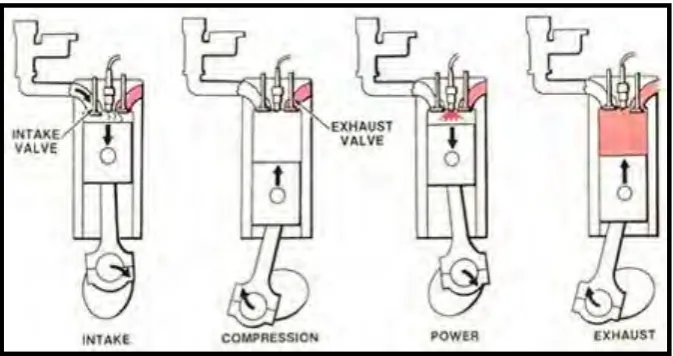
This section will explain how the working principle in combustion chamber for 4-stroke engine.
2.2.1 Working Principle of Internal Combustion Engine
5 majority of the interior burning motor is responding motors having cylinders that respond forward and backward in barrels inside the motor.
Figure 2.1: Four Strokes Combustion Engine (Pulkrabek, 2004)
a) Intake Stroke or Induction
The cylinder moves descending that draws an ignitable blend of fuel and air past the throttle and admission valve into the barrel. At this stroke, the admission valve open and the fumes valve shut.
b) Compression Stroke
6 c) Expansion or Power Stroke
At power feed, the start plug fires, lights the compacted fuel. As the fuel blazes it extends, driving the cylinder descending. The extension or power strokes result from burning of the fuel-air-blend. At this stroke, both admission and fumes valve shut.
d) Exhaust Stroke
At the base of the power stroke, the fumes valve is opened by the cam/lifter instrument. The upward stroke of the cylinder drives the depleted fuel out of the barrel. At this stroke, the admission valve shut and the fumes valve open.
e) Compression Stroke
A mid the Compression stroke, the cylinder moves upward, packing the fuel/air blend. The whole valve shut, and it will raise the temperature of the blend. A start touches off the blend toward the end of the pressure stroke
2.3 Introduction of Dynamometer
7 dynamic dynamometer. Notwithstanding being utilized to decide the torque or power attributes of a machine under test, dynamometers are utilized in various different parts. In standard discharges testing cycles, for example, those characterized by the us natural assurance office, dynamometers are utilized to give mimicked street stacking of either the motor (utilizing a motor dynamometer) or full powertrain (utilizing a case dynamometer).
2.4 Working of Principle Dynamometer
An engrossing dynamometer goes about as a heap that is driven by the prime mover that is under test. The dynamometer must have the capacity to work at any speed, and load the prime mover to any level of torque that the test requires. A dynamometer is normally outfitted with a few method for measuring the working torque and speed. The dynamometer must assimilate the power created by the prime mover. The power consumed by the dynamometer should by and large be dispersed to the encompassing air or exchanged to cooling water. Regenerative dynamometers exchange the ability to electrical cables.
8
2.5 Chassis Dynamometer
A suspension dynamometer some of the time alluded to as a moving street, measures control conveyed to the surface of the "drive roller" by the drive wheels. The vehicle is regularly stopped on the roller or rollers, which the auto then turns, and the yield measured along these lines.
Cutting edge roller-sort frame dyno system, which enhances footing and repeatability, when contrasted with the utilization of smooth or knurled drive rollers. Chassis dynamometers can be settled or compact and can do considerably more than show RPM, drive, and torque. With cutting edge gadgets and snappy responding, low dormancy dyno frameworks, it is presently conceivable to tune to best power and the smoothest keeps running progressively. Different sorts of body dynamometers are accessible that dispense with the potential for wheel slippage on old style drive rollers, connecting straightforwardly to the vehicle centers for direct torque estimation from the hub.
9
2.6 Exhaust Emission
Gases from the exhaust are product of combustion of fuel and air. The gas later will be released into the air through the exhaust pipe. Some of the gases that being released from the exhaust are contained oxygen, nitrogen oxide, carbon dioxide, carbon monoxide and hydrocarbons. Most of the gases are harmful to living life and the environment. The gases exhaust emission can be the parameter to the engine performance.
2.6.1 Carbon Monoxide (CO) Emission
CO is a dry, noxious gas, and it must be limited. CO comes about because of fragmented ignition of fuel and is discharged straightforwardly from vehicle tailpipes. Broadly and, especially in urban zones, the dominant part of CO emanations to surrounding air originate from versatile sources. CO can bring about hurtful wellbeing impacts by decreasing oxygen conveyance to the body's organs (like the heart and cerebrum) and tissues. At to a great degree abnormal state, CO can bring about death. Other than the perfect ignition handle that joins carbon (C) and oxygen (O2) to CO2, inadequate burning of carbon prompts to the arrangement of CO. The development of CO happens when the oxygen presents amid burning is deficient to frame CO2 (Canakci et al 2009). A falling pattern of CO outflow can be expected as the motor speed increments
2.6.2 Nitrogen Oxide (NOx) Emission
10 sources, for example, control plants, modern boilers, concrete ovens, and turbines. NOx frequently shows up as a caramel gas. It is a solid oxidizing specialist and assumes a noteworthy part in the climatic responses with unstable natural mixes (VOC) that deliver ozone (brown haze) on hot summer days.
2.6.3 Carbon Dioxide (CO2) Emission
Carbon dioxide (CO2) is the essential nursery gas transmitted through human exercises. In 2013, CO2 represented around 82% of all U.S. nursery gas emanations from human exercises. Carbon dioxide is normally present in the climate as a major aspect of the Earth's carbon cycle (thenatural dissemination of carbon among the air, seas, soil, plants, and creatures). Human exercises are changing the carbon cycle both by adding more CO2 to the climate and by impacting the capacity of normal sinks, similar to woodlands, to expel CO2 from the air. While CO2 emanations originate from an assortment of common sources, human-related outflows are in charge of the expansion that has happened in the environment since the mechanical upheaval. CO2 is an ordinary result of ignition. In a perfect world, burning of a hydrocarbon fuel ought to create just CO2 and water (H2O) (Sayin et al., 2009). Consequently, CO2 sum increments while HC and CO discharge sums diminishing and this means that a fruitful ignition.
2.6.4 Hydrocarbon (HC) Emission