No 2017-26/ July 2017
Karel Lannoo is the Chief Executive Officer of CEPS.
This text is based on a keynote speech delivered at the IIF/Clearing House Colloquium on Cross Border Resolution, London, 17 June 2017. Comments by the Colloquium participants, as well as by Marco Lamandini and Luis Morais are gratefully acknowledged.
CEPS Policy Insights offer analyses of a wide range of key policy questions facing Europe. As an institution, CEPS takes no position on questions of European policy. Unless otherwise indicated, the views expressed are attributable only to the author and not to any institution with which he is associated.
978-94-6138-623-6
Available for free downloading from the CEPS website (www.ceps.eu) © CEPS 2017
CEPS▪ Place du Congrès 1 ▪ B-1000 Brussels ▪ Tel: (32.2) 229.39.11 ▪ www.ceps.eu
Uneven progress in implementing
cross-border bank resolution in the EU
Karel Lannoo
Summary
Implementing the framework for cross-border bank resolution in the EU is a work in progress, but it is not necessarily proceeding in a consistent way. Three banks were recently resolved in the EU, in which the rules were applied in a different way in each case. These varying results suggest that there remain important differences in supervisory approaches in the EU that will continue to have a large bearing on how problem banks are dealt. This situation, in turn raises questions about ensuring a level playing field.
Contents
Introduction ... 1
Can resolvability reduce the need for supervisory scrutiny? ... 1
The cross-border crisis management framework ... 4
Is the European bank crisis management working? Does it reduce or increase complexity? .... 6
Conclusions ... 7
References ... 8
|1
Introduction
The resolution of four Eurozone based (or SSM) banks in June has brought the bank crisis management framework back to the foreground in the EU), and. The Banco Popular case was hailed as a showcase of the advances made by the SSM and SRB (Single Resolution Board) in implementing a common approach in the EU, but the Italian cases rapidly trimmed these expectations. Much remains to be done in aligning crisis management and resolution in the EU and EMU, 10 years after the start of the financial crisis. Now that the mood in the EU has improved, it reminds us that implementation remains an utmost priority and challenge, warranting far more attention than reflecting about new schemes and structures.
The adoption of the BRRD (Bank Recovery and Resolution Directive) and SRBR (Single Resolution Board Regulation) moved the EU huge steps forward in putting a place an EU-wide bank crisis management system. What started as a discussion around living wills became an EU-wide framework for prompt corrective action (PCA), recovery and resolution. It should be remembered that the BRRD is a directive, and not a regulation, as in many cases the BRRD refers to national law (company law, insolvency law), which is not particularly harmonised at EU level. The SRBR on the other hand is a regulation, which gave to a new institution, the SRB, the powers to wipe out a bank’s shareholders and management and resolve a bank with a fund. Some questioned whether the EU even has the right to do this (on the basis of the ‘Meroni doctrine’), but it is also an issue in some member states, with for example the policy debate in Germany surrounding the nationalisation of Hypo Real Estate bank in 2008-09.
Given the need for speed in resolution actions, the question remains whether the EU structure is sufficiently robust to withstand a crisis in a large cross-border bank. Given the number of entities involved, formally and informally, the structure remains very complex. The question we address in this contribution is: Have we facilitated action in dealing with banking crises or have we simply increased complexity?
Can resolvability reduce the need for supervisory scrutiny?
Resolution is part of a broader supervisory framework. If the other parts are not well implemented or aligned, it becomes difficult to implement resolution in a coherent fashion in the EU. With the exception of competition policy, most of these elements are part of national law or approaches, which the EU is trying to align. It is a work in progress, which in some cases has been going on for a long time. We consider nine different issues.
1) Loopholes in the Capital Requirements Directive (CRDIV) (options for national discretions, macro-prudential buffers) and the large variations in the risk-weighted assets to total assets within large European banks.
The head of the SSM, Daniele Nouy, repeats in almost every speech that bank regulatory standards are insufficiently harmonised in the EU.1 Even if CRDIV was negotiated at the same
time as the SSM, it has left a large degree of discretion to the member states in 150 options
2|KAREL LANNOO
and national discretions and in the macro-prudential buffers. It is often forgotten that supervision has been brought under the roof of the ECB for the eurozone, but not necessarily regulation, where member states continue to have a big role as the home country of a bank. Moreover, the debate about the output floors for internal models in the Basel Committee indicates that internal models result in widely varying risk-weighted assets to total assets among European banks using the models (see Ayadi, De Groen et al., 2016).
2) Difference in supervisory approaches
The way banks and markets are supervised in the EU continues to differ, creating difficulties for resolving banks in a unified fashion. Differences remain in the way rules are interpreted by supervisors, in supervisory methods, governance standards and in, for example, accounting standards for non-listed banks. The start of the SSM in November 2014 was a big step forward, but achieving convergence is still underway. In addition, many elements on the governance and risk-management side rely on largely national laws and practices, even within the SSM. Where this matters in a resolution context is the information we dispose of about the banking sector, and to what degree this has been harmonised. Banco Popular, for example, met the stress test in 2016, which can raise some questions about the way in which information was collected and interpreted. The interpretation of the rules with regard to investor protection is even more divergent, even though it was harmonised under MiFID I, which was implemented in 2007. MiFID I required a suitability test for selling investment products to retail investors, which can certainly raise the question whether this was correctly applied for subordinated bank debt. The mis-selling of subordinated bank debt was an issue in numerous EU countries, including Spain, Italy, Portugal and Slovenia.
3) Attitude towards non-performing loans
The legacy of large differences in supervisory approaches is also visible in the level and huge variation of non-performing loans (NPLs) in the EU, which has been widely publicised in recent months. According to data from the European Banking Authority (EBA), some countries – such as Italy and Portugal, with levels of 14% and 18% of NPLs to total assets, respectively – have levels well above the EU average of 5%. NPLs impair the ability to support economic activity, resulting in higher lending rates, lower lending volumes and more risk aversion. Lower recovery rates increase corporate bond spreads, and thus also possibility for securitisation of such portfolios.
4) Facility to create bad banks
To clean up their balance sheets, banks can bring their non-performing loan portfolio under a separate legal entity, a ‘bad’ bank. This entity does not necessarily need to remain a bank, but hands in its banking license, and de facto becomes an asset management company (AMC). However, the facility to create such ‘bad banks’ or AMCs depends on many different factors, such as supervisory approval, the enforcement of legal claims or eventually matters of competition policy and state aid, if it receives state guarantees or liquidity from the authorities. In January 2017, Andrea Enria, Chair of EBA, proposed to create a single EU AMC that would obtain NPLs from banks against their real economic value, and thus help to clean up balance sheets.
5) Competition policy and its application to the banking sector
How concentrated can the banking sector become? What is the relevant market for banks in the EU? In some domains, the relevant market is national, whereas in other cases it is European or international. Retail and SME lending markets are local in the EU, and cross-border provision of services is extremely limited. In addition, many national banking markets, certainly in medium-sized and smaller member states, are very concentrated. Hence, there is a competition issue at the local level, as EU competition policy authorities have also highlighted. On the other hand, ECB officials have recently called for a further phase of bank consolidation in the EU. A pro-active competition policy can reduce the number of too big to fail (TBTF) banks, but on the other hand, global markets and firms require globally active banks.
6) Is a bank systemic?
There is not a single definition of a systemic bank. The BRRD defines systemic as an institution “with the potential to have serious negative consequences for the internal market and the real economy” (Art. 1.30). Resolution tools are applicable to a bank that is systemic, and if they don’t qualify for the label, the bank should be allowed to fail. The earlier a bank is seen to be systemic, the more forbearance that can be applied by the supervisors. In Italy, two small Venetian banks were recently bailed out by the state as they were seen to be systemic, but banks of a similar size were liquidated in Denmark.
7) State aid and role of state-owned banks
4|KAREL LANNOO
be questioned. The reasoning was that a non-bail-out would trigger a domino effect in Italian banking.2
The important role played by state-owned banks in the financial sector also makes it difficult to arrive at a clear position on state aid. Today, states control about 18% of the assets of the financial sector in the EU, a share that has increased since the crisis.3 The cost of capital of
state-owned banks may be lower than for privately-owned banks.
8) Emergency Liquidity Assistance (ELA)
National Central Banks (NCBs) continue to enjoy some latitude in providing ELA for their domestic financial sector, but at their own cost. ELA aims to provide central bank money to solvent financial institutions that are facing temporary liquidity problems. Within the eurozone, the ECB’s Governing Council adopted strict ex-ante and ex-post procedures that NCBs must follow in extending ELA, in order to ensure transparency. The latest rules, adopted on 17 May 2017, allow NCBs to provide ELA to banks that do not meet the minimum capital requirements, but are expected to meet them in the next half year.4
9) Strengths of legal rights or insolvency framework, and possibility for recourse
The facility to exercise legal rights on claims are a fundamental pillar for well-functioning financial markets. However, the diversity of the related legal frameworks remains high in the EU. “The quality of insolvency frameworks across the euro area is low on average and highly diversified across member states, and has barely improved in recent years” (Valiante, 2016). In principle, all creditors should be treated fairly and equitably, but much uncertainty exists surrounding the application of the no creditor worse-off (NCWO) principle in the EU. Currently, when facing a liquidation or resolution of a bank operating in different countries, creditors may be treated differently, and different rankings of claims are applied in the EU.
In the context described above, a ‘harmonised’ resolution framework would offer little more than basic plumbing, or would provide simply a common approach to subjects that had not been sufficiently dealt with in a common way in the phases before resolution.
The cross-border crisis management framework
There are now national, European (minimum requirements for eligible liabilities, MREL) and international rules (total loss-absorbing capacity, TLAC) for dealing with crisis of cross-border banks.
The BRRD is revolutionary in the system it institutes: it requires prompt corrective action (PCA) as soon as a bank falls below certain ratios, requires banks to have a recovery plan and institutes
2 Well summarised by Erik Jones in his contribution “What we just learned about banking union from Italy” to
eSharp!, June 2017.
3See Lannoo (2014) p.19.
4 https://www.ecb.europa.eu/pub/pdf/other/Agreement_on_emergency_liquidity_assistance_20170517.en.pdf
a system for dealing with problem banks in different ways: liquidate, and in case the bank is systemic, sale of bank, splitting of activities, creation of a bad bank and bail-in of creditors for undercapitalised banks. Banks need to hold at least 8% bail-inable items. The BRRD also requires the creation of a resolution fund, which is the single resolution fund (SRF) for the EU19.
There are, however, some obscure provisions, or loopholes, in the BRRD:
a. Precautionary recapitalisation: This involves the injection of state funds in institutions that are still solvent, in the sense that they still meet their basic regulatory capital requirements. They cannot be used to absorb past losses, which must be covered out of private resources prior to the state’s intervention. Furthermore, the European Commission may require prior burden-sharing by private stakeholders (that is, bail-in by any other name, albeit of more modest proportions) as a condition for approving the precautionary recapitalisation under the state-aid regime.
b. The estimation of the capital shortfall of a bank and, in particular, of the extent to which it is attributable to past losses is by no means an exact science. This again requires harmonised procedures for NPLs!
c. NCWO and bail-in hierarchy
Also the NCWO and the bail-in hierarchy is a work in progress. The press release on Popular by the Spanish resolution authority, the FROB5, is instructive in this sense. It
states that “no shareholder or creditor shall incur greater losses than would have been incurred if the entity had been wound up under normal insolvency proceedings. To this end, the SRB will appoint an independent expert to perform a valuation to determine if shareholders would have received better treatment if Banco Popular had entered into normal insolvency proceedings. If said valuation determines that shareholders have incurred greater losses than would have been incurred if the entity had been wound up under normal insolvency proceedings, they would be entitled to obtain payment of the difference with a charge to the Single Resolution Fund.”6
In the latest Banking Reform package (November 2016), the Commission has come forward with proposals to create a clear hierarchy of bail-in-able instruments and a new asset class of non-preferred senior debt.
d. Is Tier 1 or MREL the standard? For PCA, Tier 1 (CET1) is the standard, but for resolution and bail-in, it is MREL. Both ratios have been further detailed by NCAs over the last few years, and are subject to a combination of EU-wide harmonised rules, and rules set by national authorities (as part of the options and national discretion). In addition, globally active banks are subject to risk-weighted TLAC and non-risk weighted MREL.
5 The FROB (Fondo de reestructuración ordenada bancaria), in English known as Fund for Orderly Bank
Restructuring, was initiated by the Spanish government in June 2009.
6|KAREL LANNOO
e. Can the SRB relegate a case to national insolvency procedures?
In the latest case of the Venetian banks, the SRB justified non-action by an article of the BRRD, and referred the liquidation of the two banks to the national authorities.7
Is the European bank crisis management working? Does it reduce or increase complexity?
The recent bank resolution cases raise a host of questions with regard to the role of the SSM and the SRB. The Banco Popular resolution will certainly give rise to legal challenges, as shareholders and subordinated debtholders lost out: Was the bank effectively insolvent? Was PCA applied? Why did the bank pass the 2016 stress test? The ECB and the SRB’s information on the bank were short, but the modalities of the resolution were well detailed by the FROB. However, for a first test, the cooperation between the ECB, the SRB, the Commission and the national government(s) seems to have worked.
In Italy, on the other hand, loopholes were necessary. For the Venetian banks, the EU rules were put aside, and the subordinated debtholders were compensated, which was authorised by the European Commission under Art 107.3b. One may wonder, however, whether this was a “serious disturbance to the national economy”, or rather a clean-up with government money of supervisory neglect. In the case of the moribund MPS, a precautionary recapitalisation was finally agreed upon on 1 June 2017 with the Commission, amounting to €5.4 billion, plus the transfer of €26.1 billion of bad loans in a bad bank, and the bail-in of junior debt holders. Whether this will end years of decay of the bank remains to be seen.
Even if the four resolution cases were considered to be smaller regional banks, all four banks had extensive presence in other EU countries and abroad. Banco Popular was the 6th largest
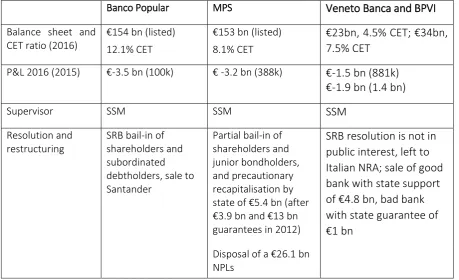
bank in Portugal and had operations in the US, Veneto Bank had operations in Croatia, and BPVI in Ireland and representative offices internationally. Table 1 on the following page gives an overview of the four banks.
The Commission has proposed some further amendments to the EU resolution framework in the banking reform package, but it can be questioned whether this will necessarily facilitate the application of the rules. The Commission has further specified the MREL ratios for the EU’s global systemically important banks and for the others, while further detailing their composition as being part of a pillar 1 and pillar 2 instrument, or the latter only. Hence there is no longer a single ratio for a cross-border bank, but a multiplicity of ratios, which raises the question of clarity in the supervisory process, and even more during a resolution weekend (see SRB, 2016, p. 15). In addition, the amendments have further confused the task of resolution authorities with bank supervisors. Both can require additional ‘capital’ levels (and guidance), both can withdraw a bank licence and both will have to resolve a bank in trouble.
Table 1. Four cases of bank resolution or restructuring compared
Banco Popular MPS Veneto Banca and BPVI
Balance sheet and CET ratio (2016)
€154 bn (listed) 12.1% CET
€153 bn (listed) 8.1% CET
€23bn, 4.5% CET; €34bn, 7.5% CET
P&L 2016 (2015) €-3.5 bn (100k) € -3.2 bn (388k) €-1.5 bn (881k) €-1.9 bn (1.4 bn)
Supervisor SSM SSM SSM
Resolution and restructuring
SRB bail-in of shareholders and subordinated debtholders, sale to Santander
Partial bail-in of shareholders and junior bondholders, and precautionary recapitalisation by state of €5.4 bn (after €3.9 bn and €13 bn guarantees in 2012)
SRB resolution is not in public interest, left to Italian NRA; sale of good bank with state support of €4.8 bn, bad bank with state guarantee of €1 bn
Disposal of a €26.1 bn NPLs
Source: Annual reports of respective banks and DG Comp of the European Commission.
Another element of the crisis management system, the deposit guarantee system (DGS), is still in full implementation phase. The Directive, adopted in 2014, requested a fully pre-funded DGS at national level, but this is still in the process of being fully developed. Italy today has only €2.4 billion in its DGS, for example.
The European Commission has maintained supervisory colleges over another part of the resolution architecture, the central counterparties (CCPs). For the few systemically important CCPs we have in Europe, it will not be efficient to have at the same time national supervisors, central banks and finance ministries around the table, especially in times of crisis.
Conclusions
Europe has takena big step forward in its crisis resolution architecture, but much remains to be done, above all in implementing the rules and making the structure work in a consistent way. Loopholes persist, with the most problematic being the difference in tolerance levels towards NPLs and the related capital shortfall, and the application of a precautionary recapitalisation by the state for undercapitalised banks.
8|KAREL LANNOO
This structure was created because taxpayers’ money should no longer be used to bail-out a bank. Recent events have underlined how difficult it is to apply this principle consistently, even for small banks. In addition, many elements of the supervisory framework remain highly divergent and intrinsically linked to national rules and practices. The question thus remains whether the structure will work when confronted with a large cross-border bank in trouble.
References
Ayadi, Rym, Willem-Pieter De Groen et al. (2016), Banking Business Models Monitor 2015:
Europe, Montréal: International Research Centre on Cooperative Finance (IRCCF) of
HEC Montréal.
De Groen, Willem-Pieter (2017), “Carving out legacy assets: A successful tool for bank
restructuring?”, CEPS Policy Brief, CEPS, Brussels, March.
Lannoo, Karel (2014), ECB Banking Supervision and Beyond, CEPS Task Force Report, CEPS, Brussels.
Single Resolution Board (SRB) (2016), MREL: Approach taken in 2016 and next steps.
Valiante, Diego (2017), “Harmonising Insolvency Laws in the Euro Area: Rationale, stocktaking
CEPS▪ Place du Congrès 1 ▪ B-1000 Brussels ▪ Tel: (32.2) 229.39.11 ▪ www.ceps.eu
ABOUT CEPS
Founded in Brussels in 1983, CEPS is widely recognised as the most experienced and authoritative think tank operating in the European Union today. CEPS acts as a leading forum for debate on EU affairs, distinguished by its strong in-house research capacity and complemented by an extensive network of partner institutes throughout the world.
Goals
Carry out state-of-the-art policy research leading to innovative solutions to the challenges facing Europe today
Maintain the highest standards of academic excellence and unqualified independence
Act as a forum for discussion among all stakeholders in the European policy process
Provide a regular flow of authoritative publications offering policy analysis and recommendations
Assets
Multidisciplinary, multinational & multicultural research team of knowledgeable analysts
Participation in several research networks, comprising other highly reputable research institutes from throughout Europe, to complement and consolidate CEPS’ research expertise and to extend its outreach
An extensive membership base of some 132 Corporate Members and 118 Institutional Members, which provide expertise and practical experience and act as a sounding board for the feasibility of CEPS policy proposals
Programme Structure
In-house Research Programmes
Economic and Finance Regulation
Rights Europe in the World Energy and Climate Change
Institutions
Independent Research Institutes managed by CEPS
European Capital Markets Institute (ECMI) European Credit Research Institute (ECRI)
Energy Climate House (ECH)
Research Networks organised by CEPS