EPOXIDATION OF UNSATURATED ESTERS
Hermann Robert Schuler
A Thesis Submitted for the Degree of PhD
at the
University of St Andrews
1974
Full metadata for this item is available in
St Andrews Research Repository
at:
http://research-repository.st-andrews.ac.uk/
Please use this identifier to cite or link to this item:
http://hdl.handle.net/10023/15100
October 1974
■
Epossidation of Unsaturated Esters
being a thesis
presented by
Hermann Robert Schuler
to the
University of St. Andrews
3 '4
in application for
■'É
The Degree of Doctor of Philosophy
I
ProQuest Number: 10166778
All rights reserved
INFORMATION TO ALL USERS
The qua lity of this reproduction is d e p e n d e n t upon the qua lity of the copy subm itted.
In the unlikely e v e n t that the author did not send a c o m p le te m anuscript and there are missing pages, these will be noted. Also, if m aterial had to be rem oved,
a n o te will in d ica te the deletion.
uest
ProQuest 10166778
Published by ProQuest LLO (2017). C o pyright of the Dissertation is held by the Author.
All rights reserved.
This work is protected against unauthorized copying under Title 17, United States C o d e M icroform Edition © ProQuest LLO.
ProQuest LLO.
789 East Eisenhower Parkway P.Q. Box 1346
(i)
Declaration
Î
?
* I hereby declare that this thesis is a record of the results è of ray own experiments, that it is my own composition, and that it
has not previously been presented in application for a higher degree. The research was carried out in the Department of Chemistry, United College of St. Salvator and St, Leonard, University of
a St. Andrews, under the supervision of Professor P.D, Gunstone,D,Sc., || F.R.I.C.
a
%:
(il)
Certificate
I hereby certify that Hermann Robert Schuler has completed twelve terms of research work under my supervision, has fulfilled the conditions of the Resolution of the University Court 1967, No, 1 (St. Andrews) and that he is qualified to submit the accompanying thesis in application for the degree of Doctor of Philosophy,
•Si (iii )
University Career
After obtaining the Abitur at the Hebei Gymnasium in LÜrrach, West Germany, I entered Basel University in April 1966 and graduated as Diplom Chemiker in June 1971,
I was admitted as a research student in the United College,
University of St, Andrews, in October 1971 and was awarded the # Elizabeth Soutar Scholarship which I held until October 1974,
I
(iv)
Acknowledgement s
My greatest debt is to Professor F.D. Gunstone who always showed interest in my concerns and the progress of my work. I wish to express to him my deep gratitude for the many helpful discussions and his continuous encouragement.
Thanks are due to all my friends and colleagues in our research group and in the Chemistry Department whose company and stimulating discussions I enjoyed so much.
I would also like to thank Mrs, M, Smith and Mr. C . Millar for running the NMR and the mass spectra. Particular thanks go to Mrs, W, Pogorzelec for her experience and patience in typing this thesis.
To my parents and
(v) Contents
Abbrevi at ions Summary
.vii I vi i i,
PART I
Epoxidation of Unsaturated Esters Introduction
Natural occurrence of epoxy fatty acids 1
B;i ological aspects of epoxy fatty acids 3
Utilisation of epoxy fatty acids 6
Peracid epoxidation and its mechanism 6
Discussion
Synthesis of epoxides related to diunsaturated fatty
acids: monounsaturated epoxides and diepoxides 9
Thin 'layer chromatography 15
Gas-liquid chromatography 22
Nuclear magnetic resonance spectroscopy 31
Mass spectrometry 45
Melting points of some vicinal dihydroxyoctadecenoic and
-ynoic acids 60
Reaction of methyl cis-6,7,cis-9,10"diepoxystearate and of methyl cis-8,9,cis-12,l3-diepoxystearate with boron
trifluoride etherate 62
part .II
‘I ,yÜ.r u b o r a f f p n b i u d i o s
Introduction 67
Discussion and results 69
Conclusions and summary 8J
EXPERIMENTAL
Solvents 83
Chromatographic analysis 83
Spectroscopic analysis 85
General chemical procedures
Estérification 86
(vi ) Pa.Ke
Trimethylsilylaticm 86
Purdie méthylation 86
Mesylation of vicinal dihydroxy esters and their conversion
to alkenoates 87
Bromination and dehydrobromination 87
Partial hydrogenation 88
Reduction with lithium aluminium hydride 88
Reduction with sodium borohydride 88
PART I
Synthesis of some A9,12“diunsaturated esters Methyl octadec-trans-12“On-9-ynoate
Methyl octadeca-cis-9,trans-12-dienoate Methyl octadec-cis-12-en-9-ynoate
Methyl octadeca-trans-9„trans-12-dienoate
Methyl oc t adec-cis-9-en-12-ynoate
(A) Attempted synthesis from ricinoleate (B) Synthesis via a Wittig reaction Methyl octadec-trans-9-en-12-ynoate Me thy1 oct adeca-trans-9,cis-12-d ienoate
Monoepoxidation oi diunsaturated esters Vicinal dihydroxyoctadecenoic acids
Methyl fois-Ctrimethylsilyloxy)octadecenca tes Mixed methyl TMS diether derivatives
Rearrangement of methyl cis-6,7,cis-9^10-diepoxystearate Rearrangement of methyl cis-8,9,cis-12,13-diepoxystearat'
89 89 90 90 91 95 99 100 10] 102 102 102 103 105
PART II Materials and general procedures Hydroboration reactions with
(i) methyl oleate
(i i) me th y1 12-methoxy o i c ate (iii) methyl 12-acetoxyoleate (iv) methyl 12-hydroxyoleate
(v) methyl linoleat© (vi) methyl stearolate (vi i) methyl hendec-10“enoate fviii) cyclohexene
( iX ) t ri dec "T -ene
(vii )
A bb re vi at i ons
A short writing is frequently used instead of systematic names of fatty acids and their methyl esters. For example, octadec- c:^“”9“enoic acid, i©„ oleic acid is abbreviated 18:1 (9c), The numbers 18 and 1 give the number of carbon atoms and the number of unsaturated centres, respectively. The parenthetical expression (9c) indicates that the unsaturated centre is located between
C(9) and C(10) and is a cis double bond; "t” denotes a trans double bond and "a” stands for an acetyIonic bond.
Ac acetate
ApL Apiezon L
DEGS diothylene glycol succinate DMF dimeIhv1formamide
-S;
E diethyl ether ;
infrared 'I
I
ECL equivalent chain length GLC gas “-liquid chromatography IR
M molecular ion
Me methyl
MS mass spectrometry 4
NMR nuclear magnetic resonance s;;
P petroleum ether
THF tetrahydrofuran
TLC thin layer chromatography IMS trimethylsilyl
•form by column and thin layer chromatography, A comparative study was made of the chromatographic (TLC and GLC) behaviour and the NMR spectra of the unsaturated ©poxy esters,
TLC gave some indication of the position and geometry of the epoxy group and the nature of the unsaturated contre. The geometry of the epoxy group and the olefinic or acetylenic nature of the unsaturated centre were also revealed by GLC,
220 MHz NMR spectra, recorded for all unsaturated epoxy esters and diepoxy esters, exhibited up to nine more or less
resolved signals which showed the long range deshielding influences of the ester group, the unsaturated centre, and the epoxy group. These influences were noticeable even when five methylene groups separated the deshielding group and the proton under consideration. Even though the 'N%1R spectra did not give a complete structural analysis of the epoxy esters, they nevertheless revealed the
geometry of the epoxy group as well as the nature of the unsaturated centre.
The epoxides were convened to vicinal diether derivatives the mass spectrometric examination of which allowed the unambiguous location of the epoxy group and therefore also of the original double bond.
Melting points of the vicinal dihydroxy acids, derived from all the twenty-six unsaturated epoxy esters by acetolysis and
hydrolysis, were determined. The melting point differences between the various isomers reflected such structural features as the
geometry and position of the a^diol group and of the accompanying (viii)
SummaryCaa uii vul «ft"
Eight isomeric 9,12-diunsaturated C^^ methyl esters and seven isomers from two series of positionally isomeric methyl octadeca- cis,cis"dienoates, ie. 18:2 (5cl2c - 8cl2c) and (6c9c - 6cllc) were epoxidised to furnish monounsaturated monoepoxy esters and diepoxy
(ix)
unsaturated centre.
Two diepoxy esters, methyl cis-°6, 7,cis-9,10-dlepoxystearate and methyl cis-8,9,cis-12,13-diepoxystearate, were reacted with boron trifluoride etherate. Instead of the expected dioxo derivatives, various cyclic ethers were obtained,
PART I
î
Natural occurrence of ©poxy fatty acids
Several of the numerous natural epoxides can be classified as derivatives of fatty acids. The first of the ©poxy acids was
1
discovered in 1954 when Gunstone found this compound as the major fatty acid component in the seed oil of Vernonia anthelmintica
and identified it as cis-12,13-epoxyoctadec-cis-9-©noic acid. Since its discovery in 1954 this ©poxy acid, also called vernolic acid, has been isolated from the seed oils of many species of several
2 “5
plant families . Its isomer, coronaric acid, ie, cis-9,10-©poxyoctadec-cis-12-enoic acid, also occurs in various seed oils.
Both these epoxy acids have a structural similarity to
thought to %e enzymatically produced in the seeds from endogenous
'if.
6 7 i|5
though at a considerably lower level ' ,
!
•ÿ* linoleic acid (18:2 9cl2c) from which they can be considered to ‘y be formally derived by replacement of on© double bond by an
epoxide ring. By analogy, 9,10-epoxystearic acid is formally related to oleic acid, the most common unsaturated fatty acid. It is therefore not surprising that cis-9,lO-epoxystearic acid is
8 9
widely met in seed oils and in spore oils of various plant rusts .
Similarly, three dienoic ©poxy acids might conceivably derive from =3 linolenic acid (18:8 9cl2cl5c). So far only one of these,
cis-15,16-epoxyoctadeca-ci5-9,cis-12-dienoic acid, has been found, again as glyceride ester in a seed oil^^*^^. .
Helichrysum teracteatum seed oil contains an acetylenic - L epoxide, cis-9,10-epoxyoctadec"12-ynoic acid, and its olefinic
V
analogue, coronaric acid. It is of interest that this seed oil also contains octadec-cis-9-en-12-ynoic acid and linoleic acid
12 which içight be the precursors of the epoxy compounds ' .
Small quantities of cis-9,lO-epoxyoctadeca-trans-3,cis-12-dienoic acid have been detected in the seeds of Stenachaenum
13
- 2 “
oct adeca-trans -3, cis -9, cis‘“12-trienoic acid. There are several reports suggesting that in various seeds a lipoxygenase is present which after harvest catalyses the conversion of unsaturated fatty
11 14 15 acids to oxygenated products like epoxy acids ^ '
Graveland^^ showed that cis-12,13-epoxy-9-hydroxyoctadec-trans-10-enoic acid and the isomeric cis-9,10-epoxy -12-hydroxy-octadec-trans-11-enolc acid are primary products of an enzymatic oxidation of linoleic acid in doughs.
In all the epoxy acids mentioned so far the epoxide group has the cis configuration. The only naturally occurring trans epoxy
17 acid is trans-9,10-epoxystearic acid which Vioque et al. discovered in the lipid extract from pressed olive pulp.
Another family of epoxy acids has been isolated from the cuticle layers of leaves and fruits of various plants. The cutin epoxy acids, some of which constituted up to 60% of the total fatty acid content of the cutin polymer, are ^-oxygenated C^g-acids with one cis-epoxy group in the 9,10-position, The wide occurrence of
18-23
cis-9,lO-epoxy-18-hydroxystearic acid and of its monounsaturated 21*^23 and diunsaturated analogues, cis-9,10-epoxy-18-hydroxy-24
18:1 (12c) and cis-9,lO-epoxy-18-hydroxy- 18:2 (12cl5c), is well documented. The dl-hydroxy group can also be further oxidised as shown by the more recent discoveries of 9,lO-epoxy-18-oxostearic
25 23
acid and of 9,lO-epoxyoctadecane-l,18-dioic acid
In contrast to all these epoxy fatty acids isolated from I plant materials only one epoxy acid has been discovered in animal j
I
Biological aspects of epoxy fatty acids
The two carbon atoms of the epoxide ring are asymmetrically substituted in all the epoxides described above. Those natural epoxy acids where optical rotation has been studied have all been found optically active. For some of them the absolute configuration of the epoxide group has been determined and their structure has
2 8 ”“31
thus been completely revealed"" . For example, (t)vernolic acid which is found in several plant families has been shown to have the D configuration (8-12, R-13). Its (-)ehantiomer, occurring 28 only in one plant family, has the L configuration (R-12,8-13) The optical activity of the natural epoxy fatty acids is taken as evidence for their being biosynthetic products rather than autoxidation products, since racemates are generally not produced in nature.
Little is known about the biosynthesis of epoxy fatty acids 32
and about their metabolic role. Scott et al. indicated an enzymatic activity possibly present in the seeds of Vernonia antheImintica. This enzyme function which becomes active only when the seeds are crushed catalyses the conversion of vernolic
33 acid to threo-12|13-dihydroxyoieic acid* Morris and Crouchman demonstrated that this hydration proceeds in a stereospecific way. The epoxide ring is opened with inversion at C -12 and the epoxide oxygen is retained in its original configuration at C -13.
Similar enzymes which catalyse the stereospecific hydration of cis-9,10-epoxystearic acid have been discovered in Claviceps
34 35 30
species and in the spores of various plant rusts' '' . 35
Tulloch made the tentative suggestion that the threo-9,10-dl- hydroxystearic acid formed may be a precursor for nonanal which stimulates spore germination. Another hydratase has been
or trans-epoxides only one enantiomeric epoxide is converted to one enantiomeric dihydroxy acid . So ©poxy acids have been established as precursors of dihydroxy acids.
40
Miwa et al. concluded that dihydroxy acids can also be precursors of epoxy acids. In their investigation of the fatty acid composition in maturing Vernonia anthelmintica they found that during maturation formation of dihydroxyoleic acid preceded the formation of vernolic acid and that the content in dihydroxy acid decreased as the proportion of epoxy acid increased. The authors suggested the presence of three enzymatic activities which may
catalyse the oxygenation of oleic and linoleic acid, the dehydration of the dihydroxy to the epoxy acid and finally the estérification to the triglyceride oil.
In a comprehensive study of the biosynthesis of cis-9,10-epoxystearic acid in red stem rust infected wheat Knoche^^ showed that acetate is an active substrate for the biosynthesis of the epoxy acid as also are stearic acid and oleic acid. These ^18 substrates are transformed to the epoxy acid without undergoing P-oxidation followed by resynthesis of the carbon chain. The experimental results provide evidence that oleic acid is the immediate precursor of the cis-9,10-epoxystearic acid. Knoch©
also showed that the epoxide oxygen originates from molecular oxygen. Similar enzymatic epoxidations are known to play key roles in the metabolism of various natural and unnatural compounds. An example is the detoxication of naphthalene. When fed to animals it is converted to naphthylmercapturic acid. 1,2“Dihydro-1,2- dihydroxynaphthalen© is the first isolated oxygenated product in this sequence and there is good evidence that it is produced from
an/epoxide intermediate”^^’ . Similarly the degradation of alkaloids
■fl such as kynurenic acid is believed to proceed via an epoxide -I1 intermediate^^. Another important example of an enzymatic epoxfdation
I
an enzyme responsible for the formation of 2,3-epoxy-2,3-dihydro squaiene. Another enzyme controls the cyclisation of 2,3-epoxy-2,3“dihydrosquaiene to lanosterol. Hence 2, 3”epoxy“2,3“dihydrosqualene is a very important intermediate in the conversion of squalen©
to sterols which is initiated by this epoxidation step. A recent report discussed the enzymatic epoxidation of aliphatic alkenes. The catalysing enzyme system consisted of three separate protein components and required NADH and molecular oxygen.
In the lipid field, the allylic hydroxy group in the aliphatic part of prostaglandin molecules is thought to be introduced via an intermediate epoxide function resulting from enzymatic oxygenation
of the appropriate olefinic bond. The position of this hydroxy î| 49
group in the prostaglandin supports this hypothesis . The biosynthesis of the various C^g-cutin fatty acids has been
24 50
extensively studied by Kolattükudy and coworkers " . They demonstrated that for fatty acids to be precursors of in-chain
oxygenated cutin acids it is essential to possess a A9 double bond. '7 Fatty acids which meet this requirement, ie. oleic, linoleic and -É $
linolenic acid, are converted to the 18-hydroxy acids, the cis-
9,10-epoxy“18-hydroxy and the 9,10-18-trihydroxy acids. 1“^”^C-stearic acid only undergoes (a) -hydroxylation but no further internal
oxygenation.
So far epoxy fatty acids have been shown to be precursors for hydroxy and dihydroxy derivatives, and it is considered that they themselves are derived from unsaturated fatty acids. Further suggestions have been made that they also could be intermediates in the formation of new olefinic and acetylenic unsaturation,
2
intermediates in this scheme are epoxides (12,51). However, no , biochemical evidence exists so far which would substantiate this
hypothesis. Labelled vernolic acid was not converted into
52 53
crepenynic acid „ Similarly, Gurr and Bloch using cis-9,10-epoxystearic acid bound to the acyl carrier protein AGP could
I
not find any formation of oleic acid.
I
Utilisation of epoxy fatty acids' The great importance of epoxides depends on the wide range 4 of reactions which these compounds can undergo. Large quantities 4 of epoxides are produced industrially for a variety of purposes
the most prominent of which is the manufacture of epoxy resins. The potential of epoxidised fatty materials was quickly recognised, Vernonia anthelmintica oil with its high epoxy acid content (70%) has been evaluated as a stabiliser and plasticiser for polyvinyl chloride^^'^^. The stabilising qualities are mainly due to the ability of the epoxy groups to react with residual hydrogen chloride in the polymer with chlorohydrin formation. Soybean, cottonseed and linseed oils, to name just a few oils rich in unsaturated fatty acids, are commercially epoxidised for use as stabilisers and plasticisers, The epoxy derivatives serve also as monomers for curing with agents like phthalic anhydride to give epoxy resins'”' a n d are valuable intermediates for a great number of chemicals.
Peracid epoxidation and its mechanism
Epoxides show great versatility in organic synthesis as a t source of many other functional groups. Hence reactions leading ;i to epoxy compounds are of major importance and the various preparative
dehydrohalogenation®^. This method has been largely replaced by 62 an epoxidation. reaction based on the discovery by Priloschajew that alkenes are smoothly epoxidised by peroxy acidsi
C=C RCO3H ^ / y
The reaction proceeds quantitatively and results in an electrophilic cis-addition of oxygen across the double bond so that the epoxide geometry is the same as that of the unsaturated centre®^
The stereospecificity and the high yields make this method extremely useful. The reaction times of this second order
reaction are normally snort. Cis olefins react faster than trans
66
olefins , whilst acetylenic bonds react very slowly so that olefinic centres can be selectively epoxidised in compounds
67 containing both olefinic and acetylenic unsaturation .
Of the various mechanisms proposed for this peroxy acid
oxidation two are still disputed, Bartlett^^ suggested the following 1.1“addition mechanj sm:
(X-
P<
I
'\rc.
1 ^ 0 + RCOpH
cr"
Kinetic studies indicate a non-ionic mechanism^^ and a rather high 70
negative entropy of activation consistent with the postulated bicyclic intermediate. The strong intramolecular H-bonding in aliphatic and aromatic peroxy acids can be taken as further support for this mechanism.
However, reactivity parameters of this epoxidation reaction led Kwart and Hoffmann to the postulation of a 1,3-dipolar addition
. 71
mechanism :
« y "
HO
HO R
1^0 + RCO H
They showed that the hydroxy carbonyloxid© species (i), produced in the ozonisation of suitable olefinic compounds like ascorbic acid, can effect the epoxidation of olefins in the same way as peroxy acids,
A MO-study on the hydrogen bonded and the dipolar forms of peroxy acids revealed only a small difference between the total
-electron energies of the two forms. It was concluded therefore that both mechanisms should be theoretically possible. The 1,1-mechanism is expected to be favoured in nonpolar solvents and the
72 1,3-mechanism in polar media
Synthesis of epoxides related to diunsaturated fatty acids; monounsaturated epoxides and diepoxides
The conversion of monounsaturated fatty acids and their
derivatives to epoxides has been extensively studied. The interest in the epoxides of polyunsaturated fatty acid materials grew
rapidly when their natural occurrence and the scope of their 73
commercial utilisation became apparent, Swern reported that methyl linoleate can be converted in good yields to mono- and di-epoxides according to the amount of peracid used in the epoxidation. Two Russian authors claimed the synthesis of methyl 12,13-epoxyocta-dec-9-enoate via the monoepoxidation of methyl linoleate with
74
peracetic acid The first total synthesis of this naturally 75 occurring epoxyacid, ie. vernolic acid, was achieved by Osbond By selective epoxidation of synthetic crepenynic acid (18:2 9cl2a) he obtained (t)cis-9,10-epoxyoctadec-12-ynoic acid which he then managed to hydrogenate partially to (t) vernolic acid without concurrent opening of the epoxide ring. The acetylenic epoxide
1 ?
was later prepared again by Conacher and Gunstone ' in order to prove the structural identity of the natural cis-9,10-epoxyoctadec-12-ynoic acid they had discovered in the seed oil of Helichrysum &racteatum, By a sequence of stereospecific reactions®^
trans-30 12,13-e poxyoc t adec -cis --9 -enoic acid was obtained from vernolic acid
76
Maerker et al. investigating the possibility of positional selectivity in the monoepoxidation of methyl linoleate found that of the two unsaturated monoepoxides methyl coronarat© was formed to a slightly larger extent (64%) than methyl vernolate (46%),
77
Ferrari at al. showed, however, that the< r monoepoxidation of methyl linoleate yielded 39% of coronarate and 40% of vernolate. These authors were the first to demonstrate that the two isomeric monoepoxides can be separated by column chromatography on a
10
-two pure epoxides, but the IR and NMR spectra showed no characteristic differences,
Apart from this last mentioned report and a few sporadic references no systematic study of the chromatographic and
spectroscopic characteristics of epoxides derived from polyunsaturated fatty materials has been undertaken so far. Jacobsberg and
78
Gunstone demonstrated that position and configuration of the epoxide group in all the isomeric methyl epoxystearates can be established on the basis of the mass and NMR spectra without resort to chemical degradation. Position and geometry of the double bond in the parent olefinic esters can be inferred because of the clear stereospecificity of the epoxidation reaction.
Since Jacobsberg's study was confined to saturated epoxides derived from all the methyl cis~ and trans-octadecenoates we decided to investigate the various epoxidation products related to a selection of fifteen synthetic diunsaturated C^g esters. Most of them had been prepared by Lie Ken Jie^^ and Jacobsberg^^ but a few were newly synthesi sed by routes already described in literature. The diunsaturated esters used in this epoxidation can be divided into four series which comprise the following acids:
n
5 18:2 (5cl2c)
1
4 18:2 (6ol2c) 18:2 (6cl2c)
3 18:2 (7cl2c) 18:2 (6cllc)
2 18:2 (8cl2c) 18:2 (6clOc)
1 18:2 (9cl2c) 18:2 (6c9c)
1 18:2 (9cl2c) 18:2 (9al2c)
1 18:2 (9cl2t) 18:2 (9al2t)
1 18:2 (9tl2c) 18:2 (9cl2a)
1 18:2 (9tl2t) 18:2 (9tl2a)
The symbol 18:2 C0cl2c) indicates a C g acid with two unsaturated
Û
centres, A5 and Al2, both of which have cis geometry. The 4
11
-groups which separate the two unsaturated centres. In the first two series one of the two cis double bonds is kept in a fixed position, ie. Al2 and A6, whilst the position of the other double bond is varied so that n = 1 to 5. In the other two series the position of the two unsaturated centres is fixed (9,12 n = 1) and their nature varied.
The epoxidation reactions were carried out on a millimole scale using meta-chloroperbenzoic acid as epoxidising agent. This peroxy <u.id is a stable, crystalline solid with a relatively high molecular weight which can be accurately weighed in the small amounts required for stoichiometric control of the reaction.
Epoxidation of dienoic esters furnishes in the first instance a mixture of the two racemic and positionally isomeric monounsat= urated epoxides which are then further epoxidised to a racemic mixture of four stereoisomeric diepoxides (as shown in Scheme 1).
Scheme 1 Epoxidation of Dienoic Esters
R -=CH=CH “(CHg ) -CH=CH -R '
ArCOgl-l
(1 mole equivalent)
A
/ \
R -C H -C H -(C H g) -CH=CH -R' + RH:H=CH^ (C H 2)^-C H -C H -R
ArCOgH
(1 mole equivalent)
A
A
R-CH “CH -(C H )^-CH -CH -R '
R = -(C H g ) COOCHg
R ' = -(CH2)^CHg
12 -
-Our preliminary experiments indicated that the isomeric
’I monoepoxides could be isolated and separated from each other without
great difficulty and that they offer more diagnostic information than the related diepoxides. To obtain the maximum yield of monoepoxides the diene esters were each treated with one mole equivalent of peracid in chloroform solution at room temperature for five hours, lodometric titration showed that all the peracid was consumed in about four hours.
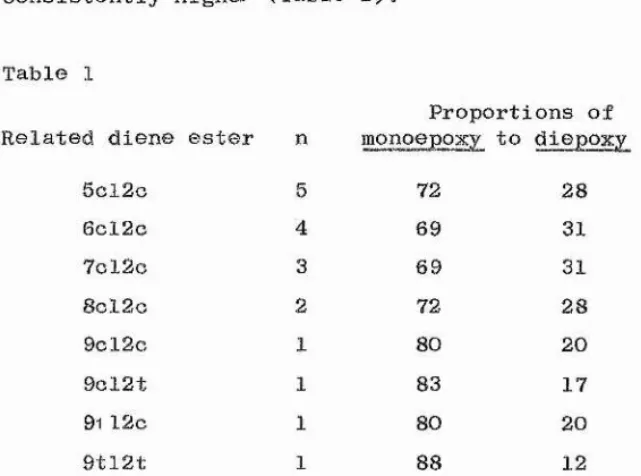
If th۔ two double bonds in the dienoic esters each had the same reactivity as the double bond remaining in the unsaturated monoepoxide, the monoepoxy and diepoxy products would be expected in a 2:1 ratio. However, in our reactions this ratio was
consistently higher (Table 1),
I
[image:28.612.97.418.353.591.2]il Table 1
Proportions of
Related diene ester n monoepoxy to diepoxy products
5cl2c 5 72 28
6cl2c 4 69 31
7cl2c 3 69 31
8cl2c 2 28
9c 12c 1 80 20
9ol2t 1 83 17
91 12c 1 80 20
9tl2t 1 88 12
6cllc 3 70 30
6clOc 2 81 19
6c 9c 1 82 18
These results, which are based on the amounts of mono- and diepoxides
separated by column chromatography, show that the double bonds in 1
■si the dienoic esters are more susceptible to electrophilie attack t
by peracid than is the double bond in the unsaturated monoepoxide,
'.'à In the monoepoxide the double bond is deactivated especially when .Q only one methylene group (n=l) removed from the epoxide group
' - ' - '- 'jgg
- 13
--€ linoleate the monoepoxidation step proceeds faster than the second 4] stage leading to the diepoxide. The products of our epoxidations
were separated by silica column chromatography into unreacted dienoates (10-25%), the pair of monoepoxy products (50-70%) and the diepoxy ester (10-25%), The two monoepoxides which were only partly resolved by column chromatography could be separated by preparative TLC. For convenience we classified the two isomeric unsaturated monoepoxy esters from each diene as A and B. In the A isomer the epoxy group is further removed from the carbomethoxy group, than is the unsaturated centre, whereas in the B isomer the epoxy group is located in between the ester function and the unsaturated centre. So methyl cis-12,13-epoxyoctadec-cls-9-enoate is by our do [j ni tion t; o A epoxide and iûothyl cis-9 . lO-^'poxyt.-»'taU^.c-
cis-lB^-enoate the B epoxide derived from the common precursor methyl : linoleate (18:2 9cl2c). This is abbreviated to 18:2 9c12c and
18:2 9c12c, respectively. The underlined part gives the position and configuration of the epoxide function. As all our epoxides were derived from diunsaturated C^g esters the code describing the chain length and number of unsaturations, 18:2 is usually ommitted:
18:2 (9cl2c) --- s* 9cl2c + 9cl2c a- 9cl2c A isomer B isomer
linoleate monoepoxide diepoxide
It is noteworthy that monoepoxidation of our dienoic esters did not produce the A and B monoepoxides in equal amounts suggesting that the two alkene centres have a different reactivity towards the peracid as indicated by Table 2. The values are based on the amounts of pure monoepoxides obtained by preparative TLC separation of the total monoepoxide fractions. The monoepoxide mixture from methyl linoleate could not be analysed fully, because the separation proved particularly difficult. Numbers marked with an asterisk refer to GLC determinations.
- 14
Table 2
monoepoxides derived from A B
% %
18:2 5cl2c 71 29
6cl2c 64 36
Belle 62 38
6c 10c 69 31
6c9c 60 40
7c 12c 60 40
8cl2c 58 42
9cl2c
*
9cl2t 47 53
*
9tl2c 54 46
9tl2t 55 45
exceeds that of the corresponding B isomer. As the distance between the carbomethoxy group and the first double bond is reduced the inequality of the two double bonds becomes more pronounced. The carbomethoxy group apparently deactivates
the nearer double bond so that the peroxy acid attacks preferably the more distant centre to furnish the A epoxide.
The monoepoxidation of 18:2 (9cl2t) constitutes the only exception where the B monoepoxide (9cl2t) is formed in greater yield than the A isomer (9cl2t). To produce either of these the cis-A9 or the trans-Al2 double bond has to be epoxidised. As already mentioned cis olefins are known to react with peracids faster than trans olefins, so it is not surprising that the proportion of cis-9,IQ-epoxide (B) exceeds that of trans-12,13- epoxide (A) and that the general pattern, A > B is reversed in this instance.
The structural features of all our unsaturated epoxy esters were determined on the basis of the chromatographic and spectro
15
-ester and to what extent these properties can be used for the
structure analysis of unsaturated epoxy esters. %
I
Thin layer chromatography (TLC)
Few inventions have caused, such basic changes in chemical and biological research as that of the various chromatographic techniques. Of these, TLC has proved enormously successful, if not indispensable in the field of lipid chemistry. It seems rather astonishing today that about two decades had to pass between
82
its first published application and its wide and general 83
recognition
As normally employed, TLC like column chromatography is a form of adsorption chromatography. Mixtures can be separated into individual components depending on the rate at which they travel through a column or across a plate under the influence of an eluting or developing solvent. It is obvious that by altering the nature of the stationary phase and the solvent the migration characteristics of a particular compound can be influenced in a controlled way.
By this procedure it is possible to separate not only compounds differing widely in chemical composition, but also such similar compounds as positional and geometrical isomers. This can
sometimes be ichieved on TLC even when it is not possible by GLC and such separation can be effected on an analytical or preparative scale for a very small expenditure of time and money.
“ 16 ~
in pure form of the two isomeric unsaturated epoxides formed in the epoxidation of diunsaturated esters. Our hopes of accomplishing such separations were raised by a number of publications which
concern the TLC characteristics of some epoxy esters. Morris 84 “^"80
et al. reported appreciable differences between the isomeric unsaturated epoxy esters methyl vernolate and methyl coronarate.
In a comprehensive study of various oxygenated methyl stearates they found that the position of the functional groups markedly influences the rate of migration on TLC resulting in a sinusoidal pattern of the values^^. The R^ minimum was observed when the substituent was attached to C(5) or C(6) and the R^ maximum was observed with compounds having the substituent at C(12) or C(13). In their study of the TLC behaviour of all the isomeric cis- and
78
trans-epoxystearates Jacobsberg and Gunstone verified not only the sinusoidal pattern resulting from the position of the epoxy function, but also a distinct separation of the isomeric cis and
87 trans epoxides which had been earlier noted by Vioque et al.
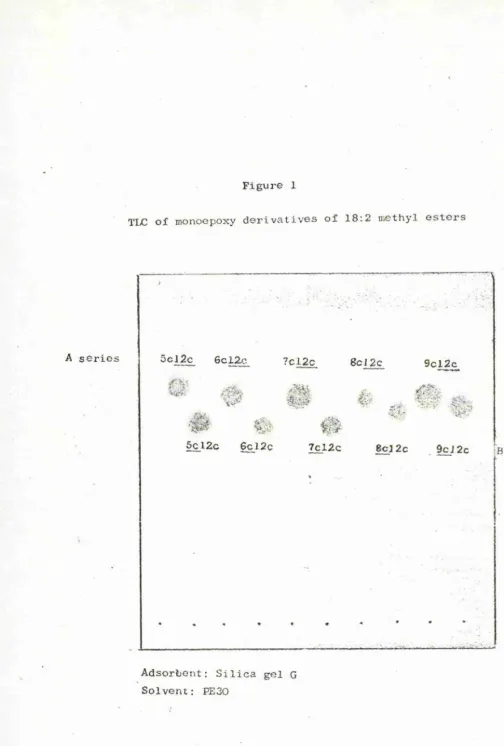
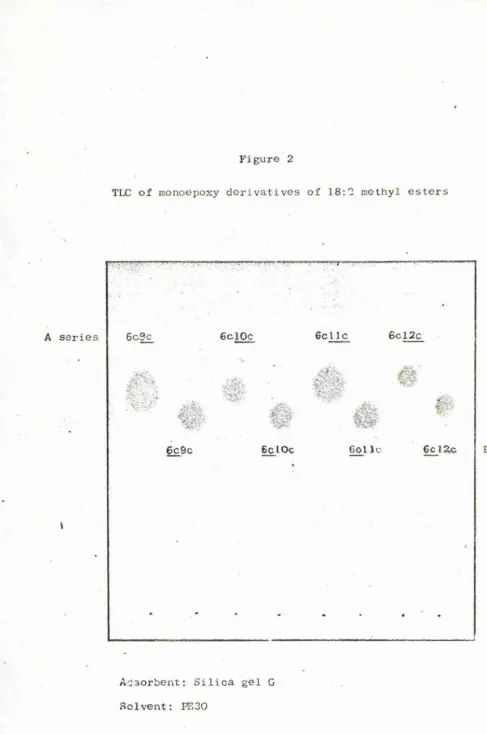
The extent by which our isomeric pairs of unsaturated epoxides are resolved on thin layers of untreated sifica gel is shown in Figures 1, 2 and 3. R^, values were not evaluated since the chromatograms were obtained by prolonged or double development. Figures 1 and 2 demonstrate that the separation becomes more distinct as the number (n) of methylene groups separating the unsaturated and epoxidised centres increases. With the structural assignment based on mass spectroscopic determinations, some more observations can be rationalised:
(I) The effect caused by the position of the epoxy group is marked, but variation of the double bond position has relatively little influence on the TLC characteristics.
17
-The members of the series of epoxides derived from all the 9,12-diunsaturated esters (Figures 3 and 4) differ in three structural features; (i) the position of the epoxy group which may be 9,10- or 12,13- (ii) the geometry of the epoxy group and (iii) the type and geometry of the unsaturated centre.
All these structural features make their characteristic
contribution to the observed overall TLC behaviour of the respective compound. The individual contributions are relatively small but still noticeable. Isomers, where these influences counteract each other, are either separated poorly or not at all. However,
modification of the silica by impregnation with AgNO^ allows satisfactory separation in such instances,
(i) Observation (II) concerning the position of the epoxy group is confirmed; 12,13-epoxides are more mobile on silica than their 9,10-isomers with similar unsaturation.
(ii) Cis geometry of the ©poxy group leads to greater polarity than trans geometry. This is noticeable on normal silica (Figure
3) taut is even more evident (Figure 4) when the separation is carried out on silica impregnated with AgNO^ as discussed below.
(iii) For an unsaturated epoxide with defined position and geometry of the epoxy group mobility is in the oru^r cis > trans — acetylenic, and this effect is more significant when the unsaturation is A9 rather than Al2.
On silica plates impregnated with AgNOg epoxy cis and tr■-»ns alkenoates can clearly be distinguished. Silver ions are known to form 7T-complexes more strongly with cis than with trans olefins^^’^^ and so it is pos-ible to separate the two monoepoxides of methyl 18:2 (9tl2c) which are not separable on normal silica plates. This is shown in Figure 4, Also seen is the effect of the geometry of the epoxy group which is somewhat obscured on Figure 3 by the oth< r influencing factors [(i) and (iii)]. The trans epoxides are clearly
18
-Figure 1
T IC o f monoepoxy d e r i v a t i v e s o f 1 8 :2 m e th y l e s t e r s
A series 5c 12 c 6 c l ^
5c12c 6cl2c
?cl2c 6cl2c
Æ
9cl2c
#
8cJ 2c 9cJ2c ;B series
[image:34.615.14.518.22.768.2]19
-Figure 2
TLC of monoepoxy derivatives of 18:3 methyl esters
A series 6o9c 6cl0c 6cllc 6cl2c
a #
6c9c 6clOc
#
ÎÎI
6ollc
#
6c 12c B series
Absorbent: Silica gel G Solvent : PE30
[image:35.613.31.518.37.771.2]- 20
Figure 3
TLC of monoopoxy derivatives of 9,12-diunsaturated C^g methyl esters
A series c ,c c,t_ t,c t a.c
c . t t.
Vt „a„.
B series
(1st letter = 9,10 position, 2nd letter = 12,13 position, epoxide underlined)
21
-Figure 4
TLC of monoepoxy derivatives of 9,1 2-diunsaturated C^g m 1 esters
A series
B series
(1st letter = 9,10 position, 2nd letter = 12,13 position, epoxide underlined)
Adsorbent: 10% AgNO^ in Silica gel G
22
-Gas“liquid chromatography (GLC)
Ont; of the first applications of GLC was the analysis of some short chain acids by James and Martin in 1962^^. Since then GLC has established itself as the most widely used technique in lipid chemistry allowing the qualitative identification as well as quantitative analysis of a variety of compounds. Suitable stationary phases and supporting materials have been developed for a wide range of analytical problems. Improvements in instrumentation also have led to a widening of the scope of GLC, Combined with mass spectrometry, GLC has gained still greater importance in the more recent past.
As its analytical power has gradually become evident, attempts have been made to correlate GLC data with structural features of
91 92
the compound chromatographed. Two groups " found independently that a logarithmic relationship exists between the retention time and the chain length of methyl esters of saturated straight“chain monocarboxylic acids: the logarithm of the retention time of such an ester is a linear function of the number of carbon atoms in the corresponding acid. On this basis an equivalent chain length (ECL) can be calculated from the logarithmic retention time of any substance chromatographed under operational conditions identical with those used for the saturated reference esters.
For a given stationary phase and within a limited temperature range each compound has a characteristic ECL value which indicates its behaviour more directly than the retention time itself. Thus the ECL concept has greatly facilitated comparison of GLC data obtained by different research groups. The increasing availability of ECL data has already proved to be particularly useful in the gas chromatographic screening of lipid extracts from numerous natural sources. In view of the importance of unsaturated epoxy esters and the scarcity of reports of their GLC characteristics
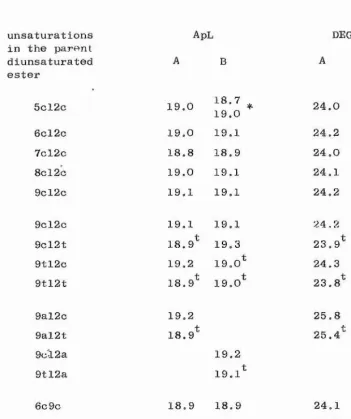
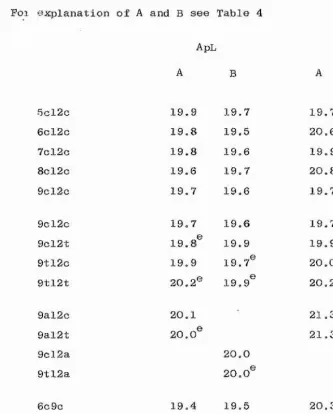
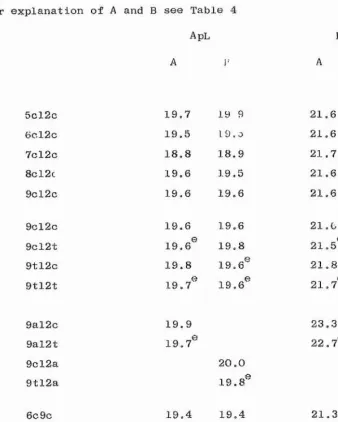
epoxy esters on packed polar (DPCiS > and nonpolar (ApL) columns. The results are given in Table 4. Tables 5 and 6 show the GLC characteristics of the bis-TM8 ether and of the mixed vicinal methyl TMS diether derivatives which were produced and used for mass spectrometric studies. These derivatives were obtained from the various epoxy esters by hydrolysis or methanolysis of the epoxy group and subsequent silylation of free hydroxy groups. The course and stereochemistry of these reactions are described in some detail in the section on mass spectrometry (pages 4-6 a-rnil, 4? ).
Attempts to rationalise ECL values of various fatty acid derivatives by correlating them with the structural features of
94
these derivatives were made by Aokman who pointed out that functional groups in fatty acid derivatives give rise to
characteristic ECL changes when compared with the saturated straight chain homologue. The magnitude of such a change depends mainly on the nature of the functional group and to a much lesser extent on
Table 3 Published ECL values of unsaturated C, „ epoxy esters
methyl vernolate (9cl2c)
ApL
93 19,1 19.2^0'92 19.1^
DEG8
24.6'
24.2O methyl coronarate
(9cl2c) 19.0
19.0 29 13 19.10 methyl cis-Q,10-epoxyoct adec-12-ynoate
(9cl2a) 19.1
19.0 19.2
93 29 O
26.093
25.70
0 = our results
24
PCL values have been successfully made for various unsaturated 95 96
fatty acids ' . The treatment rests on the assumption that all the functional groups present in a compound make their characteristic contributions (PCL) towards the overall
retention behaviour of the compound (ECL) in a simple additive manner. We have derived ECL values for our unsaturated epoxides on the basis of previously collected ECL data of the appropriate
79 96 97
monounsaturated and monoepoxy C.j ^ esters ' ' . These calculated ECL values are given in Tables 7 and 8,
In most cases the ECL values given in Tables 4“6 are based on a single determination. For several isomers up to five repeated determinations have been carried out and these shower that the maximum variation from an averaged ECL is about 0,1 when ApL and about 0,2 when DECS was used as stationary phase. Each of the unsaturated epoxy esters except one appeared asasjugle peak on the chromatogram. The exception was methyl cis“5,6™
epoxyoctadec-cis-12-enoate which gave several peaks on both columns. It is concluded that this epoxide is at least partially decomposed. This observation, as well as the ECL values of the decomposition
78 products, parallels the-findings of Jacobsberg and Gunstone who also reported decomposition for the methyl 5,6-epoxyoctadeoanoates: the cis isomer showed partial decomposition on the DEGS column only, the trans isomer on both columns.
The number of theoretical piates^^ was about 1400 for our
ApL and about 1700 for our DEGS columns. At these column efficiencies compounds had to differ by at least 0,2 ECL units before any separation of peaks could be observed. For complete separation an ECL
difference of 0,4 to 0,6 units was required. As Table 4, for the unsaturated ester, shows, only the cis and trans epoxide pairs derived from methyl 18:2 (9cl2t) and methyl 18:2 (9tl2c) meet this requirement and show some degree of separation. On DEGS the
- 25 - ■
I
pairs are only partly resolved. On both stationary phases thetrans epoxides have smaller ECL than the cis epoxides irrespective of the nature of the accompanying unsaturation. This is In
agreement with the findings for saturated cis and trans epoxy-
78 99
steamtes , Emken using EGSS-X columns also achieved partial
;i separation of the two unsaturated epoxy esters of 18:2 (9cl2t)
whereas the two monoepoxides derived from 18:2 (9tl2t) appeared as one peak as they did in our studies.
On polar phases like DEGS acetylenic epoxides are characterised by considerably greater ECL values than the olefinic isomers.
Analogous ECL differences between acetylenic and olefinic diethers are exhibited in Tables 5 and 6, The stereochemistry of the two vicinal ether groups of the mixed acetylenic methyl TWIS die+hrrs is reflected in the different ECL values of the threo and erythro
isomers: partial separation on ApL and complete separation on DEGS ^
* is obtained for the acetylenic threo and erythro methyl TMS dielhers,
Small differences are also observed between olefinic threo and 4
I
erythro diethers ; in the case of bis-TMS ethers the eryiLhro J
"B
isomer has the greater ECL, whereas amongst the mixed methyl TMS I; diethers it is the threo isomer which has the larger retention time.
On DEGS, the series of vicinal bis-TMS ethers where the position of the ether groups or of the double bond is varied (n - 1 to 5) show a noteworthy alternation of ECL which allows the separation of certain positional isomers. The alternation pattern is the same for A and B isomers with the A isomer having the slightly greater ECL, In the 6,x (x = 9 to 12) series the alternation is interrupted between the bis-TMS derivatives of
(6clOc) and (Gcllc). A similar break in alternation has been 79 observed for the melting points of octadecadiynoic acids
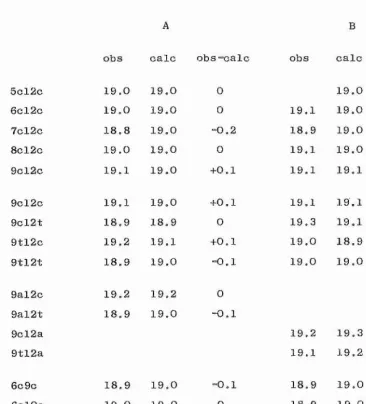
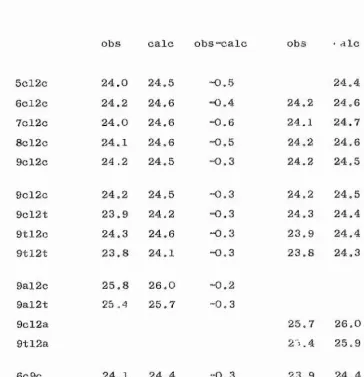
Tables 7 and 8 show the comparison between observed and calculated ECL values of our unsaturated epoxy esters. For Ap., the observed and calculated ECL are in good agreement whereas for DEGS their difference is significant and consistently
I
%
- 26 - j#
,%
Table 4 ECL values of monounsaturated monoepoxy derivatives of 4
methyl octadecanoate
-A refers to the isomer in which the unsaturated centre is located .4 between the carbomethoxy and the ether group
B refers to the isomer in which the ether group is located between
ester
Belle 18.8 18.8 24,1 24.1
6cl2c 19.0 19.1 24,2 24.2
* partial decomposition
t trans epoxide (all other values relate to cis epoxides)
■I ■ Î'
the carbomethoxy group and the unsaturated centre. 4
unsaturations ApL DEGS
in the parent
diunsaturated A B A
5C12C 19.0
ll'l*
24.0ll'l*
6cl2c 19.0 19.1 24.2 24.2
7cl2c 18.8 18,9 24,0 24.1
8cl2c 19.0 19.1 24.1 24.2
9cl2c 19.1 19.1 24,2 24.2
9cl2c 19,1 19.1 24.2 24,2
9cl2t 18.9* 19.3 23.9* 24.3
9tl2c 19.2 19.0* 24.3 23.9*
9tl2t 18.9* 19.0* 23.8* 23.8*
9al2c 19.2 25,8
9al2t 18.9* 25.4*
9ci2a 19.2 25.7
9tl2a 19.1* 25.4*
6c9c 18.9 18.9 24.1 23,9
BrlOc 19.0 18.9 24.2 23,9
I
[image:42.614.98.449.205.624.2]27
Table 5 ECL values of monounsaturated vicinal bis-TM8 ether derivatives of methyl octadecanoate
Poi explanation of A and B see Table 4
ApL DEGS
A B A B
5cl2c 19,9 19.7 19.7 19,6
6cl2c 19,8 19.5 20.6 20.3
7cl2c 19.8 19,6 19,9 19,8
8cl2c 19.6 19.7 20.8 20,7
9cl2c 19.7 19,6 19.7 19.7
9cl2c 19,7 19,6 19.7 19.7
9cl2t 19.8® 19.9 19,9® 19.9
9tl2c 19.9 19.7® 20,0 19.8®
9tl2t 20,2® 19,9® 20.2® 19.9®
9al2c 20,1 ' 21,3
9al2t 20.0® 21.3® g
9cl2a 20,0 21.2
6c9c 19.4 19.5 20.3 20,2
6clOc 19.6 19.7 19.7 19.6
■I
9tl2a 20.0® 21.2®
a
6cllc 19.4 19.4 19.8 19.7
6cl2c 19.8 19,5 20.6 20.3
e erythro bis-TMS ether (all other values relate to threo bis-TMS
ethers) ®
[image:43.612.107.440.130.544.2]28
Table 6 ECL values of monounsaturated vicinal methyl ( MS diether
derivatives of methyl octadecanoate
For explanation of A and B see Table 4
ApL DEG8
A j' A B
5cl2c 19.7 19 9 21.6 21.4
6c12c 19.5 19.0 21.6 21.5
7cl2c 18.8 18.9 21.7 21.6
8cl2c 19.6 19.5 21.6 21.4
9cl2c 19.6 19.6 21.6 21.6
9cl2c 19,6 19.6 21.6 21.6
9cl2t 19.6® 19.8 21.5® 21.6
9tl2o 19.8 19.6® 21.8 21.6®
9tl2t 19.7® 19.6® 21.7® 21.6®
9al2c 19.9 23.3
9al2t 19.7® 22.7*
9cl2a 20.0 23.2
9tl2a 19.8® 22.7®
6c9c 19.4 19.4 21.3 21.2
GclOc 19.6 19.5 21.4 21.3
Belle 19.6 19.6 21.5 21.3
6cl2c 19.5 19.5 21.6 21.5
29
Table 7 Observed and calculated ECL values of monounsaturated monoepoxy derivatives of methyl octadecanoate on ApL
A B
s
obs calc obs“calc obs calc obs-calc
5cl2c 19.0 19.0 0 19.0
6cl2c 19.0 19.0 0 19.1 19.0 +0.1
7cl2c 18.8 19.0 -0.2 18.9 19.0 -0.1
8cl2c 19.0 19.0 0 19.1 19.0 +0,1
9cl2c 19.1 19.0 +0.1 19.1 19.1 0
9cl2c 19.1 19.0 +0.1 19.1 19.1 0
9cl2t 18.9 18.9 0 19.3 19.1 +0 . 2
9tl2c 19.2 19.1 +0.1 19.0 18.9 +0.1
9tl2t 18.9 19.0 -0.1 19.0 19.0 0
9al2c 19.2 19.2 0
9al2t 18.9 19.0 -0.1
9cl2a 19.2 19.3 -0.1
9tl2a 19.1 19.2 -0.1
6c 9c 18.9 19.0 -0.1 18.9 19.0 -0.1
6cl0c 19.0 19.0 0 18.9 19.0 -0.1
6cllc 18.8 18.9 -0.1 18.8 19.0 -0.2
6cl2c 19.0 19.0 0 19.1 19.0 +0,1
Calculated ECL values are obtained as in the following example;
FCL (cis_ A5) = ECL (18:1 be) - ECL (18:0) = -0.34
FCL (cis"T2,13-epoxy) = ECL (cis-12,13-epoxy 18:0) - ECL (18:0) . . calculated ECL (5cl2c) = ECL (1.8:0) + FCL (cis A5)
+ FCL (cis-12,13-epoxy) = 18.0 + (-0.34) + 1.35 = 19.01
30
Table 8 Observed and calculated ECL values of monounsaturated momOgpoxy derivatives of methyl octadecanoate on DEGS
For explanation of A and B see Table
obs calc obs-calc obs • ale obs-calc s
5c 12c 24.0 24.5 -0.5 24.4
6cl2c 24.2 24.6 -0.4 24.2 24.6 -0.4
7cl2c 24.0 24.6 -0.6 24.1 24.7 -0.6 ^
8cl2c 24.1 24.6 -0.5 24.2 24.6 -0.4
9c 12c 24.2 24.5 -0.3 24.2 24.5 -0.3
9cl2c 24.2 24.5 -0.3 24.2 24.5 -0.3 2
9cl2t 23.9 24.2 -0.3 24.3 24.4 -0.1
9tl2c 24.3 24.6 -0.3 23.9 24 04 -0.5
9tl2t 23.8 24.1 -0.3 23.8 24.3 -0.6 >
9al2c 25.8 26.0 -0.2
9al2t 25.4 25.7 -0.3 1
9c 12a 25.7 26.0 -0.3 g
9tl2a 25.4 25.9 -0.6 4
6c9c 24.1 24.4 -0.3 23.9 24.4 -0.5 *
6clOc 24.2 24.6 -0.4 23.9 24.5 -0.6 ^
6cllc 24.1 24.6 -0.5 24.1 24.5 -0.4 g
“ 31
-negative. Bearing in mind the limited reproducibility of ECL determinations on DEGS columns^^^ and the fact that this comparison is based on results obtained by three different research workers using different DEGS columns and operating conditions, the consistent discrepancy between observed and calculated ECL values (A = 0.4 to 0.5 ECL) does not actually contradict Ackman's FCL hypothesis.
Nuclear Magnetic Resonance (NMR) Spectroscopy
NMR spectroscopy is based on the fact that certain nuclei including, in particular, the proton have a magnetic moment which can be affected by a magnetic field. When fields oscillating in the radio frequency range are applied, transitions can be induced between different energy states of the nuclear magnetic moment. The absorption of small amounts of radio frequency energy connected with such transitions can be detected instrumentally. The various
protons of an organic compound give rise to a number of signals depending on their chemical environment producing a characteristic spectrum. This is due to the shielding of the protons by the surrounding electron clouds,. Coupling o> nuclear spins via valence electrons is a second differentiating factor. Thus by virtue of chemical shift and spin coupling parameters both of which are characteristic for specific groups of compounds, NMR spectroscopv has become a widely used technique for the structural identification of organic molecules.
Unfortunately structural assignment is often complicated when both parameters are of comparable magnitude. However, advantage
‘i
Ï
Î
I32
-I
40 MHz spectra of cis-9,10-epoxystearic and cis-12,13"OpoxyoJetc acid. From the NMR spectra they inferred the presence of these acids in certain glyceride oils and confirmed this conclusion by
77
chemical analysis, Ferrari et al, reported the 60 MHz spectra of both monoepoxides derived from methyl linoleate and found no difference between the two, A few other unsaturated epoxy fatty acids examined by NMR are not representative of this class of compounds, because their epoxide protons or olefinic protons are strongly influenced by additional functional groups^^*^^. So we thought it worthwhile to carry out a systematic NMR study of unsaturated epoxy esters extending the work by Jacobsberg and
78
Gunstone on the methyl epoxyoctadecanoates, The spectra of several diepoxides are included in our studios.
All our data are derived from 220 MHz spectra which were obtained at room temperature, using approximately 10% solutions of epoxide in carbon tetrachloride. Chemical shifts are given in ppm downfield from internal tetramethylsilane (6=0), whilst
spin coupling constants are given in Hz,
1
can be taken of their intrinsic difference; whereas the spin coupling constant is independent of the magnetic field, chemical shifts are proportional to the applied field and working at the highest possible field strength gives optimum resolution of the signals. The introduction of high requency spectrometers has therefore improved NMR spectroscopy greatly.
Empirical correlations of chemical shifts, coupling constants and band shapes with certain structures play a dominant role in
theinterpretion of NMR spectra since theoretical calculation of these spectroscopic characteristics is still a very complex problem. No systematic study of unsaturated epoxy fatty acids has been
carried out so far, although one of the first applications of NMR i spectroscopy in the field of lipid chemistry was concerned with the
101 102
33
The spectra of our monoenolc epoxy esters exhibit eight
■Ï ■g distinguishable major signals which can be attributed to protons | of the following groups in order of increasing chemical shifts:
1) C-methyl group 2) methylene groups
3) methylene group f3 to -CO Me
4) methylene groups a to the double bond 5) methylene group a to -CO^Me
6) epoxy group
7) ester methyl group 8) double bond
This pattern is changed somewhat when the double bond is exchanged
for an acetylenic bond or a second epoxy gioup. Differences in the i NMR spectra of esters belonging to the same class are caused by
the deshielding of the various protons by the unsaturated centre, the carbomethoxy and the epoxy groups. Even when these groups are
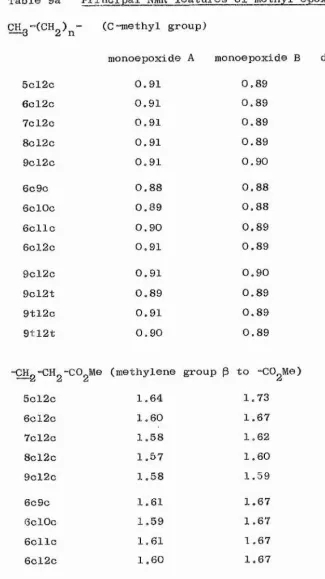
up to four methylene groups apart from a proton, slight deshielding -a influences can be recognised. Tables 9a to e and Table 10 show
the shift values of all the major signals and these are discussed below.
1) C-methyi Group
The three protons of the terminal CH group give a distorted triplet (J=7) at 0,88 to 0.926. A deshielding influence is
noticeable for various groups occupying the 12,13-position. With a cis-epoxy group also present in 9,10-position the order of this deshielding effect is:
12,13 functional group a epoxy cis trans saturat» d
6 0.92 0.91 0.90 0.89 0.88
The effect falls off rapidly when more than four CH_ groups separate the methyl group from either the unsaturated centre or the epoxide
group. It is expected that li'Os w<ntld be j'xn • significant with groups closer to the terminal methyl gro u but there were no examples of this type among our compounds.
” 34 ■“
2) Chain Methylene Groups
The protons of methylene groups only weakly deshield«d produce signals of complex shapes in the region of 1.28 to 1.486 and constitute the most intense signals of the spectrum. Because some methylene groups are slightly more deshielded than others, two peaks (sometimes three) are observed which give some indication of the relative positions of the strongly deshielding double bond, ester and epoxy groups. As the position of these groups differ in the various isomers, the intensities of the low and high field parts of the band are found to vary too. The integrals of the signals suggest, on a qualitative basis, that the signal at lower field ( 1,486) is caused by CH^, groups which are a to an epoxy group or p to an unsaturated centre or y to the ester function.
3) Methylene Group P to-CO^Me
The signals for the protons of this group always separate from the polymethylene band and appear as a distinct signal in
the range from 1.57 to 1.746. Superimposed on the strong deshielding effect exerted by the ester function, weaker deshielding influences are noticeable for the epoxy group and the double bond. This influence is relatively prominent when either of the two groups is located between C(5) and C(6), but decreases rapidly as the distance between C(3) and this deshielding group increases. The epoxy group appears to have the stronger effect of the two . Generally the signal for this CH^ group appears as the expected quintet (J=7), In the spectra of some diepoxides this signal is somewhat obscured by a multiplet due to the CH^ group deshielded by two neighbouring epoxy groups.
35
-olefinic epoxides these signals appear in the region from 1,98 up to 2,266 where they are overshadowed by the strong triplet due
103
to the C(2) protons. Unpublished results by Frost confirm our
overlaps with the triplet caused by the C(2) protons and is
sometimes completely obscured by this always very prominent triplet. Nevertheless, integration confirms that four protons are contributing to the overlapping signals of this region, two of them being allylic.
observation that in certain olefinic epoxy esters the signals of | allylic protons overlap with that of the protons attached to C(2), 4
When n = 4 or 5 both CH groups a to the double bond are quasi S equivalent, and only one signal is observed at 1,98-2,026. When
n becomes smaller the internal CH^ group comtes under the additional I; deshielding influence of the epoxy group resulting in the broadening
and eventually the splitting of the signal into two parts. The spectrum of methyl cis-6,7-epoxy 18;l(10c) for example (n=2) shows
two fully resolved quartets centred at 2.016 (J=6,5) and 2.156 J (J=7) each representing two protons. For the other olefinic
epoxides where n = 2 or 1 the signal for the internal allylic CHg group appears to be shifted even further downfield, so that it
The less deshielded external CH^ group is always seen as a multiplet I of four or more lines at 1,98 to 2.076.
In acetylenic epoxides with n=l the external propargylic protons produce a strongly distorted triplet (J=7) around 2,116, The protons of the internal methylene groups being strongly
deshielded by both the triple bond and the epoxy group are considered to give rise to a doublet (J=17) which is centred at 2.516 and
exhibits a complex fine structure.
5) Methylene Groups Adjacent to -COgMe |
The protons of the methylene groups a to the ester group produce a triplet (J=7.5) with the centre around 2,20 to 2,31"',
36
-with the C(3) protons. The deshielding effects caused by the double bond in variable positions are comparably weak. In the spectrum of the mono- or diepoxide with an epoxy group in the 5,6-position, a multiplet of six lines is observed which can be
analysed into two triplets (J=7,5) separated by 4Hz, A similar nonequivalence of the two C(2) protons is found in the 220 MHz
103 spectra of the methyl 5,6-epoxyoctadecanoates for which Frost reports values of 13,5 and 1 Hz for the cis and trans epoxides respectively.
6) Epoxide Protons
The signal for the two epoxide protons of the unsatur?ted epoxy esters examined is a poorly resolved multiplet. Its shift depends in the first instance on the geometry of the epoxy groups and to a lesser extent on its position in the molecule.
For cis epoxides (n=l to 5) signals are found between 2.69 and 2.76Ô, whereas for the trans epoxides (n=l) the signal appears
around 2,50b), These values are in close agreement with the
results obtained for the corresponding saturated cis respectively 78
trans epoxides , The slight variations of these shifts indicate a weak deshielding effect caused by the double bond. In the 5,6-and 6,7-epoxides another influence seems to come from the carbo- methoxy groups. Influenced by both the double bond and the ester group the epoxide protons of methyl cis-6,7-epoxy 18:1 (9c) exhibits the greatest shift (2,756) amongst our isomeric monoenoic epoxy esters. The geometry of the double bond does not make any difference to the shift of epoxy protons.
-
37
-poorly resolved, also represents one proton. For the two acetylenic trans epoxides only one signal centred at 2.62 or
2.636 is observed. It is a complex multiplet which overlaps partly with the signal resulting from the inner propargylic protons.
In the diepoxides the two epoxy groups influence each other, and so the shift varies slightly from 2.726 for n=6 to 2.776 for n=2. With n=l, the two protons of each epoxy group differ so much
0 p
/ \ , /\
-CH-CH~(Cli„)
-CH-CH-that they give rise to two separate signals. Two partly resolved complex multiplets with centres around either 2,79 and 2,916 or 2,52 and 2,656 are seen in the spectra of cis,cis and trans,trans diepoxides respectively. The low field part of the signal
represents the pair of inner protons [c(10) and C(12)], whereas the other part stands for the less deshielded pair of outer protons
[C(9) and C(13)]. In the mixed cis,trans diepoxides four signals are observed each.representing one proton. The signals appear at 2.55 and 2.666 (trans-epoxy group) and at around 2,78 and 2,926
(cis-epoxy group),
7) Ester Methyl Group
All the spectra show a sharp singlet at 3,58 to 3.616 which is due to the three protons of the carbomethoxy group.
8) Olefinic Protons
The olefinic protons are the most highly deshielded in the spectra of the olefinic epoxy esters. They give rise to a rather complex multiplet which is most clearly resolved when n=l. A more or less symmetrical signal of nine lines is then obtained. The separation of these lines varies between 6 and 7.5 Hz, No consistent differences concerning pattern and shift of the signal are observed between cis- and trans-olefinic protons.
“ 38 “
and the carbomethoxy groups. So the compound with the double bond furthest removed from both these deshielding groups^ ie, methyl cis-5,6-epoxy 18:1 (12c), produces the signal with the smallest shift (5,276), whilst the signal of methyl cis-9,10-epoxy 18:1 (6c), where both groups are nearest, show the largest shift (5.426).
The results discussed on the preceding pages show that NMR spectroscopy can provide much information about the
structural features of various monounsaturated epoxy esters and diepoxy esters. Not only the types of functional groups are revealed (carbomethoxy groups, epoxide, alkene or alkyne), but to some extent also their relative positions.
Diagnostic differences are caused by the deshielding influence of the three functional groups. Though strongest for protons on adjacent carbon atoms, deshielding influences are noticeable on protons which are separated by up to four methylene groups from the deshielding centre.
The chemical shifts for protons of cis and trans epoxy groups differ clearly by 0,23 ppm. So. NMHp spectroscopy, even if it does not provide a complete structural analysis of
unsaturated epoxy esters, shows unambiguously the geometry of the epoxy groups which was not revealed by our mass