Workload-Ahead-Driven Online Energy Minimization Techniques for
Battery-Powered Embedded Systems with Time-Constraints
Yuan Cai
,
Marcus T. Schmitz
,
Bashir M. Al-Hashimi
,
Sudhakar M. Reddy
Department of Electrical and Computer Engineering, University of Iowa
E-mail:
yucai, reddy
@engineering.uiowa.edu
School of Electronics and Computer Science, University of Southampton
Email:
ms4, bmah
@ecs.soton.ac.uk
Abstract
This paper proposes a new online voltage scaling (VS) tech-nique for battery-powered embedded systems with real-time con-straints. The VS technique takes into account the tasks execu-tion times and discharge currents to further reduce the battery charge consumption when compared to the recently reported slack forwarding technique [13], whilst maintaining low online com-plexity of . Furthermore, we investigate the impact of on-line rescheduling and remapping on the battery charge consump-tion for tasks with data dependency which has not been explic-itly addressed in the literature and propose a novel reschedul-ing/remapping technique. We demonstrate and compare the ef-ficiency of the presented techniques using seven real-life bench-marks and numerous automatically generated examples.
1 Introduction and Previous Work
Dynamic voltage scaling (DVS) is a powerful technique to re-duce the energy consumption in embedded computing systems. DVS algorithms can be broadly classified into offline and online techniques depending on when the voltage settings are computed. Offline (e.g. [1, 2, 3]) approaches calculate voltage settings at de-sign time before actual execution based on worst case execution times (WCET) to guarantee satisfaction of time constraints. Al-though offline DVS avoids a run-time overhead due to the voltage calculation, it fails to exploit online slack arising from tasks
ex-ecuting with less than their WCET (differences 10 times have
been reported [4]). On the contrary, online DVS techniques (e.g. [5, 6, 7]) perform the voltage calculation during run-time to uti-lize such online slack by taking into account the actual execu-tion times (AET) of tasks. Clearly, online techniques have the potential to achieve higher energy savings, however, it is neces-sary to carefully design such online DVS algorithms in order to avoid high run-time overheads that could jeopardize the achiev-able energy savings and the timing constraints. An aggressive on-line voltage adjustment approach has been presented in [5]. Here only the next task to be executed is considered during the volt-age calculation. The online approach introduced in [6] calculates the scaling factor for soft aperiodic tasks and considers run-time variations. Zhu and Muller [7] utilize a feedback control loop to facilitate DVS and integrated the controller into an earliest dead-line first (EDF) scheduler. Task scheduling and ondead-line voltage scaling are combined in [8]. This work, however, is limited to identical PE systems and a straightforward extension toward het-erogeneous systems is not apparent. Shin and Kim [9] give a path based intra-task DVS algorithm. The task is modeled as a con-ditional flow graph in which there is a worst case execution path (WCEP) and an average case execution path (ACEP). Their al-gorithm inserts voltage scaling points at branch or loop nodes to
This work is supported in part by the EPSRC, U.K., under grant GR/S95770
scale the voltage online based on the ACEP instead of the WCEP. The work in [9] is orthogonal to the proposed algorithm which determines the voltage on task-by-task basis (i.e., inter-task volt-age scaling).
Although the offline and online voltage scaling techniques in-troduced above are effective in reducing energy dissipation, they are not efficient in prolonging the battery lifetime of mobile ap-plications, since the non-linear battery characteristics [10, 11] are neglected during the optimization. In [12] an offline DVS tech-nique for battery-powered systems was introduced, and it was demonstrated that up to 56% longer battery lifetimes could be achieved by taking into account the non-linear battery behavior during voltage calculation. More recently the first online and battery-aware DVS technique has been presented in [13]. This technique specifically targets periodic, independent tasks and as-sumes identical discharge currents for each task. According to this assumption, it is always better to exploit the available slack by the last task in the schedule [13]. Based on this, the authors in-troduce a slack forwarding technique that delays the utilization of online slack as late as possible. However, for many realistic mul-tiprocessor systems executing heterogeneous tasks, this assump-tion limits the achievable savings in battery charge consumpassump-tion. This paper makes the following contributions: (a) We introduce a workload-ahead-driven online DVS technique which explicitly takes into account the workload-ahead (the sum over all products of discharge current and WCET of remaining tasks) to overcome the limitation of [13] discussed above. The proposed algorithm achieves longer battery lifetimes compared to slack forwarding algorithm without sacrificing the online time complexity, which
remains constant, i.e. , since the workload used in the
al-gorithm is computed in the offline phase. (b) In addition to the online voltage scaling, we address for the first time the problem of online task rescheduling and remapping for tasks with depen-dencies to further reduce the battery charge consumption. The proposed online rescheduling/remapping algorithm facilitates the usage of the workload-ahead-driven DVS technique and also has
a complexity of . The rest of the paper is organized as
fol-lows. Section 2 outlines the system and battery models. Section 3 presents the problem formulation. The proposed workload-ahead-driven online DVS technique is introduced in Section 4. Section 5 describes the proposed online rescheduling and remapping ap-proach. Experimental results and conclusions are given in Sec-tions 6 and Section 7, respectively.
2 Preliminaries
2.1 System Model and Task Graph
(c)
CL CI CI
PE1 PE0
PE0
CL
PE1
CI: communication interface
(a)
0
τ τ3
1
τ τ2
γ01γ02
γ13 γ23
0.8ms 1.2ms 0.6ms
1ms
τ τ0
1 τ2
τ3
γ13
0.2ms γ23
0.2ms γ02
0.3ms γ01
0.2ms 0.6 1
3.2 4 4.2
(ms)
online slack
AET
3 1.8 1.2 0.8
offline slack
WCET AET
deadline: 4.2ms B: Battery
C: Converter C B
[image:2.612.53.283.48.123.2](b)
Figure 1.Task graph and system model
system functionality is captured by a task graph model ,
Fig. 1(b). Nodes ( ) in this directed acyclic graph (DAG)
represent computational tasks. Edges ( ) denote data
com-munications between tasks. As shown in Fig. 1(b), tasks/edges are associated with worst case execution times (WCETs). The
WCETs depend on the worst case number of cycles ( )
re-quired for execution and the circuit frequency , which in turn
depends on the supply voltage and threshold voltage [1]:
!
"$#% '&
(1)
where
!
and( are technology related constants. The power
dissi-pation of a task can be expressed as [2]:
)
+*-, /.
(2)
where * , is the effective switched capacitance of the circuit.
Eqs. (1) and (2) provide the well-known energy/delay tradeoff ex-ploited by all DVS approaches. Since the discharge current drawn from the batteries follows0
)21
"+3546 (where3 and6 are
the average battery voltage and the converter efficiency respec-tively), DVS can be used to influence the battery discharge current and, as a results, it can be used to achieve savings in the battery charge consumption [10, 11]. We assume that tasks and edges have been initially (offline) mapped and scheduled onto the target architecture, such that resource and time constraints are satisfied under WCETs, Fig. 1(c). At run-time, however, tasks might fin-ish before their WCET, resulting in online slack. For instance, in
Fig. 1(c) 7 has an actual execution time (AET) of 0.6ms, leaving
an online slack of 0.48:9. 2.2 Battery Model
Rao et al. give a comprehensive survey on battery modeling in [14]. In this work we use an analytical high-level battery model proposed in [10] whose accuracy has been demonstrated to be within 3% of the physical battery. The battery charge consump-tion (reflecting the battery lifetimes) is:
;2<>= ?@
A
7
0
@
4 BCD9
@
9
@-EGF@
IH (3)
where J is the total number of steps used to approximate the
load current profile (LCP), and0
@
,
FK@
and9
@
denote the current, the duration and the start time of9
ILIM
@
in the LCP, respectively.
Further,C is the time duration that the battery has been charged
for andH is a constant related to the non-linear property modelled
by functionB :
BONPIQ+IRSH
R#TQ EGU
=
7
?
V
A
=
L
<WX
V
XZY\[<+] ^
#
L
<W_X
V
XZY\[<+`a^
H
.
8
.
(4) As smaller charge consumption (Eq. 3) will lead to longer battery lifetime [10], our optimization objective is the minimization of the charge consumption.
3 Problem Formulation
We assume that the tasks
cb
'd and precedence
con-straints eb
d of task graph have been initially
mapped and scheduled onto a distributed architecture containing voltage scalable processors, which can vary their supply voltage
within a continuous range f
V
hg Vji
[lk
. The worst case
clock cycles ( ) that each task needs to be executed as well
as its discharge current are known. In addition, some tasks may
be associated by a deadline mon. The problem addressed by the
proposed online technique is twofold. Firstly, each time when
a task
g,
[
is to be executed on a voltage scalable processor,
an appropriate voltage+gl,
[
for its execution has to be selected
such that the battery charge consumption is minimized (taking into account the workload-ahead) and all imposed deadlines can be guaranteed. This step is essential to exploit online slack that arises from variations in the execution time of tasks. Secondly, for the initially (statically) given mapping and scheduling, some online slack could be potentially wasted, as demonstrated in the motivational example of Section 5. To avoid this waste, the ini-tial mapping and scheduling should be adapted in accordance to the available online slack, i.e. online rescheduling and remapping should be performed. The online voltage scaling problem is ad-dressed in the next section, while rescheduling and remapping are the subjects of Section 5.
4 Battery-Aware Online Voltage Scaling 4.1 Motivational Example
The essence of the online voltage scaling problem is the online slack distribution, in order to efficiently exploit slack resulting from tasks that execute faster than their WCETs. In this motiva-tional example we outline two different slack distribution meth-ods using a realistic task graph from the E3S suite [17], namely the office-auto benchmark consisting of 5 tasks, Fig. 2(a). For simplicity we consider here that all tasks have been mapped to a single processing element and the execution order corresponds to Fig. 2(b). We assume that the PE can vary its supply voltage
be-tween
V
pg and Vji
[
, with
V
hg rqtsu
4v Vji
[
. In accordance, the task execution times follow Eq. (1). Table 1 gives the
worst-case execution time (WCET) and discharge current (0 ) of each
task (in execution order of Fig. 2(b)), when executing at
Vji
[
. Furthermore, the table shows the actual execution time (AET) of tasks at run-time (we assume here 80% of WCET), as well as the resulting online slack (WCET-AET). The deadline is assumed to correspond to the finishing time of the last task (Zw ), when all
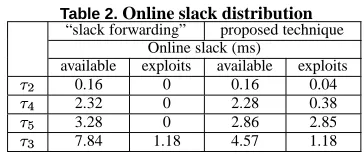
tasks execute with their WCET. Table 2 shows the outcome of two different techniques that distribute the available online slack. Note that not all the available online slack might be exploited due to the limited voltage range of the PE. The first technique is based on the slack forwarding idea presented in [13], in which all avail-able online slack is forwarded to the last task. Accordingly, task
w accumulates an online slack of 7.84ms (0.16+2.16+0.96+4.56)
before it starts execution. Nevertheless, due to the limited voltage range of the PE, it is only possible to make use of 1.18ms of the total slack, i.e., 6.66ms of slack remain unexploited. As a result, a battery charge of 0.189mAs can be calculated from Eqs. (1)– (4) and the task properties given in Table 1. A second approach (the approach we propose in this paper) distributes the available online slack by explicitly considering the discharge currents and WCETs of tasks. That is, each time a task finishes execution, the workload-ahead (sum over products of discharge current and WCET of remaining tasks) is evaluated to make a slack
distribu-τ4
τ1 τ2 τ3
τ5
τ3
τ1 τ2 τ4 τ5
t
[image:2.612.321.508.656.711.2](a) (b)
tion decision. The method is outlined in Section 4.2, however, the resulting slack distribution is given in Table 2. As we can observe from the table, using this method all tasks are assigned some of the available slack. For instance, after task
=
has finished exe-cution the available online slack that is exploitable by task
.
is 0.16ms. However, it exploits only 0.04ms of this slack via volt-age scaling, while the remaining 0.12ms are accumulated for the
workload ahead. Therefore, after
.
finishes the available slack is
2.28ms (2.16+0.12). As shown in Table 2, task exploits 0.38ms
of this slack. Similarly, the slack is forwarded and distributed to
the tasks and w . When w is to be executed, the available
online slack (4.57ms) is still sufficient to scale its voltage to the
lowest level, i.e. w obtains the same amount of slack then with
[image:3.612.322.504.54.131.2]the slack forwarding approach. According to the second distri-bution, the consumed battery charge is reduced to 0.154mAs, an improvement of 18.5% when compared to the slack forwarding method [13].
Table 1.WCETs, discharge currents, AETs and online slacks of auto-office tasks
=
.
w
WCET (ms) 0.79 10.80 4.80 22.81 0.79
(mA) 0.256 4.066 3.990 2.243 0.256
AET (ms) 0.63 8.64 3.84 18.25 0.63
online slack (ms) 0.16 2.16 0.96 4.56 0.16
4.2 Workload-Ahead-Driven Online DVS Technique
As we have seen in the motivational example of Section 4.1, slack forwarding is not particularly effective for heterogeneous tasks which draw different currents from the battery and require different WCETs. An effective online DVS algorithm must take these aspects into consideration to achieve a “globally” fair distri-bution of online slack. To cope with this problem, we define two metrics that capture the effects of tasks on the battery charge con-sumption. Assume that the next task to be scaled and the set of unscaled (ahead) tasks are denoted asZgl,
[
and , respectively,
with gl,
[
j .
Definition 1: We define the workload ( ) of a task as the
product of its discharge current 0 and WCET, i.e. T
0a 4 * .
Definition 2: We define the workload-ahead (
) of a task
as the sum of the workloads of all remaining tasks in , i.e.
. The workload-ahead-driven slack
distri-bution gives the slack to the next task based on the ratio of its
and :
9 n
!
g,
[
g,
[
$g,
[
4_9 (5)
where_9 is the available online slack. It should be noted that
both and for each task are computed in the offline phase,
so this computation does not contribute to the online complexity of the algorithm. It is also important to note that it is our aim to develop an effective yet fast online DVS technique, hence we intentionally avoiding a complex online algorithm. The work-load as given in Definition 1 is the main source of battery charge consumption, i.e. larger workloads will consume more battery charge [10]. Hence, by using Eq. (5), tasks with heavy workload are scaled more aggressively than light weight tasks. Although we use here the WCETs to compute the workloads, it is possi-ble to leverage information regarding expected execution times (EETs), if such information is available. In the case that EETs are known in advance, these values should be used rather than WCET in order to compute the workload-ahead more accurately. Another important factor affecting the battery charge consump-tion is the posiconsump-tion of a task in the schedule (the later a task is in the schedule, the smaller should be the current it draws [11]). It is apparent that this factor is also taken into account by Eq. (5):
Table 2.Online slack distribution
“slack forwarding” proposed technique Online slack (ms)
available exploits available exploits
.
0.16 0 0.16 0.04
2.32 0 2.28 0.38
3.28 0 2.86 2.85
w 7.84 1.18 4.57 1.18
the later a task is in the schedule, the smaller its , and as a
result, it will receive relatively larger slack and its current will be smaller as expected. For example, from Tables 1 and 2 we can
observe that task has the largest workload (22.81ms42.243mA)
and its position is close to the end of the schedule and as a re-sult, it obtains the largest slack portion (2.85ms). Note that we only calculate the slack distributed to the next task. It is not nec-essary to distribute slack to tasks beyond the next task because the total amount of online slack will change with the execution of the next task, hence, a recomputation of the distribution is re-quired. Based on above outlined workload-ahead principle, Fig. 3
Algorithm: WAD-DVS
Input: - gl,
[
, "! g,
[
,# , "$&%&'
gl,
[
, ()'
gl,
[
,
$+*,-,'/.1032 Output: -4 g,
[
01:57698;:29<)2>=?88;@BA>CEDF@<GA>8;@,-8.103032H.I@8;2JLK&M-NPOQ 02: R<PJ7.1<P2 A>JS@TDFC =()'gl,
[
–$+*,-,'/.1032 ; 03: AUJ7@TD>C g,
[
=R<)JL.1<)2 A>JS@TDFCWV ( g,
[
/!& g,
[
); 04: X,2YU*2><)DZK g,
[
=# /( "$&%[' gl,
[
+AUJ7@TD>C g,
[
); 05: $&R0]\?*^8;2_4 g,
[
a`bKcAUR-JLd.1<Pe+%cYgfh Ui
j
.18;:]Cg<)R
j
<4 a@T<PH&X,2UY*^2U<)DZKZgl,
[
; 06: ,2>8I*^,<G4ogl,
[
Uk 07:Ol7m>O
08: DF@gJ7J RM-RS-DVSk // (Fig. 6) 09:OQ)n3576
Figure 3.Pseudo code: Workload-ahead-driven online DVS
gives the pseudo code of our workload-ahead-driven voltage scal-ing algorithm. Its input consists of the information regardscal-ing the next task. This information includes the task’s workload ( gl,
[
)
and workload-ahead ( g,
[
), its worst case number of cycles
( ) and execution time ( * g,
[
), as well as its offline
de-cided start time (o9 g,
[
). In addition, the algorithm requires the
current time (*qp)rTrTEs8
L
) in the schedule. When a busy PE fin-ishes executing a task or an idle PE receives an incoming data communication, it calls the online voltage scaling algorithm. If the next task on the PE can start immediately (line 1), the avail-able online slack is computed from the current time and the start time of the next task
gl,
[
(line 2). The slack distributed to
gl,
[
is calculated based on Eq. (5) in line 3. According to the amount of distributed slack, the frequency and voltage at whichZg,
[
has
to be executed are computed in lines 4 and 5. Then the algorithm returns g,
[
and terminates in line 6. On the other hand, if the
next task could not start at this moment due to the lack of needed
input data (e.g. w in Fig. 1 (c) can not start when 7 finishes
since
.
w has not arrived yet), the algorithm calls the online task
rescheduling/remapping procedure described in Section V (line 8). It is important to note that each step in the algorithm can be
performed in constant time ( ), hence the overall complexity
is . The constant complexity allows the scaling overhead be
incorporated into the WCET of tasks during timg analysis [15]. In the above described online voltage scaling algorithm, no task will start later than its offline decided start time, so the timing constraint of each task is guaranteed and all hard deadlines are satisfied.
5 Online Task Rescheduling and Remapping
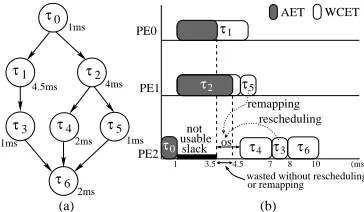
[image:3.612.305.525.257.393.2]than their WCET. The reason for this is the fact that earlier finish-ing tasks might result in other tasks becomfinish-ing ready for execution earlier, however, the static schedule ”unnecessarily” delays such tasks. To avoid this waste of online slack, we introduce online task rescheduling and remapping as supplements of the proposed online DVS (Section 4.2). Fig. 4 outlines the integration of the workload-ahead-driven DVS technique with the rescheduling and remapping strategy. The necessity for online rescheduling and remapping is illustrated through a motivational example.
5.1 Motivational Example
Fig. 5(a) shows a task graph consisting of 7 nodes. The
WCETs of tasks are indicated, and the tasks are mapped and scheduled on 3 PEs, in accordance to Fig. 5(b). For simplicity we neglect communications in this example, however, they are considered in our algorithm. As we can observe from Fig. 5(b),
=
has a longer WCET (4.5ms) than
.
(4ms). However, let us
assume that
=
requires only 2.5ms for execution at run-time, i.e. it finishes at 3.5ms. When
=
finishes, there is an online slack
ap-pearing on PE2 (indicated as os in Fig. 5(b)), but can not start
its execution earlier because its parent task
.
has not terminated at this moment. Clearly, a large portion of the online slack on
PE2 is wasted. To avoid this waste, task w on PE2 can be placed
before to fill the available online slack. That is, we change
the execution order of the remaining tasks (rescheduling). How-ever, the WCET of the rescheduled task must be smaller than the available online slack to avoid the delay of the start time of the remaining tasks, which could result in potential deadline
viola-tions. For example, to be rescheduled, the WCET of w must be
smaller than os. If the WCET ofZw is longer than the slack, then
we can further search the remaining tasks of other PEs to see if
there is suitable task. In the example of Fig. 5(b),T on PE1 can
be fetched from PE1 to fill the online slack on PE2, i.e., T is
remapped online.
5.2 Online Task Rescheduling and Remapping Technique
Our aim is to facilitate online voltage scaling to avoid online slack waste. Similar to our online voltage scaling, we want the online rescheduling and remapping techniques to be independent of the number of tasks, in order to minimize its computational overhead. Therefore, we will not take all the remaining tasks into consideration, instead, an effective yet fast local search strat-egy is proposed. The pseudo code of our online task
reschedul-ing/remapping is given in Fig. 6. Suppose there are PEs in the
system and theM
th (
M
) PE is the one with the poten-tially wasted online slack. Let each PE have anL
N
L
p
L
p
L
stor-ing tasks to be executed and let be a constant integer called
the search window. The search window represents the maximal number of tasks inL
N
L
p
L
p
L
that are potentially to be resched-uled or remapped. The complexity of the algorithm is bounded by the search window, which is constant. The algorithm first
re-stricts the search window if the number of tasks inL
N
L
p
L
p
L
is smaller than (line 1), then searches
L
N
L
p
L
p
L
of PE[M
]
within the search window to fill the online slack on PE[
M
]. To be a rescheduling candiate, a task should satisfy two conditions (line 4). First, its WCET (we still only know WCET of
remain-possible? Re− scheduling
Re− possible? mapping next task
Information
of the task start Can next now?
Remapping Rescheduling
Perform WAD
PE remains
idle
No No
No
Yes Yes Yes
Figure 4.Integrated workload-ahead-driven DVS and rescheduling/remapping
τ0
τ1 τ2
τ4
τ3 τ5
τ6
τ1
τ5
τ6
τ3
τ4
AET WCET
(a) (b)
PE2 PE1 PE0
remapping rescheduling
1 3.5 4.5 7 8 10 (ms)
wasted without rescheduling or remapping 2ms
1ms 2ms 1ms
4.5ms 4ms 1ms
slack usablenot os
τ2
[image:4.612.322.504.46.152.2]τ0
Figure 5.Online task rescheduling and remapping
ing tasks at this moment) is less than the online slack so that the next task will start no later than its offline decided start time. For
example, in Fig. 5, the WCET of w is less than the online slack
and is guaranteed to start on time. This condition prevents
any deadline violation. The second condition is that at the time of the search, all its incoming data communications have arrived so that it can start at this moment. If these two conditions are true, the found task is moved to the head of the execution queue and placed before the next task
g,
[
(line 6). Then the proposed
online DVS procedure is called (line 11) to utilize the otherwise wasted online slack. As indicated in Fig. 4, if no suitable task for rescheduling has been found, task remapping will be performed (line 12-28). Similar to online rescheduling, online remapping
Algorithm: RM-RS-DVS
Input: - gl,
[
, "!
g,
[
, "$&%['
gl,
[
, (a'
gl,
[
,
#
, $+*^,,'/.10 2 ,
Output: -4 g,
[
01:5QM9C 03.< h A>.29RX[%\If2>=2 &*^2U*^2
i
; 02:PlBAU2@,DF: ,2A>*^JL8 X?@TJA>2;
03:6
MqC //online rescheduling 04: 576[%\If2>=2 &*^2U*^2 !TAU@8I.;AX.I2A
,-2-AUDF:2H*^JL.1<Pe/DFR<)H.18I.1R<aA M-NPOBQ 05: A>2@,DF: ,2-AF*^J78 8I,-*^2 ;
06: 03RdT2_2U=2 &*2>*^2 "-8;R_8;:29:2U@gH RX]2>=2 &*^2U*^2; 07: `b,2U@gC ;
08: OBQ)n 5L6 09:OQ)nG6#
10:576_A>2@,DF: ,2-AF*^J78$ 8I,-*^2 M-NPOQ 11: DF@gJ7J WAD-DVSk // (Fig. 3) 12:Ol7m>O // online remapping 13: 6#9.
M]<&%$% .(' \
14: C) 0W.1< h* A>.T2 RX+[%.,If2>=2 &*^2U*^2
i
;
15: 6#
M-EC
16: 576.[%.,If2>=2 &*^2U*^2 !TAU@8I.;AX.I2A ,2>0 @>\\.<Pe D>RU<)H.18I.IR<)A M-NPOQ 17: A>2@,DF: ,2A>*^JL8/ 8I,-*^2;
18: X?2>8;D>:c8;@gAUC0[%.,If2U=2 &*^2U*^21"X,RU02[%.3@T<PH \?*^8^.18^8;R 8;:^2 :^2U@gH RX+[%\If2U=2 [*^2>*2; 19: `b,-2@TC ;
20: OQ)n 576 21: OBQ)n36# 22: OBQ)nW6#
23: 576 AU2@,DF: ,2A>*^JL8$ 8I,*2 M-NPOBQ 24: DF@TJSJ WAD-DVSk // (Fig. 3) 25: OBlSmFO
26: J72U8[%\`Z29.IHJS2; 27: OBQ)n 5L6
[image:4.612.302.530.319.628.2]28:OQ)n3576
Figure 6.Pseudo code: Online rescheduling/remapping
checks tasks in the search window ofL
N
L
p
L
p
L
[image:4.612.50.285.661.718.2]the task queue of its originally mapped PE to N p p head
of PE[M
] (line 18), which then will call the proposed voltage scal-ing procedure (line 24). If no task can be found remappable, the idling of PE[M
] is not avoided and the online slack is wasted (line 26).
The complexity of the rescheduling/remapping algorithm is constant due to the fixed search window. As we will see in Sec-tion 6, the search window size is usually a small number, hence the computational overhead of the rescheduling/remapping algo-rithm is very low.
6 Experimental Results
In order to validate the effectiveness of the proposed online voltage scaling and rescheduling/remapping strategies in reduc-ing battery charge consumption, we conducted several experi-ments using 30 hypothetical examples as well as 7 real-world benchmakrs. The hypothetical examples have been automatically generated using TGFF [18], a pseudo-random task graph gen-erator. The first 5 realistic examples have been taken from the E3S benchmark suit [17] (auto-indust, consumer, office-auto, net-working and telecomm), while the task graphs for GSM decoder and encoder have been derived from publicly available C code [19]. All reported results have been obtained using the battery model of Section 2.2 and the evaluation criterion is the battery charge consumption. Further, the evaluation is based on the same normal distribution (mean: 0.6 times the WCET, standard devia-tion: 0.13 times the WCET) of the actucal execution times of tasks that has been used in [13]. In the first set of experiments, we eval-uate the efficiency of our workload-ahead-driven DVS algorithm (WAD, Fig. 3) by means of a comparison with 4 different online DVS techniques, summarized for reference in the following: 1.
ASU: This heuristic is based on the slack distribution technique AlterSlackUtilization presented in [10]. Although this technique
was originally proposed as offline technique, we have extended it towards online DVS by calculating voltage setting each time before a task starts execution. The satisfaction of deadlines is imposed by considering WCET for each executing task. It is im-portant to note that this approach has a high computational
run-time overhead (for each finishing task . , where is the
number of the remaining tasks and reflects the complexity of
the battery model). However, we use this approach due to its so-lution quality as a baseline for comparison. 2. SF: The slack forwarding approach is based on the technique presented in [13].
Its time complexity is constant ( ). 3. ACD: The average
current-based distribution is a heuristic that leverages informa-tion regarding the task discharge currents to distribute slack: if the current of the next task to be executed is less than or equal to average current of tasks, it gets no slack; else, it gets some slack such that its current decreases to the average value. When there is only one task left, all slack is assigned to it. The time complexity of this method is constant, too. We use this heuristic to under-line the importance of the workload-driven technique that consid-ers discharge currents as well as remaining task execution times.
4. WAD: This represents our workload-ahead-driven distribution
technique, as introduced in Section 4.2. It has also a complexity
of . Since the slack forwarding idea [13] is most suitable for
task sets without data communications, we executed the 7 realistic
benchmarks on single PE systems1, in which the inter-PE
com-munications between tasks can be neglected. Table 3 gives the results in terms of battery charge consumption. In the table, the first column gives the benchmark name and the number of tasks in the benchmark. The results of the 4 online DVS techniques
1Note that not all these benchmarks can be executed on a single PE
without violating timing constraints. We therefore adjusted the deadlines such that no violation occurred under WCETs.
Table 3.Results of online DVS in single PE systems
Bench- battery charge consump. (mAs) Improvem. (%)
mark ASU SF ACD WAD
(# task) qh<
.
i
qh Ui
qh Ui
qh Ui
1 (28) 0.248 0.372 0.372 0.247 33.67 33.67
2 (27) 4.687 7.136 7.136 4.690 34.28 34.28
3 (5) 0.104 0.126 0.118 0.104 17.86 11.86
4 (23) 0.873 1.125 1.125 0.863 23.29 23.39
5 (42) 0.289 0.387 0.387 0.287 25.69 25.69
6 (34) 4.394 6.785 6.595 4.365 35.66 33.81
7 (53) 5.877 9.044 8.419 5.755 36.36 31.65
1: Auto-ind.; 2: Consumer; 3: Office-auto; 4: Network; 5: Telecom; 6: GSM decoder; 7: GSM encoder
are given in Columns 2–5. In the last two columns we show the percentage of improvement in battery charge consumption us-ing the proposed WAD method over methods SF and ACD. We can observe that ASU yields consistently the lowest battery con-sumption when compared to SF and ACD, while the results pro-duced by our WAD technique are very close to ASU and in some cases even slightly better. Consider, for instance, the GSM de-coder benchmark. Here ASU obtains a battery charge consump-tion of 4.394mAs, while SF and ACD result in 6.785mAs and 6.595mAs, respectively. Nevertheless, WAD achieves the lowest value with 4.365mAs, resulting in improvements of 35.66% and 33.81% over SF and ACD, respectively. This clearly indicates the high solution quality of the proposed approach at low computa-tional complexity.
The second set of experiments was conducted to vali-date the workload-ahead-driven DVS as well as the reschedul-ing/remapping techniques in the context of systems consisting of multiple processing elements. We used LOPOCOS [16], an aca-demic system-level synthesis tool, to find suitable multiple PE implementations and to generate the offline mappings and sched-ules for all 36 benchmarks (GSM decoder and encoder have been combined into a single benchmark). In all experiments we set
the search window size ( ) of the rescheduling/remapping
algo-rithm to 10, empirically found to be a good value. Nevertheless, due to the importance of the window size on the solution quality we have devoted an extra set of experiments on this subject, pre-sented later in this section. Since the slack forwarding technique [13] was particularly introduced for independent tasks, we refrain in these experiments from a direct comparison.
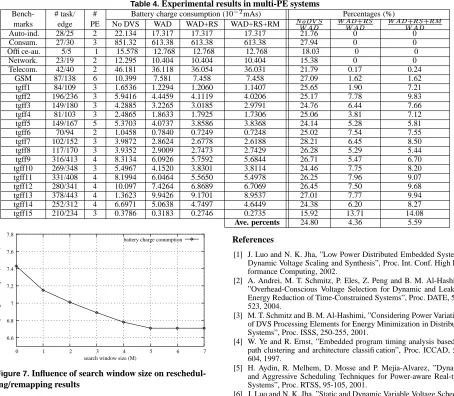
The results of our experiments are summarized in Table 4. Due to the limited space, we only show 15 of the TGFF benchmarks. The first, second, and third columns give the benchmark name, the number of tasks/communication edges, and the number of PEs in the system, respectively. Columns 4–7 show the battery charge consumptions in 4 different scenarios. Column 4 (No DVS) repre-sents the nominal charge consumption, i.e., when no online volt-age scaling is employed; Column 5 (WAD) shows the results of the proposed workload-ahead-driven DVS technique; Columns 6 (WAD+RS) and 7 (WAD+RS+RM) give the charge consumption when integrating WAD with online rescheduling and reschedul-ing with remappreschedul-ing, respectively. Columns 8–10 summarize the achieved battery charge savings in percent. Consider, for instance, benchmark tgff2. Here the nominal and the WAD-based charge
consumptions are 5.941610
q
<
. mAs and 4.4459
q
<
. mAs,
respectively, representing a saving of 25.17%. This can be fur-ther improved by using rescheduling as well as rescheduling with
remapping to 4.1119
q
<
. mAs and 4.0206
q
<
. mAs,
respec-tively, obtaining further saving of 7.78% and 9.83% when com-pared to using WAD only.
Table 4.Experimental results in multi-PE systems
Bench- # task/ # Battery charge consumption (10
<
. mAs) Percentages (%)
marks edge PE No DVS WAD WAD+RS WAD+RS+RM
;
Auto-ind. 28/25 2 22.134 17.317 17.317 17.317 21.76 0 0
Consum. 27/30 3 851.32 613.38 613.38 613.38 27.94 0 0
Office-au. 5/5 1 15.578 12.768 12.768 12.768 18.03 0 0
Network. 23/19 2 12.295 10.404 10.404 10.404 15.38 0 0
Telecom. 42/40 2 46.181 36.118 36.054 36.031 21.79 0.17 0.24
GSM 87/138 6 10.399 7.581 7.458 7.458 27.09 1.62 1.62
tgff1 84/109 3 1.6536 1.2294 1.2060 1.1407 25.65 1.90 7.21
tgff2 196/236 3 5.9416 4.4459 4.1119 4.0206 25.17 7.78 9.83
tgff3 149/180 3 4.2885 3.2265 3.0185 2.9791 24.76 6.44 7.66
tgff4 81/103 3 2.4865 1.8633 1.7925 1.7306 25.06 3.81 7.12
tgff5 149/167 5 5.3703 4.0737 3.8586 3.8368 24.14 5.28 5.81
tgff6 70/94 2 1.0458 0.7840 0.7249 0.7248 25.02 7.54 7.55
tgff7 102/152 3 3.9872 2.8624 2.6778 2.6188 28.21 6.45 8.50
tgff8 117/170 3 3.9352 2.9009 2.7473 2.7429 26.28 5.29 5.44
tgff9 316/413 4 8.3134 6.0926 5.7592 5.6844 26.71 5.47 6.70
tgff10 269/348 3 5.4967 4.1520 3.8301 3.8114 24.46 7.75 8.20
tgff11 331/408 4 8.1994 6.0464 5.5650 5.4978 26.25 7.96 9.07
tgff12 280/341 4 10.097 7.4264 6.8689 6.7069 26.45 7.50 9.68
tgff13 378/443 4 1.3623 9.9426 9.1701 8.9537 27.01 7.77 9.94
tgff14 252/312 4 6.6971 5.0638 4.7497 4.6449 24.38 6.20 8.27
tgff15 210/234 3 0.3786 0.3183 0.2746 0.2735 15.92 13.71 14.08
Ave. percents 24.80 4.36 5.59
−2
6.6 6.8 7 7.2 7.4 7.6 7.8
0 1 2 3 4 5 6 7
search window size (M)
battery charge conumption
[image:6.612.66.520.57.453.2]battery charge consumption (10 mAs)
Figure 7.Influence of search window size on reschedul-ing/remapping results
complexity. The following experiment is used to clarify this as-pect and to provide an insight into which window size should be typically used. Fig. 7 shows the battery charge consumption of
benchmark tgff12 depending on the window size . As it can be
observed, a window size of zero, i.e. no rescheduling/remapping is performed, results in a charge consumption of 7.43
q
<
. mAs.
However, with an increasing window size this value decreases to
6.7
q
<
.mAs. In general, we have observed that a window size
of 10 provides a good trade-off between solution quality and com-plexity for all investigated benchmarks.
7 Conclusion
In this paper, we have presented a workload-ahead-driven volt-age scaling technique which explicitly takes the discharge current and execution times into account to make battery-aware scaling decisions. To further improve the battery charge consumption, we have presented an online rescheduling/remapping technique that aims to reduce the waste of online slack when using static schedules and mappings. To the best of our knowledge, this is the first online approach that addresses voltage scaling as well as rescheduling/remapping in conjunction. All presented techniques
are of constant time complexity ( ), making them suitable
for applications with hard real-time systems. The efficiency of the proposed techniques have been experimentally validated us-ing automatically-generated as well as real-life benchmarks. It has been demonstrated that significant savings of up to 36% in the battery charge can be obtained when compared to approaches that delay the slack utilization as late as possible.
References
[1] J. Luo and N. K. Jha, ”Low Power Distributed Embedded Systems: Dynamic Voltage Scaling and Synthesis”, Proc. Int. Conf. High Per-formance Computing, 2002.
[2] A. Andrei, M. T. Schmitz, P. Eles, Z. Peng and B. M. Al-Hashimi, ”Overhead-Conscious Voltage Selection for Dynamic and Leakage Energy Reduction of Time-Constrained Systems”, Proc. DATE, 518-523, 2004.
[3] M. T. Schmitz and B. M. Al-Hashimi, ”Considering Power Variations of DVS Processing Elements for Energy Minimization in Distributed Systems”, Proc. ISSS, 250-255, 2001.
[4] W. Ye and R. Ernst, ”Embedded program timing analysis based on path clustering and architecture classification”, Proc. ICCAD, 598-604, 1997.
[5] H. Aydin, R. Melhem, D. Mosse and P. Mejia-Alvarez, ”Dynamic and Aggressive Scheduling Techniques for Power-aware Real-time Systems”, Proc. RTSS, 95-105, 2001.
[6] J. Luo and N. K. Jha, ”Static and Dynamic Variable Voltage Schedul-ing Algorithms for Real-Time Heterogeneous Distributed Embedded Systems”, Proc. ASP-DAC, 712-719, Jan. 2002.
[7] Y. Zhu and F. Mueller, ”Feedback EDF scheduling exploiting dy-namic voltage scaling”, Proc. RTAS, 84-89, 2004.
[8] D. Zhu, R. Melhem and B. R. Childers, ”Scheduling with Dy-namic Voltage/Speed Adjustment Using Slack Reclamation in Multi-Processor Real-Time Systems”, IEEE Trans. on Parallel and Dis-tributed Systems, Vol. 14:7, 686-700, 2003.
[9] D. Shin and J. Kim, ”A Profile-Based Energy-Efficient Itra-Task Voltage Scheduling Algorithm for Hard Real-Time Applications”, Proc. ISLPED, 271-274, 2001.
[10] D. Rakhmatov, S. Vrudhula, ”Energy Management for Battery-powered Embedded Systems”, ACM Transactions on Embedded Computing Systems, Vol. 2:3, 277-324, 2003.
[11] P. Chowdhury and C. Chakrabarti, ”Battery Aware Task Scheduling for a System-on-a-chip Using Voltage/Clock Scaling”, Proc. SIPS, 201-206, October 16-18, 2002.
[12] J. Luo and N. K. Jha, ”Battery-aware Static Scheduling for Dis-tributed Real-time Embedded Systems”, Proc. DAC, 444-449, 2001. [13] J. Ahmed and C. Chakrabarti, ”A dynamic task scheduling algo-rithm for battery powered DVS systems”, Proc. ISCAS, 813-816, 2004.
[14] R. Rao, S. Vrudhula and D. Rakhmatov, ”Battery modeling for energy-aware system design”, IEEE Computer, Vol. 36:12, 77-87, 2003.
[15] C. Shen, K. Ramamritham and J. A. Stankovic, ”Resource Reclaim-ing in Multiprocessor Real-time Systems”, IEEE Trans. on Parallel and Distributed Systems, Volume. 4:4, 382-397, 1993.
[16] M. T. Schmitz, B. M. Al-Hashimi and P. Eles, ”Synthesizing Energy-Efficient Embedded Systems with LOPOCOS”, Design Au-tomation for Embedded Systems, Vol. 6, 401-424, 2002.
![Figure 2. Office-auto task graph [17] and execution or-der](https://thumb-us.123doks.com/thumbv2/123dok_us/8508409.349375/2.612.321.508.656.711/figure-ofce-auto-task-graph-execution-der.webp)