AGGREGATION OF CENSUS DATA
C
AROLINEY
OUNG,
D
AVIDM
ARTIN,
C
HRISS
KINNERA
BSTRACTThis paper describes a geographically intelligent approach to disclosure control for protecting flexibly aggregated census data. Increased analytical power has stimulated user demand for more detailed information for smaller geographical areas and customized boundaries. Consequently it is vital that improved methods of statistical disclosure control are developed to protect against the increased disclosure risk. Traditionally methods of statistical disclosure control have been aspatial in nature. Here we present a geographically intelligent approach that takes into account the spatial distribution of risk. We describe empirical work illustrating how the flexibility of this new method, called local density swapping, is an improved alternative to random record swapping in terms of risk-utility.
Geographically intelligent disclosure control for flexible
aggregation of census data
CAROLINE YOUNG, DAVID MARTIN, CHRIS SKINNER
ABSTRACT
This paper describes a geographically intelligent approach to disclosure control for protecting flexibly aggregated census data. Increased analytical power has stimulated user demand for more detailed information for smaller geographical areas and customized boundaries. Consequently it is vital that improved methods of statistical disclosure control are developed to protect against the increased disclosure risk. Traditionally methods of statistical disclosure control have been aspatial in nature. Here we present a geographically intelligent approach that takes into account the spatial distribution of risk. We describe empirical work illustrating how the flexibility of this new method, called local density swapping, is an improved alternative to random record swapping in terms of risk-utility.
Keywords: privacy, census data, spatial analysis, small area geography, quality issues
GEOGRAPHICALLY INTELLIGENT DISCLOSURE
CONTROL FOR FLEXIBLE AGGREGATION OF
CENSUS DATA
CAROLINE YOUNG
(corresponding author: [email protected])
School of Social Sciences, University of Southampton, Highfield, Southampton, SO17 1BJ
DAVID MARTIN
School of Geography, University of Southampton, Highfield, Southampton, SO17 1BJ
CHRIS SKINNER
1. Introduction
Small area population data from censuses provide an important base layer in many GIS
applications. Indeed, census geography played a key role in early GIS data structure
development (Peucker and Chrisman, 1975). The ability to produce such detailed data is
due to censuses’ unique combination of detailed information about individuals and
households with coverage of an entire population. However, achieving a complete or near
complete response rate also makes the data highly susceptible to disclosure. Disclosure occurs when an individual can be identified in the data, leading to potentially sensitive
information being revealed (Lambert, 1993). Protecting the confidentiality of census data
by application of statistical disclosure control (SDC) methods is an integral part of the census process allowing use of protected data by researchers and policy makers across all
sectors. SDC methods either restrict or modify the detail released (Willenborg and de Waal,
2001). Internationally, government statistical organizations undertake population data
collection under various legislative frameworks (Holt 2003) which generally embody strict
confidentiality requirements. The importance of the issue is magnified by reliance of
official statistics on public trust in the safeguards employed. Historically, disclosure
control could be handled by checking outputs manually before publication. However, in the
past two decades, increases in computing power have stimulated increased demand on the
part of census users, who are able to employ complex analytical techniques and process
larger amounts of data. The growth of digital geographical information allows for the
possibility of automatically generating census geographies as required (Openshaw and Rao
sufficient to meet users’ demands. Many researchers require data which does not fit into
neat aggregations of published zones. In the UK, for example, changes in health service
organization creates demand for census data which cannot be matched by reaggregation of
standard outputs. Such demand pressures have led to discussion of the development of
flexible tabulation systems in, for example, the UK, Australia and the US (Rhind et al.
1991, Zayatz 2003, Duke-Williams and Rees, 1997). Any such system would allow users to
create their own customised tables from unpublished individual records. In the absence of
such systems, there is ongoing pressure for the production of outputs for multiple small
area geography systems.
The disclosure risk facing statistical organizations is two-fold: first, the risk from outputs
for any small population and, second, the additional risk from publishing multiple
overlapping aggregations. There is particular demand for tables of counts at
neighbourhood level but these are potentially risky since it may be possible to recognise
data relating to particular individuals, especially in the light of local knowledge.
Identification of individuals may lead to potentially sensitive information being revealed.
The difficulty of multiple outputs is that published tables, although independently safe, may
be compared with one another in order to reveal new information. This is particularly a
problem when data are published for multiple geographical boundaries, described by
Duke-Williams and Rees (1998) as geographical differencing. The response of the UK statistical
organizations has been to publish counts only for hierarchical aggregations of the smallest
output areas.
A closely related disclosure issue, arising from the availability of geographically
disaggregate level. While not usually considered in the context of aggregate census data,
there is a close link to the central focus of this paper. Leitner and Curtis (2006) draw a
distinction between statistical (attribute) and spatial (locational) confidentiality. Statistical
confidentiality is associated with individual information, in GIS terms the equivalent of
aspatial attributes, while spatial or locational confidentiality is concerned with the
placement of individual-level statistical information on a map. To date, relatively little has
been written about methods to protect the point mapping of individual information although
this is of increasing concern to the GIS community. Geoprivacy is especially sensitive in
studies of health and crime data.For example, law-enforcement agencies throughout the US
provide crime maps (Leitner and Curtis, 2006), while point maps are often published
representing cases of cancer or infectious diseases (for example, Zimmerman and Pavlik
2006, Armstrong et al. 1999). Leitner and Curtis (2006) note that an individual’s
residential location can be easily displayed, potentially leading to identification of the
individual and disclosure of confidential information as inverse address matching
technology can be used to reveal the street address and residents at a point location
(Zimmerman and Pavlik, 2006).
The conventional approach to preserving spatial confidentiality in these data has been to
adopt the same methodology as for census data, that is to aggregate records across
populations large enough to ensure prevention of disclosure (Armstrong et al. 1999).
However, aggregation damages the data, making research into causation with associated
factors very difficult (Leitner and Curtis, 2006). Armstrong et al. (1999) introduced the
term geographical masking (geomasking) for the modification of geographical coordinates
Affine transformations relocate each point by change of scale, rotation, flipping or some
concatenation of these masks. Random perturbation or jittering involves adding noise to original locations. According to Armstrong et al. (1999), random perturbation is an
effective geomasking technique, to some extent superior to affine and aggregation masks.
Kwan et al (2004) have assessed the spatial masks discussed in Armstrong et al. (1999),
particularly levels of random perturbation in relationship to disclosure risk since mapped
locations of disease or crime contain wide variation in of population density. The amount of
noise added to location can be allowed to vary with population density.This idea has also
been discussed by VanWey et al. (2005) who simulated a sampling frame of public schools
in the US. Their data contained the geographical location of each school with potentially
sensitive attribute information. A solution was proposed whereby map symbol size was
adjusted to cover multiple schools, providing locational uncertainty in proportion to a
specified level of identification risk. For schools in large cities (densely populated) a much
smaller point buffer was needed than in remote rural areas.
In this paper we propose a geographically intelligent method of statistical disclosure
control for aggregate census data which draws on elements of these geoprivacy approaches
by protecting the locations of individual records. Although described in the census context,
the method would be applicable to administrative or survey data. In the following section
we review the disclosure control problem. In section 3 we consider traditional record
swapping methods which are essentially aspatial and propose a local density swapping
approach which takes into account the distribution of population as a spatial indicator of the
risk of disclosure. Furthermore, we examine ways of offering greater protection against
The remainder of the paper then considers an empirical application of the record swapping
approaches. Section 4 describes the creation of a census-like microdataset; section 5
presents some measures of risk and utility and section 6 presents the results of our analysis.
The results of our experiments are discussed in section 7 before drawing conclusions
identifying further research priorities.
2 Statistical Disclosure Control
2.1 Census Tables
We here outline the production of aggregate census data, drawing specifically on UK
practice but with international applicability. A census collects data on attributes (e.g. age
or household size) for individuals and households. The objective is usually to collect data
from the entire population, although in reality some will be missed. For the purposes of
this discussion we will disregard the many practical challenges of enumeration which in
various ways affect data quality and consider the creation of data for publication from the
database of census responses.
Tables of counts are produced by cross-classification of subsets of attribute variables.
Counts will typically be for either individuals or households and, for generality, we use the
term unit to denote the individual, household or other set of individuals upon which the
counts are based. Geographical coordinates ( , )X Y are associated with each unit, typically
by matching to a master address list. The data available for tabulation are compiled into a
microdata file, represented by anN×(K+2) matrix, Z, where N is the total number of
as well as values of ( , )X Y for the different units. We refer to the N units as the population.
Tables for publication are formed by specifying output zones and attribute categories and
counting the number of units that fall into each unique combination of output zone and
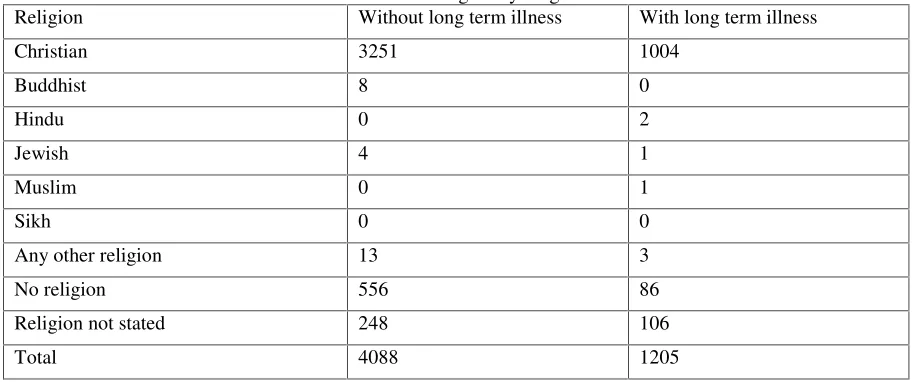
category. For example, Table 1 provides a fictitious illustration of a cross-classification of
religion by long term illness (both variables in the 2001 census in the United Kingdom) for
5293 individuals in a given zone. Such tables represent spatial aggregations of the
[image:9.612.78.537.290.481.2]microdata file.
Table 1: Fictitious Census table: Religion by long term illness for Zone H Religion Without long term illness With long term illness
Christian 3251 1004
Buddhist 8 0
Hindu 0 2
Jewish 4 1
Muslim 0 1
Sikh 0 0
Any other religion 13 3
No religion 556 86
Religion not stated 248 106
Total 4088 1205
2.2 The Disclosure Problem
We are concerned with the disclosure risk which may arise from the publication of multiple
frequency tables of the type described in the previous section. There are various ways of
defining disclosure for tabular outputs (Willenborg and de Waal, 2001). Most
commentators suppose the existence of an intruder who has access to the published tables
basic notion is that of identity disclosure or identification, which arises if it is possible for
the intruder to establish a one-to-one correspondence between an element of a table and a
known unit in the population (Bethlehem et al., 1990). Such a possibility is of particular
concern to census agencies, as it would contradict the confidentiality undertakings made to
respondents. For illustration, Table 1 reveals that in output zone H there is only one
Muslim. If, via another source of information, the intruder knows the name and address of a
Muslim who lives in zone H then they can establish a correspondence between this
individual and an element in the table. Thus, identity disclosure would have taken place.
Identity disclosure may occur more readily for cells with counts of one, termed cell
uniques, and we treat these as risky.
It might be argued that such identity disclosure is not serious since the intruder does not
gain any new information about the respondent. However, identity disclosure can be
associated with attribute disclosure, which arises if the intruder can learn additional information about a unit from the published output. For example, the intruder who knows a
Muslim living in zone H can learn from Table 1 that this individual suffers from a limiting
long term illness. Identity disclosure is not, however, a necessary condition for attribute
disclosure. For example, an intruder who knows someone in output zone H whose religion
is Hindu can learn that they must have a long term illness, despite there being two such
people and thus identification has not taken place. Despite such considerations, we shall in
this paper focus on the risk arising from identity disclosure. Focusing on cell uniques also
gives us an overall indicator of disclosure risk (since the more ones there are, the more
Tables produced for non-coterminous geographies may be independently safe, but when
published together, can sometimes be subtracted or differenced to reveal sensitive
information relating to a geographical ‘sliver’. This has been termed the geographical
differencing problem (Duke-Williams and Rees, 1998) and occurs when one or more output
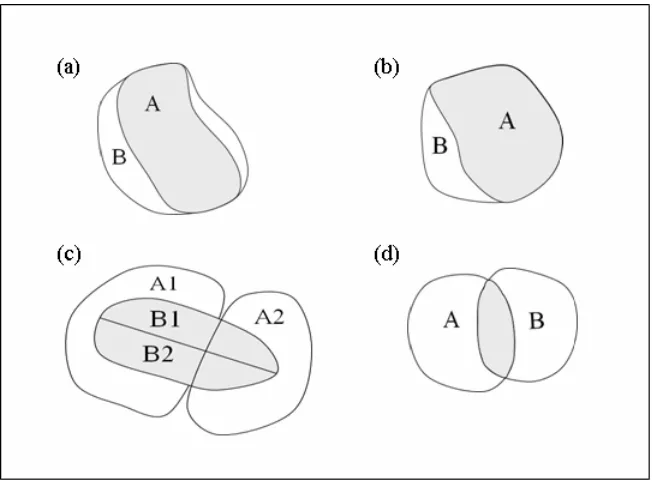
[image:11.612.85.411.268.510.2]zones nest entirely within another as in Figure 1.
Figure 1: Geographical Differencing Problem: Output zones which nest within one another
Suppose Table 2 relates to output zone B in diagram (a) or (b) in Figure 1 and Table 3
relates to output zone A, then subtracting the corresponding cells (Table 3 from Table 2)
reveals a new Table 4 which relates to the differenced zone. All the non-zero cell counts
are cell uniques. The geographical differencing scenario can be extended to consider output
zones which when aggregated can, in combination, be differenced from a larger aggregate:
for example, in diagram Figure 1(c), B2 + B1 can be differenced from A1 + A2. Sections of
no way of knowing which data units in the two tables belong to the intersecting area, as in
Figure 1(d). These examples demonstrate the problems of publishing tables relating for
multiple systems of output zones. Small slivers can result producing many small cell counts
which are potentially disclosive. This can occur through both nested and non-nested
geographies. Providing user access to an interactive tabulation tool would present many
differencing problems.
Table 2: Illustrating the Geographical Differencing Problem - Fictitious Table representing Geography A
16-20 21-30 31-40 …
Benefit claimed 10 16 19 …
Benefit not claimed 8 12 11 …
Table 3: Illustrating the Geographical Differencing Problem - Fictitious Table representing Geography B
16-20 21-30 31-40 …
Benefit claimed 9 16 19 …
[image:12.612.80.530.411.467.2]Benefit not claimed 8 11 11 …
Table 4: Illustrating the Geographical Differencing Problem - Fictitious Table representing Differenced Area
16-20 21-30 31-40 …
Benefit claimed 1 0 0 …
Benefit not claimed 0 1 0 …
2.3 Statistical Disclosure Control (SDC) Methods for Tabular Outputs
A variety of SDC methods have been proposed to protect against the kinds of disclosure
risk described in the previous section. They may be divided into pre-tabular methods,
which are applied to microdata before aggregation into tables, for example by modifying
the values of the attribute variables and post-tabular methods, which are applied to the tables, for example by rounding all cell counts to multiples of some base number, such as
zone-independent, assuming that they only involve modification of the microdata file, Z (see
section 2.1) and that standard spatial aggregation is used to form the tables from the
modified microdata. If the base microdata are ‘safe’ then any aggregation must also be safe.
Pre-tabular methods are generally more flexible, with parameters that can be varied to
achieve a balance between disclosure risk and utility. Utility refers to the quality of the
output after SDC and can be assessed by analyzing the impact of SDC methods on
statistical analysis (Shlomo, 2006). Pre-tabular methods can cause statistical damage to the
resulting tables that is difficult for the users of these tables to measure. Hence, the
parameters of these methods are often set in a way to minimize this damaging effect
(Shlomo, 2005). Post-tabular methods are zone-dependent since they must be applied
afresh to every new table that is produced for a given output zone. Not only must any risk
assessment be updated for each tabulation, but it is in theory necessary to assess that the
new table cannot be combined with previously released tables to undo the protection that
was previously applied. Post-tabular methods can be cumbersome to apply, particularly for
very large tables. Current solutions involving rounding techniques (Salazar et al, 2004) are
still in development for very large tables with a complex hierarchy of subtotals to ensure
that marginal totals add up correctly whilst maintaining a high quality table. The fact that
the pre-tabular SDC methods only need to be applied once is an important advantage
compared to post-tabular methods, when the aim is to produce tables for multiple
geographies. The remainder of this paper focuses on pre-tabular methods. In reality, the
choice between these approaches is not straightforward and a combination of pre- and
development of a method which balances risk and utility, avoiding the need for further
post-tabular adjustment.
3 The Proposed SDC Approach
Pre-tabular methods of SDC could involve modification of either attribute variables or
geographical coordinates. The former has the major disadvantage that it can result in the
introduction of inconsistencies between the attribute variables, such as a married
10-year-old. This type of anomaly will not occur as a result of modification of the geographical
coordinates since most census attributes will be consistent with any geographical location.
We therefore consider here only geographical perturbation methods, defined as those SDC
methods which modify the true spatial locations of some or all of the units in the microdata.
Thus, the coordinates (Xi,Yi) of a unit i are modified to new coordinates
(
Xi’,Yi’)
. Werefer to the distance between the old and new locations as the perturbation distance. Usually
the perturbation distance, d is measured in Euclidean space:
(
’) (
2 ’)
2i i i
i X Y Y
X
d = − + − (1)
Geographical perturbation methods may be expected to reduce disclosure risk in the
aggregated table since it will not be known whether an observed cell unique in a table
corresponds to a unit which genuinely falls in that cell or indeed whether the true cell count
is one. Geographical perturbation could be implemented in a number of ways. One
approach, applied in the geoprivacy literature to point data is that of displacement, where
procedure (Armstrong et al., 1999). One problem with this approach is that it cannot be
guaranteed that the displaced locations will be feasible, for example they might fall in a
self-evidently unpopulated area such as a lake. An alternative which overcomes this
problem and avoids the need for detailed validation of new locations is record swapping,
where pairs of units are selected from the population and the coordinates of each pair are
swapped while the global set of locations is unchanged. We will focus on record swapping
approaches, firstly considering in section 3.1 an established method which has been
employed in practice by several census agencies (Shlomo, 2005 and Zayatz, 2006). Our
proposed new approach is introduced in section 3.2.
3.1 Random Record Swapping (RRS)
Random record swapping (RRS) is a pre-tabular method of geographical perturbation
resulting in the geographical variables of two units i and j being swapped. Thus, the
geographical coordinates (Xi,Yi) are exchanged with( , )X Yj j but the attribute variables
remain unchanged. Different approaches may be adopted for deciding which pairs of units
are swapped. Often, pairs of units are matched in some way to limit the potential damage to
resulting analyses. Following Willenborg and de Waal (2001), the ith record of the
microdata may be partitioned into three sub-vectors: Mi, Ai*and (Xi,Yi), where Miis a
vector of match variables, defining a subset of the attribute variables to be controlled when
seeking recipient households for swapping, and *
i
A is a vector containing the remaining
attribute variables. Thus, only records j with Mj =Mi are considered for swapping with
Three features of RRS can be modified, each of which may affect both disclosure risk and
utility. First, the smaller the fraction of records selected for swapping, the lower both the
expected risk reduction and distortion. Second, the more variables and categories which are
used to match pairs of values the less distortion, but this may lead to difficulties in finding
matching records for all recipients. Third, swapping can be targeted on records deemed
most ‘risky’, determined by prior analysis of the small counts in tables (Zayatz, 2006). The
UK 2001 censuses were disclosure-protected by RRS in combination with a post-tabular
SDC method (Shlomo, 2006). The 2000 US census employed targeted swapping (Zayatz,
2003) in combination with post-tabular methods. The specific details of record swapping,
such as the proportion of records swapped, are kept confidential so as not to aid an intruder.
To illustrate RRS further, we present the basic approach adopted in England and Wales in
2001. The units swapped were households. Match variables consisted of a hard-to-count
index1, household size, and a broad age and sex distribution of individuals within the
household (Shlomo, 2005). A sample of households was swapped between Output Areas
(OAs: small area building brick for release of 2001 census data) within Local Authority
Districts (LADs: larger area containing around 50,000 people) (Boyd and Vickers, 1999),
that is each record in the sample was paired with a matching record from a different OA
within the same LAD. Thus, LAD is effectively a match variable also and this method is
zone-dependent, being based on specific LADs and OAs. A key drawback of such RRS is
that membership of the same LAD is the only control over the distance and direction of
perturbation, which may result in significant damage to statistical analyses involving spatial
elements finer than LADs.
3.2 Local Density Swapping (LDS)
The proposed local density swapping (LDS) method is designed to overcome this key
drawback, by applying pre-tabular perturbation to the microdata in a way which is not
dependent upon the choice of output zones. The first feature of the method is that
perturbation distances are sampled from a probability distribution. This allows greater
control because the type of distribution can be selected, as can its parameters such as mean
and standard deviation.
The risk of identifying an individual by differencing depends on the proximity of other
individuals with similar characteristics. For example, an elderly man located in an area with
mainly young people will present a high disclosure risk. In general, the more people there
are in the area, the more likely it is that someone else will share the same characteristics –
following Tobler’s first law of geography (Tobler, 1970) similar characteristics are most
likely to be found together. Thus a fundamental predictor of disclosure risk is population
density. In a densely populated urban area, less perturbation is generally needed to disguise
the true location of a household. A similar concept was identified earlier in the geoprivacy
literature (Armstrong et al. 1999, VanWey et al, 2005), masking locations of disease or
crime on a map in proportion to population density. Density is not taken into account by
conventional approaches to record swapping. Thus in a densely populated region, more
perturbation than necessary may be added to a household. Our second key proposal is to
as opposed to Euclidean distance. The household distance n is a measure of the number of households between swapped households.
Our third proposal aims to reduce the risk from geographical differencing by swapping
more records but by smaller distances. Thus a cell unique in a differenced area should have
a likelihood of having been perturbed. Perturbation at the local level will minimise damage
but introduce uncertainty. In practice this could be implemented by swapping broadly at the
same scale as the small area geography (for the UK this might be adjacent postcodes for
example, or blocks in the US) with variation depending on population density. Postcodes or
blocks represent local areas for which an intruder might know detailed information about
their neighbours and around which we might want to add noise. The initial sample of
records selected for swapping could be random within strata (as in the random record swap)
to ensure even protection against risk.
One advantage of LDS is its flexibility. Statistical organizations differ in their assessment
of tolerable levels of risk and utility. LDS parameters can be varied to achieve an
appropriate balance between risk and utility. Parameters that can be varied include the
sampling fraction, the probability distribution, the sample size and selection and match
variables. Very rare records with unusual combinations of characteristics (such as a 16
year-old-widow) are unlikely to be protected by swapping (as they tend to be unique
irrespective of geography) but these are likely to require separate recoding or suppression
4 Creating a Test Dataset
It is not possible to use an actual census database due to the census confidentiality
constraints. However, anonymised microdata samples and small area aggregations are
available from the UK censuses (Dale and Teague 2002, Dale and Marsh, 1993). In this
section we briefly describe the creation of a synthetic microdataset created from these
sources to create a 100% dataset consisting of the full set of census variables, to which we
assign point locations. The aim is to create a dataset that is realistic for testing disclosure
control methodologies rather than to accurately replicate a specific regional population.
4.1 Synthetic Population
Our synthetic population is based on 1991 UK census microdata, as 2001 files were not
released until after the commencement of this work. We use the Household Sample of
Anonymised Records (SAR), a microdata file for a 1% sample of individuals in
households, including the complete set of census variables but with geographical coding
limited to Standard Region. We also use Small Area Statistics (SAS), which give
information on individuals and households in tabular form at enumeration district (ED)
level, the smallest areas in the 1991 census geography. EDs are similar in size to OAs
containing around 200 households or 450 people. SAS tables contain the entire population
for each small area. However the table dimension is small, containing only two or three
variables, so the joint distribution for the full set of census variables is not known.
Microsimulation techniques are used to estimate this joint distribution at the small area
individuals drawn from the microdata sample, broadly preserving actual marginal
characteristics.
Since swapping involves distorting the relationships between geography and attribute
data, it is important to study an area which is spatially heterogeneous. The county of
Hampshire in Southern England was chosen because of its diverse characteristics. It
includes two densely populated urban areas (Portsmouth and Southampton) and extensive
rural areas. The population of approximately 1.5 million displays wide variety of economic
activity, household structure and individual characteristics. The county comprises 3175
EDs in thirteen LADs with population densities ranging from 138 people per km2 in
Winchester to over 4000 people per km2 in Portsmouth.
A microdataset with a realistic spatial distribution is needed in order to investigate the
effects of locational swapping. There are various techniques available including iterative
proportional fitting based on a set of small area tables (Williamson et al., 1998) or synthetic
probabilistic reconstruction (Birkin and Clarke, 1989), but here we use a method of
combinatorial optimisation developed by Williamson and Voas (2000). This approach uses
the SAR as the parent population from which households can be drawn to recreate
populations for individual EDs. This is performed iteratively by selecting a combination of
households from the SAR that best reproduces the characteristics of the ED. Constraints on
the combination of households chosen are provided by known tabulations of ED data from
the SAS. We have chosen four small area tables from the 1991 small area statistics
covering age, marital status and sex; household space type and tenure of households;
household. The more tables used as constraints, the more iterations are required to give a
good level of fit.
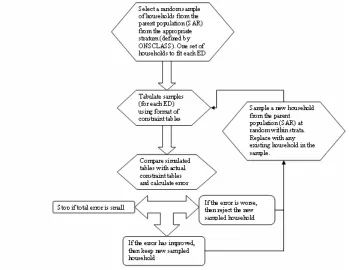
Figure 2 gives an overview of the microsimulation process. The first step is selection of
an initial sample of households for each ED. Rather than sampling at random, the
ONSCLASS variable (Wallace et al, 1995) was used to stratify the SAR records.
ONSCLASS is a census-based classification of wards present on both the SAR and SAS.
This is a very useful variable since it provides a key to the characteristics of the ward in
which the household is located. An initial sample was taken at random from the stratum
representing the same ONSCLASS as the ED. Communal establishments were excluded
from our analysis. At each iteration a new household is sampled from the appropriate
stratum and if the fit is improved the new household kept, otherwise it is dropped. This
iterative process continues until a satisfactory fit is achieved. To measure fit we compared
the simulated table frequencies, denoted Fc, to the constraint table frequencies, denoted
c
O , (Ballas et al. 1999, Williamson and Voas, 2000). The subscript c denotes a cell in the
table for which the constraint frequencies are available. We used a measure called Total Absolute Error less than 3, denoted TAE and defined by:
TAE =
∑
maxOc−Fc −3, 0 (2)This fit measure ignores absolute errors |Oc−Fc| of less than 3 in order to speed up the
Figure 2: An overview of the microsimulation process
The resulting synthetic population provided an adequate fit to the published tables using
this approach. There were no clusters of error which may have raised concerns that an area
with unusual characteristics had not been fitted properly. Urban areas showed the worst fit
but overall the TAE was relatively small at approximately 2 to 4 individuals or households
per cell. 70% of households were not unique, with 15% of households sampled three times
(representing 45% altogether) but less than 1% represented more than four times. This
would be a problem if the objective involved assessing uniques in the entire microdataset
since only 30% are unique records. However there are many uniques at the small area level
in tables of two to four variables. Moreover the majority of repeated households are located
in different LADs. This is an important consideration because households could be
better on the synthetic population than on a real population). An additional consideration is
that both the LDS and RRS tests will be equally affected by any biases in the synthetic
population.
4.2 Creating Spatial Locations
Creating spatial locations for the households is particularly important because these will be
used by the swapping procedure. There are no files directly recording household locations
in the UK. Instead, the directory of postcodes and enumeration districts was used, which
provides a household count for each ED-postcode intersection and grid references for each
postcode (Martin, 1992). Unique locations were created for households by adding noise
around postcode locations, proportional to ED population density. An incomplete sort of
households by tenure type was performed before grid reference allocation, resulting in
[image:23.612.84.433.462.585.2]households of similar tenure displaying some spatial clustering.
Figure 3: Creating artificial household locations
The smallest postcodes do not have formally defined boundaries, so these were generated
postcodes identified, using the deldir2 package in the statistical package R. We thus create
a synthetic micropopulation for Hampshire consisting of individuals within households
having a full set of census variables. Each household has a unique point location and is
assigned to a postcode, ED and ward. The postcodes have synthetic boundaries but do not
necessarily nest entirely within EDs; EDs nest entirely within wards and wards within
LADs.
5 Implementing and Evaluating the Swapping Methodology with the Test Dataset
This section describes the implementation of the general methodology proposed in Section
3 using the statistical program SAS and the synthetic population and presents measures for
the assessment of risk and utility. We refer to the synthetic data as the ‘original’
(unswapped) data.
5.1 Swapping Methodology
RRS and LDS are performed by selecting an initial sample of households from the
population and then finding matching households with which these will be swapped
(section 3). Match variables of ethnic group, family type, number of persons in household
and tenure are used. These were chosen as being similar to those used in the actual 2001
UK census RRS. RRS requires matching households in a different ED but within the same
LAD.
To implement LDS, a ‘distance’, n, is generated randomly from an exponential
distribution with a specified mean λ for each of the households in the initial sample. This
distance will determine the number of households, n, in the circle for which the initial
household is at the centre and the matching household is on the circumference. For ease of
computation, households are assigned to a 100m raster and a cellular approximation to a
circular search performed. The circular band corresponding to number of households n, is
then determined by counting the households in successive bands until the cumulative count
is greater or equal to n. The outer band of households contains the nth household.
Generating n from an exponential distribution ensures n cannot be negative and has a rapidly decreasing probability of taking a large value. The probability density function of n
is given by:
( )
1 n/f n =λ− −e λ , n≥0 (3)
so thatλ =E n( ). In the following experiments a value of λ has been specified which
represents an average distance between adjacent postcodes. A random swap of 10% of
households between adjacent postcodes was performed and λ was determined as the mean
number of households between all pairs of swapped households. The minimum and
maximum from this 10% random postcode swap was also used to truncate the distribution
to prevent swapping over very long distances or very small distances.
Once the circular band containing the nth household is determined, a best matching household from the households in this band can be found using the match variables of
ethnic group, tenure, persons in household, family type. Households which have previously
been swapped are penalized and discouraged from swapping a second time.
Following Duncan et al (2001), we propose to evaluate the effectiveness of the swapping
methods in a risk-utility framework, i.e. we study the performance of each of the methods
in terms of both disclosure risk and the utility of the resulting outputs for analysis.
Moreover, since the methods depend upon the specification of parameters, such as the
proportion of records to swap, we shall study how such choices affect risk and utility and
the trade-off between the two. In order to set up this framework we need to introduce
measures of risk and utility.
5.2.1 An Indicator of Disclosure Risk Disclosure protection can be measured by
comparing disclosure risk before and after perturbation. In section 2, we discussed how risk
before perturbation could be measured in terms of cell uniques. A crude measure would be
the number of cell uniques. After perturbation, cell uniques may also be considered, since
these might be a natural target for an intruder, but it would be inappropriate to still measure
risk by the number of cell uniques, since these may no longer be genuine. Instead, the
probability that an observed cell unique (after perturbation) represents an actual unique is
considered.
Such measures of risk are clearly dependent upon output zones. These may be EDs or
wards, for example. To measure the risk arising from geographical differencing, the
disclosure risk for frequency tables for zones assumed to be equivalent in scale to a
differenced ‘sliver’ is considered, for which the smallest zones available are postcodes (and
are independent of the geographies used in the methodology).
The cells in a table T are defined by cross classifying a subset of the attribute variables in
the categories of this subset of attribute variables. Let Fc denote the cell frequency in a
specified zone, that is the number of units in the zone with the specified combination of
values of the attribute variables. To be explicit about the effect of the perturbation process,
let o c
F denote the cell frequency before perturbation and p c
F the cell frequency after
perturbation. Also let nT denote the number of cells in table T and let match = 1 if
1
o p
c c
F =F = and if the same unique household appears in the table before and after
perturbation. A cell count of one after perturbation is called a true unique if match = 1, i.e.
if it was also a count of one in the original table and it relates to the same household. The
probability of finding a true unique is thus:
)
Pr(TU = ( 1& 1)
( 1)
T
T
n o p
c c
n p
c
I F F match
I F
= = =
=
∑
∑
(4)where the sums are over all the cells c in the table and I is an indicator function which equal 1 if true, 0 otherwise.
5.2.2 Measures of Utility Utility will be measured in terms of distortion to the data, i.e.
in terms of dis-utility. Specifically, we measure the absolute average deviation per cell
(AAD) averaged across all tables at a particular level of geography. AAD will be measured
on tables formed by cross-classifying age, sex and marital status. These variables were
chosen as they contain vital demographic information which should not be distorted and
since they do not include any of the matching variables. The measure is defined as:
AAD =
T
n p o
Section 6.5 considers some additional measures of utility, which assess how swapping
distorts spatial features of the tables.
6 Results of Applying Swapping Methodology to Test Dataset
6.1 Comparison of 10% RRS with 10% LDS
We begin our analysis by simulating a 10% RRS, taken to be a realistic option which might
be employed in a census, and compare with a 10% LDS. The methods are applied to the
entire synthetic population of Hampshire. The same initial 5% random sample (forming one
half of the swapped records) was used in both cases, with the number of records selected
proportional to the total population in each ward. This ensured an even distribution of
records for swapping over the entire county.
Table 5 presents disclosure risk in terms of (a) percentage of ‘true uniques’ and (b)
number of true uniques per 1000 population at risk. We assess disclosure risk in tables of
long term illness and ethnicity since these variables are likely to produce many small cell
counts. Table 5(a) shows that using matching variables (the variables Mi (section 3.1) on
which both households must match for a swap) as opposed to swapping households at
random, the resulting disclosure risk is higher. There is very little difference between the
two methods when swapping only 10% of households. More importantly the disclosure risk
after applying both RRS and LDS is very high at all levels of geography at over 80%. This
means there is a high probability that a cell count of one relates to the original household.
This is likely to be considered unacceptable by a statistical agency and in this case it would
seem sensible to apply a post-tabular method to the data (as in 2001). Table 5(b) also shows
true uniques per 1000 population at risk. At higher levels of geography, there are far fewer
[image:29.612.79.531.165.447.2]uniques.
Table 5: Assessing Disclosure Risk (Percentage of True Uniques) (a) DISCLOSURE RISK (proportion of true uniques)
Postcode ED Ward
10% Random Record
Swap (with matching)
0.94 0.88 0.81
10% Random Record
Swap (without matching)
1.00 0.93 0.88
10% Local Density Swap
(with matching)
0.89 0.92 0.92
(b) DISCLOSURE RISK (number of true uniques per 1000 population at risk)
Postcode ED Ward
10% Random Record
Swap (with matching)
7.55 3.13 0.30
10% Local Density Swap
(with matching)
6.79 2.92 0.27
Table 6 presents the utility of the data after swapping, measured in terms of deviation
between cell counts in the original and protected tables. As before, an average is taken over
all tables at a particular level of geography. In general the LDS produces smaller average
[image:29.612.79.534.594.690.2]cell deviations.
Table 6: Assessing Utility (Absolute Average Distance)
UTILITY Postcode ED Ward
10% Random Record Swap (non-matching)
10% Random Record Swap (matching)
0.25 0.17 1.11 1.09 6.66 5.75
6.2 Increasing the sampling fraction
Since the 10% swap results in high disclosure risk we next examine how the risk-utility
outcome changes as we increase the total proportion of records swapped. In this scenario,
we use only a sub-region of the synthetic population relating to the Basingstoke and Deane
local authority because the methods are computationally intensive. Initial samples are
drawn which when paired with matched households make total swapped samples of 10%,
25%, 50%, 70%, 90%, 100%. In this case the samples were completely random with no
stratification by ward. Moreover each sample was independent meaning that the 10% RRS
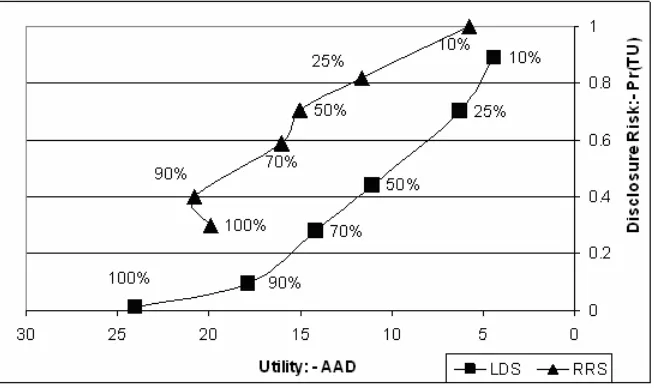
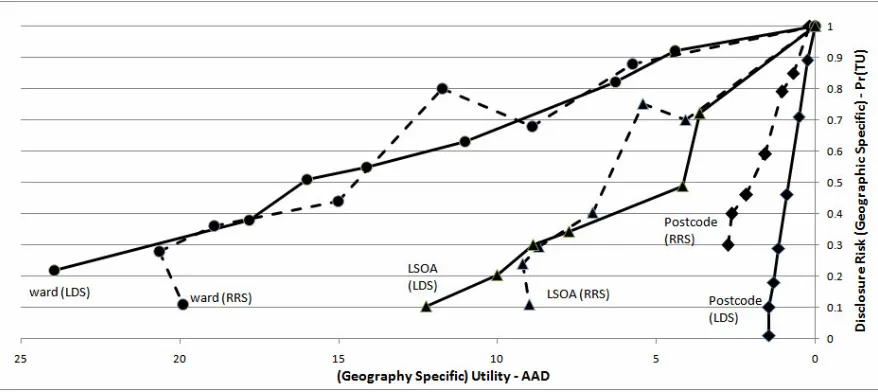
initial sample was different to the 10% LDS initial sample. In figure 4 we measure risk at
postcode level as it is the sliver level which presents the greatest disclosure risk (see table
5). The measure used is the probability of being a true unique. However, utility is measured
[image:30.612.89.416.465.659.2]at ward level representing a more common scale for analytical use.
The graph shows how LDS improves upon RRS across all sampling fractions. Thus, for a
given utility (a vertical line on the graph), LDS always has a lower disclosure risk at
postcode level than RRS. Conversely, for a given level of risk (a horizontal line on the
graph), LDS always achieves greater utility at ward level than RRS. Suppose a statistical
agency wanted to ensure disclosure risk was below 0.5; following figure 4, they would need
to swap approximately 70% of the records to achieve this through RRS but around 50% of
the records would need to be swapped if LDS was used. Moreover if 50% of records were
swapped with LDS, we would still obtain higher utility at ward level than if 70% of the
records were swapped with RRS.
6.3 Changing the Mean Perturbation Distance for LDS
The sampling fraction is one parameter of the LDS method that can be changed. Another is
the mean perturbation distance. This distance is measured in terms of number of households
and thus doubling the perturbation distance does not mean the households are moved twice
as far in Euclidean space. The relationship between the area of the circular band and the
radius of the circle containing n households is not linear and this needs to be taken into account when selecting an appropriate perturbation distance. A small sample size of 10%
would require setting λ≥10,000 households to reduce disclosure risk by a significant
amount (less than 50%) with an average distortion of 5 per cell. On the other hand, with a
sampling fraction of 70%, to reduce disclosure risk below 0.5 at ward level, λ = 2,000
6.4 The relationship between Geography and the R-U Outcome
In Figure 5, we show the general pattern in terms of risk-utility over different output scales.
These results include a completely independent geography derived from the 2001 census:
Lower Super Output Areas. LSOAs are larger than EDs but smaller than wards. Risk here
is measured in terms of the probability of being a true unique for the respective geography
(i.e. postcode, LSOA or ward). Utility is the AAD for the respective geography. The figure
shows a definite scale effect. As the zone size increases, the utility worsens in terms of
AAD, with wards having the greatest average cell deviation and postcodes having the
smallest average cell deviation: the larger zones of course have larger populations.
However, the most important effect observable in Figure 5 concerns the disclosure risk at
postcode level. LDS results in better utility (lower AAD) and lower risk than RRS for
equivalent sampling fractions (0%, 10%, 25%, 50%, 70%, 90%, 100%) as indicated by the
positioning of the lines. However, it is difficult to detect any difference between the
methods at the higher levels of geography; partly because of the more unpredictable effect
of RRS. Similar patterns were picked up for OAs and EDs (not much difference between
Figure 5: Comparing the Risk-Utility Outcome of LDS with RRS over different levels of geography
The sample sizes have been omitted from the graph for clarity; however the lines are joined
in order of increasing sample size.
6.5 Spatial Measures of Utility
Measurement of utility in terms of AAD may have masked underlying effects not picked up
by averaging. In this section we attempt to study utility in more depth. As discussed in
section 3.1, the perturbation methods swap a record i with values
(
, , ,*)
i i i
M A X Y with a
record jwith values
(
, ,* ,)
j j j
M A X Y so that, after swapping, record i has
values
(
, ,* ,)
i j j
M A X Y . Thus, the relationship between the match variables M and the
attribute variables A* is unchanged. Similarly the relationship between the geography and
match variables is unchanged. For example, we would expect the relationship between
tenure and occupation to be the same after swapping. In fact this is an important advantage
example, distorts the interrelationships between the attribute variables, often artificially
increasing correlations (Shlomo, 2005; 2006). However, the relationship between the
geography variables and the attribute variables is distorted with swapping. Thus when
searching for appropriate utility measures, it would seem sensible to focus on measures in a
spatial context. In this section we shall study utility primarily at LSOA level, representing a
common scale for policy-making and analysis.
6.5.1 Changes in spatial rank We first consider how zones change relative to one another
in terms of their ranking for a particular attribute. We are interested in changes in overall
spatial pattern, such as would alter the shading classes on a choropleth map; that is changes
in rank order rather than changes in scale. We here sort zones according to an attribute and
assign these ranks into groups, comparing the rank group for each zone before and after
swapping.
The test will be carried out on LSOAs for two different attributes: (1) percentage
unemployment and (2) percentage of male head of households, aged 35-50, in a
professional job with a first degree or higher. As with any large mixed urban/rural area,
these attributes are likely to vary over space. The latter is a category formed from a
cross-classification of the variables and will show the extent to which interactions of the variables
are distorted by geography. The LSOAs are split into deciles. We present the results in
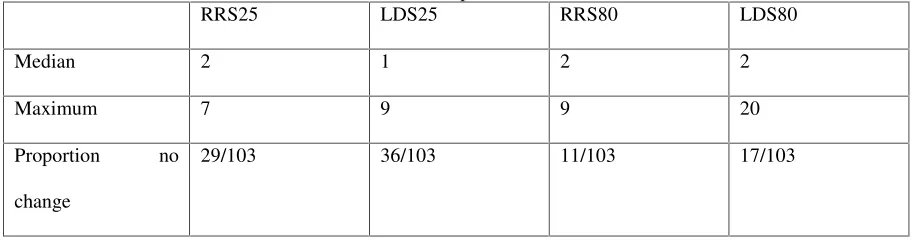
Table 7 as absolute percentage change (in rank group) showing the median of the
approximate normal distribution and the maximum. The table shows that, in general, LDS
results in fewer rank changes than RRS. The cross-classified attribute histograms also
showed similar patterns so have not been included here. This indicates that the underlying
Table 7: Absolute Percent Changes in Rank Group for LSOAs: Comparing LDS and RRS for 25% and 80% swaps.
RRS25 LDS25 RRS80 LDS80
Median 2 1 2 2
Maximum 7 9 9 20
Proportion no
change
29/103 36/103 11/103 17/103
6.5.2 Effect on Spatial Autocorrelation Another way of assessing changes in spatial
distributions is to study the effect on clustering / spatial autocorrelation (Fotheringham et
al, 2002). Swapping is likely to distort patterns of spatial autocorrelation. In particular,
swapping over large distances is likely to make the data more homogeneous and pockets of
households exhibiting unusual characteristics would tend to become more like the region as
a whole. Therefore if we know of a variable (or set of variables) which exhibit spatial
dependency, we can exploit this relationship to assess the effect of the two swapping
methods.
Typically a single measure of spatial autocorrelation is calculated which describes an
overall degree of spatial dependency across the whole dataset. Local measures of spatial
autocorrelation allow spatial variations in the spatial arrangement of data to be examined
(since a global measure may mask the true pattern). In this section we will assess spatial
autocorrelation for the two attributes (a) percentage unemployed and (b) percentage of male
head of households aged 35-50 in a professional job with a first degree. The results for the
swapped populations will be compared against the original data.
(
)
(
,)
(
)
2,
( )
u v u v
u v
u v u
u v u
m w Z Z Z Z
I
w Z Z
− −
=
−
∑ ∑
∑ ∑
∑
(6)where mis the number of zones
u
Z is the percentage in a particular category of a variable or a cross-classification of
variables A, for zone u
Zis the mean of the percentages across all zones
uv
w is an element of a contiguity matrix, taking the value 1 if zone uis a neighbour of zone
v and 0 otherwise.
Values of Moran’ s I larger than 0 indicate positive spatial autocorrelation; values smaller
than 0 indicate negative spatial autocorrelation.
Spatial autocorrelation at a local level will be measured using the LISA statistic (Local
Indicators of Spatial Association) computed as:
(
)(
)
(
)
2uv u v
v u
u u
w Z Z Z Z
I Z Z − − = −
∑
∑
(7)Maps can be produced showing the value of Iufor each zone u. In the LISA maps,
high-high and low-low relate to incidences of positive spatial autocorrelation whereas high-high-low
and low-high relate to incidences of negative spatial autocorrelation. The Moran’ s I and the
LISA maps were computed in GeoDa3 and relate to the Basingstoke and Deane local
authority.
3 GeoDa is a spatial analysis software tool developed at the Spatial Analysis Lab, University of Illinois;
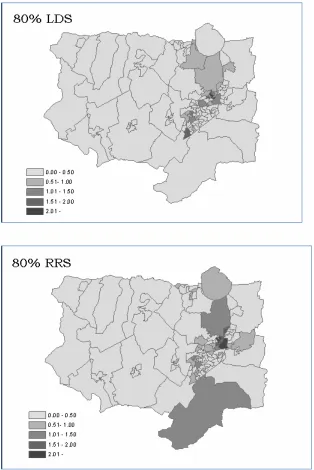
6.5.2.1 Spatial Autocorrelation for Percentage Unemployed The LISA maps in Figure 6
were computed for LSOAs in Basingstoke and Deane comparing the absolute change in Iu
between the original unswapped data and the swapped populations (for samples of 25% and
80%). The original LISA map (not pictured here) showed evidence of negative spatial
autocorrelation north of the centre of Basingstoke but positive spatial autocorrelation in
central and southern Basingstoke. The nearest neighbour weights matrix was used with
eight nearest neighbours selected. This means that there is some randomness in which
‘neighbours’ are selected (if there are more than eight nearest neighbours). For this reason,
the same weights matrix was used in every case. Figure 6 shows that at the 80% level, there
are significant amounts of absolute change in Iuparticularly in and around the central urban
area. There is more change for RRS than LDS as indicated by the darker shadings of the
LSOAs with absolute change being greater than one in several LSOAs. At the 25% level
there were only small changes for both RRS and LDS (not displayed in this paper). All
swapped populations were found to have fewer significant areas of spatial autocorrelation
as the sampling fraction increases suggesting that the data, after swapping, is possibly
Figure 6: LISA maps showing Absolute Change in Ii between the original (unswapped) data and the
swapped data, for LSOAs for %unemployed.
0.3491 for the original data and changes very little at 25% swapping. At 80% it fell to
0.2341 for RRS while remaining at 0.3338 for LDS.
6.5.2.2. Spatial autocorrelation for Percentage in a Category of a Cross-Classification
We now turn to the percentage in a category of a cross-classification of variables,
represented by the percentage of male head of households, aged 35-50, with a first degree
or higher in a professional job. As expected this percentage is broadly inversely related to
levels of unemployment. As before, most of the structure is retained at the 25% swap rate,
perhaps more so for the LDS, with little change in Iu for the LSOAs (not shown). On the
other hand at the 80% level, there is major damage to the autocorrelation structure as
indicated by the dark shaded LSOAs for RRS in Figure 7. Further investigation for RRS
showed that many of the significant LSOAs showed incorrect directions of spatial
autocorrelation after swapping. This observation is also supported by Moran’ s I. At 25%
the spatial correlation is little changed from the 0.2640 for the original data for both RRS
and LDS. At 80% swapping this has reduced to 0.0367 for RRS whereas for LDS it
remains at 0.2336. RRS swaps over much larger distances, having the potential for much
greater damage than LDS swapping, primarily over shorter distances. This divergence
Figure 7: LISA maps showing Absolute Change in Ii between the original (unswapped) data and the
swapped data, for LSOAs for % male heads in professional job aged 35-50 first degree.
OA-level maps (not shown) display similar patterns to the LSOA maps shown here but the
the work in this section provides some evidence the LDS is less damaging to the detailed
spatial data structure than RRS.
6.6 Discussion of Results
We here discuss some of the principal themes emerging from our results. Swapping records
shorter distances and in proportion to local population density using the LDS method does
seem to be effective in reducing disclosure risk at the postcode level and has the important
benefit that it permits small area tables to be produced with less risk and provides stronger
protection against geographical differencing. Although more noise is added at the local
level, similar levels of protection and damage to those seen for more conventional methods
are observed for larger zones. In addition, LDS makes no reference to pre-existing
geographical boundaries and is thus more resilient to future reaggregation and differencing
challenges.
We have begun to assess the utility of the new method by studying the changes in spatial
relationships after swapping. The LISA maps showed that with LDS, the most significant
patterns in the data still remained after a large proportion of records were swapped.
However with RRS, patterns were lost at lower levels swapping, particularly for the
cross-classified attribute. Changes in rank order indicated that LDS was altering the data less than
RRS, which is particularly relevant to GIS and mapping applications. LDS achieved a
better outcome than RRS at the postcode level, producing smaller average cell deviations in
a table made up of the independent variables age, marital status and sex. Many different
utility measures could be employed but in general LDS retains higher utility than RRS
households in high density areas being moved only short distances. In general, this
contributes to the RRS results being more unpredictable than those for LDS.
A statistical organization would normally desire that disclosure risk should be less than
50% so that the odds are against an intruder finding a true unique. Ideally the disclosure
risk would be even smaller than this, at around 10% or less. Swapping a 10% sample under
either method was very ineffective and the percentage of true uniques remained above 80%.
Even swapping 25% of the data resulted in a disclosure risk still above 50% at all levels of
geography and this helps to explain why utility remained so high in the LISA maps at this
level. Also at the 25% swap level, the order of rankings was not disturbed too greatly. To
reduce the disclosure risk below 10% for all levels of geography would probably mean
swapping around 90-100% of the records under either method. Organizations would
probably consider it unacceptable to implement such high swapping levels, which means it
is unlikely that swapping could ever be used as a sole protection method and would
probably always have to be combined with some post-tabular modification.
7 Conclusion
Statistical agencies wishing to provide outputs by flexible geographies need to protect
against the geographical differencing problem which may arise. Pre-tabular disclosure
control methods are most attractive for this purpose, because they need only be applied
once, ensuring that any tables and resulting differenced areas must also be safe. In this
paper, we have proposed the LDS method as an alternative to the established RRS method
and have argued that it may provide greater protection at the local level as well as allowing
employs greater spatial intelligence and whether or not record swapping alone is judged to
provide sufficient protection, it is a powerful disclosure control method which may provide
a more efficient balance of risk and utility particularly for GIS applications. A census user
might only know the percentage of records swapped but this still affords a large degree of
uncertainty around each cell. This contrasts with post-tabular methods such as rounding
where an intruder can usually deduce a narrow uncertainty interval around each cell in
relation to the rounding base. Moreover local swapping is a good way of providing
confidentiality protection whilst ensuring the plausibility of the data. RRS often moves
households out of their local area and thus if the two areas are very different (moved from
an inner city zone to a rural zone for example), it could be obvious that a household has
been swapped presenting both a disclosure risk and reduction in accuracy of the data. More
work needs to done to study other measures of disclosure risk and utility. Risk assessment
may, for example, be extended by looking at disclosure from zeros and other small cells
and not just from cell uniques. Another idea might be to obtain two similar geographies and
analyse the differencing risk attributable to the two swapping methods.
With regard to utility, most GIS use of census-type data currently ignores the impacts of
disclosure control methods whereas these may in fact significantly affect geographical
analysis results. Measurement of utility is far from straightforward. AAD, used here, is
limited because it is an absolute value, not relative to the original cell values and since it is
an average, it can mask underlying detailed effects. However AAD has provided a useful
initial evaluation of the effects of changing the parameter values for swapping, due to its
ease of calculation. It is important to remember that the work in this paper has been carried
unique characteristics of this dataset. Since LDS is dependent on population density, it
would be a logical extension to study the effects in regions of high and low density more
closely. Moreover, we have focused here on record swapping, but it would also be possible
to perform other types of geographical perturbation such as displacement using standard
GIS functions which are being used for geoprivacy purposes. A more comprehensive
examination of utility after swapping would need to more carefully address the spatial
operations that GIS census users typically apply. Much more work needs to be done, both
to fully understand current practice and with regard to future census data production.
Acknowledgements
This work was funded by an ESRC postgraduate studentship: PTA-042-2004-00013.
SAR and SAS census data were taken from the Census of Population Programme web
pages funded by the ESRC and additionally JISC: http://www.census.ac.uk/default.htm
References
ARMSTRONG,M.P.,RUSHTON,G., andZIMMERMAN,D.L., 1999, Geographically masking
health data to preserve confidentiality. Statistics in Medicine, 18, 497—525
BALLAS,D., CLARKE,G. and TURTON,I., 1999, Exploring microsimulation methodologies
for the estimation of household attributes.In 4th International Conference on