University of Southampton Research Repository
Copyright © and Moral Rights for this thesis and, where applicable, any accompanying data are retained by the author and/or other copyright owners. A copy can be downloaded for personal non-commercial research or study, without prior permission or charge. This thesis and the accompanying data cannot be reproduced or quoted extensively from without first obtaining permission in writing from the copyright holder/s. The content of the thesis and accompanying research data (where applicable) must not be changed in any way or sold commercially in any format or medium without the formal permission of the copyright holder/s.
When referring to this thesis and any accompanying data, full bibliographic details must be given, e.g.
Thesis: Author (Year of Submission) "Full thesis title", University of Southampton, name of the University Faculty or School or Department, PhD Thesis, pagination.
UNIVERSITY OF SOUTHAMPTON
FACULTY OF MEDICINE, HEALTH AND LIFE SCIENCES
School of Psychology
Fluency-Based Production and Memorability-Based Reduction of
False Alarms in Recognition Memory
by
Helen Ho Yan Tam
UNIVERSITY OF SOUTHAMPTON
ABSTRACT
FACULTY OF MEDICINE, HEALTH AND LIFE SCIENCES SCHOOL OF PSYCHOLOGY
Doctor of Philosophy
FLUENCY-BASED PRODUCTION AND MEMORABILITY-BASED REDUCTION OF FALSE ALARMS IN RECOGNITION MEMORY
by Helen Ho Yan Tam
The production of false alarms in recognition memory tests has long been of interest
to memory researchers. A recent paradigm devised to demonstrate false recognition
was the "hension" effect paradigm (Whittlesea & Williams, 1998), where the false
alarm (FA) rate for regular nonwords (e.g., HENSION) was found to exceed that for
natural words (e.g., CURTAIN) and for irregular nonwords (e.g., STOFWUS).
The hension effect has been cited as empirical evidence for the
discrepancy-attribution hypothesis, which assumes that the high FA rate for regular nonwords
arose because the processing of these fluent, yet meaningless items is discrepant.
Discrepancy in tum prompts fluency misattribution (i.e., false alarms) to occur.
An objective ofthis thesis was to examine the suitability of the
discrepancy-attribution hypothesis in explaining the hension effect. In Experiments 1 - 4, the sense
of discrepancy associated with the hension effect materials was manipulated. These
experiments found that discrepancy did not appear to underlie false recognition.
As an alternative explanation for the hension effect, it was argued that recognition
judgments are dependent on fluency-based processes for regular and irregular
nonwords. However, the low FA rate observed for natural words was due to their high
memorability levels (as substantiated by ratings data in Experiment 5), which allowed
participants to correctly reject these items when they acted as lures.
Compelling evidence for the involvement of a memorability-based, metacognitive
strategy in lure rejection came from the finding of a FA rate decrease for items whose
memorability levels have been experimentally enhanced (Experiments 7 - 8). These
results were interpreted from the perspective oftwo signal-detection models, one
based on criterion shifts and one based on distribution shifts (a multi-process model).
Support for the multi-process model was found in Experiments 9 - 10, where it was
demonstrated that lure groups of differing intrinsic (item-based) and extrinsic
(experimentally-manipulated) memorability levels are located on distinctly separate
List of Contents
Abstract ii
List of Contents iii
List of Tables and Figures ix
Declaration of Authorship xi
Acknowledgements xii
Abbreviations xiii
Preface xiv
Chapter 1 1
Introduction
1.1 Feelings of Remembering are Products of Attributions 1
1.2 The Basis ofthe Memory Attributions - Fluency 2
1.3 Fluency Misattribution as the Cause of False Recognition 3
1.4 Bidirectional Influence Between the Cunent Processing of a 5
Stimulus and its Prior Occunence
1.5 Dissociation Between Fluency and Recognition Memory 6
Judgments
1.6 The Dual-Process Model of Recognition Memory 7
1.7 The SCAPE Framework and the Discrepancy-Attribution 11
Hypothesis
1.8 Evidence for the Discrepancy-Attribution Hypothesis: The 13
Hension Effect
1.9 Feelings of Familiarity 15
1.10 Other Supporting Evidence for the Discrepancy-Attribution 17 Hypothesis - Perceptions of Discrepancy, Coherence, and
Incongruity
1.11 Varieties of Discrepancy 20
1.12 Problems with the Discrepancy-Attribution Hypothesis 22
Chapter 2 2.1 2.2 2.3 2.4 2.5
Testing the Discrepancy-Attribution Hypothesis:
Manipulations on Fluency Evaluation, Processing Fluency, and Meaningfulness
Experiment 1: Manipulating the Evaluation of Fluency (Feedback on Latency)
2.2.1 Method
2.2.2 Results
2.2.3 Discussion
Expeliment 2: Manipulating the Evaluation of Fluency (Descriptive Feedback on Speed)
2.3.1 Method
2.3.2 Results
2.3.3 Discussion
Experiment 3: Manipulating Actual Processing Fluency
2.4.1 Method
2.4.2 Results
2.4.3 Discussion
Concluding Remarks for Chapter 2
Chapter 3
3.1
3.2
Experiment 4: Manipulating Items' Meaningfulness
3.1.1 Method
3.1.2 Results
3.1.3 Discussion
Comments and Recent Findings on the Discrepancy-Attribution Hypothesis
Chapter 4
4.1 Recognition Performance Among Nonwords: A Concordant
4.2 Recognition Perfonnance of Natural Words and Regular 77 Nonwords: A Minor Pattem
4.3 The Hit-Rate Difference Between Natural Words and Regular 78
Nonwords: The Role of Recollection
4.4 Recollection-Based and Fluency-Based Recognition: Words 80
versus Nonwords
4.5 Recollection-Based Recognition: Strategic Discounting of 81
Fluency
4.6 Using Recollection to Suppress FA Rates: Recall-To-Reject 84
Mechanisms
4.7 Using Memorability-Based Metacognitive-Strategies to 85
Suppress FA Rates
4.8 Experiment 5: Measuring the Memorability of Items in the 88
Hension Effect Paradigm
4.8.1 Method 91
4.8.2 Results 93
4.8.3 Discussion 96
4.9 Concluding Remarks for Chapter 4 100
Chapter 5 102
5.1 Signal-Detection Theory and Recognition Memory 102
5.2 A Criterion-Shift SD Account for the Minor Effect 104
5.3 Minor Effects Arising from Experimental Manipulation of 106
Strength
5.4 Between-List and Within-List Strength Manipulations (Stretch 107
& Wixted, 1998)
5.5 Evidence for the Criterion-Shift Model: Minor Effects from 108
Between-List Strength Manipulations
5.6 Evidence Against Criterion-Shift Models: The Absence of 109
Minor Effects from Within-List Strength Manipulations
5.7 The Absence of Within-List Criterion Shifts: Implication on 110
5.8 Experiment 6: Mirror Effects in the Hension Effect Paradigm 112 - Study Duration Manipulated Within List
5.8.1 Study Duration as a Strength Manipulation 112
5.8.2 Predictions for the Strength-Based Effect (The 113 Duration Effect)
5.8.3 Predictions for the Item-Based Effect (The Hension 114 Effect)
5.8.4 Summary of Predictions for Experiment 6 117
5.8.5 Method 117
5.8.6 Results 119
5.8.7 Discussion 122
5.9 Concluding Remarks for Chapter 5 124
Chapter 6 126
6.1 Using Colour to Cue Item Memorability (Stretch & Wixted, 126
1998)
6.2 Problems with Stretch and Wixted's (1998) Colour Cueing 126
Paradigm
6.3 Experiment 7: The Use of Effective Memorability Cues in 128
Producing Strength-Based Mirror Effects (I)
6.3.1 Method 128
6.3.2 Results 130
6.3.3 Discussion 132
6.4 Experiment 8: The Use of Effective Memorability Cues in 135
Producing Strength-Based Mirror Effects (II)
6.4.1 Method 135
6.4.2 Results 136
6.4.3 Discussion 138
6.5 Findings from Experiment 7 and 8: Implications on the 139
Hension Effect
6.7 Modelling the Effects of Memorability: Within-List Criterion 141 Shifts
6.8 Arguments Against Within-List Criterion Shift Models 144
6.9 Arguments Against Criterion-Based FA Suppression: The 145
Distinctiveness Heuristic
6.10 Concluding Remarks for Chapter 6 147
Chapter 7 7.1
7.2
7.3
7.4
Distribution Shifts: Separate Distributions for Lures of Differing Memorability
Multi-Process SD Model
Target and Lure Distributions on the Strength-of-Evidence Scale: Evidence for the Multi-Process SD Model
Experiment 9: Construction of the Strength-of-Evidence Scale (I)
7.4.1 Method
7.4.2 Results and Discussion
149 149 150 152 156 156 159
7.4.2.1 Preference Data from 2AFC Trials 160
7.4.2.2 Using the Thurstonian Scaling Procedure to Construct 164
7.5
7.6
a Strength-of-Evidence Scale
Experiment 10: Construction of the Strength-of-Evidence Scale (II)
7.5.1 Method
7.5.2 Results and Discussion
Concluding Remarks for Chapter 7
Chapter 8
General Discussion 8.1
8.2
8.3
Manipulations Targeting the Perception of Discrepancy (Experiments 1 - 4)
The Mirror Effect and Item Memorability (Experiment 5)
Memorability-Based Rejections of Lures in a Within-List Context (Experiments 6 - 8)
8.4
8.5 8.6 8.7
8.8
Inter-Stimulus Similarity and the Hension Effect: Implications for the Discrepancy-Attribution Hypothesis
Multi-Process SD Model (Experiments 9 - 10)
Likelihood-Ratio Models
Comparisons Among Criterion-Shift, Likelihood-Ratio, and Multi-Process Accounts: Modelling the Distinctiveness Heuristic
Conclusions and Suggestions for Future Work
Appendix A
Appendix B
Appendix C
Appendix D
Appendix E
Appendix F
Appendix G
Appendix H
References
179
180
181
185
188
192
194
195
199
202
203
204
206
List of Tables and Figures
Tables
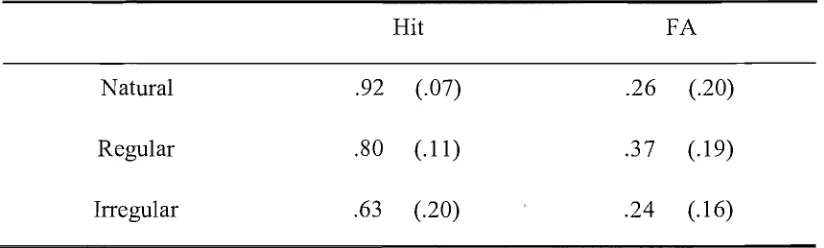
Table 1. Experiment 1: Pronunciation durations for each item
category 36
Table 2. Experiment 1: Hit rates for each item type in the three
feedback conditions 37
Table 3. Experiment 1: FA rates for each item type in the three
feedback conditions 38
Table 4. Experiment 2: Pronunciation durations for each item type
45
Table 5. Experiment 2: Hit rates for each item type in the three
feedback conditions 46
Table 6. Experiment 2: FA rates for each item type in the three
feedback conditions 47
Table 7. Experiment 3: LDT response latencies produced by the
LDT group 56
Table 8. Experiment 3: LDT accuracy produced by the LDT group
57
Table 9. Experiment 3: Hit rates for LDT and no-task groups
58 Table 10. Experiment 3: FA rates for LDT and no-task groups
59 Table 11. Experiment 4: Hit and FA rates for each item type in the
meaning and no-meaning condition 68
Table 12. Experiment 5: Hit rates and FA rates for each item type
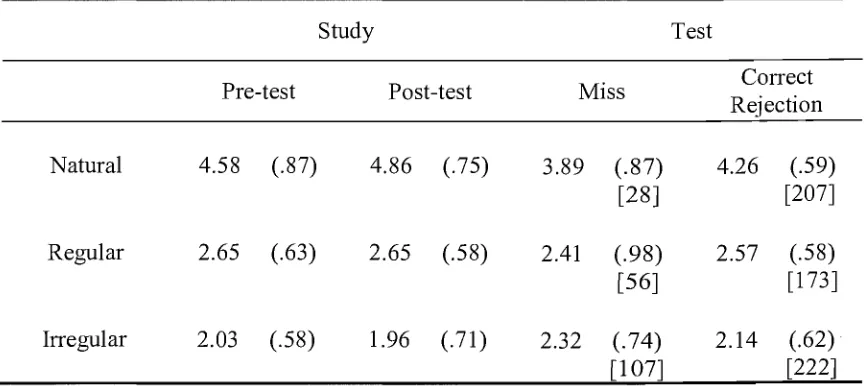
94 Table 13. Experiment 5: Memorability ratings for each item type,
obtained in the pre-test and post-test study phases, and in 95
the test phase
Table 14. Experiment 6: Hit and FA rates for each item type in the
short and long duration conditions 121
Table 15. Experiment 6: Estimates of d' for each item type in the
short and long duration conditions 121
Table 16. Experiment 7: Hit and FA rates for each item type,
presented in blue and in red 131
Table 17. Experiment 7: Estimates of d' for each item type,
Table 18. Experiment 8: Hit and FA rates for each item type, 136
presented in blue and in red
Table 19. Experiment 8: Estimates of d' for each item type, 137
presented in blue and in red
Table 20. Construction of 2AFC trials in Experiments 9 and 10 158
Table 21. Experiment 9: Preference data 160
Table 22. Experiment 10: Preference data 169
Table 23. Appendix D: Average bigram frequency for each item 200
type (category size 60 items or 40 items)
Table 24. Appendix E: Item length for each item type (category size 202
60 items or 40 items)
Table 25. Appendix G: Inter-stimulus similarity for the final list of 205
40 items, according to item type and stimulus pool size
Figures
Figure 1. SD model for recognition memory with distributions for 103
targets and lures.
Figure 2. Criterion-shift account for the mirror effect in recognition 105
memory
Figure 3. A within-list criterion-shift model, adapted from Dobbins 143
and Kroll (2005)
Figure 4. A criterion-based model for the distinctiveness heuristic, 147
adapted from Gallo, Weiss, and Schacter (2004)
Figure 5. The strength-of-evidence scale constructed for Experiment 165
9, using the Thurstonian scaling technique
Figure 6. The strength-of-evidence scale constructed for Experiment 171
10, using the Thurstonian scaling technique
Figure 7. Glanzer's likelihood-ratio model for the mirror effect 182 Figure 8. A hypothetical criterion-shift model for the distinctiveness 184
heuristic
Acknowledgements
This thesis would not have come to its completion without the help and
suppOli of many people, both at the University of Southampton and back home in
Australia. To begin, I am much indebted to my supervisor Dr Phil Higham for his
advice and comments on this PhD project. I also thank Professors Nick Donnelly and
Constantine Sedikides for their encouragements. In terms of technical assistance, I am
deeply grateful to Luke Phillips, and in particular to Dr Dave Brook, without whose
patient guidance on the programming of the Revolution software, none of the
experiments reported in this thesis would have existed. I am also indebted, quite
literally, to the School of Psychology and the Overseas Research Student Award
Scheme, for giving me this wonderful opportunity to study in Southampton.
Every aspect of this thesis has been shaped by many others, all for the better. I
send my heartfelt thanks to: my family - Maria, Francis, Henry, my friends - K., Jeta,
Yami, Angelo, Jenny, ME and Roberta, my officemates over the past years - Mark,
Xingshan, Cara, Ina, Ailsa, and Tamas (who all demonstrated saintly forbearance in
light of the negative vibes emanating from my comer), the people who have provided
the soundtrack - Ben, Roy & HG, John Safran & Father Bob Macguire, Tony Delroy,
and everyone else who have been so kind in wishing me well during my time here.
Finally, I express my sincere gratitude to all my participants, who have
provided me with so much interesting data, and therefore so much to write about in
Abbreviations
AL T Attention-likelihood theory
ANOVA Analysis of Variance
c
cm d' DRM F FA ITl LDT M MSE ms N n P PDP REM s SCAPE SD SE t WFE 112 Bias estimate centimetres dprimeDeese-Roediger-Dermott (false memory paradigm)
F ratio
False alarm
Inter-trial interval
Lexical decision task
Mean
Mean square error
Milliseconds
Sample size
Sample size (subgroup)
probability
Process dissociation procedure (Jacoby, 1991)
Retrieving Effectively from Memory (Shiffrin & Steyvers, 1997)
Seconds
Selective Construction and Preservation of Experiences (Whittlesea, 1997)
Signal-detection
Standard error
t statistic
Word frequency effect
Preface
The fallibility of human memory has been the subject of investigation since
the very beginnings of experimental psychology. One aspect of memory failure, that
of forgetting, was first examined in the pioneering work of Ebbinghaus in the late 19th
century, and continues to be a subject of interest in more recent studies on phenomena
such as retrieval-induced-forgetting (e.g., Anderson, Bjork, & Bjork, 1994) and
directed forgetting (e.g., Bjork, 1989; Sahakyan & Delaney, 2003). In contrast, the
other failure of memory, that of illusory memories for events that have not actually
occurred, has a somewhat fragmented history. Arguably, the first investigation on this
subject was carried out in the early 20th century by Alfred Binet in his systematic
examination ofumeliable recollection in children (Roediger & McDermott, 2000).
Later, Bartlett (1932) also demonstrated incidences of false memories when he
conceptualised memory as a reconstructive process, but one which was prone to
schema-influenced errors. The study of false memories went through the doldrums in
the mid 20th century, when errors in memory tests were actively factored out because
they were merely seen as noise which masked true memory performance. However,
following the cognitive revolution in the 1960s, research on memory illusions was
revived through the work of researchers such as Bransford and Franks (1973) and
Loftus (1979). Since then, the topic of false memories has formed an integral part of
memory research. There are several reasons for this. As exemplified by much of
Loftus's work, our understanding of the nature of false memories have important
social implications in the legal domain - the credibility of eyewitness testimony and
the veracity of apparently recovered memories (e.g., those concerning childhood
abuse) remain a contentious issue. Away from the applied perspective, for memory
theorists, false memories are in themselves intriguing phenomena which are worthy of
scientific investigation. Indeed some researchers have argued that in the same way
perceptual illusions have contributed to our understanding of the visual system, the
study of memory illusions may provide us with valuable insights into the true
workings of human memory (Roediger & McDermott, 2000).
One context in which false memories could occur is in recognition, whereby a
novel, never-before-seen stimulus is falsely claimed to have been encountered
victim falsely accuses an innocent suspect, or when a distractor (false option) is
chosen as the correct answer in a multiple-choice test. Experimentally, false memories
(and general perfonnance) in recognition are examined through recognition tests
devised by the experimenter. The fonnat of a typical recognition test consists of a
study phase, followed by a test phase. During the study phase, participants are
presented with a set of items to be committed to memory. In the test phase,
participants are presented with a mixture of targets (i.e., "old", or studied items) and
lures (i.e., "new", or non-studied items). The participants' task is to discriminate the
targets from the lures. In other words, correct responding entails saying "old" to a
studied item (also known as "hit") and "new" to a non-studied item ("correct
rejection"). Incorrect responding, on the other hand, entails judging a studied item as
"new" ("miss") and a non-studied item as "old" ("false alann", or FA). It can be seen
that hits and misses, and false alanns and correct rejections, are both complementary
pairs in that the two measures of the pair add up to the number of targets and lures
respectively. Hence, a participant's recognition perfonnance can be sufficiently
indexed by the hit rate (proportion of targets correctly judged as old) and FA rate
(proportion oflures incorrectly judged as old).
To investigate the phenomenon of false recognition, psychologists devise
specific paradigms which would predict and produce noteworthy patterns of F A rates.
An example of such a paradigm can be found in Whittlesea and Williams (1998).
These researchers created a recognition test consisting of three distinctly different
types of items - (a) natural words (i.e., real English words, e.g., CURTAIN), (b)
regular nonwords (i.e., nonsense words which are easy to pronounce, e.g.,
HENSION), and (c) irregular nonwords (i.e., nonsense words which are difficult to
pronounce, e.g., STOFWUS). Using these items, these researchers produced a
remarkably robust finding whereby the rate of false recognition (as indexed by the FA
rate) was greater for regular nonwords than for natural words or irregular nonwords.
Whittlesea and Williams dubbed this pattern of F A rates "the hension effect", after
one of the regular nonword items.
On the basis of their findings, the discrepancy-attribution hypothesis was put
forward by Whittlesea and Williams (1998) as a putative account for how false
concepts and experimental manipulations were further introduced to gather supporting
evidence for this hypothesis, and to generalise this principle to other illusions found in
different memory paradigms and to other aspects of human judgments and cognition
(e.g., Whittlesea, 2002a, 2002b; Whittlesea & Leboe, 2000, 2003; Whittlesea,
Masson, & Hughes, 2005; Whittlesea & Williams, 2000, 200la, 200lb). Elsewhere,
little research has emerged to examine this hypothesis, or perhaps more
fundamentally, the validity of using this hypothesis to explain the hension effect.
Thus, one of the aims of this thesis is to appraise the suitability of the
discrepancy-attribution hypothesis in accounting for the hension effect. In the first part of the
thesis, a background of the research and theories on the causes of false recognition
will be presented, along with a detailed exposition of Whittle sea and Williams's
framework. This will be followed by the report of several experiments. These
experiments were based on the hension effect paradigm, and were conducted to
evaluate some of the predictions derived from the discrepancy-attribution hypothesis.
It is important to note that the goal of this thesis is not to refute the hypothesis itself,
but rather to scrutinise whether the hypothesis is the appropriate explanation for the
hension effect, and in so doing, to investigate whether alternative factors may playa
role in producing the effect. To this end, the latter parts of the thesis will describe
other experiments which were carried out to address this issue. Specifically, it will be
argued that metacognitive processes, in particular those based on the assessment of
item memorability, may be an influential factor in the production of false alanns, and
Chapter 1
Introduction
"And it is an assumption made by many writers that the revival
of an image is all that is needed to constitute the memory of the
original occurrence. But such a revival is obviously not a
memory, whatever else it may be; it is simply a duplicate ... A
farther condition is required before the present image can be
held to stand for a past original."
"That condition is that the fact imaged be expressly referred to
the past, thought as in the past."
- William James (1890)
1.1 Feelings of Remembering are Products of Attributions
In his seminal work, Principles of Psychology, William James alluded to the
notion that in order to fully understand how memory works, we need to explain how a
rememberer comes to evaluate a "revival of an image" in memory as a representation
of an original event in the past. Nearly a century later, these sentiments were echoed
by Jacoby, Kelley and Dywan (1989) in their paper titled "Memory Attributions",
where it was proposed that subjective feelings of rememberingl, as experienced by,
say, a participant in a memory task, are "an attribution of a response to a particular
cause; that is, to the past." (p. 391). In this, the important role played by subjective
experience in remembering was emphasised by Jacoby et aI., who argued that it is this
subjective experience which drives behaviour. As an example, they noted that
amnesics could have intact procedural memory, but yet are reluctant to act upon this
retrieved information in the absence of a subjective experience of remembering. Thus,
1 The tenn remembering is used here as a generic term to refer to instances where the
participant has grounds to claim that something has happened in the past. Therefore, it should not be confused here with the identical-in-name concept in the
the phenomenology of remembering is crucial in giving one "the impetus to act"
(Jacoby et aI., p. 400).
The novel contribution of Jacoby et aI.' s (1989) work, however, lies in their
speculation that attributional mechanisms could underlie not only veridical
recognition, but also false recognition. They noted that attributional accounts, as seen
elsewhere in the research on emotions, suggests a less-than-direct relationship
between physiological responses and the nature of emotive feelings one experiences.
Depending on one's situational context, adrenal in-induced arousal could be
interpreted as anger or happiness (Schachter & Singer, 1962). In a similar way,
Jacobyet aI. proposed that the strength (or even the presence) of memory
representations might not have a direct causal relationship with feelings of
remembering. Certainly, a lack of subjective experience of remembering could reflect
an absence of that particular episode being represented in memory, or that the
representation had failed to be retrieved or activated. Conversely, subjective feelings
of remembering indicate the presence of such a trace in memory. However,
observations on amnesic patients, as well as on normal subjects, suggest that the link
between memory representation and subjective feelings of remembering may not be
as straightforward as is commonly believed (Jacoby & Witherspoon, 1982).
Specifically, Jacoby et aI. argued that feelings of remembering may not necessarily
result from a re-activation of a representational trace in memory, but rather are
products of an "attribution or unconscious inference" (p. 392). False recognition,
therefore, would occur when attributional processes produces phenomenological
experiences of pastness, in the absence of an actual memory trace of the "recognised"
event.
1.2 The Basis of the Memory Attributions - Fluency
In Jacoby et aI.'s (1989) account,jluency, as experienced during the
processing for a given stimulus, is the crucial element which underpins memory
attributions. The idea of fluency had emerged as early as the tum ofthe last century,
when Titchener described a fluent stimulus as a "reconstruction along the line ofleast
resistance" (cited in Jacoby et aI., 1989, p. 395). The phenomenology associated with
fluency was also illustrated by Baddeley's (1982) description that fluently processed
with processing ease (e.g., "words read once are more easily re-read later", p. 401),
and the speed of processing (e.g., "an idea considered once comes to mind more
readily later", p. 401). Based on these ideas, the operational definition commonly held
by memory researchers is that fluency can be measured in tem1S of the speed
(response latency, e.g., time taken to pronounce a word stimulus, see Whittlesea,
Jacoby, & Girard, 1990) and/or the accuracy by which a stimulus is identified (e.g.,
Jacoby & Dallas, 1981). The principal conjecture put forward by Jacoby et al. was
that fluency experienced during the current processing of a stimulus could be
interpreted as an indicator that this stimulus had been encountered in the past.
Much of the groundwork underlying Jacoby et aI's (1989) hypothesis that
subjective feelings of remembering arise from processing fluency could be found in
Jacoby and Dallas's (1981) investigation on repetition (or perceptual) priming. In
their investigation, repetition priming referred to the way that accuracy in identifying
a briefly flashed stimulus (presented for a duration of35 ms) could be greatly
enhanced from prior study of that stimulus. A significant finding from Jacoby and
Dallas was that the effects of repetition priming were more robust than first thought
-perceptual identification perfoffi1ance was found to benefit even from a brief previous
study (1 s) of the stimulus, and this enhancement was retained despite a 24-hour delay
between study and test. Importantly, however, Jacoby and Dallas extended their
investigation by examining the relationship between repetition priming and
recognition memory. They argued that the speed and accuracy by which perceptual
identification was perfoffi1ed could be used by participants in discriminating studied
(old) from not-studied (new) items in a recognition test. Because previously
encountered stimuli are processed more fluently (i.e., due to repetition priming),
processing fluency experienced for a given stimulus could therefore be attributed to
its prior occurrence.
1.3 Fluency Misattribution as the Cause of False Recognition
It can be seen then that fluency in processing could be a reliable indicator for
veridical recognition. That is, feelings of remembering produced through fluency
attributions do reflect the reality that the stimulus had actually occurred in the past.
Critically, however, Jacoby et al. (1989) postulated that the same fluency-based
argued that processing fluency for a stimulus could be boosted by factors other than
prior experience. In other words, if the processing of a never-before-seen stimulus is,
for some reason, fluent, then this kind of fluency could subsequently be misattributed
to a source in the past, thus resulting in false recognition.
A demonstration of this type of illusory recognition can be found in Jacoby
and Whitehouse (1989), who devised a recognition test where each test word item was
preceded by a briefly presented prime (the presentation duration was 16 ms). The
prime took one of three fonns: (a) matching - a word which was identical to the test
word, (b) nonmatching a word which was different to the test word, or ( c) control
-a series ofletters ("xoxoxox"). J-acoby -and Whitehouse found th-at signific-antly more
"old" judgments were given in the matching prime, than in the nonmatching or
control prime conditions, regardless of the test item's actual old/new status. These
researchers attributed this finding to the way that a matching prime would enhance the
processing fluency of the subsequent test word, and in tum, the fluency produced
would be interpreted by participants to be an indicator of pastness.
Similarly, Whittlesea et al. (1990) developed a paradigm to examine
fluency-based false recognition. On a given trial in their experiment, participants were
presented with a succession of seven words, each displayed briefly for 60 ms. This
serial presentation of seven words was followed immediately by the test word which
was occluded either by a light mask or a heavy mask. The difference between the two
levels of mask density used was discernible, but not obvious. For the test word,
participants were required to first pronounce it, and then judge the test word as old if
it was one of the seven preceding words that were just presented, or new if it was not
one of those seven words. Analyses on participants' pronunciation latencies revealed
two significant outcomes. First, test words that were old were pronounced more
quickly than test words that were new. This finding was consistent with the notion of
repetition priming, because identification/pronunciation of the test word was
enhanced by its previous presentation. The second finding from the pronunciation
latency data was that unsurprisingly, test words presented under a light mask were
pronounced more quickly than those presented under a heavy mask. Importantly, this
result was accompanied by recognition data showing that test words, regardless of
presented under the light rather than the heavy mask. Thus, in the case of a new test
word, processing fluency that arose because of the light mask condition was being
misattributed to the stimulus's prior occurrence (Whittlesea et aI., 1990).
1.4 Bidirectional Influence Between the Current Processing of a Stimulus and its Prior Occurrence
Additional experiments conducted by Whittlesea et al. (1990) further showed
that the relationship between processing fluency and memory appeared to be
bidirectional. Fluency resulted from an actual past encounter with the stimulus could
affect the current perception of the stimulus. In one experiment, Whittlesea et al.
utilised the same experimental paradigm as described above, but imposed a different
task demand on the participants. Rather than making an old/new judgment,
participants were required to assess the density of the mask occluding the presented
test word. In this case, processing fluency due to the test word being old resulted in
the mask being perceived as less dense.
This last finding by Whittlesea et al. (1990) was predated by a large body of
research on how memory could influence the perception of later events. For example,
when participants were asked to judge the length of presentation duration for test
items, items that were previously studied were judged to be presented for a longer
duration than those that were not studied, regardless of whether the duration was
actually long or short (Witherspoon & Allen, 1985). Likewise, in a task where
participants were to judge the noise level within which sentences were embedded, the
noise level was perceived to be less loud when a previously studied, rather than a new
sentence, was presented concurrently with the noise (Jacoby, Allan, Collins, &
Larwill, 1988). Similarly, previously encountered geometric shapes were
subsequently judged to be brighter, or darker (depending on the task specification),
than new stimuli (Mandler, Nakamura, & Van Zandt, 1987).
Further, not only could the effect of prior experience be manifested in the
perception of the stimulus's physical characteristics (e.g., clarity, duration, loudness,
brightness, etc.), it could also modify the perception of the stimulus's non-physical
attributes (e.g., meaning, pleasantness). A prior encounter of a nonfamous name could
Kelley, Brown, & Jasechko, 1989; Jacoby, Woloshyn, & Kelley, 1989); previously
presented geometrical shapes were preferred to new ones (Mandler et al., 1987); and
words that had been studied were judged to be more pleasant than those that had not
(Whittlesea, 1993).
Collectively, studies by Whittlesea et al. (1990) and others (e.g., Jacoby et al.,
1988; Mandler et al. 1987) suggest that the dimension of the stimulus to which
fluency is attributed may be largely dependent on task demands. Fluent processing
actually caused by past experience with the stimulus can be misinterpreted as a
product of a physical or non-physical characteristic inherent in the presently
encountered stimulus. Conversely, fluent processing actually caused by a current
perceptual manipulation can be misattributed to the past, resulting in false
recognition.
1.5 Dissociation Between Fluency and Recognition Memory Judgments
Thus far, it appears that in a recognition task, processing fluency would,
through attributional mechanisms, be invariably translated to "old" judgments. The
relationship between fluency and feelings of remembering, however, is in fact far
more complex. Indeed, while Jacoby and Dallas (1981) noted the robustness of
repetition priming, they also demonstrated that processing fluency (in this case,
measured by the identification accuracy of briefly presented test stimuli) could be
dissociated from recognition memory performance. More specifically, these
researchers found that certain variables could affect recognition memory performance
without necessarily affecting perceptual identification success. For instance, in one
experiment, participants encoded some items using deep processing which required
the elaboration of the items' semantic properties, and encoded other items using
shallow processing which only focused on the items' physical characteristics. As
predicted from the level-of-processing account (Craik & Lockhart, 1972), recognition
(in this case, indexed by hit rate) was better for items that underwent deep, semantic
encoding than for items that were only shallowly encoded. In contrast, accuracy in
perceptual identification remained constant despite of this level-of-processing
manipulation. Likewise, imposing a 24-hour delay between study and test
substantially impaired recognition memory while leaving perceptual identification
memory and perceptual identification performance suggests that while some studies
(e.g., Whittlesea et aI., 1990) indicated a direct link between processing fluency and
recognition judgments, this relationship might not be a straightforward one.
The observation of a low correlation between fluency and the likelihood of an
"old" judgment has also been noted by Johnston, Dark, and Jacoby (1985). These
authors argued that if recognition memory is solely dependent on processing fluency
(indexed here by pronunciation latency), then items more fluently processed (with a
faster pronunciation latency) would elicit an "old" response (i.e., produce hits and
false alarms), whereas items less fluently processed (with a slower pronunciation
latency) would elicit a "new" response (i.e., produce misses and correct rejections).
Consistent with this account, the average pronunciation latency was indeed faster for
hits than for correct rejections. However, contrary to their prediction, Johnston et al.
found that the average pronunciation latency was actually faster for misses than for
false alarms. That is, despite the fact that old items were processed more fluently than
new items in a recognition test, some ofthese old items were mistakenly judged to be
new. Conversely, some ofthe new items were incorrectly recognised as old, despite
the fact that processing fluency for these items was low (Johnston et aI., 1985; see
also Poldrack & Logan, 1998 for similar evidence that fluency, or speed of item
processing mediates recognition performance only to a limited extent).
1.6 The Dual-Process Model of Recognition Memory
To account for the indirect relationship between processing fluency and
recognition judgments (e.g., Jacoby & Dallas, 1981; Johnson et aI., 1985), Jacoby and
his colleagues advocated a dual-process account of recognition memory. First
originated in the 1970's (e.g., Atkinson & Juola, 1973, 1974), the dual-process theory
has become a prominent force in recognition memory, inspiring the proposal of a
large number of memory models in the past 30 years (e.g., Atkinson & Juola, 1973;
Huppert & Piercy, 1976; Mandler, 1979, 1980; Jacoby, 1991; Tulving, 1982, Tulving
& Schacter, 1990; Yonelinas, 1994, 1997, 1999,2001; see Yonelinas, 2002 for a review). Despite some critical differences among them, the basic assumption shared
by these models is that recognition memory is based on two distinct processes,
recollection and familiarity. A common conception ofthese two processes, as
& Dywan, 1989, Jacoby & Witherspoon, 1982), is that recollection entails the recovery of the context in which the recognised stimulus was originally encoded,
whereas a familiarity-based recognition judgment involves the assessment of
processing fluency of the encountered stimulus. Thus, according to this particular
class of dual-process models, when processing fluency of a stimulus is attributed to its
pastness, the phenomenology of remembrance is specified to be feelings ofJamiliarity
for that stimulus. Moreover, in agreement with other models such as those proposed
by Atkinson and Juola, and Mandler, Jacoby's dual-process account assumes that
recollection- and familiarity-related mechanisms operate independently and in
parallel. Additionally, while recollection is argued to be an effortful and controlled
process, familiarity, on the other hand, is described as a quick and largely automatic
route to recognition (Y onelinas, 2002f
From the perspective of the dual-process model, the low correlation between
fluency and "old" recognition judgments could be ascribed to the involvement of
recollection-based mechanisms in recognition. If recognition memory is solely based
on processing fluency, variables affecting recognition memory performance would in
tum have an impact on perceptual identification performance. The dissociation found
by Jacoby and Dallas (1981) whereby identification accuracy remained stable, while
recognition memory performance fluctuated, runs against the notion that the
probability of a stimulus being judged as old could be predicted directly from its
processing fluency. These researchers argued that, in the example where recognition
was found to benefit from deep, semantic processing, participants were basing their
reco gnition judgments on the recollection of study-context details, rather than on the
item's processing fluency. Likewise, the fact that processing fluency was found to be
greater for old items judged to be new (misses) than for new items judged to be old
(false alarms) suggests a reliance on a separate recollection-based process that was not
contingent on fluency (Johnston et al., 1985). However, because this recollection
route was argued to be "fallible" (Johnston et al., 1985, p. 7), reliance on this route
would therefore render some old items to be erroneously judged as new. Presumably,
this would occur when despite the studied item's high levels of processing fluency,
2 However, more recent reaction-time data suggested that recollection-based
responses are made faster than familiarity-based responses (Dewhurst, Holmes,
the participant fails to retrieve sufficient recollective details for it to warrant an "old"
judgment.
Thus far, the assumptions of the dual-process model delineated here primarily
concern veridical recognition, that is, according to the model, the participants' ability
to produce hits on a recognition test, is based on either recollection or familiarity. In
terms of false recognition, the model assumes that false alanns are driven by the
familiarity process. Indeed, the process dissociation procedure (PDP), which was
devised by Jacoby (1991, 1999; see also Hay & Jacoby, 1996, 1999) to investigate the
role of recollection and familiarity in recognition, hinges on these above assumptions
on how hits and false alarms are produced. To give an example, in one version of the
PDP, pmiicipants were first shown a list of visually presented word, followed then by
a list of auditorily presented word which they were required to learn intentionally for
a later test (Jacoby, 1991). Two different tests were subsequently given to participants
- an inclusion and an exclusion test. In the inclusion test, participants were asked to
respond "yes" to items that were either seen (in the first list) or heard (in the second
list). In the exclusion test, they were to respond "yes" only to items that were heard,
and "no" to items that were seen. The rationale underlying the PDP is that both
recollection and familiarity could be used in responding to items in the inclusion test,
whereas only recollection of contextual details associated with encoding would allow
participants to discriminate heard items from seen items in the exclusion test.
Moreover, seen items that were incorrectly claimed to be heard in the exclusion test
were assumed to be a reflection of the influence of familiarity on recognition (Jacoby,
1991l
3 Mathematically, these above assumptions could be expressed by the following
equations (Jacoby, 1991). In the inclusion test, the probability of a "yes" response is equal to the probability of the item being recollected and the probability of the item being accepted on the basis of familiarity (F), in the absence of recollection (R):
P(inclusion) = R + F(1-R). In the exclusion test, the probability of incorrectly
responding "yes" to a seen item is simply equal to the probability that the item is not recollected, but is familiar: P(exclusion) = F(1-R). From these equations, estimates of recollection and familiarity could be computed (Jacoby, 1991). Subtracting
P(exclusion) from P(inclusion) would give an estimate of recollection, i.e., R =
P( exclusion) - P(inclusion). An estimate of familiarity is calculated by dividing
FUliher suppOli for the notion that false recognition is derived from a
familiarity-based process could be found in a number of studies showing that
manipulation on processing fluency, which purportedly underpins the familiarity
process, would induce changes in FA rates, as well as changes in the production of
"yes" responses associated with familiarity. For example, Rajaram (1993)
incorporated remember/know response instructions (e.g., Gardiner, 1988; Gardiner,
Ramponi, & Richardson-Klavehn, 2002) in order to elucidate the specific basis by
which participants made "old" judgments in the Jacoby-Whitehouse paradigm (1989),
as detailed earlier in this chapter. First developed by Tulving (e.g., 1982, 1985), the
remember/know distinction aligns closely with the principal ideas espoused by the
dual-process theory, in that "remembering" is associated with the recollection of
details relating to the study episode, and "knowing" is associated with feelings of
familiarity in the absence of recollection. In requiring participants to classify their
"old" recognition judgments as either "remember" or "know", Rajaram showed that
the increase in "old" judgments found in Jacoby and Whitehouse's matching prime
condition was primarily driven by an increase in "know" responses. In contrast, the
propOliion of "old" judgments classified as "remember" was unaffected by the
priming manipulation.
Elsewhere, as noted by Yonelinas (2002), recognition tests using the RlK
response instructions generally produce very low levels of "R" responses for new
items, with the majority of false alarms being classified as "K" (a selection of
examples include Gregg & Gardiner, 1994; Guttentag & Carroll, 1997; Rajaram,
1993; Y onelinas, 2001; Y onelinas, Dobbins, Szymanski, Dhaliwal, & King, 1996).
The only findings that are inconsistent to this trend in RlK responses can be found
when the Deese-Roediger-McDermott (DRM) paradigm was used to produce false
recognition (Roediger & McDermott, 1995; see also Read, 1996). In the DRM
paradigm, participants are given study items (e.g., bed, blanket, night) which are all
related to a critical theme word (e.g., sleep). The theme word is not shown during
study, but acts as a critical lure at test. The rate of false recognition for the critical lure
has been found to be remarkably high, even approximating the hit rate for related
items that had actually been studied (e.g., Roediger & McDelIDott, 1995; Whittlesea,
2002a). Moreover, the majority of false alarms associated with the critical lure were
items that were not studied (e.g., Gallo, Roediger, & McDelmott, 2001; Israel &
Schacter, 1997; Schacter, Verfaellie, & Anas, 1997; Schacter, Verfaellie, & Pradere,
1996). However, altemative explanations have been offered for this contradictory
finding (Schacter, Nonnan, & Koutstaal, 1998). For example, Nonnan and Schacter
(1997) showed that infOlmation retrieved at test in a DRM experiment primarily
pertained to semantic associations rather than sensory contextual details encoded
during the study episode. False recollection would therefore arise because studied
(related) items and the critical lure share a large number of semantic associations.
Another possibility is that the critical lure is covertly generated by participants during
study and this self-generated representation of the critical lure is subsequently
recollected at test (e.g., Roediger & McDennott, 1995; see also Yonelinas, 2002).
Thus, false recollection here constitutes a source-monitoring error (e.g., Johnson,
Hashtroudi, & Lindsay, 1993 ; Johnson & Raye, 1981) because the participant fails to
discriminate between an actual experienced event from an imagined one.
Overall, the evidence from the DRM literature suggests that false recognition
could arise from other psychological mechanisms in which the concept of processing
fluency is not necessarily implicated. However, it might be important to note that
hypothesised accounts like those described above (e.g., Schacter et aI., 1998) are
specific to findings from the DRM paradigm. In a standard recognition test consisting
of word stimuli, experimenters are usually at pains to minimise the overlaps in
semantic associations among items, and it is impossible for the participants to
self-generate the lures devised by the experimenter. Thus, for the standard recognition test
based on individual word stimuli, the general consensus among adherents of the
dual-process model is that false alanns are produced through the familiarity route in
recognition, when fluency experienced for a new test item is misattributed to the past.
1.7 The SCAPE Framework and the Discrepancy-Attribution Hypothesis
An altemative to the dual-route account in explaining the complex relationship
between processing fluency and recognition memory can be found in the
discrepancy-attribution hypothesis, as put forward by Whittlesea and Williams (1998, 2000,
200la, 2001b). In their work, Whittlesea and Williams reported primarily on the
conditions whereby fluency from current processing would be misattributed to the
under certain experimental manipulations, FA rates would exceed the level that would
be predicted by fluency measures (e.g., pronunciation latency). The central point of
their theory is that in order for such an augmented rate of misattribution to occur,
participants need to experience a level of fluency that is surprising, or discrepant to
their expectations.
The discrepancy-attribution hypothesis has its foundations in the Selective
Construction And Preservation of Experiences (SCAPE) framework (Whittlesea,
1997,2003). As a functional account of memory, the SCAPE framework assumes that
there is one memory system responsible for the preservation of experiences and the
control of behaviours. Moreover, this framework places an emphasis on the idea that
memories are not "retrieved", but are reconstructed through two stages: production
and evaluation. Production here refers to the performance of a cognitive operation on
an encountered stimulus. The result of this production could be either a behavioural,
or in the case of remembering, a mental event. Further, production is said to be
influenced by the rememberer's attitudes and expectations towards this encountered
stimulus. Following production, evaluation allows the rememberer to assess the way
the cognitive operation has been performed on the stimulus. Whittlesea argued that it
is at this evaluative stage, that in the words of Marcel (1983), pmiicipants are
attempting to "make sense of as much data as possible at the most functionally useful
level" (p. 238). In relation to memory, the subjective experience of remembering is
therefore said to arise through this evaluative process (Whittlesea, 1997,2003).
Unlike the dual-route account of recognition memory, the SCAPE framework
does not assume recognition judgments which are perceived by participants to be
"recollection-based" versus those which are "familiarity-based" necessarily
correspond to separate, distinctive processes (for a similar view, see Gruppuso,
Lindsay, & Kelley, 1997; and Higham & Vokey, 2004). Instead, the primary focus of
the framework is to explain the subjective feelings of remembering one could
experience when encountering a particular stimulus. Straying from the
recollection/familiarity distinction, the terminology used in the SCAPE framework for
these subjective feelings is "feelings of familiarity". These feelings, argued to be the
sine qua non of the phenomenology of remembering (Whittlesea, 1993), are proposed
that inferences made during evaluation could be based on celiain heuristics the
rememberer is using (Whittlesea, 1997,2003). In this sense, recognition judgments
are made much in the same way some decisions are argued to be made in regards to
the nature of our environment (e.g., Kahneman & Tversky, 1973; Tversky &
Kahneman, 1971, 1973). For instance, decisions pertaining to the size of a category
are proposed to be made with the use of the availability heuristic (Tversky &
Kahneman, 1971), a rule of thumb which assumes the ease by which a category
member comes to mind reflects the size of the category to which the member belongs.
In a similar vein, recognition judgments could be perfol111ed on the basis of a "fluency
heuristic" whereby processing fluency of a particular stimulus is deemed to be
indicative of the stimulus's pastness.
1.8 Evidence for the Discrepancy-Attribution Hypothesis: The Hension Effect
The evaluative stage postulated in the SCAPE framework, however, suggests
that the fluency heuristic would only be used in celiain situations. Thus, it is not
simply the case that processing fluency would unfailingly produce feelings of
familiarity at every tum, and hence the relationship between processing fluency and
recognition memory is not direct. Specifically, Whittlesea and Williams (1998, 2000,
200 1 a, 200 1 b) argued that the possibility of fluency-based attributions being made is
largely dependent upon one's expectations and the evaluation of one's interaction
with an encountered stimulus. This tenet, which lies at the heart of the
discrepancy-attribution hypothesis, is supported by a series of experimental findings reported by
these researchers. For example, in one experiment (Whittlesea & Williams, 1998,
Experiment 1), participants studied a list containing natural words (e.g., BOTTLE),
pseudohomophones (non words that sound identical to a real word when pronounced,
e.g., PHRAUG), and nonwords (that are not pseudohomophones, e.g., BELINT). In a
subsequent recognition test, pmiicipants were first required to pronounce each test
item aloud, and then make an old/new judgment for the test item. It was found that for
new items, pronunciation latencies were faster for natural words than
pseudohomophones, which were in tum pronounced more quickly than nonwords.
However, in temlS of the probability of a new item being inconectly recognised, the
FA rate was significantly higher for pseudohomophones (43 %) than for natural words
In another study, Whittlesea and Williams (1998, Experiment 2) devised three
types of items: natural words (e.g., CURTAIN), regular nonwords (nonsense words
that are easy to pronounce, e.g., HENSION), and ilTegular nonwords (nonsense words
that are difficult to pronounce, e.g., STOFWUS). Participants were first presented
with a list containing these three types of items, and in a subsequent recognition test,
were asked to pronounce the test item, then perform a lexical decision task (i.e.,
decide whether the test item was a word or nonword), and finally judge whether the
item was old or new. For new items, pronunciation and lexical decision latencies were
fastest for natural words, followed by regular nonwords, with irregular nonwords
being the slowest. FA rates, however, showed that substantially more regular
nonwords (37%) than both natural words (16%) and ilTegular nonwords (9%) were
incolTectly judged as old by participants. This effect in the FA rates was dubbed "the
hension effect" by Whittlesea and Williams, after a regular nonword exemplar.
Consistent with findings provided by proponents of the dual-process theory
(e.g., Jacoby & Dallas, 1981 ; Johnston et aI., 1985), the results from Whittlesea and
Williams (1998) effectively demonstrated the indirect relationship between processing
fluency and judgments of old in recognition. However, unlike dual-process theorists
who invoked the concept of recollection to account for the imperfect cOlTelation
between fluency and "old" judgments, Whittlesea and Williams's exposition focussed
on the way processing fluency would be evaluated by the participant. They noted that
natural words were pronounced more quickly than both pseudohomophones and
regular nonwords. Hence, if feelings of oldness, as measured by the probability of
"old" judgments, were produced directly from processing fluency, then one would
expect more false alarms to be made for natural words than either pseudohomophones
or regular nonwords. The reversed pattern of findings, which show a higher FA rate
for pseudo homophones and regular nonwords than for natural words, therefore
suggest that the fluency heuristic was being selectively applied by participants in their
recognition decisions. Specifically, Whittlesea and Williams argued that the heuristic
was applied for pseudohomophones and regular nonwords because the processing
fluency for these items was perceived to be surprising. For pseudohomophones (e.g.,
PHRAUG), this surprise is derived from the initial expectation that these nonwords
are meaningless and therefore would not be processed fluently, but the act of
representations cOlTespond to those for meaningful natural words (e.g., FROG). For
regular nonwords (e.g., HENSION), it was argued that these items could be fluently
processed, but with this fluency one would also expect that there would be
corresponding meanings attached to these items. The realisation that these items are
ultimately meaningless therefore violates this expectation. According to the
discrepancy-attribution hypothesis, it is this discrepancy between one's initial
expectation and one's subsequent actual experience with the stimulus which crucially
predicts whether fluency misattribution would take place.
The discrepancy inherent in the processing of pseudo homophones and regular
nonwords could be contrasted with the processing of other stimuli used by Whittlesea
and Williams (1998). Although natural words were pronounced more quickly than
pseudohomophones and regular nonwords, the processing fluency of these natural
words was assumed to be un surprising, as one would expect fluently pronounced
items would also be meaningful (which they were). Similarly, the lack of processing
fluency for non-pseudohomophone (BELINT) and ilTegular nonwords (STOFWUS)
was unsurprising to participants because both of these item types were meaningless
and the lack of processing fluency experienced for these items was therefore
consistent with the items' meaninglessness. Thus, compared to the FA rate yielded for
pseudo homophones and regular nonwords, FA rates were lower for natural words,
non-pseudohomophones and irregular nonwords because there was no discrepancy
between the expectation and the actual processing experienced for these items. On the
other hand, for pseudohomophones and regular nonwords, it was proposed that their
level of subsequent processing fluency violated the initial expectations fonned for
these items, thus creating a sense of surprise and discrepancy. It was argued that in the
context of a recognition task, this sense of surprise would be attributed to a prior
encounter of these items (Whittlesea & Williams, 1998).
1.9 Feelings of Familiarity
In contrast to the dual-process model, the discrepancy-attribution hypothesis
fonnulated by Whittlesea and Williams (1998, 2000, 2001a, 2001b) has its emphasis
on false recognition, and particularly in a specific type of "feeling of familiarity"
which was described as "the subjective feeling of having prior experience, whether or
argued to be similar to the phenomenology illustrated in the oft-cited "butcher on the
bus" scenario (Mandler, 1980). A similar analogy to this scenario was offered by
Whittlesea and Williams (2000). In their hypothetical situation, a clerk with whom
one usually interacts in a store could produce feelings of familiarity ifhe is not
immediately identified as the store clerk when he is encountered in a different context,
for example, on a bus. Whittlesea and Williams argued that in this situation, the
perceptual processing of the clerk's face would be fluent, but such fluency in
processing runs counter to the nOlmative fluency one would expect when processing
the face of a stranger. It is this perceived discrepancy between actual and expected
fluency which produces a powerful feeling of familiarity, and a sense that
remembering is incomplete (Whittlesea & Leboe, 2000). The phenomenology
associated with this sense of incomplete remembering was described to be powerful,
and it usually occurs when the rememberer is in some degree of doubt (Whittlesea &
Williams, 2000). This sense of familiarity may also be accompanied by a prevailing
affect, as exemplified in the following verbalisation - "I cannot name the person, or
say from where I know [him], but I'm sure I've seen [him] before; and I may be right
or wrong." (Whittlesea & Williams, 1998, p. 142, own italics). In contrast, when there
is no discrepancy between expected and actual fluency, this powerful feeling of
familiarity is absent. This is illustrated by a counter-example to the clerk-on-the-bus
scenario - one does not have the same pressing feeling of familiarity when one
encounters one's spouse in the kitchen at home (Whittlesea & Williams, 2000). In this
case, although the perceptual processing ofthe spouse's face is undoubtedly fluent,
this fluency conforms with one's expectations and therefore is unsurprising, and
hence no feelings of familiarity would be experienced.
The focus of Whittle sea and Williams's investigations (1998, 2000, 200la,
2001 b) lay in the precise sense of familiarity one would feel when remembering is
uncertain and incomplete. In tum, the discrepancy-attribution hypothesis was
proposed as a mechanism underlying this particular phenomenology. In studies
devised by Whittlesea and Williams, such as those involving pseudohomophones
(PHRAUG) and the hension effect (as described above), the aim was to formulate
predictions based on the discrepancy-attribution hypothesis in order to recreate or
feelings of familiarity are assumed to be reflected by the production of false alanns in
recognition tests.
In the next section, some of the suppOliing evidence provided by Whittlesea
and his colleagues for the discrepancy-attribution hypothesis will be presented (e.g.,
Whittlesea & Williams, 2000, 2001 a, 2001 b). In later investigations, the
discrepancy-attribution hypothesis and the SCAPE framework were expanded by Whittlesea to
encompass other memory (e.g., cued-recall- Whittlesea & Leboe, 2003) and
decision-making processes (e.g., item classification and generation - Whittlesea &
Leboe, 2000; judgments of context reinstatement - Leboe & Whittlesea, 2002).
However, because the central interest of the current thesis is on false recognition, the
discussion below will be restricted to studies that are pertinent to this topic.
1.10 Other Supporting Evidence for the DiscrepancyAttribution Hypothesis -Perceptions of Discrepancy, Coherence, and Incongruity
In the original conceptualisation of the discrepancy-attribution hypothesis,
Whittlesea and Williams (1998) argued that the perception of discrepancy - the
antecedent to fluency misattribution and false feelings of familiarity - is produced
when there is a mismatch between expectations and actual performance. In the
context of the hension effect, Whittlesea and Williams argued that this discrepancy
arises from the way that regular nonwords such as HENSION are easy to pronounce,
but participants are oblivious to the source of this fluency, and instead regard these
regular nonwords as meaningless and therefore should-be-nonfluent items. This view
was argued to be substantiated by measures obtained from a rating task, where one
group of participants were asked to judge the ease of pronunciation of natural words
(CURTAIN), regular nonwords (HENSION) and irregular nonwords (STOFWUS)
items, while another group of participants judged whether these items were
structurally similar to English words (Whittlesea & Williams, 2001 a, Experiment 1).
Regular nonwords were judged to be easy to pronounce on 91 % ofthe trials, not
significantly different from the figure for natural words (99%). However, regular
nonwords were rated significantly lower than natural words in terms of similarity to
English words (57% versus 84%). Irregular nonwords were rated low on both of these
measures (35% and 14% for pronunciation and similarity respectively). Thus, the