Delayed school
admissions for
summer born pupils
Research report
September 2019
2
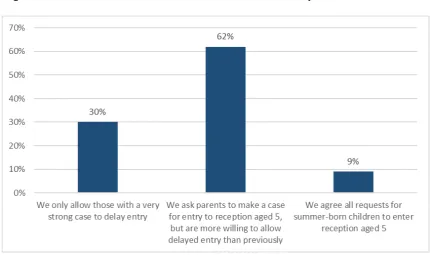
Contents
List of Figures 3
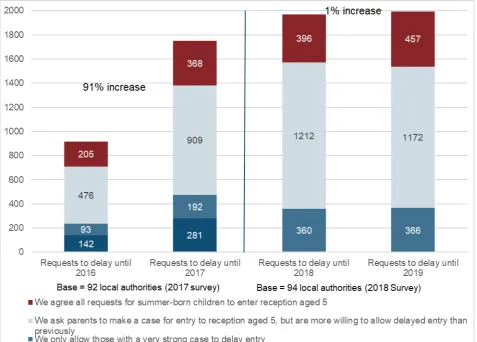
List of Tables 4
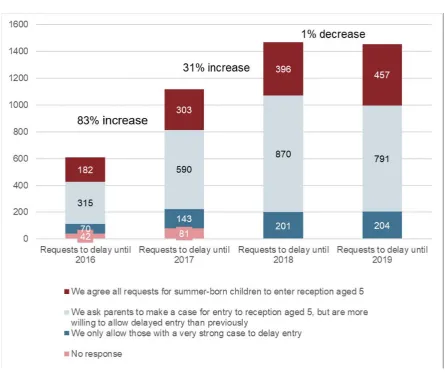
Introduction 5
Key findings 5
Methodology 7
Limitations of data 7
Willingness to accept requests for admission to reception at age 5 8
Change in the number of requests received for delayed entries between 2016 to
2019 9
Change in the proportion of requests agreed 11
Encouragement from local authorities for parents to speak to schools about potential
delays 13
Analysis from the BBC 14
3
List of Figures
Figure 1: Local authorities’ summer-born admissions policies ... 8
Figure 2: Number of requests to a delayed start each year, by local authority stance ... 10
Figure 3: Change in the number of requests received from 2016 to 2019 by local
authorities’ approach to delays ... 11
Figure 4 Percentage of requests granted to delay entry by local authority admission policy from 2018-2019 ... 12
4
List of Tables
Table 1 Treatment of applications for delay for summer born pupils for all children
compared to those who are premature ... 9
5
Introduction
1. The School Admissions Code (“the Code”) requires school admission authorities to provide for the admission of all children in the September following their fourth
birthday, and this is when children usually start school. A child does not reach
compulsory school age, however, until the “prescribed day” following their fifth birthday (or on their fifth birthday if it falls on a prescribed day1). The parents of summer born
children (born between 1 April and 31 August), are able to delay their child’s entry to school by a full academic year after they are first entitled to a place. They may request that they are admitted out of their normal age group, to reception rather than year 1, at this point.
2. In February 2017, the Department issued an online survey to all 152 top tier local authorities. The purpose of the survey was to gather information about each local
authority’s policy in relation to the admission of summer born children, and to gather information about take-up rates for delayed admission between 2015 – 2017. The findings of the survey were published in May 2018.
3. In July 2018, the Department re-issued this survey, to collect updated data and information about the admission of summer born children for entry in 18/19 and requests to delay entry until 19/20. The survey was issued to all 152 top tier local authorities and 94 local authorities completed it.
4. Of those 94 local authorities, 66 (although only 62 completed all questions) had also completed the 2017 survey. This report summarises the findings of the survey issued to local authorities in 2018 but for longitudinal analysis of longer term trends only includes responses provided by these 62 local authorities who completed all of the survey in both years.
Key findings
5. There has not been a significant change in local authorities’ self-reported admission policies between the first survey issued in 2017 and the second in 20182.
6. In the 2018 survey a small proportion (9 per cent) of the local authorities said that they grant all requests for delayed admission to reception, but the majority expect
parents to provide evidence as to why delaying would be in the child’s best interest. Nearly two-thirds (62 per cent ) of local authorities said they are now more likely to grant
1 The prescribed days are 31 December, 31 March and 31 August.
2 The 2017 survey asks local authorities about requests to delay entry to 2016 (from 2015) and 2017 (from
6
requests than they were previously3 and just over a quarter only allow those with a very
strong case to delay entry to reception until aged 5 (30 per cent in 2018). These findings were similar to the figures from the 2017 survey.
7. The number of requests received for delayed entry in reception increased each year for entries in 2016, 2017 and 2018 but appears to have plateaued for entry in 2019. It is too early to say that this is a trend.
8. The local authorities who responded to each survey were slightly different so data should not be compared at an overall level over four years; however, each survey
collected two years’ data which means the data can be analysed in two discrete blocks. The previous survey showed the number of requests almost doubled (91 per cent increase) between applications for summer born pupils for delayed entry in September 2016 and September 2017. This survey showed no statistically significant change for delayed entry between those applying for September 2018 and 2019 (a decrease of 1 per cent is not significant).
9. It is possible to compare the full results over four years for 62 local authorities who fully completed both surveys4 which also suggests the growth in requests for delays is
reaching a plateau. The percentage increases were 83 per cent between 2016 and 2017, 31 per cent between 2017 and 2018 and one per cent decrease between 2018 and 2019.
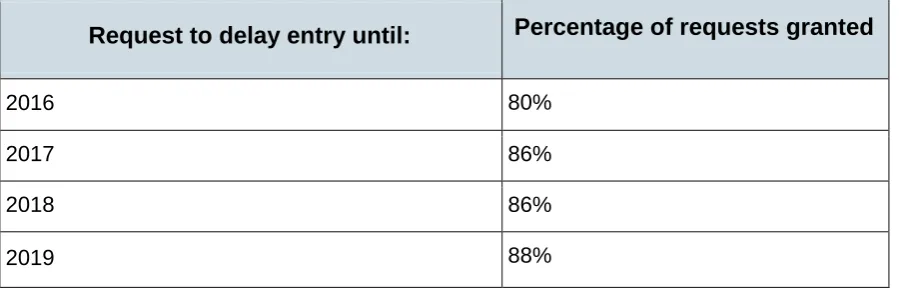
10. When comparing the 62 local authorities who responded to both the 2017 and 2018 surveys, the percentage of requests that are granted has increased but only by a small amount (80 per cent in 2016, 86 per cent in 2017 and 2018 and 88 per cent in 2019).
11. The majority of local authorities (85 per cent) said that they routinely encourage parents to speak to schools about delaying admission prior to making their decision, as they believe parents are not always aware of the provision schools can offer to summer-born children.
12. Local authorities are more likely to say they ‘agree all requests for delayed entry’ or ‘agree requests after parents have made a case’ for children born prematurely
compared to all other children. They are less likely to say they require a very strong case for delayed entry of this cohort than for other children.
3 No timescale was provided to classify what was meant by “previously” so it is difficult to know whether
local authorities stances have changed between the two years of the survey,
4 These local authorities answered questions about the number of requests to delay entry in to 2016, 2017,
7
Methodology
13. 152 local education authorities were asked to complete an online survey. 94 did so. The questions included the following topics:
How the local authority handles requests for summer-born children to be admitted to reception at age 5 and, specifically, how they handle requests for children born prematurely.
How many requests the local authority received for summer-born children to be admitted to reception in 2018 (rather than in 2017) and 2019 (rather than in 2018), and how many were agreed.
Whether the local authority routinely encourages parents who are seeking a place out of year group to speak to schools about how their child’s needs could be met in reception at age four, and if so what benefits they think these conversations provide.
Limitations of data
14. The data presented here comes with a number of caveats, set out below:
• Local authorities were asked to estimate values when uncertain of the actual figures. While this data may still be informative, it nonetheless imposes some constraints on the conclusions drawn. Unlike the 2017 survey, this time local authorities were asked to state whether the figures they provided were accurate or estimated.
• 66 of the 94 local authorities which completed this survey also completed the 2017 survey (although these figures are complicated slightly by the “uncoupling” of the Kensington tri-borough). When comparing these local authorities’ recent and past data it is important to consider potential response bias. For example, these local authorities may have been more likely than others to participate as they may have had a greater interest in the topic of summer-born admissions due to receiving more enquiries from parents of summer-born children. This has the potential to skew the figures slightly.
It is important to note that not all 66 local authorities completed all questions so base numbers have been adapted accordingly in the analysis for each question depending on the number of responses. Figure 3, for example, only includes local authorities that answered both questions about the number of requests received and the number of requests agreed for all four years (n=62)
8
request for delayed entry to reception. For some schools, the local authority is not the admission authority and so is not responsible for determining the school’s admission policy. As such, the findings are indicative, rather than fully
representative, of the school admissions sector.
Willingness to accept requests for admission to reception at
age 5
[image:8.595.55.486.314.569.2]15. A small proportion (9 per cent) of all the local authorities surveyed in 2018 currently grant all requests for delayed admission to reception, but the majority expect parents to provide evidence as to why delaying would be in the child’s best interest. Nearly two-thirds (62 per cent) of local authorities ask parents to make a case but are now more likely to grant requests than they were previously and just under a third (30 per cent) only allow those with a very strong case to delay entry.
Figure 1: Local authorities’ summer-born admissions policies in 2018
Base: 94 local authorities who responded to this particular question in the 2018 survey
9
Table 1: Treatment of applications for delay for summer born pupils for all children compared to those who are premature
All children Premature
We agree all requests 9% 15%
We ask parents to make a case 62% 66%
We only allow those with a very strong
case 30% 19%
Base: 94 local authorities who responded to this particular question in the 2018 survey
Change in the number of requests received for delayed
entries between 2016 to 2019
17. Figure 2 shows that the number of requests received for delayed entry in reception increased each year for entries between 2016 and 2018 but appear to have plateaued for entry in 2019, but it is too early to say that this is a trend. The local authorities who
responded to each survey were slightly different so data should not be compared at an overall level over four years, however each survey collected two years’ data which means the data can be analysed in two discrete blocks.
18. The previous survey (2017) showed the number of requests to delay entry to reception for summer born pupils almost doubled (91 per cent increase) between entry in September 2016 and September 2017. This survey (2018) found that delayed entry into September 2018 and 2019 did not show a significant change (an insignificant increase of 1 per cent). However, those local authorities which claim to agree all requests
experienced a 15 per cent increase in requests to delay.
10
Figure 2: Number of requests to a delayed start from 2016 to 2019, by local authority stance (all local authorities that responded)
20. Comparing only the responses from the 62 local authorities that completed both surveys (Figure 3), provides a comparative figure of the increase in requests received over the last few years. There was an 83 per cent increase between 2016 and 2017, a 31 per cent increase between 2017 and 2018, while application for a delayed entry into 2019 did not see a statistically significant change (a one per cent decrease).
11
Figure 3: Number of requests received for a delayed start from 2016 to 2019 by local authority stance (only local authorities that responded to both surveys)
Base = 62 local authorities
Change in the proportion of requests agreed
12
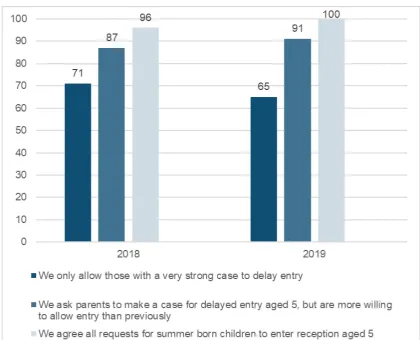
Figure 4: Percentage of requests granted to delay entry by local authority admission policy from 2018-2019
Base 94 Local Authorities in 2018 survey
23. Table 2 shows that when comparing the 62 local authorities who responded to both the 2017 and 2018 surveys, the percentage of requests that are granted has
13
Table 2: Percentage of requests granted by the 62 local authorities participating in both surveys
Request to delay entry until: Percentage of requests granted
2016 80%
2017 86%
2018 86%
2019 88%
Encouragement from local authorities for parents to speak to
schools about potential delays
24. In the 2018 survey, local authorities were asked, “Do you routinely encourage parents who are seeking a place out of year group to speak to schools about how their child’s needs could be met in reception at age four?” 85 per cent of local authorities encourage parents to speak to schools, while 14 per cent did not (1 per cent responded “Unsure”).
25. Local authorities were also asked to explain what benefits they felt were provided by parents speaking to schools. Responses tended to focus on parents underestimating the level of support that schools were able to provide to accommodate summer-born children:
“Parents do not realise that schools can often support the additional needs that their child has, in which case, delayed entry may not be required.”
“[We do it] so that parents are aware of the provision available for children in the reception class and how it is specifically tailored to meet the needs of the
youngest pupils. In many cases parents have not visited the school so this helps them make an informed decision. The schools can sometimes alleviate the parents’ concerns about their child being ready to start school.”
14
Analysis from the BBC
26. A BBC study investigating the number and proportions of requests received by local authorities to delay entry to reception for summer-born children produced similar results to this research. The BBC found that local authorities each received an average of 20 requests to delay entry to 20185. This number is very similar to the 21 requests per
local authority observed in our 2018 survey (1968 requests across 94 local authorities). This figure represents a small increase from the 2017 survey, which showed local authorities receiving an average of 19 requests (1750 requests across 94 local
authorities), although it should be noted that each survey used a different sample, and these averages are not weighted to take into account the number of children in each local authority. The BBC report recorded an 18 per cent increase between 2017 and 2018
Figure 5: Extract from BBC report (24 October 2018)
Conclusion
27. Local authorities continue to be varied in their approach to granting requests for delayed entry in reception. Some say they agree all requests, others ask parents to make a case but say they are more willing than previously to grant requests and a third group only allow delayed entry if a very strong case is made. Overall there has been no significant change in the proportion of local authorities reporting each of the three stances since the last survey (2017).
28. It appears from the survey data and 2018 BBC report that the number of requests for delayed entry increased between 2016-18 but the department’s latest survey appears to show a plateau. The department will continue to run this survey each year to observe whether a significant trend appears.
5BBC: Summer baby school delays: Parents face postcode lottery
“Figures supplied under the Freedom of Information Act show 2,243 requests were made to 110 local authorities in England to defer starts to the 2018 school year - 18% higher than the previous 12 months.
15 © Crown copyright 2019
Reference: DFE-RR936
ISBN: 978-1-83870-054-6
For any enquiries regarding this publication, contact us at:
[email protected] or www.education.gov.uk/contactus