C
HAPTER
T
EN
C
ONSTRAINTS
,
C
REATIVITY AND
CHALLENGES: EDUCATORS AND STUDENTS
WRITING TOGETHER
J
ANICE
K.
J
ONES WITH
P
AULINE
D
OBBIE
,
K
IM
F
OX
,
N
ATALIE
K
ERSNOVSKE
,
J
ACLYN
F
ITZGERALD
,
S
OPHIE
F
ITZGERALD
,
J
ENNY
H
OANG
,
T
OMMY
H
A AND
M
ELANIE
H
ARRIS
Abstract
Australia’s national curriculum calls for the prioritisation of teaching and learning in literacies. From 2013 there is also a requirement for schools to familiarise students with a broad range of literature, and teachers are required to engage children in creating plays, stories and poems in traditional and multimodal forms. Similarly, universities must prepare future teachers with a deep understanding of the creative processes involved in thinking about, writing and editing such works, with a consideration of audience and genre. Drawing upon the experiences of pre-service teachers in their co-writing with young students, the author considers how writing within literary genres may support possibility thinking, relational and dialogic pedagogies and learner agency, as well as what challenges and constraining factors may operate upon the teacher-writer partnership.
Introduction – Contextual challenges
and exploratory, creative and literary are diminishing in schools and universities (Meyer & Whitmore, 2013; Myhill & Wilson, 2013) as institutions have responded to government requirements for consistent and regulated curricula, testing and reporting. Government inspectors of schools have reported concerns (Office for Standards in Education Children’s Services and Skills, 2012) which confirm the impact of ‘busy’ and inflexible teaching practices upon the quality of learners’ experiences of writing and making meaning. Government inspectors for schools in England and Northern Island note
The desire to complete all elements of the planned lesson meant that the writing task could not be completed and the fast movement from one activity to another limited students‟ development of new learning or their consolidation of existing learning. This pattern is noted regularly by inspectors (2012, p. 13, section 17.)
However, the same report suggests that in some schools creative approaches have been highly productive, with students’ ‘Home’ class teachers sharing teaching with creative partners who support ‘Away’ time:
Examples of ‘Away’ topics include ‘Short stories; reading and writing’, ‘Gothic in film and literature’, ‘Reading and writing thrillers’. Teachers and students are very enthusiastic about this programme and there is evidence that it increases motivation for both staff and students and encourages more independent learning (2012, p. 23, Section 44.)
personal and professional knowledges (Wilson & Myhill, 2012), and for some of those authors the experience has been transformative. Writing for teachers, therefore, attends to the human factor in education (Adu-Febiri, 2011). In this chapter, pre-service teachers share their experiences of transferring their learning as writers, to their practice as teachers of writing.
From being a writer – to becoming a teacher of writing
During their experience of writing, pre-service teachers openly shared their struggles in selecting a suitable topic, and in finding a balance between fear of disclosure and stories demanding to be told (Chapter 1). As writers, students showed a clear understanding of the kinds of pedagogical support they required and expected from me as their teacher. Their priorities were:
a) Time in which to think about and choose a topic and approach that suited their interest and personal preferences.
b) No pressure to share works at any stage.
c) A safe and supportive space in which to learn from others, and where work could be shared if and when the writer felt ready. d) Timely, tactful and useful feedback.
e) Positive encouragement at all points of the process, and particularly on the first sharing of a draft.
f) Being respected and treated as an individual (open choice of topic, language, genre, language, mode of presentation).
it raised questions about the real and perceived constraints informing our thinking and practices as educators.
The following two sections of this chapter provide examples of pre-service teachers’ practices of teaching writing. First, three examples are provided where anonymised authors struggled to transfer their personal understanding of writing in their practice of teaching. Following this, examples of more learner-centred and creative practices are offered, with reflections from several teachers suggesting that they and their students became partners in writing.
External constraints and the power of habitus
Changing practice requires the connecting of knowledge and experience, and it may be that becoming a writer was perceived by some pre-service teachers as an experience that was distinct from their teaching. It is important to consider what factors may have impacted upon those pre-service teachers who did not make connection. The following descriptions illustrate the challenges facing newly qualified teachers of writing.
Example 1: Teaching to the test – no time for play
Pre-service teacher Shirley (name anonymised) worked with a year 5 student. She provides an account of her pedagogical approach:
One on one sessions took place during the students (sic) lunch break and she would also write drafts at home as extra part of her homework. These sessions ran two days a week for the two weeks leading up to the NAPLAN test. This enabled the student to have a fresh mind when taking part in the testing.
commodified in the interests of meeting external targets. Joe Onosko citing Gewertz (2010) contends that the shadow of testing impacts upon entire states in the USA, and more importantly, upon schools’ manipulation of students’ lives in the interests of higher test scores “Kentucky’s student exclusion rate on testing day jumped 300%, from 2% in 2007 to more than 6% in 2009”. This and Example 2 (Geraldine) below, give weight to Fiona Patrick’s concern (2013) that while the rhetoric of education emphasises the student’s needs, those “are narrowly defined as ‘learning’ needs within a model that reduces learning to a series of teaching inputs designed to meet pre-specified outcomes” (p.4).
The defining and unifying quality of the examples of pre-service teachers’ experiences of the teaching of writing in this text is that participants’ thinking about teaching is expressed in terms of the self-commodification of the teacher-role. This is articulated through the language of production processes, governed by external frameworks for testing and reporting (Australian Curriculum Assessment and Reporting Authority, 2010) and how these impact upon teachers and students (Onosko, 2011). As a course examiner I experienced a burden of responsibility for my choice of assessment task, on reading that students, some of whom were very young, had been subjected to hours of teacher-led planning and revising of texts beyond their existing school day and homework. I was saddened and dismayed at future educators’ lack of consideration of their writing partners’ needs to play and rest, and concerned that future educators’ planning for writing took so little account of time or space for younger learners to dream and explore the world.
Example 2: The treadmill approach - plan, correct, re-draft, correct, polish
Geraldine writes (anonymised):
Once we had worked through the features and the structure of persuasive text we could then move on to writing. Instead of jumping ahead and starting writing first, I urged the student to write the graphic organiser. At first she struggled, stating that she had not used an organiser before, but once I explained what was required of her she effectively completed the organiser. Once the student had completed the organizer we went back through it together making sure she had included everything required and fixed up any spelling and grammatical mistakes….I then encouraged the student to use the organizer to assist her in completing her rough draft. Once the student had completed her draft I then marked it, noting down any points that needed improvement.
The culture of practice that has supported pre-service teachers’ success over four years is embodied in assessment tasks. These have driven home the message that has re-configured ‘scaffolding’ (Vygotsky, 1978) as a step by step process guided by the educator, who in turn must respond to the scaffolding of external curriculum frameworks. The impact of this framing of our thinking and practice as educators at all levels, and within global systems of education works against the creative (Myhill & Wilson, 2013), relational and land-based pedagogies and those land and community-informed heutagogies that have been an expression of indigenous peoples’ methods for learning (Chapter 5) since ancient times. Where a growing number of students and families reject formal processes of schooling, or are rejected by schools, writing has an important place - it is the compass by which we may direct our practice as educators becoming writers, in our responding to students’ stories, and honouring their visions and ways of knowing the world.
McGrath (2006) indicates that the percentages are even higher in Australia with “14% -18% of all Australian students” repeating a year, and particularly during their first four years of formal education (2006, p. 49). McGrath reports that the long-term impacts of students’ failure to keep pace with systemic requirements has lasting and damaging impacts upon individuals’ social, economic and mental health prospects. For these reasons, how we teach writing is important, as is the reason why we work with younger writers and our purpose as educators in doing so: is our intent to ensure that those individuals meet external benchmarks – or is to create a space in which writing illuminates our inner worlds, allowing the author to enjoy creative and fulfilling experiences?
Example 3: Technologies supporting teacher-centred pedagogies
Elena (name anonymised) commences by asking a Year 2 child to compare and analyse two characters as ‘visual texts’ on an iPad. Then follows a brainstorming activity during which the teacher draws a diagram for the child’s use, mapping the ideas that the teacher has noted during her discussion with the child. The child is then given two different images as texts to analyse and left to create her own diagram. She is then encouraged to write about each character. However, her writing at this point is then treated as a ‘draft’ piece. Elena annotates the student’s work:
To help the learner edit her work, I circled the incorrect words and worked beside her to try and sound them out. The learner was successful in correcting some of the words through sounding out strategies; we used the dictionary to explore the spelling for the other words. This was a successful strategy as the learner was able to look through the dictionary to find the word and we were also able to discuss the meaning of these words.
Elena continues, with the subtext of her description indicating that perhaps the child was tired, or losing interest:
Stage 3 of the task was completed a few hours after Stage 2 was finished so the learner could have a break from the task. Stage 3 of this task was very laid back. During this stage the learner typed her work onto the computer, did a final edit through spell check and added a picture to reflect her character preference.
Constraining personal and cultural frameworks re-inscribe habitus
Pre-service teachers have been enculturated through their own schooling, and subsequently during their years in a Bachelor of Education program to ‘say the right thing’. Increasingly, undergraduates’ experience of secondary education has featured high-stakes testing and their success within those systems has been a framing experience. In her doctoral study, Janet Sheppard (2010) has reported that pre-service teachers’ ability to recognise and respond to the overt and hidden codes of lecturer and systemic values and requirements means a greater chance of high grades, and enhanced potential for employment in a fiercely competitive market.
Broader systemic practices impact upon lecturers in the same way. University programs for teacher education are ratified only where they demonstrate highly structured and progressive experiences where academic content, pedagogical practices and professional standards for entry to the field are embedded throughout (Australian Insitute for Teaching and School Leadership, 2011; Queensland College of Teachers, 2009). This limits what can be taught, how students may progress through a program and over what period of time, and what the requirements are for graduation. External bodies at state and national level such as the Queensland College of Teachers or the Australian Institute for Teaching and School Leadership (AITSL) apply their own requirements for acceptance into the profession, so that universities in that jurisdiction tailor their programs to meet those standards. For universities competing within global markets, teacher education programs have been informed by successive governments’ neoliberal policies at national level (Furlong, 2013; Robertson, 2007). In Australia, the United Kingdom and increasingly within the United States, policies have positioned education as the engine room for global competition, and for a creative and adaptive workforce (Torres, 2013). The means to achieve that end has been framed within the language of factory production: outputs, benchmarks, processes, standards. Ellis et al (2013) report the impact of neoliberal policy upon university courses for teacher education in the United Kingdom
Any university or college whose provision was not judged to be ‘outstanding’ by Ofsted is no longer guaranteed a core allocation of students and in the 2013–2014 allocations, many well-known universities and programmes had zero allocations (p. 278).
and transform our practice, the combined influences of personal and professional habitus (Wacquant, 2005) and a culture where education is governed by the “market logic of efficiency, competitiveness and profitability” (Bockman, 2013, p. 15) appear to act as brakes upon independent thinking and creative practice (Csikszentmihalyi, 2000). The types of cultural capital for which educators are rewarded and recognized (Bourdieu, 1992) means that with every good intent, future educators are showing what they know (Ellis et al., 2013). Where the power of a hidden curriculum, as discussed by Giroux (1981; 2000, 1997) Holt (1984) and Wink (2005), was an expression of covert control, a curriculum of compliance is now both overt (De Lissovoy, 2011; Giroux, 2011) and transnational (Furlong, 2013; Levinson, Blackwood, & Cross, 2013), and expressed through policy and process at school and university. For those at the bottom of hierarchical systems, such as the young students in these examples, a culture of compliance (Gatto, 2005) is embodied in their dutiful labour during hours of repetitive drafting (Myhill & Wilson, 2013): their joy in writing is crushed.
Relational spaces for writing
Fortunately, many of the participants during each offer of the course created unique and relational spaces within which they and learners co-operated in the creation of written works. Pre-service teacher accounts of their practice included structured processes and an acknowledgement of the need to adhere to external curricula. However, each of the examples that follow demonstrates approaches where the teachers have brought humour, interest, and a rich array of experiences into their work with younger writers. At their best, and as described by Wilson (2013), such writing experiences were exciting, tender and respectful, with both teacher and student engaged in the unfolding transformation of their understandings. The Aristotlean philosophy (1908) that education should bring happiness emerges through the following accounts of writing. Counterbalancing discourses of education as a factory, the pre-service teachers in these instances created spaces within which more imaginative and literary forms of writing were supported.
Jenny worked with her peer Tommy Ha. The two engaged in a dialogic process, learning from one another. Through Jenny’s attention to her learning partner’s other commitments they formed a creative partnership within which they discovered synergies in their ways of working. In Jenny’s lively and insightful analysis of the processes she and Tommy used in enacting time, place and character in a graphic novel format the authors draw upon the work of Shaun Tan (2006). Their approach offers a window onto the capacity of the visual narrative to transcend language and culture, and will be shared as a stimulus in the next offer of this course.
Jenny writes:
Tommy is currently studying at university. He has had prior experiences in creating story boards since he has also studied Film, Television and New Media in high school. He enjoys reading comics and manga. As a hobby he practices sketching and designing characters and is currently developing his own indie video game as a side-activity when he has time. At the time when I gave him this activity he was inundated with assessments, so I told him to take as long as he needed to complete this activity. It took roughly one week. In introducing the task, I had discussed with Tommy my own comic (at the time ‘The Queen’s Request’ was in its planning stages) and I wanted to see if he was interested in creating a comic too. We discussed the challenges, various ideas and the new things I had learnt. He enjoyed looking at my progress and decided that he wanted to create a comic too. This activity was mainly done for fun.
Stage 1: Planning and thinking
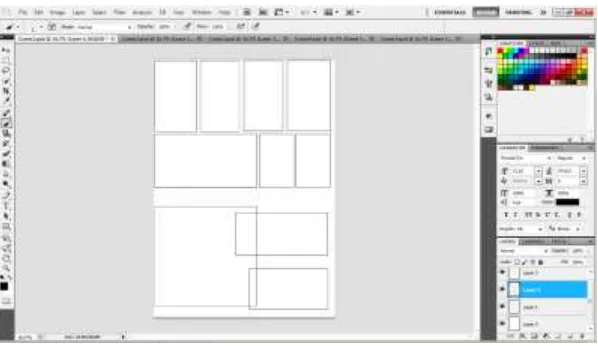
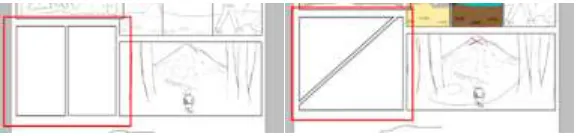
[image:11.420.62.361.253.426.2]During this stage I worked closely with my learner. We both looked for useful websites and tutorial videos that were interesting and helpful. Even though it was an activity for him, I was looking for new things to learn in order to improve my own draft for ‘The Queen’s Request’. We also looked at other examples of comics and manga, looking at the various ways they utilised the panels to illustrate time. We found that diagonal panels give an action-feel to the visual flow. The larger the panels the more time it took for readers to read the page, giving it a longer sense of time. The smaller the panels, the shorter the sense of time and the faster the action is especially if accompanied with movement lines or blurs. He discussed with me his idea for his plot: it had a basic concept of a man going on a treasure hunt, where he ages in the process of looking for treasure. He wanted his story to have a climax at the end of his story, not in the middle. After deciding on the plot, he started to plan out his panels (Fig. 10-1)
Figure 10-1: (A4 canvas size on Photoshop CS5) first layout
Figure 10-2: Simplified layout
Figure 10-3: Diagonal panel creates a more dynamic feel
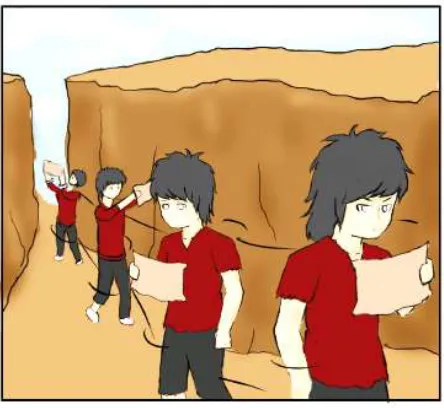
As Tommy continued drawing he struggled with the panel above (Fig 10-3). He wanted to illustrate how the character is aging. He initially thought of having two small panels.
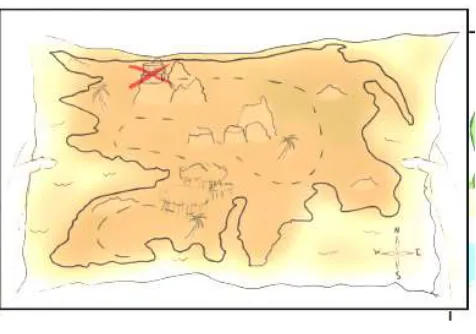
[image:12.420.60.349.274.342.2]Figure 10-4: The map
Figure 10-5: The character ageing
Jenny: I searched for information online, and [found a representation of Superman ageing over time]. This was the panel that Tommy struggled to fix – but the ageing Superman image helped Tommy create Figure 10-5.
Jenny reflects:
Overall, this had given me the experience of looking at the fine details of implementing a creative writing activity. During this experience I learnt with my learner, which I found very valuable. This experience has also given me insight into the challenges that students and I may face when implementing a similar activity, such as time management, locating resources and students’ questions or concerns with their writing. However, I believe with more experience and flexibility I would be capable of confidently implementing a creative writing activity similar to this.
Janice observes:
(Dony, 2012). Jenny also refers to a blogsite where Naruto Manga is analysed for its visual and narrative power to tell stories through images and text as graphic forms. Tommy strives to emulate the narrative density and “appealing richness” (telophase, 2005, para. 4) of these texts.
Kim Fox reflects on the challenge of teaching a younger
writer
While I do believe it is important to teach students the elements of poetry, my opinion now is that it is more important to experience poetry. So, it is acceptable not to get the iambic pentameter right every time, or to get your metaphors and similes confused. However, what is important is to consider “Why does this poem touch me? What meanings do I get from the words, and how has the writer conveyed that message?” In my classroom I would like to have students interact with as many different types of poetry as possible, so as to compare them and in order to justify their likes and dislikes. My hope is that this will help them to create a work that, while it may not be perfect, will allow the student to write about something that means a lot to them. That’s when I had my light-bulb moment. Surely students in classrooms all over Australia have the same feeling when they walk into a classroom, take their homework home, or have to work on projects outside of school. While this revelation in no way relates specifically to the writing process it was the first link I made during this assessment; and it has shaped my interactions with students within my practical experience.
I no longer plan lessons that rely on a didactic introductory phase; my intent is to capture attention and excitement, to foster the hunger to learn more – not to feed that voice in some students’ heads that screams ‘School is boring.’ I have found myself having a YouTube video relating to a topic playing as students come in, finding songs that help learn and retain information, and even, on occasions when that didactic beast must be used, breaking the routine by having a dance break or stretching to music. The success of my lessons after incorporating this has been amazing. Students walk in to class ready to learn, ready to see how we will start a lesson today. For example, my blue- tacking many pinwheels of different sizes and colours to the board and having them all spinning as the students walked in certainly made teaching the subject of ‘Forces’ a lot more fun!
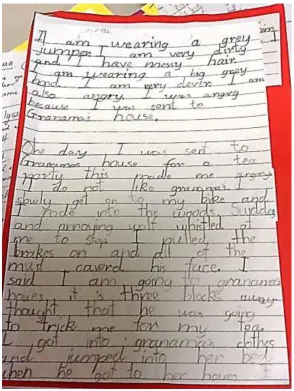
As part of an assessment set out under the C2C guidelines (Education Queensland, 2013), students were asked to take a stereotypical character, and from this to reverse the character’s attributes and appearance. [Students then had to write a narrative using this new character]. I found this highly challenging. I was tasked to assist the child whose work is shown (Fig 6). My young writer struggled with the concept of reversing the stereotype within the narrative, as well as struggling with punctuation and correct grammar. While my task of guiding him in grammar and punctuation seemed easy in theory, I found that taking what I knew academically and filtering it so that a student of eight years old who has trouble with English as a subject could understand the task, was challenging.
The biggest challenge, however, was guiding an assessment task without affecting the piece of writing that was developed. The work had to be all his own, I could only edit and keep him on task. I found it terribly difficult to walk that fine line between guiding as editor and teacher, and actually helping construct a piece of writing. How much could I help before the work was no longer his own? I found the best way for me was to use the narrative he had already writing as bricks from which he could build more. He would write “Then one day I was sent to Grandma’s house...” and have no idea what should come next. I could not tell him what to write or the work would belong to us both and now be truly his. So I would ask him to think back to his character and how his character had to change.
What would your character do or feel about going to Grandmas? You have written down that “this” happened, what would your character do next? These were common questions that I found myself asking to help guide the process of from thought, to words on the page.
This task definitely made me reflect on how I speak to students of varying age and ability levels; what words am I using and how am I demonstrating this in such a way that the content of the dialogue is equal to the language and understanding level of the audience. I have learnt that I truly need to address students as complete individuals, not just with different needs and interests, but also with different understandings, background knowledge and abilities; abilities they sometimes hide so as not to seem “unsmart” as my author told me. This is even more important when guiding the writing process of a child. You need to be able to find a way to connect on their level; they hear you in a way that makes sense to them. This doesn’t always mean using different words or asking different questions, sometimes it can involve no speech at all, with all the information being transmitted through demonstrations. Students rely on the teacher for guidance, and when that guidance is not differentiated to work at the student’s level it will be of no assistance.
Melanie Harris reflects
element of writing was actually sharing it on study desk and I can relate to how students must feel sharing their poems with their peers.
In a classroom situation I would like to give students the opportunity to write a play which leads to the experience of performing. I feel this would allow more of a connection with the script and perhaps for students who felt the same difficulty in writing as I did would benefit from seeing their scripts “come to life”.
Melanie Harris reflects on her work with a younger writer
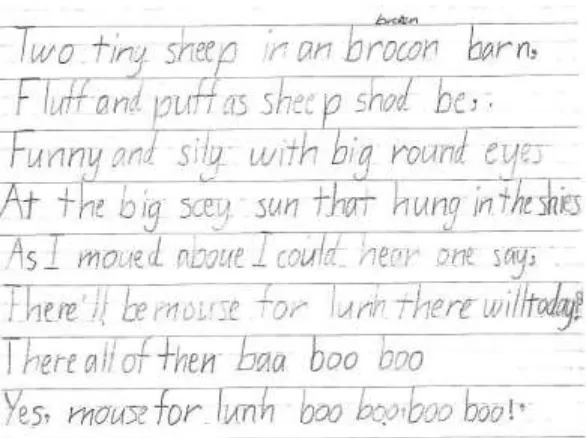
The creative writing piece (Fig.10-7) was written by a student in my year two practicum class. The first draft was extremely rough due to the abilities of the student and the time constraints placed upon her due to the nature of the school timetable. Initially, the most difficult element of assisting the student was to stop myself from correcting her spelling: I had to constantly remind myself that in order for the student to learn from her mistakes, she had to correct them herself.
Figure 10-7: Year 2 student’s poem
I did learn during this activity that letting the student lead the process is vital and that although you may feel that you are helping by pushing them along at times, the end result for the student is better if they construct their own knowledge themselves. I really enjoyed the process of helping this student with her work. Seeing her happy and proud of the end result made the challenges worthwhile. I look forward to working with many more students and seeing the exciting possibilities and ideas which emerge from students who have a uniquely imaginative basis when compared to that of adults.
Pauline Dobbie Reflects on her work with younger writers
Editor’s note: Pauline was on teaching practice, working with a small group of students.
favourite or well-known nursery rhyme. These are two of the students’ reconstructed works:
Tommy had a slimy snake (Reconstruction of Mary Had a Little Lamb).
Tommy had a slimy snake Its skin was smooth as slate.
And every night when Tommy slept He’d go out on a date.
Paul and Pete (Reconstruction of Jack and Jill)
Paul and Pete went up the street To buy a tub of ice-cream. Paul did frown as he was down But Pete was all excited.
I began by immersing the students in a range of familiar and new poems and nursery rhymes by reading books and internet resources to them, and they reading to me. The students thoroughly enjoyed a variety of poems; some made them laugh while others made them think. Following this I was able to refer to these resources while stepping the students through the process of learning about and understanding poetry. To identify poetic features we discussed and learnt how to establish the audience and purpose of poetry, how to identify the topic, how visual images and different print features can enhance the understanding and enjoyment of poetry, how to recognise rhyming words and rhythms in poetry and what we can do to make poetry more engaging when reading it to others.
My final teaching aim within the process was modelling how to reconstruct a nursery rhyme so they could create their own before reconstructing a longer poem. My aim was for students to have a deep understanding of the process and apply their knowledge to a small, familiar text before applying it to a not so familiar poem. Within this I modelled and discussed with the students how we could still apply poetic features, structures and language to change the nursery rhyme from its original form into something totally different. Following this we further discussed how the text could be enhanced by including images, and what images could be used.
On reflection, I was able to supply a variety of stimulus materials for the students, give them the space and time required to develop a deep knowledge, understanding and appreciation for poetry, and the support they needed to reconstruct a poem, then to repeat that experience with a poem that was not familiar to them.
I found my experience to be very rewarding. I believe I was able to take the students on a journey where they began by engaging in lower order thinking skills such as being able to recall, comprehend and apply information, through to higher order skills such as analysing, evaluating and creating.
Natalie Kersnovske reflects
I have not had much to do with short stories or poems since high school so felt very overwhelmed. One thing I found difficult was my closeness to my writing. This made me feel quite vulnerable: my writing seemed to be a window into my soul for everyone to see. This made it difficult for me to share my work with others and receive feedback on my writing. When I commented on other people’s work I was very aware that others may feel this way too and was quite sensitive when leaving feedback. For my future teaching practices this is something I will be aware of: creative writing is very personal. Although there is always a stage, maybe many stages, where critical appraisal is necessary, generative thinking has to be given time to flower. At the right time and in the right way, rigorous critical appraisal is essential. At the wrong point, criticism and the cold hand of realism can kill an emerging idea.
I first met Lisa (Anonymised), a grade 3 student in April; this is when our creative writing journey began. We discussed what she would like to do. Because Lisa was interested in poetry she chose to write a poem. This beginning stage was the hardest stage. How do I help Lisa in constructing a poem? I thought back to when I had been asked at the beginning of this course to create a poem and the daunting feeling of where to start.
I thought it would be a great idea for us to look through some poems to get some ideas and identify some features such as repetition, rhyme, rhythm and alliteration. It was then I discovered that Lisa had only ever written rhyming poems before. So we set ourselves the challenge of writing a poem that didn’t rhyme. As Lisa commented ‘I don’t think it will sound good if it doesn’t rhyme’ and ‘won’t it be boring?’ this led us to our next task. We started to look at poems that didn’t rhyme and discussed why they were interesting. We agreed that when writers use similes and metaphors to describe a topic the poem became interesting for the reader. We brainstormed ideas for a topic, and Lisa wanted to write about roses, her favorite flower, but she didn’t know what to say. Lisa couldn’t think of how to write smiles and metaphors about the rose. It was then clear: Lisa was not ready to write. I had to take a step back and reflect. When writing my own poem I had prepared many drafts and picked them apart, practicing how to write. That was a light bulb moment for me. For Lisa to write her poem describing how she feels and thinks about roses she would need some practice.
First we looked at different objects with a magnifying glass. I asked Lisa to consider what else could the object be? What did it remind her of? What could you use a rose for if you were an insect? What does it feel like? Lisa and I discussed those questions and drafted poems using age appropriate similes and metaphors. It was important for me to be creative in my own teaching to promote Lisa’s creative abilities. During the final stages we bought a bunch of roses, and again brainstormed ideas. Lisa was then able to write a poem about roses. After her first draft was written we discussed one thing we really liked about the poem and its central idea, and how we could enhance the poem. This allowed Lisa to complete her poem.
What is a Rose?
A rose is as pretty as a rainbow A fluffy bed for a bee
As soft as a baby’s skin.
A butterfly rests on the rose petals Because its as soft as a silk shirt And smells like a candy shop. I love Roses!
Educators should not expect students to know how to write a creative work. Students need to be exposed to a range of texts and mediums that tap into their interests. It is important to identify where the students are in their learning including finding misunderstandings and gaps, as I did with Lisa. I used this knowledge to identify starting points for teaching and provided hands on learning opportunities appropriate to Lisa’s level of readiness and need. I believe creativity is possible in all areas of education and all young people and adults have creative capacities. Developing these capacities involves a balance between teaching skills and understanding, and promoting the freedom to innovate, and take risks. This model will guide my future teaching practices in the successful implementation of the National English Curriculum.
Jaclyn and Sophie Fitzgerald
Happiness
by Sophie Fitzgerald, age 9
Happiness is family, laughter and pride, or your Dad coming home after going away.
Happiness is a bird, chirping contentedly, a barbeque, a hug, the beach or a kiss.
Happiness is a flower, dancing side to side, it’s a Sunday sleep in, dozing comfortably.
Happiness is a butterfly, hatched from its cocoon free and flying off into the world.
Jaclyn: Writing with Sophie - Reflection
tucked up in bed together: quite a beautiful, precious bonding experience as we pored over a variety of poems (see text cluster next page), discussing how each made us feel, what we think the author was trying to achieve and developing whole life stories for poets. For my teaching, I now realise the importance of reading literature as fundamental to the entire writing process (i.e. the interconnectedness of reading and writing). For Sophie, it enabled her to locate a voice of her own, having abundant time to explore, examine and discuss the work of many poets in many styles before embarking on her own writing experience in her own poetic style.
When we moved onto the creating and editing stage of the process, I discovered another essential element to productive teaching in any writing context, and that is allowing time and space for students to develop ideas around words, drawing and performing. Knowing Sophie is a visual learner meant that it was important to give her the freedom to express herself visually, and as a teacher I must ensure this is part of my pedagogical repertoire (catering to individual learning needs and styles) when teaching creative writing. I also felt it was highly beneficial to read poems aloud (both of us), and allow Sophie time to experiment vocally with her poetry, and regardless of context this will be an effective English teaching tool. As Schenk de Regniers (as cited in Anderson, 2006, p.303) eloquently states, “it seems to me that the full power of a poem… the lyrical cadence, the dance of language, the sheer pleasure of fooling around with sound and meaning…can be fully appreciated only if the poem is read aloud. This would be particularly true for children.”
March, Ljungdahl & Holliday, 2013, p.347) it is pertinent to “…give children as much practice as we can with language, allowing them to be playful and imaginative while at the same time giving them experience in the conventions of language so that they become familiar with the possibilities…” and it was to this I aspired. To overcome grammatical issues, I modelled and we engaged in shared reading of Sophie’s favourite poems to demonstrate and practice cohesion through punctuation choices and to show and explore how the writer achieved particular effects. As discussed previously Sophie also engaged in much spoken poetry reading, which helped guide her grammar decision-making and over what became a six-week process, Sophie revisited, reviewed, re-moulded and polished her writing until she was satisfied.
Jaclyn reflects
For my teaching, I think the most important thing to do is inspire a love of reading and writing, and respect the ways in which my students want to learn while also heeding curriculum requirements. Writing is a challenging but incredibly rewarding experience, and something my students will need to be guided and supported through the writing journey by both teacher and peers. In this course, the support of my peers and course team was incredibly helpful, as I often felt I had become too involved in each piece and could not view them as a reader, with fresh eyes and mind. I also shared some of my work with my parents and my husband, who thankfully loved it, and who provided really productive and positive feedback about flow and cohesion.
Conclusion: The courage to create a space for writing?
To conclude, and as other voices continue the narrative, I reflect briefly upon my own learning as an educator over three years of writing with pre-service teachers.
For those who bravely shared their works with peers, the rewards were significant, as student success rates and anonymous feedback upon their study experience attest. Informal feedback also indicated that for many, writing generated a sense of personal agency and allowed a greater understanding of forces at work their lives. For all, the process of writing allowed deep reflection: the opportunity to share works came after the course ended. As if a floodgate had been opened, a torrent of stories, poems and plays emerged, as new writers enjoyed and celebrated the singularity and intensity of their voices. As writers they spent careful hours weaving, unravelling and re-forming works that they hoped would meet their own and others’ standards for their chosen genres. As educators they worked to find a point of balance between creating a space for young people to write, and conforming to external constraints. Reflections described the experience as illuminating and rewarding, and in some cases as transformative. Many pre-service teachers commented that the course had renewed their interest and enthusiasm for writing.
Weaving Words: Personal and professional transformation through writing as research is in itself a celebration and validation of writing – and of silences. In the spaces between the narrative threads of this book, there are many stories that were not, or could not be told. As editor I acknowledge the writers whose works form the warp and weft of this book, but also whose works enriched each semester without being shared here. As educators and researchers we are privileged to create spaces for imagining, remembering and making meaning from our own and others’ stories. The little stories (Batorowicz, 2013) we tell may take many forms but unfailingly they speak to the simple but complex truths of what it is to be human. As Bruno Bettelheim (1988) attested, stories whether in the form of the fairy tales which sustain children in the darkest of places, or as tales from the field, or in the works created by children themselves, have power.
For as Jaclyn and Sophie Fitzgerald discovered the reading of poetry aloud impacts upon the heart and mind of the teller and listener. As a listener to so many stories, my experience as author and researcher has been humbling, moving, joyous and enriching. I hope the writings and reflections of authors in this book will encourage others to create spaces for writing that articulate our being and becoming. The authors of the next chapter embody those practices, and their works sparkle with the excitement of creation. I thank them all as my teachers.
Abraham, J. (2010). Pharmaceuticalization of society in context: Theoretical, empirical and health dimensions. Sociology, 44(4), 603-622. doi: 10.1177/0038038510369368
Adu-Febiri, F. (2011). Inviting emotions, morals and spirit into our classrooms: A sociological perspective on the human factor model of education. Review of Human Factor Studies, 17(1), 40-89. Anderson, N. (2006). Elementary children’s literaturę (3rd ed.). Boston:
Pearson Education.
Aristotle. (1908). Nicomachean ethics (W. D. Ross, Trans.). In D. C. Stevenson (Ed.), ILT Digital Classics. Oxford: Clarendon Press. Australian Curriculum Assessment and Reporting Authority. (2010).
National Minimum Standards: National Assessment Program –
Literacy and Numeracy (NAPLAN). Sydney: Australian
Curriculum Assessment and Reporting Authority, Retrieved from http://www.naplan.edu.au/national_minimum_standards.html. Australian Insitute for Teaching and School Leadership. (2011). National
Professional Standards for Teachers. Education Services Australia: Ministerial Council for Education, Early Childhood Development
and Youth Affairs, Retrieved from
http://www.teacherstandards.aitsl.edu.au/static/docs/AITSL_Nation al_Professional_Standards_for_Teachers_Final_110511.pdf. Baines, L. A., & Slutsky, R. (2009). Developing the sixth sense: Play.
Educational Horizons, 87(2), 5.
Batorowicz, B. A. (2013). Furry tales on a stick from the little art series
2008-2010. Retrieved 5th October, 2013, from
http://www.beatabatorowicz.com/little-art.html
Bettelheim, B. (1988). The uses of enchantment: The meaning and importance of fairy tales. London: Penguin Books.
Bockman, J. (2013). Neoliberalism. Contexts, 12(3), 14-15. doi: 10.1177/1536504213499873
Bourdieu, P. (1992). Structures, habitus, practice (R. Nice, Trans.) The Logic of Practice (pp. 52 - 65). Stanford, CA: Stanford University Press.
Clarke, E. (1980). Corporal punishment in Queensland State Schools. Queensland Department of Education Retrieved from http://education.qld.gov.au/library/edhistory/topics/corporal/. Cremin, T., & Myhill, D. (2012). Writing Voices: Creating Communities
Csikszentmihalyi, M. (2000). Education for the 21st Century: mapping the field of forces that shape children's lives Education Week, 19(32), 3. doi: 02774232
De Lissovoy, N. (2011). Education and violation: conceptualizing power, domination, and agency in the hidden curriculum. Race Ethnicity
and Education, 15(4), 463-484. doi:
10.1080/13613324.2011.618831
Devine, D., & Luttrell, W. (2013). Children and value — education in neo‐
liberal times. Children & Society, 27(4), 241-244. doi: 10.1111/chso.12038
Dewey, J. (1897). My pedagogic creed. The School Journal LIV(3), 77-80. Dony, C. (2012). Moving between worlds: 'The Arrival'. The Comics
Grid: Journal of Comics Scholarship. Year One, 1.
Education Queensland. (2013). Curriculum into the Classroom (C2C).
Queensland Government Retrieved from
http://education.qld.gov.au/c2c/.
Ellis, V., Glackin, M., Heighes, D., Norman, M., Nicol, S., Norris, K., & McNicholl, J. (2013). A difficult realisation: the proletarianisation of higher education-based teacher educators. Journal of Education
for Teaching, 39(3), 266-280. doi: 10.1080/02607476.2013.799845
Furlong, J. (2013). Globalisation, Neoliberalism, and the Reform of
Teacher Education in England. Paper presented at the The
Educational Forum.
Gatto, J. T. (2005). Dumbing us down: The hidden curriculum of
compulsory schooling. Gabriola Island, BC: New Society
Publishers.
Giroux, H. A. (1981). Ideology, culture and the process of schooling. Philadelphia: Temple University Press.
Giroux, H. A. (2011). Beyond the swindle of the corporate university: Higher education in the service of democracy/Op Ed [Tuesday 18 January]. Retrieved from http://www.truth-out.org/beyond-
swindle-corporate-university-higher-education-service-democracy66945
Giroux, H. A. (2000). Postmodern education and disposable youth. In P. P. Trifonas (Ed.), Revolutionary Pedagogies: Cultural Politics, Instituting Education, and the Discourse of Theory (pp. 174 -195). New York: Routledge.
Guldberg, H. (2009). Reclaiming childhood: freedom and play in an age of fear.
Holt, J. C. (1984). How Children Fail London: Penguin Books.
Jones, J. K. (2008). In the third space: The storied self, uncertainty and transition. In R. Henderson & P. A. Danaher (Eds.), Troubling Terrains: Tactics for Traversing and Transforming Contemporary Educational Research (pp. 193-210). Teneriffe, Queensland: Post Pressed.
Levinson, B. A., Blackwood, J., & Cross, V. (2013). Recipients, agents, or partners?: The contradictions of teacher participation in Mexican secondary education reform. Journal of Educational Change, 14(1), 1-27. doi: 10.1007/s10833-012-9193-2
Louv, R. (2010, 6 April, 2010). The criminalization of natural play:
Children, nature and the law. Retrieved from
http://www.psychologytoday.com/blog/people-in-nature/201004/the-criminalization-natural-play-0
Malone, K. (2007). The bubble-wrap generation: children growing up in walled gardens Environmental Education Research, 13(4), 4. McGrath, H. (2006). To Repeat or Not to Repeat? Words, 26(2), 39-46. Meier, D. (2000). What do kids need? Eye on Education. Retrieved 5
May, 2006, from http://www.eyeoneducation.tv/reform/meier.html Mercogliano, C. (1998). Rid-a-him or: Why Are so many boys given
drugs in school? Chapter 4. SKOLE: The Journal of Alternative Education, 15(3-4), 12.
Meyer, R, & Whitmore, K. F. (2013). Reclaiming writing. In R. Meyer & K. F. Whitmore (Eds.), Reclaiming Writing: Composing spaces for identities, relationships and action (pp. 1-11). NY, New York: Routledge.
Myhill, D, & Wilson, A. (2013). Playing it safe: Teachers’ views of creativity in poetry writing. Thinking Skills and Creativity, 10(0), 101-111. doi: http://dx.doi.org/10.1016/j.tsc.2013.07.002
Office for Standards in Education Children’s Services and Skills. (2012).
Moving English forward (110118). Retrieved from
http://www.ofsted.gov.uk/resources/moving-english-forward. Onosko, J. (2011). Race to the top leaves children and future citizens
behind: The devastating effects of centralization, standardization, and high stakes accountability. Democracy and Education, 19(2). Patrick, F. (2013). Neoliberalism, the knowledge economy, and the
Queensland College of Teachers. (2009). Professional Standards for Queensland Teachers (graduate level): A guide for use with
preservice teachers. Brisbane: Retrieved from
http://www.qct.edu.au/education/documents/PSQT_GradLevel_v3_ Web.pdf.
Robertson, S. L. (2007). 'Remaking the world': Neo-liberalism and the transformation of education and teachers' labour. In L. Weis & C. M (Eds.), The global assault on teachers, teaching and their unions. New York: Palgrave.
Sheppard, J. (2010). Emergent selves, emergent lives: the role of curriculum in the identity development of undergraduate students : a narrative phenomenological study. (Doctor of Philosophy Ph.D.),
Victoria, British Columbia. Retrieved from
http://hdl.handle.net/1828/2733
Skiba, R., & Peterson, R. (1999). The Dark Side of Zero tolerance: Can punishment lead to safe schools? Phi Delta Kappa International, 11. http://www.pdkintl.org/kappan/kski9901.htm
Tan, S. (2006). The Arrival. Sydney: Lothian Books.
telophase. (2005). Part 4.2 - Combat (Masashi Kishimoto, NARUTO) Retrieved from http://telophase.livejournal.com/94255.html?nojs=1 Timimi, S. (2010). The McDonaldization of childhood: Children’s mental health in neo-liberal market cultures. Transcultural Psychiatry, 47(5), 686-706. doi: 10.1177/1363461510381158
Torres, C. A. (2013). Neoliberalism as a new historical bloc: a Gramscian analysis of neoliberalism’s common sense in education. International Studies in Sociology of Education, 23(2), 80-106. Trahar, S. (2013). Contextualising Narrative Inquiry: Developing
Methodological Approaches for Local Contexts. Abingdon, Oxon.:
Routledge.
Vygotsky, L. S. (1978). Mind in Society: The development of higher
psychological processes. Cambridge, MA: Harvard University
Press.
Wacquant, L. (2005). Habitus. In J. Beckert & M. Zafirovski (Eds.), International Encyclopedia of Economic Sociology (pp. 315 - 319). London: Routledge.
Wilson, A. (2013). A joyous lifeline in a target-driven job: teachers' metaphors of teaching poetry writing. Cambridge journal of education, 43(1), 69.
Wilson, A., & Myhill, D. A. (2012). Ways with words: teachers’ personal epistemologies of the role of metalanguage in the teaching of poetry writing. Language and Education, 26(6), 553-568. doi: 10.1080/09500782.2012.669768
Winch, G., Ross-Johnston, R., March, P., Ljungdahl, L. & Holliday, M. (2006). Literacy: Reading, writing and children’s literature (3rd ed.). Melbourne: Oxford University Press.