Progressions from Pathways to Apprenticeships Programmes, 2012/13
1Background
Working in partnership with Sector Skills Councils and Further Education colleges, the Welsh Government (WG) introduced the Pathways to Apprenticeships (PtA) programme in 2009. The
programme was an intensive one-year course that aimed to provide learners aged 16 to 24 with the skills and experience to progress onto an apprenticeship. The programme ran for five years and concluded following the 2013/14 academic year.
This statistical article presents data on the progressions of learners completing PtA programmes in 2012/13 and has been sourced from the Lifelong Learning Wales Record (LLWR). It forms an update to the statistical article released last year which presented data for the 2010/11 and 2011/12 academic years alongside an overview of the methodology developed by WG statisticians to measure learner
progression.
Summary
In 2012/13, 16 per cent of leavers completing PtA programmes progressed onto an
Apprenticeship programme in the 12 months following the academic year. This compared with 14 per cent of leavers in 2011/12 and 13 per cent of leavers in 2010/11.
Progression rates to apprenticeships were highest for leavers from the ‘Science, Engineering & Manufacturing Technologies’ (38 per cent), ‘Plumbing’ (26 per cent) and ‘Agriculture,
Horticulture and Land-Based Engineering (24 per cent) pathways.
A further 42 per cent of learners progressed onto either Foundation Apprenticeships or Further Education programmes at level 3.
A quarter of leavers had no subsequent learning programme recorded.
Table 1 below shows the numbers of learners completing PtA programmes in 2012/13 split by pathway and subsequent learning programme.
Date of Publication: November 2014
Next update: Not a regular output
Table 1: Numbers of learners completing Pathways to Apprenticeships programmes by pathway and subsequent learning programme, 2012/13
No. % No. % No. % No. % No. % No. %
Agriculture, Horticulture &
Land-based Engineering 15 24 * * 20 35 * * * * 15 27 65
Automotive Skills 5 5 50 34 20 15 15 9 5 4 45 32 145
Construction 15 6 100 41 * * 90 38 10 3 25 10 240
Construction
(Insulation & Energy Efficiency) 0 0 15 52 0 0 10 38 * * * * 30
Creative & Cultural 0 0 0 0 5 50 * * 0 0 * * 10
Hospitality, Leisure,
Travel & Tourism 15 14 * * 55 43 5 5 * * 45 36 125
IT & Telecommunications 5 6 * * 40 53 * * 5 8 20 24 80
Plumbing 25 26 15 14 20 19 * * * * 35 36 100
Science, Engineering &
Manufacturing Technologies 80 38 15 8 55 27 10 5 10 4 40 18 210
Sport & Active Leisure 5 7 * * 20 31 10 12 * * 25 40 70
Total 170 16 205 19 250 23 150 14 40 4 260 24 1,075
Source: Lifelong Learning Wales Record (LLWR) No Subsequent
Programme
Identified Total Pathway
Apprenticeship Foundation Apprenticeship
Further Education
(Level 3)
Further Education
(Level 2)
Other Learning Programme
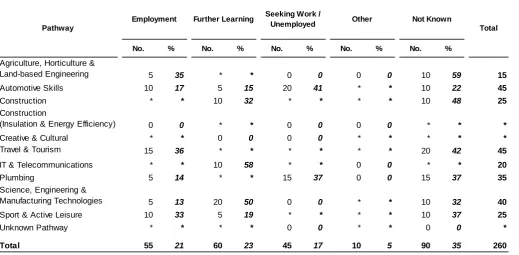
Data on learner destination within 3 months of leaving is also collected via the LLWR. Table 2 below details the recorded destinations of the 260 PtA learners in table 1 with no subsequent learning programme identified.
Table 2: Numbers of Pathways to Apprenticeships leavers with no subsequent learning programme by pathway and destination, 2012/13
No. % No. % No. % No. % No. %
Agriculture, Horticulture &
Land-based Engineering 5 35 * * 0 0 0 0 10 59 15
Automotive Skills 10 17 5 15 20 41 * * 10 22 45
Construction * * 10 32 * * * * 10 48 25
Construction
(Insulation & Energy Efficiency) 0 0 * * 0 0 0 0 * * *
Creative & Cultural * * 0 0 0 0 * * * * *
Hospitality, Leisure,
Travel & Tourism 15 36 * * * * * * 20 42 45
IT & Telecommunications * * 10 58 * * 0 0 * * 20
Plumbing 5 14 * * 15 37 0 0 15 37 35
Science, Engineering &
Manufacturing Technologies 5 13 20 50 0 0 * * 10 32 40
Sport & Active Leisure 10 33 5 19 * * * * 10 37 25
Unknown Pathway * * * * 0 0 * * 0 0 *
Total 55 21 60 23 45 17 10 5 90 35 260
Source: Lifelong Learning Wales Record (LLWR)
Total Pathway
Employment Further Learning Seeking Work /
[image:2.595.45.565.435.690.2]Methodological Issues
Timing of analysis
To produce the analysis detailed in table 1, the cohort of leavers was matched to a freeze of the LLWR taken 12 months after the end of the academic year. So, if a leaver progressed to a subsequent learning programme after this period, the progression would not be reflected in the analysis.
[image:3.595.40.577.237.403.2]To determine the impact of this issue, we have updated the analysis of learner progression detailed in the previous statistical article using freezes of the LLWR taken 19 months after the end of the respective academic years.
[image:3.595.41.579.483.690.2]Table 3a: Updated progressions of learners completing PtA programmes, 2010/11
Table 3b: Updated progressions of learners completing PtA programmes, 2011/12
No. % No. % No. % No. % No. % No. %
Automotive Skills 20 16 20 16 35 28 5 6 5 4 35 30 120
Construction 70 16 70 16 60 14 140 32 20 5 70 17 430
Hair & Beauty 20 6 20 7 180 60 20 6 10 3 55 18 305
Hospitality, Leisure,
Travel & Tourism * * 0 0 30 46 5 7 * * 30 40 70
Plumbing 15 23 5 8 15 22 * * * * 30 40 75
Science, Engineering &
Manufacturing Technologies 150 57 10 4 45 18 10 3 5 2 45 16 260
Total 275 22 125 10 370 29 180 14 45 4 265 21 1,255
Source: Lifelong Learning Wales Record (LLWR) No Subsequent Programme Identified Total Pathway Apprenticeship Foundation Apprenticeship Further Education (Level 3) Further Education (Level 2) Other Learning Programme
No. % No. % No. % No. % No. % No. %
Agriculture, Horticulture and
Land-Based Engineering 10 33 * * 10 30 0 0 * * 5 22 25
Automotive Skills 20 19 20 22 20 19 5 7 * * 30 30 100
Construction 55 18 90 28 15 5 115 36 10 4 35 11 320
Hospitality, Leisure,
Travel & Tourism 10 9 * * 50 46 10 8 * * 35 32 105
IT and Telecommunications 5 6 0 0 55 63 5 7 5 6 15 19 85
Plumbing 30 39 10 14 10 15 0 0 * * 20 31 70
Science, Engineering &
Manufacturing Technologies 125 53 10 4 35 15 10 3 * * 55 23 240
Sport and Active Leisure * * * * 20 65 0 0 0 0 5 23 30
Total 260 26 145 14 215 21 150 15 30 3 215 21 1,010
In summary:
The proportion of learners who left a PtA programme in 2010/11 and progressed to an
Apprenticeship increased from 13 per cent to 22 per cent. For 2011/12, the equivalent proportion increased from 14 per cent to 26 per cent.
The proportion of learners who left a PtA programme but were not matched to a subsequent learning programme decreased from 25 per cent to 21 per cent in both 2010/11 and 2011/12.
Overall, the proportion of learners progressing to an Apprenticeship, Foundation Apprenticeship or Level 3 FE programme increased from 53 per cent to 61 per cent in both 2010/11 and 2011/12.
Coverage of LLWR
This analysis is sourced solely from the LLWR. Hence, if a leaver progressed to a programme outside the coverage of the LLWR (for example, an apprenticeship in England) then the progression would not be reflected in the analysis.
Destinations
Table 2 shows that 60 leavers (23 per cent) where no subsequent learning programme was identified on LLWR have a recorded destination of ‘Further Learning’. This appears to contradict the analysis underpinning table 1 but could indicate where learners progressed to programme outside the coverage of the LLWR. Further analysis would be necessary to identify and investigate these data-anomalies.
Completion, Attainment and Success
Table 4 on page 4 of this article detail learning activity completion, attainment and success rates for PtA provision delivered in 2012/13.
Completion, attainment and success are the key learner outcome measures for FE provision and the data detailed in this table is comparable with the sector benchmarks published in the Learner Outcome
Measures for Further Education, Work Based Learning and Adult Community Learning 2012/13statistical first release (SDR 57/2014 ).
Evaluation Report and Next Steps
The PtA programme is currently undergoing evaluation. An interim report was published earlier this year and a final report is due for release in 2015.
Table 4: Learning activity completion, attainment and success rates for Pathways to Apprenticeships provision, by pathway and type of learning aim, 2012/13
QCF Award/Certificate/Diploma 250 99% 220 88% 87%
Key Skills/Essential Skills Wales 210 98% 205 98% 96%
OCN credit(s) 15 * 15 * *
Other 155 99% 30 * *
All 625 98% 470 93% 91%
Automotive Skills QCF Award/Certificate/Diploma 390 94% 380 98% 92%
Key Skills/Essential Skills Wales 390 93% 360 92% 86%
OCN credit(s) 65 96% 65 100% 96%
Other 850 96% 695 99% 95%
All 1,695 95% 1,505 97% 92%
Construction NVQ1 20 * 20 * *
QCF Award/Certificate/Diploma 280 93% 265 95% 88%
Key Skills/Essential Skills Wales 670 93% 610 91% 84%
OCN credit(s) 195 97% 190 99% 96%
Other 845 96% 560 97% 93%
All 2,005 94% 1,645 94% 89%
Construction NVQ1 0 * 0 * *
(Insulation & Energy Efficiency) QCF Award/Certificate/Diploma 40 * 35 * *
Key Skills/Essential Skills Wales 55 100% 55 98% 98%
OCN credit(s) 45 * 45 * *
Other 40 * 30 * *
All 180 100% 165 95% 95%
Creative & Cultural QCF Award/Certificate/Diploma 35 * 35 * *
Key Skills/Essential Skills Wales 25 * 20 * *
OCN credit(s) * * * * *
Other 5 * 5 * *
All 75 88% 70 93% 82%
Hospitality, Leisure, Travel & NVQ1 15 * 15 * *
Tourism QCF Award/Certificate/Diploma 635 98% 625 98% 96%
Key Skills/Essential Skills Wales 210 96% 195 94% 90%
OCN credit(s) 115 98% 115 100% 98%
Other 115 98% 30 * *
All 1,090 97% 980 98% 95%
IT & Telecommunications QCF Award/Certificate/Diploma 145 87% 130 89% 77%
Key Skills/Essential Skills Wales 290 88% 265 91% 81%
OCN credit(s) 30 * 25 * *
Other 195 83% 150 98% 83%
All 660 86% 565 92% 80%
Plumbing NVQ1 120 92% 105 86% 79%
QCF Award/Certificate/Diploma 215 94% 200 93% 87%
Key Skills/Essential Skills Wales 345 91% 330 96% 87%
OCN credit(s) 70 100% 70 100% 100%
Other 155 96% 95 96% 95%
All 905 93% 800 94% 88%
Science, Engineering & NVQ1 240 93% 220 91% 85%
Manufacturing Technologies QCF Award/Certificate/Diploma 275 93% 260 95% 89%
Key Skills/Essential Skills Wales 860 94% 800 93% 87%
OCN credit(s) 110 97% 110 98% 96%
Other 425 93% 295 94% 88%
All 1,910 94% 1,685 94% 88%
Sport & Active Leisure NVQ1 75 88% 65 88% 77%
QCF Award/Certificate/Diploma 155 89% 135 87% 77%
Key Skills/Essential Skills Wales 135 92% 130 94% 86%
OCN credit(s) 40 * 35 * *
Other 60 91% 30 * *
All 465 89% 390 89% 79%
All Pathways NVQ1 475 92% 430 90% 83%
QCF Award/Certificate/Diploma 2,430 94% 2,295 94% 89%
Key Skills/Essential Skills Wales 3,220 93% 2,995 93% 87%
OCN credit(s) 695 97% 675 97% 94%
Other 2,845 95% 1,925 97% 92%
% Success
Agriculture, Horticulture & Land-based Engineering
Pathway Type of learning aim
Further Information
1 Data Sources and Analysis Methodology
1.1 Data Sources
Data on learners accessing FE and WBL provision across Wales is submitted electronically to the Welsh Government Department for Education and Skills (DfES) by learning providers via the Lifelong Learning Wales Record (LLWR).
The LLWR comprises datasets based on learners, their learning programmes, their constituent learning activities and their ensuing awards. A learning activity, typically, is a specific
qualification or course pursued by a learner. A learning programme is a group of related activities (and awards where applicable) such as a PtA programme.
Further information on LLWR including user support manuals can be found at:
Welsh Government - Lifelong Learning Wales Record
Our statement of administrative sources, which also refers to this data source, can be found at:
Statement of Administrative Sources
1.2 Analysis Methodology
To measure progression from PtA programmes, a base cohort was initially defined. This cohort comprised all PtA programmes recorded as completed in a given academic year. The Unique Learner Identifier (ULI) codes of the learners completing these programmes were then matched against the entire LLWR to identify the learning programmes that each learner had undertaken following their PtA programme.
In instances where a learner progressed to more than one subsequent learning programme, a hierarchy was applied which prioritised apprenticeships ahead of foundation apprenticeships ahead of FE programmes at levels 3 and 2 respectively.
Note that this analysis is sourced solely from the LLWR. Hence, if a leaver progressed to a programme outside the coverage of the LLWR (for example, an apprenticeship in England) then the progression would not be reflected in the analysis.
2 Definitions
2.1 Terminology
The term ‘academic year’ is used throughout this release to refer to the period 1 August to 31 July.
2.2 Cohorts
The base cohorts underpinning tables 1, 3a and 3b comprise all learners recorded as completing PtA learning programmes in the respective academic year.
The base cohorts underpinning table 2 comprise all learners recorded as completing PtA learning programmes in the respective academic year that have not been matched to a subsequent
learning programme.
The base cohorts underpinning table 4 comprise all learning activities undertaken as part of a PtA programme that were either expected to complete during the respective academic year or actually ended during the academic year but were expected to complete prior to it.
2.3 Pathways
The subject area of a PtA programme is referred to as a ‘pathway’.
The ‘Construction (Insulation and Energy Efficiency)’, ‘Cogent’ and ‘Creative and Cultural’ pathways were introduced in 2012/13.
Pathways are recorded as ‘unknown’ where information relating to the subject area has not been recorded on LLWR. Instances where the pathway is unknown are not detailed separately but are included in the total lines.
Less than 5 learners completed the ‘Cogent’ pathway in 2012/13. Data for these programmes have been included in the total line.
2.4 Subsequent learning programmes
The ‘Apprenticeship’ category includes Higher Apprenticeships.
‘Further Education (Level 2)’ and ‘Further Education (Level 3)’ programmes are defined as learning programmes where one of the constituent learning activities (excluding Key Skills and Essential Skills Wales qualifications) is at level 2 or level 3 respectively of the Credit and
Qualifications Framework for Wales (CQFW).
The ‘Other learning programme’ category includes FE programmes below level 2, WBL
programmes other than Apprenticeships and Adult Community Learning (ACL) programmes.
2.5 Destinations
Data on learner destination within 3 months of leaving the learning programme is collected via the LLWR. Under the terms of receiving European Social Funds for these programmes, providers must collect information of the destination of learners following learning. Percentages are quoted on the basis of all learners, regardless of whether destination was known or not.
2.6 Completion, Attainment and Success
The completion rates shown in table 4 are calculated as the number of learning activities completed divided by the number of learning activities terminated (completed or withdrawn).
The attainment rates shown in table 4 are calculated as the number of learning activities attained divided by the number of learning activities completed.
The success rates shown in table 4 are calculated as the number of learning activities attained divided by the number of learning activities terminated.
Learning activities that are deemed to be non-assessable (i.e. do not lead to an associated award) are excluded from the denominators of the attainment and success rate calculations.
Learning activities recorded as either transferred or continuing are excluded from all calculations.
2.7 Early Drop-out
Learning activities with an expected length of 24 weeks or greater that ended within 8 weeks of their start date without completing have been classified as early drop-outs and excluded from calculations.
3
Rounding and Suppression
Notes on the use of statistical articles
Statistical articles generally relate to one-off analyses for which there are no updates planned, at least in the short-term, and serve to make such analyses available to a wider audience than might otherwise be the case. They are mainly used to publish analyses that are exploratory in some way, for example:
Introducing a new experimental series of data;
A partial analysis of an issue which provides a useful starting point for further research but that nevertheless is a useful analysis in its own right;
Drawing attention to research undertaken by other organisations, either commissioned by the Welsh Government or otherwise, where it is useful to highlight the conclusions, or to build further upon the research;
An analysis where the results may not be of as high quality as those in our routine statistical releases and bulletins, but where meaningful conclusions can still be drawn from the results.
Where quality is an issue, this may arise in one or more of the following ways:
being unable to accurately specify the timeframe used (as can be the case when using an administrative source);
the quality of the data source or data used; or other specified reasons.
However, the level of quality will be such that it does not significantly impact upon the conclusions. For example, the exact timeframe may not be central to the conclusions that can be drawn, or it is the order of magnitude of the results, rather than the exact results, that are of interest to the audience.
The analysis presented does not constitute a National Statistic, but may be based on National Statistics outputs and will nevertheless have been subject to careful consideration and detailed checking before publication. An assessment of the strengths and weaknesses in the analysis will be included in the article, for example comparisons with other sources, along with guidance on how the analysis might be used, and a description of the methodology applied.
Articles are subject to the release practices as defined by the release practices protocol, and so, for example, are published on a pre-announced date in the same way as other statistical outputs. Missing value symbols used in the article follow the standards used in other statistical outputs, as outlined below.
.. The data item is not available
. The data item is not applicable
- The data item is not exactly zero, but estimated as zero or less than half the final digit shown
* The data item is disclosive or not sufficiently robust for publication