The Achieved Weightings of Assessment
Objectives as a Source of Validity Evidence
by
Neil Stringer
Ofqual/14/5375
February 2014
2
Contents
The Achieved Weightings of Assessment Objectives as a Source of Validity Evidence 1
Summary 4
Introduction 4
Method 5
A note on tiered units 7
Analyses Part 1: Unit-Specification Weightings 7
Commentary on GCSE analysis 7
Commentary on A-level analysis 9
General Commentary on Analyses 10
GCSE
11
A-Level
11
Analyses Part 2: Question-Unit Weightings 13
A-level Media Studies 13
Assessment Objectives 13
A-level Certificating Candidates 13
MEST1 - Investigating Media 14
MEST3 - Critical Perspectives 14
GCSE History B (Full Course) 19
Assessment Objectives 19
Certificating Candidates 19
40451 - International Relations: Conflict and Peace in the 20th Century 20
40452 - Twentieth Century Depth Studies 21
Reassessing Certificating Candidates 22
GCSE Business Studies 23
Assessment Objectives 23
Quality of Written Communication (QWC) 23
Certificating Candidates 23
413001 - Setting up a Business 24
413002 - Growing as a Business 24
3
Assessment Objectives 27
Quality of Written Communication (QWC) 27
A-level Certificating Candidates 27
FREN1 - Listening, Reading and Writing 28
FREN3 - Listening, Reading and Writing 28
A-level Maths 42
Assessment Objectives 42
A-level Certificating Candidates 42
MPC1 - Pure Core 1 43
MPC2 - Pure Core 2 43
MPC3 - Pure Core 3 43
MPC4 - Pure Core 4 43
MS1B - Statistics 1B 44
MM1B - Mechanics 1B 44
GCSE Biology 57
Assessment Objectives 57
GCSE Certificating Candidates 57
BLY1F – Biology 1 60
BLY1H – Biology 1 61
BLY2F – Biology 2 61
BLY2H – Biology 2 61
BLY3F – Biology 3 61
BLY3H – Biology 3 61
General Discussion & Conclusions 76
Acknowledgements 78
References 78
4
Summary
In its proposed framework for validating Ofqual-regulated assessments, Ofqual identifies four key areas of evidence on which validity arguments should be based. One key area is the alignment between assessment and the curriculum/syllabus. The work reported here demonstrates a method for producing a source of validity evidence that falls under this category: the comparison of the intended and achieved weightings of assessment objectives at qualification and question paper level. Screening data was produced at unit-subject level for the majority of AQA GCSE and A-level specifications while six individual specifications were further analysed at the question-unit level. Where problems with achieved weightings occurred, some possible issues – both general to common assessment structures and paper-specific – were identified that could be fed back into the specification design and examination paper-writing processes. The complexities of interpreting and improving the achieved weightings of assessment objectives, in a context in which they are only one of a number of interrelated facets of validity, are discussed.
Introduction
Validity is the concern that any inferences made from, or actions based on, the results obtained from a measurement instrument are supported by theory and evidence. Validity is a matter of degree and it is attached to the uses of the measurement instrument, rather than the instrument itself. Thus, for example, there may be a strong validity argument for using a given test to select applicants for entry to one occupation but a much weaker argument for using it to select for entry to another occupation. In its proposed framework for validating Ofqual-regulated assessments, Ofqual identifies four key areas of evidence on which validity arguments should be based. The work reported here addresses a potential source of validity evidence that falls under category 1: Alignment between assessment and the curriculum/syllabus. The intended weightings of assessment objectives reflect the relative importance placed on them by those setting the subject criteria and examining the subject. The intended weightings are normally reflected in the number of marks assigned to each assessment objective; however, there are various factors that can result in the achieved weightings being different. If the achieved weightings are very different from those intended, the most successful candidates may not be those who achieve the intended balance of knowledge and skills but rather those whose performances are biased towards certain types of knowledge or skills.1 This would constitute a threat to the use of the assessment for certification per se as well as to subsequent selection decisions by employers and higher education institutions.
The subject criteria for general qualifications specify assessment objectives for the subject including lower and upper limits on the proportion of marks that must be dedicated to them. The choice of assessment objectives and the intended weight given to them in the examination are matters of validity; however, assuming that the assessment objectives and their intended weightings are valid for the purposes of the qualification, it remains possible that the weightings achieved in each assessment and in the qualification overall are not those intended. For example, if an assessment objective is tested on a disproportionate number of relatively easy – or difficult – questions, candidates’ scores on
1
5
those questions may be homogeneous and therefore will not contribute to candidates’ final rankings as much as if the questions had produced a greater spread of marks. Similarly, certain types or lengths of question may provide greater discrimination between candidates and will therefore achieve greater weight. If particular assessment objectives are associated with particular types or lengths of questions, there is a risk that the achieved weight of the assessment objectives is not as intended. The same could be true of types of assessment. Candidates typically perform better at coursework and practical assessments than at external examinations, resulting in negatively skewed distributions of marks. Where this results in a compressed range of marks, relative to the externally assessed unit(s), the coursework may fail to meet its intended weighting. Consequently, any assessment objectives that are overrepresented in the coursework unit will be underweighted in the overall assessment.
The work reported here investigates the achieved weightings of assessment objectives in GCSE and A-level qualifications. There are two levels at which achieved weightings of assessment objectives can be analysed: firstly, in relation to the achieved weightings of units at qualification level; secondly, in relation to the achieved weightings of questions at unit level. For a full understanding of the achieved weightings of assessment objectives, the two levels of analysis must be considered. Here, we report the first level of analysis for the vast majority of AQA GCSEs and A-levels and follow this up with analyses at the second level for a selection of specifications at GCSE and A-level, including some in key subjects such as Maths and Science, as well as specifications identified as potentially problematic in the first level analyses. In the absence of a central electronic system that routinely links assessment objectives with individual questions, the work must be done ad hoc and manually from paper records; therefore, the second-level analyses are, necessarily, more limited in number. To make this a routine exercise, data on the intended associations between questions, or part-questions, and the assessment objectives need to be collected as a matter of routine in some authoritative way, such as from Principal Examiners or item writers and test constructors, depending on the process. The purpose of the study is twofold: 1) to explore the achieved weighting of assessment objectives as a facet of validity and to establish a method for investigating and reporting on it; 2) where problems with achieved weightings are identified, to consider the possible causes and solutions that may be fed back into the specification design and examination paper-writing processes.
Method
The method used in this study is a potential screening device for identifying examinations in which the intended achieved weights of the assessment objectives are not achieved. Currently, the achieved weightings of units are calculated routinely. The intended weights of assessment objectives for each unit are contained in the specifications and could easily be combined with the unit weighting analysis to describe the weighting of assessment objectives at subject level via the unit weightings. This analysis assumes that, within each unit, the assessment objectives have achieved their intended weights. It is possible that, withinaunit, a given assessment objective is over- or underweighted. This could potentially offset or exacerbate the effects of an imbalance in the weighting of units.
Thanks to computerised item-level marking, question-level data is increasingly available for GCSE and A-level units. The intended weightings of assessment objectives at question level are not systematically recorded or collected currently; future implementation of this could lead to the question-level analysis of assessment objective weightings being automated to describe the weighting of assessment objectives at unit level via the question weightings.
6
less than intended. This report will present the full screening evidence, provide some commentary on particular specifications where appropriate, and look in detail at six cases where interesting effects were seen.
For efficiency’s sake, the specifications subjected to question-level analyses consist of units for which item level data is electronically captured at the time of marking. This is necessary to analyse the weighting of questions within units. Using mark schemes, the assessment objectives addressed by items are identified and their achieved weightings calculated at unit and qualification levels. For coursework and controlled assessment units, item level data is not available, so the analysis can only address the weighting of the unit at qualification level but not the weighting of questions at unit level. The formula for calculating the achieved weighting of units (and thereby their assessment objectives) at qualification level is:
where rct = part-with-whole correlation coefficient between unit marks2
and the total marks sc = standard deviation of unit marks
st – standard deviation of total marks.
For calculating the achieved weights of questions (and thereby their assessment objectives) at unit level, substitute “item marks” for “unit marks” and “total unit marks” for “total marks”.
This equation combines two factors associated with the weight a unit achieves. The part-with-whole correlation coefficient measures the relationship between candidates’ marks on a single unit and the
total of their marks over all the units. The higher the correlation, the more closely the rank order on the unit resembles the final rank order, thus the greater its influence on the total marks; or, the greater its achieved weighting is. The relative standard deviations of the unit marks also affect the achieved weights of the units. The unit with the greater standard deviation of marks has a greater effect on the final rank order (assuming the correlations between the unit marks and the total marks are the same). Whilst test developers can exert the most control over achieved weightings at the item level, there is a lot that can occur during the grading, scaling and aggregation process that can distort these values in a potentially unanticipated manner. Where an assessment is anything more than the simplest design, such as linear scaling and no optional routes (including different tiers), interpreting the achieved weightings and evaluating the impact on them of changing the assessment becomes challenging. For example, if a raw mark grade boundary were placed one mark differently, this would affect the spread of marks because it is the spread of uniform marks that becomes important or, if more foundation tier candidates were capped in a given series, this would affect the unit-subject correlation and could, therefore, impact on the achieved weight.
2 The unit-subject analyses use uniform (UMS) marks because: (i) the conversion from raw to uniform marks
7 A note on tiered units
The intended weight of a unit is defined as the percentage of the total uniform marks available for a specification that can be obtained from the unit in question. For example, in a typical GCSE with a specification level maximum uniform mark of 200, units with maximum uniform marks of 80 and 120 have intended weights of 40% and 60%, respectively. For GCSE specifications containing tiered units, this definition is undermined, since, following the description provided above, candidates sitting units at higher or foundation tiers have different unit level uniform marks available to them. This issue is discussed in detail by Stockford (2012). The approach taken to defining the intended weight for foundation tier units here follows his advice, which is to use the maximum uniform marks available for the equivalent higher tier unit.This is a reasonable approach because the full range of uniform marks is available to every candidate prior to their choice of entry tier and it would be perverse to change the intended weight of the units – and, more importantly, the assessment objectives – according to that choice. Candidates entering for the foundation tier appropriately will not miss out on any marks available only on the higher tier, as they should, by definition, not be able to access them.
Analyses Part 1: Unit-Specification Weightings
The analyses are presented separately for GCSE and A-level specifications. For each, there are two tables: one showing the intended and achieved weightings of assessment objectives by unit and another summarising the intended and achieved weightings at specification level.
Clearly, the ideal outcome is that the achieved weightings of the assessment objectives equal the intended weightings. What is difficult to judge is how significant any deviation from the intended weightings is. Should we be concerned with the absolute size of deviation? Or, if an assessment objective is intended to be weighted at 10% and achieves 8%, should we be more worried than if an assessment objective intended to be weighted at 30% achieves 28%: a 20% difference compared with a 6.7% difference. In the summary tables (Table 38 and Table 40), the absolute differences have been flagged where they are not between -1 and 1 percentage points of the intended weight. The proportional differences have been flagged where they are not between -10% and 10%. Commentaries on subject routes with flags are provided where there are greater than 500 entries. Commentary on GCSE analysis (Table 37, Appendix 1, p.79 and Table 38, Appendix 2, p.95)
These commentaries provide brief descriptions of the circumstances in which the achieved weights of units have led to the achieved weights of the assessment objectives falling outside of the tolerances specified above. They are to be read in conjunction with the tables and their intended audience comprises awarding organisation staff and examiners, so might require rather more unpacking for interested laypersons.
Applied Science (pages 80, 95) – The double award in Applied Science comprises three portfolio units intended to contribute a total weight of 65% and a written unit intended to contribute 35%. The written paper (unit 2) is tiered and the most common route is the foundation paper (route 0), with greater than ten times the number of entries as the higher tier route. The achieved weight of the written paper is approximately 10% less than intended. The results is that AO1, which is associated mostly with the written paper, is underweighted, whilst AO3, associated mostly with portfolio units 3 and 4, is overweighted. AO2 is spread more evenly across the four units and near-enough achieves its intended weight.
8
greater than six times the number of entries as the higher tier route. On both tiers, the achieved weight of the written paper is closer to 25% than to the intended 40%. The distribution of assessment objectives is very similar to those in Applied Science and, consequently, AO1 is underweighted, AO2 correctly weighted, and AO3 overweighted.
Citizenship Studies (pages 81, 96) – The short course unit 1 (written) is underweighted whilst unit 2 (controlled assessment) is overweighted. AO1 is assessed in both units thus its overall weighting is satisfactory. In contrast, AO2 is measured only in unit 2 and is thus overweighted, whilst AO3 is measured only in unit 1 and is thus underweighted. These units are common to the full course and units 3 (written) and 4 (controlled assessment) mirror the assessment objectives and disparity of weightings of units 1 and 2.
Dance (pages 82, 96) – Unit 1 (written) and unit 2 (externally assessed practical) are both underweighted whilst units 3 and 4 (controlled assessment) are both overweighted. The result of this is that AO1, which is concentrated heavily in the written paper, is underweighted whilst AO2 and, to a lesser degree, AO3, which are concentrated heavily in the controlled assessments, are overweighted. Drama (pages 82, 96) – Unit 1 (written) achieves a higher weight than intended whilst unit 2 (controlled assessment) achieves a lower weight. AO1 is assessed in both units and achieves a slightly higher weight than intended. AO2 is assessed only in unit 2, so it is underweighted. AO3 is assessed only in unit 1 and is thus overweighted. AO2 is a practical skill and therefore can only be assessed in the practical unit. The key to achieving a more satisfactory balance is to improve the discrimination on unit 2 so that it contributes more to the rank order of candidates at subject level. Human Health & Physiology (pages 88, 98) – At both foundation and higher tier level, unit 1 (written) achieves a greater weight than intended whilst unit 2 (controlled assessment) achieves less than its intended weight. AO1 and, to a lesser extent, AO2 are concentrated in unit 1 and are thus overweigthed, whilst AO3, which is concentrated in unit 2, is underweighted. Again, because AO3 is practical in nature, its underweighting cannot be resolved by assessing it in the written unit; rather, the discrimination provided by the practical unit would need to increase.
Modern Foreign Languages (Table 37 from page 79, Table 38 from page 95) – The structure of MFLs is such that there is one unique assessment objective per unit. There is a general pattern across many of the language specifications in which AO1 (listening) and AO3 (reading) are underweighted whilst AO2 (speaking) and AO4 (writing) are overweighted. This is broadly true of: Bengali (route 3); French short course (route 0); French full course (routes 0, 1, 3); German full course (routes 0, 1, 2, 3); Italian (route 2); Panjabi (route 2); Polish (route 0); and Spanish full course (routes 0, 1, 3).
In the case of the purely higher tier route through French full course (route 2) the achieved weightings of the four assessment objectives are each within 1% of their intended weights. In the case of the purely higher tier route through Spanish full course (route 2) the achieved weightings of the assessment objectives are considerably closer to their intended weightings and, in contrast to other routes, AO1 and AO3 are slightly overweighed and AO2 and AO4 are slightly underweighted. Urdu (route 2) follows a similar pattern, except that AO1 is correctly weighted.
9
PE (pages 90, 99) – Both the short course and the full course consist of a written unit (1) worth 40% and a controlled assessment unit (2) worth 60%. In the short course, the written paper achieves less than its intended weight; consequently, AO1 – assessed exclusively by the written paper – and AO3 – assessed predominantly by the written paper – are underweighted, whilst AO2 – assessed exclusively by the controlled assessment – is overweighted. In the full course, it is the controlled assessment that is underweighted, thus AO1 is overweighted and AO2 is underweighted. AO3 is approximately as intended.
Commentary on A-level analysis (Table 39, Appendix 3, p.103 and Table 40, Appendix 4, p.124)
There is a general point about A-levels that is worth making here. The AS and A2 units represent different standards, with the AS being less demanding than the A2. A consequence of this is that the AS units tend to discriminate between A-level candidates less well than the A2 units do and thus the intended 50:50 weighting of the AS:A2 is often imbalanced in favour of the A2 (see General Commentary on Analyses on page 10). Intentionally or not, the overweighting of the A2 is a characteristic of A-level design – it is a direct consequence of making the early units less demanding than the later ones – and it is not necessarily undesirable for the more challenging content to carry greater weight for the final A-level grade. It is a matter of judgement as to whether the deviation from the intended weighting of assessment objectives at specification level is acceptable. Only where assessment objectives are divided unevenly between AS and A2 might there be an issue.
Biology (pages 104, 124) / Chemistry (pages 105, 124) / Physics (pages 117, 128) – The sciences share a common structure, where the AS and A2 each comprise two written papers plus either teacher-assessed coursework (denoted by 3T/6T) or an externally assessed practical (denoted by 3X/6X). There is a general pattern across the sciences of units 4 and 5 – the A2 written papers – achieving above their intended weights, leading to AO2 being overweighted at subject level. The unit 3s (AS coursework/practical) tend to be underweighted, leading to AO3 being underweighted at subject level. This tends to occur regardless of whether unit 3 is coursework (T) or externally-assessed practical (X), although the weightings are generally closer to the intended weights when unit 3 is externally assessed. At A2, there is a tendency for the unit 6 coursework (T) to be slightly underweighted but not the externally-assessed practical (X). Consequently, the weighting of the A2 unit 6, and the overall weighting of AO3, depend to some extent on the mode of assessment of unit 6. Citizenship Studies (pages 106, 124) – Citizenship comprises four written papers. Both AS units achieved approximately 5% less than their intended weights. Unit 3 achieved over 8% more than its intended weight whilst unit 4 achieved a little over 1% more than intended. AO1 and, to a greater extent, AO3 are concentrated in the AS units and are thus underweighted compared with AO2, which is concentrated in the A2 units, and AO4, which is assessed exclusively at A2.
Communication & Culture (pages 106, 125) – The assessment consists of a written paper and a coursework unit at both AS and A2. Both AS units are underweighted so the weighting of the AS:A2 is nearer to 40:60 than the intended 50:50. AOs 2 and 4 are reasonably evenly divided between the AS and A2 units, so the imbalance between the weighting of the AS and A2 units has a largely self-correcting effect in terms of the weighting of assessment objectives at A-level. The same is not true of AO1, which is concentrated most heavily in the AS units, or AO3, which is concentrated mainly in the A2 units. Consequently, AO1 is somewhat underweighted at subject level, whilst AO3 is somewhat overweighted.
10
underweighted by approximately 5% and the A2 written paper (unit 3) is overweighted by approximately 8%. Consequently, AO1, which is assessed exclusively by the practical coursework units, is underweighted by approximately 5%, whilst AO3, which is concentrated heavily in the A2 written paper (unit 3) is overweighted by more than 4%.
History (pages 111, 126) – Units 1-3 are written papers and unit 4 is coursework. There are many optional units available in History, combining to make thousands of possible routes to certification; the most popular combination boasts only 514 candidates. Despite these many routes, there is a tendency amongst the most popular ones, included in this analysis, for unit 3 to be overweighted at the expense of the AS units, particularly unit 2. Consequently, AO3 – assessed mainly in unit 2 – is often underweighted, whilst AO4 – assessed predominantly in unit 3 – is often overweighted.
History of Art (pages 115, 127) – The assessment consists of four written papers. Both AS units achieve -5 to -6% below their intended weights, whilst the A2 units, 3 and 4, are overweighted by approximately 3% and 8%, respectively. The distribution of assessment objectives across units is fairly uniform with the exception of AO4, which is assessed only at A2. Consequently, the only remarkable impact of the imbalance of units is the overweigthing by 2.6% of AO4 in the overall A-level assessment.
Media Studies (pages 116, 127) – See separate commentary below.
Music (pages 116, 127) – Music comprises six units. The AS units are (1) a written paper, (2) an externally assessed coursework, and (3) an internally assessed coursework (performance). The A2 units are (1) a written paper, (2) an externally assessed coursework, and (3) an externally assessed coursework (performance). Units 2 and 5 have three optional units each, so there are numerous routes to certification. In the routes analysed here, the AS units tend to be underweighted, in particular the AS performance unit (3). This is unsurprising, as it is likely that most people who opt to study music at A-level will be reasonably accomplished performers and therefore achieve high grades on the AS practical unit. At A2, there is a tendency for the written paper, unit 4, to be considerably overweighted, with the coursework units achieving closer to their intended weights. The result of this is that AO1, which is assessed only on the performance units (3 & 6), is underweighted, whilst AO3, which is assessed only on the written papers, is overweighted.
PE (pages 117, 128) – The assessment consists of a written paper and a (largely performance-based) coursework unit at both AS and A2. The assessment objectives covered by the written papers (units 1 & 3) are almost mutually exclusive to those covered by the coursework units (units 2 & 4): AO1 is assessed on units 1 and 3 only; AO2 is assessed on units 2 and 4 only; and AO3 is largely assessed on units 1 and 3, but also on unit 4. Both written papers are overweighted – by around 4% at AS and 7% at A2 – but it is the performance of the coursework that is of greatest concern. Although unit 4 is very close to its intended weight, unit 2 has achieved less than half its intended weight of 20%. The exclusivity of AO2 to the coursework units means that this underweighting of unit 2 leads to the underweighting of AO2 by -11.1% at A-level and the overweighting of AO1 and AO3 by +7.5% and +3.6%. PE is another example of a subject where those people opting to take it are likely to do so because of their enthusiasm and aptitude for the practical unit, so it is unsurprising when the AS practical unit does not seem to discriminate effectively. This often means, rather perversely, that the aspect of a subject which attracts candidates to a course, and which they mostly do very well at, contributes much less to their final A-level grades than is intended.
General Commentary on Analyses
11
dataset created for the study. It considers whether there is a tendency for coursework and controlled assessment units to be under-weighted more commonly than written papers.
GCSE
(Table 37, Appendix 1, page 79; Table 38, Appendix 2, page 95)
The most popular routes through each specification were selected, including short courses, and the units classified as written examinations or ‘other’ (including coursework, practical, and oral examinations). Where specifications are tiered, the most popular pure foundation tier and pure higher tier routes were included. Obviously, controlled assessment units that are common to two or more specifications, e.g. the foundation and higher tier routes and/or a short and a long course, are necessarily double counted, but candidates are not double counted.
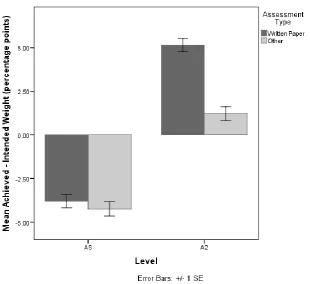
The mean of the differences between the achieved weights and the intended weights of units is negative for the written papers – mean = -0.84 (SE = 0.45), N=143 – and positive for the ‘other’ units – mean = 0.91 (SE = 0.43), N=132. The difference between these differences is statistically significant – t(273) = 2.81, p = .005 (equal variances assumed) – but the size of the average difference is small and unlikely to be of any systematic practical consequence.
A-Level
(Table 39, Appendix 3, page 103; Table 40, Appendix 4, page 124)
12
Figure 1. The mean differences between the achieved weights and the intended weights of AS and A2 written paper and ‘other’ units.
The difference between GCSE and A-level might be explained by the fact that controlled assessment – prevalent at GCSE – is more exam-like than coursework – still the most common form of centre assessed work at A-level – and that the timed element in controlled assessment produces greater discrimination than is achieved in coursework. The other main differences between controlled assessment and coursework are that the current GCSEs – and, therefore, the controlled assessment units – are newer than the current A-levels – and their coursework units – but, perhaps more importantly, that the controlled assessment tasks change regularly, whereas coursework tasks tend not to. This familiarity with the coursework tasks could make it relatively easier for candidates to fulfil the criteria for coursework than for controlled assessment.
13
Analyses Part 2: Question-Unit Weightings
A-level Media Studies
Assessment Objectives
The assessment objectives for A-level Media Studies are as follows:
AO1 Demonstrate knowledge and understanding of media concepts, contexts and critical debates. AO2 Apply knowledge and understanding when analysing media products and processes and
evaluating their own practical work, to show how meanings and responses are created. AO3 Demonstrate the ability to plan and construct media products using appropriate technical and
creative skills.
AO4 Demonstrate the ability to undertake, apply and present appropriate research. A-level Certificating Candidates
Table 1 shows the achieved weightings of units and their corresponding assessment objectives for candidates certificating A-level Media Studies in summer 2011.
Table 1. The achieved weightings of units and their corresponding assessment objectives for candidates certificating A-level Media Studies in summer 2011 (N = 6,986).
Unit Intended
Weight
Achieved
Weight AO1 AO2 AO3 AO4
Ach AO1 Ach AO2 Ach AO3 Ach AO4 MEST1
AS Written 25.00 21.72 15.00 10.00 0.00 0.00 13.03 8.69 0.00 0.00
MEST2
AS Portfolio
25.00 24.36 0.00 5.00 15.00 5.00 0.00 4.87 14.62 4.87
MEST3
A2 Written 25.00 24.59 10.00 15.00 0.00 0.00 9.84 14.76 0.00 0.00
MEST4
A2 Portfolio
25.00 29.32 5.00 0.00 10.00 10.00 5.86 0.00 11.73 11.73
Total 30.00 30.00 25.00 15.00 28.73 28.32 26.35 16.60
Difference -1.27 -1.68 1.35 1.60
The achieved weights for the units show that MEST4, the A2 portfolio unit, has exceeded its intended weighting by 4.32%, whilst MEST1, the AS written paper unit, has fallen 3.28% short of its intended weight. MEST2 (AS portfolio) and MEST3 (A2 written paper) have near-enough achieved their intended weightings. The assessment objectives AO3 and AO4 are practical in nature and are measured only by the portfolio units, whilst AO1 and AO2 constitute only 5% of the marks for MEST4 and MEST2, respectively. Consequently, the underweighting of a written unit and the overweighting of a portfolio unit means that AO3 and AO4 over-contribute and AO1 and AO2 under-contribute to the A-level outcomes.
14
unrepresentative of how candidates enter for units. It would be unwise to draw conclusions from their data; rather, it would be better to monitor the weightings over several series. If there are stable, undesirable patterns in the data, structural changes to units or improvements to the setting and/or marking of questions may be desirable.
MEST1 - Investigating Media
The aim of this unit is to enable candidates to investigate the media by applying media concepts to a range of media products in order to reach an understanding of how meanings and responses are created. Candidates should be encouraged to investigate the contemporary media landscape and the changing contexts within which media texts are produced and consumed.
Candidates will investigate the processes of meaning-making in media production and reception: • at the micro level within individual products (also termed texts)
• and at a macro level in terms of technologies (also termed platforms).
In this specification the media platforms are referred to as broadcasting, e-media and print, to include linear broadcasting (audio-visual) and cinema, print media, digital/web-based and emerging media. Candidates will firstly investigate a wide range of media texts to familiarise themselves with media language and media codes and conventions and then embark upon a cross-media study.
The investigations into media concepts, processes and products will link with and inform the research into Unit 2: Creating Media, where candidates are required to produce media artefacts taken from two of the three media platforms.
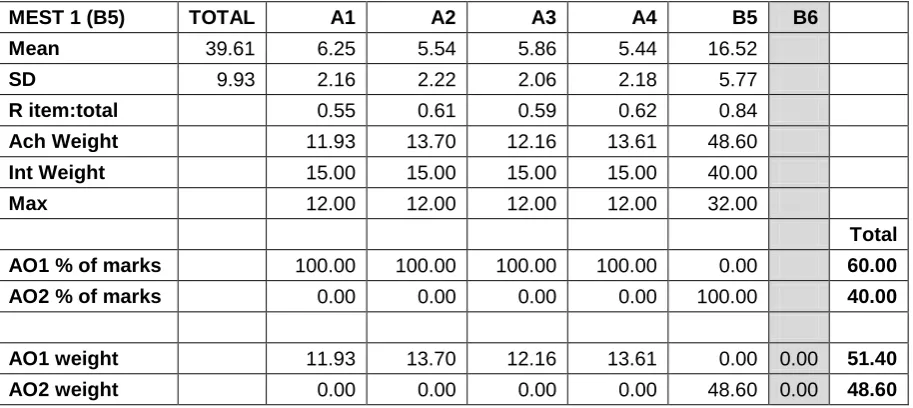
On MEST1, candidates must answer the four questions in section A and one of the two questions in section B. Table 2 shows the analysis for those candidates who opted for (or, where they did both optional questions, scored highest on) question B5. AO1 is associated with the section A questions, which constitute 48/80 (60%) marks on the paper. The remaining 32/80 (40%) marks in section B are associated with AO2. The analysis shows that the achieved weightings of 51.40% for AO1 and 48.60% for AO2 are closer to a 50/50 split than the intended 60/40.
Table 3 shows the analysis for those candidates who opted for (or, where they did both optional questions, scored highest on) question B6. Again, the achieved weightings of 47.82% for AO1 and 52.18% for AO2 are closer to a 50/50 split than the intended 60/40 and, in this case, AO2 has slightly outweighed AO1.
MEST3 - Critical Perspectives
The aim of this synoptic unit is to allow candidates to demonstrate their holistic understanding of the Media Studies Specification. It is assumed that during the course of their study they will have covered media concepts in some detail but, generally speaking, individually. At this level they are encouraged to examine the media in a less formulaic way. MEST3 will encourage candidates to demonstrate their understanding of the concepts, and also to develop and formulate their approach to the media and the role of the media in today’s society by referring in detail to the wider contexts (social, political, historical, economic, as appropriate) which affect media production, distribution and exhibition, by tackling media theory and by taking part in a discussion of the major contemporary media issues and debates. Candidates are expected to look at cross-cultural factors and the effects of globalisation on the media where appropriate.
15
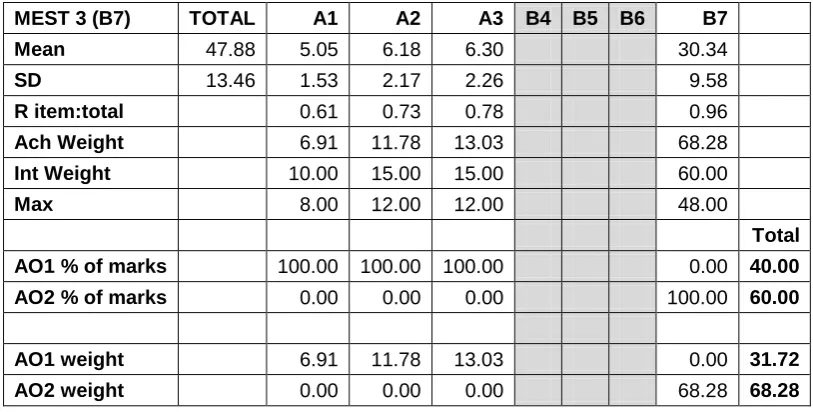
than one optional question, scored highest on) question B4. AO1 is associated with the section A questions, which constitute 32/80 (40%) marks on the paper. The remaining 48/80 (60%) marks in section B are associated with AO2. The analysis shows that the achieved weightings of 30.61% for AO1 and 69.39% for AO2 are closer to a 30/70 split than the intended 40/60.
Table 5 shows the analysis for those candidates who opted for (or, where they did more than one optional question, scored highest on) question B5. Again, the achieved weightings of 29.73% for AO1 and 70.27% for AO2 are closer to a 30/70 split than the intended 40/60.
Table 6 shows the analysis for those candidates who opted for (or, where they did more than one optional question, scored highest on) question B6. Again, the achieved weightings of 31.70% for AO1 and 68.30% for AO2 are closer to a 30/70 split than the intended 40/60.
Table 7 shows the analysis for those candidates who opted for (or, where they did more than one optional question, scored highest on) question B7. Again, the achieved weightings of 31.72% for AO1 and 68.28% for AO2 are closer to a 30/70 split than the intended 40/60.
There are two things to note from these findings. First, at unit level (Table 1), the portfolio units have defied the trend for A-level coursework/practical units to achieve less than their intended weights. Second, at the question level in the written units (Tables 2-7), the longer questions – associated exclusively with AO2 – have achieved over their intended weights, whilst the shorter questions – associated exclusively with AO1 – have achieved under their intended weights.
16
Table 2. The achieved weightings of questions and their corresponding assessment objectives for MEST1 (B5) in summer 2011 (N = 7,184).
MEST 1 (B5) TOTAL A1 A2 A3 A4 B5 B6
Mean 39.61 6.25 5.54 5.86 5.44 16.52
SD 9.93 2.16 2.22 2.06 2.18 5.77
R item:total 0.55 0.61 0.59 0.62 0.84
Ach Weight 11.93 13.70 12.16 13.61 48.60
Int Weight 15.00 15.00 15.00 15.00 40.00
Max 12.00 12.00 12.00 12.00 32.00
Total
AO1 % of marks 100.00 100.00 100.00 100.00 0.00 60.00
AO2 % of marks 0.00 0.00 0.00 0.00 100.00 40.00
AO1 weight 11.93 13.70 12.16 13.61 0.00 0.00 51.40
AO2 weight 0.00 0.00 0.00 0.00 48.60 0.00 48.60
Table 3. The achieved weightings of questions and their corresponding assessment objectives for MEST1 (B6) in summer 2011 (N = 2,707).
MEST1 (B6) TOTAL A1 A2 A3 A4 B5 B6
Mean 38.71 6.15 5.30 5.79 5.47 16.00
SD 10.81 2.16 2.30 2.06 2.25 6.54
R item:total 0.55 0.61 0.57 0.63 0.86
Ach Weight 10.91 12.88 10.85 13.18 52.18
Int Weight 15.00 15.00 15.00 15.00 40.00
Max 12.00 12.00 12.00 12.00 32.00
Total
AO1 % of marks 100.00 100.00 100.00 100.00 0.00 60.00
AO2 % of marks 0.00 0.00 0.00 0.00 100.00 40.00
AO1 weight 10.91 12.88 10.85 13.18 0.00 47.82
[image:16.595.76.520.365.573.2]17
Table 4. The achieved weightings of questions and their corresponding assessment objectives for MEST3 (B4) in summer 2011 (N = 2,098).
MEST 3 (B4) TOTAL A1 A2 A3 B4 B5 B6 B7
Mean 39.85 4.70 5.53 5.64 23.98
SD 14.15 1.60 2.18 2.19 10.20
R item:total 0.68 0.74 0.74 0.96
Ach Weight 7.67 11.44 11.50 69.39
Int Weight 10.00 15.00 15.00 60.00
Max 8.00 12.00 12.00 48.00
Total
AO1 % of marks 100.00 100.00 100.00 0.00 40.00
AO2 % of marks 0.00 0.00 0.00 100.00 60.00
AO1 weight 7.67 11.44 11.50 0.00 30.61
AO2 weight 0.00 0.00 0.00 69.39 69.39
Table 5. The achieved weightings of questions and their corresponding assessment objectives for MEST3 (B5) in summer 2011 (N = 1,224).
MEST 3 (B5) TOTAL A1 A2 A3 B4 B5 B6 B7
Mean 41.41 4.77 5.67 5.75 25.21
SD 13.47 1.52 2.06 2.11 9.81
R item:total 0.65 0.73 0.71 0.96
Ach Weight 7.28 11.24 11.21 70.27
Int Weight 10.00 15.00 15.00 60.00
Max 8.00 12.00 12.00 48.00
Total
AO1 % of marks 100.00 100.00 100.00 0.00 40.00
AO2 % of marks 0.00 0.00 0.00 100.00 60.00
AO1 weight 7.28 11.24 11.21 0.00 0.00 0.00 0.00 29.73
[image:17.595.85.510.366.572.2]18
Table 6. The achieved weightings of questions and their corresponding assessment objectives for MEST3 (B6) in summer 2011 (N = 2,142).
MEST 3 (B6) TOTAL A1 A2 A3 B4 B5 B6 B7
Mean 41.13 4.63 5.28 5.58 25.64
SD 13.36 1.58 2.11 2.14 9.50
R item:total 0.65 0.75 0.76 0.96
Ach Weight 7.68 11.83 12.18 68.30
Int Weight 10.00 15.00 15.00 60.00
Max 8.00 12.00 12.00 48.00
Total
AO1 % of marks 100.00 100.00 100.00 0.00 40.00
AO2 % of marks 0.00 0.00 0.00 100.00 60.00
AO1 weight 7.68 11.83 12.18 0.00 0.00 0.00 0.00 31.70
[image:18.595.94.501.366.572.2]AO2 weight 0.00 0.00 0.00 0.00 0.00 68.30 0.00 68.30
Table 7. The achieved weightings of questions and their corresponding assessment objectives for MEST3 (B7) in summer 2011 (N = 899).
MEST 3 (B7) TOTAL A1 A2 A3 B4 B5 B6 B7
Mean 47.88 5.05 6.18 6.30 30.34
SD 13.46 1.53 2.17 2.26 9.58
R item:total 0.61 0.73 0.78 0.96
Ach Weight 6.91 11.78 13.03 68.28
Int Weight 10.00 15.00 15.00 60.00
Max 8.00 12.00 12.00 48.00
Total
AO1 % of marks 100.00 100.00 100.00 0.00 40.00
AO2 % of marks 0.00 0.00 0.00 100.00 60.00
AO1 weight 6.91 11.78 13.03 0.00 31.72
19
GCSE History B (Full Course)
Assessment Objectives
AO1 Recall, select and communicate their knowledge and understanding of history. AO2 Demonstrate their understanding of the past through explanation and analysis of:
key concepts: causation, consequence, continuity, change and significance within an historical context;
key features and characteristics of the periods studied and the relationship between them. AO3 Understand, analyse and evaluate:
a range of source material as part of an historical enquiry;
how aspects of the past have been interpreted and represented in different ways as part of an historical enquiry.
Certificating Candidates
Table 8 shows the achieved weightings of units and their corresponding assessment objectives for candidates certificating GCSE History B (Full Course) in summer 2011.
Table 8. The achieved weightings of units and their corresponding assessment objectives for candidates certificating GCSE History B (Full Course) in summer 2011 (N = 35,720).
Unit Intended
Weight
Achieved
Weight AO1 AO2 AO3
Ach AO1 Ach AO2 Ach AO3 40451
Written Paper 37.50 37.87 15.00 15.00 7.50 15.15 15.15 7.57
40452
Written Paper 37.50 41.36 15.00 15.00 7.50 16.54 16.54 8.27
40453
Controlled Assessment
25.00 20.77 2.50 2.50 20.00 2.08 2.08 16.62
Total 32.50 32.50 35.00 33.77 33.77 32.46
Difference 1.27 1.27 -2.54
The achieved weights for the units show that the written paper, 40451, has achieved a weighting very close to that intended (+0.37%), whilst the other written paper, 40452, has exceeded its intended weight by 3.86%. The controlled assessment unit, 40453, has fallen short of its intended weight by 4.23%. Although all of the three assessment objectives are measured across the three units, AO1 and AO2 are assessed predominantly in the written papers, whilst AO3 is assessed predominantly in the controlled assessment unit. Consequently, AO3 is underweighted when compared with AO1 and AO2.
20
undesirable patterns in the data, structural changes to units or improvements to the setting and/or marking of questions may be desirable.
40451 - International Relations: Conflict and Peace in the 20th Century
This unit provides an outline study of history. The content is on international relations and covers many of the main events of the 20th Century.
On 40451, candidates must answer three questions on three of six optional topics. Table 9 shows the analysis for those candidates who opted for (or, where they attempted more than three questions, scored highest on) questions 1, 2, and 3 (the most popular combination).
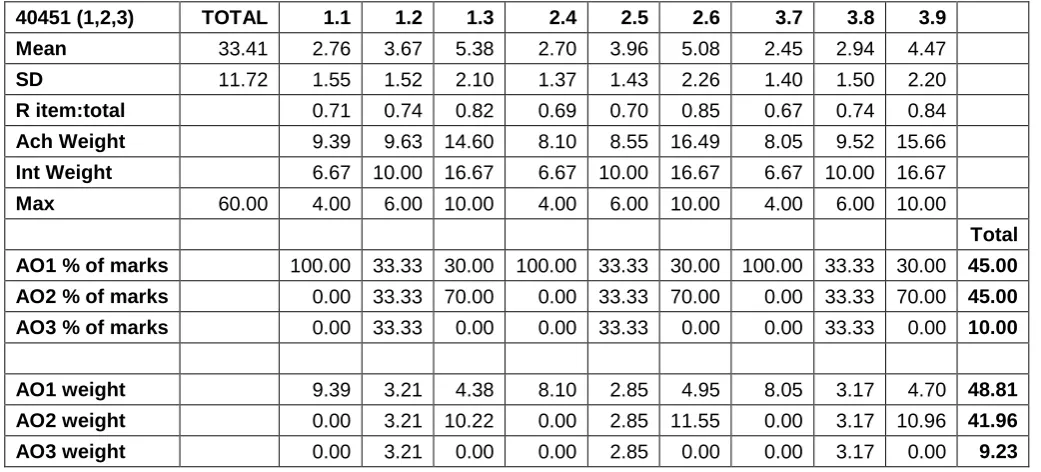
AO1, AO2, and AO3 achieve respective weightings of 48.81%, 41.96%, and 9.23%, compared with their intended weightings of 40:40:20. However, the achieved weightings are not purely the product of the performance of the question paper. Clearly, this question paper has been written with greater emphasis on AO1 and AO2 and less emphasis on AO3 than stated in the specification: the effective
intended weightings are 45:45:10 (Table 9). Considering that AO3 appeared underweighted when it was assumed that it had achieved its intended weight within each unit, the finding that AO3 is significantly underweighted within 40451 must be a concern.
[image:20.595.39.560.432.668.2]Table 10 shows the analysis for those candidates who opted for (or, where they attempted more than three questions, scored highest on) questions 4, 5, and 6 (the third most popular combination). AO1, AO2, and AO3 achieve respective weightings of 45.87%, 44.24%, and 9.89%. These weightings are very close to the effective intended weightings of 45:45:10 – so the question paper has performed well – but obviously are not in line with the published intended weightings of 40:40:20.
Table 9. The achieved weightings of questions and their corresponding assessment objectives for 40451 (1,2,3) in summer 2011 (N = 12,876).
40451 (1,2,3) TOTAL 1.1 1.2 1.3 2.4 2.5 2.6 3.7 3.8 3.9
Mean 33.41 2.76 3.67 5.38 2.70 3.96 5.08 2.45 2.94 4.47
SD 11.72 1.55 1.52 2.10 1.37 1.43 2.26 1.40 1.50 2.20
R item:total 0.71 0.74 0.82 0.69 0.70 0.85 0.67 0.74 0.84
Ach Weight 9.39 9.63 14.60 8.10 8.55 16.49 8.05 9.52 15.66
Int Weight 6.67 10.00 16.67 6.67 10.00 16.67 6.67 10.00 16.67
Max 60.00 4.00 6.00 10.00 4.00 6.00 10.00 4.00 6.00 10.00
Total
AO1 % of marks 100.00 33.33 30.00 100.00 33.33 30.00 100.00 33.33 30.00 45.00
AO2 % of marks 0.00 33.33 70.00 0.00 33.33 70.00 0.00 33.33 70.00 45.00
AO3 % of marks 0.00 33.33 0.00 0.00 33.33 0.00 0.00 33.33 0.00 10.00
AO1 weight 9.39 3.21 4.38 8.10 2.85 4.95 8.05 3.17 4.70 48.81
AO2 weight 0.00 3.21 10.22 0.00 2.85 11.55 0.00 3.17 10.96 41.96
21
Table 10. The achieved weightings of questions and their corresponding assessment objectives for 40451 (4,5,6) in summer 2011 (N = 3,812).
40451 (4,5,6) TOTAL 4.10 4.11 4.12 5.13 5.14 5.15 6.16 6.17 6.18
Mean 37.28 3.56 3.96 5.74 3.22 3.66 6.04 3.15 3.06 4.90
SD 10.59 0.89 1.39 2.05 1.18 1.43 2.04 1.28 1.55 2.26
R item:total 0.57 0.74 0.82 0.72 0.70 0.79 0.71 0.72 0.83
Ach Weight 4.76 9.69 15.98 7.94 9.45 15.29 8.56 10.52 17.81
Int Weight 6.67 10.00 16.67 6.67 10.00 16.67 6.67 10.00 16.67
Max 60.00 4.00 6.00 10.00 4.00 6.00 10.00 4.00 6.00 10.00
Total
AO1 % of marks 100.00 33.33 30.00 100.00 33.33 30.00 100.00 33.33 30.00 45.00
AO2 % of marks 0.00 33.33 70.00 0.00 33.33 70.00 0.00 33.33 70.00 45.00
AO3 % of marks 0.00 33.33 0.00 0.00 33.33 0.00 0.00 33.33 0.00 10.00
AO1 weight 4.76 3.23 4.79 7.94 3.15 4.59 8.56 3.51 5.34 45.87
AO2 weight 0.00 3.23 11.18 0.00 3.15 10.70 0.00 3.51 12.47 44.24
AO3 weight 0.00 3.23 0.00 0.00 3.15 0.00 0.00 3.51 0.00 9.89
40452 - Twentieth Century Depth Studies
This unit requires the study of contrasting or complementary governments throughout the Twentieth Century. It gives a national or regional focus to studies in depth, based on events, developments and issues in specified countries or regions.
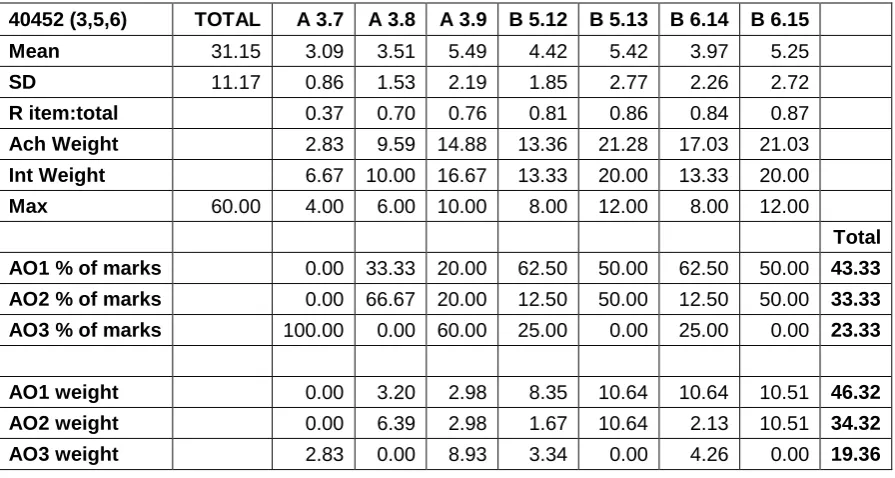
On 40452, candidates must answer three questions: one of three questions from Section A and two of seven questions from Section B. Table 11 shows the analysis for those candidates who opted for (or, where they attempted more than three questions, scored highest on) questions A3, B5, and B6 (the most popular combination, with four times as many candidates as the next most popular route). Table 11. The achieved weightings of questions and their corresponding assessment objectives for 40452 (3,5,6) in summer 2011 (N = 10,005).
40452 (3,5,6) TOTAL A 3.7 A 3.8 A 3.9 B 5.12 B 5.13 B 6.14 B 6.15
Mean 31.15 3.09 3.51 5.49 4.42 5.42 3.97 5.25
SD 11.17 0.86 1.53 2.19 1.85 2.77 2.26 2.72
R item:total 0.37 0.70 0.76 0.81 0.86 0.84 0.87
Ach Weight 2.83 9.59 14.88 13.36 21.28 17.03 21.03
Int Weight 6.67 10.00 16.67 13.33 20.00 13.33 20.00
Max 60.00 4.00 6.00 10.00 8.00 12.00 8.00 12.00
Total
AO1 % of marks 0.00 33.33 20.00 62.50 50.00 62.50 50.00 43.33
AO2 % of marks 0.00 66.67 20.00 12.50 50.00 12.50 50.00 33.33
AO3 % of marks 100.00 0.00 60.00 25.00 0.00 25.00 0.00 23.33
AO1 weight 0.00 3.20 2.98 8.35 10.64 10.64 10.51 46.32
AO2 weight 0.00 6.39 2.98 1.67 10.64 2.13 10.51 34.32
[image:21.595.42.557.101.340.2] [image:21.595.75.523.535.774.2]22
As with the previous unit, the effective weightings of the assessment objectives are not in line with those published in the specification. AO1, AO2, and AO3 have respective effective intended weightings of 43.33%, 33.33%, and 23.33% compared with published intended weightings of 40:40:20. AO1 and AO2 have achieved slightly above their effective intended weights, whilst AO3 has achieved slightly under its intended weight. Both questions in section A that assess AO3 are underweighted, including the four mark question, which assesses purely AO3.
Reassessing Certificating Candidates
Table 12 shows the achieved weightings of units and their corresponding assessment objectives for candidates certificating GCSE History B (Full Course) in summer 2011, adjusted to reflect the effective intended weightings on 40451 and 40452. Based on these effective intended AO weightings and achieved unit weights, the overall assessment overweights AO1 by approximately 5% and underweights AO3 by approximately the same. When we consider the question level analysis and the fact that, at that level too, AO1 tends to be overweighted and AO3 underweighted, these 5% estimates are probably somewhat conservative.
Table 12. The achieved weightings of units and their corresponding assessment objectives for candidates certificating GCSE History B (Full Course) in summer 2011 (N = 35,720) – adjusted to reflect the effective intended weightings on 40451 and 40452.
Unit Intended
Weight
Achieved
Weight AO1 AO2 AO3
Ach AO1 Ach AO2 Ach AO3
40451 37.50 37.87 16.88 16.88 3.75 17.04 17.04 3.79
40452 37.50 41.36 16.25 12.50 8.75 17.92 13.78 9.65
40453 25.00 20.77 2.50 2.50 20.00 2.08 2.08 16.62
Total 35.62 31.87 32.50 37.04 32.90 30.05
Difference Achieved - Effective
1.42 1.03 -2.45
Difference Achieved - Published
4.54 0.40 -4.95
In the case of the A-level Media Studies papers, the longer extended response questions all exceeded their intended weights while the shorter-response questions tended to be underweighted. In the case of the current papers no such pattern is obvious: some of the questions with the lowest tariff – four marks – exceed their intended weightings while others fail to reach them.
23
GCSE Business Studies
Assessment Objectives
The assessment units will assess the following assessment objectives:
AO1 Recall, select and communicate their knowledge and understanding of concepts, issues and terminology.
AO2 Apply skills, knowledge and understanding in a variety of contexts and in planning and carrying out investigations and tasks.
AO3 Analyse and evaluate evidence, make reasoned judgements and present appropriate conclusions.
Quality of Written Communication (QWC)
GCSE specifications which require candidates to produce written material in English must:
• ensure that text is legible and that spelling, punctuation and grammar are accurate so that meaning is clear
• select and use a form and style of writing appropriate to purpose and to complex subject matter • organise information clearly and coherently, using specialist vocabulary when appropriate.
In this specification QWC will be assessed in all units as part of AO3 (indicated in the tables as question 1/2/3dE).
Certificating Candidates
Table 13 shows the achieved weightings of units and their corresponding assessment objectives for candidates certificating GCSE Business Studies in summer 2011.
Table 13. The achieved weightings of units and their corresponding assessment objectives for candidates certificating GCSE Business Studies in summer 2011 (N = 20,754).
Unit Intended
Weight
Achieved
Weight AO1 AO2 AO3
Ach AO1 Ach AO2 Ach AO3 413001
WrittenPaper 40.00 37.47 12.00 14.00 14.00 11.24 13.12 13.12
413002
WrittenPaper 35.00 38.02 10.50 12.25 12.25 11.41 13.31 13.31
413003
Controlled Assessment
25.00 24.50 7.50 8.75 8.75 7.35 8.58 8.58
Total 30.00 35.00 35.00 30.00 35.00 35.00
Difference 0.00 0.00 0.00
24
This analysis assumes that, within each unit, the assessment objectives have achieved their intended weights. It is possible that, withinaunit, a given assessment objective is over- or underweighted. This could potentially offset or exacerbate the effects of an imbalance in the weighting of units. An item level analysis is required to confirm or refute this. It should be noted that the majority of certificating candidates will not have taken all of their units in the certificating series. To sample such candidates would introduce two fundamental problems: first, they are few in number; second, they are unrepresentative of how candidates enter for units. It would be unwise to draw conclusions from their data; rather, it would be better to monitor the weightings over several series. If there are stable, undesirable patterns in the data, structural changes to units or improvements to the setting and/or marking of questions may be desirable.
413001 - Setting up a Business
This unit introduces candidates to issues concerning the setting up and operation of a business. It explores the activities of business and the reasons for success or failure. It encourages candidates to appreciate that businesses must operate within society and that this involves businesses engaging with a wide range of stakeholders who will hold differing perspectives.
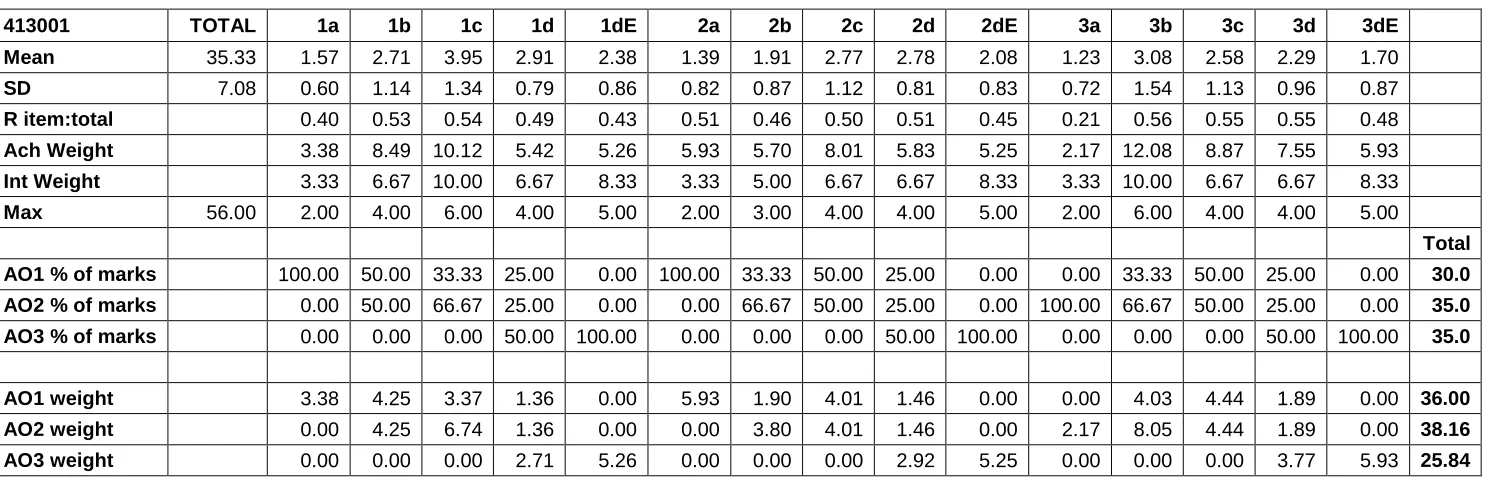
Table 14 shows the intended and achieved weights for the questions and their corresponding assessment objectives for 413001. Candidates must answer all questions on this paper. AO1, AO2, and AO3 achieve respective weightings of 36.00%, 38.16%, and 25.84%, compared with their intended weightings of 30:35:35. Closer examination of Table 14 shows that the mean marks awarded for QWC (questions 1/2/3dE), which is assessed as a part of AO3, are low and that the achieved weightings for these part-questions are in the range of ½ to 2/3 of those intended. By contrast, the achieved weightings for those part-questions (1/2/3d) based on the marks awarded for AO1, AO2, and non-QWC AO3 are much closer to, or exceed, the intended weightings. So, whilst AO3 on the whole is quite seriously underweighted, it appears that it is the QWC component, more than the analytical and evaluative skills component, which is problematic. The marks allocated to QWC are not discriminating between candidates. It may be that the candidature is genuinely homogenous and that the measure would work appropriately on a more heterogeneous candidature. This could be regarded as a success, as it might indicate that the inclusion of QWC in the assessment has made the majority of candidates take care over the quality of their writing without the assessment actually discriminating between them on the basis of it. Alternatively, it could be that the mark scheme is not enabling markers to award a large enough range of marks to facilitate discrimination between candidates, or that QWC is genuinely too weakly correlated with performance on the subject content to ever achieve its intended weight, no matter how examiners intervene.
413002 - Growing as a Business
This unit builds upon the content of Unit 1, allowing candidates to study businesses as they grow and the issues that expansion raises.
25
Table 14. The achieved weightings of questions and their corresponding assessment objectives for 413001 in summer 2011 (N = 21,467).
413001 TOTAL 1a 1b 1c 1d 1dE 2a 2b 2c 2d 2dE 3a 3b 3c 3d 3dE
Mean 35.33 1.57 2.71 3.95 2.91 2.38 1.39 1.91 2.77 2.78 2.08 1.23 3.08 2.58 2.29 1.70
SD 7.08 0.60 1.14 1.34 0.79 0.86 0.82 0.87 1.12 0.81 0.83 0.72 1.54 1.13 0.96 0.87
R item:total 0.40 0.53 0.54 0.49 0.43 0.51 0.46 0.50 0.51 0.45 0.21 0.56 0.55 0.55 0.48
Ach Weight 3.38 8.49 10.12 5.42 5.26 5.93 5.70 8.01 5.83 5.25 2.17 12.08 8.87 7.55 5.93
Int Weight 3.33 6.67 10.00 6.67 8.33 3.33 5.00 6.67 6.67 8.33 3.33 10.00 6.67 6.67 8.33
Max 56.00 2.00 4.00 6.00 4.00 5.00 2.00 3.00 4.00 4.00 5.00 2.00 6.00 4.00 4.00 5.00
Total
AO1 % of marks 100.00 50.00 33.33 25.00 0.00 100.00 33.33 50.00 25.00 0.00 0.00 33.33 50.00 25.00 0.00 30.0
AO2 % of marks 0.00 50.00 66.67 25.00 0.00 0.00 66.67 50.00 25.00 0.00 100.00 66.67 50.00 25.00 0.00 35.0
AO3 % of marks 0.00 0.00 0.00 50.00 100.00 0.00 0.00 0.00 50.00 100.00 0.00 0.00 0.00 50.00 100.00 35.0
AO1 weight 3.38 4.25 3.37 1.36 0.00 5.93 1.90 4.01 1.46 0.00 0.00 4.03 4.44 1.89 0.00 36.00
AO2 weight 0.00 4.25 6.74 1.36 0.00 0.00 3.80 4.01 1.46 0.00 2.17 8.05 4.44 1.89 0.00 38.16
26
Table 15. The achieved weightings of questions and their corresponding assessment objectives for 413002 in summer 2011 (N = 19,528).
413002 TOTAL 1a 1b 1c 1d 1dE 2a 2b 2ci 2cii 2d 2dE 3a 3bi 3bii 3c 3cE
Mean 36.35 1.16 2.40 3.67 2.46 2.70 2.81 2.48 1.71 2.07 2.44 2.61 1.37 1.84 1.28 2.57 2.80
SD 7.07 0.88 0.85 1.18 0.90 0.94 1.10 1.23 0.51 1.18 0.83 0.93 0.74 0.48 0.73 0.89 0.97
R item:total 0.50 0.44 0.56 0.52 0.53 0.40 0.52 0.31 0.52 0.53 0.55 0.42 0.35 0.44 0.53 0.55
Ach Weight 6.18 5.35 9.35 6.58 7.08 6.23 9.11 2.23 8.76 6.23 7.27 4.40 2.34 4.53 6.75 7.60
Int Weight 3.33 6.67 10.00 6.67 8.33 6.67 6.67 3.33 6.67 6.67 8.33 3.33 3.33 5.00 6.67 8.33
Max 57.00 2.00 4.00 6.00 4.00 5.00 4.00 4.00 2.00 4.00 4.00 5.00 2.00 2.00 3.00 4.00 5.00
Total
AO1 % of marks 100.00 50.00 33.33 25.00 0.00 50.00 50.00 100.00 25.00 25.00 0.00 100.00 0.00 0.00 25.00 0.00 30.00
AO2 % of marks 0.00 50.00 66.67 25.00 0.00 50.00 50.00 0.00 75.00 25.00 0.00 0.00 100.00 100.00 25.00 0.00 35.00
AO3 % of marks 0.00 0.00 0.00 50.00 100.00 0.00 0.00 0.00 0.00 50.00 100.00 0.00 0.00 0.00 50.00 100.00 35.00
AO1 weight 6.18 2.67 3.12 1.65 0.00 3.12 4.55 2.23 2.19 1.56 0.00 4.40 0.00 0.00 1.69 0.00 33.36
AO2 weight 0.00 2.67 6.24 1.65 0.00 3.12 4.55 0.00 6.57 1.56 0.00 0.00 2.34 4.53 1.69 0.00 34.91
27
A-level French
Assessment Objectives
The assessment objectives for A-level French are as follows:
AO1 Understand and respond, in speech and writing, to spoken language. AO2 Understand and respond, in speech and writing, to written language.
AO3 Show knowledge of and apply accurately the grammar and syntax prescribed in the specification.
Quality of Written Communication (QWC)
In GCE specifications which require candidates to produce written material in English, candidates must:
• ensure that text is legible and that spelling, punctuation and grammar are accurate so that meaning is clear
• select and use a form and style of writing appropriate to purpose and to complex subject matter • organise information clearly and coherently, using specialist vocabulary when appropriate.
In this specification QWC will be assessed in Units 1 and 3 by means of the transfer of meaning tasks.
A-level Certificating Candidates
Table 16 shows the achieved weightings of units and their corresponding assessment objectives for candidates certificating A-level French in summer 2011.
Table 16. The achieved weightings of units and their corresponding assessment objectives for candidates certificating A-level French in summer 2011 (N = 3,627).
Unit Intended
Weight
Achieved
Weight AO1 AO2 AO3 Ach AO1 Ach AO2 Ach AO3
FREN1
AS WrittenPaper 35.00 36.75 11.00 16.00 8.00 11.55 16.80 8.40
FRE2T
AS SpeakingTest 15.00 9.49 7.00 3.00 5.00 4.43 1.90 3.16
FREN3
A2 WrittenPaper 35.00 39.11 8.00 19.00 8.00 8.94 21.23 8.94
FRE4T
A2 SpeakingTest 15.00 14.66 7.00 4.00 4.00 6.84 3.91 3.91
Total 33.00 42.00 25.00 31.76 43.84 24.41
Difference -1.24 1.84 -0.59
28
response to written language, is slightly overweighted compared with AO1 and, to a lesser extent, AO3.
This analysis assumes that, within each unit, the assessment objectives have achieved their intended weights. It is possible that, withinaunit, a given assessment objective is over- or underweighted. This could potentially offset or exacerbate the effects of an imbalance in the weighting of units. An item level analysis is required to confirm or refute this. It should be noted that the majority of certificating candidates will not have taken all of their units in the certificating series. To sample such candidates would introduce two fundamental problems: first, they are few in number; second, they are unrepresentative of how candidates enter for units. It would be unwise to draw conclusions from their data; rather, it would be better to monitor the weightings over several series. If there are stable, undesirable patterns in the data, structural changes to units or improvements to the setting and/or marking of questions may be desirable.
FREN1 - Listening, Reading and Writing
Table 17 shows the intended and achieved weights for the questions and their corresponding assessment objectives for FREN1. Candidates must answer all questions on this paper. The results show that AO1 – understanding and responding to spoken language – is somewhat underweighted (-4.49%), whilst AO3 – knowledge and application of grammar and syntax – is overweighted (+4.71%). AO2 – understanding and responding to written language – achieved a weighting broadly in line with that intended (-0.22%).
FREN3 - Listening, Reading and Writing
On FREN3, candidates must answer all of the questions in section A and one of the five questions in section B. The analyses presented are for the two most popular routes. Table 18 shows the analysis for those candidates who opted for (or, where they did multiple optional questions, scored highest on) question B12. As with the AS unit, FREN1, AO1 on FREN3 is underweighted, except that, in this case, it is more dramatic at -9.05%. Both AO2 and AO3 achieved weights greater than intended, at +3.04% and +6.01%, respectively. Clearly, the questions that require candidates to respond to spoken language do not discriminate between them as well as those requiring responses to written language or those requiring syntactically and grammatically accurate production of written language. There is a considerable number of these questions with extremely high facility indices (mean/max) – many greater than 0.95 – which are simply too easy.
29
Table 17. The achieved weightings of questions and their corresponding assessment objectives for FREN1 in summer 2011 (N = 11,103).
FREN1 TOTAL A1a A1b A1c A2a A2b A2c A2d A2e A2f A2g A2h A2i
Mean 78.35 2.33 2.67 3.15 0.82 0.96 0.96 0.94 0.97 0.97 0.80 0.96 0.96
SD 15.60 0.79 0.60 0.98 0.38 0.20 0.20 0.23 0.16 0.17 0.40 0.20 0.19
R item:total 0.48 0.32 0.58 0.37 0.31 0.28 0.29 0.26 0.23 0.30 0.19 0.29
Ach Weight 2.44 1.24 3.65 0.92 0.39 0.37 0.43 0.26 0.25 0.78 0.25 0.35
Int Weight 2.73 2.73 3.64 0.91 0.91 0.91 0.91 0.91 0.91 0.91 0.91 0.91
Max 110.00 3.00 3.00 4.00 1.00 1.00 1.00 1.00 1.00 1.00 1.00 1.00 1.00
AO1 % of marks 100.00 100.00 100.00 100.00 100.00 100.00 100.00 100.00 100.00 100.00 100.00 100.00
AO2 % of marks 0.00 0.00 0.00 0.00 0.00 0.00 0.00 0.00 0.00 0.00 0.00 0.00
AO3 % of marks 0.00 0.00 0.00 0.00 0.00 0.00 0.00 0.00 0.00 0.00 0.00 0.00
AO1 weight 2.44 1.24 3.65 0.92 0.39 0.37 0.43 0.26 0.25 0.78 0.25 0.35
AO2 weight 0.00 0.00 0.00 0.00 0.00 0.00 0.00 0.00 0.00 0.00 0.00 0.00
30
FREN1 (cont.) A2j A3a A3bi A3bii A3c A3d A4a A4b A4c A4d A4e A4f A4g
Mean 0.88 0.48 0.63 1.70 1.49 1.15 0.92 0.90 0.93 0.89 0.51 0.96 0.89
SD 0.33 0.50 0.48 0.56 0.67 0.75 0.28 0.30 0.26 0.31 0.50 0.21 0.32
R item:total 0.41 0.45 0.48 0.48 0.58 0.58 0.44 0.37 0.34 0.41 0.37 0.31 0.35
Ach Weight 0.87 1.45 1.48 1.75 2.50 2.76 0.78 0.72 0.57 0.81 1.19 0.41 0.71
Int Weight 0.91 0.91 0.91 1.82 1.82 1.82 0.91 0.91 0.91 0.91 0.91 0.91 0.91
Max 1.00 1.00 1.00 2.00 2.00 2.00 1.00 1.00 1.00 1.00 1.00 1.00 1.00
AO1 % of marks 100.00 100.00 100.00 100.00 100.00 100.00 100.00 100.00 100.00 100.00 100.00 100.00 100.00
AO2 % of marks 0.00 0.00 0.00 0.00 0.00 0.00 0.00 0.00 0.00 0.00 0.00 0.00 0.00
AO3 % of marks 0.00 0.00 0.00 0.00 0.00 0.00 0.00 0.00 0.00 0.00 0.00 0.00 0.00
AO1 weight 0.87 1.45 1.48 1.75 2.50 2.76 0.78 0.72 0.57 0.81 1.19 0.41 0.71
AO2 weight 0.00 0.00 0.00 0.00 0.00 0.00 0.00 0.00 0.00 0.00 0.00 0.00 0.00
31
FREN1 (cont.) A5a A5b A5c A5d