
Exploring the underlying nature of alcohol-related implicit attitudes
374
0
0
Full text
(2) Exploring the Underlying Nature of Alcohol-related Implicit Attitudes.. Thesis submitted by Daniel Bruce LINDSAY, BPsych (Hons.) in September 2015. For the degree of Doctor of Philosophy in the Department of Psychology, College of Healthcare Sciences James Cook University.
(3) i Statement of Access. I, the undersigned author of this work, understand that James Cook University will make this thesis available for use within the university library and, via the Australia Digital Thesis network, for use elsewhere.. I understand that, as an unpublished work, a thesis has significant protection under the Copyright Act and I do not wish to place any further restriction on access to this work.. 01/09/2015 Daniel Lindsay. Date.
(4) ii Statement of Sources Declaration. I declare that this thesis is my own work and has not been submitted in any form for another degree of diploma at any university or other institution of tertiary education. I declare that I have stated clearly and fully in the thesis the extent of any collaboration with others. To the best of my knowledge and belief, the thesis contains no material previously published by any other person except where due acknowledgment has been made. Every reasonable effort has been made to gain permission and acknowledge the owners of copyright material. I would be pleased to hear from any copyright owner who has been omitted or incorrectly acknowledged.. 01/09/2015 Daniel Lindsay. Date.
(5) iii Declaration of Ethics. The research presented and reported in this thesis was conducted within the guidelines for research ethics outlined in the National Statement on Ethics Conduct in Research Involving Humans (1999), the Joint NHMRC/AVCC Statement and Guidelines on Research Practice (1997), the James Cook University Policy on Experimentation Ethics, Standard Practices and Guidelines (2001), and the James Cook University Statement and Guidelines on Research Practice (2001). The proposed research methodologies received human research ethics approval from the James Cook University Human Research Ethics Committee (approval numbers H4279, H4248, H4891, and H5292).. 01/09/2015 Daniel Lindsay. Date.
(6) iv Statement of the Contribution of Others. I recognise the financial and infrastructural contribution of James Cook University through providing me a work station, access to resources, and funding to conduct my research and attend conferences.. I recognise the financial contribution of the Graduate Research School who awarded Graduate Research Scheme grants for attendance at domestic and international conferences.. I recognise the support, guidance, and input provided by my primary supervisor Dr Anne Swinbourne.. 01/09/2015 Daniel Lindsay. Date.
(7) v Acknowledgments The completion of this thesis would not have been possible without the support of the individuals listed below, each of whom I express the deepest gratitude for their guidance during the completion of my PhD. First, to my Primary Supervisor, Dr Anne Swinbourne, who I cannot thank enough for being the perfect supervisor to me (“The Boy”) over these past four years. Your level of knowledge and excellent communication skills are the reason I stuck with Psychology when I thought I would give the degree away after my first undergraduate year. Now, nearly a decade later, you remain the primary reason I am still interested in this field. I thank you for your constant supervision and for keeping me motivated throughout my PhD. Also, I would like to acknowledge your help in finding work for me during my postgraduate years and supporting me financially for conference attendance. Much appreciated. Next, I would like to acknowledge my supporting and loving parents, whose constant emotional and financial support, not just over these 4 years, but throughout my entire life, has made me the person I am today. To Dad, I can’t think of anything better to say than I basically have moulded myself to be as much like you as possible. You are my role model, the person I look up to and admire for all you have achieved. Your level of involvement in keeping me sane and motivated throughout my PhD is second to none, and I fully appreciate the Thursday/Friday lunch sessions we have where I could unload all my problems onto you. To Mum, you are an amazing woman who has been nothing but caring and supportive toward me. I love you both dearly. To my wonderful partner Erin who has stuck with me throughout my undergraduate and postgraduate years. You have been a shoulder to lean on when things have been tough and an excellent sounding board when I need to talk things over. You are an absolute gem.
(8) vi and I am lucky to have someone so supportive by my side. Thank you also to Lisa and Craig for all of your support, it is much appreciated. Thanks also to my colleagues, The Penthouse Crew. Kayla, you have been a constant source of intelligent conversation, humorous mannerisms and excellent advice. Together, we have managed to encourage one another to get to this final point and without you this process would have been a lot more difficult. To Connar, you have essentially been another supervisor to me throughout my PhD and your advice was much appreciated. To Bec, you have made this process a lot easier just by going through it with me. Also to Meegan, my “research mother.” Thank you all. Lastly, to all those who participated in this research, I would like to express my thanks. Without you, this project would not exist..
(9) vii Abstract Contemporary research into alcohol consumption has identified automatic cognitive processes such as implicit attitudes as being influential on the initiation and maintenance of drinking behaviour (Houben & Wiers, 2006, 2008a). However, the structure of implicit alcohol-related attitudes, as well as ways in which these attitudes can be manipulated, remains relatively unknown. Therefore, the current research project aimed to explore the underlying nature of implicit attitudes toward alcohol consumption. To date, research examining implicit alcohol-related attitude change has focused on associative processes, namely Evaluative Conditioning (EC; Houben, Haverman, & Wiers, 2010; Houben, Schoenmakers, & Wiers, 2010). It was argued here that advertisements may serve as a real-world example of an EC trial. Study 1 (N = 80) and Study 2 (N = 54) examined the immediate influence of beer and chocolate advertising on implicit attitudes, as measured on an Implicit Association Test (IAT; Greenwald, McGhee, & Schwartz, 1998), and using a pre- and post-test design. The results of Study 1 indicated that viewing an advertisement for beer produced a significant positive shift in beer-related implicit attitudes from pre- to post-test. Participants who had previously seen the beer advertisement reported a significantly larger shift in beer-related implicit attitudes than participants who had never seen it. Furthermore, participants who had seen the beer advertisement most often reported the strongest implicit attitude change. No change was found for chocolate-related implicit attitudes in Study 1. All of the above attitude findings from Study 1 were replicated in Study 2. Extending the results from Study 1, Study 2 introduced a measure of consumption behaviour for both beer and chocolate. The results from Study 2 found no direct relationship between advertisement exposure and product consumption in the laboratory. However, previous.
(10) viii advertisement exposure moderated the relationship between beer-related implicit attitude change and beer consumption in the laboratory. The results from Studies 1 and 2 indicated that advertisements, which may use the associative principles of EC, are able to produce implicit alcohol-related attitude change. Study 3 (N = 243) aimed to examine the influence of non-associative processes, namely message frames, on alcohol-related implicit attitude change. The results from Study 3 indicated that socially-focused messages were more influential in producing negative implicit attitude change than health-focused messages. Due to the significant alcohol-related implicit attitude change found in Studies 1-3, it was argued that individuals may hold ambivalent attitudes toward alcohol. Therefore, the ambivalent nature of explicit and implicit alcohol-related attitudes was explored in Study 4 (N = 257) and Study 5 (N = 340) respectively. The results from these studies provided evidence to suggest that implicit and explicit attitudes toward alcohol consumption are ambivalent. Study 5 also examined whether the experience of alcohol-related consequences contributed to ambivalence in alcohol-related attitudes, but no significant relationships were found. Based on the results of this research project, it appears as though both associative and non-associative processes can produce alcohol-related implicit attitude change. A possible explanation for this change is that individuals’ attitudes toward alcohol consumption are ambivalent. Further research is needed to examine the relationship between ambivalence in alcohol-related attitudes and consumption behaviour, as well as an exploration of the factors that may produce ambivalence in alcohol-related attitudes. Recommendations for alcohol advertising, attitude measurement and community level anti-drinking messages are provided. The results of this research project increase the current understanding of the complex nature of implicit alcohol-related attitudes..
(11) ix Table of Contents Statement of Access .................................................................................................................... i Statement of Sources..................................................................................................................ii Declaration of Ethics................................................................................................................ iii Statement of the Contribution of Others ................................................................................... iv Acknowledgments...................................................................................................................... v Abstract ....................................................................................................................................vii List of Tables ......................................................................................................................... xiii List of Abbreviations .............................................................................................................. xiv Introduction ............................................................................................................................ 1 Research Questions ................................................................................................................ 3 Chapter 1: Dual-systems Modelling .......................................................................................... 4 General Overview of Dual-systems Models .......................................................................... 4 Implicit-explicit Attitude Distinction................................................................................... 22 Chapter 2: Implicit Attitudes and Alcohol Consumption ........................................................ 32 Alcohol Consumption in Australia ...................................................................................... 32 Explicit Alcohol-related Cognitions .................................................................................... 36 Dual-systems Models of Addictive Behaviours .................................................................. 40 Implicit Health-related Attitudes ......................................................................................... 43 Implicit Attitudes ................................................................................................................. 46 Implicit Alcohol-related Attitudes ....................................................................................... 48 The Implicit Association Test .............................................................................................. 49 Chapter 3: Evaluative Conditioning and Implicit Attitude Change ......................................... 58 Explicit Attitude Change...................................................................................................... 58 Implicit Attitude Change...................................................................................................... 61 Evaluative Conditioning ...................................................................................................... 62 Implicit Attitude Change/Formation .................................................................................... 64 Message Framing ................................................................................................................. 78 Evaluative Conditioning and Advertising............................................................................ 80 Chapter 4: Methodology .......................................................................................................... 88 What are Implicit Measures? ............................................................................................... 88 The Implicit Association Test .............................................................................................. 91 Chapter 5: Study 1 ................................................................................................................... 99 Current Study ..................................................................................................................... 100 Method ................................................................................................................................... 102 Participants ......................................................................................................................... 102.
(12) x Materials ............................................................................................................................ 102 Procedure ........................................................................................................................... 114 Results .................................................................................................................................... 114 Randomisation Checks....................................................................................................... 114 Implicit Attitude Change.................................................................................................... 117 Discussion .............................................................................................................................. 121 Previous Advertisement Exposure ..................................................................................... 124 Chapter 6: Study 2 ................................................................................................................. 126 MODE Model .................................................................................................................... 130 Current Study ..................................................................................................................... 132 Method ................................................................................................................................... 133 Participants ......................................................................................................................... 133 Materials ............................................................................................................................ 134 Procedure ........................................................................................................................... 136 Results .................................................................................................................................... 137 Randomisation Checks....................................................................................................... 137 Implicit Attitude Change.................................................................................................... 138 Consumption Behaviour .................................................................................................... 143 Moderation Analyses ......................................................................................................... 144 Discussion .............................................................................................................................. 146 Chapter 7: Study 3 ................................................................................................................. 149 Alcohol Public Service Announcements ........................................................................... 149 Message Framing ............................................................................................................... 150 Alcohol-related Consequences........................................................................................... 152 Current Study ..................................................................................................................... 153 Method ................................................................................................................................... 154 Participants ......................................................................................................................... 154 Materials ............................................................................................................................ 155 Procedure ........................................................................................................................... 158 Results .................................................................................................................................... 159 Randomisation Checks....................................................................................................... 159 Implicit Attitude Change.................................................................................................... 160 Discussion .............................................................................................................................. 162 Chapter 8: Attitudinal ambivalence ....................................................................................... 166 Explicit Ambivalence......................................................................................................... 167 Measurement of Attitudinal Ambivalence ......................................................................... 173 Why are some Attitudes Ambivalent? ............................................................................... 179.
(13) xi Implicit Ambivalence......................................................................................................... 181 Implicit Ambivalence in Alcohol-related Attitudes ........................................................... 185 Chapter 9: Study 4 ................................................................................................................. 190 Method ................................................................................................................................... 193 Participants ......................................................................................................................... 193 Materials ............................................................................................................................ 193 Procedure ........................................................................................................................... 195 Results .................................................................................................................................... 196 Health Behaviour ............................................................................................................... 196 Ambivalence ...................................................................................................................... 196 Discussion .............................................................................................................................. 200 Ambivalence and Health-risk Behaviour ........................................................................... 200 Differing Predictive Power for Potential and Felt Ambivalence ....................................... 203 Chapter 10: Study 5 ............................................................................................................... 207 Implicit Ambivalence......................................................................................................... 207 Relationship with Explicit Ambivalence ........................................................................... 208 Alcohol-related Consequences........................................................................................... 210 Method ................................................................................................................................... 211 Participants ......................................................................................................................... 211 Materials ............................................................................................................................ 212 Procedure ........................................................................................................................... 216 Results .................................................................................................................................... 217 Implicit Attitudes ............................................................................................................... 218 Implicit and Explicit Ambivalence .................................................................................... 219 Alcohol-related Consequences and Explicit Ambivalence ................................................ 222 Alcohol-related Consequences and Implicit Ambivalence ................................................ 223 Discussion .............................................................................................................................. 224 Ambivalence and Consequences........................................................................................ 227 Chapter 11: General Discussion............................................................................................. 230 General Overview .............................................................................................................. 230 Implicit Attitude Change through Associative Processes .................................................. 231 Implicit Attitude Change through Non-associative Processes ........................................... 233 Explicit Ambivalence......................................................................................................... 234 Implicit Ambivalence......................................................................................................... 235 Alcohol-related Consequences........................................................................................... 237 Attitudinal Ambivalence and Implicit Attitude Change .................................................... 238 Practical Implications of Results ....................................................................................... 239.
(14) xii Limitations ......................................................................................................................... 242 Future Research ................................................................................................................. 244 Conclusions ........................................................................................................................ 246 References .............................................................................................................................. 247 Appendices ............................................................................................................................. 282.
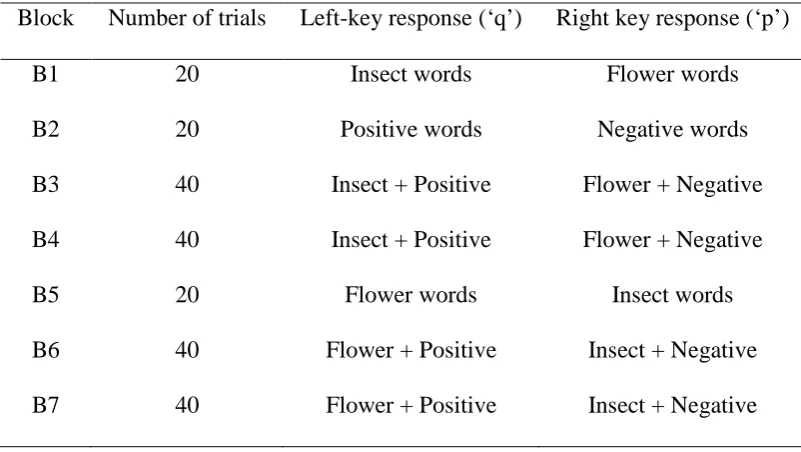
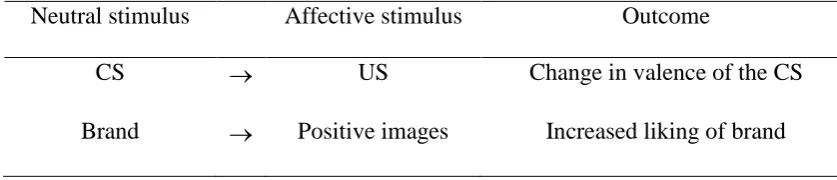
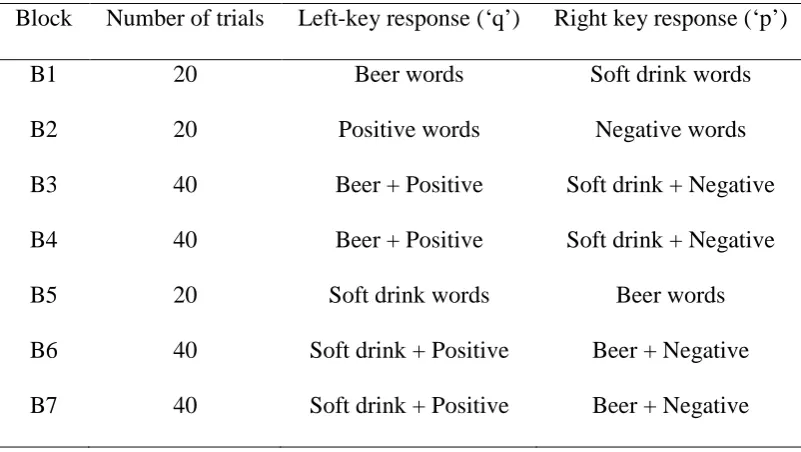
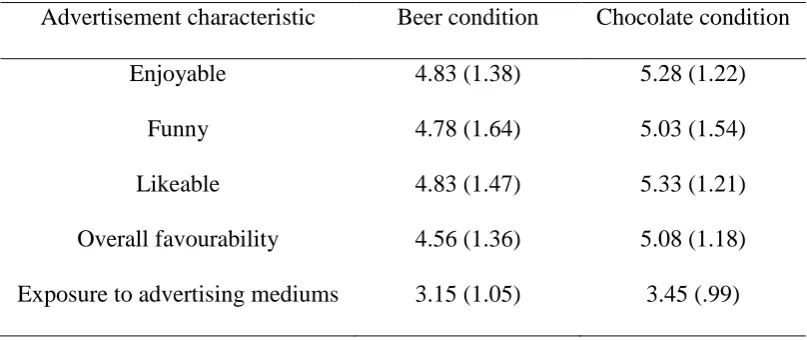
(15) xiii List of Tables Table 1. Overview of the Bipolar Affective IAT Procedure ..................................................... 51 Table 2. Typical Evaluative Conditioning Paradigm .............................................................. 63 Table 3. Overview of Rydell and McConnell – Study 5 Design ............................................... 69 Table 4. Evaluative Conditioning and Advertising .................................................................. 81 Table 5. Overview of IAT Procedure for Studies 1 and 2 ...................................................... 105 Table 6. Stimuli for IATs in Studies 1 and 2 .......................................................................... 106 Table 7. Mean (SD) Scores for Study 1 Randomisation Checks ............................................ 116 Table 8. Mean (SD) Scores for Advertisement Favourability and Exposure ........................ 116 Table 9. Mean (SD) Scores for Chocolate-related Implicit Attitudes ................................... 118 Table 10. Mean (SD) Scores for Beer-related Implicit Attitudes .......................................... 118 Table 11. Mean (SD) Scores for Beer-related Implicit Attitude Change Based on Previous Advertisement Exposure......................................................................................................... 120 Table 12. Mean Difference (SD) Scores for Beer-related Implicit Attitude Change Based on Number of Previous Advertisement Exposures ...................................................................... 121 Table 13. Mean (SD) Scores for Study 2 Randomisation Checks .......................................... 138 Table 14. Mean (SD) Scores for Advertisement Favourability and Exposure ...................... 138 Table 15. Mean (SD) Scores for Chocolate-related Implicit Attitudes.................................. 139 Table 16. Mean (SD) Scores for Beer-related Implicit Attitudes........................................... 140 Table 17. Mean (SD) Scores for Beer-related Implicit Attitude Change Based on Previous Advertisement Exposure......................................................................................................... 141 Table 18. Mean Difference (SD) Scores for Beer-related Implicit Attitude Change Based on Number of Previous Advertisement Exposure ....................................................................... 143 Table 19. Mean (SD) Scores for Consumption in the Laboratory ......................................... 143 Table 20. Stimuli for Study 3 IAT........................................................................................... 158 Table 21. Mean (SD) Scores for Study 3 Randomisation Checks .......................................... 160 Table 22. Mean Difference (SD) Scores Based on Condition ............................................... 161 Table 23. Overview of the Griffin Index ................................................................................ 177 Table 24. Mean (SD) Scores for Felt and Potential Ambivalence ......................................... 196 Table 25. Predicting Health-risk Behaviour Using Ambivalence Measures ......................... 198 Table 26. Predicting Health-promoting Behaviour Using Ambivalence Measures .............. 199 Table 27. ST-IAT Stimuli for Study 5 ..................................................................................... 213 Table 28. Overview of the ST-IAT Design for Study 5 ........................................................... 213 Table 29. Mean (SD) Scores for Frequency and Evaluation of Alcohol Consequences ....... 218 Table 30. Correlations between Explicit Ambivalence and Alcohol Consuequence Frequency ................................................................................................................................................ 223.
(16) xiv List of Abbreviations AGPHT = Australian Government Preventative Health Taskforce AIHW = Australian Institute of Health and Welfare APE = Associative-propositional evaluation model EAST = Extrinsic Affective Simon Task EC = Evaluative Conditioning ELM = Elaboration Likelihood Model FARE = Foundation of Alcohol Research and Education HSM = Heuristic-Systematic Model IAT = Implicit Association Test MCM = Meta-Cognitive Model NDSHS = National Drug Strategy Household Survey PSA = Public Service Announcement RIM = Reflective-impulsive Model ST-IAT = Single Target Implicit Association Test WHO = World Health Organisation.
(17) 1 Introduction In a survey of over 1800 Australian adults undertaken in 2014, three-quarters of all participants reported that they believed Australia has a problem with excess drinking or alcohol abuse (Foundation for Alcohol Research and Education, 2015). Alcohol remains the most commonly consumed drug in Australian society (Australian Institute of Health and Welfare, 2011). The high rate of alcohol consumption within Australia remain despite the documented health and social negatives associated with drinking behaviour (Australian Government, 2009; Begg, Vos, Barker, Stanley, & Lopez, 2008; World Health Organisation, 2011). If an individual was making a rational decision to consume alcohol, one would expect that the individual would take these negatives into account and perhaps make the decision to not consume alcohol. However, recent research has identified that the decision to engage in alcohol consumption may not be fully governed by rational or deliberative processes, with automatic and impulsive processes such as implicit attitudes being influential on drinking behaviour (Houben & Wiers, 2008a). With the emergence of research examining processes such as implicit attitudes, a greater understanding of why individuals engage in health-risk behaviour such as alcohol consumption may be produced. By attempting to understand the underlying structure of implicit attitudes, as well as how these attitudes can be manipulated, perhaps it will become possible to influence implicit attitudes in order to reduce drinking behaviour. The current research project aims to assist in this endeavour, with the results of the five experimental studies conducted here contributing to a greater understanding of the underlying nature of alcohol-related implicit attitudes. More specifically, this research project aimed to identify both associative and non-associative processes through which implicit attitudes could be altered. Additionally, the final two.
(18) 2 studies of this research project examined the structure of both explicit and implicit attitudes to help examine the underlying positive and negative evaluations an individual may hold toward alcohol consumption. This thesis consists of 11 Chapters, with Chapters 1-4 and Chapter 8 presenting a critical review of the literature on dual-systems modelling, implicit attitudes, attitude change, implicit attitude measurement and attitudinal ambivalence. Within each chapter, the appropriate construct is applied to alcohol consumption, as this is the behaviour of interest throughout this research project. This literature review led to the development of various aims and hypotheses which are addressed through the experimental studies outlined in Chapters 5-7 and 9-10. Chapter 11 presents a general discussion of the findings from this research project, with attempts made to link these findings back to previous research findings and theoretical assumptions. Chapter 11 also includes the bigger picture implications and limitations of these findings..
(19) 3 Research Questions The initial focus of the literature review for this research project was driven by the following research questions: 1. Can alcohol-related implicit attitudes be immediately influenced by exposure to an alcohol-related advertisement? 2. Can alcohol-related implicit attitude change produced by advertisement exposure influence alcohol consumption behaviour? 3. Can non-associative processes, namely health message frames, produce alcoholrelated implicit attitude change? These research questions were the focus of Chapters 1-7 of this research project, with Studies 1-3 directly examining these research questions. Based on the results of the first 3 studies of this research project, the following research questions were developed: 4. Are explicit attitudes toward alcohol consumption ambivalent? 5. Are implicit attitudes toward alcohol consumption ambivalent? 6. Is the experience of various alcohol-related consequences associated with attitudinal ambivalence? These research questions were the focus of Chapters 8-10 of this research project, with Studies 4 and 5 directly examining these research questions..
(20) 4 Chapter 1: Dual-systems Modelling General Overview of Dual-systems Models When attempting to explain the nature of human behaviour, major psychological theories have assumed that individuals act in ways which are deliberative and rational (Ajzen, 1991; Fishbein & Ajzen, 1971). Based on the assumption that behaviour is driven by largely deliberative processes, human beings have been labelled as ‘rational animals’ that are able to understand the value and consequences of their actions (Strack & Deutsch, 2004). However, it is obvious that individuals do not always behave rationally and may engage in behaviour that is not congruent with their stated beliefs or best interests. Several theories have attempted to explain such irrational behaviour, with a major assumption of these theories being that there are more than one set of principles controlling human cognitive processes (Chaiken, 1980; Sloman, 1996; Smith & DeCoster, 2000; Wilson, Lindsey, & Schooler, 2000) and/or behaviour (Strack & Deutsch, 2004). With the emergence of these theories, multiple aspects of human behaviour once assumed to be driven by higher order processes of deliberative judgement and decision making are now hypothesised to be influenced by automatic processes that lie outside of conscious awareness and may occur spontaneously (Gawronski & Bodenhausen, 2006). In line with the apparent influence of automatic and deliberative processing on human behaviour, dual-process models have become a popular theoretical outlook of contemporary research in social cognition. Although they have gained significant interest of late, the concept of dual-processing accounts of human cognition is not a new one, with Sloman (1996) suggesting that the distinction between automatic and deliberative processes can be traced back to the work of Aristotle. Sloman (1996) also notes that various other prominent psychological researchers (e.g. James, 1950; Piaget,.
(21) 5 1926, as cited in Sloman, 1996) have made a distinction between automatic and deliberative decision-making processes. Before examining the characteristics of dual-process and dual-systems models, it is important to highlight that the development and refinement of these models has been largely theoretical in nature. Therefore, some authors argue that dual-systems modelling can best be described as a theoretical framework lacking the “…conceptual rigour required from a well-formulated scientific theory and consequently does not lend itself to the derivation of precise and unambiguous hypotheses” (Keren & Schul, 2009, p. 543). As the predictions of dual-systems models are theoretically and not empirically driven, the following discussion on dual-process and dual-systems models is relatively descriptive in nature, providing an overview of the suggested processes that are predicted to be responsible for human decision making. Although largely theoretical, dual-systems models provide one possible explanation for the nature of human cognitive processing and behaviour. Whether or not this is the correct interpretation of such complex processes remains open to debate and cannot be covered in great detail here. However, it is argued that there is benefit to using dual-systems models because they provide a broad theoretical framework for the explanation of some of the most complex processes in psychological research: human cognition and behaviour. Dual-processes or dual-systems? As reported by Evans (2008), contemporary dual-process models of social cognition emerged in the 1980’s (Chaiken, 1980; Petty & Cacioppo, 1981). Since their introduction, dual-process models have been constantly refined and expanded upon and authors have argued that they are among the most popular large-scale theories currently used in social cognition research (Deutsch & Strack, 2006). Before examining the different characteristics associated with the dual nature of social cognition, it is important to make a distinction between dual-process.
(22) 6 and dual-systems models. The distinction between these two separate models is a rather confusing one, with some authors using the terms interchangeably, while others highlight major differences between the two concepts (Keren & Schul, 2009). According to Deutsch and Strack (2006), dual-process models differ from dual-systems models because the latter move beyond simply describing two routes to judgements or decision-making by assigning characteristics to each of the systems and not limiting themselves to one area of social cognition. Early dual-process models were domain-specific in that they were specifically applied to a single area of social cognition such as persuasion or prejudice and stereotyping (Gawronski & Creighton, 2013). Major models of social cognition proposed in the 1980’s such as the Elaboration Likelihood Model (ELM; Petty & Cacioppo, 1986) and the Heuristic-Systematic Model (HSM; Chaiken, Liberman, & Eagly, 1989) propose two separate processes that manipulate information differently. For example, the HSM, which focuses on information processing, suggests that there are two distinct modes of thinking about information. Firstly, the HSM assumes that when engaging in systematic processing, individuals attempt to understand information through careful attention, deep thinking and intensive reasoning (Chaiken & Ledgerwood, 2012). In contrast, heuristic processing involves a focus on salient and easily comprehended cues that can activate judgements that are well established in memory (Chaiken & Ledgerwood, 2012). Therefore, the HSM is a dual-process model in that it suggests there are two separate processes that are responsible for information processing. Essentially, dual-systems models are an extension of dual-process models in that the former can be applied to more general areas of social cognition and are not limited in their applicability to a particular area of research (e.g. persuasion). Authors argue.
(23) 7 that the biggest drawback of dual-process models is that they are domain-specific, whereas dual-systems models are more generalised theories that aim to identify domainindependent principles of social cognitive processing (Gawronski & Creighton, 2013). Deutsch and Strack (2006) suggest that the biggest strength of dual-system over dualprocess models is that the former integrates theory and research in the realm of existing dual-process models. Therefore, dual-systems models can perhaps be seen as more extensive and comprehensive in nature and are greater in their applicability to social cognitive phenomena than their dual-process counterparts. Furthermore, dual-system approaches can account for two types of duality apparent in dual-process models. Dual-process models suggest that there is a difference between systematic, effortful and deliberative processing and heuristic, automatic and impulsive processing. However, popular dual-systems models such as the reflective-impulsive model (RIM; Strack & Deutsch, 2004) suggest that the deliberative system proposed in dual-systems models can be responsible for both heuristic and systematic judgments and whether or not one judgment is made over the other depends on the motivation and capacity of the individual (Deutsch & Strack, 2006). Therefore, one system can be responsible for two processes and this assumption does not apply in dual-process models. Characteristics of dual-systems models. With the distinction between dualprocess and dual-systems models now made, the focus of this particular research project will be on a dual-systems approach to social cognition and the characteristics of such models will now be explained. Since their initial appearance, multiple authors have developed many different dual-systems models relating to social cognition (Gawronski & Bodenhausen, 2006; Smith & DeCoster, 2000; Strack & Deutsch, 2004). It is important to remember that each of these proposed models are theories concerning the.
(24) 8 nature of human cognitive processes. These theories attempt to provide an explanation for complex phenomena using a dual-systems framework. Therefore, they are just one possible explanation for the nature of human cognition and limitations and alternatives to these models will be discussed later. Despite different authors providing new information about dual-system models and applying them to different areas of psychological research, the basic premise remains the same: these models hypothesise that there are two separate cognitive systems that process information and influence behaviour in different fashions (Gawronksi & Bodenhausen, 2006; Smith & DeCoster, 2000; Strack & Deutsch, 2004). The first of these systems is assumed to be unconscious, rapid and automatic with a high capacity for information. These automatic processes are generally defined by four major characteristics, they: (1) are elicited unintentionally; (2) cannot be stopped voluntarily; (3) require lower amounts of cognitive resources; and (4) are out of conscious awareness (Gawronski & Creighton, 2013). In contrast, the second of these systems is assumed to be responsible for conscious, slow and deliberative decisions or judgments. Again, these controlled processes can be defined by four major characteristics, they: (1) are initiated intentionally; (2) can be stopped voluntarily; (3) require greater amounts of cognitive resources and (4) operate within conscious awareness (Gawronski & Creighton, 2013). Over the past 20 years, the conceptualisation of dual-systems models has been constantly refined and updated to include new research from different psychological areas (Smith & DeCoster, 2000; Strack & Deutsch, 2004). As well as using different nomenclature to label each system (e.g. System 1 and System 2, implicit and explicit, reflective and impulsive), different dual-system models tend to add something new about how each system processes information and influences behaviour. For example,.
(25) 9 in his dual-systems model, Sloman (1996) suggested that the automatic system was governed by associative processes, while the deliberative system was governed by rulebased processing. Dual-systems models were expanded further by Smith and DeCoster (2000) who added a memory component to these models. The authors suggested that there were two qualitatively different memory systems, one which is slow-learning and the other being fast-learning. The slow-learning memory is thought to be associative in nature, sitting with the automatic system. In contrast, the fast-learning memory system is assumed to be based on rules so it can be identified as belonging to the deliberative system (Smith & DeCoster, 2000). Lastly, in his dual-systems approach, Kahneman (2003) highlighted the importance of information accessibility as the determining factor in whether a thought or preference is considered intuitive or deliberative. The more easily accessible a piece of information, the more likely the cognitive process is to be automatic. The above information is but a very brief overview of some of the major dual-systems models that have been proposed to explain the nature of human cognition. For further discussion of the development of dual-systems models, see Evans (2008). While various dual-systems models have been proposed which add new characteristics to the different systems, there are times when authors have used different language to explain very similar concepts (Gigerenzer & Reiger, 1996). It has been argued that the labelling of similar concepts with different terminology makes it difficult to “…obtain objective and unequivocal empirical support for a valid and meaningful two-system partitioning” (Keren & Schul, 2009, p. 535). In other words, whereas explaining similar characteristics using different terminology may provide authors with a ‘uniqueness’ for their dual-systems theory, it limits the ability of researchers to clearly identify the characteristics which are assigned to each system. This confusion surrounding the terminology assigned to each system may explain why.
(26) 10 minimal empirical evidence has been established for the existence of two separate processes of human cognition (Keren & Schul, 2009). As a result of there being multiple dual-systems models of social cognition, it is not surprising that each model has small differences in certain characteristics associated with each system. Although there have been problems with consistency in the language used to explain these characteristics, the basic differences between the two systems remain relatively consistent throughout each dual-systems model. In order to highlight commonly mentioned differences between the two systems, Evans (2008) created four separate characteristic clusters that have been frequently used to distinguish them. The first of these clusters, and perhaps the most commonly-referred to characteristic, is the level of ‘consciousness’ predicted in each system. As mentioned above, the automatic system is assumed to be unconscious, while the controlled system is suggested to be a conscious process. The concept of ‘consciousness’ as referred to in dual-systems models is predicted to be closely linked to working memory processes (Evans, 2008). It is assumed that controlled processing requires access to a central working memory system which has a limited capacity for information, while automatic processing requires no access to working memory (Evans, 2008). This working memory system processes the information that individuals are currently aware of and are consciously processing and seems to be in line with the original construct of working memory as proposed by Baddeley and Hitch (1974). Although further definitions of working memory and its structure will not be discussed here (see Baddeley & Hitch, 1974), the associations of conscious thought with working memory can be used to explain why controlled processing is considered slow, sequential and limited in capacity. The second of the characteristic clusters, labelled ‘evolution’, focuses on how the two systems have evolved over time and is mainly used to distinguish the two.
(27) 11 systems in dual-systems models of the late 1990s (Evans & Over, 1996; Stanovich, 1999). This particular distinction between the two systems focuses on the assumption that automatic cognitions developed earlier in human history than more deliberative ones. Deliberative processing is thought to be unique to humans and is concerned with language, reflective consciousness and higher order control, as well as the ability to think about future possibilities. In contrast, it is argued that automatic processing is shared with animals (Evans, 2008). Unfortunately, the evolution distinction for dualsystems is somewhat flawed, with a major argument against it based on the observation that controlled processing may not be uniquely human. Research with animals, particularly that done with primates, suggests that these animals have the capacity for high-order mental representations (Toates, 2006; Whiten, 2000). Therefore, the evolution distinction is not one generally mentioned in more recent dual-systems models (Gawronski & Bodenhausen, 2006; Strack & Deutsch, 2004). The next characteristic cluster focuses on functional characteristics of the two systems. The major distinction between the two systems in regards to this cluster is the slow and controlled versus rapid and automatic processing of information that is thought to occur in the separate systems. Further distinctions between the two systems based on their functional characteristics include the suggestion that the automatic processing system uses parallel processes in order to produce rapid processing and has a higher capacity for information than the deliberative system. In contrast, conscious thought is assumed to be sequential and limited in capacity (Evans, 2008). Another major distinction of importance is that automatic processing is suggested to be associative in nature while deliberative processing is rule-based. This particular characteristic has been argued by various authors (Gawronski & Bodenhausen, 2006;.
(28) 12 Smith & DeCoster, 2000), and the associative nature of automatic processes will be discussed in greater detail later due to its importance to the current research project. The final cluster used to differentiate the two systems is individual differences, with authors arguing that deliberative processing is related to general intelligence and working memory capacity (Stanovich, 1999), while automatic processing is independent of both factors. This argument is based on research which has found that inhibiting the controlled processing system by placing time constraints on responses leads to a greater likelihood of erroneous responses on certain reasoning tasks (De Neys, 2006a, 2006b; Roberts & Newton, 2001). This suggests that, regardless of general intelligence, when automatic processing is used all individuals are similar in their ability to perform certain reasoning tasks and may be equally prone to making incorrect decisions. Further discussion of the individual difference cluster is provided in the discussion below on the psychometric approach to empirical evidence for dualsystems modelling. The Reflective-impulsive Model. The above characteristics are just some of the distinctions made between the automatic and deliberative systems as proposed in various dual-systems models. Although there are multiple dual-systems models applicable to social cognition, the one of particular interest for the current research project is the reflective-impulsive model (RIM; Strack & Deutsch, 2004). The RIM was chosen for further description because the authors have attempted to apply this model to various fields of psychological research, including the field of most interest for the current project, addictive behaviours (Deutsch & Strack, 2006). The RIM also differs from previously mentioned dual-systems models in that it accounts for a prediction of behaviour, not just judgments and information processing. Although the RIM attempts to outline some of the more complex processes in psychological research.
(29) 13 - human cognitions and behaviour - using a dual-systems framework, it is not without its limitations. However, as Kruglanski and Orehek (2007) highlight, the RIM is “…more of a ‘grand’ psychological theory than are similar alternative dual-system frameworks in that it subsumes nearly all facets of psychological functioning” (p. 306). Therefore, it is one of the most comprehensive dual-systems models proposed in contemporary psychological research. It is again worth mentioning here that the RIM is a theoretical framework which takes a dual-systems approach in an attempt to understand human cognition and behaviour. Therefore, it is important to keep in mind that the description provided below is a set of assumptions pertaining to the theory behind the RIM as proposed by Strack and Deutsch (2004). The RIM was initially developed to provide a dual-systems explanation of social behaviour and suggests that human behaviour is governed by an impulsive system which is responsible for influencing impulsive and automatic behaviour and a reflective system which is responsible for higher order mental operations that influence more deliberative behaviour (Strack & Deutsch, 2004). According to this model, the two systems operate interactively, can serve different functions and perform optimally under different boundary conditions (Deutsch & Strack, 2006). In the reflective system, behaviour is assumed to be governed by a decision process whereby the value and possible consequences are assessed and integrated into decisions to behave in particular ways. This system is also predicted to be responsible for making deliberative judgments and evaluations, creating strategic action plans for reaching certain goals and inhibiting or over-riding impulses. The decision-making processes linked to the reflective system are assumed to operate through relatively slow and controlled processes that are based on symbolic representations (Strack & Deutsch, 2004). The reflective system is also predicted to be responsible for the generation of judgments,.
(30) 14 decisions and intentions and has a limited processing capacity that depends on ones intentions to behave in a particular way. In contrast, the RIM assumes that the impulsive system is governed by impulses that are hypothesised to emerge from the activation of associative clusters in long-term memory by the actual or imagined input of different stimuli (Strack & Deutsch, 2004). It is also assumed that associative clusters are created or strengthened as a result of temporal or spatial co-activation of external stimuli, affective reactions to particular stimuli or associated behavioural tendencies based on previous learning experiences of the individual. For example, through repeated experience with alcohol, an associative cluster may be formed whereby the links between alcohol, the positive affective reactions of consuming alcohol, and the physical responses for consuming alcohol (e.g. putting alcohol into one’s mouth) become associated. The RIM predicts that once an associative cluster is created, it can be reactivated quickly by stimulus exposure and provide an individual with a sense of ‘prepardedness’ such that the individual can evaluate and respond to an environment quickly in accordance with their needs or previous learning experiences (Hofmann, Friese, & Strack, 2009). These associative processes are hypothesised to need no attentional resources to become active and are independent of whether an individual actually endorses the nature of that associative link (Strack & Deutsch, 2004). The RIM predicts that the impulsive system can influence behaviour relatively automatically by linking perceptual stimulation to behavioural schemata that have been created through previously learned associations (Deutsch & Strack, 2006). The impulsive system may also generate habit-like procedural memories, called behavioural schemata, whereby frequently occurring motor representations are paired with their antecedents and consequences. It is assumed that, through learning, concepts in the.
(31) 15 impulsive system can also acquire an affective representation, resulting in positive or negative feelings toward an object (Deutsch & Strack, 2006). The linking of these affective valences can induce motivational orientations, such that an individual may either approach or avoid particular attitude objects. Last, the RIM assumes that the impulsive system is limited in its ability to combine concepts through abstract reasoning, suggesting that the impulsive system is purely responsible for immediate responses to a situation (Deutsch & Strack, 2006). As mentioned previously, the RIM has been used in an attempt to explain why individuals engage in addictive behaviours such as alcohol consumption and drug use. Deutsch and Strack (2006) suggested that their model could be applied to addictive behaviours because some of the processes highlighted by addiction research could be linked to the reflective system (e.g. explicit drug-related expectancies) and some processes could be linked to the impulsive system (e.g. the development of drug habits). In regards to the valence of drugs, Deutsch and Strack (2006) assumed that drugs would be evaluatively ambivalent because consuming drugs often leads to immediate positive and delayed negative outcomes. If consumption of a drug usually ends with a negative behavioural state (e.g. hungover after consuming alcohol), then “…the drug and behavioural representations of its consumption will become associated not only with the positive consequences of its consumption, but also with aspects of the preceding negative state” (Deutsch & Strack, 2006, p. 51). This means that the associative cluster related to the drug may contain both positive and negative elements, leading to ambivalence. The argument for the development of ambivalent attitudes toward alcohol as proposed here is an important one will be discussed in greater detail later in this thesis..
(32) 16 Empirical evidence (or lack thereof) for dual-systems models. As mentioned previously, dual-systems accounts of social cognition often lack clear empirical evidence to support their existence. In contrast to this argument, Evans and Stanovich (2013) recently proposed that dual-systems models could be supported by a “…wide range of converging experimental, psychometric, and neuroscientific methods” (p. 224). Experimental methods for obtaining empirical evidence for dual-systems models focus on experiments that are designed to influence one type of processing system while having no influence on the other. For example, an experiment may suppress controlled processing by using tasks that load working memory or tasks that allow little time for reflective thought. Therefore, individuals are only able to use their automatic processing system to complete the task. In regards to neuroscientific methods, neural imaging may be used to show that different brains areas are activated when either automatic or controlled processing occurs. Also, a psychometric approach to distinguishing automatic and controlled processing draws upon correlational research which suggests that controlled processing is strongly correlated with an individual’s cognitive ability, while automatic processing shows no such relationship (Evans & Stanovich, 2013). In support of a division between controlled and automatic processing, Evans and Stanovich (2013) cite research looking at performance on the Wason selection task (Wason, 1968) and Tversky and Kahneman’s (1983) conjuction problem. In the Wason selection task, participants are asked to decide how to test the truthfulness of a rule in the form of ‘if p, then q.’ Participants are then presented with four cards, each of which represents a single combination of p and q values. The selection task requires participants to make a decision regarding which cards to turn over in order to test the above rule. Due to only being able to see one side of each card, participants must.
(33) 17 judge, based on what is on the visible side of the card, whether the invisible side is useful for testing the rule. Based on logic, the correct response would be to select the p and not q cards (Almor & Sloman, 2000). However, a typical finding for the Wason selection task is that participants will make an error in logic by selecting only the p card or both the p and q cards (Griggs & Cox, 1982). In Tversky and Kahneman’s (1983) conjuction problem, participants are asked to read a statement describing a fictional woman named Linda. They are then asked to rank three separate events based on their probability: 1) Linda is a bank teller, 2) Linda is active in the feminist movement, and 3) Linda is a bank teller and is active in the feminist movement. In their study using the conjunction problem, Tversky and Kahneman (1983) found that only 10-20% of participants ranked the 3rd event as being the least probable alternative. All other participants violated the conjuction rule, which suggests that the mathematical probability of a conjoint event (3rd event) cannot exceed that probability of any of its constituent events (1st and 2nd event). Research indicates a decrease in logical accuracy on the above tasks when controlled processing is inhibited, such as when respondents perform tasks under time pressure (Evans & Curtis-Holmes, 2005) or concurrent working memory load (De Neys, 2006a). De Neys (2006a) found that participants making the conjunction fallacy when working on the Linda conjunction problem (e.g. “Linda is a feminist”; Tversky & Kahneman, 1983) responded quicker than participants who did not make this response. Further evidence (De Neys, 2006b; Roberts and Newton, 2001) focuses on performance of on the Wason selection task, with respondents making the intuitive “matching bias” response (choosing ‘p’ and ‘q’ as opposed to ‘p’ and ‘not q’) more often when they were placed under time constraints or when engaged in concurrent working memory tasks. These results suggest that when controlled processing is inhibited, responses may.
(34) 18 be heavily influenced by automatic processing which can often be subject to belief biases leading to errors in responding. When individuals are able to engage their controlled processing systems, belief biases are often discarded and the correct answers are obtained. For example, Evans, Handley, Neilens, Bacon and Over (2010) found that respondents with higher intellectual ability will suppress belief biases on the Wason and conjunction tasks mentioned above when they are specifically asked to think logically and draw appropriate conclusions (Evans et al., 2010). Researchers supporting a dual-systems approach suggest that individuals are able to engage their controlled processing system which overrides automatic reasoning and overcomes belief biases, producing the correct answer to reasoning problems. Therefore, the assumption of two separate systems to human reasoning is supported by findings on these reasoning tasks, with one system assumed to be governed by biases and the other by logic. Other empirical evidence for a dual-systems division comes from the field of neuroscience. Evans (2008) suggests that research into neuroscience provides further evidence for a dual-systems approach to social cognition, with authors finding a neurological distinction between automatic and controlled processing. The so-called Xsystem, composed of the amygdala, lateral temporal cortex and basal ganglia, which are known to be used in relation to conditioning and associative learning, have been linked to automatic processing. In contrast, the C-system, consisting of the prefrontal cortex, cingulate cortex and the medial-temporal lobe are linked to the controlled aspects of processing (Lieberman, 2003; Lieberman, Jarcho, & Satpute, 2004). Other studies examining the neurological basis of dual-systems have used fMRI methodologies to find that different areas of the brain are activated when different reasoning (abstract or logical) was required to solve problems (Goel, Buchel, Frith, & Dolan, 2000; Goel &.
(35) 19 Dolan, 2003). Therefore, it can be argued that there are different parts of the human brain which may be responsible for different levels of processing, providing support for a distinct dual-systems approach to social cognition. The empirical evidence used by both Sloman (1996) and Evans and Stanovich (2013) to justify a dual-systems have been interpreted differently by various authors. For example, Osman (2004) suggested that the previously mentioned results on the Wason and conjunction tasks can also be explained using a single-system framework which does not divide automatic and controlled processing. Furthermore, Keren (2013) argues that although the above research findings may be explained using dual-process theories, they are also consistent with various alternative theoretical frameworks of human cognition. This suggests that empirical evidence which may be used to support a dual-systems approach is able to be explained with similar merit by contrasting theoretical frameworks. Therefore, it still remains unknown which theoretical framework of human reasoning – a dual-systems, multiple-systems or single-system approach – is most effective in explaining these processes. Unfortunately, it can be argued that the question of how many ‘systems’ underlie human cognitive processes may not be an empirically testable one. Therefore, it is possible that no single experiment will provide a definitive answer regarding the processes behind human cognition. Further arguments against the dual-systems distinction have focused on the neuroscientific findings mentioned earlier, with authors (Nee, Berman, Moore, & Jonides, 2008) questioning the interpretation of these findings. These authors argue that neurological evidence for automatic and controlled processing remains scarce and should not provide the basis for major assumptions regarding the dual nature of human cognitive processing. Therefore, further neurological evidence.
(36) 20 for separate processing systems is required before such a distinction can be accurately made. Alternatives to dual-systems models. Although dual-systems models have become some of the more widely used models for explaining social cognitive phenomena, various alternatives to these models have been proposed. Kruglanski and Orehek (2007) suggest that just as dual-systems models have been developing over time, so have alternatives to these models. One of the major arguments against the division of systems in dual-systems models relates to the association and rule-based split related to learning in the two systems. According to Kruglanski and Orehek (2007), there are evidence-based arguments suggesting that the two types of processes outlined in dual-systems models (associative and deliberative) are both forms of rulebased learning. Based on this reliance on rule-based learning, Kruglanski and Orehek (2007) argue that the two processes may actually be considered as different points along the same continuum, not separate processes. Another major argument against dual-systems modelling is the lack of conceptual precision for the two proposed systems, making it difficult to empirically prove or disprove the arguments made in dual-processing accounts (Gawronski & Creighton, 2013). However, the same authors highlight that the argument for the distinction between single-process, dual-process or multiple-processes are ontological in nature, and cannot be tested empirically (Gawronski & Creighton, 2013). That is, due to the largely theoretical assumptions surrounding the distinction between the processes, it is difficult to state with full confidence how many systems govern human processing. For this reason, it is perhaps impossible to obtain a full understanding of the number of systems involved in social cognitive phenomena. Despite this, various.
(37) 21 alternatives to the dual-systems approach to social cognition have been hypothesised and applied in an attempt to explain human cognitive processes. One possible alternative to dual-system models is the Unimodel (Kruglanski et al., 2006; Kruglanski & Thompson, 1999; Kruglanski, Thompson, & Spiegel, 1999). In the Unimodel, Kruglanski and colleagues outline a single-process model of human judgment which focuses on syllogistic reasoning based on various pieces of evidence such as, but not limited to, persuasive arguments and feelings. According to this model, dual-systems approaches complicate human judgments by depicting complex variants of the same mechanism. The Unimodel proposes that all judgments are essentially governed by rules, with a particular emphasis on if-then contingencies that an organism has learnt. What really separates the Unimodel from dual-systems models then is the argument in the Unimodel approach that associative learning can represent an instance of rule following as opposed to an automatic, non-rule based type of learning (Kruglanski et al., 2006). In other words, dual-systems theories generally argue that only controlled processing is rule-based, whereas the Unimodel argues that both automatic and controlled processing can be governed by rules. In support of this, Kruglanski and Orehek (2007) cite the work of Holyoak, Kohl, and Nisbett (1989) who argued that classical conditioning can be explained through ‘if-then’ rules. For example, the learning of a relationship between a light and a shock stimulus can be rulebased, such that if a tone sounds, then a shock will occur. Therefore, the Unimodel argues that a distinction between automatic and controlled processing is not necessary as they are both governed by similar sets of rules and principles. A major problem with the Unimodel approach is its focus on the influence of human judgment on social cognition, as “judgment formation touches only the tip of the iceberg of social cognition, which does not occur in mental isolation but in close.
(38) 22 interaction with memory, affect, habits, and other nonjudgmental factors” (Deutsch & Strack, 2006, p. 169). Deutsch and Strack (2006) argue that accessibility of knowledge and affective reactions may influence the outcome of reasoning and result from independent memory or affect systems separate from judgments alone. However the concepts of affect and accessibility are not part of the Unimodel approach and without reference to these independent concepts, the model may be incomplete in its ability to explain human judgments. Another single-process account for human cognition comes from the connectionist network approach, which suggests that knowledge is formed via a connection of “nodes” with identical properties (Smith & DeCoster, 1998). This approach has been used to explain how people acquire and generalise social knowledge and is similar to the associative networks outlined in the impulsive system of the RIM. The connectionist approach also assumes that associative properties may be responsible for deliberative processes. However, Deutsch and Strack (2006) suggest that because connectionist approaches used to simulate reflective functions often show the emergence of subsystems or use additional, qualitatively different processes (e.g. Van Overwalle & Siebler, 2005), the use of them as single- process accounts of cognitions is questionable. The alternative models proposed above are not without their flaws and dual-system approaches continue to be a popular psychological explanation for social cognitive processes. As a result of this, a dual-systems approach will continue to be used as the psychological framework for the current research project. Implicit-explicit Attitude Distinction Having examined dual-systems models of social cognition, a dual-systems framework will now be applied to one of the major research fields of social cognition, that of attitudes. An attitude can be defined as “…favourable or unfavourable.
(39) 23 dispositions toward social objects, such as people, places, and policies” (Greenwald & Banaji, 1995, p. 7). This is just one of many definitions of an attitude, with a common theme in the general definition of attitudes being that they are summary evaluations of different objects which can range along a positive or negative dimension (Petty, Wegener, & Fabrigar, 1997). In 1954, Allport (as cited in Schwarz & Bohner, 2001) suggested that attitudes were the single most indispensable construct in social psychological research. Attitudes are considered so important to social cognitive research because they may have great influence over an individual’s behaviour (Fazio, 1990). Therefore, attitude research is vital because it may help to explain and predict important aspects of human interaction. As a result of its importance, research into attitudes has been prolific in an attempt to provide a greater understanding of the structure and bases of this construct. According to Gawronski and Bodenhausen (2006), the dual-systems approach so common in social cognition research is also dominant in the contemporary research of attitudes, which distinguishes between explicit and implicit attitudes in order to obtain a greater understanding of when attitudes may influence behaviour. It is worth noting that, similar to the dual-systems divisions discussed above, the explicit-implicit distinction is a theoretical framework that attempts to explain the nature of the attitude concept. Therefore, the characteristics assigned to each attitude construct, as defined below, are theoretical in nature. Fortunately, there has been a greater effort to empirically examine the differences between explicit and implicit attitudes than there has been for the automatic and controlled processing distinction. This empirical evidence is promising in highlighting a distinction between the two attitude constructs and will be discussed in greater detail later..
(40) 24 The first set of cognitions defined in a dual-systems approach to attitudes can be referred to as explicit cognitions. The investigation of these cognitions has dominated psychological research into attitudes over the past 80 years. Explicit attitudes are assumed to be intentional in nature, can be consciously accessed and are under cognitive control (Pieters, van der Vorst, Engels, & Wiers, 2010). According to the associative-propositional evaluation (APE) model proposed by Gawronski and Bodenhausen (2006), the explicit cognitive system is propositional and operates through controlled processes. As a result of being propositional, researchers (Gawronski & Bodenhausen, 2006; Strack, Werth, & Deutsch, 2006) argue that explicit cognitions are evaluative judgements about stimuli that are assigned truth values (e.g. ‘I like flowers’). Additionally, explicit cognitions operate slowly, tend to be disrupted by other processes, and depend largely on intention. Therefore, similar to the reflective system in the RIM, explicit cognitions are suggested to be deliberative judgments that operate slowly and have a greater influence on rational human behaviour. In contrast, implicit attitudes are a relatively recent introduction to the study of attitudes considering the level of psychological research dedicated to this construct. The first major application of implicit attitudes to social cognition research occurred less than 20 years ago (Greenwald & Banaji, 1995), with the authors defining implicit attitudes as “…introspectively unidentified (or inaccurately identified) traces of past experience that mediate favourable or unfavourable feeling, thought, or action toward social objects” (p. 8). Since the introduction of the implicit attitude construct, research focused on attitudes has experienced what some authors describe as a ‘second measurement revolution’ focused on the development of implicit attitude measures (Gawronski & LeBel, 2008). This so-called revolution has produced a large body of research, with Bohner and Dickel (2011) finding that in a five-year period from 2005 to.
Figure
+7



Related documents