This is a repository copy of
A Framework for Energy Efficient NFV in 5G Networks
.
White Rose Research Online URL for this paper:
http://eprints.whiterose.ac.uk/101023/
Version: Accepted Version
Proceedings Paper:
Al-Quzweeni, A, Lawey, A, El-Gorashi, T et al. (1 more author) (2016) A Framework for
Energy Efficient NFV in 5G Networks. In: 18th International Conference on Transparent
Optical Networks (ICTON 2016). ICTON 2016, 10-14 Jul 2016, Trento, Italy. IEEE . ISBN
9781509014675
https://doi.org/10.1109/ICTON.2016.7550698
(c) 2016, IEEE. Personal use of this material is permitted. Permission from IEEE must be
obtained for all other uses, in any current or future media, including reprinting/republishing
this material for advertising or promotional purposes, creating new collective works, for
resale or redistribution to servers or lists, or reuse of any copyrighted component of this
work in other works.
[email protected] https://eprints.whiterose.ac.uk/ Reuse
Unless indicated otherwise, fulltext items are protected by copyright with all rights reserved. The copyright exception in section 29 of the Copyright, Designs and Patents Act 1988 allows the making of a single copy solely for the purpose of non-commercial research or private study within the limits of fair dealing. The publisher or other rights-holder may allow further reproduction and re-use of this version - refer to the White Rose Research Online record for this item. Where records identify the publisher as the copyright holder, users can verify any specific terms of use on the publisher’s website.
Takedown
If you consider content in White Rose Research Online to be in breach of UK law, please notify us by
A Framework for Energy Efficient NFV in 5G Networks
A. Al-Quzweeni, A. Lawey, T. El-Gorashi, and Jaafar M.H. Elmirghani Senior Member, IEEE School of Electronic & Electrical Engineering, University of Leeds, LS2 9JT, United Kingdom
Abstract
Several critical benefits are encompassed by the concept of NFV when this concept is brought under the roof of 5G such as scalability, high level of flexibility, efficient utilisation of network resources, cost and power reduction, and on demand allocation of network resources. NFV could reduce the cost for installing and maintaining network equipment through consolidating the hardware resources. By deploying NFV, network resources could be shared between different users and several network functions in a facile and flexible way. Beside this the network resources could be rescaled and allocated to each function in the network. As a result, the NFV can be customised according the precise demands, so that all the network components and users could be handled and accommodated efficiently. In this paper we extend the virtualization framework that was introduced in our previous work to include a large range of virtual machine workloads with the presence of mobile core network virtual machine intra communication. In addition, we investigate a wide range of traffic reduction factors which are caused by base band virtual machines (BBUVM) and their effect on the power consumption. We used two general scenarios to group our finding, the first one is virtualization in both IP over WDM (core network) and GPON (access network) while the second one is only in IP over WDM network (core network). We illustrate that the virtualization in IP over WDM and GPON can achieve power saving around (16.5% Ð 19.5%) for all cases for all cases compared to the case where no NFV is deployed, while the virtualization in IP over WDM records around (13.5% Ð 16.5%).
1. Introduction
As the proliferation of the bandwidth Ð greedy applications and the huge leap in the amount of the connected wireless devices and smartphones, the mobile user experience has been enriched and the mobile traffic has been increased enormously. This phenomenon is further fed by social networking and mobile video streaming, where the latest is expected to reach 69% of the total mobile traffic by 2018 [1]. Beside this, the next generation of mobile network; which is expected to be deployed beyond 2020, is characterised by a high data rate and a data sharing for anyone, anything, anywhere and anytime [2] with an end Ð to Ð end latency lower than 1 ms [3]. Consequently, the energy consumption of information and telecommunication technologies (ICT) industries will be increased unless new technologies will be deployed to limit the growth in the energy consumption.
A number of research has been done around the world in both industrial and academic sectors to investigate the energy consumption in the telecommunication systems and the key technologies to reduce its level. The authors of [4] introduced a framework for energy efficient cloud computing over non Ð bypass IP over WDM network. They scrutinised the cloud services in three trends: content delivery, storage as a service, and the VM based applications. They elaborated that replicating content into multiple clouds based on content popularity may save up to 43% of the total power consumption, while the authors of [5] showed the feasibility of saving up to 36% of the total power consumption in IoT network by the deployment of cloud processing and virtualization. In term of 5G, the authors of [6] presented a detailed perspective about increasing the number of connected devices in mobile access network and decreasing the energy consumption in 5G. According to their vision, the 5G network should be soft and green. The authors of [7] explained that the energy consumption of 5G wireless access system could be decreased if the mobile traffic is balanced and offloaded by local small cells. They argued the current framework and wireless access infrastructure and their capabilities to meet the 5G energy efficiency.
In this paper we extend the virtualization architecture that was introduced in our previous work in [8], by investigating a large range of virtual machine workloads with the presence of inter Ð traffic communication between the virtual machines. Beside that, we investigate a wide range of traffic reduction factors which are caused by base band virtual machines (BBUVM) and their effect on the power consumption. The rest of this paper is organised as follows: Section 2 elaborates the virtualization in mobile network and our framework. Section 3 presents the results obtained from the MILP model, while the conclusions are drawn in section 4.
2. NFV in mobile network
Mobile network function virtualization targets the both of mobile core network and mobile radio access network. In other words, the mobile network functions in both mobile core network and radio access network (RAN) could be virtualised and provided on demand. Nevertheless, the network operators and service providers focused on virtualization in RAN [9] as the RAN consumes around 70% - 80% of the energy requirement [11]. Therefore, by consolidating as many RAN functions as possible in standard hardware using NFV, the power consumption in the access network could be reduced.
Charging and Role Function (PCRF), and Mobility and Management Entity (MME) [13, 14]. On the other hand, the mobile radio access network is formed by a number of evolved node Bs (eNodeB)[15]. These nodes consist of base band unit (BBU) and radio remote unit (RRU)[16].
In this paper, the function of each entity of the mobile core network (EPC) is virtualised and provided as a mobile core network function virtual machine (CNVM) whenever it is requested. Moreover, the two main parts of the evolved node B (eNodeB) are decoupled and the BBU is transformed into a base band virtual machine (BBUVM). Consequently, the wireless access network of the mobile system network will encompass only the RRU units that are left after the RRU-BBU decoupling. To realise the connectivity between the RRU units and the mobile home office, we leveraged GPON as a fronthaul of the mobile system in our proposed architecture. The GPON will carry the burden of high data rate traffic from and to the RRU units instead of the original optical connection that is realised by common public radio interface (CPRI) or open base station architecture initiative (OBSAI). Beside this, it will constitute a foster environment that will host any virtual machine (VM) of any type which might be requested by the RRU units. By the deployment of GPON as a fronthaul in the proposed architecture, the number of nodes that may host a VM will increase. By such a scenario, the processing of user data may be brought closer to the RRUs. In addition to this, we attached the mobile home office to IP over WDM network. Consequently, there will be three locales to host virtual machines in our proposed architecture, the first locale is an IP over WDM node, the second one is a GPON OLT, and the last locale is a GPON ONU.
3. Results
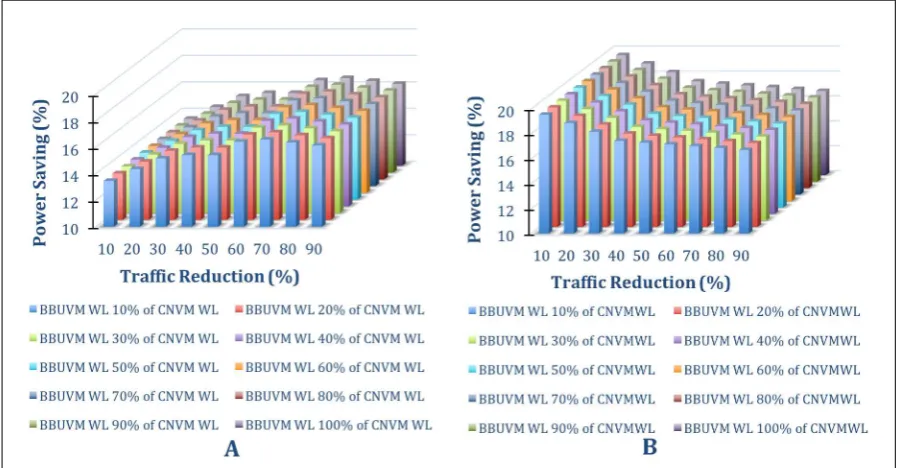
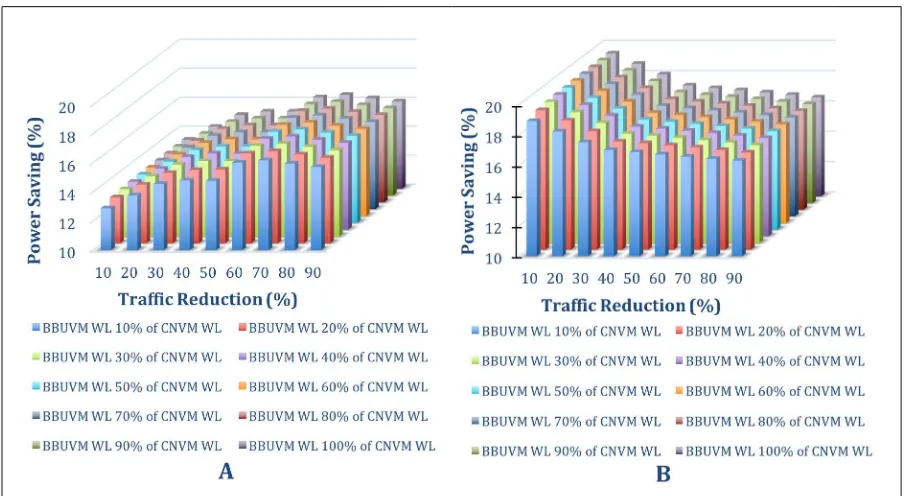
In our topology we considered 5 IP over WDM nodes as a core network and 10 OLT nodes which have been attached in pairs to each IP over WDM node. Each OLT node feds two ONU nodes to end with 20 ONU nodes in total each one of them is attached to one RRU unit. Also we considered a situation where each RRU unit requests BBUVM and each BBUVM requests CNVM. Also a fixed traffic between CNVMs was considered as an internal communication traffic. Beside this, the traffic between CNVM and BBUVM was investigated with different reduction factors (from 10% to 90%). This reduction is due to the RF to/from Base Band signal conversion that is considered as one of the BBUVM functions. Moreover, we considered ranges of BBUVM, and CNVM workloads. We set the BBUVM workload (WL) to (10%, 30%, and 50%) of the ONU processor capacity and for each value we consider a range of CNVM workload and reduction factor. Generally, we organised our results into two scenarios: the first one considers the virtualization in IP over WDM network and GPON, while the second considers the virtualization in IP over WDM network only. In each scenario the power saving is calculated for different reduction factors and virtual machines workloads.
It is clearly seen, that the scenario of virtualization in both IP over WDM and GPON has more power saving rating than the other one. It generally records around (16.5% Ð 19.5%) power saving for all cases, while the virtualization in IP over WDM records around (13.5% Ð 16.5%). This is due to the extension in the range of candidate locations that might host the virtual machines.
[image:3.595.70.520.508.742.2]!
!
Figure 2: Power Saving at BBU WL=30 % of ONU processor Cap. with different CNWL and Reduction factorsA) Virtualization only in IP over WDM B) Virtualization in IP over WDM and GPON
4. Conclusions
In this paper we extend our previous investigation of the energy efficiency of NFV in 5G networks. A large range of virtual machine workloads is investigated with the presence of mobile core network virtual machine inter Ð traffic. Beside this, the traffic reduction caused by base band processing is considered. We grouped our finding according to two scenarios of virtualization, the first one is achieved by accommodating the virtual machines in both IP over WDM (core network) and GPON (access network) while the second one is only in IP over WDM network. We illustrate that the virtualization in IP over WDM and GPON can achieve power saving around (16.5% Ð 19.5%) for all cases compared to the case where no NFV is deployed, while the virtualization in IP over WDM records around (13.5% Ð 16.5%) power savings.
!
!
!
Figure 3:Power Saving at BBU WL=50% of ONU processor Cap. with different CNWL and Reduction factors [image:4.595.70.522.368.616.2]Acknowledgement
The authors would like to acknowledge funding from the Engineering and Physical Sciences Research Council (EPSRC), INTERNET (EP/H040536/1) and STAR (EP/K016873/1). Also Mr. A. Al-Quzweeni would like to thank the Higher Committee for Education Development (HCED) for funding his scholarship.
REFERENCES
[1] Cisco, "Cisco Visual Networking Index: Global Mobile Data Traffic Forecast Update, 2013Ð2018,"
White paper, 2014.
[2] E. Dahlman, G. Mildh, S. Parkvall, J. Peisa, and J. Sachs, "5G wireless access: requirements and realization," Communications Magazine, IEEE, vol. 52, pp. 42-47, 2014.
[3] T. Chen, M. Matinmikko, X. Chen, X. Zhou, and P. Ahokangas, "Software defined mobile networks: concept, survey, and research directions," IEEE Communications Magazine, vol. 53, pp. 126-133, 2015. [4] A. Q. Lawey, T. E. El-Gorashi, and J. M. Elmirghani, "Distributed Energy Efficient Clouds Over Core
Networks," Journal of Lightwave Technology, vol. 32, pp. 1261-1281, 2014.
[5] Z. T. Al-Azez, A. Q. Lawey, T. E. H. El-Gorashi, and J. M. H. Elmirghani, "Virtualization framework for energy efficient IoT networks," presented at the 2015 IEEE 4th International Conference on Cloud Networking (CloudNet), 2015.
[6] C.-L. I, C. Rowell, S. Han, Z. Xu, G. Li, and Z. Pan, "Toward green and soft: a 5G perspective," IEEE Communications Magazine, vol. 52, pp. 66-73, 2014.
[7] S. Chen and J. Zhao, "The requirements, challenges, and technologies for 5G of terrestrial mobile telecommunication," Communications Magazine, IEEE, vol. 52, pp. 36-43, 2014.
[8] A. Al-Quzweeni, T. E. H. El-Gorashi, L. Nonde, and J. M. H. Elmirghani, "Energy efficient network function virtualization in 5G networks," presented at the 17th International Conference on Transparent Optical Networks (ICTON), 2015.
[9] H. Hawilo, A. Shami, M. Mirahmadi, and R. Asal, "NFV: state of the art, challenges, and implementation in next generation mobile networks (vEPC)," Network, IEEE, vol. 28, pp. 18-26, 2014. [10] P. Demestichas, A. Georgakopoulos, D. Karvounas, K. Tsagkaris, V. Stavroulaki, J. Lu, et al., "5G on
the horizon: Key challenges for the radio-access network," IEEE Vehicular Technology Magazine, vol. 8, 2013.
[11] P. Agyapong, M. Iwamura, D. Staehle, W. Kiess, and A. Benjebbour, "Design considerations for a 5G network architecture," Communications Magazine, IEEE, vol. 52, pp. 65-75, 2014.
[12] F. Firmin, "The Evolved Packed Core". [Online]. Available:
http://www.3gpp.org/technologies/keywords-acronyms/100-the-evolved-packet-core. [Accessed: 3
March 2016]
[13] Alcatel-Lucent. Interworking LTE EPC with W-CDMA Packet Switched Mobile Cores. Alcatel-Lucent White Paper. Available: http://www.alcatel-lucent.com/
[14] Alcatel-Lucent. Introduction to Evolved Packet Core. Alcatel-Lucent White Paper. Available: http://www.alcatel-lucent.com/
[15] C. Monfreid, "The LTE Network Architecture-A Comprehensive Tutorial," Alcatel-Lucent White Paper, 2012.
[16] B. Guo, W. Cao, A. Tao, and D. Samardzija, "LTE/LTE!A Signal Compression on the CPRI Interface,"