ISSN 10185593
Commission
of
the
European
Communities
tec!
Community's
research
and
development
programme
on
radioactive
waste
management
and
storage
Sharedcost
action
(199094)
Annual
progress
report,
1992
■-■WBBicim&æB&m--Report
Commission of the European Communities
nuclear science
and technology
Community's research and development programme
on radioactive waste management and storage
Shared-cost action
(1990-94)
Annual progress report, 1992
Science, Research and Development fDirectorate-General j AKL EUROP, Bibtioth.
1993
|\|
tc
EUR15132
ENPublished by the
COMMISSION OF THE EUROPEAN COMMUNITIES Directorate-General XIII
Telecommunications, Information Market and Exploitation of Research L-2920 Luxembourg
LEGAL NOTICE
Neither the Commission of the European Communities nor any person acting on behalf of the Commission is responsible for the use which might be made of
the following information
Cataloguing data can be found at the end of this publication
Luxembourg: Office for Official Publications of the European Communities, 1993 ISBN 92-826-6550-X
CONTENTS
FOREWORD
THE MANAGEMENT AND COORDINATION ADVISORY COMMITTEE
PROGRESS OF THE R&D WORK
PART A: WASTE MANAGEMENT AND ASSOCIATED R&D PROJECTS
Al: STUDIES OF MANAGEMENT SYSTEMS
Task 1 "Studies of Management Systems"
A2: WASTE TREATMENT
Task 2 'Treatment of Radioactive Waste"
A3: SAFETY OF THE MULTI-BARRIER SYSTEM OF GEOLOGICAL DISPOSAL
Task 3 "Characterisation and Qualification of Waste Forms, Packages and their Environment"
Task 4 "Disposal of Radioactive Waste : Research to Back-up the Development of Underground Repositories"
Task 5 "Method of Evaluating the Safety of Disposal Systems"
PART B: CONSTRUCTION AND/OR OPERATION OF UNDERGROUND FACILITIES OPEN TO COMMUNITY JOINT ACTIVmES
Project Bl 'The Underground Facility in the Asse Salt Mine (FRG)"
Project B2 "The Underground Facility HADES in the Argillaceous Layer under the Mol Site
(By-Project B4 "Underground Validation Facility at Sellafield (UK)"
ANNEX : List of Organisms and Companies Participating in the Programme during 1992
7
8
9
139
139
206
206
387
630
648
653
702
757
765
-FOREWORD
This report covers the progress of research work and activities started and developed during 1992 in the framework of the five-year programme (1990-1994) of the European Energy Community on "Management and Storage of Radioactive Waste". This R&D programme has been adopted by decision 89/664/EURATOM of the Council of the Ministers of the European Community on 15 December 1989.
The total amount of funding allocated to the programme is 79,6 million ECU over the five-year period.
The Council Decision, together with the technical content and the indicative Community financial contributions for the individual sections of the programme, has been published in the Official Journal of the E.C., Nr. L395, 30.12.1989, p. 28-32.
The programme is subdivided in :
Part A : Waste management and associated R&D projects
Part B : Construction and/or operation of underground facilities open to Community joint activities.
A call for research proposals has been launched (OJ. of E.C. Nr. C55/4, 7 March 1990) to implement Part A of the programme through shared-cost research contracts with public organisations or private firms established in the Member States. Multipartner projects have been encouraged.
Contract negotiations for the selected research proposals lead to the signature of 115 contracts for both Part A and Part B of the Programme. The number of research projects running in 1992 are 105.
The Commission is responsible for implementing and managing the programme and is assisted in this task by the Management and Coordination Advisory Committee "Nuclear Fission energy - Fuel cycle/processing and storage of waste" (see the annexed list of the Members of the Committee).
In addition to shared-cost research contracts, the programme also includes study contracts, awards of training and mobility grants, as well as international co-operation agreements with states outside the Community.
The co-operation among various teams within the Member States has considerably been promoted by the numerous multi-partner research projects.
The presentation and discussion of the work carried out during periodical progress meetings of working groups of the various projects assures the exchange of information within contractors and representatives of public and private institutions in the Community which are interested in the specific research area.
In order to provide a world wide information on the Community's activities in the field of the radioactive waste a biannual newsletter "EC-FOCUS" is edited.
-In this report, the objectives, the working programme and a synopsis of progress and results obtained for each contract in 1992 are presented as prepared by the contractors, under the responsibility of the project leader(s).
The Commission wishes to express its gratitude to all scientists who have contributed to this report.
The previous annual progress reports of the programme are : EUR-11089 (for 1986); EUR-11482 (for 1987); EUR-12141 (for 1988); EUR-12761/Vol. 1 and 2 (for 1989) and EUR-14418 EN (for 1991). The overall results achieved including the progress of work for 1990 during the programme 1985-1989 have been presented and discussed at the third European Community Conference on Radioactive Waste Management and Disposal -Luxembourg, September 17-21,1990 (Proceedings published under EUR-13389 - Elsevier Appi. Science Publisher).
S. ORLOWSKI
Head, Radioactive Waste and Fuel Cycle Division
-MEMBERS OF THE MANAGEMENT AND COORDINATION ADVISORY COMMITTEE NUCLEAR FISSION ENERGY
FUEL CYCLE/PROCESSING AND STORAGE OF WASTE *
BELGIUM DENMARK FRANCE GERMANY GREECE IRELAND ITALY LUXEMBOURG NETHERLANDS PORTUGAL SPAIN UNITED KINKDOM COMMISSION (during 1992) Th. G. K. S. J. P. H.G. S. C. F. G. F. C. H. J.W.A. A. C. A. J. M. S.M. PJ. HJ. J. L. VAN RENTERGEM DEDEURWAERDER BRODERSEN HOE LEFEVRE RIEUTORD BLOSER RIOÏTK AMARANTOS HONE TURVEY GROSSI MORSELLI BACK CORNELISSEN VAN ENST SEVERO RAMALHO CARLOS RODRIGUEZ BECEIRO ARANA LANDA
RODRIGUEZ PARRA (Chairperson)
STEARN HUBBARD
ALLGEIER VAN GEEL
CECILLE (Secretary)
1 This Committee was established by the Council Decision of 29 June 1984 dealing with structures and
PARTA
WASTE MANAGEMENT AND ASSOCIATED R&D PROJECTS
Al : STUDIES OF MANAGEMENT SYSTEMS
A2 : WASTE TREATMENT
Al: STUDIES OF MANAGEMENT SYSTEMS
Taskl
"Studies of Management Systems"
Topic 1 : System studies
Topic 2 : Harmonisation of radioactive waste management practices and policies
Topic 3 : Comparative assessment of disposal practices in various management schemes for toxic and radioactive waste
Topic 4 : Information of the public
Taskl
Topic 1 : System studies
Contract
FI2W/0037 Study on depleted uranium (tails) and on uranium residues from reprocessing with respect to quantities, characteristics, storage, possible disposal routes, and radiation exposure.
FI2W/0041 Waste management studies for large volumes of very low-level waste.
FI2W/0044 Treatment, disposal, re-use of building demolition and site cleaning wastes from nuclear facilities.
FI2W/0058 Treatment study of contaminated sodium with a view to decommissioning of FBR.
FI2W/0067 Studies of minimising transport of spent fuel.
FI2W/0119 Study of the retrievability of radioactive waste from a deep underground disposal facility.
Topic 2 : Harmonisation of radioactive waste management practices and policies
FI2W/0060 Assessment and proposal for activity limits for release of very low-level radioactive waste to landfills.
FI2W/0066 Definition of reference level for exemption of wastes, suitable for incineration.
Topic 3 : Comparative assessment of disposal practices in various management schemes for toxic and radioactive waste.
FI2W/0042 Comparison of safety assessment methods for toxic and radioactive wastes.
FI2W/0045 Study concerning the evaluation of toxic elements present in nuclear wastes.
FI2W/0061 Disposal of radioactive waste and toxic waste in underground repositories.
FI2W/0110 Use of methods and programmes developed in nuclear field for treatment and disposal of toxic and hazardous wastes.
-Taskl
Topic 4 : Information of the public
FI2W/0036 Study of a communication strategy aimed at achieving a possible better understanding of the consequence of radioactive waste management in a well defined group of public.
FI2W/0043 Information of the public in the field of decommissioning waste. Study of strategies and means for specific information.
FI2W/0074 The evolution and implementation of a public information strategy on radioactive waste management.
FI2W/0105 A public information campaign to support a proposed national deep repository for low and intermediate level radioactive waste
Topic 5 : Transmutation studies
FI2W/0103 Transmutation of long-lived radionuclides by advanced converters.
FI2W/0104 Participation in a CEC strategy study on nuclear waste transmutation.
FI2W/0106 Potentialities and costs of partition and transmutation of long-lived radionuclides.
Task 1 - Studies of management systems
A. Objective
The system studies concern the evaluation of various scenarios for the management of different types of waste. Harmonisation work mainly involves the development of common waste management criteria and schemes. Waste from dismantling operations and spent fuel where these are considered as waste are included as well as the development of analytical models for minimising transport of waste. An additional topic is the evaluation of the possibilities offered by transmutation to reduce the inventory of long-lived radionuclides. Information of the public in all fields of radioactive waste management and disposal is a further topic.
B. Research performed under previous programmes
System studies have been performed by comparing various management schemes for particular categories of wastes or groups of waste streams; the comparisons were based on evaluation of costs and radiological consequences to workers and the public. The management alternatives were studied for :
solid plutonium contaminated waste,
alkaline liquid wash waste from fuel reprocessing and zircaloy-hulls, reactor waste (waste from normal operation of light-water reactors),
waste management implications of direct spent fuel disposal and disposal after reprocessing.
Activities in the field of harmonisation of practices covered a review on "Objectives, standards and criteria of radioactive waste disposal in the European Community", the development of criteria for exemption from regulatory control for radioactive waste not linked to the nuclear fuel cycle, and first approaches to waste equivalence.
C Present programme (1990-1994)
Studies are performed under five headings corresponding to specific research topics.
Topic 1 : System studies
The system studies are based on the comparison of possible management schemes, with the definition of waste inventories at origin, an analysis of the subsequent steps in the possible management routes (treatment, transport, interim storage and disposal), evaluation of costs and determination of radiological consequences. The sensitivity of each scenario to modifications in waste quantities, release limits, and waste acceptance criteria is also evaluated.
The main waste streams concerned are radioactive waste arising from decommissioning of nuclear installations, tailings from uranium-treatment, spent fuel declared as being waste and very low level waste candidate to being exempted from regulatory control.
Topic 2 : Harmonisation of radioactive waste management practices and policies
The main field of activity is the development of the scientific basis for developing criteria for exemption of particular waste streams from regulatory control. Particular disposal routes considered are incineration and disposal at industrial waste burial sites.
Topic 3 : Comparative assessment of disposal practices in various management schemes for toxic and radioactive waste
Studies are performed which compare radioactive waste management schemes to management practices for waste streams involving radioactive isotopes in material not linked to the nuclear fuel cycle and toxic waste mixed with radioactive elements. Particular attention is paid to disposal of toxic and mixed waste in salt formations.
Topic 4 : Information of the public
Studies on strategies allowing efficient information to be given to the public, and on how a good degree of penetration through various media may be reached are in progress. Development of information materials (booklets, visual aids, etc.) is also part of the activities.
Topic 5 : Transmutation studies
After having established the inventory of long-lived radionuclides produced for a given reactor capacity in considering the spent fuel as a waste, the possibilities of reducing the inventory of long-lived actinides and fission products by partitioning and transmutation are calculated. The conventional routes are irradiation in thermal reactors with MOX-fuel and a mix of light-water-reactors and fast breeder reactors, with long-lived radionuclides added in a homogeneous or heterogeneous way. Advanced possibilities considered are spallation devices and reactors with special fuel types.
Title: Study on Depleted Uranium (Tails) and on Ura-nium Residues from Reprocessing with Respect to. Quantities, Characteristics, Storage,
Possible Disposal Routes, and Radiation . Exposure
Contractors: NUKEM GmbH 8755 Alzenau, FRG (Co-ordinator) WasteChem Ltd., Manchester/UK (Partner)
Contract N°: FI2W-CT90-0037 Duration oT Contract: March 01, 1991 - Oct. 31, 1992 Period covered: Jan. 01, 1992 - Oct. 31, 1992 Project Leader: Dr. H.J. Wingender (NUKEM);
J. Doran (WasteChem)
A. OBJECTIVES AND SCOPE
The objectives of the study are to:
- determine the quantities and rates of accumulation of depleted uranium tails arising from enrichment of natural uranium in the past and the foreseeable future (until about 2010 A.D.),
- allocate these data to the storages currently in existence,
- characterise the substances with respect to their chemical, physical, and radiological properties,
- identify and quantify possible ways to use and/or to dispose of these quantities.
Estimates of radiation and dose rate levels will be made for the different treatment steps. Similar investigations will be performed for reprocessed uranium as it is and for the tails generated by re-enrichment of the reprocessed uranium. Based on a predefined 20 GWe nuclear capacity scenario, the results for the three types of residues (see Figure 1), ie.
uranium tails, reprocessed uranium, and tails from the re-enrichment of this will be compared and conclusions derived.
B. WORK PROGRAMME 1. Basic data evaluation
2. Investigation of use or disposal of the materials 3. Relating the data to a predefined scenario 4. Safety considerations
5. Comparison and conclusions.
-C. PROGRESS OF WORK AND OBTAINED RESULTS State of advancement
The investigation has proceeded generally in line with the initial schedule. Difficulties with respect to source data availability -
initial-ly faced - and resulting deviations from schedule could be cancelled out with some effort. In consequence, the contractor had to exceed the origi-nal budget. A draft version of the fiorigi-nal report has been submitted for comment to the CEC in December 1992.
Progress and results C I Basic Data Evaluation
The study refers to experience from the UK, the Netherlands, Belgium, and the FRG. The data covers the following items:
- reprocessed uranium (Ur e)
- tails uranium from the enrichment of natural uranium (Un a t) or Ur e.
The respective information had been communicated in the 1991 progress report. In 1992 the data has been detailed to some degree and essentially confirmed.
C.2 Possible Use or Disposal of the Materials
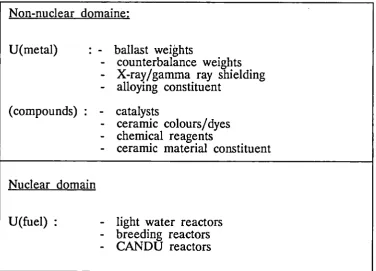
The possibilities to make use of uranium tails from Ur e have been
looked at discerning applications in the non-nuclear and in the nuclear domain (table I). Use of U in the non-nuclear field is recommendable for tails from natural U enrichment only. It is to be emphasised that using U does not mean its disappearing: the material re-emerges as scrap when the equipment containing U-devices is decommissioned.
The following conclusions have been drawn with respect to the possibil-ities to use U-tails and reprocessed uranium:
° The non-nuclear use of uranium will have a minimal effect on reducing the stocks of depleted or reprocessed uranium
° Basically tails uranium and reprocessed uranium with todays assays represent a stockpile of U235 which facilitates some conservation of natural uranium
Tails uranium ( U ^ t tails) 's a v e ry
fuel elements ana in' Fast Breeding Reactors suitable material for use in MOX
According to is residual U235 content, reprocessed uranium is suitable for repeated energy production, either as-is in CANDU reactors or after a new enrichment, in LWR's. However the usefulness of the material depends on its composition, which is determined by its history as reactor fuel. New loading and burn-up strategies can move the limits of qualification for re-use. New selective enrichment methods might neces-sitate new valuations.
Ways to store or to dispose of the materials have been investigated taking into consideration their chemical, physical, and radiological properties as well as the quantities to be expected. One particular issue governing the result of this consideration has become the inherent energy potential.
For relatively short term storage, uranium hexafluoride (UFg) might be the most appropriate compound, as it is a basis for many conversion steps (fig. 2). For long term storage exceeding 50 years and for final disposal uranium dioxide (UO2) is preferable because of its chemical stability, density, non-volatility and low chemical toxicity compared with UF6.
Despite the currently perceived adverse economics (and, to some extent, public perception of nuclear power) of the use of tails in fuel fabrication for LWR's and FBR's, the present stock represents, not waste, but a very important strategic stockholding of energy. Such tails stocks in the UK have been calculated to represent more available energy than the total reserves of coal in the UK. Future energy resources will need to keep pace with demand from the world population, which is estimated to double before the middle of the next century, and reserves of fossil fuels are diminishing. Apart from the beneficial environmental effects, nuclear power will continue to provide a necessary part of our energy production. Thus, the UK position is clear; tails stocks will be stored as a usable energy source and utilised as demand dictates.
No re-use outlets for Ur e have been found, other than return to
customers or enrichment for fuel fabrication. No disposal of Ur e either
for retrieval or non-retrieval has taken place, but this would only be done if the re-enrichment option were seriously uneconomically viable and
Ur e considered as waste. However disposal options would be evaluated.
C. 3 Scenario Relation
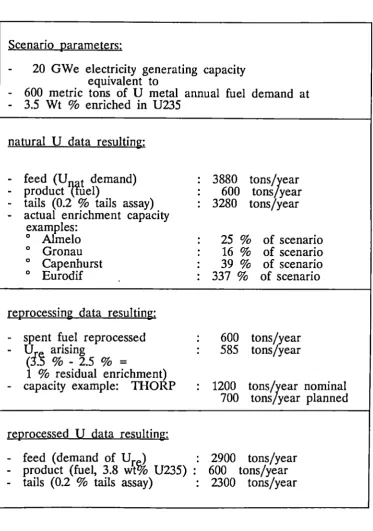
In order to relate the data and results to a more general scale, a scenario of reactor capacity of 20 GWe was chosen. The respective through - put of uranium (3,5 % enriched in U935) amounts to 600 metric tons of uranium metal equivalent per year, and this is roughly the amount of reprocessed uranium in this scenario, too.
The respective data of the scenario are shown in table II for a particular example. It is to be emphasised that - in reality - there will be spectra
- of residual enrichment in spent fuel, - of initial enrichment in fresh fuel,
- of blending uranium fuel and mixed oxide fuel,
- of enrichment demands according to fuel poisoning and - of storing/processing strategies of the materials.
Whatever the activities are, in the end the amounts of Ur e or/and of
Utails,nat> Utails,re w i U b e Pr e s e n t a n d t 0 b e d e a l t w i t h'
C. 4 Safety Considerations
Tails materials mainly consist of U238 and their specific activity is lower than that of natural uranium.
Reprocessed uranium on the other hand contains some constituents which alter the radiation behaviour of the material in relation to natural
or enriched natural uranium. As can be seen by the figures of the tables I to III in annual progress report 1991, these constituents are some newly formed uranium nuclides, which do not exist in natural or enriched urani-um. They are generated by nuclear processes during irradiation of the fuel elements in the reactors; their quantitative proportion depends on the
burn up. ^
In addition to this, there are traces of impurities, consisting of fission products mainly being gamma emitters.
In order to allow an assessment of the changed radiation properties of reprocessed uranium compared with those of natural or enriches natural uranium some, dose rate calculations have been carried out.
The following parameters have been varied:
- Initial enrichment of the reprocessed fuel elements (3.2 % to 4.4 % U235)
- Final burp up (33 to 50 GWd/tHM)
- Storage time after cooling and reprocessing (three months to two years).
The calculation of the gamma dose rate caused by fission products is based on separation factors stated in the literature.
Summing up it may be said, that
- the gamma dose rate level of reprocessed uranium is higher than that of natural uranium or enriched natural uranium
- the gamma dose rate level of reprocessed uranium depends on the burn up history of the former fuel element; the higher the burn up the higher the dose rate in reprocessed uranium
- the gamma dose rate level of reprocessed uranium generated by uranium and its decay products increases during a period of ten years after reprocessing; after this time it remains constant.
- this effect is superimposed by the influence of fission products always being present in reprocessed uranium; gamma dose rate of fission prod-ucts diminishes with time. Its magnitude depends on the separation . factors achieved during the reprocessing.
C.5 Conclusions
In the nuclear fuel cycle of Light Water Reactors two materials arise whose utilisation today is not fixed definitely. These materials are the tails of the enrichment of either natural or reprocessed uranium and the reprocessed uranium itself.
Real consumption of depleted uranium in the non nuclear field is minimal. The re-use of the materials in the nuclear fuel cycle is associated with various conditions, which are not easy to predict, i.e. the reloading and burn-up strategies for Light Water Reactors leading to qualitative changes of the spent fuel composition, the supply and the price of natural uranium influencing the enrichment conditions (e.g. the tails assay), or the success of the development of new technologies as selective uranium enrichment (e.g. LASER techniques as AVLIS or MLIS).
The accumulating amounts of these materials in question have been estimated, their characteristics investigated, and possibilities for
further treatment considered. These comprise an intermediate storage as well as a final disposal.
Depleted uranium (tails and reprocessed) can be stored for several decades as produced, i.e. as uranium trioxide or hexafluoride: Adequate storage capacity is available. But there are also processes practicable and proven to convert these original materials into less reactive com-pounds better suited for intermediate or final disposal.
According to the expected extension of the burn-ups in the future the isotopie composition of reprocessed uranium will change. As a result the emitted radiation of the materials will cause higher dose rates which must be taken into account when handling these materials.
Regarding the variety of influences on quality and quantity of de-pleted uranium, it is very difficult to make long term statements whether these materials should be classified for use or for final disposal. Con-sidering the anticipated success in selective enrichment methods, an intermediate storage for the next few decades seems to be a good policy.
-Table I: Possibilities to use reprocessed uranium and tails of natural and reprocessed uranium enrichment
Non-nuclear domaine:
U(metal) :
(compounds) :
-Nuclear domain
U(fuel) :
ballast weights
counterbalance weights X-ray/gamma ray shielding alloying constituent
catalysts
ceramic colours/dyes chemical reagents
ceramic material constituent
light water reactors breeding reactors CANDU reactors
[image:22.595.112.489.170.441.2]Table II: Scenario related data
Scenario parameters:
20 GWe electricity generating capacity equivalent to
- 600 metric tons of U metal annual fuel demand at - 3.5 Wt % enriched in U235
natural U data resulting:
- feed (Ungt demand) - product (fuel)
- tails (0.2 % tails assay) - actual enrichment capacity
examples: ° Almelo ° Gronau ° Capenhurst ° Eurodif
reprocessing data resulting:
- spent fuel reprocessed
- Ur p arising :
(3.5 % - 2.5 % =
1 % residual enrichment)
- capacity example: THORP :
reprocessed U data resulting:
- feed (demand of Ur e) :
- product (fuel, 3.8 wt% U235) :
- tails (0.2 % tails assay) :
: 3880 tons/year 600 tons/year 3280 tons/year
25 % of scenario 16 % of scenario 39 % of scenario 337 % of scenario
600 tons/year 585 tons/year
1200 tons/year nominal 700 tons/year planned
2900 tons/year 600 tons/year
2300 tons/year
Unat
UF6
enr¡ebnen t P I an t
Unat, en
UF6
Unat, tai I:
UF6
s torage
L N R
pI an t s reprocess ing p I an t
spen t fue I e I enen ts
f i ss ion produc ts
f ina I di sposa I
plu ton i U M
reuse/s tore
ro o
1 r
U r e , e n U F6
r t u s e i n f u e 1 eye le p1 an t s
enr ichnen t p I an t
U re
UF6
Ure, tails
UF6
s torage
U F6
convers i on pi an t
s torage
U re
UOo
UF6
AUC
ADU
UNH
A 1
UO3
UO2
Figure 2 : Uranium and the most known compounds
AUC: ammonia uranyl carbonate ADU: ammonia di-uranate
UNH: uranyl nitrate
Title : Waste Management Studies for Large Volumes of
Very Low-Level Waste
Contractor : Intera Information Technologies, United Kingdom
Contract n° : FI2W-CT90-0041
Duration of contract : March 1991 - September 1992
Period covered : January 1992 - September 1992
Project Leader : CM. Smith
A. Objectives and Scope
A significant proportion of the radioactive material which arises on decommissioning of nuclear facilities contains only small amounts and low concentrations of radionuclides, either as surface contamination, or as activation products within the body of the material. The objective of this study is to investigate the implications for waste management systems of various levels and forms of exemption criteria and the corresponding implications for routing low-level waste materials arising from decommissioning. Following a review of the existing information on the volumes and radionuclide contents of the most significant low level materials which arise during decommissioning, and the current legislative background relevant to the disposal, recycling or reuse of such materials, the study will investigate the full range of radiological implications of adopting alternative clearance levels now under consideration. A number of related factors, such as volumes of materials which would require disposal as "radioactive" waste, the timing and the degree of dismantling, and the requirements for waste packaging are also addressed.
B. Work Programme
B.l. Characterisation of the waste arisings, the options for the management of the arisings, and the exemption principles and criteria within which the options have to be applied.
B.2. Ranging of parameters which characterise the system identified in B.l., particularly those associated with the formulation of exemption.
B.3. Evaluation of the radiological impacts following adoption of the relevant sets of parameter values characterising the system.
B.4. Evaluation of the implications for routing of wastes following adoption of alternative formulations and levels for exemption by means of a comprehensive assessment and sensitivity analysis.
-C. Progress of work and obtained results
State of advancement
The work carried out during the year 1992 has been focused on the completion of item 2 and development of the items 3 and 4.
. Following on from the review of various waste management procedures, appropriate representations of these were made to assess the potential for waste material to give rise to a wide range of radiation doses to workers and members of the public. This involved aggregating the individual procedures (eg. dismantling, transport, smelting operation, post-disposal impact from landfill) into overall options (eg. unrestricted and restricted disposal, recycling) whose impacts are required to be quantified.
. Available information on waste streams (eg. PWR contaminated steel, Magnox activated concrete) were collated. These were represented mathematically in terms of radionuclide contents, and the distribution of activity throughout the mass or volume.
. Preliminary calculations were conducted of the annual individual and collective doses to workers and public for unit activity concentrations of each radionuclide, or for total activity, resulting from the various management procedures.
. Given the information gathered on the composition of the various waste streams and the representations of the management options, their respective radiological impacts were calculated, as was their sensitivity to factors such as the assumed exemption level and delay prior to dismantling.
Summary of the overall study
A significant proportion of the radioactive waste which arises on decommissioning of nuclear facilities contains only small amounts or low concentrations of radionuclides, either as surface contamination, or as activation products within the body of waste materials.
The primary objective of this study is to investigate the implications for overall waste management systems of various levels and forms of exemption criteria, and the corresponding implications for routing of low-level wastes arising from decommissioning. In addition, consideration has been given to related topics such as the amount of the radioactive waste to be disposed of given various levels of exemption, and monitoring requirements. The work was divided into four topic areas :
1. Literature search and analysis of existing work on low-level decommissioning waste arisings,
2. Review and mathematical representation of the options for managing large volumes of low-level and potentially exempt material,
3. Review of forms and levels of criteria practicable in the context of large scale exemption,
4. Assessment and analysis of the radiological impact of adopting various management options, and their dependence on important parameters such as exemption level and delay after reactor shutdown.
In the context of the arisings of decommissioning waste, numerous recent studies conducted by government agencies, international bodies and operators have been reviewed. The options for the management of very low level waste arisings include interim or partial measures, eg. deferred decommissioning and decontamination, as well as unrestricted and restricted final disposal and recycling. In the context of exemption principles and criteria, the recommendations of international agencies (the International Commission on Radiological Protection and the International Atomic Energy Agency) have been reviewed, as well as those of national authorities within and outside the European Community.
The majority of the high volume low level wastes from decommissioning comprise the concrete and steel structures of nuclear power plants. Given the magnitudes of exemption criteria being considered in such contexts (expressed as limits on activity concentrations) there is considerable scope for the unrestricted disposal or reuse of very large fractions of the substantial concrete structures of most nuclear facilities, along with significant fractions of the potentially active steels and other metals outside the areas of greatest radioactivity. The volume of materials which has to be treated as radioactive waste is a function of many factors. These include particularly the delay prior to dismantling, the decontamination factor for the various affected surfaces and the exemption criteria assumed. Notably the
adoption of higher concentration limits (around 50 Bq g*1) implies arisings of
hundreds of m3 whereas lower values (around 1 Bq g"1) imply thousands of m3 per
major faculty.
A major interest concerns how the radiological impacts of adopting various management strategies for potentially exemptible decommissioning waste are dependent on factors such as the exemption limits adopted and the delay assumed between facility shutdown and dismantling, waste disposal or recycling. Extensive calculations have been undertaken to investigate this issue, on the basis of exemption for options giving rise to individual doses less than 10 ^Sv per year and collective doses less than 1 man Sv. A detailed explanation of the assumptions made and parameter values adopted in the assessment has been provided. Consideration has been given to the problem of defining the practice which is being exempted. In a sensitivity analysis gross activity concentration limits have been varied within the range 0.1-10 Bq g"1, in line with current international and
national consensus, and delays between shutdown and waste processing up to 100 years have been considered.
Given the cautions nature of the assessment of individual doses, the results presented here confirm the considerable scope for exempting large fractions of both concrete and steel waste arising from decommissioning. Collective doses do not appear to be a significant factor in choices between management options.
-The volumes of, and the annual individual doses associated with, material which is potentially exemptible, are both approximately linearly dependent on the
numerical value of the exemption limit in the region of 1 Bq g"1, being somewhat
sub-linear at higher levels. This follows from the best available data on the distribution of activity throughout the various waste streams.
For some waste streams and management options, allowing the radionuclide inventory to decay prior to removal from the facility occasionally leads to an increased radiological impact per unit activity concentration owing to the ingrowth of some long lived radiotoxic nuclides, notably Am-241, and because older material at the same activity concentration tends to contain longer-lived radionuclides.
For some exposure modes it is important to consider whether the distribution of individual doses associated with a given volume of waste should be addressed or allowed for in evaluations of impact, or whether average values are sufficient, especially in the light of the generally low doses involved. This reflects the absence of clear guidance in recommendations for exemption criteria on how to deal with uncertain exposure conditions. For some wastes and some exposure modes the distributions of dose do not appear to be very wide. However, in some cases it is possible, though unlikely, that individual doses may be an order of magnitude or more higher than those estimated on the assumption of exposure to average material in the volume being considered.
Useful guidance on waste stream characterisation and corresponding VLLW exemption can be provided generically. The results presented here illustrate what is practicable in terms of assessment. Possibilities arise for the application of partial exemption of special exemption justified on a case by case basis, rather than blanket exemption at a higher level which could be harder to justify.
Such assessments can be used to direct procedures and plans on a site-specific basis. However, better radiological control in management of decommissioning VLLW requires improved characterisation of the high volume waste streams involved. Particularly important is the distribution of radionuclide concentrations throughout the considered volumes, as this largely determines how much of the total waste volume can be considered for exemption.
-Title: Treatment, Disposal, Re-Use of Building Demolition and Site Cleaning Wastes from Nuclear Facilities
Contractors: NUKEM GmbH, FRG (Coordinator); WasteChem Ltd., UK; SGN, F
Contract No: FI2W-CT90-0044 Duration of contract: February 91 - December 92 Period covered: January 92 - December 92
Project Leaders: H.J. Wingender (NUKEM); J. Doran (WasteChem); S. Goetghebeur (SGN)
A. OBJECTIVES AND SCOPE
The study concerns waste materials arising from building demolition and from site cleaning activities associated with decommissioning of nuclear facilities. The study does not consider wastes such as dismantled and/or disassembled process equipment, radioactive process inventories, etc., as these wastes are assumed to have been removed from the facilities prior to building demolition and site cleaning.
The objectives are:
Establish an overview of building demolition and site cleaning wastes arising from various types of fuel cycle facilities (enrichment, fuel manufacturing, power reactors, reprocessing, waste treatment, spent fuel encapsulation).
Consider sampling, monitoring and analysis tools enabling the characterization and classification of these wastes.
Classify these wastes according to a 3 class scheme (release for unrestricted use, release for restricted use only, radioactive waste) and describe possible ways of re-use or disposal.
Information from FRG, UK and France is to be used. Three partners contribute to the study (NUKEM: enrichment, fuel fabrication, reactors, fuel encapsulation; SGN-F: reprocessing, waste treatment; WasteChem-UK: enrichment, fuel fabrication, reactors, reprocessing, waste treatment).
B. WORK PROGRAMME
The programme of the study is structured according to following tasks: B.l Collection and compilation of waste data and characterization (3 partners) B.2 Investigation of sampling, monitoring and analysis tools (NUKEM)
B.3 Material classification and investigation of re-use and disposal possibilities (3 partners)
For standardization purposes, the information obtained is to be re-arranged in such a way that it reflects the waste arisings from a 20 GWe fuel cycle scenario (equivalent to 600 metric tons of heavy metal per year ).
C. PROGRESS OF WORK AND OBTAINED RESULTS
State of advancement
With the completion of the study in December 1992, a report has been prepared which needs only editorial revision.
As mentioned in the last annual report considerable difficulties occurred. The problem of completing the report in the given time frame and the limited finances was difficult. However, with extra efforts the report was completed, keeping to the original rimescale.
Progress and results
C.l Determination of the waste arisings
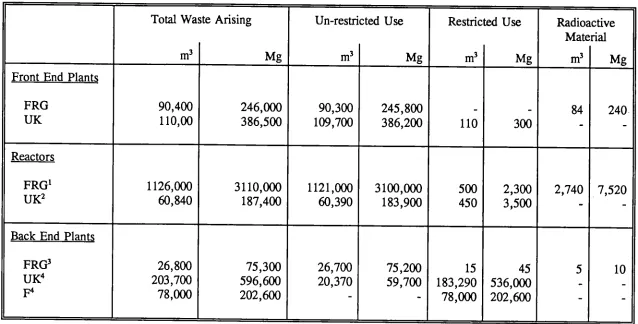
The total waste arising from the demolition of the scenarios building structures is listed in Table I. The main portion of waste arising is generated by reactor demolition, i.e. 85% when the demolition starts as soon as possible after shut down. The lower portion in the case of UK results from a different strategy. Here, the reference strategy entailed the removal off site of the plant and buildings external to the biological shield within 10-14 years of shut down. Total building waste arising must remain the same irrespective demolition timing - only the categorized waste will change. The demolition and the removal of remaining structures occurs after 100-135 years. Approximately 5% reduction of the total building waste arising accrues from fuel encapsulation replacing reprocessing at the back end of the fuel cycle. Approximately 90% of the wastes contain reinforced concrete, 8% steel, 1,5% brickwork and 1% of other materials.
A unified scheme for demolition waste estimation is difficult, since the regulations and the strategies practiced and/or envisaged are different from country to country and from plant to plant. Therefore, the listed waste arising data are strongly dependent on the model used.
Two main types of building demolition strategy are considered: total demolition and step by step demolition. The first case employed in France: the materials with and without radioactive material are mixed. The average specific radioactivity is below the limits given by the regulations. However, a release of this material for unrestricted use is not possible. These waste materials must be disposed of in a near-surface landfill. The second case, as employed in FRG and UK: parts of floors and walls are removed at first which contain radioactivity. Then the remaining building structures are demolished.
The amount of contaminated soil is difficult to estimate. Experience only exist for older plants in which such waste could be generated. In newer plants, such waste can be excluded or the amount is insignificant compared to the volumes produced by other sources. Therefore, this waste arising was not considered.
The secondary waste expected during the demolition phase is also small. The part with radioactive impact is less than 1 % of the total radioactive waste arising and was not considered.
The determination of the expected radionuclide content, distributions, concen-trations, and dose levels necessitates several assumptions along with suitable models. The only detailed experience exists in the ease of power reactor decommissioning. Here, the activation of the material by neutron irradiation can be precisely determined.
-For calculating the surface contamination the operating data, the release rates of radioactive material and the possiblity for transfer of radioactive material was considered. The quantities expected are evaluated according to former decommissioning studies and/or experiences from the plant operation.
The radioactive impact is conservatively calculated. A more precise estimation would be possible with increasing experience on nuclear plant decommissioning, especi-ally for the front end and back end plants.
Assumptions for calculating the radioactive impact and surface contamination are made with a relative high uncertainty. One uncertainty results from the assumption of how to decontaminate the surfaces before the safe enclosure period, especially for plants on which there is no decommissioning experience. The other uncertainty results from the mass correlation of contamination corresponding to surface contamination.
C.2 Sampling. Monitoring and Analysis Tools
The wastes with beta and gamma radioactive constituents can be suitably monito-red (radionuclide content, distributions, concentrations, and dose levels) for release of these materials into the environment. Particularly in the case.of non-destructive analysis techniques (NDA) for large radioactive waste packages, the experiments and the routine measurements demonstrate the applicability of a monitoring system. Detectors and measuring systems are also suitable for localization of the contamination on building structures. When a gamma emitter is utilized as a lead-nuclide the survey technique can be used for measuring the surface contamination. With the application of the contami-nation register system (cataster), an effective waste management system can be established to survey the waste arising from the initial phase to the removal of the material from the surfaces, to the packaging of the material.
In the case of alpha radioactive contaminated waste, a suitable NDA monitoring system does not exist. Surface measurements are unsuitable for crushed material. In this case, samples are used together with laboratory analysis. But, this method is unsuitable for routine monitoring because of the complex techniques and is time consuming. Sampling techniques have the disadvantage of being unable to estimate the activity at locations between the points on the sampling grid. The developed statistical methods are only useful when hidden "hot spots" can be excluded. A combination of NDA measurement with sampling collections could solve this problem when a lead-nuclide as a gamma emitter can be used in the NDA measurement. The developed measurement systems based on neutron detection are utilized in the area for waste treatment and for checking the limits of near-surface disposal.
In both cases, i.e. (beta, gamma) and alpha radiation monitoring cannot be used at the present time because the material throughput is not high enough to process the large amount of waste. The delay would significantly increase the total cost of the project. For routine operation, new measurement systems must be developed to treat large amounts of waste. A key role in this scheme is played by the application-oriented user interface while measurements and testing routines must become more and more automated and interconnected.
C.3 Material Classification
The classification of the waste material governs the categorization of the material as:
radioactive waste ready for restricted use
-ready for unristricted use
Two main groups must be considered when classifying the waste material according to the specific radioactivity content and surface contamination: 1. beta, gamma and 2. alpha radioactivity. Each group has its own limits given by the respective national regulations, needs its own measurement methods to control the waste material, and has its own strategy in waste management.
For compilation of waste arisings from the 3 countries mentioned, a more general scheme for waste classification (pre-classification) is used according to the following definitions: very low level waste (VLLW), low level waste (LLW), and intermediate waste (ILW) and high level waste (HLW).
In the case of VLLW, the radioactive content and the surface radioactivity are below the exemption limits and the waste material can be handled as "free of radioactivity".
The significant proportion of the waste material which arises on plant demolition contains only a small amount of low concentration of radionuclides within the body of waste material.
Wastes with higher activity are only generated by dismantling the biological shield when the demolition phase is started after a short safe enclosure period. Therefore, HLW does not arise in UK consideration. All these waste materials are suitable for final disposal and no extra classification in ILW and HLW is needed for this study.
Based on the uncertainties for calculating the waste quantities and the different exemption limits in the three countries, detailed analysis is difficult. For this reason, no detailed consideration was given to calculation and estimation of waste arising in respect of the different exemption limits given by the separate authorities in the participating countries.
Presently, large quantities of waste material classified as for unrestricted use are disposed of. A transportation to public landfills is already a complicated process. There-fore in the future, these wastes could be used unrest ri en vel y for road construction, dam building etc.. However, it must be demonstrated , that no accumulation and/or no mobilization of radioactivity can occur and produce any harmful effects on the human environment.
In the context of waste treatment, disposal, and re-use, a major interest of this study concerns how these waste materials do not need to be disposed of, but rather to be re-used as restricted and unrestricted material. Numerous studies have been reviewed to investigate the waste arisings and the options for classification. Table I gives an idea of the waste proportions when considering optimistic options of waste management mentioned in research.
No special strategies and procedures are considered to minimize the radioactive waste arising (pre-sorting, decontamination procedure, incineration, etc.). An effective minimization of radioactive contaminated waste can be implemented by doing an effective decontamination of the building structures in the beginning of the demolition phase, as well as during the different steps of the waste treatment phases. It is worth noting that the decontamination procedure can become too costly; thus, the direct disposal of the contaminated material may be then preferred. Therefore, for evaluating the waste amounts, the radioactive material should be also classified by criteria related to different waste treatment procedures.
-Table I: Building Waste Material from Scenario Fuel Cycle Plants
W O
Front End Plants
FRG UK
Reactors
FRG1
UK2
Back End Plants
FRG3
UK4
F4
Total Waste Arising
m3 90,400 110,00 1126,000 60,840 26,800 203,700 78,000 Mg 246,000 386,500 3110,000 187,400 75,300 596,600 202,600 Un-restricted Use m3 90,300 109,700 1121,000 60,390 26,700 20,370 Mg 245,800 386,200 3100,000 183,900 75,200 59,700 Restricted Use m3 110 500 450 15 183,290 78,000 Mg 300 2,300 3,500 45 536,000 202,600 Radioactive Material m3 84 2,740 5 Mg 240 7,520 10
1) Building demolition as soon as possible
2) Building demolition 100 years after shut down for reactors, 50 years for other fuel cycle plant
[image:34.842.144.782.116.440.2]Title : Treatment Study of Contaminated Sodium with a View to De-commissioning of FBR
Contractors : CEA - SIEMENS - FRAMATOME Contract N° : F12W - CT90-0058
Duration of the contract : from April 1991 to April 1993 Period covered : January 1992 • December 1992 Project Leader : C Latgé (CEA - coordinator)
N. de Seroux (Framatome) Mr. Hanebeck (Siemens)
A. OBJECTIVE AND SCOPE
In the Fast Breeder Reactor (FBR) decommissioning studies, sodium management is a ma-jor problem. Sodium becomes an important waste which must be taken into account in the
final process. To handle this specific topic, a cooperative working group has been formed, with the French "Commissariat à l'Energie Atomique" (CEA), FRAMATOME and SIE-MENS. CEA is the project leader.
The scope of work is based on a step by step approach, using available data and experimen-tal results with regard to the sodium inventory, sodium purification and waste treatment. The aim of this particular development program is to highlight optimized scenarios for so-dium destruction and recycling, based on a technical and an economical approach. Moreo-ver a Research & Development (R&D) orientation will be provided to improve the selected scenario and to allow a better understanding of fundamental processes.
B. WORK PROGRAMME
To perform the above scope of work, five main stages have been defined :
a : Inventory of the sodium needs :
The sodium balance, based on sodium needs for future FBR programs and existing wastes to be treated, is the starting point from which the problem is tackled and from which the scenarios to be highlighted later on are set.
b: Assessment of sodium behaviour and characteristics :
From an estimated contamination, provided by mathematical models which have been vali-dated using experimental data, it is possible to predict the behaviour and characteristics of the sodium to be treated.
c: Sodium purification :
Purification processes are examined with regard to the predicted quantities of contaminated sodium and the associated storage and transportation techniques. The R&D axes are defi-ned, according to the required level of knowledge in the waste treatment domain.
d: Analysis of the scenarios and their main parameters :
Using the previous steps as a reference, the main parameters of the scenarios are reviewed, with both a technical and an economical vision. This twofold approach allows the working group to highlight arguments to select and describe the scenarios to be analysed.
e: Optimized scenarios :
These processes, having been defined as suitable scenarios for sodium treatment, will be described. Further needs for R&D programs will be highlighted, to improve the processes
efficiency.
C. PROGRESS OF WORK AND OBTAINED RESULTS CI. STATE OF ADVANCEMENT
The cooperative working group was assigned in April 1991 the task of sodium management in the decommissioning studies environment.
A first semestrial report was published on November, 1991, / l / and is included in the An-nual Progress Report 1991, IV.
Two semestrial reports were published on April, 1992, /3/ and on September, 1992,IAl.
The Reference /3/ describes the activation and the contamination assessments of the sodium to be treated after the final shutdown of the FBR.
Then it lists the sodium purification processes : physical processes such as filtration and cristallization, or chemical processes such as molecular adsorption and isotopie exchange. It describes also available disposal processes for contaminated sodium. Sodium is conver-ted in an inert waste which is sent to a definitive storage.
The Reference /4/, following the results of the previous work, gives an analysis of the main parameters for the choice of the scenarios for the sodium treatments, either to reuse it, or to dispose it.
For the primary sodium, it details the storage conditions, the transportation possibilities and the scenarios following several axes : reuse, disposal, long term storage.
The same work has been carried out for the secondary sodium.
The milestones with regard to the sodium treatment in a decommissioning framework are presented on figure 1.
C.n. SODIUM ACTIVATION AND CONTAMINATION The pollution due to the radioactive elements consists in :
Primary sodium :
- primary sodium activation coming from the neutronic flux within the core.
- continuous contamination coming from tritium of control rods releases going through the clads and from corrosion products of the steels.
- uncontinuous contamination coming from caesium of spent fuel subassemblies re-leases.
Secondary sodium :
- secondary sodium activation from the neutronic flux during its way through the in-termediate heat exchangers in the vessel (only sodium 24).
- continuous contamination coming from tritium of primary sodium going through the pipes of the intermediate heat exchangers.
A computer programme, CORONA, from CEA - France allowed us to assess the sodium activation and contamination level at the final shutdown of a FBR after a thirty years opera-ting time.
We have noted fast decay of activation and contamination level when the reactor operation
is ended and a reduction by a factor of 5000 is quickly obtained in one year. Some radiotive elements, like Iodine 132, have very short half life and they are not to be taken into ac-count in our case. The short decay time of the sodium 24 brings a large contribution to the general decay.
After the quick decay of the sodium 24, the secondary sodium activation and contamination is mainly due to the tritium. The long half life of this element cannot allow to expect signi-ficant modifications in time.
Figure 2 gives the main activation and contamination levels to take into account at the final shutdown for the primary and the secondary sodium. We did not consider : elements with half life under 1 year, corrosion products (their concentrations stay very low) and gazeous products.
CHI. SODIUM TREATMENT
In the view of sodium reuse or easy disposal, several purification processes have been listed following the different elements being in the sodium.
- the filtration of oxygen and hydrogen is carried out by solubility decreasing by the cooling of a secondary flow of sodium. They are crystallized and retained by filtration. FBR are fitted out with cold traps (figure 3) which include these functions. The final concentration can be very low, under 1 ppm for O and under 0.5 ppm for H.
- the filtration of the tritium is carried out with cold traps. The tritium can be crystalli-zed by cooling like the isotope hydrogen and retained by filtration or can be fixed by isotopie exchange with hydrogen. The final concentration can be very low, as for H. - the control of the sodium purity is carried out with a plugging indicator : its principle is to measure a sodium flow through a calibrated hole during a cooling phasis. The reading of the flow/temperature curve indicates the purity level of the sodium.
- the filtration of the solids particles such as metallic or fuel particles can be carried out by the cold traps. Specific filters in sintered metal are also very efficient (near mi-crometer squale).
- the purification of caesium is made by adsorption on carbon material sorbent (mainly RVC type : Reticulated Vitreous Carbon). Efficiency is very good and it has been tes-ted successfully at KNK and RAPSODIE.
- in case of water/sodium reaction in steam generators, the purification of sodium hy-droxide (caustic soda) can be carried out with cold traps.
- corrosion products such as Mn 54 and Co 60 can be eliminated by adsorption on a nickel support but the efficiency is low.
- caes i uni Mn 54 and Co 60 concentration level can be easily assessed by gamma spec-tromeasure.
Several sodium disposal processes have been examined. Three main processes have been distinguished :
- reaction with steam : good efficiency but not adapted to large volume, - alcohol process : good efficiency but not adapted to large volume, - dissolution in water : good efficiency, adapted to large volume.
For these 3 processes, the successive phases are : conversion of the sodium in caustic soda, neutralization with acids, drying in salts, mixing with epoxy resins and definitive storage. Only one process has been developed up to an industrial scale : the water process NOAH.
NOAH process has been developed and patented by CEA. A pilot plant has been ope-rated to validate the process and 2 tonnes of sodium have been disposed. NOAH pro-cess is chosen in DESORA plant at RAPSODIE for the operation of the primary so-dium disposal (37 tonnes).
NOAH process principle (figure 4) consists in injecting small quantities of sodium in a large water flow in a vessel. The sodium is quickly scattered in the water and the conversion of the sodium is very soft The results of the conversion is hydrogen which is released in the atmosphere after several filtrations, and aqueous caustic soda which is sent to a liquid waste centre.
Caustic soda can be purified in cesium with resins at this step. This can avoid to purify the activated sodium in cesium with RVC filters of which the use is quite expensive. The main interests of the NOAH process are :
- operation in one step
- good monitoring of the sodium quantity reacting at any time - process developed at an industrial scale.
CIV. ANALYSIS OF PARAMETERS OF THE SCENARIOS
Three parameters having an influence upon the choice of the scenarios are analysed hereaf-ter:
- buffer sodium storage,
- transportation of sodium and soda, - long term sodium storage.
Buffer sodium storage :
EFR (European Fast Reactor) plant is fitted out with seven sodium tanks. Their total capa-city is sufficient to store all the primary sodium but four of them need biological shielding addings to take into account the radioactivity.
SPX plant is fitted out with six sodium tanks but their total capacity is insufficient to store all the primary sodium and three of them need biological shielding addings to take into ac-count the radioactivity.
There is no problem to store the secondary sodium for the two plants.
Transportation of sodium and soda
Sodium transportation is expensive because heating and inert gas covering are necessary. But soda volume is four times larger after the conversion than the sodium volume.
Eventually, the sodium transportation cost has been assessed lower than the soda transpor-tation cost per reactor plant
The main transportation condition to fulfill, with regard to the regulations, is to have a dose rate under 10"4 Sv/h at 2 meters of the transport tank. Transported quantities per travel vary
following the purification level and the storage decay. For example, for a total load of 21 tonnes per travel, there are 12 tonnes of sodium and 9 tonnes of biological shielding when the sodium has not been purified and has not been stored, and there are 19 tonnes of sodium and 2 tonnes of biological shielding when the sodium has been purified at 98 % in caesium and has been stored 5 years.
-Long term storage :
Sodium can be stored for a transition period, waiting a reuse in FBR or an other solution. Storage can allow to differ large costs for disposal and to decrease the sodium activity by time decay.
Storage time is the sole mean to decrease the sodium 22 activity.
But long term storage brings cost penalty if the sodium has to be finally disposed. Its decay effect is negligible if the cesium is not purified by carbon traps.
C.V. MAIN SCENARIOS DESCRIPTION
The possible scenarios for the sodium treatments, taking into account the previous work, are then analysed, either to reuse it, or to dispose it.
The scenarios can be separated in two groups :
- there is one or several FBR to fill up in sodium --> scenarios of sodium reuse
- there is no FBR to fill up in sodium --> scenarios of sodium disposal or sodium sale in in-dustrial field when it is desactivated.
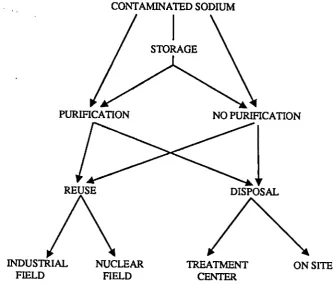
The possible scenarios are summarized in figure 5. The selected steps are : storage, purifica-tion, processing, final destination.
a) Primary sodium :
After reactor final shutdown, primary sodium can be disposed with the NOAH process or can be reused in nuclear or industrial field.
If the sodium has to be disposed, it can be converted in the reactor site and aqueous caustic soda has to be transported, or it can be converted in the liquid waste site after its transportation.
In each case, caesium and tritium purification has to be considered. al) Sodium reuse:
Several scenarios have been examined :
- reuse of sodium with activity below 10 Bq/g, in industrial field, - reuse of non purified sodium in a new plant
- reuse of sodium purified at 98% and stored during 5 years, in a new plant - reuse of non purified sodium but stored during 30 years, in a new plant - reuse of sodium purified at 99% and stored during 5 years, in a new plant - reuse of sodium with activity below 10 Bq/g, in a new plant
The new plant can be on the same site than the old one or in an other site. Sodium reuse can bring two main advantages :
- cost saving :
If the sodium can be reused in new FBR, new sodium buying is avoided. If the sodium can be reused in industrial field, it is sold to a customer. In these two cases, no major waste storage cost has to be considered. - time saving :
New sodium delivery can necessitate several months from the supplier. If the old and new FBR are on the same site, reusable sodium can be delivered in few days. If the old and new FBR are not on the same site, reusable sodium can be delivered in one month.
Sodium reuse in industrial field necessitates high purification means (division of the caesium and tritium content by 10 000) and long term storage (30 years due to the
dium 22 decay) to decrease the total activity below 10 Bq/g.
These conditions are difficult to reach. Industrial sodium price is also lower than the nuclear one. But the purification and storage cost can be covered by the sodium sale and that can avoid waste storage cost.
Sodium reuse in nuclear field with activity above 10 Bq/g implies specific biological shielding measures during the sodium drying of the old plant, transportation, filling up and testing of the new plant. The plant has to be put in controlled areas several months earlier, due to the filling up and hydraulic testing phases.
It is also possible to use sodium with activity below 10 Bq/g to avoid specific biologi-cal shielding measures.
a2^ Sodium disposal :
Sodium cannot be disposed directly. It has to be converted in a stable element being able to be treated in liquid waste centres. The conversion of 2000 tonnes of sodium ge-nerates large volumes of aqueous caustic soda, about 8000 tonnes. This soda can be used to neutralize acid liquid wastes from reprocessing centres or can be treated direct-ly as a waste.
Sodium disposal is the sole way if no new plant is expected or if sodium sale is not possible in industrial field.
The better cost balance has to be established between the plant capacity (cost of the plant) and the operation duration (cost of the operation). In the case of EFR, we have considered 2 years of operation for the disposal plant with a disposal capacity of
1000 t/y.
Several scenarios have been examined :
- disposal of no purified sodium on the reactor site and transport of purified soda to a treatment center,
- disposal of sodium purified at 98% on the reactor site and transport of no purified so-da to a treatment center,
- transport of no purified sodium from the reactor site to a treatment center and dispo-sal of the sodium,
- transport of sodium purified at 98% from the reactor site to a treatment center and disposal of the sodium.
The operation can be carried out in the old plant site or in the liquid waste centre. Transportation cost has to be considered following the purification level.
The disposal plant can be designed : either in several modules to be mobile between old sodium plants, or as a fixed plant on one site.
Sodium disposal operation is the most unfavourable economical way because :
- if there is a new plant to fill up, the total cost is the addition of the disposal cost and the new sodium cost,
- if there is no new plant, sodium reuse cost in industrial field is not upper than sodium disposal cost.
b) Secondary sodium :
Secondary sodium is contaminated only by tritium, which is a beta emitter. No biolo-gical shielding is necessary for the operators.
SPX secondary sodium activity will be about 2,5 103 Bq/g at the final shutdown.
EFR secondary sodium, which is continuously purified in operation, will have an acti-vity bellow 10 Bq/g at the final shutdown.
bl") Secondary sodium reuse ;
Several scenarios have been examined :
- reuse of not purified sodium in secondary loops
- reuse of purified sodium with activity below 10 Bq/g, in secondary loops - reuse of purified sodium with activity below 10 Bq/g, in industrial field
Sodium can be easily reused in a new plant because no modification has to be carried out. If the sodium activity is above 10 Bq/g, controlled areas have to be foreseen ear-lier.
This reuse has the same interest than for the primary sodium one : cost saving and time schedule reduction. A purification, if it is necessary, is made with cold traps. EFR secondary sodium can be reused directly without purification because its activity is below 10 Bq/g.
b2i Secondary sodium disposal : Two scenarios have been examined :
- disposal of sodium purified at 98% on the reactor site and transport of soda to a treat-ment center,
- transport of sodium purified at 98% from the reactor site to a treatment center and disposal of the sodium.
Sodium disposal is the sole way if no new plant is expected or if sodium reuse is not possible in indutrial field.
Tritium purification has to be made in sodium to allow low tritium concentration in soda.
NOAH process has been also selected for the sodium conversion.
Secondary sodium disposal brings the same cost disvantages than the primary one.
CVI. NEXT STEP
Next step will consist to carry out a cost assessment of the different scenarios. They will be compared together and classified. Proposed scenarios will be highlighted in relation to the main technical conditions.
References :
HI CCE - Gestion et stockage des déchets radioactifs - Traitement du sodium
contami-né - Rapport semestriel N°l - NOVA X 005 807 000
/2/ CCE - Community's research and development programme on radioactive waste management and storage - Annual Progress Report - EUR 14418 EN
131 CCE - Gestion et stockage des déchets radioactifs - Traitement du sodium
contami-né - Rapport semestriel N°2 - NOVA X 006 067 000
¡AI CCE - Gestion et stockage des déchets radioactifs - Traitement du sodium
contami-né - Rapport semestriel N°3 - NOVA X 006 123 000
-Figure 1 : Main Milestones
Stepl Step 2 Step 3 Step 4 Step 5
04/91 10/91 04/92
H + 10/92 04/93
Figure 2 : sodium activation and contamination levels
PRIMARY SODIUM
_ ,. „ . , ! Activity ; Total activity Radio-element j Period ; inBq/kg | inBq
Ña 22 (B+ gamma)! 2,62: years I 1,33. ÏÓ7 Î 4,4.ÏÖ13
Cs 137 (ß-,gamma)! 30years I 8,95.IO7 I 2,9.ÏÖ14
Tritium (ß+) i 12,3 years ] 3,35.fÕ7 } ÏJ.ÏÖ14
TOTAL I 15.ÏÖ7 I 4,9.ÏÖ14
SECONDARY SODIUM
Activity i Total activity in Bq/kg j in Bq
i
_
-i
2,5.IO6 ; 3,2.IO12
2,5.106 1 3,2.1012
EFR secondary sodium activity will be under 10 Bq/g in tritium because it will be conti-nuously purified during operation.
Figure 3 : cold trap
Figure 4 : sodium disposal NOAH process
-Figure 5 : scenario ways
CONTAMINATED SODIUM
PURIFICATION NO PURIFICATION
INDUSTRIAL
FIELD NUCLEAR HELD TREATMENT CENTER ON SITE
[image:44.595.155.492.135.422.2]