* *
ISSN 1018-5593
European Commission
nuclear science
and technology
Community's research and development programme
on radioactive waste management and storage
Shared-cost action (1990-94)
European Commission
nuclear science
and technology
Community's research and development programme
on radioactive waste management and storage
Shared-cost action (1990-94)
LEGAL NOTICE
Neither the European Commission nor any person acting on
behalf of the Commission is responsible for the use which might be made of the following information
CONTENTS FOREWORD
THE MANAGEMENT AND COORDINATION ADVISORY COMMITTEE
PROGRESS OF THE R&D WORK
PART A: WASTE MANAGEMENT AND ASSOCIATED R&D PROJECTS
Al: STUDIES OF MANAGEMENT SYSTEMS Task 1 "Studies of Management Systems" A2: WASTE TREATMENT
Task 2 "Treatment of Radioactive Waste"
A3: SAFETY OF THE MULTI-BARRIER SYSTEM OF GEOLOGICAL DISPOSAL
Task 3 "Characterisation and Qualification of Waste Forms, Packages and their Environment" Task 4 "Disposal of Radioactive Waste :
Research to Back-up the Development of Underground Repositories"
Task 5 "Method of Evaluating the Safety of Disposal Systems"
PART B: CONSTRUCTION AND/OR OPERATION OF UNDERGROUND FACILITIES OPEN TO COMMUNITY JOINT ACTIVITIES
Project Bl "The Underground Facility in the Asse Salt Mine (FRG)"
Project B2 "The Underground Facility HADES in the Argillaceous Layer under the Mol Site (B)"
Project B4 "Underground Validation Facility at Sellafield (UK)"
ANNEX I
ANNEX II
List of Organisations Participating in the Programme during 1994
FOREWORD
This report covers the progress of research work and activities started and developed during 1993 in the framework of the five-year programme (1990-1994) of the European Atomic Energy Community on "Management and Storage of Radioactive Waste". This R&D programme has been adopted by decision 89/664/EURATOM of the Council of the Ministers of the European Union on 15 December 1989.
The Council Decision, together with the technical content and the indicative Community financial contributions for the individual sections of the programme, has been published in the Official Journal of the E.C.,Nr. L395, 30.12.1989,p. 28-32.
The initial total amount of funding allocated to the programme of 79.6 million ECU over the five-year period, has been reduced to 76.5 million ECU.
The programme is subdivided in :
Part A : Waste management and associated R & D projects -Al: Studies of management systems (Task 1)
- A2: Waste treatment (Task 2)
- A3: Safety of the multi-barrier system of geological disposal (Task 3, Task 4 and Task 5)
Part Β : Construction and/or operation of underground facilities
A call for research proposals has been launched (O.J. of E.C. Nr. C55/4,7 March 1990) to implement the programme through shared-cost research contracts with public organisations or private firms established in the Member States. Multipartner projects have been encouraged.
Contract negotiations for the selected research proposals lead to the signature of 120 contracts for both Part A and Part Β of the Programme. The number of research projects running in 1994 is 94.
The European Commission is responsible for implementing and managing the programme and is assisted in this task by the Management and Coordination Advisory Committee "Nuclear Fission energy - Fuel cycle/processing and storage of waste" (see the annexed list of the Members of the Committee).
In addition to shared-cost research contracts, the programme also includes study contracts, awards of training and mobility grants, as well as international co-operation agreements with states outside the European Union.
The co-operation among various teams within the Member States has considerably been promoted by the numerous multi-partner research projects.
In this report, the objectives, the working programme and a synopsis of progress and results obtained for each contract in 1994 are presented as prepared by the contractors, under the responsibility of the project leader(s). Several projects have been extended to
1995. The overall results and conclusions of the whole five-year programme 1990-94 are planned to be presented and discussed during the fourth International Conference on
"Radioactive Waste Management and Disposal" organized by the European Commission in Luxembourg on 25-29 March 1996.
From 1995 onward, the most of the R&D pursued under the EAEC Programme on "Management and Storage of Radioactive Waste" will be carried out under the specific RTD programme "Nuclear Fission Safety of the EURATOM Framework Programme
1994-1998.
The European Commission wishes to express its gratitude to all scientists who have contributed to this report.
N. CADELLI Head of the Programme
MEMBERS OF THE MANAGEMENT AND COORDINATION ADVISORY COMMITTEE NUCLEAR FISSION ENERGY
FUEL CYCLE/PROCESSING AND STORAGE OF WASTE ' (during 1994) BELGIUM DENMARK FRANCE GERMANY GREECE Th. G. K. S. J. P. M. H.G. S. VAN RENTERGEM DEDEURWAERDER BRODERSEN HOE LEFEVRE RIEUTORD BLOSER RIOTTE AMARANTOS
IRELAND C. HONE
F. TURVEY
ITALY G.
F. GROSSI MORSELLI
LUXEMBOURG
BACK
NETHERLANDS
PORTUGAL SPAIN UNITED KINKDOM COMMISSION H. J.W.A. A. J. C. J. L. M. R.L. P J . H.J. J. T.CORNELISSEN
VAN ENST (Chairperson) DA CONCEIÇÃO SILVA RAMALHO CARLOS ROJAS DE DIEGO RODRIGUEZ PARRA JACKSON
HUBBARD ALLGEIER VAN GEEL
PART A
WASTE MANAGEMENT AND ASSOCIATED R&D PROJECTS
Al : STUDIES OF MANAGEMENT SYSTEMS
A2 : WASTE TREATMENT
Al: STUDIES OF MANAGEMENT SYSTEMS
Task 1
"Studies of Management Systems"
* List of contract
* Introduction to Task 1
Topic 1
Topic 2
Topic 3
Topic 4
Topic 5
System studies
Harmonisation of radioactive waste management practises and policies
Comparative assessment of disposal practices in various management schemes for toxic and radioactive waste
Information
TASK 1 - LIST OF CONTRACTS
Topic 1
Contract
System studies
FI2W-CT92-0119 Study of the retrievability of radioactive waste from a deep underground disposal facility.
Topic 2 : Harmonisation of radioactive waste management practices and policies
FI2W-CT90-0060 Assessment and proposal for activity limits for release of very low-level radioactive waste to landfills.
Topic 3 Comparative assessment of disposal practices in various management schemes for toxic and radioactive waste.
FI2W-CT90-0042 Comparison of safety assessment methods for toxic and radioactive wastes.
FI2W-CT90-0061 Disposal of radioactive waste and toxic waste in underground repositories.
Topic 4 Information of the public
FI2W-CT90-0036
FI2W-CT90-0043
FI2W-CT90-0074
Study of a communication strategy aimed at achieving a possible better understanding of the consequence of radioactive waste management in a well defined group of public.
Information of the public in the field of decommissioning waste. Study of strategies and means for specific information.
TASK 1 - LIST OF CONTRACTS
Topic 5 : Transmutation studies
FI2W-CT91-0103 Transmutation of long-lived radionuclides by advanced converters.
FI2W-CT91-0104 Participation in a CEC strategy study on nuclear waste transmutation.
INTRODUCTION TO TASK 1 - STUDIES OF MANAGEMENT SYSTEMS
A. Objective
The system studies concern the evaluation of various scenarios for the management of different types of waste. Harmonisation work mainly involves the development of common waste management criteria and schemes. Waste from dismantling operations and spent fuel where these are considered as waste are included as well as the development of analytical models for minimising transport of waste. An additional topic is the evaluation of the possibilities offered by transmutation to reduce the inventory of long-lived radionuclides. Information of the public in all fields of radioactive waste management and disposal is a further topic.
B. Research performed under previous programmes
System studies have been performed by comparing various management schemes for particular categories of wastes or groups of waste streams; the comparisons were based on evaluation of costs and radiological consequences to workers and the public. The management alternatives were studied for:
- solid plutonium contaminated waste,
- alkaline liquid wash waste from fuel reprocessing and zircaloy-hulls, - reactor waste (waste from normal operation of light-water reactors),
- waste management implications of direct spent fuel disposal and disposal after reprocessing.
Activities in the field of harmonisation of practises covered a review on "Objectives, standards and criteria of radioactive waste disposal in the European Community", the development of criteria for exemption from regulatory control for radioactive waste not linked to the nuclear fuel cycle, and first approaches to waste equivalence.
C. Present programme (1990-1994)
Studies are performed under five headings corresponding to specific research topics.
Topic 1 : System studies
The system studies are based on the comparison of possible management schemes, with the definition of waste inventories at origin, an analysis of the subsequent steps in the possible management routes (treatment, transport, interim storage and disposal), evaluation of costs and determination of radiological consequences. The sensitivity of each scenario to modifications in waste quantities, release limits, and waste acceptance criteria is also evaluated.
Topic 2 : Harmonisation of radioactive waste management practices and policies
The main field of activity is the development of the scientific basis for developing criteria for exemption of particular waste streams from regulatory control. Particular disposal routed considered are incineration and disposal at industrial waste burial sites.
Topic 3 : Comparative assessment of disposal practices in various management schemes for toxic and radioactive waste
Studies are performed which compare radioactive waste management schemes to management practises for waste streams involving radioactive isotopes in material not linked to the nuclear fuel cycle and toxic waste mixed with radioactive elements. Particular attention is paid to disposal of toxic and mixed waste in salt formations.
Topic 4 : Information of the public
Studies on strategies allowing efficient information to be given to the public, and on how a good degree of penetration through various media may be reached are in progress. An exhibition targeted at school children (aged up to 18) and using the latest interactive multi-media techniques was developed to be installed in Science Museums and Information centres for the public. Development of information materials (booklets, visual, aids, etc.) is also part of the activities.
Topic 5 : Transmutation studies
Title: Study of the retrievability of radioactive waste from a deep underground disposal facility
Contractor: ECN
Contract no: FI2W-CT92-0119 Duration of contract: July 1992 to March 1994
Period covered: January 1994 to December 1994 Project leader: J. Prij
A. OBJECTIVES AND SCOPE
Retrievability of radioactive waste emplaced in a deep repository in a geological formation has received increasing attention during recent years. Most of the Member States of the European Union, however, have not, up to date, included provisions for retrievability in their regulatory framework or in recommendations for disposal of waste. Other countries, like the United States, ask for an access to conditioned waste to be guaranteed for some decades. Retrievability of suitably packaged waste may only be guarantied during the period that the waste packages remain intact and the position of the package is known. As those conditions can only be met for a few centuries, provisions for retrievability make sense only for up to some hundreds of years.
During these few centuries, retrievability may be realised by keeping the access to the waste packages open, by maintaining in operational condition the access shafts and the main galleries. A second possibility is to dispose the waste in a suitable overpack and abandon the repository after backfilling, closing, and sealing. In this case the waste must be re-mined from the surface. Although this re-mining will be very costly it is obvious that there will be a point in time, where the cost of keeping the repository in operating condition will be higher than those of re-mining from the surface to reach the waste packages in a closed repository. The objective of this study is to determine this break-even point for several storage options.
B. WORK PROGRAMME
Present state of the retrievability option
Existing information on retrievability of radioactive waste will be collected in EC-Member States and other countries having a nuclear energy production programme.
Overview of expected modifications because of opting for retrievability
This overview will examine aspects concerning design and fabrication of waste packages, design of the repository, operation and maintenance of the repository and associated equipment, surveillance and control of the installation, and maintaining a documentation system when changing from final disposal to retrievability.
For these factors an estimate of additional costs and occupational exposure will be attempted. Evaluations about radiation protection and long term safety to the environment will be made without carrying out detailed performance assessment calculations.
(including the annual costs of keeping the repository open) and the costs of re-mining the waste from a final deep underground repository (including the costs of closing and sealing). The assumptions and boundary conditions are:
• The study is restricted to HAW (high level radioactive waste). The quantity of HAW is based on 20 GW installed nuclear power (in standard LWR NPP's) operating for a period of 30 years.
• Two types of waste management strategies will be considered, direct disposal of all spent fuel and disposal of the HAW from reprocessing all the spent fuel
• One loading sequence of the waste into the repository will be considered.
• The disposal concepts will be chosen based on current state of the mining and disposal techniques.
• Three types of host rock will be considered: clay, granite and rock salt. • One retrieving and one re-mining strategy will be selected.
• The waste will be stored in a suitable overpack, capable of keeping radiation level at the outside small enough for human presence in the vicinity of the waste and capable of withstanding the rock pressure in the repository.
The activities to be carried out are:
select feasible final disposal and retrievable storage concepts for each of the three host rock formations,
assess the feasibility of the selected options: concise safety evaluations will be performed concerning radiation protection and long term safety to the environment,
select a feasible retrieval and re-mining concept for each of the three host rock formations,
assess the feasibility of retrieval for the concepts chosen with respect to maximum temperatures and stability of the mine-building after retrieval,
determine the total costs of each option selected:
for the retrievable options the total costs are the annual costs to guarantee the retrievability, and the costs of the retrieval.
for the final disposal concepts selected the total costs are the costs of closing and the costs of re-mining.
• evaluate the costs in present day value and determine for each of the host rocks the break even point at which re-mining is more favourable from an economical point of view. This evaluation will be based on the present-day society and present day estimates of the economical parameters such as interest rates.
C. PROGRESS OF WORK AND OBTAINED RESULTS
State of advancement
has been performed of the individual container and of the complete repository. It appears that the maximum temperature at the container surface reaches 160 °C for storage in clay. This temperature will be reached some 10 years after storage. For storage in granite the maximum temperature will be 123 °C and will be reached after 20 years of storage. For storage in rock salt, the maximum temperature of 117 °C will be reached after about 20 years. The extreme temperatures always occur for storage of vitrified waste. No attempt has been made to investigate the existing criteria for mining at elevated temperatures. However, ore production mining at rock temperatures up to 120 °C has been reported. Apart from local hot areas the rock temperature is below this temperature and therefore it is very unlikely that the temperature will be a major obstacle for proper retrieval.
The aspects of safety regarding the repository operation and regarding the complete fuel cycle, as well as the long term safety of the stored waste, and the chemical interaction between the container and the surrounding rock, which may lead to the formation of corrosion gases, have not explicitly been treated in this study.
The storage and removal of the heat generating waste and the related thermal expansion or contraction of the rock may cause instability phenomena in the underground or collapse of the galleries. For a repository in clay this stability is not a major problem due to the presence of a concrete lining in all underground excavations. For granite and rock salt an assessment of the stability has been performed and it appears that in only relatively small regions around the waste cracks may form or instability may occur. The extent of this damage is such that support measures as used in normal mining practice are sufficient to guarantee the safety of the retrieval operation.
The cost for construction of the repository, re-mining the waste from a closed and sealed repository, and the annual operating cost for the different options is in 1994 money terms:
Cost in millions of Netherlands Guilders (1994)
Repository construction Re-mining Annual care maintenance and clay 730 518 1.3 Spent fuel granite 511 595 2.4 salt 618 622 1.8 clay 546 424 1.3 Vitrified waste granite salt 417 507 451 529 2.4 1.8
These numbers are based on normal ore production mining practice and it has been assumed that the overpack of the waste is such that no additional precautions for radiation protection or safety are required.
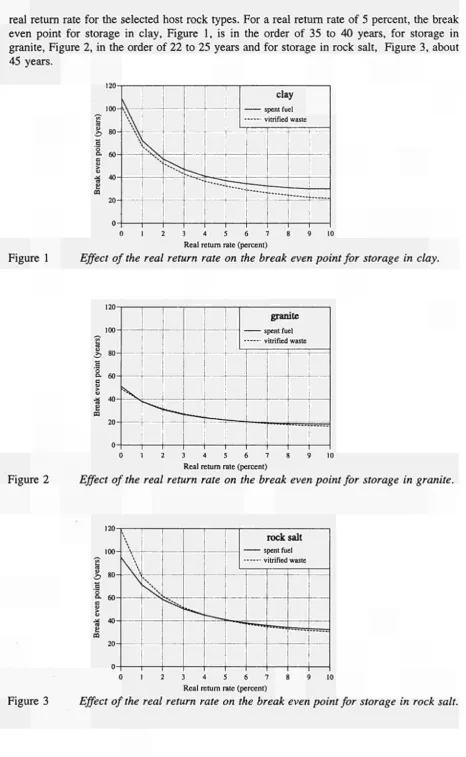
real return rate for the selected host rock types. For a real return rate of 5 percent, the break even point for storage in clay, Figure 1, is in the order of 35 to 40 years, for storage in granite, Figure 2, in the order of 22 to 25 years and for storage in rock salt, Figure 3, about 45 years.
Figure 1
/—s >} 93~
.3 α tí
β
2 0 0
A j »V.
*
| 1 '
***.
| clay
vitrified waste
¡ μ* ~ ^
j 1 !
¡
1
10
0 1 2 3 4 5 6 7 8
Real return rate (percent)
Effect of the real return rate on the break even point for storage in clay.
120
100
W S3
h «H
.S o S. 60
a o
> ■a "o m
20
!
^ v ! i
ι |
1 ¡ 1
granite spennuei vitrified waste 1 1 ! 1
1 1—
i
¡
I i
Figure 2
0 1 2 3 4 5 6 7 8 9 10
Real return rate (percent)
[image:22.595.62.529.38.796.2]Title Assessment and proposal for activity limits for release of very low-level radioactive waste to landfills
Contractor CEA/IPSN, France and ONDRAF, Belgium Contract N° FI2W-CT90-0060
Duration of contract April 1991 - July 1995
Period covered 1 January 1994 - 31 December 1994 Project leader J.M. PERES (CEA/IPSN, coordinator)
A. OBJECTIVES AND SCOPE
In the frame of studies dealing with low level waste destinations, the project aims to establish acceptance criteria for municipal and industrial landfill.
Correspondances between levels of exposure and levels of radioactivity will be. established.
From this work, it will be possible to derive activity concentration and surface activity levels for acceptance criteria to landfill disposal.
A complementary study will investigate the implications of disposal management in a specific landfill which receives only very low level radioactive waste.
B. WORK PROGRAMME The initial program included :
-Phase 1 : Analysis of landfill disposal practices of industrial and municipal waste. A particular attention was paid to the regulatory context and to the conditions encountered in the different installations.
Phase 2 : Development of a radioprotection code CERISE, in order to establish the relations between exposure and radioactivity of waste, including a data bank of dose conversion factors.
Evaluation of the exposure of workers and public resulting from the water pathway using the code GEOLE (geosphere) and the code ABRICOT (biosphere).
Phase 3 : Establishment of the correspondance between exposure and activity concentration in the one hand or surface activity in the other hand.
Proposal of levels of radioactivity for the waste acceptance in the different types of landfill and for different dose criteria.
Final report.
The additional program includes :
-Review of the existing information of the volumes and radionuclides content in very low level radioactive waste,
-Review of operating data of a landfill including working conditions,
-Evaluation of radiological impact in the case of landfill disposal of very low level radioactive waste,
-Discussion of monitoring procedures.
C. PROGRESS OF WORK AND OBTAINED RESULTS State of advancement
The first part of the program (phase 1,2,3) has been published under EUR 15483 FR. The english translation of this document is in progress.
Progress and results
The work carried out include :
- Review of the different waste types (concrete, metal, heat insulator, technological waste...) in the range from lBq/g to 100Bq/g.
- Site definition and disposal concept.
The landfill site is assumed to be a generic site. In french context, a site capacity of about 250 000 m3 corresponding to very low level waste generated until 2050.
Nowadays, no specified site is selected for this type of waste. The site is defined as a "saturated sandy-argilaceous formation"
- Review of main scenarios to be considered : landfill site workers, disturbance of the site after closure, radionuclide transfer via groundwater
- Selection of input parameters to be used in computer codes,.is underway. - Waste acceptance and monitoring procedures have been determined.
List of publications
Ph.GUETAT (CEA/IPSN), L.BAEKELANDT (ONDRAF)
CECcontract N° FI2W-CT90 00 60. Annual Progress Report 1993 (EUR 15853)
J.M.ASSELINEAU, Ph. GUET AT, P.RENAUD (CEA/IPSN) L.BAEKELANDT, B.SKA (ONDRAF).
Tide: Comparison of Safety Assessment Methods for Toxic and Radioactive Wastes
Contractor: Intera Information Technologies Ltd.
Contract No.: FI2W-CT90-0042
Duration of Contract: March 1991 - December 1994 Period Covered: January 1994 - December 1994
Project Leader Richard Little (Intera) and Carlos Torres (ΓΜΑ/CIEMAT)
A. OBJECTIVES AND SCOPE
The need for safety assessments of waste disposal stems not only from the increasing implementation of regulations requiring the assessment of environmental effects but also from the more general need to justify decisions on protection requirements. Just as waste disposal has become more technologically based, through the application of more highly engineered design concepts and through more rigorous and specific limitations on the types and quantities of the waste disposed, so too must the assessment procedure become more sophisticated. It is the overall aim of this study to improve the predictive modelling capacity for post-disposal safety assessments of land-based disposal facilities through the development and testing of a comprehensive yet practicable assessment framework.
Within this project the disposal of toxic, radioactive and mixed hazardous wastes is considered. The term "toxic wastes" is interpreted broadly to include any kind of liquid or solid non-radioactive waste which could give rise to some detrimental environmental effects, post-disposal. The associated work programme is being undertaken jointly by Intera Information Technologies, Environmental Division, United Kingdom, and Instituto de Medio Ambiente of Centro de Investigaciones Energéticas Medioambientales y Tecnológicas (ΓΜΑ/CIEMAT), Spain.
Β. WORK PROGRAMME
B . l . To review the different waste types and to compare and contrast concepts and methods adopted for their land based disposal.
B.2. To review the kinds of criteria adopted for authorising disposals, in so far as they relate to post-disposal environmental impact.
B.3. To review the different assessment methods which have been used to assess post-disposal environmental impacts and to evaluate the advantages and disadvantages of alternative assessment methods.
B.4. To identify the types of post-disposal impact which might arise and use a scenario analysis, according to a well defined procedure, to determine how such impacts may arise.
B.5. To develop and enhance a practicable framework for assessment of post-disposal safety for disposal of wastes to land-based facilities taking full account of existing methodological developments.
C. PROGRESS OF WORK AND OBTAINED RESULTS
State of advancement
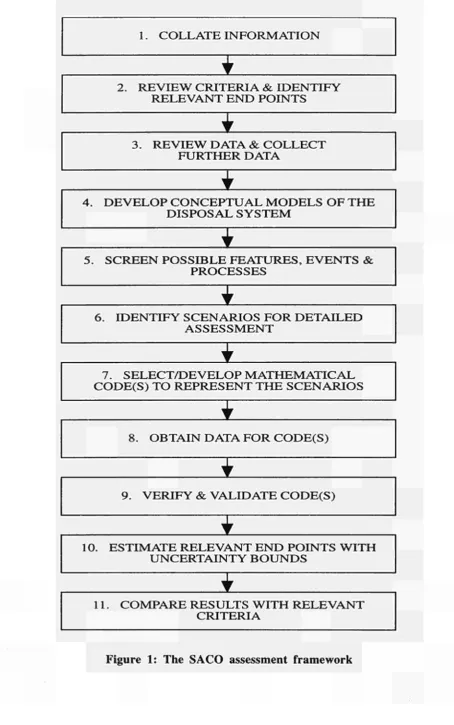
During 1994 the extension to the project, which involved the further development and testing of the Safety Assessment Comparison (SACO) framework (Figure 1), has been completed.
Progress and results
C.l Enhancing the Assessment Framework (B.5.Ì
In Phases 2 and 3 of the initial project, the SACO methodology was developed and tested. In light of this work, the aim of Phase 4 was to develop and enhance the SACO methodology further. The following tasks were undertaken and have been reported in III, 121,131.
• Task 1 - Generic information, which could be used to support the SACO methodology, especially Steps 1, 2, 3 and 8, in cases where site-specific data are scarce, were identified and collated. Such information related to technical data on: the wastes (eg contaminant concentrations in different waste types, solubilities of contaminants under different Eh and pH conditions, waste densities, waste porosities, and waste hydraulic conductivities); the disposal facilities (eg hydraulic conductivities, porosities and life expectancies of engineered barriers); the geosphere (eg hydraulic conductivities, porosities, dispersivities and contaminant sorption coefficients for different geological media); the biosphere (eg contaminant sorption coefficients for different surface environments, sediment and water transfers, human and animal intake/activity data, and subchronic and chronic contaminant toxicity levels for humans); regulatory and other criteria which affect assessment objectives (eg performance of engineering barriers, Environmental Quality Standards for contaminant concentrations in media such as groundwater and surface water, and dose/risk levels for humans).
• Task 2 - Procedures to aid scenario analysis in Steps 5 and 6 of the SACO methodology were developed and enhanced. For example, the simple scoping calculations used under Phase 2 to make preliminary assessments of the impacts of waste disposals on groundwater were extended to allow the screening of other scenarios, such as human intrusion and gas generation.
• Task 3 - Version 1.0 of the SACO assessment code was reviewed and Version 2.0 produced. The code application was made more user friendly, the representation of processes considered in the code enhanced, and certain new features from the original list of processes identified under Phase 2 of the original project were incorporated. Key enhancements were:
• modularisation of the code to allow independent running of the geosphere and biosphere components of the code;
• development of links to software packages such as SPSS and Lotus; • development of simplified source term models;
C.2 Testing the Enhanced Assessment Framework (B.6.Ì
The aim of Phase 5 was to continue the SACO test programme using data from shallow and deep disposal systems, and uranium mill tailings. In particular, the following tasks were undertaken and have been reported in I Al, 151.
• Task 1 Collation of sitespecific data from appropriate sources for the assessment of the SACO methodology (generic data were be collated under Task 1 of Phase 4). During Phase 3, budgetary and temporal restrictions meant that it was not possible to apply the SACO methodology to real sites in entirely realistic situations. For Phase 5, where possible, the methodology was applied to real examples from the disposal of toxic and radioactive waste. In addition, tests based upon data from international intercomparison exercises were continued to be used. Such tests allowed the comparison of results from the SACO assessment code with those from other assessment codes.
• Task 2 Testing of the SACO methodology. The data collected in Task 1 of Phases 4 and 5 were used to test the SACO methodology and assessment code, especially the modifications made in Phase 4.
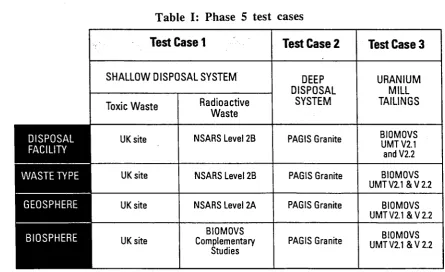
The tests undertaken during Phase 5 are summarised in Table I and below.
• Shallow Disposal The disposal of radioactive and toxic waste to shallow facilities was considered. The radioactive disposal case was based primarily on the continuing NearSurface Radioactive Waste Disposal Safety Assessment Reliability Study (NSARS) programme /6/, 111, whilst data based on a site in the United Kingdom (UK) were used for the disposal of toxic waste 181,191.
• Deep Disposal The disposal of radioactive waste to an engineered deep facility was considered. The facility, geosphere and biosphere were based on the granite option of the study concerned with the Performance Assessment of Geological Isolation Systems for Radioactive Waste (PAGIS) /IO/, lì il.
• Uranium Mill Tailings Disposals to mill tailings of wastes which pose a radioactive hazard is assessed. Data from the real site considered in the V2.1 and V2.2 scenarios of the Uranium Mill Tailings Working Group of the Biosphere Model Validation (BIOMOVS) study were used for the test case /12/, /13Λ
Illustrative results from the application of the SACO framework are given in Figures 24. The testing of the SACO framework during Phases 3 and 5 of the project has shown that:
it is applicable to all waste types;
it is applicable to shallow and deep disposal facilities; it is applicable to varying levels of data availability;
it has a range of possible end points, including barrier performance, environmental quality standards, and human health risks;
Indeed, the framework is now being used in a CEC funded investigation into the derivation of illustrative disposal limits for the toxic, nonradioactive component of low level and exemptible radioactive wastes /14/.
List of publications
LITTLE, R.H., TORRES, C , TOWLER, P.A., SIMÓN, I. and AGÜERO Α., The Analysis of the Long Term Environmental Impact of Landfills using the Safety Assessment Comparison (SACO) Methodology. Paper to be presented at SARDINIA '95, the Fifth International Landfill Symposium, Sardinia, 2 6 October 1995.
TOWLER, P.A., SIMÓN, I., CLARK, K.J. and WATKINS, B.M., Application of the Safety Assessment Comparison Methodology (SACO) to Deep Disposal Systems for Radioactive and Toxic Wastes. Paper to be presented at SARDINIA '95, the Fifth International Landfill Symposium, Sardinia, 2 6 October 1995.
LITTLE, R.H. and TORRES, C , The Development of a Methodology for the Safety Assessment of Radioactive and Toxic Waste Disposals. Paper presented at the 16th USDoE LowLevel Radioactive Waste Management Conference, Phoenix, 1315 December 1994. SIMÓN, I., TORRES, C , AGÜERO A. and LITTLE, R.H., Evaluación de un Almacenamiento Superficial de Residuos Radiactivos y Tóxicos con la Metodologia SACO. Paper presented at the Fifth Congress of the Spanish Radioloigical Protection Society, Santiago de Compostela, 2629 April 1994.
AGÜERO Α., SIMÓN, I. And TORRES, C , Evaluación Ambiental de Diques de Estériles de Uranio con la Metodologia SACO Participación en Ejercicios Internacionales. Paper presented at the Fifth Congress of the Spanish Radioloigical Protection Society, Santiago de Compostela, 2629 April 1994.
SMITH, G.M., LITTLE, R .H., TORRES, C. and SIMÓN, I., Coherent and Consistent Decision Making for Mixed Hazardous Waste Management: The Application of Quantitative Assessment Techniques. Waste Management 94. Tuscon, 27 February 3 March 1994, Proceedings Vol 2, pp 11731177.
LITTLE, R.H., GROGAN, H.A, SMITH, G.M. and TORRES, C , Land Disposal Practices in Europe and North America. J. Inst. Water and Env. Man. 7, 354362.
LITTLE, R.H., TORRES, C , CHARLES, D., GROGAN, H.A., SIMÓN, I., SMITH, G.M., SUMERLING, T.J. and WATKINS, B.M., PostDisposal Safety Assessment of Toxic and Radioactive Waste: Waste Types, Disposal Practices, Disposal Criteria, Assessment Methods, and Postdisposal Impacts. EUR 14627 (1993).
LITTLE, R.H., TORRES, C , SIMÓN, I. and SMITH, G.M., Quantitative Assessment and Its Relevance to Waste Disposal. International Conference on Environmental Pollution, Sitges (Barcelona), 28 September 1 October 1993. Proceedings Vol 2, pp 525532.
References
III INTERA and IMA/CIEMAT, Intera Report IE273211 (Version 1.0) (1995) 111 INTERA and IMA/CIEMAT, Intera Report IE273212 (Version 1.0) (1995) 131 INTERA and IMA/CIEMAT, Intera Report Œ273213 (Version 1.0) ( 1995) 141 INTERA and IMA/CIEMAT, Intera Report EE273214 (Version 1.0) ( 1995) 151 INTERA and ΓΜΑ/CIEMAT, Intera Report ΓΕ273215 (Version 1.0) ( 1995)
16/ IAEA, Coordinated Research Programme on the Safety Assessment of Nearsurface Radioactive Waste Disposal Facilities (NSARS). Specifications for Test Case 2A (1992).
ΠI IAEA, Coordinated Research Programme on the Safety Assessment of Nearsurface Radioactive Waste Disposal Facilities (NSARS). Specification for Test Case 2B (1993).
/8/ PALMER, C. and YOUNG, P.J,, Protecting Water Resources from the Effects of Landfill Sites: Foxhall Landfill Site. J. Inst, of Water and Env. Man.. 5, 682696. 191 PALMER, C. and YOUNG, P.J., Leachate Contamination from Closed Landfills '
Predicting the Impacts. In New Developments in Landfill. Proceedings of the 1992 Harwell Waste Management Symposium. UK Atomic Energy Authority, AEA Environment and Energy, pp 6582.
110/ CADELLI, N., COTTONE, G., ORLOWSKI, S., BERTOZZI, G , GIRARDI, F. and SALTELLI, Α., PAGIS (Performance Assessment of Geological Isolation Systems for Radioactive Waste) Summary. EUR 11775 EN (1988).
IUI VAN KOTE, F., PERES, J.M., OLIVIER, M., LEWI, J., ASSOULINE, M. and MEJONGOULA, M.J., PAGIS (Performance Assessment of Geological Isolation Systems for Radioactive Waste): Enfouissement dans des Formations Granitiques. EURI 1777 FR (1988).
/12/ BIOMOVS, BIOMOVS II Uranium Mill Tailings Working Group Scenario Description Version 2.1 (FinalRevised), November 1994. SSI, Stockholm (1994). /13/ BIOMOVS, BIOMOVS II Uranium Mill Tailings Working Group Scenario
Description Version 2.2, February 1995. SSI, Stockholm (1995).
/14/ CLARK, K.J., SCHALLER, K.H., LITTLE, R.H., MAUL, P.R., TOWLER, P.A., and WATKINS, B.M., An Illustration of the Application of Radioactive Waste Disposal Assessment Methods to Mixed Waste Disposals. Paper to be presented at the Third Biennial Mixed Waste Symposium, Baltimore, 7 1 1 August 1995.
Table I: Phase 5 test cases
DISPOSAL FACILITY
WASTE TYPE
GEOSPHERE
Test Case 1
SHALLOW DISPOSAL SYSTEM
Toxic Waste UK site UK site UK site Radioactive Waste
NSARS Level 2B
NSARS Level 2B
NSARS Level 2A
Test Case 2
DEEP DISPOSAL SYSTEM PAGIS Granite PAGIS Granite PAGIS Granite
Test Case 3
[image:29.595.67.513.471.743.2]1. COLLATE INFORMATION
2. REVIEW CRITERIA & IDENTIFY RELEVANT END POINTS
3. REVIEW DATA & COLLECT FURTHER DATA
4. DEVELOP CONCEPTUAL MODELS O F T H E DISPOSAL SYSTEM
5. SCREEN POSSIBLE FEATURES, EVENTS & PROCESSES
6. IDENTIFY SCENARIOS FOR DETAILED ASSESSMENT
7. SELECT/DEVELOP MATHEMATICAL CODE(S) TO REPRESENT T H E SCENARIOS
8. OBTAIN DATA FOR CODE(S)
9. VERIFY & VALIDATE CODE(S)
10. ESTIMATE RELEVANT END POINTS W I T H UNCERTAINTY B O U N D S
[image:30.595.67.522.33.759.2]l.OE+0 τ
l.OE-1
Total Intake (mg y') l.OE-2
1.0E-3
1.0E-4
-* »rtk AA A-* AA A
►—Mercury l— Cadmium —A—Zinc
[image:31.595.61.544.40.697.2]0 200 400 600 800 1000 1200 1400 1600 1800 2000 Time (y)
Figure 2: Heavy metal intakes from the shallow toxic waste disposal test case
l.OE-5 χ
1.0E-6
1.0E-7
Dose i.OE-8
(Svy1)
1.0E-9
1.0E-10
1.0E-11 i 1 1 1 1
-0.0E+0 5.0E+5 1.0E+6 1.5E+6 2.0E+6 2.5E+6 3.0E+6 3.5E+6 4.0E+6 4.5E+6 5.0E+6
Time (y)
l.OE-8 τ
l.OE-9
l.OE-10
Lifetime Additional
Cancer Risks
l.OE-11
l.OE-12
1.0E-13
1.0E-14 ■
1.0E-15
►-U-238 i-Th-230 -A-Ra-226
[image:32.595.41.549.34.791.2]0 500 1000 1500 2000 2500 3000 3500 4000 4500 5000 Time (y)
Title: Disposal of Radioactive Waste and Toxic Waste in Underground Repositories
Contractor: GSF-Forschungszentrum für Umwelt und Gesundheit, GmbH; Stichting Energieonderzoek Centrum Nederland
(ECN)
Contract No: FI2W-CT90-0061 Duration of contract: March 1991 - June 1994 Period covered: January 1994 - June 1994
Project Leaders: Th. Brasser (GSF - Coordinator); A. van Dalen (ECN)
A. OBJECTIVES AND SCOPE
The initial objective of a mutual research project between GSF and ECN is to delineate the statutory boundary conditions pertaining to an underground emplacement of hazardous wastes. At the same time the wastes of relevance to disposal are to be characterized according to type, composition, origin, toxicity, and volume, while taking the particularities of the situation in both countries into due consideration. Assumed potential hazards to the environment emanating from disposal are to be assessed on the basis of these data. The current strategies for an underground storage of hazardous wastes are described and compared with the concepts for the final disposal of radioactive wastes. Reference is taken to the special R&D topics of final disposal, such as the selection of the host rock, investigation of the geomechanical and hydrogeologicai situation, transport methods, backfilling and sealing techniques as well as the more complex subjects, such as the spreading of toxic agents and the safety analysis. This mutual project is to combine the basic knowledge of the repository concepts for the disposal of radioactive and hazardous wastes.
B. WORK PROGRAMME
B. 1 Consideration of legal stipulations for the underground disposal of toxic wastes, based on the aims, requirements, techniques and safety concepts of radioactive waste disposal.
B.2 Description of the types of waste, their composition, origin, toxicity and assessment of their potential hazards to the environment emanating from the emplacement.
B.3 Description of strategies for underground disposal of toxic wastes and comparison with the concepts for radioactive waste disposal.
C. PROGRESS OF WORK AND OBTAINED RESULTS
With the completion of the study in June 1994 the final report has been submitted to the Commission. Its main results are compiled in the
following.
In the Federal Republic of Germany the concept of nonretrievable and, in the postoperational phase, surveillance-free disposal in deep geological formations is being pursued in conjunction with the disposal of radioactive
wastes. This concept has been implemented for some thirty years in the form
of R&D programmes, technical development projects, and site investigations.
The approval procedure is currently in progress for a final repository for non heat-producing radioactive wastes in the former Konrad iron ore mine. A, further final repository - especially for heat-generating, high radioactive wastes - is currently undergoing exploration in the Gorleben salt dome. Since 1st July 1990, the "Final Repository for
Radioactive Wastes at Morsleben" (ERAM), has held the legal status of a
national final repository in conformance with the Law Relating to Nuclear Energy. Site approval had already been granted to the former German Democratic Republic in 1972, and approval was granted for sustained operation in 1981 and 1986. In the Asse research mine, techniques and methods of investigation for the disposal of radioactive wastes are under development.
In the Netherlands the disposal of radioactive wastes in salt formations has been under investigation for about twenty years. The final report on the initial phase of the Netherlands research programme on geological disposal of radioactive wastes in salt formations (OPLA) has recently been published. Since in situ investigations have hitherto not been feasible in the Netherlands, the research programme of the GSF in the experimental Asse mine has become the object of close cooperation and participation. A three-year follow-up programme for OPLA is currently in preparation.
Underground deposition of chemical-toxic wastes, partially with the proviso of retrievability, is already in progress for particular types of wastes in various mines in the Federal Republic of Germany. On the one hand, such measures are implemented in compliance with the laws relating to waste disposal; on the other hand, mining law may also be applicable under certain conditions, for instance, in conjunction with the underground re-utilization of residues as backfilling materials. Since 1991 a "Technical Regulation Relating to Storage, Chemical/Physical, Biological Treatment, Incineration, and Deposition of Hazardous Wastes" (TA Abfall) has become effective as a supplement to the Waste Disposal Act; underground deposition in salt rock is thereby treated with a series of regulations, too. Besides the existing facilities a number of conceptions and pending approval procedures are currently in progress.
In the Netherlands a growing tendency in favour of underground deposition of certain categories of chemical-toxic wastes can be observed at present. If a waste disposal concept of this kind can be realized, however, it will be feasible only with a guarantee of waste retrievability from a present-day standpoint.
For the Netherlands section of the joint research project the consequences of the retrievability requirement are the object of special consideration. This implies that the associated projects are based exclusively on the mine concept. In contrast, final repository concepts for both mines and caverns are being pursued in the Federal Republic of Germany.
Within the scope of the joint research project by GSF and ECN, the general legal conditions for underground deposition of chemical-toxic
wastes are first determined - on the basis of the objectives, requirements,
techniques, and safety concepts in connection with the disposal of
radioactive wastes (chapter 1) . Subsequently, the types of wastes relevant
to underground deposition are classified in accordance with type, composition, and quantity, and the differences between the situation in the
Federal Republic of Germany and that in the Netherlands are described
(chapter 2). On this basis the present concepts for underground deposition
of chemical-toxic wastes are indicated and compared with the concepts for'
the disposal of radioactive wastes (chapter 3). These concepts are referred to the major R&D objectives in the field of radioactive waste disposal, such as selection of the host rock, investigation of the geomechanical and hydrogeological conditions, transport, backfilling, and sealing techniques, as well as the complex topics of pollutant propagation and safety analysis
(chapter 4) . This joint venture should provide a summary of fundamental understanding of final repository concepts for radioactive wastes, on the one hand, and chemical-toxic wastes, on the other hand. On the basis of the clearly defined relationship between final repository costs and recycling, general economic aspects of underground deposition are also presented.
The study has been conducted by both contractual partners, GSF (for the area of the Federal Republic of Germany) and ECN (for the area of the
Netherlands). The two institutions have been cooperating for quite some
time in the field of radioactive waste disposal, both bilaterally and within the scope of programmes of the European Union. The present project is designed for D - NL information transfer on a broad basis, which can later be extended to further member countries of the European Union.
The Commission of the European Union has supported the performance of the present study within the framework of its R&D programme, "Disposal of
Radioactive Wastes", coordinated the work within the scope of this
programme, and participated in financing.
C. 1 Legal principles
The legal principles for underground deposition in the Federal
Republic of Germany as well as in the Netherlands are first summarized.
Existing laws, ordinances, guidelines, bodies of regulations, etc., as well as those in planning or preparation, are thereby taken as basis, and a distinction is made between radioactive and chemical-toxic wastes. By means of a comparison, different trial solutions or features in common, especially with respect to the basic objectives and safety criteria, are indicated.
As a matter of principle, the disposal of radioactive wastes in the
Federal Republik of Germany is governed by nuclear energy law, and the
have subsequently been enacted by the Community, especially for protecting the population and employees against ionizing radiation. Regulatory instructions for such tasks as the disposal of radioactive wastes are not included in EC law; these are determined by the laws of the respective member countries. This was implemented in German federal law concerning
radioactive waste with the enactment of the Atomic Act and the Radiation Protection Ordinance. Since 1974 a technical concept for the disposal of these wastes has been available to the German Federal Government.
The development of laws relating to wastes, including the legal basis for waste disposal (that is, e.g. for chemical-toxic wastes), has proceded quite differently. The fundamental system of contracts at the European level is the Agreement on the Establishment of the European Economic Community concluded in 1957. In German federal law, legal regulations relating to waste disposal were not proposed until long after this time, particularly because of the question of competency between the German Federal Government and the Federal States. In 1971, the German Federal Government passed a draught law relating to the disposal of waste materials. In contrast, a modern waste disposal law has existed only since 1986. The Law Relating to the Avoidance, Recycling and Disposal of Wastes will become effective in 1996 at the earliest. A Technical Regulation (TA Abfall), which has existed since 1991, is among other points an administrative specification for ensuring environmentally compatible waste disposal in the Federal Republic of Germany in the future. It comprises regulations for storage, chemical/physical and biological treatment, incineration, and disposal of chemical-toxic wastes. A further Technical Regulation relating to municipial wastes (TA Siedlungsabfall) includes requirements on recycling, treatment, and disposal of those wastes in accordance with the state of the art, as necessary for avoiding impairment of general well-being.
The legal regulations pertaining to the disposal of radioactive wastes and those pertaining to the disposal of chemical-toxic wastes are thus based on mutually independent fields of law. The disposal of
radioactive wastes is governed by nuclear energy law, whereas the disposal of chemical-toxic wastes is governed by the waste act. In spite of these differences in the development of nuclear energy law and waste disposal law all the way to differences in the selection of the terms and designations in the laws and ordinances, essential agreements are evident in the implementation of the concepts. Project evaluation and examination of environmental compatibility are specified in both fields of law. Residues which cannot be recycled at the present state of technology or for economic reasons require disposal as wastes in an orderly manner. Limiting values for appraising environmental compatibility are anchored in the Law Relating to Nuclear Energy; in the case of chemical-toxic waste disposal, however, reference must be made to other legal fields in environmental law. The Water Resources Act is applicable in both fields of law and constitutes a part of the project evaluation procedure or results in independent water rights proceedings.
In the Netherlands the last few years the legislator published laws and regulations and revised older laws in order to have a systematic view on regulation of the environment. The General Law on Environment Mangement has to cover all parts describing and regulating influences of human activities on the environment. Concerning wastes produced in society the most urgent subject was regulated first the last year: the law on landfill disposal in relation to soil protection. Related to the degree of isolation of the landfill from the environment non-chemical and low toxic chemical waste may be disposed.
The important part of the system of environmental hazardous
{chemical-toxic) waste, the new name after repeal of the Chemical Waste Act, is the leachability of toxic compounds. The system of waste classification for disposal purposes based on leachability is used in practise for nearby a decade, but the introduction into the legislation is still not made.
Legislation for deep underground disposal is not available in the
Netherlands; the Mine Law allows only to bring down materials in direct relation to the mining. For the technical and economical conditions of waste disposal in a salt formation the legal conditions are important. The evolution in legislation for Environment Management has been used in this report to formulate the main conditions for deep underground disposal:
- waste disposal becomes a private enterprise, economic profit is a consequence,
in principle the wastes disposed underground are retrievable,
competent authorities have to control the obeyance of the legal conditions,
at the end of the operational phase or end of the license the mine has to be closed with the guarantee of safety to the environment.
No decision has been taken for the final disposal of radioactive waste, agreed in an interim storage for 50 to 100 years.
C.2 Characterization of wastes
The types of wastes in question for underground deposition or disposal in compliance with the present regulations are classified with respect to type, composition, and quantity. In the case of radioactive wastes the existing data for the final repositories in operation or in the planning stage can be employed in the Federal Republic of Germany. Since
much less knowledge is available in the case of chemical-toxic wastes,
exemplary analyses are performed on relevant types of wastes for better classification of these wastes, since the appraisal of the long-term behaviour of wastes in an underground repository requires thorough
knowledge of all components of the wastes as well as their potential behaviour upon release under the conditions of deposition. This applies to
radioactive wastes as well as chemical-toxic wastes.
Classification with respect to types of wastes, are established largely in accordance with national regulations. An international specification in analogy with the IAEO Classification is the objective of current endeavours.
The mass content of radioactive nuclides as referred to the accompanying materials in radioactive wastes is very low, especially for wastes with negligible heat generation as well as for conditioned wastes. The radionuclides are associated with a high mass content of accompanying materials which, as a rule, are known (conditioning products, among other items) and whose toxicity is low or zero.
Chemical-toxic wastes are subject to surveillance by the authorities of the German Federal States, in most cases only after declaration as wastes or as residues. The characterization of wastes first requires reference to the description by the waste proprietor; in addition, however, waste analyses must be performed by the waste producer or disposer. The analyses are then performed in conformance with known codes of practice or standard methods. But in many cases the usual or specified methods of analysis do not allow a complete characterization of wastes. Consequently, the best-suited analytical technique must first be assigned to each type of waste; as a rule, more detailed analyses are then necessary for improving the overall balance. Furthermore, no universally applicable bodies of regulations exist for the qualitative classification of the concentration ranges determined for components of waste materials. Upon investigation of the leaching behaviour under conditions of deposition, even wastes with identical waste code numbers exhibit decidedly different characteristics. Hence, the assignment of waste materials to an underground repository - as well as of residues for underground backfilling measures - is feasible only conditionally on the basis of waste disposal instructions (such as TA Abfall); instead, the assignment must be site-specific and waste-specific.
In the Netherlands radioactive wastes are considered unsuitable for aboveground disposal, the classification is based on the interim storage. Shielding of radiation and removal of decay heat are the main items for the classification. The data collection of radioactive wastes received and to be accepted in the near future is related to the actual nuclear power of the two power stations, and the wastes from radioactive material users.
For chemical waste classification the description is given of the leach procedure resulting in low toxic chemical waste and non-chemical waste suitable for landfill disposal. Provisional definitions for high
toxic and medium toxic chemical waste are: not suitable for aboveground disposal, and disposal in a facility showing no or negligible release to the environment respectively.
The data collection of chemical wastes in the Netherlands published yearly is according to this system (C-l, C-2, and C-3 wastes). The declaration of the wastes according to the Chemical Waste Act is considered
fairly accurate and complete. Some large volume wastes not included in the data collection are problematic because other useful destinations have not been found e.g. jarosite from zinc, and gypsum from phosphate fertilizer production.
C.3 Final repository concepts
The concepts hitherto available or in preparation, as well as the previous practice of underground disposal of radioactive wastes, or deposition of chemical-toxic wastes, are summarized. This indicates a concentration on salt deposits, which are considered predominantly for waste disposal purposes in the Federal Republic of Germany, and exclusively for this purpose in the Netherlands. Moreover, the mine concept is considered specially from the standpoint of retrievability in the
Netherlands.
The objective of protection relating to the final deposition of
radioactive wastes or the deposition of chemical-toxic has received a
comparable formulation in the Federal Republic of Germany. Thus, the formulation of the objective of protection in the "Safety Criteria for the Final Deposition of Radioactive Wastes in a Mine" is as follows: "The final deposition of radioactive wastes in mines shall ensure the protection of man and environment against damage by ionizing radiation from these wastes. For achieving this objective, certain requirements shall be satisfied." In the TA Abfall, "Special Requirements on Underground Repositories in Salt Rock", the following principle is formulated: "In the deposition of wastes in underground facilities in salt rock, the wastes shall be permanently isolated from the biosphere."
The successive priority of avoidance, recycling, deposition, or final deposition, that is, the demand that no wastes be produced if at all possible, and that unavoidable wastes be recycled, is anchored in nuclear energy law as well as in the waste act. If neither of these options -avoidance or recycling - is feasible, the objective of protection just mentioned requires deposition of chemical-toxic wastes or the final deposition of radioactive wastes. The requirements on final deposition of
radioactive wastes as well as the deposition of chemical-toxic wastes
mutually concur as far as essential features are concerned. In both approval procedures for construction and operation, an examination of the environmental compatibility as well as a project evaluation procedure with public participation are prerequisites. In both cases also the concrete location must be investigated.
A conceptual component for the disposal of radioactive wastes as well
as chemical-toxic wastes is underground deposition. Exclusively mined
underground cavities are intended for the final deposition of radioactive
wastes, and shall be operated as final repository mines (e.g. chambers,
drifts, and under some circumstances large boreholes). In addition to mines, caverns are available for the deposition of chemical-toxic wastes,
especially for bulk wastes. The so-called salt concept, that is, the construction of a final repository in salt rock (for instance, Zechstein salt), is thereby pursued with priority. In principle, however, other formations may also serve as host rock. An example is the former Konrad iron ore mine, which is intended for use as a final repository for low and medium radioactive wastes.
The conditioning of raw radioactive wastes is an important component step in the disposal of these wastes. Conditioning represents a further technical barrier which imparts the necessary consistency to the wastes and decidedly decreases the release of activity in the event of leaching. In the case of conditioning of chemical-toxic wastes for deposition in underground repositories, questions of transport engineering or stability are of primary importance. For the final deposition of radioactive wastes,
Containers is not mandatory for the deposition of chemical-toxic wastes;
however, containers are probably necessary for handling in a final repository mine and are therefore demanded by operators in several cases as a rule.
Wastes are transported through a shaft into the mine. In a final repository, the wastes are transported by means of special vehicles. They are transported into a cavern by bulk conveyance or hydraulic conveyance. The deposition techniques for waste containers are independent of the type of waste. Well known and proved methods include the stacking and tipping techniques. Containerless deposition is at present envisaged only for the disposal of chemical-toxic wastes in caverns. After the shut-down of an underground repository, sealing measures are necessary; these measures always include plugging of the shaft. Moreover, residual cavities possibly present in the area surrounding the wastes should be backfilled, and dams must be constructed in the underground tunnel system.
Based on recent historical data (1992) in the Netherlands an annual toxic waste quantity in excess of 180,000 tons is deposited at various sites (excluding some 300,000 tons of contaminated soil). For the purpose of this study an annual amount of 165,500 tons has been assumed to be available at a considerable length of time for underground storage. This storage has been planned in a salt dome in a retrievable manner which influences design parameters. The mine has been developed using a highly mechanised method in order to obtain a continuous operation.
Based on a system of defining cost centres and activities, a bottom-up approach to determine the cost of the mine has been employed. Recent costs for storage have been used to obtain probable revenue. These have been transferred on a proper time scale with the aid of a project planning program from which ultimately a cash flow could be derived. The value of the mine and its internal rate of return follow from the cash flow. The net present value of the project at a discount rate of 15 per cent amounts to a negative Nig 111 million in January 1995 money terms. The internal rate of return of the project is 8.6 per cent. Although the operating margin of the mine is high (75 per cent) the long lead time of 10 years has a major influence on the return of the project. Which internal rate of return is acceptable to this project is a matter of judgement. Compared with what is common in the mineral industries and regarding the risk of this project a minimum return of 15 per cent is required. Therefore it can be concluded that the project within these constraints is not financially attractive.
It is clear from the analysis that to construct a mine for 30000 tons of CI and C2 waste only will reduce the net present value and the internal rate of return and is therefore less attractive. To combine the storage of
chemical-toxic waste with low and middle radioactive waste will probably
enhance the return of the project. This will be the case when the increased investment during the construction of the mine (in e.g. separate storage halls and waste treatment facilities) and increased operating costs (in e.g. underground storage requirements and safety arrangements) will be small compared to the increase in revenue of storing nuclear waste.
Especially the aspects of nature and quantity of chemical-toxic waste
and its suitability for underground storage as well as requirements of the retrievability concept are recommended for further analysis in order to increase the knowledge and understanding of underground storage of
C.4 R&D transfer
The major research and development projects hitherto executed, currently implemented, or in preparation in the field of radioactive waste
disposal are classified with respect to their objectives, results, and possible relevance to the underground deposition of chemical-toxic wastes.
Furthermore, special emphasis is placed on those topics from research on final repositories for radioactive wastes which may be of importance for the future conception and realization of underground deposition of
chemical-toxic wastes. A requirement for research and development on underground deposition of chemical-toxic wastes which results from this comparison is formulated and explained. Finally, the possibilities of information transfer from the radioactive to the chemical-toxic field are indicated; hence, the results of the study may also be of interest to countries of the European Union without, or with only minor utilization of nuclear energy.
Research and development projects on the final deposition of
radioactive wastes have been in progress in the Federal Republic of Germany
for more than thirty years. In this work special emphasis has been placed on waste characterization, release behaviour, conditioning, final repository engineering, safety of final repositories, as well as site-specific investigations and associated matters. The performance and coordination of the investigations were concentrated in the field of activity of major research institutions as well as universities and industry.
In the field of deposition of chemical-toxic wastes research and development projects have been in progress on a large scale only for a few years. The major subjects of research are comparable with those for the final deposition of radioactive wastes. The present demand for research is especially high in the fields of waste characterization and release behaviour as well as the associated matters of geotechnical stability,
safety during the operational phase, as well as long-term safety.
On the basis of the previous research in the field of final deposition of radioactive wastes, R&D transfer is feasible in nearly all major fields of research. Consequently, the decided separation between the
final deposition of radioactive wastes and the deposition of chemical-toxic wastes is no longer present in the field of research policy. In some major fields of research, the formulation of the research demand is referred in the same manner to both radioactive and chemical-toxic wastes but, the extent of the necessary projects for the final deposition of radioactive
wastes or chemical-toxic wastes will differ.
For waste disposal in a salt formation of both radioactive waste and
chemical-toxic waste no existing facility is available in the Netherlands.
In this way the problems are the same, thus the main parts of efforts already produced to calculate the conditions for a safe disposal of
radioactive waste can be applied to chemical-toxic waste disposal. The
equivalent of heat producing high active nuclear waste is not present in the chemical waste collection, meaning that disposal in deep boreholes for
For radioactive waste it has been decided in the Netherlands that above ground disposal is not suitable, for chemical-toxic waste such a decision has only been taken for high toxic C-l wastes. The amount of C-l wastes is by far too small (500-1000 tons per year) to think about a mined deep underground disposal. The much higher amount of wastes used in this study originates from economic reasoning to have incentives for mining by a private company.
The safety assessment studied for non-heat producing radioactive
waste in the PACOMA contract is very useful to study chemical-toxic waste
analog. The processes used for the description of the effects in the host rock and surroundings are the same. The studies on the effects of mixed wastes are important for the risk calculations of the chemical components.
The economics of waste disposal underground will have a large influence on the decision to perform the action of mining or not: the enterprise has to be a private one, and thus have a net profit. The conditions for underground disposal have still to be formulated; a law permitting waste disposal in the deep underground is not existing in the
Netherlands. For radioactive waste the decision of how and where to dispose
has been postponed for 50 to 100 years, for chemical-toxic waste such an action is not possible in view of the number of large interim storage facilities to be build.


![Figure 7: Dissolution rate (μ% d"1 cm'2) versus H2C>2 concentration, reference [Shoesmith and Sunder 1992]](https://thumb-us.123doks.com/thumbv2/123dok_us/7752113.167698/173.595.60.525.56.499/figure-dissolution-rate-versus-concentration-reference-shoesmith-sunder.webp)