Concord grape juice, cognitive function, and driving performance:
a 12-wk, placebo-controlled, randomized crossover trial in mothers
of preteen children
1Daniel J Lamport,2Clare L Lawton,2Natasha Merat,3Hamish Jamson,3Kyriaki Myrissa,2Denise Hofman,2 Helen K Chadwick,2Frits Quadt,4JoLynne D Wightman,5and Louise Dye2*
2
School of Psychology and3Institute for Transport Studies, University of Leeds, Leeds, United Kingdom;4Quadt Consultancy BV, Schiedam, Netherlands; and5Welch Foods Inc., Concord, MA
ABSTRACT
Background: Daily consumption of Concord grape juice (CGJ) over 3–4 mo has been shown to improve memory function in adults with mild cognitive impairment and reduce blood pressure in hy-pertensive adults. These benefits likely result from the high concen-tration of polyphenols in CGJ. Increased stress can impair cognitive function and elevate blood pressure. Thus, we examined the poten-tial beneficial effect of CGJ in individuals with somewhat stressful and demanding lifestyles.
Objective:We sought to examine the effects of the daily consump-tion of CGJ for 12 wk on cognitive funcconsump-tion, driving performance, and blood pressure in healthy, middle-aged working mothers.
Design:Twenty-five healthy mothers (aged 40–50 y) of preteen children who were employed for$30 h/wk consumed 12 ounces (355 mL) of either CGJ (containing 777 mg total polyphenols) or an energy-, taste-, and appearance-matched placebo daily for 12 wk according to a randomized crossover design with a 4-wk washout. Verbal and spatial memory, executive function, atten-tion, blood pressure, and mood were assessed at baseline and at 6 and 12 wk. Immediately after the cognitive battery, a sub-sample of 17 women completed a driving performance assess-ment at the University of Leeds Driving Simulator. The 25-min driving task required participants to match the speed and di-rection of a lead vehicle.
Results: Significant improvements in immediate spatial memory and driving performance were observed after CGJ relative to pla-cebo. There was evidence of an enduring effect of CGJ such that participants who received CGJ in arm 1 maintained better perfor-mance in the placebo arm.
Conclusions: Cognitive benefits associated with the long-term consumption of flavonoid-rich grape juice are not exclusive to adults with mild cognitive impairment. Moreover, these cogni-tive benefits are apparent in complex everyday tasks such as driving. Effects may persist beyond the cessation of flavonoid consumption, and future studies should carefully consider the length of washout within crossover designs. This trial was regis-tered at clinicaltrials.gov as NCT01411631. Am J Clin Nutrdoi: 10.3945/ajcn.115.114553.
Keywords: cognitive function, driving, flavonoids, grape juice, polyphenols, cognition, anthocyanins, memory
INTRODUCTION
Systematic reviews have suggested that the consumption of polyphenol-rich foods and drinks such as grape juice, blueberries, and cocoa are associated with cognitive benefits in humans (1). Concord grape juice (CGJ)6 is a rich source of polyphenols, particularly flavonoids such as proanthocyanidins and anthocy-anins, which have been postulated to positively affect cognitive function by a variety of mechanisms, including the inhibition of neuroinflammation (2), and inducing neurogenesis and synaptic plasticity (3). Improved verbal learning and reduced semantic interference on memory tasks in older adults with mild cognitive impairment were reported after consuming CGJ daily for 12 and 16 wk (4, 5). Evidence for underlying mechanisms comes from blueberry supplementation studies in aged (18 mo old) rats, in which the increased activation of cAMP response element binding protein led to higher hippocampal concentrations of brain-derived neurotrophic factor. An accompanying benefit to spatial working memory was observed after 3–12 wk of sup-plementation (6). Enhanced vascular physiology in the brain such as improved cerebral blood flow has been observed in humans after the consumption of cocoa flavonols (7, 8). It is proposed that such effects are mediated by the enhanced endo-thelial function and increased bioavailability of nitric oxide (9, 10). Increased activation in the right-middle prefrontal and right superior parietal cortical regions with use of fMRI was observed in adults with mild cognitive impairment after CGJ consumption
1Supported by Welch Foods Inc. This is a free access article, distributed
under terms (http://www.nutrition.org/publications/guidelines-and-policies/ license/) that permit unrestricted noncommercial use, distribution, and re-production in any medium, provided the original work is properly cited.
*To whom correspondence should be addressed. E-mail: [email protected].
Received May 5, 2015. Accepted December 31, 2015. doi: 10.3945/ajcn.115.114553.
6
Abbreviations used: AICc, Aikake information criterion; CGJ, Concord grape juice; EAT-26, Eating Attitudes Test 26; HFS, high-frequency compo-nent of steering; PSS, Perceived Stress Scale; RVIP, rapid visual information processing; SDLP, SD of lane position; STAI, State-Trait Anxiety Inventory; STREV, steering reversal rate; TETtLC2, time-to-line crossing,2 s; TtLc, time-to-line crossing; VSLT, visual spatial learning test; VVLT, visual verbal learning test.
Am J Clin Nutrdoi: 10.3945/ajcn.115.114553. Printed in USA.Ó2016 American Society for Nutrition 1 of 9
AJCN. First published ahead of print February 10, 2016 as doi: 10.3945/ajcn.115.114553.
enhanced cerebral blood flow. Endothelial and nitric oxide pathways are implicated in the beneficial effects on cardiovas-cular outcomes induced by CGJ and other polyphenol-rich foods and drinks (11, 12).
The allostatic load model describes how chronic stress, car-diovascular disease, and associated risk factors can lead to a cascade of physiological and psychological consequences, such as cognitive impairment (13–15). Individuals experiencing ele-vated levels of daily stress may therefore be particularly re-sponsive to the benefits of consuming polyphenol-rich foods and drinks such as CGJ, as supported by animal models (16). We recruited a healthy cohort of working mothers with preteen children who reported experiencing a psychologically de-manding and potentially stressful lifestyle and thus might benefit from long-term polyphenol consumption. Although it is impor-tant to consider the effects on specific cognitive domains reflecting particular neurological processes, the ecological validity, i.e., the extent to which performance on a battery of cognitive tests is related to everyday cognitive tasks, is also important (17). Driving is a highly ecological behavior requiring a multitude of complex processes encompassing all cognitive domains. Psychologically stressed individuals are more vulner-able to driving errors because of an overload of attentional re-sources (18). It is therefore of interest to examine whether dietary polyphenol-based interventions can affect performance on everyday tasks such as driving, which can be assessed in a controlled laboratory environment. This study examined per-formance on several cognitive domains shown to be sensitive to berry polyphenol consumption (1) in addition to longitudinal and lateral tracking tasks within an immersive driving environ-ment with use of a state-of-the-art driving simulator.
METHODS
Design
CGJ or a placebo was consumed daily for 12 wk according to a double-blind, randomized crossover design. Previous data in-dicate that consuming CGJ daily for 12 wk is a sufficient duration for detecting cognitive benefits (4). Participants were assigned to 1 of 2 orders (CGJ then placebo or placebo then CGJ) according to a counterbalanced randomization schedule prepared by an independent statistician. Outcome variables were assessed at baseline (before drink consumption) and at 6 and 12 wk (after daily consumption). Each arm was separated by a 4-wk washout.
Treatment drinks
The 12-ounce (355-mL) daily servings of CGJ and placebo were matched for energy (233 kcal), appearance, taste, volume (355 mL), carbohydrate content (59.5 g), and all sugars (54 g). The CGJ contained 777 mg total polyphenolics as a gallic acid equivalent/355-mL daily serving (167 mg anthocyanins as malvidin equivalent and 334 mg proanthocyanidins as catechin equivalent). Vitamin C was not present in either CGJ or placebo. Total polyphenol concentration was determined by the Folin-Ciocalteu procedure (19). Anthocyanins were determined by a spectrophotometric procedure (20). Proanthocyanidins were determined by normal-phase HPLC after solid-phase extraction of the juice with a Sephadex LH-20 (Sigma-Aldrich) (21, 22).
The daily dosage was selected after evaluating previous research showing that a 12-ounce daily dose of CGJ containing 740 mg total polyphenolics over 12 wk is sufficient to detect cognitive benefits (4). Both drinks were analyzed and prepared by Welch Foods Inc. and refrigerated at 1–58C until distributed to the participants, who were instructed to keep the juice refrigerated. To ensure double blinding, the CGJ and placebo were labeled with a 3-letter code by Welch Foods. The code was revealed to the experimenters upon completion of the analysis. Both drinks underwent standard microbiological and safety testing by Welch Foods. To examine the equivalence of taste, participants re-sponded to how pleasant they found the drink on a 10-cm Likert scale after consumption at each visit.
Participants
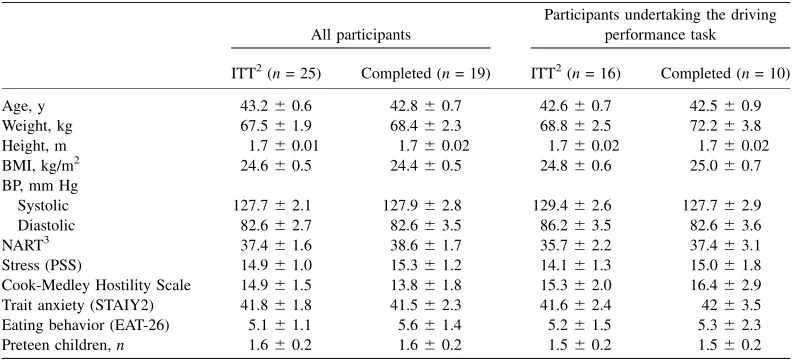
Twenty-five working mothers were recruited from Leeds, United Kingdom and the surrounding area. The inclusion criteria were as follows: aged 40–50 y, at least 1 child aged,13 y, BMI (in kg/m2) of 18–29, works$30 h/wk, adequate understanding of verbal and written English, possession of a full driving license for.5 y, and having driven.5000 miles in the past year. Ex-clusion criteria were smoking, self-reported menopausal symp-toms, working night shifts, pregnant or planning pregnancy in the next 6 mo, consuming.3 portions of fruit and vegetables/d, vegetarian, current or history of eating disorder [.20 on the Eating Attitudes Test 26 (EAT-26) (23)], and any current illness or disease. The following additional exclusion criteria were re-quired for the driving performance subsample: epilepsy, claus-trophobia, fear of heights, and severe motion sickness. All eligible participants completed a screening test drive in the driving simulator and were familiarized with the cognitive test battery and other measures before randomization. This required completing a full version of the cognitive battery. Twenty-five participants started arm 1. Two participants withdrew after completing the first arm (both completed the placebo arm), neither of whom gave a reason for withdrawal. An additional 4 participants withdrew during the second arm (CGJ:n= 3; pla-cebo: n = 1). Of these 4 withdrawals, 1 reported depression (CGJ), and 3 reported they no longer wanted to drink the juice. Therefore, 25 participants completed the first arm, and 19 completed both arms. Of the 25 initial recruits, 17 met the driving simulator inclusion/exclusion criteria. Cognitive per-formance was the primary outcome measure; therefore, partic-ipants who failed the driving simulator screening were retained, and data were collected for all other outcome measures. Of the 17 participants who passed the driving simulator screening, 1 was excluded for not complying with the driving task. Of the remaining 16 participants, driving performance data for both arms were available for 11 (because, as described previously, 5 participants withdrew during arm 2). Participant characteristics at screening are shown inTable 1.
Cognitive function
Grooved Pegboard (psychomotor skill) (Lafayette Instrument Co.), Tower of Hanoi (executive function), and VVLT and VSLT delayed recall. Equivalent versions of each test were incorporated in a counterbalanced order across the 6 cognitive test sessions, and the order in which the tests occurred within the cognitive test battery remained constant across all administrations.
The VVLT is a visual analog of the Rey Auditory-Verbal Learning Test (24). Three trials of 16 words (list A) were presented in a random sequence on a computer screen at the rate of 1 word every 2 s. At the end of each trial, participants were instructed to verbally recall as many of the words as possible in a free-recall task over 1 min (trials A1–A3). Trial A3 was followed by a pre-sentation of a 16-word interference list (list B) and a subsequent free recall of these words over 1 min (trial B1). A 1-min free recall of list A without presentation immediately succeeded this task (trial A4). Outcome variables were the mean number of words recalled over trials A1–A3, retroactive interference (A3 and A4), and proactive interference (A1–B1). Delayed memory was assessed 30 min after the initial presentation of the test.
The VSLT (25) is a test of visuospatial memory and learning. The original version of the test was designed as an assessment of de-mentia and involves 5 trials. However, to avoid ceiling effects in this sample without dementia only, 3 trials were administered. At each identical trial, participants were given 10 s to observe the image and location of 7 abstract patterns placed on 534 grid. The task was to correctly choose the 7 target patterns from a choice of 15 and place them on the correct locations on the grid. The outcome variable was the number of correct targets placed in the correct location per trial (maximum of 7). Delayed VSLT performance was assessed 30 min after the test was initially presented.
The RVIP involved a presentation of a series of single digits at a rate of 600 ms with a 600-ms interstimulus interval. The task lasted for 6 min with 100 stimuli/1-minute block and 5 odd and 5 even targets within each block. Target sequences were 3 consec-utively presented odd or even numbers that required participants to press the spacebar as quickly as possible. Outcome variables were
the number of correctly identified sequences, the number of false-positive responses, and reaction time for correct responses.
The Grooved Pegboard (26) assesses manual dexterity and is a test of psychomotor skill. The apparatus consists of a board with 25 holes and 35 identical pegs. The pegs have a groove down one side. Participants were asked to fill the holes with pegs in a specified order as quickly as possible and completed the task with their dominant hand followed by their nondominant hand. The outcome variable was completion time to fill the board with pegs (averaged across both hands).
The Tower of Hanoi (27) is a test of planning ability that is considered an exemplar measure of executive function. A computerized version was administered that consisted of a visual representation of 3 rods on which 4 discs of different size and color were placed. The target formation of discs on the rods was at the top of the screen, and the starting formation was at the bottom. The aim of the task was to rearrange the discs on the starting formation rods to match the target formation in the fewest possible moves. There was only 1 correct sequence of moves for each trial. This was the fewest number of moves required to match the target formation. If the participant deviated from the correct sequence, the screen refreshed to the original starting formation. There was one rule: a disc could not be placed on a disc that was larger than itself; such moves were not recorded as errors because the program would not allow it. At the outset, the screen informed the participant of the number of moves required to complete a trial. There were 10 trials/test administration that consisted of 2 trials for each of the 5 levels of 4, 5, 6, 7, and 8 moves. Level 4 trials consisted of a sequence of 4 blocks, level 5 consisted of a sequence of 5 blocks, and so on. There were 2 outcome variables: number of errors made and completion time.
Blood pressure and subjective mood
[image:3.585.95.494.77.258.2]Resting systolic and diastolic blood pressure were measured with an Omron M7 ambulatory blood pressure monitor.
TABLE 1
Participant characteristics at baseline1
All participants
Participants undertaking the driving performance task
ITT2(n= 25) Completed (n= 19) ITT2(n= 16) Completed (n= 10)
Age, y 43.260.6 42.860.7 42.660.7 42.560.9 Weight, kg 67.561.9 68.462.3 68.862.5 72.263.8 Height, m 1.760.01 1.760.02 1.760.02 1.760.02 BMI, kg/m2 24.660.5 24.460.5 24.860.6 25.060.7 BP, mm Hg
Systolic 127.762.1 127.962.8 129.462.6 127.762.9 Diastolic 82.662.7 82.663.5 86.263.5 82.663.6 NART3 37.461.6 38.661.7 35.762.2 37.463.1
Stress (PSS) 14.961.0 15.361.2 14.161.3 15.061.8 Cook-Medley Hostility Scale 14.961.5 13.861.8 15.362.0 16.462.9 Trait anxiety (STAIY2) 41.861.8 41.562.3 41.662.4 4263.5 Eating behavior (EAT-26) 5.161.1 5.661.4 5.261.5 5.362.3 Preteen children,n 1.660.2 1.660.2 1.560.2 1.560.2
1Values are means 6SEs. BP, blood pressure; EAT-26, Eating Attitudes Test 26; ITT, intention to treat; NART,
National Adult Reading Test; PSS, Perceived Stress Scale; STAIY2, State-Trait Anxiety Inventory Y2.
Measurements were taken after participants rested their left upper arm for 15 min, and the mean of 3 consecutive measurements was calculated. Subjective mood was assessed with use of pen-and-paper 100-mm visual analog scales with questions relating to hunger, fullness, contentedness, irritability, sleepiness, mental alertness, ability to concentrate, and energy with anchors for each: “not at all” and “very.” Subjective stress was assessed with the Perceived Stress Scale (PSS), and anxiety was assessed with use of the short State-Trait Anxiety Inventory (STAI) 6-item form MSTAIY6 (28, 29).
Driving performance
A 25-min virtual driving scenario of car following and lane keeping was choreographed at the University of Leeds Advanced Driving Simulator. The high-fidelity simulator consists of a Jaguar S-type vehicle, a 4-m-diameter spherical projection dome that houses an 11-channel display system covering a forward field of view of 2708and large amplitude, and an 8 degree-of-freedom electrical motion system with 5 m of effective travel in surge and sway. Driving performance was assessed by 2 tasks: lon-gitudinal and lateral. The lonlon-gitudinal and lateral tasks were performed concurrently.
The longitudinal task required participants to follow a lead vehicle at a safe and constant distance. The lead vehicle adjusted its speed in a smooth fashion matching a 60-s period sine wave
with a maximum speed of 60 mph (w97 km/h) and minimum
speed of 40 mph (w64 km/h) until 5 cycles of the sine wave
were completed (a driving distance of w7 km). The drive
consisted of sections of straight and curved road. The curved sections were alternate bends to the left and right with a radius of 750 m and a length of 252 m. There were 3 independent variables for the longitudinal task: coherence, phase shift, and modulus (30). Coherence, a measure of correlation of the 2 speed cycles, indicates the accuracy of the participant’s speed adjustments to meet the main longitudinal tracking task re-quirement to maintain a consistent following distance. Co-herence can range from 0 (no coCo-herence between the 2 cycles) to 1 (perfect coherence). Phase shift measures the delay between the change in the lead vehicle’s speed and the subsequent re-sponse (akin to a delay in rere-sponse). Modulus is an amplification factor between the 2 signals, expressed as the amplitude gain; if the participant overreacts to the lead vehicle’s speed changes, the modulus will be larger than 1. Data were analyzed for the final four of five 5-min sine wave cycles; the first cycle allowed the participant time to settle into the task.
The lateral task required participants to maintain a constant position in the driving lane. There were 4 outcome measures for the lateral task: SD of lane position (SDLP), time-to-line crossing (TtLC), steering reversal rate (STREV), and high-frequency component of steering (HFS). The SDLP measured the variation in lane position. TtLC was defined as the time to cross either lane boundary with any of the wheels of the vehicle. Therefore, as the vehicle approached the edge of the road, TtLC decreased. A TtLC,2 s was the threshold for close proximity to exiting the lane boundary (31). A TtLC,2 s is termed TETtLC2. The total time of exposure during which TETtLC2 occurred was mea-sured. Therefore, TETtLC2 defined the duration for which the participant was driving in close proximity to the lane boundary. STREV was the number of changes in steering wheel direction/min
(an angle of 18is required to qualify as a reversal). A higher STREV indicated higher difficulty in achieving accurate track-ing. HFS reflected the number of steering corrections. Increased corrections indicated erratic, reactive driving as opposed to having a strong awareness of the road ahead, which is associated with predictive steering and fewer corrections (32).
Procedure
Inclusion and exclusion criteria were checked at a screening session that took place at the University of Leeds Human Ap-petite Research Unit (as did all test days and procedures, not-withstanding the driving simulator procedures, which took place at the University of Leeds Advanced Driving Simulator). Screening included a recruitment information questionnaire (assessing general health), a measure of eating behavior (EAT-26), the National Adult Reading Test (33), baseline PSS, a measure of hostility (Cook-Medley Hostility Scale) (34), and a measure of baseline trait anxiety (STAIY2) (29). Height, weight, and blood pressure were measured, and familiarization versions of the cognitive battery and driving performance task were completed. Participants were informed that consumption of the following polyphenol-rich drinks were not permitted for the duration of the study, including the 4-wk washout: red wine, grape juice (notwithstanding the treatment drink), or any dark fruit juices. A minimum of 1 wk separated the screening visit and test day 1. The day before each test day, participants refrained from exercise and alcohol consumption after 1700 and were told to consume an evening meal of their choice before 2100. The meal was standardized across all test days (within participants) to control for the cognitive effects of the second meal (35). Par-ticipants fasted (except for water) from 2100. All test days commenced between 0730 and 1000. Data were collected in the following order: weight, mood 1 (visual analog scale), stress (PSS), anxiety (MSTAIY6), and blood pressure. The treatment drink was then consumed within 15 min followed by mood 2 and the commencement of the cognitive battery. Mood 3 was assessed upon completion of the cognitive battery, and participants were escorted to the Institute for Transport Studies to commence the driving performance task. Immediately before and after the driving task, moods 4 and 5 were assessed. The total time for the test day was approximately 2 h. To monitor compliance, participants were required to return bottle tops from the con-sumed drinks to the Human Appetite Research Unit on a weekly basis and to complete a daily drink diary detailing the time of consumption. Compliance was high; 22 participants reported 100% compliance, and all participants except 1 exceeded 90% compliance (at least 75 d recorded). The lowest compliance was 76% (64 of 84 d recorded). Participants received a£160 hono-rarium upon completion of the study or pro rata for withdrawals. The University of Leeds School of Psychology Research Ethics Committee reviewed the procedures and awarded a favorable opinion for conduct. Recruitment commenced in January 2011 and ended in June 2012.
Statistical analysis
driving performance). Within-subject ANCOVAs were per-formed to examine the effects of condition (CGJ/placebo) and visit [day 1 (baseline) and 6 and 12 wk] nested within the study phase (arm 1/arm 2) on all outcome variables. Covariates were age, IQ (National Adult Reading Test), subjective stress (PSS), psychological hostility (Cook-Medley Hostility Scale), anxiety (STAIY2), and eating behavior (EAT-26), all of which were assessed during screening (see Procedure section).
All main effects and their interactions were requested in the first model, and all covariates were included. Nonsignificant interactions with covariates were removed first, and the analysis was rerun. Nonsignificant covariates and higher-order in-teractions of fixed factors were then removed. The resulting model was compared with the previous model with use of the McQuarrie and Tsai Aikake information criterion (AICc) (36). The AICc gives an indication of the amount of remaining un-explained variance after the model has been fitted, in which a smaller AICc value indicates a better model. If an improvement in model fit was found, other nonsignificant effects were re-moved, and again the AICc was used to evaluate the model fit. Models were chosen on the basis of best fit, and interaction terms that improved the fit were retained. The reported ANCOVAs are the best fit (i.e., lowest AICc) models adjusted for significant covariates. Tukey-Kramer post hoc tests were employed to follow up significant main effects or interactions, and thePvalues re-ported are adjusted for multiple comparisons. Analyses were performed with SAS version 9.3 (SAS Institute). All residuals were screened, and outliers were removed.
RESULTS
Drink characteristics
The ANCOVA for pleasantness data showed no significant main effects or interactions, indicating equivalence of taste. Upon completion of both arms, 12 of 19 (63%) participants identified CGJ as the active drink, which was not significantly different to chance according to a 1-samplettest (t= 1.16;df= 18;P= 0.26).
Cognitive performance
Verbal recall
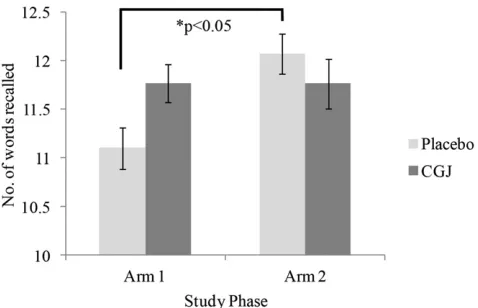
VVLT immediate recall averaged over the first 3 trials (A1– A3) showed a significant condition 3 study phase interaction [F(1, 20) = 4.61; P,0.05]. As shown inFigure 1, post hoc tests revealed that this interaction was specific to the placebo condition, whereby recall was better when the placebo was consumed in arm 2 relative to arm 1 (P,0.05). This indicates an initial benefit of the CGJ in arm 1 that endured until arm 2 when the placebo was consumed. No significant effects were observed for retroactive, proactive interference, or delayed VVLT recall (Table 2).
Spatial recall
VSLT immediate recall showed a significant main effect of condition [F(1, 22) = 5.58;P,0.05] such that recall (total over 3 trials) was higher after CGJ (mean: 12.72 items; SE: 0.39) relative to placebo (mean: 12.57 items; SE: 0.36). Immediate and delayed VSLT recall were significantly higher in arm 2 relative to arm 1, as indicated by a main effect of study phase
[immediateF(1, 21) = 12.8,P,0.01; delayedF(1, 17) = 5.24,
P,0.05].
Psychomotor skill
Completion time for the Grooved Pegboard showed a significant condition3study phase interaction [F(1, 21) = 9.61;P,0.01]. Post hoc tests revealed that the completion time in arm 1 was significantly faster for the placebo (mean: 60.4 s; SE: 1.9 s) rel-ative to CGJ (mean: 63.2 s; SE: 2.3 s) (P,0.05), whereas no difference was observed between the 2 drink conditions in arm 2.
Executive function
TOH completion time showed a significant condition3study phase interaction [F(1, 21) = 14.12; P , 0.01]. As shown in
Figure 2, post hoc tests revealed that the completion time was significantly faster for the CGJ relative to the placebo in arm 1 (P,0.01), whereas this difference was not significant in arm 2. A main effect of study phase was observed for the number of errors [F(1, 21) = 5.27;P,0.05] such that fewer errors were made in arm 2 (mean: 3.6 errors; SE: 0.6) relative to arm 1 (mean: 6 er-rors; SE: 1.1). No significant effects were observed for reaction time, correctly identified targets, or false positives on the RVIP (Table 2).
Driving performance
Longitudinal tracking task (car following)
Analysis of coherence revealed that the main effect of con-dition was significant [F(1, 11) = 4.64;P= 0.05] such that car following was more accurate during CGJ (mean correlation: 0.97; SE: 0.01) relative to placebo (mean correlation: 0.96; SE: 0.01). Similarly, the main effect of condition approached significance for phase-shift analysis [F(1, 11) = 4.26;P= 0.06] such that CGJ was associated with a quicker driver response to changes in the lead vehicle speed (CGJ mean: 3.54 s; SE: 0.54) (placebo mean: 4.13 s; SE: 0.64). Finally, an analysis of mod-ulus revealed a main effect of study phase [F(1, 10) = 6.67;P,
[image:5.585.304.543.52.206.2]0.05] such that performance was better (less overshoot) in arm 1
(mean amplitude gain: 1.1; SE: 0.03) relative to arm 2 (mean amplitude gain: 1.14; SE: 0.03).
Lateral tracking
A significant condition 3 study phase interaction was ob-served for steering reversals [F(1, 10) = 16.73;P,0.01] such that during arm 1 steering control was more stable (fewer steering reversals) for the CGJ condition, whereas steering control during arm 2 was more stable for the placebo condition (although post hoc tests did not reach significance; seeFigure 3). No significant effects were observed for time-to-line crossing
(TETtLC2), lane position (SDLP), or the high-frequency com-ponent of steering (HFS).
Subjective outcomes and blood pressure
[image:6.585.41.551.76.396.2]Contentedness was significantly higher in arm 1 (mean: 64; SE: 2.6) relative to arm 2 (mean: 60; SE: 2.5) as indicated by a main effect of study phase [F(1, 21) = 5.35; P , 0.05]. Alertness and concentration were significantly higher for par-ticipants who consumed CGJ in arm 1 (mean: 58 and 60 and SE: 3.6 and 3.7, respectively) relative to participants who consumed
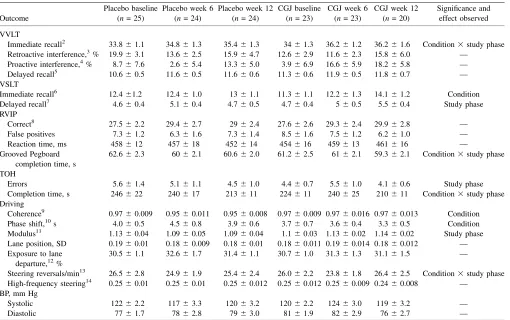
TABLE 2
Scores for each cognitive test outcome, driving performance, and blood pressure at each test visit by condition1
Outcome
Placebo baseline (n= 25)
Placebo week 6 (n= 24)
Placebo week 12 (n= 24)
CGJ baseline (n= 23)
CGJ week 6 (n= 23)
CGJ week 12 (n= 20)
Significance and effect observed
VVLT
Immediate recall2 33.861.1 34.861.3 35.461.3 3461.3 36.261.2 36.261.6 Condition3study phase Retroactive interference,3% 19.963.1 13.662.5 15.964.7 12.662.9 11.662.3 15.866.0 —
Proactive interference,4% 8.767.6 2.665.4 13.365.0 3.966.9 16.665.9 18.265.8 —
Delayed recall5 10.660.5 11.660.5 11.660.6 11.360.6 11.960.5 11.860.7 —
VSLT
Immediate recall6 12.461.2 12.461.0 1361.1 11.361.1 12.261.3 14.161.2 Condition
Delayed recall7 4.660.4 5.160.4 4.760.5 4.760.4 560.5 5.560.4 Study phase
RVIP
Correct8 27.562.2 29.462.7 2962.4 27.662.6 29.362.4 29.962.8 — False positives 7.361.2 6.361.6 7.361.4 8.561.6 7.561.2 6.261.0 — Reaction time, ms 458612 457618 452614 454616 459613 461616 — Grooved Pegboard
completion time, s
62.662.3 6062.1 60.662.0 61.262.5 6162.1 59.362.1 Condition3study phase
TOH
Errors 5.661.4 5.161.1 4.561.0 4.460.7 5.561.0 4.160.6 Study phase Completion time, s 246622 240617 213611 224611 240625 210611 Condition3study phase Driving
Coherence9 0.9760.009 0.9560.011 0.9560.008 0.9760.009 0.9760.016 0.9760.013 Condition Phase shift,10s 4.060.5 4.560.8 3.960.6 3.760.7 3.660.4 3.360.5 Condition
Modulus11 1.1360.04 1.0960.05 1.0960.04 1.160.03 1.1360.02 1.1460.02 Study phase
Lane position, SD 0.1960.01 0.1860.009 0.1860.01 0.1860.011 0.1960.014 0.1860.012 — Exposure to lane
departure,12%
30.561.1 32.661.7 31.461.1 30.761.0 31.361.3 31.161.5 —
Steering reversals/min13 26.562.8 24.961.9 25.462.4 26.062.2 23.861.8 26.462.5 Condition3study phase
High-frequency steering14 0.2560.01 0.2560.01 0.2560.012 0.2560.012 0.2560.009 0.2460.008 —
BP, mm Hg
Systolic 12262.2 11763.3 12063.2 12062.2 12463.0 11963.2 — Diastolic 7761.7 7862.8 7963.0 8161.9 8262.9 7662.7 —
1Values are means6SEs unless otherwise indicated.P,0.05 for all significance and effects observed (except for phase shift, which wasP= 0.06). BP,
blood pressure; CGJ, Concord grape juice; RVIP, rapid visual information processing; TOH, Tower of Hanoi; VSLT, visual spatial learning test; VVLT, visual verbal learning test.
2Sum of A1–A3.
3Number of words recalled during trial A32words recalled during A4 as a percentage of the number of words recalled during A3. 4Number of words recalled during trial A12words recalled during B1 as a percentage of the number of words recalled during A1. 5
Maximum possible score of 16.
6
Sum of 3 trials.
7
Maximum possible score of 7.
8
Maximum possible score of 60.
9
Coherence is a correlation between the speed cycle of the participant and the lead vehicle ranging from 0 (no coherence between the 2 cycles) to 1 (perfect coherence).
10
Phase shift measures the delay between the change in the lead vehicle’s speed and the subsequent response by the participant. A lower score indicates better performance.
11
If the participant overreacts to the lead vehicle’s speed changes, the modulus will be.1.
12
Exposure to imminent lane departure (also known as time-to-line crossing).
13
Driving steering reversals (number of changes in steering wheel direction per minute).
CGJ in arm 2 (mean: 53 and 56 and SE: 3.4 and 3.3, re-spectively; bothP , 0.05), as indicated by significant condi-tion 3study phase interactions [F(1, 21) = 19.45;P, 0.001 andF(1, 21) = 24.98;P,0.0001, respectively]. A significant condition3study phase interaction was also observed for stress ratings [F(1, 21) = 4.86; P , 0.05]; however, post hoc tests failed to reach significance. There were no other significant ef-fects of interest for the subjective mood outcomes or either di-astolic or systolic blood pressure (Table 2).
DISCUSSION
CGJ was associated with better immediate spatial memory and 2 aspects of driving performance in this sample of healthy working mothers (aged 40–50 y) of preteen children relative to a placebo. Previous interventions that demonstrated the benefits of CGJ have been performed exclusively in older adults with mild cognitive impairment (4, 5); thus, this is the first study to our knowledge to demonstrate cognitive benefits after CGJ in healthy middle-aged adults. Combined with another recent study that showed that executive function and memory improvements after the consumption of flavanone-rich orange juice (37), these results indicate that cognitive benefits achieved from regular daily flavonoid consumption are not exclusive to adults ex-hibiting cognitive decline or neurodegenerative disease. More-over, long-term consumption of CGJ was associated with a reduced phase shift in car following, which was comparable to a quicker reaction time to unfolding traffic events. This was evidenced by increased steering accuracy in combination with a faster response time to changes in lead vehicle behavior during car following. The observed effects would account for a re-duction in stopping distance ofw11 m at the speeds driven (40– 60 mph;w64–97 km/h), which is an important safety benefit. Thus, the cognitive effects of long-term CGJ consumption translate into meaningful outcomes on everyday tasks.
The observed subtle benefit for spatial memory is consistent with the literature on rodents (6, 38) and several other polyphenol interventions in humans. It has been proposed that memory function is particularly susceptible to potential mechanisms that
underlie the association between flavonoids and cognitive ben-efits (3), possibly because the hippocampus is a region where flavonoids and their metabolites seem capable of exerting their actions (6, 38). In support of this proposal, improved performance of a spatial recognition task and increased activation with use of fMRI was seen in the dentate gyrus (a subregion of the hippo-campus) in healthy older adults after consuming flavonol-rich cocoa for 3 mo (7).
[image:7.585.43.285.53.213.2]The consistent interaction between drink condition and study phase in this study over a number of cognitive outcomes suggests enduring effects of CGJ after the cessation of consumption. Specifically, benefits for verbal recall, executive function, and lateral tracking associated with CGJ consumption in arm 1 persisted into the second arm when the placebo was consumed. Similar enduring effects were recently reported after 8 wk of consumption of flavanone-rich orange juice after a 4-wk washout on tests of executive function and memory (37). These enduring effects may signify that polyphenols cause relatively stable physiologic effects that do not dissipate rapidly after withdrawal from the diet. This has implications for determining a suitable washout period between treatments; 4 wk may not be sufficient in flavonoid interventions. It is also noteworthy that persistent main effects of study phase revealed performance was significantly better during the second arm regardless of the drink consumed (e.g., immediate and delayed spatial memory, executive function). This indicates practice effects, whereby participants improved over time. Given that cognitive benefits in healthy populations are likely to be small (17), it is crucial that potential practice effects are considered by including study phase and drink order within statistical models examining cognitive effects of flavonoid in-terventions. This study phase effect was not exclusive to objective cognitive outcomes; higher ratings of alertness and concentration were reported during the first arm relative to the second arm (albeit only for the CGJ condition). It is perhaps not surprising that the alertness and conscientiousness of participants may decline over the course of a 28-wk trial, and it is entirely pos-sible that these subjective effects have an impact on cognitive performance (39). This possibility further emphasizes the
FIGURE 2 Tower of Hanoi completion time (s) for each condition and study phase (means6SEs). The condition3study phase interaction was significant [F(1, 21) = 14.12;P,0.01]. Post hoc tests revealed that com-pletion time was significantly faster for the CGJ (n = 14) relative to the placebo for arm 1 (n= 15;P,0.01). This difference was not significant for arm 2. Placebo arm 1,n= 15; CGJ arm 1,n= 14; placebo arm 2,n= 10; and CGJ arm 2,n= 9. CGJ, Concord grape juice.
[image:7.585.303.542.502.650.2]importance of considering order effects in long-term in-terventions. Previous studies that reported strong effects of CGJ on immediate verbal memory (4) and spatial recognition (5) adopted a parallel group design in which order effects were avoided.
The data from this study show that grape flavonoids may improve performance on everyday tasks; safer driving behavior was observed after the CGJ relative to the placebo, as indicated by characteristics such as a faster response to the lead vehicle. The potential for flavonoid-rich diets to have a small but im-portant impact on cognitive tasks such as driving should not be overlooked, and future research should consider effects on other ecologically valid everyday tasks throughout the lifespan. Acute benefits of flavonoid consumption for the peripheral vascular system in the immediate postprandial period are well documented (10). Several studies have shown improvements in endothelial function in patients with heart disease after grape juice supple-mentation (40, 41); however, our data did not show any long-term effects of CGJ on blood pressure. This could be a function of the population; the sample of healthy middle-aged women did not have high blood pressure at the outset; therefore, the potential for a relatively short dietary intervention to have a meaningful impact is limited.
It is important to point out that during this 28-wk trial par-ticipants did not abstain from all dietary sources of anthocyanins and other polyphenols. The specific restrictions included red wine, dark fruit juice, and any other grape juice. It is possible that the participants consumed other sources of polyphenols that may have masked the effectiveness of the treatment drink. However, high habitual polyphenol consumers were likely to have been captured by the exclusion criterion of.3 portions of fruit and vegetables/d, and it is unlikely that the habitual diets of the participants would have varied substantially between the 2 arms of the study. A strength of our data is its generalizability; effects were observed regardless of any variability in habitual poly-phenol intake and in the context of the participants’ normal diets. Future studies should assess habitual intake with food diary records together with urinary measures of biomarkers and metabolites, which also provide evidence of treatment compli-ance. Finally, in light of the observed carryover effects, re-searchers should consider incorporating a suitable washout period before commencing similar polyphenol interventions (and between arms) to reduce the effects of habitual polyphenol intake, thus allowing a more sensitive assessment of the in-tervention. Habitual dietary polyphenol intake before trial commencement and during the trial could account for some of the variance indicated by the condition 3study phase in-teraction for verbal recall.
In summary, consumption of CGJ for 12 wk was associated with subtle improvements in immediate spatial memory and safer driving behavior relative to the placebo in this sample of healthy working mothers (aged 40–50 y) of preteen children aged. This is the first study to our knowledge to demonstrate the benefits of CGJ in healthy adults on domain-specific and ev-eryday cognitive tasks such as driving. However, it is important to acknowledge that there were no effects on most cognitive outcomes; in addition, there was evidence for enduring flavonoid effects such that when CGJ was consumed during the first arm some of the associated benefits persisted into the second arm when the placebo was consumed. Furthermore, practice effects
were observed such that performance was generally better during the second arm regardless of condition. The combi-nation of the enduring and practice effects may have masked some of the potential effects of the CGJ, particularly in this healthy middle-aged sample in which the effects of nutritional interventions are likely to be small. These findings have clear implications for the design of future crossover interven-tions and indicate that the cognitive effects of CGJ are not exclusive to older adults and adults with neurodegenerative disease. Future studies should seek to explore the strength and length of cognitive effects after the cessation of flavonoid supplementation.
The authors’ responsibilities were as follows—DJL, CLL, NM, HJ, JDW, and LD: designed the research and edited the manuscript; DJL, KM, DH, and HKC: collected the data; FQ: analyzed the data; DJL: prepared the manuscript; and all authors: read and approved the final version of the manuscript. JDW is an employee of Welch Foods Inc. None of the other authors reported a conflict of interest.
REFERENCES
1. Lamport DJ, Dye L, Wightman JD, Lawton CL. The effects of flavo-noid and other polyphenol consumption on cognitive performance: a systematic research review of human experimental and epidemio-logical studies. J Nutr Health Aging 2012;1:5–25.
2. Spencer JPE, Vafeiadou K, Williams RJ, Vauzour D. Neuro-inflammation: modulation by flavonoids and mechanisms of action. Mol Aspects Med 2012;33:83–97.
3. Spencer JPE. Beyond antioxidants: the cellular and molecular in-teractions of flavonoids and how these underpin their actions on the brain. Proc Nutr Soc 2010;69:244–60.
4. Krikorian R, Nash TA, Shidler MD, Shukitt-Hale B, Joseph JA. Con-cord grape juice supplementation improves memory function in older adults with mild cognitive impairment. Br J Nutr 2010;103:730–4. 5. Krikorian R, Boespflug EL, Fleck DE, Stein AL, Wightman JD, Shidler
MD, Sadat-Hossieny S. Concord grape juice supplementation and neurocognitive function in human aging. J Agric Food Chem 2012;60: 5736–42.
6. Williams CM, El Mohsen MA, Vauzour D, Butler LT, Ellis JA, Whiteman M, Spencer JPE. Blueberry-induced changes in spatial working memory correlate with changes in hippocampal CREB phosphorylation and BDNF levels. Free Radic Biol Med 2008;45: 295–305.
7. Brickman AM, Khan UA, Provenzano FA, Yeung L-K, Suzuki W, Schroeter H, Wall M, Sloan RP, Small SA. Enhancing dentate gyrus function with dietary flavanols improves cognition in older adults. Nat Neurosci 2014;17:1798–803.
8. Francis ST, Head K, Morris PG, Macdonald IA. The effect of flavanol-rich cocoa on the fMRI response to a cognitive task in healthy young people. J Cardiovasc Pharmacol 2006;47:S215–20.
9. Fisher ND, Hollenberg NK. Aging and vascular responses to flavanol-rich cocoa. J Hypertens 2006;24:1575–80.
10. Schroeter H, Heiss C, Balzer J, Kleinbongard P, Keen CL, Hollenberg NK, Sies H, Kwik-Uribe C, Schmitz HH, Kelm M. (2)-Epicatechin mediates beneficial effects of flavanol-rich cocoa on vascular function in humans. Proc Natl Acad Sci USA 2006;103:1024–9.
11. Wightman JD, Heuberger RA. Effect of grape and other berries on cardiovascular health. J Sci Food Agric 2015;8:1584–97.
12. Barona J, Blesso CN, Anderson CJ, Youngki P, Lee J, Fernandez ML. Grape consumption increases anti-inflammatory markers and upregu-lates peripheral nitric oxide synthase in the absence of dyslipidemias in men with metabolic syndrome. Nutrients 2012;4:1945–57.
13. McEwen BS, Sapolsky RM. Stress and cognitive function. Curr Opin Neurobiol 1995;5:205–16.
14. McEwen BS. Stress and hippocampal plasticity. Annu Rev Neurosci 1999;22:105–22.
16. Patki G, Allam FH, Atrooz F, Dao AT, Solanki N, Chugh G, Asghar M, Jafri F, Bohat R, Alkadhi KA, et al. Grape powder intake prevents overiectomy-induced anxiety behaviour, memory impairment and high blood pressure in female Wistar rats. PLoS One 2013;8:e74522. 17. de Jager CA, Dye L, de Bruin EA, Butler L, Fletcher J, Lamport DJ,
Latulippe ME, Spencer JPE, Wesnes K. Cognitive function: criteria for validation and selction of cognitive tests for investigating the effects of foods and nutrients. Nutr Rev 2014;72:162–79.
18. Matthews G, Sparkes TJ, Bygrave HM. Stress, attentional overload and simulated driving performance. Hum Perform 1996;9:77–101. 19. Singleton VL, Rossi JA. Colorimetry of total phenolics with
phosphomolybdic-phosphotungstic acid reagents. Am J Enol Vitic 1965;16:144–58. 20. Niketic-Alesksic GK, Hrazdina G. Quantitative analysis of the
antho-cyanin content in grape juices and wines. Lebenson Wiss Technol 1972;5:163–5.
21. Adamson GE, Lazarus SA, Mitchell AE, Prior RL, Cao G, Jacobs PH, Kremers BG, Hammerstone JF, Rucker RB, Ritter KA, et al. HPLC method for the quantification of procyanidins in cocoa and chocoloate samples and correlation to total antioxidant capacity. J Agric Food Chem 1999;47:4184–4188.
22. Gu L, Kelm M, Hammerstone JF, Beecher G, Cunningham D, Vannozzi S, Prior RL. Fractionation of polymeric procyanidins from lowbush blueberry and quantification of procyanidins in selected foods with an optimized normal-phase HPLC-MS fluorescent detection method. J Agric Food Chem 2002;50:4852–60.
23. Garner DM, Garfinkel PE. The eating attitudes test: an index of the symptoms of anorexia nervosa. Psychol Med 1979;9:273–9. 24. Rey A. L’examen clinique en psychologie. [Clinical examination in
psychology.] Paris: Presses Universitaires de France; 1964 (in French). 25. Malec JF, Ivnik RJ, Smith GE. Visual spatial learning test. Psychol
Assess 1991;3:82–8.
26. Klove H. Clinical neuropsychology. In: Forster FM, editor. The med-ical clinics of North America. New York: Saunders; 1963.
27. Simon HA. The functional equivalence of problem solving skills. Cognit Psychol 1975;7:268–88.
28. Marteau TM, Bekker H. The development of a six-item short-form of the state scale of the Spielberger State-Trait Anxiety Inventory (STAI). Br J Clin Psychol 1992;31:301–6.
29. Speilberger CD. Manual for the state-trait anxiety inventory. Palo Alto (CA): Consulting Psychologist Press; 1983.
30. Brookhuis K, De Waard D, Mulder B. Measuring driving performance by car following in traffic. Ergonomics 1994;37:427–34.
31. Godthelp H, Konings H. Levels of steering control; some notes on the time-to-line crossing concept. In: Proceedings of the First European Annual Conference on Human Decision and Manual Control; 1981; Delft, Netherlands: Technical University.
32. MacDonald WA, Hoffman ER. Review of relationships between steering wheel reversal rate and driving task demand. Hum Factors 1980;22:733–9.
33. Nelson HE. National Adult Reading Test (NART) test manual: part I. Windsor (United Kingdom): National Foundation for Educational Research; 1982.
34. Cook WW, Medley DM. Proposed hostility and pharisaic-virtue scales for the MMPI. J Appl Psychol 1954;38:414–8.
35. Lamport DJ, Hoyle E, Lawton CL, Mansfield MW, Dye L. Evidence for a second meal cognitive effect: glycaemic responses to high and low glycaemic index meals are associated with cognitive the following morning. Nutr Neurosci 2011;14:66–71.
36. McQuarrie AD, Tsai CL. Regression and time series model selection. Singapore: World Scientific; 1998.
37. Kean RJ, Lamport DJ, Dodd GF, Freeman JE, Williams CM, Ellis JA, Butler LT, Spencer JPE. Chronic consumption of flavanone-rich orange juice is associated with cognitive benefits: an 8-wk, randomized, double-blind, placebo-controlled trial in healthy adults. Am J Clin Nutr 2015;3: 506–14.
38. Rendeiro C, Vauzour D, Rattray M, Waffo-Teguo P, Merillon JM, Butler LT, Williams CM, Spencer JPE. Dietary levels of pure flavo-noids improve spatial memory performance and increase hippocampal brain derived neurotrophic factor. PLoS One 2013;8:e63535. 39. Hamer M, Dye L, Mitchell S, Laye S, Saunders C, Boyle N, Schuermans
J, Sijben J. Examining techniques for measuring the effects of nutrients on mental performance and mood states. Eur J Nutr 2016; Jan 7 (Epub ahead of print; DOI 10.1007/s00394-015-1143-3).
40. Stein JH, Keevil JG, Wiebe DA, Aeschlimann S, Folts JD. Purple grape juice improves endothelial function and reduces susceptibility of LDL cholesterol to oxidation in patients with coronary artery disease. Cir-culation 1999;100:1050–5.