The Advent of Recursion & Logic in Computer Science
MSc Thesis
(Afstudeerscriptie)
written by
Karel Van Oudheusden –alias Edgar G. Daylight
(born October 21st, 1977 in Antwerpen, Belgium)
under the supervision of Dr Gerard Alberts, and submitted to the Board of Examiners in partial fulfillment of the requirements for the degree of
MSc in Logic
at theUniversiteit van Amsterdam.
Date of the public defense: Members of the Thesis Committee: November 17, 2009 Dr Gerard Alberts
1
“We are reaching the stage of development where each new gener-ation of participants is unaware both of their overall technological ancestry and the history of the development of their speciality, and have no past to build upon.”
J.A.N. Lee in 1996 [73, p.54]
“To many of our colleagues, history is only the study of an irrele-vant past, with no redeeming modern value –a subject without useful scholarship.”
J.A.N. Lee [73, p.55]
“[E]ven when we can’t know the answers, it is important to see the questions. They too form part of our understanding. If you cannot answer them now, you can alert future historians to them.”
M.S. Mahoney [76, p.832]
“Only do what only you can do.”
2
Abstract
The history of computer science can be viewed from a number of disciplinary perspectives, ranging from electrical engineering to linguistics. As stressed by the historian Michael Mahoney, different ‘communities of computing’ had their own views towards what could be accomplished with a programmable comput-ing machine. The mathematical logicians, for instance, had established what programmable computing machines with unbounded resources could not do, while the switching theorists had showed how to analyze and synthesize cir-cuits. “But no science accounted for what finite machines with finite, random access memories could do or how they did it. That science had to be created.” –Mahoney [78, p.6].
3
Disclaimer
Contents
1 Introduction 6
1.1 Related Work . . . 11
1.2 Historical Context . . . 15
2 The Advent of Recursion 20 2.1 Dijkstra’s Ideology . . . 21
2.1.1 The English Language as an Example . . . 21
2.1.2 Human vs. Machine . . . 22
2.1.3 Ideology Applied toALGOL60 . . . 22
2.1.4 Ideology Leads to Recursive Procedures . . . 24
2.1.5 Bottom-Up vs. Top-Down . . . 25
2.2 Dijkstra’s Wonderful Year: 1960 . . . 26
2.2.1 Defining Recursive Procedures . . . 27
2.2.2 Implementing Recursive Procedures . . . 28
2.2.2.1 Illustration of Samelson and Bauer’s Stack . . . 28
2.2.2.2 Extending Samelson and Bauer’s Approach to Incorporate Procedure Calls . . . 32
2.2.2.3 Dijkstra’s Approach . . . 35
2.3 Several Pioneers Implemented Recursive Procedures for the “First Time” . . . 37
3 The Advent of Logic 39 3.1 Theory of Computation vs. Programmable Computing Machines 39 3.1.1 Sammet & Hopper . . . 40
3.1.2 Logicians Did Not Initially Connect Turing’s 1936 Paper With Computing Machines Either . . . 41
3.1.3 Emphasis That They Were Not Logicians . . . 42
3.2 Indirect Reception of Logic . . . 45
3.2.1 Bauer . . . 45
3.2.2 Wang . . . 45
3.2.3 Newell, Shaw, and Simon . . . 46
3.2.4 Backus . . . 48
3.2.5 Rice . . . 49
3.3 Dijkstra and the Halting Problem . . . 50
CONTENTS 5
3.3.1 Dijkstra’s Reception of Turing’s 1936 Paper . . . 51 3.3.2 Dijkstra Applies the Unsolvability of the Halting Problem 52 3.3.3 Dijkstra vs. Logic . . . 55
4 Conclusions & Future Work 57
4.1 Recursion . . . 57 4.2 Logic and Turing’s Halting Problem . . . 60 4.3 More Future Work . . . 60
A Backus Naur Form 72
Chapter 1
Introduction
Rome, March, 1962: It was a sunny day and the streets were packed with tourists, many of whom were American. The occasion was Jacqueline Kennedy’s visit to Pope John XXIII at the Vatican, where she received a beautiful gold casket. Among those few tourists who were fortunate enough to get a glimpse of Jacqueline Kennedy and the Pope were the two Americans Sarah Ingerman and Monica Weizenbaum.
Less fortunate, according to Sarah and Monica, were their husbands. Only a few blocks away, but inside the “Palazzo dei Congressi”, Peter Ingerman and Joseph Weizenbaum were attending the International Symposium of Symbolic Languages in Data Processing. In one of Rome’s largest conference rooms, filled solely with men, Peter and Joseph sat together listening to the famous 31-year old Dutch man, Edsger W. Dijkstra. To some extent irritated by Dijk-stra’s arrogance, but equally impressed by his remarks, Peter and Joseph were trying to make up their minds whether Dijkstra was right. Should a machine-independent programming language be able to express recursive procedures, as Dijkstra was advocating for? Or, was the majority of the attendees correct in claiming that recursive procedures were too inefficient to execute on a machine and, generally, of little or no practical value?
The Ideal Narrative
In my opinion, the previous two paragraphs represent, with perhaps a slight exaggeration, the ideal historical narrative for my thesis. Unfortunately, a lot of it is made up. While Jacqueline Kennedy did1
visit the Vatican in March 1962, I don’t know whether it was a sunny day and whether Sarah Ingerman and Monica Weizenbaum actually existed and, if they did, whether they were there that day. In fact, the Symposium was held several days later. What is true is that Ingerman, Weizenbaum, and Dijkstra attended the International Symposium of Symbolic Languages in Data Processing, held in Rome at the
1
Jacqueline Kennedy: The White House Years –Selections from the John F. Kennedy Presidential Library and Museum (Columbia Point, Boston).
CHAPTER 1. INTRODUCTION 7
“Palazzo dei Congressi” between March 26-31. Also correct is that Dijkstra was already famous, and, according to some, arrogant. Finally, and most impor-tantly, the recursive procedure was indeed an important topic of debate during that symposium, and Dijkstra was one of its strong advocates2
.
The Advent of Recursion (Chapter 2)
The recursive procedure, which Dijkstra openly advocated for in Rome 1962, had already been introduced in 1960 in thedefinition of the programming lan-guageALGOL60, albeit in a peculiar way. Subsequently, but still in 1960, Dijkstra and his colleague Zonneveld succeeded in being internationally the first to imple-ment ALGOL60, i.e. by building the firstALGOL60compiler. Both the definition of ALGOL60 and its implementation, with respect to the recursive procedure, constitute thefirst themeof my thesis, addressed in greater detail in Chapter 2. The reason to do so lies in my quest to understand how the general concept of re-cursion entered the arena of programming languages and, hence, also computer science.
In the previous paragraph, I have used the terms ‘recursive procedure’ and ‘recursion’. The former, to be illustrated later, is an example of the latter. In general terms, recursion isthe act of returning.
In the context of functions, recursion can be described more precisely asthe process for defining new functions from old at work [12, p.67]. For instance, let
hbe a function of two arguments andg a function of three arguments. Then, in accordance with:
h(x, z) =g(x, y, h(x, y))
his defined by recursion on the basis ofg and the symbols in the previous line denote a recursive definition of the functionh.
To illustrate another example of a recursive definition, it is instructive to consider the classical mathematical definition of a continued fraction (1) and to compare it with the definition in (2):
1. A continued fraction is a fraction whose numerator is an integer and whose denominator is an integer plus a fraction, whose numerator is an integer and whose denominator is an integer plus a fraction and so on. . .
2. A continued fraction is a fraction whose numerator is an integer and whose denominator is an integer plus a continued fraction.
While the mathematical definition (1) is iterative in form, the definition (2) is circular, i.e. returning, and hence a recursive definition. As mentioned by Dijk-stra in 1988, the recursive definition was, conceptually, a quantum leap forward.
2
CHAPTER 1. INTRODUCTION 8
(1) procedure quicksort(A,M,N); value M,N;
(2) array A; integer M,N;
(3) begin
(4) integer I,J;
(5) if M < N then
(6) begin
(7) partition(A,M,N,I,J);
(8) quicksort(A,M,J);
(9) quicksort(A,I,N)
(10) end
[image:9.612.170.413.73.210.2](11) end quicksort
Table 1.1: QuickSort[54]
For, even in the 1980s, some mathematicians eschewed the recursive definition due to its circularity, claiming that circular definitions did not make sense [44]. In the context of recursive procedures, recursion can be described more pre-cisely as a technique involving the use of a procedure that calls itself one or more times until a specified condition is met at which time the rest of each repetition is processed from the last one called to the first [84]. To illustrate a recursive procedure, it suffices to glance at lines 1, 8, and 9 of Tony Hoare’s QuickSortalgorithm [54], presented in Table 1.1. Lines 8 and 9 each contain a recursive (i.e. a returning) procedure call to the procedure ‘quicksort’ in line 1. The algorithm was published in 1961 in theALGOL60programming language3. In 1980, in his Turing-Aware lecture, Hoare expressed the importance of ALGOL60’s recursive procedures. Being able to use it concisely allowed him to discover his elegant and efficientQuickSortalgorithm [57, p.145]. Likewise, Perlis in 1978 expressed the positive impact whichALGOL60’s recursive procedures had had:
“Even though numerical analysis did not make much use of recursive procedures, inclusion of recursion made the language much more useful for important applications that would surface in the years immediately followingALGOL60’s birth.” [101, p.86]
On the other hand, it is important to note that recursive procedures were con-troversial during the 1950s and 1960s [113, p.193]. Many researchers did not want to have recursive procedures in the ALGOL60 language; others, such as Dijkstra, did. Recursive procedures and its controversy are discussed at length in Chapter 2 with a particular interest in Dijkstra’s views.
Finally, it suffices to mention here that Dijkstra, in his advocation for re-cursive procedures, was led by what I call ‘linguistic ideals’. Dijkstra, himself,
3
CHAPTER 1. INTRODUCTION 9
used the term ‘linguistic’ to describe his work at the 1962 Rome symposium [27, p.241]. Likewise, and more generally, Perlis, in 1978, used the term ‘linguistic’ to distinguish between the research concerning the programming systemFORTRAN, on the one hand, and the programming languagesALGOL58andALGOL60, on the other hand:
“Linguistic growth –unlike FORTRAN, which was designed for a spe-cific machine, and for which the issues were coding efficiency and properly so, ALGOLwas designed for arbitrary, unknown machines. Consequently, the design of ALGOLfocused on linguistic structure. They were the first languages, bothALGOL58andALGOL60, in which linguistic issues forged to the front.” [101, p.146]
So far, I have not found any evidence to suggest that Dijkstra was influenced by the linguist Chomsky. On the other hand, Chomsky’s work (e.g. [18]) may have influenced Backus, who, in 1959, developed a concise formal notation to describe the syntax of ALGOL60. This issue is briefly addressed in Section 3.2 and the relationship between Backus’ notation and recursion is described in Appendix A. To conclude, then, linguistic ideas influenced several computer pioneers of the late 1950s and early 1960s, but these ideas did not necessarily originate from Chomsky’s work.
The Advent of Logic (Chapter 3)
In 2001, as a computer-science engineer, I became very interested in logic after having read Martin Davis’ book, Engines of Logic: Mathematicians and the Origin of the Computer [24]. One of the first passages in the book states:
”Nowadays, as computer technology advances with such breathtak-ing rapidity, as we admire the truly remarkable accomplishments of the engineers, it is all too easy to overlook the logicians whose ideas made it all possible. This book tells their story.” [24, p.xii]
Chapters are devoted to each of the following scholars: Leibniz, Boole, Frege, Cantor, Hilbert, Gödel, and Turing. Also Von Neumann and many other com-puter pioneers are treated towards the end of the book.
Davis’ book has been praised by many, including Andrew Hodges, the biog-rapher of Alan Turing.
Hodges: “At last, a book about the origin of the computer that goes to the heart of the story: the human struggle for logic and truth. Erudite, gripping, and humane, Martin Davis shows the extraordi-nary individualsthrough whom the groundwork of the computer came into being, and the culmination in Alan Turing,whose universal ma-chine now dominates the world economy.
CHAPTER 1. INTRODUCTION 10
Andrew Hodges and Martin Davis are two authors who have contributed greatly to increasing the public awareness of the importance of Alan Turing’s work. With this objective in mind, Davis started the introduction of his book by contrasting the words of Howard Aiken4
with those of Alan Turing5
. Aiken, 1956: “If it should turn out that the basic logics of a machine designed for the numerical solution of differential equations coincide with the logics of a machine intended to make bills for a department store, I would regard this as the most amazing coincidence I have ever encountered.” [24, p.xi]
Turing, 1947: “Let us now return to the analogy of the theoretical computing machines [. . .] It can be shown that a single special ma-chine of that type can be made to do the work of all. It could in fact be made to work as a model of any other machine. The special machine may be called the universal machine.” [24, p.xi]
Later on in his book, Davis referred to the above words of Aiken:
“Aiken made thisremarkableassertion in1956 when computers that could readily be programmed to do both of these things were already commercially available. If Aiken had grasped the significance of Alan Turing’s paper published two decades earlier, he would never have made such apreposterous statement.” [24, p.140, my italics]
In an attempt to summarize Davis’ words: the computer pioneer Aiken was clearly lagging behind on the current events of his time. In contrast, conformity to Mahoney’shistories of computing [77], leads to a more positive characteri-zation of Aiken: speaking as a leading figure of his community, Aiken did not depend on Turing’s 1936 theory of computation to further the research agenda of his community6
.
Inspired by Davis’ book (and the previous quotes in particular), thesecond theme of my thesis, presented in Chapter 3, lies in trying to better understand how Turing, or logic in general, has and has not influenced specific develop-ments in computer science. It will, for instance, turn out that many computer pioneers, includinglogicians such as Martin Davis himself, did not initially see the connection between Turing’s 1936 paper and programmable computing ma-chines. In fact, even as late as 1978, Turing’s work had not been received among some prominent computer pioneers. In short, Howard Aiken’s words, presented
4
Aiken was one of the first people to build a programmable computing machine [118, p.31].
5
Turing’s 1947 quote implicitly refers to his 1936 paper [122], in which ‘the universal machine’ was defined.
6
CHAPTER 1. INTRODUCTION 11
above, were not exceptional for various communities of computing. While Tur-ing had belonged to one community of computTur-ing, Aiken belonged to another7
. The computer pioneers of the 1950s and 1960s can be roughly split into two groups. The first group of pioneers never really became well acquainted with Turing’s 1936 paper or logic in general. The second group, including Dijk-stra, did. In particular, Chapter 3 will show that DijkDijk-stra, by grasping the relationship between the unsolvability of Turing’s Halting Problem and practi-cal engineering problems, was able to advance the state of the art in his own community, i.e. that of programming-language design and compiler building, in several ways. In retrospect then, Dijkstra’s ability to link Turing’s work with his own may have been exceptional for his time8
.
1.1
Related Work
Having described the contents of my thesis in general terms, I now address the related work.
Micro vs. Macro
Jacqueline Kennedy’s visit to Rome in 1962 occurred at almost the same time as the Symposium on Symbolic Languages in Data Processing. From a micro-scopic perspective, this was probably a pure coincidence. Macro-micro-scopically, how-ever, the two events were related. A year prior, the missile crisis in Cuba had led to a climax in the Cold War. The West, in response, had intensified their cooperation on various levels. Jacqueline Kennedy’s visit to the Pope signi-fied, politically, the cooperation between the USA and Western Europe, while the symposium exemplified the military cooperation in terms of heavily-funded computer-science research. It lies beyond the scope of this thesis to grasp the implications that these world-wide events had on the computer pioneers of the 1950-60s; cf. Krige [70] and Campbell-Kelly [14].
The Contextual Development of Ideas
In the first conference on the history of computing in 1976, a plea was held by Richard Hamming to pursue the contextual development of ideas, instead of simply listing names, dates, places, and “firsts” [85, 73]. The historian Lee stressed this point further in 1996 by noting that, in the literature, ideas are
7
The italicized words of Andrew Hodges, presented previously, may deserve some scrutiny as well. It is all too easy to overlook the engineers whose ideas and efforts made it all possible. In fact, Davis’ distinction between logicians and engineers (in the very first quote) may not be the most relevant distinction to highlight. In my opinion, Turing and Von Neumann were exceptional exactly because they wereboth well-versed in logic and knowledgeable in engineering. And, I believe, it isthis trait that, not only distinguished them from many logicians and engineers, but also led to the advent of the programmable computing machine. This thesis does not tell their story, but I could not refrain myself here from expressing my personal opinion, which, in retrospect, corresponds with Mahoney’s views [76, 77, 78].
8
CHAPTER 1. INTRODUCTION 12
almost always presented as one straight line of thought; side alleys or dead ends are typically not mentioned [73, p.56]. Given an innovation that came about, an historian should understand its environment by posing revealing questions. The personal attitudes of the people involved, their backgrounds, prior experiences, and achievements need to be studied thoroughly, along with the influences of theknown state-of-the-art [73, p.56-57].
In Chapter 2, I will show that there were several pioneers who had, inde-pendently from each other, implemented recursive procedures for the first time; Dijkstra was one of them. In addition, I will try to capture Dijkstra’s thoughts on recursive procedures and explain why he was such a strong advocate of it. A comparison will be made with e.g. English and German computer pioneers who were strong opponents of recursive procedures. And, I will try to understand how their opinions differed from Dijkstra’s. Likewise, I wish to understand which parts of the state of the art were and which parts were not known among several computer pioneers of the 1950s and 1960s. To do so, I will start a spe-cific investigation in Chapter 3, with the purpose of finding out which computer pioneers had eventually grasped Turing’s 1936 theory of computation and logic in general.
Hamming, in his 1976 key-note address, also suggested that historians “go beyond the published documentation and tospeculate about those elements of the history of projects and events that were still unrecorded” [73, p.55]. In this regard, I will present some general conclusions in Chapter 4. For instance, as mentioned previously, I speculate that, unlike many of his contemporaries, Dijkstra was able to apply the unsolvability of Turing’s Halting Problem to progress the agenda of his research community. Another speculation that will be presented in Chapter 4 lies in the distinction that can be made between those pioneers who did not have a programmable computing machine at their disposal during the early 1950s and those who did. The former group consisted of people who were mainly led by linguistic ideals (i.e., Dijkstra, Van Wijngaarden, Naur), while the latter group consisted of people who were primarily concerned with down-to-earth engineering problems (i.e. Rutishauser, Samelson, Bauer, Stra-chey, Wilkes). In other words, being one of the firsts to have a programmable computing machinemayhave had both its advantages and disadvantages; cf. [1, p.124,125].
Roots of Computer Science
In his 1990 paper [75], Michael Mahoney marked the electronic digital stored-program computer as the convergence of two lines of development: (i) the design of mechanical calculators capable of automatic operation, and (ii) the develop-ment of mathematical logic. In addition, Mahoney develop-mentioned that neither elec-trical engineers nor mathematical logicians viewedprogramming as their main concern:
con-CHAPTER 1. INTRODUCTION 13
sidered independently of any particular device, while electrical en-gineers concentrated on the synthesis and optimization of switching circuits for specific inputs and outputs.” [75, p.3]
Since programming is a central topic in my thesis, it is important to stress, in accordance with Mahoney’s observations, the conceptual leap forward that was made by those computer pioneers who worked on what we now call program-ming languages and compilers. Many of these pioneers were, not incidentally, numerical analysts, since they were the ones who “embraced the machine as part of their subject and hence took programming it as part of their task” [75, p.3]. Several of these numerical analysts are introduced in Section 1.2; Dijkstra was one of them.
Different Communities of Computing
Mahoney has also stressed the diversity amongst the creators and practitioners9
of what we now call computer science [77, p.120]. Different groups of people saw different possibilities in computing [77, p.124]. With this in mind, Mahoney introduced the termcommunities of computing [77, p.124].
In my thesis, I mainly focus on the community of pioneers who sought tech-niques to overcome the tediousness in programming their machines. However, the ideas prevailing in this community were diverse. In Chapter 2, I distinguish between ideas that were used to advocate for recursive procedures and ideas that were used to oppose recursive procedures. And, in Chapter 3, I implic-itly distinguish between those pioneers who eventually became acquainted with Turing’s work or logic in general, and those who did not. Another, but much smaller community, is obtained by selecting those few pioneers who were well-versed in logic at the time that recursive procedures were introduced. Dijkstra, for instance, did not belong to this select group. As will be concluded in Chap-ter 4, the recursive procedure was promoted by some of these logically-inclined researchers, but also eschewed by others.
Histories of Software
For any aspiring historian of computer science, Mahoney’s words describe the road to follow:
“[Historians] remain largely ignorant about the origins and develop-ment of the dynamic processes running on [computers], the processes that determine what we do with computers and how we think about what we do. The histories of computing will involve many aspects, but primarily they will be histories of software.” [77, p.127]
An important example of such a process is the recursive procedure, addressed in Chapter 2. As already illustrated with Hoare’s QuickSort algorithm, the
9
CHAPTER 1. INTRODUCTION 14
advent of recursive procedures changed the way in which computer practitioners thought about algorithms.
ALGOL60
AfterLISP, the first programming language to provide recursive procedures was ALGOL60. Since ALGOL60 is a central topic in Chapter 2, the reader may wish to study De Beer’s thesis [9] as a secondary source: De Beer’s thesis covers ALGOL60 in great generality, while my Chapter 2 solely focuses on ALGOL60’s recursive procedures.
Man-To-Man vs. Man-To-Machine Conversation
In an attempt to understand Dijkstra’s views on recursion, Section 2.1 addresses the comparison Dijkstra made in 1963, between man-to-man conversation and man-to-computer conversation. Very briefly: while unpredictability prevails in man-to-man conversations, Dijkstra stressed that man-to-computer conversa-tions can be and should be made completely predictable. In a recent paper [87], De Mol has essentially addressed the same comparison, but from a different an-gle. De Mol notes that, traditionally, programmers have always tried to reduce the unpredictability in man-to-machine conversations, and suggests to those in-terested in artificial intelligence to step away from this tradition. In De Mol’s words: freer man-to-computer conversations can be obtained by accepting the unpredictability of the computer.
The Mathematical Community
The advent of the programmable computing machine created new communities, such as that of the numerical analysts, and influenced others, such as that of the number theorists. In a very recent article [88], De Mol has studied the com-puter’s historical impact on mathematics and its practice. In particular, she has investigated what kind of mathematical problems were implemented on the ENIAC10
and how these implementations were perceived by two computer prac-titioners and mathematicians. Her main thesis is that, from its very beginning, the electronic general-purpose computer was conceived by the numerical analyst Von Neumann and the number theorist Lehmer as a mathematical instrument per se.
Influence of Logic on Computer Science
As stated by the logician Martin Davis, concepts and methods from logic have proved to be important in computer science [22, p.149]. This claim can easily be backed up by mentioning the work of De Bakker, Scott, Rabin and several others. Instead of doing so, I prefer to merely present two specific papers. First, Wadler’s didactic account in [123] of Gentzen’s natural deduction and Church’s
10
CHAPTER 1. INTRODUCTION 15
lambda calculus shows that (i) proofs and functional programs are one and the same thing, and that (ii) simplifying a proof corresponds to executing a pro-gram. At the end of his paper, Wadler explains the practical relevance that this has with respect to mobile code for the Internet. Second, several computer scientists in [51] have presented examples from various fields: descriptive com-plexity, database query languages, type theory in programming languages, and automatic verification of semiconductor designs. Their main thesis states that:
“[L]ogic has permeated through computer science during the past thirty years much more than it has through mathematics during the past one hundred years.” [51, p.215]
1.2
Historical Context
In the rest of this introductory chapter, I introduce various important computer pioneers of the 1950s and 1960s.
While solving a fundamental problem in mathematical logic, Alan Turing found a mathematical model of an all-purpose programmable computing ma-chine, which he published in his 1936 paper: ‘On computable numbers, with an application to the Entscheidungsproblem’ [122]. Several years later, between the mid-1940s and mid-1950s, a small group of engineers in the USA and Eng-land built some of the very first programmable computing machines, which were primarily used by applied mathematicians to solve numerical problems. Among those engineers and applied mathematicians were John Mauchly, Presper Eck-ert, Maurice Wilkes, John von Neumann, Herman Goldstine, Howard Aiken, and Alan Turing [22, 24].
In Germany, between the mid-1930s and mid-1940s, Konrad Zuse had been building some machines as well. One of them, the Z4, survived the Allied bombings [69, p.7]. While the war was ending, Zuse took his Z4 and moved westwards, away from potential Soviet occupation. Later, the Z4 would end up in Zürich where it would be used by Heinz Rutishauser, a Swiss mathematician. By first working on numerical problems, i.e. as a numerical analyst, Rutishauser started to seek specific techniques to overcome his tedious programming efforts. While doing so, he introduced algebraic expressions and a technique to translate them into machine code [69, 9, 118, p.24-25, p.9, p.41-50].
Rutishauser, Samelson, and Bauer
CHAPTER 1. INTRODUCTION 16
of the art in computing and, on the other hand, he had a computing machine at his disposal [115, p.2].
By 1950, Rutishauser had begun working on numerical methods (i.e. sci-entific computing). In collaboration with Eduard Stiefel and Ambros Speiser, he wrote a series of four papers in which he covered topics such as possible number systems, fixed vs. floating point and complementation, arithmetic pro-cesses, etc.11. In 1951, Rutishauser submitted his habilitation at ETH, titled
Automatische Rechenplanfertigung,in which he described a machine procedure for handling various portions of an arithmetic formula and how these could be combined to produce machine code [115, p.2-3].
Rutishauser’s strong position, in terms of computing machinery and know-how, attracted his neighbours from Münich, Klaus Samelson and Friedrich Bauer. Gradually, during the 1950s, these three men increased their cooper-ation and friendship [115, p.3]. By the late 1950s, they were interncooper-ationally respected for their expertise in automatically producing machine code from al-gebraic expressions12
.
The collaboration in scientific computing between Rutishauser, Samelson, Bauer, and some others, was hindered by the diversity of computing machin-ery: different machines were being built and used in Zürich and Münich (and in other parts of Europe). To overcome this diversity, Rutishauser appealed for a universal programming language in the 1955 GaMM13meeting (described
in greater detail below). By 1958, The Swiss and Germans were collaborat-ing with the Americans. This led to a one-week ACM14-GaMM meeting which
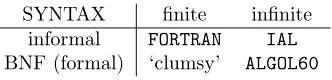
was held in May 1958 at ETH. The chosen name for the universal program-ming language was initially IAL (International Algorithmic Language), later denoted asALGOL58, but would by January 1960 change intoALGOL (Algorith-mic Language) [9, p.31], and denoted asALGOL60in this text. As programming languages,ALGOL58andALGOL60would be drastically different [9, p.35].
The ALGOLEffort
The 1955 GaMM meeting is commonly marked as the start of theALGOLEffort, i.e. the international effort involved in creating a universal programming lan-guage. TheALGOLEffort is associated with the period that ended in 1968 with the publication of the ALGOL68report; cf. [9, p.4]. In this text, however, only the languageALGOL60(or plain ALGOL) is covered, not the languageALGOL68.
The GaMM meeting was held in Darmstadt, Germany in October 1955. Several participants of that meeting (e.g. Rutishauser) stressed the need for one
universal andmachine-independent algorithmic language [9, p.5]. Programs in ALGOLwere meant to allow people to communicate algorithms with each other
11
It is not clear to me how influential these papers were. However, Rutishauser was also the inventor of the now-famous QD algorithm, which he explained in a 74-page bookletDer Quotienten-Differenzen-Algorithmus[115, p.3].
12
Cf. the comments of the American Perlis in [101] or Chapter 3 in [9].
13
Gesellschaft für Angewandte Mathematik und Mechanik.
14
CHAPTER 1. INTRODUCTION 17
without having to execute them on a machine [11, p.139]. The adjective uni-versal referred to the aspiration that everybody would communicate with each other in the same algorithmic language. Themachine independence expressed the desire that the language would be designed without having a specific ma-chine in mind [9, p.6]. Of equal importance is the adjective algorithmic. It emphasized the fact that numerical computations were intended to be the main (if not the only) application domain of the language [91, p.101]. However, while the European participants of theALGOLEffort were primarily academic numer-ical analysts, most of the Americans were not [101, p.141].
In Zürich, between May 27 and June 1, 1958, the Germans, Swiss, and Americans agreed on the following criteria:
1. The new language shall be as close as possible to standard mathematical notation and be readable with little further explanation.
2. It should be possible to use it for the description of computing processes in publications.
3. The new language should be mechanically translatable into machine pro-grams.
–cited after [100]. TheALGOLEffort would quickly become more international. For instance, the Dutch Aad van Wijngaarden and Edsger W. Dijkstra and the Dane Peter Naur would join the ALGOLEffort. The latter was to become the editor of theALGOL60report [4], a document that became the standard for defining programming languages [9, p.35] for several decades15.
Van Wijngaarden and Dijkstra
Aad van Wijngaarden was, similar to Rutishauser, a specialist in numerical analysis who went abroad (England and the USA in 1947) to familiarize himself with the state of the art in computing. Unlike Rutishauser, he did not have a programmable computing machine at his disposal. Therefore, Van Wijngaarden and his team in Amsterdam had to build a machine themselves. Their ability to do so was strengthened by the arrival of Gerrit Blaauw, a Ph.D. graduate of Howard Aiken at Harvard, who joined the Amsterdam group in November 1952. By January 1954, the Amsterdammers had their first working programmable computing machine, the ARRA II [1, p.102-111].
Though it took quite some time (compared to the English, Americans, and Swiss) before the Dutch could actually run programs on a decent machine, as early as 1952 programs were written on paper by Edsger W. Dijkstra who had joined the Amsterdam group in March of that same year. Not being able to work with a real computer was, in hindsight, a blessing in disguise for Dijkstra and the rest of the team. Dijkstra could focus mainly on the problem domain
15
Even today, ALGOL-like programming languages are being used extensively in industry
CHAPTER 1. INTRODUCTION 18
and attempt to solve corresponding problems by writing his programs, without having to bother much about machine-related problems [1, 11, p.111,125, p.133]. Only from 1954 and onwards, could the Amsterdammers actually test their automatic-programming skills by running programs on their ARRA II and sub-sequent machines. Nevertheless, in 1960, they obtained world-wide recognition in compiler building: the Amsterdammers Dijkstra and Zonneveld were the first to implement a compiler for theALGOL60programming language [1, 9, p.124-125, p.40].
Backus, Perlis, McCarthy
In contrast to the Europeans, the Americans already had, prior to 1957, several (executable) algorithmic languages. This diversity was felt and was the incentive for the Americans to accept the invitation from the GaMM [9, p.11], resulting in the joint ACM-GaMM meeting in May 1958 at ETH, as described previously. One of the available algorithmic programming systems in the USA was FORTRAN, invented by Backus and his team. Already in December 1953, John Backus proposed theFORTRANproject to his boss at IBM [5]. In contrast to the programming languageALGOL60,FORTRANbecame a de facto standard program-ming language for scientific computing [9, p.11]. However, while ALGOL60was essentially machine independent,FORTRANhad six machine dependent language constructs [9, p.15].
Compared to other existing programming languages of the 1950s, FORTRAN was, in hindsight, the first high-level language that met two seemingly contrast-ing requirements. First, a FORTRANprogram could be translated into machine code at a sufficiently low cost. Second, the obtained machine code was suffi-ciently economical in comparison to code that was hand written by an expert machine-level programmer16
. To meet these requirements, Backus and his team primarily focused on the design of the translator and not on the design of the language [118, p.233].
While many computer pioneers were sceptical about theFORTRANproject, it is amusing to note that the creators ofFORTRANwere, at times, as impressed by their achievements as their critics.
Backus: “It was a really exciting period because by late summer and early fall we were beginning to get fragments of compiled pro-grams out of the system, and we were often astonished at the code it produced. It often transformed the source code so radically that we would think it had made an error, and we’d study the program carefully, and finally realize it was correct. Many of the changes in the computation were surprising, even to the authors of the section responsible for them.” [5, p.59]
After hisFORTRAN years, Backus participated in theALGOLEffort and made a significant contribution related to formal syntax (cf. Appendix A). Two other
16
CHAPTER 1. INTRODUCTION 19
Americans who contributed substantially to theALGOLEffort were Alan Perlis and John McCarthy. Perlis was the chairman of the ACM Programming Lan-guages Committee in 1957 and a delegate to the meeting in Zürich in 1958 [17]. McCarthy was the inventor of the functional programming languageLISP, which had a large influence onALGOL60. In particular, recursive procedures were in-troduced by McCarthy and eventually included in the ALGOL60 language (cf. Chapter 2).
Naur
In February 1959, Peter Naur from Denmark joined theALGOLEffort [91, p.92]. He was the editor of the influentialALGOLreport [4], and looking back in 1978 at his role, he stated:
“I was led to the conviction that the formulation of a clear and complete description was more important than any particular char-acteristic of the language.” [91, p.99]
Chapter 2
The Advent of Recursion
Rome, March, 1962: Edsger W. Dijkstra was sitting in the “Palazzo dei Con-gressi”, attending the Panel Discussion on Philosophies for Efficient Proces-sor Construction at the International Symposium of Symbolic Languages in Data Processing. Together with Naur, Duncan, and Garwick, he was defending the case for recursive procedures in theALGOL60programming language. Even though he had become famous more than a year ago by being the first to build a compiler for theALGOL60language1, a large group of panel members remained sceptical about the usefulness of recursive procedures.
Inspection of the minutes of the panel shows that almost every panel mem-ber had a slightly different view towards why recursive procedures should or should not belong to a machine-independent programming language, such as ALGOL60. For instance, Dijkstra advocated for recursive procedures due to lin-guistic reasons (cf. Section 2.1), while Garwick was one of those few who was convinced that there were classes of problems for which recursion would come in handy [97, p.369].
According to Samelson and Strachey, general programming constructs, such as the recursive procedure, typically led to inefficient object programs. Their opinion –which was not shared by e.g. Naur and Van der Poel– made Stra-chey want to simplify or reduce theALGOL60programming language by restrict-ing (not necessarily discardrestrict-ing) the use of recursive procedures [97, p.368,373]. Samelson, on the other hand, was primarily concerned with the immediate “eco-nomical” considerations: “the final judge in matters of efficiency is money”. Samelson wanted to minimize the financial cost of a complete project: design-ing a programmdesign-ing language, builddesign-ing a compiler, compildesign-ing programs, and executing those programs. According to Samelson, the efficiency of the running program influenced the total cost the most and,therefore, he preferred to avoid general program constructs, such as the recursive procedure [97, p.364,372].
The moderator, Van der Poel, in turn, opposed Dijkstra’s quest for gener-ality, but, on the other hand, did not think that recursive procedures led to
1
That is, theALGOL60language with recursive procedures. Also, Dijkstra was the first to build such a compiler,together with his friend and colleague Zonneveld [71].
CHAPTER 2. THE ADVENT OF RECURSION 21
inefficient object programs2
.
The tension between several panel members was apparent [97, p.373]. For instance, Naur’s views, which were very similar to those of Dijkstra, were in sharp contrast to Samelson’s economic considerations. And, Seegmüller’s nasty but loudly applauded comment certainly did not help ease the tension. It was directed towards those in favor of general language constructs:
“And the question is –to state it once more– that we want to work with this language, really to work and not to play with it, and I hope we don’t become a kind of Algol play-boys.” [97, p.375]
2.1
Dijkstra’s Ideology
To understand why Seegmüller’s comment was loudly applauded, it will help to clarify the extreme views that Dijkstra had on programming-language design. To do so, I will rely on Dijkstra’s written description of his ideology which he published only a year later in [29]. In that paper, Dijkstra wanted to concen-trate on the programming language proper, not on a specific problem that could be solved by programming in that language3. In particular, Dijkstra wanted to
focus on the linguistic demands that underly the design of a programming lan-guage [29, p.31]. To do so, he first took English as his lanlan-guage under study (Section 2.1.1), before he started reasoning about a programming language (Sec-tion 2.1.2) and ALGOL60 in particular (Section 2.1.3). Finally, by presenting more excerpts from the 1962 symposium, I will show that Dijkstra’s 1960 im-plementation of recursive procedures wasmerely a by-product of his agenda to pursue simplicity, based on linguistic ideals (Section 2.1.4). In hindsight, Dijk-stra followed what today we would call a top-down design methodology, while the many who opposed his linguistic ideals were more in line with what we now call a bottom-up approach (Section 2.1.5).
2.1.1
The English Language as an Example
Dijkstra suggested to consider any English text that respected five restrictions: 1. Words of more than 15 letters are forbidden.
2. The total number of letters of three consecutive words may not be greater than 40.
3. Sentences of more than 60 words are not allowed.
4. In one and the same sentence, the same word may not be used twice as a subject.
2
Cf. [97, p.368,375]. On the other hand, Van der Poel laterdid express strong sympathy with “the Dijkstra language or another generalized Algol” in [98, p.642].
3
CHAPTER 2. THE ADVENT OF RECURSION 22
5. A list of 2000 words is given and each word in that list may not be used. Given any English text that obeys these five restrictions, Dijkstra remarked that (i) the readability of that text is not necessarily hindered and (ii) one can read such a text while being completely ignorant of the existence of the five restrictions. However, constructing acorrect English text can become very problematic if more restrictions are added to the above list or especially if they impose highly implicit conditions. “In the extreme case one would need a large computer with a complicated program to check whether one’s text does not violate the rules!” [29, p.31].
The previous paragraph already hints at Dijkstra’s preference to avoid as many restrictions as possible, in the interest of being able to construct texts that are easy to validate in terms of correctness.
2.1.2
Human vs. Machine
To distinguish between a natural language (e.g. English) and a programming language, Dijkstra considered two scenarios. In the first scenario, a speaker communicates with a listener by talking in English. In the second scenario, a programmer communicates with a computer by programming. Dijkstra then explained the difference between both scenarios. Briefly, a listener is rather unpredictable in his reactions, while a computer can, essentially, be completely understood and, hence, be predictable. To exploit this advantage that a com-puter can have over a listener (i.e. a human), Dijkstra stressed the importance of avoiding an unnecessarily complicated computer [29, p.33,34], and expressed his disappointment withALGOL60in this particular respect:
“From this point of view the way in which ALGOL60 is defined is rather alarming. ‘Pure ALGOL60’ is defined by the official Report on the Algorithmic Language ALGOL60, edited by Peter Naur, but reasonably speaking one cannot expect a user of the language to know this Report by heart. Specific implementations of the language are defined by translators, etc., of a couple of thousand machine instructions, a quantity which exceeds our powers of comprehension even further.” [29, p.34]
2.1.3
Ideology Applied to
ALGOL60
Later in his paper, Dijkstra applied his ideology to ALGOL60. Just like the five restrictions in his English-language example, Dijkstra wanted to reduce the number of ‘unnecessary’ restrictions in theALGOL60language. To do so, he pre-sented examples (see below) in which he advocated fordynamicinstead of static constructions since they make the language more ‘systematic’ and ‘powerful’.
CHAPTER 2. THE ADVENT OF RECURSION 23
declarations both reserve an identifier for a special sort of object and that ob-ject is defined statically, i.e. immediately. In this sense, both the switch and the procedure declarations are similar to the ‘constant’ declaration. On the other hand, however, while a ‘constant’ number can be used in an assignment statement which dynamically assigns a value, a switch or procedure declaration can not be used in such a manner. Dijkstra therefore suggested to extend the concept of ‘assignment of a value’ so that lists, statements, etc. can also act as ‘assigned values’. This, in turn, would allow one to remove the value-defining function of the switch and procedure declaration. The result would then be that the declaratorsswitch and procedure would only be followed by a list of identifiers, to which suitable assignments would eventually (i.e. at run time) be made [29, p.35,36]. According to Dijkstra:
“[Such a modification] is an improvement: the language then be-comes more systematic and more powerful at the same time, asall value-relations have now becomedynamic.” [29, p.36, my italics]
Dijkstra’s ideology led him to theextreme of omitting all type indications and, hence, transferring all the type checking to the run-time system [29, p.36], which, as many observed, would have a negative effect on computation time4
. Likewise, for arrays, Dijkstra suggested to remove the explicit specification of an array’s subscript bounds, since they become determined at run time any way. The bounds were, in other words, ‘redundant information’ that need not be written down by the programmer. Omitting the array bounds, in turn, resulted in more freedom. For, now there was no reason to restrain an array to being rectangular; it could for instance just as well be triangular. Continuing in this manner, the homogeneity of an array need not be required either. For instance, some array elements could now be arrays again, or procedures, etc. [29, p.36] Dijkstra continued:
“Once the type of a variable is always defined dynamically, there is not even a reason for it to be constant in time. The power of expression is increased as the language contains a smaller number of different kinds of elements and all kinds of artificial barriers have fallen away. An ordinary variable is nothing but a trivial example
of a parameterless procedure. In short, the programmer now no longer needs to squeeze the relevant information into the rigid forms permitted byALGOL60.” [29, p.36]
With such an ideology in mind, Dijkstra was perceived as someone who totally neglected efficiency issues. Hence, it is no surprise that Dijkstra and his fellow
4
CHAPTER 2. THE ADVENT OF RECURSION 24
‘linguists’ were the laughing stock of Seegmüller’s well-received comment. In-deed, for most people at the symposium, efficiency was important, or, at least, to a sufficient extent that it should be mentioned explicitly.
A closer look at Dijkstra’s ideology, however, shows that his agenda was not to neglect efficiency issues per se, but to focus on the more general objective of increasing programming comfort:
“In order to get as clear a picture as possible of the real needs of the programmer, I intend to pay, for a while, no attention to the well-known criteria ‘space and time’. Those who on the ground of this remark now doubt the honest fervour with which the following is written, should remember that, in the last instance, a machine serves one of its highest purposes when its activities significantly contribute to ourcomfort.” [29, p.30, my italics]
In other words, to better understand the real underlying problems of program-ming, Dijkstra suggested to temporarily ignore (i.e. abstract away) machine-dependent features. While a decrease in execution time or memory footprint may, indeed, contribute to an increase in programming comfort, other criteria, such as program correctness, could contribute much more, according to Dijkstra:
“I am convinced that these problems [of program correctness] will prove to be much more urgent than, for example, the exhaustive exploitation of specific machine features, if not now, then at any rate in the near future.” [29, p.30]
2.1.4
Ideology Leads to Recursive Procedures
Having described Dijkstra’s pursuit for a general language, it is also important to note that at the 1962 symposium he was not alone. Duncan, for instance, compared a restricted version ofALGOL60with the actualALGOL60language in accordance with Dijkstra’s views.
Duncan: “[T]here may be a significant class of problems for which, because of the restricted language, the source program may need to be more cumbersome and complicated than it would have been had the full powers of Algol 60 been available.” [97, p.368]
An example of Duncan’s ‘restricted language’ isALGOL60 in which procedures can not call other procedures5. As we shall see in Section 2.2.2, such a restriction
was most notably supported by Samelson and Bauer. Dijkstra, on the other hand, allowed the programmer to use procedure calls in full generality. In response to Duncan’s comments, Dijkstra replied:
“[. . .] you are not only hindered by restrictions that prohibit you to do things [such as calling a procedure from within another proce-dure], it is even so that you gain by possibilities [such as a recursive
5
CHAPTER 2. THE ADVENT OF RECURSION 25
procedure] that are not actually used in the program at all.” [97, p.368]
These words capture Dijkstra’s insistence on generality: he wanted procedure calls of any kind to be in the language, so that the language would be simple and, hence, easy to translate. Allowing some kinds of procedure calls and pro-hibiting others, was in violation of Dijkstra’s linguistic ideals. Once simplicity was obtained by means of generalization, positive, unexpected results would follow:
<continued> “One of the great features of our compiler is that it happens to turn out that it is very easy to have a good recursive function in it. I am very fond of them. They are hardly used by customers. Nevertheless, it is very important that they are in. The reason is that they give us possibilities that make the tool inspir-ing.” [97, p.368, my italics]
In other words, it seems that Dijkstra’s prime –if not only– concern was to pursue simplicity by means of general principles6
. Finding a way to implement recursive procedures was merely a by-product of his research agenda. In Section 2.2.2 we will see how Dijkstra, by means of generalization, implemented recursive procedures.
2.1.5
Bottom-Up vs. Top-Down
Seegmüller’s remark was only one of many that expressed common dissatisfac-tion with the linguists à la Dijkstra. Another example was Strachey’s comment, supporting the prevailing doctrine of taking efficiency into account during lan-guage design.
Strachey: “I think the question of simplifying or reducing a language in order to make the object program more efficient is extremely im-portant. I disagree fundamentally with Dijkstra, about the necessity of having everything as general as possible in all possible occasions as I think that this is a purely theoretical approach [. . .]” [97, p.368] Incidentally, it is interesting to note that Strachey used the verb ‘simplifying’ to denote the opposite action of what Dijkstra would have associated with that verb.
In response to Strachey’s comment, the moderator of the panel, Van der Poel, responded by characterizing two disjoint groups of panel members. On the one hand, there were those who wanted to restrict the programming language (under study, i.e. ALGOL) to make it fast by avoiding recursion. On the other hand, there were those who wanted a general language, but who also claimed
6
CHAPTER 2. THE ADVENT OF RECURSION 26
that their programs could be made just as fast7
[97, p.369]. These two different schools of thought seem to correspond, more or less, with what Naur in 1978 called the “restrictionists” and the “liberalists” [91].
Instead of contrasting between restrictionists and liberalists, I prefer to dis-tinguish between bottom-up and top-down design. The bottom or down part corresponds to the machine, while the up or top part denotes the machine-independent programming languageALGOL60.
Seegmüller, Strachey, Samelson, Bauer, and many others wanted to indi-rectly take specific machine features into account while defining the machine-independent languageALGOL60. For instance, since they believed that recursive procedures were inefficient to execute, they wanted to restrict theALGOL60 lan-guage such that recursive procedures were avoided, without tampering with ALGOL60’s machine-independence. That is, these people followed, more or less, what today we would call a bottom-up methodology. They certainly did not work in accordance with a top-down methodology.
Dijkstra, on the other hand, explicitly abstracted away specific machine features (cf. Section 2.1.3) and wanted to first concentrate on the language. Only after having defined the language, did he want to take efficiency issues into account. Hence, Dijkstra did work in conformance with what we would now call a top-down methodology.
The reason why Dijkstra followed a top-down methodology8 may, as hinted
in [1, p.124,125], lie in the fact that he did not have a programmable computing machine during the early 1950s, while those mentioned who worked bottom-up, did. Those who were “firsts” in having a programmable computing machine at their disposal, were confronted relatively quickly with its finite limitations. Presumably, this made them take efficiency to be their prime concern.
2.2
Dijkstra’s Wonderful Year: 1960
The recursive procedure, which Dijkstra openly advocated for in Rome 1962 and which led to Seegmüller’s nasty comment, had already been introduced in 1960 in the definition of the programming language ALGOL60 by Van Wijngaarden and Dijkstra via a peculiar telephone call with Naur (Section 2.2.1). Subse-quently, but still in 1960, Dijkstra and his colleague Zonneveld succeeded in being internationally the first toimplement ALGOL60, i.e. by building the first ALGOL60compiler (Section 2.2.2). Both of Dijkstra’s contributions were, as we shall see, due to his aptitude for linguistics.
7
It is true that various participants of the symposium defended the case that recursive procedures didnotlead to inefficient object programs. But Van der Poel’s characterization is, to say the least, an over-simplification. Recall that Van der Poel, himself, did not believe that recursive procedures led to inefficient programs but that he was also against Dijkstra’s quest for generality. Also, as mentioned before, Dijkstra did believe that recursive procedures, or any general program construct for that matter, incurred a run-time penalty, while he was in pursuit of a general language.
8
CHAPTER 2. THE ADVENT OF RECURSION 27
2.2.1
Defining Recursive Procedures
As part of the ALGOLEffort, a subcommittee in November 1959 (consisting of Rutishauser, Ehrling, Woodger, and Paul) recommended that certain restric-tions be put in place with respect to the parameters of a procedure. These lan-guage restrictions automatically prevented recursive procedure activations [91, p.108,109,151,154]. Such restrictions were exactly what Samelson and Bauer (and many others) wanted in accordance with their bottom-up methodology (cf. Section 2.2.2).
In contrast, on the other side of the Atlantic, John McCarthywastrying to use recursion in his programming. When working at IBM in the summer of 1958, he tried to use FORTRANto write a program that would differentiate algebraic expressions, such as the expressiony2
. To calculate the derivative ofy2
–which is equal to2y times another derivative (namely that of y)– McCarthy realized that he needed recursive conditional expressions. SinceFORTRANdid not contain recursion either, he tried to add it to the language, but without success. This, in turn, led him to develop his own programming languageLISP[116, p.27], heavily inspired by previous work of Newell, Shaw, and Simon (cf. Section 3.2.3).
In August 1959, McCarthy wrote a letter9 in which he openly advocated
for recursive procedures [80], and, in January 1960, at the finalALGOL60 Paris conference, McCarthy suggested to add recursive procedures to the ALGOL60 language [116, p.30]. With regards to McCarthy’s proposal to add recursive procedures, an American representative to the ALGOL60 Conference (perhaps McCarthy himself but probably not) proposed to add the delimiterrecursive to the language, to be used in the contextrecursive procedure [91, p.112]. The American’s proposal was, by voting, turned down by a narrow margin [91, p.112]. According to some, this rejection was interpreted to mean that recur-sive procedures should not be added to theALGOL60language; others, however, interpreted it to mean that recursive procedures should not be distinguished syn-tactically from non recursive procedures by means of the proposed delimiter [91, p.160]. The latter category of people, therefore, did assume that recursive pro-cedures (introduced by McCarthy) belonged to theALGOL60language, while the former category of people –including Naur and McCarthy [91, p.159-160]– as-sumed that recursive procedures did not belong to the language. In short, and in Perlis’ words: “it is not clear what the votes meant!” [91, p.160].
The voting, discussed previously, took place before other issues, concerning the (informal) semantics of procedures, had been clarified [91, p.160-161]. Af-ter the voting, and afAf-ter several modifications were made to the semantics of procedures, the defined language (ALGOL60) implicitly allowed for recursive pro-cedures to be expressed syntactically, contrary to the November 1959 decision (see above) to prohibit this explicitly [91, p.112].
Whether Van Wijngaarden and Dijkstra belonged to the first or the second category of people, described above, or to neither category, is not entirely clear. But, on approximately February 10, 1960, Van Wijngaarden, alongside Dijkstra,
9
CHAPTER 2. THE ADVENT OF RECURSION 28
called theALGOLeditor, Naur, by telephone to point to a lack of definition in Naur’s report [91, p.112]. The Dutch had stumbled upon the possibility to syn-tactically express recursive procedure activations, noting that it was nowhere stated in theALGOLreport whether recursive procedures activations were indeed intended semantically or not. Therefore, Van Wijngaarden, after consulting Dijkstra, suggested to Naur to add one sentence to theALGOLreport so that it would be clear that recursive procedure activations were allowed in ALGOL60. The fact that the alternative, of preventing recursive procedure activations by means of several language restrictions, would be cumbersome, was also men-tioned by Van Wijngaarden [91, p.112]. In line with Dijkstra’s linguistic ideals, described in Section 2.1, it is clear that Van Wijngaarden and Dijkstra were primarily reasoning along linguistic lines andnot in terms of specific machine features. Simplicity for them meant less language restrictions. Naur, being lin-guistically inclined as well, was charmed by the one-sentence clarification of the Dutch and added it to theALGOLreport.
Naur in 1978: “I got charmed with the boldness and simplicity of this [one-sentence] suggestion and decided to follow it in spite of the risk of subsequent trouble over the question (cf. Appendix 5, Bauer’s point 2.8 and the oral presentation).” [91, p.112-113]
Naur’s reference to Bauer shows that he was well aware of the Germans’ strong will to prohibit recursive procedures from the language, in accordance with the November 1959 meeting.
2.2.2
Implementing Recursive Procedures
Dijkstra’s ability to implement anALGOL60compiler in such a short time span, was, as we shall see, again due to his pursuit for simplicity. Fundamental to this discussion will be the concept of a stack, which Dijkstra borrowed from Samelson and Bauer (Section 2.2.2.1). I will mainly explain and to some extent speculate why Samelson and Bauer did not implement recursive procedures (Section 2.2.2.2), and then explain Dijkstra’s generalization on how a stack could be used in order to implement recursive procedures (Section 2.2.2.3). Many examples presented below are conceptualizations of the actual translation techniques used by Samelson, Bauer, and Dijkstra.
2.2.2.1 Illustration of Samelson and Bauer’s Stack
Samelson and Bauer’s stack principle [6] can be illustrated by means of the algebraic expression:
A+ (B−C)×(D/E+F)
which was first translated into postfix notation:
CHAPTER 2. THE ADVENT OF RECURSION 29
by a trivial algorithm10
.
In postfix notation, the operators (e.g.−) are placed after the operands (e.g.
B,C). The presented postfix expression was subsequently read from left to right and, while doing so, the stack was used to store information, as is illustrated below. In the meantime, corresponding object code was also generated, as desired, but I shall not illustrate this explicitly11. In this simple example, the
important thing to remember is that the stack was solely used prior to executing the object program; i.e. solely at what today we would call compile time.
A stack was merely a part of the memory of the computing machine, con-sisting of successive memory locations: v0,v1,v2,. . .:
v4
v3
v2
v1
v0
Scanning the postfix expression from left to right implies that the first symbol scanned is the symbolA. This symbol was placed on the stack by the translation algorithm12
, resulting in:
v4
v3
v2
v1
v0 A
The second scanned symbol isB and was likewise placed on the stack:
v4
v3
v2
v1 B
v0 A
Similarly, scanning the next two symbols resulted in:
v4
v3 −
v2 C
v1 B
v0 A
10
This explicit translation step is already a simplification of Samelson’s and Bauer’s actual approach.
11
For a more thorough example, see Knuth [69].
12
CHAPTER 2. THE ADVENT OF RECURSION 30
Contrary to the previous cases, we now have an operator on top of the stack13
. This meant that enough information had been gathered on the stack to perform the corresponding operation. To be more precise, the minus sign was removed from the stack, together with the two operandsC andB. (Then, the machine code instruction ofB−Cwas generated and placed into the instruction memory of the computing machine.) The ‘result’ of the subtraction was placed on the stack14:
v4
v3
v2
v1 B−C
v0 A
Next, the symbolsD,E, and/were placed on the stack:
v4 /
v3 E
v2 D
v1 B−C
v0 A
Again, because an operator topped the stack, this meant that enough infor-mation had been gathered to perform the corresponding operation. That is, the division symbol was removed from the stack, together with the two operandsE
andD. (Then, the machine code instruction ofD/E was generated and placed into the instruction memory of the computing machine.) The ‘result’ of the division was placed on the stack:
v4
v3
v2 D/E
v1 B−C
v0 A
Next, symbolF was read and placed on top of the stack:
v4
v3 F
v2 D/E
v1 B−C
v0 A
13
Strictly speaking, the operator did not have to be put on the stack, but for simplicity I have chosen to do so here any way.
14
This is strictly speaking incorrect. The ‘result’ can only be known if the actual values of
BandCare known at compile time, which, of course, was typically not the case. So, instead of the ‘result’, it was e.g. a register namenthat was stored in stack cellv1, withnbeing the
CHAPTER 2. THE ADVENT OF RECURSION 31
Then the+sign was read, placed on top of the stack, consequently removed from the stack, along withF andD/E . . ., resulting in:
v4
v3
v2 D/E +F
v1 B−C
v0 A
Next, the symbol×was read, placed on top of the stack,. . ., resulting in:
v4
v3
v2
v1 (B−C)×(D/E +F)
v0 A
Finally, the last symbol+resulted in:
v4
v3
v2
v1
v0 A+(B−C)×(D/E +F)
and the entry ofv0was removed, resulting in an empty stack.
The previous illustration is, I stress again, a conceptualization. The transla-tion process started at the left most symbol in the postfix notatransla-tion and with an empty stack. The translation process ended at the right most symbol and with an empty stack. In the meantime, machine code was generated and placed in the instruction memory of the computing machine, while the stack was used for administrative purposes. The actual values ofA, B,C,. . .,F were, of course, not known during the translation. The crux lies in that the stack was only used prior to executing the object program. In other words, the generated machine code did not need a stack to execute; it only used a constant number of regis-ters15
to store the values ofA,B,. . .and to store intermediate results, such as the values ofB−C andD/E.
The algebraic expression, presented above, is a very simple example of a program that was written in a machine-independent programming language, such as ALGOL60. In general, the program could contain multiple algebraic expressions, and also for loops and other kinds of control-flow constructs. Let us denote such a program by “main”, and depict it by an empty rectangle:
15
CHAPTER 2. THE ADVENT OF RECURSION 32
"main" program
This representation will come in handy in the next section.
2.2.2.2 Extending Samelson and Bauer’s Approach to Incorporate Procedure Calls
The previous example can now be extended. Instead of only considering a “main” program as above, we now also have some procedures. Each procedure, internally, contains an algebraic expression (or multiple algebraic expressions in general), similar to the one used in the previous discussion. Some of the algebraic expressions in the “main” program, however, contain procedure calls to one or more of the procedures. Conceptually, we have:
"main" program procedure 1
procedure 2
procedure 3
program-CHAPTER 2. THE ADVENT OF RECURSION 33
mer was not allowed to write a program in which one procedure was called from within another procedure: only the “main” program could contain arrows that pointed outwards.
A natural way to compile a program that was composed of a “main” program and three separate procedures, as pictured above, was to, conceptually speak-ing, compile each piece of text in conformance with the stack-based scheme addressed previously. That is, the “main” program was, essentially16,
trans-lated as explained before, and each of the procedures was transtrans-lated in a similar manner. The net effect was, again, that no stack was needed at run time, but, now, not only did the translated “main” program have its own working space, also each translated procedure had its own private fixed working space (which it would use at run time).
In other words, Samelson and Bauer treated each procedure statically, by providing each of them with their own fixed working space17
. This approach naturally prevented a procedure to be activated more than once during the execution of the program, because only one fixed working space was available for each procedure. In particular, Samelson and Bauer’s approach could not handle a procedure that recursively called itself. Dijkstra summarized Samelson and Bauer’s approach:
“If every subroutine [i.e. procedure] has its own private fixed work-ing spaces, this has two consequences. In the first place the storage allocations for all the subroutines together will, in general, occupy much more memory space than they ever need simultaneously, and the available memory space is therefore used rather uneconomically. Furthermore –and this is a more serious objection– it is then impos-sible to call in a subroutine while one or more previous activations of the same subroutine have not yet come to an end, without losing the possibility of finishing them off properly later on.” [26, p.312] As the previous words indicate, and as Samelson and Bauer, themselves, admitted at the 1962 Rome symposium, their implementation led to excessive use of memory:
[. . .] it was decided [to minimize run time], to assign static data storage to each procedure separately within the block containing the procedure, whichof course rules out recursive procedures. The waste of static storage, in conflict with our original cellar [i.e., stack] prin-ciple, was consideredregrettable. [112, p.214, my italics]
The first sentence in the quote stresses that Samelson and Bauer did not want to use a stack at run time –contrary to Dijkstra, as we shall see later– because they were afraid that it would increase the execution time of their programs.
16
Some additional book-keeping was needed to implement the arrows in the figure.
17
![Table 1.1: QuickSort [54]](https://thumb-us.123doks.com/thumbv2/123dok_us/8385949.321920/9.612.170.413.73.210/table-quicksort.webp)