Expressive Power of Weighted Propositional Formulas for
Cardinal Preference Modelling
Yann Chevaleyre
LAMSADE, Universit´e Paris-Dauphine Place du Mar´echal de Lattre de Tassigny
75775 Paris Cedex 16, France [email protected]
Ulle Endriss
ILLC, University of AmsterdamPlantage Muidergracht 24 1018 TV Amsterdam, The Netherlands
J´erˆome Lang
IRIT, Universit´e Paul Sabatier118 Route de Narbonne 31062 Toulouse Cedex 04, France
Abstract
As proposed in various places, a set of propositional formu-las, each associated with a numerical weight, can be used to model the preferences of an agent in combinatorial domains. If the range of possible choices can be represented by the set of possible assignments of propositional symbols to truth val-ues, then the utility of an assignment is given by the sum of the weights of the formulas it satisfies. Our aim in this paper is twofold: (1) to establish correspondences between certain types of weighted formulas and well-known classes of util-ity functions (such as monotonic, concave ork-additive func-tions); and (2) to obtain results on the comparative succinct-ness of different types of weighted formulas for representing the same class of utility functions.
Introduction
Many individual or multiagent decision making problems have in their input the preferences of the agent(s) over a set of possible alternatives. These preferences can be either ordinal (i.e. preference relations, typically weak orders) or cardinal (i.e. utility functions). We make use of the generic word preference structure for either a preference relation or a utility function. Such problems include decision mak-ing and plannmak-ing under uncertainty, multi-criteria decision making and decision support systems, automated group de-cision making (including auctions, fair division, vote), and distributed decision making (including negotiation).
Saying that the input of a problem contains the preference structure of the agent(s) over the set of alternatives does not imply anything about how these structures are specified in the input. Clearly, if the set of alternatives is small, this question is not relevant, since the size of the explicit repre-sentation of the preference structure is small as well. This is no longer the case when the set of alternatives is a com-binatorial domain: in this case, the set of alternatives is the set of all assignments of each of a given finite set of vari-ables to a value of the corresponding finite domain.1 Exam-ples are numerous: in combinatorial auctions and negotia-tion over resources (Cramton, Shoham, & Steinberg 2006;
Copyright c 2006, American Association for Artificial Intelli-gence (www.aaai.org). All rights reserved.
1
Another situation where preference representation is non-trivial is when the set of alternatives is continuous. We leave this issue aside and focus on finite domains only.
Chevaleyre et al. 2006), an alternative is an assignment of each good to an agent; in multiple issue referenda (Brams, Kilgour, & Zwicker 1998), an alternative consists of a truth value (yes or no) for each issue.
For this purpose, many languages have been developed so as to express preference structures as succinctly as possible. These languages differ significantly, depending on whether the preference structure to be expressed is ordinal or car-dinal. Languages for the succinct representation of ordi-nal preferences include languages of ceteris paribus state-ments, which range from very expressive languages (Doyle & Wellman 1991) to syntactical restrictions such as CP-nets (Boutilier et al. 1999), where a weaker expressivity is compensated for by the availability of efficient elicitation and optimisation techniques. They also include languages based on conditional logics, prioritised logics, and priori-tised constraint satisfaction problems (see e.g. Lang (2004) for an overview). Languages for the succinct represen-tation of utility functions include graphical models (Bac-chus& Grove 1996; La Mura & Shoham 1999; Boutilier, Bacchus, & Brafman 2001; Gonzales & Perny 2004), deci-sion trees (Boutilier, Dearden, & Goldszmidt 1995), valued constraint satisfaction problems (Bistarelli et al. 1999), and bidding languages for combinatorial auctions (Nisan 2006; Boutilier & Hoos 2001; Sandholm 2002).
Many different issues concerning preference representa-tion languages are worth investigating:
• Elicitation: design algorithms to elicit preferences from
an agent so as to get an output expressed in a given lan-guage.
• Cognitive relevance: assess the cognitive relevance of a
language by measuring its proximity to the way human agents “know” their preferences and express them in nat-ural language.
• Expressive power: identify the set of preference structures
that can be expressed in a given language.
• Complexity: for a given language, determine the
• Comparative succinctness: given two languagesL and
L0, determine whether every preference structure that can be expressed inLcan also be expressed inL0 without a significant (that is, supra-polynomial) increase in size (in which caseL0is said to be at least as succinct asL). Elicitation and complexity have been the subject of much previous work that we will not recall here. Cognitive rele-vance is somewhat harder to assess, due to its non-technical nature, and to our knowledge it has been rarely studied (see Nisan (2006) for a short discussion). Expressive power and comparative succinctness, have been investigated to a lesser extent. Coste-Marquis et al. (2004) give a systematic analysis of both issues for ordinal preferences, while sev-eral other authors (Boutilier & Hoos 2001; Sandholm 2002; Chevaleyre et al. 2004; Nisan 2006) investigate these issues for bidding languages for auctions and negotiation (which express valuation functions for bundles of goods). In this pa-per we investigate expressive power and succinctness for one of the simplest languages for utility representation, where goals are specified as propositional logic formulas, and each goal is associated with a numerical weight. The utility of an alternative is then obtained by summing up the weights of the goals it satisfies. This language has been considered in many places, as have several of its variations (Pinkas 1991; Haddawy & Hanks 1992; Dupin de Saint-Cyr, Lang, & Schiex 1994; Lafage & Lang 2000).
After covering some preliminaries and introducing the problems addressed in this paper in more formal detail in the next section, we first investigate expressivity issues. We focus on a number of possible restrictions on both formulas and weights, and identify the corresponding classes of util-ity functions. While the results are obvious in extreme cases (if no restriction is imposed, all utility functions can be ex-pressed, with maximal succinctness; if only atomic formu-las are allowed then only linear functions can be expressed), there appear to be many cases for which they are non-trivial and particularly interesting, because they correspond to in-termediate classes which may realise a good trade-off be-tween simplicity and efficiency. We then present, in less de-tail, initial results concerning the comparative succinctness of different preference languages. In the final section, we discuss related work and further research directions. In par-ticular, we point out interesting directions for future work re-garding the computational complexity of working with dif-ferent languages based on weighted propositional formulas.
Modelling Preferences
In this section we introduce two approaches to modelling cardinal preferences: by means of classical utility functions and by means of weighted propositional formulas.
We first fix some basic notation. Let PS be a finite set of propositional symbols and let n = |PS|. LPS is the propositional language built fromPS using the operations of negation, conjunction and disjunction. For any formula
ϕ ∈ LPS, Var(ϕ) denotes the set of propositional sym-bols occurring inϕ. PS(k)is the set of all subsets ofPS with at mostk elements (in particular, PS(1) andPS(n) are isomorphic toPS and2PS
, respectively). ElementsM
of2PS
could be bundles of indivisible goods, agreements in the context of multi-criteria decision making, coalitions of agents in the context of cooperative games or, more gen-erally, propositional worlds (assigning true to every symbol appearing inM and false to all other symbols).
Utility Functions
We now introduce the concept of a utility function over propositional worlds and recall the definitions of several well-known classes of utility functions.
Definition 1 (Utility functions) A utility function is a map-pingu: 2PS
→R.
• uis normalised iffu({ }) = 0.
• uis non-negative iffu(X)≥0for allX.
• uis monotonic iffu(X)≤u(Y)wheneverX ⊆Y.
• uis modular iffu(X∪Y) =u(X) +u(Y)−u(X∩Y)
for allXandY.
• uis subadditive iffu(X∪Y)≤u(X)+u(Y)−u(X∩Y)
for allXandY.
• uis superadditive iffu(X∪Y)≥u(X)+u(Y)−u(X∩Y)
for allXandY.
• uis concave iffu(X ∪Y)−u(Y)≤u(X∪Z)−u(Z)
for allXwheneverY ⊇Z.
• uis convex iffu(X∪Y)−u(Y)≥u(X∪Z)−u(Z)for allXwheneverY ⊇Z.
• uisk-additive iff there exists a mappingm :PS(k)→R
such that (for allX):
u(X) = X{m(Y)|Y ⊆XandY ∈PS(k)}
Intuitively, concavity means that marginal utility (of obtain-ing X) decreases as we move to a better starting position (namely fromZ toY). Observe thatuis convex iff−uis concave and, similarly, uis superadditive iff−uis subad-ditive. All concave functions are also subadditive and all convex functions are superadditive (setZ =X ∩Y). The class of modular functions is the intersection of the classes of subadditive and superadditive functions. Utility functions that are both monotonic and normalised are also known as
capacities.
The class ofk-additive functions, the definition of which is inspired by work in fuzzy measure theory (see e.g. (Gra-bisch 1997)) and which recently also have found applica-tion in combinatorial aucapplica-tions (Conitzer, Sandholm, & Santi 2005) and distributed negotiation (Chevaleyre et al. 2004), is probably less well-known than the other classes of func-tions mentioned in Definition 1. This class is useful in domains where synergies between different items are re-stricted to bundles of at most k elements. We recall the well-known fact that fork = n, any utility function is k -additive:m({ }) =u({ })andm(X)can be defined recur-sively asu(X)−P
Y⊂Xm(Y)for allX6={ }. Moreover,
the functionm such that u(X) = P
{m(Y) | Y ⊆ X}
This may be seen as follows. LetXbe any non-empty set in 2PS and let
x∈X. Then the equation characterising mod-ularity impliesu(X) =u(X\ {x}) + [u({x})−u({ })]. If we apply this step recursively for every element ofX, then we end up with the following equation:
u(X) = u({ }) + X
x∈X
[u({x})−u({ })]
Choosingm({ }) =u({ })andm({x}) =u({x})−u({ }), this shows that modularity implies 1-additivity. The con-verse is easily seen to hold as well.
Weighted Formulas
An alternative approach to representing preferences uses
weighted propositional formulas. A weighted formula is a
pair(ϕ, α), whereϕis a propositional formula in the lan-guage LPS and αis a numerical weight representing the relative importance of that formula. Intuitively, the degree of satisfaction derived from a particular propositional world (bundle of goods, agreement, coalition) is the sum of the weights of the formulas satisfied by that world.
Definition 2 (Goal bases) A goal base is a set G = {(ϕi, αi)}iof pairs, each consisting of a satisfiable formula
ϕi ∈ LPS and a real numberαi. The utility functionuG
generated byGis defined by
uG(M) =
X
{αi|(ϕi, αi)∈GandM |=ϕi}
for allM ∈2PS.
Gis called the generator ofuG.
Summing up the individual weights is particularly suited for modelling utility functions, but other aggregation functions have been investigated as well (Lafage & Lang 2000). In this paper we are going to be interested in the following question:
Are there simple restrictions on goal bases such that the utility functions they generate enjoy simple structural properties?
Interesting candidates for restrictions on formulas include restrictions on the length of formulas as well as the range of propositional connectives appearing in a formula. The most obvious restriction on weights would be to allow only positive numbers.
Definition 3 (Restrictions) LetH ⊆ LPS be a restriction
on the set of propositional formulas and letH0⊆Rbe a re-striction on the set of weights allowed in the specification of goals. For formulas, we consider the following restrictions:
• A positive formula is a formula with no occurrence of¬; a strictly positive formula is a positive formula that is not a tautology.
• A clause is a (possibly empty) disjunction of literals; a
k-clause is a clause of length≤k.
• A cube is a (possibly empty) conjunction of literals; ak -cube is a -cube of length≤k.
• Ak-formula is a formulaϕwith|Var(ϕ)| ≤k.
As for weights, we consider only the restriction to the posi-tive reals. Given two restrictionsHandH0, letU(H,H’)be the class of utility functions that can be generated from goal bases conforming to the restrictionsH andH0.
Restrictions on formulas can also be combined (e.g. posi-tive clauses are disjunctions of posiposi-tive literals). We write “all” in case no specific restriction applies. For example,
U(positivek-cubes,all)is the class of utility functions gen-erated by goal bases made up from positive k-cubes and where weights are not subject to any restrictions. We are also going to consider restrictions to both atoms (propositional symbols) and literals (atoms and their negations). Note that
>is a cube (of length0), but not a clause (nor is it a literal). The empty clause is equivalent to⊥, i.e. it is not of interest here, because goals are required to be satisfiable.
Two goal basesGandG0are said to be equivalent (writ-ten G ≡ G0) iff they generate the same utility functions,
i.e. iff uG = uG0. The following lemma introduces two equivalence-preserving transformations on goal bases. It shows how to eliminate both negations and disjunctions from inside a conjunction.
Lemma 1 The following equivalences hold for all goal basesG, formulasϕ, ψ, χ∈ LPS and weightsα∈R: (i) G∪ {(ϕ∧ ¬ψ, α)} ≡G∪ {(ϕ, α),(ϕ∧ψ,−α)} (ii) G∪ {(ϕ∧(ψ∨χ), α)≡
G∪ {(ϕ∧ψ, α),(ϕ∧χ, α),(ϕ∧ψ∧χ,−α)}}
Proof. The claims are easily verified by considering all
(eight) possible ways of assigning truth values to the
formulasϕ,ψandχ. 2
A special case of part(i) shows how to eliminate a nega-tion from the outside of a formula:{(¬ψ, α)}can be rewrit-ten as{(>, α),(ψ,−α)}. Similarly, settingϕ =>in part (ii)provides us with a way of transforming a disjunction into a set of conjunctions: {(ψ∨χ, α)}can be replaced by
{(ψ, α),(χ, α),(ψ∧χ,−α)}.
Correspondence Results
This section gives a range of answers to our earlier question regarding the existence of restrictions on goal bases gener-ating utility functions with simple structural properties.
Basic Results
It turns out that the notion ofk-additivity plays a central role in characterising the classes of utility functions correspond-ing to certain types of goal bases. This connection is at its most apparent in the case of positivek-cubes.
Proposition 1 U(positivek-cubes,all)is equal to the class ofk-additive utility functions.
Proof. Ak-additive function can be represented by a map-pingm :PS(k) →R(see Definition 1). We can define a bijective functionf from such mappingsmonto goal bases
Gwith only positivek-cubes:
f :m7→ {(p1∧ · · · ∧pk, α)|m({p1, . . . , pk}) =α}
Clearly, the utility functions generated by m and the goal
basef(m)are identical. 2
k-additive functions. This may be seen as follows. Let
B(u) be defined by B(u)(M) = u(M) for all M. If
u is generated by G, then B(u) is generated by G ob-tained by replacing every literal in every formula ofGby its negation, which shows that U(negativek-cubes,all) =
B(U(positivek-cubes,all)), which is equal to the set of all
k-additive utility functions (since the latter is closed under
B). In fact, for several of our correspondence results on pos-itive formulas below, there exist similar results for formulas where all literals are negative, even though we are not going to specifically report these here.
Proposition 2 The following sets are also all equal to the class ofk-additive utility functions:
• U(k-cubes,all)andU(k-clauses,all);
• U(positivek-formulas,all)andU(k-formulas,all). Proof. Any positivek-cube(p1∧· · ·∧pk, α)can be rewritten
as a set ofk-clauses (using an arbitrary additional proposi-tional symbolp):
{(¬p1∨ · · · ∨ ¬pk,−α),(p, α),(¬p, α)}
Hence, U(positivek-cubes,all) ⊆ U(k-clauses,all). Clearly, U(positivek-cubes,all) is also included in both
U(k-cubes,all) andU(positivek-formulas,all), and all of the classes mentioned are included inU(k-formulas,all).
Using Lemma 1, we can transform any goal base consist-ing ofk-formulas into a goal base of positivek-cubes, i.e. we also getU(k-formulas,all) ⊆ U(positivek-cubes,all). Hence, all of the sets of utility functions mentioned earlier are equivalent. The claim then follows immediately from
Proposition 1. 2
The positive k-clauses do not generate the full set of k -additive utility functions, because (due to the fact that>is not a clause) positivek-clauses do not allow us to assign a non-zero utility to{ }. We therefore obtain the following weaker result:
Proposition 3 U(positivek-clauses,all) is equal to the class of normalisedk-additive utility functions.
Proof. First observe that positive k-clauses augmented with> can generate allk-additive utility functions. This immediately follows from case (ii) of Lemma 1 and Proposition 1. Without lack of generality, we may assume that any goal baseGof positivek-clauses augmented with
>includes exactly one weighted goal of the form(>, α). It then remains to be shown thatuGis normalised iffα= 0.
This is clearly so, becauseuG({ }) = αholds due to the
fact that{ }falsifies all positive clauses. 2
Next we list a number of further basic results, all of which are simple consequences of the results onk-additive utility functions for the special cases ofk=nandk= 1.
Proposition 4 The following sets are all equal to the class of all utility functions:
• U(positive cubes,all)andU(positive,all);
• U(cubes,all),U(clauses,all)andU(all,all).
Proof. Recall that any utility function is k-additive for a sufficiently high value ofk. The claim then follows from
Propositions 1 and 2. 2
U(positive cubes,all)corresponds to the marginal
contribu-tion nets of Ieong and Shoham (2005), who also point out
that this language is fully expressive.
Proposition 5 U(positive clauses,all)is equal to the class of normalised utility functions.
Proof. This is a corollary to Proposition 3. 2
Proposition 6 U(strictly positive,all) is also equal to the class of normalised utility functions.
Proof. As any positive clause is a strictly positive formula,
by Proposition 5, any normalised function must belong to
U(strictly positive,all). Vice versa, ifGis a set of strictly positive formulas thenuG({ }) = 0, because{ }falsifies all
strictly positive formulas. 2
Proposition 7 U(literals,all)is equal to the class of modu-lar utility functions.
Proof. First recall that the class of modular functions is equal
to the class of 1-additive functions. Therefore, by Proposi-tion 2,U(1-cubes,all)is equal to the class of modular func-tions. The set of 1-cubes is the set of literals together with
>. The claim then follows from the fact that we can rewrite
{(>, α)}as{(p, α),(¬p, α)}using any propositional
sym-bolp. 2
Proposition 8 U(atoms,all) is equal to the class of nor-malised modular utility functions.
Proof. Atoms are strictly positive literals, i.e. the claim
fol-lows from Propositions 6 and 7. 2
Non-negative Functions
Next we study the classes of utility functions generated by positively weighted formulas. Unsurprisingly, such func-tions will be non-negative.
Proposition 9 U(all,positive) and U(cubes,positive) are both equal to the class of non-negative utility functions.
Proof. It is obvious that U(all,positive), and a fortiori
U(cubes,positive), are contained in the set of all non-negative utility functions. For the converse inclusion, it is enough to show that any non-negative utility function can be generated by positively weighted cubes. So sup-pose u is such a non-negative utility function and define
G={(form(M), u(M))|M ∈2PS
}, where:
form(M) = ^{x|x∈M} ∧^{¬x|x∈PS\M}
We haveu=uG, i.e.uis inU(cubes,positive)). 2
Again, clauses are less expressive than cubes:2
2
Proposition 10 U(clauses,positive) is a proper subset of the class of non-negative utility functions.
Proof. Inclusion ofU(clauses,positive)in the set of non-negative functions follows from Proposition 9. To show that the inclusion is strict, consider the following non-negative utility function:
u({p, q}) = 1; u({p}) = 0; u({q}) = 0; u({ }) = 0
Suppose there exists a generator Gof uusing only posi-tively weighted clauses. Let wc be the weight associated
with clausec. We obtain the following list of constraints: (1) wp+wq+wp∨q +w¬p∨q+wp∨¬q+w>= 1
(2) wp+w¬q+wp∨q+wp∨¬q+w¬p∨¬q+w>= 0
(3) w¬p+wq+wp∨q+w¬p∨q+w¬p∨¬q+w>= 0
(4) w¬p+w¬q+w¬p∨q+wp∨¬q+w¬p∨¬q+w>= 0
(5) wc≥0for all clausesc
Constraints (2), (3), (4) and (5) givewc = 0for any clause
c, which is inconsistent with (1). 2
Likewise, U(k-clauses,positive) is a proper subset of the class of non-negativek-additive utility functions.
Monotonic Functions
The next result characterises the class of normalised mono-tonic utility functions, also known as capacities.
Proposition 11 U(strictly positive,positive)is equal to the class of normalised monotonic utility functions.
Proof. Clearly, any utility function generated by posi-tive formulas with posiposi-tive weights must be monotonic; and by Proposition 6, any function generated by strictly positive formulas is normalised. Hence, every u ∈ U(strictly positive,positive)must be a capacity. For the con-verse, we sketch how to construct a goal base of positively weighted strictly positive formulas for any given capacityu. Consider the utility functionsuk(fork= 1, . . . , n) defined
as follows:
uk(X) = max{u(X0)|X0⊆Xand|X0| ≤k}
For instance,u1
(X) = maxx∈Xu({x})andun = u
(be-cause of monotonicity). We are going to show how to con-struct generators foru1
,u2
−u1 ,u3
−u2
and so forth; the union of these will then be a generator for the utility function
un, and hence foru.
(Step 1) To construct a generatorG1 foru1
, order the ele-mentspiofPS such thatu({p1})≤ · · · ≤u({pn}).
G1
={(p1∨ · · ·,∨pn, u({p1})),
(p2∨ · · · ∨pn, u({p2})−u({p1})), . . . ,
(pn, u({pn})−u({pn−1})}
Clearly,G1
is a generator foru1 .
(Step 2) To construct a generator foru2−1
= u2
−u1 , let
{X1, . . . , X(n 2)}
be the set of all 2-ary subsets of PS,
or-dered in such a way thatu2−1
(Xi) ≤u2−1(Xj)whenever
i < j. Observe thatu2−1
(Xi)is non-negative (due to the
monotonicity ofu). Now define: G2={(V
X1∨ · · · ∨VX(n 2)
, u2−1(X 1)), (V
X2∨ · · · ∨
V X(n
2), u 2−1(X
2)−u2−1(X1)), . . . , (V
X(n 2)
, u2−1(X
(n 2))
−u2−1(X
(n 2)−1))}
G2
is a generator foru2
−u1
. If we continue using the same method, we can construct generatorsG3
, . . . , Gn for
u3
−u2
up toun−un−1
. The union ofG1
, . . . , Gnwill then
be a generator for the sum ofu1
, u2
−u1
, . . . , un−un−1 ; that is, it will be a generator foru=un.
2
To exemplify our construction, consider the capacityuwith
u({p1}) = 2,u({p2}) = 5andu({p1, p2}) = 6:
(Step 1) Ordering the elements of{p1, p2}givesu({p1})<
u({p2}, therefore, G1 = {(p1 ∨ p2,2),(p2,3)}. G1 is a generator for u1
, where u1
({}) = 0, u1
({p1}) = 2,
u1
({p2}) = 5,u1({p1, p2}) = 5.
(Step 2) Since{p1, p2}is the only 2-ary subset of{p1, p2},
G2
={(p1∧p2, u2−1({p1, p2}))}. Now,u2−1({p1, p2}) =
u2
({p1, p2})−u 1
({p1, p2}) =u({p1, p2})−5 = 1. There-fore, we obtain the following goal base:
G=G1∪G2={(p1∨p2,2),(p2,3),(p1∧p2,1)} Also observe that we can model the full set of mono-tonic utility functions by allowing a single goal(>, α)with weightα(which could be negative) in a goal base that oth-erwise consists only of strictly positive formulas with posi-tive weights. Furthermore,U(positive,positive)is the set of non-negative monotonic utility functions.
Concave Functions
As a final correspondence result, we establish a connection between restrictions on goal bases and concave utilities.
Proposition 12 U(positive clauses,positive)is a subset of the class of normalised concave monotonic utility functions.
Proof. The fact that any utility function from the set
U(positive clauses,positive) is a capacity follows from Proposition 11. So the interesting part is to show that pos-itive clauses with pospos-itive weights generate concave utility functions. Letube generated by a goal baseGof positive clauses with positive weights and letX,Y andZbe propo-sitional worlds such that Y ⊇ Z. For positive clausesϕ,
X ∪Y |= ϕtogether withY 6|= ϕimpliesX |= ϕ, and
M |=ϕimpliesM0 |=ϕwheneverM ⊆M0. Hence:
{(ϕ, α)∈G|X∪Y |=ϕandY 6|=ϕ} ⊆ {(ϕ, α)∈G|X∪Z|=ϕandZ6|=ϕ}
Because all weightsαare positive, we immediately obtain the required inequation characterising concavity, namely
u(X∪Y)−u(Y)≤u(X∪Z)−u(Z). 2
We do not know whether the converse inclusion holds as well. Note that Proposition 12 implies that positive clauses
with negative weights generate only convex utility functions
Comparative Succinctness
Different restrictions on goal bases constitute different
lan-guages for describing utility functions. In this section, we
make a first step towards analysing the comparative
suc-cinctness of such languages.
Defining Succinctness
A languageL0 for expressing utility functions is said to be
at least as succinct as another languageLiff there exists a polysize reduction for any utility function expressed inLto the same utility function expressed inL0 (see also (Cadoli
et al. 1996; Coste-Marquis et al. 2004)). In our case,
lan-guages are restrictionsU(H,H’)or, more generally, sets of goal bases.
Definition 4 (Succinctness) Let L and L0 be two sets of goal bases. We say thatL0 is at least as succinct asL, de-noted byLL0, iff there exist a mappingf :L→L0and a polynomial functionpsuch that:
• G≡f(G)for allG∈L; and
• size(f(G)) ≤ p(size(G))for allG∈L.
Here the size of a goal base is the sum of the lengths of the formulas in that goal base.
IfL L0 andL0 L, thenLandL0are as succinct as each other: they express the same sets of utilities in the same order of size. It may also be the case that two languages are incomparable, that is, neitherLL0norL0 Lholds. The strict order associated withis denoted by≺(i.e.L ≺L0 iffLL0but notL0 L).
We are interested in comparing the succinctness of differ-ent languages that have the same expressive power (i.e. that can generate the same class of utility functions). Note that, ifH, H0⊆ LPS andH00⊆RwithU(H,H”)≡ U(H’,H”), thenH ⊆H0impliesU(H,H”) U(H’,H”). In this case the polysize reduction is simply the identity function.
An Incomparability Result
The most basic way of representing a utility function would be to explicitly list all propositional worlds with a non-zero utility. We call this the explicit form. This directly cor-responds to goal bases consisting solely of cubes, each of which contains eitherpor¬pas a conjunct for every propo-sitional symbolp ∈ PS (let us refer to such cubes as n -cubes). Clearly,U(n-cubes,all)is equal to the class of all utility functions.
As discussed earlier, the concept ofk-additivity gives rise to a different representation, which we call thek-additive form. The k-additive form directly corresponds to goal bases consisting only of positive cubes (see proof of Propo-sition 1). As shown elsewhere (Chevaleyre et al. 2004), the explicit form and thek-additive form of representing util-ity functions are incomparable with respect to succinctness. This means thatU(n-cubes,all) andU(positive cubes,all) are also incomparable. The following two utility functions can be used to prove the mutual lack of a polysize reduction (details may be found in (Chevaleyre et al. 2004)):3
3
In that paper (Chevaleyre et al. 2004), cardinality rather than
• The functionu1(M) = |M|can be generated by a goal base of justnpositive cubes of length1, but we require 2n−1n-cubes to generateu
1.
• The function u2, with u2(M) = 1 for |M| = 1 and
u2(M) = 0otherwise, can be generated by a goal base ofn n-cubes, but we require2n−1positive cubes to
gen-erateu2.
The Efficiency of Negation
Recall that bothU(positive cubes,all)andU(cubes,all)are equal to the class of all utility functions (Proposition 4). However, as the next proposition states, the representation of utility functions based on cubes is strictly more succinct than the representation based on positive cubes alone:4
Proposition 13 U(positive cubes,all)≺ U(cubes,all). Proof. Clearly, U(positive cube,all) U(cubes,all), be-cause every positive cube is also a cube (i.e. the polysize reduction here is identity). To show that the representation based on general cubes is strictly more succinct, we con-sider the family of utility functions un, forn ≥ 1, where
un : 2{p1,...,pn} →
R is defined by un({ }) = 1 and
un(M) = 0for allM 6= { }. un is generated by the goal
baseG = {(¬p1∧ · · · ∧ ¬pn,1)}. That is, using general
cubes,un can be generated from a goal base with a single
weighted formula of lengthn.
Now, consider the following goal base using positive cubes alone:
G0 = {(^X,(−1)|X|)|X⊆PS}
That is, every cube of lengthkgets the weight(−1)k.
Ob-serve thatG0generatesun, i.e.un=uG0:
uG0(M) = X
X⊆M
(−1)|X|=
|M| X
k=0
|M|
k
(−1)k = 0|M|
Next, the M¨obius inversion shows that the goal base gener-atingunis in fact uniquely determined if only positive cubes
are available:5 Indeed, the only positive cube satisfied by{ }
is>. Hence, we must have(>,1)∈G0. But then we must have(p,−1) ∈G0 for every propositional symbolp∈ PS to ensure u({p}) = 0. This in turn fully determines the weights of cubes with two conjuncts, and so forth.
Thus, because the size ofG0is exponential in the number of propositional symbols in PS and because no other goal base using positive cubes can generate un, the language
based on cubes is indeed strictly more succinct than the
language based on positive cubes. 2
This result shows that the inclusion of negation into a rep-resentation language for cardinal preferences can make that language strictly more succinct.
size is used as a measure for succinctness. Note, however, that comparative succinctness results coincide for the two approaches as long as only formulas of polynomial length occur (as is the case for cubes of any kind).
4This has also been observed by Ieong and Shoham (2005). 5
Formulas Weights Utility Functions Reference
cubes/clauses/all general = all Prop. 4
positive cubes/formulas general = all Prop. 4
positive clauses general = normalised Prop. 5
strictly positive formulas general = normalised Prop. 6
k-cubes/clauses/formulas general = k-additive Prop. 2
positivek-cubes/formulas general = k-additive Prop. 1 & 2
positivek-clauses general = normalisedk-additive Prop. 3
literals general = modular Prop. 7
atoms general = normalised modular Prop. 8
cubes/formulas positive = non-negative Prop. 9
clauses positive ⊂ non-negative Prop. 10
[image:7.612.128.493.55.219.2]strictly positive formulas positive = normalised monotonic Prop. 11 positive clauses positive ⊆ normalised concave monotonic Prop. 12
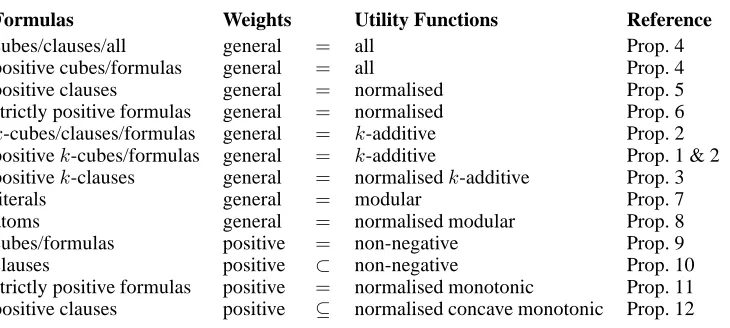
Table 1: Summary of Correspondence Results
Conclusion
We have further analysed the language of weighted proposi-tional formulas previously studied by several authors. Most of our results concern the expressive power of this language; we have established several correspondences between cer-tain types of weighted formulas and well-known classes of utility functions. Our correspondence results are sum-marised in Table 1. We have then made initial steps towards analysing the comparative succinctness of languages based on different types of weighted formulas that can represent the same class of utility functions. In particular, we have seen that the language of weighted cubes, while not more expressive, is strictly more succinct than the language based on positive cubes.
In this paper, we have focussed exclusively on the additive interpretation of weighted propositional formulas. Other ag-gregation functions can be considered, such as maximum (Dubois, Lang, & Prade 1994) or more general functions (see, for instance, the work of Bistarelli et al. (1999) in the CSP framework). Weighted formulas together with maxi-mum as the aggregation function have been considered in various places, including for instance the so-called XOR lan-guage for combinatorial auctions (Sandholm 2002), which furthermore restricts formulas to positive cubes. Comparing the simple (but yet expressive) framework of weighted goals with the various languages designed for combinatorial auc-tions (a synthesis of which is given by Nisan (2006)) is an issue for further research.
While this paper establishes a number of interesting re-sults on the expressive power and comparative succinctness of weighted formulas for cardinal preference modelling, it also raises a multitude of open questions. As concerns ex-pressive power, further correspondence results are needed to fully understand the relationship between restrictions on goal bases and different classes of utility functions. For in-stance, it would be very interesting to obtain precise charac-terisations of the classes of superadditive and subadditive functions in terms of goal bases. As concerns succinct-ness, our observation that the inclusion of negation into a language significantly improves succinctness in the case of
cubes immediately raises the question whether this remains true for more general formulas: IsU(all,all)strictly more succinct than U(positive,all)? We conjecture: yes. An-other interesting question would be whether U(all,all) is strictly more succinct than U(cubes,all). Again, we con-jecture: yes.
A further important area for future research concerns the
complexity of working with different languages of weighted
formulas. For instance, let MAX-UTILITY(H,H’) be the following decision problem: given a goal base G ∈ U(H,H’) and an integer K, check whether there exists a worldM ∈2PS such that
uG(M)≥K. Obviously,
MAX-UTILITYis in NP for the full language of weighted formu-las, sinceuG(M)≥Kcan be checked in polynomial time.
Clearly as well, the general problem is NP-complete, due to its straightforward reduction from SAT (Garey & John-son 1979). More interestingly, for sublanguages such as
U(k-clauses,positive), MAX-UTILITYis also NP-complete, even for k = 2. This can be shown via a reduction from MAX2SAT(Garey & Johnson 1979).
Simpler languages such as U(literals,all), on the other hand, give rise to polynomial decision problems: as-suming that G contains every literal exactly once (pos-sibly with weight 0), making a propositional symbol
p true iff the weight of p is greater than the weight of ¬p results in an alternative with maximal utility. MAX-UTILITY(positive,positive) is also in P, because making all propositional symbols true will result in maxi-mal utility. We shall leave a full analysis of these issues to a future occasion.
Acknowledgements. We would like to thank the anony-mous reviewers for their insightful comments and for point-ing us into the direction of some of the relevant literature.
References
Bacchus, F., and Grove, A. J. 1996. Utility indepen-dence in a qualitative decision theory. In Proc. 5th
Rep-resentation and Reasoning (KR-1996). Morgan Kaufmann
Publishers.
Bistarelli, S.; Fargier, H.; Montanari, U.; Rossi, F.; Schiex, T.; and Verfaillie, G. 1999. Semiring-based CSPs and val-ued CSPs: Frameworks, properties and comparison.
Con-straints 4(3):199–240.
Boutilier, C., and Hoos, H. 2001. Bidding languages for combinatorial auctions. In Proc. 17th International Joint
Conference on Artificial Intelligence (IJCAI-2001).
Mor-gan Kaufmann Publishers.
Boutilier, C.; Bacchus, F.; and Brafman, R. 2001. UCP-networks: A directed graphical representation of condi-tional utilities. In Proc. 17th Conference on Uncertainty
in Artificial Intelligence (UAI-2001). Morgan Kaufmann
Publishers.
Boutilier, C.; Brafman, R.; Hoos, H.; and Poole, D. 1999. Reasoning with conditional ceteris paribus prefer-ence statements. In Proc. 15th Conferprefer-ence on Uncertainty
in Artificial Intelligence (UAI-1999). Morgan Kaufmann
Publishers.
Boutilier, C.; Dearden, R.; and Goldszmidt, M. 1995. Ex-ploiting structure in policy construction. In Proc. 14th
International Joint Conference on Artificial Intelligence (IJCAI-1995). Morgan Kaufmann Publishers.
Brams, S. J.; Kilgour, D. M.; and Zwicker, W. S. 1998. The paradox of multiple elections. Social Choice and Welfare 15(2):211–236.
Cadoli, M.; Donini, F.; Liberatore, P.; and Schaerf, M. 1996. Comparing space efficiency of propositional knowl-edge representation formalisms. In Proc. 5th International
Conference on Principles of Knowledge Representation and Reasoning (KR-1996). Morgan Kaufmann Publishers.
Chevaleyre, Y.; Endriss, U.; Estivie, S.; and Maudet, N. 2004. Multiagent resource allocation withk-additive util-ity functions. In Proc. DIMACS-LAMSADE Workshop on
Computer Science and Decision Theory, Annales du
LAM-SADE 3.
Chevaleyre, Y.; Dunne, P. E.; Endriss, U.; Lang, J.; Lemaˆıtre, M.; Maudet, N.; Padget, J.; Phelps, S.; Rodr´ıguez-Aguilar, J. A.; and Sousa, P. 2006. Issues in multiagent resource allocation. Informatica 30:3–31. Conitzer, V.; Sandholm, T. W.; and Santi, P. 2005. Com-binatorial auctions withk-wise dependent valuations. In
Proc. 20th National Conference on Artificial Intelligence (AAAI-05). AAAI Press.
Coste-Marquis, S.; Lang, J.; Liberatore, P.; and Marquis, P. 2004. Expressive power and succinctness of propositional languages for preference representation. In Proc. 9th
In-ternational Conference on Principles of Knowledge Repre-sentation and Reasoning (KR-2004). AAAI Press.
Cramton, P.; Shoham, Y.; and Steinberg, R., eds. 2006.
Combinatorial Auctions. MIT Press.
Doyle, J., and Wellman, M. P. 1991. Preferential semantics for goals. In Proc. 9th National Conference on Artificial
Intelligence (AAAI-1991). AAAI Press.
Dubois, D.; Lang, J.; and Prade, H. 1994. Possibilistic logic. In Gabbay, D. M., et al., eds., Handbook of Logic in
Artificial Intelligence and Logic Programming, volume 3.
Oxford University Press. 439–513.
Dupin de Saint-Cyr, F.; Lang, J.; and Schiex, T. 1994. Penalty logic and its link with Dempster-Shafer theory. In
Proc. 10th Conference on Uncertainty in Artificial Intelli-gence (UAI-1994). Morgan Kaufmann Publishers.
Garey, M. R., and Johnson, D. S. 1979. Computers and
Intractability: A Guide to the Theory of NP-completeness.
W. H. Freeman and Co.
Gilboa, I., and Schmeidler, D. 1992. Canonical repre-sentation of set functions. Technical report, Northwestern University Kellogg Graduate School of Management. Dis-cussion Paper No. 986.
Gonzales, C., and Perny, P. 2004. GAI networks for utility elicitation. In Proc. 9th International Conference on
Prin-ciples of Knowledge Representation and Reasoning (KR-2004). AAAI Press.
Grabisch, M. 1997. k-order additive discrete fuzzy mea-sures and their representation. Fuzzy Sets and Systems
92:167–189.
Haddawy, P., and Hanks, S. 1992. Representations for decision-theoretic planning: Utility functions for deadline goals. In Proc. 4th International Conference on Principles
of Knowledge Representation and Reasoning (KR-1994).
Morgan Kaufmann Publishers.
Ieong, S., and Shoham, Y. 2005. Marginal contribu-tion nets: A compact representacontribu-tion scheme for coalicontribu-tional games. In Proc. 6th ACM Conference on Electronic
Com-merce (EC-2005). ACM Press.
La Mura, P., and Shoham, Y. 1999. Expected utility net-works. In Proc. 15th Conference on Uncertainty in
Artifi-cial Intelligence (UAI-1999). Morgan Kaufmann
Publish-ers.
Lafage, C., and Lang, J. 2000. Logical representation of preferences for group decision making. In Proc. 7th
In-ternational Conference on Principles of Knowledge Rep-resentation and Reasoning (KR-2000). Morgan Kaufmann
Publishers.
Lang, J. 2004. Logical preference representation and com-binatorial vote. Annals of Mathematics and Artificial
Intel-ligence 42(1–3):37–71.
Nisan, N. 2006. Bidding languages for combinatorial auc-tions. In Cramton, P.; Shoham, Y.; and Steinberg, R., eds.,
Combinatorial Auctions. MIT Press.
Pinkas, G. 1991. Propositional nonmonotonic reasoning and inconsistency in symmetric neural networks. In Proc.
12th International Joint Conference on Artificial Intelli-gence (IJCAI-1991). Morgan-Kaufmann Publishers.
Rota, G.-C. 1964. On the foundations of combinato-rial theory I: Theory of M¨obius functions. Zeitschrift f¨ur Wahrscheinlichkeitstheorie und Verwandte Gebiete
2(4):340–368.
Sandholm, T. W. 2002. Algorithm for optimal winner determination in combinatorial auctions. Artificial
Intel-ligence 135:1–54.
Shafer, G. 1976. A mathematical theory of evidence.