Economic Analysis of Certification Systems in Organic Food and Farming
07.02.2011
Lizzie Melby Jespersen
ICROFSORGANIC CERTIFICATION IN SELECTED
EUROPEAN COUNTRIES:
CONTROL FEES AND SIZE OF THE SECTOR
DELIVERABLE 8
Archived
at
DISCLAIMER
This publication was generated as part of the CERTCOST Project, agreement no.
207727
under the 7
thFramework Programme. The publication reflects the views of the
author(s) and not those of the European Community, who is not to be held liable for
any use that may be made of the information contained.
1
EXECUTIVE SUMMARY
In the increasing organic market in Europe, more and more of the organic food is sold via big retail chains. This development implies that an increasing trade with organic food takes place over long distances and across borders in Europe. Therefore, the control of organic products through the food chain “from farm to fork” has become increasingly important, because the organic inspection and certification system is the only guarantee to the consumer that the organic food products they buy really are organic.
At the European level quite a lot of research has been done on various aspects of organic farming and marketing of organic food products, but little is known about the organic certification system at EU level as regards efficiency, costs and size of the organic certification sector. As an outcome of the CERTCOST project, baseline information on the
actors in the organic certification sector has been made available in
th
information, contact details and other relevant information on the actors involved in the organic certification chain (competent authorities, accreditation bodies, control authorities, control bodies, standards owners and authorities managing certification subsidies), and it covers 16 EU countries, 2 associated countries and an EU candidate country.
This study intends to shed some light on the European certification sector with respect to the fees for control (inspection and certification) of organic operators (as far as they are publicly available) and to make an estimate of the size of the certification sector in the EU and two other European countries (Switzerland and Turkey) in staff full time years and costs. Data on publicly available fees for organic control plus public certification support measures influencing the actual control costs were collected by the CERTCOST partners from 19
European countries, for the certification database,
detailed survey was carried out in 7 study countries (the Czech Republic, Denmark, Germany, Italy, the United Kingdom, Switzerland and Turkey) by means of detailed questionnaires, which were particularly aimed at the 4 types of actors involved in organic control (competent authorities, accreditation bodies, control authorities / control bodies and standards owners). The questionnaires were designed for collection of data for several tasks in the CERTCOST project, but relevant for this study were questions concerning control fees, hours spent on control and other costs related to the control (travel costs, overhead etc.). The questionnaire for the control bodies also contained questions concerning control fees for 3 farm cases and 2 processor cases in order to get comparable data on control fees and time spent on the control for different control bodies and countries. Besides, all actors were asked for information on the number of staff employed by them, measured in full time years, and the hours in a full time year for their organisation for estimation of the organic certification sector size.
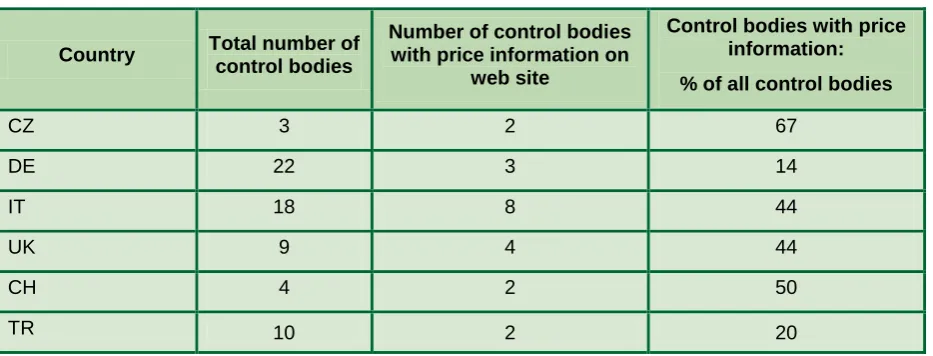
United Kingdom and Turkey. It seems obvious that all control bodies offering their services to the organic operators should have a publicly available price list on their web site, as also stated in the requirements of ISO 65 (EN45011), according to which all approved control bodies are accredited. However, the percentage of control bodies in the 7 study countries, which did have public price lists on their web site, varied from 67 % in the Czech Republic, 50 % in Switzerland, 44 % in Italy and the United Kingdom, 20 % in Turkey, down to only 14 % in Germany. Denmark has a governmental certification system free of charge for all organic operators, for which reason there is no price list.
The questionnaire survey showed that the control fees were calculated in many different ways by different control bodies, making it very difficult for the customers to estimate and compare prices. As it was expected that it would be difficult to compare control fees of different control bodies, the questionnaire contained questions on fees and hours spent on the control for 3 farm cases and 2 processor cases. In total 25 control bodies supplied data on the farm cases, of which 2 from the Czech Republic, 3 from Germany, 5 from Italy, 4 from the United Kingdom, 2 from Switzerland and 9 from Turkey. The number of respondents who filled in data on the processor cases was slightly lower. Comparison of control bodies within countries showed that there was not necessarily any correlation between the size of the fee and the time spent on the control. For comparison of the fees, hours spent on the control and the hourly rate between the countries minimum, maximum and average fees were calculated for each of the 3 farm cases and 2 processor cases for each country. The comparison showed that the variation in the size of the fee, the hours spent and the hourly rate could vary as much as or even more between control bodies within the same country as between countries.
In general the Czech Republic had the lowest average fees – for the farm cases: 66-109 €, followed by Italy (262-375 €), Germany (350-420 €), United Kingdom (526-571 €), Turkey (544-798 €) and Switzerland (811-1003 €). For the processor cases the order of the countries as concerns fee size was the same. The main reason for the high control fees in Turkey is that the Turkish control bodies generally spent much more time on the inspection and certification (21-34 hours on average), than the control bodies in the other countries for the farm cases. The average time spent by the 4 EU countries was only 7-10 hours.
In 11 of 16 Länder in Germany and in 18 of 19 regions and 1 of 2 provinces of Italy the regional governments subsidise organic control costs of organic farmers. Hereby farmers may get their control fee reduced or even get the whole control fee paid back, depending on the control body they use. The 5 German Länder involved in the study pay a support of 35 €/ha up to maximum 15 ha or 530 €, which is enough to cover all or most of the control fee for the 3 farm cases depending on the control body carrying out the control. Of the 2 Italian regions involved in the study, Marche had no support scheme, while Tuscany paid the actual documented control cost up to 3000 € per farm and year for a 5 year period.
The study shows that the fee calculation of the control bodies is done in quite diverse ways. It also shows that in many cases the operators may save money by choosing the “right” control body, which however may change depending on the type and size of the farm or operation. For the sake of transparency it is recommended that the competent authorities and/or the accreditation bodies enforce on the control bodies that they must have easily accessible public price lists on their various services on their web sites.
The study should also give an estimate of the size of the organic certification sector in the EU (competent authorities, accreditation bodies, control authorities, control bodies and standards owners) expressed in staff full time years. Filled in questionnaires were received from 49 respondents of which 12 competent authorities, 5 accreditation bodies, 2 control authorities, 28 control bodies and 2 standards owners.
3
workforce of the accreditation bodies, control bodies and standards owners involved in accreditation and control according to private standards and standards outside the EU were not included, and work spent on import and export control was not included either.
With 1500 employees the cost of the workforce of the organic certification sector was estimated to about 35-55 million €. Besides the staff wages, there are other fixed and variable costs plus overhead, which means that the annual turnover of the competent authorities, accreditation bodies, control authorities and control bodies in the EU-27 was probably at least around 70-110 million € in 2008. In Switzerland the 46 staff full time years in the organic certification sector corresponded to at least 2 million € in 2008, and the annual turnover of the organic certification sector was probably at least 4 million €. In Turkey the 35 staff full time years corresponded to at least 350,000 € in 2008, and the annual turnover of the organic certification chain was probably at least 700,000 €.
Index
EXECUTIVE SUMMARY
... 1
List of tables
... 6
List of figures
... 8
List of abbreviations
... 8
1
BACKGROUND
... 9
1.1
Introduction
... 9
1.2
Objectives
...11
1.3
Definition of terms
...12
2
Overview of the organic sector and certification systems in 7countries
16
2.1
Background information
...16
2.1.1.
Study countries
...16
2.1.2.
Certification systems
...18
3
Data collection
...21
3.1
Data collection methods
...21
3.1.1.
Publicly available organic control fees
...21
3.1.2.
Size of the organic certification sector
...23
3.1.3.
Questionnaire response rate
...24
3.2
Problems encountered
...26
3.2.1.
Comparability of data on control fees
...26
3.2.2.
Comparability of data on estimation of staff full time years
...26
4
Control fees
...27
4.1
Comparison of organic control fees
...27
4.1.1.
Publicly available organic control fees
...27
4.1.2.
Fee calculation methods
...28
5
4.2.1.
Comparison of farm cases within countries
...28
4.2.2.
Comparison of farm cases between countries
...34
4.3
Case study on prices for 2 processor cases
...35
4.3.1.
Comparison of processor cases within countries
...35
4.3.2.
Comparison of processor cases between countries
...39
4.4
Comparison of subsidies for certification costs
...41
4.5
Discussion of control fee results.
...41
5
Estimation of the size of the organic sector
...44
5.1
Size of organic sector at different levels of the certification chain
...44
5.1.1.
Response rate
...44
5.1.2.
Average number of full time hours per year
...44
5.2
Discussion on the estimation of the organic certification sector
...50
6
References
...52
Annex I: Questionnaire for competent authorities
...55
ANNEX II: Farm and processor cases
...63
List of tables
Table 1 Definition of terms………. .... 12
Table 2 Statistical information on organic area and operators in the 7 study
countries ... 17
Table 3 Overview of the actors involved in the certification chain of the 7 study
countries for the year 2008 based on the www.organicrules.org database ... 19
Table 4 Number of approved control authorities and bodies in the EU for 2008 and
2009 according to (EC, 2009); (EC, 2010b) compared to the information in
table 3 ... 20
Table 5 Questions on farm and processor cases ... 22
Table 6 Questions for estimation of the size of the certification sector in staff full
time years ... 24
Table 7 Number of actors, which returned the detailed questionnaire and total actors
in the certification chain. ... 25
Table 8 Number of control bodies and number of control bodies with public price
information on their website in 6 study countries ... 27
Table 9 Czech control bodies: Fees, working hours spent, hourly rate and other
costs for control of 3 farm cases ... 29
Table 10 German control bodies: Fees, working hours spent, hourly rate and other
costs for control of 3 farm cases ... 30
Table 11 Italian control bodies: Fees, working hours spent, hourly rate and other
costs for control of 3 farm cases ... 30
Table 12 British control bodies: Fees, working hours spent, hourly rate and other
costs for control of 3 farm cases ... 31
Table 13 Swiss control bodies: Fees, working hours spent, hourly rate and other
costs for control of 3 farm cases ... 32
Table 14 Turkish control bodies: Fees, working hours spent, hourly rate and other
costs for control of 3 farm cases ... 33
Table 15 Farm cases: Average and interval of fees, working hours spent and hourly
rates for 6 European study countries ... 34
Table 16 Czech control bodies: Fees, working hours spent, hourly rate and other
costs for control of 2 processor cases ... 36
Table 17 German control bodies: Fees, working hours spent, hourly rate and other
7
Table 18Italian control bodies: Fees, working hours spent, hourly rate and other
costs for control of 2 processor cases ... 37
Table 19 British control bodies: Fees, working hours spent, hourly rate and other
costs for control of 2 processor cases ... 38
Table 20 Swiss control bodies: Fees, working hours spent, hourly rate and other
costs for control of 2 processor cases ... 38
Table 21 Turkish control bodies: Fees, working hours spent, hourly rate and other
costs for control of 2 processor cases ... 39
Table 22 Processor cases: Average and interval of fees, working hours spent and
hourly rates for 6 European study countries ... 40
Table 23 Number of responses on staff full time years in questionnaires ... 44
Table 24 Number of hours in staff full time years, as estimated by the questionnaire
Respondents ... 45
Table 25 Averate annual number of working hours in 2008 according to different
Sources... 45
Table 26 Estimated number of staff full time years spent on orgnaic control in 2008
in the 7 study countries ... 46
Table 27 Number of staff full time years, operators, and oprators per full time
CHAPTER 1_BACKGROUND
List of figures
Figure 1 Organic farming in Europe, surface area by country ... 18
Figure 2 Overview of the actors involved in the organic certification chain ... 19
Figure 3 Mean gross annual earnings for full time employees in industry and
services ... 48
List of abbreviations
AC
Accreditation body
CA
Competent authority
CAU
Control authority
CB
Control body
CH
Switzerland
DE
Germany
DK
Denmark
ECB
European Central Bank
EU-12
Member states which joined the EU in May 2004 (Cyprus, Czech
Republic, Estonia, Hungary, Latvia, Lithuania, Malta, Poland, Slovakia,
Slovenia) + Bulgaria and Romania.
EU-15
Member states which joined the EU before 2004 (Austria, Belgium,
Denmark, Finland, France, Italy, Germany, Greece, Ireland,
Luxembourg, Netherlands, Portugal, Spain, Sweden and United
Kingdom).
FCA
Federal competent authority
FTE
Full Time Equivalents
IT
Italy
RCA
Regional competent authority
SO
Standards owner
TR
Turkey
UK
United Kingdom
CHAPTER 1_BACKGROUND
9
1 BACKGROUND
1.1 Introduction
The organic sector has become increasingly important in the EU over the last decades. Not only has the area increased to 7.6 million ha in 2008, corresponding to 4.3 % of the EU-27 utilised agricultural area (EC, 2010a). In recent years the consumer demand for organic food products has also increased impressively. In 2006/2007 the sale of organic food in the retail sector in the EU-15 member states reached 14.4 billion €. The average annual increase on the four largest EU markets for organic food (France, Germany, Italy and the United Kingdom) was 18.1 % for France (2005-2009), 14 % for Germany (2000-2008), 8.7% for Italy (2001-2009) and 11.9 % for the United Kingdom (2000-2008) (EC, 2010a). In Denmark, which probably had one of the highest growth rates in the organic food retail turnover in the world in 2008, the organic food turnover was 6.5 % of the total food retail turnover corresponding to 621 million € and a growth of 29 % compared to 2007 (Oekologisk Landsforening, 2009). As the organic market increases and more and more organic food products are sold through big retail chains, an increasing trade with organic food products takes place over long distances and across borders in Europe. Therefore, the control of organic food products through the food chain from farm to fork has become increasingly important, because the organic certification system is the only guarantee to the consumer that the organic food products marketed are really organic.
At the European level quite a lot of research has been done on various aspects of organic farming and marketing of organic food products, but hardly any research has been done on the organic certification system at European or national level as regards the efficiency, costs and size of the organic certification system (Zorn et al., 2009). In fact, it is quite difficult on the national or EU level to get an overview of all the authorities and bodies involved in the certification chain. For stakeholders or users of the organic certification system it is even more difficult to get an overview of the control fees applied by different organic control authorities and control bodies at the national or EU level. Neither is there any information on the size of the organic certification sector in the EU, because so little information is publicly available, and the little information which can be found, is quite scattered.
This study intends to shed some light on the transparency of the European certification sector as regards publicly available fees for inspection and certification of organic operators and to make an estimate of the size of the certification sector in the EU and two other European countries (Switzerland and Turkey).
CHAPTER 1_BACKGROUND
certification system of the member states and contact details of the EU approved control authorities and control bodies in each member state.
The Commission also collects data on the organic control in each member state according to EC 834/2007 Article 27 paragraph 14, which states that “by January each year the control authorities and control bodies shall transmit to the competent authorities a list of the operators which were subject to their controls on December 31 the previous year and a summary report of the control activities carried out during the previous year shall be provided [to the Commission] by 31 March each year”. However, these reports are not public, but for 2005 to 2007 the Commission has published annual summary reports on the supervision of inspection bodies and authorities of the Member States according to Article 15 of Council Regulation (EEC) No 2092/91 on organic production on the Organic web site of DG Agri (EC 2010c).
Another source of information on the organic certification sector and the size of it is The Organic Standard (TOS), which has collected annual data from organic certification bodies around the world since 2005 for publication in the annual TOS Organic Certification Directory. Besides contact details, a number of data is presented for each certifier, i.e. annual turnover, number of employees, own organic standards, standards certified, countries of operation, number of operators, number of farms, number of full time and free lance employees, EU and ISO 65 approval and other approvals. However, far from all certification bodies have responded and very few of those, which have responded, have answered all the questions asked.
According to TOS (2008) there were 481 control bodies and control authorities world wide in 2008, of which 177 (37%) in Europe. Of the 177 European certification bodies 152 had an EU approval, 87 had an ISO65/EN45011 approval, 14 had an IFOAM approval, 32 had a US-NOP (USA National Organic Program) and 14 had a JAS (Japanese Organic Standard) approval. Most of the certification bodies were not transparent concerning their turnover. Of the 481 certifiers only 78 bodies supplied such data for 2008. In 2009 78 certification bodies out of 488 supplied data on their annual turnover of which many reported figures of 100.000- 500.000 € (TOS, 2009). European certification bodies reporting an annual turnover of 2 million € or more in the TOS 2009 enquiry were Ecocert France, Bio.inspecta, ICEA, CCPB, Soulo e Salute, Ecocert International, Qualité France, DIO, Biohellas, Skal, and Debio. It was further estimated that the global annual turnover of organic certification would be clearly above 200 million € and perhaps even the double amount (400 million € would represent about 1 % of the estimated market value of organic products or less than 300 € per farmer) (TOS, 2009).
In an earlier study Rundgren (2001) estimated the financial costs for organic certification at the farm level to be about 3 % of business turnover and about 1 – 2 % of business turnover for the following steps of handling and processing of organic products, corresponding to around 1.5 % of the organic retail turnover. These results were based on a questionnaire investigation where responding certification bodies were asked to calculate the fees for 3 farm cases:
• A 6 ha horticultural farm with 3 ha intensive horticulture and 3 ha of land under grain, rice, pulses, hay or green manures. Perhaps a couple of sheep or goats for own consumption.
• A 30 ha dairy farm with fodder crops and pasture for 20 dairy cows and their offspring for replacement and slaughter.
CHAPTER 1_BACKGROUND
11
In total 80 questionnaires were sent out to certification bodies worldwide, but only 18 (of which 6 from Europe) responded. The annual certification fee for the 6 ha horticulture farm varied from about 120-850 US$ (160-950 €1
Using the above mentioned 1.5 % for the turnover of the organic certification industry and an annual retail turnover of 14.6 billion € in 2006 for the European organic market Zorn et al. (2009) estimated the financial turnover of the European organic certification sector to more than 200 million € for 2006.
) and for the 30 ha dairy farm from about 380 – 1100 US$ (420-1230 €) for the 6 European certification bodies. Based on an estimated annual turnover of the two farm types of 20,000 US$ (22330 €) and an average certification fee of 530 US$ (590 €) for the horticulture farm and 672 US$ (750 €) for the dairy farm worldwide, the certification fee was calculated to correspond to around 2.7 % of the annual turnover for the horticulture farm case and 3.4 % of the annual turnover for the dairy farm case. Using these farm cases as an example Rundgren (2001) estimated the total certification fees for farms to be around 3 % and guessing that the certification fee for processors and handling is in the range of 1-2 % of the annual turnover. Using a figure of 20 billion US$ (22.3 billion €) for the global turnover of organic products at retail level and assuming that the global turnover of organic products at wholesale and processor level is 10 billion US$ (11.6 billion €) and 5 billion US$ (5.6 €) at farm level he uses the certification fees of 1-2 % and 3 % of the annual turnover respectively to estimate the total worldwide turnover in the organic certification industry to be around 300 million US$ (335 million €) i.e. 1.5 % of the global retail value .
1.2 Objectives
The overall objective of the CERTCOST project is to provide research based recommendations to improve organic food certification systems in Europe in terms of efficiency, transparency, and cost effectiveness. This is likely to strengthen the competitiveness of the European organic food sector because it will reduce the incidence of non-compliance and thus increase consumers’ trust.
To be able to analyse the organic certification systems in Europe in relation to transparency, efficiency and cost effectiveness it is necessary to have some baseline information on the organic certification systems and standard setting procedures within the EU and associated European countries (Switzerland and Turkey). These matters have been dealt with in the CERTCOST Report “The European Regulatory Framework and its Implementation in Influencing Organic Inspection and Certification Systems in the EU” (Padel, 2010). Besides, it is necessary to apply economic theory to the case of the organic food and certification chain and to define relevant terms regarding inspection, certification and economic concepts. This has been dealt with in the CERTCOST Report “Economic Concepts of Organic Certification” (Zorn et al., 2009).
Further baseline information on the actors in the certification chain for the year 2008 has
been made available in the
contact details, number of operators certified and other relevant information on the certification chain actors of 16 European countries, 2 associated countries and an accession country.
One objective of this report is to supplement the information on fees in
t
1
CHAPTER 1_BACKGROUND
certification for farmers, processors, wholesalers, retailers and importers in selected EU and associated countries (Czech Republic, Denmark, Germany, Italy, Switzerland, Turkey and the United Kingdom). Transparency and the possibility to compare certification fees are important for the organic operators (farmers, processors, importers etc.) and stakeholders, and it is particularly interesting in countries where there are many certification bodies to choose among, e.g. Germany and Italy.
Another objective of this report is to present an estimate of the size of the certification sector (competent authorities, accreditation bodies, control authorities and control bodies) expressed in staff full time years, because at the moment there are no figures for the size of this sector in Europe.
1.3 Definition of terms
Table 1 lists definitions of terms used in the report based on the glossary of the CERTCOST Report “Economic Concepts of Organic Certification” by Zorn et al. (2009).
Table 1: Definition of Terms, partly based on Zorn et al., 2009
TERM DEFINITION / DESCRIPTION
Accreditation Procedure by which an authoritative body (this can either be a public
or a private accreditation body) gives a formal recognition that a body is competent to provide inspection and certification services (International Task Force (ITF) 2007). In the European Union, organic control bodies have to be accredited to European Standard EN 45011 or ISO Guide 65.
Accreditation body Public or private body that conducts accreditation
Audit See Control
Certification Procedure by which a certification or control authority or body (a third
party) gives written assurance that a product, process or service is in conformity with certain standards (Codex Alimentarius Commission 1995), is called certification.
Certification body Body that conducts certification. See also “Control body”.
Competent authority
CHAPTER 1_BACKGROUND
13
Control
Synonyms: Inspection (NOP), Audit (FAO)
An on-site visit of operators in order to verify that their performance is in accordance with a particular set of production or processing standards is called control (Dankers and Liu, 2003; International Task Force (ITF), 2007).
Controls can be categorised into announced and unannounced controls. Furthermore, the following types of controls are differentiated (Rundgren, 2007):
•An initial control is the first visit to an operator who is in the process of converting to organic. This first visit usually is more time-consuming than routine controls, since a lot of data has to be collected.
•A routine or regular control is a physical inspection of an operator and usually is scheduled (announced) but can also occur as an unannounced inspection. The key aspects of an operation are examined during a routine control. This kind of control is usually performed once a year - also called an annual control.
•A random or spot-check control is conducted primarily unannounced. Random controls shall be based on the risk of non-compliance with the organic standard, previous control results, the quantity of products concerned and the risk for exchange of products according to Commission Regulation (EC) No 889/2008, Article 65(4).
A follow-up control
Control authority
results from another precedent control. The reasons for a follow-up control are varied. Such a control has got the character of a sanction, if an operation was not perfectly prepared for certification during the routine control or the certification body has required the control of corrective actions, which should be implemented.
Council Regulation (EC) No 834/2007, Article 2(o), defines the control
authority as follows: “public administrative organisation of a Member
State to which the competent authority has conferred, in whole or in part, its competence for the inspection and certification in the field of organic production in accordance with the provisions set out under this Regulation; it shall also include, where appropriate, the corresponding authority of a third country or the corresponding authority operating in a third country”.
Control body “Independent private third party carrying out inspection and
certification” Council Regulation (EC) No 834/2007, Article 2(p). In Council Regulation (EC) No 834/2007 on organic production and labelling of organic products, the term control body is used throughout. This regulation does neither use the term ‘inspection body’ (which was used in the Council Regulation (EEC) 2092/91) nor ‘certification body’.
CHAPTER 1_BACKGROUND
Control body
(continued)
Where a certification body performs its own inspections, the certification body is both the inspection body (Dankers and Liu 2003)) and the certification body (organisation performing certifications; the certification body may use an existing standard or may set its own standard, based on an international and/or normative standard (Dankers and Liu 2003; International Task Force (ITF) 2007)). See also “Control authority” for public bodies that are in charge of inspection and certification.
EN45011 See “ISO 65”.
EU-27 Austria, Belgium, Bulgaria, Cyprus, Czech Republic, Denmark,
Estonia, Finland, France, Germany, Greece, Hungary, Ireland, Italy, Latvia, Lithuania, Luxemburg, Malta, the Netherlands, Poland, Portugal, Romania, Slovakia, Slovenia, Spain, Sweden and the United Kingdom.
EU-15 Austria, Belgium, Denmark, Finland, France, Germany, Greece,
Ireland, Italy, Luxembourg, the Netherlands, Portugal, Spain, Sweden and the United Kingdom.
EU-12 Bulgaria, Czech Republic, Cyprus, Estonia, Hungary, Latvia, Lithuania,
Malta, Poland, Romania, Slovakia, Slovenia.
Full Time
Equivalents (FTE)
Full-time equivalent employment, which equals the number of full-time equivalent jobs, is defined as total hours worked divided by the average annual number of hours worked in full-time jobs within the economic territory (ESA95 1996). FTE is similar to staff full time years.
Inspection See “Control”.
Inspection body See “Control body”.
ISO 65
(EN 45011)
ISO is the abbreviation for the International Organization of Standardization, a non-governmental organisation. The abbreviation ISO is derived from the Greek word “isos” (equal). ISO does not certify nor accredit, it only sets standards for sectors, quality management and conformity assessments systems.
ISO Guide 65 on “general requirements for bodies operating a
CHAPTER 1_BACKGROUND
15
Operator Operator means any person – natural or legal – who produces,
prepares or imports, with a view to the subsequent marketing thereof, food products, or who markets such products (Codex Alimentarius Commission, 2007).
The current EU organic regulation (Council Regulation (EC) No 834/2007, Article 2(d)) introduced a new, more precise definition for the operator being the “natural or legal persons responsible for ensuring that the requirements of this Regulation are met within the organic business under their control.”
The activities covered entail the production, preparation, storage, import and marketing (distribution) of organic products.
Private Standards owners
Private standards are set by private actors while the government or its public agencies may have issued national public standards, i.e. regulations and guidelines, which may be stricter than Council Regulation (EC) No 834/2007. Private standards exist on regional, national and international levels for food products (Will and Guenther, 2007). In the organic sector, these standards are set by growers’ associations, umbrella organisations and sometimes by certain certification bodies.
Private organic standards are often stricter in some areas than Council Regulation (EC) No 834/2007 which has the function of a minimum
organic quality standard.2
Processor
Associations and companies can use private standards in order to differentiate their products from competitors and to enhance their relative market position. Private standards can become a de-facto-minimum quality standard, when their market significance is very high.
In the NOP, processing is defined as: “Cooking, baking, curing, heating, drying, mixing, grinding, churning, separating, extracting, slaughtering, cutting, fermenting, distilling, eviscerating, preserving, dehydrating, freezing, chilling, or otherwise manufacturing and includes the packaging, canning, jarring, or otherwise enclosing food in a container” (United States Department of Agriculture - Agricultural Marketing Service, 2000).
The European food legislation, i.e. both the Regulation (EC) No 178/2002 on the general principles and requirements of food law and the Council Regulation (EC) No 834/2007, does not provide a definition of processing.
Other operators Operators other than farmers or processors, e.g. importers, exporters,
farm suppliers, wholesalers, packaging companies, distributors, retailers.
2
CHAPTER 2_OVERVIEW OF THE ORGANIC SECTOR AND CERTIFICATION SYSTEMS IN 7 COUNTRIES
2 OVERVIEW OF THE ORGANIC SECTOR AND
CERTIFICATION SYSTEMS IN 7 COUNTRIES
2.1 Background information
2.1.1. Study countries
7 countries were selected for this study, and 5 of these are EU countries (the Czech Republic, Denmark, Germany, Italy and the United Kingdom). Germany, Italy and the United Kingdom were the 4th, 9th and 11th
Table 2 presents an overview of the most important statistical data from 2007-2008 on organic farming area and operators for the 7 selected countries. This includes information on total agricultural area, organic area, in conversion area and the organic area in percent of the total agricultural area. Data on total number of farmers, certified organic operators, organic farmers, other organic operators than farmers and organic farmers in percent of total farmers is also included. Switzerland has the highest percentage of organic area (11.2 %) and organic farmers (10 %) of all 7 countries, while the Czech Republic has the highest percentage of organic area (8 %) and Denmark has the highest percentage of organic farmers (6.2 %) within the selected EU countries.
CHAPTER 2_OVERVIEW OF THE ORGANIC SECTOR AND CERTIFICATION SYSTEMS IN 7 COUNTRIES
[image:19.595.67.568.88.485.2]17
Table 2: Statistic information on organic area and operators in the 7 study countries
Country Unit CZ DE DK IT UK CH TR
Country area1 km2 78,866 356,854 43,094 301,263 244,820 41,290 783,562 Agricultural area1 ha 4,249,177 16,931,900 2,662,590 12,707,850 17,452,100 1,047,384 24,479,216 Certified organic +
in conversion area
ha
2 341,632 907,786 150,374 1,002,414 737,631 117,286 109,387
Certified organic
area3 ha 232,939 - 139,021 812,139 582,205 - -
Area in conversion
to organic ha 108,693 - 11,353 190,275 155,426 - -
Agricultural area in % of country area
%
2 54 47 62 42 71 25 31
Certified organic + in conversion area in % of agricultural area
% 8.0 5.4 5.6 7.9 4.2 11.2 0.4
Farmers (conventional + organic) 4
39,396 370,480 44,620 1,679,440 299,830 60,857 3,076,649
Certified organic
operators5 2,585 29,244 3,794 49,653 7,896 - 15,918
certified organic
farmers5 1,946 19,813 2,751 42,037 5,177 6,111 15,406
Other organic operators than farmers5
639 9,431 1,043 7,616 2,719 - 512
Certified organic farmers in % of total farmers
% 4.9 5.3 6.2 2.5 1.7 10.0 0.5
1: 2007 data from
2: 2008 data from
3: 2008 data from EUROSTAT: “Organic Crop Area”, as of November 2010.
4: 2007 data from EUROSTAT: “Number of agricultural holdings”, as of November 2010. 5: 2008 from CERTCOST Questionnaire investigation (see Section 3.1.1)
CHAPTER 2_OVERVIEW OF THE ORGANIC SECTOR AND CERTIFICATION SYSTEMS IN 7 COUNTRIES
Figure 1: Organic farming in Europe, surface area by country (Rekacewicz et al., 2007)
2.1.2. Certification systems
The countries were selected to represent different certification systems. The Commission discriminates between 3 types of certification systems (EC, 2009):
A: System of approved private inspection bodies
B: System of (a) designated public inspection authority(ies).
C: System of a designated public inspection authority and approved private inspection bodies. In 2007 when the application for the CERTCOST project was written the countries selected for the study represented all three types of certification systems (EC, 2007).
3 EU countries, Germany, Italy and the United Kingdom plus the 2 countries outside the EU, Switzerland and Turkey, had the type A certification system, while Denmark had a type B and the Czech Republic a type C system. However, in 2008 the Czech Republic changed its certification system to type A, so only type A and type B certification systems could be studied for the year 2008, which was chosen as the reference year for the data collection.
[image:20.595.71.554.80.371.2]CHAPTER 2_OVERVIEW OF THE ORGANIC SECTOR AND CERTIFICATION SYSTEMS IN 7 COUNTRIES
[image:21.595.105.511.73.384.2]19
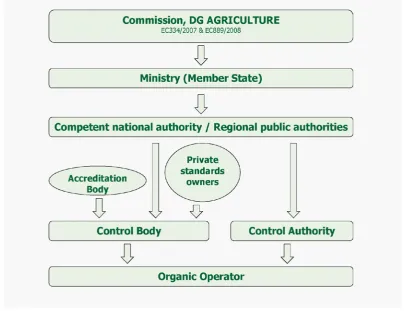
Figure 2: Overview of the actors involved in the organic certification chain based on figure in Zorn et al. (2009)
Table 3 shows an overview of the number of actors involved in the certification chain for the 7
[image:21.595.68.548.483.675.2]study countries in the year 2008 based on the
Table 3: Overview of the actors involved in the organic certification chain of the 7 study
countries for the year 2008, based on t
databaseCompetent Authorities
Accredita tion Bodies
Control Authorities
Control Bodies
Standards
Owners TOTAL
Authorities subsidizing certification
costs
CZ 1 1 3 5
DE 15 2 22 9 48 11
DK 2 2 1 3 8 1
IT 1 (24)1 1 18 4 24 19
UK 1 1 9 1 12 1
CH 1 1 4 4 10
TR 1 1 10 1 13
Total 22 7 2 67 22 120 34
1: The Italian Ministry of Agriculture and Forestry has delegated the supervision of the private control bodies to the Central Inspectorate for the Control of Food Quality (ICQ) and to 20 regional and 2 autonomous provincial governments.
CHAPTER 2_OVERVIEW OF THE ORGANIC SECTOR AND CERTIFICATION SYSTEMS IN 7 COUNTRIES
Italy. In Denmark the supervision of the organic certification system has been delegated to two governmental agencies.
Accreditation bodies are not involved in the certification chain in all of the study countries because the EC 834/2007 does not require that public control authorities are accredited
according to ISO65 / EN45011. This is the reason why there is no accreditation body in Denmark. (The private Danish Demeter association, which certifications the bio-dynamic farmers and
processors according to the Demeter standards on top of the EU organic legislation, is not accredited).
In the Czech Republic no standards owners are involved, because the control bodies certify according to the organic EU regulations only. Standards owners may be public authorities (standards for areas not covered by the EU organic regulations, as for example catering in Denmark) or private bodies, e.g. Demeter, Bioland, AIAB and the Soil Association (in Germany, Italy and the United Kingdom), while the countries outside the EU (Switzerland and Turkey) apply their own governmental regulation as well as private standards (in Switzerland).
Certification support payment is found only in Germany, Italy and the United Kingdom, while in Denmark the public organic certification system is free of charge for all organic farmers and processors, as long as the control carried out is not an extra control due to risk of fraud. In Germany the organic certification subsidies are managed by the regional governments in 11 of the 16 regions/Länder. In Italy the certification subsidies are managed by the regional
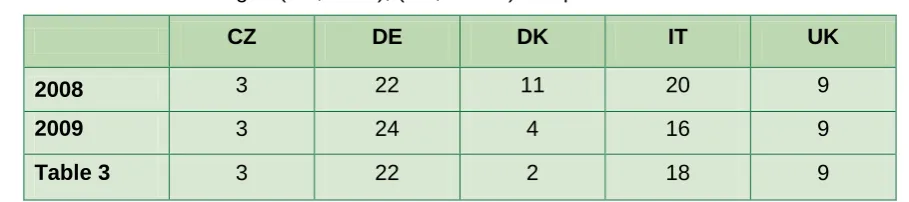
governments in 18 out of 19 regions and in 1 of the 2 provinces, while in the United Kingdom only 1 region, Scotland, pays certification subsidies, and only to a limited number of operators. In these 3 countries the organic certification support payment is only given to farmers (not to processors or other operators), and often only for a limited number of years (see section 4.3). Table 4 shows the number of approved control authorities and bodies according to the “List of approved control authorities and bodies in the EU” for 2008 and 2009 (EC, 2009); (EC, 2010b). As can be seen, the number of control bodies in Denmark and Italy for 2008 according to
the
[image:22.595.76.531.626.727.2]Commission for 2008 and 2009. There are several reasons for these differences. The data on actors involved in the certification chain for the database was collected in 2009, and the new EU regulations, EC 834/2007 and EC 889/2008 entered into force on January 1, 2009. From this date it became a condition that private organic control bodies operating in the EU were accredited according to the most recently notified version of the European Standard EN45011 / ISO Guide 65 (General requirements for bodies operating product certification systems) in accordance with EC 834/2007, article 32, paragraph 2. Two Italian control bodies had not obtained an EN45011 accreditation, for which reason they were not active in organic certification at the time of data collection. As regards Denmark only the two main offices of the organic control authorities were listed in the database while the 10 regional offices of one of the two control authorities were listed in the official list for 2008 (EC, 2009). In 2009 the control authority reduced the number of regional offices to 3.
Table 4: Number of control authorities or control bodies respectively in the EU for 2008 and 2009 according to (EC, 2009); (EC, 2010b) compared to the information in table 3
CZ DE DK IT UK
2008 3 22 11 20 9
2009 3 24 4 16 9
CHAPTER 3_DATA COLLECTION
21
3 DATA COLLECTION
3.1 Data collection methods
3.1.1. Publicly available organic control fees
Data on publicly available fees for organic certification and inspection plus public certification support measures influencing the actual control costs were collected by the CERTCOST partners 3 from 19 countries, for which data was entered into the certification
database,
France, Germany, Hungary, Italy, Norway, Poland, the Republic of Slovenia, Romania, Spain, Sweden, Switzerland, the Netherlands, Turkey and the United Kingdom.
In this study “publicly available organic control fee” has been defined as a price list or price information on certification and inspection services, which is available on the web site of the control authorities / control bodies, because the internet is currently the most important and transparent communication tool for the users of the organic certification system. The control fee may be a single fee covering both certification and inspection or it may consist of separate fees for inspection and certification.
As a first step in the data collection process, publicly available fees for organic certification and inspection of farmers, processors, wholesalers, retailers and importers were collected by searching of web pages of the control bodies and authorities in the 19 countries mentioned above. For those control authorities and control bodies, which had publicly available control fee information on their web page, the most important information was summarised in English and uploaded under the respective control authority / control body in
the
webpage in the original language.
In a second step a more detailed survey was carried out in the 7 study countries (the Czech Republic, Denmark, Germany, Italy, the United Kingdom, Switzerland and Turkey) by means of 4 different detailed questionnaires, which were particularly aimed at the 4 types of actors in the chain (competent authorities, accreditation bodies, control authorities / control bodies and standards owners). The questionnaires concerned among other things questions on
3
CHAPTER 3_DATA COLLECTION
various types of costs, control and licence fees, turnover and number of full time employees etc. All questionnaires are enclosed in Annex I.
The questionnaire survey was partly designed to deliver data to the
database and to this study on organic control fees and estimation of the size of the organic certification sector in the EU in staff full time years. However, most of the questions in the questionnaires were to be used for collection of data and information for the CERTCOST Deliverable 21 report on total costs of organic certification systems in 7 European countries with particular focus on several organic supply chains and the potential of alternative systems (to be published in 2011).
It was foreseen that it might be difficult to get comparable data on the fees of different control authorities and control bodies for various types of operators. Therefore the questionnaire also included cases on 3 different types of farms and 2 different types of processors, for which the respondents were asked to estimate the control fee (certification and inspection) and the total time spent (incl. administration etc.) on an annual control of the following operators:
FARM CASES:
A: 50 ha arable farm (cereals), no livestock.
B: 50 ha dairy farm with 50 dairy cows and 10 ha arable crops. C: 10 ha vegetables.
PROCESSOR CASES:
D: Oil mill (olive, rapeseed or other), 100% organic processing, 100,000 t raw material processed per year.
E: Flour mill, 10 % organic processing, with a total of 100.000 t. flour produced per year The questions asked to the control authorities and control bodies concerning the farm and processor cases are shown in table 5.
Table 5: Questions on farm and processor cases
What are the total costs (costs for staff and others) for one control? (in €)
How much time (in hours per control) is involved in :
• Control on-site (inspection visit)
• Preparation and post-processing by qualified personnel
• Preparation and post-processing by administrative staff
• Carrying out or managing lab analysis of samples taken
• Handling sanctions, withdrawal etc.
• Customer support during the year
Other costs than staff; overhead
Partners from each study country sent out the questionnaires to the competent authorities, accreditation bodies, control authorities / control bodies and standards owners in their country. The authorities and bodies should then prepare their answers and return their questionnaire to the responsible partner. Afterwards the respondents and the responsible partner discussed the answers and clarified any uncertainties in a telephone interview.
CHAPTER 3_DATA COLLECTION
23
number of regional competent authorities in Germany and Italy included in the questionnaire survey was also reduced to a reasonable number. In Germany the competent authorities of 5 regions (“Länder”) out of a total of 15, representing the east, west, north and south of Germany were chosen: Bavaria, Hesse, Mecklenburg-Western Pomerania, Saarland and Saxony. In Italy the Ministry of Agriculture and Forestry plus 2 regional competent authorities out of 20 regional and provincial competent authorities from mid-Italy, Marche and Tuscany were chosen.
The questionnaires were also sent out to the accreditation bodies, control authorities and
control bodies in the 7 countries based on the information in the
database.
As mentioned earlier some national or regional authorities in Germany, Italy and the United Kingdom give support to cover certification costs of farmers. Therefore, to be able to compare the real costs of the farmers, data on certification support was collected by the relevant partners by searching the web pages of the national or regional authorities responsible for the administration of the support. These data were checked with data collected by Schwarz et al. (2010), who conducted a study on all types of organic farming support payments in the EU at the same time. Information on certification support schemes and the authorities responsible for the administration of them has also been uploaded to
t
3.1.2. Size of the organic certification sector
CHAPTER 3_DATA COLLECTION
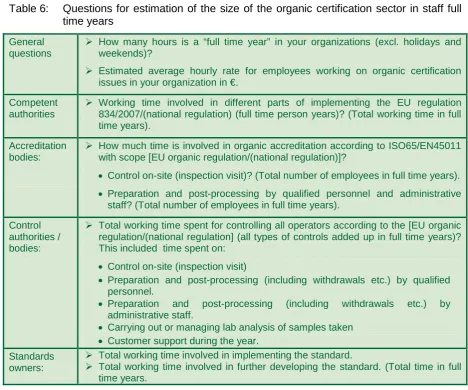
Table 6: Questions for estimation of the size of the organic certification sector in staff full time years
General questions
How many hours is a “full time year” in your organizations (excl. holidays and weekends)?
Estimated average hourly rate for employees working on organic certification issues in your organization in €.
Competent authorities
Working time involved in different parts of implementing the EU regulation 834/2007/(national regulation) (full time person years)? (Total working time in full time years).
Accreditation bodies:
How much time is involved in organic accreditation according to ISO65/EN45011 with scope [EU organic regulation/(national regulation)]?
• Control on-site (inspection visit)? (Total number of employees in full time years). • Preparation and post-processing by qualified personnel and administrative
staff? (Total number of employees in full time years). Control
authorities / bodies:
Total working time spent for controlling all operators according to the [EU organic regulation/(national regulation] (all types of controls added up in full time years)? This included time spent on:
• Control on-site (inspection visit)
• Preparation and post-processing (including withdrawals etc.) by qualified personnel.
• Preparation and post-processing (including withdrawals etc.) by administrative staff.
• Carrying out or managing lab analysis of samples taken • Customer support during the year.
Standards owners:
Total working time involved in implementing the standard.
Total working time involved in further developing the standard. (Total time in full time years.
3.1.3. Questionnaire response rate
Table 7 shows the number of respondents in the 7 countries, which returned the detailed questionnaire and the total number of actors. (The results of the questionnaire survey are presented in Chapter 4 and 5).
In total 57 authorities and bodies involved in the organic certification chain responded, of which:
• 14 competent authorities
• 6 accreditation bodies
• 35 control authorities and control bodies (2 control authorities + 33 control bodies)
CHAPTER 3_DATA COLLECTION
[image:27.595.79.522.115.303.2]25
Table 7: Number of actors, which returned the detailed questionnaire and total actors in the certification chain: [actors / (total actors)]
Country Competent authorities
Accreditation bodies
Control authorities / control bodies
Standards
owners1 TOTAL CZ 1 / (1) 1 / (1) 3 / (3) - / (-) 5 / (5) DE 5 /(15)2 1 /(2) 6 /(22) - / (9) 12 / (39) DK
1
2 / (2) - 2 / (2) - / (3) 4 / (4) IT 3 / (24)3 1 / (1) 5 / (18) - / (4) 9 / (43) UK 1 / (1) 1 / (1) 7 / (9) - / (1) 9 / (11) CH 1 / (1) 1 / (1) 2 / (4) 1 / (4) 5 / (10) TR 1 / (1) 1 / (1) 10 / (10) 1 / (1) 13 / (13)
1: Questionnaires were only sent to public and private standards owners in the countries outside the EU. 2: Questionnaires were only sent to 5 regional competent authorities (see also section 3.1.1)
3: Questionnaires were only sent to 3 regional competent authorities (see also section 3.1.1)
As can be seen from table 7 all the competent authorities, accreditation bodies and control authorities approached did respond except one German accreditation body. Of the 66 control bodies approached half of them responded, while 2 out of the 5 standards owners approached responded. In the Czech Republic, Denmark and Turkey all actors approached in the organic certification chain responded. Besides the 2 control authorities in Denmark there is also a private control body, but it is not accredited and it only carries out a supplementary inspection and certification for specific rules on top of the organic control carried out by the public Danish control authorities. Therefore its control and fees are not comparable to other private control bodies, and it has not filled in data for the 5 case studies for which reason it has been left out of the study.
The number of responding control bodies was lower than the total for Germany, Italy, United Kingdom and Switzerland due to a lower response rate. This influences the results and representativeness of the data on fees and the number of staff in full time equivalents (FTE) for these countries. Standards owners were only included for the two countries outside the EU, Switzerland and Turkey.
Of the standards owners approached in Switzerland and Turkey the only organic standards owner in Turkey, the Ministry of Agriculture and rural Affairs responded, while in Switzerland only 1 private standards owner responded out of 3 private and 1 public standards owners. With such a limited data base it was decided to leave out the standards owners’ contribution to fees (licence fees for the use of private standards and logos) and the size of the organic certification sector in staff FTE in this report.
CHAPTER 3_DATA COLLECTION
3.2 Problems encountered
3.2.1. Comparability of data on control fees
From the data collection for the
control bodies had publicly available price lists for their services on their web site. Besides, some control bodies did not give very detailed information on their fees in the questionnaire survey. Therefore the collected data on fees are not necessarily representative for all control bodies in those countries (Germany, Italy, the United Kingdom and Switzerland (see table 7). The collected data on control fees also showed that the basis for calculation of fees differed a lot between control bodies within the same country and between countries. This made an overall comparison of the certification and inspection fees between control bodies and between countries impossible. However, in the questionnaire the control authorities and control bodies were asked to estimate their fees for 3 different farm types and 2 different processor types, and that made a comparison of the fees possible for those control bodies, which had filled in these questions (see section 3.1.1).
3.2.2. Comparability of data on estimation of staff full time years
CHAPTER 4_CONTROL FEES
27
4 CONTROL FEES
4.1 Comparison of organic control fees
4.1.1. Publicly available organic control fees
[image:29.595.67.534.583.761.2]As mentioned in Section 3.2 far from all European control bodies had publicly available price information on their web sites. Denmark has a public certification system free of charge for all the organic operators and therefore no price information. In the other 6 study countries the number of control bodies, which had public price information on their web site, varied from 67 % in the Czech Republic to 14 % in Germany (see table 8). Except for the Czech Republic, 50 % or less of the control bodies in the 5 other study countries had publicly available information on inspection and certification fees on their website. According to ISO 65 (1996), article 4.8.1 (d) “the certification body shall provide (through publications, electronic media or other means) update at regular intervals, and make available on request general information on the fees charged to applicants and to suppliers of certified products”. All control bodies in the EU have to be accredited to ISO 65 / EN 45011since 1 January 2009 according to the EC 834/2007 Regulation. Therefore, it was expected that all control bodies had public information on their fees and services on their web site. ISO 65 is also applied for organic certification in Switzerland and Turkey according to their national organic regulation, but in Switzerland only half of the control bodies had public information on their control fees and in Turkey this was the case for 20 % of the control bodies.
Table 8 Number of control bodies and number of control bodies with public price information on their website in 6 study countries
Country Total number of control bodies
Number of control bodies with price information on
web site
Control bodies with price information: % of all control bodies
CZ 3 2 67
DE 22 3 14
IT 18 8 44
UK 9 4 44
CH 4 2 50
CHAPTER 4_CONTROL FEES
4.1.2. Fee calculation methods
According to the information received from the control bodies in the questionnaire survey their fees are calculated in many different ways. Some of the control bodies have separate fees for the inspection and the certification (e.g. in Switzerland and Turkey), but most control bodies do not distinguish between inspection and certification fees but apply a control fee covering both the inspection and the certification. Some control bodies apply a basic fixed fee, which may be the same for everybody or depend on the type and/or size of the operator, and they may apply a minimum and perhaps also a maximum fixed fee. Many apply a combination of a basic fixed fee and variable fees. For farmers the variable fees most often depend on the area and types of crops, types and number of animals farmed, while for processors (and other operators, e.g. importers, exporters and retailers) the fee most often depends on the economic turnover from the sale of organic products. Several control bodies have combinations of fixed fees (basic fees) and variable fees (e.g. in the Czech Republic, Italy and the United Kingdom). Some control bodies apply a minimum fee limit and some also have a maximum fee limit for farmers and processors per year for the normal control (e.g. in Germany and the Czech Republic) and some have an extra fee for farmers and processors, which also have conventional production/processing (in the Czech Republic).
To make the payment system simpler to overlook some control bodies have applied a number of fee classes for various types of farms, based on area, crop types and sometimes also the number and types of animals (e.g. in Germany and the United Kingdom). A few control bodies have a similar fee class system for the processors based on the size of the annual turnover of organic products. Some control bodies apply an hourly rate or a “per day” rate for the time spent on inspection excluding or including administration and transport time and costs, which then will have to be paid on top of the fee (e.g. in the Czech Republic, Germany, Switzerland and Turkey).
There is very little information available on the fees for other operators than farmers and processors, e.g. importers, exporters, retailers and farm suppliers. From the United Kingdom and Switzerland there is no information, while there is one response from Italy and the Czech Republic, respectively, and German control bodies have delivered 3 answers. Fees for such operators are either lump sums or based on hourly rates. From Turkey 8 control bodies have responded, and they have all applied the same fees for such operators as for the processors, i.e. fees based on daily rates. Because there is so little data available this issue will not be dealt with further in this report.
As can be seen from the description of the many different fee systems described above, which may even be combined in many different ways, it is very difficult - if not impossible for organic operators or stakeholders to compare the fees of different control bodies in the same country (especially if there are many control bodies as in Germany or Italy) or between countries. However, this was foreseen, for which reason 3 farm cases and 2 processor cases were included in the detailed questionnaire survey, and the control bodies were asked to estimate the price and the number of hours spent on control including administration before and after the control visit for one annual control in order to get comparable data (see also table 5).
4.2 Case study on control fees for 3 farm cases
4.2.1. Comparison of farm cases within countries
CHAPTER 4_CONTROL FEES
29
including administration and other costs involved, e.g. travel and accommodation costs, overhead, etc. The 3 farm cases were:
A: 50 ha arable farm (cereals) no livestock.
B: 50 ha dairy farm with 50 dairy cows and 10 ha arable crops. C: 10 ha vegetables.
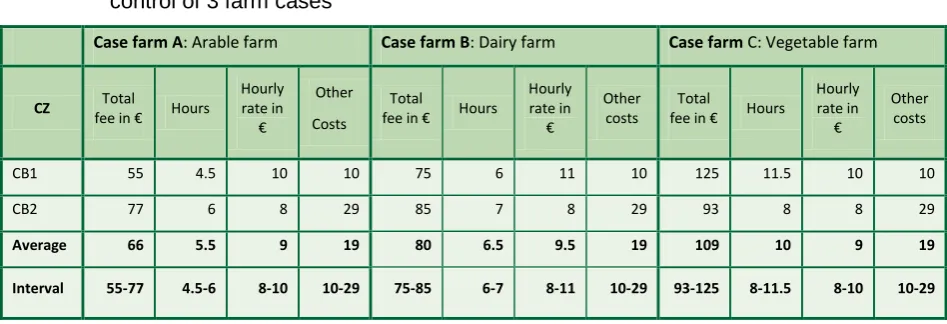
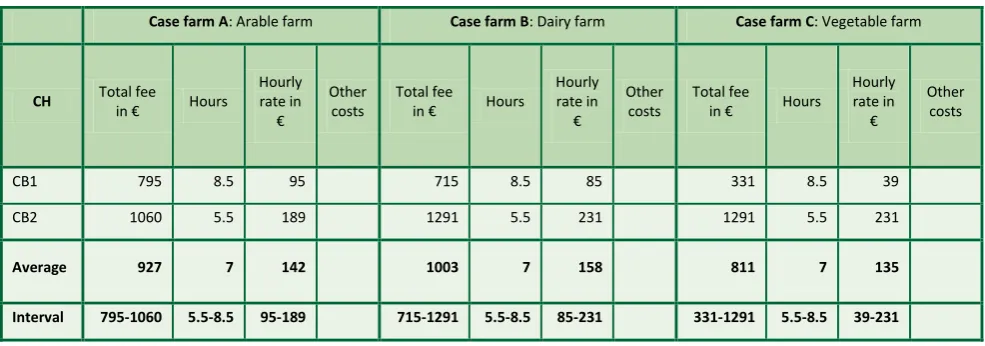
In tables 9-14 are presented the results of the 3 farm case studies for 6 of the 7 study countries: the Czech Republic, Germany, Italy, the United Kingdom, Switzerland and Turkey. Denmark is left out because the governmental organic control system is free of charge for all organic operators in Denmark as long as the control is normal, but not in cases of extra controls because of fraud. Table 9-14 present the total control fee, the hours spent on the control (including administrative tasks), other control costs (e.g. travel costs, overhead, etc.) and calculated hourly rates for the 6 countries for comparison of differences between control bodies within countries. The hourly rate is calculated as the total fee (i.e. labour costs and other costs), divided by the hours spent on the control. In tables 9-15 “Total fees”, “Other costs” and “Hourly rate” are rounded to whole numbers in €, while “Hours” are rounded to half hours.
Only the control bodies, which had filled in information on total fees as well as hours spent on the control, have been included in the comparison. The raw figures and the results for the control bodies, which only filled in the hours spent or the total fees can be found in the enclosed Annex II.
For two countries, Italy and Turkey the fees were adjusted to excl. VAT prices, because the fees were including 20 % VAT in Italy and 18 % VAT in Turkey. For the control bodies in the United Kingdom and Switzerland the fees were expressed in GBP and CHF, respectively. Therefore the fees were converted into EUR using the ECB (European Central Bank) average annual reference exchange rate for 2009, when the data was collected. The exchange rate used for conversion of GBP to EUR was 0.89094 and for conversion of CHF to EUR: 1.51.
[image:31.595.70.544.496.658.2]Table 9 shows the results for the 3 farm cases for the Czech control bodies.
Table 9: Czech control bodies: Fees, working hours spent, hourly rate and other costs for control of 3 farm cases
Case farm A: Arable farm Case farm B: Dairy farm Case farm C: Vegetable farm
CZ Total
fee in € Hours
Hourly rate in € Other Costs Total
fee in € Hours
Hourly rate in € Other costs Total
fee in € Hours
Hourly rate in
€
Other costs
CB1 55 4.5 10 10 75 6 11 10 125 11.5 10 10
CB2 77 6 8 29 85 7 8 29 93 8 8 29
Average 66 5.5 9 19 80 6.5 9.5 19 109 10 9 19
Interval 55-77 4.5-6 8-10 10-29 75-85 6-7 8-11 10-29 93-125 8-11.5 8-10 10-29
CHAPTER 4_CONTROL FEES
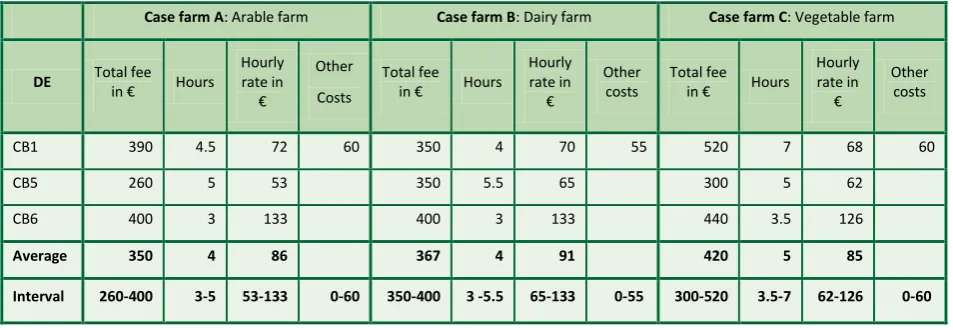
Table 10 shows the results for the German control bodies.
Table 10: German control bodies: Fees, working hours spent, hourly rate and other costs for control of 3 farm cases
Case farm A: Arable farm Case farm B: Dairy farm Case farm C: Vegetable farm
DE Total fee in € Hours
Hourly rate in € Other Costs Total fee in € Hours
Hourly rate in € Other costs Total fee in € Hours
Hourly rate in
€
Other costs
CB1 390 4.5 72 60 350 4 70 55 520 7 68 60
CB5 260 5 53 350 5.5 65 300 5 62
CB6 400 3 133 400 3 133 440 3.5 126
Average 350 4 86 367 4 91 420 5 85
Interval 260-400 3-5 53-133 0-60 350-400 3 -5.5 65-133 0-55 300-520 3.5-7 62-126 0-60
In Germany 3 out of the 22 approved German organic control bodies filled in all questions for the 3 farm cases. 2 of the control bodies (CB1 and CB6), estimated the highest fee for the vegetable farm, case C, while the third CB (CB5) estimated the highest fee for the dairy farm, case B. CB6 estimated the same fee (400 €), for the arable farm and the dairy farm, (case A and B), while CB1 estimated the lowest fee for the dairy farm, case B, which is surprising, as farm B had the same area as farm A, but also 50 dairy cows, which give a more complex production and control situation. Looking at the average total fees, the arable farm, case A was cheapest followed by the dairy farm, case B and the vegetable farm, case C in ascending order. The greatest variation in the fee and time spent on the control was for the vegetable farm, case C with fees from 300-520 € and 3.5-7 hours spent on the control. The hourly rate varied a bit between farms for the same control body, which may be due to different ways of calculating the fee dependent on the type of farm. Between control bodies the hourly rate varied from 53 € (CB5) to 133 € (CB6) for the arable farm, case A, and from 62 € (CB5) to 126 € (CB6) for the vegetable farm, case C.
Table 11 shows the results for the Italian control bodies.
Table 11: Italian control bodies: Fees, working hours spent, hourly rate and other costs for control of 3 farm cases
Case farm A: Arable farm Case farm B: Dairy farm Case farm C: Vegetable farm
IT Total fee in € Hours
Hourly rate in
€
Other
costs Total fee in € Hours
Hourly rate in
€
Other
costs Total fee in € Hours
Hourly rate in
€
Other costs
CB1 142 6.5 22 375 18.5 20 375 18.5 20
CB2 667 13 51 473 15 32 646 15 43
CB3 208 6.5 32 250 10 25 258 11 24
CB4 125 5.5 24 342 14 25 308 14 22
CB5 167 5.5 30 292 11 27 288 10.5 27
Average 262 7.5 32 346 13.5 26 375 14 27
[image:32.595.70.547.134.299.2] [image:32.595.71.567.551.780.2]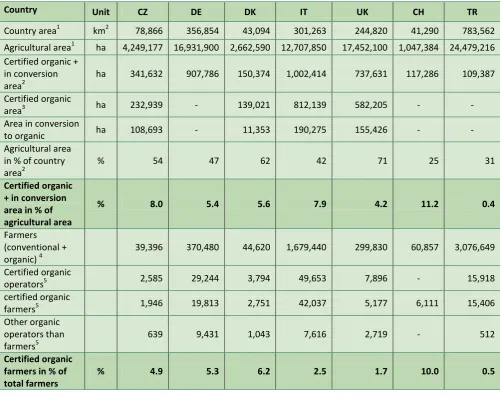

![Table 7: Number of actors, which returned the detailed questionnaire and total actors in the certification chain: [actors / (total actors)]](https://thumb-us.123doks.com/thumbv2/123dok_us/8431838.332125/27.595.79.522.115.303/table-number-actors-returned-detailed-questionnaire-actors-certification.webp)