Objectivity and reproducibility of formal narrative representations or
annotations: Propp’s functions & narrative summarization
Alexander Block
1,5, Rens Bod
1, Bernhard Fisseni
1,2,3, Adil Kurji
1,
Carlos Le´on
3,4,5, Benedikt L¨owe
1,3,5,6, Deniz Sarikaya
51Institute for Logic, Language and Computation, Universiteit van Amsterdam
Postbus 94242, 1090 GE Amsterdam, The Netherlands
{alexander.block,aadil.kurji}@student.uva.nl, {l.w.m.bod,b.loewe}@uva.nl
2Fakult¨at f¨ur Geisteswissenschaften, Universit¨at Duisburg-Essen
Universit¨atsstraße 12, 45117 Essen, Germany
3Isaac Newton Institute for Mathematical Sciences
20 Clarkson Road, Cambridge CB3 0EH, United Kingdom
4Escuela Polit´ecnica Superior, Universidad Alfonso X el Sabio
28691 Villanueva de la Ca˜nada, Madrid, Spain
5Fachbereich Mathematik, Universit¨at Hamburg
Bundesstraße 55, 20146 Hamburg, Germany
6Corpus Christi College, University of Cambridge
Cambridge CB2 1RH, United Kingdom
Abstract
Formal narrative representation is a procedure assigning a formal description to a natural language narrative. In general, it is a human procedure, and one of the goals ofcomputational models of narrativeis to understand this procedure better in order to automatise it. In order to be automatisable, a formal framework should allow for objective and reproducible representations. In this paper, we present empirical work focussing on objectivity and reproducibility of the Proppian framework and the hypothesis that narrative formalisation is summarisation. The first two experiments consider Propp’s formalisation of Russian fairy tales; the third compares these results to summaries of the same stories. The data show that some features of Propp’s system such as the assignment of the characters to the dramatis personaeand some of the functions are difficult to reproduce; furthermore, natural summaries of folktales do not match the Proppian functions.
1.
Introduction & Motivation
The formal study of narratives goes back to the Russian structuralist school, paradigmatically represented by the
Vladimir Propp’s 1928 study Morphology of the Folktale
(Propp, 1928) in which he identifies seven dramatis per-sonae and 31 functions that allow him to formally analyse
a corpus of Russian folktales (cf.§2.1. for details).
Researchers in the field of computational models of
nar-rative have developed the general Proppian methodology into various formal and computational frameworks for the analysis, automated understanding and generation of narra-tives. Examples for this are Lehnert’s Plot Units, Rumel-hart’s Story Grammars, Schank’s Thematic Organization Points (TOPs), Dyer’s Thematic Abstraction Units (TAUs),
or Turner’s Planning Advice Themes (PATs).1
While the biggest advances of this research community were on the technical side, recent years have seen an in-creased interest in the methodological and conceptual is-sues involved, linking this research closely to questions of
the philosophy of information.2
1Cf. (Lehnert, 1981; Rumelhart, 1980; Schank, 1982; Dyer,
1983; Turner, 1994).
2
Cf. (L¨owe, 2011).
The enterprise of representing a narrative by a formal object formalizing its structure that can then be used in computa-tional application rests on a number of assumptions:
Assumption E (Existence of a structural core). There is a structural core of narratives; or several, depending on which part of the structure we are interested in.
Assumption O (Objectivity of the structural core).
Given a narrative, there is an interpersonal agree-ment what its structural core is; possibly after some agreement of what part of the structure should be represented.
A formal frameworkΛfor representing narratives consists
of a formal languageLΛ, a class of mathematical structures
MΛ, and a description of a procedure (calledformalization
in (L¨owe, 2011)) of assigning to each natural language
nar-rativeN a structureΣΛ(N) ∈ MΛ. Note that this
proce-dure that assignsΣ(N)toN is not a function in the
math-ematical sense, but an activity by expert formalizers who
follow given guidelines to produceΣΛ(N)on the basis of
N.
In this paper, we mainly explore the validity of Assumption
O: in particular, we are investigating the following property
Property Obj(Λ). Sufficiently trained human formalizers,
given the same narrative N will produce the same
structureΣΛ(N).
PropertyObjis an important (and arguably necessary)
fea-ture of a formal frameworkΛif it is supposed to be the basis
of an automatised system. The existence or non-existence
of formal frameworksΛwith propertyObj(Λ) is closely
re-lated to AssumptionO: if no formal frameworks proposed
in practice has this property, this is evidence against
As-sumption O. Checking Obj(Λ) was described in (Bod et
al., 2011) as a natural analogue of the study of annotator agreement in corpus linguistics and computational linguis-tics: whereas typical annotation tasks involve annotation of
sentences or discourses,3the formalization or annotation of
a narrative is at the next level of complexity, involving se-quences or systems of discourses, connected to a narrative. At the sentence or discourse level, inter-annotator agree-ment has been studied (Carletta et al., 1997; Marcu et al., 1999), but for the annotation or formalization of narratives, no such analysis has ever been done, not even with the old-est and bold-est-known formal approach to narrative structure, the Proppian narratemes.
We therefore decided to focus on this particular formal framework, not because we feel that the Proppian
frame-work is a good candidate for a frameframe-work close to thestable
structural core, but mostly due to its prominent place in the
history of formal representations of narrative. In§2., we
describe the Proppian formal framework and discuss two
empirical studies calledPropp IandPropp IIpertaining
to it and performed at theUniversiteit van Amsterdam.
There is a very close relationship between formal represen-tation of narrative and summarization: simple formal
rep-resentations (e.g., Plot Units) should serve as a summary
of a narrative, and similarly, a formalized theory of narra-tive summarization could give rise to high-quality formal
frameworks for the representation of narrative. In§3., we
describe a follow-up empirical study called
Summariza-tiondone at the Universit¨at Hamburgwith the same
nar-ratives that were used in the two studies described in§2.
In this study, we investigated natural summarization tech-niques and their relation to Propp’s functions as resulting from the two Amsterdam studies.
2.
Propp’s formal system
2.1. Overview of Propp
Working with a corpus of 100 Russian folktales, from the book Narodnye Russkie Skazki by Alexander Afanas’ev (Afanas’ev, 1973), Vladimir Propp developed a formal sys-tem to identify each folktale by short annotation strings
consisting of symbols representing Proppian functionsor
narratemes. In the following, we give a description of the components of the Proppian system relevant for the exper-iments discussed in this paper. For more details, we refer the reader to (Propp, 1928).
Propp identified eightdramatis personaerepresenting roles
that the various characters inhabit within the stories. Not
3Cf., e.g., (Marcus et al., 1993; Brants, 2000; Passonneau et
al., 2006).
False Hero. The FALSE HERO is a person who tries to take credit for the actions of the hero. He may try to
marry the PRINCESS, or gain respect ofPRINCESS’S
FATHERto further complicate the HERO’S pursuit of thePRINCESS.
ηTrickery. The villain attempts to deceive his victim in order to take possession of him or of his belongings.
Villain first assumes a disguise. Then follows the function: Example 1. By persuasion: e.g. A witch tries to have a ring accepted.
Example 2. By direct application of magic: e.g. Step mother gives a sleeping pill.
Figure 1: Examples of descriptions of adramatis persona
and a function used in the experimentsPropp IandPropp
II.
everydramatis personaoccurs in each story, not every
char-acter represents a dramatis persona, and some dramatis
personae can be represented by the same character. The
Proppiandramatis personaeare: the hero (H), the villain
(V), the princess (P), the princess’s father (PF), the
dis-patcher (Di), the donor (Do), the magical helper (MH) and
the false hero (FH) (Propp, 1928,§3).
The actions of the dramatis personae are described by a
set of thirty-one functions described in (Propp, 1928, §3)
by means of examples and more specified subfunctions (cf. Figure 1 for an example). These functions are marked by symbols in the order of their occurrence in the folktale:
β Absentation; γ Interdiction;δ Violation, ε
Reconnais-sance, ξ Delivery, η Trickery, θ Complicity, A Villainy,
a Lack,B Mediation, CBeginning counteraction, ↑
De-parture, D First function of the Donor, E Hero’s
reac-tion, FProvision or receipt of magical agent, GSpatial
transference between two kingdoms,HStruggle,J
Brand-ing, I Victory, K Liquidation, ↓ Return, Pr Pu! rsuit,
RsRescue,oUnrecognized Arrival,LUnfounded Claims,
MDifficult Task,N Solution,QRecognition,Ex
Expo-sure,TTransfiguration,UPunishment,WWedding.
These functions occur in strict sequential order, i.e., func-tions have to occur in the folktale in the order they are given
in the list above: after functionI(Victory) has occurred,
none of the functions listed earlier can occur anymore. The full Proppian system contains a number of additional features: some folktales contain a series of individual tale
units; the Proppian system allows formoveswithin an
an-notation. Since none of the tales we used in the experiment had these features, we shall not further discuss this here. Another additional feature is a special annotation symbol fortrebling: in folktales, a common motif is the triple
repe-tition of some functions calledtrebling. Propp’s system
al-lows for annotating occurrences of trebling, and we’ll
com-ment on this in§3.3.
2.2. Description of Propp I
In the experimentPropp I, test subjects were briefly trained
folktales The Seven Semyons, 145, Shabarsha, 151, and
Ivan the Bear’s Son, 152; in the following, we refer to
these folktales as Semyons, Shabarsha, andIvanko.4 We
chose tales that were available in English translation, did
not exhibit the Proppian phenomenon ofmoves, and used
few functions in Propp’s own formalisation (Ivankoand
Se-myonsuse eight functions,Shabarshasix). An annotation
of a folktale inPropp Iconsisted of
1. the assignment of story characters to thedramatis
per-sonae, and
2. a list of the functions (group 1) or functions specified by subfunctions (group 2) occurring in the folktale.
Procedure. We had nine test subjects, all students of the
Universiteit van Amsterdam, and all with native or near-native competence of English. The test subjects were split into two groups: in the first group, only the functions had to be given; in the second group, the function had to be speci-fied with the subfunction. Test subjects were instructed that the experiment would last three hours and received a mod-erate financial compensation for participation.
During the experiment, test subjects were given a 45-minute introduction to Propp’s system given by a native speaker of English supported by a projector presentation.
It explained the Propp’s system (without moves and
tre-bling), i.e., thedramatis personaeand their functions. We
gave short descriptions of the dramatis personaeroughly
based on Propp’s original text and the the descriptions of the functions from Propp’s text. Only a selection of the subfunctions was included (for subjects in group 1, these were marked as “examples”, for subjects in group 2, they were numbered subfunctions). Finally, we analyzed a sim-ple examsim-ple story designed by the experimenters as an il-lustration.
Figure 1 shows examples of the description of adramatis
personaand a function as we used them in the presentation.
A condensed version of the description of Proppian
drama-tis personaeand functions was distributed as a leaflet to test
subjects for use during the annotation.5
4
InPropp I, we also used the folktaleThe Enchanted Princess, but it turned out to be too long and was omitted in the other ex-periments. Due to an oversight, we worked with version 147 of Semyonswhile Propp had annotated version 145. We used the translations of Gutermann from (Afanas’ev, 1973) forSemyons andIvanko, and the translation of Cook from (Afanas’ev, 1985) forShabarsha. In Semyons, seven orphans meet the Tsar and pledge to work hard in their professions. The seventh becomes a thief and, with the help of his brothers and their respective tal-ents, journeys to capture Elena the fair as a bride for the Tsar. In Ivanko, Ivanko is born of a peasant woman and her kidnapper, a bear. After returning to human society, he causes some damage and is sent to a lake in which devils dwell. Through a series of tricks, Ivanko gains all of the devils’ gold and the services of a lit-tle devil for a year. InShabarsha, the protagonist Shabarsha takes a day off to earn some money for himself and his boss. He goes to a lake to catch fish, meets a little devil and threatens to evict all of the devils from the lake if they don’t pay rent. Through a series of tricks he acquires all of their wealth.
5To simplify the annotations, we used the symbols A–Z and
a–f for the Proppian functions.
Results. Propp’s own annotations only contain the func-tion string, and do not specify the assignment of
charac-ters to thedramatis personae. The original Propp strings
for the narratives are: a1B2C↑F2G1K2↓ (Semyons),
A8B4C↑H2I2K1↓ (Shabarsha), and A9↑H2I2K1↓
(Ivanko).6
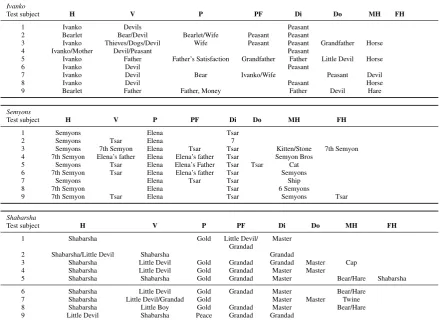
We give the results of the assignments of the characters to thedramatis personaein Table 1. We see some amount of
variation even in the assignment of the three maindramatis
personae,H,V, andP: consider, e.g., the variations among
the choices of villain in theIvankostory or theSemyonsor
the choice of hero in theShabarshastory (see below for a
methodological remark).
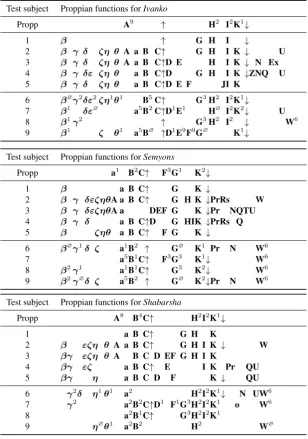
The annotation strings vary widely and are given in Table 2. Test subjects 1–5 belonged to group 1 (no subfunction) and test subjects 6–9 to group 2 (subfunctions). The subfunc-tions are marked by superscripts in the table, and a missing
subfunction is marked by a superscript of ∅. No strings
matched across all annotators and all stories, and thus no inter-annotator analysis was necessary. It is interesting to notice that the annotation strings are considerably longer than Propp’s original strings (compare an average of 14.2,
13.2, and 12.8 functions forIvanko,Semyons, and
Shabar-sha, respectively, with the Proppian string lengths of 6, 8
and 8 for the same folktales).
Methodological Conclusion. In their post-experiment comments, several test subjects reported that they consid-ered the task as easy. Four out of nine test subjects reported that the example story from the presentation was consider-ably simpler than the actual folktales.
The variation in the assignment of characters to dramatis
personaesuggests that the description of thedramatis per-sonaewas not precise enough. For instance, our descrip-tion of the hero read “The hero can be a prince, a poor girl, a bear-man, a group of soldiers or anyone who is good and sets out on an adventure”. Arguably, Shabarsha’s
be-haviour inShabarshacannot be described as “good”, which
has caused some of the variation in the assignment of the hero in that folktale.7
A number of functions are consistently annotated by the annotators that do not show up in Propp’s annotation: for
instance,Ivankohas nine annotations with functionβ, eight
withBand six each withγ,δ,ζ,θ,a, andC, none of which occur in Propp’s annotation.
On the other hand, we see that some functions used by Propp show up in all or almost all annotations strings: e.g.,
↑,G,H,I, and↓are reliably reproduced in theIvanko
anno-tation strings. However, since we do not know which events in the tale the annotators marked with these functions, we cannot be sure whether these are actual reproductions of Propp’s assignments.
2.3. Description of Propp II
FromPropp I, we learned that
6
Cf. Footnote 4.
7It is conceivable that the designator “devil” created a
Ivanko
Test subject H V P PF Di Do MH FH
1 Ivanko Devils Peasant
2 Bearlet Bear/Devil Bearlet/Wife Peasant Peasant
3 Ivanko Thieves/Dogs/Devil Wife Peasant Peasant Grandfather Horse
4 Ivanko/Mother Devil/Peasant Peasant
5 Ivanko Father Father’s Satisfaction Grandfather Father Little Devil Horse
6 Ivanko Devil Peasant
7 Ivanko Devil Bear Ivanko/Wife Peasant Devil
8 Ivanko Devil Peasant Horse
9 Bearlet Father Father, Money Father Devil Hare
Semyons
Test subject H V P PF Di Do MH FH
1 Semyons Elena Tsar
2 Semyons Tsar Elena 7
3 Semyons 7th Semyon Elena Tsar Tsar Kitten/Stone 7th Semyon 4 7th Semyon Elena’s father Elena Elena’s father Tsar Semyon Bros
5 Semyons Tsar Elena Elena’s Father Tsar Tsar Cat 6 7th Semyon Tsar Elena Elena’s father Tsar Semyons
7 Semyons Elena Tsar Tsar Ship
8 7th Semyon Elena Tsar 6 Semyons
9 7th Semyon Tsar Elena Tsar Semyons Tsar
Shabarsha
Test subject H V P PF Di Do MH FH
1 Shabarsha Gold Little Devil/ Master
Grandad
2 Shabarsha/Little Devil Shabarsha Grandad
3 Shabarsha Little Devil Gold Grandad Grandad Master Cap 4 Shabarsha Little Devil Gold Grandad Master Master
5 Shabarsha Shabarsha Gold Grandad Master Bear/Hare Shabarsha
6 Shabarsha Little Devil Gold Grandad Master Bear/Hare 7 Shabarsha Little Devil/Grandad Gold Master Master Twine
8 Shabarsha Little Boy Gold Grandad Master Bear/Hare
[image:4.595.76.517.70.391.2]9 Little Devil Shabarsha Peace Grandad Grandad
Table 1: The assignment of thedramatis personaefor the three folktales inPropp I.
1. the variations in the assignment of the characters of the
dramatis personaemade comparison of the annotation strings difficult,
2. we did not know because of which passage in the text the test subjects marked a function as present in a folk-tale,
3. the constructed example story was considered too sim-ple in comparison with the actual folktales.
It should be noted that we Propp only recorded the
anno-tation strings, so that his choice ofdramatis personaeand
text passages would have to be extrapolated from (Propp, 1928).
The experimentPropp IIwas a modified version ofPropp
I, taking these lessons into account. We used the same
folk-tales as inPropp I. An annotation of a folktale inPropp II
consisted of
1. a list of the functions occurring in the folktale, and 2. marked text passages for each of the functions that
oc-curred.
The main changes toPropp Iwere: the test subjects were
given the assignment of characters to the dramatis
per-sonae; subfunctions were not discussed at all; the example story was from Propp’s own corpus.
Procedure. We had six test subjects, all students of the
Universiteit van Amsterdam, and all with native or near-native competence of English. Test subjects were instructed
that the experiment would last three hours and received a moderate financial compensation for participation. During the experiment, test subjects were given an intro-duction to Propp’s system given by a native speaker of En-glish supported by a projector presentation. It explained
the Propp’s system (without movesandtrebling), i.e., the
dramatis personaeand their functions. There was no ex-plicit mention of subfunctions: a selection of subfunctions was included as “examples”. The presentation lasted 45 minutes and finished by presenting the analysis of an
ex-ample folktale from the Propp corpus (Ivan Popyalov, 135).
Again, the condensed version of the description of Prop-piandramatis personaeand functions was distributed as a leaflet to test subjects for use during the annotation. This time, test subjects were given an assignment of characters
to thedramatis personaetogether with each folktale (this
assignment was done by the experimenters on the basis of
the Proppian annotation strings):8 InIvanko, we assigned
Ivanko toHand the Little Devil and the Grandfather jointly
toV; inSemyons, we assigned the seventh Semyon toH,
Elena the Fair toP, and the Tsar toDi; finally, in
Shabar-sha, we assigned Shabarsha toHand the Little Devil and
the Grandfather jointly toV.
Results. We give the results of the function annotation in Table 3. The annotation strings are noticeably shorter
8
Test subject Proppian functions forIvanko
Propp A9 ↑ H2 I2K1↓
1 β ↑ G H I ↓
2 β γ δ ζη θ A a B C↑ G H I K ↓ U
3 β γ δ ζη θ A a B C↑D E H I K ↓ N Ex
4 β γ δε ζη θ a B C↑D G H I K ↓ZNQ U
5 β γ δ ζη θ a B C↑D E F JI K
6 β∅γ2
δε2ζη1θ1 B5C↑ G3H2 I2K1↓
7 β1 δε∅ a5B2C↑D1E1 H∅ I2K2↓ U
8 β1γ2 ↑ G3H2 I2 ↓ W6
9 β1 ζ θ1 a5B∅ ↑D1E9F9G∅ K1↓
Test subject Proppian functions forSemyons
Propp a1 B2C↑ F3G1 K2↓
1 β a B C↑ G K ↓
2 β γ δεζηθA a B C↑ G H K ↓PrRs W
3 β γ δεζηθA a DEF G K ↓Pr NQTU
4 β γ δ a B C↑D G HIK ↓PrRs Q
5 β ζηθ a B C↑ F G K ↓
6 β∅γ1
δ ζ a1B2 ↑ G∅ K1
Pr N W6
7 a5B1C↑ F3G3 K1↓ W6
8 β2γ1 a1B1C↑ G3 K2↓ W6
9 β2γ∅δ ζ a5B2 ↑ G∅ K2↓Pr N W6
Test subject Proppian functions forShabarsha
Propp A8 B4C↑ H2I2K1↓
1 a B C↑ G H K
2 β εζη θ A a B C↑ G H I K ↓ W
3 βγ εζη θ A B C D EF G H I K
4 βγ εζ a B C↑ E I K Pr QU
5 βγ η a B C D F K ↓ QU
6 γ2δ η1θ1 a2 H2I2K1↓ N UW6
7 γ2 a2B2C↑D1 F1G3H2I2K1 o W6
8 a2B1C↑ G3H2I2K1
9 η∅θ1
[image:5.595.142.451.69.509.2]a2B2 H2 W∅
Table 2: The annotation strings for the three folktales inPropp I(cf. Footnote 4).
than in Propp I (on average 6.8 functions per annotator,
compared with 13.4 functions inPropp Iand 7.3 functions
in the original Propp strings), and in general more similar to the Proppian strings, but we still do not have matching strings among the test subjects.
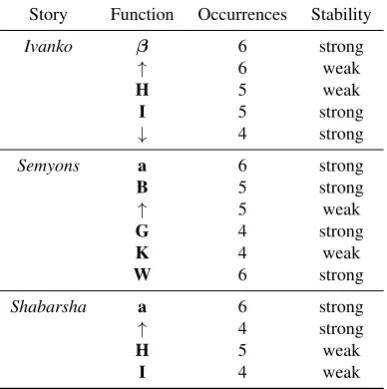
We say that a function occursstablyinPropp IIif at least
four of the six annotators list it. In Table 4, we list the
sta-ble functions (five for Ivanko, six forSemyons, and four
forShabarsha). Of these 15 stable functions, 12 are listed in Propp’s original annotations; this is the majority of the functions listed by Propp. It is interesting to note that each of the three folktales has one stable function that is not an-notated by Propp.
The areas of text assigned to the functions by the test sub-jects varied considerably, both in length and place. We call
a stable functionstrongly stableif at least four of the six
an-notators list the function and the text marked by these four
annotators overlaps. We call itweakly stableotherwise. We
list strong and weak stability for the 15 stable functions in
Table 4.
As an example, inSemyons, all annotators marked the same
stretch of text as the functionW(Wedding):
He generously rewarded the Semyons, exempted them from land rent and head taxes...
In contrast, consider the stable function H (Struggle) in
Shabarsha: five out of the six subjects annotated this func-tion, but none of the text areas match with each other. One of the annotations covered approximately half the text of the entire narrative. The other four marked stretches were:
Text passage 1. While he was working a little boy in a black jacket and a red cap jumped out of the water onto the bank. “What are you doing, uncle?” he asked. “Making some twine.” “What for?” “I’m going to clean up the pond and pull you devils out of the water.” “Oh no! Wait a moment, I’ll go and tell my grandad.”
Subj. Ivanko
Propp A ↑ HIK↓ 1 β a ↑GHIK↓
2 βγ ↑ MN W
3 β B↑ HI U
4 β ↑ HI ↓ U
5 β aB↑ HI ↓ 6 β aB↑ HIK↓ W
Subj. Semyons
Propp aBC↑FGK↓
1 aB ↑ GK W
2 β aB ↑ K↓ W
3 β aB G oNW
4 ηa ↑ G Pr W
5 aB ↑ K↓PrRs W
6 β aBC↑ GK↓PrRs W
Subj. Shabarsha
Propp A BC↑HIK↓
1 a HIK N
2 aB ↑ MN W
3 a C↑HI M UW
4 a ↑HI MN
5 a ↑H K
[image:6.595.84.506.68.169.2]6 aBC HIK W
Table 3: The annotation strings for the three folktales inPropp II(cf. Footnote 4).
Story Function Occurrences Stability
Ivanko β 6 strong
↑ 6 weak
H 5 weak
I 5 strong
↓ 4 strong
Semyons a 6 strong
B 5 strong
↑ 5 weak
G 4 strong
K 4 weak
W 6 strong
Shabarsha a 6 strong
↑ 4 strong
H 5 weak
I 4 weak
Table 4: Stable functions inPropp II, marked as weakly
and strongly stable
bad,” said Shabarsha, “but not as good as me! When I whis-tle you’ll be knocked off your feet and your eardrums will split. So lie face down on the ground and put your hands over your ears.”
Text passage 3. So lie face down on the ground and put your hands over your ears.” The devil boy lay face down and cov-ered his ears with his hands. Shabarsha took a heavy stick, brought it down with all his might on the devil boy’s neck, and whistled.
Text passage 4. “Alright, you toss first and I’ll watch.”
2.4. Conclusion
The assignment of the characters to thedramatis personae
has an important effect on the assignment of the functions. Different Proppian functions are handled very differently by the annotators: some are stable, others aren’t; some are typically assigned to the same text passages, others not. It is particularly striking that some of the stably annotated func-tions do not show up in Propp’s own annotation strings. As
an illustration, we mention that subfunction 6 ofWis listed
as “Other form of compensation like a monetary reward”. This vague description fits in much more general situations than Propp apparently intended.
3.
Experiment Summarization
3.1. Overview of automatic summarization
In the experimentSummarization, we aimed at testing the
hypothesis that Proppian functions formalise core events of the story which will be replicated in summaries.
Automatic text summarization has been tackled by the Nat-ural Language Processing community from the
perspec-tives ofmachine learninganddeep natural language
anal-ysis. Machine learning approaches apply statistical
tech-niques to produce document extracts (Lin and Hovy, 1997; Kupiec et al., 1995; Conroy and O’Leary, 2001). This statistical approach has proven to be successful in a wide range of domains, reaching acceptable quality levels. On the other hand, deep natural language analysis uses linguis-tic knowledge to process and summarize texts (Barzilay and Elhadad, 1997; Miller, 1995; Marcu, 1998). By extracting
the chunks of text conveying the main message (nuclei), a
summary can be constructed.
Human assessment of evaluation of summaries has proven to be rather unstable (Lin and Hovy, 2002), so automatic metrics like ROUGE (Lin, 2004) and BLEU (Papineni et al., 2002) have been proposed. In our comparison of
sum-maries to the results ofPropp II, we are mostly interested
in natural human summaries.
3.2. Description of the experiment
The experiment was conducted with six students of the
Uni-versit¨at Hamburg; they all had native or near-native com-petence of German. We used the same stories used in the
Propp IIexperiment in German translations. The test sub-jects were given a sheet of instructions which was read to them by a native speaker of German. The instructions
high-lighted that the story should berecognisablefrom the
sum-mary, and that the summary should not just retell the story, and that it should not give comments on style or order of events. No precise algorithm was given how to determine the important events to mention in the summary. Test
sub-jects were instructed to use “simple sentences” (einfache
S¨atze) to facilitate the mapping of sentences to events; sim-ple sentences were explained to “normally consist of up to 14 words” and examples were given, which contained at most one level of sub- or co-ordination. No example of a summary was given.
[image:6.595.53.247.219.414.2]3.3. Results of the experiment
On the basis of six summaries, no quantitative analysis can be done, but certain features emerge from the data. First of all, the majority of references in the summaries refer to
events rather than situational descriptions (our of 241 in-dividual facts mentioned in the summaries as a summary sentence or part of a summary sentence, 22 are not events,
i.e., only 9.1%). Of these events, some show up as acore
that is mentioned by many or all test subjects, others form a cluster of events possibly mentioned.
Major Agreement. InSemyons, test subjects agree least which details to take into their summary. However, all agree to mention some events before the theft, esp. meet-ing the Tsar, presentmeet-ing their plans what trade to learn and the test cases (four test subjects each). All agree in naming theft and reward, and all except one mention the wedding of Tsar and Princess. The fact that a trick was performed is only mentioned by four.
InIvankoandShabarsha, test subjects agree on the central events: All mention some event leading up to the compe-tition between the hero and the little devil (Ivanko’s blun-ders and assignment to go to the lake; Shabarsha’s fishing plans or presence at the lake). The competitions are al-ways mentioned, so is receiving the gold. The trickery is only mentioned by four (one test subject fails to mention trickery in all three tales). The final trick with gold is
com-pletely omitted inIvankosummaries but mentioned by four
forShabarsha.
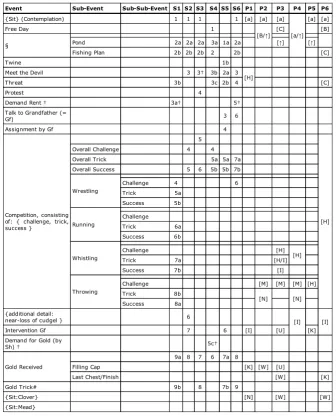
Event mapping. Since the majority of marked features of the narrative were events, we decided to construct an event mapping as follows: we identified the event descriptions
that occurred in all of the summaries9and created a master
list of the events mentioned in at least one summary.
Fig-ure 2 shows the event mapping for Shabarshawhere the
columns S1 to S6 correspond to the six test subjects in the
Summarizationexperiment. In order to allow a
compari-son with the annotations fromPropp II, we extended the
event mapping to account for the events marked inPr! opp
II, as not all text passages marked by test subjects inPropp
IIwere represented in the summaries. The six test subjects
fromPropp IIare listed as columns P1 to P6 in Table 2. Comparison is made more difficult by the fact that sum-maries may regroup events (something not allowed in a Proppian annotation due to the strict ordering of the func-tions). Furthermore, summary descriptions tend to be very dense, making use of certain implicatures (Grice, 1968 1989): for instance, “er geht zu einem Teich, um zu an-geln” (he goes to a pond in order to catch fish), does not formally imply that he actually arrives at the pond, but this is certainly implicated in the summary.
Trebling. In two of the stories,treblingoccurs: There are different tasks that are structurally similar and occur in
or-der: InShabarsha, there are four competitions, each
con-9
Here, we counted a sentence or fragment of a sentence as an event description if it grammatically describes a change of the state of affairs. So, for instance, “Kurz darauf verwaisen die sieben Br¨uder” (Shortly after that, the seven brothers are or-phaned) is an event description, whereas “Sieben Waisen namens Simeon...” (Seven orphans named Semyon...) is not.
sisting of a challenge, a trick and the success); inIvanko,
both the mistakes made and the competitions with the devil occur in several forms. In the summaries, we see that the majority of test subjects mentions these as a block and not as individual events. This corresponds to the fact that the
full Proppian system has a special symbol fortrebling.
3.4. Comparison of Propp II and Summarization
An overall comparison is difficult, because already the Propp II results on their own are so diverse. We therefore focus on three qualitative examples of differences: story-lines that are omitted from function assignment, some ‘sta-ble functions’ that are not present in the summaries, an ex-ample of a ‘stable passage’, where we find in all Propp an-notations but in no summary.
Storylines. Both Ivanko and the Semyons have a pre-historystoryline that leads up to the central story line of the competition with the devil and the theft of the princess.
While Propp’s full system allows for moveswith several
storylines, Propp did not annotate the pre-history events in
his own annotation strings (and we did not mentionmoves
as a possibility to the test subjects inPropp I andPropp
II. The pre-history storylines are largely not annotated in
Propp II, with one exception: nearly all test subjects mark
β(Absentation) ora(lack).10 The summaries only mention
the events resulting from them: Shabarsha’s plan to earn money by fishing and the order/permission to steal Elena of the Semyon’s journey.
Shabarshaand theSemyonsalso have a final commentary by the narrator, which steps out of the main storyline into the narration context. These final commentaries are left out by nearly all test subjects in both experiments (except for
one summary) in the Semyons. InShabarsha, the part of
the commentary relating to the main storyline is referenced by three summaries and three Propp annotators, while the final ‘morale’ is referenced only by three Summaries.
Stable Functions. As mentioned above, weakly stable
functions are those which are not annotated at the same pas-sage by Propp test subjects. We take up the discussion of
theH(Struggle) function from the end of§2.3.: The
anno-tators do not agree, but mostly annotate single events in the course of the competition; the majority of the summaries
regroup the single events, as discussed above (trebling).
InSemyons, four Propp annotators mark the Tsar’s love for
Elena asa (lack; strongly stable function), while none of
the summaries mentions this condition. Similarly, the lack that affects Shabarsha’s master at the beginning of the story is marked in the Propp annotations, but not mentioned in any summary.
Stable Passages. Conversely, near the end ofIvanko, all Propp annotators have one function for Ivanko’s journey to the lake and at least one labelled event after the com-petitions and before the transfer of money and servant to Ivanko’s father; none of the summaries mentions these
ex-plicitly. Similarly, inSemyons, three Propp annotators
as-sign various functions between the theft of the princess and
10
VDQG >$06 ++ '8 ( 1DUU:LNL@
NRUSRUD H[S ]LP XQL GXLVEXUJ HVVHQ GH 1DUU:LNL GRNX SKS"LG VDQG
(YHQW 6XE (YHQW 6XE 6XE (YHQW 6 6 6 6 6 6 3 3 3 3 3 3
^6LW` &RQWHPSODWLRQ >D@ >D@ >D@
>D9@ >D@ >D@
)UHH 'D\
>%9@
>&@ >%@
† 3RQG D D D D D D >9@ >9@
)LVKLQJ 3ODQ E E E E >&@
7ZLQH E
0HHW WKH 'HYLO ‚ E D
>+@
7KUHDW E F E >&@
3URWHVW
'HPDQG 5HQW ‚ D‚ ‚
7DON WR *UDQGIDWKHU *I
$VVLJQPHQW E\ *I
&RPSHWLWLRQ FRQVLVWLQJ RI ^ FKDOOHQJH WULFN VXFFHVV `
>+@ 2YHUDOO &KDOOHQJH
2YHUDOO 7ULFN D D D
2YHUDOO 6XFFHVV E E E
:UHVWOLQJ
&KDOOHQJH
7ULFN D
6XFFHVV E
5XQQLQJ
&KDOOHQJH
7ULFN D
6XFFHVV E
:KLVWOLQJ
&KDOOHQJH >+@
>+@
7ULFN D >+ ,@
6XFFHVV E >,@
7KURZLQJ
&KDOOHQJH >0@ >0@ >0@ >+@
7ULFN E
>1@ >1@
6XFFHVV D
^DGGLWLRQDO GHWDLO
QHDU ORVV RI FXGJHO ` >,@ >,@
,QWHUYHQWLRQ *I >,@ >8@ >.@
'HPDQG IRU *ROG E\
6K ‚ F‚
*ROG 5HFHLYHG
D D
)LOOLQJ &DS >.@ >:@ >8@
/DVW &KHVW )LQLVK >:@ >.@
*ROG 7ULFN E E
^6LW &ORYHU` >1@ >:@ >:@
^6LW 0HDG`
[image:8.595.128.465.69.486.2]VDQG W[W /DVW PRGLILHG E\ EHUQKDUGBILVVHQL
Figure 2: Synoptic annotations ofShabarshafromPropp IIandSummarization. We used the following markers:−for
deficient or imcomplete descriptions, †for mistakes or errors, § for anonymous super-events, {Sit . . .} for non-event
(situation descriptions), * for events occurring only in Propp, and # for auxiliary events only occurring in the summaries.
her delivery to the Tsar, while no summary mentions these details.
4.
Discussion & Future Work
The detailed study of human annotations of Propp’s frame-work highlights some weaknesses of its description, and in general, points out some important obstacles for an automa-tisation of the process of formalisation in a computational setting. Key weaknesses are that descriptions of some of thedramatis personaeand functions are vague and require a large amount of interpretation. We also observed that the Proppian framework encourages the marking of minor events that do not naturally occur in summaries of the same folktales. It would also be preferable accommodate more than one storyline in a framework.
In (Bod et al., 2011), we suggested to follow up the stud-iesPropp IandPropp IIwith a large-scale inter-annotator study: the results of our experiments suggest that this is not worthwhile. Instead, we should distill the lessons learned
from this Proppian case study into studies dealing with other formal representation systems, possibly designed and documented on the basis of the results of this study.
Acknowledgements
The research in this paper was funded by theJohn
Temple-ton Foundation (JTF) via the projectWhat makes stories similar? (grant id 20565) and theNederlandse Organisatie voor Wetenschappelijk Onderzoek(NWO) via the projects Integrating Cognition in the VICI programme (DN
277-70-006) and Dialogical Foundations of Semantics in the
ESF EuroCoRes programme LogICCC (LogICCC-FP004; DN 231-80-002; CN 2008/08314/GW). The third, fifth and sixth author acknowledge the financial support and the kind
hospitality of theIsaac Newton Institute for Mathematical
5.
References
Aleksandr Nikolayevich Afanas’ev. 1973. Russian Fairy
Tales. Pantheon. Translation by Norbert Guterman from the collections of Aleksandr Afanas’ev. Folkloristic com-mentary by Roman Jakobson.
Aleksandr Nikolayevich Afanas’ev. 1985. Shabarsha,
translated by Kathleen Cook. In The Three Kingdoms.
Russian Fairy Tales From Alexander Afanasiev’s Collec-tion, illustrated by Alexander Kurkin. Raduga Publisher, Moscow.
Regina Barzilay and Michael Elhadad. 1997. Using lexi-cal chains for text summarization. In Inderjeet Mani and
Mark Maybury, editors, Intelligent Scalable Text
Sum-marization. Proceedings of a Workshop sponsored by the
ACL, pages 10–17, Somerset, NJ. Association for
Com-putational Linguistics.
Rens Bod, Benedikt L¨owe, and Sanchit Saraf. 2011. How much do formal narrative annotations differ? A Prop-pian case study. In Charles Ess and Ruth
Hagengru-ber, editors,The computational turn: Past, presents,
fu-tures?, Aarhus University, July 4–6, 2011, pages 242– 245, M¨unster. MV-Wissenschaft.
Thorsten Brants. 2000. Inter-annotator agreement for
a German newspaper corpus. In Proceedings Second
International Conference on Language Resources and Evaluation LREC-2000.
Jean C. Carletta, Amy Isard, Steven Isard, Jacqueline C. Kowtko, Gwyneth Doherty-Sneddon, and Anne H. An-derson. 1997. The reliability of a dialogue structure
cod-ing scheme. Computational Linguistics, 23(1):13–31.
John M. Conroy and Dianne P. O’Leary. 2001. Text
sum-marization via hidden markov models. InProceedings
of the 24th annual international ACM SIGIR conference on Research and development in information retrieval, SIGIR ’01, pages 406–407, New York, NY, USA. ACM.
Michael G. Dyer. 1983. In-depth understanding: A
puter model of integrated processing for narrative com-prehension. Artificial Intelligence Series. MIT Press, Cambridge MA.
Herbert Paul Grice. [1968] 1989. Logic and conversation. In Studies in the Way of Words, pages 22–40. Harvard University Press, Cambridge MA.
Julan Kupiec, Jan Pedersen, and Francine Chen. 1995.
A trainable document summarizer. In Proceedings of
the 18th Annual International ACM SIGIR Conference on Research and Development in Information Retrieval, pages 68–73, New York, NY, USA. ACM Press. Wendy G. Lehnert. 1981. Plot units and narrative
summa-rization. Cognitive Science, 4:293–331.
Chin-Yew Lin and Eduard Hovy. 1997. Identifying
top-ics by position. In Proceedings of the fifth conference
on Applied natural language processing, ANLC ’97, pages 283–290. Association for Computational Linguis-tics, Stroudsburg, PA, USA.
Chin-Yew Lin and Eduard Hovy. 2002. Manual and
au-tomatic evaluation of summaries. InProceedings of the
ACL-02 Workshop on Automatic Summarization, vol. 4, AS ’02, pages 45–51, Stroudsburg, PA, USA. Associa-tion for ComputaAssocia-tional Linguistics.
Chin-Yew Lin. 2004. Rouge: A package for automatic evaluation of summaries. In Stan Szpakowicz
Marie-Francine Moens, editor, Text Summarization Branches
Out: Proceedings of the ACL-04 Workshop, pages 74– 81, Barcelona, Spain, July. Association for Computa-tional Linguistics.
Benedikt L¨owe. 2011. Methodological remarks about comparing formal frameworks for narratives. In Patrick
Allo and Giuseppe Primiero, editors, Third Workshop
in the Philosophy of Information, Contactforum van de Koninklijke Vlaamse Academie van Belgi¨e voor Weten-schappen en Kunsten, pages 10–28, Brussel. KVAB. Daniel Marcu, Magdalena Romera, and Estibaliz
Amor-rortu. 1999. Experiments in constructing a corpus of discourse trees: Problems, annotation choices, issues.
In Marilyn A. Walker, editor, Towards Standards and
Tools for Discourse Tagging. Proceedings of the
Work-shop, pages 71–78.
Daniel Marcu. 1998. Improving summarization through rhetorical parsing tuning. In Eugene Charniak, editor,
Proceedings of the Sixth Workshop on Very Large
Cor-pora, Montr´eal. Universit´e de Montr´eal.
Mitchell P. Marcus, Beatrice Santorini, and Mary Ann Marcinkiewicz. 1993. Building a large annotated corpus
of English: The Penn Treebank. Computational
Linguis-tics, 19:302–330.
George A. Miller. 1995. Wordnet: a lexical database for
english.Commun. ACM, 38:39–41, November.
Kishore Papineni, Salim Roukos, Todd Ward, and Wei jing Zhu. 2002. Bleu: a method for automatic evaluation of
machine translation. InProceedings of the 40th Annual
Meeting of the ACL, pages 311–318, Stroudsburg, PA, USA. Association for Computational Linguistics. Rebecca Passonneau, Nizar Habash, and Owen Rambow.
2006. Inter-annotator agreement on a multilingual
se-mantic annotation task. In Proceedings LREC-2006,
pages 1951–1956.
Vladimir Yakovlevich Propp. 1928. Morfologiya skazki.
Akademija, Leningrad.
David E. Rumelhart. 1980. On evaluating story grammars.
Cognitive Science, 4:313–316.
Roger C. Schank. 1982. Dynamic memory: A theory of
reminding and learning in computers and people. Cam-bridge University Press.
Scott Turner. 1994. The creative process. A computer