Objectivity and reproducibility of Proppian narrative annotations
Rens Bod
1, Bernhard Fisseni
1,2,3,4, Aadil Kurji
1, Benedikt L¨owe
1,3,4,51Institute for Logic, Language and Computation, Universiteit van Amsterdam
Postbus 94242, 1090 GE Amsterdam, The Netherlands
{l.w.m.bod,b.loewe}@uva.nl,[email protected]
2Fakult¨at f¨ur Geisteswissenschaften, Universit¨at Duisburg-Essen
Universit¨atsstraße 12, 45117 Essen, Germany
3Isaac Newton Institute for Mathematical Sciences
20 Clarkson Road, Cambridge CB3 0EH, United Kingdom
4Fachbereich Mathematik, Universit¨at Hamburg
Bundesstraße 55, 20146 Hamburg, Germany
5Corpus Christi College, University of Cambridge
Cambridge CB2 1RH, United Kingdom
Abstract
A formal narrative representation is a procedure assigning a formal description to a natural language narrative. One of the goals of the computational models of narrativecommunity is to understand this procedure better in order to automatize it. A formal framework fit for automatization should allow for objective and reproducible representations. In this paper, we present empirical work focussing on objectivity and reproducibility of the formal framework by Vladimir Propp (1928). The experiments consider Propp’s formalization of Russian fairy tales and formalizations done by test subjects in the same formal framework; the data show that some features of Propp’s system such as the assignment of the characters to thedramatis personaeand some of the functions are not easy to reproduce.
1.
Introduction & Motivation
The formal study of narratives goes back to the Rus-sian structuralist school, paradigmatically represented by Vladimir Propp’s 1928 study Morphology of the Folktale
(Propp, 1958). Researchers in the field ofcomputational
models of narrative have developed the general Proppian
methodology into formal and computational frameworks for the analysis, automated understanding and generation of narratives.1
In recent years, there has been an increased interest in the methodological and conceptual issues involved. The enter-prise of representing a narrative by a formal structure that can then be used in computational application rests on a number of assumptions:
Assumption E. (Existence of a structural core) There is a struc-tural core of narratives; or several, depending on which part of the structure we are interested in.
Assumption O. (Objectivity of the structural core) Given a nar-rative, there is an interpersonal agreement what its structural core is; possibly after some agreement of what part of the structure should be represented.
A formal frameworkΛfor representing narratives consists of a formal languageLΛ, a class of mathematical structures
MΛ, and a description of a procedure (calledformalization
in (L¨owe, 2011)) of assigning to each natural language nar-rativeNa structureΣΛ(N)∈MΛ. Note that this procedure
1Lehnert’s Plot Units, Rumelhart’s Story Grammars, Schank’s
Thematic Organization Points (TOPs), Dyer’s Thematic Abstrac-tion Units (TAUs), or Turner’s Planning Advice Themes (PATs) are some examples; cf. (Lehnert, 1981; Rumelhart, 1980; Schank, 1982; Dyer, 1983; Turner, 1994).
is not a function in the mathematical sense, but an activity by expert formalizers who follow given guidelines. In this paper, we explore the validity of AssumptionO: in particular, we are investigating the following property of formal frameworksΛ:
Property Obj(Λ). Sufficiently trained human formalizers, given the same narrativeNwill produce the same structureΣΛ(N).
PropertyObjis an important (and arguably necessary) fea-ture of a formal frameworkΛif it is supposed to be the basis of an automatized system. The existence or non-existence of formal frameworks Λ with propertyObj(Λ) is closely related to Assumption O. In (Bod et al., 2011), we de-scribed the investigation ofObj(Λ) as a natural analogue of the study of annotator agreement in corpus linguistics and computational linguistics: whereas typical annotation tasks involve annotation of sentences or discourses (e.g., (Mar-cus et al., 1993; Brants, 2000; Passonneau et al., 2006)), the formalization or annotation of a narrative is at the next level of complexity. At the sentence or discourse level, inter-annotator agreement has been studied (e.g. (Carletta et al., 1997; Marcu et al., 1999)), but no such analysis has been done for the formalization of narratives, not even for the oldest and best-known formal approach, Propp’s Mor-phology of the folktale, first published in 1928.
Ivanko
Test subject H V P PF Di Do MH FH
1 Ivanko Devils Peasant
2 Bearlet Bear/Devil Bearlet/Wife Peasant Peasant
3 Ivanko Thieves/Dogs/Devil Wife Peasant Peasant Grandfather Horse
4 Ivanko/Mother Devil/Peasant Peasant
5 Ivanko Father Father’s Satisfaction Grandfather Father Little Devil Horse
6 Ivanko Devil Peasant
7 Ivanko Devil Bear Ivanko/Wife Peasant Devil
8 Ivanko Devil Peasant Horse
9 Bearlet Father Father, Money Father Devil Hare
Semyons
Test subject H V P PF Di Do MH FH
1 Semyons Elena Tsar
2 Semyons Tsar Elena 7
3 Semyons 7th Semyon Elena Tsar Tsar Kitten/Stone 7th Semyon 4 7th Semyon Elena’s father Elena Elena’s father Tsar Semyon Bros
5 Semyons Tsar Elena Elena’s Father Tsar Tsar Cat 6 7th Semyon Tsar Elena Elena’s father Tsar Semyons
7 Semyons Elena Tsar Tsar Ship
8 7th Semyon Elena Tsar 6 Semyons
9 7th Semyon Tsar Elena Tsar Semyons Tsar
Shabarsha
Test subject H V P PF Di Do MH FH
1 Shabarsha Gold Little Devil/Grandad Master
2 Shabarsha/Little Devil Shabarsha Grandad
3 Shabarsha Little Devil Gold Grandad Grandad Master Cap
4 Shabarsha Little Devil Gold Grandad Master Master
5 Shabarsha Shabarsha Gold Grandad Master Bear/Hare Shabarsha
6 Shabarsha Little Devil Gold Grandad Master Bear/Hare
7 Shabarsha Little Devil/Grandad Gold Master Master Twine
8 Shabarsha Little Boy Gold Grandad Master Bear/Hare
[image:2.595.75.517.70.370.2]9 Little Devil Shabarsha Peace Grandad Grandad
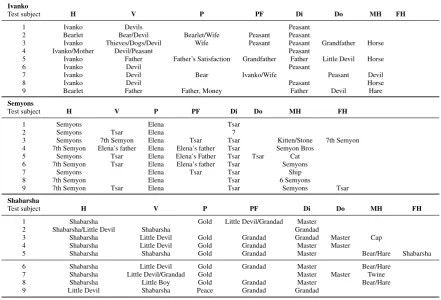
Table 1: The assignment of thedramatis personaefor the three folktales inPropp I.
2.
Propp’s formal system
2.1. Overview of Propp
Working with a corpus of 100 Russian folktales from Afanas’ev’s collectionNarodnye Russkie Skazki, Vladimir Propp developed a formal system to identify each folktale by short annotation strings consisting of symbols represent-ing Proppianfunctionsornarratemes. In the following, we give a description of the components of the Proppian sys-tem relevant for the experiments discussed in this paper. For more details, we refer the reader to (Propp, 1958). Propp identified seven2 dramatis personae representing
roles the characters may play within the tales. They are: the hero (H), the villain (V), the princess (P), the princess’s father (PF), the dispatcher (Di), the donor (Do), the (mag-ical) helper (MH) and the false hero (FH) (Propp, 1958, §3).
The actions of thedramatis personaeare described by a set of thirty-one functions described in (Propp, 1958, §3) by means of examples and more specified subfunctions. These functions are marked by symbols in the order of their oc-currence in the folktale; the first seven functions, marked with lowercase Greek letters, are calledpreliminary func-tions:β Absentation;γ Interdiction;δ Violation,ε
Recon-naissance,ξ Delivery,η Trickery,θComplicity. The pre-liminary functionsare not fully developed in (Propp, 1958) and are not included in Propp’s own annotation strings. The main functions are:AVillainy,aLack,BMediation,C
Be-2One of these, thePrincess/Princess’s Father, can be split into
two with a slightly difficult delineation. In our experiment, we presented the resulting list of eightdramatis personae.
ginning counteraction,↑Departure,DFirst function of the Donor, EHero’s reaction,F Provision or receipt of mag-ical agent, GSpatial transference between two kingdoms,
HStruggle, J Branding, I Victory,KLiquidation, ↓ Re-turn,PrPursuit,RsRescue,oUnrecognized Arrival,L Un-founded Claims, MDifficult Task,NSolution, Q Recog-nition, Ex Exposure, T Transfiguration, U Punishment,
WWedding. These functions, instantiated bysubfunctions
marked by superscripts, occur in strict sequential order, i.e., functions have to occur in the folktale in the order they are given in the list above. In the full Proppian system, there are a few specific ways to break strict sequentiality (Propp, 1958,§IX.A): The most important one is that some folk-tales contain a series of individual tale units, calledmoves. Examples aretrebling, the triple repetition of moves within the tale, and moves in which a magical agent is obtained in the first move but only used in the second move of the tale. None of the tales we used hadmoves(according to Propp’s own annotations), so we did not include this option in our experiment.
2.2. Description of Propp I
Test subjects were trained in the Proppian framework and then asked to annotate four of the folktales formalized in (Propp, 1958). We used the folktalesThe Seven Semyons, 147,Shabarsha, 151, andIvan the Bear’s Son, 152; in the following, we refer to these folktales asSemyons, Shabar-sha, andIvanko.3We chose tales that were available in En-glish translation, and in Propp’s annotation had nomoves
3In Propp I, we also used the folktale The Enchanted
(i.e., retained strict sequential ordering) and used few func-tions (Ivankouses eight functions,Shabarshasix). An an-notation of inPropp I consisted of (1) the assignment of story characters to thedramatis personae, and (2) a list of the functions (group 1) or the functions with corresponding subfunctions (group 2) occurring in the folktale.
Procedure. We had nine test subjects, all students of the
Universiteit van Amsterdam, and all with native or
near-native competence of English. We split them into two groups: Test subjects 1 to 5 were group 1 (no subfunction marking) and test subjects 6 to 9 were group 2 (subfunction marking). Test subjects were instructed that the experiment would last three hours and received a moderate financial compensation for participation.
The experiment started with a 45-minute introduction to Propp’s system given by a native speaker of English sup-ported by a projector presentation explaining the relevant fragment of Propp’s system. Only a selection of the sub-functions was included (labelled “examples” for group 1 and “subfunctions” for group 2). We analyzed a simple ex-ample story, of our own design, as an illustration. A con-densed version of thedramatis personaeand functions was distributed as a leaflet for use during the annotation.
Results. Propp’s annotation for Shabarsha was
A8B4C↑H2I2K1↓; his annotation for Ivanko was A9↑H2I2K1↓. These consist of the function strings alone
and do not include thepreliminary functions.4
We give the results of the assignments ofdramatis personae
in Table 1. The results indicate that the test subjects did not fully understand the Proppian scheme; note in particular the variation in the three maindramatis personae,H,V, andP
(see below for a methodological remark).
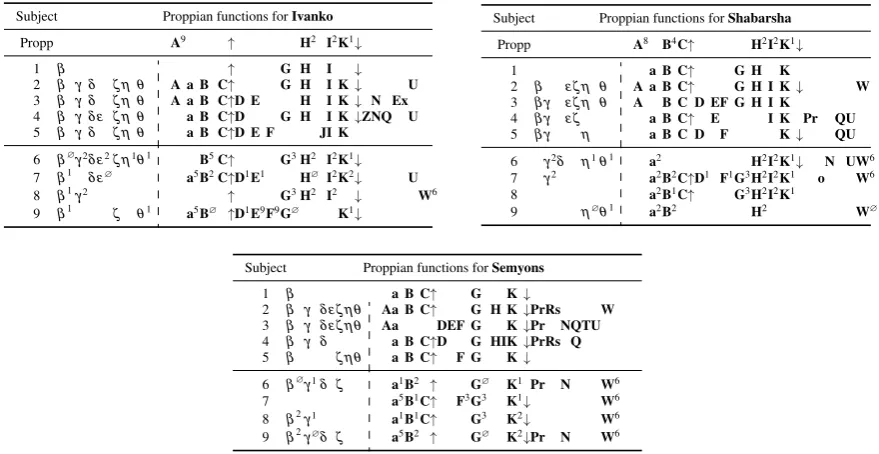
The annotation strings vary widely and are given in Table 2 (subfunctions are marked by superscripts, with a missing subfunction marked by ∅). Since no two strings are the same, comparison would have to be per function;
calcula-oversight, we worked with version 147 ofSemyonswhile Propp annotated version 145. This makes it impossible to compare our results to Propp’s original annotation, but it does not invalidate the discussion of inter-annotator agreement of our test subjects. We used the translations of Gutermann (Afanas’ev, 1973) for Se-myonsandIvanko, and the translation of Cook (Afanas’ev, 1985) forShabarsha.
InSemyons, seven orphans meet the Tsar and pledge to work hard in their professions. The seventh becomes a thief and, with the help of his brothers and their respective talents, journeys to capture Elena the fair as a bride for the Tsar. InIvanko, Ivanko is born of a peasant woman and her kidnapper, a bear. After return-ing to human society, he causes some damage and is sent to a lake in which devils dwell. Through a series of tricks, Ivanko gains all of the devils’ gold and the services of a little devil for a year. In Shabarsha, the protagonist Shabarsha takes a day off to earn some money for himself and his boss. He goes to a lake to catch fish, meets a little devil and threatens to evict all of the devils from the lake if they don’t pay rent. Through a series of tricks he acquires all of their wealth.
4Therefore, we do not take thepreliminary functionsinto
ac-count for comparison between Propp’s original strings and the strings produced by the test subjects. For the sake of complete-ness, we also list the Propp string forSemyons(version 145, cf. fn. 3):a1B2C↑F2G1K2↓.
tions of statistics per function are not useful because of the variation in the assignment ofdramatis personaeand the small amount of data. The strings are longer than Propp’s strings (compare an average of 14.2, 13.2, and 12.8 func-tions with the Propp’s of 6 and 8 forIvankoandShabarsha, respectively).
Methodological Conclusion. Four out of nine test sub-jects reported that the example story from the presentation was considerably simpler than the folktales.
The variation in the assignment of characters to dramatis personaesuggests that the description of thedramatis
per-sonaewas not precise enough. For instance, our
descrip-tion of the hero used the words “who is good”. Arguably, Shabarsha’s behaviour inShabarshacannot be described as “good”, which caused some of the variation in the assign-ment of the hero.5
A number of functions are consistently annotated which do not show up in Propp’s own annotations. On the other hand, we see that some of Propp’s functions show up in all or almost all annotations strings: e.g., ↑, H,I,Kand↓ are reliably reproduced in theIvankoannotation strings. How-ever, since we do not know which events in the tale the annotators marked with these functions, we cannot be sure whether these are actual reproductions of Propp’s assign-ments.
2.3. Description of Propp II
The experiment Propp II was a modified version of
Propp I, taking the problems discussed in§2.1. into ac-count. We used the same folktales as inPropp I. An an-notation of a folktale inPropp IIconsisted of (1) a list of the functions occurring in the folktale, and (2) marked text passages for each of the functions that occurred.
The main changes toPropp Iwere: the test subjects were given the assignment of dramatis personae; subfunctions were not discussed at all; the example story was from Propp’s own corpus. It should be noted that Propp only recorded the annotation strings, so that his choice of drama-tis personaewas extrapolated from (Propp, 1958).6
Procedure. We had six test subjects, all students of the
Universiteit van Amsterdam, and all with native or
near-native competence of English. Test subjects were instructed that the experiment would last three hours and received a moderate financial compensation for participation. The experiment started with a 45-minute introduction to Propp’s system given by a native speaker of English sup-ported by a projector presentation explaining the relevant fragment of Propp’s system. We gave short descriptions of
the dramatis personae roughly based on Propp’s original
text and the the descriptions of the functions from Propp’s
5It is conceivable that the designator “devil” created a
conno-tation in the original audience of the folktale producing a very dif-ferent reading of Shabarsha’s behaviour that cannot be reproduced in contemporary test subjects due to a lack of cultural context and contemporary sympathy for harmless “little devils”.
6InIvanko, we assigned Ivanko toHand the Little Devil and
Subject Proppian functions forIvanko
Propp A9 ↑ H2 I2K1↓
1 β ↑ G H I ↓
2 β γ δ ζ η θ A a B C↑ G H I K↓ U 3 β γ δ ζ η θ A a B C↑D E H I K↓ N Ex 4 β γ δ ε ζ η θ a B C↑D G H I K↓ZNQ U 5 β γ δ ζ η θ a B C↑D E F JI K
6 β∅γ2δ ε2ζ η1θ1 B5C↑ G3H2 I2K1↓ 7 β1 δ ε∅ a5B2C↑D1E1 H∅ I2K2↓ U
8 β1γ2 ↑ G3H2 I2 ↓ W6
9 β1 ζ θ1 a5B∅ ↑D1E9F9G∅ K1↓
Subject Proppian functions forShabarsha
Propp A8 B4C↑ H2I2K1↓
1 a B C↑ G H K
2 β ε ζ η θ A a B C↑ G H I K↓ W 3 β γ ε ζ η θ A B C D EF G H I K
4 β γ ε ζ a B C↑ E I K Pr QU
5 β γ η a B C D F K↓ QU
6 γ2δ η1θ1 a2 H2I2K1↓ N UW6 7 γ2 a2B2C↑D1 F1G3H2I2K1 o W6 8 a2B1C↑ G3H2I2K1
9 η∅θ1 a2B2 H2 W∅
Subject Proppian functions forSemyons
1 β a B C↑ G K↓
2 β γ δ ε ζ η θ Aa B C↑ G H K↓PrRs W 3 β γ δ ε ζ η θ Aa DEF G K↓Pr NQTU
4 β γ δ a B C↑D G HIK↓PrRs Q
5 β ζ η θ a B C↑ F G K↓
[image:4.595.77.517.68.295.2]6 β∅γ1δ ζ a1B2 ↑ G∅ K1 Pr N W6 7 a5B1C↑ F3G3 K1↓ W6 8 β2γ1 a1B1C↑ G3 K2↓ W6 9 β2γ∅δ ζ a5B2 ↑ G∅ K2↓Pr N W6
Table 2: The annotation strings for the three folktales inPropp I(cf. fn. 3).
Ivanko Test subject Proppian Functions
Propp A ↑ HIK↓
1 β a ↑GHIK↓
2 β γ ↑ MN W
3 β B↑ HI U
4 β ↑ HI ↓ U
5 β aB↑ HI ↓
6 β aB↑ HIK↓ W
Semyons Test subject Proppian Functions
1 aB ↑GK W
2 β aB ↑ K↓ W
3 β aB G oNW
4 η a ↑G Pr W
5 aB ↑ K↓PrRs W
6 β aBC↑GK↓PrRs W
Shabarsha Test subject Proppian Functions
Propp A BC↑HIK↓
1 a HIK N
2 aB ↑ MN W
3 a C↑HI M UW
4 a ↑HI MN
5 a ↑H K
6 aBC HIK W
Table 3:The annotation strings for the three folktales inPropp II(cf. fn. 3).
text. We analyzed the folktale (Ivan Popyalov, 135) from the Propp corpus. Again the condensed version of the
dramatis personaeand functions was distributed as a leaflet to for use during the annotation. Test subjects were given an assignment of characters to thedramatis personaetogether with each folktale.
Results. We give the results of the function annotation in Table 3. The annotation strings are noticeably shorter than inPropp I(on average 6.8 functions per annotator, com-pared with 13.4 functions inPropp Iand 6 and 8 functions in the original Propp strings forIvankoandShabarsha, re-spectively),7 and more similar to Propp’s original strings, but we still do not have matching strings among the test subjects.
It is again not possible to do a serious statistical analysis on the basis of six annotations; we therefore do a qualitative analysis instead. We say that a function occurs stablyin
Propp IIif it is in at least four of the six annotations. We further distinguishstrong stabilitywhen the marked text of the annotators overlaps, and weak otherwise. In Ivanko,
β,Iand↓were strongly stable and↑andHwere weakly
stable (of which↑,H,Iand↓are annotated by Propp); in
Shabarsha,a and↑were strong stable and HandIwere
7Most likely, a reason for the much longer strings inPropp I
was the assignment of superfluousdramatis personaeby the test subjects in that experiment.
weakly stable (of which ↑, H, and I were annotated by Propp); inSemyons,a,B,G, andWwere strongly stable and↑andKwere weakly stable. Note that in bothIvanko
andShabarsha, there is a strongly stable function not anno-tated by Propp (Banda, respectively).
3.
Discussion & Future Work
The difference betweenPropp IandPropp II show that the assignment of the characters to thedramatis personae
has an important effect on the assignment of the func-tions. Even with pre-assigneddramatis personae, there are marked differences between Propp’s and the test subjects’ annotations, and among the test subjects. Some of this ef-fect can be explained by the vagueness of the description of Propp’s functions: as an illustration, we mention that subfunction 6 ofWis listed as “Other form of compensa-tion like a monetary reward”. This vague descripcompensa-tion fits in much more general situations than Propp apparently in-tended. Making these vague descriptions understandable for the test subjects may require considerably more time and training than we gave the test subjects in our experi-ments.
The detailed study of human annotations of Propp’s frame-work highlights weaknesses such as vague descriptions of
In (Bod et al., 2011), we suggested to follow up the stud-iesPropp IandPropp IIwith a large-scale inter-annotator study: the results of our experiments suggest that this is not worthwhile. Instead, we should distill the lessons learned from this Proppian case study into studies dealing with other formal representation systems, possibly designed and documented on the basis of the results of this study.
Acknowledgements
The research in this paper was funded by theJohn
Temple-ton Foundation (JTF) via the projectWhat makes stories
similar? (grant id 20565) and theNederlandse Organisatie
voor Wetenschappelijk Onderzoek(NWO) via the projects
Integrating Cognition in the VICI programme (DN 277-70-006) and Dialogical Foundations of Semantics in the ESF EuroCoRes programme LogICCC (LogICCC-FP004; DN 231-80-002; CN 2008/08314/GW). The second, and fourth author acknowledge the financial support and the kind hospitality of the Isaac Newton Institute for
Mathe-matical Sciences (programmeSemantics & Syntax). All
authors would like to thank Ekaterina Abramova and San-chit Saraf (Amsterdam) for their work in the early set-up phase of the research.
4.
References
Aleksandr Nikolayevich Afanas’ev. 1973. Russian Fairy
Tales. Pantheon. Translation by Norbert Guterman from
the collections of Aleksandr Afanas’ev. Folkloristic com-mentary by Roman Jakobson.
Aleksandr Nikolayevich Afanas’ev. 1985. Shabarsha, translated by Kathleen Cook. In The Three Kingdoms. Russian Fairy Tales From Alexander Afanasiev’s Collec-tion, illustrated by Alexander Kurkin. Raduga Publisher, Moscow.
Rens Bod, Benedikt L¨owe, and Sanchit Saraf. 2011. How much do formal narrative annotations differ? A Prop-pian case study. In Charles Ess and Ruth Hagengru-ber, editors,The computational turn: Past, presents,
fu-tures?, Aarhus University, July 4–6, 2011, pages 242–
245, M¨unster. MV-Wissenschaft.
Thorsten Brants. 2000. Inter-annotator agreement for a German newspaper corpus. In Proceedings Second International Conference on Language Resources and
Evaluation LREC-2000.
Jean C. Carletta, Amy Isard, Steven Isard, Jacqueline C. Kowtko, Gwyneth Doherty-Sneddon, and Anne H. An-derson. 1997. The reliability of a dialogue structure cod-ing scheme. Computational Linguistics, 23(1):13–31. Michael G. Dyer. 1983. In-depth understanding: A
puter model of integrated processing for narrative com-prehension. Artificial Intelligence Series. MIT Press, Cambridge MA.
Wendy G. Lehnert. 1981. Plot units and narrative summa-rization. Cognitive Science, 4:293–331.
Benedikt L¨owe. 2011. Methodological remarks about comparing formal frameworks for narratives. In Patrick Allo and Giuseppe Primiero, editors, Third Workshop in the Philosophy of Information, Contactforum van de Koninklijke Vlaamse Academie van Belgi¨e voor
Weten-schappen en Kunsten, pages 10–28, Brussel. KVAB.
Daniel Marcu, Magdalena Romera, and Estibaliz Amor-rortu. 1999. Experiments in constructing a corpus of discourse trees: Problems, annotation choices, issues. In Marilyn A. Walker, editor, Towards Standards and Tools for Discourse Tagging. Proceedings of the Work-shop, pages 71–78.
Mitchell P. Marcus, Beatrice Santorini, and Mary Ann Marcinkiewicz. 1993. Building a large annotated corpus of English: The Penn Treebank. Computational Linguis-tics, 19:302–330.
Rebecca Passonneau, Nizar Habash, and Owen Rambow. 2006. Inter-annotator agreement on a multilingual se-mantic annotation task. In Proceedings LREC-2006, pages 1951–1956.
Vladimir Yakovlevich Propp. 1958. Morphology of the folktale. University of Texas Press, Austin, Texas, 2nd edition. English translation of (?).
David E. Rumelhart. 1980. On evaluating story grammars.
Cognitive Science, 4:313–316.
Roger C. Schank. 1982. Dynamic memory: A theory of
reminding and learning in computers and people.
Cam-bridge University Press.
Scott Turner. 1994. The creative process. A computer
model of storytelling. Lawrence Erlbaum Associates,