In this issue:
2: News in brief
3: Editorial: Sustainable
intensification?
4: Protect the pollinators!
6: Oat varieties for weed
suppression
8: Organic regulation review
9: Dairy farm sustainability
11: System health & resilience
12: GM co-existence conflicts
13: Agroforestry world tour
15: Harvesting hedges
16: Events and more
Crop dominance?
ORC crop researchers Sally Howlett and Nick Fradgley in the 2012 oats trial at Wakelyns (see page 6)
Organic Research Centre
Bulletin
No. 111 – Winter 2012
ORC E-Bulletin
Subscribe free of charge to
our E-bulletin service, with
monthly updates on our
work and events.
Just go to our home page at
www.organicresearchcentre.com
News in brief
Cost-effectiveness of Swiss organic farming
A new study shows that the cost-effectiveness of specific agri-environmental measures is higher on organic farms in Switzerland than on conventional ones. In a new peer-reviewed publication, researchers from FIBL, ORC and other Swiss/UK institutions have examined the efficiency of financial support for organic farming as an agri-environmental policy measure in Switzerland,The economic efficiency of financial support for organic farming has been questioned by some economists and policy makers but little empirical research has been done. This study, led by Christian Schader, shows that mixing system-based approaches, such as organic farming, with more targeted, single-approach measures such as extensifi-cation of arable land and meadows, has the potential to be more effective in terms of benefits due to the multiple outputs from the system-based approaches. There is a slightly higher policy cost with organic farming compared to a combination of three single agri-environmental measures, but the researchers consider these are marginal.
Schader C, Lampkin N, Christie M, Nemecek T, Gaillard G, Stolze M (2012) Evaluation of cost-effectiveness of organic farming support as an agri-environmental measure at Swiss agricultural sector level. Land Use Policy. http://dx.doi.org/10.1016/j.landusepol.2012.06.014
Agroforestry growing in Europe
The European Agroforestry Federation (EURAF) organised the first European Scientific Conference on agroforestry in Brussels during October, with participants from 17 Euro-pean countries and delegates from America and Africa. Evidence of outstanding productivity and efficient provi-sion of ecosystem services was discussed at the conference, with more than 50 papers offered to the audience. The book of abstracts is now available on-line.
During the Conference, an event titled ‘Agroforestry: Trees for a Sustainable European Agriculture’ was organ-ised at the European Parliament. This was the first time that agroforestry has been promoted at the European Parliament level. The response was very positive, with Mrs Benitez Salas from the European Commission commenting that ‘Agroforestry is a rediscovered form of sustainable and creative agriculture’. The Conference concluded with a statement asking for agro-forestry to be adopted as part of mainstream EU agriculture policy measures. The UK’s Stephen Briggs was elected Vice President of EURAF. For further information, see: www.agroforestry.eu.
New report on soil biology
Natural England has published a report on Managing Soil Biota to Deliver Ecosystem Services, produced by a team led by Dr Elizabeth Stockdale (Newcastle University) and Dr Christine Watson (Scottish Agricultural College). Many recent studies have highlighted the fundamental role that soil organisms play in making soils work for us, but also suggest that soil life and its function can be com-promised by many commonplace agricultural practices. This report explores farming practices and systems that
can improve the biological function of soil, delivering benefits to both agriculture and the wider environment. It includes feedback from farmers’ workshops on the practi-calities of different approaches, and also five case studies which describe soil biological management in action. The report concludes that the biological function of soils can be enhanced by simple approaches that can be inte-grated into real farm systems - adapting organic matter management, cultivation approaches and cropping - with likely benefits to both farming and the environment. However, uptake of these approaches was restricted by the lack of UK-based demonstrations, trials and advice, and because it is currently difficult for farmers to measure and evaluate impacts on soil biological health.
Staff changes in EU Commission’s Organic Unit
The EU Commission’s organic farming unit has recently seen substantial staff changes, with a new unit head, Mr. Joao Onofre, and several new staff members, being ap-pointed in September. The new team is facing up to the twin challenges of a complete overhaul of the EU organic regulation (see page 8) and the financial cutbacks likely to result from the EU Budget agreement expected in 2013.SA Soil Symposium success
The Soil Association’s sell-out conference at the Coventry Transport Museum covered a wide range of topics. Luca Marmo from the European Commission’s DG Environ-ment described the aims of the seventh EnvironEnviron-ment Action Programme (2012-2020) and the difficult process of finding agreement on the EU proposal of the soil strategy directive among member states. Carlo Leifert from New-castle University outlined the challenges of food security and sustainable intensification for a rapidly growing world population, with additional inputs in conventional agricul-ture unlikely to substantially increase global yields further, and prices for these inputs rising dramatically.
Liz Stockdale of Newcastle University presented new research results on soil micro-organisms and their ability to persevere in undesirable soil conditions in a sort of ‘dormant’ state, sometimes over years, and become active again when conditions improve, while Dan Carpenter of the Natural History Museum introduced the earthworm species found in the UK, underlining their significance and providing guidance on their identification.
Other sessions covered: the potential of biochar/charcoal in organic production; the benefits and methods of com-post use and production; the role of anaerobic digestion and organic standards relating to the use of digestate; and the potential of agroforestry.
More information can be found on the SA website:
About us
ISSN 1367-6970 Bulletin editor
Lawrence Woodward OBE
The Organic Research Centre
is the UK’s leading, independent research organisation committed to developing sustainable land management and food production systems based on IFOAM organic/ agro-ecological principles; disseminating knowledge to current and future farmers/land managers and other related businesses; compiling evidence on systems performance and informing public debate through communication with policy makers and opinion leaders, and through them the wider public, in order to ensure the health and well-being of soil, plant, animal, people and the environment.
Patrons
Christopher Bielenberg Juliet Kindersley Peter Kindersley
Countess of March and Kinrara Lord Poole
Yvonne Pye Jan Sundt
Prof. Dr. Hardy Vogtmann
Council of Management:
Alice Astor Roger Harrison Andrew Jedwell Jennifer Jones
Jeanette Longfield MBE Mike Turnbull (Chair) James Skinner David Wilson David Wolfe
Executive Director
Prof. Nic Lampkin
Registered in UK as
Progressive Farming Trust Ltd. Company No. 1513190 Charity No. 281276 VAT No. GB314668159
Registered address
Organic Research Centre Elm Farm
Hamstead Marshall Newbury
RG20 0HR
T: +44 (0)1488 658298 F: +44 (0)1488 658503
[email protected] www.organicresearchcentre.com
Editorial: Sustainable intensification – can it be?
It is now gospel that food production has to increase dramatically in order to feed a world population of nine billion by 2050. This article of faith is widely sung. Govern-ments, international agencies, politicians, scientists, media, NGOs, agribusiness repre-sentatives and farmers all carol it out without question and many of them add the catechism that this means we have to use intensive production methods, sustainably. Hans Herren, President of the Millenium Institute and co-Chair of the United Nations sponsored IAASTD study into how agricultural technologies and knowledge can feed the world’s growing population, frequently highlights how globally we currently produce 4600kcal of edible food per person per day, which is enough to provide a healthy diet for 14 billion people. And that does not take into account the fact that we waste about 40% of all the food we produce.
Combatting this waste, the pursuit of a high-protein western diet and the market/ speculator driven food system with its inequitable access and distribution, are the things that should be at the top of our Christmas wish list, rather than more intensive, production-focused fashions, whether or not the word sustainable is attached to them. ‘Sustainable intensification’ has been the buzz incantation for a while now and it’s pronounced loudly by many of the wise (and unwise) men of agriculture. Although I’m sure that they have all been saying that intensive conventional agriculture has been sustainable – or they are making it so – for the past 20 years, they have embraced this new incarnation as if it’s the second coming.
Back in May, the House of Commons Environmental Audit Select Committee in its report on Sustainable Food pointed out that, although the government was promoting sustainable intensification, they had failed to define or describe what it is in practice. This doesn’t seem to have caused anyone to pause for thought.
In fact it looks like it has encouraged all and sundry to rewrap all the old stuff – inten-sification, biotechnology, intellectual property rights and patents, global supply chains and agribusiness – in new paper/s and present it as something that isn’t business as usual. As they’ve done this, agro-ecological approaches, including organic farming, have been dismissed as irrelevant, or at best, not something that is of interest to the grown- ups at the party.
There are proponents of sustainable intensification who would say this is unfair and that it is wrong to characterise it as intensive and GM agriculture dressed up in fancy clothes. They argue that, in various guises, sustainable intensification can encompass agro-ecology, eco-functional intensification and even organic farming in the pursuit of making food production more efficient and sustainable.
A recent report, led by Tara Garnett from the Food Climate Research Network and Charles Godfray from the Oxford Martin Programme on the Future of Food, covers these perceptions and issues. It is an interesting and illuminating discussion. It is a pity, they say, that the voices of intensive conventional farming and GM have dominated the sustainable intensification story, because all of us can play a part.
Ultimately though, we are not talking about technological differences or the balance of priorities. We are talking more about different views about how food should be grown and distributed in a world of finite and diminishing resources. Are we pursuing a productivist or sufficiency agenda? Our values and vision for the world has no place for a multi-national, corporate-driven food system that does not recognise planetary boundaries or equity; that is based on appropriation of nature through patents and intellectual property rights; and that refuses to put ecological processes above input sales – even if it has ‘sustainable’ on the wrapping paper.
Lawrence Woodward
Protect the pollinators: it’s vital and urgent
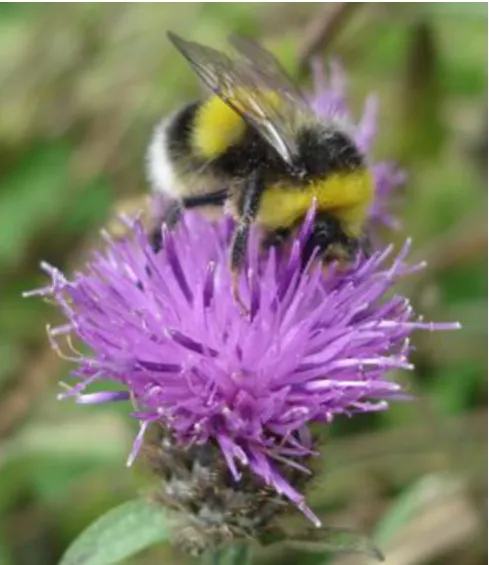
Pollination is vital for crop production, improving crop yield and quality in around 75% of global crops
1.
In the UK, yields of some of the most widely grown and valuable crops are dependent or benefit directly
from insect pollination (Table 1). These benefits are worth an estimated £430m of additional crop
pro-duction to UK agriculture
2. But pollinating insects are now severely threatened and endangered.
Tom
Breeze
of Reading University explains how they can be protected.
Pollination services in the UK are supplied by a variety of wild solitary bees, bumblebees and hoverflies as well as managed honeybees (Apis mellifera), buff-tailed bumble-bees (Bombus terrestris) and red mason bees (Osmia rufa). Although the relative importance of each group is un-known, maintaining a high diversity of pollinating insects can reduce risks by buffering against losses of key species and has been demonstrated to keep yields stable between years3. In some crops, notably strawberries, a combination
of different species is required for optimal yields4.
Recent research has suggested that yields of some crops are more limited by pollination than other inputs such as fertiliser5. As such, pollination services may be especially
[image:4.595.300.545.161.444.2]valuable to organic producers.
Table 1: Benefits of pollination to some major UK crops
Crop Benefits
% yield dependence
Added output (£/ha, 2007)
Apples Increased fruit set, weight
and nutrient quality 85 9000
Plums Increased fruit set and
weight 65 7200
Straw-berries
Increased fruit quality and
weight 45 15600
Oilseed rape
Increased oil content, stable
genetic diversity 25 200 Field
beans
Increased seed and pod set,
stronger disease resistance 25 100 Adapted from (2). Benefits are taken from a wide range of published literature from experimental studies. Yield dependence represents the proportion of yield that is lost in the absence of pollination and may vary between cultivars. Added output (£/ha, 2007) represents the gross value of production added by insect pollination services per hectare of crop in 2007 based on Defra data.
Significant decline in pollinator numbers
Studies have demonstrated significant declines in bumble-bees6, wild bees and hoverflies7 across the UK. There has
been a 54% decline in the number of honeybee colonies since 19858, leaving honeybee numbers far below levels
required by UK agriculture9.
These declines in wild pollinators have been primarily driven by a loss of suitable habitats in the landscape as a result of agricultural intensification and development. For instance there has been a 97% decline in flower-rich meadows since the 1930s and nearly 10% of remaining lowland meadows are outside protected areas10.
Many remnant patches have become isolated, putting pressures on pollinators that nest and forage in different habitats and causing greater inbreeding stress. While mass flowering crops such as oilseed rape can provide plentiful food for wild insects, unless other, later-flowering plants are available, they will ultimately starve or begin compet-ing with each other for the few remaincompet-ing resources11.
Declines in honeybees are thought to stem mostly from the spread of parasites and diseases which can reduce their fitness and survival. The most significant of these pests is the parasitic mite Varroa destructor, which both weakens bees by drinking their blood and transmits viruses, such as Deformed Wing Virus, leaving them unable to fly. Con-trolling these pests has become very expensive and this, along with the falling price of honey and little or no payment for pollination services, has driven many bee-keepers out of the market8.
Recent studies have highlighted that a number of pesti-cides can have detrimental effects on both wild bees and honeybees, even at the very low doses encountered in the field. These effects are often manifold, from weakening their immune systems12 to reducing the number of
Protecting and enhancing pollinators
Concerns about the impacts of pollinator declines on agriculture have prompted more research into pollinator conservation and maintenance methods, including signifi-cant EU and UK government investment ( www.step-project.net, www.bbsrc.com/pollinators). However, a number of other practices, many of which are part of agri-environmental schemes or practised by organic farmers, are already known to be effective in increasing in-field pollinator numbers and species richness:1. Planting and maintaining diverse nectar flower mar-gins at the edges of fields can provide valuable flower-ing resources for pollinatflower-ing insects when crops are not in flower, and provide corridors to link semi-natural nesting habitats such as meadows to fields. Nectar flower margins can form part of agri-environmental schemes such as the Organic Entry Level Stewardship in England (option OF4). 2. Where land is available, establishing or maintaining
floral-rich, semi-natural habitats such as hay meadows and heathland or keeping grasslands unimproved can increase both pollinator populations and pollination services to crops. This effect is strongest where habitat patches are within 500m of a crop as this is the typical foraging range of most insects3. Advice and support on
these measures can be found from local wildlife trusts and may be eligible for payments under
agri-environmental schemes, such as the Uplands Entry Level Stewardship, which subsidises hay making. 3. Planting cover crops can help diversify the resources
available to insect pollinators across the landscape as well as providing other benefits such as improving soil quality or reducing pest and weed burdens.
4. Maintaining hedges, diverse grass margins and patches of bare soil can provide valuable nesting resources for a variety of different pollinating insects, notably bum-ble bees and soil-nesting solitary bees. These measures can receive funding under agri-environment schemes, such as Organic Entry Level Stewardship Options OB3 and OB10.
All these approaches are most effective if carefully co-ordinated within the landscape, for instance by using floral strips to connect habitat patches or by maintaining differ-ent habitats across the landscape.
Typical organic farming practices, such as reduced herbi-cide input and lower stocking densities, have been demon-strated to be effective at increasing pollinator populations14
and can increase overall pollination service delivery in landscapes where there is a high proportion of good-quality habitat in the surrounding landscape15.
International studies have suggested other, more unortho-dox methods of enhancing pollinator populations. For instance research from South Africa indicates that leaving flowering weeds in sunflower fields can improve pollina-tion significantly and more than counter-balances yield losses from the weeds16. A study in Canada also
demon-strated that big-leaf lupines sown in margins around apple orchards helped commercially bought solitary mason bees (Osmia sp.) establish populations in the orchard, reducing the need to buy as many in the following years17.
A global and national R&D priority
Protecting and restoring pollination services is a global R&D priority because the decline in pollinators is having an adverse impact in all parts of the world. For instance declining bumblebees have been linked with falling clover yields in Sweden18. In extreme cases, such as in parts of
China, pollinators have been wiped out from crop systems due to pesticide overuse, forcing growers to hire labourers to pollinate crops by hand at a substantial cost19.
Future studies will aim to develop more tailored manage-ment strategies and how they link with other conservation measures and ecosystem services, such as natural pest control. In the UK context, research into the availability of honeybees and demand for pollination services will identi-fy regions most at risk of pollinator losses so as to better target conservation work.
References
1. Klein et al. (2007) Importance of pollinators in changing landscapes for world crops; Proceedings of the Royal Society B-Biological Sci-ence. 274(1608):303-313
2. Smith et al. (2011) UK National Ecosystem Assessment Technical Report – Chapter 14: Regulating Services. http://uknea.unep-wcmc.org
3. Garibaldi et al. (2011) Global growth and stability of agricultural yield decrease with pollinator dependence; Proceedings of the Na-tional Academy of Science of the United States 108:1581-1584 4. Chagnon et al. (1993) Complementary aspects of strawberry
pollina-tion by honey bees and indigenous bees (Hymenoptera); Journal of Economic Entomology 86 (2):416-420
5. Klein et al. (2012) Wild pollination services to California almond rely on semi-natural habitat; Journal of Applied Ecology 49:723-732 6. Goulson et al. (2008) Decline and conservation of bumble bees.
Annual Review of Entomology 13, 177-181
7. Biesmeijer et al. (2006) Parallel declines in pollinators and insect pollinated plants in Britain and the Netherlands. Science 313(5785): 351-354
8. Potts et al. (2010) Declines of managed honey bees and beekeepers in Europe. Journal of Apicultural Research 49(1):15-22
9. Breeze et al. (2011) Pollination services in the UK: How important are honey bees? Agriculture, Ecosystems, Environment 142:137-143 10. Lawton et al. (2010) Making space for nature: a review of England’s
wildlife sites and ecological network. http://archive.defra.gov.uk/en-vironment/ biodiversity/documents/201009spacefor- nature.pdf 11. Diekotter et al. (2010) Oilseed rape crops distort plant-pollinator
interactions. Journal of Applied Ecology 47:209-214
12. Henry et al. (2012) A common pesticide decreases foraging success and survival in honey bees. Science 336:348-350
13. Pettis et al. (2012) Pesticide exposure in honey bees results in increased levels of the gut pathogen Nosema. Naturwissenschaften 99:153-158
14. Scheper and Kleijn (2011) Analysis of the effectiveness of measures mitigating pollinator loss. STEP Project Deliverable 4.3.
http://www.step-project.net/files/DOWNLOAD2/STEP_D4%203.pdf 15. Brittan et al. (2010) Organic farming in isolated landscapes does not
benefit flower-visiting insects and pollination; Biological Conserva-tion 143:1860-1867
16. Carvalheiro et al. (2011) Natural and within-farmland biodiversity enhances crop productivity. Ecology Letters 14:251-259
17. Sheffield et al. (2008) Potential of bigleaf lupine for building and sustaining Osmia lignaria populations for pollination of apple. Cana-dian Entomologist 140:589–599
18. Bommarco et al. (2011) Drastic historic shifts in bumble bee commu-nity composition in Sweden; Proceedings of the Royal Society B - Biological Science 279:309-315
Oat variety characteristics for suppressing weeds
The excellent weed suppression ability of oats makes them a valuable part of crop rotations in organic
and conventional farming systems. ORC researchers
Thomas Döring, Louisa Winkler
and
Nick Fradgley
report new results that show how plant breeding can bring further improvement.
Weed control is probably one of the topics that will neverleave farmers’ and researchers’ to-do lists. Including oats in the rotation contributes towards weed control as, in comparison to other cereals, they are effective weed suppressors. Oats are allelopathic, secreting weed-growth inhibiting compounds from their roots. Also, because of their tall stature, they can create a denser canopy than other cereals such as wheat or barley, and are thereby able to suppress competing weeds by shading out light. Nonetheless, as in other cereals, breeders are attempting to create oat varieties with decreased plant height, both to reduce the risk of lodging and to allocate a higher propor-tion of biomass to grain yield. This leads to a conflict of goals: reduced height for lodging resistance on the one hand and tall plant height for weed suppression potential on the other.
Importantly, because the organic sector does not yet have the resources to run dedicated organic oat breeding pro-grammes, it still depends on conventional cereal breeding, wherein weed suppression is generally less important than lodging resistance.
Varieties and lodging
We considered whether a compromise could be achieved by finding oat varieties that display high weed suppression ability whilst being relatively small in stature. To do this, we looked at data from an oat variety trial run as part of the Harnessing new technologies for sustainable oat production and utilisation (QUOATS) project over three years at Wakelyns Agroforestry, Suffolk.
This replicated field experiment was conducted using five husked and three naked oat varieties under two different fertility regimes (with and without added chicken manure pellets). Among other parameters, the canopy cover (Leaf Area Index or LAI) was measured three times during the growing season; this is a measure of the light which pene-trates the crop canopy and becomes available to the weeds. Crop yield and final crop height were also measured and weed cover levels were estimated post-harvest.
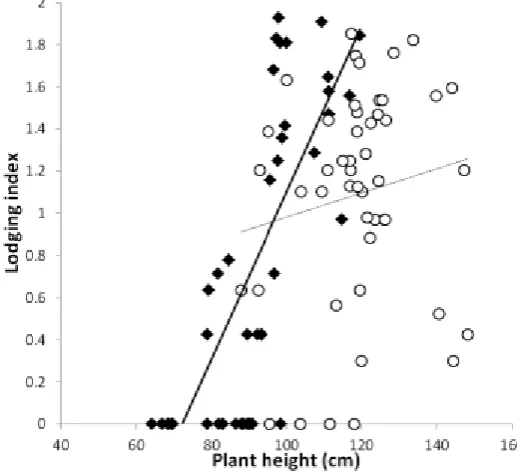
[image:6.595.301.560.137.373.2]With this dataset we first tested whether taller varieties display more severe lodging. This was generally the case, but not in all years: in one year (2010/2011), there was no lodging at all, mainly because a very dry spring had led to stunted crop growth; in the other two years, there was a significant increase of the lodging index with crop height (Figure 1). This indicates that even within organic systems, it is useful to grow varieties that are not too tall, in order to avoid excessive lodging.
Secondly, we looked at the relationship between crop height and weed levels. As expected, we found that tall plant height was significantly associated with lower post-harvest weed levels. However, other characteristics of the crop, in particular, the mid-season LAI, were found to be better predictors of weed suppression than crop height.
Figure 1: Taller plants increase lodging risk.
Data from 2009/2010 (in black) and 2011/2012 (in white). In 2010/11 no lodging was observed.
The importance of canopy cover (LAI)
Taller oat varieties generally tend to have a higher LAI, but an important question is whether ‘outlier’ varieties can be found that simultaneously exhibit low lodging risk through relatively short height and high weed suppression through a relatively high LAI. Among the husked varieties grown at Wakelyns, there was one variety (Brochan) that showed a high LAI but is not too tall in stature (Figure 2). Among naked oats varieties, however, none showed this combination of characteristics.
In terms of yield, although there are significant differences between varieties, there was no clear winner over the three years. Out of the husked varieties, Balado did yield significantly lower over the years; whether this can be attributed to its shorter height and lower LAI is unclear. Across all varieties, we observed a significant relationship between high LAI and high yields. This is due to the fact that up to a point a denser canopy can mean more leaf area for photosynthetic energy, which will increase grain yield. Theoretically, there can also be a trade-off between LAI and yield, as the plant uses energy producing the canopy rather than investing it into the grain. However, we found no evidence of such a trade-off, meaning that the mid-season canopy cover emerges as a useful selection criterion for oat varieties.
Figure 2: Relative differences (% of average) in LAI and height of selected oat varieties. Darker shaded circles are husked and lighter circles naked varieties. Size of circle indicates average yield of each variety. Shaded square shows area where below-average crop height (small stature) is combined with above-average LAI.
For plant breeders developing oat varieties for organic systems, high canopy cover should be considered an important trait.
Acknowledgements
The QUOATS project, led by IBERS at Aberystwyth University, is funded by AHDB and industry partners, and jointly sponsored by BBSRC, by Defra through the Sus-tainable Arable LINK Programme, by European Regional Development Funding through the Welsh Assembly Government’s Academic Expertise for Business (A4B) Programme and by the Scottish Government Contract Research fund. See www.quoats.org for further details.
Book Review:
Organic
Agricul-ture for Sustainable Livelihoods
Edited by Niels Halberg and Adrian Muller. Earthscan from Routledge, Abingdon (2012). ISBN 978-1-84971-296-5. £ 29.99.
When starting to read this book I was a bit sceptical about whether yet another book on organic agriculture was needed, but I was positively surprised. The book, edited by prominent organic researchers Niels Halberg and Adrian Muller, not only claims but really does provide a timely analysis and assessment of the potential of organic agricul-ture for rural development.
In the battle of discourses over food production it places itself firmly on the side of the school of thought that is now frequently labelled ‘sufficiency’ as opposed to
‘productivist’ in the debate on ‘sustainable intensification’. The authors explore the role that organic agriculture can play, with a clear focus on livelihoods and the potential of organic agriculture and agro-ecology to act as a laboratory for development of future sustainable food production.
The book’s main focus is on developing countries - and includes recommendations of the research needs of organ-ic agrorgan-iculture in sub-Saharan Afrorgan-ica - but it has broad relevance. It challenges the simple assumption that feeding the world depends only on high wheat yields and high-lights recent studies showing clear differences between the relative yields of fruits and vegetables with those of cereals and oilseeds.
As 90% of the world’s farms are small, with less than 2 ha, and faced with poverty and social exclusion, the authors explore whether smallholder farmers can really take part in market chain development, setting out that just being organic does not automatically lead into a ‘safe haven’. Several chapters cover agro-ecology, exploring to what extent agro-ecological methods are actually used in organ-ic agrorgan-iculture; the different meanings that the term can have; how it is applied in Latin America as a set of practic-es and a social movement; and proposals for a set of agro-ecological indicators related to the principles of organic agriculture that could guide future development.
The literature on climate change and other environmental impacts of organic agriculture is summarised and the potential of organic agriculture in assisting farmers to adapt to climate change is outlined.
But several chapters make it clear that the message about the wide range of benefits of organic agriculture has not yet reached many governments. The obstacles in terms of conventional mindsets and vested interests are covered and policy support in two large ‘emerging’ countries, Brazil and China, is examined.
Chapters have been authored by various teams, often from different parts of the world. Whilst the chapters explore different topics and can stand on their own, the editors have succeeded in bringing them together in one book. Four well-chosen and informative case studies round the book off, covering topics as wide ranging as: farmer learn-ing groups from Denmark to Uganda; experience with carbon credits; the impact of organic/fair trade on small-holder livelihoods in Sri Lanka; and life-cycle assessment of organic juice imported to Denmark from Brazil.
The organic regulation: review, revise or rewrite?
The EU Commission has announced a review of the organic regulation with the aim of simplification,
reducing red tape and increasing transparency. ORC is part of a consortium involved in one part of the
evaluation process. Here
Susanne Padel
explains what is involved and where stakeholders fit in.
Council Regulation (EC) 834/2007 on organic productionand the labelling of organic products has been in force since 1 January 2009. It replaced an earlier (1991) regula-tion which is widely recognised to have been an important factor in the growth of the organic sector in Europe. Earlier this year, the Commission published a report1 on
the ‘application of Council Regulation (EC) No 834/2007’ and announced a three-stage review to evaluate and review how it can develop in the future. As part of the report a survey covering experiences of the current regula-tion in Member States had been sent to the competent authorities and a stakeholder consultation had been under-taken.
The report makes clear that overall the Commission wants simplification of the legislative framework, while at the same time ensuring that the standards are not watered down. It wants to ‘reduce red tape for both farmers and administrations by making rules more transparent’. The main conclusions of the report are:
a) The Commission prefers to deepen the regulatory and control aspects for agricultural products rather than to expand the scope to more products and sectors, such as mass catering or non-food. For labelling of organic textiles and cosmetics, other instruments (e.g. the EU Ecolabel) could give adequate protection of consumers and producer interests.
b) On the use of GMOs, the Commission wants to follow up on vendor declaration and the availability of some products in non-GM version, but does not see justifi-cation for a specific GMO threshold for organic. c) On co-existence, it refers to the Commission
Recom-mendation to Member States from 2010, but wants re-cent developments to be analysed.
d) The control system was found to be helping the functioning of the internal market, but some weak-nesses were noted requiring further action. Work is needed to streamline the newly implemented import regime based on equivalence, although some progress has been made.
The IFOAM EU group broadly welcomed the report but would have liked to see the issue of flexibility be consid-ered in more detail.
Stakeholder consultation
To oversee the process and receive and review input from all the different stages, the Commission has set up an inter-Service Steering Group in which many parts of European Commission Directorates are represented. Three hearings with invited speakers were organised by the Commission in Brussels. The first one took place on 27/28 September 2012 focussing on ‘The EU organic market – Internal market and standards’. The second hearing was scheduled for 25/26 October covering ‘Con-trols and enforcement’ and the third for 20/21 November
on the theme ‘International trade in organic products and global issues’. As yet, no reports of those hearings have been published.
The Commission also plans on holding an additional online consultation before 13 February 2013.
An external evaluation
An external evaluation is to be carried out by a consortium led by Dr Jürn Sanders of the German Thunen Institute. ORC is part of this group along with FiBL (CH), Oreade Breche (FR), IEEP (UK) and national experts in a further 10 countries.
The aim of the evaluation is to examine the relevance (being pertinent to the needs) and effectiveness (in terms of achieving its objectives) of the existing regulation and its implementing rules.
Four sections are to be evaluated: rules for organic produc-tion, for controls, for labelling and for trade with Third Countries. Possible unintended side-effects of the measures and effects that would have occurred without the regulation (deadweight) will also be assessed. The main focus is on studying in detail the different aspects of implementation in specific product sectors in 13 national case studies, one of them the UK, although some aspects will be covered in all 27 EU Member States. The analysis will consider relevant national legislation and implementation guidelines, standards and literature as well as statistical and administrative data held by the Commis-sion and in Member States.
It will also carry out interviews and two online consulta-tions (one of them with consumers) in the case study countries. The team has been given a list of evaluation questions that have to be answered, related to the scope, the production rules, the control system, the import rules, consumers, simplification, EU added value and the sus-tainable development of the sector.
One key task of the team is putting forward recommenda-tions based on the analysis of the data on how the legisla-tive framework of organic production in the EU could be improved with respect to achieving its objectives.
Watch this space
The Commission aims to complete this review and evalua-tion process and publish legal proposals for amendments of the Council Regulation 834/2007 by the end of 2013. However proposals for the alignment of the regulation to the Lisbon Treaty are still under discussion in the Euro-pean Parliament and the Council of Ministers and need to be taken into account.
Assessing the sustainability of EU organic and low input dairy farms
The EU funded Sustainable Organic and Low Input Dairy Systems project (SOLID), aims to support the
improvement of sustainable production on organic and low input dairy farms. 10 farms in each of 9
countries participated in an initial interview based assessment.
Katharine Leach
discusses the findings.
SOLID is a wide ranging project with 20 partners. ORCand the organic milk co-operatives, OMSCo and Calon Wen, as small medium enterprises (SMEs), are the UK partners specifically involved in the ‘Participatory Re-search’ aspects being carried out on commercial farms, rather than at research institutes.
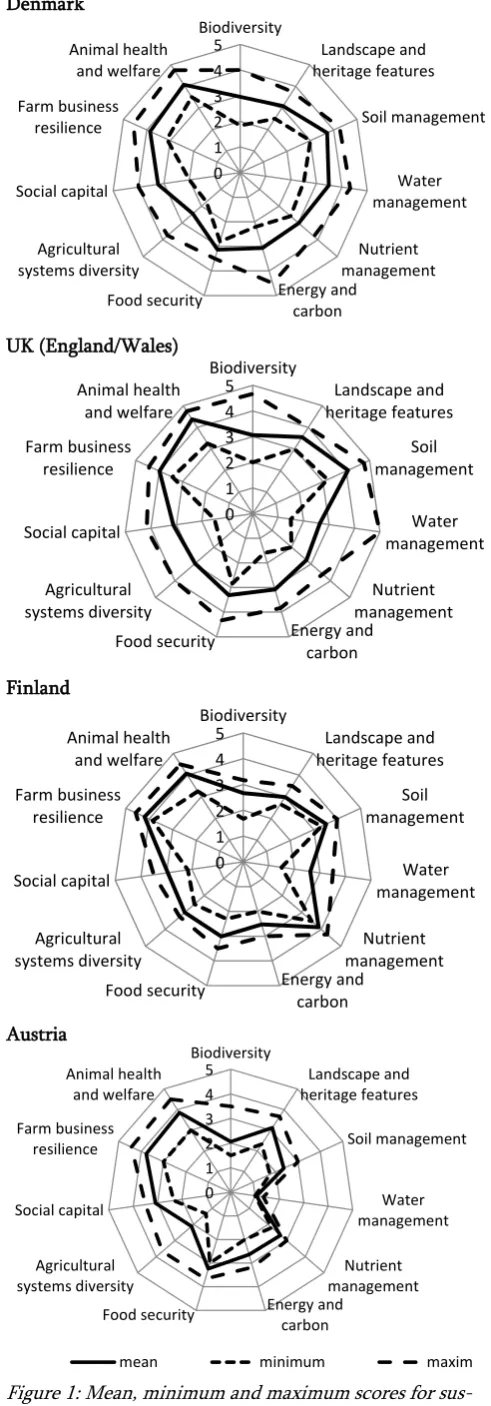
As a first step in considering where sustainability might be improved, and identifying research needs, interviews with farmers were carried out and a computer based tool was used to assess farm sustainability according to 11 different components or ‘spurs’ (Figure 1). These farms were chosen to illustrate examples from the range of farms associated with the ‘SME’ partner in each country.
[image:9.595.307.563.153.539.2]We present below some results from the UK (Ten OMSCo and seven Calon Wen farms), Austria, Finland and Den-mark. Other countries - Romania, Italy, Spain, Greece and the Netherlands - are also involved in the project, but since these countries have very different production systems from the UK they are not covered in this article.
How the farms differ
Table 1 shows some characteristics of the farms studied, giving an idea of aspects of the organic dairy sector in these four countries. The UK farms included extensive spring calving grazing based systems, higher input winter milk producers, farms with diversification into tourism and on-farm milk processing, small family farms, and larger units employing outside labour.
In Austria, 2/3 of milk is produced in mountain areas. The farms studied were all members of an organic co-operative with 40 members, and were very small farms, located in the mountains, providing milk for processing into cheese. Concentrate inputs are very low in these traditional Alpine systems.
Danish farms were members of the Thise Dairy Company, a pioneer of organic milk production in the country. The average Danish farm area was similar to that of the UK farms studied, while herd size had a wider range, and slightly lower average, than the UK selection. In Finland, all but two of the nine members of Juvan Luomu Ltd, the only totally organic dairy in Finland, participated. These producers had relatively small herds compared with the UK, but in fact were about twice the average size for Finnish organic dairy farms, in terms of both area and cow numbers. In contrast with the small Austrian herds, they reached much higher yields. The Austrian farms chosen generally had several different enterprises, usually including forestry. No farms in the Austrian group had any arable land, but Finnish, Danish and UK farms had varying amounts, with least in the UK where a considerable proportion of the land was in short term grass leys (three years old or younger). On the Aus-trian mountain farms almost all grass was permanent pasture, while this was uncommon in Denmark and Finland. Most UK farms had some permanent pasture.
Table 1: Characteristics of farms included in the sustaina-bility assessment in each country – mean (range) values
Attribute Unit Austria Denmark Finland UK
Farms n 12 10 7 17
SOLID SME Partner organisation Sennerei Hatzen-städt Thise Dairy Juvan Luomu OMSCo & Calon Wen Time in organic
farming y
21 (20-39) 16 (12-28) 17 (10-22) 11 (3-30) Farm size ha 21
(12-31) 221 (50-512) 139 (18-414) 204 (46-422) Herd size
(adult cows) n
13 (1017) 161 (36-480) 47 (9-124) 151 (65-378) Stocking rate and land use
Grassland stocking rate GLU/ for ha 0.9 (0.6-1.4) 1.5 (0.9-2.3) 0.8 (0.5-1.20) 1.6 (1.1-2.5) Proportion of
area in arable % 0
30 (11-44) 30 (6-44) 9 (0-42) Proportion in
perm. pasture %
94 (62-100) 12 (2-22) 4 (0-16) 45 (4-100) Milk production
Milk sales l/cow/ yr 4576 (2352-6375) 6444 (4554-8750) 7765 (6400-10071) 5603 (4125-7368) Milk price €/l 0.48
(0.45-0.58) 0.42 (0.36-0.49) 0.57 (0.51-0.63) 0.34 (0.31-0.40)
Animal housing: % of herds… …outdoors day & night
during grazing season 33 80 28 100
…kept tethered 50 0 14 0
…kept in straw yards
(loose housing) 0 70 14 22 …kept in cubicles 50 30 72 78 Labour input Annual labour units (ALU) ALU/ 100ha 3.8 (2.0-6.9) 1.2 (0.6-2.3) 2.3 (0.6-5.5) 1.9 (0.3-6.5) Milking cows per ALU n/ ALU 18 (12-30) 72 (36-105) 25 (9-53) 61 (24-145)
Stocking rate of the forage area was highest for the UK and Denmark and lowest for Austria and Finland. The majori-ty of the Finnish and Austrian herds only grazed during the day, and three Finnish farms had a grazing season of less than six months, whereas for all other farms in the study the grazing season was six months or more.
[image:9.595.316.559.635.793.2]ORC Bulletin No. 111 - Winter 2012 The level of milk production also varied, the mean being
lowest in the Austrian group, followed by the UK, Den-mark, and then Finland. Austrian farms consistently used little or no purchased concentrate while levels were higher, although variable, in each of the other three groups. The Finnish farms included some that were rela-tively small but high in purchased feed inputs, in contrast to the Austrian farms which were all small and low input. Labour input per cow was very high in Austria and Fin-land compared with Denmark and UK.
Variations in sustainability measures
The extent to which sustainability measures can be satis-factorily assessed using this type of interview based ‘tool’ is limited. Nonetheless some interesting differences between countries were identified (Figure 1).
The most consistent strengths indicated for the UK were in animal health and welfare, and, perhaps, to farmers’ surprise, farm business resilience. Austria and Finland had rather lower scores for health and welfare, influenced by the fact that some cows are kept tethered. Even when scores were high, farmers in each country were generally interested in further improvements in health and welfare. Business resilience in Finland was similar to that in the UK, with Austria and Denmark showing a wider range. The remaining ‘component spurs’ showed considerable variation among UK farms. Water management varied both within and between countries, reflecting the availa-bility of water from precipitation. Soil management, nutrient management and energy and carbon use also showed a wide range of scores in all countries, indicating that there is potential for improvement in all these areas. As an example of variability in nutrient management, nitrogen surplus (N imported to the farm – N captured in products) ranged from 43 to 179 kg/ha on the UK farms. Cropping patterns, feed use efficiency and manure man-agement might be adapted to achieve improvements. When UK herds were divided into those above and below 100 cows, the average score of the larger herds was lower for landscape, soil management and energy and carbon use but higher for farm business resilience.
Moving forward with R&D
Carrying out this exercise has led to discussions of various aspects of sustainability with farmers individually and in groups. The outcomes of these discussions are being used to develop on-farm research in each country. A common broad theme across several countries is more economic feed and forage production on farm and more efficient utilization of forage.
In the UK some case studies of different systems achieving good milk production from forage are a starting point. UK farmers also expressed a need for better understanding of the soil, seeing this as fundamental to the system and to overall sustainability. Particular issues included how to encourage soil biological activity, and cope with the risk of declining P levels. Ideas are also moving forward for a trial exploring the use of more diverse swards for grazing.
Denmark
UK (England/Wales)
Finland
[image:10.595.296.542.56.760.2]Austria
Figure 1: Mean, minimum and maximum scores for sus-tainability indicators on dairy farms in four EU countries (higher score suggests greater benefit)
0 1 2 3 4 5 Biodiversity Landscape and heritage features Soil management Water management Nutrient management Energy and carbon Food security Agricultural systems diversity Social capital Farm business resilience Animal health and welfare
mean minimum maximum
0 1 2 3 4 5 Biodiversity Landscape and heritage features Soil management Water management Nutrient management Energy and carbon Food security Agricultural systems diversity Social capital Farm business resilience Animal health and welfare
England and Wales
mean minimum maximum
0 1 2 3 4 5 Biodiversity Landscape and heritage features Soil management Water management Nutrient management Energy and carbon Food security Agricultural systems diversity Social capital Farm business resilience Animal health and welfare
Finland
mean minimum maximum
0 1 2 3 4 5 Biodiversity Landscape and heritage features Soil management Water management Nutrient management Energy and carbon Food security Agricultural systems diversity Social capital Farm business resilience Animal health and welfare
Austria
Resilience: linking health in soils, plants, animals and people
The promotion of health is a central principle of organic agriculture. But what is health? An international
workshop held at ORC in June explored how different disciplines, ranging from soil science to veterinary
medicine and philosophy, define and assess health, and whether common ground can be found.
ORC researchers
Anja Vieweger
and
Thomas Döring
highlight one potentially pivotal finding.
Nearly seven decades ago, Lady Eve Balfour captured oneof the central tenets of organic agriculture in an iconic phrase: ‘The health of soil, plant, animal and man is one and indivisible’1. It highlights the connections between
wholeness and health, and between healthy soils, healthy plants, healthy animals and healthy humans. But if this statement is to be filled with meaning, or to be scrutinised in an experimental approach, we need to be clear about what is actually meant by health.
Contrary to the Balfourian spirit of interconnectedness, current debates about the meaning and measurement of health indicate a seemingly large disconnection between various agricultural disciplines2. Soil science, plant
patho-logy, veterinary science and human medicine have all pursued separate paths in defining and measuring health. Therefore, with the help of the Swedish Ekhaga Founda-tion, ORC started a 15-month research project in March 2012, to review and develop more comprehensive health concepts for organic agriculture. As part of this we organ-ised an interdisciplinary workshop where ideas about criteria of health in agriculture were discussed from various perspectives.
The invited participants came from several European countries and the US, and had a variety of backgrounds, including human medicine, soil science, plant pathology, veterinary medicine, philosophy, ecology and the produc-tion of healthy food. Although we recognised that the workshop could only be the beginning of a long – and probably difficult – process, the search for commonalities and differences among disciplines resulted in a first glimpse of a more unified and comprehensive idea of health in organic agriculture.
Resilience as a common denominator
In particular, the workshop participants singled out resili-ence as one important criterion of health that can be applied to soils, plants, animals, humans and ecosystems. Originally coming from material science, resilience is defined as the power or ability to return to the original form or position after being bent, compressed or stretched. More directly related to living organisms it is defined as the ability to recover readily from illness, depression or adversity. But it can even be applied to systems which are not organisms, such as soils and entire ecosystems. Here, resilience means the ability of a system to return to its original state after being disturbed.
It is clear that resilience is itself a term with many facets, but the understanding of it among different disciplines is surprisingly similar – a kind of bounce-back effect – and much clearer than the fuzzy term of health. While health is certainly more than just resilience, the perspective of resilience as one of its key components opens up several interesting avenues.
Group discussion during health concepts workshop
Creating resilience
For example, we can look for common causes of resilience. For ecosystems, it was shown that higher biodiversity results in increased ecosystem resilience3,4, and the same
effect can be found in highly diverse populations of winter wheat (Döring et al. 2010). We can then move on to ask if and how diversity also influences resilience in soils, ani-mals or humans.
Resilience may provide a measurable concept with which we can evaluate and compare the health of agricultural systems. Using resilience as a universal criterion of health enables us to revisit Eve Balfour’s idea and test whether the health of soil, plant, animal and man is indeed linked through the individual resilience properties of the compo-nent parts.
References
1 Balfour EB (1943) The Living Soil. London:Faber New 2006 Edition: Bristol: Soil Association
2 Döring TF, Pautasso M, Finckh MR, Wolfe MS (2012) Concepts of plant health – reviewing and challenging the foundations of plant protection. Plant Pathology 61:1-15
3 Allison G (2004) The influence of species diversity and stress intensity on community resistance and resilience. Ecological Monographs 74:117-134
4 Elmqvist T, Folke C, Nyström M, Peterson G, Bengtsson J, Walker B, Norberg J (2003) Response diversity, ecosystem change, and resilience. Frontiers in Ecology and Environment 1:488–494
Organic farmers in conflicts with GM producers
Texan organic farmer Eric Herm is ready to sue his GM farmer neighbours. In Western Australia, organic
farmer Steve Marsh is already in the process of suing his. In Switzerland, where GM crops have been
banned since 2005, GM canola/rape is turning up in railway yards, and in North Dakota it’s found along
the highways and in wild plants.
Lawrence Woodward
questions whether co-existence is an illusion.
At present the EU does not have a legal definition or rulesfor co-existence. Instead it has a guidance document which pretty much allows each member state to do what it likes. Some, like Denmark, have very detailed rules. Others, like Germany, have punitive rules. And others, including the UK, have nothing in place.
Defra has recently altered its website entry1 on
co-existence to read: ‘The Government supports farmers having access to developments in new technology and being able to choose whether or not to adopt them. If and when GM crops are grown in England commercially, we will implement pragmatic and proportionate measures to segregate these from conventional and organic crops, so that choice can be exercised and economic interests ap-propriately protected.’
In the light of Defra’s insistence on interpreting the EU GM labelling regulation as allowing a de facto 0.9% threshold for contamination when it is meant to apply only to accidental and ‘unavoidable’ contamination, this statement might not be as reasonable as it reads.2
If threshold levels of GM contamination of non-GM seeds and crops are routinely allowed at levels proposed by Defra, then separation distances and cropping distances will not be rigorous or restrictive enough to prevent the UK getting stuck on the same escalator of contamination that is causing organic and GM farmer neighbours in the US and Australia to be at each other’s throats.
Fighting in the fields and in the courts
Eric Herm and his father farm over 6000 organic acres in Texas. He is the fourth generation of his family to run his farm. And now he is conflict with the neighbours he has known all his life because they are all GM farmers and their spraying is killing his crops and their GM seed is contaminating his fields. He has described his situation in an article posted on the website GM Education3: ‘Every
field on our farm either borders or is within one mile of fields where Roundup Ready cotton is planted year after year.’ ‘To date this season, we've had more than 300 acres damaged by Roundup drift. I've turned in four cases to the TDA’ [Texas Department of Agriculture].
‘The real ‘tattle-tales’ in nature are the Roundup Ready cotton plants I find sporadically in my field. They repre-sent one to two percent of the total population, but when a completely healthy plant stands six inches taller than the rest, you know what it is and how real the seed contami-nation risks are in our business.’
1. http://www.defra.gov.uk/environment/quality/gm/
2. http://www.organicresearchcentre.com/manage/authincludes/article _uploads/EngineeringCoexistence.pdf
3. http://www.gmeducation.org/farming/p192611-roundup-in-texas:-spray-drift-showdown-in-the-gm-cotton-fields.html
‘Speaking with one neighbour (who farms close to 10,000 acres of GM cotton) I've known my entire life on the phone, he stated he just hated to see us make enemies. I can't tackle Monsanto in court. But I will not hesitate to sue my neighbours if Roundup spraying continues to damage our farming.’
Western Australian organic farmer Steve Marsh has already taken that step. His legal action against his GM neighbour will come before the state’s Supreme Court early next year.4,5 Mr Marsh says that GM canola/rape seed
blew onto his farm in 2010, causing him to lose his organic status. He says he is prepared to risk his 480 hectare property to defend his right to farm organically. ‘It’s totally about freedom of choice.’ ‘The GM proponents argue for their rights to grow and use GM. All I'm asking is for the same right to be able to produce a GM-free product which we've traditionally done for years.’
Steve Marsh’s neighbour is being supported by the West-ern Australia Pastoralists and Graziers Association. They have highlighted what could also become a major point of conflict in the UK. For them, Mr Marsh and the ‘organics industry’ are setting an ‘impossible’ zero tolerance stand-ard for GM contamination. They say, like Defra, that a ‘contamination threshold of up to 0.9 per cent’ allows ‘for things like pollen flow and other accidental events’.
Co-existence is impossible with some GM crops
However, as Steve Marsh will be arguing, whilst pollen flow is technically avoidable it can only be achieved through adequate separation distances, crop and variety choice and careful management which means, in some cases, not growing particular crops.Canola/rape for example is notorious for its capacity to spread and invade places it is not meant to be and the threat of GM varieties is particularly worrying. Recent research has discovered GM canola plants along railways and highways and in wild plants in Australia, the US and Switzerland.6
Conventional farmers in Switzerland are deeply troubled by such incidents and have a profound concern about co-existence. The Swiss Farmers’ Association have asked for an extension to the national moratorium on GM crops until at least 2017 because their customers don’t want GM foods and they cannot see any feasible way non-GM and GM agriculture can co-exist.
Defra want to be ‘pragmatic and proportionate’. Will they take into account the experiences of farmers in other countries and the evidence of GM contamination?
4. http://www.abc.net.au/news/2012-07-06/organic-certification-row-to-head-to-wa-court/4114336
5. http://stevemarshbenefitfund.com.au/
Agroforestry around the world
After establishing an apple agroforestry system – designed ‘on the back of an envelope’ – on his farm in
Cambridgeshire, organic farmer and adviser
Stephen Briggs
was awarded a Nuffield Farming scholarship
in 2011 to ‘see how it should be done’. This enabled him to study commercial agroforestry globally and
see what could be applied in the UK. He travelled to Canada, the USA, New Zealand, China, France,
Ger-many, Switzerland, Austria and Belgium. Here he gives a whistle-stop tour of some his travels.
Wheat/walnut agroforestry system in Gers, France
North America
There are many examples of successful agroforestry adop-tion in North America. For example, in Canada it is widely used to create riparian buffers for water protection and it is now being included in the 2012 US and Canadian Farm Bills. I was able to visit large- and small-scale production where agroforestry has been integrated into both conven-tional and organic systems.
Like many States in the USA, Georgia and Pennsylvania have a lot of woodland (38% tree cover compared to 12% in the UK), so some farmers are thinning existing wooded areas, and with more light penetrating the canopy they are able to establish grassland and introduce livestock grazing systems into woodland.
Missouri pecan growers grow grass under trees, which is grazed with bison and buffalo and then tightly mown to allow picking-up of the nuts, which are shaken from the trees. Researchers at the University of Missouri are inves-tigating the shade tolerance of different species of grass under trees, an important area in which little work has been done. Research here has shown that trees were not only stopping nutrients being lost to rivers, but they were also taking up antibiotic and hormone pollutants. I also visited the University of Guelph in Canada, which established alley cropping research trials in 1993, compar-ing agroforestry to adjacent monoculture. These trials looked at productivity from the alley crops (arable), which showed no reduction in yields in the first seven years and cropped at near the monoculture norm until the trial ended in 2005. Subsequently, as the trees matured, crop yields have declined by 15%, but this does not take into account the yields and value of the timber element.
Stephen Briggs (on right) and friend in paulownia/wheat system in Henan province, China
Europe
In many parts of Europe agroforestry is a traditional approach combining trees with grazing livestock. In the Spanish Dehesa and Portuguese Montado there is more than 3 million hectares of agroforestry managed as grazed cork oak plantation.
The CAP has led to the eradication of a lot of traditional agroforestry, especially in France, through the payment of grants for grubbing up trees. However, from 2001 to 2005, the EU funded a Silvoarable Agroforestry for Europe (SAFE) research project. This studied 42 tree/crop combi-nations and found that they had Land Equivalent Ratios of between 1 and 1.4, meaning that they are more productive than their corresponding monocropping systems.
Black walnuts are the timber crop of choice of many French agroforestry systems, most of which are on con-ventional farms. I saw one farm which had a 30-year-old agroforestry system with wild cherry. The standing vol-ume of the timber is estimated to be €4000/ha – which matches the value of the land. The future value will exceed €10,000/ha.
I was able to visit many different types of agroforestry production in France. I saw cereals grown in spacings of up to 52m between tree rows; a vegetable agroforestry system in which the trees were used as a structure to carry and hang the irrigation system; and a vineyard where trees are used to stop or slow down disease spread.
China
Agroforestry is a traditional practice in China and it has been integrated into mainstream agricultural policy as a land use system that could halt and reverse soil degrada-tion whilst simultaneously allowing the producdegrada-tion of food and timber crops.
Although at least 120 tree species have been intercropped with agricultural crops, the paulownia/wheat combination is the most popular. Three million ha of paulownia inter-cropping systems were established in China in the 1980s and a serious impact has been made on reclaiming eroded barren land to productivity.
I visited Henan, Xian and Shandong provinces, where there is more than 3.5 mha of this combination. The in-row spacing is always 5m, but the distance between in-rows can vary from 6 to 50m depending on whether the farmer considers the alley crops or the timber to take priority. A density of 100 trees per ha of agroforestry system has the potential to produce 10t/ha/year of fresh forage from leaves, plus the timber. The trees also provide shade for the wheat crops in the hot summers. Paulownia is a native of China but may have potential for use in the UK. It is fast-growing, nitrogen-fixing, deep rooting and drought tolerant, but it does not like waterlogged conditions...
Getting things right
My visit and study has provided me with a clear insight that agroforestry is crucial for creating a genuinely sus-tainable land management and food system. I found that:
Agroforestry systems are compatible with modern mechanised agriculture. Tree densities of 100 trees/ha allow alley crop productivity to be maintained.
Agroforestry can be as, or more, productive than monoculture systems, with total productivity increas-es of up to 30% in biomass, and 60% in final products, achievable.
Agroforestry is as profitable as monoculture, and often more profitable when high-value timber trees (such as walnut, poplar or paulownia) are included.
Alleys have been getting wider, as 12m and 18m was found to be too close, with productivity of the alley crop declining after a decade or so. Alleys of 24m and above work well. As soon as the trees get as tall as the alley there is a crash of productivity in the alley crop. That is the case in latitudes further south than the UK, so distances may need to be greater here.
At our latitude it is N-S row alignment that works best, as the alley crop is shaded too much otherwise.
Spatial and temporal partitioning: trees start later and finish later and therefore are not competing for light and water with cereal crops. It is clear that trees can make better use of the space above ground, in captur-ing energy through photosynthesis
Rooting and nutrient access: research has shown that trees in an agroforestry system put their roots down much deeper than they would in a forestry monocrop, due to cultivations in the alley and competition for nutrients in the spring. This means they are better able to withstand drought and storm damage. They al-so bring up minerals from parts of the al-soil profile the alley crops would not normally be able to access.
Nutrient utilisation is more efficient in agroforestry systems, with farmland nitrogen losses reduced by 50% in agroforestry compared to monoculture.
Temperature: agroforestry can increase the relative humidity of the air above the fields by 7-12%, reduce crop air temperature by 1-2C and reduce crop ther-mal stress during critical growing periods.
Wind: agroforestry systems locally reduce wind speed by 30-50 % (depending on the spacing of the trees), having a horizontal effect 10 times tree height.
Agroforestry can reduce evapotranspiration from alley crops by 30%, reducing irrigation requirements, and improving the growth and development of crops.
Agroforestry systems have more earthworms, with 60-70 earthworms per m3 of soil compared to 20
earth-worms per m3 of soil under monoculture arable. Pest and disease levels are lower in agroforestry
systems than in monoculture.
Significantly more beneficial insects, carabid beetles, syrphid flies and other insectivores are found in agro-forestry systems compared to monoculture.
Fruit trees such as apple, pear, cherry and plum can be used as the tree species and provide income from fruit production 3-5 years after planting. A suitable harvest window for the fruit crop must be considered in rela-tion to the alley crop. In general the fruit crop needs to be harvested after the alley crop so as to facilitate access with harvesting machinery. For example, cher-ry trees with alley crops of wheat or maize in England may not work as the alley crop could prevent access to harvesting cherries in midsummer, whereas nuts and later maturing fruit like apples and pears follow the summer harvesting of cereals satisfactorily.
Getting things wrong
I visited many agroforestry research sites around the world that are 18-20 years old, but are being wound down as research funding is directed more towards biomass pro-duction. This is a muddle-headed waste of resources. The benefits of delivering multi-functional ‘services’ whilst increasing productivity from the land should make agro-forestry a priority for policy-makers, an attractive option for producers and a cause for anyone concerned about the sustainability of our environment and food.
We must stop thinking of forestry and agriculture sepa-rately. At present if a tenant plants trees he is seen as degrading agricultural land, and security of land tenure is a big problem for tree crops. The new CAP reforms will be introduced in 2014 and that could herald a new age for agroforestry. But ignorance of agroforestry within Defra and other farming bodies is a big obstacle in the UK. So please help to lobby government agencies to look at the benefits of agroforestry and adopt it. A short video (5 minutes) ‘Agroforestry: Trees for a Sustainable European Agriculture’ of the case being made at the European Parliament can be viewed at http://vimeo.com/51054429.
Acknowledgement and reference
Stephen Briggs’ study tour was sponsored by the NFU Mutual Charitable Trust. The full report can be accessed at
Harvesting hedgerows
ORC is starting an exciting new project with the daunting title: Towards Eco-energetic Communities:
Valorizing biomass from landscape elements for local energy or heat production (TWECOM).
Put simply, how can we manage hedgerow and other landscape elements better, to generate both
economic benefits as biofuels and ecosystem services such as biodiversity and carbon sequestration.
Jo Smith
is leading the project and outlines what is planned.
Background
Landscape elements such as hedgerows and small woody elements have many functions and benefits within the agricultural landscape, including sheltering crops and livestock, supporting biodiversity, controlling erosion, buffering natural habitats from agricultural impacts and enhancing aesthetic appeal. They have significant cultural and historical value and are characteristic of many rural landscapes across Western Europe.
Traditionally, they also functioned as sources of a variety of wood products, including wood fuel for energy produc-tion, although this economic function declined from the mid-20th century when fossil fuel replaced wood as the
primary source of energy production in Western Europe. Currently they are primarily valued for biodiversity, as reflected by the support available for farmers to manage their hedgerows under certain prescriptions within agri-environment schemes (e.g. Environmental Stewardship). With the global development of the biofuel sector putting pressure on agricultural land to maximize both food and fuel production, is there a new role for hedgerows to provide a renewable energy resource within short chain systems that connect the farmed landscape with local communities? And how can harvesting of hedgerows for biomass be optimized while maintaining their multiple ecological and social functions?
The aim of this project is to demonstrate that local, short-chain systems of valorising biomass from landscape ele-ments for local energy or heat production is economically feasible, even in densely populated areas and taking into account ecological and social constraints.
Through realizing these short chain systems and bringing together experiences from different partners and regions in north-western Europe, we want to demonstrate that this unused biomass from landscape elements can contrib-ute to local sustainable energy production, with respect to ecological, social and cultural aspects.
What do we hope to achieve?
If the project is successful, we should achieve:
optimization of biomass use from landscape elements with respect to their ecological and social functions;
local communities more independent in meeting their energy needs;
a more multi-functional landscape;
reductions in carbon emissions and increased carbon storage;
enhanced biodiversity.
Planned activities
As part of the project, we will be:
Conducting pilot projects to develop short chain systems of harvesting biomass from existing landscape elements for local energy use. The UK pilot will use the Organic Research Centre, Elm Farm as a central hub and will work with local farmers and landowners, and local communities and community resources (e.g. schools/community centres) to develop a co-operative. This will be carried out in collaboration with
Newbury-based Thames Valley Energy, who have expertise in establishing energy co-operatives.
Developing a planning tool with our Belgian partners to optimize biomass production without
compromising environmental and cultural values.
Optimizing the use of machinery and logistics for harvesting biomass from hedgerows.
Investigating the effect of the valorisation of biomass from landscape elements on biodiversity, carbon storage and regional identity.
Conducting a socio-economic analysis/evaluation of the different short chain systems and cooperative systems in different European regions.
Funding and partners
TWECOM is funded by the European Interreg 4b pro-gramme which supports trans-national cooperation. The project will be co-ordinated by RLLK, a regional landscape organisation in Belgium, and involves partners in Belgium, Netherlands, Germany and the UK. The project should start in Jan 2013 and runs for 30 months. ORC has re-ceived match-funding for the project from the Ashden Trust, a Sainsbury Family Charitable Trust.
Have you seen your cattle browsing hedgerows?
As part of a project researching sustainable dairy farming (www.solidairy.eu), we would like to find out more about when and how much cattle (dairy in particular, but also beef) browse hedgerows, shrubs and trees. So if you have noticed your cattle feeding on trees and shrubs, particular-ly in hedgerows, we would love to hear about it. We have put together an on-line questionnaire to collect observa-tions – this should take about 15-20 minutes to do:https://www.surveymonkey.com/s/cattle_browsing_hedges