A technical manual
Copyright © 2012 International Center for Agricultural Research in the Dry Areas (ICARDA)
All rights reserved. ICARDA encourages fair use of this material for non-commercial purposes, with proper citation.
The opinions expressed are those of the author, not necessarily those of ICARDA. Where trade names are used, it does not imply endorsement of, or discrimination against, any product by ICARDA.
ISBN 92-9127-271-X
Various software tools are referred to in this manual: ALPHANAL © Scottish Crop Research Institute. GenStat © VSN International.
GGEbiplot was developed by Dr Weikai Yan, who gave authorization to reproduce parts of the product in descriptions in the manual.
Contents
Foreword vii
Acknowledgement viii
Abbreviations used in the text ix
Executive summary xi
INTRODUCTION AND DEFINITIONS 1
Historical perspective 1
Plant breeding 3
Self-pollinated crops 5
Cross-pollinated crops 5
Vegetatively propagated crops 6
Who is a plant breeder? 6
Participatory Plant Breeding (PPB) 6
Participatory Variety Selection (PVS) 9
A general model of participatory plant breeding 9
Decentralized plant breeding 12
HOW TO GET STARTED: ORGANIZATIONAL ISSUES 13
Setting criteria to identify target environments and target users 15
Choice of the target environment and users 16
Type of participation 18
Choice of genetic material 18
Choice of parental material 18
Choice of breeding method 19
When farmer participation should start 20
Naming of varieties 20
Management of trials in farmers’ fields 21
Managing equipment 21
Farmer selection 23
Visits to farmers 24
Managing the transition phase 24
Sharing and disseminating findings 26
DATA COLLECTION 27
Traditional approach 27
Digital approach 27
Parameters recorded 28
Before harvesting 28
At harvest 28
Derived data 28
Additional information 29
Farmer-generated inputs 29
Simple ranking 29
Pair-wise ranking 30
Matrix ranking 31
EXPERIMENTAL DESIGNS FOR PPB TRIALS 33
Stage 1 trials 33
Stage 2 and 3 trials 37
Stage 4 trials 38
PREPARATION OF DATA FILES AND DATA ENTRY 41
Randomization 43
Alphanal 43
DIGGer 45
Lumping together trials of different stages 47
Preparation of a file for data recording 49
Unreplicated or partially replicated trials 49
Replicated trials 52
Data entry 53
Data storage 55
DATA ANALYSIS 57
Updating a file for data analysis: unreplicated trials 57
Spatial analysis of an unreplicated trial 58
Preparing the file 58
Updating a file for data analysis: replicated trials in rows and columns 60
Spatial analysis of a replicated trials in rows and columns 60
Updating a file for data analysis: replicated trials 62
Spatial analysis of a replicated trials 62
Data analysis of a replicated trials with ALPHANAL 64
Importing the results of the analysis 66
Discussion of results and farmers’ final selection 71
Stage 1 trials 71
Stage 2 trials 75
Stage 3 trials 78
Stage 4 trials 84
Genotype × environment interactions 86
GGEbiplot software 90
Input data format 90
Computer requirement and software availability 91
Multi-environment data analysis using the GGEbiplot software 91
Genotype × Location and Genotype × Traits interactions in Stage 1 trials 100
Genotype × Location × Year interactions in Stage 2, 3 and 4 trials 103
Relationships between traits 107
VARIETY RELEASE AND SEED PRODUCTION 111
THE IMPACT OF PLANT BREEDING 115
Conventional plant breeding 115
Participatory plant breeding 116
CONCLUSIONS 119
new. Men are generally incredulous, never really trusting new things unless they have tested them by experience."
Foreword
This manual on Participatory Plant Breeding (PPB) is based primarily on the direct experience derived from several years of implementing PPB programmes in a number of countries and on a number of crops, and secondly, from a number of training courses (China, Ethiopia, Jordan, Australia, South Africa) and when necessary, on relevant scientific literature, as part of the ICARDA research programme. The methods presented here have been used by in rural communities over the course of several years particularly in North Africa (Tunisia, Morocco, Egypt and Algeria), the Horn of Africa (Eritrea and Ethiopia), the Arabian Peninsula (Yemen), the Near East (Syria, Jordan and Iran) and by others (NGOs, Universities, IARCs, etc.) in other countries. Most probably the methods described will not suit every situation that researchers and partners are likely to encounter; therefore, the manual will attempt to give some general principles that may help in adjusting the methodologies to new situations. PPB is defined here as that type of plant breeding in which farmers, as well as other partners, such as extension staff, seed producers, traders and NGOs, participate in the development of a new variety. The definition implies that a breeding programme cannot be defined “participatory” unless it is inclusive (particularly with reference to gender) and therefore gender is not treated as a separate issue.
The manual describes how to organize a PPB programme in self-pollinated, cross-pollinated and vegetatively propagated crops, how to design the trials, collect, organize and analyse the data, and eventually how to use and share the information generated by a PPB programme. The overall objective is to show that Institutions responsible for plant breeding can organize their plant breeding programmes in a participatory manner and therefore in many cases the topics discussed are common to PPB and to Conventional Plant Breeding (CPB); this underlines that a PPB programme can be organized on scientific grounds as solid as those on which a CPB programme is based.
The manual begins with definitions, as there is still much confusion about what PPB is, followed by six sections on organizational issues, data collection, experimental designs, data entry, data analysis, and variety release and seed production.
Acknowledgement
The author has been a barley breeder at ICARDA, based in Aleppo, Syria, for nearly 30 years. After decentralizing the breeding programme to National Programmes in the early 1990s, his team started PPB in 1996 in Syria, with the financial support of GTZ (Germany). Later PPB was extended to other countries with the support of IDRC (Canada), DANIDA (Denmark), the Governments of Italy and of Switzerland, the Participatory Research and Gender Analysis System-Wide Program (PRGA) of the CGIAR, the Global Crop Diversity Trust, the OPEC Fund for International Development, IFAD and the CGIAR Challenge Programme on Water and Food. During the preparation of the manuscript the author has been partly supported by the SOLIBAM project.
The author gratefully acknowledges the contribution of several national programme scientists and of very many farmers, the support of policy-makers in Algeria, Eritrea, Islamic Republic of Iran, Jordan and Yemen, and the encouragement and positive cooperation of many scientists. In particular, I would like to acknowledge the suggestions of J. Dawson, M. Maatougui, A. Galié, S. Grando, M. Singh, W. Yan, M. Wirthensohn, S. Rosenfeld, D. Kassahun Mengistu, H. Giraud and Y. Song.
Abbreviations used in the text
BLUE Best Linear Unbiased Estimator
BLUP Best Linear Unbiased Predictor
CCAP Centre for Chinese Agricultural Policy
CAS Chinese Academy of Sciences
CPB Conventional Plant Breeding
CGIAR Consultative Group on International Agricultural Research
DBP Decentralized Breeding Programme
IARC International Agricultural Research Centre
FAO Food and Agriculture Organization of the United Nations
GGE Genotype main effect (G) and Genotype x Environment interaction (G×E) effects
GY grain yield
G×E Genotype × Environment Interaction
G×L Genotype × Location Interaction
G×T Genotype × Trait Interaction
G×Y Genotype × Year Interaction
ICARDA International Center for Agricultural Research in Dry Areas
MAS Marker Assisted Selection
NARS National Agricultural Research System
NGO Non-governmental Organization
PRGA Participatory Research and Gender Analysis System-Wide Program
PPB Participatory Plant Breeding
PVS Participatory Variety Selection
REML Residual Maximum Likelihood
RCBD Randomized Complete Block Design
SEARICE Southeast Asia Regional Initiative for Community Empowerment
SOLIBAM Strategies for Organic and Low-input Integrated Breeding and Management
SPUR Spatial Analysis for Unreplicated designs
SPIB Spatial Analysis for Incomplete Block designs
Executive summary
There is increasing interest in participatory plant breeding (PPB), both in developing and in developed countries. While there is a conspicuous body of literature in the form of both scientific papers and books, this manual aims to provide a source of information on how to implement a PPB programme on the ground, with the purpose of encouraging scientists to start such programmes. The manual is addressed to all those involved in planning and implementing participatory breeding activities. This includes research centres, universities, non-governmental organizations (NGOs), farmer associations and government extension officials
This manual presents some background on PPB and on participatory variety selection (PVS), but is mostly devoted to providing the reader with as much detailed technical information on the different aspects involved in successfully starting and conducting a PPB programme. The manual fills a gap by making available in one document diverse information that is otherwise scattered in several different publications.
The manual shows clearly that there are no major technical difficulties in transforming a conventional breeding programme into a participatory programme. In fact, many of the principles and techniques described in this manual apply equally well to conventional plant breeding programmes. Readers are encouraged to submit their comments, corrections or criticism to improve future versions of the manual.
The objectives of this manual are to:
• Introduce the reader to the concepts and methodologies of plant breeding in general, and to participatory plant breeding in particular;
• Take the user through the main steps in designing and implementing participatory breeding programmes in various crops;
• Provide examples of data collection and data analysis for various types of experimental designs; and
• Discuss key issues in participatory plant breeding, such as variety release, seed production and impact.
The manual draws heavily on ICARDA’s experience in conducting participatory breeding programmes in Algeria, Egypt, Eritrea, Ethiopia, Iran, Jordan, Morocco, Syria, Tunisia and Yemen. However, efforts have been made to highlight a number of general principles that entitle a research programme to be called “participatory”.
Introduction and definitions
HISTORICAL PERSPECTIVE
In recent years there has been increasing interest toward participatory research in general, and toward participatory plant breeding (PPB) in particular. Following the early work of Rhoades and Booth (1982), scientists have become increasingly aware that user participation in technology development may substantially increase the probability of adoption of the technology.
That farmers should be involved in plant breeding was recognized over a century ago. In 1908 a Bulletin of Cornell University stated
“To every farmer the field of breeding, whether in plants or animals, furnishes an interesting and profitable diversion. Plant breeding especially should become a farmer’s fad. Few can afford to breed animals in the extensive way necessary to secure important results, owing to the expense. No farmer, however, is so poor but that he can have his breeding patch of corn, wheat or potatoes. Indeed, if they but knew it, they can ill afford not to have such a breeding patch to furnish seed for their own planting.” (Webber, 1908).
The more recent interest is partly associated with the perception that the impact of agricultural research, including plant breeding, has been below expectations, particularly in developing countries, and for marginal environments and poor farmers. In fact, about 2 billion people still lack reliable access to safe, nutritious food (Reynolds and Borlaug, 2006), and more than one billion suffer from food insecurity and malnutrition (IAASTD, 2009). More recent data (Foresight, 2011) indicate that hunger remains widespread, with 925 million people experiencing hunger: they lack access to sufficient of the major macronutrients (carbohydrates, fats and protein). Perhaps another billion are thought to suffer from ‘hidden hunger’, in which important micronutrients (such as vitamins and minerals) are missing from their diet, with consequent risks of physical and mental impairment. In contrast, a billion people are substantially over-consuming, spawning a new public health epidemic involving chronic conditions such as type 2 diabetes and cardiovascular disease. Much of the responsibility for these three billion people having suboptimal diets lies within the global food system, which in turn is affected by the decreased agro biodiversity and by climate changes.
The main rationale for PPB and participatory varietal selection (PVS) in developing-country agriculture is the existence of important cropping systems in marginal regions where the adoption of modern varieties is low or negligible (Walker, 2007). This widespread perception that the green-revolution varieties have had an impact only on irrigated areas of high production potential is not strictly correct, as farmers in large regions of rainfed agriculture have benefited from varietal change. For instance, improved wheat varieties have penetrated many so-called marginal production regions in Asia and Latin America (Byerlee, 1994). Moreover, not all high-potential regions are characterized by a rapid turnover of improved varieties; in some high-yielding areas of South Asia, farmers still grow varieties that were bred more than 40 years ago.
that seamlessly fits the description of a by-passed region (Walker and Ryan, 1990). The dominant sorghum variety in post-rainy season is still Maldandi (M 35-1), an improved local selection released by the Sholapur research station in 1933 (B.S. Dhillon, pers. comm., 2006, quoted by Walker, 2007). And, Maldandi excels in several key traits, such as grain colour and size, fodder production, drought tolerance and pest resistance (Dvorak, 1987). Still, the absence of progress in stimulating varietal change in a cropping system covering several million hectares in a strong NARS setting is surprising.
As we will see in the section on Genotype × Environment (G×E) Interactions the main reason for the limited impact of plant breeding in marginal environments is the existence of large interactions (i.e. differences) among the performances of breeding materials, which varies from research stations (the selection environment) to the field of poor farmers or in marginal areas (the target environment). When the magnitude of these G×E interactions is such that the ranking of varieties changes, then selection on research stations will not result in the expected response to selection in the target environment.
PPB has evolved mainly to address the difficulties of poor farmers in developing countries. Widely seen as having advantages for use in low yield potential, high stress environments, PPB is most often applied when specific adaptation is sought. For this reason, a review of plant breeding methodologies in the CGIAR conducted in 2001 recommended that it should form an “organic part of each Center’s breeding programme” (TAC, 2001: 24). However, some results show that both specific and wide adaptation is possible (see for example, Joshi, Sthapit and Witcombe, 2001).
Three common characteristics of most agricultural research programmes that might help explain its limited impact in marginal areas are:
• The research agenda is usually decided unilaterally by the scientists and is not discussed with the user.
• Agricultural research is typically organized in compartments, that is, disciplines and/or commodities (for example breeding and agronomy, or breeding programmes of specific crops), and seldom uses an integrated approach; this contrasts with the integration existing at farm level.
• There is a disproportional development between the large number of technologies generated by the agricultural scientists and the relatively small number of them actually adopted and used by the farmers.
When one looks at these characteristics as applied to plant breeding programmes, most scientists would agree that:
1. Plant breeding has not been very successful in marginal environments and for poor farmers. 2. It still takes a long time (about 15 years) to develop and release a new variety,
particularly in developing countries.
3. Many varieties are officially released, but few are adopted by farmers; despite the release of nearly 1700 improved wheat varieties in developing countries during the period 1988–2002 (Lantican, Dubin and Morris, 2005), only a relatively small number have been adopted on a substantial scale by farmers (Smale et al., 2002). In Ethiopia, for example, over 122 varieties of cereals, legumes and vegetables have been released, but only 12 varieties had been adopted by farmers (Mekbib, 1997), and similar examples are known in many countries. In contrast, farmers often grow varieties that have not been officially released, a phenomenon known to be associated not only with an inefficient and biased testing system prior to variety release, but also with breeders using different selection criteria from the farmers and particularly G×E interactions in the case of farmers in marginal environments (see page 86).
5. There is a widespread perception of a decrease of biodiversity associated with conventional plant breeding (CPB) programmes.
Participatory research is defined in general as that type of research in which users are involved in the design – and not merely in the final testing – of a new technology. PPB, in particular, is that type of plant breeding in which farmers, as well as other partners, such as extension staff, seed producers, traders and NGOs, participate and collaborate in the development of a new variety.
Participatory research is now seen by many as a way to address the problems noted above, as PPB is expected to produce varieties that are targeted (focused on various typologies of partners), relevant (responding to real needs, concerns and preferences) and appropriate (able to produce results that can be adopted) (Bellon, 2006).
The objective of this manual is to illustrate some of the characteristics of PPB using mostly, but non exclusively, examples from projects implemented in a number of countries by the International Center for Agricultural Research in the Dry Areas (ICARDA).
In several sections the Manual draws on a recently published book: Plant Breeding and Farmer Participation (Ceccarelli, Guimaraes and Weltzien, 2009).
There are many definitions of PPB, reflecting the fact that many PPB practitioners are not plant breeders, and therefore we will start this manual by defining plant breeding in general and PPB in particular.
PLANT BREEDING
Plant breeding is an applied, multidisciplinary science based on the application of genetic principles and practices for the development of cultivars more suited to the needs of people; it uses knowledge from agronomy, botany, genetics, cytogenetics, molecular genetics, physiology, pathology, entomology, biochemistry, bio-informatics and statistics (Schlegel, 2003). The ability to transfer, in addition to major genes, large suites of genes conditioning quantitative traits such as yield and other traits of socio-economic interest is of particular importance. The ultimate outcome of plant breeding is mainly improved cultivars. Therefore, plant breeding is primarily a science which looks at the organism as a whole even though it is also suited to translate information at the molecular level (DNA sequences, protein products) into economically important phenotypes (Gepts and Hancock, 2006).
As a science, plant breeding started soon after the rediscovery of Mendel’s Laws at the beginning of the 20th century. Before that, plant improvement had been done for several thousand years by farmers who, after domesticating the crops which give the food, feed, medicines, textiles, etc., of today, have continued to modify them, and to move them from continent to continent, adapting them to new climates, new cultural practices and new uses. There is evidence that hybridization also started before 1900 (as discussed by, for example, Strampelli, 1944).
Since then, plant breeding has evolved by absorbing approaches from different areas of science, allowing breeders to increase their efficiency and exploit genetic resources more thoroughly (Gepts and Hancock, 2006). Over the years, it has put to productive use progress in crop evolution, population and quantitative genetics, statistical genetics and biometry, molecular biology, and genomics. Thus, plant breeding has remained a vibrant science, with continued success in developing and deploying new cultivars on a worldwide basis. On average, around 50% of productivity increases can be attributed to genetic improvement (Fehr, 1984).
Despite differences between crops and between breeders, in all breeding programmes it is possible to identify three main stages (Schnell, 1982; Ceccarelli, 2009a):
2. Selection of the best genetic material within the genetic variability created in the first stage. In self-pollinated crops this includes primarily the implementation of various methods, such as classical pedigree, bulk pedigree, backcross, hybridisation, recurrent selection, or the F2 progeny method. In self-pollinated tree crops this includes progressive evaluation of individual plants. In cross-pollinated crops, synthetic varieties, open pollinated varieties and hybrids are used, and in vegetatively propagated crops there are clones and hybrids. Marker assisted selection (MAS) could be used in this stage.
3. Testing of breeding lines. This includes comparisons between existing cultivars and the breeding lines emerging from Stage 2, and the appropriate methodologies to conduct such comparisons. These comparisons take place partly on-station (on-station trials) and partly in farmers’ fields (on-farm trials).
As a consequence of Stage 1 and partly also due to selection during the first part of Stage 2, the amount of breeding materials generated is very large (from a few to several thousands). During Stages 2 and 3 the number of breeding lines decreases, the amount of seed per line increases and so does the number of locations where the material can be tested.
There are two other important stages in a breeding programme: setting priorities; and dissemination of cultivars. These two steps have been discussed in detail by Weltzien and Christinck (2009) and by Bishaw and van Gastel (2009).
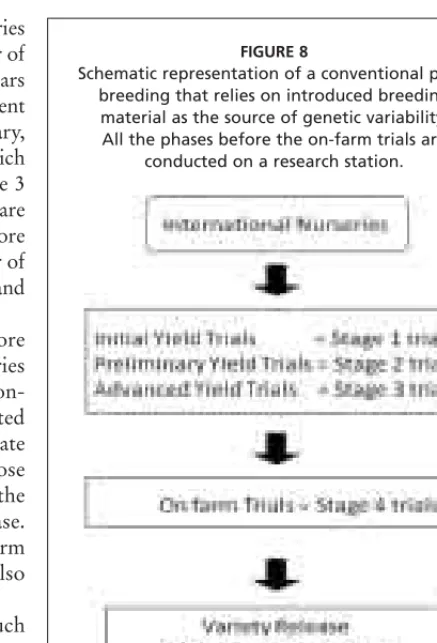
In a CPB programme (i.e. non-participatory) all the decisions are taken by the breeder and by the breeding team, even in the case of on-farm trials.
An important characteristic of a breeding programme is that it is a cyclic process in which each step feeds information and material into the subsequent step, and each breeding cycle feeds information into the next cycle (Figure 1)1. By breeding cycle we mean the period of time,
usually 10-15 cropping seasons (assuming one generation per year), from making a cross to obtaining advanced lines or varieties, which in turn are used as parental material in the crossing programme to start a new cycle, i.e. from cross to cross. In a breeding programme, where crosses are made every year, several breeding cycles co-exist, each one year ahead of its sucessor.
During this process a tremendous amount of information is generated, and one of the major challenges in a breeding programme is how to capture and store this information in a way that is sufficiently transparent for others (scientists and non-professionals) to use. In CPB programmes, most of this information represents the ‘cumulative experience’ or the ‘knowledge of the germplasm’ that the breeder slowly accumulates over the years.
Examples of the three main stages of a breeding programme can be easily identified in the three major groups of crops, namely self-pollinated, cross-pollinated and vegetatively (or clonally) propagated, and in the most common breeding methods used.
1 Most breeding programmes in Australia do not follow the scheme in Figure 1 as they are decentralized to
farmers fields, but with no involvement of the farmers in the selection process. FIGURE 1
Self-pollinated crops
In self-pollinated crops, where the most popular breeding method is the classical pedigree method, the first stage is making the crosses and producing the F1, the second stage includes
the generations from (generally) F2 to F6, and the third from the F7 to (usually) the F11.
During the second stage the breeding material is grown as spaced plants and selection is done based on the phenotype of individual plants. In some cases, single plant selection is only done in the F2 generation and F2-derived F3 families are the first generation to be yield tested.
In the Single Seed Descent (SSD) method, each F2 is propagated by a single seed and so are
subsequent generations till the F6. This is done in controlled environments (greenhouses
or growth cabinets) which allow a rapid generation turnover (2 or 3 generations in a year). Selection starts only when a high degree of homozygosity is reached.
Another popular method is the bulk-pedigree approach, in which the first stage is the same as in the classical pedigree method, but in the second the segregating populations are kept as bulks (number of bulks = number of crosses) with a considerable reduction in the quantity of breeding materials. Selection is thus done between bulks, while selection within bulks is done after the number of bulks has been considerably reduced.
The third stage may take two different forms depending on whether the final variety needs to be uniform or can be released as a population. In the first case, the best populations selected during the second stage are submitted to pedigree selection. In the second case, the best populations resulting from the second stage are tested in the third stage and the best populations become the new varieties.
In self-pollinated trees, such as almond, apple, apricot, avocado, cherry, citrus, olive, peach, nectarine, plum and pomegranate, the methods vary but are based on the evaluation of individual trees from a number of crosses. Because of the substantial time required for the plants to express the desirable traits, breeding cycles must be adequately spaced in time.
Cross-pollinated crops
The breeding methods for cross-pollinated crops are fundamentally of two types, either population improvement or production of hybrids. Population improvement methods relying on various recurrent selection schemes involving cycles of testing, selection and recombination of breeding ‘units’, with the possibility of deriving new varieties from each population cycle bulk or from the progenies developed during each cycle (Rattunde et al.,
2009). Therefore the three cycles (recombination, selection and testing) correspond to Stages 1, 2 and 3 above. These methods are those used more often in PPB programmes of cross-pollinated crops (Machado and Fernandes, 2001; Mendes-Moreira et al., 2009).
In the case of hybrid production, the first stage corresponds to the assembling and enrichment of breeding populations. These can be the locally adapted landraces, or crosses between the landraces and elite germplasm, or crosses between inbred lines. In the case of horticultural crops, interspecific crosses can be used to bring in novel traits. This is not unique to hybrid breeding but introgressed genes may be used more easily in hybrids (Duvick, 2009).
The third stage is the field testing of the experimental hybrids: in field crops, a large numbers of experimental hybrids typically are tested for a number of seasons as small-plot yield trials grown not only at the breeder’s research station but also on farm fields distributed over the locations where the hybrids are expected to be grown commercially (Duvick, 2009). We have limited evidence of PPB being used for hybrid production (Y. Song, pers. comm.) even though there are no reasons why hybrids cannot be produced through a participatory programme.
Vegetatively propagated crops
The general principle in breeding clonally propagated crops is to break the normal clonal propagation by introducing a crossing step, which culminates in sexual seed production and genetic variation (Grüneberg et al., 2009), thus corresponding to Stage 1 in Figure 1. After the genetic recombination, all subsequent propagation steps are asexual in nature and done by clonal propagation. The populations developed from seeds are planted in the so called seedling nursery in which individual plants (true seed plants) are selected to give clones. This corresponds to the beginning of Stage 2. After this initial individual selection there is no further genetic recombination as the clones are genetically identical to the true seed plant from which they derive. Therefore Stage 2 in vegetatively propagated crops differs from the same stage in cross- and self-pollinated crops because of the genetic nature of the breeding material. Stage 3 consists of testing and selection of a progressively reduced number of clones.There are several examples of PPB programmes with clonally propagated crops (see, for example, Thiele et al., 1997; Manu-Aduening et al., 2006; Gibson et al., 2008).
WHO IS A PLANT BREEDER?
Alongside a definition of plant breeding it is also important to define who is a plant breeder. The traditional definition of a plant breeder includes only those persons who have the full responsibility of a breeding programme, made up of progressive cycles, as described earlier, to develop new cultivars and improved germplasm. However, many feel this definition should be expanded to include persons who contribute to crop improvement through breeding research (Ransom et al., 2006). In this manual we will use the traditional definition of a plant breeder because we believe that only scientists who have the full responsibility for a breeding programme can be successful partners of farmers in PPB programmes.
PARTICIPATORY PLANT BREEDING (PPB)
We define PPB as a dynamic and permanent collaboration that exploits the comparative advantages both of plant breeding institutions (national or international) that have the institutional responsibility for plant breeding, and of farmers and possibly other partners, as noted earlier. The definition does not imply pre-assigned roles, or a given amount of collaborative work (at one extreme, scientists may only supply germplasm, while at the other partners may only do field selection), nor imply that farmers and breeding institutions are the ONLY partners. This is because field experience in practicing PPB tells us that a true PPB programme is a dynamic process in which both the roles of partners and the extent and the manner in which they collaborate change with time. Implicit in this definition is that farmer breeding, in which scientists or other stakeholders have no part, is not considered as a PPB programme. This of course should not be interpreted as an underestimation of its value and importance.
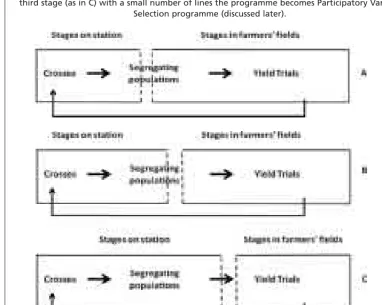
A PPB programme (Figure 2) is similar to a CPB programme in that it maintains the typical cyclic structure of a breeding programme, but with three important organizational differences:
• Most of the programme takes place in farmers’ fields (decentralized, see below). • The decisions are taken jointly by the breeder and the farmers and partners.
• The programme, being decentralized, can be replicated in several locations with different methodologies and types of germplasm (Figure 3).
Comparing Figure 2 with Figure 1, it will be noticed that there are no differences in the case of Stage 1; in Stage 2, the CPB programme is conducted on station, while in a PPB programme it is conducted partly on-station and partly in farmers’ fields; while in Stage 3, which in CPB programmes is partly conducted on-station and partly conducted on-farm, in the case of a PPB programme it is confined to farmers’ fields.
Figure 2 C also represents the case of crops grown for the market (malting barley, wheat for industrial transformation, canola, groundnut, cassava, etc.), which need to possess a given expression of a suite of traits to be accepted by the market. These traits can be fixed, when possible with MAS, on-station, while traits associated with adaptation to different environments will be selected on-farm with the participation of farmers and other partners.
[image:20.595.52.435.171.476.2]It is also possible for farmers to make crosses on-farm with the technical assistance of breeders. In these cases the entire process takes place on-farm and the amount of variability
FIGURE 2
Schematic representation of two types (A and B) of a PPB programme: the stages that take place within a research station are much less (the first and part of the second in A and the first and
most of the second in B) than in a CPB programme, with all the decisions being taken by the breeder’s team together with the farmer community. If the decentralization takes place in the third stage (as in C) with a small number of lines the programme becomes Participatory Variety
can be increased by crosses coming from the station. These cases are not very frequent as they require special skills and dedication.
The question is therefore of when during Stage 2 is the breeding material under selection— which is usually involves large numbers (up to several thousand lines)—taken into farmers fields. A general guideline is that the material can be reduced by conducting selection on-station for traits with high heritability (for example phenology) and for quality characters and disease resistance, but should not be submitted to selection for traits known to be affected by large G×E interactions. In a “mature” PPB programme, when farmer preferences are well identified, preliminary selection could be done on station, using MAS when appropriate, but only for those traits of importance to farmers and not affected by G×E interactions, hence with high heritability.
Under the section below on A General Model of Participatory Plant Breeding we will give some guidelines on when to transfer the breeding programme to the farmers’ fields, and with which type of breeding material.
Being a highly decentralized process, PPB is more flexible than CPB, in terms of both methodology and germplasm.
Figure 3 shows a hypothetical example of a highly decentralized PPB programme. The three zones could be either different agroclimatic zones (or different provinces or different states) within the same country, or different countries. Within the zones, farmers may grow the same crop for different uses, for example malting barley in one zone and feed barley in a different zone, or improved wheat cultivars as a cash crop and landraces for home consumption.
The knowledge of the type of germplasm needed by the farmer and by the market dictates the composition of the PPB trials, that can thus differ from one zone to another.
FIGURE 3
A PPB programme can be replicated in various zones (= agroclimatic areas or administrative provinces or regions within a country or countries). In each zone, the programme can use
PARTICIPATORY VARIETY SELECTION (PVS)
Participatory Variety (or Varietal) Selection (PVS) is a process by which the field testing of finished or nearly finished varieties, usually only a limited number, is done with the participation of the partners. Therefore PVS is always an integral part of PPB, representing its final stages (Stage 4 in Figure 4), but can also stand alone in an otherwise non-participatory breeding programme if, using Figure 1 as an example, partners’ opinion is collected and used
during the final stage, i.e. the on-farm trials.
Involvement of partners during the last stage of an otherwise non-participatory breeding programme has one major advantage and one major disadvantage: the advantage is that, if the partners’ opinion becomes part of the release process which follows the on-farm trials, only the variety(ies) that partners like will be proposed for release, thus increasing enormously the speed and the rate of adoption; the major disadvantage is that because partners’ opinion is sought at the very last stage of the breeding programme there may be nothing left among the varieties tested in the on-farm trials that meets partner expectations. This disadvantage may induce the breeder to seek partner participation at an earlier stage of the breeding programme, hence moving from PVS to PPB.
PVS may also be used as a starting point, a sort of exploratory trial, to help partners assessing properly the amount of commitment in land and time that a fully fledged PPB programme requires.
A GENERAL MODEL OF PARTICIPATORY PLANT BREEDING
A general model of PPB as defined above is shown in Figure 4. In this model, the first step (generation of genetic variability) is often, but not necessarily always, the responsibility of the research institution. It should be noted that when the genetic variability is created by making crosses, there is a substantial difference between making crosses, choosing the
FIGURE 4
parents and designing the crosses. Making a cross is a purely technical operation, while choosing the parents and designing the crosses is a key decision in a breeding programme. In a breeding programme, a large part of the parental material used in crosses is represented by the best breeding material selected from the previous breeding cycle, and because in PPB the selection is done by both breeders and farmers, farmers do in fact participate in the choice of the parents to begin a new breeding cycle. Farmers may also explicitly choose parents by suggesting crosses to the research institution or learning to perform crosses themselves.
A number of stages of selection (four in this hypothetical example) are conducted in farmers’ fields with the participation of farmers and other stakeholders, with continuous interaction with the research institute (for example for the choice of appropriate experimental designs, data analysis, seed production, etc.) and with other farmers involved in the PPB programme. The selection is conducted independently in each location. This generally leads to the selection of different entries in different locations but does not exclude selecting the same material (see for example variety A being selected in locations 1 and 3 and variety B being selected in locations 2 and 3.
The best breeding material produced after the four stages of selection can be used by farmers as varieties and by the research institute as parental material for crosses to begin a new breeding cycle. It is important to notice that different locations may receive different types of germplasm of the same crop and select different varieties and that interaction among farmers may depend on their geographical location as well as communication technologies, language differences, etc.
In the case of self-pollinated crops and when the breeding method is the pedigree method, the selection in farmers fields can start with the segregating populations (for example, F2
-derived F3 families) after their number is reduced by selection (including MAS) on station for
disease resistance, for traits with high heritability (for example phenology), or for quality traits such as malting quality, or a combination. Distributing different segregating populations to different locations according to farmer preferences is an additional strategy to further reduce the amount of breeding material in any one farmer’s field. When the breeding programme uses the bulk-pedigree method, it is possible to start the field testing as early as the F3 bulks.
In both cases, the yield testing should continue for at least four consecutive cropping seasons to generate sufficient information on the stability and performance of the breeding material for farmers to make a decision about adoption and for the variety release process.
In the case of population improvement of cross-pollinated crops, the recombination phase corresponds with the creation of genetic variability, which can be done on station while the selection and testing can be done in farmers’ fields. In the case of hybrid development, the creation and enrichment of breeding populations can be done—and in fact is being done, for example in China—in farmers’ field (Song et al.,2006). The production of uniform inbred lines to use as parents of hybrid cultivars can equally well be done on station or in farmers’ fields. In the latter case, because of the lower yield of inbred lines, a farmer compensation scheme should be envisaged. The advantage of developing inbreds in farmers’ fields is that selection during the inbreeding process is done in the real production environment, making sure that field heterogeneity does not bias the selection. Similarly in the case of test crosses, they can be more efficiently evaluated in farmers’ fields. While the actual production of the hybrid seed can be done both on station and in farmers’ field, the former has the advantage of not using farmers’ land and farmers’ labour. The field testing of the experimental hybrids has to be done for at least four cropping seasons, for the reasons given earlier. As in the case of self-pollinated crops, targeting germplasm to farmer preferences is an additional strategy to reduce the amount of breeding material under selection and testing at any one site.
pedigree method for self-pollinated crops, the number of clones can be reduced on station by selecting for traits such as disease and or pest resistance, for traits with high heritability, and quality traits.
In Figure 4 the number of stages of selection has been set to four (defined as in most breeding programmes: Stage 1, Stage 2, Stage 3 and Stage 4) and it is envisaged that these stages are conducted in farmers’ fields with the participation of farmers and other stakeholders. The type of breeding material (segregating lines, bulks, clones, populations, hybrids) depends on the type of crop (self-pollinated, cross pollinated or vegetatively propagated) and on the breeding method. There is regular technical interaction with the research institute, for example, for the choice of appropriate experimental designs, data analysis, seed production, etc. The best breeding material produced after the four cycles of selection can be used by farmers as varieties, and by the research institute as parental material for crosses to begin a new breeding cycle.
Other important features of the general model are summarized below.
• From Stage 1 to Stage 4 there is a progressive decrease in the amount of the breeding material (entries) and an increase in the amount of seed available for each entry. This, as we will see later, affects the choice of the experimental design and the number of locations where the entries are tested. It will be noticed that Stages 3 and 4 trials in this model are somewhat equivalent to the “mother” and “baby” trials concept (Snapp, 1999), respectively.
• The decision on what to promote from one stage to the next is taken by the farmers in ad hoc meetings held between harvesting and planting, and is based on both farmers’ visual selection during the cropping season and on the data collected by the researchers or by the farmers, or by both, after proper statistical analysis – as described later.
• In general, researchers have the primary responsibility for designing, planting and harvesting the trials, data collection and data analysis. Farmers are responsible for everything else and make all the agronomic management decisions. However, as the programme evolves, farmers can become responsible for planting, harvesting and data collection.
• Spatial analysis (Singh et al., 2003) of unreplicated or partially replicated or fully replicated trials and Genotype × Environment Interaction analysis by GGEbiplot (Yan, 2001) are used routinely for data analysis.
• In terms of the farmer’s time, the cost of participation ranges from two days to two weeks annually, depending on the level of participation.
• A back-up set of all the materials tested in Stages 1 to 4 is also planted at the research station to purify the bulks if pure lines are required in the case of self-pollinated crops, but, more importantly, to produce the seed needed for the trials and to insure against the risk of losing the trials to drought or other climatic events.
• In some countries, the farmers who are hosting trials are compensated (in kind) for the area used for the trials with an amount of seed equivalent to the production expected in an average year.
• Seed cleaning machinery is supplied to some villages to assist in the multiplication and dissemination of selected varieties following the fourth year of farmer selection. • Screening for diseases and insect pests is carried out on-station before the first stage of
yield testing on farmers’ fields to avoid the spreading of new diseases or pests, as PPB has been criticized (for example, in Syria) for the danger of spreading new diseases, yet interestingly in Syria, most of the wheat and barley varieties released through CPB are disease susceptible.
FIGURE 5
Combinations of Centralization and Participation in breeding approaches.
should be able to provide reliable information on desirable traits that could later be evaluated via MAS should this be available and deemed desirable by farmers). One of the consequences of a PPB programme is that the number of varieties it generates and the turnover of varieties are both higher than with CPB, thus increasing both spatial and temporal agro biodiversity. Also, it is not unusual that more varieties are adopted and cultivated within a region at any given time. While this is of course highly positive in terms of both agricultural biodiversity conservation and enhancement, and of protection against pests and diseases, it poses a number of challenges to seed production and for studies on the impact of PPB programmes (see page 115).
DECENTRALIZED PLANT BREEDING
Decentralization in the case of plant breeding is defined as selection and evaluation in the target environments, which are defined based on the repeatability of Genotype × Location interactions (see section on Genotype × Environment Interactions). Decentralized breeding does not necessarily mean selection for specific adaptation unless selection is conducted for superior performance in each target environment regardless of the mean performance.
Therefore, with reference to decentralization and participation, we can have the four combinations shown in Figure 5. While we have already discussed CPB, On-farm trials, PPB and PVS, Farmers’ selection on station deserves a comment.
How to get started: organizational
issues
As defined earlier, a PPB programme is necessarily decentralized. We will therefore start by discussing the organizational issues involved in transforming a breeding programme from centralized to decentralized (Ceccarelli, 2009b).
Transferring a breeding programme to outside of a research station almost always implies losing some degree of control of a number of steps and operations. This is often associated with the perception that less control by scientists implies lower precision, and this explains the reluctance with which several plant breeders, particularly those in the developing countries, operate away from their research stations.
Within a research station, all the operations associated with running a breeding programme are shared by staff belonging to the same institution and having daily interaction (which does not necessarily make things easier). When a number of stages are transferred outside the research station, a number of operations can be, and actually should be, shared with staff belonging to other institutions or to out-posted staff of the same institution, or a combination of the two.
Depending on the presence or absence of a strong extension service, and reflecting the structure of the research institute responsible for the plant breeding, a number of different scenarios are possible.
In the case of countries with a strong extension service and the presence of regional (or sub-regional or provincial) research centres with infrastructure such as offices, computer facilities and agricultural equipment (including plot machinery), a PPB programme could be organized based on the following principles, which can be easily extended to international breeding programmes such as those of the Centers of the CGIAR.
• The scientist(s) at the institute’s headquarters are responsible for the preparations of trials (seed preparation, experimental design, and having the seed in envelopes ready for planting), the preparation of field books (or electronic files for electronic capture of field data), the preparation of draft field maps with possible alternatives for the layout of the trials, and the shipment of trials with all the detailed instructions for planting and note taking.
• At headquarters there will be a central database where all the information generated in the breeding programme is kept. Information generated in the regional centres should also be kept where it was generated, as a form of safety duplication.
• The main responsibility of the staff of the extension service is to collaborate in the selection of the sites and the specific fields, according to the type and objectives of trials and the general philosophy of the breeding programme.
• The research staff in the regional centres are responsible for implementing the trials on the ground, ensuring the required management, the timing of the field operations and eventually for collecting field data, which information is then transferred to headquarters for statistical analysis. Alternatively, when the necessary expertise is available, they can be requested to do the single-site statistical analysis, leaving responsibility for the multi-site statistical analysis to headquarters.
also to understand through the interaction with farmers whether the experimental setting (location, type of soil, type of management, etc.) is actually representative of farmers’ conditions.
This overall organization is facilitated by involving all staff participating in the implementation of the breeding programme in regular meetings, through which the basic principles of the breeding programme are understood and shared by everyone. This obviously includes the full sharing of results among all the participants on an annual basis.
One important beneficial effect of this type of organization is that it replaces the traditional linear flow of information typical of agricultural research (Figure 6A) with a continuous exchange of information between the different partners (Figure 6B). As we will see below, this concept is fully developed in a PPB programme. In this type of scenario (Figure 6B), one of the main sources of additional cost associated with decentralized breeding, i.e. transportation and travel, is considerably reduced. In the case of countries where the extension service is limited or absent, all the responsibilities could be the responsibility of either research staff or NGOs.
In describing the organizational aspects of a decentralized breeding programme we are deliberately excluding the use of additional research stations as ‘decentralized’ sites, because, even if sub-stations capture differences in temperature and rainfall, they still suffer from all the management issues described earlier, and therefore they may not represent any real production environment. However, the regional stations can share with the headquarters station the responsibility for seed production.
A different scenario is that of those countries where, for various reasons, the national breeding programme cannot afford to go through the first stage of a breeding programme, i.e. the generation of genetic variability (regardless of the method), and therefore relies entirely on either locally collected germplasm, or on germplasm donated by breeding programmes in other countries or other research centres, such as international agricultural research centres (IARCs), or some combination. In such cases, the research station should be used for both seed multiplication and negative selection, particularly in the case of introduced germplasm, which might have photoperiod or vernalization requirements that makes it ill adapted to national conditions.
FIGURE 6
PPB replaces the linear sequence Research >> Extension >> Farmers (A) with team work that implies a continuous flow of information between the different partners (B). The Figure hypothesizes a general situation with a multitude of partners, some of whom may not be
Seed multiplication is necessary because the seed from germplasm collections and breeding material received from other programmes usually comes in very small quantities. The steps following the initial seed multiplication depend on the breeding methods and on the type of genetic material received or collected, but will vary from a centralized, on-station, programme of selection, evaluation and testing, with only the final stages transferred to farmers fields, through to a decentralized non participatory programme or to a PPB programme.
At the beginning of the manual we defined PPB programmes as breeding programmes in which selection and testing are conducted in the target environment(s) with the participation of the users. Here we will add that, in order to reach its maximum effectiveness, the participation of users should take place as early as possible, and ideally at the beginning of Stage 2 in a plant breeding programme, as described in Figure 1. For traits that are not affected by G×E interaction (see page 86) it may also be desirable to involve farmers in the choice of parents on station, or to plant a set of parents on farm and involve the farmers in the choice of the most desirable parents.
The organizational aspects of a PPB programme do not differ conceptually from those of a CPB programme. The major difference is that the decisions and the choices for the organizational aspects involve all the stakeholders, and the type of participation depends on how, when and which stakeholders are involved.
We will examine the following organizational aspects:
• Setting criteria to identify target environments and target users. • Choice of the target environment and users.
• Type of participation. • Choice of genetic material. • Choice of parental material. • Choice of breeding method.
• When farmer participation should start. • Naming of varieties.
• Management of trials in farmers’ fields. • Managing equipment.
• Farmer selection. • Visits to farmers.
• Managing the transition phase. • Sharing and disseminating findings.
One fundamental issue in discussing organizational issues with farmers’ communities is to pose and justify the problem, rather than simply presenting a solution. The solution should come from the community, and if the community or the individual farmers are not prepared to solve the problem, a possible solution can be offered, but only as a suggestion.
SETTING CRITERIA TO IDENTIFY TARGET ENVIRONMENTS AND TARGET USERS A PPB programme may lose a great deal of its potential effectiveness if the sample of both environments and users in which the programme is implemented does not represent both the target environments and the target users. In order to do that, setting the criteria for identification of the target environments and users is a critically important step.
In setting the criteria, it is useful also to assign priorities to the different categories of environments and users so that, depending on the resources available to the programme, environments and users can be added or discontinued on the basis of priorities established in an ideal context.
practices, soil types, landscape, etc. The criteria for the choice of the socio-economic environments are closely interconnected with those of the target users. The programme has therefore to decide whether to work for all the various socio-economic environments present in the target area, or to privilege the most difficult environments where farmers have fewer opportunities for market access and where most of the agricultural products are used within the farms or within the community, or to work only for the most favourable, high potential, environments possibly market oriented. As mentioned earlier, PPB has evolved mainly to address the difficulties of poor farmers in developing countries (Ashby and Lilja, 2004), which have been largely bypassed by the products of CPB. In fact there is no reason why the approach should be confined to working only with low-income farmers. Basically, when done properly, PPB is an approach that, even if applied in a variety of modes, merges the technical knowledge of the ‘scientists’ with the knowledge of the ‘farmers’, which is historically based on millennia spent in domesticating wild plants and adapting the resulting crops to a multitude of different environments and uses. Therefore, in principle, PPB can apply equally well even in situations of market-oriented agriculture in favourable environments. It seems particularly suited for organic and bio dynamic agriculture, and in developed countries, interest in PPB programmes is primarily coming from organic farmers (Lammerts van Bueren and Myers, in press).
The main criteria for identifying farmers can be grouped in three broad categories: • Farmer characteristics. These include language, religion, ethnicity, caste, age,
gender, income, education, market relations or orientation, membership in farmer organizations (unions or cooperatives), and relationships among groups within the same community and between communities.
• Farmer expertise. This includes the need to understand whether farmers are already practicing some types of plant improvement, as this is essential in the choice of the breeding methodology (see below). In some communities, e.g. Eritrea, specific individuals have specific responsibilities in relation to crop and variety introduction (Soleri et al., 2002).
• Farmer needs. These include the needs of different groups, their perception of risk and hence the type of variety they consider most appropriate in term of stability and yield (Anderson, 1974; Soleri et al., 2002), and the need for special quality attributes for either feed or food, or both. These include also the farmers’ understanding of production limitations with reference to the use of fertilizers, appropriate rotations and irrigation. It is also important to understand farmers’ needs in terms of seed supply, because it makes a large difference whether the farmers predominantly use their own seed (or the seed of their neighbours), or usually buy seed from the formal sector.
In these meetings it is also essential to understand what sources of seed farmers use for various crops, to anticipate which type of change the participatory programme might introduce, and to make sure that farmers are aware and prepared to absorb these changes.
CHOICE OF THE TARGET ENVIRONMENT AND USERS
Once the criteria are set, the actual choice of locations and users requires the involvement of partners who have very good knowledge of both the environment and the users. These are typically the staff of the extension service or the staff of the provincial research stations. The first step is to set meetings with all the stakeholders with the objective of identifying partners and locations.
who regularly experiment with varieties, are able to recognize important intra- as well as inter-varietal differences, and who target specific varieties to different micro-niches) or whether they should represent the wider community; and (iii) whether equity should be the main objective in the identification of the users. Meetings with all different types of farmers together may be inappropriate without a proper knowledge of the power relationships within the community. This usually leads to a few farmers monopolizing all the discussions, reducing the possibilities for others to express their views. This danger varies greatly with the culture: in some cultures, women are not even allowed to attend meetings; in others, they can participate with a passive role; and in others they can participate freely and with the same rights as the men. Therefore, it is not possible to give a ‘cookbook formula’ for what works better. In general, if some groups or individuals tend to be discriminated against, it may be appropriate to have separate meetings with different social, gender, age or wealth groups.
In the process of choice of users, it is very important to clarify (i) what plant breeding can offer and how long it can take; (ii) what sort of commitment in land, time and labour is required from the farmer; (iii) what are the risks for the farmer and how these can be compensated for (in-kind compensation vs money); and (iv) what overall benefits farmers can expect if everything goes well.
The choice of sites is both at the macro-level (choice of villages or locations within a country or a region) and at the micro-level (choice of the field within a village for planting the trial(s)).
The choice of the sites at the macro-level is associated with the issue of the breeding philosophy: whether these sites should be sufficiently representative to allow some degree of extrapolation of the results to other sites, or whether the priority should be to meet farmers’ needs within micro-environments. In practice, it is advisable that sites must represent the range of environmental and agronomic conditions in which the crop is grown, because this is known to have a major effect on farmers’ selection (Ceccarelli et al., 2000, 2003).
An “ideal” test environment should be both discriminating of the genotypes, repeatable over years and representative of the target environment (Yan et al., 2011). The “Discrimination vs Representativeness” of test sites will be discussed later in the section on GGEbiplot software (see page 90).
PPB programmes are often seen exclusively as programmes leading to niche varieties, adapted to only a restricted complex of environmental and social characteristics. This is not necessarily true, as the type of adaptation (narrow or wide) of the varieties emerging from a PPB programme is largely dependent upon the nature of the locations and the users. If the locations covered by the programme represent a mix of favourable and unfavourable growing conditions, it could be expected that the more uniform environmental conditions that generally characterize favourable environments will led to the selection of the same varieties across a number of locations (widely adapted in a geographical sense), assuming that farmers’ preferences are also homogenous across the same locations. In less favourable conditions, one can expect that more location-specific varieties (narrowly adapted) will be selected. Eventually, even if the selection is conducted independently in each of many locations, giving the impression that selection is for specific adaptation, the process will not discard a truly widely adapted genotype if such a genotype does exist in the breeding material (Ceccarelli, 1989). Therefore a PPB programme easily results in a mixture of widely and narrowly adapted varieties.
cropping seasons (stable over time) – without too much concern whether it performs well elsewhere (stable over space).
The participation of farmers in the choice of the fields is unavoidable because it is associated with the relevance of the results and with the issues of ‘who participates’ and ‘who benefits’: it is at this point that small-scale farmers run the risk of being excluded as active participants because their land is not large enough to host trials in addition to their subsistence crops. As we will see later, it is possible to find experimental designs that allow the distribution of a relatively large number of entries in small blocks, each planted in a different farmer’s field. It is difficult to reach an optimal allocation of resources regarding the number of sites and the number of farmers at each site. As we will see later, it is possible to organize a PPB programme in such a way that G×E interaction, and more specifically Genotype × Location (G×L) and Genotype × Years within Locations (G×Y(L)) will eventually optimize the overall structure, at least from a biological point of view.
TYPE OF PARTICIPATION
Several scientists (Biggs and Farrington, 1991; Pretty 1994; Lilja and Ashby 1999a, b; Ashby and Lilja, 2004; McGuire, Manicad and Sperling, 1999; Weltzien et al., 2000, 2003; Ashby, 2009) discriminate among different types or modes of participation, which are not necessarily mutually exclusive, although there may be trade-offs among the impacts of the different types. We will not discuss these different typologies because field experience indicates that PPB is a continuously evolving process. It is quite common that, as farmers become progressively more empowered—an almost inevitable consequence of a truly PPB programme—the type or mode of participation also evolves.
CHOICE OF GENETIC MATERIAL
The type of genetic material to be used in the programme needs to be discussed with the farmers. Initially, the scientists may find that farmers are not aware of the diversity within the crop, and in this case our suggestion is to start with a wide array of genotypes representing as wide range of diversity as possible. But there are cases where farmers have previous experience with various type of germplasm and they may feel very strongly concerning one or more types of specific germplasm type. For example, in Syria, farmers grow two barley landraces: one with black seed, which is grown predominantly in dry areas, and one with white seed, which is grown predominantly in wetter areas. Farmers feel very strongly about the seed colour and therefore in the participatory barley breeding programme in Syria we make available different initial genetic material in the two areas. Similarly in Syria, there is a strong preference for two-row barleys, with very few exceptions, while in North Africa there is a strong preference for six-row types. The issue of the type of genetic material also includes the issue of the checks. As we will see later in the section on experimental designs, the checks have the dual purpose of providing an estimate of error variance (for example, in unreplicated trials with systematic checks) and to provide a comparison for farmers during selection. The ideal solution is to have a well adapted variety that fits both purposes, and if the choice of the check(s) is left, as it should be, to the farmers, they usually choose a variety that is suitable for both.
CHOICE OF PARENTAL MATERIAL
Research Centres (IARCs), that have multiple objectives and address a large population of target environments. Here we only add that, as in a CPB, the parental material in a PPB programme is, with few exceptions, the best material selected by farmers in the previous cycle.
CHOICE OF BREEDING METHOD
The breeding method is only one of the factors determining the success of a breeding programme; others include the identification of objectives and the choice of suitable germplasm (Schnell, 1982).
In CPB, the choice of the breeding method is purely the responsibility of the breeder and is largely influenced by the breeder’s scientific background and by the mandate of the organization, public or private, for which the breeder works.
In PPB, the choice of the breeding methods cannot be made without considering whether and how farmers are handling genetic diversity. The rationale is as follows. As shown in Figure 1, the generation of variability is the first step of any breeding programme, conventional or participatory, followed by the utilization of variability and eventually the testing of the prospective varieties. In a number of countries, farmers do use genetic diversity either as a specialized activity within the community, or as an individual initiative. For example, in Eritrea it is common for farmers to select individual heads within a wheat or a barley plot, plant them as head rows in a small portion of their field, decide whether to bulk one or more rows and start testing the bulk in the field of other farmers, initially on a small scale and gradually on a larger area. One of the most widely grown wheat varieties in the country has been developed starting from a small seed sample bought by an expert farmer in a local seed market and planted initially as spaced plants. In Nepal, before harvesting the crop, a woman farmer growing an old barley landrace habitually collects a sample of heads representing all the different morphological types present in the field to produce the seed to be planted in the following cropping season. In the northernmost part of India (Sikkim) farmers maintain and improve their rice varieties by carefully selecting (before harvesting) the best panicles, which are then stored for the next planting season, while the rest of the crop is consumed (Ceccarelli, 2011). In contrast, in Syria and in many other countries in the Near East and North Africa, the selection unit is a plot, and excessive heterogeneity within a plot not only is not exploited, but is also considered undesirable.
These examples indicate that, even within the same crop, a PPB programme may have to use different breeding methods, at least at the beginning of the programme, to ensure full participation. It is obvious that a blanket approach, based on the same breeding method used everywhere regardless of whether and which skills farmers have in handling genetic variation, cannot ensure true participation, as farmers will be confronted with methodologies they cannot relate to anything they are familiar with.
In addition to the examples given earlier, breeding methods may differ for the same crop within the same country. Using Africa as an example, barley is grown in Ethiopia and Eritrea both as food and feed (largely landraces) and also for malt production for local breweries. While population methods can well be used in the first case, pedigree breeding or SSD is more suitable in the second.
An issue related to the choice of the breeding method is how much breeding material farmers can handle. This is a controversial issue, and many scientists believe that farmers can only handle a very limited number of genotypes and therefore, implicitly, believe that the only form of possible participation is PVS. If true, this will make it impossible to implement true PPB programmes, because plant breeding needs to start from a sufficiently large sample of genetically variable material.